EP1608132A1 - Zusammenklappbare mobilkommunikationsendgeräteeinrichtung - Google Patents
Zusammenklappbare mobilkommunikationsendgeräteeinrichtung Download PDFInfo
- Publication number
- EP1608132A1 EP1608132A1 EP04721677A EP04721677A EP1608132A1 EP 1608132 A1 EP1608132 A1 EP 1608132A1 EP 04721677 A EP04721677 A EP 04721677A EP 04721677 A EP04721677 A EP 04721677A EP 1608132 A1 EP1608132 A1 EP 1608132A1
- Authority
- EP
- European Patent Office
- Prior art keywords
- light emission
- push button
- talk
- communication terminal
- opening
- Prior art date
- Legal status (The legal status is an assumption and is not a legal conclusion. Google has not performed a legal analysis and makes no representation as to the accuracy of the status listed.)
- Withdrawn
Links
Images



Classifications
-
- H—ELECTRICITY
- H04—ELECTRIC COMMUNICATION TECHNIQUE
- H04M—TELEPHONIC COMMUNICATION
- H04M1/00—Substation equipment, e.g. for use by subscribers
- H04M1/02—Constructional features of telephone sets
- H04M1/0202—Portable telephone sets, e.g. cordless phones, mobile phones or bar type handsets
- H04M1/0206—Portable telephones comprising a plurality of mechanically joined movable body parts, e.g. hinged housings
- H04M1/0208—Portable telephones comprising a plurality of mechanically joined movable body parts, e.g. hinged housings characterized by the relative motions of the body parts
- H04M1/0214—Foldable telephones, i.e. with body parts pivoting to an open position around an axis parallel to the plane they define in closed position
- H04M1/0216—Foldable in one direction, i.e. using a one degree of freedom hinge
- H04M1/0218—The hinge comprising input and/or output user interface means
-
- H—ELECTRICITY
- H04—ELECTRIC COMMUNICATION TECHNIQUE
- H04M—TELEPHONIC COMMUNICATION
- H04M1/00—Substation equipment, e.g. for use by subscribers
- H04M1/02—Constructional features of telephone sets
- H04M1/0202—Portable telephone sets, e.g. cordless phones, mobile phones or bar type handsets
- H04M1/0206—Portable telephones comprising a plurality of mechanically joined movable body parts, e.g. hinged housings
- H04M1/0241—Portable telephones comprising a plurality of mechanically joined movable body parts, e.g. hinged housings using relative motion of the body parts to change the operational status of the telephone set, e.g. switching on/off, answering incoming call
- H04M1/0245—Portable telephones comprising a plurality of mechanically joined movable body parts, e.g. hinged housings using relative motion of the body parts to change the operational status of the telephone set, e.g. switching on/off, answering incoming call using open/close detection
-
- H—ELECTRICITY
- H04—ELECTRIC COMMUNICATION TECHNIQUE
- H04M—TELEPHONIC COMMUNICATION
- H04M1/00—Substation equipment, e.g. for use by subscribers
- H04M1/02—Constructional features of telephone sets
- H04M1/22—Illumination; Arrangements for improving the visibility of characters on dials
-
- H—ELECTRICITY
- H04—ELECTRIC COMMUNICATION TECHNIQUE
- H04M—TELEPHONIC COMMUNICATION
- H04M19/00—Current supply arrangements for telephone systems
- H04M19/02—Current supply arrangements for telephone systems providing ringing current or supervisory tones, e.g. dialling tone or busy tone
- H04M19/04—Current supply arrangements for telephone systems providing ringing current or supervisory tones, e.g. dialling tone or busy tone the ringing-current being generated at the substations
- H04M19/048—Arrangements providing optical indication of the incoming call, e.g. flasher circuits
Definitions
- This invention relates to a foldable type portable communication terminal apparatus in which an opening operation is carried out by an one-push button.
- a foldable type portable communication terminal apparatus such as portable telephones and personal handy phone systems (PHS)
- PHS personal handy phone systems
- a foldable type portable communication terminal apparatus is configured in such a manner that the hinge mechanism can be opened by an one-push button, as described in the following patent document 1, and thereby, it becomes possible to open the foldable type portable communication terminal apparatus by one hand at the time that there was an incoming call and to talk over the phone.
- a portable communication terminal apparatus is configured in such a manner that a talk start key, which should be operated at the time that there was an incoming call, is lighted up by a light emitting device such as LED, to inform a user of the incoming call, and at the same time, a place of a key to be operated next is informed to a user.
- a light emitting device is attached to an one-push button for opening a hinge mechanism, and at the time that there was an incoming call, this light emitting device is turned on.
- An object of the invention is to provide a foldable type portable communication terminal apparatus which can surely guide a user to a talkable state at the time that there was an incoming call.
- a foldable type portable communication terminal apparatus of the invention is characterized by having a hinge mechanism which couples an upper side housing and a lower side housing in such a manner that they can be opened and closed, a push button which opens the hinge mechanism when it was depressed, light emission means which has the push button lighted up at the time of light emission, and control means which turns on the light emission means when the hinge mechanism is closed at the time that there was an incoming call.
- a foldable type portable communication terminal apparatus of the invention is characterized by having a hinge mechanism which couples an upper side housing and a lower side housing in such a manner that they can be opened and closed, a push button which opens the hinge mechanism when it was depressed, first light emission means which has the push button lighted up at the time of light emission, a talk key which starts a talk when it is depressed in such a state that the hinge mechanism was opened, second light emission means which has the talk key lighted up at the time of light emission, opening/closing detection means which detects whether or not the upper side housing and the lower side housing were opened at a predetermined angle or more, and control means which turns on the first light emission means and turns off the second light emission means when the opening/closing detection means detected a "closing" state at the time that there was an incoming call, and turns off the first light emission means and turns on the second light emission means when it detected an "opening" state.
- control means of the foldable type portable communication terminal apparatus of the invention turns on the first light emission means and turns off the second light emission means when the opening/closing detection means detected the "closing" state after it turned off the first light emission means and turned on the second light emission means since the opening/closing detection detected the "opening" state at the time that there was an incoming call and before the talk key is depressed.
- control means of the foldable type portable communication terminal apparatus of the invention starts t a talk over the phone when the push button, which was lighted up, was depressed at the time that there was an incoming call and the hinge mechanism was opened.
- control means of the foldable type portable communication terminal apparatus of the invention starts a talk over the phone after it turns off the light emission means which is in a state of light emission before start of the talk, at the time that there was a talk instruction by use of a hands-free device or an ear phone device after it turned on the light emission means.
- 1 designates a foldable type portable communication terminal apparatus
- 2 designates a lower side housing
- 2a designates a lower case
- 2b designates a lower cover
- 2c designate bearing storage section
- 3 designates an upper side housing
- 4 designates a hinge mechanism
- 5a designates a talk key
- 6 designates an antenna
- 11 designates LED for an incoming call
- 12 designates a one-push button
- 13 designates a substrate
- 14 designates a key sheet
- 17 designates LED for the talk key
- 18 designates LED for the one-push button
- 19 designates a light guiding hole
- 21 designates a circuit control section
- 23 designates an opening/closing detection switch.
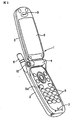
- Fig.1 is an external appearance view of such a state that a foldable type portable communication terminal apparatus, which relates to a first embodiment of the invention, was folded
- Fig.2 is an external appearance view of such a state that it was opened.
- a lower side housing and an upper side housing 3 are coupled by a hinge mechanism 4.
- various operation keys 5 are disposed, and on a side portion, an antenna 6 is disposed, and on the lowermost portion, a through-hole 7 for a telephone microphone is disposed.
- a main display section 8 On an inside surface of the upper side housing 3 (a surface which hides when it was closed), a main display section 8 is disposed, and on the uppermost portion, a through-hole 9 for a telephone receiver is disposed, and on the inside surface and an outside surface which is on an opposite side thereof, as shown in Fig.1, a sub display section 10 and an incoming call LED 11 are disposed.
- an one-push button 12 is disposed, and when this one-push button 12 is depressed, the hinge mechanism 4 is opened, and comes from a state of Fig.1 into a state of Fig.2.
- Fig.3 is an exploded view of the foldable type portable communication terminal apparatus shown in Fig.1, and Fig.4 is a cross-sectional view of the one-push button 12 portion of this foldable type portable communication terminal apparatus .
- the lower housing 2 is disposed so as to be divided into a lower case 2a and a lower cover 2b, and between the lower case 2a and the lower cover 2b, a substrate 23 for mounting electronic components and a key sheet 14 are sandwiched, and an antenna 6 is incorporated into a side portion.
- Both end portions of the hinge mechanism 4 are supported by bearing sections 15, 16, respectively, and one bearing section 15 is coupled to the one-push button 12.
- Respective bearing section 15, 16 are stored in bearing storage sections 2c, 2d which were formed so as to be evaginated on top end both sides of the lower cover 2b.
- LED 17 for the talk key which has the talk key 5a lighted up or blinked, is disposed.
- one side of the substrate 13, on which the one-push button 12 is disposed is formed so as to be extended up to an one-push button mounting position, and on a fore-end portion of an extended portion 13a, LED 18 for the one-push button, which is used for lighting or blinking display of the one-push button, is disposed.
- a light guiding hole 19 is formed in a bottom surface of the above-described bearing storage section 2c which was formed so as to be evaginated, and emitted light of LED 18 passes through the light guiding hole 9 and is guided to a back surface side of the one-push button 12.
- the one-push button 12 is molded by a milk-white diffusing material, and is configured in such a manner that, when light was guided in the back surface side, the entire one-push button 12 shines.
- Fig. 5 is a block diagram of an electric control system which was mounted on the foldable type portable communication terminal apparatus shown in Fig.1.
- a circuit control section 21 On the substrate 13, a circuit control section 21, a wireless communication circuit 22 and an opening/closing detection switch 23 which were connected to this circuit control section 21, are disposed, and a telephone receiver 24 which is disposed on a back surface side of the through-hole shown in Fig.2, and a telephone microphone 25 which is disposed on a back surface side of the through-hole 7, are connected to the circuit control section 21.
- the opening/closing detection switch 23 outputs an opening signal to the circuit control section 21 when the upper side housing 3 and the lower side housing 2 are in such a state that they are opened at a predetermined angle or more, and outputs a closing signal to the circuit control section 21 when it is in a state other than that.
- the LED 11 for an incoming call shown in Fig.1, and LED 17 for the talk key and LED 18 for the one-push button shown in Fig.3, are connected to the circuit control section 21, and further, various operation keys 5 including the talk key 5a are connected to the circuit control section 21.
- the one-push button 12 in this embodiment is disposed only for the purpose of simply opening the hinge mechanism mechanically, there is no electric connection of the one-push button 12 and the circuit control section 21.
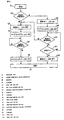
- Fig. 6 is a flow chart which shows processing procedures of the circuit control section 21 at the time that there was an incoming call.
- the circuit control section 21 detects opening/closing of the housing (step S2). That is, it judges whether the opening/closing detection switch 23 is outputting the opening signal or the closing signal.
- step S3 In case that the opening/closing detection switch 23 is outputting the closing signal and the housing is closed, LED 15 for the talk key 5a is remained OFF (step S3), and then, LED 18 for the one-push button 12 is turned ON (step S4) .
- a surface on which the operation keys 5 were disposed is hiding, and therefore, even if the talk key 5a is lighted up, battery power consumption becomes waste, and therefore, LED 17 is remained OFF, and LED 18 for the one-push button 12 is turned ON, to urge a user to push the one-push button 12.
- step S5 After LED 18 for the one-push button 12 was turned ON, it waits for such time that the housing is opened (step S5). That is, it waits for such time that the opening signal is outputted from the opening/closing detection switch 23.
- the opening/closing detection switch 23 When a user depresses the one-push button and the housing is opened, the opening/closing detection switch 23 outputs the opening signal, and the circuit control section 21 receives this opening signal to firstly turn off LED 18 (step S6), and starts a talk over the phone by use of the wireless communication circuit 22 (step S7). That is, in this embodiment, a talk over the phone starts when there is an incoming call and the housing is changed from "closing" to "opening", and thereby, depression of the talk key 5a becomes unnecessary.
- step S8 In case that the housing is opened when there was an incoming call (step 51), LED 17 for the talk key 5a is turned ON (step S8), and LED 18 for the one-push button 12 is remained OFF (step S9). Since the talk key 5a is lighted up and the one-pushbutton 12 is remained no-lighting, it becomes possible for a user to easily judge that a next operation for carrying out a talk over the phone is depression of the talk key 5a.
- the circuit control section 21 detects again an opening/closing state of the housing (step S10), and if the opening signal is outputted from the opening/closing detection switch 23, it judges whether the talk key 5a was depressed or not this time (step S11). In case that the talk key 5a is not depressed, it goes back to detection processing of an opening/closing state of the housing (step S10), and in case that the talk key 5a was depressed, LED 17 is turned OFF, i.e., lighting is turned off (step S12), and thereafter, it enters into talk processing (step S7).
- step S10 In case that it was judged that the housing is closed in detection processing of an opening/closing state of the housing (step S10), i.e., in case that there is an incoming call in such a state that the housing was opened and a user closed the housing, in this embodiment, lighting for the talk key 5a is turned off (step S3) and lighting for the one-push button 12 is turned on (step S4). Then, when the housing is opened again (step S5), lighting for the one-push button 12 is turned off (step S6), and thereafter, a talk is started (step S7).
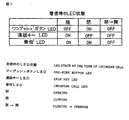
- Fig.7 is a view which collected up an opening/closing state of the housing and ON/OFF states of LEDs 18, 17, 11.
- LED for the one-push button is OFF when the housing is in “opening” and ON when the housing is in “closing”, and turned OFF when the housing was changed from “closing” to “opening”.
- LED for the talk key is ON when the housing is in “opening” and OFF when the housing is in “closing”, and turned OFF so as for a talk to be started, when the housing is changed from "closing" to "opening”.
- LED for an incoming call is turned ON at the time that there was an incoming call whether the housing is in "opening” or "closing”, and turned OFF in order for a talk to be started, when the housing was changed from "closing" to "opening".
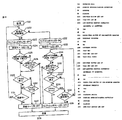
- Fig. 8 is a flow chart which shows processing procedures of a circuit control section which relates to a second embodiment of the invention.
- a portable communication terminal apparatus is used by being connected to a hands-free device when a user is driving a car, and there is also such a case that an earphone is used. Processing procedures in the suchlike cases will be hereinafter described.
- step S21 When there is an incoming call (step S21), opening/closing of a housing is detected (step S22). When the housing is in "opening”, the one-push button 12 is remained OFF (step S23), and lighting for the talk key 5a is turned off (step S29).
- step S25 it is judged whether a hands-free car-mounted adapter is connected or not.
- a hands-free switch is ON or OFF (step S26).
- LED 17 for the talk key 5a is turned off, in order to start a talk directly (step S27), and thereafter, it enters into talk processing (step S28).
- step S26 it is next judged whether an earphone is inserted or not (step S29). In case that the earphone is inserted, it is judged whether an earphone switch is ON or OFF (step S30).
- step S27 LED for the talk key 5a is turned off
- step S28 it enters into talk processing
- step S31 it is judged whether the talk key 5a was depressed or not.
- step S30 it is judged whether this talk key 5a was depressed or not (step S31).
- step S31 In case that the talk key 5a was depressed (step S31), LED for the talk key 5a is next turned off (step S27), and thereafter, it enters into talk processing (step S28). In case that the talk key 5a is not depressed, it goes back to detection processing of an opening/closing state of the housing (step S22).
- step S21 In case that there is an incoming call (step S21) and it was judged that the housing is in "closing” (step S22), or in case that there was an incoming cal when the housing is in "opening” and a user once closed the housing and thereby it was judged that the housing is in "closing” (step s22), the one-push button 12 is turned ON (step S32), and lighting for the talk key 5a is turned off, i.e., LED 17 is remained in a no-lighting state (step S33).
- step S24 it is judged whether the hands-free car-mounted adapter is connected or not (step S24). In case that the car-mounted adapter is connected, it is next judged whether the hands-free switch is ON or OFF (step S35). In case that the hands-free switch is ON, lighting for the one-push button 12 is turned off (step S36), and thereafter, it enters into talk processing (step S28).
- step S35 In case that the hands-free switch is OFF (step S35) or in case that it was judged that the car-mounted adapter is not connected (stepS34), it is judgedwhether an earphone is inserted or not (step S37). In case that the earphone is inserted, it is judged whether the earphone switch is ON or OFF (step S38).
- step S36 LED for the one-push button 12 is turned OFF
- step S28 it enters into talk processing
- step S37 an opening/closing state of the housing is detected (step S39) .
- step S38 it proceeds on to detection processing of an opening/closing state of the housing (step S39).
- step S39 LED for the one-push button 12 is turned off (step S36), and thereafter, it enters into talkprocessing (step S28).
- step S28 When the housing is remained in "closing”, it goes back to judgment processing of whether the car-mounted adapter is connected or not, and it waits for such time that a user talks over the phone by use of each of the hands-free device or the earphone and "opening" of the housing.
- a foldable type portable communication terminal apparatus which can surely guide a user to a talkable state at the time that there was an incoming call.
Landscapes
- Engineering & Computer Science (AREA)
- Signal Processing (AREA)
- Human Computer Interaction (AREA)
- Telephone Function (AREA)
- Telephone Set Structure (AREA)
Applications Claiming Priority (3)
| Application Number | Priority Date | Filing Date | Title |
|---|---|---|---|
| JP2003080890 | 2003-03-24 | ||
| JP2003080890 | 2003-03-24 | ||
| PCT/JP2004/003640 WO2004086734A1 (ja) | 2003-03-24 | 2004-03-18 | 折畳型携帯通信端末装置 |
Publications (2)
| Publication Number | Publication Date |
|---|---|
| EP1608132A1 true EP1608132A1 (de) | 2005-12-21 |
| EP1608132A4 EP1608132A4 (de) | 2011-01-05 |
Family
ID=33094881
Family Applications (1)
| Application Number | Title | Priority Date | Filing Date |
|---|---|---|---|
| EP04721677A Withdrawn EP1608132A4 (de) | 2003-03-24 | 2004-03-18 | Zusammenklappbare mobilkommunikationsendgeräteeinrichtung |
Country Status (5)
| Country | Link |
|---|---|
| US (1) | US7383068B2 (de) |
| EP (1) | EP1608132A4 (de) |
| JP (1) | JP4387357B2 (de) |
| CN (1) | CN1765110B (de) |
| WO (1) | WO2004086734A1 (de) |
Families Citing this family (15)
| Publication number | Priority date | Publication date | Assignee | Title |
|---|---|---|---|---|
| CA111086S (en) * | 2004-11-11 | 2006-10-25 | Nokia Corp | Handset |
| KR100675162B1 (ko) * | 2004-12-30 | 2007-01-29 | 엘지전자 주식회사 | 멀티-모드 라이트 기능을 갖춘 이동통신 단말기 |
| KR100631628B1 (ko) * | 2005-03-07 | 2006-10-11 | 엘지전자 주식회사 | 이동 통신 단말기의 전원키 독립 백라이트 장치 및 방법 |
| CA116876S (en) * | 2006-02-02 | 2008-02-12 | Lg Electronics Inc | Mobile phone |
| CA119323S (en) * | 2006-08-18 | 2007-12-05 | Nokia Corp | Handset |
| JP5068556B2 (ja) * | 2007-02-07 | 2012-11-07 | 日本電気株式会社 | 折り畳み型携帯機器におけるストラップ取り付け部の構造 |
| JP4679543B2 (ja) * | 2007-03-27 | 2011-04-27 | 京セラ株式会社 | 通信端末 |
| JP4716334B2 (ja) * | 2007-05-21 | 2011-07-06 | シャープ株式会社 | 携帯情報端末 |
| USD571340S1 (en) * | 2007-05-22 | 2008-06-17 | Samsung Electronics Co., Ltd. | Portable telephone |
| USD571339S1 (en) * | 2007-05-22 | 2008-06-17 | Samsung Electronics Co., Ltd. | Portable telephone |
| USD578982S1 (en) * | 2007-06-18 | 2008-10-21 | Samsung Electronics Co., Ltd. | Mobile phone |
| USD571771S1 (en) * | 2007-06-21 | 2008-06-24 | Samsung Electronics Co., Ltd. | Portable telephone |
| USD571343S1 (en) * | 2007-07-25 | 2008-06-17 | Samsung Electronics Co., Ltd. | Mobile phone |
| CN104883451A (zh) * | 2015-06-15 | 2015-09-02 | 联想(北京)有限公司 | 一种通话处理方法和电子设备 |
| EP4226603B1 (de) * | 2020-10-12 | 2025-07-02 | Apple Inc. | Dynamische benutzerschnittstellenschemata für eine elektronische vorrichtung auf basis erkannter zubehörvorrichtungen |
Family Cites Families (12)
| Publication number | Priority date | Publication date | Assignee | Title |
|---|---|---|---|---|
| JPH0630086A (ja) * | 1992-07-06 | 1994-02-04 | Matsushita Electric Ind Co Ltd | 電話機の着信表示装置 |
| JP3606498B2 (ja) * | 1996-04-26 | 2005-01-05 | 三菱電機株式会社 | 携帯情報端末装置 |
| JP2944582B2 (ja) * | 1997-06-25 | 1999-09-06 | 埼玉日本電気株式会社 | 折り畳み型携帯電話機 |
| JPH1141328A (ja) | 1997-07-18 | 1999-02-12 | Fujitsu Ltd | 折り畳み型携帯電話機 |
| GB2372662B (en) * | 1998-05-08 | 2002-11-27 | Orange Personal Comm Serv Ltd | Mobile communications |
| KR100300760B1 (ko) * | 1999-02-26 | 2001-09-26 | 김성수 | 조명램프를 가지는 휴대용 무선전화기 |
| JP4183898B2 (ja) * | 2000-11-09 | 2008-11-19 | 株式会社ケンウッド | 移動体電話機及びそれに用いる音声入出力装置 |
| JP2002232534A (ja) * | 2001-01-31 | 2002-08-16 | Sanyo Electric Co Ltd | 電話装置 |
| JP2002314658A (ja) * | 2001-04-16 | 2002-10-25 | Nec Corp | 折り畳み式携帯端末 |
| JP2002320012A (ja) * | 2001-04-20 | 2002-10-31 | Nec Access Technica Ltd | 液晶ディスプレイ付き電子機器 |
| JP4642292B2 (ja) * | 2001-09-06 | 2011-03-02 | パナソニック株式会社 | 折りたたみ式の無線端末、通話開始方法および通話開始プログラム |
| JP2004135177A (ja) * | 2002-10-11 | 2004-04-30 | Sharp Corp | 携帯電話機 |
-
2004
- 2004-03-18 US US10/550,445 patent/US7383068B2/en not_active Expired - Fee Related
- 2004-03-18 JP JP2005504014A patent/JP4387357B2/ja not_active Expired - Lifetime
- 2004-03-18 EP EP04721677A patent/EP1608132A4/de not_active Withdrawn
- 2004-03-18 WO PCT/JP2004/003640 patent/WO2004086734A1/ja not_active Ceased
- 2004-03-18 CN CN200480008296.6A patent/CN1765110B/zh not_active Expired - Fee Related
Also Published As
| Publication number | Publication date |
|---|---|
| EP1608132A4 (de) | 2011-01-05 |
| US7383068B2 (en) | 2008-06-03 |
| CN1765110A (zh) | 2006-04-26 |
| JPWO2004086734A1 (ja) | 2006-06-29 |
| WO2004086734A1 (ja) | 2004-10-07 |
| US20070004474A1 (en) | 2007-01-04 |
| JP4387357B2 (ja) | 2009-12-16 |
| CN1765110B (zh) | 2010-09-29 |
Similar Documents
| Publication | Publication Date | Title |
|---|---|---|
| US7383068B2 (en) | Collapsible mobile communication terminal device | |
| US7376449B2 (en) | Slide-type portable communication apparatus | |
| US7792557B2 (en) | Slide-type portable communication apparatus | |
| US7149781B2 (en) | Portable terminal device and communication connection method thereof | |
| AU693613B2 (en) | Cellular speakerphone and method of operation thereof | |
| GB2295744A (en) | Folding portable telephone and data communication device | |
| US20100151911A1 (en) | Integrated telecommunications handset | |
| US6957090B2 (en) | Hands-free car kit | |
| JP2004072285A (ja) | 携帯電話機 | |
| JP2001309002A (ja) | 携帯型移動通信端末 | |
| JP2526764B2 (ja) | 携帯用無線電話機 | |
| JP2008263332A (ja) | 携帯電子機器 | |
| JP4076226B2 (ja) | 情報端末 | |
| KR101030643B1 (ko) | 휴대용 단말기의 사이드 키 장치 | |
| KR100995723B1 (ko) | 듀얼 폴더형 이동통신단말기의 배터리 전압 절약방법 | |
| KR100901189B1 (ko) | 폴더형 휴대 단말기 | |
| KR200252843Y1 (ko) | 음성스위치를 구비한, 영상휴대폰 및 핸즈프리와 한 조가된 운전대 부착 장치 | |
| KR200252842Y1 (ko) | 음성스위치를 구비한, 휴대폰 및 핸즈프리와 한 조가 된운전대 부착 장치 | |
| JP2001127837A (ja) | 携帯電話器 | |
| KR200225629Y1 (ko) | 폴더형 휴대 단말기 | |
| JP2526763B2 (ja) | 携帯用無線電話機 | |
| KR200258285Y1 (ko) | 음성스위치를 구비한 영상휴대폰과 한 조가 된 운전대부착 장치 | |
| JP2002111812A (ja) | 折り畳み型端末装置 | |
| KR20020010024A (ko) | 휴대용 무선단말기의 스피커폰 장착구조 | |
| KR20010088525A (ko) | 음성스위치를 구비한, 영상휴대폰 및 핸즈프리와 한 조가된 운전대 부착 장치 |
Legal Events
| Date | Code | Title | Description |
|---|---|---|---|
| PUAI | Public reference made under article 153(3) epc to a published international application that has entered the european phase |
Free format text: ORIGINAL CODE: 0009012 |
|
| 17P | Request for examination filed |
Effective date: 20050923 |
|
| AK | Designated contracting states |
Kind code of ref document: A1 Designated state(s): AT BE BG CH CY CZ DE DK EE ES FI FR GB GR HU IE IT LI LU MC NL PL PT RO SE SI SK TR |
|
| AX | Request for extension of the european patent |
Extension state: AL LT LV MK |
|
| DAX | Request for extension of the european patent (deleted) | ||
| RBV | Designated contracting states (corrected) |
Designated state(s): DE FR GB |
|
| RAP1 | Party data changed (applicant data changed or rights of an application transferred) |
Owner name: PANASONIC CORPORATION |
|
| A4 | Supplementary search report drawn up and despatched |
Effective date: 20101203 |
|
| 17Q | First examination report despatched |
Effective date: 20111020 |
|
| GRAP | Despatch of communication of intention to grant a patent |
Free format text: ORIGINAL CODE: EPIDOSNIGR1 |
|
| RIC1 | Information provided on ipc code assigned before grant |
Ipc: H04M 1/02 20060101AFI20120224BHEP |
|
| STAA | Information on the status of an ep patent application or granted ep patent |
Free format text: STATUS: THE APPLICATION IS DEEMED TO BE WITHDRAWN |
|
| 18D | Application deemed to be withdrawn |
Effective date: 20120717 |