EP1610237A2 - Kombinieren von multidimensionalen Ausdrücken und Erweiterungen der Datenermittlung zur Ermittlung von OLAP Würfen - Google Patents
Kombinieren von multidimensionalen Ausdrücken und Erweiterungen der Datenermittlung zur Ermittlung von OLAP Würfen Download PDFInfo
- Publication number
- EP1610237A2 EP1610237A2 EP05104834A EP05104834A EP1610237A2 EP 1610237 A2 EP1610237 A2 EP 1610237A2 EP 05104834 A EP05104834 A EP 05104834A EP 05104834 A EP05104834 A EP 05104834A EP 1610237 A2 EP1610237 A2 EP 1610237A2
- Authority
- EP
- European Patent Office
- Prior art keywords
- data
- multidimensional
- query
- data mining
- relational
- Prior art date
- Legal status (The legal status is an assumption and is not a legal conclusion. Google has not performed a legal analysis and makes no representation as to the accuracy of the status listed.)
- Ceased
Links
Images

Classifications
-
- G—PHYSICS
- G06—COMPUTING OR CALCULATING; COUNTING
- G06F—ELECTRIC DIGITAL DATA PROCESSING
- G06F16/00—Information retrieval; Database structures therefor; File system structures therefor
- G06F16/20—Information retrieval; Database structures therefor; File system structures therefor of structured data, e.g. relational data
- G06F16/24—Querying
- G06F16/242—Query formulation
- G06F16/2433—Query languages
- G06F16/244—Grouping and aggregation
-
- E—FIXED CONSTRUCTIONS
- E06—DOORS, WINDOWS, SHUTTERS, OR ROLLER BLINDS IN GENERAL; LADDERS
- E06C—LADDERS
- E06C1/00—Ladders in general
- E06C1/02—Ladders in general with rigid longitudinal member or members
- E06C1/14—Ladders capable of standing by themselves
- E06C1/16—Ladders capable of standing by themselves with hinged struts which rest on the ground
- E06C1/18—Ladders capable of standing by themselves with hinged struts which rest on the ground with supporting struts formed as ladders
-
- E—FIXED CONSTRUCTIONS
- E06—DOORS, WINDOWS, SHUTTERS, OR ROLLER BLINDS IN GENERAL; LADDERS
- E06C—LADDERS
- E06C7/00—Component parts, supporting parts, or accessories
- E06C7/02—Extending means
- E06C7/04—Hand-operated extending means carried by the ladder
-
- E—FIXED CONSTRUCTIONS
- E06—DOORS, WINDOWS, SHUTTERS, OR ROLLER BLINDS IN GENERAL; LADDERS
- E06C—LADDERS
- E06C7/00—Component parts, supporting parts, or accessories
- E06C7/06—Securing devices or hooks for parts of extensible ladders
-
- G—PHYSICS
- G06—COMPUTING OR CALCULATING; COUNTING
- G06F—ELECTRIC DIGITAL DATA PROCESSING
- G06F16/00—Information retrieval; Database structures therefor; File system structures therefor
- G06F16/20—Information retrieval; Database structures therefor; File system structures therefor of structured data, e.g. relational data
- G06F16/24—Querying
- G06F16/245—Query processing
- G06F16/2458—Special types of queries, e.g. statistical queries, fuzzy queries or distributed queries
- G06F16/2465—Query processing support for facilitating data mining operations in structured databases
-
- G—PHYSICS
- G06—COMPUTING OR CALCULATING; COUNTING
- G06F—ELECTRIC DIGITAL DATA PROCESSING
- G06F16/00—Information retrieval; Database structures therefor; File system structures therefor
- G06F16/20—Information retrieval; Database structures therefor; File system structures therefor of structured data, e.g. relational data
- G06F16/28—Databases characterised by their database models, e.g. relational or object models
- G06F16/283—Multi-dimensional databases or data warehouses, e.g. MOLAP or ROLAP
-
- Y—GENERAL TAGGING OF NEW TECHNOLOGICAL DEVELOPMENTS; GENERAL TAGGING OF CROSS-SECTIONAL TECHNOLOGIES SPANNING OVER SEVERAL SECTIONS OF THE IPC; TECHNICAL SUBJECTS COVERED BY FORMER USPC CROSS-REFERENCE ART COLLECTIONS [XRACs] AND DIGESTS
- Y10—TECHNICAL SUBJECTS COVERED BY FORMER USPC
- Y10S—TECHNICAL SUBJECTS COVERED BY FORMER USPC CROSS-REFERENCE ART COLLECTIONS [XRACs] AND DIGESTS
- Y10S707/00—Data processing: database and file management or data structures
- Y10S707/99931—Database or file accessing
- Y10S707/99933—Query processing, i.e. searching
-
- Y—GENERAL TAGGING OF NEW TECHNOLOGICAL DEVELOPMENTS; GENERAL TAGGING OF CROSS-SECTIONAL TECHNOLOGIES SPANNING OVER SEVERAL SECTIONS OF THE IPC; TECHNICAL SUBJECTS COVERED BY FORMER USPC CROSS-REFERENCE ART COLLECTIONS [XRACs] AND DIGESTS
- Y10—TECHNICAL SUBJECTS COVERED BY FORMER USPC
- Y10S—TECHNICAL SUBJECTS COVERED BY FORMER USPC CROSS-REFERENCE ART COLLECTIONS [XRACs] AND DIGESTS
- Y10S707/00—Data processing: database and file management or data structures
- Y10S707/99941—Database schema or data structure
- Y10S707/99944—Object-oriented database structure
- Y10S707/99945—Object-oriented database structure processing
Definitions
- This invention is related to databases, and more specifically, to methods for searching and analyzing such databases.
- Enormous amounts of data can be stored as a data warehouse, which is a database that typically represents the business history of an organization.
- the history data is used for analysis that supports business decisions at many levels, from strategic planning to performance evaluation of a discrete organizational unit. It can also involve taking the data stored in a relational database and processing the data to make it a more effective tool for query and analysis.
- a data mart is employed in which only a targeted subset of the data is managed.
- multidimensional data can be represented by structures with more than two dimensions. These multidimensional structures are called cubes.
- a cube is a multidimensional database that represents data similar to a 3-D spreadsheet rather than a relational database.
- the cube allows different views of the data to be displayed quickly by employing concepts of dimensions and measures.
- Dimensions define the structure of the cube (e.g., geographical location or a product type), while measures provide the quantitative values of interest to the end user ( e . g ., sales dollars, inventory amount, and total expenses).
- Cell positions in the cube are defined by the intersection of dimension members, and the measure values are aggregated to provide the values in the cells.
- OLAP online analytical processing
- OLAP enables data warehouses and data marts to be used effectively for online analysis and providing rapid responses to iterative complex analysis queries.
- OLAP systems provide the speed and flexibility to support analysis in real time.
- MDX Multi-Dimensional expressions
- SQL Structured Query Language
- each MDX query requires a data request (the SELECT clause), a starting point (the FROM clause), and a filter (the WHERE clause).
- WHERE clause the filter
- These and other keywords provide the tools used to extract specific portions of data from a cube for analysis.
- MDX also supplies a robust set of functions for the manipulation of retrieved data, as well as the ability to extend MDX with user-defined functions.
- Data mining is about finding interesting structures in data (e.g., patterns and rules) that can be interpreted as knowledge about the data or may be used to predict events related to the data. These structures take the form of patterns that are concise descriptions of the data set. Data mining makes the exploration and exploitation of large databases easy, convenient, and practical for those who have data but not years of training in statistics or data analysis.
- the "knowledge" extracted by a data mining algorithm can have many forms and many uses. It can be in the form of a set of rules, a decision tree, a regression model, or a set of associations, among many other possibilities. It may be used to produce summaries of data or to get insight into previously unknown correlations. It also may be used to predict events related to the data ⁇ for example, missing values, records for which some information is not known, and so forth. There are many different data mining techniques, most of them originating from the fields of machine learning, statistics, and database programming.
- the present invention disclosed and claimed herein comprises a formal language that integrates multidimensional extensions (e.g., MDX) and data mining extensions (e.g., DMX) for performing data mining operations on data residing in OLAP cubes.
- Data Mining operations generally perform operations on a set of source data indicated by a ⁇ source-data-query>.
- the ⁇ source-data-query> elements have been limited to relational queries acting directly against a relational database, or a SHAPE statement that takes relational queries and forms them into a nested rowset.
- This invention provides that the ⁇ source-data-query> can not only be a relational query, rather a multidimensional query formed using MDX, for example.
- data mining models are used to perform predictions against data contained inside an OLAP cube.
- this invention states that upon creation, the source data type is unknown and is not set until the training phase.
- the "type" of the model was implied upon creation, the type being a relational-sourced or OLAP-sourced model.
- a mining model can be trained from an arbitrary data source regardless of its relational or multidimensional nature. Column binding is handling consistently by explicit column order in both multidimensional and relational sources, unlike conventional systems where column binding is implied through name matching between the mining model and the OLAP cube.
- a mining model can take as a data source for prediction, an arbitrary data source, regardless of its relational or multidimensional nature.
- the disclosed architecture allows prediction to occur using DMX, and allows the OLAP cube to source predictions from any model, regardless of how it was created or trained. Conventionally, prediction against data in an OLAP cube is carried out in MDX, and only using mining models trained on the same cube.
- a component can be, but is not limited to being, a process running on a processor, a processor, an object, an executable, a thread of execution, a program, and/or a computer.
- an application running on a server and the server can be a component.
- One or more components can reside within a process and/or thread of execution, and a component can be localized on one computer and/or distributed between two or more computers.
- the invention provides architecture for integrating multidimensional extensions and data mining extensions for performing data mining operations on data residing in OLAP cubes.
- the ⁇ source-data-query> elements have been limited to relational queries acting directly against a relational database, or a SHAPE statement that takes relational queries and forms them into a nested rowset.
- This invention provides that the ⁇ source-data-query> can not only be a relational query, but rather a multidimensional query formed using multidimensional extensions.
- MDX is an acronym for MultiDimensional expressions, as defined by the OLE DB for OLAP Specification, by Microsoft Corporation, the entirety of which is incorporated by reference.
- DMX is an acronym for Data Mining extensions, as defined by the OLE DB for Data Mining Specification, by Microsoft Corporation, the entirety of which is incorporated by reference. For the purposes of this description, the operations of model creation, model training, and prediction against new data are described.
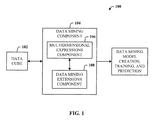
- FIG. 1 there is illustrated a system 100 that facilitates multidimensional expression and data mining extension integration in accordance with the present invention.
- a multidimensional data source e.g., an OLAP (On-Line Analytical Processing) cube
- a data mining component 104 includes a multidimensional expression component 106 (e.g., MDX) and a data mining extensions component 108 together which facilitate data mining of the OLAP cube 102.
- An output of the data mining component is data that is used as input to data mining model creation, training, and prediction.
- both the multidimensional expression component 106 and the data mining extensions component 108 reside in the single overall data mining component 104, but either can be a separate external entity from the data mining component 104.
- the components (106 and 108) can be independent such that one feeds the other.
- FIG. 2 there is illustrated a flow chart of one methodology of multidimensional data mining in accordance with the present invention. While, for purposes of simplicity of explanation, the one or more methodologies shown herein, e . g ., in the form of a flow chart, are shown and described as a series of acts, it is to be understood and appreciated that the present invention is not limited by the order of acts, as some acts may, in accordance with the present invention, occur in a different order and/or concurrently with other acts from that shown and described herein. For example, those skilled in the art will understand and appreciate that a methodology could alternatively be represented as a series of interrelated states or events, such as in a state diagram. Moreover, not all illustrated acts may be required to implement a methodology in accordance with the present invention.
- multidimensional data is provided for data mining.
- the language schema is provided that integrates the multidimensional extensions and data mining extensions, and operates on the multidimensional data.
- a data mining model is created from the multidimensional data.
- the data mining model is trained on the data.
- predications can now be made on new data using the data mining extensions. The process then reaches a Stop block.
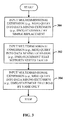
- FIG. 3 there is illustrated a flow chart of examplary ways to use multidimensional expressions as inputs to data mining extensions in accordance with the present invention.
- Data mining extension queries traditionally expect relational tables as their data sources. These queries can accept either a flat table as input, or a nested table created through the use of the SHAPE directive. Binding is done either by column order - as in the INSERT INTO statement, or by explicit mapping using an ON clause, as in the SELECT ... PREDICTION JOIN statement. For example:
- the disclosed invention allows for multiple ways of using multidimensional extensions queries (e . g ., MDX) as inputs to data mining extension statements (e . g ., DMX).
- MDX multidimensional extensions queries
- DMX data mining extension statements
- a first way is by simple replacement of the relational query with an MDX query.
- the query can be expressed in an MDX cube as,
- the MDX expressions can be substituted for the relational queries.
- a second form allows for the elimination of the SHAPE construct by taking advantage of the inherent multidimensional structure of the cube.
- the above shaped relational queries can then be written in MDX as, Additional nested tables can be arranged on additional axes.
- a third form of the invention involves statements that bind by name only, e.g., SELECT, PREDICTION, and JOIN.
- the data mining extension processor takes advantage of the cube structure, allowing for simpler queries, expanding the ON clause to extract information from the MDX query. For example,
- this invention states that upon creation, the source data type is unknown and is not set until the training phase.
- the "type" of the model was implied upon creation, the type being a relational-sourced or OLAP-sourced model.
- a mining model can be trained from an arbitrary data source regardless of its relational or multidimensional nature. Column binding is handling consistently by explicit column order in both multidimensional and relational sources, unlike conventional systems where column binding is implied through name matching between the mining model and the OLAP cube.
- a mining model can take as a data source for prediction, an arbitrary data source, regardless of its relational or multidimensional nature.
- prediction against data in an OLAP cube can only be carried out in MDX, and only using mining models trained on the same cube.
- the disclosed architecture allows prediction to occur using DMX, and allows the OLAP cube to source predictions from any model, regardless of how it was created or trained.
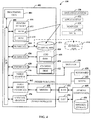
- FIG. 4 there is illustrated a block diagram of a computer operable to execute the disclosed architecture.
- FIG. 4 and the following discussion are intended to provide a brief, general description of a suitable computing environment 400 in which the various aspects of the present invention can be implemented. While the invention has been described above in the general context of computer-executable instructions that may run on one or more computers, those skilled in the art will recognize that the invention also can be implemented in combination with other program modules and/or as a combination of hardware and software.
- program modules include routines, programs, components, data structures, etc., that perform particular tasks or implement particular abstract data types.
- inventive methods can be practiced with other computer system configurations, including single-processor or multiprocessor computer systems, minicomputers, mainframe computers, as well as personal computers, hand-held computing devices, microprocessor-based or programmable consumer electronics, and the like, each of which can be operatively coupled to one or more associated devices.
- the illustrated aspects of the invention may also be practiced in distributed computing environments where certain tasks are performed by remote processing devices that are linked through a communications network.
- program modules can be located in both local and remote memory storage devices.
- a computer typically includes a variety of computer-readable media.
- Computer-readable media can be any available media that can be accessed by the computer and includes both volatile and nonvolatile media, removable and non-removable media.
- Computer readable media can comprise computer storage media and communication media.
- Computer storage media includes both volatile and nonvolatile, removable and non-removable media implemented in any method or technology for storage of information such as computer readable instructions, data structures, program modules or other data.
- Computer storage media includes, but is not limited to, RAM, ROM, EEPROM, flash memory or other memory technology, CD-ROM, digital video disk (DVD) or other optical disk storage, magnetic cassettes, magnetic tape, magnetic disk storage or other magnetic storage devices, or any other medium which can be used to store the desired information and which can be accessed by the computer.
- Communication media typically embodies computer-readable instructions, data structures, program modules or other data in a modulated data signal such as a carrier wave or other transport mechanism, and includes any information delivery media.
- modulated data signal means a signal that has one or more of its characteristics set or changed in such a manner as to encode information in the signal.
- communication media includes wired media such as a wired network or direct-wired connection, and wireless media such as acoustic, RF, infrared and other wireless media. Combinations of the any of the above should also be included within the scope of computer-readable media.
- FIG. 4 there is illustrated an exemplary environment 400 for implementing various aspects of the invention that includes a computer 402, the computer 402 including a processing unit 404, a system memory 406 and a system bus 408.
- the system bus 408 couples system components including, but not limited to, the system memory 406 to the processing unit 404.
- the processing unit 404 can be any of various commercially available processors. Dual microprocessors and other multi-processor architectures may also be employed as the processing unit 404.
- the system bus 408 can be any of several types of bus structure that may further interconnect to a memory bus (with or without a memory controller), a peripheral bus, and a local bus using any of a variety of commercially available bus architectures.
- the system memory 406 includes read only memory (ROM) 410 and random access memory (RAM) 412.
- ROM read only memory
- RAM random access memory
- a basic input/output system (BIOS) is stored in a non-volatile memory 410 such as ROM, EPROM, EEPROM, which BIOS contains the basic routines that help to transfer information between elements within the computer 402, such as during start-up.
- the RAM 412 can also include a high-speed RAM such as static RAM for caching data.
- the computer 402 further includes an internal hard disk drive (HDD) 414 (e . g ., EIDE, SATA), which internal hard disk drive 414 may also be configured for external use in a suitable chassis (not shown), a magnetic floppy disk drive (FDD) 416, (e.g., to read from or write to a removable diskette 418) and an optical disk drive 420, (e.g., reading a CD-ROM disk 422 or, to read from or write to other high capacity optical media such as the DVD).
- the hard disk drive 414, magnetic disk drive 416 and optical disk drive 420 can be connected to the system bus 408 by a hard disk drive interface 424, a magnetic disk drive interface 426 and an optical drive interface 428, respectively.
- the interface 424 for external drive implementations includes at least one or both of Universal Serial Bus (USB) and IEEE 1394 interface technologies.
- the drives and their associated computer-readable media provide nonvolatile storage of data, data structures, computer-executable instructions, and so forth.
- the drives and media accommodate the storage of any data in a suitable digital format.
- computer-readable media refers to a HDD, a removable magnetic diskette, and a removable optical media such as a CD or DVD, it should be appreciated by those skilled in the art that other types of media which are readable by a computer, such as zip drives, magnetic cassettes, flash memory cards, cartridges, and the like, may also be used in the exemplary operating environment, and further, that any such media may contain computer-executable instructions for performing the methods of the present invention.
- a number of program modules can be stored in the drives and RAM 412, including an operating system 430, one or more application programs 432, other program modules 434 and program data 436. All or portions of the operating system, applications, modules, and/or data can also be cached in the RAM 412.
- a user can enter commands and information into the computer 402 through one or more wired/wireless input devices, e.g., a keyboard 438 and a pointing device, such as a mouse 440.
- Other input devices may include a microphone, an IR remote control, a joystick, a game pad, a stylus pen, touch screen, or the like.
- These and other input devices are often connected to the processing unit 404 through an input device interface 442 that is coupled to the system bus 408, but can be connected by other interfaces, such as a parallel port, an IEEE 1394 serial port, a game port, a USB port, an IR interface, etc.
- a monitor 444 or other type of display device is also connected to the system bus 408 via an interface, such as a video adapter 446.
- a computer typically includes other peripheral output devices (not shown), such as speakers, printers etc.
- the computer 402 may operate in a networked environment using logical connections via wired and/or wireless communications to one or more remote computers, such as a remote computer(s) 448.
- the remote computer(s) 448 can be a workstation, a server computer, a router, a personal computer, portable computer, microprocessor-based entertainment appliance, a peer device or other common network node, and typically includes many or all of the elements described relative to the computer 402, although, for purposes of brevity, only a memory storage device 450 is illustrated.
- the logical connections depicted include wired/wireless connectivity to a local area network (LAN) 452 and/or larger networks, e.g., a wide area network (WAN) 454.
- LAN and WAN networking environments are commonplace in offices, and companies, and facilitate enterprise-wide computer networks, such as intranets, all of which may connect to a global communication network, e.g., the Internet.
- the computer 402 When used in a LAN networking environment, the computer 402 is connected to the local network 452 through a wired and/or wireless communication network interface or adapter 456.
- the adaptor 456 may facilitate wired or wireless communication to the LAN 452, which may also include a wireless access point disposed thereon for communicating with the wireless adaptor 456.
- the computer 402 can include a modem 458, or is connected to a communications server on the LAN, or has other means for establishing communications over the WAN 454, such as by way of the Internet.
- the modem 458, which can be internal or external and a wired or wireless device, is connected to the system bus 408 via the serial port interface 442.
- program modules depicted relative to the computer 402, or portions thereof, can be stored in the remote memory/storage device 450. It will be appreciated that the network connections shown are exemplary and other means of establishing a communications link between the computers can be used.
- the computer 402 is operable to communicate with any wireless devices or entities operatively disposed in wireless communication, e.g., a printer, scanner, desktop and/or portable computer, portable data assistant, communications satellite, any piece of equipment or location associated with a wirelessly detectable tag (e.g., a kiosk, news stand, restroom), and telephone.
- any wireless devices or entities operatively disposed in wireless communication e.g., a printer, scanner, desktop and/or portable computer, portable data assistant, communications satellite, any piece of equipment or location associated with a wirelessly detectable tag (e.g., a kiosk, news stand, restroom), and telephone.
- the communication can be a predefined structure as with conventional network or simply an ad hoc communication between at least two devices.
- Wi-Fi Wireless Fidelity
- Wi-Fi is a wireless technology like a cell phone that enables such devices, e.g., computers, to send and receive data indoors and out; anywhere within the range of a base station.
- Wi-Fi networks use radio technologies called IEEE 802.11 (a, b, g, etc.) to provide secure, reliable, fast wireless connectivity.
- IEEE 802.11 a, b, g, etc.
- a Wi-Fi network can be used to connect computers to each other, to the Internet, and to wired networks (which use IEEE 802.3 or Ethernet).
- Wi-Fi networks operate in the unlicensed 2.4 and 5 GHz radio bands, with an 11 Mbps (802.11 b) or 54 Mbps (802.11 a) data rate or with products that contain both bands (dual band), so the networks can provide real-world performance similar to the basic 10BaseT wired Ethernet networks used in many offices.
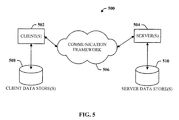
- the system 500 includes one or more client(s) 502.
- the client(s) 502 can be hardware and/or software (e.g., threads, processes, computing devices).
- the client(s) 502 can house cookie(s) and/or associated contextual information by employing the present invention, for example.
- the system 500 also includes one or more server(s) 504.
- the server(s) 504 can also be hardware and/or software (e.g., threads, processes, computing devices).
- the servers 504 can house threads to perform transformations by employing the present invention, for example.
- One possible communication between a client 502 and a server 504 can be in the form of a data packet adapted to be transmitted between two or more computer processes.
- the data packet may include a cookie and/or associated contextual information, for example.
- the system 500 includes a communication framework 506 (e . g ., a global communication network such as the Internet) that can be employed to facilitate communications between the client(s) 502 and the server(s) 504.
- a communication framework 506 e . g ., a global communication network such as the Internet
- Communications can be facilitated via a wired (including optical fiber) and/or wireless technology.
- the client(s) 502 are operatively connected to one or more client data store(s) 508 that can be employed to store information local to the client(s) 502 (e.g., cookie(s) and/or associated contextual information).
- the server(s) 504 are operatively connected to one or more server data store(s) 510 that can be employed to store information local to the servers 504.
Landscapes
- Engineering & Computer Science (AREA)
- Databases & Information Systems (AREA)
- Theoretical Computer Science (AREA)
- Physics & Mathematics (AREA)
- General Engineering & Computer Science (AREA)
- General Physics & Mathematics (AREA)
- Data Mining & Analysis (AREA)
- Mathematical Physics (AREA)
- Computational Linguistics (AREA)
- Mechanical Engineering (AREA)
- Fuzzy Systems (AREA)
- Probability & Statistics with Applications (AREA)
- Software Systems (AREA)
- Information Retrieval, Db Structures And Fs Structures Therefor (AREA)
- Management, Administration, Business Operations System, And Electronic Commerce (AREA)
Applications Claiming Priority (2)
| Application Number | Priority Date | Filing Date | Title |
|---|---|---|---|
| US873676 | 2004-06-22 | ||
| US10/873,676 US7627555B2 (en) | 2004-06-22 | 2004-06-22 | Combining multidimensional expressions and data mining extensions to mine OLAP cubes |
Publications (2)
| Publication Number | Publication Date |
|---|---|
| EP1610237A2 true EP1610237A2 (de) | 2005-12-28 |
| EP1610237A3 EP1610237A3 (de) | 2006-12-13 |
Family
ID=34981588
Family Applications (1)
| Application Number | Title | Priority Date | Filing Date |
|---|---|---|---|
| EP20050104834 Ceased EP1610237A3 (de) | 2004-06-22 | 2005-06-03 | Kombinieren von multidimensionalen Ausdrücken und Erweiterungen der Datenermittlung zur Ermittlung von OLAP Würfen |
Country Status (10)
| Country | Link |
|---|---|
| US (1) | US7627555B2 (de) |
| EP (1) | EP1610237A3 (de) |
| JP (1) | JP4716796B2 (de) |
| KR (1) | KR101034428B1 (de) |
| CN (1) | CN1713180B (de) |
| AU (1) | AU2005201996B2 (de) |
| BR (1) | BRPI0502063A (de) |
| CA (1) | CA2506135A1 (de) |
| MX (1) | MXPA05005536A (de) |
| RU (1) | RU2398273C2 (de) |
Cited By (1)
| Publication number | Priority date | Publication date | Assignee | Title |
|---|---|---|---|---|
| CN102789488A (zh) * | 2012-06-29 | 2012-11-21 | 用友软件股份有限公司 | 数据查询处理系统和数据查询处理方法 |
Families Citing this family (26)
| Publication number | Priority date | Publication date | Assignee | Title |
|---|---|---|---|---|
| US7937401B2 (en) * | 2004-07-09 | 2011-05-03 | Microsoft Corporation | Multidimensional database query extension systems and methods |
| US20060036939A1 (en) * | 2004-08-13 | 2006-02-16 | Microsoft Corporation | Support for user-specified spreadsheet functions |
| US8095499B2 (en) * | 2004-10-19 | 2012-01-10 | Microsoft Corporation | Query consolidation for structured reports |
| US7899776B2 (en) * | 2007-07-02 | 2011-03-01 | Microsoft Corporation | Explaining changes in measures thru data mining |
| ES2593955T3 (es) * | 2008-07-21 | 2016-12-14 | Idt Electronic Products Limited | Equipo de recuperación de datos |
| US8229923B2 (en) * | 2008-09-26 | 2012-07-24 | Microsoft Corporation | Multidimensional data space queries with expression evaluation |
| CA2708911C (en) | 2009-07-09 | 2016-06-28 | Accenture Global Services Gmbh | Marketing model determination system |
| US8583686B2 (en) * | 2009-07-22 | 2013-11-12 | University Of Ontario Institute Of Technology | System, method and computer program for multi-dimensional temporal data mining |
| JP5175903B2 (ja) * | 2009-08-31 | 2013-04-03 | アクセンチュア グローバル サービスィズ ゲーエムベーハー | 適応分析多次元処理システム |
| KR101117649B1 (ko) * | 2010-10-13 | 2012-03-20 | 세종대학교산학협력단 | Olap 기반의 3차원 공간에서 데이터 분석 객체의 선택 방법 및 시스템 |
| CN102306176B (zh) * | 2011-08-25 | 2013-09-25 | 浙江鸿程计算机系统有限公司 | 一种基于数据仓库内在特征的olap关键词查询方法 |
| CN103164222A (zh) * | 2013-02-25 | 2013-06-19 | 用友软件股份有限公司 | 多维建模系统和多维建模方法 |
| CN103235793A (zh) * | 2013-04-01 | 2013-08-07 | 华为技术有限公司 | 联机处理数据的方法、设备及系统 |
| US10275484B2 (en) * | 2013-07-22 | 2019-04-30 | International Business Machines Corporation | Managing sparsity in a multidimensional data structure |
| US9361407B2 (en) | 2013-09-06 | 2016-06-07 | Sap Se | SQL extended with transient fields for calculation expressions in enhanced data models |
| US9176801B2 (en) | 2013-09-06 | 2015-11-03 | Sap Se | Advanced data models containing declarative and programmatic constraints |
| US9619552B2 (en) | 2013-09-06 | 2017-04-11 | Sap Se | Core data services extensibility for entity-relationship models |
| US9430523B2 (en) | 2013-09-06 | 2016-08-30 | Sap Se | Entity-relationship model extensions using annotations |
| US9575819B2 (en) | 2013-09-06 | 2017-02-21 | Sap Se | Local buffers for event handlers |
| US9639572B2 (en) | 2013-09-06 | 2017-05-02 | Sap Se | SQL enhancements simplifying database querying |
| US9442977B2 (en) | 2013-09-06 | 2016-09-13 | Sap Se | Database language extended to accommodate entity-relationship models |
| US9354948B2 (en) | 2013-09-06 | 2016-05-31 | Sap Se | Data models containing host language embedded constraints |
| CN106528795B (zh) * | 2016-11-10 | 2023-10-13 | 中国农业银行股份有限公司 | 一种数据挖掘方法及装置 |
| KR102058124B1 (ko) * | 2019-01-25 | 2019-12-23 | (주)비아이매트릭스 | 피벗 테이블 구조의 olap 결과를 이용한 딥러닝 예측 데이터 반영 시스템 |
| CN114610757B (zh) * | 2022-03-14 | 2025-04-01 | 浪潮通用软件有限公司 | 对基础查询对象进行扩展查询的方法、系统、设备及介质 |
| US11868329B2 (en) | 2022-05-20 | 2024-01-09 | International Business Machines Corporation | Multidimensional cube multivariate regression |
Family Cites Families (12)
| Publication number | Priority date | Publication date | Assignee | Title |
|---|---|---|---|---|
| US6205447B1 (en) * | 1997-06-30 | 2001-03-20 | International Business Machines Corporation | Relational database management of multi-dimensional data |
| RU2167450C2 (ru) * | 1999-02-17 | 2001-05-20 | Общество с ограниченной ответственностью "Информбюро" | Способ идентификации объектов по их описаниям |
| US6473764B1 (en) * | 1999-10-15 | 2002-10-29 | Microsoft Corporation | Virtual dimensions in databases and method therefor |
| US7822629B2 (en) * | 1999-12-15 | 2010-10-26 | Hewlett-Packard Development Company, L.P. | Customer profiling apparatus for conducting customer behavior pattern analysis, and method for comparing customer behavior patterns |
| US6917940B1 (en) * | 2000-03-10 | 2005-07-12 | Hewlett-Packard Development Company, L.P. | Olap-based customer behavior profiling method and system |
| US7007020B1 (en) * | 2000-03-10 | 2006-02-28 | Hewlett-Packard Development Company, L.P. | Distributed OLAP-based association rule generation method and system |
| US6687693B2 (en) * | 2000-12-18 | 2004-02-03 | Ncr Corporation | Architecture for distributed relational data mining systems |
| US7099880B2 (en) * | 2002-01-31 | 2006-08-29 | International Business Machines Corporation | System and method of using data mining prediction methodology |
| US6931391B2 (en) * | 2002-06-21 | 2005-08-16 | Microsoft Corporation | Systems and methods for generating prediction queries |
| US7472127B2 (en) * | 2002-12-18 | 2008-12-30 | International Business Machines Corporation | Methods to identify related data in a multidimensional database |
| CN100359495C (zh) * | 2003-09-04 | 2008-01-02 | 上海格尔软件股份有限公司 | 基于数据仓库的信息安全审计方法 |
| BRPI0415352B1 (pt) * | 2003-10-17 | 2017-05-23 | Hydralift Amclyde Inc | sistema e método baseado em computador para administrar componentes substituíveis para equipamento tendo uma pluralidade de componentes, e, método usado para monitorar a condição de equipamento remoto tendo pelo menos um componente de desgaste |
-
2004
- 2004-06-22 US US10/873,676 patent/US7627555B2/en not_active Expired - Fee Related
-
2005
- 2005-05-02 CA CA002506135A patent/CA2506135A1/en not_active Abandoned
- 2005-05-03 KR KR1020050037086A patent/KR101034428B1/ko not_active Expired - Fee Related
- 2005-05-10 AU AU2005201996A patent/AU2005201996B2/en not_active Ceased
- 2005-05-17 BR BR0502063-8A patent/BRPI0502063A/pt not_active IP Right Cessation
- 2005-05-23 CN CN200510074012XA patent/CN1713180B/zh not_active Expired - Fee Related
- 2005-05-24 MX MXPA05005536A patent/MXPA05005536A/es active IP Right Grant
- 2005-06-03 EP EP20050104834 patent/EP1610237A3/de not_active Ceased
- 2005-06-07 JP JP2005167100A patent/JP4716796B2/ja not_active Expired - Fee Related
- 2005-06-21 RU RU2005119376/09A patent/RU2398273C2/ru active
Cited By (2)
| Publication number | Priority date | Publication date | Assignee | Title |
|---|---|---|---|---|
| CN102789488A (zh) * | 2012-06-29 | 2012-11-21 | 用友软件股份有限公司 | 数据查询处理系统和数据查询处理方法 |
| CN102789488B (zh) * | 2012-06-29 | 2016-05-04 | 用友网络科技股份有限公司 | 数据查询处理系统和数据查询处理方法 |
Also Published As
| Publication number | Publication date |
|---|---|
| CN1713180B (zh) | 2013-05-08 |
| RU2398273C2 (ru) | 2010-08-27 |
| BRPI0502063A (pt) | 2006-01-10 |
| CA2506135A1 (en) | 2005-12-22 |
| KR20060047700A (ko) | 2006-05-18 |
| AU2005201996A1 (en) | 2006-01-12 |
| KR101034428B1 (ko) | 2011-05-12 |
| RU2005119376A (ru) | 2006-12-27 |
| JP2006012143A (ja) | 2006-01-12 |
| CN1713180A (zh) | 2005-12-28 |
| US7627555B2 (en) | 2009-12-01 |
| US20050283459A1 (en) | 2005-12-22 |
| EP1610237A3 (de) | 2006-12-13 |
| JP4716796B2 (ja) | 2011-07-06 |
| AU2005201996B2 (en) | 2010-07-08 |
| MXPA05005536A (es) | 2006-01-11 |
Similar Documents
| Publication | Publication Date | Title |
|---|---|---|
| EP1610237A2 (de) | Kombinieren von multidimensionalen Ausdrücken und Erweiterungen der Datenermittlung zur Ermittlung von OLAP Würfen | |
| US12032532B2 (en) | System and method for automatic inference of a cube schema from a tabular data for use in a multidimensional database environment | |
| US8447721B2 (en) | Interest-driven business intelligence systems and methods of data analysis using interest-driven data pipelines | |
| US7562086B2 (en) | Custom grouping for dimension members | |
| US20180210934A1 (en) | Systems and methods for interest-driven business intelligence systems including event-oriented data | |
| US20140122413A1 (en) | Bulk read and write between multi-dimensional data structures | |
| US20170185663A1 (en) | Interpreting relational database statements using a virtual multidimensional data model | |
| US20020078039A1 (en) | Architecture for distributed relational data mining systems | |
| JP2003526159A (ja) | 多次元データベースおよび統合集約サーバ | |
| US20150081353A1 (en) | Systems and Methods for Interest-Driven Business Intelligence Systems Including Segment Data | |
| CN104823185A (zh) | 用于兴趣驱动的商业智能系统中的兴趣驱动的数据共享的系统和方法 | |
| Oussous et al. | NoSQL databases for big data | |
| US7970735B2 (en) | Cross varying dimension support for analysis services engine | |
| EP1492030B1 (de) | System und Verfahren zur online analytischen Datenverarbeitung mit Gebrauch von Dimensionsattributen und mehrfachen Hierarchien pro Dimension | |
| US20160379148A1 (en) | System and Methods for Interest-Driven Business Intelligence Systems with Enhanced Data Pipelines | |
| US20060005121A1 (en) | Discretization of dimension attributes using data mining techniques | |
| WO2005076160A1 (en) | Data warehouse distributed system and architecture to support distributed query execution | |
| KR20050001469A (ko) | 측정치들 간의 관계의 표현 및 계산을 위한 시스템 및 방법 | |
| Mumolo | Yet Another Automated OLAP Workload Analyzer: Principles, and Experiences | |
| Almentero et al. | DWMiner: A tool for mining frequent item sets efficiently in data warehouses | |
| Hsiao | Web-based OLAP | |
| Kalyankar et al. | Data warehousing and OLAP technology with multidimensional database technology |
Legal Events
| Date | Code | Title | Description |
|---|---|---|---|
| PUAI | Public reference made under article 153(3) epc to a published international application that has entered the european phase |
Free format text: ORIGINAL CODE: 0009012 |
|
| AK | Designated contracting states |
Kind code of ref document: A2 Designated state(s): AT BE BG CH CY CZ DE DK EE ES FI FR GB GR HU IE IS IT LI LT LU MC NL PL PT RO SE SI SK TR |
|
| AX | Request for extension of the european patent |
Extension state: AL BA HR LV MK YU |
|
| PUAL | Search report despatched |
Free format text: ORIGINAL CODE: 0009013 |
|
| AK | Designated contracting states |
Kind code of ref document: A3 Designated state(s): AT BE BG CH CY CZ DE DK EE ES FI FR GB GR HU IE IS IT LI LT LU MC NL PL PT RO SE SI SK TR |
|
| AX | Request for extension of the european patent |
Extension state: AL BA HR LV MK YU |
|
| 17P | Request for examination filed |
Effective date: 20070611 |
|
| AKX | Designation fees paid |
Designated state(s): AT BE BG CH CY CZ DE DK EE ES FI FR GB GR HU IE IS IT LI LT LU MC NL PL PT RO SE SI SK TR |
|
| 17Q | First examination report despatched |
Effective date: 20080414 |
|
| RAP1 | Party data changed (applicant data changed or rights of an application transferred) |
Owner name: MICROSOFT TECHNOLOGY LICENSING, LLC |
|
| STAA | Information on the status of an ep patent application or granted ep patent |
Free format text: STATUS: THE APPLICATION HAS BEEN REFUSED |
|
| 18R | Application refused |
Effective date: 20161119 |