EP1610468A1 - Turbo-demodulateur - Google Patents
Turbo-demodulateur Download PDFInfo
- Publication number
- EP1610468A1 EP1610468A1 EP03715669A EP03715669A EP1610468A1 EP 1610468 A1 EP1610468 A1 EP 1610468A1 EP 03715669 A EP03715669 A EP 03715669A EP 03715669 A EP03715669 A EP 03715669A EP 1610468 A1 EP1610468 A1 EP 1610468A1
- Authority
- EP
- European Patent Office
- Prior art keywords
- signal
- hard decision
- likelihood
- decoding
- turbo decoder
- Prior art date
- Legal status (The legal status is an assumption and is not a legal conclusion. Google has not performed a legal analysis and makes no representation as to the accuracy of the status listed.)
- Granted
Links
Images


Classifications
-
- H—ELECTRICITY
- H04—ELECTRIC COMMUNICATION TECHNIQUE
- H04L—TRANSMISSION OF DIGITAL INFORMATION, e.g. TELEGRAPHIC COMMUNICATION
- H04L1/00—Arrangements for detecting or preventing errors in the information received
- H04L1/004—Arrangements for detecting or preventing errors in the information received by using forward error control
- H04L1/0045—Arrangements at the receiver end
- H04L1/0047—Decoding adapted to other signal detection operation
- H04L1/005—Iterative decoding, including iteration between signal detection and decoding operation
-
- H—ELECTRICITY
- H03—ELECTRONIC CIRCUITRY
- H03M—CODING; DECODING; CODE CONVERSION IN GENERAL
- H03M13/00—Coding, decoding or code conversion, for error detection or error correction; Coding theory basic assumptions; Coding bounds; Error probability evaluation methods; Channel models; Simulation or testing of codes
- H03M13/29—Coding, decoding or code conversion, for error detection or error correction; Coding theory basic assumptions; Coding bounds; Error probability evaluation methods; Channel models; Simulation or testing of codes combining two or more codes or code structures, e.g. product codes, generalised product codes, concatenated codes, inner and outer codes
- H03M13/2957—Turbo codes and decoding
-
- H—ELECTRICITY
- H03—ELECTRONIC CIRCUITRY
- H03M—CODING; DECODING; CODE CONVERSION IN GENERAL
- H03M13/00—Coding, decoding or code conversion, for error detection or error correction; Coding theory basic assumptions; Coding bounds; Error probability evaluation methods; Channel models; Simulation or testing of codes
- H03M13/29—Coding, decoding or code conversion, for error detection or error correction; Coding theory basic assumptions; Coding bounds; Error probability evaluation methods; Channel models; Simulation or testing of codes combining two or more codes or code structures, e.g. product codes, generalised product codes, concatenated codes, inner and outer codes
- H03M13/2957—Turbo codes and decoding
- H03M13/2975—Judging correct decoding, e.g. iteration stopping criteria
-
- H—ELECTRICITY
- H03—ELECTRONIC CIRCUITRY
- H03M—CODING; DECODING; CODE CONVERSION IN GENERAL
- H03M13/00—Coding, decoding or code conversion, for error detection or error correction; Coding theory basic assumptions; Coding bounds; Error probability evaluation methods; Channel models; Simulation or testing of codes
- H03M13/37—Decoding methods or techniques, not specific to the particular type of coding provided for in groups H03M13/03 - H03M13/35
- H03M13/39—Sequence estimation, i.e. using statistical methods for the reconstruction of the original codes
- H03M13/3994—Sequence estimation, i.e. using statistical methods for the reconstruction of the original codes using state pinning or decision forcing, i.e. the decoded sequence is forced through a particular trellis state or a particular set of trellis states or a particular decoded symbol
-
- H—ELECTRICITY
- H03—ELECTRONIC CIRCUITRY
- H03M—CODING; DECODING; CODE CONVERSION IN GENERAL
- H03M13/00—Coding, decoding or code conversion, for error detection or error correction; Coding theory basic assumptions; Coding bounds; Error probability evaluation methods; Channel models; Simulation or testing of codes
- H03M13/65—Purpose and implementation aspects
- H03M13/6577—Representation or format of variables, register sizes or word-lengths and quantization
-
- H—ELECTRICITY
- H04—ELECTRIC COMMUNICATION TECHNIQUE
- H04L—TRANSMISSION OF DIGITAL INFORMATION, e.g. TELEGRAPHIC COMMUNICATION
- H04L1/00—Arrangements for detecting or preventing errors in the information received
- H04L1/004—Arrangements for detecting or preventing errors in the information received by using forward error control
- H04L1/0056—Systems characterized by the type of code used
- H04L1/0064—Concatenated codes
- H04L1/0066—Parallel concatenated codes
-
- H—ELECTRICITY
- H03—ELECTRONIC CIRCUITRY
- H03M—CODING; DECODING; CODE CONVERSION IN GENERAL
- H03M13/00—Coding, decoding or code conversion, for error detection or error correction; Coding theory basic assumptions; Coding bounds; Error probability evaluation methods; Channel models; Simulation or testing of codes
- H03M13/03—Error detection or forward error correction by redundancy in data representation, i.e. code words containing more digits than the source words
- H03M13/05—Error detection or forward error correction by redundancy in data representation, i.e. code words containing more digits than the source words using block codes, i.e. a predetermined number of check bits joined to a predetermined number of information bits
- H03M13/09—Error detection only, e.g. using cyclic redundancy check [CRC] codes or single parity bit
Definitions
- the present invention relates to decoders in the case of demodulating a received signal in mobile communications, and particularly to a turbo decoder.
- a transmission signal is often encoded at a transmission end and subjected to error detection and correction at a reception end.
- IP Internet Protocol
- An IP packet that can be relatively large in size is divided into packet data units (PDU) of a predetermined small size at the transmission end.
- a cyclic redundancy check (CRC) code is added to each packet data unit.
- a predetermined number of packet data units to each of which the CRC code is added are reconnected to form the signal contents of a single block.
- Turbo coding for increasing error correction capability is performed on each of these blocks.
- the blocks are transmitted after being further subjected to puncturing for increasing transmission rate.
- a signal is divided into packet data units relatively small in size mainly in order to eliminate the necessity of a large-capacity memory and a processor of high computing power at the reception end. Further, multiple packet data units are joined to form a block because a long data sequence is preferable in terms of improving encoding quality such as block error rate.
- de-puncturing is performed on a received signal so that a predetermined data bit is inserted into the position of a bit removed at the time of puncturing.
- Turbo decoding is performed on this signal block by block so that the correctness of the entire block is checked using the CRC code added to each packet data unit. If there is no error, the individual packet data units are joined to each other so that the transmitted desired data is restored. If an error is detected, decoding calculations are reperformed, or retransmission from the transmission end is requested.
- a turbo decoder employed in such decoding includes multiple (for instance, two) decoders and an error detector connected to the output of the rearmost decoder.
- One of the decoders performs decoding calculations with a signal from another one of the decoders, and provides its output to the other one of the decoders.
- likelihood information By exchanging likelihood information on the likelihood of the signal contents between the decoders, decoding is performed repetitively.
- Likelihood information input to a decoder is referred to as preliminary likelihood information
- likelihood information output from the decoder is referred to as extrinsic likelihood information.
- a turbo decoding method is disclosed in, for instance, Japanese Laid-Open Patent Application No. 2000-201085 (Patent Document 1).
- a turbo decoder itself is disclosed in, for instance, Japanese Laid-Open Patent Application No. 2001-230677 (Patent Document 2).
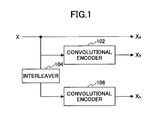
- FIGS. 1 and 2 are block diagrams for illustrating a conventional method of turbo encoding and decoding.
- FIG. 1 is a block diagram of signal processing related to turbo encoding performed at a transmission end.
- a signal sequence X to be transmitted is transmitted as signal sequences of three forms.
- a first signal sequence xa is transmitted in the exact form of the input signal sequence.
- a second signal sequence xb is created by subjecting the input signal sequence to convolutional encoding in a convolutional encoder 102.
- a third signal sequence xc is created by subjecting the input signal to convolutional encoding in a convolutional encoder 106 after changing data order in the signal sequence in an interleaver 104.
- FIG. 2 is a block diagram of signal processing related to turbo decoding performed at the reception end.
- the received signals are demodulated, and three signal sequences ya, yb, and yc corresponding to the signal sequences of three lines xa, xb, and xc created at the transmission end are obtained.
- These signals are signals after a soft decision, that is, signals before a hard decision related to binary signal determination such as "0" or "1" is made.
- a signal after a soft decision (soft decision data) is expressed in multi-bit floating-point notation.
- a turbo decoder includes a first decoding part 202, to which the first and second input signal sequences ya and yb and preliminary likelihood information Le2' are input. Based on these input signals, the first decoding part 202 outputs a first output signal L1 and extrinsic likelihood information Le1, which are decoding results.
- the first input signal sequence ya is interleaved by an interleaver 204 to be input to a second decoding part 208.
- the first extrinsic likelihood information Le1 from the first decoding part 202 is also interleaved by an interleaver 206 to be input to the second decoding part 208.
- the third input signal sequence yc is also input to the second decoding part 208. That is, the first decoding part 202 performs decoding based on the non-interleaved signals, while the second decoding part 208 performs decoding based on the interleaved signals.
- Le1' which is the interleaved first extrinsic likelihood information Le1 from the first decoding part 202, is input to the second decoding part 208 as preliminary likelihood information.
- the second decoding part 208 outputs a second output signal L2 and extrinsic likelihood information Le2, which are decoding results.
- the extrinsic likelihood information Le2 is input (fed back) to the first decoding part 202 as preliminary likelihood information after being deinterleaved by a deinterleaver 210.
- the second output signal L2 from the second decoding part 208 is deinterleaved by a deinterleaver 212 to be input to a hard decision part 214.
- the deinterleavers 210 and 212 are means for restoring the data order that has been rearranged by the interleavers 204 and 206 and the interleaver 104 (FIG. 1) at the transmission end.
- the hard decision part 214 makes a hard decision on soft decision data included in the decoded signal, and creates a binary-signal data sequence U(k) (k represents a sample number).
- the data sequence U(k) after the hard decision is input to an error check part 216.
- the error check part 216 performs a cyclic redundancy check (CRC) on all packet data units (PDUs) included in the data sequence U(k) of one block after the hard decision.
- CRC cyclic redundancy check
- the first and second decoding parts 202 and 208 output the decoded signals L1 and L2 repetitively, exchanging extrinsic likelihood information with each other.
- error correction capability in decoding can be improved compared with a case without performing it.
- the decoding result thus calculated is subjected to a hard decision in the hard decision part 214 and to error checking in the error check part 216. If no error is detected with respect to any packet data unit, this shows that the block is received and decoded satisfactorily, so that the processing of a later stage not graphically illustrated is caused to proceed. If an error is detected, this shows that the reception and decoding of the block includes an error, so that, for instance, retransmission is requested from the transmission end, or the number of repetitions of decoding is increased, thereby restoring appropriate data.
- Patent Document 1
- Patent Document 2
- a turbo decoder receiving a demodulated input signal before a hard decision, the input signal including blocks each being formed of a plurality of data units, the turbo decoder outputting a decoded signal block by block, characterized by:
- FIG. 3 is a block diagram for illustrating a turbo decoding method according to a first embodiment of the present invention.
- the signal sequence X to be transmitted is transmitted as signal sequences of three forms.
- the first signal sequence xa is transmitted in the exact form of the input signal sequence.
- the second signal sequence xb is created by subjecting the input signal sequence to convolutional encoding.
- the third signal sequence xc is created by subjecting the input signal to convolutional encoding after interleaving the input signal.
- the signals are received at the reception end and demodulated, so that the three signal sequences ya, yb, and yc corresponding to the signal sequences of three lines xa, xb, and xc created at the transmission end are obtained.
- These signals are signals after a soft decision, and in general, are expressed in multi-bit floating-point notation. These signals are finally determined as binary signals such as "1" or "0" (hard decision).
- a turbo decoder includes a first decoding part 302, to which the first and second input signal sequences ya and yb and preliminary likelihood information Le2' are input. Based on these input signals, the first decoding part 302 outputs a first output signal L1 and extrinsic likelihood information Le1, which are decoding results.
- the first input signal sequence ya is interleaved by an interleaver 304 to be input to a second decoding part 308.
- the first extrinsic likelihood information Le1 from the first decoding part 302 is also interleaved by an interleaver 306 to be input to the second decoding part 308.
- the third input signal sequence yc is also input to the second decoding part 308. That is, the first decoding part 302 performs decoding based on the non-interleaved signals, while the second decoding part 308 performs decoding based on the interleaved signals.
- Le1' which is the interleaved first extrinsic likelihood information Le1 from the first decoding part 302, is input to the second decoding part 308 as preliminary likelihood information.
- the second decoding part 308 outputs a second output signal L2 and extrinsic likelihood information Le2, which are decoding results.
- the extrinsic likelihood information Le2 is input to the first decoding part 302 as preliminary likelihood information after being deinterleaved by a deinterleaver 310.
- the second output signal L2 from the second decoding part 308 is deinterleaved by a deinterleaver 312 to be input to a hard decision part 314.
- the deinterleavers 310 and 312 are means for restoring the data order that has been rearranged by the interleavers 304 and 306 and the interleaver at the transmission end (for instance, 104 of FIG. 1).
- the hard decision part 314 makes a hard decision on soft decision data included in the decoded signal, and creates a binary-signal data sequence U(k) (k represents a sample number).
- the data sequence U(k) after the hard decision is input to an error check part 316.
- the error check part 316 performs a cyclic redundancy check (CRC) on all packet data units (PDUs) included in the data sequence U(k) of one block after the hard decision.
- CRC cyclic redundancy check
- the turbo decoder includes a specification part 318.
- the specification part 318 determines a packet data unit of the block with respect to which no error has been detected in the error checking performed on each packet data unit.
- the turbo decoder according to this embodiment includes a replacement part 320 connected to the specification part 318. With respect to a packet data unit in the input signal sequence corresponding to the packet data unit specified in the specification part 318, the replacement part 320 replaces its signal contents before the hard decision with its signal contents after the hard decision.
- the demodulated signals after the soft decision are input to the turbo decoder as the first through third input signal sequences.
- the first and second input signal sequences ya and yb are input to the first decoding part 302 to be decoded.
- the second and third input signal sequences yb and yc are input to the second decoding part 308 to be decoded.
- the first and second decoding parts 302 and 308 repetitively output the decoded signals L1 and L2 while exchanging the extrinsic likelihood information Le1, Le1', Le2, and Le2' with each other. By repetitively feeding back the extrinsic likelihood information to each other, error correction capability in decoding can be improved compared with a case without performing it.
- the decoding result thus calculated is subjected to a hard decision in the hard decision part 314 and to error checking in the error check part 316. If no error is detected with respect to any packet data unit, this shows that the block is received and decoded satisfactorily, so that the processing of a later stage not graphically illustrated is caused to proceed. If an error is detected with respect to all of the packet data units, restoration of appropriate data is sought by, for instance, increasing the number of repetitions of decoding or requesting retransmission from the transmission end.
- the check result of the error check part 316 is also reported to the specification part 318.
- the specification part 318 determines a packet data unit of the block with respect to which no error has been detected in the error checking performed on each packet data unit. For instance, it is assumed that N packet data units PDU 1 through PDU N are included in a single block and that their respective error checking results PDU-CRC 1 through PDU-CRC N are obtained. It is assumed that of these N error checking results, the r th one, PDU-CRC r , is satisfactory (without an error) and the others are not satisfactory (with errors). In this case, the specification part 318 specifies and retains the hard decision result U(k) corresponding to the r th packet data unit PDU r in the decoding result subjected to the hard decision U(k), and prepares for subsequent processing.
- the replacement part 320 replaces its signal contents before the hard decision with its signal contents after the hard decision.
- the binary data U(k), whose correctness is assured by the hard decision made thereon, is employed instead of the soft decision data y a (k). Thereafter, the decoded signal is output repetitively.
- a packet data unit whose error checking result is satisfactory is specified and retained, so that part of an input signal sequence is replaced with signal contents after the hard decision, and decoding calculations are reperformed.
- the correctness of the part of the input signal sequence is assured. Accordingly, it is possible to improve the accuracy and convergence of subsequent decoding calculations. In this respect, there is a great difference from the conventional method in which the error checking result is used only to determine the correctness of the entire block.
- FIG. 4 is a block diagram for illustrating a turbo decoding method according to a second embodiment of the present invention.
- the signal sequence to be transmitted is transmitted in the first signal sequence xa in the exact form of the input signal sequence, the second signal sequence xb as a result of subjecting the input signal sequence to convolutional encoding, and the third signal sequence xc as a result of subjecting the input signal to interleaving and convolutional encoding.
- These signal sequences of three lines are transmitted to a reception end after being subjected to modulation.
- the received signals are demodulated, so that the three signal sequences ya, yb, and yc corresponding to the signal sequences of three lines xa, xb, and xc created at the transmission end are obtained.
- These signals are signals subjected to a soft decision, but are finally subjected to a hard decision.
- a turbo decoder includes a first decoding part 402, to which the first and second input signal sequences ya and yb and preliminary likelihood information Le2' are input. Based on these input signals, the first decoding part 402 outputs a first output signal L1 and extrinsic likelihood information Le1, which are decoding results.
- the first input signal sequence ya is interleaved by an interleaver 404 to be input to a second decoding part 408.
- the first extrinsic likelihood information Le1 from the first decoding part 402 is also interleaved by an interleaver 406 to be input to the second decoding part 408.
- the third input signal sequence yc is also input to the second decoding part 408, and Le1', which is the interleaved first extrinsic likelihood information Le1 from the first decoding part 402, is input to the second decoding part 408 as preliminary likelihood information.
- the second decoding part 408 outputs a second output signal L2 and extrinsic likelihood information Le2, which are decoding results.
- the extrinsic likelihood information Le2 is input to the first decoding part 402 as preliminary likelihood information after being deinterleaved by a deinterleaver 410.
- the second output signal L2 from the second decoding part 408 is deinterleaved by a deinterleaver 412 to be input to a hard decision part 414.
- the hard decision part 414 makes a hard decision on soft decision data included in the decoded signal, and creates a binary-signal data sequence U(k) (k represents a sample number).
- the data sequence U(k) after the hard decision is input to an error check part 416.
- the error check part 416 performs a cyclic redundancy check (CRC) on all packet data units (PDUs) included in the data sequence U(k) of one block after the hard decision.
- CRC cyclic redundancy check
- the turbo decoder includes a specification part 418.
- the specification part 418 determines a packet data unit of the block with respect to which no error has been detected in the error checking performed on each packet data unit.
- the turbo decoder includes a first replacement part 420 connected to the specification part 418. With respect to a packet data unit in the input signal sequence corresponding to the packet data unit specified in the specification part 418, the first replacement part 420 replaces its signal contents before the hard decision with its signal contents after the hard decision.
- the turbo decoder includes a second replacement part 422.
- the second replacement part 422 provides the first decoding part 402 with the signal contents U(k) after the hard decision with respect to the packet data unit specified in the specification part 418.
- the first decoding part 402 includes a decoding operation part 424 that outputs a decoded signal L(k) decoded based on the preliminary likelihood information and the input signals.
- the first decoding part 402 includes a likelihood operation part 426 that calculates extrinsic likelihood information Le(k) based on the preliminary likelihood information, the decoding output L(k), and a signal from the input signal sequence.
- the demodulated signals after the soft decision are input to the turbo decoder as the first through third input signal sequences.
- the first and second decoding parts 402 and 408 repetitively output the decoded signals L1 and L2 while exchanging the extrinsic likelihood information Le1, Le1', Le2, and Le2' with each other.
- the decoding result thus calculated is subjected to a hard decision in the hard decision part 414 and to error checking in the error check part 416. If no error is detected with respect to any packet data unit, this shows that the block is received and decoded satisfactorily, so that the processing of a later stage not graphically illustrated is caused to proceed. If an error is detected with respect to all of the packet data units, restoration of appropriate data is sought by, for instance, increasing the number of repetitions of decoding or requesting retransmission from the transmission end.
- the check result of the error check part 416 is also reported to the specification part 418.
- the specification part 418 determines a packet data unit of the block with respect to which no error has been detected in the error checking performed on each packet data unit. For instance, it is assumed that N packet data units PDU 1 through PDU N are included in a single block and that their respective error checking results PDU-CRC 1 through PDU-CRC N are obtained. It is assumed that of these N error checking results, the r th one, PDU-CRC r , is satisfactory (without an error) and the others are not satisfactory (with errors). In this case, the specification part 418 specifies and retains the hard decision result U(k) corresponding to the r th packet data unit PDU r in the decoding result subjected to the hard decision U(k), and prepares for subsequent processing.
- the first replacement part 420 replaces its signal contents before the hard decision with its signal contents after the hard decision.
- soft decision data signal contents y a (k) pertaining to the PDU r in the first input signal sequence ya are replaced with the U(k) after the hard decision.
- the binary data U(k) whose correctness is assured by the hard decision made thereon, is employed instead of the soft decision data y a (k). Thereafter, the decoded signal is output repetitively.
- the second replacement part 422 also provides the first decoding part 402 with the signal contents U(k) after the hard decision with respect to the packet data unit specified in the specification part 418.
- the decoding operation part 424 of the first decoding part 402 calculates a decoding output L(k) decoded based on signals from the input signal sequences.
- the likelihood operation part 426 calculates extrinsic likelihood information using a signal from the second replacement part 422. More specifically, the likelihood operation part 426 calculates the extrinsic likelihood information Le(k), replacing an absolute value
- the second replacement part 422 is configured to affect signal processing in the first decoding part 402.
- the second replacement part 422 may also be configured to affect signal processing in the second decoding part 408. This is because the first and second decoding parts have the same functional means or configuration and it is satisfactory if decoding is performed using the hard decision result of a packet data unit proved to be correct by error checking and it is reflected in extrinsic likelihood information.
- FIG. 5 shows the results of a simulation performed using the turbo decoder according to the first embodiment of the present invention.
- a communications system using orthogonal frequency division multiplexing (OFDM) and code division multiple access (CDMA) is assumed with the modulation method being 64 QAM and the number of packet data units in a single block being 26.
- the horizontal axis represents the ratio of signal energy to noise power density (signal-to-noise ratio) per bit E b /N 0 .
- the vertical axis represents block error rate (BLER).
- the block error rates for four types of signal-to-noise ratios E b /N 0 were checked, and determined to be values represented by graph 502 according to the conventional method and values represented by graph 504 according to the embodiments of the present invention.
- the turbo decoders include a decoding part that decodes a signal based on input signal sequences and preliminary likelihood information, and outputs extrinsic likelihood information; a specification part that specifies a packet data unit whose error checking result has been satisfactory; and a replacement part that replaces the signal contents of the packet data unit with the signal contents after a hard decision.
- a decoding part that decodes a signal based on input signal sequences and preliminary likelihood information, and outputs extrinsic likelihood information
- a specification part that specifies a packet data unit whose error checking result has been satisfactory
- a replacement part that replaces the signal contents of the packet data unit with the signal contents after a hard decision.
- error checking is performed by a cyclic redundancy check (CRC).
- CRC cyclic redundancy check
- Some communications systems have employed CRC as a standard. Accordingly, in such communications systems, it is possible to realize the embodiments of the present invention without newly introducing a function or means for conducting a CRC check.
- decoding efficiency can be improved by effectively using the CRC check result of each of packet data units included in a block not only for determining the correctness of the entire block, but also for the next decoding calculation.
- extrinsic likelihood information calculated based on a hard decision result U(k) with respect to a PDU specified in the specification part and a decoding output L(k) and preliminary likelihood information z(k) with respect to the PDU, is used as preliminary likelihood information in the next decoding calculation.
- the preliminary likelihood information is corrected. Accordingly, it is possible to further improve the accuracy and convergence of decoding calculations.
Landscapes
- Engineering & Computer Science (AREA)
- Physics & Mathematics (AREA)
- Probability & Statistics with Applications (AREA)
- Theoretical Computer Science (AREA)
- Computer Networks & Wireless Communication (AREA)
- Signal Processing (AREA)
- Error Detection And Correction (AREA)
- Detection And Prevention Of Errors In Transmission (AREA)
Applications Claiming Priority (1)
| Application Number | Priority Date | Filing Date | Title |
|---|---|---|---|
| PCT/JP2003/004115 WO2004088852A1 (fr) | 2003-03-31 | 2003-03-31 | Turbo-demodulateur |
Publications (3)
| Publication Number | Publication Date |
|---|---|
| EP1610468A1 true EP1610468A1 (fr) | 2005-12-28 |
| EP1610468A4 EP1610468A4 (fr) | 2007-04-25 |
| EP1610468B1 EP1610468B1 (fr) | 2013-01-23 |
Family
ID=33105354
Family Applications (1)
| Application Number | Title | Priority Date | Filing Date |
|---|---|---|---|
| EP03715669A Expired - Lifetime EP1610468B1 (fr) | 2003-03-31 | 2003-03-31 | Turbo décodeur avec détection de sous-blocs sans erreurs |
Country Status (4)
| Country | Link |
|---|---|
| US (1) | US7346117B2 (fr) |
| EP (1) | EP1610468B1 (fr) |
| JP (1) | JP3892872B2 (fr) |
| WO (1) | WO2004088852A1 (fr) |
Cited By (1)
| Publication number | Priority date | Publication date | Assignee | Title |
|---|---|---|---|---|
| EP1742372A1 (fr) * | 2005-07-07 | 2007-01-10 | Highdimension Ltd. | Systeme et methode de turbo codage avec turbo entrelacement intra et intersequence |
Families Citing this family (4)
| Publication number | Priority date | Publication date | Assignee | Title |
|---|---|---|---|---|
| JP4551740B2 (ja) * | 2004-11-08 | 2010-09-29 | 株式会社東芝 | 低密度パリティチェック符号復号器及び方法 |
| GB0624572D0 (en) | 2006-12-08 | 2007-01-17 | Cambridge Silicon Radio Ltd | Data Proccessing in Signal Transmissions |
| JP4900168B2 (ja) * | 2007-09-28 | 2012-03-21 | 富士通株式会社 | 無線受信装置 |
| KR20170028160A (ko) * | 2015-09-03 | 2017-03-13 | 에스케이하이닉스 주식회사 | 에러 정정기를 포함하는 메모리 시스템 및 그것의 동작 방법 |
Family Cites Families (7)
| Publication number | Priority date | Publication date | Assignee | Title |
|---|---|---|---|---|
| CA2344046C (fr) * | 1998-09-28 | 2008-02-05 | Comtech Telecommunications Corp. | Turbo-decodeur de codes de produit |
| JP3545623B2 (ja) | 1999-01-05 | 2004-07-21 | 株式会社エヌ・ティ・ティ・ドコモ | 復号方法 |
| US6810502B2 (en) * | 2000-01-28 | 2004-10-26 | Conexant Systems, Inc. | Iteractive decoder employing multiple external code error checks to lower the error floor |
| JP2001230677A (ja) | 2000-02-16 | 2001-08-24 | Kawasaki Steel Corp | ターボ復号器 |
| EP1337075B1 (fr) | 2000-05-17 | 2007-07-11 | Matsushita Electric Industrial Co., Ltd. | Système ARQ hybride de transmission de paquets de données avec canal de commande et canal de données |
| US6950977B2 (en) * | 2001-03-15 | 2005-09-27 | 3G.Com, Inc. | Mechanism for turbo decoding when CRC for partial blocks is provided |
| US6950975B2 (en) * | 2001-08-03 | 2005-09-27 | Combasis Technology, Inc. | Acceleration of convergence rate with verified bits in turbo decoding |
-
2003
- 2003-03-31 JP JP2004570170A patent/JP3892872B2/ja not_active Expired - Fee Related
- 2003-03-31 EP EP03715669A patent/EP1610468B1/fr not_active Expired - Lifetime
- 2003-03-31 WO PCT/JP2003/004115 patent/WO2004088852A1/fr not_active Ceased
-
2005
- 2005-03-23 US US11/087,372 patent/US7346117B2/en not_active Expired - Lifetime
Cited By (1)
| Publication number | Priority date | Publication date | Assignee | Title |
|---|---|---|---|---|
| EP1742372A1 (fr) * | 2005-07-07 | 2007-01-10 | Highdimension Ltd. | Systeme et methode de turbo codage avec turbo entrelacement intra et intersequence |
Also Published As
| Publication number | Publication date |
|---|---|
| JPWO2004088852A1 (ja) | 2006-07-06 |
| WO2004088852A1 (fr) | 2004-10-14 |
| EP1610468A4 (fr) | 2007-04-25 |
| EP1610468B1 (fr) | 2013-01-23 |
| US7346117B2 (en) | 2008-03-18 |
| US20050185740A1 (en) | 2005-08-25 |
| JP3892872B2 (ja) | 2007-03-14 |
Similar Documents
| Publication | Publication Date | Title |
|---|---|---|
| US6557139B2 (en) | Encoding apparatus and encoding method for multidimensionally coding and encoding method and decoding apparatus for iterative decoding of multidimensionally coded information | |
| CN101449466B (zh) | 接收装置及其解码方法 | |
| JP3610329B2 (ja) | 大最小距離を用いたターボ符号化方法及びそれを実現するシステム | |
| US8443265B2 (en) | Method and apparatus for map decoding and turbo decoder using the same | |
| CN104025459B (zh) | 译码处理方法及译码器 | |
| US6292918B1 (en) | Efficient iterative decoding | |
| EP1004182B1 (fr) | Procedes et systemes de communication utilisant le codage parallele sans imbrication | |
| KR100860733B1 (ko) | 디코딩 디바이스, 디코딩 방법, 및 수신 장치 | |
| CN1536767B (zh) | 通信系统中的迭代解码装置和迭代解码方法 | |
| EP1004181B1 (fr) | Procedes et systemes de communication utilisant un decodage selectif recursif | |
| US20090041166A1 (en) | Method and apparatus to improve information decoding when its characteristics are known a priori | |
| CA2490802A1 (fr) | Procede d'etablissement d'accuse de reception h-arq rapide reposant sur l'utilisation d'une regle d'interruption pour decodage turbo | |
| US20030028838A1 (en) | Acceleration of convergence rate with verified bits in turbo decoding | |
| WO2002063889A2 (fr) | Detection aveugle de format de transport de donnees a codage turbo | |
| US8358713B2 (en) | High throughput and low latency map decoder | |
| US20090254792A1 (en) | Hybrid decoding using multiple turbo decoders in parallel | |
| CN101069357B (zh) | 对数据块冗余版本进行解码的Turbo解码器 | |
| US7346117B2 (en) | Turbo decoder | |
| US7380193B1 (en) | Jointly coded cooperative networking | |
| JP3910777B2 (ja) | 復号装置 | |
| US20030226086A1 (en) | Systems and methods for correcting errors in a received frame | |
| US6700938B1 (en) | Method for determining quality of trellis decoded block data | |
| KR100791228B1 (ko) | Bip를 이용한 반복복호 중단 장치 및 그 방법과, 그를이용한 터보 디코더 | |
| CN117176187A (zh) | 宽带双频率传输抗干扰方法、装置、计算机设备及存储介质 | |
| Yeh et al. | An FEC overlay for idle slot utilization for IS-136 |
Legal Events
| Date | Code | Title | Description |
|---|---|---|---|
| PUAI | Public reference made under article 153(3) epc to a published international application that has entered the european phase |
Free format text: ORIGINAL CODE: 0009012 |
|
| 17P | Request for examination filed |
Effective date: 20050318 |
|
| AK | Designated contracting states |
Kind code of ref document: A1 Designated state(s): AT BE BG CH CY CZ DE DK EE ES FI FR GB GR HU IE IT LI LU MC NL PT SE SI SK TR |
|
| RBV | Designated contracting states (corrected) |
Designated state(s): DE FR GB |
|
| A4 | Supplementary search report drawn up and despatched |
Effective date: 20070327 |
|
| 17Q | First examination report despatched |
Effective date: 20070612 |
|
| RIC1 | Information provided on ipc code assigned before grant |
Ipc: H03M 13/29 20060101AFI20120405BHEP Ipc: H04L 1/00 20060101ALN20120405BHEP |
|
| RTI1 | Title (correction) |
Free format text: TURBO DECODER WITH DETECTION OF ERROR-FREE SUB-BLOCKS |
|
| REG | Reference to a national code |
Ref country code: DE Ref legal event code: R079 Ref document number: 60343172 Country of ref document: DE Free format text: PREVIOUS MAIN CLASS: H03M0013450000 Ipc: H03M0013290000 |
|
| GRAP | Despatch of communication of intention to grant a patent |
Free format text: ORIGINAL CODE: EPIDOSNIGR1 |
|
| GRAJ | Information related to disapproval of communication of intention to grant by the applicant or resumption of examination proceedings by the epo deleted |
Free format text: ORIGINAL CODE: EPIDOSDIGR1 |
|
| GRAP | Despatch of communication of intention to grant a patent |
Free format text: ORIGINAL CODE: EPIDOSNIGR1 |
|
| RIC1 | Information provided on ipc code assigned before grant |
Ipc: H03M 13/29 20060101AFI20120724BHEP Ipc: H04L 1/00 20060101ALN20120724BHEP |
|
| GRAS | Grant fee paid |
Free format text: ORIGINAL CODE: EPIDOSNIGR3 |
|
| GRAA | (expected) grant |
Free format text: ORIGINAL CODE: 0009210 |
|
| AK | Designated contracting states |
Kind code of ref document: B1 Designated state(s): DE FR GB |
|
| REG | Reference to a national code |
Ref country code: GB Ref legal event code: FG4D |
|
| REG | Reference to a national code |
Ref country code: DE Ref legal event code: R096 Ref document number: 60343172 Country of ref document: DE Effective date: 20130321 |
|
| PLBE | No opposition filed within time limit |
Free format text: ORIGINAL CODE: 0009261 |
|
| STAA | Information on the status of an ep patent application or granted ep patent |
Free format text: STATUS: NO OPPOSITION FILED WITHIN TIME LIMIT |
|
| 26N | No opposition filed |
Effective date: 20131024 |
|
| REG | Reference to a national code |
Ref country code: DE Ref legal event code: R097 Ref document number: 60343172 Country of ref document: DE Effective date: 20131024 |
|
| PGFP | Annual fee paid to national office [announced via postgrant information from national office to epo] |
Ref country code: FR Payment date: 20140311 Year of fee payment: 12 |
|
| PGFP | Annual fee paid to national office [announced via postgrant information from national office to epo] |
Ref country code: GB Payment date: 20140326 Year of fee payment: 12 |
|
| PGFP | Annual fee paid to national office [announced via postgrant information from national office to epo] |
Ref country code: DE Payment date: 20140417 Year of fee payment: 12 |
|
| REG | Reference to a national code |
Ref country code: DE Ref legal event code: R119 Ref document number: 60343172 Country of ref document: DE |
|
| GBPC | Gb: european patent ceased through non-payment of renewal fee |
Effective date: 20150331 |
|
| REG | Reference to a national code |
Ref country code: FR Ref legal event code: ST Effective date: 20151130 |
|
| PG25 | Lapsed in a contracting state [announced via postgrant information from national office to epo] |
Ref country code: GB Free format text: LAPSE BECAUSE OF NON-PAYMENT OF DUE FEES Effective date: 20150331 Ref country code: DE Free format text: LAPSE BECAUSE OF NON-PAYMENT OF DUE FEES Effective date: 20151001 |
|
| PG25 | Lapsed in a contracting state [announced via postgrant information from national office to epo] |
Ref country code: FR Free format text: LAPSE BECAUSE OF NON-PAYMENT OF DUE FEES Effective date: 20150331 |