EP1611492B1 - Verfahren zum steuern eines garvorgangs - Google Patents
Verfahren zum steuern eines garvorgangs Download PDFInfo
- Publication number
- EP1611492B1 EP1611492B1 EP04719425.3A EP04719425A EP1611492B1 EP 1611492 B1 EP1611492 B1 EP 1611492B1 EP 04719425 A EP04719425 A EP 04719425A EP 1611492 B1 EP1611492 B1 EP 1611492B1
- Authority
- EP
- European Patent Office
- Prior art keywords
- temperature
- cooking
- cooking chamber
- heating device
- switching
- Prior art date
- Legal status (The legal status is an assumption and is not a legal conclusion. Google has not performed a legal analysis and makes no representation as to the accuracy of the status listed.)
- Expired - Lifetime
Links
- 238000010411 cooking Methods 0.000 title claims description 44
- 238000000034 method Methods 0.000 title claims description 19
- 238000010438 heat treatment Methods 0.000 claims description 16
- 230000005855 radiation Effects 0.000 claims description 11
- 230000001105 regulatory effect Effects 0.000 claims description 3
- 230000001276 controlling effect Effects 0.000 claims description 2
- 235000013305 food Nutrition 0.000 description 17
- 238000001816 cooling Methods 0.000 description 11
- 230000000694 effects Effects 0.000 description 2
- 235000021168 barbecue Nutrition 0.000 description 1
- 230000003111 delayed effect Effects 0.000 description 1
- 230000001419 dependent effect Effects 0.000 description 1
- 238000011161 development Methods 0.000 description 1
- 230000018109 developmental process Effects 0.000 description 1
- 230000004048 modification Effects 0.000 description 1
- 238000012986 modification Methods 0.000 description 1
- 230000002035 prolonged effect Effects 0.000 description 1
- 230000000630 rising effect Effects 0.000 description 1
- 230000002123 temporal effect Effects 0.000 description 1
Images
Classifications
-
- F—MECHANICAL ENGINEERING; LIGHTING; HEATING; WEAPONS; BLASTING
- F24—HEATING; RANGES; VENTILATING
- F24C—DOMESTIC STOVES OR RANGES ; DETAILS OF DOMESTIC STOVES OR RANGES, OF GENERAL APPLICATION
- F24C7/00—Stoves or ranges heated by electric energy
- F24C7/08—Arrangement or mounting of control or safety devices
Definitions
- the invention relates to a method for controlling a grilling process of the type explained in the preamble of claim 1.
- Cooking devices in the form of stoves or the like are known in large numbers.
- the control of a cooking process in these cooking devices is usually done by the user manually setting either a certain cooking temperature or a certain, predetermined mode (and optionally an operating period) selects that is automatically assigned to a specific cooking temperature.
- the predetermined cooking temperature is then kept substantially constant within a temperature control cycle, wherein the heater is switched on or off when reaching a predetermined switching temperature, the temperature usually within a temperature range oscillates.
- a method of operating a general cooking appliance is disclosed.
- a cooking chamber is supplied by means of a heater, an amount of heat in a control interval a cooking chamber temperature is controlled to a desired value, and in a control interval following the control interval, the cooking chamber temperature is not regulated, but it is independent of the setpoint the cooking or no amount of heat supplied ,
- the browning of the food is often unsatisfactory.
- the degree of browning of the food depends on the length of time in which the food is exposed to direct heat radiation through the heating device switched on.
- the heater In the Anatomphase the heater is always on, so that the food is constantly exposed to heat radiation and thus well browned.
- the heating device is switched off cyclically, so that the food to be cooked is also subjected to heat convection in addition to the tanning heat radiation, as a result of which the food to be cooked is less well browned. This is particularly noticeable when the food to be cooked during the cooking process must be turned, in which case the first page is well browned and the second page is cooked rather and less well browned.
- the invention has for its object to provide a method that provide a better browning result.
- the invention is solved by a method according to claim 1.
- the temperature is lowered via a temporary cooling phase causes subsequently the heater is turned on for a longer period of time, so that the food is exposed to the tanning heat radiation for a long time.
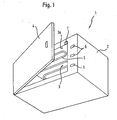
- Fig. 1 shows a cooking device 1 according to the invention, which is shown in the present embodiment as a grill device.
- the cooking device includes a housing 2 which encloses a cooking chamber 3 which is closed by a door 4.
- a conventional heating device 5 is provided in the form of heating coils, which are arranged on the ceiling 3 a of the cooking chamber 3. Furthermore, the usual temperature sensor, preferably provided in the rear region of the cooking chamber 3, which are not shown in the drawing.
- the cooking device 1 further includes a not shown control that can be operated by conventional controls 6.
- the control is connected to a switching contact 7 shown only schematically, which is actuated by the opening and closing of the door.
- the switching contact 7 is designed such that it switches off the heating device 5 as soon as the door 4 is opened and releases the switching on of the heating device 5 as soon as the door 4 is closed.
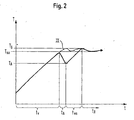
- Fig. 2 shows the course of a grilling process as a preferred cooking process.
- the user places the food to be cooked in the cooking chamber 3 and selects the desired operating mode "barbecue" and / or the desired cooking temperature and / or the desired cooking time via the controls 6.
- the heater turns on and heats the cooking chamber 3 over the time t v .
- the heater 5 remains turned on; the heater facing side of the food is thus exposed to permanent heat radiation and tans accordingly sufficient.
- the food is cooking.
- the time t v has expired, the food must be turned over.
- the user opens the door 4, whereby the heating device 5 is switched off by the switching contact 7.
- the cooking chamber 3 is not further heated and the temperature drops over a temporary cooling phase t A to a lowering temperature T A.
- switching on the heater 5 is released again via the switching contact 7, so that the heating to the predetermined cooking temperature T G within the time range t vs with a substantially same curve increase as in the area t v is continued.
- the beginning of a control cycle t R in which the heating device 5 is switched on and off in order to keep the temperature constant between the cooking temperature T G and a lower switching temperature T SU , is delayed.
- the cooling phase t A thus causes an extension of the switch-on of the heater after cooling.
- the heating phase t v would not be interrupted or substantially interrupted, but would continue at the same rising angle up to the cooking temperature T G and then pass into the control phase, as indicated by the dot-dash line II in FIG Fig. 2 is indicated.
- the heater 5 is designed relatively strong especially for grills and the temperature sensors are usually so far away from the door that they can not be influenced by the user, so that opening the door 4 for the purpose of turning the Gargutes with ongoing heating device 5 Although a slight lowering of the temperature causes this lowering is not sufficient to increase the turn-on time of the heater after turning crucial, and thus to influence the degree of browning positive.
- the temperature within the temporary cooling period t A is lowered to a reduced temperature T A, which lies below the lower switching temperature T SU.
- the temporal arrangement of the temporary cooling phase t A can be placed at any point of the curve, ie, for example, be introduced only in the control cycle t R and interrupt it.
- the following table shows the extension effect of the cooling phase on the radiation time when grilling a steak: duration Grilling steaks without door contact Grilling steaks with door contact 1 page 10 mins 10 minutes on-time the radiator 10 minutes on-time the radiator Turn: about 30 seconds Radiator continues Radiator off 2. Page 5 minutes 2 minutes radiator 3 min. 40 sec. Radiator on 3 minutes radiator off 1 min 10 sec radiator off
- the invention is preferably applicable to grills or grills, but can be used anywhere in the context of claim 1, where it depends on a good browning with short cooking times and / or on a safety function (when coupled with the door opening).
Landscapes
- Engineering & Computer Science (AREA)
- Chemical & Material Sciences (AREA)
- Combustion & Propulsion (AREA)
- Mechanical Engineering (AREA)
- General Engineering & Computer Science (AREA)
- Electric Stoves And Ranges (AREA)
- Baking, Grill, Roasting (AREA)
Description
- Die Erfindung bezieht sich auf ein Verfahren zum Steuern eines Grillvorgangs der in dem Oberbegriff der Anspruchs 1 erläuterten Art.
- Gareinrichtungen in Form von Herden oder dgl. sind in großer Zahl bekannt. Die Steuerung eines Garvorgangs in diesen Gareinrichtungen erfolgt üblicherweise dadurch, dass der Benutzer manuell entweder eine bestimmte Gartemperatur einstellt oder eine bestimmte, vorgegebene Betriebsart (und gegebenenfalls eine Betriebsdauer) wählt, der automatisch eine bestimmte Gartemperatur zugeordnet ist. Beim Erreichen dieser Gartemperatur wird dann innerhalb eines Temperatur-Regelzyklus die vorgegebene Gartemperatur im Wesentlichen konstant gehalten, wobei die Heizeinrichtung jeweils beim Erreichen einer vorbestimmten Schalttemperatur an- bzw. abgeschaltet wird, wobei die Temperatur gewöhnlich innerhalb eines Temperaturbereichs pendelt.
- In der
EP 1 273 852 A2 ist zum Beispiel ein Verfahren zum Betrieb eines allgemeinen Gargeräts offenbart. Dabei wird einem Garraum mittels einer Heizeinrichtung eine Wärmemenge zugeführt, wobei in einem Regelintervall eine Garraumtemperatur auf einen Sollwert geregelt wird, und in einem dem Regelintervall folgenden Steuerintervall wird die Garraumtemperatur nicht geregelt, sondern es wird unabhängig vom Sollwert dem Garraum keine oder eine bestimmte Wärmemenge zugeführt. - Bei kürzeren Betriebsarten, wie beispielsweise der Betriebsart "Grillen", besteht jedoch das Problem, dass die Bräunung des Gargutes oft unbefriedigend ist. Bei diesen kürzeren Betriebsarten hängt der Bräunungsgrad des Gargutes von der Zeitdauer ab, in der das Gargut einer direkten Wärmestrahlung durch die angeschaltete Heizeinrichtung ausgesetzt ist. In der Anheizphase ist die Heizeinrichtung ständig eingeschaltet, so dass das Gargut ständig einer Wärmstrahlung ausgesetzt ist und somit gut bräunt. Während des Regelzyklus wird jedoch die Heizeinrichtung zyklisch ausgeschaltet, so dass das Gargut außer der bräunenden Wärmestrahlung auch einer Wärmekonvektion ausgesetzt ist, durch die das Gargut weniger gut gebräunt wird. Dies macht sich besonders bemerkbar, wenn das Gargut im Verlauf des Garvorganges gewendet werden muss, wobei dann die erste Seite gut gebräunt ist und die zweite Seite eher gegart und weniger gut gebräunt wird.
- Der Erfindung liegt die Aufgabe zugrunde, ein Verfahren bereitzustellen, das ein besseres Bräunungsergebnis liefern.
- Die Erfindung wird durch ein Verfahren gemäß Anspruch 1 gelöst.
- Durch den erfindungsgemäßen Vorschlag, im Verlaufe des Garvorgangs die Temperatur über eine temporäre Abkühlphase abzusenken wird bewirkt, dass anschließend die Heizeinrichtung für eine längere Zeitdauer eingeschaltet bleibt, so dass das Gargut längere Zeit der bräunenden Wärmestrahlung ausgesetzt ist.
- Vorteilhafte Weiterbildungen der Erfindung sind den Unteransprüchen zu entnehmen.
- Besonders zweckmäßig ist es, die temporäre Abkühlphase durch ein Abschalten der Heizeinrichtung beim Öffnen der Tür des Garraumes einzuleiten. Diese Maßnahme hat einen zusätzlichen Sicherheitseffekt, da sie einerseits den Benutzer beispielsweise beim Wenden des Gargutes gegen eine übermäßige Wärmestrahlung schützt, und andererseits verhindert, dass die Heizeinrichtung bei einer versehentlich offengelassenen Tür eingeschaltet bleibt.
- Ein Ausführungsbeispiel der Erfindung wird nachfolgend anhand der Zeichnungen näher erläutert. Es zeigen:
- Fig. 1
- eine schematische Darstellung einer erfindungsgemäßen Gareinrichtung, und
- Fig. 2
- eine schematische Temperatur-Zeit-Kurve eines beispielhaften Garvorganges.
-
Fig. 1 zeigt eine erfindungsgemäße Gareinrichtung 1, die im vorliegenden Ausführungsbeispiel als Grillgerät abgebildet ist. Die Gareinrichtung enthält ein Gehäuse 2, das einen Garraum 3 umschließt, der von einer Tür 4 abgeschlossen wird. - Im Garraum 3 ist eine übliche Heizvorrichtung 5 in Form von Heizschlangen vorgesehen, die an der Decke 3a des Garraumes 3 angeordnet sind. Weiterhin sind die üblichen Temperaturfühler, vorzugsweise im hinteren Bereich des Garraums 3 vorgesehen, die in der Zeichnung nicht dargestellt sind.
- Die Garvorrichtung 1 enthält weiterhin eine nicht gezeichnete Steuerung, die durch übliche Bedienelemente 6 betätigt werden kann.
- Mit der Steuerung ist ein nur schematisch dargestellter Schaltkontakt 7 verbunden, der durch das Öffnen und Schließen der Tür betätigt wird. Der Schaltkontakt 7 ist so ausgebildet, dass er die Heizeinrichtung 5 abschaltet, sobald die Tür 4 geöffnet wird und das Einschalten der Heizeinrichtung 5 freigibt, sobald die Tür 4 geschlossen ist.
- Anhand der Temperatur-Zeit-Kurve der
Fig. 2 soll ein Garvorgang näher erläutert werden.Fig. 2 zeigt den Verlauf eines Grillvorganges als bevorzugten Garprozess. Der Benutzer legt das Grillgut in den Garraum 3 und wählt über die Bedienelemente 6 die gewünschte Betriebsart "Grillen" und/oder die gewünschte Gartemperatur und/oder die gewünschte Garzeit vor. Nach dem Schließen der Tür 4 schaltet sich die Heizeinrichtung ein und heizt den Garraum 3 über die Zeitdauer tv auf. Während dieser Zeit tv bleibt die Heizeinrichtung 5 angeschaltet; die der Heizeinrichtung zugewandte Seite des Gargutes ist somit einer permanenten Wärmestrahlung ausgesetzt und bräunt demzufolge ausreichend. Gleichzeitig gart das Gargut vor. Nach Ablauf der Zeitdauer tv muss das Gargut gewendet werden. Der Benutzer öffnet die Tür 4, wodurch durch den Schaltkontakt 7 die Heizeinrichtung 5 abgeschaltet wird. Dadurch wird der Garraum 3 nicht weiter beheizt und die Temperatur fällt über eine temporäre Abkühlphase tA auf eine Absenktemperatur TA ab. Wird die Tür 4 nach dem Wenden des Gargutes wieder geschlossen, so wird über den Schaltkontakt 7 das Einschalten der Heizvorrichtung 5 wieder freigegeben, so dass das Aufheizen auf die vorbestimmte Garguttemperatur TG innerhalb des Zeitbereiches tvs mit einem im Wesentlichen gleichen Kurvenanstieg wie im Bereich tv fortgesetzt wird. Auf diese Weise verzögert sich der Beginn eines Regelzyklus tR, in dem die Heizeinrichtung 5 zum Konstanthalten der Temperatur zwischen der Gartemperatur TG und einer unteren Schalttemperatur TSU getaktet ein- und ausgeschaltet wird. Nach dem Wenden des Gargutes wird damit auch die zweite Seite des Gargutes über eine längere Zeit der Wärmestrahlung ausgesetzt, als dies ohne die temporäre Abkühlphase tA der Fall wäre, und das Gargut wird auf der zweiten Seite besser gebräunt, als dies mit dem üblichen Wechsel von Wärmestrahlung und Wärmekonvektion bei der üblichen Länge des Regelzyklus tR der Fall wäre. Die Abkühlphase tA bewirkt somit eine Verlängerung der Einschaltzeit der Heizeinrichtung nach dem Abkühlen. Ohne die Abkühlphase tA würde hingegen die Aufheizphase tv nicht oder im Wesentlichen nicht unterbrochen, sondern mit dem gleichen Anstiegswinkel bis zur Gartemperatur TG weitergeführt und dann in die Regelphase übergehen, wie dies durch den strichpunktierten Verlauf II inFig. 2 angedeutet ist. - Es soll darauf hingewiesen werden, dass die Heizeinrichtung 5 insbesondere für Grillgeräte relativ stark ausgelegt ist und die Temperaturfühler gewöhnlich so weit von der Tür entfernt sind, dass sie vom Benutzer nicht beeinflusst werden können, so dass ein Öffnen der Tür 4 zum Zwecke des Wendens des Gargutes bei weiterlaufender Heizeinrichtung 5 zwar auch ein geringfügiges Absenken der Temperatur bewirkt, dieses Absenken jedoch nicht ausreicht, die Einschaltzeit der Heizvorrichtung nach dem Wenden entscheidend zu erhöhen, und somit den Bräunungsgrad positiv zu beeinflussen.
- Für eine Wirksamkeit der Erfindung ist es wesentlich, dass die Temperatur innerhalb der temporären Abkühlphase tA auf eine Absenktemperatur TA abgesenkt wird, die unterhalb der unteren Schalttemperatur TSU liegt. Dagegen kann die zeitliche Anordnung der temporären Abkühlphase tA an jede Stelle der Kurve gelegt werden, d.h. beispielsweise auch erst im Regelzyklus tR eingeleitet werden und diesen unterbrechen.
- Die nachfolgende Tabelle zeigt die Verlängerungswirkung der Abkühlphase auf die Strahlungszeit beim Grillen eines Steaks:
Dauer Grillen von Steaks ohne Türkontakt Grillen von Steaks mit Türkontakt 1. Seite 10 Minuten 10 Minuten Ein-Zeit der Heizkörper 10 Minuten Ein-Zeit der Heizkörper Wenden: ca. 30 Sekunden Heizkörper weiterhin ein Heizkörper aus 2. Seite 5 Minuten 2 Minuten Heizkörper ein 3 Min 40 Sec Heizkörper ein 3 Minuten Heizkörper aus 1 Min 10 Sec Heizkörper aus - In Abwandlung des gezeichneten Ausführungsbeispieles ist es weiterhin möglich, die temporäre Abkühlphase auch in ein Garprogramm einzuarbeiten, beispielsweise indem man das Wiederanschalten der Heizeinrichtung nach Unterschreiten der unteren Schalttemperatur, nach dem ersten Erreichen der Gartemperatur, solange aussetzt, bis die Temperatur genügend weit unterhalb der unteren Schalttemperatur abgefallen ist oder aktiv abgesenkt wurde, so dass anschließend wieder eine verlängerte Strahlungszeit der Heizeinrichtung notwendig ist.
- Die Erfindung ist bevorzugt bei Grillgeräten oder Grilleinrichtungen anwendbar, kann jedoch im Rahmen von Anspruch 1 überall dort eingesetzt werden, wo es auf eine gute Bräunung bei kurzen Garzeiten und/oder auf eine Sicherheitsfunktion (bei Kopplung mit der Türöffnung) ankommt.
Claims (3)
- Verfahren zum Steuern eines Grillvorganges in einem mit einer Heizeinrichtung (5) versehenen, abgeschlossenen Garraum (3) einer Grilleinrichtung (1), wobei die Temperatur im Garraum (3) festgestellt und die Heizeinrichtung (5) über einen Temperatur-Regelzyklus an- und abgeschaltet wird, sobald eine vorbestimmte Schalttemperatur erreicht wird, dadurch gekennzeichnet, dass die Temperatur im Garraum (3) während des Grillvorganges im Verlauf einer temporären Abkühlphase (tA) abgesenkt, die unterhalb einer unteren Schalttemperatur (TSU) liegt, und in einer anschließenden Aufheizphase (tvs) wieder erhöht wird, wobei die temporäre Abkühlphase (tA) durch ein bezüglich des Regelzyklus (tR) außerplanmäßiges Abschalten der Heizeinrichtung (5) bei einem Öffnen des Garraumes (3) eingeleitet wird und Gargut während der Aufheizphase (tvs) einer permanenten Wärmestrahlung ausgesetzt ist, und wobei ein Einschalten der Heizeinrichtung (5) freigegeben wird, sobald der Garraum (3) geschlossen wird.
- Verfahren nach Anspruch 1, dadurch gekennzeichnet, dass die temporäre Abkühlphase (tA) kurz vor dem Erreichen der Gartemperatur (TG) eingeleitet wird.
- Verfahren nach Anspruch 1 oder 2, dadurch gekennzeichnet, dass die temporäre Abkühlphase (tA) beim Wenden des Gargutes eingeleitet wird.
Applications Claiming Priority (2)
| Application Number | Priority Date | Filing Date | Title |
|---|---|---|---|
| DE10313595A DE10313595A1 (de) | 2003-03-26 | 2003-03-26 | Verfahren zum Steuern eines Garvorgangs und Gareinrichtung |
| PCT/EP2004/002546 WO2004086162A1 (de) | 2003-03-26 | 2004-03-11 | Verfahren zum steuern eines garvorgangs und gareinrichtung |
Publications (2)
| Publication Number | Publication Date |
|---|---|
| EP1611492A1 EP1611492A1 (de) | 2006-01-04 |
| EP1611492B1 true EP1611492B1 (de) | 2013-05-15 |
Family
ID=32946189
Family Applications (1)
| Application Number | Title | Priority Date | Filing Date |
|---|---|---|---|
| EP04719425.3A Expired - Lifetime EP1611492B1 (de) | 2003-03-26 | 2004-03-11 | Verfahren zum steuern eines garvorgangs |
Country Status (5)
| Country | Link |
|---|---|
| US (1) | US7446283B2 (de) |
| EP (1) | EP1611492B1 (de) |
| DE (1) | DE10313595A1 (de) |
| ES (1) | ES2409337T3 (de) |
| WO (1) | WO2004086162A1 (de) |
Families Citing this family (4)
| Publication number | Priority date | Publication date | Assignee | Title |
|---|---|---|---|---|
| DE102005020744B3 (de) * | 2005-05-02 | 2006-12-14 | Rational Ag | Verfahren zum Führen eines Garprozesses unter Berücksichtigung des Öffnungsgrades zumindest einer Garraumöffnung und Gargerät zur Durchführung solch eines Verfahrens |
| DE102008040981A1 (de) | 2008-08-05 | 2010-02-11 | BSH Bosch und Siemens Hausgeräte GmbH | Verfahren zum Steuern eines Garvorgangs |
| CH702581B1 (de) | 2011-06-21 | 2019-09-13 | V Zug Ag | Verfahren zum Garen eines Garguts mittels Dampf. |
| US10782027B2 (en) * | 2017-10-17 | 2020-09-22 | Whirlpool Corporation | Cooking appliance with user-selectable sear feature |
Citations (1)
| Publication number | Priority date | Publication date | Assignee | Title |
|---|---|---|---|---|
| US5339726A (en) * | 1989-06-09 | 1994-08-23 | Cyclofur Company, L.P. | Hot air circulating oven and food heating apparatus |
Family Cites Families (14)
| Publication number | Priority date | Publication date | Assignee | Title |
|---|---|---|---|---|
| US2564321A (en) * | 1947-02-14 | 1951-08-14 | John B Brosseau | Timing device |
| US4302660A (en) * | 1976-12-13 | 1981-11-24 | Sunbeam Corporation | Door opening mechanism for partially opening a toaster oven door |
| CA1147036A (en) * | 1978-09-26 | 1983-05-24 | Shigeru Kusunoki | Method of controlling heating in food heating apparatus including infrared detecting system |
| DE4423557C2 (de) | 1994-07-05 | 2001-02-01 | Wiesheu Gmbh | Ofen zur Wärmebehandlung von Lebensmitteln |
| CA2224447A1 (en) * | 1995-06-15 | 1997-01-03 | Aktiebolaget Electrolux | An oven for the preparation of food |
| US5786996A (en) * | 1996-06-28 | 1998-07-28 | Eaton Corporation | Appliance control circuit comprising dual microprocessors for enhanced control operation and agency safety redundancy and software application method thereof |
| US5889259A (en) * | 1997-05-22 | 1999-03-30 | Hp Intellectual Corp. | Toaster oven control assembly |
| WO1999027828A1 (en) * | 1997-12-02 | 1999-06-10 | Koninklijke Philips Electronics N.V. | Heating vessel and method of controlling the heating element of such a vessel |
| US6333492B1 (en) * | 1999-03-30 | 2001-12-25 | General Electric Company | Thermal compensation for visible light cooking oven |
| US6140619A (en) * | 1999-05-28 | 2000-10-31 | The Garland Group | Temperature control apparatus, method and memory medium for an oven |
| US6417493B1 (en) * | 1999-09-13 | 2002-07-09 | Maytag Corporation | Self-cleaning method for a cooking appliance |
| DE60116244D1 (de) * | 2000-11-10 | 2006-02-02 | Electrolux Ab | Steuerung der Energieaufnahme eines Ofens |
| DE10129885C1 (de) * | 2001-06-19 | 2002-10-10 | Schwab Technologieberatung | Verfahren zur Regelung der Heizleistung eines Backofens |
| DE10132304B4 (de) | 2001-07-06 | 2005-10-27 | BSH Bosch und Siemens Hausgeräte GmbH | Verfahren zum Betrieb eines Gargeräts |
-
2003
- 2003-03-26 DE DE10313595A patent/DE10313595A1/de not_active Withdrawn
-
2004
- 2004-03-11 WO PCT/EP2004/002546 patent/WO2004086162A1/de not_active Ceased
- 2004-03-11 ES ES04719425T patent/ES2409337T3/es not_active Expired - Lifetime
- 2004-03-11 US US10/546,789 patent/US7446283B2/en not_active Expired - Lifetime
- 2004-03-11 EP EP04719425.3A patent/EP1611492B1/de not_active Expired - Lifetime
Patent Citations (1)
| Publication number | Priority date | Publication date | Assignee | Title |
|---|---|---|---|---|
| US5339726A (en) * | 1989-06-09 | 1994-08-23 | Cyclofur Company, L.P. | Hot air circulating oven and food heating apparatus |
Also Published As
| Publication number | Publication date |
|---|---|
| EP1611492A1 (de) | 2006-01-04 |
| WO2004086162A1 (de) | 2004-10-07 |
| US7446283B2 (en) | 2008-11-04 |
| ES2409337T3 (es) | 2013-06-26 |
| DE10313595A1 (de) | 2004-10-07 |
| US20060081597A1 (en) | 2006-04-20 |
Similar Documents
| Publication | Publication Date | Title |
|---|---|---|
| EP0723115B1 (de) | Ofen und Verfahren zum Garen von Fleisch | |
| EP0513721B1 (de) | Verfahren und Vorrichtung zur Steuerung eines Back-/Bratvorgangs | |
| EP1436550B1 (de) | Gargerät mit einem wrasenlüfter | |
| EP1838137B1 (de) | Verfahren sowie Schaltungsanordnung zum Steuern wenigstens eines Heizelementes eines Heizgerätes | |
| EP1611492B1 (de) | Verfahren zum steuern eines garvorgangs | |
| EP1394472B1 (de) | Verfahren zum Betrieb eines Gargeräts | |
| DE102005057585B3 (de) | Garverfahren | |
| EP1273852B2 (de) | Verfahren zum Betrieb eines Gargeräts sowie Gargerät | |
| EP1600694B1 (de) | Vorrichtung und Verfahren zum Einstellen und Anzeigen von Zeitfunktionen für ein Haushaltsgerät | |
| DE20221600U1 (de) | Vorrichtung zum Steuern eines Gargerätes, insbesondere Haushaltsgargerätes | |
| EP2233016B2 (de) | Verfahren zum Garen von Gargut mit einem Gargerät | |
| EP2767255A1 (de) | Dentalbrennofen sowie Verfahren zum Betrieb eines Dentalbrennofens | |
| EP3267114A1 (de) | Verfahren zur steuerung eines backofens und backofen | |
| DE102020128418A1 (de) | Verfahren zum Betreiben eines Gargeräts und Gargerät | |
| EP2129969A2 (de) | Verfahren zur verhinderung des unbeabsichtigten betriebes eines heizgerätes | |
| EP0552409B1 (de) | Verfahren und Schaltungsanordnung zum Betrieb eines Backraumes mit mindestens einer elektrischen Heizeinrichtung und einer Mikrowelleneinrichtung | |
| DE102013215847A1 (de) | Verfahren zum Durchführen eines Zubereitungsvorgangs mit einer Absenk-Zeitdauer sowie Gargerät zum Durchführen eines derartigen Verfahrens | |
| EP0618408B1 (de) | Verschliessbares Heizgerät mit einem Behandlungsraum mit Temperaturregelung für einen festlegbaren Temperaturbereich | |
| DE102005047582B4 (de) | Verfahren zum Garen von Speisen in einen Garraum eines Gargeräts | |
| EP3569932A1 (de) | Verfahren zum niedertemperatur-garen von nahrungsmitteln | |
| EP1791395A2 (de) | Temperaturerfassungseinrichtung für eine Heizeinrichtung sowie Verfahren zur Ansteuerung einer Heizeinrichtung | |
| DE10064117B4 (de) | Kochfeld mit zwei Betriebsarten | |
| DE102011056653A1 (de) | Gargerät und Verfahren zum Betreiben eines Gargerätes | |
| DE69917525T2 (de) | Verfahren zum Kochen von Nahrungsmitteln in einem Garofen | |
| DE102009059268B3 (de) | Backofen und Verfahren zum Betreiben eines Backofens |
Legal Events
| Date | Code | Title | Description |
|---|---|---|---|
| PUAI | Public reference made under article 153(3) epc to a published international application that has entered the european phase |
Free format text: ORIGINAL CODE: 0009012 |
|
| 17P | Request for examination filed |
Effective date: 20051026 |
|
| AK | Designated contracting states |
Kind code of ref document: A1 Designated state(s): AT BE BG CH CY CZ DE DK EE ES FI FR GB GR HU IE IT LI LU MC NL PL PT RO SE SI SK TR |
|
| AX | Request for extension of the european patent |
Extension state: AL LT LV MK |
|
| DAX | Request for extension of the european patent (deleted) | ||
| 17Q | First examination report despatched |
Effective date: 20070301 |
|
| RTI1 | Title (correction) |
Free format text: METHOD FOR CONTROLLING A COOKING PROCESS |
|
| GRAP | Despatch of communication of intention to grant a patent |
Free format text: ORIGINAL CODE: EPIDOSNIGR1 |
|
| GRAS | Grant fee paid |
Free format text: ORIGINAL CODE: EPIDOSNIGR3 |
|
| GRAA | (expected) grant |
Free format text: ORIGINAL CODE: 0009210 |
|
| AK | Designated contracting states |
Kind code of ref document: B1 Designated state(s): AT BE BG CH CY CZ DE DK EE ES FI FR GB GR HU IE IT LI LU MC NL PL PT RO SE SI SK TR |
|
| REG | Reference to a national code |
Ref country code: GB Ref legal event code: FG4D Free format text: NOT ENGLISH Ref country code: CH Ref legal event code: EP |
|
| REG | Reference to a national code |
Ref country code: AT Ref legal event code: REF Ref document number: 612450 Country of ref document: AT Kind code of ref document: T Effective date: 20130615 |
|
| REG | Reference to a national code |
Ref country code: IE Ref legal event code: FG4D Free format text: LANGUAGE OF EP DOCUMENT: GERMAN |
|
| REG | Reference to a national code |
Ref country code: ES Ref legal event code: FG2A Ref document number: 2409337 Country of ref document: ES Kind code of ref document: T3 Effective date: 20130626 |
|
| REG | Reference to a national code |
Ref country code: DE Ref legal event code: R096 Ref document number: 502004014169 Country of ref document: DE Effective date: 20130711 |
|
| REG | Reference to a national code |
Ref country code: NL Ref legal event code: VDEP Effective date: 20130515 |
|
| PG25 | Lapsed in a contracting state [announced via postgrant information from national office to epo] |
Ref country code: PT Free format text: LAPSE BECAUSE OF FAILURE TO SUBMIT A TRANSLATION OF THE DESCRIPTION OR TO PAY THE FEE WITHIN THE PRESCRIBED TIME-LIMIT Effective date: 20130916 Ref country code: GR Free format text: LAPSE BECAUSE OF FAILURE TO SUBMIT A TRANSLATION OF THE DESCRIPTION OR TO PAY THE FEE WITHIN THE PRESCRIBED TIME-LIMIT Effective date: 20130816 Ref country code: SI Free format text: LAPSE BECAUSE OF FAILURE TO SUBMIT A TRANSLATION OF THE DESCRIPTION OR TO PAY THE FEE WITHIN THE PRESCRIBED TIME-LIMIT Effective date: 20130515 Ref country code: SE Free format text: LAPSE BECAUSE OF FAILURE TO SUBMIT A TRANSLATION OF THE DESCRIPTION OR TO PAY THE FEE WITHIN THE PRESCRIBED TIME-LIMIT Effective date: 20130515 Ref country code: FI Free format text: LAPSE BECAUSE OF FAILURE TO SUBMIT A TRANSLATION OF THE DESCRIPTION OR TO PAY THE FEE WITHIN THE PRESCRIBED TIME-LIMIT Effective date: 20130515 |
|
| PG25 | Lapsed in a contracting state [announced via postgrant information from national office to epo] |
Ref country code: PL Free format text: LAPSE BECAUSE OF FAILURE TO SUBMIT A TRANSLATION OF THE DESCRIPTION OR TO PAY THE FEE WITHIN THE PRESCRIBED TIME-LIMIT Effective date: 20130515 Ref country code: BG Free format text: LAPSE BECAUSE OF FAILURE TO SUBMIT A TRANSLATION OF THE DESCRIPTION OR TO PAY THE FEE WITHIN THE PRESCRIBED TIME-LIMIT Effective date: 20130815 |
|
| PG25 | Lapsed in a contracting state [announced via postgrant information from national office to epo] |
Ref country code: EE Free format text: LAPSE BECAUSE OF FAILURE TO SUBMIT A TRANSLATION OF THE DESCRIPTION OR TO PAY THE FEE WITHIN THE PRESCRIBED TIME-LIMIT Effective date: 20130515 Ref country code: CZ Free format text: LAPSE BECAUSE OF FAILURE TO SUBMIT A TRANSLATION OF THE DESCRIPTION OR TO PAY THE FEE WITHIN THE PRESCRIBED TIME-LIMIT Effective date: 20130515 Ref country code: SK Free format text: LAPSE BECAUSE OF FAILURE TO SUBMIT A TRANSLATION OF THE DESCRIPTION OR TO PAY THE FEE WITHIN THE PRESCRIBED TIME-LIMIT Effective date: 20130515 Ref country code: DK Free format text: LAPSE BECAUSE OF FAILURE TO SUBMIT A TRANSLATION OF THE DESCRIPTION OR TO PAY THE FEE WITHIN THE PRESCRIBED TIME-LIMIT Effective date: 20130515 |
|
| PG25 | Lapsed in a contracting state [announced via postgrant information from national office to epo] |
Ref country code: IT Free format text: LAPSE BECAUSE OF FAILURE TO SUBMIT A TRANSLATION OF THE DESCRIPTION OR TO PAY THE FEE WITHIN THE PRESCRIBED TIME-LIMIT Effective date: 20130515 Ref country code: RO Free format text: LAPSE BECAUSE OF FAILURE TO SUBMIT A TRANSLATION OF THE DESCRIPTION OR TO PAY THE FEE WITHIN THE PRESCRIBED TIME-LIMIT Effective date: 20130515 Ref country code: NL Free format text: LAPSE BECAUSE OF FAILURE TO SUBMIT A TRANSLATION OF THE DESCRIPTION OR TO PAY THE FEE WITHIN THE PRESCRIBED TIME-LIMIT Effective date: 20130515 |
|
| PLBE | No opposition filed within time limit |
Free format text: ORIGINAL CODE: 0009261 |
|
| STAA | Information on the status of an ep patent application or granted ep patent |
Free format text: STATUS: NO OPPOSITION FILED WITHIN TIME LIMIT |
|
| 26N | No opposition filed |
Effective date: 20140218 |
|
| REG | Reference to a national code |
Ref country code: DE Ref legal event code: R097 Ref document number: 502004014169 Country of ref document: DE Effective date: 20140218 |
|
| PG25 | Lapsed in a contracting state [announced via postgrant information from national office to epo] |
Ref country code: LU Free format text: LAPSE BECAUSE OF FAILURE TO SUBMIT A TRANSLATION OF THE DESCRIPTION OR TO PAY THE FEE WITHIN THE PRESCRIBED TIME-LIMIT Effective date: 20140311 |
|
| REG | Reference to a national code |
Ref country code: CH Ref legal event code: PL |
|
| REG | Reference to a national code |
Ref country code: IE Ref legal event code: MM4A |
|
| PG25 | Lapsed in a contracting state [announced via postgrant information from national office to epo] |
Ref country code: IE Free format text: LAPSE BECAUSE OF NON-PAYMENT OF DUE FEES Effective date: 20140311 Ref country code: CH Free format text: LAPSE BECAUSE OF NON-PAYMENT OF DUE FEES Effective date: 20140331 Ref country code: LI Free format text: LAPSE BECAUSE OF NON-PAYMENT OF DUE FEES Effective date: 20140331 |
|
| REG | Reference to a national code |
Ref country code: FR Ref legal event code: PLFP Year of fee payment: 12 |
|
| REG | Reference to a national code |
Ref country code: DE Ref legal event code: R081 Ref document number: 502004014169 Country of ref document: DE Owner name: BSH HAUSGERAETE GMBH, DE Free format text: FORMER OWNER: BSH BOSCH UND SIEMENS HAUSGERAETE GMBH, 81739 MUENCHEN, DE Effective date: 20150407 Ref country code: DE Ref legal event code: R081 Ref document number: 502004014169 Country of ref document: DE Owner name: BSH HAUSGERAETE GMBH, DE Free format text: FORMER OWNER: BSH BOSCH UND SIEMENS HAUSGERAETE GMBH, 81739 MUENCHEN, DE Effective date: 20130517 |
|
| REG | Reference to a national code |
Ref country code: AT Ref legal event code: MM01 Ref document number: 612450 Country of ref document: AT Kind code of ref document: T Effective date: 20140311 |
|
| REG | Reference to a national code |
Ref country code: ES Ref legal event code: PC2A Owner name: BSH HAUSGERATE GMBH Effective date: 20150527 |
|
| PG25 | Lapsed in a contracting state [announced via postgrant information from national office to epo] |
Ref country code: AT Free format text: LAPSE BECAUSE OF NON-PAYMENT OF DUE FEES Effective date: 20140311 |
|
| REG | Reference to a national code |
Ref country code: FR Ref legal event code: CD Owner name: BSH HAUSGERATE GMBH Effective date: 20151022 |
|
| REG | Reference to a national code |
Ref country code: FR Ref legal event code: PLFP Year of fee payment: 13 |
|
| PG25 | Lapsed in a contracting state [announced via postgrant information from national office to epo] |
Ref country code: MC Free format text: LAPSE BECAUSE OF FAILURE TO SUBMIT A TRANSLATION OF THE DESCRIPTION OR TO PAY THE FEE WITHIN THE PRESCRIBED TIME-LIMIT Effective date: 20130515 |
|
| PG25 | Lapsed in a contracting state [announced via postgrant information from national office to epo] |
Ref country code: CY Free format text: LAPSE BECAUSE OF FAILURE TO SUBMIT A TRANSLATION OF THE DESCRIPTION OR TO PAY THE FEE WITHIN THE PRESCRIBED TIME-LIMIT Effective date: 20130515 |
|
| PG25 | Lapsed in a contracting state [announced via postgrant information from national office to epo] |
Ref country code: HU Free format text: LAPSE BECAUSE OF FAILURE TO SUBMIT A TRANSLATION OF THE DESCRIPTION OR TO PAY THE FEE WITHIN THE PRESCRIBED TIME-LIMIT; INVALID AB INITIO Effective date: 20040311 |
|
| REG | Reference to a national code |
Ref country code: FR Ref legal event code: PLFP Year of fee payment: 14 |
|
| PG25 | Lapsed in a contracting state [announced via postgrant information from national office to epo] |
Ref country code: BE Free format text: LAPSE BECAUSE OF NON-PAYMENT OF DUE FEES Effective date: 20140331 |
|
| REG | Reference to a national code |
Ref country code: FR Ref legal event code: PLFP Year of fee payment: 15 |
|
| REG | Reference to a national code |
Ref country code: DE Ref legal event code: R084 Ref document number: 502004014169 Country of ref document: DE |
|
| PGFP | Annual fee paid to national office [announced via postgrant information from national office to epo] |
Ref country code: FR Payment date: 20230320 Year of fee payment: 20 |
|
| PGFP | Annual fee paid to national office [announced via postgrant information from national office to epo] |
Ref country code: TR Payment date: 20230309 Year of fee payment: 20 Ref country code: GB Payment date: 20230323 Year of fee payment: 20 Ref country code: DE Payment date: 20230331 Year of fee payment: 20 |
|
| PGFP | Annual fee paid to national office [announced via postgrant information from national office to epo] |
Ref country code: ES Payment date: 20230414 Year of fee payment: 20 |
|
| REG | Reference to a national code |
Ref country code: DE Ref legal event code: R071 Ref document number: 502004014169 Country of ref document: DE |
|
| REG | Reference to a national code |
Ref country code: ES Ref legal event code: FD2A Effective date: 20240326 |
|
| REG | Reference to a national code |
Ref country code: GB Ref legal event code: PE20 Expiry date: 20240310 |
|
| PG25 | Lapsed in a contracting state [announced via postgrant information from national office to epo] |
Ref country code: ES Free format text: LAPSE BECAUSE OF EXPIRATION OF PROTECTION Effective date: 20240312 |
|
| PG25 | Lapsed in a contracting state [announced via postgrant information from national office to epo] |
Ref country code: ES Free format text: LAPSE BECAUSE OF EXPIRATION OF PROTECTION Effective date: 20240312 Ref country code: GB Free format text: LAPSE BECAUSE OF EXPIRATION OF PROTECTION Effective date: 20240310 |
|
| PGFP | Annual fee paid to national office [announced via postgrant information from national office to epo] |
Ref country code: DE Payment date: 20230331 Year of fee payment: 20 |