EP1612708A1 - Système d'analyse d'essai clinique et simulateur d'essai cliniques pour essais des médicaments - Google Patents
Système d'analyse d'essai clinique et simulateur d'essai cliniques pour essais des médicaments Download PDFInfo
- Publication number
- EP1612708A1 EP1612708A1 EP04425481A EP04425481A EP1612708A1 EP 1612708 A1 EP1612708 A1 EP 1612708A1 EP 04425481 A EP04425481 A EP 04425481A EP 04425481 A EP04425481 A EP 04425481A EP 1612708 A1 EP1612708 A1 EP 1612708A1
- Authority
- EP
- European Patent Office
- Prior art keywords
- variables
- database
- clinical
- variable
- input
- Prior art date
- Legal status (The legal status is an assumption and is not a legal conclusion. Google has not performed a legal analysis and makes no representation as to the accuracy of the status listed.)
- Withdrawn
Links
- 239000003814 drug Substances 0.000 title claims abstract description 83
- 229940079593 drug Drugs 0.000 title claims abstract description 83
- 238000000034 method Methods 0.000 title claims abstract description 27
- 238000004088 simulation Methods 0.000 title claims abstract description 13
- 238000011282 treatment Methods 0.000 claims abstract description 107
- 238000013528 artificial neural network Methods 0.000 claims abstract description 78
- 238000012549 training Methods 0.000 claims abstract description 53
- 230000001419 dependent effect Effects 0.000 claims abstract description 44
- 239000000902 placebo Substances 0.000 claims abstract description 16
- 201000010099 disease Diseases 0.000 claims abstract description 15
- 208000037265 diseases, disorders, signs and symptoms Diseases 0.000 claims abstract description 15
- 230000000694 effects Effects 0.000 claims abstract description 14
- 229940068196 placebo Drugs 0.000 claims abstract description 11
- 238000004422 calculation algorithm Methods 0.000 claims description 86
- 238000012360 testing method Methods 0.000 claims description 58
- 230000002068 genetic effect Effects 0.000 claims description 13
- 230000003449 preventive effect Effects 0.000 claims description 4
- 238000012545 processing Methods 0.000 claims description 4
- 238000010200 validation analysis Methods 0.000 claims description 4
- 230000007246 mechanism Effects 0.000 claims description 3
- 230000004044 response Effects 0.000 claims description 3
- 108090000623 proteins and genes Proteins 0.000 claims description 2
- 230000000284 resting effect Effects 0.000 claims description 2
- 238000002474 experimental method Methods 0.000 description 18
- 238000010586 diagram Methods 0.000 description 6
- 239000011159 matrix material Substances 0.000 description 3
- 235000016709 nutrition Nutrition 0.000 description 3
- 238000010187 selection method Methods 0.000 description 3
- 206010016654 Fibrosis Diseases 0.000 description 2
- 206010019663 Hepatic failure Diseases 0.000 description 2
- 238000004458 analytical method Methods 0.000 description 2
- 230000007882 cirrhosis Effects 0.000 description 2
- 208000019425 cirrhosis of liver Diseases 0.000 description 2
- 230000008094 contradictory effect Effects 0.000 description 2
- 230000004069 differentiation Effects 0.000 description 2
- 230000036541 health Effects 0.000 description 2
- 230000006872 improvement Effects 0.000 description 2
- 208000007903 liver failure Diseases 0.000 description 2
- 231100000835 liver failure Toxicity 0.000 description 2
- 239000000203 mixture Substances 0.000 description 2
- 230000000750 progressive effect Effects 0.000 description 2
- 230000009469 supplementation Effects 0.000 description 2
- 102100030840 AT-rich interactive domain-containing protein 4B Human genes 0.000 description 1
- 206010003445 Ascites Diseases 0.000 description 1
- 101100433727 Caenorhabditis elegans got-1.2 gene Proteins 0.000 description 1
- 101000792935 Homo sapiens AT-rich interactive domain-containing protein 4B Proteins 0.000 description 1
- 238000012896 Statistical algorithm Methods 0.000 description 1
- 230000004872 arterial blood pressure Effects 0.000 description 1
- 210000004556 brain Anatomy 0.000 description 1
- 150000005693 branched-chain amino acids Chemical class 0.000 description 1
- 230000000747 cardiac effect Effects 0.000 description 1
- 230000000295 complement effect Effects 0.000 description 1
- 238000013461 design Methods 0.000 description 1
- 206010012601 diabetes mellitus Diseases 0.000 description 1
- 235000021004 dietary regimen Nutrition 0.000 description 1
- 238000003255 drug test Methods 0.000 description 1
- 230000004064 dysfunction Effects 0.000 description 1
- XXUJMEYKYHETBZ-UHFFFAOYSA-N ethyl 4-nitrophenyl ethylphosphonate Chemical compound CCOP(=O)(CC)OC1=CC=C([N+]([O-])=O)C=C1 XXUJMEYKYHETBZ-UHFFFAOYSA-N 0.000 description 1
- 230000010429 evolutionary process Effects 0.000 description 1
- 230000003862 health status Effects 0.000 description 1
- 230000007774 longterm Effects 0.000 description 1
- 210000003061 neural cell Anatomy 0.000 description 1
- 239000002547 new drug Substances 0.000 description 1
- 230000007170 pathology Effects 0.000 description 1
- 239000000825 pharmaceutical preparation Substances 0.000 description 1
- 229940127557 pharmaceutical product Drugs 0.000 description 1
- 230000005180 public health Effects 0.000 description 1
- 230000004873 systolic arterial blood pressure Effects 0.000 description 1
Images


Classifications
-
- G—PHYSICS
- G16—INFORMATION AND COMMUNICATION TECHNOLOGY [ICT] SPECIALLY ADAPTED FOR SPECIFIC APPLICATION FIELDS
- G16H—HEALTHCARE INFORMATICS, i.e. INFORMATION AND COMMUNICATION TECHNOLOGY [ICT] SPECIALLY ADAPTED FOR THE HANDLING OR PROCESSING OF MEDICAL OR HEALTHCARE DATA
- G16H50/00—ICT specially adapted for medical diagnosis, medical simulation or medical data mining; ICT specially adapted for detecting, monitoring or modelling epidemics or pandemics
- G16H50/50—ICT specially adapted for medical diagnosis, medical simulation or medical data mining; ICT specially adapted for detecting, monitoring or modelling epidemics or pandemics for simulation or modelling of medical disorders
-
- G—PHYSICS
- G16—INFORMATION AND COMMUNICATION TECHNOLOGY [ICT] SPECIALLY ADAPTED FOR SPECIFIC APPLICATION FIELDS
- G16H—HEALTHCARE INFORMATICS, i.e. INFORMATION AND COMMUNICATION TECHNOLOGY [ICT] SPECIALLY ADAPTED FOR THE HANDLING OR PROCESSING OF MEDICAL OR HEALTHCARE DATA
- G16H10/00—ICT specially adapted for the handling or processing of patient-related medical or healthcare data
- G16H10/20—ICT specially adapted for the handling or processing of patient-related medical or healthcare data for electronic clinical trials or questionnaires
Definitions
- the invention relates to a clinical trial phase simulation method for drug trials, which method allows to predict the trend of the results of a clinical trial phase of a drug.
- Clinical trials comprises three phases. In a first phase the drug is tested on healthy volunteers. If the results are positive, a phase two clinical trial is carried out in which the drug is tested onto a limited number of patients which are affected by the disease against which the drug is thought to be active. In this phase the patients are divided into three groups. The individuals of two of the three groups are treated with placebos of different kind or with existing remedies. The individuals of the resting group are treated with the drug to be tested.
- the phase 3 is a clinical test on a very large number of volunteers.
- the third phase of the clinical trial is often not carried out if the results of the second phase of the clinical trial, i.e. the testing of the drug on a limited number of individuals does not indicate a relevant effectiveness of the drug.
- the differentiation of the conditions of the individuals treated with the drug and the conditions of the individuals treated with the placebos or other known remedies is not as high as to give sufficient certainty that the drug is really effective and thus that a third phase of the clinical trials would lead to a positive result.
- the lacking degree of differentiation of the conditions of the individuals treated with the drug from the condition of the individuals treated with placebos or other known remedies can also be caused by a unlucky choice or distribution of the individuals in the three groups or by the fact that the drug is effective only if the treated individual has certain clinical conditions. So for example the drug may be effective against a certain disease only if the patient is not affected by other dysfunctions such as diabetes or other kind of non normal clinical conditions.
- This simulator however is not constructed in order to simulate the results or the trend of the results of a third phase of a clinical result basing on clinical trials carried out on a limited number of individuals as in a typical second phase of the clinical test. Thus the prediction cannot be seen as very reliable.
- the method furthermore is more oriented on better planning the trials relatively to the kind of individuals and the way the trials has to be carried out in order to have bigger chances of success.
- the object of the present invention is to provide for a clinical trial phase simulation method and clinical trial phase simulator for drug tests which can give a high accuracy and reliability of the success of a third phase of the clinical trial basing on the results of the second phase of the clinical trial.
- the invention achieves the above mentioned aim by means of a clinical trial phase simulation method comprising the following steps:
- a further interrogation step or an alternative interrogation step may be also carried out in which to the trained and validated artificial neural network the values of the dependent variables are inputted, this means the values of the effectiveness of the treatment while the network gives as an output the input variables and particularly the variables relating to the kind of treatment which according to the said network will lead to the inputted effectiveness values.
- This further or alternative interrogation step gives the opportunity to have a cross control of the first interrogation results.
- the artificial neural network will also furnish as a result values of all the other independent variable, which gives a further information, namely the optimum clinical profile of the individuals to be chosen for the trial.
- the database is generated usually by the population of individuals and the corresponding clinical, relevant parameters as the parameters describing the treatment and the dependent variables describing the effectiveness of the treatments, which individuals form the group for the second phase of the clinical trial, i.e. the restricted limited group of volunteers.
- the population of individuals on which a second phase clinical test is carried out are normally divided into at least two groups.
- the individuals of one group being treated with the drug to be tested and the other group being treated with a placebo or a known remedy.
- the method according to the present invention provides a preventive phase of carrying out a second phase trial of the treatment or drug on a limited number of individuals, while the database used for the simulation steps as described above is generated from the results of the second phase clinical trial.
- step of carrying out an input variable selection by means of an appropriate method, particularly an appropriate algorithm is a basic step for the method according to the present invention.
- any kind of input variable selection method could be used. There are different known selection method or algorithm.
- This is a so called artificial organism since it combines an artificial neural network operating as a simulation of the human brain or network of neural cells and of an evolutionary algorithm which operate according to the rules of genetic.
- a particularly relevant artificial organism consist in a combination of an artificial neural network and a genetic algorithm.
- the input selection is carried out as follows: Starting form a database having a certain number of input variables, i.e. of independent variables, and a certain number of records to which the said independent and dependent variables are univocally associated, a first population of artificial neural network is generated by training and testing the artificial neural network with different training and testing databases which databases are formed by distributing the records of the complete database on the said testing and on the said training database the records of each training database may be also varied by eliminating one or more different independent variables.
- Each of the said artificial neural networks is univocally represented by the specific training database and by the validation score obtained in a testing phase carried out by using the trained artificial neural network on the testing database and by comparing the results outputted by the artificial neural networks with the known results of the testing database.
- the said first population of artificial neural networks is then treated as starting population for an evolutionary algorithm, particularly a genetic algorithm which uses as a genome of each artificial neural network the corresponding specific training database.
- Genetic rules apply to generating new artificial neural networks from the combination of two neural network of the starting population by combining according to the said genetic rules the training databases of the said parent artificial neural networks.
- the score is calculated by carrying out the testing phase and a new generation of artificial neural network is generated in which the training databases have a certain structure.
- the evolutionary process can be interrupted as soon as a certain score is obtained in the testing phase which is considered satisfying.
- the artificial organism will give as a result an artificial neural network reaching a satisfying or selected score and having a training database which records comprise only some of the independent variables of the totality of independent variables which were present in the original database.
- any auto associated artificial neural network can be used in combination of the said artificial organism.
- a first solution is to add the two independent variables relating to the two kinds of treatments to the selected independent variables. This solution does not give sure results since it consist in a kind of forcing the selection algorithm.
- a better solution consist in the fact that the algorithm is stopped when a certain degree of fitness score has been reached while the selected independent variables comprise at least one or both the independent variables relating to the treatment.
- the above method according to the invention can be carried out also considering three or more groups each of the said groups is submitted to a different treatment.
- one of the treatment is carried out using the drug to be tested and the other treatments uses different kinds of placebos or different kinds of known drugs.
- the invention relates also to an apparatus for carrying out a simulation of clinical trials on a large number of patients, i.e. third phase clinical trials, the said apparatus comprising a first virtual network formed by a computing machine and a program for the said computing machine which program forces the apparatus to work as a neural network of the autoassociative kind;
- the said network being provided with input channels each one for a variable of a certain number of variables describing relevant clinical data of patients and variables describing the treatment to which a the said certain number of patients has been submitted;
- the said network being also provided with a certain number of output channels each one relating to variables describing the effects of the treatments;
- the apparatus being also provided with means for reading the variables describing the relevant clinical data of patients and the variables relating to the kind of treatment to which the said patients has been submitted and the corresponding output variables relating to the experimentally ascertained effects of the treatments on the said certain number of patients and for adjusting the network response to the input variables in order to generate the known output variables when the input variable of the said database are fed to the input channels;
- Means being provided for manually inputting the variable relating to a kind of the treatment and for reading the corresponding output of the network;
- And means being provided for forcing the outputs of the output channels at a value corresponding to a certain effect and reading the corresponding input values of the network.
- the apparatus is provided further with a program which generates different networks, by eliminating or suppressing different input channels relating to different variables describing the clinical status of the patients in each different network and which program generates combinations of the said different networks by combining the sets of the different active or eliminated or suppressed channels of each pair of networks according to combination rules following the basic biologic gene combination rules between parents;
- Means being provided for evaluating the accuracy of prediction of each network
- the two experiments are carried out using the same starting database which has been created using the database of a third phase trial carried out for a known drug and having given known and certain results.
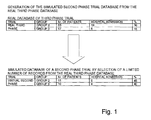
- the starting database is created so to simulate a second phase trial database by reducing the number of groups of individuals subjected to different treatments to only two groups of individuals, one group of which was subjected to treatment with the tested drug while the other group of individuals was subjected to treatment with a placebo. Furthermore from each group a reduced number of individuals forming the group is chosen.
- the choice is also carried out in such a way as to provide trials results which does not lead to a clear indication of effectiveness of the tested drug on the contrary to the results of the third phase trial which has demonstrated that the drug had e clear effectiveness on the disease against which it is directed.
- the experimental database from which simulated second phase trial database is constructed is the database of the third phase trial relating to the pharmaceutical product named FRILIVER.
- the experimental database from which simulated second phase trial database is constructed is the database of the third phase trial relating to the pharmaceutical product named FRILIVER.
- Detailed information about the trial and the drug are disclosed in the following article "Nutritional Supplementation With Branched-Chain Amino Acids in Advanced Cirrhosis: A Double-Blind, Randomized Trial" of GIULIO MARCHESINI, GIAMPAOLO BIANCHI, MANUELA MERLI, PIERO AMODIO, ARMINE PANELLA, CARMELA LOGUERCIO, FILLIPO ROSSI FANELLI and ROBERTO ABBIATI, carried out for the ITALIAN BCAA STUDY GROUP and published on GASTROENTEROLOGY 2003;124:1792-1801.
- the drug has the aim of reducing hospital admission of patients by a nutritional approach which might prevent progressive liver failure, improve nutritional parameters and quality of life.
- Several clinical parameters of the patients treated were taken into consideration.
- the said parameters formed part of the independent variables of the database records and will explained in greater detail in the following.
- the independent variables there were three variables indicating three different treatments carried out onto three different groups in which the totality of the patients which attended the trial were divided. Two of the said three groups were treated with a placebo, which was different for each of the two groups and the third group was treated with the drug to be tested.
- the dependent variable namely the results of the trial indicates whether a patient subjected to a treatment has necessitated of an hospital admission after a certain time. This in order to evaluate the effectiveness of the drug.
- the complete database had 168 records each belonging to a different patient. Three groups were formed according to the different three treatments provided.
- the independent variables were formed by the clinical relevant physiologic parameters of the patients relating to the pathology and to the drug to be tested and are listed in the following table 1.
- Table 1 comprises also the indication of the two dependent variables which had to give the measure of the effectiveness of the drug, namely hospital admission and no hospital admission.
- OSPEDALIERO AP 32 HEIGHT 10 SMOKER 33 BMI 11 SPENOM 34 CIRCUMFERENCE OF THE WRIST 12 Plt ⁇ 100 35 CIRCUMFERENCE OF THE ARM 13 CHILD-PUGH 36 TSF 14 RED BLOOD CELL 37 BSF 15 HEMATOCRIT 38 SISF 16 HEMOGLOBIN 39 SSSF 17 LEUKOCYTE 40 MAMA 18 THROMBOCYTE 41 MAFA 19 CREATININE 20 ALBUMIN 21 BILIRIRUBINA TOTALE 22 GTP DEPENDENT VARIABLES 1 HOSPITAL ADMISSION 2 NO HOSPITAL ADMISSION
- Figure 1 illustrates the step of generating the composition of the experimental data and thus of the database used for carrying out the two experiments of the method according to the present invention.
- composition of the simulated second phase trial database is reported here: TRIAL GROUP Nr. OF PATIENTS HOSPITAL ADMISSION % VIRTUAL SECOND PHASE GROUP 2 11 5 45 GROUP 3 10 4 40
- the invention aims to simulate a third phase trial result basing on the results and the database of the individuals of a second phase trial in order to avoid an abandoning of the trial at the second phase stage if no clear result is given by this second phase trial.
- the above mentioned simulated second phase trial database is used for training and testing a prediction algorithm which might not be limited but which preferably is an artificial neural network.
- a prediction algorithm which might not be limited but which preferably is an artificial neural network.
- the database is divided into a training and a testing database.
- This step is a usual step which is needed for instructing an artificial neural network or other prediction algorithm.
- the algorithm Being the dependent variables of the database known by feeding the independent and dependent variables respectively to the input channels of the prediction algorithm and to the output channels thereof the algorithm "learns", namely adjusts its internal weight matrix in order that the independent variables fed match with the dependent variables within a certain error or precision.
- Testing consist normally in feeding to the trained algorithm the independent variables and letting the algorithm calculate the dependent variables without forcing the outputs of the prediction algorithm with the said dependent variables with the known values thereof. Afterwards the values of the dependent variables calculated by the prediction algorithm are compared with the known values thereof.
- the selected independent variables are chosen by way of empiric criteria, such as a clinical relevance for the disease, among several variables of the set of independent variables there might be some variables which are false independent variables and which in reality are more or less dependent variables. Due to the fact that the database has a limited number of cases, namely of individuals, this false independent variables may cause the algorithm not to work correctly. Thus as already disclosed above an intermediate step of selecting a reduced number of independent variables is carried out.
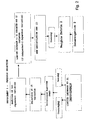
- This step is also disclosed in figure 2.
- a certain number of training and testing sets are generated each of which training and testing set is different form the other training and testing set relatively to the number of independent variables and to the kind of the independent variables which are chosen from the totality of independent variables provided in the database.
- GenD algorithm Genetic Doping Algorithm
- the successive generation of populations is carried out till an artificial neural network is found which fitness score in testing is higher than a predetermined fitness score and which has a minimum number of independent variables in its training database and testing database.
- the reduced set of selected independent variables should comprise at least one variable related to one of the treatments (treatment b or 2 or treatmente c or 3), or both the variables related to both the treatments to which the two groups of individuals has been subjected in the second pahse trial.
- this criterion obliges for stopping the independent variable selection phase not only the fitness score and the minimum number of independent variables in the training and testing database, but also the fact that the reduced database must comprise at least one of the two independent variables describing at least one of the treatments.
- the independent variables selection phase was stopped at a generation in which the artificial neural network having the best fitness score had only 15 independent variables selected from the 21 of the original starting database defined as the complete simulated second phase trial database.
- This new reduced staring database comprises 21 individuals and for each individual 15 selected independent variables relating to 15 selected clinical parameters and 2 dependent variables relating to the results "hospitalization” and "no hospitalization”.
- This new reduced staring database is used for training a New Recirculation artificial network.
- a weight matrix for the knots of the network is generated.
- the network can be than interrogated.
- Interrogation takes place as follows.
- the corresponding Input knots of certain variables either independent or dependent variables are forced to certain values and the values of the other variables either independent and dependent are obtained which according to the artificial neural network and to its weight matrix fits the values inputted for the certain variables.
- two kind of interrogation may be relevant.
- a first kind comprises to input the values of the independent variables relating to the treatments and then observing the output given by the artificial neural network for the dependent variables.
- a cross interrogation may be carried out in which the value for the dependent variable is given to the output of the artificial neural network, forcing the output at these values and considering the response of the artificial neural network for the independent variables relating to the treatment.
- the two interrogation give then a clear idea if the results obtained by the artificial neural network are true or false, depending on whether or not the results of the two interrogation are consistent or contradictory.
- the artificial neural network of experiment 1 sets the values of the independent variables “ treatment2" (placebo) and “treatment3” (drug) respectively to 0 and 1, thus indicating that "No hospitalization” occurs when “Treatment3", namely the treatment with the drug is applied. This result is consistent with the result of the third phase trial carried out in reality.
- results of the interrogations of table 3 and 4 did not lead to any indication about the effectiveness
- results of the interrogation according to table 5 and the analysis of the node dynamics are clear indications that there might be a drug effectiveness. This also if the simulated second phase trial did not show results indicationg an effectiveness of the drug.
- Table 6 illustrates the validation diagram of the new recirculation algorithm trained with the reduced database after having carried out the independent variable selection.
- the interrogation done in table 6 consists in inputting the value 1 for the independent variable describing treatment with the drug, namely "treatment 3" and considering the outputs given by the artificial neural network for the two dependent variables "Hospital admission yes” and "Hospital admission No".
- Table 7 relates to an interrogation where the value for the dependent variables are inputted to the artificial neural network.
- the value 0 is given for the variable "Hospital admission No" and the value 1 is given to the variable " Hospital admission Yes". This is equivalent to query the artificial neural network about the treatment if there is no hospital admission of the patient.
- Table 8 depicts the answer of the artificial neural network to the question if in case of no treatment with the drug there will be an hospital admission or not.
- variable relating to "Hospital admission Yes" is set to 1 by the algorithm, while the variable relating to "Hospital admission NO" is set to zero or approximately to 0.
- a further important result which is obtained by the method disclosed by means of the two experiments relates to the fact that interrogating the artificial neural network, a certain profile of the values of the other independent variables is obtained.
- the said profile of the clinical parameters can give information about the clinical parameters which are really relevant for the disease and also in order to identify special circumstances or combination of values of clinical parameters for which the drug is ineffective or particularly effective, thus constituting a further tool for medical studies of the disease.
- the method according to the invention is a very useful and low cost tool for simulating third phase trials starting form a second phase trial database. This could help in deciding to carry out a third phase trial or not for a certain drug although the results of the second phase trial did not furnish any indication on the effectiveness of the drug. Thus very high investments can be better checked avoiding loss of money and use of time.
Landscapes
- Health & Medical Sciences (AREA)
- Engineering & Computer Science (AREA)
- Medical Informatics (AREA)
- Public Health (AREA)
- Epidemiology (AREA)
- General Health & Medical Sciences (AREA)
- Primary Health Care (AREA)
- Biomedical Technology (AREA)
- Data Mining & Analysis (AREA)
- Databases & Information Systems (AREA)
- Pathology (AREA)
- Medical Treatment And Welfare Office Work (AREA)
Priority Applications (5)
| Application Number | Priority Date | Filing Date | Title |
|---|---|---|---|
| EP04425481A EP1612708A1 (fr) | 2004-06-30 | 2004-06-30 | Système d'analyse d'essai clinique et simulateur d'essai cliniques pour essais des médicaments |
| EP05771971A EP1782308A1 (fr) | 2004-06-30 | 2005-06-27 | Système d'analyse d'essai clinique et simulateur d'essai cliniques pour essais des médicaments |
| PCT/EP2005/053008 WO2006003132A1 (fr) | 2004-06-30 | 2005-06-27 | Methode de simulation de phase d'essai clinique et simulateur de phase d'essai clinique pour essais de medicaments |
| US11/571,199 US20080256006A1 (en) | 2004-06-30 | 2005-06-27 | Clinical Trial Phase Simulation Method and Clinical Trial Phase Simulator For Drug Trials |
| CNA2005800213717A CN1977270A (zh) | 2004-06-30 | 2005-06-27 | 用于药物试验的临床试验期模拟方法以及临床试验期模拟器 |
Applications Claiming Priority (1)
| Application Number | Priority Date | Filing Date | Title |
|---|---|---|---|
| EP04425481A EP1612708A1 (fr) | 2004-06-30 | 2004-06-30 | Système d'analyse d'essai clinique et simulateur d'essai cliniques pour essais des médicaments |
Publications (1)
| Publication Number | Publication Date |
|---|---|
| EP1612708A1 true EP1612708A1 (fr) | 2006-01-04 |
Family
ID=34932599
Family Applications (2)
| Application Number | Title | Priority Date | Filing Date |
|---|---|---|---|
| EP04425481A Withdrawn EP1612708A1 (fr) | 2004-06-30 | 2004-06-30 | Système d'analyse d'essai clinique et simulateur d'essai cliniques pour essais des médicaments |
| EP05771971A Withdrawn EP1782308A1 (fr) | 2004-06-30 | 2005-06-27 | Système d'analyse d'essai clinique et simulateur d'essai cliniques pour essais des médicaments |
Family Applications After (1)
| Application Number | Title | Priority Date | Filing Date |
|---|---|---|---|
| EP05771971A Withdrawn EP1782308A1 (fr) | 2004-06-30 | 2005-06-27 | Système d'analyse d'essai clinique et simulateur d'essai cliniques pour essais des médicaments |
Country Status (4)
| Country | Link |
|---|---|
| US (1) | US20080256006A1 (fr) |
| EP (2) | EP1612708A1 (fr) |
| CN (1) | CN1977270A (fr) |
| WO (1) | WO2006003132A1 (fr) |
Cited By (1)
| Publication number | Priority date | Publication date | Assignee | Title |
|---|---|---|---|---|
| WO2010105988A1 (fr) * | 2009-03-20 | 2010-09-23 | Semeion Centro Ricerche | Machine de calcul naturelle |
Families Citing this family (35)
| Publication number | Priority date | Publication date | Assignee | Title |
|---|---|---|---|---|
| US20070250429A1 (en) * | 2006-04-19 | 2007-10-25 | Clinical Futures Llc | Prediction markets for assessing clinical probabilities of success |
| US20120078840A1 (en) * | 2010-09-27 | 2012-03-29 | General Electric Company | Apparatus, system and methods for comparing drug safety using holistic analysis and visualization of pharmacological data |
| US10734115B1 (en) | 2012-08-09 | 2020-08-04 | Cerner Innovation, Inc | Clinical decision support for sepsis |
| US11398310B1 (en) | 2010-10-01 | 2022-07-26 | Cerner Innovation, Inc. | Clinical decision support for sepsis |
| US20120089421A1 (en) | 2010-10-08 | 2012-04-12 | Cerner Innovation, Inc. | Multi-site clinical decision support for sepsis |
| US10431336B1 (en) | 2010-10-01 | 2019-10-01 | Cerner Innovation, Inc. | Computerized systems and methods for facilitating clinical decision making |
| US9111018B2 (en) | 2010-12-30 | 2015-08-18 | Cerner Innovation, Inc | Patient care cards |
| US10628553B1 (en) | 2010-12-30 | 2020-04-21 | Cerner Innovation, Inc. | Health information transformation system |
| US8856156B1 (en) | 2011-10-07 | 2014-10-07 | Cerner Innovation, Inc. | Ontology mapper |
| CN103164823B (zh) * | 2011-12-13 | 2017-12-29 | 天津阿贝斯努科技有限公司 | 药物临床试验监督管理系统 |
| US10249385B1 (en) | 2012-05-01 | 2019-04-02 | Cerner Innovation, Inc. | System and method for record linkage |
| US20130346093A1 (en) * | 2012-06-22 | 2013-12-26 | Quintiles Transnational Corporation | Systems and Methods for Analytics on Viable Patient Populations |
| US10795879B2 (en) | 2012-06-22 | 2020-10-06 | Iqvia Inc. | Methods and systems for predictive clinical planning and design |
| US10946311B1 (en) | 2013-02-07 | 2021-03-16 | Cerner Innovation, Inc. | Discovering context-specific serial health trajectories |
| US10769241B1 (en) | 2013-02-07 | 2020-09-08 | Cerner Innovation, Inc. | Discovering context-specific complexity and utilization sequences |
| US11894117B1 (en) | 2013-02-07 | 2024-02-06 | Cerner Innovation, Inc. | Discovering context-specific complexity and utilization sequences |
| US10854334B1 (en) | 2013-08-12 | 2020-12-01 | Cerner Innovation, Inc. | Enhanced natural language processing |
| US12020814B1 (en) | 2013-08-12 | 2024-06-25 | Cerner Innovation, Inc. | User interface for clinical decision support |
| US10483003B1 (en) | 2013-08-12 | 2019-11-19 | Cerner Innovation, Inc. | Dynamically determining risk of clinical condition |
| WO2015160760A1 (fr) * | 2014-04-16 | 2015-10-22 | Analgesic Solutions | Méthodes de formation pour l'analyse améliorée des symptômes cliniques chez des sujets participant à un essai clinique |
| EP3234874B1 (fr) | 2014-12-18 | 2025-04-02 | Fresenius Medical Care Holdings, Inc. | Système et procédé de mise en oeuvre d'essais cliniques in silico |
| WO2017106427A1 (fr) | 2015-12-15 | 2017-06-22 | Joseph Fox | Procédés pour induire une réactivité bio-orthogonale |
| CA2977126A1 (fr) * | 2016-08-23 | 2018-02-23 | Michael S. Clemmons | Collecte de donnees distribuees et recommandation en phytotherapie |
| CN107050668B (zh) * | 2017-06-09 | 2020-03-31 | 南京医科大学第一附属医院 | 基于云处理的放疗效果预测方法 |
| CN109887599B (zh) * | 2019-02-25 | 2021-07-06 | 中国计量大学 | 一种基于神经网络的中医处方疗效推演方法 |
| JP7453988B2 (ja) * | 2019-03-01 | 2024-03-21 | サノフイ | 治療の有効性を推定する方法 |
| US11730420B2 (en) | 2019-12-17 | 2023-08-22 | Cerner Innovation, Inc. | Maternal-fetal sepsis indicator |
| US20210240884A1 (en) | 2020-01-31 | 2021-08-05 | Cytel Inc. | Trial design with convex-hull techniques |
| US20220374558A1 (en) * | 2020-01-31 | 2022-11-24 | Cytel Inc. | Systems and methods for trade-off visual analysis |
| US12051488B2 (en) | 2020-01-31 | 2024-07-30 | Cytel Inc. | Interactive trial design platform |
| US20220382935A1 (en) * | 2020-01-31 | 2022-12-01 | Cytel Inc. | Filtering designs using boundaries derived from optimal designs |
| CN111403040A (zh) * | 2020-06-04 | 2020-07-10 | 成都泰盟软件有限公司 | 基于虚拟标准病人的治疗模拟系统 |
| EP4033317A1 (fr) | 2021-01-26 | 2022-07-27 | Sedapta S.r.l. | Procede de gestion d'un systeme de production cyber-physique a capacites de prevision de conditions de fonctionnement anomales et systeme cyber-physique fonctionnant selon ce procede |
| CN116806357A (zh) * | 2021-02-22 | 2023-09-26 | 柏林格英格翰国际有限公司 | 用于测量药物的治疗效果的系统和方法 |
| IT202100029405A1 (it) | 2021-11-22 | 2023-05-22 | Genera Ip B V | Un mezzo di potenziamento del contrasto per metodi e sistemi di diagnostica per immagini |
Citations (5)
| Publication number | Priority date | Publication date | Assignee | Title |
|---|---|---|---|---|
| US6230142B1 (en) * | 1997-12-24 | 2001-05-08 | Homeopt, Llc | Health care data manipulation and analysis system |
| US20030069698A1 (en) * | 2000-06-14 | 2003-04-10 | Mamoru Uchiyama | Method and system for predicting pharmacokinetic properties |
| US20030104453A1 (en) * | 2001-11-06 | 2003-06-05 | David Pickar | System for pharmacogenetics of adverse drug events |
| US6658396B1 (en) * | 1999-11-29 | 2003-12-02 | Tang Sharon S | Neural network drug dosage estimation |
| US20040030503A1 (en) * | 1999-11-29 | 2004-02-12 | Scott Arouh | Neural -network-based identification, and application, of genomic information practically relevant to diverse biological and sociological problems, including susceptibility to disease |
Family Cites Families (1)
| Publication number | Priority date | Publication date | Assignee | Title |
|---|---|---|---|---|
| US7906359B2 (en) * | 2002-12-03 | 2011-03-15 | Analog Devices, Inc. | Method of forming a surface micromachined MEMS device |
-
2004
- 2004-06-30 EP EP04425481A patent/EP1612708A1/fr not_active Withdrawn
-
2005
- 2005-06-27 WO PCT/EP2005/053008 patent/WO2006003132A1/fr not_active Ceased
- 2005-06-27 EP EP05771971A patent/EP1782308A1/fr not_active Withdrawn
- 2005-06-27 US US11/571,199 patent/US20080256006A1/en not_active Abandoned
- 2005-06-27 CN CNA2005800213717A patent/CN1977270A/zh active Pending
Patent Citations (5)
| Publication number | Priority date | Publication date | Assignee | Title |
|---|---|---|---|---|
| US6230142B1 (en) * | 1997-12-24 | 2001-05-08 | Homeopt, Llc | Health care data manipulation and analysis system |
| US6658396B1 (en) * | 1999-11-29 | 2003-12-02 | Tang Sharon S | Neural network drug dosage estimation |
| US20040030503A1 (en) * | 1999-11-29 | 2004-02-12 | Scott Arouh | Neural -network-based identification, and application, of genomic information practically relevant to diverse biological and sociological problems, including susceptibility to disease |
| US20030069698A1 (en) * | 2000-06-14 | 2003-04-10 | Mamoru Uchiyama | Method and system for predicting pharmacokinetic properties |
| US20030104453A1 (en) * | 2001-11-06 | 2003-06-05 | David Pickar | System for pharmacogenetics of adverse drug events |
Cited By (1)
| Publication number | Priority date | Publication date | Assignee | Title |
|---|---|---|---|---|
| WO2010105988A1 (fr) * | 2009-03-20 | 2010-09-23 | Semeion Centro Ricerche | Machine de calcul naturelle |
Also Published As
| Publication number | Publication date |
|---|---|
| WO2006003132A1 (fr) | 2006-01-12 |
| US20080256006A1 (en) | 2008-10-16 |
| EP1782308A1 (fr) | 2007-05-09 |
| CN1977270A (zh) | 2007-06-06 |
Similar Documents
| Publication | Publication Date | Title |
|---|---|---|
| EP1612708A1 (fr) | Système d'analyse d'essai clinique et simulateur d'essai cliniques pour essais des médicaments | |
| JP6653365B2 (ja) | 数学モデルの関数として患者特有の投与を提供するためのシステムおよび方法 | |
| Halpern et al. | Health and economic outcomes modeling practices: a suggested framework | |
| US20150088534A1 (en) | Method for selecting a clinical treatment plan tailored to patient defined health goals | |
| US20180004905A1 (en) | Systems and Methods for Response Prediction to Chemotherapy in High Grade Bladder Cancer | |
| EP1681986A2 (fr) | Procede pour predire l'apparition ou la modification d'un etat pathologique | |
| US20180004903A1 (en) | Analysis system and analysis method | |
| Prentice et al. | The statistical analysis of multivariate failure time data: A marginal modeling approach | |
| Duffull et al. | What do we learn from repeated population analyses? | |
| WO2015169810A1 (fr) | Procédé de prédiction d'une réponse à un placebo chez un individu | |
| Affan et al. | Adaptive individualized modeling from limited clinical data for precise anemia management | |
| KR101783689B1 (ko) | 질병 및 약물 특이적 임상 변수의 상보성을 활용한 신약 재창출 기법 및 장치 | |
| Buscema et al. | Artificial neural networks and artificial organisms can predict Alzheimer pathology in individual patients only on the basis of cognitive and functional status | |
| Franco et al. | Molecular similarity considerations in the licensing of orphan drugs | |
| Wang et al. | Updating the cost effectiveness of oral anticoagulants for patients with atrial fibrillation based on varying stroke and bleed risk profiles | |
| KR102873330B1 (ko) | 머신러닝 기술을 활용한 항응고제 초기 적정 용량 예측 방법 및 장치 | |
| KR102536982B1 (ko) | 문진표를 이용한 인공지능 기반의 질병 예측 방법 및 장치 | |
| JP7385873B2 (ja) | シミュレーションシステム及びプログラム | |
| US8355874B2 (en) | Method for identifying predictive biomarkers from patient data | |
| Ulum et al. | Enhancing diabetes classification performance using XGBoost integrated with SMOTE and bayesian hyperparameter optimization | |
| KR102868889B1 (ko) | 인공지능을 이용한 혈색소 수치 제공 방법, 조혈제 용량의 권고 방법 및 혈색소 관리 시스템 | |
| Gaweda et al. | Artificial Intelligence in Medicine in Anemia | |
| Pozzi et al. | A Bayesian adaptive dose selection procedure with an overdispersed count endpoint | |
| Rofik et al. | Breast Cancer Diagnosis Utilizing Artificial Neural Network (ANN) Algorithm for Integrating Multi-Omics Data and Clinical Features | |
| CN120998357B (zh) | 基于机器学习的药物靶点预测与筛选方法及系统 |
Legal Events
| Date | Code | Title | Description |
|---|---|---|---|
| PUAI | Public reference made under article 153(3) epc to a published international application that has entered the european phase |
Free format text: ORIGINAL CODE: 0009012 |
|
| AK | Designated contracting states |
Kind code of ref document: A1 Designated state(s): AT BE BG CH CY CZ DE DK EE ES FI FR GB GR HU IE IT LI LU MC NL PL PT RO SE SI SK TR |
|
| AX | Request for extension of the european patent |
Extension state: AL HR LT LV MK |
|
| AKX | Designation fees paid | ||
| REG | Reference to a national code |
Ref country code: DE Ref legal event code: 8566 |
|
| STAA | Information on the status of an ep patent application or granted ep patent |
Free format text: STATUS: THE APPLICATION IS DEEMED TO BE WITHDRAWN |
|
| 18D | Application deemed to be withdrawn |
Effective date: 20060705 |