EP1612841A2 - Keramisches Entladungsgefäss mit integriertem induktivem Heizelement - Google Patents
Keramisches Entladungsgefäss mit integriertem induktivem Heizelement Download PDFInfo
- Publication number
- EP1612841A2 EP1612841A2 EP05005587A EP05005587A EP1612841A2 EP 1612841 A2 EP1612841 A2 EP 1612841A2 EP 05005587 A EP05005587 A EP 05005587A EP 05005587 A EP05005587 A EP 05005587A EP 1612841 A2 EP1612841 A2 EP 1612841A2
- Authority
- EP
- European Patent Office
- Prior art keywords
- arc tube
- ceramic arc
- susceptor
- ceramic
- tube
- Prior art date
- Legal status (The legal status is an assumption and is not a legal conclusion. Google has not performed a legal analysis and makes no representation as to the accuracy of the status listed.)
- Withdrawn
Links
- 239000000919 ceramic Substances 0.000 title claims abstract description 46
- 239000000463 material Substances 0.000 claims abstract description 23
- 238000007789 sealing Methods 0.000 claims abstract description 19
- 238000000034 method Methods 0.000 claims description 14
- 239000004020 conductor Substances 0.000 claims description 13
- PNEYBMLMFCGWSK-UHFFFAOYSA-N aluminium oxide Inorganic materials [O-2].[O-2].[O-2].[Al+3].[Al+3] PNEYBMLMFCGWSK-UHFFFAOYSA-N 0.000 claims description 7
- WFKWXMTUELFFGS-UHFFFAOYSA-N tungsten Chemical compound [W] WFKWXMTUELFFGS-UHFFFAOYSA-N 0.000 claims description 7
- 229910052721 tungsten Inorganic materials 0.000 claims description 7
- 239000010937 tungsten Substances 0.000 claims description 7
- OKTJSMMVPCPJKN-UHFFFAOYSA-N Carbon Chemical compound [C] OKTJSMMVPCPJKN-UHFFFAOYSA-N 0.000 claims description 5
- NRTOMJZYCJJWKI-UHFFFAOYSA-N Titanium nitride Chemical compound [Ti]#N NRTOMJZYCJJWKI-UHFFFAOYSA-N 0.000 claims description 5
- 239000000203 mixture Substances 0.000 claims description 3
- ZOKXTWBITQBERF-UHFFFAOYSA-N Molybdenum Chemical compound [Mo] ZOKXTWBITQBERF-UHFFFAOYSA-N 0.000 claims description 2
- 229910052799 carbon Inorganic materials 0.000 claims description 2
- 229910010293 ceramic material Inorganic materials 0.000 claims description 2
- 239000000155 melt Substances 0.000 claims description 2
- 229910052750 molybdenum Inorganic materials 0.000 claims description 2
- 239000011733 molybdenum Substances 0.000 claims description 2
- 229910052758 niobium Inorganic materials 0.000 claims description 2
- 239000010955 niobium Substances 0.000 claims description 2
- GUCVJGMIXFAOAE-UHFFFAOYSA-N niobium atom Chemical compound [Nb] GUCVJGMIXFAOAE-UHFFFAOYSA-N 0.000 claims description 2
- ZVWKZXLXHLZXLS-UHFFFAOYSA-N zirconium nitride Chemical compound [Zr]#N ZVWKZXLXHLZXLS-UHFFFAOYSA-N 0.000 claims description 2
- 238000010438 heat treatment Methods 0.000 abstract description 8
- 239000012799 electrically-conductive coating Substances 0.000 abstract 1
- 230000001939 inductive effect Effects 0.000 abstract 1
- 238000000576 coating method Methods 0.000 description 10
- 239000011248 coating agent Substances 0.000 description 9
- 229910001507 metal halide Inorganic materials 0.000 description 8
- 230000006698 induction Effects 0.000 description 7
- 150000005309 metal halides Chemical class 0.000 description 5
- 238000004519 manufacturing process Methods 0.000 description 4
- 239000000843 powder Substances 0.000 description 4
- 238000000429 assembly Methods 0.000 description 3
- 230000000712 assembly Effects 0.000 description 3
- 239000011195 cermet Substances 0.000 description 3
- 229910002804 graphite Inorganic materials 0.000 description 3
- 239000010439 graphite Substances 0.000 description 3
- 230000035515 penetration Effects 0.000 description 3
- 239000000758 substrate Substances 0.000 description 3
- CSCPPACGZOOCGX-UHFFFAOYSA-N Acetone Chemical compound CC(C)=O CSCPPACGZOOCGX-UHFFFAOYSA-N 0.000 description 2
- LFQSCWFLJHTTHZ-UHFFFAOYSA-N Ethanol Chemical compound CCO LFQSCWFLJHTTHZ-UHFFFAOYSA-N 0.000 description 2
- DGAQECJNVWCQMB-PUAWFVPOSA-M Ilexoside XXIX Chemical compound C[C@@H]1CC[C@@]2(CC[C@@]3(C(=CC[C@H]4[C@]3(CC[C@@H]5[C@@]4(CC[C@@H](C5(C)C)OS(=O)(=O)[O-])C)C)[C@@H]2[C@]1(C)O)C)C(=O)O[C@H]6[C@@H]([C@H]([C@@H]([C@H](O6)CO)O)O)O.[Na+] DGAQECJNVWCQMB-PUAWFVPOSA-M 0.000 description 2
- 239000000443 aerosol Substances 0.000 description 2
- 230000008901 benefit Effects 0.000 description 2
- 229920002678 cellulose Polymers 0.000 description 2
- 239000001913 cellulose Substances 0.000 description 2
- 238000010891 electric arc Methods 0.000 description 2
- 238000005304 joining Methods 0.000 description 2
- 229910052708 sodium Inorganic materials 0.000 description 2
- 239000011734 sodium Substances 0.000 description 2
- 238000005507 spraying Methods 0.000 description 2
- 238000007740 vapor deposition Methods 0.000 description 2
- UNMYWSMUMWPJLR-UHFFFAOYSA-L Calcium iodide Chemical compound [Ca+2].[I-].[I-] UNMYWSMUMWPJLR-UHFFFAOYSA-L 0.000 description 1
- ATJFFYVFTNAWJD-UHFFFAOYSA-N Tin Chemical compound [Sn] ATJFFYVFTNAWJD-UHFFFAOYSA-N 0.000 description 1
- -1 TlI Chemical compound 0.000 description 1
- 230000009471 action Effects 0.000 description 1
- 239000011230 binding agent Substances 0.000 description 1
- 230000015572 biosynthetic process Effects 0.000 description 1
- 229910001640 calcium iodide Inorganic materials 0.000 description 1
- 230000008859 change Effects 0.000 description 1
- 239000002537 cosmetic Substances 0.000 description 1
- 230000008878 coupling Effects 0.000 description 1
- 238000010168 coupling process Methods 0.000 description 1
- 238000005859 coupling reaction Methods 0.000 description 1
- 230000003247 decreasing effect Effects 0.000 description 1
- 238000003618 dip coating Methods 0.000 description 1
- 238000009826 distribution Methods 0.000 description 1
- RZQFCZYXPRKMTP-UHFFFAOYSA-K dysprosium(3+);triiodide Chemical compound [I-].[I-].[I-].[Dy+3] RZQFCZYXPRKMTP-UHFFFAOYSA-K 0.000 description 1
- NLQFUUYNQFMIJW-UHFFFAOYSA-N dysprosium(III) oxide Inorganic materials O=[Dy]O[Dy]=O NLQFUUYNQFMIJW-UHFFFAOYSA-N 0.000 description 1
- 238000001125 extrusion Methods 0.000 description 1
- 230000005484 gravity Effects 0.000 description 1
- KXCRAPCRWWGWIW-UHFFFAOYSA-K holmium(3+);triiodide Chemical compound I[Ho](I)I KXCRAPCRWWGWIW-UHFFFAOYSA-K 0.000 description 1
- 238000001746 injection moulding Methods 0.000 description 1
- QSHDDOUJBYECFT-UHFFFAOYSA-N mercury Chemical compound [Hg] QSHDDOUJBYECFT-UHFFFAOYSA-N 0.000 description 1
- 229910052753 mercury Inorganic materials 0.000 description 1
- 229910052751 metal Inorganic materials 0.000 description 1
- 239000002184 metal Substances 0.000 description 1
- 230000005012 migration Effects 0.000 description 1
- 238000013508 migration Methods 0.000 description 1
- 238000012986 modification Methods 0.000 description 1
- 230000004048 modification Effects 0.000 description 1
- 239000012768 molten material Substances 0.000 description 1
- 238000007639 printing Methods 0.000 description 1
- 230000008569 process Effects 0.000 description 1
- 230000005855 radiation Effects 0.000 description 1
- FVAUCKIRQBBSSJ-UHFFFAOYSA-M sodium iodide Chemical compound [Na+].[I-] FVAUCKIRQBBSSJ-UHFFFAOYSA-M 0.000 description 1
- 239000007787 solid Substances 0.000 description 1
- 238000004544 sputter deposition Methods 0.000 description 1
- 230000008646 thermal stress Effects 0.000 description 1
- LZOMHYVAEHYDST-UHFFFAOYSA-K thulium(3+);triiodide Chemical compound I[Tm](I)I LZOMHYVAEHYDST-UHFFFAOYSA-K 0.000 description 1
Images

Classifications
-
- H—ELECTRICITY
- H01—ELECTRIC ELEMENTS
- H01J—ELECTRIC DISCHARGE TUBES OR DISCHARGE LAMPS
- H01J61/00—Gas-discharge or vapour-discharge lamps
- H01J61/02—Details
- H01J61/30—Vessels; Containers
-
- H—ELECTRICITY
- H01—ELECTRIC ELEMENTS
- H01J—ELECTRIC DISCHARGE TUBES OR DISCHARGE LAMPS
- H01J61/00—Gas-discharge or vapour-discharge lamps
- H01J61/02—Details
- H01J61/30—Vessels; Containers
- H01J61/35—Vessels; Containers provided with coatings on the walls thereof; Selection of materials for the coatings
-
- H—ELECTRICITY
- H01—ELECTRIC ELEMENTS
- H01J—ELECTRIC DISCHARGE TUBES OR DISCHARGE LAMPS
- H01J61/00—Gas-discharge or vapour-discharge lamps
- H01J61/02—Details
- H01J61/36—Seals between parts of vessels; Seals for leading-in conductors; Leading-in conductors
- H01J61/366—Seals for leading-in conductors
-
- H—ELECTRICITY
- H01—ELECTRIC ELEMENTS
- H01J—ELECTRIC DISCHARGE TUBES OR DISCHARGE LAMPS
- H01J9/00—Apparatus or processes specially adapted for the manufacture, installation, removal, maintenance of electric discharge tubes, discharge lamps, or parts thereof; Recovery of material from discharge tubes or lamps
- H01J9/24—Manufacture or joining of vessels, leading-in conductors or bases
- H01J9/245—Manufacture or joining of vessels, leading-in conductors or bases specially adapted for gas discharge tubes or lamps
- H01J9/247—Manufacture or joining of vessels, leading-in conductors or bases specially adapted for gas discharge tubes or lamps specially adapted for gas-discharge lamps
-
- H—ELECTRICITY
- H01—ELECTRIC ELEMENTS
- H01J—ELECTRIC DISCHARGE TUBES OR DISCHARGE LAMPS
- H01J9/00—Apparatus or processes specially adapted for the manufacture, installation, removal, maintenance of electric discharge tubes, discharge lamps, or parts thereof; Recovery of material from discharge tubes or lamps
- H01J9/24—Manufacture or joining of vessels, leading-in conductors or bases
- H01J9/32—Sealing leading-in conductors
- H01J9/323—Sealing leading-in conductors into a discharge lamp or a gas-filled discharge device
Definitions
- This invention relates to ceramic arc tubes having frit seals and methods of forming said frit seals. More particularly, this invention relates to the radio frequency (RF) sealing of ceramic arc tubes.
- RF radio frequency
- High-intensity discharge (HID) lamps containing ceramic arc tubes are well known. Such lamps include high pressure sodium lamps and metal halide lamps which contain translucent polycrystalline (PCA) arc tubes.
- the arc tubes have opposed capillary tubes extending outwardly from an axially symmetric body. Each capillary tube contains an electrode assembly which provides the electrical energy needed to strike the arc discharge inside the discharge vessel. The end region of each capillary tube is sealed hermetically to the electrode assembly with a frit material. Examples of such arc tubes are described in U.S. Patent Nos. 5,973,453 and 5,424,609, and European Patent Nos. 0 971 043 A2 and 0 954 007.
- the RF sealing apparatus comprises a resealable pressure chamber with an RF induction heater mounted at one end.
- the RF induction heater is comprised of an RF power supply, an RF induction coil located external to the pressure chamber, and an RF susceptor located within the chamber.
- the end of the arc tube to be sealed is held within the RF susceptor, preferably a hollow graphite cylinder.
- the RF susceptor absorbs energy from the RF induction coil causing the susceptor to heat up.
- the thermal radiation emitted by the hot susceptor in turn causes a ring of frit material mounted on the end of the capillary to melt and the molten frit flows into the open end of the capillary tube and down along the electrode assembly.
- the frit solidifies forming a hermetic seal.
- an RF susceptor may be formed as an integral part of the ceramic arc tube instead of being part of the sealing apparatus.
- the integral susceptor is formed from a conductive coating that is applied directly to the exterior surface of the ceramic arc tube in a seal region.
- seal region generally refers to any region of the arc tube where a seal is formed, or components are joined, using at least a partially molten material. This includes regions where ceramic components are joined to each other or to other metal or cermet components as well as regions where openings in the ceramic arc tube are sealed against atmospheric intrusion and/or for containment purposes. Such latter seals are usually desired to be hermetic, however, this invention is not limited to the formation of hermetic seals.
- the susceptor material should have a coefficient of thermal expansion similar to that of the arc tube material so that it remains adhered to the arc tube over the life of the lamp.
- the susceptor material should also be able to withstand operation at high temperatures ( ⁇ 1900°C) in inert atmospheres and couple well with the applied RF energy from the RF induction coil.
- the integral susceptor enables RF heating that is sufficient to melt a frit material and hermetically seal an electrode assembly to the arc tube.
- the integral susceptor of this invention eliminates the need for an RF susceptor in the sealing furnace since the susceptor is already part of the arc tube to be sealed. As a result, the RF sealing apparatus can be simplified so that there is less labor required to change between various arc tube types. Since the susceptor may be applied by a conventional printing technique, it is easy to adapt the integral susceptor to numerous arc tube types. Moreover, the structure of the susceptor can be altered to provide better coupling to the RF inductor and/or to provide a different heating rate. This can reduce the RF power and time required for sealing. In particular, the susceptor may be formed as a solid band or a coil around the seal region.
- the integral susceptor can provide for a more accurate control of the frit seal length thereby minimizing the penetration of the frit into the arc tube beyond the predetermined seal region.
- standard ceramic fabrication techniques e.g., injection molding, isopressing, or extrusion of ceramic powders, are first used to form the arc tube or arc tube parts.
- the green part or parts are then prefired in air to remove the binder material and impart a higher degree of mechanical stability.
- a coating of the conductive material which forms the integral susceptor is then applied directly to the porous arc tube by one of a number of conventional coating techniques. These include aerosol spraying, dip coating, or applying the coating as an ink with a pen or other ink dispensing means.
- aerosol spraying a conductive powder is combined with an alcohol/acetone/cellulose-based carrier and sprayed onto unmasked portions of the arc tube.
- a conductive powder is mixed with an alcohol/cellulose carrier and applied to the substrate with an ink dispenser through a pen tip. It is possible to blend the conductive powder with other materials, e.g., alumina, in order to improve the translucency, adherence, or electrical properties of the integral susceptor.
- the prefired arc tube is then sintered, e.g., at 1880°C for 1 hour in a flowing N 2 /8%H 2 gas atmosphere.
- the conductive material in the coating sinters simultaneously onto the ceramic arc tube.
- the conductive coating is applied using a vapor deposition technique, e.g., sputtering or plasma vapor deposition, after the arc tube has been fully sintered.
- the conductive susceptor material should have a coefficient of thermal expansion similar to that of the arc tube material, be able operate at high temperatures ( ⁇ 1900°C) in inert atmospheres, and couple well with the applied RF energy.
- Preferred conductive materials include titanium nitride, zirconium nitride, carbon, tungsten, niobium, molybdenum, cermets, or combinations thereof. The properties of some of these materials are listed in Table 1. More preferably, the integral susceptor is comprised of titanium nitride or a tungsten/alumina cermet. The thickness of the susceptor coating ranges from about 15 to about 100 ⁇ m.
- the preferred thickness of a tungsten/alumina cermet stripe is 17 to 37 ⁇ m. This yields a suitable electrical performance while providing thermal expansion compatibility with a polycrystalline alumina (PCA) substrate.
- PCA polycrystalline alumina
- the preferred thickness is from 20 to 100 ⁇ m in order to produce a surface resistivity of 0.9 to 1.3 ohms across a distance of 2 mm.
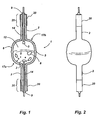
- Fig. 1 is a cross-sectional illustration of a sealed ceramic metal halide arc tube having integral susceptors according to this invention.
- the basic shape of arc tube shown here is generally referred to as a "bulgy" shape.
- the bulgy shape is preferred because it provides a more uniform temperature distribution compared to right-cylinder shapes such as those described in U.S. Patent Nos. 5,424,609 and 6,525,476.
- the integral susceptor of this invention may be used for sealing other arc tube configurations and types, in particular, e.g., high pressure sodium arc tubes.
- the arc tube 1 is a two-piece design which is made by joining two identically molded ceramic halves in their green state. The method of joining the arc tube halves typically leaves a cosmetic seam 5 in the center of the arc tube where the halves were mated. A more detailed description of a method of making this type of ceramic arc tube is described in U.S. Patent 6,620,272 which is incorporated herein by reference.
- the ceramic arc tube material is a translucent polycrystalline alumina (PCA), although other ceramic materials may be used.
- the arc tube has an axially symmetric body 6 which encloses a discharge chamber 12. Two opposed capillary tubes 2 extend outwardly from the body 6 along a central axis.
- the capillary tubes have been integrally molded with the arc tube body.
- the discharge chamber 12 of the arc tube contains a buffer gas, e.g., 30 to 300 torr Xe or Ar, and a metal halide fill 8, typically a mixture of mercury and metal halide salts, e.g., TlI, NaI, DyI 3 , HoI 3 , TmI 3 , and CaI 2 .
- Electrode assemblies 14 are inserted into each capillary tube 2. One end of the electrode assembly 14 protrudes out of the arc tube to provide an electrical connection. The tips of the electrode assemblies extend into the hemispherical end wells 17a, 17b of the discharge chamber and are fitted with a tungsten coil 3 or other similar means for providing a point of attachment for the arc discharge.
- the electrode assemblies are sealed hermetically to the capillary tubes by a frit material 9 (preferably, a Al 2 O 3 -SiO 2 -Dy 2 O 3 frit). Integral susceptors 20 are disposed on the exterior surface of capillary tubes 2 in the seal regions 25.
- the integral susceptors 20 were applied as a uniform coating forming a band around the end of the capillary.
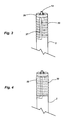
- the band structure is more clearly illustrated in Fig. 2. Because the edge of the susceptor creates a significant temperature gradient at the edge of the seal region, the longitudinal extent of the integral susceptor acts to determine the length of each seal by controlling the penetration of the molten frit into the capillary.
- a ring 35 of the frit material is placed over the protruding end of the electrode assembly as illustrated in Figs. 3 and 4.
- This end of the capillary is then inserted into an RF induction coil under an inert atmosphere at a controlled pressure.
- the RF coil is powered using an RF frequency that couples well with the integral susceptor.
- the RF energy rapidly heats the end of the capillary tube until the frit ring melts.
- a combination of capillary action and gravity draws the molten frit into the end of the capillary tube and along the electrode assembly.
- the molten frit solidifies when it encounters the temperature gradient at the edge of the susceptor thereby fixing the penetration length of the frit.
- the RF power is then turned off completing the seal.
- the lamp fill Hg and metal halide salts
- the sealing process is then repeated to completely seal the arc tube.
- the linear relationship between the susceptor length and the length of the frit seal is shown in Fig. 5.
- the use of the integral susceptor allows for a more accurate placement of the frit seal and minimizes unwanted migration of the frit beyond the seal region. This is especially important in ceramic metal halide lamps where the frit material is susceptible to attack by the corrosive metal halide salts in the arc tube fill.
- Fig. 3 shows a partial view of a capillary tube of a ceramic arc tube prior to sealing.
- a ring 35 of frit material is shown placed over the protruding end of the electrode assembly 14.
- the integral susceptor 30 has a coil structure.
- a longitudinal stripe 37 completes the electrical circuit between the ends of the coil to enable RF heating. It is not necessary that the longitudinal stripe connect to each turn of the coil.
- means other than a longitudinal stripe could be used to make the electrical connection between the ends of the coil structure.
- the coil structure has the added advantage of creating a partial window through which the frit flow into the capillary may be monitored during sealing.
- Fig. 4 also shows a partial view of a capillary tube prior to sealing.
- a third alternate embodiment of the integral susceptor is shown wherein the integral susceptor is a combination of the coil and band structures.
- the coil structure 30 of Fig. 3 has been covered with the band structure 20 of Figs. 1 and 2.
- the combined structure can be used to induce a very intense heating in the band region along with a decreasing gradient in the coil region. This can help reduce the thermal stresses which are induced in the ceramic substrate, particularly in ceramic pieces which have a large thermal mass.
Landscapes
- Engineering & Computer Science (AREA)
- Manufacturing & Machinery (AREA)
- Vessels And Coating Films For Discharge Lamps (AREA)
- Manufacture Of Electron Tubes, Discharge Lamp Vessels, Lead-In Wires, And The Like (AREA)
- Ceramic Products (AREA)
Applications Claiming Priority (1)
| Application Number | Priority Date | Filing Date | Title |
|---|---|---|---|
| US10/881,197 US7170228B2 (en) | 2004-06-30 | 2004-06-30 | Ceramic arc tube having an integral susceptor |
Publications (2)
| Publication Number | Publication Date |
|---|---|
| EP1612841A2 true EP1612841A2 (de) | 2006-01-04 |
| EP1612841A3 EP1612841A3 (de) | 2009-12-23 |
Family
ID=34934268
Family Applications (1)
| Application Number | Title | Priority Date | Filing Date |
|---|---|---|---|
| EP05005587A Withdrawn EP1612841A3 (de) | 2004-06-30 | 2005-03-15 | Keramisches Entladungsgefäss mit integriertem induktivem Heizelement |
Country Status (4)
| Country | Link |
|---|---|
| US (1) | US7170228B2 (de) |
| EP (1) | EP1612841A3 (de) |
| JP (1) | JP5079990B2 (de) |
| CA (1) | CA2491314A1 (de) |
Cited By (1)
| Publication number | Priority date | Publication date | Assignee | Title |
|---|---|---|---|---|
| WO2009067289A1 (en) * | 2007-11-20 | 2009-05-28 | General Electric Company | Joining green ceramics |
Families Citing this family (7)
| Publication number | Priority date | Publication date | Assignee | Title |
|---|---|---|---|---|
| US20060199041A1 (en) * | 2005-03-03 | 2006-09-07 | Osram Sylvania Inc. | Method of making a ceramic arc discharge vessel and ceramic arc discharge vessel made by the method |
| US7404496B2 (en) * | 2005-06-20 | 2008-07-29 | Osram Sylvania Inc. | Green-state ceramic discharge vessel parts |
| AU2008216072A1 (en) * | 2007-02-16 | 2008-08-21 | Thermal Solutions, Inc. | Inductively heated clothing |
| WO2009052852A1 (de) * | 2007-10-19 | 2009-04-30 | Osram Gesellschaft mit beschränkter Haftung | Hochdruckentladungslampe |
| US8698054B2 (en) * | 2010-09-16 | 2014-04-15 | Bernard Lasko | Integral inductor-susceptor |
| JP6103868B2 (ja) * | 2012-09-25 | 2017-03-29 | 株式会社オーク製作所 | 放電ランプ、及び、放電ランプの製造方法 |
| US11270872B2 (en) | 2019-09-25 | 2022-03-08 | Western Digital Technologies, Inc. | Base conducting layer beneath graphite layer of ceramic cathode for use with cathodic arc deposition |
Citations (8)
| Publication number | Priority date | Publication date | Assignee | Title |
|---|---|---|---|---|
| EP0351097A1 (de) | 1988-07-12 | 1990-01-17 | THORN EMI plc | Bogenrohr für eine Entladungslampe |
| US5424609A (en) | 1992-09-08 | 1995-06-13 | U.S. Philips Corporation | High-pressure discharge lamp |
| US5973453A (en) | 1996-12-04 | 1999-10-26 | U.S. Philips Corporation | Ceramic metal halide discharge lamp with NaI/CeI3 filling |
| EP0954007A1 (de) | 1997-01-18 | 1999-11-03 | Toto Ltd. | Entladungslampe verfahren und vorrichtung zur abdichtung einer entladungslampe |
| EP0971043A2 (de) | 1998-07-09 | 2000-01-12 | Ushiodenki Kabushiki Kaisha | Cermet und keramische Entladungslampe |
| US20020117965A1 (en) | 2001-02-23 | 2002-08-29 | Osram Sylvania Inc. | High buffer gas pressure ceramic arc tube and method and apparatus for making same |
| US6525476B1 (en) | 1997-12-02 | 2003-02-25 | Koninklijke Philips Electronics N.V. | Metal halide lamp with lithium and cerium iodide |
| US6620272B2 (en) | 2001-02-23 | 2003-09-16 | Osram Sylvania Inc. | Method of assembling a ceramic body |
Family Cites Families (8)
| Publication number | Priority date | Publication date | Assignee | Title |
|---|---|---|---|---|
| US4437039A (en) * | 1978-10-03 | 1984-03-13 | North American Philips Electric Corp. | Starting arrangement for high-intensity-discharge sodium lamp |
| JPH0388235A (ja) * | 1989-08-31 | 1991-04-12 | Toshiba Lighting & Technol Corp | 蛍光ランプの製造方法 |
| EP0592040B1 (de) * | 1992-10-08 | 1999-01-13 | Koninklijke Philips Electronics N.V. | Hochdruckentladungslampe |
| JP2000228170A (ja) * | 1998-12-04 | 2000-08-15 | Toshiba Lighting & Technology Corp | 高圧放電ランプ、高圧放電ランプ装置、高圧放電ランプ点灯装置および照明装置 |
| US6172462B1 (en) * | 1999-11-15 | 2001-01-09 | Philips Electronics North America Corp. | Ceramic metal halide lamp with integral UV-enhancer |
| JP2002231472A (ja) * | 2001-02-01 | 2002-08-16 | Harison Toshiba Lighting Corp | 放電ランプ |
| US6641449B2 (en) * | 2001-04-24 | 2003-11-04 | Osram Sylvania Inc. | High pressure lamp bulb and method of induction sealing |
| JP4862240B2 (ja) * | 2001-09-14 | 2012-01-25 | 岩崎電気株式会社 | 金属蒸気放電ランプの製造方法および金属蒸気放電ランプ |
-
2004
- 2004-06-30 US US10/881,197 patent/US7170228B2/en not_active Expired - Fee Related
- 2004-12-30 CA CA002491314A patent/CA2491314A1/en not_active Abandoned
-
2005
- 2005-03-15 EP EP05005587A patent/EP1612841A3/de not_active Withdrawn
- 2005-06-29 JP JP2005190553A patent/JP5079990B2/ja not_active Expired - Fee Related
Patent Citations (8)
| Publication number | Priority date | Publication date | Assignee | Title |
|---|---|---|---|---|
| EP0351097A1 (de) | 1988-07-12 | 1990-01-17 | THORN EMI plc | Bogenrohr für eine Entladungslampe |
| US5424609A (en) | 1992-09-08 | 1995-06-13 | U.S. Philips Corporation | High-pressure discharge lamp |
| US5973453A (en) | 1996-12-04 | 1999-10-26 | U.S. Philips Corporation | Ceramic metal halide discharge lamp with NaI/CeI3 filling |
| EP0954007A1 (de) | 1997-01-18 | 1999-11-03 | Toto Ltd. | Entladungslampe verfahren und vorrichtung zur abdichtung einer entladungslampe |
| US6525476B1 (en) | 1997-12-02 | 2003-02-25 | Koninklijke Philips Electronics N.V. | Metal halide lamp with lithium and cerium iodide |
| EP0971043A2 (de) | 1998-07-09 | 2000-01-12 | Ushiodenki Kabushiki Kaisha | Cermet und keramische Entladungslampe |
| US20020117965A1 (en) | 2001-02-23 | 2002-08-29 | Osram Sylvania Inc. | High buffer gas pressure ceramic arc tube and method and apparatus for making same |
| US6620272B2 (en) | 2001-02-23 | 2003-09-16 | Osram Sylvania Inc. | Method of assembling a ceramic body |
Cited By (4)
| Publication number | Priority date | Publication date | Assignee | Title |
|---|---|---|---|---|
| WO2009067289A1 (en) * | 2007-11-20 | 2009-05-28 | General Electric Company | Joining green ceramics |
| CN101861240A (zh) * | 2007-11-20 | 2010-10-13 | 通用电气公司 | 生坯陶瓷的联接 |
| US8398796B2 (en) | 2007-11-20 | 2013-03-19 | General Electric Company | Green joining ceramics |
| CN101861240B (zh) * | 2007-11-20 | 2013-05-08 | 通用电气公司 | 生坯陶瓷的联接 |
Also Published As
| Publication number | Publication date |
|---|---|
| US7170228B2 (en) | 2007-01-30 |
| EP1612841A3 (de) | 2009-12-23 |
| JP2006019293A (ja) | 2006-01-19 |
| JP5079990B2 (ja) | 2012-11-21 |
| CA2491314A1 (en) | 2005-12-30 |
| US20060001379A1 (en) | 2006-01-05 |
Similar Documents
| Publication | Publication Date | Title |
|---|---|---|
| JP3465193B2 (ja) | 高圧放電ランプ | |
| CA2230876C (en) | Ceramic envelope device, lamp with such a device and method of manufacturing such a device | |
| JP4304902B2 (ja) | 高圧放電ランプ | |
| US8456087B2 (en) | High-pressure sodium vapor discharge lamp with hybrid antenna | |
| EP1568066B1 (de) | Hockdruckgasentladungslampe und verfahren zur herstellung | |
| JP3507179B2 (ja) | 高圧放電灯 | |
| US6456005B1 (en) | Materials and methods for application of conducting members on arc tubes | |
| GB2105904A (en) | High pressure discharge lamps | |
| US7170228B2 (en) | Ceramic arc tube having an integral susceptor | |
| US6538377B1 (en) | Means for applying conducting members to arc tubes | |
| JPH11329361A (ja) | ランプ用サ―メットおよびセラミック製放電ランプ | |
| US6563265B1 (en) | Applying prealloyed powders as conducting members to arc tubes | |
| US6819047B2 (en) | High pressure discharge lamps, and assemblies and discharge vessels therefor | |
| EP1367635B1 (de) | Quecksilberhochdruckentladungslampen und Dichtungselemente dafür | |
| EP1150334B1 (de) | Elektrode für entladungsröhre und mit solcher elektrode versehener entladungsröhre | |
| US6592808B1 (en) | Cermet sintering of ceramic discharge chambers | |
| JP3827428B2 (ja) | 管球用閉塞体と管球 | |
| WO2007019044A1 (en) | Ceramic arc tube and end plugs therefor and methods of making the same |
Legal Events
| Date | Code | Title | Description |
|---|---|---|---|
| PUAI | Public reference made under article 153(3) epc to a published international application that has entered the european phase |
Free format text: ORIGINAL CODE: 0009012 |
|
| AK | Designated contracting states |
Kind code of ref document: A2 Designated state(s): AT BE BG CH CY CZ DE DK EE ES FI FR GB GR HU IE IS IT LI LT LU MC NL PL PT RO SE SI SK TR |
|
| AX | Request for extension of the european patent |
Extension state: AL BA HR LV MK YU |
|
| PUAL | Search report despatched |
Free format text: ORIGINAL CODE: 0009013 |
|
| AK | Designated contracting states |
Kind code of ref document: A3 Designated state(s): AT BE BG CH CY CZ DE DK EE ES FI FR GB GR HU IE IS IT LI LT LU MC NL PL PT RO SE SI SK TR |
|
| AX | Request for extension of the european patent |
Extension state: AL BA HR LV MK YU |
|
| RIC1 | Information provided on ipc code assigned before grant |
Ipc: C04B 37/02 20060101ALI20091118BHEP Ipc: C04B 37/00 20060101ALI20091118BHEP Ipc: H01J 9/24 20060101ALI20091118BHEP Ipc: H01J 9/32 20060101ALI20091118BHEP Ipc: H01J 61/36 20060101ALI20091118BHEP Ipc: H01J 61/35 20060101ALI20091118BHEP Ipc: H01J 61/30 20060101AFI20050810BHEP |
|
| 17P | Request for examination filed |
Effective date: 20100617 |
|
| AKX | Designation fees paid |
Designated state(s): AT BE BG CH CY CZ DE DK EE ES FI FR GB GR HU IE IS IT LI LT LU MC NL PL PT RO SE SI SK TR |
|
| 17Q | First examination report despatched |
Effective date: 20101022 |
|
| STAA | Information on the status of an ep patent application or granted ep patent |
Free format text: STATUS: THE APPLICATION IS DEEMED TO BE WITHDRAWN |
|
| 18D | Application deemed to be withdrawn |
Effective date: 20141001 |