EP1612859A2 - Electrode traversante et son procédé de fabrication - Google Patents
Electrode traversante et son procédé de fabrication Download PDFInfo
- Publication number
- EP1612859A2 EP1612859A2 EP05253943A EP05253943A EP1612859A2 EP 1612859 A2 EP1612859 A2 EP 1612859A2 EP 05253943 A EP05253943 A EP 05253943A EP 05253943 A EP05253943 A EP 05253943A EP 1612859 A2 EP1612859 A2 EP 1612859A2
- Authority
- EP
- European Patent Office
- Prior art keywords
- hole
- layer
- electrode
- forming
- substrate
- Prior art date
- Legal status (The legal status is an assumption and is not a legal conclusion. Google has not performed a legal analysis and makes no representation as to the accuracy of the status listed.)
- Granted
Links
Images






Classifications
-
- H—ELECTRICITY
- H05—ELECTRIC TECHNIQUES NOT OTHERWISE PROVIDED FOR
- H05K—PRINTED CIRCUITS; CASINGS OR CONSTRUCTIONAL DETAILS OF ELECTRIC APPARATUS; MANUFACTURE OF ASSEMBLAGES OF ELECTRICAL COMPONENTS
- H05K3/00—Apparatus or processes for manufacturing printed circuits
- H05K3/40—Forming printed elements for providing electric connections to or between printed circuits
- H05K3/42—Plated through-holes or plated via connections
- H05K3/423—Plated through-holes or plated via connections characterised by electroplating method
-
- H—ELECTRICITY
- H10—SEMICONDUCTOR DEVICES; ELECTRIC SOLID-STATE DEVICES NOT OTHERWISE PROVIDED FOR
- H10W—GENERIC PACKAGES, INTERCONNECTIONS, CONNECTORS OR OTHER CONSTRUCTIONAL DETAILS OF DEVICES COVERED BY CLASS H10
- H10W20/00—Interconnections in chips, wafers or substrates
- H10W20/01—Manufacture or treatment
- H10W20/021—Manufacture or treatment of interconnections within wafers or substrates
- H10W20/023—Manufacture or treatment of interconnections within wafers or substrates the interconnections being through-semiconductor vias
- H10W20/0261—Manufacture or treatment of interconnections within wafers or substrates the interconnections being through-semiconductor vias characterised by the filling method or the material of the conductive fill
-
- H—ELECTRICITY
- H05—ELECTRIC TECHNIQUES NOT OTHERWISE PROVIDED FOR
- H05K—PRINTED CIRCUITS; CASINGS OR CONSTRUCTIONAL DETAILS OF ELECTRIC APPARATUS; MANUFACTURE OF ASSEMBLAGES OF ELECTRICAL COMPONENTS
- H05K2203/00—Indexing scheme relating to apparatus or processes for manufacturing printed circuits covered by H05K3/00
- H05K2203/01—Tools for processing; Objects used during processing
- H05K2203/0147—Carriers and holders
- H05K2203/016—Temporary inorganic, non-metallic carrier, e.g. for processing or transferring
-
- H—ELECTRICITY
- H05—ELECTRIC TECHNIQUES NOT OTHERWISE PROVIDED FOR
- H05K—PRINTED CIRCUITS; CASINGS OR CONSTRUCTIONAL DETAILS OF ELECTRIC APPARATUS; MANUFACTURE OF ASSEMBLAGES OF ELECTRICAL COMPONENTS
- H05K2203/00—Indexing scheme relating to apparatus or processes for manufacturing printed circuits covered by H05K3/00
- H05K2203/07—Treatments involving liquids, e.g. plating, rinsing
- H05K2203/0703—Plating
- H05K2203/0733—Method for plating stud vias, i.e. massive vias formed by plating the bottom of a hole without plating on the walls
-
- H—ELECTRICITY
- H05—ELECTRIC TECHNIQUES NOT OTHERWISE PROVIDED FOR
- H05K—PRINTED CIRCUITS; CASINGS OR CONSTRUCTIONAL DETAILS OF ELECTRIC APPARATUS; MANUFACTURE OF ASSEMBLAGES OF ELECTRICAL COMPONENTS
- H05K3/00—Apparatus or processes for manufacturing printed circuits
- H05K3/007—Manufacture or processing of a substrate for a printed circuit board supported by a temporary or sacrificial carrier
-
- H—ELECTRICITY
- H05—ELECTRIC TECHNIQUES NOT OTHERWISE PROVIDED FOR
- H05K—PRINTED CIRCUITS; CASINGS OR CONSTRUCTIONAL DETAILS OF ELECTRIC APPARATUS; MANUFACTURE OF ASSEMBLAGES OF ELECTRICAL COMPONENTS
- H05K3/00—Apparatus or processes for manufacturing printed circuits
- H05K3/10—Apparatus or processes for manufacturing printed circuits in which conductive material is applied to the insulating support in such a manner as to form the desired conductive pattern
- H05K3/20—Apparatus or processes for manufacturing printed circuits in which conductive material is applied to the insulating support in such a manner as to form the desired conductive pattern by affixing prefabricated conductor pattern
- H05K3/205—Apparatus or processes for manufacturing printed circuits in which conductive material is applied to the insulating support in such a manner as to form the desired conductive pattern by affixing prefabricated conductor pattern using a pattern electroplated or electroformed on a metallic carrier
-
- H—ELECTRICITY
- H05—ELECTRIC TECHNIQUES NOT OTHERWISE PROVIDED FOR
- H05K—PRINTED CIRCUITS; CASINGS OR CONSTRUCTIONAL DETAILS OF ELECTRIC APPARATUS; MANUFACTURE OF ASSEMBLAGES OF ELECTRICAL COMPONENTS
- H05K3/00—Apparatus or processes for manufacturing printed circuits
- H05K3/38—Improvement of the adhesion between the insulating substrate and the metal
- H05K3/386—Improvement of the adhesion between the insulating substrate and the metal by the use of an organic polymeric bonding layer, e.g. adhesive
-
- H—ELECTRICITY
- H10—SEMICONDUCTOR DEVICES; ELECTRIC SOLID-STATE DEVICES NOT OTHERWISE PROVIDED FOR
- H10P—GENERIC PROCESSES OR APPARATUS FOR THE MANUFACTURE OR TREATMENT OF DEVICES COVERED BY CLASS H10
- H10P14/00—Formation of materials, e.g. in the shape of layers or pillars
- H10P14/40—Formation of materials, e.g. in the shape of layers or pillars of conductive or resistive materials
- H10P14/46—Formation of materials, e.g. in the shape of layers or pillars of conductive or resistive materials using a liquid
- H10P14/47—Electrolytic deposition, i.e. electroplating; Electroless plating
-
- H—ELECTRICITY
- H10—SEMICONDUCTOR DEVICES; ELECTRIC SOLID-STATE DEVICES NOT OTHERWISE PROVIDED FOR
- H10W—GENERIC PACKAGES, INTERCONNECTIONS, CONNECTORS OR OTHER CONSTRUCTIONAL DETAILS OF DEVICES COVERED BY CLASS H10
- H10W20/00—Interconnections in chips, wafers or substrates
- H10W20/01—Manufacture or treatment
- H10W20/021—Manufacture or treatment of interconnections within wafers or substrates
- H10W20/023—Manufacture or treatment of interconnections within wafers or substrates the interconnections being through-semiconductor vias
-
- H—ELECTRICITY
- H10—SEMICONDUCTOR DEVICES; ELECTRIC SOLID-STATE DEVICES NOT OTHERWISE PROVIDED FOR
- H10W—GENERIC PACKAGES, INTERCONNECTIONS, CONNECTORS OR OTHER CONSTRUCTIONAL DETAILS OF DEVICES COVERED BY CLASS H10
- H10W72/00—Interconnections or connectors in packages
- H10W72/20—Bump connectors, e.g. solder bumps or copper pillars; Dummy bumps; Thermal bumps
-
- H—ELECTRICITY
- H10—SEMICONDUCTOR DEVICES; ELECTRIC SOLID-STATE DEVICES NOT OTHERWISE PROVIDED FOR
- H10W—GENERIC PACKAGES, INTERCONNECTIONS, CONNECTORS OR OTHER CONSTRUCTIONAL DETAILS OF DEVICES COVERED BY CLASS H10
- H10W72/00—Interconnections or connectors in packages
- H10W72/90—Bond pads, in general
- H10W72/921—Structures or relative sizes of bond pads
- H10W72/923—Bond pads having multiple stacked layers
-
- H—ELECTRICITY
- H10—SEMICONDUCTOR DEVICES; ELECTRIC SOLID-STATE DEVICES NOT OTHERWISE PROVIDED FOR
- H10W—GENERIC PACKAGES, INTERCONNECTIONS, CONNECTORS OR OTHER CONSTRUCTIONAL DETAILS OF DEVICES COVERED BY CLASS H10
- H10W72/00—Interconnections or connectors in packages
- H10W72/90—Bond pads, in general
- H10W72/941—Dispositions of bond pads
- H10W72/9415—Dispositions of bond pads relative to the surface, e.g. recessed, protruding
-
- H—ELECTRICITY
- H10—SEMICONDUCTOR DEVICES; ELECTRIC SOLID-STATE DEVICES NOT OTHERWISE PROVIDED FOR
- H10W—GENERIC PACKAGES, INTERCONNECTIONS, CONNECTORS OR OTHER CONSTRUCTIONAL DETAILS OF DEVICES COVERED BY CLASS H10
- H10W72/00—Interconnections or connectors in packages
- H10W72/90—Bond pads, in general
- H10W72/951—Materials of bond pads
- H10W72/952—Materials of bond pads comprising metals or metalloids, e.g. PbSn, Ag or Cu
Definitions
- the present invention relates to a through electrode and a method for forming the same, and particularly relates to a through electrode adapted to fill a small hole with a conductive material and a method for forming the same.
- MEMS Micro Electro Mechanical Systems
- through electrodes that connect an upper wiring pattern to a lower wiring pattern in such an electronic device
- through electrodes are formed in through holes extending between an upper face and a lower face of a substrate so as to provide electrical connection between wiring patterns (see, for example, Japanese Patent Laid-Open Publication No. 1-258457).
- This publication discloses a method for filling through holes, which are formed in a substrate covered with insulating film, with metal by plating.
- a seed layer is formed on an upper face of a substrate by a sputtering method.
- an electrode for plating is brought into contact with an upper face of the seed layer to deposit conductive metal, such as Cu, onto the surface of the seed layer using an electrolytic plating method.
- a conductor layer formed of the conductive metal is then grown, so that the through holes are filled with metal.
- the method described above has a problem that, because the conductor layer formed on the surface of the seed layer is formed on the inner surfaces of the through holes and grows on the inner surfaces of the through holes, voids are formed near the center of the individual through holes along with the growth of the conductor layer.
- a general object of the present invention is to provide a through electrode and a method for forming the same to solve at least one problem described above.
- a method for forming a through electrode comprising a first step of forming a seed layer on a surface of a support body, a second step of forming an adhesive layer on a surface of the seed layer, a third step of pressing a substrate having a through hole formed therein onto the adhesive layer, a fourth step of removing a portion of the adhesive layer that communicates with the through hole of the substrate by a development process to form a clearance wider than a cross section of the through hole at a lower end of the through hole; a fifth step of filling the clearance and the through hole with a conductor to form a lower end electrode pad covering the lower end of the through hole and a columnar electrode filling the through hole; and a sixth step of removing the support body, the seed layer, and the adhesive layer from the substrate.
- the fifth step preferably includes a step of forming an Au layer constituting the lower end electrode pad on the surface of the seed layer, a step of forming a Ni layer on a surface of the Au layer, and a step of laminating a Cu layer on a surface of the Ni layer to form the columnar electrode.
- an adhesive tape be applied to the surface of the support body, and then the seed layer be formed on an adhesive face of the adhesive layer in the first step; and after the columnar electrode is formed in the fifth step, the support body be separated from the seed layer by heating the adhesive tape in the sixth step.
- the seed layer be formed on the surface of the support body in the first step, and then the adhesive layer be formed on the seed layer; and after the columnar electrode is formed inside the through hole in the fifth step, the support body be separated from the seed layer by heating the adhesive layer in the sixth step.
- the adhesive layer include a photoresist layer; and the fourth step include a step of removing the photoresist layer formed in the area communicating with the through hole of the substrate by a development process, and a step of forming the clearance wider than the cross section of the through hole at the lower end of the through hole.
- the method for forming a through electrode further comprise a step of laminating a resist layer on an upper face of the substrate and forming an opening wider than the cross section of the through hole at an upper end of the through hole in the resist layer, a step of filling the opening of the resist layer with a conductor to form an upper end electrode pad continuous to an upper end of the columnar electrode, and a step of removing the resist layer surrounding the upper end electrode pad.
- an electrode that is inserted in a through hole extending through a substrate and electrically connects a conductor pattern formed on an upper face of the substrate to a conductor pattern formed on a lower face of the substrate, comprising a lower end electrode pad wider than a cross section of the through hole and configured to seal a lower end opening of the through hole, and a columnar electrode formed from bottom to top so as to fill the through hole by laminating a conductive material on the lower end electrode pad.
- an upper end electrode pad wider than the cross section of the through hole and configured to seal an upper end opening of the through hole be formed on an upper end of the columnar electrode.
- the support body is easily separable from the seed layer by heating the adhesive tape after forming the through electrode.
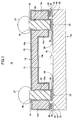
- Fig. 1 is a vertical cross-sectional view illustrating an electronic device 10 to which an embedment of a through electrode and a method for forming the same according to the present invention are applied.
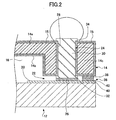
- Fig. 2 is an enlarged vertical cross-sectional view illustrating the through electrode.
- a function element 18 serving as a micromachine part is formed in an element mount space 16 defined by a substrate 12 and a lid (substrate) 14.
- the substrate 12 may be, for example, a silicon wafer (silicon substrate) or a glass substrate. If silicon is used as the substrate 12, a silicon wafer or glass is preferable as a support body described below. This embodiment is applicable for forming through electrodes not only in simple substrates but also in semiconductor wafers with integrated circuits.
- an electronic circuit for operating the function element 18 is formed on the surface of the substrate 12, in addition to the function element 18 including a cantilever.
- the electronic circuit includes electrodes 20 made of aluminum (Al) or copper (Cu).
- the function element 18 is formed on the surface of the substrate 12 by a micromachining method.
- the electronic device 10 may be used as, for example, a sensor such as accelerometer and a micro gyro in accordance with the configuration of the function element 18 mounted on the substrate 12.
- the electronic device 10 includes ultrasonic joint sections 22 for electrically joining the substrate 12 to the lid 14.
- the lid 14 includes a substrate 14a made of a Si wafer having a surface coated with an insulating layer 15, a recess 14b defining the element mount space 16, and a frame 14c surrounding the recess 14b.
- Each of the ultrasonic joint sections 22 comprises the electrode 20, a through electrode 24 formed in the lid 14, and a bump 26 made of gold for connecting a lower end of the through electrode 24 to the electrode 20.
- a solder bump 27 is formed on an upper end of the through electrode 24.
- the frame 14c of the lid 14 is provided with through holes 28 in which the through electrodes 24 are formed.
- the through holes 28 have hole diameters of 30 ⁇ m through 100 ⁇ m and heights (corresponding to the thickness of the substrate 14a) of 150 ⁇ m through 500 ⁇ m. Accordingly, the aspect ratio (thickness/hole diameter) of this embodiment ranges from 1.5 through 16.67.
- the through electrode 24 integrally comprises a columnar electrode 30 filling the through hole 28, a lower end electrode pad 32 formed on a lower end side of the columnar electrode 30 and having a size (horizontal surface area) wider than the cross section of the through hole 28, and an upper end electrode pad 34 formed on an upper end side of the columnar electrode 30 and having a size wider than the cross section of the through hole 28.
- the electronic device 10 is provided with an ultrasonic joint section 36 for sealing between a periphery of four edges of the lid 14 and a periphery of four edges of the substrate 12.
- the ultrasonic joint section 36 seals the element mount space 16 by joining, through a gold bump 42, quadrangular sealing pattern 38 formed on a lower face periphery of the lid 14 and a quadrangular sealing pattern 40 formed on an upper face periphery of the substrate 12.
- the sealing pattern 38 is made of copper, while the sealing pattern 40 is made of copper or aluminum (Al).
- the sealing patterns 38 and 40 are integrally joined by Au-Cu bonding through the gold bump 42 or gold plating.
- the lower end electrode pad 32 and the upper end electrode pad 34 each have a size wider than the cross section of the through hole 28, so that the through hole 28 is tightly sealed. This contributes to ensuring airtightness of the element mount space 16.
- the lower end electrode pad 32 and the upper end electrode pad 34 each have a surface area wider than the hole diameter of the through hole 28. The wider surface area, which is used as a connection area, facilitates connecting work with, for example, soldering.
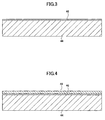
- a film-type adhesive tape 46 is applied to the surface of a Si wafer 44, which serves as a support body, by a lamination method.
- the adhesive tape 46 which is a two-sided adhesive tape having an adhesive layer on each of an upper face and a lower face thereof, tightly adheres to the surface of the Si wafer 44.
- the adhesive tape 46 serves to join a photoresist layer (adhesive layer) 52 described below and the Si wafer 44.
- the adhesive tape 46 becomes removable when the contact area is reduced due to explosion of micro capsules in a heat treatment performed after the through electrode 24 is completed.
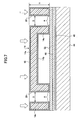
- a seed layer 48 is formed on an upper face of the adhesive tape 46 applied to the surface of the Si wafer 44.
- An example of a method for forming the seed layer 48 includes a method for forming a coating of copper (Cu) by vacuum deposition or sputtering, and a method for laminating a metal foil such as a Cu foil.
- a dry film 50 is applied to the surface of the seed layer 48 by a lamination method or by roller pressing.
- the dry film 50 has a double layer structure in which a passivation film (PET: polyethylene terephthalate) 53 is joined to an upper face of the photoresist layer 52 used as an adhesive layer.
- PET polyethylene terephthalate
- the photoresist layer 52 tightly adheres to the surface of the seed layer 48.
- the photoresist layer 52 is a negative resist film made of a photosensitive organic material that loses adhesiveness upon exposure and allows an unexposed part thereof to be dissolved and removed by developer.
- the photoresist layer 52 is formed by applying the dry film 50 to the surface of the seed layer 48 in this embodiment, the photoresist layer 52 may be formed by other methods, such as printing, without using the dry film 50. Instead of using the photoresist layer 52, an adhesive agent made of epoxy resin or polyimide resin may be used as the adhesive layer.
- the passivation film 53 of the dry film 50 is peeled and separated from the photoresist layer 52.
- the upper face and the lower face of the photoresist layer 52 have adhesiveness, and the adhesion between the lower face of the photoresist layer 52 and the seed layer 48 is stronger than the adhesion between the upper face of the photoresist layer 52 and the passivation film 53. Therefore, when the passivation film 53 is peeled off, the photoresist layer 52 is not separated from the seed layer 48.
- the photoresist layer 52 has a thickness ranging about from 10 ⁇ m through 15 ⁇ m, which corresponds to the thickness of the lower end electrode pad 32 as described below.
- step 5A shown in Fig. 7 the lid 14 made of a Si wafer is mounted on the adhesive surface of the photoresist layer 52.
- the recess 14b forming the element mount space 16 in the center of the lower face of the lid 14 is formed in the lid 14.
- the plural through holes 28 are formed to vertically extend through the frame 14c protruding downward and surrounding the recess 14b.
- the lid 14 is pressed onto the photoresist layer 52, so that the lower face of the frame 14c is press-bonded to the adhesive surface of the photoresist layer 52.
- the lid 14 is directly press-bonded to the surface of the photoresist layer 52 without using an adhesive tape, thereby eliminating a need for applying an adhesive tape and simplifying the production process.
- step 6A shown in Fig. 8 developer is provided into each of the through holes 28 so as to dissolve the photoresist layer 52 in an area A opposing a lower opening of the through hole 28.
- a dip development system for dipping the lid 14 mounted on the Si wafer 44 into the developer or a spray development system for spraying the developer onto the lid 14 from the upper side thereof may be applicable. Both of these development systems can dissolve the photoresist layer 52 in the area A opposing the lower opening of the through hole 28 and, therefore, can form a flange clearance 54 with a width Da (>D) greater than the inside diameter D of the through hole 28 while controlling infiltration time.
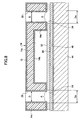
- step 7A shown in Fig. 9 the surface of the seed layer 48 exposed at the bottom of the through hole 28 is gold plated to form an Au plating layer 56 serving as barrier metal that prevents diffusion of the through electrode 24. Then, an upper face of the Au plating layer 56 is nickel plated, so that a Ni plating layer 58 is formed. Subsequently, copper is deposited on the Ni plating layer 58 by an electrolytic plating method, so that a columnar section 60b of a stud via 60 is formed inside the through hole 28. The stud via 60 is formed from bottom to top in the through hole 28 by depositing copper on the surface of the Ni plating layer 58 serving as a base. This prevents formation of voids near the center of the stud via 60 and can fill up the through hole 28 to its upper opening by depositing copper into the through hole 28.
- the size of the Au plating layer 56 and the Ni plating layer 58 is wider than the cross section of the through hole 28.
- a Cu flange section 60a of the stud via 60 deposited on the Ni plating layer 58 also has a size wider than the cross section of the through hole 28.
- the Au plating layer 56, the Ni plating layer 58, and the Cu flange section 60a constitute the lower end electrode pad 32.
- the Cu columnar section 60b deposited on the Cu flange section 60a corresponds to the columnar electrode 30.
- the plating structure of the electrode pad 32 may be a double layer plating structure of nickel and palladium (palladium on the top side) or may be a three-layer plating structure of nickel, palladium, and gold (gold on the top side).
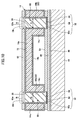
- a dry film is applied to an upper face of the lid 14 by a lamination method to form a negative resist layer 62.
- the negative resist layer 62 in an area B opposing an upper end of the stud via 60 is exposed and cured, and an unexposed part of the negative resist layer 62 is removed by developer. With this patterning process, a part of the negative resist layer 62 of an area wider than the upper opening of the through hole 28 is dissolved.
- a flange clearance 62a continuous to the upper end of the stud via 60 (upper side of the through hole 28) is formed.
- the flange clearance 62a formed in the negative resist layer 62 has a width Db (>D) greater than the inside diameter D of the through hole 28.
- a Cu flange section 60c is formed on the upper end of the Cu columnar section 60b by electrolytic plating.
- the Cu flange section 60c has an area wider than the cross section of the through hole 28, because the Cu flange section 60c is formed in the flange clearance 62a having an area wider than the cross section of the through hole 28.
- a Ni plating layer 64 is formed on an upper face of the Cu flange section 60c by electrolytic plating.
- an electrolytic Au plating layer (or Sn plating layer) 66 serving as barrier metal is formed on an upper face of the Ni plating layer 64 by electrolytic gold plating.
- the Au plating layer (or Sn plating layer) 66, the Ni plating layer 64, and the Cu flange section 60c constitute the upper end electrode pad 34.
- the plating structure of the electrode pad 34 may be a double layer plating structure of nickel and palladium (palladium on the top side) or may be a three-layer plating structure of nickel, palladium, and gold (gold on the top side).
- step 10A shown in Fig. 12 the exposed part of the negative resist layer 62 on the lid 14 is removed by swelling with use of remover (e.g. alkaline solution, caustic soda, etc.).
- remover e.g. alkaline solution, caustic soda, etc.
- step 11A shown in Fig. 13 the Si wafer 44 is heated to a high temperature in a baking process, so that the microcapsules contained in the adhesive tape 46 are exploded.
- the contact area of the adhesive tape 46 is reduced. Therefore, the Si wafer 44 bonded to the seed layer 48 through the adhesive tape 46 becomes easily separable from the seed layer 48.
- the Si wafer 44 may be removed by buffing.
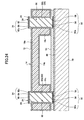
- step 12A shown in Fig. 14 the seed layer 48 is removed by etching. Then, the photoresist layer 52 bonded to the lower face of the lid is removed by using remover (e.g. alkaline solution, caustic soda, etc.) In this way, the lid 14 having the through electrodes 24 is completed.
- remover e.g. alkaline solution, caustic soda, etc.
- the through electrode 24 formed by the above-described forming method has a configuration in which the columnar electrode 30 filling the through hole 28 extending through the substrate 14a of the lid 14, the lower end electrode pad 32 formed on the lower end side of the columnar electrode 30 and having an area wider than the cross section of the through hole 28, and the upper end electrode pad 34 formed on the upper end side of the columnar electrode 30 and having an area wider than the cross section of the through hole 28 are integrally joined. Therefore, both upper and lower ends of the through hole 28 are tightly sealed. Moreover, as the columnar electrode 30 is formed from bottom to top on the lower end electrode pad 32, formation of voids near the center of the through hole 28 is prevented. Therefore, the columnar electrode 30 can be stably formed in the through hole 28 even if the aspect ratio (thickness/hole diameter) is high.
- the seed layer 48 is formed on the surface of the Si wafer 44 with the adhesive tape 46 interposed therebetween. Therefore, after the through electrode 24 is formed, the Si wafer 44 can be easily separated from the seed layer 48 by heating the adhesive tape 46. This simplifies a production process, and lowers production costs.
- step 1B shown in Fig. 15 a glass wafer 70 serving as a support body is prepared.
- a seed layer 48 is formed on an upper face of the glass wafer 70.
- An example of a method for forming the seed layer 48 includes vacuum deposition or sputtering of copper or nickel.
- step 3B shown in Fig. 17 a dry film 50 is applied to the surface of the seed layer 48 by a lamination method.
- step 4B shown in Fig. 18 a passivation film 53 of the dry film 50 is peeled and separated from a photoresist layer 52.
- step 5B shown in Fig. 19 the lid 14 made of a Si wafer is attached on an adhesive surface of the photoresist layer 52.
- a recess 14b forming an element mount space 16 (see Fig. 1) in the center on a lower face of the lid 14 is formed in the lid 14.
- Through holes 28 are formed to vertically extend through a frame 14c protruding downward and surrounding the recess 14b.
- the lid 14 is pressed onto the photoresist layer 52, so that a lower face of the frame 14c is press-bonded to the adhesive surface of the photoresist layer 52.
- step 6B shown in Fig. 20 developer is provided into each of the through holes 28 so as to dissolve the photoresist layer 52 in an area A (see Fig. 8) opposing a lower opening of the through hole 28.
- the developer provided into the through hole 28 can dissolve the photoresist layer 52 in the area A opposing the lower opening of the through hole 28 and, therefore, can form a flange clearance 54 with a width Da (>D) (see Fig. 8) greater than the inside diameter D of the through hole 28 while controlling infiltration time.
- plasma ashing is performed to generate active oxygen atoms in the dissolved photoresist layer 52 in the area A by electron collision dissociation utilizing plasma.
- the photoresist layer 52 is removed from the flange clearance 54.
- the plasma ashing improves the wetting efficiency of a plating solution in plating processing in the next step.
- step 7B shown in Fig. 21 the surface of the seed layer 48 exposed at the bottom of the through hole 28 is gold plated to form an Au plating layer 56 serving as barrier metal that prevents diffusion of the through electrode 24. Then, an upper face of the Au plating layer 56 is nickel plated, so that a Ni plating layer 58 is formed. Subsequently, copper is deposited on the Ni plating layer 58 by an electrolytic plating method, so that a columnar section 60b of a stud via 60 is formed inside the through hole 28. The stud via 60 is formed bottom to top in the through hole 28 by depositing copper on the surface of the Ni plating layer 58 serving as a base. This prevents formation of voids near the center of the stud via 60 and can fill up the through hole 28 to the upper opening of by depositing copper into the through hole 28.
- the area of the Au plating layer 56 and the Ni plating layer 58 is wider than the cross section of the through hole 28.
- a Cu flange section 60a of the stud via 60 deposited on the Ni plating layer 58 also has an area wider than the cross section of the through hole 28.
- a dry film is applied to an upper face of the lid 14 by a lamination method to form a negative resist layer 62.
- the negative resist layer 62 in an area B opposing an upper end of the stud via 60 is exposed and cured, and an unexposed part of the negative resist layer 62 is removed by developer. With this patterning process, a part of the negative resist layer 62 of an area wider than the upper opening of the through hole 28 is dissolved. Thus, a flange clearance 62a continuous to the upper end of the stud via 60 (upper side of the through hole 28) is formed.
- the flange clearance 62a formed in the negative resist layer 62 has a width Db (>D) greater than the inside diameter D of the through hole 28.
- a Cu flange section 60c is formed on the upper end of the Cu columnar section 60b by plating.
- the Cu flange section 60c has an area wider than the cross section of the through hole 28, because the Cu flange section 60c is formed in the flange clearance 62a having an area wider than the cross section of the through hole 28.
- a Ni plating layer 64 is formed on the upper face of the Cu flange section 60c by electroless plating.
- an electrolytic Au plating layer (or Sn plating layer) 66 serving as barrier metal is formed on an upper face of the Ni plating layer 64 by electroless plating.
- step 10B shown in Fig. 24 the exposed negative resist layer 62 on the lid 14 is removed therefrom by swelling with use of a remover (e.g. alkaline solution, caustic soda, etc.).
- a remover e.g. alkaline solution, caustic soda, etc.
- the glass wafer 70 is heated to a high temperature from the lower side in a baking process, so that the photoresist layer 52 is cured. The photoresist layer 52 thus loses adhesiveness, so that the photoresist layer 52 becomes easily separable from the lid 14.
- step 12B shown in Fig. 26 the glass wafer 70 is separated to the lower side, so that the photoresist layer 52 is separated from the lower surface of the lid 14. In this way, the lid 14 having the through electrodes 24 is completed.
- the photoresist layer 52 may be separated from the lower face of the lid 14 by removing the glass wafer 70 by grinding, and then removing the seed layer 48 by etching.
- the through electrode 24 formed by the above-described forming method has a configuration in which the columnar electrode 30 filling the through hole 28 extending through the substrate 14a of the lid 14, the lower end electrode pad 32 formed on the lower end side of the columnar electrode 30 and having an area wider than the cross section of the through hole 28, and the upper end electrode pad 34 formed on the upper end side of the columnar electrode 30 and having an area wider than the cross section of the through hole 28 are integrally joined. Therefore, both upper and lower ends of the through hole 28 are tightly sealed. Moreover, as the columnar electrode 30 is formed from bottom to top on the lower end electrode pad 32, formation of voids near the center of the through hole 28 is prevented. Therefore, the columnar electrode 30 can be stably formed in the through hole 28 even if the aspect ratio (thickness/hole diameter) is high.
- the glass wafer 70 can be easily separated from the lid 14 by heating the photoresist layer 52 formed on the surface of the glass wafer 70 with the seed layer 48 interposed therebetween. This simplifies a production process, and lowers production costs.
- micromachine packages for electronic devices are exemplified in the above embodiments, the present invention is also applicable to electrodes used in other products (e.g. interposers and products having through holes for connecting upper face side wiring patterns and lower face side wiring patterns).
Landscapes
- Engineering & Computer Science (AREA)
- Manufacturing & Machinery (AREA)
- Microelectronics & Electronic Packaging (AREA)
- Internal Circuitry In Semiconductor Integrated Circuit Devices (AREA)
- Micromachines (AREA)
- Production Of Multi-Layered Print Wiring Board (AREA)
- Printing Elements For Providing Electric Connections Between Printed Circuits (AREA)
Applications Claiming Priority (1)
| Application Number | Priority Date | Filing Date | Title |
|---|---|---|---|
| JP2004191488A JP3751625B2 (ja) | 2004-06-29 | 2004-06-29 | 貫通電極の製造方法 |
Publications (3)
| Publication Number | Publication Date |
|---|---|
| EP1612859A2 true EP1612859A2 (fr) | 2006-01-04 |
| EP1612859A3 EP1612859A3 (fr) | 2006-02-01 |
| EP1612859B1 EP1612859B1 (fr) | 2010-01-27 |
Family
ID=34941762
Family Applications (1)
| Application Number | Title | Priority Date | Filing Date |
|---|---|---|---|
| EP05253943A Ceased EP1612859B1 (fr) | 2004-06-29 | 2005-06-24 | Procédé de fabrication d'une électrode traversante |
Country Status (7)
| Country | Link |
|---|---|
| US (2) | US20060001173A1 (fr) |
| EP (1) | EP1612859B1 (fr) |
| JP (1) | JP3751625B2 (fr) |
| KR (1) | KR101117618B1 (fr) |
| CN (1) | CN100461357C (fr) |
| DE (1) | DE602005019124D1 (fr) |
| TW (1) | TWI381482B (fr) |
Cited By (3)
| Publication number | Priority date | Publication date | Assignee | Title |
|---|---|---|---|---|
| US20080299768A1 (en) * | 2007-06-04 | 2008-12-04 | Shinko Electric Industries Co., Ltd. | Manufacturing method of substrate with through electrode |
| CN102280429A (zh) * | 2010-06-14 | 2011-12-14 | 富士通株式会社 | 电路板、电路板组件和半导体装置 |
| EP2586742A1 (fr) * | 2007-06-20 | 2013-05-01 | Shinko Electric Industries Co., Ltd. | Boitier pour composant électronique et son procédé de fabrication |
Families Citing this family (19)
| Publication number | Priority date | Publication date | Assignee | Title |
|---|---|---|---|---|
| KR100620810B1 (ko) * | 2005-03-07 | 2006-09-07 | 삼성전자주식회사 | Mems 소자 패키지 및 그 제조방법 |
| US7633167B2 (en) * | 2005-09-29 | 2009-12-15 | Nec Electronics Corporation | Semiconductor device and method for manufacturing same |
| TWI324800B (en) | 2005-12-28 | 2010-05-11 | Sanyo Electric Co | Method for manufacturing semiconductor device |
| US7704800B2 (en) * | 2006-11-06 | 2010-04-27 | Broadcom Corporation | Semiconductor assembly with one metal layer after base metal removal |
| JP5154819B2 (ja) * | 2007-04-03 | 2013-02-27 | 新光電気工業株式会社 | 基板及びその製造方法 |
| TW200919593A (en) * | 2007-10-18 | 2009-05-01 | Asia Pacific Microsystems Inc | Elements and modules with micro caps and wafer level packaging method thereof |
| KR100986296B1 (ko) * | 2008-09-05 | 2010-10-07 | 삼성전기주식회사 | 반도체 패키지 및 그 제조 방법 |
| JP5453763B2 (ja) * | 2008-10-27 | 2014-03-26 | 大日本印刷株式会社 | 貫通電極基板の製造方法 |
| US20120314390A1 (en) * | 2010-03-03 | 2012-12-13 | Mutual-Tek Industries Co., Ltd. | Multilayer circuit board |
| JP5423572B2 (ja) | 2010-05-07 | 2014-02-19 | セイコーエプソン株式会社 | 配線基板、圧電発振器、ジャイロセンサー、配線基板の製造方法 |
| CN101916754B (zh) * | 2010-06-29 | 2012-08-29 | 香港应用科技研究院有限公司 | 通孔和通孔形成方法以及通孔填充方法 |
| JP5619542B2 (ja) * | 2010-09-08 | 2014-11-05 | ピーエスフォー ルクスコ エスエイアールエルPS4 Luxco S.a.r.l. | 半導体基板の処理方法及び半導体装置の製造方法 |
| US10526198B2 (en) * | 2011-03-04 | 2020-01-07 | Texas Instruments Incorporated | Infrared sensor design using an epoxy film as an infrared absorption layer |
| WO2013076830A1 (fr) * | 2011-11-22 | 2013-05-30 | 富士通株式会社 | Composant électronique et procédé de production de celui-ci |
| US8987871B2 (en) * | 2012-05-31 | 2015-03-24 | Stmicroelectronics Pte Ltd. | Cap for a microelectromechanical system device with electromagnetic shielding, and method of manufacture |
| JP5874690B2 (ja) | 2012-09-05 | 2016-03-02 | 株式会社デンソー | 半導体装置の製造方法 |
| JP2015177382A (ja) | 2014-03-15 | 2015-10-05 | キヤノン株式会社 | 素子電極が貫通配線と繋がったデバイス、及びその製造方法 |
| SG11201807926PA (en) * | 2016-03-24 | 2018-10-30 | Agency Science Tech & Res | A through silicon interposer wafer and method of manufacturing the same |
| CN108811354A (zh) * | 2017-04-28 | 2018-11-13 | 鹏鼎控股(深圳)股份有限公司 | 电路板及其制作方法 |
Citations (1)
| Publication number | Priority date | Publication date | Assignee | Title |
|---|---|---|---|---|
| EP1376686A2 (fr) | 2002-06-19 | 2004-01-02 | Shinko Electric Industries Co. Ltd. | Méthode pour boucher des trous traversants dans un substrat de silicium |
Family Cites Families (14)
| Publication number | Priority date | Publication date | Assignee | Title |
|---|---|---|---|---|
| DE3008143C2 (de) * | 1980-03-04 | 1982-04-08 | Ruwel-Werke Spezialfabrik für Leiterplatten GmbH, 4170 Geldern | Verfahren zum Herstellen von gedruckten Leiterplatten mit Lochungen, deren Wandungen metallisiert sind |
| JPH01258457A (ja) * | 1988-04-08 | 1989-10-16 | Nec Corp | 半導体集積回路の実装構造およびその製造方法 |
| JPH05243735A (ja) | 1992-03-03 | 1993-09-21 | Hitachi Chem Co Ltd | 多層配線板の製造法 |
| JPH07307565A (ja) | 1994-05-10 | 1995-11-21 | Hitachi Chem Co Ltd | 配線板の製造方法 |
| US5579207A (en) | 1994-10-20 | 1996-11-26 | Hughes Electronics | Three-dimensional integrated circuit stacking |
| JP3724110B2 (ja) * | 1997-04-24 | 2005-12-07 | 三菱電機株式会社 | 半導体装置の製造方法 |
| US6039889A (en) * | 1999-01-12 | 2000-03-21 | Fujitsu Limited | Process flows for formation of fine structure layer pairs on flexible films |
| JP3681155B2 (ja) * | 1999-12-22 | 2005-08-10 | 新光電気工業株式会社 | 電子部品の実装構造、電子部品装置、電子部品の実装方法及び電子部品装置の製造方法 |
| US6605551B2 (en) * | 2000-12-08 | 2003-08-12 | Intel Corporation | Electrocoating process to form a dielectric layer in an organic substrate to reduce loop inductance |
| US6441486B1 (en) * | 2001-03-19 | 2002-08-27 | Texas Instruments Incorporated | BGA substrate via structure |
| JP3860000B2 (ja) * | 2001-09-07 | 2006-12-20 | Necエレクトロニクス株式会社 | 半導体装置およびその製造方法 |
| JP2004095849A (ja) * | 2002-08-30 | 2004-03-25 | Fujikura Ltd | 貫通電極付き半導体基板の製造方法、貫通電極付き半導体デバイスの製造方法 |
| JP3910907B2 (ja) * | 2002-10-29 | 2007-04-25 | 新光電気工業株式会社 | キャパシタ素子及びこの製造方法、半導体装置用基板、並びに半導体装置 |
| US7091589B2 (en) * | 2002-12-11 | 2006-08-15 | Dai Nippon Printing Co., Ltd. | Multilayer wiring board and manufacture method thereof |
-
2004
- 2004-06-29 JP JP2004191488A patent/JP3751625B2/ja not_active Expired - Fee Related
-
2005
- 2005-06-23 TW TW094120930A patent/TWI381482B/zh not_active IP Right Cessation
- 2005-06-24 DE DE602005019124T patent/DE602005019124D1/de not_active Expired - Lifetime
- 2005-06-24 EP EP05253943A patent/EP1612859B1/fr not_active Ceased
- 2005-06-27 US US11/167,750 patent/US20060001173A1/en not_active Abandoned
- 2005-06-28 KR KR1020050056136A patent/KR101117618B1/ko not_active Expired - Fee Related
- 2005-06-29 CN CNB2005100811765A patent/CN100461357C/zh not_active Expired - Fee Related
-
2006
- 2006-08-07 US US11/499,947 patent/US7498259B2/en not_active Expired - Fee Related
Patent Citations (1)
| Publication number | Priority date | Publication date | Assignee | Title |
|---|---|---|---|---|
| EP1376686A2 (fr) | 2002-06-19 | 2004-01-02 | Shinko Electric Industries Co. Ltd. | Méthode pour boucher des trous traversants dans un substrat de silicium |
Cited By (4)
| Publication number | Priority date | Publication date | Assignee | Title |
|---|---|---|---|---|
| US20080299768A1 (en) * | 2007-06-04 | 2008-12-04 | Shinko Electric Industries Co., Ltd. | Manufacturing method of substrate with through electrode |
| US8349733B2 (en) * | 2007-06-04 | 2013-01-08 | Shinko Electric Industries Co., Ltd. | Manufacturing method of substrate with through electrode |
| EP2586742A1 (fr) * | 2007-06-20 | 2013-05-01 | Shinko Electric Industries Co., Ltd. | Boitier pour composant électronique et son procédé de fabrication |
| CN102280429A (zh) * | 2010-06-14 | 2011-12-14 | 富士通株式会社 | 电路板、电路板组件和半导体装置 |
Also Published As
| Publication number | Publication date |
|---|---|
| KR20060048594A (ko) | 2006-05-18 |
| US20060267210A1 (en) | 2006-11-30 |
| US7498259B2 (en) | 2009-03-03 |
| CN100461357C (zh) | 2009-02-11 |
| TWI381482B (zh) | 2013-01-01 |
| EP1612859A3 (fr) | 2006-02-01 |
| US20060001173A1 (en) | 2006-01-05 |
| JP3751625B2 (ja) | 2006-03-01 |
| DE602005019124D1 (de) | 2010-03-18 |
| KR101117618B1 (ko) | 2012-03-07 |
| TW200603237A (en) | 2006-01-16 |
| CN1716558A (zh) | 2006-01-04 |
| EP1612859B1 (fr) | 2010-01-27 |
| JP2006013330A (ja) | 2006-01-12 |
Similar Documents
| Publication | Publication Date | Title |
|---|---|---|
| EP1612859B1 (fr) | Procédé de fabrication d'une électrode traversante | |
| KR100838440B1 (ko) | 전자 장치용 기판과 그 제조 방법, 및 전자 장치와 그 제조방법 | |
| EP1449810B1 (fr) | Procédé pour l'assemblage d'un système micro-éléctro-mécanique à billes de soudure | |
| US7670962B2 (en) | Substrate having stiffener fabrication method | |
| US20100071944A1 (en) | Chip capacitor embedded pwb | |
| EP0997942A2 (fr) | Boítier semi-conducteur à largeur de puce et méthode de fabrication associée | |
| US20020031905A1 (en) | Methods of making a connection component | |
| JP2011501410A (ja) | 頑健な多層配線要素および埋設された超小型電子素子とのアセンブリ | |
| KR20110002074A (ko) | 3차원 실장 반도체 장치 및 그의 제조 방법 | |
| TW200400918A (en) | Method of manufacturing an electronic device | |
| CN113517270A (zh) | 大板级扇出基板预埋芯片的低厚度封装结构的制备方法 | |
| JP2016048795A (ja) | 導体構造要素及び導体構造要素を製造するための方法 | |
| TW201631715A (zh) | 佈線基板、製造佈線基板之方法及電子組件裝置 | |
| US20110169107A1 (en) | Method for manufacturing a component, method for manufacturing a component system, component, and component system | |
| JP5543754B2 (ja) | 半導体パッケージ及びその製造方法 | |
| KR100658022B1 (ko) | 회로 장치의 제조 방법 | |
| JPH01226160A (ja) | 電子部品接続用の端子装置および端子の製造方法 | |
| US20040195669A1 (en) | Integrated circuit packaging apparatus and method | |
| CN111106013A (zh) | Tmv结构的制备方法、大板扇出型异构集成封装结构及其制备方法 | |
| CN113299569A (zh) | 大板级扇出基板倒装芯片封装结构的制备方法 | |
| US20090315169A1 (en) | Frame and method of manufacturing assembly | |
| KR20070068268A (ko) | 배선 기판의 제조 방법 | |
| JP2003229513A (ja) | 素子内蔵基板および素子内蔵基板の製造方法 | |
| JPH11121647A (ja) | 半導体装置及びその製造方法 | |
| JP2022549518A (ja) | 拡張ヘッドバンプボンドピラーを備える集積キャパシタ |
Legal Events
| Date | Code | Title | Description |
|---|---|---|---|
| PUAI | Public reference made under article 153(3) epc to a published international application that has entered the european phase |
Free format text: ORIGINAL CODE: 0009012 |
|
| PUAL | Search report despatched |
Free format text: ORIGINAL CODE: 0009013 |
|
| AK | Designated contracting states |
Kind code of ref document: A2 Designated state(s): AT BE BG CH CY CZ DE DK EE ES FI FR GB GR HU IE IS IT LI LT LU MC NL PL PT RO SE SI SK TR |
|
| AX | Request for extension of the european patent |
Extension state: AL BA HR LV MK YU |
|
| AK | Designated contracting states |
Kind code of ref document: A3 Designated state(s): AT BE BG CH CY CZ DE DK EE ES FI FR GB GR HU IE IS IT LI LT LU MC NL PL PT RO SE SI SK TR |
|
| AX | Request for extension of the european patent |
Extension state: AL BA HR LV MK YU |
|
| 17P | Request for examination filed |
Effective date: 20060313 |
|
| AKX | Designation fees paid |
Designated state(s): DE |
|
| 17Q | First examination report despatched |
Effective date: 20080416 |
|
| RTI1 | Title (correction) |
Free format text: METHOD FOR FORMING A THROUGH ELECTRODE |
|
| GRAP | Despatch of communication of intention to grant a patent |
Free format text: ORIGINAL CODE: EPIDOSNIGR1 |
|
| GRAJ | Information related to disapproval of communication of intention to grant by the applicant or resumption of examination proceedings by the epo deleted |
Free format text: ORIGINAL CODE: EPIDOSDIGR1 |
|
| GRAP | Despatch of communication of intention to grant a patent |
Free format text: ORIGINAL CODE: EPIDOSNIGR1 |
|
| GRAS | Grant fee paid |
Free format text: ORIGINAL CODE: EPIDOSNIGR3 |
|
| GRAA | (expected) grant |
Free format text: ORIGINAL CODE: 0009210 |
|
| AK | Designated contracting states |
Kind code of ref document: B1 Designated state(s): DE |
|
| REF | Corresponds to: |
Ref document number: 602005019124 Country of ref document: DE Date of ref document: 20100318 Kind code of ref document: P |
|
| PLBE | No opposition filed within time limit |
Free format text: ORIGINAL CODE: 0009261 |
|
| STAA | Information on the status of an ep patent application or granted ep patent |
Free format text: STATUS: NO OPPOSITION FILED WITHIN TIME LIMIT |
|
| 26N | No opposition filed |
Effective date: 20101028 |
|
| PGFP | Annual fee paid to national office [announced via postgrant information from national office to epo] |
Ref country code: DE Payment date: 20160622 Year of fee payment: 12 |
|
| REG | Reference to a national code |
Ref country code: DE Ref legal event code: R119 Ref document number: 602005019124 Country of ref document: DE |
|
| PG25 | Lapsed in a contracting state [announced via postgrant information from national office to epo] |
Ref country code: DE Free format text: LAPSE BECAUSE OF NON-PAYMENT OF DUE FEES Effective date: 20180103 |