EP1614465A1 - Mikrofluidisches System für chemische Analyse - Google Patents
Mikrofluidisches System für chemische Analyse Download PDFInfo
- Publication number
- EP1614465A1 EP1614465A1 EP05076524A EP05076524A EP1614465A1 EP 1614465 A1 EP1614465 A1 EP 1614465A1 EP 05076524 A EP05076524 A EP 05076524A EP 05076524 A EP05076524 A EP 05076524A EP 1614465 A1 EP1614465 A1 EP 1614465A1
- Authority
- EP
- European Patent Office
- Prior art keywords
- fluid
- substrate
- fluid sample
- reagent
- inlet
- Prior art date
- Legal status (The legal status is an assumption and is not a legal conclusion. Google has not performed a legal analysis and makes no representation as to the accuracy of the status listed.)
- Granted
Links
Images




Classifications
-
- B—PERFORMING OPERATIONS; TRANSPORTING
- B01—PHYSICAL OR CHEMICAL PROCESSES OR APPARATUS IN GENERAL
- B01L—CHEMICAL OR PHYSICAL LABORATORY APPARATUS FOR GENERAL USE
- B01L3/00—Containers or dishes for laboratory use, e.g. laboratory glassware; Droppers
- B01L3/50—Containers for the purpose of retaining a material to be analysed, e.g. test tubes
- B01L3/502—Containers for the purpose of retaining a material to be analysed, e.g. test tubes with fluid transport, e.g. in multi-compartment structures
- B01L3/5027—Containers for the purpose of retaining a material to be analysed, e.g. test tubes with fluid transport, e.g. in multi-compartment structures by integrated microfluidic structures, i.e. dimensions of channels and chambers are such that surface tension forces are important, e.g. lab-on-a-chip
- B01L3/502715—Containers for the purpose of retaining a material to be analysed, e.g. test tubes with fluid transport, e.g. in multi-compartment structures by integrated microfluidic structures, i.e. dimensions of channels and chambers are such that surface tension forces are important, e.g. lab-on-a-chip characterised by interfacing components, e.g. fluidic, electrical, optical or mechanical interfaces
-
- B—PERFORMING OPERATIONS; TRANSPORTING
- B01—PHYSICAL OR CHEMICAL PROCESSES OR APPARATUS IN GENERAL
- B01L—CHEMICAL OR PHYSICAL LABORATORY APPARATUS FOR GENERAL USE
- B01L3/00—Containers or dishes for laboratory use, e.g. laboratory glassware; Droppers
- B01L3/50—Containers for the purpose of retaining a material to be analysed, e.g. test tubes
- B01L3/502—Containers for the purpose of retaining a material to be analysed, e.g. test tubes with fluid transport, e.g. in multi-compartment structures
- B01L3/5027—Containers for the purpose of retaining a material to be analysed, e.g. test tubes with fluid transport, e.g. in multi-compartment structures by integrated microfluidic structures, i.e. dimensions of channels and chambers are such that surface tension forces are important, e.g. lab-on-a-chip
- B01L3/502707—Containers for the purpose of retaining a material to be analysed, e.g. test tubes with fluid transport, e.g. in multi-compartment structures by integrated microfluidic structures, i.e. dimensions of channels and chambers are such that surface tension forces are important, e.g. lab-on-a-chip characterised by the manufacture of the container or its components
-
- B—PERFORMING OPERATIONS; TRANSPORTING
- B01—PHYSICAL OR CHEMICAL PROCESSES OR APPARATUS IN GENERAL
- B01L—CHEMICAL OR PHYSICAL LABORATORY APPARATUS FOR GENERAL USE
- B01L3/00—Containers or dishes for laboratory use, e.g. laboratory glassware; Droppers
- B01L3/50—Containers for the purpose of retaining a material to be analysed, e.g. test tubes
- B01L3/502—Containers for the purpose of retaining a material to be analysed, e.g. test tubes with fluid transport, e.g. in multi-compartment structures
- B01L3/5027—Containers for the purpose of retaining a material to be analysed, e.g. test tubes with fluid transport, e.g. in multi-compartment structures by integrated microfluidic structures, i.e. dimensions of channels and chambers are such that surface tension forces are important, e.g. lab-on-a-chip
- B01L3/50273—Containers for the purpose of retaining a material to be analysed, e.g. test tubes with fluid transport, e.g. in multi-compartment structures by integrated microfluidic structures, i.e. dimensions of channels and chambers are such that surface tension forces are important, e.g. lab-on-a-chip characterised by the means or forces applied to move the fluids
Definitions
- the present invention relates to a chemical analysis system and, more particularly, to the use of self-supporting microfluidic systems for chemical analysis of water or mixtures of water and oil.
- Fluid samples collected downhole can undergo various reversible and irreversible phase transitions between the point of collection and the point of analysis as pressure and temperature conditions are hard to preserve. Concentrations of constituent species may change because of loss due to vaporization, precipitation etc., and hence the analysis as done in the laboratories may not be representative of true conditions. For example, water chemistry and pH are important for estimating scaling tendencies and corrosion; however, the pH can change substantially as the fluid flows to the surface. Likewise, scaling out of salts and loss of carbon dioxide and hydrogen sulfide can give misleading pH values when laboratory measurements are made on downhole-collected samples. Conventional methods and apparatuses require bulky components that are not efficiently miniaturized for downhole applications.
- fluid sample for water management requires very frequent (i.e. daily, twice daily, etc.) monitoring and measuring of fluid properties.
- These monitoring regimes include permanent subsurface systems that are designed solely to gather and store frequently acquired data over long periods of time. Accordingly, there is a need for a system that uses very low quantities of reagent, operates autonomously, and collects or neutralizes waste product.
- Traditional solutions include chemical sensors that tend to lose calibration over a relatively short period of time.
- Micro electromechanical systems are well known as microfluidic devices for chemical applications since the 1990's (see Manz et al., “Miniaturized Total Chemical and Analysis Systems: A Novel Concept for Chemical Sensing," Sensors and Actuators B, Vol. B 1, pages 244-248 (1990), incorporated by reference herein in its entirety) and are typically fabricated from silicon, glass, quartz and poly(dimethylsiloxane) (PDMS) (see Verpoorte et al., "Microfluidics Meets MEMS" Proceedings of the IEEE, Vol.
- PDMS poly(dimethylsiloxane)
- MEMS technology allows for miniaturized designs requiring smaller liquid volumes.
- MEMS devices are easy to mass produce having a very accurate reproducibility.
- MEMS also allows easy integration of different components, such as valves, mixers, channels, etc.
- MOEMS micro optical electro mechanical systems, or Optical MEMS.
- MOEMS have also been used for chemical applications since the 1990's.
- Commercial (non-chemical) structures are used in the telecommunications field to make use of MEMS wave-guides to modify or route an optical signal.
- United States Patent No. 5,116,759 to Klainer et al. discloses a laboratory-based system utilizing a MEMS device.
- the MEMS device is a cell that receives the sample for analysis.
- All associated analytical devices, including optical interrogation, power supply, reagent sources, and processing means, are typical laboratory-sized devices not suitable for remote interrogation.
- a microfluidic system for performing fluid analysis having: (a) a submersible housing having a fluid analysis means and a power supply to provide power to the system; and (b) a substrate for receiving a fluid sample, having embedded therein a fluid sample inlet, a reagent inlet, a fluid sample outlet, and a mixing region in fluid communication with the fluid sample inlet, the reagent inlet, and the fluid sample outlet, and wherein the substrate includes a fluid drive means for moving the fluid sample through the substrate, and wherein the substrate interconnects with the housing. At least a portion of the fluid analysis means may be embedded in the substrate.
- a passive fluid drive system includes a system wherein the fluid is driven due to the differential in pressure between the sampling environment and the internal pressure of the microfluidic device.
- Active fluid drive systems may include a pump in the housing or embedded in the substrate.
- the pump is a piezo-electric pump embedded in the substrate; most preferably, it is pressure-balanced.
- At least one reagent reservoir may be connected to the reagent inlet to provide reagents to perform the fluid analysis.
- the substrate may include more than one reagent inlet, wherein each additional inlet has at least one reagent reservoir.
- the reagent reservoirs are collapsible bags, and, most preferably, they are threaded bags.
- the fluid sample inlet and fluid sample outlet may be in fluid communication with the fluid to be sampled.
- a separator system may be positioned at the fluid sample outlet to remove particulate from the fluid prior to analysis.
- the separator system may be embedded in the substrate and may include activated charcoal, an ion exchange membrane, or other means commonly used in the field.
- the system may further comprise a control means to control fluid analysis means to assist in the remote operation of the system.
- data processing means may be used to receive, store, and/or process data from the fluid analysis means.
- the control means may include data transmission means to transmit data received from the fluid analysis means.
- a second embodiment is a method of performing fluid analysis comprising: (a) remotely deploying a microfluidic system in or proximate to the fluid to be sampled (also referred to as a sampling environment), wherein the microfluidic system is comprised of a submersible housing having a fluid analysis means and a power supply to provide power to the system; and a substrate for receiving a fluid sample, having embedded therein a fluid sample inlet, a reagent inlet, a fluid sample outlet, and a mixing region in fluid communication with the fluid sample inlet, the reagent inlet, and the fluid sample outlet, and wherein the substrate includes a fluid drive means for moving the fluid sample through the substrate, and wherein the substrate interconnects with the housing; (b) receiving a fluid sample into the fluid sample inlet; (c) mixing the fluid sample with reagent from the reagent inlet in the mixing region; and (d) analyzing the fluid sample using the fluid analysis means.
- the fluid sample may then be stored in the housing for later disposal or discharged
- the device of the present invention may be manufactured by (a) providing two or more substrates; (b) forming fluid mixing channels and fluid analysis channels within at least one of the substrates; (c) forming an inlet and an outlet within at least one of the substrates; (d) embedding a piezoelectric pump within at least one of the substrates; and (e) bonding the substrates to one another. It is preferred that the optical fibers and electrical wires required for the operation of the pump and the fluid analysis region be embedded within at least one of the substrates.
- the overall system has limited dimensions (such as in diameter and length) and is completely self supporting, enabling remote analysis or monitoring such as in standpipes, aquifers, groundwater, hazardous sites, chemical plants and boreholes.
- the device is submersible and autonomous. Because the device remains robust over an extended period of time it may be permanently (or semi-permanently) installed in remote locations for extended monitoring.
- the instrument is particularly useful, for example, in oilfield applications for the detection of scale forming ions and dissolved gases and in water applications for the detection of hazardous chemicals.
- Chemical measurements of interest in the water business include, but is not limited to, pH and toxic chemicals, such as nitrate, arsenic and other heavy metals, benzene and other organic compounds.
- Chemical measurements of interest in the oilfield include, but is not limited to, the determination of pH, the detection of H 2 S and CO 2 , as well as scale forming ions such as Ca, Ba, Sr, Mg, and SO 4 .
- Figure 1 is a schematic diagram of the microfluidic system of the present invention.
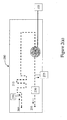
- Figures 2(a), (b) and (c) are schematic diagrams of the substrate of the microfluidic system of the present invention.
- Figure 3 is a schematic showing a detail of a reagent reservoir having a spiral channel.
- Figure 4 is a schematic diagram showing one method of manufacturing the present invention.
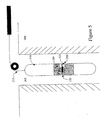
- Figure 5 is a schematic diagram of one application of the present invention, useful in the oilfield and water management areas.
- Figure 6 is a schematic diagram showing various suitable telemetry methods.
- Figure 1 is a schematic of the autonomous microfluidic system 10 of the present invention having a microfluidic substrate 200 in communication with a housing 100.
- the substrate 200 is hermetically sealed to the housing 100 such that the sample inlet 205 extends outside of the housing 100 and the electrical connections 120 are within the housing 100.
- the housing 100 further includes a power supply 105 and control electronics 110 in electrical connection with the substrate 200. It is noted that while reservoir 210 is shown in this figure outside the housing 100 and the waste collector 225 is shown inside the housing 100, the location of these components relative to the housing will depend on the desired configuration of the system. Alternatively, the waste fluid may be discharged via outlet 235. Accordingly, the configuration of Figure 1 is intended to be illustrative and non-limiting. Most preferably, the housing 100 is bonded 115 directly to the substrate 200 avoiding electrical feedthroughs.
- Figures 2(a)-(c) are detailed schematics showing non-limiting embodiments of the substrate 200. More particularly, Figure 2(a) depicts the substrate 200 having fluid channels (dashed lines), optical fibers (dotted lines), and electrical wires (grey lines) embedded therein. Fluids enter the system via sample inlet 205 and mixes with reagent stored in the reagent reservoir 210 in mixing region 215. To minimize particulate in the system, a filter (not shown) may be placed over, attached to, or embedded in, the inlet. The fluid in the system is subject to a driving force, which may be passive or active.
- a driving force which may be passive or active.
- the fluid may be moved through the system using a pump 220 (such as an ultrasonic pump or a piezo-electric pump) operated by control electronics 110 and a power source 105.
- the pump is a piezo-electric pump that is pressure-balanced, such as by applying a water impervious, electrically isolating gel on the surface of the piezo.
- the system may be designed such that the pump pulls or pushes the fluid through the system, or designed such that the pump pulls a portion of the fluid and pushes another portion of the fluid.
- the arrows are intended to show the direction of fluid flow.
- fluid may be moved through the substrate using a passive fluid drive means wherein the differential in pressure between the sampling environment and the pressure within the tool housing is used to move the fluid through the system (such as by lowering the pressure within the submersible housing relative to the sampling environment).
- the sample may be stored in a collector 225 for later use or disposal, or discharged back into the borehole via outlet 235.
- the sample may be 'cleaned' (i.e., reagents or precipitates removed to an acceptable level) prior to discharge using a separator means 230, having, for example, activated charcoal or an ion membrane.
- the separator means 230 may be embedded on the substrate or may be positioned to the outside of the outlet such that the sample passes through the separator means prior to discharge.
- the reagent reservoir 210 preferably has a pressure-balanced contact with the environment to ensure that the reagent is subject to the same pressure as the sample.
- This pressure-balanced contact might be, for example, a flexible impermeable foil or a mechanical pressure adapter.
- the pressure equilibrium prevents back flow through the microfluidic device and reduces the pressure difference to be overcome by the pump.
- the reagent in the reservoir can be, for example, a pH-sensitive color indicator or other reagents or catalysts applicable to the chemical analyses desired.
- the reagent reservoir 210 is connected to the fluid handling system, such as through a permanently open connection or a controlled connection such as with a valve. It is noted that the overall system is inherently pressure-balanced as the inlet and the outlet are exposed to the sampling environment.
- the system may be designed to control the flow rate, sample volumes, and mixing ratios by adjusting the fluid resistance of the system. Because the total flow rate is dependent on the fluid resistance of the complete circuitry, dimensional variation (shape and geometry of the channels, for example) in the system will influence the total fluid resistance and thus the flow rate. To ensure that adequate mixing of the sample with the reagent over a relatively short channel length, various mixing and channel geometries may be used.
- One useful geometry is the herringbone geometry as described by Strook et al. in "Chaotic Mixer for Microchannels", Science, Vol. 295, pages 647-651 (2002) (incorporated by reference herein in its entirety).
- the fluid circuitry may be adapted to generate certain reaction time before interrogation. Accordingly, the fluid circuitry may contain multiple reagent reservoirs, fluid resistors and mixers to control fluid flow and mixing or to create subsequent reactions (such as multistage reactions with variable reaction times).
- Figures 2(b) and 2(c) show alternate embodiments of the present invention.
- Figure 2(b) shows the microfluidic device of Figure 2(a) with a fluid analyzing means 245 inside housing 100 (such as part of the analysis module of Figure 5).
- a fluid analyzing means 245 inside housing 100 (such as part of the analysis module of Figure 5).
- more than one reagent reservoir may be used (i.e., positioned in parallel or series) to allow more than one analyses to be performed using a single microfluidic system.
- the reagents may be stored in a collapsible bag, or a threaded bag as shown in Figure 3, to minimize backflow through the substrate.
- this embodiment shows the fluid analysis means 245 in the housing 100 and connected to the substrate 200 , the fluid analysis means 245 may be embedded directly into the substrate 200 (see, for example, Figure 2(c)).
- the fluid analyzing means 245 is an optical interrogation zone 245a having a light source 245b and a detector 245c.
- the light source 245b and detector 245c may be either embedded in the substrate or connected via optical fibers (as shown).
- the light source 245b transmits lights through the optical interrogation zone 245a to the detector 245c.
- the light source 245b may be any incandescent lamp, LED, laser, etc. suitable for the analysis to be performed.
- the detector 245c measures the transmitted light at a defined wavelength depending on the analysis performed and the source 245b used.
- the detector 245c can be a spectrum analyzer or a combination of appropriate filters and photodiodes.
- Light source 245b and detector 245c are controlled by electronics 110, which may include a microprocessor to process the data and store the measurement values. It is noted that if cyclic olefin copolymer (COC) or any optically clear material is used as the substrate, then no separate optical windows are needed; COC may be used as the optical window.
- COC cyclic olefin copolymer
- FIG. 3 is a schematic of a most preferred embodiment of the reagent reservoir 210, hereinafter referred to as a threaded reagent reservoir.
- This embodiment includes a spiral channel 250 having an opening at the top at 255 such that the channel is pressure balanced relative to the sampling environment.
- a channel 260 extends through the threaded portion to allow the reagent reservoir to be filled and capped 265. Reagent passes from the reservoir into the channels of the substrate via outlet 270.
- the fluid analyzing system may be designed to perform resistivity tests, determine the presence of specific precipitate (such as metal or salt precipitates) or perform other chemical analyses.
- fluid analyses may take place at more than one interrogation zone (not shown), placed in parallel or in series.
- multiple reagents may be used to allow for multiple analyses.
- One particularly useful downhole fluid analysis is pH indication.
- the present invention was tested wherein the interrogation zone was a colorimetric (i.e. optical) pH indicator.
- the results of this test are provided in Table 1, wherein a sample with a known pH was measured using the present invention and compared to measurements taken with standard laboratory equipment (in this case a Spectroquant® Vega 400 photometer): Table 1 Certified Buffer pH Measurement using Vega 400 Measurement using the present invention 4.00 3.98 3.97 5.00 4.90 5.01 6.00 not taken 5.98 6.86 6.78 6.84 7.00 6.90 6.97 7.70 7.63 7.67 8.00 7.99 7.97 As can be seen by the data of Table 1, the system of the present invention can take measurements that are comparable to standard laboratory measurements.
- a bubble trap 240 may be positioned between the mixing region 215 and the optical interrogation zone 245a.
- the entire system is preferably manufactured using MEMS/MOEMS techniques such that all or nearly all connections are eliminated. Accordingly, most bubble sources are naturally eliminated in the design. However, the bubble trap 240 may be used to remove any remaining bubbles and ensure the integrity of the optical measurements.
- the microfluidic device described herein is preferably designed and manufactured so that all channels, tubes and fibers are embedded in a single substrate, such as that possible using MEMS/MOEMS techniques.
- Suitable substrates include (but are not limited to) silicon, quartz, and plastic.
- the substrate may be constructed of plastic using micro-molding techniques wherein a mold is made by machining a piece of metal. The plastic is then formed using the mold and appropriately cured, if needed.
- a second substrate 200b may be attached to 200a where a surface-to-surface bond is applied such that the channels 250 are preserved.
- Adheisve such as UV curable adhesive, may be used.
- a mask may be used to selectively cure the glue in areas of interest.
- the mask allows preferential transmission of UV light such that the glue does not cure in the area of the channels, but cures where desired.
- laser welds may be used.
- substrate is formed of plastic and chemical bonds are used which minimizes dimensional variations due to the layer of glue and complexity of laser welding.
- channel surfaces within the optical interrogation zone may require optical grade polishing to nano-meter scale. For plastic molding, this can be achieved by making the corresponding surface of the mold to be of optical quality polish.
- All tubes and fibers should preferably extend from the substrate at a common end such that they may be isolated in a common waterproof housing. This configuration also allows the device to be easily adapted for fitting in various sampling tools, such as those typically used to monitor aquifers and groundwater as well as those used in the oilfield.
- the present invention may be implemented in a laboratory or in various downhole fluid analysis tools.
- the apparatus described in commonly owned co-pending United States Patent Application Serial No. 10/667,639 filed September 22, 2003, entitled “Determining Fluid Chemistry of Formation Fluid by Downhole Reagent Injection Spectral Analysis” (incorporated by reference herein in its entirety) is a preferred implementation of the present reagent mixture.
- One non-limiting embodiment of the present invention is a wireline formation tester 310, including fluids analyzer 320.
- the formation tester is shown downhole within fluid-filled borehole 305 in formation 300 suspended by logging cable 315.
- Logging cable 315 also couples the formation tester to surface system.
- the housing in this example is the formation tester 310 having a fluids analyzer module 320 with the substrate 200.
- the substrate 200 is affixed to the formation tester 310 in the area of the fluids analyzer module 320 such that the electrical connections 120 are isolated within the tool and the inlet of the microfluidic device (not shown) extends into a fluid flow line 325.
- the power supply and control electronics (not shown) are within the formation tester 310. This configuration eliminates the need to separate pumps, probes and reagent containers.
- Figure 5 is intended to depict a non-limiting embodiment useful for deploying the present invention in the oilfield.
- Other suitable elements may be included as dependent upon the specific application.
- other configurations may be used to extract fluids such as in water or waste water management.
- the substrate may be affixed to tools usually deployed in groundwater monitoring wells such as the Diver® by Van Essen Instruments, chemical processes plants, or producing wells.
- the device may be permanently or semi-permanently installed in these environments.
- the microfluidic device can be used to perform fluid analysis on any fluid sample obtained remotely where space and sample volume is of concern.
- the device may be used in processing plants, for space applications or in a downhole oilfield or water management applications.
- the microfluidic system of the present invention is robust for long term, semi-permanent and permanent applications (on the order of days, months, and years).
- the microfluidic device 100 may communicate with remote equipment via one of the many telemetry schemes known in the art, such as over electronic conductors, optical fibers or other suitable medium to a computer or other remote processing/data storage means 110; it may store the data retrieved from the sensors in the incorporated memory (not shown) to be later retrieved; or it may be transmitted wirelessly 415; or it may be downloaded to a local or remote computer 410.
- a computer or other remote processing/data storage means 110 may store the data retrieved from the sensors in the incorporated memory (not shown) to be later retrieved; or it may be transmitted wirelessly 415; or it may be downloaded to a local or remote computer 410.
Landscapes
- Chemical & Material Sciences (AREA)
- Health & Medical Sciences (AREA)
- Dispersion Chemistry (AREA)
- Analytical Chemistry (AREA)
- General Health & Medical Sciences (AREA)
- Hematology (AREA)
- Clinical Laboratory Science (AREA)
- Chemical Kinetics & Catalysis (AREA)
- Sampling And Sample Adjustment (AREA)
- Investigating Or Analyzing Non-Biological Materials By The Use Of Chemical Means (AREA)
- Automatic Analysis And Handling Materials Therefor (AREA)
Applications Claiming Priority (1)
| Application Number | Priority Date | Filing Date | Title |
|---|---|---|---|
| US10/885,471 US7799278B2 (en) | 2004-07-06 | 2004-07-06 | Microfluidic system for chemical analysis |
Publications (3)
| Publication Number | Publication Date |
|---|---|
| EP1614465A1 true EP1614465A1 (de) | 2006-01-11 |
| EP1614465B1 EP1614465B1 (de) | 2007-08-29 |
| EP1614465B8 EP1614465B8 (de) | 2008-02-20 |
Family
ID=34938366
Family Applications (1)
| Application Number | Title | Priority Date | Filing Date |
|---|---|---|---|
| EP05076524A Expired - Lifetime EP1614465B8 (de) | 2004-07-06 | 2005-07-04 | Mikrofluidisches System für chemische Analyse |
Country Status (5)
| Country | Link |
|---|---|
| US (1) | US7799278B2 (de) |
| EP (1) | EP1614465B8 (de) |
| AT (1) | ATE371498T1 (de) |
| CA (1) | CA2511454C (de) |
| DE (1) | DE602005002196D1 (de) |
Cited By (4)
| Publication number | Priority date | Publication date | Assignee | Title |
|---|---|---|---|---|
| WO2007102783A1 (en) * | 2006-03-07 | 2007-09-13 | Nanyang Technological University | Microfluidic immunoassay device |
| EP2075403A1 (de) | 2007-12-27 | 2009-07-01 | PRAD Research and Development N.V. | Echtzeitmessung von Eigenschaften von Reservoirfluiden |
| US7575681B2 (en) * | 2004-07-06 | 2009-08-18 | Schlumberger Technology Corporation | Microfluidic separator |
| US10175380B2 (en) | 2013-04-18 | 2019-01-08 | Halliburton Energy Services, Inc. | Device and method for parallel microfluidic pressure-volume-temperature analysis |
Families Citing this family (37)
| Publication number | Priority date | Publication date | Assignee | Title |
|---|---|---|---|---|
| GB0122929D0 (en) * | 2001-09-24 | 2001-11-14 | Abb Offshore Systems Ltd | Sondes |
| SE0400662D0 (sv) * | 2004-03-24 | 2004-03-24 | Aamic Ab | Assay device and method |
| JP4683538B2 (ja) * | 2004-05-06 | 2011-05-18 | セイコーインスツル株式会社 | 分析用マイクロチップを含む分析システムと分析方法 |
| US8262909B2 (en) * | 2004-07-06 | 2012-09-11 | Schlumberger Technology Corporation | Methods and devices for minimizing membrane fouling for microfluidic separators |
| US20060198742A1 (en) * | 2005-03-07 | 2006-09-07 | Baker Hughes, Incorporated | Downhole uses of piezoelectric motors |
| US7424366B2 (en) * | 2005-08-27 | 2008-09-09 | Schlumberger Technology Corporation | Time-of-flight stochastic correlation measurements |
| US7600413B2 (en) * | 2006-11-29 | 2009-10-13 | Schlumberger Technology Corporation | Gas chromatography system architecture |
| US20080245740A1 (en) * | 2007-01-29 | 2008-10-09 | Searete Llc, A Limited Liability Corporation Of The State Of Delaware | Fluidic methods |
| US7784330B2 (en) * | 2007-10-05 | 2010-08-31 | Schlumberger Technology Corporation | Viscosity measurement |
| US20090120168A1 (en) * | 2007-11-08 | 2009-05-14 | Schlumberger Technology Corporation | Microfluidic downhole density and viscosity sensor |
| US7574898B2 (en) * | 2007-11-08 | 2009-08-18 | Schlumberger Technology Corporation | Vibrating wire viscosity sensor |
| US20110039033A1 (en) * | 2008-01-31 | 2011-02-17 | Erika Merschrod | Method of depositing a polymer micropattern on a substrate |
| US8340913B2 (en) * | 2008-03-03 | 2012-12-25 | Schlumberger Technology Corporation | Phase behavior analysis using a microfluidic platform |
| CA2623793C (en) * | 2008-03-03 | 2010-11-23 | Schlumberger Canada Limited | Microfluidic apparatus and method for measuring thermo-physical properties of a reservoir fluid |
| US8440063B2 (en) * | 2008-03-26 | 2013-05-14 | Massachusetts Institute Of Technology | Electrokinetic concentration devices |
| US9051821B2 (en) * | 2008-12-15 | 2015-06-09 | Schlumberger Technology Corporation | Microfluidic methods and apparatus to perform in situ chemical detection |
| US8564768B2 (en) * | 2009-04-17 | 2013-10-22 | Schlumberger Technology Corporation | High pressure and high temperature optical spectroscopy cell using spherical surfaced lenses in direct contact with a fluid pathway |
| US20100269579A1 (en) * | 2009-04-22 | 2010-10-28 | Schlumberger Technology Corporation | Detecting gas compounds for downhole fluid analysis using microfluidics and reagent with optical signature |
| WO2010135852A1 (zh) * | 2009-05-27 | 2010-12-02 | 西门子公司 | 适于在线应用的毛细管电池芯片、装置和方法 |
| US8380446B2 (en) | 2010-06-14 | 2013-02-19 | Schlumberger Technology Corporation | System and method for determining the phase envelope of a gas condensate |
| US8826981B2 (en) * | 2011-09-28 | 2014-09-09 | Schlumberger Technology Corporation | System and method for fluid processing with variable delivery for downhole fluid analysis |
| FR2981283B1 (fr) | 2011-10-13 | 2014-08-29 | Chambre De Commerce Et De L Ind De Paris Au Titre De Son Etablissement D Enseignement Superieur Esie | Dispositif microfluidique pour analyser un fluide sous pression. |
| US20130175036A1 (en) * | 2012-01-10 | 2013-07-11 | Andreas Hausot | Methods and Apparatus for Downhole Extraction and Analysis of Heavy Oil |
| US9249661B2 (en) | 2012-01-20 | 2016-02-02 | Schlumberger Technology Corporation | Apparatus and methods for determining commingling compatibility of fluids from different formation zones |
| US11015434B2 (en) * | 2013-09-20 | 2021-05-25 | Schlumberger Technology Corporation | Microfluidic determination of wax appearance temperature |
| EP2878374B1 (de) | 2013-11-29 | 2021-05-12 | IMEC vzw | Verfahren zur Ausführung einer digitalen PCR |
| US9863881B2 (en) * | 2014-01-15 | 2018-01-09 | Purdue Research Foundation | Methods for measuring concentrations of analytes in turbid solutions by applying turbidity corrections to raman observations |
| KR101562318B1 (ko) * | 2014-02-10 | 2015-10-22 | 나노바이오시스 주식회사 | 미세유체 칩 및 이를 이용한 실시간 분석 장치 |
| US10018040B2 (en) | 2014-10-24 | 2018-07-10 | Schlumberger Technology Corporation | System and methodology for chemical constituent sensing and analysis |
| US20180223649A1 (en) * | 2015-10-06 | 2018-08-09 | Halliburton Energy Services, Inc. | Methods and systems using micro-photomultiplier tubes and microfluidics with integrated computational elements |
| KR101878569B1 (ko) * | 2015-11-26 | 2018-07-16 | 부산대학교 산학협력단 | 관류 세포 배양 마이크로 유체 시스템 |
| US11358140B2 (en) * | 2017-05-16 | 2022-06-14 | Autonomous Medical Devices Inc. | Apparatus for automatic sampling of biological species employing an amplification with a magnetic nanoparticle and propulsion method |
| US11039765B2 (en) * | 2017-09-26 | 2021-06-22 | International Business Machines Corporation | Smart pellet for sample testing |
| CN111220625B (zh) * | 2020-01-18 | 2023-04-07 | 哈尔滨工业大学 | 表面及亚表面一体化共焦显微测量装置和方法 |
| CN113063779A (zh) * | 2021-03-15 | 2021-07-02 | 埃妥生物科技(杭州)有限公司 | 一种取样器以及样本与试剂的混合装置 |
| CN116930541A (zh) * | 2023-09-14 | 2023-10-24 | 深圳希克生物医疗科技有限公司 | 生物体液样品的检测方法、控制装置、检测仪器及介质 |
| US12571934B2 (en) | 2024-01-26 | 2026-03-10 | Schlumberger Technology Corporation | NMR-based lithium measuring and monitoring downhole tools, methods of using said downhole tools, and methods of measuring lithium concentrations based on NMR measurements acquired by said downhole tools |
Citations (4)
| Publication number | Priority date | Publication date | Assignee | Title |
|---|---|---|---|---|
| US5116759A (en) | 1990-06-27 | 1992-05-26 | Fiberchem Inc. | Reservoir chemical sensors |
| US5984023A (en) * | 1996-07-26 | 1999-11-16 | Advanced Coring Technology | Downhole in-situ measurement of physical and or chemical properties including fluid saturations of cores while coring |
| WO2002077613A2 (en) * | 2001-03-23 | 2002-10-03 | Services Petroliers Schlumberger | Fluid property sensors |
| US20040129874A1 (en) | 2002-11-22 | 2004-07-08 | Schlumberger Technology Corporation | Determining fluid chemistry of formation fluid by downhole reagent injection spectral analysis |
Family Cites Families (14)
| Publication number | Priority date | Publication date | Assignee | Title |
|---|---|---|---|---|
| DE69207071D1 (de) * | 1991-06-07 | 1996-02-08 | Asahi Glass Co Ltd | Verfahren für die Trennung und die Wiedergewinnung von Säuren |
| AU667579B2 (en) * | 1992-08-10 | 1996-03-28 | Akw A & V Protec Gmbh | Process and device for the biological treatment of organically polluted waste water and organic waste |
| US6074827A (en) * | 1996-07-30 | 2000-06-13 | Aclara Biosciences, Inc. | Microfluidic method for nucleic acid purification and processing |
| US6039897A (en) * | 1996-08-28 | 2000-03-21 | University Of Washington | Multiple patterned structures on a single substrate fabricated by elastomeric micro-molding techniques |
| US6306590B1 (en) * | 1998-06-08 | 2001-10-23 | Caliper Technologies Corp. | Microfluidic matrix localization apparatus and methods |
| US6262519B1 (en) * | 1998-06-19 | 2001-07-17 | Eastman Kodak Company | Method of controlling fluid flow in a microfluidic process |
| GB9821573D0 (en) | 1998-10-02 | 1998-11-25 | Central Research Lab Ltd | Method and apparatus for removing a substance from a container |
| DE19941271A1 (de) | 1999-08-31 | 2001-04-05 | Lienhard Pagel | Mikrofluidisches Membranmodul |
| US20020164816A1 (en) * | 2001-04-06 | 2002-11-07 | California Institute Of Technology | Microfluidic sample separation device |
| US6919046B2 (en) | 2001-06-07 | 2005-07-19 | Nanostream, Inc. | Microfluidic analytical devices and methods |
| WO2003050035A2 (en) | 2001-12-06 | 2003-06-19 | Nanostream, Inc. | Adhesiveless microfluidic device fabrication |
| JP4039481B2 (ja) | 2001-12-26 | 2008-01-30 | 財団法人川村理化学研究所 | 多孔質部を有するマイクロ流体デバイスの製造方法 |
| US20030150791A1 (en) | 2002-02-13 | 2003-08-14 | Cho Steven T. | Micro-fluidic anti-microbial filter |
| WO2004087283A1 (en) | 2003-03-25 | 2004-10-14 | Massachusetts Institute Of Technology | Fluid separation |
-
2004
- 2004-07-06 US US10/885,471 patent/US7799278B2/en active Active
-
2005
- 2005-07-04 AT AT05076524T patent/ATE371498T1/de not_active IP Right Cessation
- 2005-07-04 EP EP05076524A patent/EP1614465B8/de not_active Expired - Lifetime
- 2005-07-04 DE DE602005002196T patent/DE602005002196D1/de not_active Expired - Lifetime
- 2005-07-05 CA CA2511454A patent/CA2511454C/en not_active Expired - Fee Related
Patent Citations (4)
| Publication number | Priority date | Publication date | Assignee | Title |
|---|---|---|---|---|
| US5116759A (en) | 1990-06-27 | 1992-05-26 | Fiberchem Inc. | Reservoir chemical sensors |
| US5984023A (en) * | 1996-07-26 | 1999-11-16 | Advanced Coring Technology | Downhole in-situ measurement of physical and or chemical properties including fluid saturations of cores while coring |
| WO2002077613A2 (en) * | 2001-03-23 | 2002-10-03 | Services Petroliers Schlumberger | Fluid property sensors |
| US20040129874A1 (en) | 2002-11-22 | 2004-07-08 | Schlumberger Technology Corporation | Determining fluid chemistry of formation fluid by downhole reagent injection spectral analysis |
Non-Patent Citations (5)
| Title |
|---|
| MANZ: "Miniaturized Total Chemical and Analysis Systems: A Novel Concept for Chemical Sensing", SENSORS AND ACTUATORS B, vol. B1, pages 244 - 248 |
| RUZICKA: "FLOW INJECTION ANALYSIS", 1981, JOHN WILEY |
| STROOK: "Chaotic Mixer for Microchannels", SCIENCE, vol. 295, 2002, pages 647 - 651 |
| VERPOORTE: "Microfluidics Meets MEMS", IEEE, vol. 91, pages 930 - 953, XP002334969, DOI: doi:10.1109/JPROC.2003.813570 |
| VOGEL, A. I.: "TEXT- BOOK OF QUANTITATIVE INORGANIC ANALYSIS, 3RD EDITION", 1961, JOHN WILEY |
Cited By (10)
| Publication number | Priority date | Publication date | Assignee | Title |
|---|---|---|---|---|
| US7575681B2 (en) * | 2004-07-06 | 2009-08-18 | Schlumberger Technology Corporation | Microfluidic separator |
| WO2007102783A1 (en) * | 2006-03-07 | 2007-09-13 | Nanyang Technological University | Microfluidic immunoassay device |
| US8158363B2 (en) | 2006-03-07 | 2012-04-17 | Nanyang Technological University | Microfluidic immunoassay device |
| EP2075403A1 (de) | 2007-12-27 | 2009-07-01 | PRAD Research and Development N.V. | Echtzeitmessung von Eigenschaften von Reservoirfluiden |
| WO2009083243A1 (en) * | 2007-12-27 | 2009-07-09 | Services Petroliers Schlumberger | Real-time measurement of reservoir fluid properties |
| US9696193B2 (en) | 2007-12-27 | 2017-07-04 | Schlumberger Technology Corporation | Real-time measurement of reservoir fluid properties |
| US10175380B2 (en) | 2013-04-18 | 2019-01-08 | Halliburton Energy Services, Inc. | Device and method for parallel microfluidic pressure-volume-temperature analysis |
| US11327197B2 (en) | 2013-04-18 | 2022-05-10 | Halliburton Energy Services, Inc. | Device and method for parallel pressure-volume-temperature analysis using gas chromatography and mass spectrometry |
| US11635541B2 (en) | 2013-04-18 | 2023-04-25 | Halliburton Energy Services, Inc. | Microfluidic device and method for parallel pressure-volume-temperature analysis in reservoir simulations |
| US11774623B2 (en) | 2013-04-18 | 2023-10-03 | Halliburton Energy Services, Inc. | Microfluidic device and method for parallel pressure-volume-temperature analysis in reservoir simulations |
Also Published As
| Publication number | Publication date |
|---|---|
| CA2511454A1 (en) | 2006-01-06 |
| US20060008382A1 (en) | 2006-01-12 |
| CA2511454C (en) | 2015-11-24 |
| DE602005002196D1 (de) | 2007-10-11 |
| ATE371498T1 (de) | 2007-09-15 |
| US7799278B2 (en) | 2010-09-21 |
| EP1614465B1 (de) | 2007-08-29 |
| EP1614465B8 (de) | 2008-02-20 |
Similar Documents
| Publication | Publication Date | Title |
|---|---|---|
| EP1614465B1 (de) | Mikrofluidisches System für chemische Analyse | |
| US7575681B2 (en) | Microfluidic separator | |
| US8262909B2 (en) | Methods and devices for minimizing membrane fouling for microfluidic separators | |
| US20130269423A1 (en) | Passive Micro-vessel and Sensor | |
| US9051821B2 (en) | Microfluidic methods and apparatus to perform in situ chemical detection | |
| US20140024073A1 (en) | Bio-mems for downhole fluid analysis | |
| US20100210008A1 (en) | Configurable Microfluidic Substrate Assembly | |
| EA021134B1 (ru) | Обнаружение газообразных соединений для анализа скважинных текучих сред с использованием микрофлюидных устройств и реагента с оптической регистрацией | |
| US11015430B2 (en) | Passive micro-vessel and sensor | |
| US10208591B2 (en) | Flushing microfluidic sensor systems | |
| EP3168595B1 (de) | System und verfahren zur probennahme in einem flüssigkeitskörper | |
| US20190323345A1 (en) | Flushing microfluidic sensor systems | |
| Bowden et al. | A prototype industrial sensing system for phosphorus based on micro system technology | |
| EP3740746B1 (de) | Passives mikrogefäss und sensor | |
| EP2953677B1 (de) | Passives mikrogefäss und sensor zur bestimmung der viscosität | |
| US20140001114A1 (en) | Fluid Filters | |
| Koch | Micro total analysis system for in-situ and autonomous spectrophotometric monitoring of iron in groundwater | |
| Fukuba | Application of Ambient Pressure-Driven Pumping Technology for Underwater pH Measurement | |
| Tavernier et al. | Microsystem With Fluidic and Optical Interface for Inline Measurement of ${\rm CO} _ {2} $ in Oil Fields | |
| Sieben et al. | Autonomous microfluidic sensors for nutrient detection: applied to nitrite, nitrate, phosphate, manganese and iron |
Legal Events
| Date | Code | Title | Description |
|---|---|---|---|
| PUAI | Public reference made under article 153(3) epc to a published international application that has entered the european phase |
Free format text: ORIGINAL CODE: 0009012 |
|
| 17P | Request for examination filed |
Effective date: 20050704 |
|
| AK | Designated contracting states |
Kind code of ref document: A1 Designated state(s): AT BE BG CH CY CZ DE DK EE ES FI FR GB GR HU IE IS IT LI LT LU LV MC NL PL PT RO SE SI SK TR |
|
| AX | Request for extension of the european patent |
Extension state: AL BA HR MK YU |
|
| AKX | Designation fees paid |
Designated state(s): AT BE BG CH CY CZ DE DK EE ES FI FR GB GR HU IE IS IT LI LT LU LV MC NL PL PT RO SE SI SK TR |
|
| GRAP | Despatch of communication of intention to grant a patent |
Free format text: ORIGINAL CODE: EPIDOSNIGR1 |
|
| GRAS | Grant fee paid |
Free format text: ORIGINAL CODE: EPIDOSNIGR3 |
|
| GRAA | (expected) grant |
Free format text: ORIGINAL CODE: 0009210 |
|
| AK | Designated contracting states |
Kind code of ref document: B1 Designated state(s): AT BE BG CH CY CZ DE DK EE ES FI FR GB GR HU IE IS IT LI LT LU LV MC NL PL PT RO SE SI SK TR |
|
| REG | Reference to a national code |
Ref country code: GB Ref legal event code: FG4D |
|
| REG | Reference to a national code |
Ref country code: CH Ref legal event code: EP |
|
| REG | Reference to a national code |
Ref country code: IE Ref legal event code: FG4D |
|
| REF | Corresponds to: |
Ref document number: 602005002196 Country of ref document: DE Date of ref document: 20071011 Kind code of ref document: P |
|
| RAP2 | Party data changed (patent owner data changed or rights of a patent transferred) |
Owner name: SCHLUMBERGER HOLDINGS LIMITED Owner name: SERVICES PETROLIERS SCHLUMBERGER Owner name: SCHLUMBERGER TECHNOLOGY B.V. |
|
| PG25 | Lapsed in a contracting state [announced via postgrant information from national office to epo] |
Ref country code: NL Free format text: LAPSE BECAUSE OF FAILURE TO SUBMIT A TRANSLATION OF THE DESCRIPTION OR TO PAY THE FEE WITHIN THE PRESCRIBED TIME-LIMIT Effective date: 20070829 Ref country code: FI Free format text: LAPSE BECAUSE OF FAILURE TO SUBMIT A TRANSLATION OF THE DESCRIPTION OR TO PAY THE FEE WITHIN THE PRESCRIBED TIME-LIMIT Effective date: 20070829 Ref country code: ES Free format text: LAPSE BECAUSE OF FAILURE TO SUBMIT A TRANSLATION OF THE DESCRIPTION OR TO PAY THE FEE WITHIN THE PRESCRIBED TIME-LIMIT Effective date: 20071210 Ref country code: IS Free format text: LAPSE BECAUSE OF FAILURE TO SUBMIT A TRANSLATION OF THE DESCRIPTION OR TO PAY THE FEE WITHIN THE PRESCRIBED TIME-LIMIT Effective date: 20071229 Ref country code: LT Free format text: LAPSE BECAUSE OF FAILURE TO SUBMIT A TRANSLATION OF THE DESCRIPTION OR TO PAY THE FEE WITHIN THE PRESCRIBED TIME-LIMIT Effective date: 20070829 |
|
| NLV1 | Nl: lapsed or annulled due to failure to fulfill the requirements of art. 29p and 29m of the patents act | ||
| PG25 | Lapsed in a contracting state [announced via postgrant information from national office to epo] |
Ref country code: LI Free format text: LAPSE BECAUSE OF FAILURE TO SUBMIT A TRANSLATION OF THE DESCRIPTION OR TO PAY THE FEE WITHIN THE PRESCRIBED TIME-LIMIT Effective date: 20070829 Ref country code: PL Free format text: LAPSE BECAUSE OF FAILURE TO SUBMIT A TRANSLATION OF THE DESCRIPTION OR TO PAY THE FEE WITHIN THE PRESCRIBED TIME-LIMIT Effective date: 20070829 Ref country code: AT Free format text: LAPSE BECAUSE OF FAILURE TO SUBMIT A TRANSLATION OF THE DESCRIPTION OR TO PAY THE FEE WITHIN THE PRESCRIBED TIME-LIMIT Effective date: 20070829 Ref country code: CH Free format text: LAPSE BECAUSE OF FAILURE TO SUBMIT A TRANSLATION OF THE DESCRIPTION OR TO PAY THE FEE WITHIN THE PRESCRIBED TIME-LIMIT Effective date: 20070829 |
|
| REG | Reference to a national code |
Ref country code: CH Ref legal event code: PL |
|
| PG25 | Lapsed in a contracting state [announced via postgrant information from national office to epo] |
Ref country code: LV Free format text: LAPSE BECAUSE OF FAILURE TO SUBMIT A TRANSLATION OF THE DESCRIPTION OR TO PAY THE FEE WITHIN THE PRESCRIBED TIME-LIMIT Effective date: 20070829 Ref country code: BE Free format text: LAPSE BECAUSE OF FAILURE TO SUBMIT A TRANSLATION OF THE DESCRIPTION OR TO PAY THE FEE WITHIN THE PRESCRIBED TIME-LIMIT Effective date: 20070829 |
|
| ET | Fr: translation filed | ||
| PG25 | Lapsed in a contracting state [announced via postgrant information from national office to epo] |
Ref country code: DK Free format text: LAPSE BECAUSE OF FAILURE TO SUBMIT A TRANSLATION OF THE DESCRIPTION OR TO PAY THE FEE WITHIN THE PRESCRIBED TIME-LIMIT Effective date: 20070829 Ref country code: GR Free format text: LAPSE BECAUSE OF FAILURE TO SUBMIT A TRANSLATION OF THE DESCRIPTION OR TO PAY THE FEE WITHIN THE PRESCRIBED TIME-LIMIT Effective date: 20071130 |
|
| PG25 | Lapsed in a contracting state [announced via postgrant information from national office to epo] |
Ref country code: CZ Free format text: LAPSE BECAUSE OF FAILURE TO SUBMIT A TRANSLATION OF THE DESCRIPTION OR TO PAY THE FEE WITHIN THE PRESCRIBED TIME-LIMIT Effective date: 20070829 Ref country code: SK Free format text: LAPSE BECAUSE OF FAILURE TO SUBMIT A TRANSLATION OF THE DESCRIPTION OR TO PAY THE FEE WITHIN THE PRESCRIBED TIME-LIMIT Effective date: 20070829 Ref country code: PT Free format text: LAPSE BECAUSE OF FAILURE TO SUBMIT A TRANSLATION OF THE DESCRIPTION OR TO PAY THE FEE WITHIN THE PRESCRIBED TIME-LIMIT Effective date: 20080129 |
|
| PG25 | Lapsed in a contracting state [announced via postgrant information from national office to epo] |
Ref country code: RO Free format text: LAPSE BECAUSE OF FAILURE TO SUBMIT A TRANSLATION OF THE DESCRIPTION OR TO PAY THE FEE WITHIN THE PRESCRIBED TIME-LIMIT Effective date: 20070829 Ref country code: SE Free format text: LAPSE BECAUSE OF FAILURE TO SUBMIT A TRANSLATION OF THE DESCRIPTION OR TO PAY THE FEE WITHIN THE PRESCRIBED TIME-LIMIT Effective date: 20071129 |
|
| PLBE | No opposition filed within time limit |
Free format text: ORIGINAL CODE: 0009261 |
|
| STAA | Information on the status of an ep patent application or granted ep patent |
Free format text: STATUS: NO OPPOSITION FILED WITHIN TIME LIMIT |
|
| PG25 | Lapsed in a contracting state [announced via postgrant information from national office to epo] |
Ref country code: DE Free format text: LAPSE BECAUSE OF FAILURE TO SUBMIT A TRANSLATION OF THE DESCRIPTION OR TO PAY THE FEE WITHIN THE PRESCRIBED TIME-LIMIT Effective date: 20071130 |
|
| 26N | No opposition filed |
Effective date: 20080530 |
|
| PG25 | Lapsed in a contracting state [announced via postgrant information from national office to epo] |
Ref country code: MC Free format text: LAPSE BECAUSE OF NON-PAYMENT OF DUE FEES Effective date: 20080731 |
|
| PG25 | Lapsed in a contracting state [announced via postgrant information from national office to epo] |
Ref country code: EE Free format text: LAPSE BECAUSE OF FAILURE TO SUBMIT A TRANSLATION OF THE DESCRIPTION OR TO PAY THE FEE WITHIN THE PRESCRIBED TIME-LIMIT Effective date: 20070829 |
|
| PG25 | Lapsed in a contracting state [announced via postgrant information from national office to epo] |
Ref country code: SI Free format text: LAPSE BECAUSE OF FAILURE TO SUBMIT A TRANSLATION OF THE DESCRIPTION OR TO PAY THE FEE WITHIN THE PRESCRIBED TIME-LIMIT Effective date: 20070829 |
|
| PG25 | Lapsed in a contracting state [announced via postgrant information from national office to epo] |
Ref country code: CY Free format text: LAPSE BECAUSE OF FAILURE TO SUBMIT A TRANSLATION OF THE DESCRIPTION OR TO PAY THE FEE WITHIN THE PRESCRIBED TIME-LIMIT Effective date: 20070829 Ref country code: IE Free format text: LAPSE BECAUSE OF NON-PAYMENT OF DUE FEES Effective date: 20080704 |
|
| PG25 | Lapsed in a contracting state [announced via postgrant information from national office to epo] |
Ref country code: BG Free format text: LAPSE BECAUSE OF FAILURE TO SUBMIT A TRANSLATION OF THE DESCRIPTION OR TO PAY THE FEE WITHIN THE PRESCRIBED TIME-LIMIT Effective date: 20071129 |
|
| PG25 | Lapsed in a contracting state [announced via postgrant information from national office to epo] |
Ref country code: LU Free format text: LAPSE BECAUSE OF NON-PAYMENT OF DUE FEES Effective date: 20080704 Ref country code: HU Free format text: LAPSE BECAUSE OF FAILURE TO SUBMIT A TRANSLATION OF THE DESCRIPTION OR TO PAY THE FEE WITHIN THE PRESCRIBED TIME-LIMIT Effective date: 20080301 |
|
| PG25 | Lapsed in a contracting state [announced via postgrant information from national office to epo] |
Ref country code: TR Free format text: LAPSE BECAUSE OF FAILURE TO SUBMIT A TRANSLATION OF THE DESCRIPTION OR TO PAY THE FEE WITHIN THE PRESCRIBED TIME-LIMIT Effective date: 20070829 |
|
| PG25 | Lapsed in a contracting state [announced via postgrant information from national office to epo] |
Ref country code: IT Free format text: LAPSE BECAUSE OF NON-PAYMENT OF DUE FEES Effective date: 20080731 |
|
| REG | Reference to a national code |
Ref country code: FR Ref legal event code: PLFP Year of fee payment: 11 |
|
| PGFP | Annual fee paid to national office [announced via postgrant information from national office to epo] |
Ref country code: FR Payment date: 20150629 Year of fee payment: 11 |
|
| PGFP | Annual fee paid to national office [announced via postgrant information from national office to epo] |
Ref country code: GB Payment date: 20160629 Year of fee payment: 12 |
|
| PG25 | Lapsed in a contracting state [announced via postgrant information from national office to epo] |
Ref country code: FR Free format text: LAPSE BECAUSE OF NON-PAYMENT OF DUE FEES Effective date: 20160801 |
|
| REG | Reference to a national code |
Ref country code: FR Ref legal event code: ST Effective date: 20170331 |
|
| GBPC | Gb: european patent ceased through non-payment of renewal fee |
Effective date: 20170704 |
|
| PG25 | Lapsed in a contracting state [announced via postgrant information from national office to epo] |
Ref country code: GB Free format text: LAPSE BECAUSE OF NON-PAYMENT OF DUE FEES Effective date: 20170704 |
|
| P01 | Opt-out of the competence of the unified patent court (upc) registered |
Effective date: 20231208 |