EP1614533A1 - Wabenartiges Material - Google Patents
Wabenartiges Material Download PDFInfo
- Publication number
- EP1614533A1 EP1614533A1 EP05013082A EP05013082A EP1614533A1 EP 1614533 A1 EP1614533 A1 EP 1614533A1 EP 05013082 A EP05013082 A EP 05013082A EP 05013082 A EP05013082 A EP 05013082A EP 1614533 A1 EP1614533 A1 EP 1614533A1
- Authority
- EP
- European Patent Office
- Prior art keywords
- partitions
- base walls
- thickness
- walls
- base
- Prior art date
- Legal status (The legal status is an assumption and is not a legal conclusion. Google has not performed a legal analysis and makes no representation as to the accuracy of the status listed.)
- Withdrawn
Links
- 239000000463 material Substances 0.000 title claims abstract description 122
- 230000001413 cellular effect Effects 0.000 title claims abstract description 17
- 238000005192 partition Methods 0.000 claims abstract description 73
- 229920000098 polyolefin Polymers 0.000 claims abstract description 9
- 238000000465 moulding Methods 0.000 claims description 10
- 238000001125 extrusion Methods 0.000 claims description 5
- 239000000835 fiber Substances 0.000 claims description 4
- 239000002245 particle Substances 0.000 claims description 4
- 229920002994 synthetic fiber Polymers 0.000 claims description 3
- 244000025254 Cannabis sativa Species 0.000 claims description 2
- 235000012766 Cannabis sativa ssp. sativa var. sativa Nutrition 0.000 claims description 2
- 235000012765 Cannabis sativa ssp. sativa var. spontanea Nutrition 0.000 claims description 2
- 239000004743 Polypropylene Substances 0.000 claims description 2
- 235000009120 camo Nutrition 0.000 claims description 2
- 235000005607 chanvre indien Nutrition 0.000 claims description 2
- 239000011487 hemp Substances 0.000 claims description 2
- 239000012764 mineral filler Substances 0.000 claims description 2
- 239000012766 organic filler Substances 0.000 claims description 2
- -1 polypropylene Polymers 0.000 claims description 2
- 229920001155 polypropylene Polymers 0.000 claims description 2
- 239000000454 talc Substances 0.000 claims description 2
- 229910052623 talc Inorganic materials 0.000 claims description 2
- 235000013311 vegetables Nutrition 0.000 claims description 2
- 239000002023 wood Substances 0.000 claims description 2
- 239000000945 filler Substances 0.000 claims 1
- 239000010410 layer Substances 0.000 description 7
- 230000006835 compression Effects 0.000 description 5
- 238000007906 compression Methods 0.000 description 5
- 238000004519 manufacturing process Methods 0.000 description 5
- 239000012535 impurity Substances 0.000 description 3
- 238000004806 packaging method and process Methods 0.000 description 2
- 239000002131 composite material Substances 0.000 description 1
- 238000001816 cooling Methods 0.000 description 1
- 239000012792 core layer Substances 0.000 description 1
- 230000003247 decreasing effect Effects 0.000 description 1
- 230000001788 irregular Effects 0.000 description 1
- 239000000203 mixture Substances 0.000 description 1
- 239000004033 plastic Substances 0.000 description 1
- 229920003023 plastic Polymers 0.000 description 1
- 239000006223 plastic coating Substances 0.000 description 1
- 239000002982 water resistant material Substances 0.000 description 1
Images
Classifications
-
- B—PERFORMING OPERATIONS; TRANSPORTING
- B32—LAYERED PRODUCTS
- B32B—LAYERED PRODUCTS, i.e. PRODUCTS BUILT-UP OF STRATA OF FLAT OR NON-FLAT, e.g. CELLULAR OR HONEYCOMB, FORM
- B32B3/00—Layered products comprising a layer with external or internal discontinuities or unevennesses, or a layer of non-planar shape; Layered products comprising a layer having particular features of form
- B32B3/10—Layered products comprising a layer with external or internal discontinuities or unevennesses, or a layer of non-planar shape; Layered products comprising a layer having particular features of form characterised by a discontinuous layer, i.e. formed of separate pieces of material
- B32B3/12—Layered products comprising a layer with external or internal discontinuities or unevennesses, or a layer of non-planar shape; Layered products comprising a layer having particular features of form characterised by a discontinuous layer, i.e. formed of separate pieces of material characterised by a layer of regularly- arranged cells, e.g. a honeycomb structure
-
- B—PERFORMING OPERATIONS; TRANSPORTING
- B32—LAYERED PRODUCTS
- B32B—LAYERED PRODUCTS, i.e. PRODUCTS BUILT-UP OF STRATA OF FLAT OR NON-FLAT, e.g. CELLULAR OR HONEYCOMB, FORM
- B32B27/00—Layered products comprising a layer of synthetic resin
- B32B27/32—Layered products comprising a layer of synthetic resin comprising polyolefins
Definitions
- the present invention relates to a so-called “alveolar” material, which is usually found in the form of a plate or sheet, or in the form of profiles.
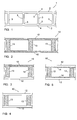
- a material 1 of this type comprises two base walls 2 forming the main faces of the material and partitions 3 perpendicular to these base walls 2, keeping the latter at a distance from one another.
- This material is in particular synthetic material, said base walls and partitions being made by the same molding operation, in particular by extrusion.
- This type of material is well known and is widely used in particular for the production of packaging boxes, pallet handling paddles or billboards, when it comes to plates or sheets, or for the realization of floors or panels, when it comes to profiles.
- the thickness of the partitions is on average of the order of 5% of the total thickness of the material.
- This kind of material however, has the important disadvantage of having a limited resistance to compression in a direction perpendicular to the base walls 2, due either to a buckling of the partitions 3, that is to say of a longitudinal folding thereof, or a "parallelogram" deformation of the material 1 as a result of pivoting partitions 3 relative to the base walls 2 at the junction areas of these partitions to these base walls.
- This type of material also has the disadvantage of requiring the use of a material free of impurities and having a high degree of fluidity. Indeed, the presence of impurities in this material, or insufficient fluidity of this material, may prevent sufficient filling of the grooves for performing the molding of the partitions 3 during the extrusion of the material. This insufficient filling occurs in particular in the middle areas of the partitions and is the main cause of the aforementioned buckling risk of these partitions in the event of compression of the material.
- This kind of material also has the drawbacks of having an average folding resistance, such folding also causing a buckling said partitions in areas of the material adjacent to the fold, and having an irregular surface appearance at the outer faces of the base walls 2, which limits its use in some applications requiring smooth surface aspects.
- This aspect of uneven surface results from the existence of longitudinal depressions 4 in line with the partitions 3 due to the withdrawal of the material during its cooling, this withdrawal occurring in a differentiated manner to the rights of the partitions 3 and between these partitions taking into account the different thicknesses of the material in these different areas (well-known phenomenon called "hot shrinkage").
- the present invention aims to remedy all of these disadvantages.
- No. 5,914,175 discloses a building board structure comprising two honeycomb panels affixed to each other so that the partitions of one panel are perpendicular to the partitions of the other panel.
- the partitions of these panels are less thick than the base walls of these panels, and the thickness of the partitions is small compared to the total thickness of a panel.
- the panels may be formed of closed cell plastics compositions.
- the panel according to this document does not remedy the aforementioned drawbacks.
- WO 00/30845 discloses a composite multilayer panel having a core layer of high density foamed material and at least one side layer of honeycomb or grid structure, said side layer having on at least one of its faces and preferably both, a plastic coating with high resistance modulus.
- the panel may comprise one or more stiffening layers, for example with honeycomb structure, bars, strips or grid.
- GB 2 120 167 discloses a deformable panel structure for use in buildings during molding operations of concrete, the deformability of such panels allowing deformability of the building and therefore an adaptability of the latter to possible ground movements.
- This panel comprises side walls of water-resistant material and a core of cellular material can be formed by elongate blocks parallel to each other, made of cellular material.
- the side walls are glued to the soul.
- the panel according to this document also does not overcome the aforementioned drawbacks of "cellular" panels used in particular for the production of packaging boxes or billboards.
- the main object of the present invention is therefore to provide a material having increased compressive strengths in a direction perpendicular to the base walls, and the fold.
- Another object of the invention is to provide a material whose mechanical strength properties are not affected by the possible presence of impurities in the material intended to constitute this material, and not imposing the use of a material specific, having a high degree of fluidity.
- Yet another object of the invention is to provide a material having as smooth a surface appearance as possible at the outer faces of its base walls.
- the material concerned comprises, in a manner known per se, two base walls forming the principal faces of the material and partitions perpendicular to these base walls and connected thereto, keeping the latter at a distance from one another, wherein at least a portion of the partitions, and optionally at least one of the base walls or part of these base walls, is made of a rigid cellular material, in particular an expanded polyolefin.
- each partition of rigid cellular material has a thickness greater than 5% of the total thickness of the material.
- the rigid cellular material makes it possible to give the partitions a thickness greater than or substantially greater than the thickness that these partitions have in the materials according to the prior art, without significant weighting of the material.
- This increased thickness makes it possible to obtain perfect resistance of the partitions with respect to the stresses exerted on the material in compression, and a perfect connection of the partitions to the base walls. This results in a much greater resistance of the material to compression in a direction perpendicular to said base walls, as well as to the fold. This increased thickness also makes it possible to greatly facilitate the arrival of material flows in the median areas of the partitions during the molding operation, thereby guaranteeing a complete filling of the partition molding grooves and thus a perfect homogeneity of the structure of these structures. partitions.
- the thickness of the partitions greatly reduces the phenomenon of shrinkage at the connection areas of the partitions to the base walls, given the low density of the material at these connection areas, and limit, or even eliminates the need for holidays at the connection areas of the partitions to the base walls to ensure the rigidity of this connection.
- the material according to the invention can thus have, at the outer faces of the base walls, a surface much more even and flat than a material according to the prior art.
- the expansion gas can escape mainly in the spaces delimited by the partitions between them, which limits the escape of this gas through the base walls.
- the surface appearance of these base walls at their outer faces is therefore not or little affected by this exhaust.
- each partition of rigid cellular material has a thickness greater than 10% of the total thickness of this material.
- the thickness of the partitions may in particular be between 10 and 30% of the total thickness of the material.
- the material is preferably made of synthetic material.
- Said base walls and partitions are then preferably produced by the same molding operation, in particular by extrusion.
- the material may comprise one or two expanded layers extending along one or both of the inner side base walls, being bonded thereto.
- the increase in the strength of the partitions at their central zone and the resistance of the junction of the partitions to the base walls makes it possible to provide a greater spacing of the partitions, with equal strength of the material.
- the spacing between the partitions can thus be increased from 20 to 100% with respect to the spacing between the partitions of a material according to the prior art.
- the spacing between the partitions of a material according to the prior art being substantially equivalent to the thickness of the material, the spacing between the partitions of the material according to the invention can range from 1.2 to 2 times the thickness of the material.
- this material is advantageously loaded with a mineral filler, for example of talc or chalk type, or of an organic filler, for example of fibers or wood particles, or fibers or vegetable particles, in particular hemp.
- a mineral filler for example of talc or chalk type
- an organic filler for example of fibers or wood particles, or fibers or vegetable particles, in particular hemp.
- This load makes it possible to obtain a better dimensional stability of the material, a greater rigidity of this material, a decreased manufacturing cost, and a better ability to be fixed by nailing, screwing or stapling.
- the percentage of charges can vary between 5 and 80% by weight of the material, or even up to 90% in the case where the polyolefin is a polypropylene.
- Figures 2 to 5 are side views, on an enlarged scale, portions of this material, according to four embodiments.
- FIG. 2 represents a so-called “cellular" material 10 in the form of a plate, comprising two base walls 12 forming the main faces of the material 10 and partitions 13 perpendicular to these base walls 12, keeping the latter at a distance one of the other.
- This material 10 is made of a rigid cellular material, in particular an expanded polyolefin, said base walls 12 and partitions 13 being made by the same molding operation, in particular by extrusion, and each partition 13 of the material 10, or each partition 13 a portion of the partitions 13 that includes this material 10, has an increased thickness relative to the partitions 3, of the order of 30% of the total thickness of the material 10 in the example shown.
- the spacing between the partitions 13 is also increased relative to that of the partitions 3, of the order of 50% in the example shown.
- the material 10 may comprise a base wall 12 (see FIG. 3), or the two base walls 12 (see FIG. 4), made of an unexpanded material, assembled with the partitions 13.
- material 10 is obtained by coextrusion of the material intended to form these base walls 12 with the expanded material intended to constitute these partitions13.
- the material 10 may also include one or two expanded layers 14 extending along one or both of the base walls 12 internal side (see Figure 5), being linked to that (s) -ci. These layers 14 make it possible to ensure perfect connection of the base wall or walls 12 to the partitions 13.
- the layers 14 can be obtained simply by varying the flow rates of the materials, the flow rate of expanded material being increased relative to the flow rate of unexpanded material.
- the aforementioned rigid cellular material makes it possible to give the partitions 13 a thickness that is greater than or substantially greater than the thickness that these partitions 3 have in the materials 1 according to the prior art, without significantly increasing the weight of the material. 10.
- This increased thickness makes it possible to obtain a perfect resistance of the partitions 13 with respect to the stresses exerted in compression on the material 10 and a perfect connection of the partitions 13 to the base walls 2, and makes it possible to facilitate greatly the arrival of the flows of material in the median areas of the partitions 13 during the molding of the material 10.
- the thickness of the partitions 13 also greatly reduces the phenomenon of shrinkage at the connection areas of these partitions to the base walls 12, and eliminates in this case the need for holidays 5.
- the material 10 thus has, at the level of outer faces of the base walls 12, a surface much more even and flat than the material 1.
Landscapes
- Laminated Bodies (AREA)
- Extrusion Moulding Of Plastics Or The Like (AREA)
Applications Claiming Priority (1)
| Application Number | Priority Date | Filing Date | Title |
|---|---|---|---|
| FR0406626A FR2871722B1 (fr) | 2004-06-18 | 2004-06-18 | Materiau dit "alveolaire" comprenant deux parois de base et des cloisons perpendiculaires a ces parois de base |
Publications (1)
| Publication Number | Publication Date |
|---|---|
| EP1614533A1 true EP1614533A1 (de) | 2006-01-11 |
Family
ID=34949092
Family Applications (1)
| Application Number | Title | Priority Date | Filing Date |
|---|---|---|---|
| EP05013082A Withdrawn EP1614533A1 (de) | 2004-06-18 | 2005-06-17 | Wabenartiges Material |
Country Status (2)
| Country | Link |
|---|---|
| EP (1) | EP1614533A1 (de) |
| FR (1) | FR2871722B1 (de) |
Citations (3)
| Publication number | Priority date | Publication date | Assignee | Title |
|---|---|---|---|---|
| GB2120167A (en) * | 1982-04-21 | 1983-11-30 | Beldale Investments Ltd | A deformable structure and method of using such a structure |
| US5914175A (en) * | 1997-08-25 | 1999-06-22 | Duraframe Window Shutter Systems Inc. | Composite panel and method |
| WO2000030845A1 (en) * | 1998-11-19 | 2000-06-02 | G.O.R. Applicazioni Special S.P.A. | Multilayer panel and use thereof as a formwork |
-
2004
- 2004-06-18 FR FR0406626A patent/FR2871722B1/fr not_active Expired - Fee Related
-
2005
- 2005-06-17 EP EP05013082A patent/EP1614533A1/de not_active Withdrawn
Patent Citations (3)
| Publication number | Priority date | Publication date | Assignee | Title |
|---|---|---|---|---|
| GB2120167A (en) * | 1982-04-21 | 1983-11-30 | Beldale Investments Ltd | A deformable structure and method of using such a structure |
| US5914175A (en) * | 1997-08-25 | 1999-06-22 | Duraframe Window Shutter Systems Inc. | Composite panel and method |
| WO2000030845A1 (en) * | 1998-11-19 | 2000-06-02 | G.O.R. Applicazioni Special S.P.A. | Multilayer panel and use thereof as a formwork |
Also Published As
| Publication number | Publication date |
|---|---|
| FR2871722B1 (fr) | 2008-02-15 |
| FR2871722A1 (fr) | 2005-12-23 |
Similar Documents
| Publication | Publication Date | Title |
|---|---|---|
| BE898264A (fr) | Noyau de construction léger à structure cellulaire. | |
| WO2012085420A1 (fr) | Element constructif de construction pour batiment | |
| BE1020843A5 (fr) | Bande de produit isolant multicouche, bande de complexe isolant forme a partir de telles bandes de produit isolant multicouche. | |
| EP3445578B1 (de) | Mehrschichtige platte | |
| FR2562837A1 (fr) | Elements composites de construction et procede pour la realisation de structures multi-directionnelles par formage et/ou assemblage de tels elements | |
| FR2810638A1 (fr) | Palette en matiere plastique | |
| FR2548713A1 (fr) | Panneau composite porteur | |
| FR2640938A1 (de) | ||
| EP4019707B1 (de) | Vorgefertigte holzplatte für den bau von gebäuden | |
| LU88243A1 (fr) | Panneau compose,particulierement pour coffrages et planchers de vehicules industriels | |
| FR2816240A1 (fr) | Panneau composite presentant une amelioration de l'acoustique aux bruits d'impact et de la stabilite thermique | |
| EP0541437B1 (de) | Modulare Platte für horizontale Trennungen | |
| FR2860533A1 (fr) | Panneau isolant | |
| EP2725162A1 (de) | Baustein aus einem Porenbetonkörper in Plastikhülle | |
| FR2871722A1 (fr) | Materiau dit "alveolaire" comprenant deux parois de base et des cloisons perpendiculaires a ces parois de base | |
| BE1019343A3 (fr) | Produit de construction a base de bambou ou de bois de haute performance et procede de fabrication. | |
| EP1170439B1 (de) | Parkettelement mit ausgleichenden Fugen und Verfahren zur Herstellung | |
| FR2888594A1 (fr) | Plaque alveolaire multiparois | |
| EP2888102B1 (de) | Kernschicht eines baumaterials, kern und baumaterial mit solcher schicht | |
| EP2867015B1 (de) | Aussenhaut eines bauteils, insbesondere für ein kraftfahrzeug | |
| FR2989021A1 (fr) | Panneau composite de type sandwich | |
| EP1614534A1 (de) | Wabenartiges Material | |
| FR2851595A1 (fr) | Element de construction et son procede de fabrication | |
| FR2612829A1 (fr) | Conteneur comportant au moins une couche de polyester arme de fibres, et son procede de fabrication | |
| FR2876624A1 (fr) | Materiau dit "alveolaire" |
Legal Events
| Date | Code | Title | Description |
|---|---|---|---|
| PUAI | Public reference made under article 153(3) epc to a published international application that has entered the european phase |
Free format text: ORIGINAL CODE: 0009012 |
|
| AK | Designated contracting states |
Kind code of ref document: A1 Designated state(s): AT BE BG CH CY CZ DE DK EE ES FI FR GB GR HU IE IS IT LI LT LU MC NL PL PT RO SE SI SK TR |
|
| AX | Request for extension of the european patent |
Extension state: AL BA HR LV MK YU |
|
| 17P | Request for examination filed |
Effective date: 20060710 |
|
| AKX | Designation fees paid |
Designated state(s): AT BE BG CH CY CZ DE DK EE ES FI FR GB GR HU IE IS IT LI LT LU MC NL PL PT RO SE SI SK TR |
|
| GRAP | Despatch of communication of intention to grant a patent |
Free format text: ORIGINAL CODE: EPIDOSNIGR1 |
|
| STAA | Information on the status of an ep patent application or granted ep patent |
Free format text: STATUS: THE APPLICATION IS DEEMED TO BE WITHDRAWN |
|
| 18D | Application deemed to be withdrawn |
Effective date: 20090929 |