EP1614620A2 - Dispositif respiratoire flottant de sauvetage - Google Patents
Dispositif respiratoire flottant de sauvetage Download PDFInfo
- Publication number
- EP1614620A2 EP1614620A2 EP05076525A EP05076525A EP1614620A2 EP 1614620 A2 EP1614620 A2 EP 1614620A2 EP 05076525 A EP05076525 A EP 05076525A EP 05076525 A EP05076525 A EP 05076525A EP 1614620 A2 EP1614620 A2 EP 1614620A2
- Authority
- EP
- European Patent Office
- Prior art keywords
- gas
- bags
- bag
- breathing device
- floatation
- Prior art date
- Legal status (The legal status is an assumption and is not a legal conclusion. Google has not performed a legal analysis and makes no representation as to the accuracy of the status listed.)
- Withdrawn
Links
Images



Classifications
-
- B—PERFORMING OPERATIONS; TRANSPORTING
- B63—SHIPS OR OTHER WATERBORNE VESSELS; RELATED EQUIPMENT
- B63C—LAUNCHING, HAULING-OUT, OR DRY-DOCKING OF VESSELS; LIFE-SAVING IN WATER; EQUIPMENT FOR DWELLING OR WORKING UNDER WATER; MEANS FOR SALVAGING OR SEARCHING FOR UNDERWATER OBJECTS
- B63C9/00—Life-saving in water
- B63C9/08—Life-buoys, e.g. rings; Life-belts, jackets, suits, or the like
- B63C9/11—Life-buoys, e.g. rings; Life-belts, jackets, suits, or the like covering the torso, e.g. harnesses
- B63C9/125—Life-buoys, e.g. rings; Life-belts, jackets, suits, or the like covering the torso, e.g. harnesses having gas-filled compartments
- B63C9/1255—Life-buoys, e.g. rings; Life-belts, jackets, suits, or the like covering the torso, e.g. harnesses having gas-filled compartments inflatable
Definitions
- This invention pertains to lifesaving floatation devices inflated with respirable gas and having mouthpieces to breathe the gas therein. More particularly, it pertains to a floatation device having two inflatable compartments interconnected together through a valve arrangement that is sequentially positioned to inhale from one compartment and exhale into the other, and to re-breathe the previously-exhaled gas from the other compartment in order to extend the breathing period thereof.
- a lack of breathing air and a need for floatation are often combined in a same catastrophic event. For example, people trapped inside a submerged vehicle need breathing air to get out of the vehicle and added buoyancy to swim to the shore. Similarly, smoke inhalation and drowning are often combined risks in an air plane crash or in the case of a burning ship. Home owners living near flood plains could also be exposed to smoke inhalation from a house fire due to electrical short circuits caused by rising water, and drowning when evacuating their house during an inundation. Therefore it is believed that a need exists for a lifesaving device offering both floatation and oxygen supply for at least a short period of time.
- Examples of emergency oxygen or air supply devices of the prior art are described in the following documents. These documents are divided in two groups. The documents in the first group pertain to devices used to filter ambient air delivered to a mouthpiece, and the documents in the second group pertain to devices incorporating a limited supply of breathable gas contained under pressure in a small cylinder. Examples of the devices of the prior art having a filter incorporated therein are as follows:
- breathing devices having a supply of respirable gas included therein are as follows:
- each mouthpiece is equipped with a check valve that prevents re-breathing from the bags. These devices are therefore not appropriate for preserving someone's life in a hazardous situation requiring both floatation and respirable air.
- floatation vests each being made of two compartments from which at least one contains respirable air and is equipped with a hose and a mouthpiece for inhaling the air from the bag.
- One of the problems associated with a pressurized gas container used in a breathing device is that the discharge of the container into the bag of the device increases the pressure of the breathable gas inside the bag or vest and makes in difficult, at least initially, to control the flow of gas through a mouthpiece.
- the pressure surge of the discharging cylinder is susceptible of causing a wearer to inadvertently over-breathe or otherwise let escape a substantial amount of gas through the mouthpiece, and to waste a portion of the lifesaving feature of the device. Therefore conventional breathing apparatus using pressurized cylinders have pressure regulators incorporated therein or calibrated orifices to limit the flow of gas to the mouthpiece.
- a pressure regulator mounted in a lifesaving breathing device increases the manufacturing cost of the device and is believed to be a determining factor limiting the accessibility of the device to a large number of people.
- the use of an orifice in a breathing device limits the amount of air available to the user at any given time. As the pressure drops in the supply cylinder, the flow of gas also drops across the orifice and to the mouthpiece. This reduction of flow to the mouthpiece could induce a sense of panic to the user.
- a lifesaving floatation and breathing device comprising first and second inflatable bags having similar bag volumes, and a mouthpiece communicating with both bags.
- a pressurized gas cylinder, or other container, filled with breathable gas is mounted to one of the bags.
- This pressurized cylinder has a nominal gas volume and a nominal gas pressure therein
- the device also has an inflator mechanism for transferring the breathable gas from the pressurized gas cylinder into one of the bags.
- the volume of each bag corresponds to a mathematical product of the nominal gas volume inside the cylinder and a ratio of the nominal gas pressure inside the cylinder over atmospheric pressure.
- a selector valve in communication with the mouthpiece, and hoses or conduits between the selector valve and each of the bags.
- the selector valve has a pair of check valves mounted therein communicating with the hoses or conduits and the mouthpiece to control a gas flow in the mouthpiece to and from the bags.
- the check valves are mounted inside a circular dial, in opposite air-flow orientations relative to each other. The dial is movable relative to the base of the selector valve from a first position to a second position. In the first position, the check valves allow inhaling oxygen gas from the first bag and exhaling into the second bag.
- the check valves allow the re-breathing of the previously exhaled gas, and exhaling in the first bag. Although the oxygen content in the first exhaled gas is somewhat reduced, it is believed to be appropriate for re-breathing again in a life threatening situation.
- the position of the selector valve can be inverted several times, to allow re-breathing gas from the inflated bag and to exhale and inflate the other bag, until the exhaled gas reaches a minimum breathable oxygen content.
- each bag has the shape of a horseshoe having a first end and a second end.
- the pressurized cylinder has means to introduce the breathable gas in the first end of the first bag and the selector valve is in communication with the other end of that same bag. Because of these opposite mountings, a pressure surge inside the bag when the gas from the cylinder is introduced into the bag all at once has negligible effect on the gas pressure at the mouthpiece.
- a floatation and breathing device comprising a front bag and a rear bag each having an upper end and a lower end, and a mouthpiece mounted to the upper ends.
- the bags share a common membrane and jointly define the shape of a pillow.
- the pressurized cylinder has means to introduce the breathable gas in the lower end of the front bag.
- the pressure surge from discharging the pressurized cylinder inside one of the bags has little effect on the gas pressure at the mouthpiece.
- the pressure surge caused by the discharging of the gas cylinder into one of the bags when the bags are in a folded form helps to expand the bags from their folded form.
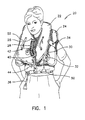
- the life vest 20 is made of a front bag 22 and a rear bag 24 .
- the front bag 22 is separate from the rear bag 24 .
- the front bag 22 is inflatable with exhaled air by the user, by mean a mouthpiece 26 and a flexible and extensible tube 28 .
- the rear bag 24 is inflatable with oxygen by means of a high pressure gas cylinder 30 and a manual inflator 32 .
- Each bag has the shape of a horseshoe with a central hole and two lower ends on opposite sides thereof.
- the gas cylinder 30 preferably contains a breathable gas mixture having a high oxygen content, such as 90% oxygen for example.
- the front bag 22 and the rear bag 24 are retained to each other by central tendons 32 extending around the central hole or the neck of the life vest, and by a pair of side tendons 34 extending from the sides of the life vest.
- a belt 36 is also provided and is fastened to the lower front end of the life vest 20 .
- the life vest 20 is worn as a bib and is attached to the waist of the user as illustrated in FIG. 1.
- the life vest 20 also comprises a selector valve 40 communicating with both bags 22, 24 by way of two hoses.
- the hose mounted to the front bag 22 is referred to as the exhaled air hose and is labelled 42 .
- the hose mounted to the rear bag 24 is referred to as the oxygen hose and is labelled 44 .
- the oxygen hose 44 is mounted at one end of the horseshoe shape on the rear bag 24 , and the pressurized gas cylinder 30 and the manual inflator 32 are mounted at the opposite end of that same bag.
- the high-pressure cylinder 30 has a preferred volume of about 4.85 cubic inches and contains oxygen-rich breathable gas at a pressure of about 2000 psi. Both bags 22, 24 have a respective volume of about 660 cubic inches.
- this bag When the breathable gas from the cylinder is released in the rear bag 24 , this bag is inflated to a pressure that is substantially the same as the atmospheric pressure. Therefore, there is no need for a pressure regulator or a flow control orifice to control the flow of gas to the mouthpiece 26 .
- This breathable gas is readily available for breathing, through the oxygen hose 44 and the selector valve 40 . A volume of 660 cubic inches is believed sufficient to provide breathable gas to a person for a period of about one minute.
- the pressure surge created by the sudden release of breathable gas from the high pressure cylinder 3 0 is partly absorbed in the inflation of the rear bag 24 , and therefore does not cause a significant increase in pressure in the oxygen hose 44 and in the selector valve 40 .
- the life vest 20 may be put on by a user, and the handle 50 is pulled down quickly and firmly to puncture a diaphragm (not shown) in the neck of the high pressure cylinder 30 .
- the breathable gas is released into the rear bag 24 thereby inflating the rear bag 24 .
- the mouthpiece 26 with the selector valve 40 in an initial position the user inhales breathable gas from the rear bag 24 and exhales a mixture of oxygen and CO 2 into the front bag 22 .
- the buoyancy of the life vest 20 is thereby maintained.
- Both bags 22, 24 are made of a flexible, weather-resistant and gas-tight material.
- a pair of handles 52 are provided on the front bag 22 to allow a user to hold on to the life vest 20 by hand as if it was a pillow for example.
- the handles 52 are also advantageous to assist a user in squeezing the air out of one of the bags.
- ambient air contains about 21% oxygen. It is also known that a recommended minimum oxygen content in breathable air is about 15%, because a lower amount could cause hallucinations. It is further known that a person breathing normally consumes about 5% of the oxygen present in ambient air, while a person hyperventilating in a panic situation absorbs only about 3%. Therefore, it is believed that in many circumstances, the air exhaled into the front bag 22 of the life vest 20 still contains oxygen and can be re-breathed again.
- the selector valve 40 in the life vest 20 is rotated nan a turn to allow the re-breathing the once-exhaled air and to allow exhaling in the rear bag 24 .
- the selector valve 40 can be rotated once more to re-breathe the twice-exhaled gas from one bag and exhaled in the other. In other words, the selector valve 40 is rotated as required to breathe from the inflated bag and to exhale and inflate the other bag.
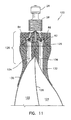
- the selector valve 40 constitutes a base from which extends the flexible tube 28 leading to the mouthpiece 26 .
- the selector valve 40 has a cylindrical shape, a base portion 60 and a circular dial 62 to which is mounted the flexible tube 28 and the mouthpiece 26 .
- the base portion 60 has flat tabs 64 extending therefrom. These tabs 64 are sewn, glued or bonded to the life vest 20 to retain the selector valve 40 to the life vest 20 .
- a pair of hose nipples 66 extend radially from the base portion 60 . The exhaled air hose 42 and the oxygen hose 44 are mounted to these hose nipples 66 .
- the base portion 60 of the selector valve 40 has a pair of conduits 70, 72 therein extending parallel to the axis of the valve 40 .
- Each conduit 70, 72 communicates with one of the hose nipples 66 .
- These conduits 70, 72 are open at their top ends and closed at their bottom ends by a pair of pipe plugs 74 .
- the dial 62 is mounted atop the base portion 60 and is held to the base portion 60 by a snap ring 76 and a stem 78 extending upward from the centre of the base portion 60 .
- the snap ring 76 is engaged into a groove on the end of the stem 78 .
- a spring disc 80 is also provided under the snap ring 76 to retain the dial 62 to the base portion 60 with a light pressure.
- the dial 62 has a pair of cavities 84, 86 therein in which are respectively mounted an inhale check valve 88 and an exhale check valve 90 .
- Each of the cavities 84, 86 communicates with a respective conduit 92 or 94 extending into the lower end of the flexible tube 28 , and joining the flexible tube 28 to both check valves 88, 90.
- the dial 62 has a shoulder 96 on its bottom surface and an O-ring 98 circling that shoulder.
- the shoulder 96 and the O-ring 98 have dimensions to mount into a circular groove 100 in the upper surface of the base portion 60 so to seal the dial 62 to the base portion 60.
- Each of the check valves 88, 90 has a valve seat 110 which is force-fitted into a respective cavity 84 or 86.
- a valve stem 112 extends from the valve seat.
- a valve disc 114 is mounted to the valve stem 112 and is urged against the valve seat 110 by a compression spring 116 fastened to the valve stem 112.
- the compression spring 116 is calibrated so that the valve disc 114 opens under a pressure of about between 1-5 psi.
- the locations of the breathable gas cylinder 30 and of the oxygen hose 44 on opposite sides of the oxygen bag 24, and the size of the oxygen bag make it unnecessary to use stronger check valves. Consequently, the content of the life vest 20 is breathable without effort.
- the content of the oxygen bag 24 is inhaled first.
- the dial 62 is rotated half a turn to interchange to positions of the check valves 88 and 90.
- the content of the front bag 22 can be re-breathed, while exhaling into the oxygen bag 24.
- the dial 62 can be rotated back to its initial position to re-breathe the exhaled gas a second time, and still find in it a quantity of oxygen gas.
Landscapes
- Engineering & Computer Science (AREA)
- Mechanical Engineering (AREA)
- Ocean & Marine Engineering (AREA)
- Respiratory Apparatuses And Protective Means (AREA)
Applications Claiming Priority (1)
| Application Number | Priority Date | Filing Date | Title |
|---|---|---|---|
| CA 2472901 CA2472901C (fr) | 2004-07-05 | 2004-07-05 | Appareil respiratoire et de flottaison de sauvetage |
Publications (2)
| Publication Number | Publication Date |
|---|---|
| EP1614620A2 true EP1614620A2 (fr) | 2006-01-11 |
| EP1614620A3 EP1614620A3 (fr) | 2006-04-19 |
Family
ID=34981723
Family Applications (1)
| Application Number | Title | Priority Date | Filing Date |
|---|---|---|---|
| EP05076525A Withdrawn EP1614620A3 (fr) | 2004-07-05 | 2005-07-04 | Dispositif respiratoire flottant de sauvetage |
Country Status (2)
| Country | Link |
|---|---|
| EP (1) | EP1614620A3 (fr) |
| CA (1) | CA2472901C (fr) |
Cited By (5)
| Publication number | Priority date | Publication date | Assignee | Title |
|---|---|---|---|---|
| WO2014173795A1 (fr) | 2013-04-23 | 2014-10-30 | Innotia Eesti Oü | Dispositif de flottaison |
| CN104773128A (zh) * | 2015-04-15 | 2015-07-15 | 罗帮辉 | 一种车载救生装置 |
| FR3054998A1 (fr) * | 2016-08-11 | 2018-02-16 | Helper-Drone | Bouee autogonflante de sauvetage amelioree |
| WO2019128476A1 (fr) * | 2017-12-27 | 2019-07-04 | 王佩朱 | Gilet de sauvetage pliable ayant une fonction respiratoire |
| CN114555461A (zh) * | 2019-10-18 | 2022-05-27 | 李明子 | 救生衣、为其提供的吹气构件及组合救生衣和吹气构件的方法 |
Citations (13)
| Publication number | Priority date | Publication date | Assignee | Title |
|---|---|---|---|---|
| US2742654A (en) | 1953-02-09 | 1956-04-24 | Us Rubber Co | Life saving device |
| US2831607A (en) | 1955-04-29 | 1958-04-22 | Walter W Stillman | Inhalation apparatus |
| US3866253A (en) | 1973-01-08 | 1975-02-18 | Dacor Corp | Divers buoyancy vest |
| US3877425A (en) | 1969-06-12 | 1975-04-15 | Westinghouse Electric Corp | Underwater breathing apparatus |
| US4324234A (en) | 1980-05-21 | 1982-04-13 | Maness Samuel G | Dual chamber personal flotation device |
| US4440163A (en) | 1982-07-30 | 1984-04-03 | Gabriel Spergel | Emergency escape breathing apparatus |
| US4515156A (en) | 1983-01-17 | 1985-05-07 | Vsesojuzny Nauchno-Issledovatelsky Institut Gornospasatelngo Dela | Regenerative canister of a self-contained oxygen-breathing apparatus on chemically fixed oxygen |
| US4813899A (en) | 1987-12-07 | 1989-03-21 | Haruo Fujimoto | Inflatable pocket life preserver |
| CA2084765A1 (fr) | 1991-06-05 | 1992-12-06 | Linsey J. Swann | Appareil respiratoire autonome d'urgence jetable |
| US5516233A (en) | 1992-04-17 | 1996-05-14 | Courtney; William L. | Water safety and survival system |
| US5979442A (en) | 1994-08-17 | 1999-11-09 | Orr; Rodney J. | Emergency breathing device, and methods of constructing and utilizing same |
| US6032668A (en) | 1998-05-04 | 2000-03-07 | Chung; Chao Yang | Fire emergency life saving arrangement |
| US6412482B1 (en) | 2000-01-24 | 2002-07-02 | Carl D. Rowe | Avalanche survival pack assembly |
Family Cites Families (2)
| Publication number | Priority date | Publication date | Assignee | Title |
|---|---|---|---|---|
| FR1577373A (fr) * | 1968-04-12 | 1969-08-08 | ||
| GB0123524D0 (en) * | 2001-10-01 | 2001-11-21 | Richards Paul | Life-saving apparatus |
-
2004
- 2004-07-05 CA CA 2472901 patent/CA2472901C/fr not_active Expired - Fee Related
-
2005
- 2005-07-04 EP EP05076525A patent/EP1614620A3/fr not_active Withdrawn
Patent Citations (13)
| Publication number | Priority date | Publication date | Assignee | Title |
|---|---|---|---|---|
| US2742654A (en) | 1953-02-09 | 1956-04-24 | Us Rubber Co | Life saving device |
| US2831607A (en) | 1955-04-29 | 1958-04-22 | Walter W Stillman | Inhalation apparatus |
| US3877425A (en) | 1969-06-12 | 1975-04-15 | Westinghouse Electric Corp | Underwater breathing apparatus |
| US3866253A (en) | 1973-01-08 | 1975-02-18 | Dacor Corp | Divers buoyancy vest |
| US4324234A (en) | 1980-05-21 | 1982-04-13 | Maness Samuel G | Dual chamber personal flotation device |
| US4440163A (en) | 1982-07-30 | 1984-04-03 | Gabriel Spergel | Emergency escape breathing apparatus |
| US4515156A (en) | 1983-01-17 | 1985-05-07 | Vsesojuzny Nauchno-Issledovatelsky Institut Gornospasatelngo Dela | Regenerative canister of a self-contained oxygen-breathing apparatus on chemically fixed oxygen |
| US4813899A (en) | 1987-12-07 | 1989-03-21 | Haruo Fujimoto | Inflatable pocket life preserver |
| CA2084765A1 (fr) | 1991-06-05 | 1992-12-06 | Linsey J. Swann | Appareil respiratoire autonome d'urgence jetable |
| US5516233A (en) | 1992-04-17 | 1996-05-14 | Courtney; William L. | Water safety and survival system |
| US5979442A (en) | 1994-08-17 | 1999-11-09 | Orr; Rodney J. | Emergency breathing device, and methods of constructing and utilizing same |
| US6032668A (en) | 1998-05-04 | 2000-03-07 | Chung; Chao Yang | Fire emergency life saving arrangement |
| US6412482B1 (en) | 2000-01-24 | 2002-07-02 | Carl D. Rowe | Avalanche survival pack assembly |
Cited By (5)
| Publication number | Priority date | Publication date | Assignee | Title |
|---|---|---|---|---|
| WO2014173795A1 (fr) | 2013-04-23 | 2014-10-30 | Innotia Eesti Oü | Dispositif de flottaison |
| CN104773128A (zh) * | 2015-04-15 | 2015-07-15 | 罗帮辉 | 一种车载救生装置 |
| FR3054998A1 (fr) * | 2016-08-11 | 2018-02-16 | Helper-Drone | Bouee autogonflante de sauvetage amelioree |
| WO2019128476A1 (fr) * | 2017-12-27 | 2019-07-04 | 王佩朱 | Gilet de sauvetage pliable ayant une fonction respiratoire |
| CN114555461A (zh) * | 2019-10-18 | 2022-05-27 | 李明子 | 救生衣、为其提供的吹气构件及组合救生衣和吹气构件的方法 |
Also Published As
| Publication number | Publication date |
|---|---|
| CA2472901A1 (fr) | 2006-01-05 |
| CA2472901C (fr) | 2007-12-18 |
| EP1614620A3 (fr) | 2006-04-19 |
Similar Documents
| Publication | Publication Date | Title |
|---|---|---|
| US7047966B2 (en) | Lifesaving floatation and breathing device | |
| US4964404A (en) | Breathing apparatus | |
| US5368018A (en) | Breathing apparatus mouthpiece | |
| US5494469A (en) | Inflatable life vest | |
| US20140261406A1 (en) | Safety vest floatation system with oxygen supply | |
| US20120274471A1 (en) | Methods and devices for rescuing a distressed diver | |
| US4324234A (en) | Dual chamber personal flotation device | |
| CA1068580A (fr) | Appareil respiratoire | |
| US5074298A (en) | Gas flow control system | |
| CA2472901C (fr) | Appareil respiratoire et de flottaison de sauvetage | |
| PL227178B1 (pl) | Urzadzenie ratunkowe z poduszka lawinowa | |
| US7335078B2 (en) | Tactical flotation support system | |
| EP1106500A2 (fr) | Appareil respiratoire | |
| US20020148467A1 (en) | Emergency breathing apparatus | |
| CN210912822U (zh) | 紧凑型救生衣 | |
| US20150093201A1 (en) | Self-contained diving system with an automatic alarm | |
| JP3806574B2 (ja) | 水難救命用ウェストバッグ | |
| GB2298141A (en) | Counterlung breathing apparatus | |
| CN216374939U (zh) | 便捷式救生设施及其书包、双气囊救生设施、救生设备 | |
| CN215622615U (zh) | 一种车辆落水自救逃生装置 | |
| US20050000516A1 (en) | Transportable diving system | |
| US5408993A (en) | Snorkel and buoyancy vest with manual controls | |
| KR200366083Y1 (ko) | 간이 공기재호흡기 | |
| EP0615899A2 (fr) | Appareil respiratoire autonome pour plongée sous-marine | |
| KR101930170B1 (ko) | 구명 조끼 |
Legal Events
| Date | Code | Title | Description |
|---|---|---|---|
| PUAI | Public reference made under article 153(3) epc to a published international application that has entered the european phase |
Free format text: ORIGINAL CODE: 0009012 |
|
| AK | Designated contracting states |
Kind code of ref document: A2 Designated state(s): AT BE BG CH CY CZ DE DK EE ES FI FR GB GR HU IE IS IT LI LT LU LV MC NL PL PT RO SE SI SK TR |
|
| AX | Request for extension of the european patent |
Extension state: AL BA HR MK YU |
|
| PUAL | Search report despatched |
Free format text: ORIGINAL CODE: 0009013 |
|
| AK | Designated contracting states |
Kind code of ref document: A3 Designated state(s): AT BE BG CH CY CZ DE DK EE ES FI FR GB GR HU IE IS IT LI LT LU LV MC NL PL PT RO SE SI SK TR |
|
| AX | Request for extension of the european patent |
Extension state: AL BA HR MK YU |
|
| RIC1 | Information provided on ipc code assigned before grant |
Ipc: B63C 9/08 20060101ALI20060301BHEP Ipc: B63C 9/125 20060101AFI20051017BHEP |
|
| AKX | Designation fees paid |
Designated state(s): AT BE BG CH CY CZ DE DK EE ES FI FR GB GR HU IE IS IT LI LT LU LV MC NL PL PT RO SE SI SK TR |
|
| STAA | Information on the status of an ep patent application or granted ep patent |
Free format text: STATUS: THE APPLICATION IS DEEMED TO BE WITHDRAWN |
|
| 18D | Application deemed to be withdrawn |
Effective date: 20061020 |