EP1614926A1 - Matériau de friction poreux avec couche modificatrice de friction - Google Patents
Matériau de friction poreux avec couche modificatrice de friction Download PDFInfo
- Publication number
- EP1614926A1 EP1614926A1 EP20050254285 EP05254285A EP1614926A1 EP 1614926 A1 EP1614926 A1 EP 1614926A1 EP 20050254285 EP20050254285 EP 20050254285 EP 05254285 A EP05254285 A EP 05254285A EP 1614926 A1 EP1614926 A1 EP 1614926A1
- Authority
- EP
- European Patent Office
- Prior art keywords
- friction
- base material
- layer
- resin
- friction material
- Prior art date
- Legal status (The legal status is an assumption and is not a legal conclusion. Google has not performed a legal analysis and makes no representation as to the accuracy of the status listed.)
- Ceased
Links
- 239000002783 friction material Substances 0.000 title claims abstract description 141
- 239000000463 material Substances 0.000 claims abstract description 179
- 239000002245 particle Substances 0.000 claims abstract description 80
- 229920005989 resin Polymers 0.000 claims abstract description 52
- 239000011347 resin Substances 0.000 claims abstract description 52
- 239000000835 fiber Substances 0.000 claims description 35
- VYPSYNLAJGMNEJ-UHFFFAOYSA-N Silicium dioxide Chemical compound O=[Si]=O VYPSYNLAJGMNEJ-UHFFFAOYSA-N 0.000 claims description 33
- 239000000203 mixture Substances 0.000 claims description 33
- 239000000945 filler Substances 0.000 claims description 29
- 229920006231 aramid fiber Polymers 0.000 claims description 27
- 239000004760 aramid Substances 0.000 claims description 26
- 229920001568 phenolic resin Polymers 0.000 claims description 26
- 239000005011 phenolic resin Substances 0.000 claims description 26
- 229920002050 silicone resin Polymers 0.000 claims description 23
- KXGFMDJXCMQABM-UHFFFAOYSA-N 2-methoxy-6-methylphenol Chemical compound [CH]OC1=CC=CC([CH])=C1O KXGFMDJXCMQABM-UHFFFAOYSA-N 0.000 claims description 20
- OKTJSMMVPCPJKN-UHFFFAOYSA-N Carbon Chemical compound [C] OKTJSMMVPCPJKN-UHFFFAOYSA-N 0.000 claims description 19
- 230000035699 permeability Effects 0.000 claims description 17
- 239000011148 porous material Substances 0.000 claims description 15
- 229920000049 Carbon (fiber) Polymers 0.000 claims description 14
- 229920000742 Cotton Polymers 0.000 claims description 14
- 229910052799 carbon Inorganic materials 0.000 claims description 14
- 239000004917 carbon fiber Substances 0.000 claims description 14
- 239000012530 fluid Substances 0.000 claims description 14
- 239000002657 fibrous material Substances 0.000 claims description 9
- 239000000377 silicon dioxide Substances 0.000 claims description 8
- 238000000034 method Methods 0.000 claims description 6
- 239000005909 Kieselgur Substances 0.000 claims description 4
- 230000001788 irregular Effects 0.000 claims description 4
- 229920006395 saturated elastomer Polymers 0.000 claims description 4
- 238000004519 manufacturing process Methods 0.000 claims description 3
- 238000009738 saturating Methods 0.000 claims description 3
- 239000004816 latex Substances 0.000 claims description 2
- 229920000126 latex Polymers 0.000 claims description 2
- 150000001247 metal acetylides Chemical class 0.000 claims description 2
- 229910044991 metal oxide Inorganic materials 0.000 claims description 2
- 150000004706 metal oxides Chemical class 0.000 claims description 2
- 150000004767 nitrides Chemical class 0.000 claims description 2
- 239000010410 layer Substances 0.000 description 66
- 239000003921 oil Substances 0.000 description 12
- 235000019198 oils Nutrition 0.000 description 12
- ISWSIDIOOBJBQZ-UHFFFAOYSA-N phenol group Chemical group C1(=CC=CC=C1)O ISWSIDIOOBJBQZ-UHFFFAOYSA-N 0.000 description 12
- WSFSSNUMVMOOMR-UHFFFAOYSA-N Formaldehyde Chemical compound O=C WSFSSNUMVMOOMR-UHFFFAOYSA-N 0.000 description 9
- 230000005540 biological transmission Effects 0.000 description 9
- 239000002904 solvent Substances 0.000 description 9
- -1 and optionally Polymers 0.000 description 8
- 238000009472 formulation Methods 0.000 description 8
- KFZMGEQAYNKOFK-UHFFFAOYSA-N Isopropanol Chemical compound CC(C)O KFZMGEQAYNKOFK-UHFFFAOYSA-N 0.000 description 6
- LFQSCWFLJHTTHZ-UHFFFAOYSA-N Ethanol Chemical compound CCO LFQSCWFLJHTTHZ-UHFFFAOYSA-N 0.000 description 5
- 239000000314 lubricant Substances 0.000 description 5
- 239000000843 powder Substances 0.000 description 5
- 239000010425 asbestos Substances 0.000 description 4
- 239000008199 coating composition Substances 0.000 description 4
- 229910052895 riebeckite Inorganic materials 0.000 description 4
- XLYOFNOQVPJJNP-UHFFFAOYSA-N water Substances O XLYOFNOQVPJJNP-UHFFFAOYSA-N 0.000 description 4
- ZWEHNKRNPOVVGH-UHFFFAOYSA-N 2-Butanone Chemical compound CCC(C)=O ZWEHNKRNPOVVGH-UHFFFAOYSA-N 0.000 description 3
- UHOVQNZJYSORNB-UHFFFAOYSA-N Benzene Chemical compound C1=CC=CC=C1 UHOVQNZJYSORNB-UHFFFAOYSA-N 0.000 description 3
- 239000004593 Epoxy Substances 0.000 description 3
- OKKJLVBELUTLKV-UHFFFAOYSA-N Methanol Chemical compound OC OKKJLVBELUTLKV-UHFFFAOYSA-N 0.000 description 3
- YXFVVABEGXRONW-UHFFFAOYSA-N Toluene Chemical compound CC1=CC=CC=C1 YXFVVABEGXRONW-UHFFFAOYSA-N 0.000 description 3
- 229910021383 artificial graphite Inorganic materials 0.000 description 3
- 239000001913 cellulose Substances 0.000 description 3
- 239000003822 epoxy resin Substances 0.000 description 3
- 230000014759 maintenance of location Effects 0.000 description 3
- 229920000647 polyepoxide Polymers 0.000 description 3
- 239000000758 substrate Substances 0.000 description 3
- 229920002994 synthetic fiber Polymers 0.000 description 3
- 239000012209 synthetic fiber Substances 0.000 description 3
- 238000012360 testing method Methods 0.000 description 3
- 244000226021 Anacardium occidentale Species 0.000 description 2
- KAKZBPTYRLMSJV-UHFFFAOYSA-N Butadiene Chemical compound C=CC=C KAKZBPTYRLMSJV-UHFFFAOYSA-N 0.000 description 2
- 229920003043 Cellulose fiber Polymers 0.000 description 2
- RTZKZFJDLAIYFH-UHFFFAOYSA-N Diethyl ether Chemical compound CCOCC RTZKZFJDLAIYFH-UHFFFAOYSA-N 0.000 description 2
- 229920000914 Metallic fiber Polymers 0.000 description 2
- LRHPLDYGYMQRHN-UHFFFAOYSA-N N-Butanol Chemical compound CCCCO LRHPLDYGYMQRHN-UHFFFAOYSA-N 0.000 description 2
- 239000006057 Non-nutritive feed additive Substances 0.000 description 2
- 229910052782 aluminium Inorganic materials 0.000 description 2
- PNEYBMLMFCGWSK-UHFFFAOYSA-N aluminium oxide Inorganic materials [O-2].[O-2].[O-2].[Al+3].[Al+3] PNEYBMLMFCGWSK-UHFFFAOYSA-N 0.000 description 2
- 230000006399 behavior Effects 0.000 description 2
- 235000020226 cashew nut Nutrition 0.000 description 2
- 229920002678 cellulose Polymers 0.000 description 2
- 150000001875 compounds Chemical class 0.000 description 2
- 239000000356 contaminant Substances 0.000 description 2
- 238000010586 diagram Methods 0.000 description 2
- 230000000694 effects Effects 0.000 description 2
- 235000019441 ethanol Nutrition 0.000 description 2
- 238000010438 heat treatment Methods 0.000 description 2
- 239000004615 ingredient Substances 0.000 description 2
- 238000005461 lubrication Methods 0.000 description 2
- 229920002647 polyamide Polymers 0.000 description 2
- 230000008569 process Effects 0.000 description 2
- 238000001878 scanning electron micrograph Methods 0.000 description 2
- 239000004634 thermosetting polymer Substances 0.000 description 2
- 239000010936 titanium Substances 0.000 description 2
- 229910052719 titanium Inorganic materials 0.000 description 2
- 229920002972 Acrylic fiber Polymers 0.000 description 1
- CTQNGGLPUBDAKN-UHFFFAOYSA-N O-Xylene Chemical compound CC1=CC=CC=C1C CTQNGGLPUBDAKN-UHFFFAOYSA-N 0.000 description 1
- 229920006282 Phenolic fiber Polymers 0.000 description 1
- 239000004952 Polyamide Substances 0.000 description 1
- 238000010521 absorption reaction Methods 0.000 description 1
- 239000002253 acid Substances 0.000 description 1
- 150000007513 acids Chemical class 0.000 description 1
- 230000009471 action Effects 0.000 description 1
- 229920003235 aromatic polyamide Polymers 0.000 description 1
- 239000011230 binding agent Substances 0.000 description 1
- 238000009835 boiling Methods 0.000 description 1
- 239000003575 carbonaceous material Substances 0.000 description 1
- 206010061592 cardiac fibrillation Diseases 0.000 description 1
- 230000015556 catabolic process Effects 0.000 description 1
- 239000000919 ceramic Substances 0.000 description 1
- 238000007906 compression Methods 0.000 description 1
- 230000006835 compression Effects 0.000 description 1
- 238000011109 contamination Methods 0.000 description 1
- 238000011217 control strategy Methods 0.000 description 1
- 238000001723 curing Methods 0.000 description 1
- 239000007857 degradation product Substances 0.000 description 1
- 230000032798 delamination Effects 0.000 description 1
- 238000013461 design Methods 0.000 description 1
- 239000006185 dispersion Substances 0.000 description 1
- 238000009826 distribution Methods 0.000 description 1
- 239000000428 dust Substances 0.000 description 1
- 239000000839 emulsion Substances 0.000 description 1
- 230000007613 environmental effect Effects 0.000 description 1
- 239000005007 epoxy-phenolic resin Substances 0.000 description 1
- 238000001704 evaporation Methods 0.000 description 1
- 230000008020 evaporation Effects 0.000 description 1
- 239000004744 fabric Substances 0.000 description 1
- 230000002349 favourable effect Effects 0.000 description 1
- 230000002600 fibrillogenic effect Effects 0.000 description 1
- 239000000446 fuel Substances 0.000 description 1
- 239000011521 glass Substances 0.000 description 1
- 239000010439 graphite Substances 0.000 description 1
- 229910002804 graphite Inorganic materials 0.000 description 1
- 230000005484 gravity Effects 0.000 description 1
- LNEPOXFFQSENCJ-UHFFFAOYSA-N haloperidol Chemical compound C1CC(O)(C=2C=CC(Cl)=CC=2)CCN1CCCC(=O)C1=CC=C(F)C=C1 LNEPOXFFQSENCJ-UHFFFAOYSA-N 0.000 description 1
- 230000036541 health Effects 0.000 description 1
- 230000017525 heat dissipation Effects 0.000 description 1
- 230000006872 improvement Effects 0.000 description 1
- 239000012784 inorganic fiber Substances 0.000 description 1
- 229910010272 inorganic material Inorganic materials 0.000 description 1
- 239000011147 inorganic material Substances 0.000 description 1
- 230000003993 interaction Effects 0.000 description 1
- XEEYBQQBJWHFJM-UHFFFAOYSA-N iron Substances [Fe] XEEYBQQBJWHFJM-UHFFFAOYSA-N 0.000 description 1
- 229910052742 iron Inorganic materials 0.000 description 1
- 229910001337 iron nitride Inorganic materials 0.000 description 1
- UQSXHKLRYXJYBZ-UHFFFAOYSA-N iron oxide Inorganic materials [Fe]=O UQSXHKLRYXJYBZ-UHFFFAOYSA-N 0.000 description 1
- 235000013980 iron oxide Nutrition 0.000 description 1
- VBMVTYDPPZVILR-UHFFFAOYSA-N iron(2+);oxygen(2-) Chemical class [O-2].[Fe+2] VBMVTYDPPZVILR-UHFFFAOYSA-N 0.000 description 1
- 239000007788 liquid Substances 0.000 description 1
- 230000005923 long-lasting effect Effects 0.000 description 1
- 230000007774 longterm Effects 0.000 description 1
- 230000013011 mating Effects 0.000 description 1
- 238000005259 measurement Methods 0.000 description 1
- VNWKTOKETHGBQD-UHFFFAOYSA-N methane Chemical compound C VNWKTOKETHGBQD-UHFFFAOYSA-N 0.000 description 1
- 229940032007 methylethyl ketone Drugs 0.000 description 1
- 230000007935 neutral effect Effects 0.000 description 1
- 239000010466 nut oil Substances 0.000 description 1
- 229920001778 nylon Polymers 0.000 description 1
- SOQBVABWOPYFQZ-UHFFFAOYSA-N oxygen(2-);titanium(4+) Chemical class [O-2].[O-2].[Ti+4] SOQBVABWOPYFQZ-UHFFFAOYSA-N 0.000 description 1
- RIPZIAOLXVVULW-UHFFFAOYSA-N pentane-2,4-dione Chemical compound CC(=O)CC(C)=O.CC(=O)CC(C)=O RIPZIAOLXVVULW-UHFFFAOYSA-N 0.000 description 1
- 229920000728 polyester Polymers 0.000 description 1
- 229920001296 polysiloxane Polymers 0.000 description 1
- 230000002265 prevention Effects 0.000 description 1
- 238000012545 processing Methods 0.000 description 1
- 239000000047 product Substances 0.000 description 1
- 235000012239 silicon dioxide Nutrition 0.000 description 1
- 229920002379 silicone rubber Polymers 0.000 description 1
- 239000004590 silicone sealant Substances 0.000 description 1
- 239000002344 surface layer Substances 0.000 description 1
- 239000000725 suspension Substances 0.000 description 1
- 238000001029 thermal curing Methods 0.000 description 1
- OGIDPMRJRNCKJF-UHFFFAOYSA-N titanium oxide Inorganic materials [Ti]=O OGIDPMRJRNCKJF-UHFFFAOYSA-N 0.000 description 1
- 239000002383 tung oil Substances 0.000 description 1
- 239000003981 vehicle Substances 0.000 description 1
- 239000011800 void material Substances 0.000 description 1
- 239000008096 xylene Substances 0.000 description 1
Images



Classifications
-
- F—MECHANICAL ENGINEERING; LIGHTING; HEATING; WEAPONS; BLASTING
- F16—ENGINEERING ELEMENTS AND UNITS; GENERAL MEASURES FOR PRODUCING AND MAINTAINING EFFECTIVE FUNCTIONING OF MACHINES OR INSTALLATIONS; THERMAL INSULATION IN GENERAL
- F16D—COUPLINGS FOR TRANSMITTING ROTATION; CLUTCHES; BRAKES
- F16D69/00—Friction linings; Attachment thereof; Selection of coacting friction substances or surfaces
- F16D69/02—Composition of linings ; Methods of manufacturing
- F16D69/025—Compositions based on an organic binder
- F16D69/026—Compositions based on an organic binder containing fibres
-
- B—PERFORMING OPERATIONS; TRANSPORTING
- B32—LAYERED PRODUCTS
- B32B—LAYERED PRODUCTS, i.e. PRODUCTS BUILT-UP OF STRATA OF FLAT OR NON-FLAT, e.g. CELLULAR OR HONEYCOMB, FORM
- B32B5/00—Layered products characterised by the non- homogeneity or physical structure, i.e. comprising a fibrous, filamentary, particulate or foam layer; Layered products characterised by having a layer differing constitutionally or physically in different parts
- B32B5/22—Layered products characterised by the non- homogeneity or physical structure, i.e. comprising a fibrous, filamentary, particulate or foam layer; Layered products characterised by having a layer differing constitutionally or physically in different parts characterised by the presence of two or more layers which are next to each other and are fibrous, filamentary, formed of particles or foamed
-
- B—PERFORMING OPERATIONS; TRANSPORTING
- B32—LAYERED PRODUCTS
- B32B—LAYERED PRODUCTS, i.e. PRODUCTS BUILT-UP OF STRATA OF FLAT OR NON-FLAT, e.g. CELLULAR OR HONEYCOMB, FORM
- B32B3/00—Layered products comprising a layer with external or internal discontinuities or unevennesses, or a layer of non-planar shape; Layered products comprising a layer having particular features of form
- B32B3/10—Layered products comprising a layer with external or internal discontinuities or unevennesses, or a layer of non-planar shape; Layered products comprising a layer having particular features of form characterised by a discontinuous layer, i.e. formed of separate pieces of material
-
- F—MECHANICAL ENGINEERING; LIGHTING; HEATING; WEAPONS; BLASTING
- F16—ENGINEERING ELEMENTS AND UNITS; GENERAL MEASURES FOR PRODUCING AND MAINTAINING EFFECTIVE FUNCTIONING OF MACHINES OR INSTALLATIONS; THERMAL INSULATION IN GENERAL
- F16D—COUPLINGS FOR TRANSMITTING ROTATION; CLUTCHES; BRAKES
- F16D69/00—Friction linings; Attachment thereof; Selection of coacting friction substances or surfaces
- F16D2069/005—Friction linings; Attachment thereof; Selection of coacting friction substances or surfaces having a layered structure
- F16D2069/008—Layers of fibrous materials
-
- Y—GENERAL TAGGING OF NEW TECHNOLOGICAL DEVELOPMENTS; GENERAL TAGGING OF CROSS-SECTIONAL TECHNOLOGIES SPANNING OVER SEVERAL SECTIONS OF THE IPC; TECHNICAL SUBJECTS COVERED BY FORMER USPC CROSS-REFERENCE ART COLLECTIONS [XRACs] AND DIGESTS
- Y10—TECHNICAL SUBJECTS COVERED BY FORMER USPC
- Y10T—TECHNICAL SUBJECTS COVERED BY FORMER US CLASSIFICATION
- Y10T428/00—Stock material or miscellaneous articles
- Y10T428/249921—Web or sheet containing structurally defined element or component
- Y10T428/249953—Composite having voids in a component [e.g., porous, cellular, etc.]
-
- Y—GENERAL TAGGING OF NEW TECHNOLOGICAL DEVELOPMENTS; GENERAL TAGGING OF CROSS-SECTIONAL TECHNOLOGIES SPANNING OVER SEVERAL SECTIONS OF THE IPC; TECHNICAL SUBJECTS COVERED BY FORMER USPC CROSS-REFERENCE ART COLLECTIONS [XRACs] AND DIGESTS
- Y10—TECHNICAL SUBJECTS COVERED BY FORMER USPC
- Y10T—TECHNICAL SUBJECTS COVERED BY FORMER US CLASSIFICATION
- Y10T428/00—Stock material or miscellaneous articles
- Y10T428/249921—Web or sheet containing structurally defined element or component
- Y10T428/249953—Composite having voids in a component [e.g., porous, cellular, etc.]
- Y10T428/249955—Void-containing component partially impregnated with adjacent component
-
- Y—GENERAL TAGGING OF NEW TECHNOLOGICAL DEVELOPMENTS; GENERAL TAGGING OF CROSS-SECTIONAL TECHNOLOGIES SPANNING OVER SEVERAL SECTIONS OF THE IPC; TECHNICAL SUBJECTS COVERED BY FORMER USPC CROSS-REFERENCE ART COLLECTIONS [XRACs] AND DIGESTS
- Y10—TECHNICAL SUBJECTS COVERED BY FORMER USPC
- Y10T—TECHNICAL SUBJECTS COVERED BY FORMER US CLASSIFICATION
- Y10T428/00—Stock material or miscellaneous articles
- Y10T428/249921—Web or sheet containing structurally defined element or component
- Y10T428/249953—Composite having voids in a component [e.g., porous, cellular, etc.]
- Y10T428/249967—Inorganic matrix in void-containing component
- Y10T428/249969—Of silicon-containing material [e.g., glass, etc.]
-
- Y—GENERAL TAGGING OF NEW TECHNOLOGICAL DEVELOPMENTS; GENERAL TAGGING OF CROSS-SECTIONAL TECHNOLOGIES SPANNING OVER SEVERAL SECTIONS OF THE IPC; TECHNICAL SUBJECTS COVERED BY FORMER USPC CROSS-REFERENCE ART COLLECTIONS [XRACs] AND DIGESTS
- Y10—TECHNICAL SUBJECTS COVERED BY FORMER USPC
- Y10T—TECHNICAL SUBJECTS COVERED BY FORMER US CLASSIFICATION
- Y10T428/00—Stock material or miscellaneous articles
- Y10T428/249921—Web or sheet containing structurally defined element or component
- Y10T428/249953—Composite having voids in a component [e.g., porous, cellular, etc.]
- Y10T428/249986—Void-containing component contains also a solid fiber or solid particle
Definitions
- the present invention relates to a porous fiction material having a first or lower layer comprising a porous base material and a second or top layer comprising at least one type of friction modifying particles.
- the friction material of the present invention has high coefficient of friction characteristics, very robust anti-shudder characteristics and extremely high heat resistance.
- the friction material also has improved strength, wear resistance and noise resistance.
- the new friction material must be able to withstand high speeds wherein surface speeds are up to about 65m/seconds. Also, the friction material must be able to withstand high facing lining pressures up to about 1500 psi. It is also important that the friction material be useful under limited lubrication conditions.
- the friction material must be durable and have high heat resistance in order to be useful in the advanced systems. Not only must the friction material remain stable at high temperatures, it must also be able to rapidly dissipate the high heat that is being generated during operating conditions.
- the high speeds generated during engagement and disengagement of the new systems mean that a friction material must be able to maintain a relatively constant friction throughout the engagement. It is important that the frictional engagement be relatively constant over a wide range of speeds and temperatures in order to minimize "shuddering" of materials during braking or the transmission system during power shift from one gear to another. It is also important that the friction material have a desired torque curve shape so that during frictional engagement the friction material is noise or "squawk" free.
- transmission and torque-on-demand systems incorporate slipping clutches mainly for the fuel efficiency and driving comfort.
- the role of the slip clutch within these systems varies from vehicle launching devices, such as wet start clutches, to that of a torque converter clutches.
- the slip clutch can be differentiated into three principle classes: (1) Low Pressure and High Slip Speed Clutch, such as wet start clutch; (2) High Pressure and Low Slip Speed Clutch, such as Converter Clutch; and (3) Extreme Low Pressure and Low Slip Speed Clutch, such as neutral to idle clutch.
- the principal performance concerns for all applications of the slip clutch are the prevention of shudder and the energy management of the friction interface.
- shudder can be attributed to many factors including the friction characteristics of the friction material, the mating surface's hardness and roughness, oil film retention, lubricant chemistry and interactions, clutch operating conditions, driveline assembly and hardware alignment, and driveline contamination.
- the friction interface energy management is primarily concerned with controlling interface temperature and is affected by the pump capacity, oil flow path and control strategy.
- the friction material surface design also contributes to the efficiency of interface energy management.
- the Kearsey U.S. Patent No. 5, 585,166 describes a multi layer friction lining having a porous substrate layer (cellulose and synthetic fibers, filler and thermoset resin) and a porous friction layer (nonwoven synthetic fibers in a thermoset resin) where the friction layer has a higher porosity than the substrate layer.
- the Seiz U.S. Patent No. 5,083,650 reference involves a multi-step impregnating and curing process; i.e., a paper impregnated with a coating composition, carbon particles are placed on the paper, the coating composition in the paper is partially cured, a second coating composition is applied to the partially cured paper, and finally, both coating compositions are cured.
- metallic fibers combined with carbon materials were included in the friction material for wear resistance.
- Fujimaki et al. U.S. Patent No. 4,451,590 describes a friction material having metallic fibers, filler, carbon particles, carbon fibers and phenolic resin.
- the metallic based friction materials do not have sufficient porosity and compressibility to be capable of high fluid permeation capacity during use.
- the metallic based friction materials are not sufficiently resilient or elastic, yet resistant to compression set to be capable of withstanding high facing lining pressures of up to about 1500 psi (approximately 105 kg/cm 2 ).
- the metallic based friction material also is not capable of withstanding high surface speeds of up to about 65 m/second which are generated during engagement and disengagement of the new transmission and braking systems.
- Lam et al. U.S. Patent No. 5,998,307 relates to a friction material having a primary fibrous base material impregnated with a curable resin where the porous primary layer comprises at least one fibrous material and a secondary layer comprises carbon particles covering at least about 3 to about 90% of the surface of the primary layer.
- the Lam et al., U.S. Patent No. 5,858,883 relates to a base material having a primary layer of less fibrillated aramid fibers, synthetic graphite, and a filler, and a secondary layer comprising carbon particles on the surface of the primary layer.
- the Lam et al., U.S. Patent No. 5,856,244 relates to a friction material comprising a base impregnated with a curable resin.
- the primary layer comprises less fibrillated aramid fibers, synthetic graphite and filler; the secondary layer comprises carbon particles and a retention aid.
- the Lam et al. U.S. Patent No. 5,958,507 relates to a process for producing a friction material where about 3 to about 90% of at least one surface of the fibrous material which comprises less fibrillated aramid fibers is coated with carbon particles.
- the Lam, U.S. Patent No. 6,001,750 relates to a friction material comprising a fibrous base material impregnated with a curable resin.
- the porous primarily layer comprises less fibrillated aramid fibers, carbon particles, carbon fibers, filler material, phenolic novoloid fibers, and optionally, cotton fibers.
- the secondary layer comprises carbon particles which cover the surface at about 3 to about 90% of the surface.
- Lam U.S. Patent No. 6,130,176
- Lam relates to non-metallic paper type fibrous base materials comprising less fibrillated aramid fibers, carbon fibers, carbon particles and filler.
- the friction material in order to be useful in "wet” applications, the friction material must have a wide variety of acceptable characteristics.
- the friction material must have good anti-shudder characteristics; have high heat resistance and be able to dissipate heat quickly; and, have long lasting, stable and consistent frictional performance. If any of these characteristics are not met, optimum performance of the friction material is not achieved.
- the friction material must have good shear strength during use when the friction material is infused with brake fluid or transmission oil during use.
- a further object of this invention is to provide a friction materials with improved "anti-shudder", “hot spot” resistance, high heat resistance, high friction stability and durability, and strength.
- the present invention relates to a friction material having a first layer that comprises a porous base material and a second layer that comprises at least one type of friction modifying particle on a top surface of the base material.
- the second layer is deposited on the first layer such that the second layer has a permeability lower than the first layer.
- the friction modifying particles are deposited on individual fibers or, if a nonwoven material, on randomly spaced portions of the surface of the friction material.
- a friction material comprises a first layer having a porous base material and at least one type of resin material, and a second layer having at least one type of friction modifying particle at least partially covering a top surface of the porous base material.
- the second layer has an average thickness ranging from about 30 to about 400 ⁇ m, such that the second layer has a lower permeability than the first layer.
- the layer of the friction modifying particles on the individual fibers and/or fillers comprising the porous base material has a thickness of about 50 to about 100 ⁇ m, and in certain embodiments, about 75 to about 85 ⁇ m on the individual fibers and/or filler particles that make up the first, or base, layer.
- the second layer has a lower permeability in the radial direction and a lower permeability in the normal direction than the porous base material.
- the friction modifying particles have an average size from about 0.1 to about 80 microns, and in certain embodiments, have an average size from about 0.5 to about 20 microns, and in certain other embodiments, from about 0.1 to about 0.15 microns.
- the base material can have an average voids volume from about 60% to about 85%.
- the porous base layer comprises from about 70-85%, by weight, fibers and from about 10-30%, by wt., fillers.
- the porous base material can comprise about 80% fiber and about 20% filler.
- the invention in another aspect, relates to a method for producing friction material where a porous base material is saturated with a saturant.
- the saturant can include at least one resin material, and at least one type of friction modifying particles, such that a plurality of the friction modifying particles form a layer on the individual fibers and/or fillers comprising the base material.
- the layer of friction modifying particles have an average thickness of about 30-400 ⁇ m, such that the second layer has a lower permeability than the first layer.
- the saturated base material is cured at a predetermined temperature for a predetermined period of time.
- the method includes producing a friction material by preparing a saturant material comprising a mixture of at least one curable resin material and at least one type friction modifying particle, preparing a porous base material having a plurality of interstices dispersed therethrough, and saturating the porous base material with the saturant material.
- the friction modifying particles are deposited on the top surface of the base material such that the friction modifying particles are, in effect, deposited on individual fibers and/or individual fillers that make up the base material.
- the resin material in the saturant is substantially evenly dispersed throughout the base material.
- the friction modifying particles form a porous top layer on at least one side of the base material.
- a friction material has a uniform dispersion of the curable resin throughout a porous base material and a substantially nonuniform layer of friction modifying materials on a top or outer surface of the porous base material.
- the base material layer comprises a highly porous material such as a woven material.
- the base material comprises a highly porous nonwoven material.
- the porous base material has a high fiber content in the range of about 75 to about 85%, and in certain embodiments, about 80%, by weight, based on the weight of the base material.
- the base material also has a filler content in the range of about 15 to about 25%, by weight, and in certain embodiments about 20%, based on the weight of the base material.
- Suitable base materials are useful in the friction material of the present invention, including, for example, non-asbestos fibrous base materials comprising, for example, fabric materials, woven and/or nonwoven materials.
- Suitable fibrous base materials include, for example, fibers and fillers.
- the fibers can be organic fibers, inorganic fibers and carbon fibers.
- the organic fibers can be aramid fibers, such as fibrillated and/or nonfibrillated aramid fibers, acrylic fibers, polyester fibers, nylon fibers, polyamide fibers, cotton/cellulose fibers and the like.
- the fillers can be, for example, silica, diatomaceous earth, graphite, alumina, cashew dust and the like.
- the base material can comprise fibrous woven materials, fibrous non-woven materials, and paper materials.
- fibrous base materials useful in the present invention are disclosed in the above-referenced BorgWarner U.S. patents which are fully incorporated herein by reference. It should be understood however, that other embodiments of the present invention can include yet different fibrous base materials.
- the woven materials can be, for example, organic fibers such as aramid fibers, carbon, cotton/cellulose, glass, polyamid, ceramic, and the like fibers.
- aramid fibers are useful in the woven material to provide a desirable pore structure to the friction material which, in turn, provides increased thermal resistance to the friction material.
- the fiber geometry not only provides increased thermal resistance, but also provides delamination resistance and squeal or noise resistance.
- the use of less fibrillated aramid fibers in the base material improves the friction material's ability to withstand high temperatures. Less fibrillated aramid fibers generally have few fibrils attached to a core fiber.
- the use of the less fibrillated aramid fibers provides a friction material having a more porous structure; i.e., there are more and larger pores than if a typical fibrillated aramid fiber is used.
- the porous structure is generally defined by the pore size and liquid permeability.
- the base material defines pores ranging in mean average size from about 2.0 to about 25 microns in diameter. In certain embodiments, the mean pore size ranges from about 2.5 to about 8 microns in diameter and the friction material had readily available air voids of at least about 50% and, in certain embodiments, at least about 60% or higher.
- the aramid fibers have a length ranging from about 0.5 to about 10 mm and a Canadian Standard Freeness (CSF) of greater than about 300.
- CSF Canadian Standard Freeness
- more fibrillated fibers, such as aramid pulp have a freeness of about 285-290.
- the "Canadian Standard Freeness" (T227 om-85) means that the degree of fibrillation of fibers can be described as the measurement of freeness of the fibers.
- the CSF test is an empirical procedure which gives an arbitrary measure of the rate at which a suspension of three grams of fibers in one liter of water may be drained. Therefore, the less fibrillated aramid fibers have higher freeness or higher rate of drainage of fluid from the friction material than more fibrillated aramid fibers or pulp.
- Friction materials comprising the aramid fibers having a CSF ranging from about 430-650 (and in certain embodiments preferably about 580-640, or preferably about 620-640), provide superior friction performance and have better material properties than friction materials containing conventionally more fibrillated aramid fibers.
- the less fibrillated aramid fibers (CSF about 530-about 650) have especially good long-term durability and stable coefficients of friction.
- the base material has from about 10 to about 20%, and in certain embodiments about 15%, by weight, aramid fibers, when combined with a relatively high level of cotton or other cellulose type fibers.
- the woven material has from about 50 to about 60%, and in certain embodiments about 55%, by weight, aramid fibers, when combined with carbon fibers.
- the presence of the carbon fibers in the primary layer aids in increasing the thermal resistance, maintaining a steady coefficient of friction and increasing the squeal resistance.
- carbon fibers are used in the base material to provide good heat conduction such that the friction material has a desired heat resistance.
- the base material has from about 5 to about 20%, and in certain embodiments, about 10 to about 15%, by weight, carbon fibers.
- cotton fibers are present in the primary layer, it is preferred that there is no cotton fiber content.
- a relatively high amount of cotton fibers, such as about 40-50%, by weight, in the primary layer of the base material improves the friction material's clutch "break-in" characteristics at an economical cost.
- cotton fiber is added to the base material of the present invention to give the friction material higher coefficients of friction. In certain embodiments, about 40 to about 50%, and, in certain embodiments, about 45% cotton can also be added to the base material.
- One example of a formulation for the primary layer of a base material comprises about 10 to about 50%, by weight, of a less fibrillated aramid fiber; about 10 to about 35%, by weight, of activated carbon particles; about 5 to about 20%, by weight, cotton fibers, about 2 to about 15%, by weight, carbon fibers; and, about 10 to about 35%, by weight, of a filler material.
- one particular formulation has found to be useful comprises about 35 to about 45%, by weight, less fibrillated aramid fibers; about 10 to about 20%, by weight, activated carbon particles; about 5 to about 15% cotton fibers; about 2 to about 10%, by weight, carbon fibers; and, about 25 to about 35%, by weight, filler.
- fillers are also useful in the primary layer of the fibrous base material of the present invention.
- silica fillers such as diatomaceous earth, are useful.
- other types of fillers are suitable for use in the present invention and that the choice of filler depends on the particular requirements of the friction material.
- cotton fiber is added to the fibrous base material of the present invention to give the fibrous material higher coefficients of friction. In certain embodiments, about 10 to about 20%, and, in certain embodiments, about 10% cotton can also be added to the fibrous base material.
- One example of a formulation for the primary layer of a fibrous base material comprises from about 15 to about 25% cotton, about 40 to about 50% aramid fibers, about 10 to about 20% carbon fibers, about 5 to about 15% carbon particles, about 5 to about 15% celite, and, optionally about 0 to about 3% latex add-on.
- the friction material comprises a base material which has a plurality of voids or interstices therein.
- the size of the voids in the fibrous base material can range from about 0.5 ⁇ m to about 20 ⁇ m.
- the base material preferably has a void volume of about 60 to about 85% such that the fibrous base material is considered “porous” as compared to a “dense” base material.
- the present invention relates to a friction material having a novel microstructured surface.
- the microstructured surface friction material has a higher coefficient of friction, even more robust anti-shudder characteristics, and extremely high heat resistance.
- the friction material has a porous or lofty and open base material.
- the base material has a low density and has a fiber architecture which allows a resin material to soak into the base material.
- the friction material has extremely good heat resistance and coefficient of friction characteristics which allows the friction material to respond well under thermal and mechanical stresses.
- the "macro porous" fibrous material has a surface which is partially uncovered by the friction modifying materials.
- the large pores allow the friction modifying materials to settle into the voids or interstices in the base material.
- the macro porous friction material of the present invention the large pores allow contaminants in the fluid to pass through readily. As lubrications deteriorate over time, debris is generated.
- the friction material of the present invention keeps the friction behavior of the friction material constant.
- the friction material thus comprises a top, or second, layer of friction modifying particles on a first, or top, surface of the fibrous base material.
- the presence of the friction modifying materials as a discontinuous, or randomly covered, top layer on the fibrous base material provides the friction material with many advantageous properties, including good oil retention properties.
- the friction material When the fibrous base material has a higher mean pore diameter and fluid permeability, the friction material is more likely to run cooler or with less heat generated in a transmission due to better automatic transmission fluid flow throughout the porous structure of the friction material.
- the fluid tends, over time, to breakdown and form "oil deposits", especially at high temperatures. These "oil deposits” decrease the pore openings. Therefore, when the friction material initially starts with larger pores, there are more open pores remaining during the useful life of the friction material.
- the friction modifying particles on the top surface of the fibrous base material provides an improved three-dimensional structure to the resulting friction material.
- the layer of oil or fluid on the top friction modifying particle layer keeps the oil film on the surface, thus making it more difficult for the oil or fluid to initially penetrate into the friction material.
- the top friction modifying material layer holds the fluid lubricant on the surface and increases the oil retaining capacity of the friction material.
- the friction material of the present invention thus allows an oil film to remain on its surface. This also provides good coefficient of friction characteristics and good slip durability characteristics.
- the average area of coverage of friction modifying particles forming the top layer is in the range of about 0 to about 50% of the surface area. In certain other embodiments, the average area of coverage ranges from about 40 to about 100%.
- the friction modifying particles can have a size that can range from about 0.1 to about 80 microns in diameter, and in certain embodiments from about 0.5 to about 20 microns, and in other certain embodiments from about 0.1 to about 0.5 microns. In certain embodiments, the particles have an average particle diameter of about 12 ⁇ m. In certain embodiments, it has been discovered that if the friction modifying particle size is too large or too small, a desired optimum three-dimensional structure not achieved and, consequently, the heat dissipation and antishudder characteristics are not as optimum.
- the amount of coverage of friction modifying particles on the fibrous base material is sufficiently random such that the layer of friction modifying particles on the individual fibers and/or fillers of the base material has a three dimensional structure.
- This three dimensional structure is comprised of individual particles of the friction modifying material on the individual fibers and/or fillers and in the voids or interstices between the individual fibers of the base material.
- the second layer (comprising the friction modifying particles) is less porous than the lower layer (of the fibrous base material).
- useful friction modifying particles include silica particles.
- Other embodiments can have friction modifying particles such as resin powders such as phenolic resins, silicone resins epoxy resins and mixtures thereof.
- Still other embodiments can include partial and/or fully carbonized carbon powders and/or particles and mixtures thereof; and mixtures of such friction modifying particles.
- silica particles such as diatomaceous earth, Celite®, Celatom®, and/or silicon dioxide are especially useful.
- the silica particles are inexpensive inorganic materials which bond strongly to the base material.
- the silica particles provide high coefficients of friction to the friction material.
- the silica particles also provide the base material with a smooth friction surface and provides a good "shift feel” and friction characteristics to the friction material such that any "shudder" is minimized.
- the friction modifying particles can also include other friction modifying particles such as metal oxides, nitrides, carbides, and mixtures thereof. It is within the contemplated scope of the present invention that these embodiments can include, for example, silica oxides, iron oxides, aluminum oxides, titanium oxides and the like; silica nitrides, iron nitrides, aluminum nitrides, titanium nitrides and the like; and, silica carbides, iron carbides, aluminum carbides, titanium carbides and the like.
- the friction modifying materials comprising the second layer can have an irregular shape.
- the irregular shaped friction modifying particles act to hold a desired quantity of lubricant at the surface and in the "body" of the base material due to the capillary action of many invaginations on the surface of the irregularly shaped friction modifying particle.
- a silica material such as celite is useful as a friction modifying material since celite has an irregular or rough surface.
- the resin material at least partially fills the voids in the fibrous base material.
- the resin material is substantially uniformly dispersed throughout the thickness of the base material.
- the friction material can be impregnated using different resin systems.
- it is useful to use at least one phenolic resin, at least one modified phenolic-based resin, at least one silicone resin, at least one modified silicone resin, at least one epoxy resin, at least one modified epoxy resin, and/or combinations of the above.
- a silicone resin blended or mixed with a phenolic resin in compatible solvents is useful.
- the resin can comprise phenolic or phenolic based resins, preferably so that the saturant material comprises about 45 to about 65 parts, by weight, per 100 parts, by weight, of the friction material.
- the impregnated base material is heated to a desired temperature for a predetermined length of time to form a friction material.
- the heating cures the phenolic resin present in the saturant at a temperature of about 300°F.
- the heating cures the silicone resin at a temperature of about 400°F.
- the cured friction material is adhered to a desired substrate by suitable means.
- phenolic resins include phenolic resins and phenolic-based resins. It is to be understood that various phenolic-based resins which include in the resin blend other modifying ingredients, such as epoxy, butadiene, silicone, tung oil, benzene, cashew nut oil and the like, are contemplated as being useful with the present invention. In the phenolic-modified resins, the phenolic resin is generally present at about 50% or greater by weight (excluding any solvents present) of the resin blend.
- friction materials in certain embodiments, can be improved when the mixture includes resin blend containing about 5 to about 80%, by weight, and for certain purposes, about 15 to about 55%, and in certain embodiments about 15 to about 25%, by weight, of silicone resin based on the weight of the silicone-phenolic mixture (excluding solvents and other processing acids).
- Silicone resins useful in the present invention include, for example, thermal curing silicone sealants and silicone rubbers.
- Various silicone resins are useful with the present invention.
- One resin in particular, comprises xylene and acetylacetone (2,4-pentanedione).
- a suitable phenolic resin comprises (% by wt.): about 55 to about 60% phenolic resin; about 20 to about 25% ethyl alcohol; about 10 to about 14% phenol; about 3 to about 4% methyl alcohol; about 0.3 to about 0.8% formaldehyde; and, about 10 to about 20% water.
- Another suitable phenolic-based resin comprises (% by wt.): about 50 to about 55% phenol/formaldehyde resin; about 0.5% formaldehyde; about 11 % phenol; about 30 to about 35% isopropanol; and, about 1 to about 5% water.
- an epoxy modified phenolic resin which contains about 5 to about 25 percent, by weight, and preferably about 10 to about 15 percent, by weight, of an epoxy compound with the remainder (excluding solvents and other processing aids) phenolic resin.
- the epoxy-phenolic resin compound provides, in certain embodiments, higher heat resistance to the friction material than the phenolic resin alone.
- resin mixture comprises desired amounts of the resin and the friction modifying particles such that the target pick up of resin by the base material ranges from about 25 to about 70%, in other embodiments, from about 40 to about 65%, and, in certain embodiments, about 60 to at least 65%, by weight, total silicone-phenolic resin.
- the base material is saturated with the resin, the base material is cured for a period of time (in certain embodiments for about 1/2 hour) at temperatures ranging between 300-400°C to cure the resin binder and form the friction material.
- the final thickness of the friction material depends on the initial thickness of the base material.
- the resin mixture can comprise both the silicone resin and the phenolic resin which are present in solvents which are compatible to each other. These resins are mixed together (in preferred embodiments) to form a homogeneous blend and then used to saturate the fibrous base material. In certain embodiments, there is not the same effect if the base material is impregnated with a phenolic resin and then a silicone resin is added thereafter or vice versa. There is also a difference between a mixture of a silicone-phenolic resin solution, and emulsions of silicone resin powder and/or phenolic resin powder. When silicone resins and phenolic resins are in solution they are not cured at all. In contrast, the powder particles of silicone resins and phenolic resins are partially cured. The partial cure of the silicone resins and the phenolic resins inhibits a good saturation of the base material.
- the base material is impregnated with a blend of a silicone resin in a solvent which is compatible with the phenolic resin and its solvent.
- a silicone resin in a solvent which is compatible with the phenolic resin and its solvent.
- isopropanol has been found to be an especially suitable solvent. It is to be understood, however, that various other suitable solvents, such as ethanol, methyl-ethyl ketone, butanol, isopropanol, toluene and the like, can be utilized in the practice of this invention.
- suitable solvents such as ethanol, methyl-ethyl ketone, butanol, isopropanol, toluene and the like.
- the friction material of the present invention includes a layer of friction modifying particles forming a randomly covered surface of a base material provides a friction material with good anti-shudder characteristics, high resistance, high coefficient of friction, high durability, good wear resistance and improved break-in characteristics.
- Fig. 1 shows a schematic diagram of a friction material 10 having a fibrous base material 12 and a noncontinuous, or randomly covered, layer of surface friction modifying materials 14 substantially covering the base material 12.
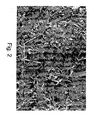
- Fig. 2 is a SEM image showing Ex. 1 where the friction material has many large holes such that at least some of the lubricant does not stay on the surface of the friction material.
- the friction particles in the Ex. 1 formulation penetrate deeper into the fibrous base material such that surface pores remain fairly open.
- the noncontinuous layer of friction modifying materials used in the porous friction material of the present invention provides the friction material with good anti-shudder characteristics.
- the high temperature synthetic fibers and porosity of the base material provides improved heat resistance.
- porous friction material has relatively large pores which allow contaminants of fluids to pass through readily. This absorption of such degradation products provides the friction material with even more constant friction behaviors.
- Compar. E is a commercial friction material.
- Compr. G is a commercial friction material formulation.
- Compar. Z is a friction material formulation with a dense layer of friction modifying particles as a top layer.
- the failure criterion of mu-v (friction coefficient to slip speed (rpm)) slope is set at -1.0*E-5, which is acceptable in the industry. A product with a slope below this level is more prone to shudder.
- the Ex. 1 material allows the oil flow to be within the desired conditions and allows for good dissipation of heat.
- the Ex. 1 material lasts for more than 40 hours before falling below the "failure criterion" while the other materials failed at between 6 and 20 hours.
- the deposit of the friction modifying particle creates a porous surface layer which does not significantly reduce permeability of the top layer.
- the permeability of the top friction modifying particle layer allows the fluid or lubricant to flow into the base material and not remain held at the surface of the friction material.
- the Ex. 1 friction material has a normal permeability (k normal ) of about 0.36 Darcy or less and a lateral permeability (k lateral ) of about 0.71 Darcy or greater.
- the Compar. Z material has a normal permeability (k normal ) of about 0.22 Darcy and a lateral permeability (k materal ) of about 0.35 Darcy.
- the present invention is useful as a high energy friction material for use with clutch plates, transmission bands, brake shoes, synchronizer rings, friction disks or system plates.
Landscapes
- Engineering & Computer Science (AREA)
- General Engineering & Computer Science (AREA)
- Mechanical Engineering (AREA)
- Braking Arrangements (AREA)
Applications Claiming Priority (1)
| Application Number | Priority Date | Filing Date | Title |
|---|---|---|---|
| US10/888,054 US20060008635A1 (en) | 2004-07-09 | 2004-07-09 | Porous friction material with friction modifying layer |
Publications (1)
| Publication Number | Publication Date |
|---|---|
| EP1614926A1 true EP1614926A1 (fr) | 2006-01-11 |
Family
ID=35134446
Family Applications (1)
| Application Number | Title | Priority Date | Filing Date |
|---|---|---|---|
| EP20050254285 Ceased EP1614926A1 (fr) | 2004-07-09 | 2005-07-07 | Matériau de friction poreux avec couche modificatrice de friction |
Country Status (5)
| Country | Link |
|---|---|
| US (1) | US20060008635A1 (fr) |
| EP (1) | EP1614926A1 (fr) |
| JP (1) | JP2006022963A (fr) |
| KR (1) | KR20060050020A (fr) |
| CN (1) | CN1721176A (fr) |
Cited By (5)
| Publication number | Priority date | Publication date | Assignee | Title |
|---|---|---|---|---|
| US7749562B1 (en) | 2004-07-26 | 2010-07-06 | Borgwarner Inc. | Porous friction material comprising nanoparticles of friction modifying material |
| US8021744B2 (en) | 2004-06-18 | 2011-09-20 | Borgwarner Inc. | Fully fibrous structure friction material |
| US8397889B2 (en) | 2008-03-12 | 2013-03-19 | Borgwarner Inc. | Frictional device comprising at least one friction plate |
| US8603614B2 (en) | 2004-07-26 | 2013-12-10 | Borgwarner Inc. | Porous friction material with nanoparticles of friction modifying material |
| DE102018205761A1 (de) | 2018-04-16 | 2019-10-17 | LF GmbH & Co. KG | Verfahren zur Herstellung eines Reibmaterials, hierdurch hergestelltes Reibmaterial und dessen Verwendung |
Families Citing this family (21)
| Publication number | Priority date | Publication date | Assignee | Title |
|---|---|---|---|---|
| US20050075021A1 (en) * | 2003-10-03 | 2005-04-07 | Lam Robert C. | High performance, durable, deposit friction material |
| US20050074595A1 (en) * | 2003-10-03 | 2005-04-07 | Lam Robert C. | Friction material containing partially carbonized carbon fibers |
| US20060009541A1 (en) * | 2004-07-09 | 2006-01-12 | Yih-Fang Chen | Saturant for friction material containing friction modifying layer |
| KR101201958B1 (ko) * | 2005-04-26 | 2012-11-16 | 보르그워너 인코퍼레이티드 | 마찰재 |
| JP5043024B2 (ja) * | 2005-11-02 | 2012-10-10 | ボーグワーナー インコーポレーテッド | カーボン摩擦材料 |
| US20090048369A1 (en) * | 2006-03-29 | 2009-02-19 | Newcomb Timothy P | Friction Materials Made With Resins Containing Polar Functional Groups |
| EP2028221A1 (fr) * | 2007-08-03 | 2009-02-25 | Borgwarner, Inc. | Matériau de friction avec du silicone |
| DE102009030506A1 (de) * | 2008-06-30 | 2009-12-31 | Borgwarner Inc., Auburn Hills | Reibungsmaterialien |
| US8172061B2 (en) * | 2008-09-26 | 2012-05-08 | GM Global Technology Operations LLC | Clutch friction material and method of forming same |
| DE102009025540A1 (de) * | 2009-06-19 | 2010-12-23 | Hoerbiger Antriebstechnik Gmbh | Reibring und Verfahren zu seiner Herstellung |
| DE102010053947B4 (de) * | 2009-12-17 | 2020-06-04 | Schaeffler Technologies AG & Co. KG | Reibelement für Synchronisiereinrichtung |
| US9677635B2 (en) | 2013-07-29 | 2017-06-13 | Borgwarner Inc. | Friction material |
| CN103438127B (zh) * | 2013-08-08 | 2016-12-28 | 临安华龙摩擦材料有限公司 | 基于碳纤维陶瓷纤维增强的湿式纸基摩擦片及其制作方法 |
| US10808782B2 (en) | 2015-12-30 | 2020-10-20 | Borgwarner Inc. | Friction material |
| US20170261057A1 (en) * | 2016-03-09 | 2017-09-14 | Schaeffler Technologies AG & Co. KG | Friction material with high performance surface layer |
| CN107620773B (zh) * | 2016-07-15 | 2021-03-19 | 博格华纳公司 | 摩擦材料 |
| US10989263B2 (en) | 2016-11-15 | 2021-04-27 | Borgwarner Inc. | Friction material |
| DE102018216268A1 (de) * | 2017-09-29 | 2019-04-04 | Robert Bosch Gmbh | Additiv hergestellte bremsklotzanordnung mit gesteuertem kompressibilitätsfaktor |
| US10816043B2 (en) | 2018-03-06 | 2020-10-27 | Schaeffler Technologies AG & Co. KG | Method of forming wet friction material by burning off fibers |
| DE102019113375A1 (de) | 2018-05-31 | 2019-12-05 | Borgwarner Inc. | Reibmaterial |
| US20210277972A1 (en) * | 2020-03-04 | 2021-09-09 | Borgwarner Inc. | Friction material |
Citations (12)
| Publication number | Priority date | Publication date | Assignee | Title |
|---|---|---|---|---|
| US4451590A (en) | 1981-06-10 | 1984-05-29 | Kureha Kagaku Kogyo Kabushiki Kaisha | Organic friction material |
| US5083650A (en) | 1991-05-24 | 1992-01-28 | Minnesota Mining And Manufacturing Company | Friction material having heat-resistant paper support bearing resin-bonded carbon particles |
| US5585166A (en) | 1994-02-25 | 1996-12-17 | Hoerbiger & Co. | Friction lining |
| US5707905A (en) | 1993-08-04 | 1998-01-13 | Borg-Warner Automotive, Inc. | Fibrous base material for a friction lining material comprising less fibrillated aramid fibers and synthetic graphite |
| US5753356A (en) | 1993-08-04 | 1998-05-19 | Borg-Warner Automotive, Inc. | Friction lining material comprising less fibrillated aramid fibers and synthetic graphite |
| US5856244A (en) | 1993-08-04 | 1999-01-05 | Borg-Warner Automotive, Inc. | Carbon deposit friction lining material |
| US5858883A (en) | 1993-08-04 | 1999-01-12 | Borg-Warner Automotive, Inc. | Fibrous lining material comprising a primary layer having less fibrillated aramid fibers and synthetic graphite and a secondary layer comprising carbon particles |
| US6001750A (en) | 1993-08-04 | 1999-12-14 | Borg-Warner Automotive, Inc. | Fibrous lining material comprising a primary layer having less fibrillated aramid fibers, carbon fibers, carbon particles and a secondary layer comprising carbon particles |
| US6130176A (en) | 1993-08-04 | 2000-10-10 | Borg-Warner Inc. | Fibrous base material for a friction lining material comprising less fibrillated aramid fibers and carbon fibers |
| EP1391629A1 (fr) * | 2002-08-13 | 2004-02-25 | BorgWarner Inc. | Matériau de friction avec couche modificatrice de friction contenant des nonoparticules |
| EP1394438A1 (fr) * | 2002-08-30 | 2004-03-03 | BorgWarner Inc. | Materiau de friction avec couche modificatrice de friction |
| EP1396655A1 (fr) * | 2002-09-04 | 2004-03-10 | BorgWarner Inc. | Materiau de friction avec couche modificatrice de friction |
Family Cites Families (5)
| Publication number | Priority date | Publication date | Assignee | Title |
|---|---|---|---|---|
| US2005A (en) * | 1841-03-16 | Improvement in the manner of constructing molds for casting butt-hinges | ||
| US2004A (en) * | 1841-03-12 | Improvement in the manner of constructing and propelling steam-vessels | ||
| JP3103850B2 (ja) * | 1989-03-07 | 2000-10-30 | アイシン精機株式会社 | 秘匿通信制御装置 |
| TW357441B (en) * | 1998-01-14 | 1999-05-01 | United Semiconductor Corp | Manufacturing method of split gate flash memory |
| US6630416B1 (en) * | 2000-11-06 | 2003-10-07 | Borgwarner Inc. | Friction material formed by deposition of friction modifiers on high, wet energy carbonaceous friction materials |
-
2004
- 2004-07-09 US US10/888,054 patent/US20060008635A1/en not_active Abandoned
-
2005
- 2005-07-07 EP EP20050254285 patent/EP1614926A1/fr not_active Ceased
- 2005-07-08 CN CNA2005100835187A patent/CN1721176A/zh active Pending
- 2005-07-08 JP JP2005200469A patent/JP2006022963A/ja active Pending
- 2005-07-09 KR KR1020050061974A patent/KR20060050020A/ko not_active Ceased
Patent Citations (14)
| Publication number | Priority date | Publication date | Assignee | Title |
|---|---|---|---|---|
| US4451590A (en) | 1981-06-10 | 1984-05-29 | Kureha Kagaku Kogyo Kabushiki Kaisha | Organic friction material |
| US5083650A (en) | 1991-05-24 | 1992-01-28 | Minnesota Mining And Manufacturing Company | Friction material having heat-resistant paper support bearing resin-bonded carbon particles |
| US5858883A (en) | 1993-08-04 | 1999-01-12 | Borg-Warner Automotive, Inc. | Fibrous lining material comprising a primary layer having less fibrillated aramid fibers and synthetic graphite and a secondary layer comprising carbon particles |
| US5707905A (en) | 1993-08-04 | 1998-01-13 | Borg-Warner Automotive, Inc. | Fibrous base material for a friction lining material comprising less fibrillated aramid fibers and synthetic graphite |
| US5753356A (en) | 1993-08-04 | 1998-05-19 | Borg-Warner Automotive, Inc. | Friction lining material comprising less fibrillated aramid fibers and synthetic graphite |
| US5856244A (en) | 1993-08-04 | 1999-01-05 | Borg-Warner Automotive, Inc. | Carbon deposit friction lining material |
| US5958507A (en) | 1993-08-04 | 1999-09-28 | Borg-Warner Automotive, Inc. | Carbon deposit friction lining material |
| US5998307A (en) | 1993-08-04 | 1999-12-07 | Borg-Warner Autotive, Inc. | Fibrous lining material comprising a primary layer having less fibrillated aramid fibers and synthetic graphite and a secondary layer comprising carbon particles |
| US6001750A (en) | 1993-08-04 | 1999-12-14 | Borg-Warner Automotive, Inc. | Fibrous lining material comprising a primary layer having less fibrillated aramid fibers, carbon fibers, carbon particles and a secondary layer comprising carbon particles |
| US6130176A (en) | 1993-08-04 | 2000-10-10 | Borg-Warner Inc. | Fibrous base material for a friction lining material comprising less fibrillated aramid fibers and carbon fibers |
| US5585166A (en) | 1994-02-25 | 1996-12-17 | Hoerbiger & Co. | Friction lining |
| EP1391629A1 (fr) * | 2002-08-13 | 2004-02-25 | BorgWarner Inc. | Matériau de friction avec couche modificatrice de friction contenant des nonoparticules |
| EP1394438A1 (fr) * | 2002-08-30 | 2004-03-03 | BorgWarner Inc. | Materiau de friction avec couche modificatrice de friction |
| EP1396655A1 (fr) * | 2002-09-04 | 2004-03-10 | BorgWarner Inc. | Materiau de friction avec couche modificatrice de friction |
Cited By (5)
| Publication number | Priority date | Publication date | Assignee | Title |
|---|---|---|---|---|
| US8021744B2 (en) | 2004-06-18 | 2011-09-20 | Borgwarner Inc. | Fully fibrous structure friction material |
| US7749562B1 (en) | 2004-07-26 | 2010-07-06 | Borgwarner Inc. | Porous friction material comprising nanoparticles of friction modifying material |
| US8603614B2 (en) | 2004-07-26 | 2013-12-10 | Borgwarner Inc. | Porous friction material with nanoparticles of friction modifying material |
| US8397889B2 (en) | 2008-03-12 | 2013-03-19 | Borgwarner Inc. | Frictional device comprising at least one friction plate |
| DE102018205761A1 (de) | 2018-04-16 | 2019-10-17 | LF GmbH & Co. KG | Verfahren zur Herstellung eines Reibmaterials, hierdurch hergestelltes Reibmaterial und dessen Verwendung |
Also Published As
| Publication number | Publication date |
|---|---|
| US20060008635A1 (en) | 2006-01-12 |
| CN1721176A (zh) | 2006-01-18 |
| JP2006022963A (ja) | 2006-01-26 |
| KR20060050020A (ko) | 2006-05-19 |
Similar Documents
| Publication | Publication Date | Title |
|---|---|---|
| US7749562B1 (en) | Porous friction material comprising nanoparticles of friction modifying material | |
| EP1394438B1 (fr) | Materiau de friction avec couche modificatrice de friction | |
| EP1391629B1 (fr) | Matériau de friction avec couche modificatrice de friction contenant des nonoparticules | |
| US6875711B2 (en) | Friction material with friction modifying layer having symmetrical geometric shapes | |
| US8603614B2 (en) | Porous friction material with nanoparticles of friction modifying material | |
| EP1614926A1 (fr) | Matériau de friction poreux avec couche modificatrice de friction | |
| EP1203897B1 (fr) | Matériau de friction formé par dépôt de modificateurs de friction sur des matériaux de friction carbonés | |
| EP1521007A2 (fr) | Matériau de friction durable à haute performance | |
| EP1521010B1 (fr) | Matériau de friction multicouches | |
| US20050064778A1 (en) | High coefficient friction material with symmetrical friction modifying particles | |
| EP1521008A2 (fr) | Matériau de friction poreux et élastique à haute teneur en fibres | |
| EP1521009A2 (fr) | Matériau de friction contenant des fibres de carbone partiellement carbonisées | |
| US20050075021A1 (en) | High performance, durable, deposit friction material | |
| EP1521001B1 (fr) | Matériau de frottement | |
| EP1614925A1 (fr) | Agent d'imprégnation pour matériau de friction avec couche modificatrice de friction |
Legal Events
| Date | Code | Title | Description |
|---|---|---|---|
| PUAI | Public reference made under article 153(3) epc to a published international application that has entered the european phase |
Free format text: ORIGINAL CODE: 0009012 |
|
| AK | Designated contracting states |
Kind code of ref document: A1 Designated state(s): AT BE BG CH CY CZ DE DK EE ES FI FR GB GR HU IE IS IT LI LT LU LV MC NL PL PT RO SE SI SK TR |
|
| AX | Request for extension of the european patent |
Extension state: AL BA HR MK YU |
|
| 17P | Request for examination filed |
Effective date: 20060310 |
|
| AKX | Designation fees paid |
Designated state(s): DE FR GB IT |
|
| APBK | Appeal reference recorded |
Free format text: ORIGINAL CODE: EPIDOSNREFNE |
|
| APBN | Date of receipt of notice of appeal recorded |
Free format text: ORIGINAL CODE: EPIDOSNNOA2E |
|
| APAZ | Date of receipt of statement of grounds of appeal deleted |
Free format text: ORIGINAL CODE: EPIDOSDNOA3E |
|
| APBR | Date of receipt of statement of grounds of appeal recorded |
Free format text: ORIGINAL CODE: EPIDOSNNOA3E |
|
| APAF | Appeal reference modified |
Free format text: ORIGINAL CODE: EPIDOSCREFNE |
|
| APBT | Appeal procedure closed |
Free format text: ORIGINAL CODE: EPIDOSNNOA9E |
|
| STAA | Information on the status of an ep patent application or granted ep patent |
Free format text: STATUS: THE APPLICATION HAS BEEN REFUSED |
|
| 18R | Application refused |
Effective date: 20141015 |