EP1616953A1 - Procede de detection de gene mutant recepteur d'adrenaline beta 3, et sonde d'acide nucleique et kit correspondants - Google Patents
Procede de detection de gene mutant recepteur d'adrenaline beta 3, et sonde d'acide nucleique et kit correspondants Download PDFInfo
- Publication number
- EP1616953A1 EP1616953A1 EP04728043A EP04728043A EP1616953A1 EP 1616953 A1 EP1616953 A1 EP 1616953A1 EP 04728043 A EP04728043 A EP 04728043A EP 04728043 A EP04728043 A EP 04728043A EP 1616953 A1 EP1616953 A1 EP 1616953A1
- Authority
- EP
- European Patent Office
- Prior art keywords
- nucleic acid
- probe
- fluorescent dye
- nucleotide sequence
- acid probe
- Prior art date
- Legal status (The legal status is an assumption and is not a legal conclusion. Google has not performed a legal analysis and makes no representation as to the accuracy of the status listed.)
- Granted
Links
Images




Classifications
-
- C—CHEMISTRY; METALLURGY
- C12—BIOCHEMISTRY; BEER; SPIRITS; WINE; VINEGAR; MICROBIOLOGY; ENZYMOLOGY; MUTATION OR GENETIC ENGINEERING
- C12Q—MEASURING OR TESTING PROCESSES INVOLVING ENZYMES, NUCLEIC ACIDS OR MICROORGANISMS; COMPOSITIONS OR TEST PAPERS THEREFOR; PROCESSES OF PREPARING SUCH COMPOSITIONS; CONDITION-RESPONSIVE CONTROL IN MICROBIOLOGICAL OR ENZYMOLOGICAL PROCESSES
- C12Q1/00—Measuring or testing processes involving enzymes, nucleic acids or microorganisms; Compositions therefor; Processes of preparing such compositions
- C12Q1/68—Measuring or testing processes involving enzymes, nucleic acids or microorganisms; Compositions therefor; Processes of preparing such compositions involving nucleic acids
- C12Q1/6876—Nucleic acid products used in the analysis of nucleic acids, e.g. primers or probes
-
- C—CHEMISTRY; METALLURGY
- C07—ORGANIC CHEMISTRY
- C07K—PEPTIDES
- C07K14/00—Peptides having more than 20 amino acids; Gastrins; Somatostatins; Melanotropins; Derivatives thereof
- C07K14/435—Peptides having more than 20 amino acids; Gastrins; Somatostatins; Melanotropins; Derivatives thereof from animals; from humans
- C07K14/705—Receptors; Cell surface antigens; Cell surface determinants
- C07K14/70571—Receptors; Cell surface antigens; Cell surface determinants for neuromediators, e.g. serotonin receptor, dopamine receptor
-
- C—CHEMISTRY; METALLURGY
- C12—BIOCHEMISTRY; BEER; SPIRITS; WINE; VINEGAR; MICROBIOLOGY; ENZYMOLOGY; MUTATION OR GENETIC ENGINEERING
- C12Q—MEASURING OR TESTING PROCESSES INVOLVING ENZYMES, NUCLEIC ACIDS OR MICROORGANISMS; COMPOSITIONS OR TEST PAPERS THEREFOR; PROCESSES OF PREPARING SUCH COMPOSITIONS; CONDITION-RESPONSIVE CONTROL IN MICROBIOLOGICAL OR ENZYMOLOGICAL PROCESSES
- C12Q2600/00—Oligonucleotides characterized by their use
- C12Q2600/156—Polymorphic or mutational markers
Definitions
- the present invention relates to method for detecting a ⁇ 3-adrenergic receptor mutant gene, and a nucleic acid probe and a kit therefor.
- the ⁇ 3-adrenergic receptor plays a major part in lypolysis in white adipose cells and heat generation in brown adipose cells.
- the existence of the mutation replacing tryptophan at position 64 in the amino acid sequence of B3AR with arginine (Trp64Arg) is said to reduce the resting metabolic rate by 200 kcal, and to be involved in obesity with abdominal fat and in insulin resistance.
- the mutation resulting in the Trp64Arg mutation in B3AR (also referred to as "B3AR Trp64Arg mutation”) exists, a recognition site of a restriction enzyme emerges at the position of the mutation. Therefore, the mutation can be detected by a method of amplifying DNA by PCR so that a portion including the mutation position should be amplified, digesting the amplification product with a restriction enzyme and determining whether the DNA has been digested or not by electrophoresis (PCR-RFLP) (for example, refer to The Japanese Journal of Clinical Pathology, vol. 44, 8, pp.778-782, 1996).
- PCR-RFLP electrophoresis
- PCR-RFLP PCR-RFLP
- the amplification product needs to be collected and subjected to a treatment with a restriction enzyme after PCR, and therefore the amplification product may contaminate the subsequent reaction system. Accordingly, a false positive or false negative result may be obtained.
- DNA is treated with a restriction enzyme and then subjected to electrophoresis after completion of PCR. Therefore, time required for the detection becomes extremely long. In addition, because the procedure is complicated, automatization is difficult.
- a method is generally known in which a region containing a mutation is amplified by PCR, then a melting curve analysis is performed by using a nucleic acid probe labeled with a fluorescent dye, and the mutation is analyzed on the basis of the result of the melting curve analysis (Clinical Chemistry, vol. 46, 5, pp.631-635, 2000; Japanese Patent Application Laid-open (Kokai) No. 2002-119291).
- An object of the present invention is to identify a quenching probe effective for the detection of the B3AR Trp64Arg mutation and thereby provide a method for detecting the B3AR Trp64Arg mutation and a kit therefor.
- the literature concerning the aforementioned method of using a probe only teaches that, concerning the design of the probe, the probe should be designed so that, when a quenching probe having an end labeled with a fluorescent dye hybridizes with a target nucleic acid, two or more nucleotide pairs of the probe-nucleic acid hybrid should form at least one pair of G and C in the end portion.
- the inventors of the present invention designed a quenching probe satisfying the aforementioned condition and attempted the detection. However, no quenching probe that enabled detection was easily obtained.
- the inventors of the present invention found that by designing a quenching probe based on a specific region containing the B3AR Trp64Arg mutation, the B3AR Trp64Arg mutation could be detected by a melting curve analysis using the quenching probe.
- the present invention provides the followings.
- the probe of the present invention is a nucleic acid probe of which end is labeled with a fluorescent dye, and in which fluorescence of the fluorescent dye decreases upon hybridization, wherein the probe has a nucleotide sequence starting from the nucleotide number 183 in the nucleotide sequence of SEQ ID NO: 1 and having a length of 8 to 30 nucleotides, and the 5' end of the probe is labeled with the fluorescent dye, or the probe has a nucleotide sequence ending at the nucleotide number 196 in the nucleotide sequence of SEQ ID NO: 2 and having a length of 7 to 30 nucleotides, and the 3' end of the probe is labeled with the fluorescent dye.
- the probe of the present invention may be similar to the quenching probe described in Patent Document 1 except that it has a nucleotide sequence starting from the nucleotide number 183 in the nucleotide sequence of SEQ ID NO: 1 (sequence having the wild type nucleotide in the B3AR Trp64Arg mutation) and having a length of 8 to 30 nucleotides, or a nucleotide sequence ending at the nucleotide number 196 in the nucleotide sequence of SEQ ID NO: 2 (sequence having the mutant type nucleotide in the B3AR Trp64Arg mutation) and having a length of 7 to 30 nucleotides.
- nucleotide sequence of the quenching probe used in the present invention examples include the nucleotide sequences of SEQ ID NOS: 8 to 12.
- fluorescent dye those described in Patent Document 1 can be used, and specific examples thereof include FAM (trademark), TAMRA (trademark), BODIPY (trademark) FL and so forth.
- the fluorescent dye can be bound to an oligonucleotide in an ordinary manner, for example, by the method described in Patent Document 1.
- the detection method of the present invention is a method for detecting a mutation by performing a melting curve analysis for a nucleic acid having a single nucleotide polymorphism site by using a nucleic acid probe labeled with a fluorescent dye and measuring fluorescence of the fluorescent dye, and detecting the mutation on the basis of the result of the melting curve analysis, and characterized in that the single nucleotide polymorphism is the B3AR Trp64Arg mutation, and the nucleic acid probe is the probe of the present invention.
- the detection method of the present invention can be performed according to usual methods for nucleic acid amplification and melting curve analysis (Tm analysis) except that a region containing the B3AR Trp64Arg mutation in a DNA encoding B3AR is amplified, and the probe of the present invention is used.
- Tm analysis nucleic acid amplification and melting curve analysis
- a method of using a polymerase is preferred, and examples thereof include PCR, ICAN, LAMP and so forth.
- amplification is preferably performed in the presence of the probe of the present invention.
- the reaction conditions of the amplification and others can be easily adjusted depending on the used probe by those skilled in the art.
- Tm of the probe is analyzed after amplification of a nucleic acid, and therefore it is not necessary to handle the amplification product after completion of the reaction. Thus, there is no risk of contamination with the amplification product. Further, because the detection is performed with the same equipment as required for the amplification, it is not even necessary to move a vessel. Therefore, automatization of the method is also easy.
- the primer pair used for PCR can be designed in the same manner as in a method for designing a primer pair in usual PCR except that it is designed so that a region to which the probe of the present invention is hybridizable should be amplified.
- the length and Tm of the primers are usually 10- to 40-mer and 40 to 70°C, preferably 15- to 25-mer and 55 to 60°C, respectively. Primers of the primer pair may not be equal in length. However, it is preferred that the Tm values of the primers are substantially equal (the difference is usually within 2°C).
- the Tm values are values calculated by the nearest neighbor method.
- Examples of the primer pair include a primer pair comprising primers having the nucleotide sequences of SEQ ID NOS: 2 and 3.
- PCR is preferably performed in the presence of the probe of the present invention. This enables the Tm analysis without performing any operation of handling the amplification product after completion of the amplification reaction. Tm values of primers and reaction conditions of PCR can be easily adjusted by those skilled in the art depending on the used probe.
- a typical example of the composition of the reaction mixture for PCR is as follows.
- Table 1 DNA fragments 10 1 to 10 8 molecules/reaction Primers 200 to 1000 nM Probe 100 to 1000 nM Nucleotides 20 to 200 ⁇ M each DNA polymerase 0.01 to 0.03 U/ ⁇ l Tris-HCl (pH 8.4 to 9.0) 5 to 20 mM MgCl 2 1.5 to 3 mM KCl 10 to 100 mM Glycerol 0 to 20% (Final fluid volume: 10 to 100 ⁇ l)
- a typical example of the temperature cycle is as follows, and this temperature cycle is usually repeated 25 to 40 times.
- the Tm analysis can be performed in a conventional manner except that fluorescence of the fluorescent dye binding to the probe of the present invention is measured. Fluorescence can be measured by using excitation light having a wavelength suitable for the fluorescent dye and measuring intensity of light of the emission wavelength.
- the temperature increasing rate in the Tm analysis is usually 0.1 to 1°C per second.
- Composition of the reaction mixture for Tm analysis is not particularly limited so long as a probe and a nucleic acid having a sequence complementary to the nucleotide sequence of the prove can hybridize to each other.
- the monovalent cation concentration is usually 1.5 to 5 mM, and pH is usually 7 to 9. Because a reaction mixture for an amplification method using a DNA polymerase such as PCR usually satisfies these conditions, the reaction mixture after the amplification can be used as it is for the Tm analysis.
- the B3AR Trp64Arg mutation can be detected on the basis of the results of the Tm analysis in an ordinary manner.
- the detection in the detection method of the present invention include not only detection of the presence or absence of a mutation, but also quantification of mutant type DNA and determination of the ratio of wild type DNA and mutant type DNA.
- the kit of the present invention is a kit used for the second detection method of the present invention.
- This kit is characterized by including a nucleic acid probe of which end is labeled with a fluorescent dye and in which fluorescence of the fluorescent dye decreases upon hybridization (quenching probe), wherein the nucleic acid probe has a nucleotide sequence starting from the nucleotide number 183 in the nucleotide sequence of SEQ ID NO: 1 and having a length of 8 to 30 nucleotides, and the 5' end of the probe is labeled with the fluorescent dye, or the nucleic acid probe has a nucleotide sequence ending at the nucleotide number 196 in the nucleotide sequence of SEQ ID NO: 2 and having a length of 7 to 30 nucleotides, and the 3' end of the probe is labeled with the fluorescent dye.
- the quenching probe is as explained above with regard to the probe of the present invention.
- the kit of the present invention may include reagents required for amplification of a nucleic acid in the detection method of the present invention, in particular, primers for amplification using a DNA polymerase, in addition to the quenching probe.
- the quenching probe, primers and other reagents may be separately included, or a part thereof may be provided as a mixture.
- the primers shown in Table 2 were designed on the basis of the nucleotide sequence containing the site of the Trp64Arg mutation of human B3AR gene (SEQ ID NO: 1) so that a region containing the Trp64Arg mutation could be amplified.
- the positions are indicated with the nucleotide numbers in the nucleotide sequence of SEQ ID NO: 1.
- Table 2 Primers Name Sequence (5' ⁇ 3') mer Position SEQ ID NO: R gccagcgaagtcacgaacac 20 239-220 3 F Ggcgctggcggtgc 14 132-145 4
- the probes having C at the ends shown in Table 3 were designed.
- the positions are indicated with the nucleotide numbers in the nucleotide sequence of SEQ ID NO: 1.
- the capital letters in the nucleotide sequences represent sites of the B3AR Trp64Arg mutation, and (P) at the 3' ends means being phosphorylated.
- the probes were labeled with BODIPY (trademark) FL or TAMRA (trademark) in a conventional manner.
- PCR and Tm analysis were performed by using genomic DNA as a sample and Smart Cycler System (Cephied) under the conditions shown below.
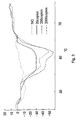
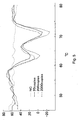
- the excitation wavelength and the detection wavelength in the Tm analysis were 450 to 495 nm and 505 to 537 nm (BODIPY FL) and 527 to 555 nm and 565 to 605 nm (TAMRA), respectively.
- PCR and Tm analysis were performed by using each probe.
- the positions of the probes relative to the nucleotide sequence containing the B3AR Trp64Arg mutation are shown in Figs. 1 and 2.
- the wild type sequence and mutant type sequence shown in the drawings correspond to the nucleotide numbers 171 to 205 in the nucleotide sequences of SEQ ID NOS: 1 and 2, respectively.
- F denotes a fluorescent dye.
- plasmid having the wild type sequence (same as the above plasmid except that nucleotide number 285 is A in the nucleotide sequence of SEQ ID NO: 1) was prepared.
- Ten samples (wt/mt) were prepared by mixing the wild type plasmid and the mutant type plasmid. With respect to each of these samples as well as a sample (wt/wt) of only the wild type plasmid and a sample (mt/mt) of only the mutant type plasmid, the above method was repeated. The results are shown in Fig. 4. As seen from Fig. 4, it is shown that the method is excellent in the reproducibility.
- the vertical axis represents a primary derivative value of fluorescence intensity with an inverted sign (-dF/dt), and the horizontal axis represents temperature (°C).
- a quenching probe effective for detecting the B3AR Trp64Arg mutation is provided, and a method for detecting the B3AR Trp64Arg mutation by using it and a kit therefor are further provided. Because the Tm analysis is completed within several tens of seconds, time required for the detection can be markedly reduced. According to a preferred embodiment of the present invention, wherein amplification of nucleic acid in the presence of the probe and Tm analysis are combined, only the Tm of the probe is analyzed after the amplification of nucleic acid, and therefore it is not necessary to handle the amplification product after completion of the reaction. Accordingly, there is no risk of contamination with the amplification product. Further, because the detection can be performed with the same equipment as required for the amplification, it is even unnecessary to move a vessel. Therefore, automatization of the method is also easy.
Landscapes
- Chemical & Material Sciences (AREA)
- Health & Medical Sciences (AREA)
- Life Sciences & Earth Sciences (AREA)
- Organic Chemistry (AREA)
- Proteomics, Peptides & Aminoacids (AREA)
- Engineering & Computer Science (AREA)
- Zoology (AREA)
- Biophysics (AREA)
- Genetics & Genomics (AREA)
- General Health & Medical Sciences (AREA)
- Immunology (AREA)
- Biochemistry (AREA)
- Molecular Biology (AREA)
- Analytical Chemistry (AREA)
- Wood Science & Technology (AREA)
- Bioinformatics & Cheminformatics (AREA)
- Gastroenterology & Hepatology (AREA)
- General Engineering & Computer Science (AREA)
- Biotechnology (AREA)
- Physics & Mathematics (AREA)
- Biomedical Technology (AREA)
- Neurology (AREA)
- Cell Biology (AREA)
- Toxicology (AREA)
- Microbiology (AREA)
- Medicinal Chemistry (AREA)
- Measuring Or Testing Involving Enzymes Or Micro-Organisms (AREA)
- Investigating Or Analysing Biological Materials (AREA)
- Investigating, Analyzing Materials By Fluorescence Or Luminescence (AREA)
- Investigating Or Analysing Materials By The Use Of Chemical Reactions (AREA)
- Saccharide Compounds (AREA)
- Peptides Or Proteins (AREA)
Applications Claiming Priority (2)
| Application Number | Priority Date | Filing Date | Title |
|---|---|---|---|
| JP2003114381A JP4336877B2 (ja) | 2003-04-18 | 2003-04-18 | β3アドレナリン受容体変異遺伝子の検出法ならびにそのための核酸プローブおよびキット |
| PCT/JP2004/005525 WO2004092385A1 (fr) | 2003-04-18 | 2004-04-16 | Procede de detection de gene mutant recepteur d'adrenaline $g(b)3, et sonde d'acide nucleique et kit correspondants |
Publications (3)
| Publication Number | Publication Date |
|---|---|
| EP1616953A1 true EP1616953A1 (fr) | 2006-01-18 |
| EP1616953A4 EP1616953A4 (fr) | 2006-06-14 |
| EP1616953B1 EP1616953B1 (fr) | 2009-01-14 |
Family
ID=33296148
Family Applications (1)
| Application Number | Title | Priority Date | Filing Date |
|---|---|---|---|
| EP04728043A Expired - Lifetime EP1616953B1 (fr) | 2003-04-18 | 2004-04-16 | Procede de detection de gene mutant recepteur d'adrenaline beta 3, et sonde d'acide nucleique et kit correspondants |
Country Status (7)
| Country | Link |
|---|---|
| US (1) | US7501239B2 (fr) |
| EP (1) | EP1616953B1 (fr) |
| JP (1) | JP4336877B2 (fr) |
| CN (1) | CN1809638B (fr) |
| AT (1) | ATE420957T1 (fr) |
| DE (1) | DE602004019067D1 (fr) |
| WO (1) | WO2004092385A1 (fr) |
Cited By (2)
| Publication number | Priority date | Publication date | Assignee | Title |
|---|---|---|---|---|
| EP2078747A4 (fr) * | 2006-11-30 | 2009-12-09 | Arkray Inc | Jeu d'amorces pour l'amplification du gene nat2, reactif pour l'amplification du gene nat2 comprenant ledit jeu d'amorces et utilisation du reactif |
| EP2055789A4 (fr) * | 2006-11-30 | 2009-12-23 | Arkray Inc | Jeu d'amorces pour l'amplification du gène cyp2c19, réactif pour l'amplification du gène cyp2c19 comprenant ledit jeu d'amorces et utilisation du réactif |
Families Citing this family (4)
| Publication number | Priority date | Publication date | Assignee | Title |
|---|---|---|---|---|
| US20070176822A1 (en) * | 2006-01-30 | 2007-08-02 | Fujitsu Limited | Target detection apparatus and system |
| JP5279492B2 (ja) * | 2006-11-30 | 2013-09-04 | アークレイ株式会社 | 肥満遺伝子増幅用プライマーセット、それを含む肥満遺伝子増幅用試薬およびその用途 |
| JP6059453B2 (ja) * | 2011-05-31 | 2017-01-11 | アークレイ株式会社 | 同一又は近傍の検出波長を有する蛍光色素で修飾された複数のオリゴヌクレオチドを用いて、1種類の波長で複数の遺伝子多型を検出する方法 |
| JP6145974B2 (ja) * | 2012-08-24 | 2017-06-14 | 東洋紡株式会社 | 肺炎マイコプラズマの検出方法 |
Family Cites Families (10)
| Publication number | Priority date | Publication date | Assignee | Title |
|---|---|---|---|---|
| US5364772A (en) | 1992-07-20 | 1994-11-15 | Wayne State University | DNA molecule encoding the β3 -adrenergic receptor |
| US5766851A (en) * | 1995-05-19 | 1998-06-16 | The Johns Hopkins University School Of Medicine | Susceptibility gene for obesity and type II diabetes mellitus |
| US6117635A (en) * | 1996-07-16 | 2000-09-12 | Intergen Company | Nucleic acid amplification oligonucleotides with molecular energy transfer labels and methods based thereon |
| WO1998020165A2 (fr) * | 1996-11-06 | 1998-05-14 | Whitehead Institute For Biomedical Research | Marqueurs bialleliques |
| US6140054A (en) * | 1998-09-30 | 2000-10-31 | University Of Utah Research Foundation | Multiplex genotyping using fluorescent hybridization probes |
| JP3437816B2 (ja) | 1999-04-20 | 2003-08-18 | 環境エンジニアリング株式会社 | 核酸の測定方法 |
| JP2001037489A (ja) * | 1999-05-25 | 2001-02-13 | Mitsubishi Chemicals Corp | 遺伝子解析法 |
| JP2002034598A (ja) * | 2000-07-27 | 2002-02-05 | Toyobo Co Ltd | 塩基多型を検出する方法 |
| JP3963422B2 (ja) * | 2000-08-03 | 2007-08-22 | 日鉄環境エンジニアリング株式会社 | 核酸の測定方法 |
| AU1141602A (en) * | 2000-10-04 | 2002-04-15 | Celadon Lab Inc | Computer system for designing oligonucleotides used in biochemical methods |
-
2003
- 2003-04-18 JP JP2003114381A patent/JP4336877B2/ja not_active Expired - Fee Related
-
2004
- 2004-04-16 WO PCT/JP2004/005525 patent/WO2004092385A1/fr not_active Ceased
- 2004-04-16 US US10/553,509 patent/US7501239B2/en not_active Expired - Fee Related
- 2004-04-16 AT AT04728043T patent/ATE420957T1/de not_active IP Right Cessation
- 2004-04-16 DE DE602004019067T patent/DE602004019067D1/de not_active Expired - Lifetime
- 2004-04-16 EP EP04728043A patent/EP1616953B1/fr not_active Expired - Lifetime
- 2004-04-16 CN CN2004800170191A patent/CN1809638B/zh not_active Expired - Fee Related
Cited By (2)
| Publication number | Priority date | Publication date | Assignee | Title |
|---|---|---|---|---|
| EP2078747A4 (fr) * | 2006-11-30 | 2009-12-09 | Arkray Inc | Jeu d'amorces pour l'amplification du gene nat2, reactif pour l'amplification du gene nat2 comprenant ledit jeu d'amorces et utilisation du reactif |
| EP2055789A4 (fr) * | 2006-11-30 | 2009-12-23 | Arkray Inc | Jeu d'amorces pour l'amplification du gène cyp2c19, réactif pour l'amplification du gène cyp2c19 comprenant ledit jeu d'amorces et utilisation du réactif |
Also Published As
| Publication number | Publication date |
|---|---|
| EP1616953A4 (fr) | 2006-06-14 |
| EP1616953B1 (fr) | 2009-01-14 |
| US20070003932A1 (en) | 2007-01-04 |
| CN1809638B (zh) | 2010-12-22 |
| DE602004019067D1 (de) | 2009-03-05 |
| JP4336877B2 (ja) | 2009-09-30 |
| US7501239B2 (en) | 2009-03-10 |
| WO2004092385A1 (fr) | 2004-10-28 |
| ATE420957T1 (de) | 2009-01-15 |
| JP2004313120A (ja) | 2004-11-11 |
| CN1809638A (zh) | 2006-07-26 |
Similar Documents
| Publication | Publication Date | Title |
|---|---|---|
| JP5456950B2 (ja) | 短いタンデム反復遺伝子座の多重増幅 | |
| EP2447378B1 (fr) | Sonde pour la détection de polymorphisme dans le gène EGFR, amorce d'amplification et utilisation associée | |
| EP2518165A1 (fr) | Procédé permettant de détecter simultanément des mutations de gène d'acétaldéhyde déshydrogénase 2 et alcool déshydrogénase 2 | |
| EP1616953B1 (fr) | Procede de detection de gene mutant recepteur d'adrenaline beta 3, et sonde d'acide nucleique et kit correspondants | |
| JP4505838B2 (ja) | Nat2*6の変異の検出法ならびにそのための核酸プローブおよびキット | |
| EP1619258B1 (fr) | Procede permettant de detecter ou de determiner de maniere quantitative une mutation d'adn mitochondrial en position 3243, et kit utilise a cet effet | |
| EP1616952B1 (fr) | Procede permettant de detecter un gene mutant de proteine amyloide des ilots pancreatiques ainsi que sonde d'acide nucleique et kit associes | |
| JP4454366B2 (ja) | Mdr1遺伝子の変異の検出法ならびにそのための核酸プローブおよびキット | |
| EP2653560A1 (fr) | Sonde et procédé de détection de polymorphisme l'utilisant | |
| JP4437207B2 (ja) | Cyp2d6の変異の検出法ならびにそのための核酸プローブおよびキット | |
| EP2711435A1 (fr) | Sonde de détection de mutation, procédé de détection de mutation, procédé d'évaluation de l'efficacité de médicaments et kit de détection de la mutation | |
| JP5047448B2 (ja) | Cyp2c19の変異の検出法およびそのための核酸プローブ | |
| JP4505839B2 (ja) | Cyp2d6*4の変異の検出法ならびにそのための核酸プローブおよびキット | |
| JP4276874B2 (ja) | ミトコンドリアdna3243変異の検出法ならびにそのための核酸プローブおよびキット | |
| JP4517175B2 (ja) | Nat2*7の変異の検出法ならびにそのための核酸プローブおよびキット | |
| JP4437206B2 (ja) | Cyp2c9の変異の検出法ならびにそのための核酸プローブおよびキット | |
| JP5860667B2 (ja) | Egfrエクソン21l858r遺伝子多型検出用プライマーセット及びその用途 | |
| JP4517176B2 (ja) | Nat2*5の変異の検出法ならびにそのための核酸プローブおよびキット | |
| JP6754202B2 (ja) | K−ras遺伝子増幅用フォワードプライマーセット、K−ras遺伝子増幅用キット、K−ras遺伝子増幅方法、多型解析方法、及び薬効判定方法 | |
| JP4454365B2 (ja) | Cyp2d6*2の変異の検出法ならびにそのための核酸プローブおよびキット | |
| JP2005110502A (ja) | Cyp2c19*3アレルの検出法およびそのための核酸プローブ | |
| JP4454377B2 (ja) | チオプリンメチルトランスフェラーゼの変異の検出法ならびにそのための核酸プローブおよびキット |
Legal Events
| Date | Code | Title | Description |
|---|---|---|---|
| PUAI | Public reference made under article 153(3) epc to a published international application that has entered the european phase |
Free format text: ORIGINAL CODE: 0009012 |
|
| 17P | Request for examination filed |
Effective date: 20051104 |
|
| AK | Designated contracting states |
Kind code of ref document: A1 Designated state(s): AT BE BG CH CY CZ DE DK EE ES FI FR GB GR HU IE IT LI LU MC NL PL PT RO SE SI SK TR |
|
| AX | Request for extension of the european patent |
Extension state: AL HR LT LV MK |
|
| A4 | Supplementary search report drawn up and despatched |
Effective date: 20060517 |
|
| DAX | Request for extension of the european patent (deleted) | ||
| 17Q | First examination report despatched |
Effective date: 20060814 |
|
| GRAP | Despatch of communication of intention to grant a patent |
Free format text: ORIGINAL CODE: EPIDOSNIGR1 |
|
| GRAS | Grant fee paid |
Free format text: ORIGINAL CODE: EPIDOSNIGR3 |
|
| RAP1 | Party data changed (applicant data changed or rights of an application transferred) |
Owner name: ARKRAY, INC. |
|
| GRAA | (expected) grant |
Free format text: ORIGINAL CODE: 0009210 |
|
| AK | Designated contracting states |
Kind code of ref document: B1 Designated state(s): AT BE BG CH CY CZ DE DK EE ES FI FR GB GR HU IE IT LI LU MC NL PL PT RO SE SI SK TR |
|
| REG | Reference to a national code |
Ref country code: GB Ref legal event code: FG4D |
|
| REG | Reference to a national code |
Ref country code: CH Ref legal event code: EP |
|
| REG | Reference to a national code |
Ref country code: IE Ref legal event code: FG4D |
|
| REF | Corresponds to: |
Ref document number: 602004019067 Country of ref document: DE Date of ref document: 20090305 Kind code of ref document: P |
|
| PG25 | Lapsed in a contracting state [announced via postgrant information from national office to epo] |
Ref country code: NL Free format text: LAPSE BECAUSE OF FAILURE TO SUBMIT A TRANSLATION OF THE DESCRIPTION OR TO PAY THE FEE WITHIN THE PRESCRIBED TIME-LIMIT Effective date: 20090114 |
|
| NLV1 | Nl: lapsed or annulled due to failure to fulfill the requirements of art. 29p and 29m of the patents act | ||
| PG25 | Lapsed in a contracting state [announced via postgrant information from national office to epo] |
Ref country code: FI Free format text: LAPSE BECAUSE OF FAILURE TO SUBMIT A TRANSLATION OF THE DESCRIPTION OR TO PAY THE FEE WITHIN THE PRESCRIBED TIME-LIMIT Effective date: 20090114 Ref country code: SI Free format text: LAPSE BECAUSE OF FAILURE TO SUBMIT A TRANSLATION OF THE DESCRIPTION OR TO PAY THE FEE WITHIN THE PRESCRIBED TIME-LIMIT Effective date: 20090114 Ref country code: ES Free format text: LAPSE BECAUSE OF FAILURE TO SUBMIT A TRANSLATION OF THE DESCRIPTION OR TO PAY THE FEE WITHIN THE PRESCRIBED TIME-LIMIT Effective date: 20090425 |
|
| PG25 | Lapsed in a contracting state [announced via postgrant information from national office to epo] |
Ref country code: AT Free format text: LAPSE BECAUSE OF FAILURE TO SUBMIT A TRANSLATION OF THE DESCRIPTION OR TO PAY THE FEE WITHIN THE PRESCRIBED TIME-LIMIT Effective date: 20090114 Ref country code: PL Free format text: LAPSE BECAUSE OF FAILURE TO SUBMIT A TRANSLATION OF THE DESCRIPTION OR TO PAY THE FEE WITHIN THE PRESCRIBED TIME-LIMIT Effective date: 20090114 Ref country code: SE Free format text: LAPSE BECAUSE OF FAILURE TO SUBMIT A TRANSLATION OF THE DESCRIPTION OR TO PAY THE FEE WITHIN THE PRESCRIBED TIME-LIMIT Effective date: 20090414 Ref country code: PT Free format text: LAPSE BECAUSE OF FAILURE TO SUBMIT A TRANSLATION OF THE DESCRIPTION OR TO PAY THE FEE WITHIN THE PRESCRIBED TIME-LIMIT Effective date: 20090615 |
|
| PG25 | Lapsed in a contracting state [announced via postgrant information from national office to epo] |
Ref country code: BE Free format text: LAPSE BECAUSE OF FAILURE TO SUBMIT A TRANSLATION OF THE DESCRIPTION OR TO PAY THE FEE WITHIN THE PRESCRIBED TIME-LIMIT Effective date: 20090114 |
|
| PG25 | Lapsed in a contracting state [announced via postgrant information from national office to epo] |
Ref country code: DK Free format text: LAPSE BECAUSE OF FAILURE TO SUBMIT A TRANSLATION OF THE DESCRIPTION OR TO PAY THE FEE WITHIN THE PRESCRIBED TIME-LIMIT Effective date: 20090114 Ref country code: EE Free format text: LAPSE BECAUSE OF FAILURE TO SUBMIT A TRANSLATION OF THE DESCRIPTION OR TO PAY THE FEE WITHIN THE PRESCRIBED TIME-LIMIT Effective date: 20090114 Ref country code: CZ Free format text: LAPSE BECAUSE OF FAILURE TO SUBMIT A TRANSLATION OF THE DESCRIPTION OR TO PAY THE FEE WITHIN THE PRESCRIBED TIME-LIMIT Effective date: 20090114 |
|
| PLBE | No opposition filed within time limit |
Free format text: ORIGINAL CODE: 0009261 |
|
| STAA | Information on the status of an ep patent application or granted ep patent |
Free format text: STATUS: NO OPPOSITION FILED WITHIN TIME LIMIT |
|
| PG25 | Lapsed in a contracting state [announced via postgrant information from national office to epo] |
Ref country code: SK Free format text: LAPSE BECAUSE OF FAILURE TO SUBMIT A TRANSLATION OF THE DESCRIPTION OR TO PAY THE FEE WITHIN THE PRESCRIBED TIME-LIMIT Effective date: 20090114 Ref country code: RO Free format text: LAPSE BECAUSE OF FAILURE TO SUBMIT A TRANSLATION OF THE DESCRIPTION OR TO PAY THE FEE WITHIN THE PRESCRIBED TIME-LIMIT Effective date: 20090114 |
|
| REG | Reference to a national code |
Ref country code: CH Ref legal event code: PL |
|
| 26N | No opposition filed |
Effective date: 20091015 |
|
| PG25 | Lapsed in a contracting state [announced via postgrant information from national office to epo] |
Ref country code: LI Free format text: LAPSE BECAUSE OF NON-PAYMENT OF DUE FEES Effective date: 20090430 Ref country code: CH Free format text: LAPSE BECAUSE OF NON-PAYMENT OF DUE FEES Effective date: 20090430 Ref country code: BG Free format text: LAPSE BECAUSE OF FAILURE TO SUBMIT A TRANSLATION OF THE DESCRIPTION OR TO PAY THE FEE WITHIN THE PRESCRIBED TIME-LIMIT Effective date: 20090414 |
|
| REG | Reference to a national code |
Ref country code: IE Ref legal event code: MM4A |
|
| PG25 | Lapsed in a contracting state [announced via postgrant information from national office to epo] |
Ref country code: MC Free format text: LAPSE BECAUSE OF NON-PAYMENT OF DUE FEES Effective date: 20090430 Ref country code: IE Free format text: LAPSE BECAUSE OF NON-PAYMENT OF DUE FEES Effective date: 20090416 |
|
| PG25 | Lapsed in a contracting state [announced via postgrant information from national office to epo] |
Ref country code: GR Free format text: LAPSE BECAUSE OF FAILURE TO SUBMIT A TRANSLATION OF THE DESCRIPTION OR TO PAY THE FEE WITHIN THE PRESCRIBED TIME-LIMIT Effective date: 20090415 |
|
| PG25 | Lapsed in a contracting state [announced via postgrant information from national office to epo] |
Ref country code: LU Free format text: LAPSE BECAUSE OF NON-PAYMENT OF DUE FEES Effective date: 20090416 |
|
| PG25 | Lapsed in a contracting state [announced via postgrant information from national office to epo] |
Ref country code: HU Free format text: LAPSE BECAUSE OF FAILURE TO SUBMIT A TRANSLATION OF THE DESCRIPTION OR TO PAY THE FEE WITHIN THE PRESCRIBED TIME-LIMIT Effective date: 20090715 |
|
| PG25 | Lapsed in a contracting state [announced via postgrant information from national office to epo] |
Ref country code: TR Free format text: LAPSE BECAUSE OF FAILURE TO SUBMIT A TRANSLATION OF THE DESCRIPTION OR TO PAY THE FEE WITHIN THE PRESCRIBED TIME-LIMIT Effective date: 20090114 |
|
| PG25 | Lapsed in a contracting state [announced via postgrant information from national office to epo] |
Ref country code: CY Free format text: LAPSE BECAUSE OF FAILURE TO SUBMIT A TRANSLATION OF THE DESCRIPTION OR TO PAY THE FEE WITHIN THE PRESCRIBED TIME-LIMIT Effective date: 20090114 |
|
| REG | Reference to a national code |
Ref country code: FR Ref legal event code: PLFP Year of fee payment: 12 |
|
| REG | Reference to a national code |
Ref country code: FR Ref legal event code: PLFP Year of fee payment: 13 |
|
| REG | Reference to a national code |
Ref country code: FR Ref legal event code: PLFP Year of fee payment: 14 |
|
| PGFP | Annual fee paid to national office [announced via postgrant information from national office to epo] |
Ref country code: FR Payment date: 20170419 Year of fee payment: 14 Ref country code: DE Payment date: 20170419 Year of fee payment: 14 Ref country code: GB Payment date: 20170419 Year of fee payment: 14 |
|
| PGFP | Annual fee paid to national office [announced via postgrant information from national office to epo] |
Ref country code: IT Payment date: 20170424 Year of fee payment: 14 |
|
| REG | Reference to a national code |
Ref country code: DE Ref legal event code: R119 Ref document number: 602004019067 Country of ref document: DE |
|
| GBPC | Gb: european patent ceased through non-payment of renewal fee |
Effective date: 20180416 |
|
| PG25 | Lapsed in a contracting state [announced via postgrant information from national office to epo] |
Ref country code: DE Free format text: LAPSE BECAUSE OF NON-PAYMENT OF DUE FEES Effective date: 20181101 |
|
| PG25 | Lapsed in a contracting state [announced via postgrant information from national office to epo] |
Ref country code: GB Free format text: LAPSE BECAUSE OF NON-PAYMENT OF DUE FEES Effective date: 20180416 |
|
| PG25 | Lapsed in a contracting state [announced via postgrant information from national office to epo] |
Ref country code: IT Free format text: LAPSE BECAUSE OF NON-PAYMENT OF DUE FEES Effective date: 20180416 Ref country code: FR Free format text: LAPSE BECAUSE OF NON-PAYMENT OF DUE FEES Effective date: 20180430 |