EP1617667A2 - Contrôle d'accès à un contenu diffusé - Google Patents
Contrôle d'accès à un contenu diffusé Download PDFInfo
- Publication number
- EP1617667A2 EP1617667A2 EP05253772A EP05253772A EP1617667A2 EP 1617667 A2 EP1617667 A2 EP 1617667A2 EP 05253772 A EP05253772 A EP 05253772A EP 05253772 A EP05253772 A EP 05253772A EP 1617667 A2 EP1617667 A2 EP 1617667A2
- Authority
- EP
- European Patent Office
- Prior art keywords
- content
- receiver
- user
- descriptors
- modified
- Prior art date
- Legal status (The legal status is an assumption and is not a legal conclusion. Google has not performed a legal analysis and makes no representation as to the accuracy of the status listed.)
- Withdrawn
Links
Images


Classifications
-
- H—ELECTRICITY
- H04—ELECTRIC COMMUNICATION TECHNIQUE
- H04N—PICTORIAL COMMUNICATION, e.g. TELEVISION
- H04N7/00—Television systems
- H04N7/16—Analogue secrecy systems; Analogue subscription systems
- H04N7/162—Authorising the user terminal, e.g. by paying; Registering the use of a subscription channel, e.g. billing
- H04N7/165—Centralised control of user terminal ; Registering at central
-
- H—ELECTRICITY
- H04—ELECTRIC COMMUNICATION TECHNIQUE
- H04N—PICTORIAL COMMUNICATION, e.g. TELEVISION
- H04N21/00—Selective content distribution, e.g. interactive television or video on demand [VOD]
- H04N21/40—Client devices specifically adapted for the reception of or interaction with content, e.g. set-top-box [STB]; Operations thereof
- H04N21/41—Structure of client; Structure of client peripherals
- H04N21/4104—Peripherals receiving signals from specially adapted client devices
- H04N21/4126—The peripheral being portable, e.g. PDAs or mobile phones
- H04N21/41265—The peripheral being portable, e.g. PDAs or mobile phones having a remote control device for bidirectional communication between the remote control device and client device
-
- H—ELECTRICITY
- H04—ELECTRIC COMMUNICATION TECHNIQUE
- H04N—PICTORIAL COMMUNICATION, e.g. TELEVISION
- H04N21/00—Selective content distribution, e.g. interactive television or video on demand [VOD]
- H04N21/40—Client devices specifically adapted for the reception of or interaction with content, e.g. set-top-box [STB]; Operations thereof
- H04N21/45—Management operations performed by the client for facilitating the reception of or the interaction with the content or administrating data related to the end-user or to the client device itself, e.g. learning user preferences for recommending movies, resolving scheduling conflicts
- H04N21/4508—Management of client data or end-user data
- H04N21/4532—Management of client data or end-user data involving end-user characteristics, e.g. viewer profile, preferences
-
- H—ELECTRICITY
- H04—ELECTRIC COMMUNICATION TECHNIQUE
- H04N—PICTORIAL COMMUNICATION, e.g. TELEVISION
- H04N21/00—Selective content distribution, e.g. interactive television or video on demand [VOD]
- H04N21/40—Client devices specifically adapted for the reception of or interaction with content, e.g. set-top-box [STB]; Operations thereof
- H04N21/47—End-user applications
- H04N21/475—End-user interface for inputting end-user data, e.g. personal identification number [PIN], preference data
- H04N21/4753—End-user interface for inputting end-user data, e.g. personal identification number [PIN], preference data for user identification, e.g. by entering a PIN or password
-
- H—ELECTRICITY
- H04—ELECTRIC COMMUNICATION TECHNIQUE
- H04N—PICTORIAL COMMUNICATION, e.g. TELEVISION
- H04N21/00—Selective content distribution, e.g. interactive television or video on demand [VOD]
- H04N21/40—Client devices specifically adapted for the reception of or interaction with content, e.g. set-top-box [STB]; Operations thereof
- H04N21/47—End-user applications
- H04N21/488—Data services, e.g. news ticker
- H04N21/4882—Data services, e.g. news ticker for displaying messages, e.g. warnings, reminders
-
- H—ELECTRICITY
- H04—ELECTRIC COMMUNICATION TECHNIQUE
- H04N—PICTORIAL COMMUNICATION, e.g. TELEVISION
- H04N21/00—Selective content distribution, e.g. interactive television or video on demand [VOD]
- H04N21/80—Generation or processing of content or additional data by content creator independently of the distribution process; Content per se
- H04N21/83—Generation or processing of protective or descriptive data associated with content; Content structuring
- H04N21/835—Generation of protective data, e.g. certificates
- H04N21/8352—Generation of protective data, e.g. certificates involving content or source identification data, e.g. Unique Material Identifier [UMID]
-
- H—ELECTRICITY
- H04—ELECTRIC COMMUNICATION TECHNIQUE
- H04N—PICTORIAL COMMUNICATION, e.g. TELEVISION
- H04N7/00—Television systems
- H04N7/16—Analogue secrecy systems; Analogue subscription systems
- H04N7/173—Analogue secrecy systems; Analogue subscription systems with two-way working, e.g. subscriber sending a programme selection signal
- H04N7/17309—Transmission or handling of upstream communications
- H04N7/17318—Direct or substantially direct transmission and handling of requests
Definitions
- the present invention relates to controlling access to broadcast content (e.g. television video and audio content).
- broadcast content e.g. television video and audio content.
- the invention is particularly, although not necessarily exclusively concerned with controlling access to broadcast digital television channels, including digital terrestrial television (“DTT”) channels and is useful for the provision of pay TV channels or "pay per view” events on these platforms.
- DTT digital terrestrial television
- Conditional access systems are commonly used to control access to digital television channels broadcast over satellite, cable and DTT platforms. They are generally used for pay channels (i.e. channels where a subscriber pays a one off or regular fee to access the channel content, generally for a specified time period) to ensure that only paid up subscribers can view the channel content. They can also be used to control access to channels broadcasting content that is not suitable for all audiences (e.g. pornography and gambling channels) with or without an associated payment.
- broadcast content e.g. digital TV channels
- This approach has the advantage that pay channels can be provided to DTT users who do not have a set-top box with a smart card reader.
- the invention provides a method for controlling access to broadcast content in a broadcast system in which the content is identified by one or more content-type descriptors that enable a receiver to recognise the content and make it available to a user, the method comprising:
- the user is provided with a content access code in response to the request and the user inputs the content access code to the receiver, the receiver using the content access code to translate the modified content-type descriptors.
- the invention provides a system for controlling access to broadcast content in a broadcast system in which the content is identified by one or more content-type descriptors that enable a receiver to recognise the content and make it available to a user, the system comprising:
- the receiver comprises means for receiving from a user the content access code and the content-type descriptor is adapted to respond to the content access code to translate the modified content-type descriptors.
- the broadcast system may be a digital television broadcast system, for example a satellite, cable or DTT television system.
- the receiver may be a digital set-top box for example (used with a television set or other display device) or a digital television, a mobile device, such as a mobile telephone or a personal digital assistant (PDA), or a personal video recorder (PVR).
- a digital set-top box for example (used with a television set or other display device) or a digital television
- a mobile device such as a mobile telephone or a personal digital assistant (PDA), or a personal video recorder (PVR).
- PDA personal digital assistant
- PVR personal video recorder
- the 'translation' of the modified content-type descriptors may comprise over-writing the descriptors with the appropriate non-modified descriptors. Alternatively it may comprise controlling the receiver to recognise the modified descriptors or to recognise the content itself for what it is.
- the content may include audio content and/or video content and preferably includes both.
- the content includes games and other interactive applications, such as betting applications.
- the content could also be related to pay TV, such as "pay per view" events.
- the content will generally be broadcast as a channel with multiple streams (e.g. an audio stream, a video stream, a subtitle stream and a stream carrying interactivity data for iTV channels).
- multiple streams e.g. an audio stream, a video stream, a subtitle stream and a stream carrying interactivity data for iTV channels.
- one or more, but preferably at least the video and audio streams have modified content-type identifiers in accordance with the present invention.
- content with non-modified content-type descriptors i.e. ones that can be recognised by the receiver without the need for any intervention
- content with the non-modified content-type descriptors can be played out to the user on initially selecting the channel and replaced by the content having the modified content-type descriptors when the user provides the correct content access code.
- a system in accordance with an embodiment of the invention comprises a digital broadcaster 2, which broadcasts one or more channels of content that can be received by a receiver 4, in this example a set-top box.
- the set-top box 4 is connected to a television set 6 via which the channel content can be viewed.
- the set-top box 4 is controlled by the user through a remote control unit 8 in a conventional manner.
- the user also has a cellular telephone 10, which can be used in the manner described below to exchange text messages with the digital broadcaster 2 (or an associated system) via a telecommunications system 12.
- the system uses an interactive application written e.g. in MHEG1, which is loaded onto the set-top box 4 and can be used to instigate a transaction and reveal some premium content.
- an interactive application written e.g. in MHEG1
- MHEG1 which is loaded onto the set-top box 4 and can be used to instigate a transaction and reveal some premium content.
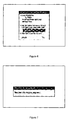
- a user initially tunes the receiver to the broadcast channel carrying the content of interest 20. They are presented with a blank screen and an interactive prompt offering a chance to view the channel (see figure 4). The receiver then waits for user input 32 (in this example pressing the 'red' button on the remote control 8).
- the display changes to instruct the user to send a specified code from their cell phone as an SMS text to a specified number (e.g. MSISDN or 'short code') 36 (see figure 5).
- a specified code e.g. MSISDN or 'short code'
- SMS text message When the user sends the SMS text message as instructed 24, they are billed for the service via their mobile service provider and they receive a 'release code' in a reply SMS text message 26.
- the receiver waits for the returned 'release code' to be entered by the user via their remote control 28,
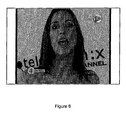
- the release code is entered by the user 38 (also see figure 6), assuming it is the correct code 40, the display is changed to give the user confirmation that the transaction has been successful (see figure 7) and the channel content is then revealed 30,42 (see figure 8).
- each 'TV channel' uses a PMT (Program Map Table) to define which video and audio streams are associated with it.
- PMT Program Map Table
- a receiver set top box
- a video stream for instance will have 'descriptors' associated with it to indicate that it is a video 'type' stream and that it has an index value (component tag) of '1'.
- a PMT for a TV channel may appear similar to Table 1 below.
- it will also contain other streams and descriptors e.g.
- a receiver By changing the descriptors to a different type, a receiver will not know what to do with the stream. For example in Table 2, the video and audio streams are not identified as video and audio by the descriptors. The receiver will not then attempt to decode these streams in the usual manner; hence they are 'hidden'. To reveal the AV, an interactive application is used which diverts the streams to the correct decoders for presentation. Alternatively, the interactive application can operate to over-write the modified descriptors with the recognised descriptors that correctly identify the content in each stream.
- Table 2 Example of a Program Map Table (PMT) tor a channel Z with modified stream type descriptors. PMT for TV Channel Z Video stream for Z Stream type descriptor: Private Data Component tag: 1 Audio stream for Z Stream type descriptor: Private Data Component tag: 2
- the PMT it is also possible for the PMT to reference two sets of AV streams (see Table 3).
- the first set of AV streams is tagged correctly with video and audio type descriptors. Since these are tagged as video and audio, a receiver is encouraged to decode these streams as 'default'.
- These streams could contain advertising material or other text and images, e.g. a Teletext page, or just broadcast a black screen for example.
- the interactive application directs the streams with component 3 and 4 to be decoded and presented.
- Table 3 Example of a Program Map Table (PMT) for a channel Z with modified stream type descriptors and multiple video and audio streams.
- PMT Program Map Table
- a user is issued a random 'ID number' or 'Code'.
- the desired content is only released to the user if they purchase a corresponding 'Release Code' in the manner described above.
- the 'ID number' is most preferably a 'unique' number for each user, but may also simply be a random number that is generated when needed. This number (the 'release code') is arithmetically manipulated (via an algorithm) and presented to the user as his/her 'ID number'.
- the user would then submit their 'ID Number' with payment, to the content provider (via SMS text message in the above example).
- the content provider would then apply the reverse algorithm to the 'ID Number' and return the resulting 'release code' to the user.
- the user inputs the release code to reveal the purchased content (using the mechanism described above).
- a number that is routinely generated by the set-top box 4 is arithmetically manipulated (via an algorithm) and presented to the user as his/her 'ID number'.
- the interactive application writes some information (a 'token') into 'persistent storage' to indicate to the receiver that the user has purchased the content for a certain period. This will enable the user to tune away from the channel and back again without losing the access they have purchased.
- the receiver 4 could be a mobile device, such as a mobile telephone or PDA, or a computer or PVR.
- the user could communicate via a computer network, such as the Internet.
Landscapes
- Engineering & Computer Science (AREA)
- Multimedia (AREA)
- Signal Processing (AREA)
- Computer Security & Cryptography (AREA)
- Databases & Information Systems (AREA)
- Human Computer Interaction (AREA)
- Two-Way Televisions, Distribution Of Moving Picture Or The Like (AREA)
Applications Claiming Priority (3)
| Application Number | Priority Date | Filing Date | Title |
|---|---|---|---|
| GB0413779A GB0413779D0 (en) | 2004-06-18 | 2004-06-18 | Controlling access to broadcast content |
| GB0414098A GB0414098D0 (en) | 2004-06-23 | 2004-06-23 | Controlling access to broadcast content |
| GB0427243A GB2415312B (en) | 2004-06-18 | 2004-12-13 | Controlling access to broadcast content |
Publications (2)
| Publication Number | Publication Date |
|---|---|
| EP1617667A2 true EP1617667A2 (fr) | 2006-01-18 |
| EP1617667A3 EP1617667A3 (fr) | 2008-11-05 |
Family
ID=35276602
Family Applications (1)
| Application Number | Title | Priority Date | Filing Date |
|---|---|---|---|
| EP05253772A Withdrawn EP1617667A3 (fr) | 2004-06-18 | 2005-06-17 | Contrôle d'accès à un contenu diffusé |
Country Status (1)
| Country | Link |
|---|---|
| EP (1) | EP1617667A3 (fr) |
Cited By (1)
| Publication number | Priority date | Publication date | Assignee | Title |
|---|---|---|---|---|
| CN104330996A (zh) * | 2014-11-24 | 2015-02-04 | 小米科技有限责任公司 | 遥控方法及装置 |
Family Cites Families (2)
| Publication number | Priority date | Publication date | Assignee | Title |
|---|---|---|---|---|
| JPH0646419A (ja) * | 1992-07-27 | 1994-02-18 | Lsi Japan Kk | Tv課金システム |
| EP1062812B1 (fr) * | 1998-03-16 | 2005-05-25 | Intertrust Technologies Corp. | Lecteur multimedia de transmission en continu avec commande et de protection continues du contenu de supports |
-
2005
- 2005-06-17 EP EP05253772A patent/EP1617667A3/fr not_active Withdrawn
Cited By (1)
| Publication number | Priority date | Publication date | Assignee | Title |
|---|---|---|---|---|
| CN104330996A (zh) * | 2014-11-24 | 2015-02-04 | 小米科技有限责任公司 | 遥控方法及装置 |
Also Published As
| Publication number | Publication date |
|---|---|
| EP1617667A3 (fr) | 2008-11-05 |
Similar Documents
| Publication | Publication Date | Title |
|---|---|---|
| US20040163134A1 (en) | Digital television set with gaming system emulating a set top box | |
| US6507950B1 (en) | Program information broadcasting system, broadcasting device, and receiving terminal unit | |
| CN100385940C (zh) | 提供订阅的数字广播电视节目的装置、方法及系统 | |
| JP5207370B2 (ja) | 通信システムのポータルを表示するための端末 | |
| CA2406778C (fr) | Distribution d'interruptions de contenu | |
| ES2666394T3 (es) | Generación de información de control multimedia en un sistema de suministro de contenido multimedia interactivo | |
| RU2225076C2 (ru) | Многоканальная система цифрового телевидения | |
| US20060271971A1 (en) | Interactive television system | |
| US20080109840A1 (en) | System and method for advertisement skipping | |
| JP2002501347A (ja) | 一方向データ・ストリームに対して双方向接続性をシミュレーションするホスト装置 | |
| JP2002501346A (ja) | 一方向データ・ストリームに対し双方向接続をシミュレートする携帯通信装置 | |
| GB2327837A (en) | Transmission, reception and display of combined video data in a set area of a hyperlink data file. | |
| US20020066100A1 (en) | Method for providing data services for a large number of small-sized data files | |
| US20030177492A1 (en) | Semiconductor integrated circuit and program record/playback device, system, and method | |
| US20090031360A1 (en) | Method and system for enabling a service using a welcome video | |
| WO2003047257A1 (fr) | Messagerie televisuelle en ligne | |
| US20090007203A1 (en) | Enhanced Interactive Television Return Path | |
| EP1617667A2 (fr) | Contrôle d'accès à un contenu diffusé | |
| EP1433275B1 (fr) | Procede permettant a un consommateur d'interagir avec un fournisseur de services | |
| GB2415312A (en) | Broadcast access control | |
| US7342612B1 (en) | System and method for controlling an electronic device | |
| US20060059527A1 (en) | Set top box having tv plaza function and method for applying tv plaza function to the set top box | |
| KR20240037533A (ko) | 가상 광고를 제공하는 방송 수신 장치 및 그의 동작 방법 | |
| KR100600568B1 (ko) | 디지털 방송시스템의 정보수집 시스템 및 그 방법 | |
| CN113473209A (zh) | 数字电视付费节目的管理方法、计算机存储介质 |
Legal Events
| Date | Code | Title | Description |
|---|---|---|---|
| PUAI | Public reference made under article 153(3) epc to a published international application that has entered the european phase |
Free format text: ORIGINAL CODE: 0009012 |
|
| AK | Designated contracting states |
Kind code of ref document: A2 Designated state(s): AT BE BG CH CY CZ DE DK EE ES FI FR GB GR HU IE IS IT LI LT LU MC NL PL PT RO SE SI SK TR |
|
| AX | Request for extension of the european patent |
Extension state: AL BA HR LV MK YU |
|
| RAP1 | Party data changed (applicant data changed or rights of an application transferred) |
Owner name: TOP UP TV EUROPE LIMITED |
|
| PUAL | Search report despatched |
Free format text: ORIGINAL CODE: 0009013 |
|
| AK | Designated contracting states |
Kind code of ref document: A3 Designated state(s): AT BE BG CH CY CZ DE DK EE ES FI FR GB GR HU IE IS IT LI LT LU MC NL PL PT RO SE SI SK TR |
|
| AX | Request for extension of the european patent |
Extension state: AL BA HR LV MK YU |
|
| 17P | Request for examination filed |
Effective date: 20090505 |
|
| 17Q | First examination report despatched |
Effective date: 20090608 |
|
| AKX | Designation fees paid |
Designated state(s): AT BE BG CH CY CZ DE DK EE ES FI FR GB GR HU IE IS IT LI LT LU MC NL PL PT RO SE SI SK TR |
|
| STAA | Information on the status of an ep patent application or granted ep patent |
Free format text: STATUS: THE APPLICATION IS DEEMED TO BE WITHDRAWN |
|
| 18D | Application deemed to be withdrawn |
Effective date: 20091219 |