EP1617896B1 - Herzschrittmacher/überwachungsgerät enthaltend einen behälter mit drähten zur drahtlosen kommunikation - Google Patents
Herzschrittmacher/überwachungsgerät enthaltend einen behälter mit drähten zur drahtlosen kommunikation Download PDFInfo
- Publication number
- EP1617896B1 EP1617896B1 EP04760121A EP04760121A EP1617896B1 EP 1617896 B1 EP1617896 B1 EP 1617896B1 EP 04760121 A EP04760121 A EP 04760121A EP 04760121 A EP04760121 A EP 04760121A EP 1617896 B1 EP1617896 B1 EP 1617896B1
- Authority
- EP
- European Patent Office
- Prior art keywords
- pod
- base
- patient
- defibrillator
- module
- Prior art date
- Legal status (The legal status is an assumption and is not a legal conclusion. Google has not performed a legal analysis and makes no representation as to the accuracy of the status listed.)
- Expired - Lifetime
Links
- 238000004891 communication Methods 0.000 claims abstract description 36
- 230000035939 shock Effects 0.000 claims abstract description 12
- 238000003032 molecular docking Methods 0.000 claims description 63
- 229940030602 cardiac therapy drug Drugs 0.000 claims description 21
- 230000036772 blood pressure Effects 0.000 claims description 16
- 230000033764 rhythmic process Effects 0.000 claims description 9
- 230000000747 cardiac effect Effects 0.000 claims description 7
- 230000000241 respiratory effect Effects 0.000 claims description 6
- 230000033001 locomotion Effects 0.000 claims description 5
- 238000003780 insertion Methods 0.000 claims description 2
- 230000037431 insertion Effects 0.000 claims description 2
- 230000000452 restraining effect Effects 0.000 description 17
- 238000002560 therapeutic procedure Methods 0.000 description 10
- 238000012544 monitoring process Methods 0.000 description 9
- 238000000034 method Methods 0.000 description 8
- 230000013011 mating Effects 0.000 description 6
- 230000002159 abnormal effect Effects 0.000 description 5
- 208000003663 ventricular fibrillation Diseases 0.000 description 5
- 230000003993 interaction Effects 0.000 description 4
- 230000008569 process Effects 0.000 description 4
- 230000001225 therapeutic effect Effects 0.000 description 4
- 238000012546 transfer Methods 0.000 description 4
- 238000013459 approach Methods 0.000 description 3
- 239000008280 blood Substances 0.000 description 3
- 210000004369 blood Anatomy 0.000 description 3
- 238000013194 cardioversion Methods 0.000 description 3
- 230000001934 delay Effects 0.000 description 3
- 230000000694 effects Effects 0.000 description 3
- 230000004044 response Effects 0.000 description 3
- 230000001360 synchronised effect Effects 0.000 description 3
- 229910001369 Brass Inorganic materials 0.000 description 2
- 230000008901 benefit Effects 0.000 description 2
- 239000010951 brass Substances 0.000 description 2
- 230000006378 damage Effects 0.000 description 2
- 229940079593 drug Drugs 0.000 description 2
- 239000003814 drug Substances 0.000 description 2
- 230000002107 myocardial effect Effects 0.000 description 2
- 238000005086 pumping Methods 0.000 description 2
- 230000003362 replicative effect Effects 0.000 description 2
- 208000010496 Heart Arrest Diseases 0.000 description 1
- 206010049418 Sudden Cardiac Death Diseases 0.000 description 1
- 206010003119 arrhythmia Diseases 0.000 description 1
- 230000006793 arrhythmia Effects 0.000 description 1
- QVGXLLKOCUKJST-UHFFFAOYSA-N atomic oxygen Chemical compound [O] QVGXLLKOCUKJST-UHFFFAOYSA-N 0.000 description 1
- 230000033228 biological regulation Effects 0.000 description 1
- 230000000740 bleeding effect Effects 0.000 description 1
- 230000036760 body temperature Effects 0.000 description 1
- 210000004556 brain Anatomy 0.000 description 1
- 230000006931 brain damage Effects 0.000 description 1
- 231100000874 brain damage Toxicity 0.000 description 1
- 208000029028 brain injury Diseases 0.000 description 1
- 230000008878 coupling Effects 0.000 description 1
- 238000010168 coupling process Methods 0.000 description 1
- 238000005859 coupling reaction Methods 0.000 description 1
- 230000007423 decrease Effects 0.000 description 1
- 230000002999 depolarising effect Effects 0.000 description 1
- 230000009977 dual effect Effects 0.000 description 1
- 230000007831 electrophysiology Effects 0.000 description 1
- 238000002001 electrophysiology Methods 0.000 description 1
- 238000005516 engineering process Methods 0.000 description 1
- 230000036541 health Effects 0.000 description 1
- 208000019622 heart disease Diseases 0.000 description 1
- 238000001990 intravenous administration Methods 0.000 description 1
- 230000028161 membrane depolarization Effects 0.000 description 1
- 229910052760 oxygen Inorganic materials 0.000 description 1
- 239000001301 oxygen Substances 0.000 description 1
- 238000007747 plating Methods 0.000 description 1
- 238000012545 processing Methods 0.000 description 1
- 230000002269 spontaneous effect Effects 0.000 description 1
- 208000014221 sudden cardiac arrest Diseases 0.000 description 1
- 201000006361 tethered spinal cord syndrome Diseases 0.000 description 1
- 238000013024 troubleshooting Methods 0.000 description 1
- 230000000007 visual effect Effects 0.000 description 1
Images






Classifications
-
- A—HUMAN NECESSITIES
- A61—MEDICAL OR VETERINARY SCIENCE; HYGIENE
- A61N—ELECTROTHERAPY; MAGNETOTHERAPY; RADIATION THERAPY; ULTRASOUND THERAPY
- A61N1/00—Electrotherapy; Circuits therefor
- A61N1/18—Applying electric currents by contact electrodes
- A61N1/32—Applying electric currents by contact electrodes alternating or intermittent currents
- A61N1/38—Applying electric currents by contact electrodes alternating or intermittent currents for producing shock effects
- A61N1/39—Heart defibrillators
- A61N1/3925—Monitoring; Protecting
-
- A—HUMAN NECESSITIES
- A61—MEDICAL OR VETERINARY SCIENCE; HYGIENE
- A61N—ELECTROTHERAPY; MAGNETOTHERAPY; RADIATION THERAPY; ULTRASOUND THERAPY
- A61N1/00—Electrotherapy; Circuits therefor
- A61N1/18—Applying electric currents by contact electrodes
- A61N1/32—Applying electric currents by contact electrodes alternating or intermittent currents
- A61N1/38—Applying electric currents by contact electrodes alternating or intermittent currents for producing shock effects
- A61N1/39—Heart defibrillators
- A61N1/3904—External heart defibrillators [EHD]
Definitions
- the field relates to medical devices, and in particular, to defibrillation/monitor systems having a detachable pod with leads.
- SCA sudden cardiac arrest
- SCA occurs when the heart stops pumping blood. Usually SCA is due to abnormal electrical activity in the heart, resulting in an abnormal rhythm (arrhythmia). One such abnormal rhythm, ventricular fibrillation (VF), is caused by abnormal and very fast electrical activity in the heart. During VF the heart cannot pump blood effectively. Because blood may no longer be pumping effectively during VF, the chances of surviving decreases with time after the onset of the emergency. Brain damage can occur after the brain is deprived of oxygen for four to six minutes.
- Cardiac arrest is a life-threatening medical condition that may be treated with external defibrillation.
- External defibrillation includes applying electrodes to the patient's chest and delivering an electric shock to the patient to depolarize the patient's heart and restore normal sinus rhythm. The chance a patient's heart can be successfully defibrillated increases significantly if a defibrillation pulse is applied quickly.
- a paramedic In a scenario where a paramedic is responding to an emergency call with a nonspecific patient condition, for example, there has been a car accident.
- the paramedic will typically carry his or her own defibrillator/monitor, a gurney, and drug box, and other supplies considered essential. If, perhaps, the car has driven off an embankment, the paramedic will have a long distance to run with all this equipment. This slows the response time to a call where someone may be bleeding to death. Smaller lighter equipment is always demanded by paramedics to save them time and effort, and allow them to get to the scene earlier.
- the prior art has tried to solve this problem by providing a wireless module that transmits data to a patient monitor, such as the MobiMed offered for Sale by Ortivus.
- a patient monitor such as the MobiMed offered for Sale by Ortivus.
- this device does not include a defibrillator and does not have the capability to provide any therapeutic functions such as pacing, defibrillation or synchronous cardioversion without attaching another monitor/defibrillator to the patient, which further increases the complexity and ambulance provider cost.
- the Ortivus patient module does not offer replaceable batteries so functionality is severely limited if a reliable source of battery charging is not available, or if the transport time is excessively long.
- the Ortivus device does not offer a display to allow visual monitoring of the waveforms or vital signs if the other module is out of range or obscured.
- medical device A is comprised of two parts, a patient data acquisition module (AA) and a display module (AD). The two parts communicate with each other via one of many wireless methods.
- Medical device B is comprised of two similar parts patient data acquisition module (BA) and display module (BD).
- BA patient data acquisition module
- BD display module
- Patient X's vital signs are being acquired by acquisition module AA and transmitted to display module AD.
- Patient Y's vital signs are being acquired by acquisition module BA and transmitted to display module BD.
- a problem would arise when, in the state of confusion typically existing in a mass casualty incident, the two display modules become switched. In this case, the user of display module AD would be viewing the vital signs transmitted from Patient X while attending to Patient Y. This could result in inappropriate administration of drugs or other therapy with potentially serious consequences.
- the acquisition modules would still be paired to the appropriate display modules, and would still be functioning properly, but the user would be viewing the wrong patient's vital signs.
- wireless communications methods cannot be visually assessed by the user prior to failure, such as a broken or damaged cable can.
- Wireless communications may not be permitted in certain areas, such as an aircraft environment, in military use, or elsewhere.
- Some wireless communications means have delays between sending a message and getting a response which are too long for therapeutic and other needs. There is a risk of the user not being able to find a cable when, for instance, a critical therapy has to be administered where the wireless link cannot support it.
- a modular external defibrillator system in embodiments of the invention may include one or more of the following features: (a) a base containing a defibrillator module, (b) a pod having a patient parameter module with patient lead cables attachable to a patient to collect at least one patient vital sign, the pod operable at a distance from the base, and (c) a communications link between the pod and the base to carry the at least one vital sign from the pod to the base, the defibrillator module delivering a defibrillation shock to the patient based on the at least one vital sign.
- a modular external defibrillator system in embodiments of the invention may include one or more of the following features: (a) a base containing a defibrillator module adapted to deliver a defibrillation shock to a patient, (b) a pod having a patient parameter module with patient lead cables attachable to the patient to collect patient vital signs, the pod operable at a distance from the base, (c) a communications link between the pod and the base to carry the patient vital signs from the pod to the base, the base having a monitor area to visually display the patient vital signs, (d) the communications link is a direct electrical connection between the pod and the base, (e) the communications link is a wireless communications link, and (f) a direct electrical connection between the pod and the base serves as an alternate communications link to the wireless communications link, (f) the communications link is a cable tethered to and housed within the base, (g) the tethered cable is retractable into the base when not in use, (h) a first end of the cable
- An external cardiac therapy system in embodiments of the invention may include one or more of the following features: (a) a pod having a patient parameter module with patient leads attachable to a patient to collect patient data, (b) a base containing a cardiac therapy module adapted to deliver an electrical cardiac therapy to the patient, the base having a latching assembly to mount the pod in a releasable manner, the pod operable at a distance from the base, (c) a communications link between the pod and the base to transfer the patient data from the pod to the base, the base having a display area to visually display the patient data, (d) the latching assembly has a recess to receive the pod, (e) the recess can releasably hold one or more pods, and (f) the recess releasably mounts two of the pods.
- An external cardiac therapy system in embodiments of the invention may include one or more of the following features: (a) a pod having a patient parameter module with patient leads attachable to a patient to collect patient data, (b) a base containing a cardiac therapy module adapted to deliver an electrical cardiac therapy to the patient, the base having a recess within which to mount the pod in a releasable manner, the pod operable at a distance from the base, (c) a communications link between the pod and the base to transfer the patient data from the pod to the base, the base having a display area to visually display the patient data, (d) the recess can releasably hold a power supply for the base, (e) the recess is adapted to mount different sizes of pods with at least one pod being secured to a latching assembly, (f) the latching assembly has a pair of guide ribs in the recess to receive the pod and control the pod's motion in both the horizontal and vertical direction, (g) the guide ribs align the pod during
- a modular cardiac therapy system in embodiments of the invention may include one or more of the following features: (a) a base containing a cardiac therapy module adapted to deliver an electrical cardiac therapy to a patient, (b) a pod having a patient parameter module with patient lead cables attachable to the patient to collect patient vital signs, the pod operable at a distance from the base, (c) a communications link between the pod and the base to carry the patient vital signs from the pod to the base, the base having a monitor area to visually display the patient vital signs, and (d) a docking station to house the base in a releasable manner, the base operable when housed by the docking station or at a distance from the docking station.
- a modular cardiac therapy system in embodiments of the invention may include one or more of the following features: (a) a base containing a cardiac therapy module adapted to deliver an electrical cardiac therapy to a patient, (b) a pod having a patient parameter module with patient lead cables attachable to the patient to collect patient data, the pod operable at a distance from the base, the cardiac therapy module in the base delivering an electrical cardiac therapy to the patent based on the patient data, (c) a communications link between the pod and the base to carry the patient vital signs from the pod to the base; (d) a docking station to house the base in a releasable manner, the base operable at a distance from the docking station, (e) the docking station houses the pod in a releasable manner, (f) the base mounts the pod in a releasable manner, (g) the docking station provides power to recharge batteries within the base and power the base, (h) the docking station provides power to recharge a battery within the pod, (i) the
- a modular external defibrillator system in embodiments of the invention may include one or more of the following features: (a) a base containing a defibrillator module adapted to deliver a defibrillation shock to a patient, the base containing a removable battery to source the power for the defibrillation shock, (b) a pod having a patient parameter module with patient lead cables attachable to the patient to collect patient vital signs, the pod operable at a distance from the base, the pod containing a removable battery to source the power to collect patient vital signs, the pod battery and the base battery being interchangeable between the base and the pod, (c) a communications link between the pod and the base to carry the patient vital signs from the pod to the base, the base having a monitor area to visually display the patient vital signs, (d) the base contains two removable batteries, and each base battery being interchangeable with the pod battery, (e) the base is connected to a printer to print out the patient data, and (f) the base includes printer to print out the patient data.
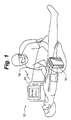
- External defibrillator 10 is comprised of two components the patient module (pod) 12 and the defibrillator/monitor (base) 14, which communicate patient data (e.g., vital signs) wirelessly and share common replaceable battery technology.
- Pod 12 generally rests within base 14, generally in the back of base 14 as will be discussed in more detail below.
- the user during an emergency, has the option of carrying base 14 with pod 12 attached or simply carrying pod 12 to the emergency site. Since pod 12 is smaller and lighter than base 14, generally it will be easier for the user to simply carry pod 12. By carrying pod 12, the user is free to carry more ALS equipment and not be slowed by the heavier and more awkward base 14.
- pod 12 connects to patient via several leads 19 in order to measure the patient's vital signs.
- the pod communicates the patient's vital signs wirelessly to defibrillator monitor 14.
- the patient data or vital signs collected may include 3, 4, and 5 lead ECG readings, 12 lead ECG readings, non-invasive blood pressure (NIBP), pulse oximeter data, capnography and other respiratory data, invasive blood pressure, body temperature, CO 2 levels, and additional patient monitoring functions.
- pod 12 may include a small display (not shown) replicating some or all of the information such as waveforms, numerical data, and vital signs being transmitted to base 14.
- Base 14 includes a therapy module and therapy cables.
- the therapy module has the capability to provide therapeutic functions such as pacing, defibrillation or synchronous cardioversion without attaching another monitor/defibrillator to the patient.
- the therapy cables typically include patient paddles or electrodes that attach between the patient and the base 14 in order to deliver the therapy to the patient. Since pod 12 connects to the patient and transmits vital signs to the base 14, then base 14 need not also have patient monitoring cables. Accordingly, paramedic mobility and ease of use are greatly increased.
- the defibrillator in the base 14 may be configurable in either an ALS mode or an AED mode.
- the ALS mode includes a multi-parameter monitoring capability and all of the defibrillator therapy delivery capability. Additionally the base unit may be just as an AED.
- Pod 12 includes some means by which it can be attached to base 14 for the purpose of carrying base 14 to an emergency scene.
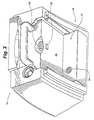
- a pictorial representation of a latching assembly on a defibrillator/monitor in an embodiment of the present invention is shown.
- Latching assembly 16 is used to attach pod 12 to base 15.
- Latching assembly 16 is provided with guide ribs 18 and 18', which provide control motion in both the horizontal and vertical direction, aligning base-to-pod interface connector 20 with a similar connector (not shown) on pod 12.
- Latch 22 actuates automatically when pod 12 is placed within slot 17. When pod 12 is lowered within slot 17, latch 22 will align with a matching cavity on pod 12 to hold pod 12 within slot 17.
- pod 12 When the user wants to remove pod 12 from slot 17, they simply press button 24, which pushes the spring-loaded latch 22 back within rear wall 26 of slot 17. Pod 12 is released and the user simply pulls pod 12 from slot 17. It is further contemplated pod 12 could be spring released by springs placed at the base of ribs 18 and 18' or perhaps a spring placed within base-to-pod connector 20. It is also further contemplated base-to-pod connector could be most any type of connector such as a USB port, an AC power connector, an RS-232 connector or any other type of connector known to those skilled in the art. In addition, it is contemplated pods of different sizes could be used within slot 17. For example, a large pod would be guided in place with ribs 18 and 18' and held with latch 22. If a smaller pod were being used, then the smaller pod would be guided in place with rib 18 so pod 12 aligns with base-to-pod connector 20 and held in place with latch 22.
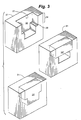
- Mating assembly 30 comprises recess or slot 32 which can house two types of pods 33' and 33". Since both pods 33' and 33" have the same dimension in the horizontal, both pods 33' and 33" are capable of fitting within slot 32. When large pod 33' is fit within slot 32 it takes up generally all the available room within slot 32. When small pod 33" is placed within slot 32 only the room within upper portion 34 is taken up. Both pod 33' and 33" are held in place by attachment to base-to-pod connector 29. It is contemplated, however, a latch assembly similar to that of Figure 2 could be utilized to ensure pods 33' and 33" remain within slot 32.
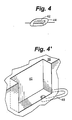
- a pictorial representation of a mating assembly having a tethered connector in an embodiment of the present invention is shown.
- a pod similar to 12 rests within slot 40 and connects to base-to-pod connector 42, which allows base 39 and a pod to communicate with each other.
- Base-to-pod connector 42 rests freely within connector cavity 44, which allows connector cable 46 to retractably exit and enter base 39 as shown in Figures 4 and 4' .
- Tethered cable 46 allows a pod to mate with and rest within base 39 or mate with base 39 when not docked within slot 40. It is sometimes preferred that base 39 communicate with a pod through tethered cable 46 since communications through a direct connection is generally faster as is discussed in more detail below.
- base 39 is equipped with a USB bus, which provides quick communication of information between a pod and base 39.
- Base 39 is also able to automatically detect when tethered cable 46 is plugged in so direct communications can be established immediately.
- a direct communication between a pod and base 39 can be established.
- This automatic establishment of direct communication between a pod and base 39 includes when a pod is docked within base 39 and a connection is made between a pod and base 39 through connector 42.
- Tethered cable 46 provides a back-up system for use when the wireless link between pod 12 and base 14 fails for whatever reason or when precise signal synchronization demands a wired connection. Tethered cable 46 also provides the added advantage in that the user cannot lose cable 46 because it is tethered to base 39. Similar to the discussion above, wireless links can impose a delay in communication between a pod and base 39 longer than may be experienced with a cable.
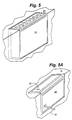
- FIG. 5A a pictorial representation of an alternate use for a defibrillator/monitor base 51 in an embodiment of the present invention is shown.
- a pod 12 is placed within a base using components such as a latching assembly and mating assembly when the pod is not in use or when base 51 is carried to an emergency site, as shown in Figure 5 .
- the embodiment of Figure 5A allows for an AC power supply 50 to be placed within the base and to provide power to base 51. Power supply 50 would transfer power to base 51 through a base-to-pod connector (not visible) similar to connector 20.
- power LED 52 Upon power supply 50 being plugged into a wall outlet via power cord 54, power LED 52 provides an indication to the user notifying them power supply 50 is powering 51 and/or charging the base's battery.
- Power supply 50 is typically used when for example; a pod is being used on a patient such as on a gurney or next to the patient to provide constant power and reduce battery depletion. Power supply 50 could also be used when the user desires to substantially power base 39 through line power. Thus an alternate pod mounting device would have to be provided as will be discussed in more detail below.
- FIG. 5B a front profile view of a defibrillator/monitor providing an alternate power supply option in accordance with an embodiment of the present invention is shown.
- Figure 5B shows a modular integrated defibrillator/monitor 14 with multiple power supply options.
- base 53 typically is powered by dual batteries 56.
- base 53 could be powered by A/C power module 58.
- batteries 56 are replaced with A/C power module 58.
- Module 58 is then connected to A/C power to power base 53 without having to remove the pod.
- base 49 has a removable bottom section 59 able to accommodate A/C power module 57. Therefore, base 49 is able to accommodate a pod and an alternate power supply.
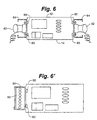
- FIG. 6 shows base 61 with brass inserts 60 mounted on the side of base 60.
- Brass inserts 60 can be used as clips to attach hand paddles 62, or side-mounted carrying bags, or a bracket 64 to side mount pod 65.
- Bracket 64 allows defibrillator 10 the ability to carry various types of defibrillator support equipment.
- the user has the ability to mount a pod outside of its docking assembly so a power supply 50 can be within the docking assembly and the base can be powered from line power as described above.
- This alternate mounting assembly provides the advantages of providing easily accessible connectors for troubleshooting and easier access for connection and disconnection of various leads and connectors.
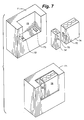
- Pods can come in different sizes generally representing the capability of the pod. For example, smaller pod 74' would provide only the basic features for an external defibrillator, while medium pod 74 would provide several additional features.
- pods 74 and 74' can be docked together in mounting recess or slot 72 contemporaneously. In one embodiment, pod 74 could be latched within mounting slot 72 communicating with base 71 through connector 73. Similarly, pod 74' can be placed within mounting slot 72 contemporaneously with pod 74 and latched in a communicating relationship with base 71 through connector 73'.
- pods 74 and 74' could be placed within mounting slot 72 without the need for two base-to-pod connectors 73.
- pod 74 and 74' latch together and communicate through connectors 70. Then both pods 74 and 74' are placed within mounting slot 72 and latched in a communicating relationship with base 71 through connector 73.
- This embodiment not only limits the amount of connectors needed on base 71, but also allows the user to choose the amount of functions the pod can perform. For example, if the user simply needed to perform an ECG, then the user could choose to carry small pod 74'. However, if the emergency situation required additional functions such as monitoring blood pressure in a non-invasive method or a pulse oximeter, then the user would choose to carry medium pod 74'. In addition, if the emergency situation required all of the available pod functions, then pod 74' could be latched together with pod 74 to provide a large pod having all necessary functions.
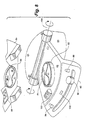
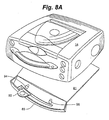
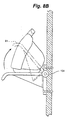
- FIG. 8 , 8A , 8B , 8C, and 8D a pictorial representation of a docking station for a defibrillator/monitor in an embodiment of the present invention is shown.
- Docking station 80 performs two main roles. It restrains base 85 under semi-violent maneuvers (2-5G's) and provides DC power to charge the batteries (not shown) and operate base 85.
- Docking station 80 is comprised of restraining plate 81 held to a wall by backing plate 83. It is contemplated restraining plate 81 could be attached to any surface such as a horizontal shelf of a vertical wall.
- Restraining plate 81 provides a ring 82 housing a self-aligning propeller or blade 84 as best seen in Figure 8D .
- base 85 When the user desires to dock base 85 as shown in Figure 8A , it is placed on restraining plate 81 where recess 86 fits over ring 82 and blade 84 fits within opening 88 in plate 90.
- base 85 When base 85 is properly placed on restraining plate 81, the user slides lever 92 from unlocked position 94 to locked position 96.
- Blade 84 has a quarter turn twist which pulls base 85 to restraining plate 81 when the user slides lever 92 from unlock position 94 to locked position 96.
- docking station 80 When base 85 is locked to restriction plate 82 docking station 80 provides power to base 85. When in locked position 96, docking station 80 restricts the base's up and down, side to side movement to prevent damage to base 85. It is contemplated docking station 80 could also dock a pod. It is further contemplated docking station 80 could also provide communications from base 85 to a network, such as is described in commonly owned U.S. Patent Application No. 10/378,001 filed February 28, 2003 titled "Medical Device Status Information System". Finally, when the user has removed base 85, restriction plate 81 quickly rotates out of the way for compact storage along axis 104 as more clearly shown in Figure 8B .
- FIG. 9 a side rear profile view of a docking station for a defibrillator/monitor in an embodiment of the present invention is shown.
- Docking station 110 is comprised of sliding plate 112, rollers 114, ribs 116, and latch 118.
- base 111 is modified with guides 120 held in place by screw, bolts or the like, which slide under ribs 116 when base 111 is placed upon and slid on sliding plate 112. Rollers assist in sliding base 111 along sliding plate 112.
- latch 118 engages a notch on the underside of base 111, which prevents base 111 from exiting sliding plate 112.
- docking station 130 houses pod 133 and base 131. It is contemplated docking station 130 could be similar to the structure of docking stations 80 or 110 adjusting of course the size of the docking station to accommodate pod 133 and base 131. In this embodiment, both pod 133 and base 131 are held securely in docking station 130 and both pod 133 and base 131 are provided with power to charge each respective battery and power each respective device. It is further contemplated pod 133 could be an alternate in the event the pod within base 131 failed.
- the user would simply return to docking station 130 and retrieve pod 133 place it within the base's docking station (or connect to base 131 through a tethered cord) where base 131 would automatically identify pod 133 and dynamically pair up with pod 133.
- FIG. 11 a front profile view of a docking station for a defibrillator/monitor in an embodiment of the present invention is shown. Similar to the docking station of Figure 8 , the present docking station 140 has a locking handle 142 a propeller or blade 144, and restraining plate 146. A base would rest on restraining plate 146, the user would then slid handle 142 into the locking position, thus rotating propeller 144 to hold base 14 to restraining plate 146. Docking station 140 is held to a wall by screws, bolts, or the like through retaining holes 148.
- restraining plate 146 When the user removes the base by taking locking handle 142 to the unlock position and lifting the base, restraining plate 146 is moved upward along axis 150 until it rests against back plate 154. The user then moves locking handle 142 into the locking position, which causes propeller 144 to engage aperture 152 and thus retain restraining plate 146 to back plate 154 thus keeping docking station 130 out of the way for others who may be walking by.
- FIG. 12 and 12A front and side profile views of a docking station for a defibrillator/monitor in an embodiment of the present invention is shown.
- Docking station 160 is attached to a wall by screw, bolts, or the like through retaining holes 162.
- Base 14 is placed upon tray 164 and then the user would turn locking knob 166 to the locking position.
- Lock knob 166 base 14 is pulled back towards the wall until hook 168 on base 14 engages hook 170 on support 173.
- Battery 171 provides power to the base and can recharge the battery if the base carries a rechargeable battery. This allows docking station 160 to be used in an area when line power is inaccessible.
- support 173 is lifted toward wall mount 175 for storage.
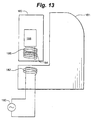
- base 181 is able to charge pod battery 188 wirelessly from line power 180 through primary coil 182 located in base 181 and secondary coil 184 located in pod 183.
- Bridge rectifier 186 acts to convert A/C line power 180 to a D/C voltage which charges battery 188 of pod 183.
- This concept can even be extended to cover a docking station wirelessly charging a base unit as is disclosed in commonly owned U.S. Patent Application titled “Apparatus and Method for Maintaining a Defibrillator Battery Charge and Optionally Communicating" serial number 10/423,805 filed on April 15, 2003 .
- FIG. 14 another side profile schematic of a defibrillator/monitor and a patient module according to a patient module wireless battery charging embodiment of the present invention is shown.
- proper alignment of a first plate 192 connected to line power 190 within base 14 and a second plate 194 within pod 193 provides for capacitive coupling.
- bridge rectifier 196 acts to convert A/C line power 190 to a D/C voltage which charges battery 198 of pod 193.
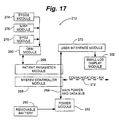
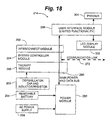
- pod 212 uses replaceable or rechargeable batteries 216 for power and comprises any combination of the following features: 3, 4, and 5 lead ECG inputs 218, 12 lead ECG inputs 220, non-invasive blood pressure (NIBP) input 222, pulse oximeter input 224, capnography input (not shown), invasive blood pressure input 226, temperature input 228, CO 2 input 230, additional patient monitoring functions, wireless (RF) transceiver 232 to transmit any or all real time patient data to base 214.
- pod 212 may include a small display (not shown) replicating some or all of the information such as waveforms, numerical data, and vital signs being transmitted to base 214.
- pod 212 includes some means by which it can be attached to base 214 for the purpose of carrying base 214 to an emergency scene as is discussed in detail above.
- Base 214 uses a replaceable or rechargeable battery 250 for power.
- Batteries 216 and 250 are generally similar in battery chemistry, electrical, and mechanical features to permit the interchangeability between batteries 216 and 250.
- base 214 comprises a display 252 sufficient to show current and historical patient data, a transceiver (not shown) to send acquired patient data onto a receiving station or third party data receiver (discussed in more detail below), a module 256 to synchronize shocks and pacing pulses to the patient's intrinsic rhythm from data acquired by a pod 212, an error checking and demultiplexing module 254 receiving and processing data received from pod 212, and a data interpretation module 258 which analyzes data acquired by pod 212 and makes certain interpretive statements on the patient's cardiac or respiratory condition, displays vital sign trends, and provides additional functions found in ALS monitoring products.
- pod 212 can be powered from a removable/rechargeable battery 260.
- Power module 262 processes the incoming power into appropriate power levels for each of the internal components.
- Power module 262 routes the pod's power supply through main power and data bus 264 to system controller module 266, patient parameter module 268, and user interface module 270.
- pod 212 can be used wirelessly, however, pod 212 can be directly connected through a tethered cable 46 or through attachment to a connector 20 to utilize the speed of data bus 264.
- System controller module 266 controls interaction of all the pod's modules through data bus 264 and interaction with base 214 through wired or wireless (e.g., IrDA, RF, etc.) communication link 272 or through data bus 264 if pod 212 is connected to base 214.
- Patient parameter module 268 monitors functions such as invasive blood pressure, patient's temperature, and inputs from the pod leads. Module 268 further collects inputs from EtCO2 module 274, NIBP module 276, and SpO2 module 278 through OEM module 280. Patient parameter module 268 takes all of these inputs and processes them for display and routes only a limited number of inputs to Small LCD display module 282 through user interface module 270.
- User Interface module 270 allows the user to primarily interact with pod 212; however, it is contemplated that user could use the module 270 to interact with base 214 as well.
- Base 214 is powered by a removable/rechargeable battery 284, which provides power to power module 286.
- base 214 could be powered by A/C line power 288.
- Power module 286 processes the incoming power into appropriate powered levels for each of the internal components.
- Power module 286 also routes the bases power supply through main power and data bus 290 to interconnect module 292, system controller module 294, therapy module 296, and user interface module 298.
- Interconnect module 292 is utilized to detect how pod 212 is connected to base 214 (wirelessly, docked, or tethered cable).
- system controller module 294 controls all interaction of all of the base's modules through data bus 290 and interaction with pod 212 through wired or wireless connection communication link 272 or through data bus 290 if pod 212 is connected to base 214.
- Therapy module 296 synchronizes shocks and pacing pulses to the patient's intrinsic rhythm from data acquired from pod 212.
- Module 296 administers shocks from voltages via the defibrillation cap 300 and, in turn, administers pacing pulses to a patient.
- User interface module 298 allows the user to primarily interact with base 214; however, it is contemplated that user could use the module 298 to interact with pod 212 as well.
- LCD module 302 allows the user to view a patient's monitored parameters. Finally, the user has the option to print out patient information on a printer 304 (e.g., a 100mm strip chart printer).
Landscapes
- Health & Medical Sciences (AREA)
- Cardiology (AREA)
- Heart & Thoracic Surgery (AREA)
- Engineering & Computer Science (AREA)
- Biomedical Technology (AREA)
- Nuclear Medicine, Radiotherapy & Molecular Imaging (AREA)
- Radiology & Medical Imaging (AREA)
- Life Sciences & Earth Sciences (AREA)
- Animal Behavior & Ethology (AREA)
- General Health & Medical Sciences (AREA)
- Public Health (AREA)
- Veterinary Medicine (AREA)
- Electrotherapy Devices (AREA)
- Communication Cables (AREA)
- Alarm Systems (AREA)
Claims (38)
- Modulares externes Defibrillatorsystem mit:einer Basis (14) mit einem Defibrillatormodul;einer portablen Einrichtung bzw. Halterung (12) mit einem Patientenparametermodul mit Patientenleitungskabeln, die an einen Patienten zum Sammeln wenigstens eines Vitalzeichens des Patienten anbringbar sind, wobei die Halterung in einer Distanz von der Basis betreibbar ist und die Halterung und die Basis dafür eingerichtet sind, optional miteinander gekoppelt zu werden, um als eine Einheit getragen zu werden, und in zwei getrennte Einheiten trennbar sind; undeiner drahtlosen Kommunikationsverbindung zwischen der Halterung und der Basis, um das wenigstens eine Vitalzeichen von der Halterung zu der Basis zu übertragen, wobei das Defibrillatormodul einen Defibrillationsschock bzw. -stoß auf Grundlage des von der mobilen Einrichtung empfangenen wenigstens einen Vitalzeichens an den Patienten abgibt.
- Defibrillatorsystem nach Anspruch 1, bei dem die Kommunikationsverbindung durch sowohl eine drahtlose Kommunikationsverbindung als auch eine direkte elektrische Verbindung zwischen der Halterung und der Basis bereitgestellt wird.
- Defibrillatorsystem nach Anspruch 1, bei dem eine direkte elektrische Verbindung zwischen der Halterung und der Basis als eine alternative Kommunikationsverbindung zu der drahtlosen Kommunikationsverbindung dient.
- Defibrillatorsystem nach Anspruch 1, bei dem die Kommunikationsverbindung eine direkte elektrische Verbindung zwischen der Basis und zwei oder mehreren der Halterungen beinhaltet.
- Modulares externes Defibrillatorsystem nach Anspruch 1, bei dem die Basis einen Überwachungs- bzw. Monitorbereich aufweist, um die Vitalzeichen des Patienten visuell anzuzeigen.
- Defibrillatorsystem nach Anspruch 1, bei dem die durch die Halterung überwachten Vitalzeichen des Patienten über mehrere Leitungen erhaltene EKG-Daten, nichtinvasive Blutdruckdaten, Pulsoximeterdaten, Kapnographiedaten und respiratorische Daten, invasive Blutdruckabfragen und/oder Patiententemperaturdaten beinhalten.
- Defibrillatorsystem nach Anspruch 5, bei dem der Monitorbereich der Basis über mehrere Leitungen erhaltene EKG-Daten, nichtinvasive Blutdruckdaten, Pulsoximeterdaten, Kapnographiedaten und respiratorische Daten, invasive Blutdruckabfragen und/oder Patiententemperaturdaten anzeigt.
- System nach Anspruch 1, bei dem das Defibrillatormodul auf Grundlage der Vitalzeichen des Patienten Defibrillationsstöße mit dem intrinsischen Rhythmus des Patienten synchronisiert.
- System nach Anspruch 1, bei dem die Basis ein Dateninterprätationsmodul beinhaltet, das die Vitalzeichen des Patienten analysiert, um interprätative Aussagen über den kardialen oder respiratorischen Zustand des Patienten zu treffen.
- System nach Anspruch 1, bei dem die Basis eine Arretieranordnung zum Anbringen der Halterung in einer freigebbaren Weise aufweist, wobei die Halterung in einer Distanz von der Basis betreibbar ist.
- System nach Anspruch 10, bei dem die Aritierungsanordnung eine Aussparung zur Aufnahme der Halterung aufweist.
- System nach Anspruch 11, bei dem die Aussparung in freigebbarer Weise eine oder mehrere Halterungen aufnehmen bzw. halten kann.
- System nach Anspruch 11, bei dem die Aussparung zwei der Halterungen freigebbar anbringt bzw. aufnimmt.
- System nach Anspruch 13, bei dem die zwei Halterungen aneinander verriegelt bzw. miteinander arretiert sind und über einen Verbinder auf jeder Halterung kommunizieren.
- System nach Anspruch 14, bei dem die Basis getrennte Verbinder zum Kommunizieren mit jeder Halterung beinhaltet.
- System nach Anspruch 14, bei dem die Halterungen unterschiedliche Vitalzeichen überwachen.
- System nach Anspruch 10, bei dem die Basis eine Anzahl von Basis-Interfaceverbindern aufweist, um eine direkte elektrische Verbindung mit einer Anzahl von Halterungen in der Arretieranordnung bereitzustellen.
- System nach Anspruch 17, bei dem jeder Interfaceverbinder einer Halterung mit einem Interfaceverbinder einer anderen Halterung ausgerichtet und verbunden werden kann.
- System nach Anspruch 10, bei dem die Arretieranordnung ferner eine Arretierung zum Halten der Halterung in der Aussparung aufweist.
- System nach Anspruch 19, bei dem die Arretierung mit einem Hohlraum auf der Halterung ausgerichtet ist bzw. wird, um die Halterung in der Aussparung zu halten.
- Kardiales Therapiesystem nach Anspruch 19, bei dem die Arretierung federbetrieben ist.
- System nach Anspruch 19, bei dem die Arretieranordnung ferner einen Druckknopf aufweist, der die federbetriebene Arretierung freigibt, wenn ein Benutzer die Halterung aus dem Schlitz bzw. der Aufnahme entfernen bzw. entnehmen will.
- System nach Anspruch 19, bei dem die Arretieranordnung ferner wenigstens eine Feder aufweist, die in wenigstens einer Führungsrippe bzw. -nut angeordnet ist.
- System nach Anspruch 19, wobei die Arretieranordnung in Wirkverbindung mit der Basis steht und mit einem passenden Hohlraum auf der Halterung ausgerichtet ist.
- System nach Anspruch 1, bei dem die Basis eine Aussparung aufweist, in die die Halterung in einer freigebbaren Weise anzubringen ist, wobei die Halterung in einer Distanz von der Basis betreibbar ist.
- System nach Anspruch 25, bei dem die Aussparung in freigebbarer Weise eine Leistungsversorgung für die Basis halten kann.
- System nach Anspruch 25, bei dem die Aussparung dafür eingerichtet ist, unterschiedliche Größen von Halterungen anzubringen bzw. aufzunehmen, wobei wenigstens eine Halterung an einer Arretieranordnung befestigt ist.
- System nach Anspruch 25, bei dem Arretieranordnung ein Paar Führungsrippen in der Aussparung aufweist, um die Halterungen aufzunehmen und die Bewegung der Halterung in sowohl der horizontalen als auch der vertikalen Richtung zu steuern.
- System nach Anspruch 28, bei dem die Führungsrippen die Halterung während der Einführung in die Aussparung ausrichten, um eine elektrische Verbindung zwischen einem Basis-Interfaceverbinder und einem Interfaceverbinder der Halterung, die zusammen die Kommunikationsverbindung bereitstellen, sicherzustellen.
- Kardiales Therapiesystem nach Anspruch 29, bei dem die Führungsrippen der Arretieranordnung einen Interfaceverbinder einer Halterung mit einem Interfaceverbinder einer Basis ausrichten, um die direkte elektrische Verbindung einzurichten.
- System nach Anspruch 25, bei dem die Basis Einfügungen aufweist, um Defibrillationspaddel, einen Tragebeutel und/oder eine Befestigungshalterung, die die Halterung hält, beinhaltet.
- System nach Anspruch 25, bei dem die Basis Leistung bereitstellt, um eine Batterie, die die Halterung speist, zu laden.
- System nach Anspruch 32, bei dem die Basis Ladeleistung drahtlos an die Halterung bereitstellt.
- System nach Anspruch 25, bei dem das kardiale Therapiesystem auf Grundlage der Patientendaten die elektrische kardiale Therapie mit dem intrinsischen Rhythmus des Patienten synchronisiert.
- System nach Anspruch 1, das ferner aufweist:eine Dockingstation (8) um die Basis in einer freigebbaren Weise aufzunehmen, wobei die Basis betreibbar ist, wenn sie durch die Dockingstation aufgenommen ist oder sich in einer Distanz von der Dockingstation befindet.
- Kardiales Therapiesystem nach Anspruch 35, wobei die Dockingstation die Halterung in einer freigebbaren Weise aufnimmt.
- System nach Anspruch 35, bei dem die Dockingstation Leistung zum Wiederaufladen von Batterien in der Basis und zum Speisen der Basis bereitstellt.
- System nach Anspruch 35, bei dem die Dockingstation Leistung zum Wiederaufladen einer Batterie in der Halterung bereitstellt.
Applications Claiming Priority (3)
| Application Number | Priority Date | Filing Date | Title |
|---|---|---|---|
| US46486003P | 2003-04-22 | 2003-04-22 | |
| US53015103P | 2003-12-17 | 2003-12-17 | |
| PCT/US2004/012421 WO2004093979A1 (en) | 2003-04-22 | 2004-04-22 | Defibrillator/monitor system having a pod with leads capable of wirelessly communicating |
Publications (2)
| Publication Number | Publication Date |
|---|---|
| EP1617896A1 EP1617896A1 (de) | 2006-01-25 |
| EP1617896B1 true EP1617896B1 (de) | 2009-09-02 |
Family
ID=33313501
Family Applications (1)
| Application Number | Title | Priority Date | Filing Date |
|---|---|---|---|
| EP04760121A Expired - Lifetime EP1617896B1 (de) | 2003-04-22 | 2004-04-22 | Herzschrittmacher/überwachungsgerät enthaltend einen behälter mit drähten zur drahtlosen kommunikation |
Country Status (5)
| Country | Link |
|---|---|
| EP (1) | EP1617896B1 (de) |
| AT (1) | ATE441453T1 (de) |
| DE (1) | DE602004022933D1 (de) |
| DK (1) | DK1617896T3 (de) |
| WO (1) | WO2004093979A1 (de) |
Families Citing this family (8)
| Publication number | Priority date | Publication date | Assignee | Title |
|---|---|---|---|---|
| US20050131465A1 (en) * | 2000-02-04 | 2005-06-16 | Freeman Gary A. | Integrated resuscitation |
| US7957798B2 (en) | 2003-12-17 | 2011-06-07 | Physio-Control, Inc. | Defibrillator/monitor system having a pod with leads capable of wirelessly communicating |
| US10413742B2 (en) | 2008-03-05 | 2019-09-17 | Physio-Control, Inc. | Defibrillator patient monitoring pod |
| US9289621B2 (en) | 2012-05-08 | 2016-03-22 | Physio-Control, Inc. | Defibrillator network system |
| US10303852B2 (en) | 2012-07-02 | 2019-05-28 | Physio-Control, Inc. | Decision support tool for use with a medical monitor-defibrillator |
| IL229394A (en) * | 2013-11-11 | 2017-05-29 | Inovytec Medical Solutions Ltd | System for controlled defibrillation and ventilation |
| US11166628B2 (en) | 2016-02-02 | 2021-11-09 | Physio-Control, Inc. | Laryngoscope with handle-grip activated recording |
| US11920361B2 (en) * | 2020-03-27 | 2024-03-05 | Physio-Control, Inc. | Medical device docking station |
Family Cites Families (4)
| Publication number | Priority date | Publication date | Assignee | Title |
|---|---|---|---|---|
| US3865101A (en) * | 1974-05-01 | 1975-02-11 | Datascope Corp | Portable and separable heart monitor and heart defibrillator apparatus |
| US7006865B1 (en) * | 2000-03-09 | 2006-02-28 | Cardiac Science Inc. | Automatic defibrillator module for integration with standard patient monitoring equipment |
| US20020116029A1 (en) * | 2001-02-20 | 2002-08-22 | Victor Miller | MRI-compatible pacemaker with power carrying photonic catheter and isolated pulse generating electronics providing VOO functionality |
| US20030028219A1 (en) * | 2001-07-20 | 2003-02-06 | Powers Daniel J. | Modular medical device, base unit and module thereof, and automated external defibrillator (AED), methods for assembling and using the AED |
-
2004
- 2004-04-22 AT AT04760121T patent/ATE441453T1/de not_active IP Right Cessation
- 2004-04-22 DK DK04760121T patent/DK1617896T3/da active
- 2004-04-22 DE DE602004022933T patent/DE602004022933D1/de not_active Expired - Lifetime
- 2004-04-22 WO PCT/US2004/012421 patent/WO2004093979A1/en not_active Ceased
- 2004-04-22 EP EP04760121A patent/EP1617896B1/de not_active Expired - Lifetime
Also Published As
| Publication number | Publication date |
|---|---|
| WO2004093979A1 (en) | 2004-11-04 |
| ATE441453T1 (de) | 2009-09-15 |
| EP1617896A1 (de) | 2006-01-25 |
| DE602004022933D1 (de) | 2009-10-15 |
| DK1617896T3 (da) | 2009-12-07 |
Similar Documents
| Publication | Publication Date | Title |
|---|---|---|
| US20060142808A1 (en) | Defibrillator/monitor system having a pod with leads capable of wirelessly communicating | |
| US10124184B2 (en) | Defibrillator/monitor system having a pod with leads capable of wirelessly communicating | |
| US6591135B2 (en) | Portable patient monitor with defibrillator/pacemaker interface and battery power management | |
| US8788038B2 (en) | External defibrillator with power and battery sharing capabilities with a pod | |
| US10124181B2 (en) | Defibrillator network system | |
| US8600491B2 (en) | Defibrillator patient monitoring pod | |
| US12320136B2 (en) | Medical device docking station | |
| EP1617896B1 (de) | Herzschrittmacher/überwachungsgerät enthaltend einen behälter mit drähten zur drahtlosen kommunikation | |
| US20200016421A1 (en) | Defibrillator patient monitoring pod | |
| US11140957B2 (en) | Protective cradle and modular pouches | |
| EP4438104B1 (de) | Batterieverwaltung für medizinische vorrichtung | |
| EP3265174B1 (de) | Modulares medizinisches system zur patientenüberwachung und elektrischen therapieabgabe | |
| PL229747B1 (pl) | Modułowe urządzenie telemedyczne |
Legal Events
| Date | Code | Title | Description |
|---|---|---|---|
| PUAI | Public reference made under article 153(3) epc to a published international application that has entered the european phase |
Free format text: ORIGINAL CODE: 0009012 |
|
| 17P | Request for examination filed |
Effective date: 20051122 |
|
| AK | Designated contracting states |
Kind code of ref document: A1 Designated state(s): AT BE BG CH CY CZ DE DK EE ES FI FR GB GR HU IE IT LI LU MC NL PL PT RO SE SI SK TR |
|
| AX | Request for extension of the european patent |
Extension state: AL HR LT LV MK |
|
| DAX | Request for extension of the european patent (deleted) | ||
| 17Q | First examination report despatched |
Effective date: 20080818 |
|
| GRAP | Despatch of communication of intention to grant a patent |
Free format text: ORIGINAL CODE: EPIDOSNIGR1 |
|
| GRAS | Grant fee paid |
Free format text: ORIGINAL CODE: EPIDOSNIGR3 |
|
| GRAA | (expected) grant |
Free format text: ORIGINAL CODE: 0009210 |
|
| AK | Designated contracting states |
Kind code of ref document: B1 Designated state(s): AT BE BG CH CY CZ DE DK EE ES FI FR GB GR HU IE IT LI LU MC NL PL PT RO SE SI SK TR |
|
| REG | Reference to a national code |
Ref country code: CH Ref legal event code: EP |
|
| REG | Reference to a national code |
Ref country code: IE Ref legal event code: FG4D |
|
| REF | Corresponds to: |
Ref document number: 602004022933 Country of ref document: DE Date of ref document: 20091015 Kind code of ref document: P |
|
| REG | Reference to a national code |
Ref country code: DK Ref legal event code: T3 |
|
| PG25 | Lapsed in a contracting state [announced via postgrant information from national office to epo] |
Ref country code: SE Free format text: LAPSE BECAUSE OF FAILURE TO SUBMIT A TRANSLATION OF THE DESCRIPTION OR TO PAY THE FEE WITHIN THE PRESCRIBED TIME-LIMIT Effective date: 20090902 Ref country code: FI Free format text: LAPSE BECAUSE OF FAILURE TO SUBMIT A TRANSLATION OF THE DESCRIPTION OR TO PAY THE FEE WITHIN THE PRESCRIBED TIME-LIMIT Effective date: 20090902 |
|
| NLV1 | Nl: lapsed or annulled due to failure to fulfill the requirements of art. 29p and 29m of the patents act | ||
| PG25 | Lapsed in a contracting state [announced via postgrant information from national office to epo] |
Ref country code: SI Free format text: LAPSE BECAUSE OF FAILURE TO SUBMIT A TRANSLATION OF THE DESCRIPTION OR TO PAY THE FEE WITHIN THE PRESCRIBED TIME-LIMIT Effective date: 20090902 Ref country code: PL Free format text: LAPSE BECAUSE OF FAILURE TO SUBMIT A TRANSLATION OF THE DESCRIPTION OR TO PAY THE FEE WITHIN THE PRESCRIBED TIME-LIMIT Effective date: 20090902 Ref country code: NL Free format text: LAPSE BECAUSE OF FAILURE TO SUBMIT A TRANSLATION OF THE DESCRIPTION OR TO PAY THE FEE WITHIN THE PRESCRIBED TIME-LIMIT Effective date: 20090902 |
|
| PG25 | Lapsed in a contracting state [announced via postgrant information from national office to epo] |
Ref country code: CY Free format text: LAPSE BECAUSE OF FAILURE TO SUBMIT A TRANSLATION OF THE DESCRIPTION OR TO PAY THE FEE WITHIN THE PRESCRIBED TIME-LIMIT Effective date: 20090902 |
|
| PG25 | Lapsed in a contracting state [announced via postgrant information from national office to epo] |
Ref country code: PT Free format text: LAPSE BECAUSE OF FAILURE TO SUBMIT A TRANSLATION OF THE DESCRIPTION OR TO PAY THE FEE WITHIN THE PRESCRIBED TIME-LIMIT Effective date: 20100104 Ref country code: ES Free format text: LAPSE BECAUSE OF FAILURE TO SUBMIT A TRANSLATION OF THE DESCRIPTION OR TO PAY THE FEE WITHIN THE PRESCRIBED TIME-LIMIT Effective date: 20091213 Ref country code: EE Free format text: LAPSE BECAUSE OF FAILURE TO SUBMIT A TRANSLATION OF THE DESCRIPTION OR TO PAY THE FEE WITHIN THE PRESCRIBED TIME-LIMIT Effective date: 20090902 Ref country code: CZ Free format text: LAPSE BECAUSE OF FAILURE TO SUBMIT A TRANSLATION OF THE DESCRIPTION OR TO PAY THE FEE WITHIN THE PRESCRIBED TIME-LIMIT Effective date: 20090902 Ref country code: RO Free format text: LAPSE BECAUSE OF FAILURE TO SUBMIT A TRANSLATION OF THE DESCRIPTION OR TO PAY THE FEE WITHIN THE PRESCRIBED TIME-LIMIT Effective date: 20090902 |
|
| PG25 | Lapsed in a contracting state [announced via postgrant information from national office to epo] |
Ref country code: SK Free format text: LAPSE BECAUSE OF FAILURE TO SUBMIT A TRANSLATION OF THE DESCRIPTION OR TO PAY THE FEE WITHIN THE PRESCRIBED TIME-LIMIT Effective date: 20090902 |
|
| PG25 | Lapsed in a contracting state [announced via postgrant information from national office to epo] |
Ref country code: AT Free format text: LAPSE BECAUSE OF FAILURE TO SUBMIT A TRANSLATION OF THE DESCRIPTION OR TO PAY THE FEE WITHIN THE PRESCRIBED TIME-LIMIT Effective date: 20090902 |
|
| PLBE | No opposition filed within time limit |
Free format text: ORIGINAL CODE: 0009261 |
|
| STAA | Information on the status of an ep patent application or granted ep patent |
Free format text: STATUS: NO OPPOSITION FILED WITHIN TIME LIMIT |
|
| 26N | No opposition filed |
Effective date: 20100603 |
|
| PG25 | Lapsed in a contracting state [announced via postgrant information from national office to epo] |
Ref country code: GR Free format text: LAPSE BECAUSE OF FAILURE TO SUBMIT A TRANSLATION OF THE DESCRIPTION OR TO PAY THE FEE WITHIN THE PRESCRIBED TIME-LIMIT Effective date: 20091203 |
|
| PG25 | Lapsed in a contracting state [announced via postgrant information from national office to epo] |
Ref country code: MC Free format text: LAPSE BECAUSE OF NON-PAYMENT OF DUE FEES Effective date: 20100430 |
|
| PG25 | Lapsed in a contracting state [announced via postgrant information from national office to epo] |
Ref country code: IE Free format text: LAPSE BECAUSE OF NON-PAYMENT OF DUE FEES Effective date: 20100422 |
|
| PG25 | Lapsed in a contracting state [announced via postgrant information from national office to epo] |
Ref country code: IT Free format text: LAPSE BECAUSE OF FAILURE TO SUBMIT A TRANSLATION OF THE DESCRIPTION OR TO PAY THE FEE WITHIN THE PRESCRIBED TIME-LIMIT Effective date: 20090902 |
|
| PGFP | Annual fee paid to national office [announced via postgrant information from national office to epo] |
Ref country code: DK Payment date: 20120425 Year of fee payment: 9 |
|
| PG25 | Lapsed in a contracting state [announced via postgrant information from national office to epo] |
Ref country code: HU Free format text: LAPSE BECAUSE OF FAILURE TO SUBMIT A TRANSLATION OF THE DESCRIPTION OR TO PAY THE FEE WITHIN THE PRESCRIBED TIME-LIMIT Effective date: 20100303 Ref country code: BG Free format text: LAPSE BECAUSE OF FAILURE TO SUBMIT A TRANSLATION OF THE DESCRIPTION OR TO PAY THE FEE WITHIN THE PRESCRIBED TIME-LIMIT Effective date: 20090902 Ref country code: LU Free format text: LAPSE BECAUSE OF NON-PAYMENT OF DUE FEES Effective date: 20100422 |
|
| PG25 | Lapsed in a contracting state [announced via postgrant information from national office to epo] |
Ref country code: TR Free format text: LAPSE BECAUSE OF FAILURE TO SUBMIT A TRANSLATION OF THE DESCRIPTION OR TO PAY THE FEE WITHIN THE PRESCRIBED TIME-LIMIT Effective date: 20090902 |
|
| REG | Reference to a national code |
Ref country code: DK Ref legal event code: EBP Effective date: 20130430 |
|
| PG25 | Lapsed in a contracting state [announced via postgrant information from national office to epo] |
Ref country code: DK Free format text: LAPSE BECAUSE OF NON-PAYMENT OF DUE FEES Effective date: 20130430 |
|
| REG | Reference to a national code |
Ref country code: FR Ref legal event code: PLFP Year of fee payment: 13 |
|
| PGFP | Annual fee paid to national office [announced via postgrant information from national office to epo] |
Ref country code: DE Payment date: 20160427 Year of fee payment: 13 Ref country code: CH Payment date: 20160427 Year of fee payment: 13 Ref country code: GB Payment date: 20160427 Year of fee payment: 13 |
|
| PGFP | Annual fee paid to national office [announced via postgrant information from national office to epo] |
Ref country code: BE Payment date: 20160427 Year of fee payment: 13 Ref country code: FR Payment date: 20160425 Year of fee payment: 13 |
|
| REG | Reference to a national code |
Ref country code: DE Ref legal event code: R119 Ref document number: 602004022933 Country of ref document: DE |
|
| REG | Reference to a national code |
Ref country code: CH Ref legal event code: PL |
|
| GBPC | Gb: european patent ceased through non-payment of renewal fee |
Effective date: 20170422 |
|
| REG | Reference to a national code |
Ref country code: FR Ref legal event code: ST Effective date: 20171229 |
|
| PG25 | Lapsed in a contracting state [announced via postgrant information from national office to epo] |
Ref country code: FR Free format text: LAPSE BECAUSE OF NON-PAYMENT OF DUE FEES Effective date: 20170502 Ref country code: DE Free format text: LAPSE BECAUSE OF NON-PAYMENT OF DUE FEES Effective date: 20171103 |
|
| PG25 | Lapsed in a contracting state [announced via postgrant information from national office to epo] |
Ref country code: CH Free format text: LAPSE BECAUSE OF NON-PAYMENT OF DUE FEES Effective date: 20170430 Ref country code: GB Free format text: LAPSE BECAUSE OF NON-PAYMENT OF DUE FEES Effective date: 20170422 Ref country code: LI Free format text: LAPSE BECAUSE OF NON-PAYMENT OF DUE FEES Effective date: 20170430 |
|
| REG | Reference to a national code |
Ref country code: BE Ref legal event code: MM Effective date: 20170430 |
|
| PG25 | Lapsed in a contracting state [announced via postgrant information from national office to epo] |
Ref country code: BE Free format text: LAPSE BECAUSE OF NON-PAYMENT OF DUE FEES Effective date: 20170430 |