EP1621973A2 - Tastatur mit Tasten mit speziellen Symbolen und Verfahren zum Kodenaustausch für solche Tasten - Google Patents
Tastatur mit Tasten mit speziellen Symbolen und Verfahren zum Kodenaustausch für solche Tasten Download PDFInfo
- Publication number
- EP1621973A2 EP1621973A2 EP05016222A EP05016222A EP1621973A2 EP 1621973 A2 EP1621973 A2 EP 1621973A2 EP 05016222 A EP05016222 A EP 05016222A EP 05016222 A EP05016222 A EP 05016222A EP 1621973 A2 EP1621973 A2 EP 1621973A2
- Authority
- EP
- European Patent Office
- Prior art keywords
- keyboard
- special symbol
- code
- code signal
- key
- Prior art date
- Legal status (The legal status is an assumption and is not a legal conclusion. Google has not performed a legal analysis and makes no representation as to the accuracy of the status listed.)
- Ceased
Links
Images


Classifications
-
- G—PHYSICS
- G06—COMPUTING OR CALCULATING; COUNTING
- G06F—ELECTRIC DIGITAL DATA PROCESSING
- G06F3/00—Input arrangements for transferring data to be processed into a form capable of being handled by the computer; Output arrangements for transferring data from processing unit to output unit, e.g. interface arrangements
- G06F3/01—Input arrangements or combined input and output arrangements for interaction between user and computer
- G06F3/02—Input arrangements using manually operated switches, e.g. using keyboards or dials
- G06F3/023—Arrangements for converting discrete items of information into a coded form, e.g. arrangements for interpreting keyboard generated codes as alphanumeric codes, operand codes or instruction codes
Definitions
- the present invention relates to a keyboard, and more particularly to a keyboard with special symbol keys.
- the present invention also relates to a code exchange method for these special symbol keys.
- ASCII American Standard Code for Information Interchange
- ASCII was first published as a standard in 1963. There are many variations of ASCII, but the common form is ANSI X3.4 as well as ISO 646 International Reference Version.
- the standard keyboard generally uses standard key codes to express 128 codes with 7 bits.
- the 128 codes e.g. 0 ⁇ 127, comprise control characters, English letters and Arabic numerals. Such a standard is also referred as ASCII NO.5 standard.
- Extended ASCII codes Based on the 7-bit characters of the ASCII NO.5 standard, Extended ASCII codes use an 8-bit encoding system representing 256 characters. In the Extended ASCII codes, the additional 128 codes, which are not available from the ASCII NO.5 standard, include many useful characters such as special symbols, functional symbols and control characters. Extended ASCII is the worldwide standard for encoding text on IBM compatible personal computers. The second character encoding approach is an ISO standard 8859 that describes its own set of 8-bit ASCII extensions. The most popular is ISO 8859-1, also called ISO Latin1, which contains characters sufficient for the most common Western European languages. ISO 8859-1 is the common character encoding standard used by the X Window System and most Internet standards.
- ISO 8859-1 is also based on the ASCII NO.5 standard and utilizes the eighth bit, which was unused in ASCII, to allow positions for another 128 characters. Since the ISO 8859-1 encoding system can be supported by Hypertext Markup Language (HTML) and Windows 95/98 operating system and has its own set of characters, this standard is also called "Windows Latin-1".
- HTML Hypertext Markup Language
- Windows 95/98 operating system and has its own set of characters
- the Codes 0-127 is derived from the ASCII NO.5 standard, the additional codes from the Code 128 comprise the characters and symbols representing the local languages.
- the examples of such encoding systems comprise Traditional Chinese Big-5, simplified Chinese Hz, Japanese JIS and Korean KSC encoding systems.
- a key corresponding to one of the Codes 0 ⁇ 127 is depressed, for example when the Code 65 representing a capital letter "A" is depressed, no error may occur because the encoding systems used in different languages are all based on the ASCII NO.5 standard.
- the additional codes from the Code 128 are not identical in all encoding systems, if any special symbol key representing the character or symbol not belonging to the ASCII NO.5 encoding system, for example the currency symbol ⁇ , £ or € and the engineering symbol ⁇ , ⁇ , ⁇ or ⁇ , is included in the keyboard, some problems may occur.
- the Code 128 of such encoding system represents the Euro symbol " €”.
- the Euro symbol " €" is represented by the Code 136.
- the present invention provides a keyboard having at least one special symbol key and applicable to the computer using any language-based operating system.
- the present invention also provides a code exchange method for use in the keyboard of the present invention, in which a special symbol corresponding to a depressed key is directly displayed on the computer screen without generation of error codes.
- a keyboard for use with a data processing device.
- the keyboard comprises at least one special symbol key, a controller and a middleware.
- the controller asserts a code signal when the special symbol key is depressed.
- the middleware performs a matrix mapping procedure to convert the code signal into a new one conforming to an operation system of the data processing device if the code signal is not identical to that of the operation system.
- the special symbol key represents a special symbol or character not belonging to the ASCII NO.5 encoding system.
- the special symbol or character is selected from a group consisting of ⁇ , £, €, E, ⁇ , ⁇ and ⁇ .
- the controller is an embedded controller, and the controller and the middleware are integrated into a control module.
- the matrix mapping procedure comprises detection of an Input Method Editor (IME) for the operating system, thereby realizing the language using in the operating system.
- IME Input Method Editor
- the special symbol key is located at an unoccupied portion of the keyboard.
- the special symbol key replaces a function key or a control key of the keyboard.
- the data processing device comprises a notebook, a mobile phone, a personal digital assist (PDA), a panel PC or electronic equipment.
- PDA personal digital assist
- a code exchange method for use in a keyboard having at least one special symbol key.
- the method comprises steps of (a) asserting a code signal when the special symbol key is depressed, (b) detecting an Input Method Editor (IME) for the operating system, thereby realizing the language using in the operating system, and (c) performing a matrix mapping procedure to convert the code signal into a new one conforming to an operation system of the data processing device if the code signal is not identical to that of the operation system.
- IME Input Method Editor
- the step (a) is performed in an embedded controller of the keyboard.
- the steps (b) and (c) are performed by a middleware.
- Fig. 1 illustrates a simplified perspective view of a computer keyboard according to a preferred embodiment of the present invention
- Fig. 2 is a functional block diagram illustrating the architecture for implementing code exchange
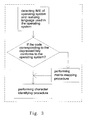
- Fig. 3 is a flowchart illustrating the code exchange process performed in the middleware.
- keyboards for use in a personal computer. It is understood that the keyboard and the method of the present invention can be applied to any electronic appliance using a keyboard.
- An example of such electronic appliance includes but is not limited to notebook, a mobile phone, a personal digital assist (PDA), a panel PC or other electronic equipment.
- PDA personal digital assist
- Fig. 1 illustrates a simplified perspective view of a computer keyboard according to a preferred embodiment of the present invention.
- the input interface of the keyboard 1 comprises a basic typewriter-style alphanumeric keyboard 11, numeric keys 12, directional cursor movement keys 13, fixed control keys 14 (for instance, "HOME”, “PAGE UP”, “PAGE DOWN”, etc.), programmable function keys 15 ("F1", "F2”, etc.), all of which are defined according to the ASCII NO.5 encoding system.
- the keyboard 1 further comprises several special symbol keys 16 representing the characters or symbols not belonging to the ASCII NO.5 encoding system, for example ⁇ , €, ⁇ , etc.
- the architecture for implementing code exchange according to the present invention comprises the special symbol key 16 of the keyboard 1, a control module 17 disposed under the input interface of the keyboard 1, and a character processing module 2.
- the keyboard control module 17 comprises an embedded controller 171, for example a control chip, and a middleware 172.
- an electrical code signal corresponding to the position of the depressed key is asserted from the embedded controller 171 to the middleware 172.
- the middleware 172 will detect an Input Method Editor (IME) for the operating system of the computer to realize the language and encoding system for the operating system. If the code signal corresponding to the position of the depressed key is the same as that of the encoding system for the operating system, a character identifying procedure is performed in the character processing module 2 so as to display the character or symbol of the depressed key on the computer screen. On the contrary, if the code signal corresponding to the position of the depressed key is different from that of the encoding system for the operating system, a matrix mapping procedure should be done, thereby converting the code signal to a new one conforming to the operating system. Afterward, the character identifying procedure is performed in the character processing module 2 to display the character or symbol of the depressed key on the computer screen.
- IME Input Method Editor
- the Euro symbol " €” in the character code table for English, German or Traditional Chinese encoding system is represented by Code 128.
- the Euro symbol “ €”in the character code table for Russian encoding system is represented by Code 136.
- the Euro symbol " €” may be represented by the code other Code 128 and 136 when an encoding system based on any other language is used.
- the Euro symbol " €” is included in the special symbol keys 16 of the keyboard 1 and represented by Code 128.
- an electrical code signal Code 128 corresponding to the position of the depressed key is asserted from the embedded controller 171 to the middleware 172.
- the middleware 172 will detect an Input Method Editor (IME) for the operating system of the computer to realize the language and encoding system for the operating system.
- IME Input Method Editor
- the electrical code signal Code 128 of the " €" symbol is discriminated to be identical to that for the operating system.
- a character identifying procedure is performed to directly display the " €" symbol of the depressed key on the computer screen.
- the electrical code signal Code 128 of the " €" symbol is discriminated to be different from that for the operating system.
- the middleware 172 will perform a matrix mapping procedure, thereby converting the code signal Code 128 to a new code signal Code 136 conforming to the Russian encoding system. Afterward, the character identifying procedure is performed in the character processing module 2 to display the " €" symbol on the computer screen.
- the keyboard of the present invention may be designed as an exclusive keyboard for the professional persons.
- the special symbol keys established on the keyboard can include ⁇ , £, € , ⁇ , ⁇ , ⁇ and ⁇ , which are widely used for business affairs or engineering. Theses special symbol keys can be located anywhere the keyboard, for example at the unoccupied portion of the keyboard.
- the rarely-used keys for example the function keys 15 and some control keys 14, can be replaced by theses special symbol keys.
Landscapes
- Engineering & Computer Science (AREA)
- General Engineering & Computer Science (AREA)
- Theoretical Computer Science (AREA)
- Human Computer Interaction (AREA)
- Physics & Mathematics (AREA)
- General Physics & Mathematics (AREA)
- Input From Keyboards Or The Like (AREA)
Applications Claiming Priority (1)
| Application Number | Priority Date | Filing Date | Title |
|---|---|---|---|
| CN200410058874A CN100595725C (zh) | 2004-07-30 | 2004-07-30 | 键盘及其按键的字码转换方法 |
Publications (2)
| Publication Number | Publication Date |
|---|---|
| EP1621973A2 true EP1621973A2 (de) | 2006-02-01 |
| EP1621973A3 EP1621973A3 (de) | 2009-01-28 |
Family
ID=35134585
Family Applications (1)
| Application Number | Title | Priority Date | Filing Date |
|---|---|---|---|
| EP05016222A Ceased EP1621973A3 (de) | 2004-07-30 | 2005-07-26 | Tastatur mit Tasten mit speziellen Symbolen und Verfahren zum Kodenaustausch für solche Tasten |
Country Status (2)
| Country | Link |
|---|---|
| EP (1) | EP1621973A3 (de) |
| CN (1) | CN100595725C (de) |
Families Citing this family (3)
| Publication number | Priority date | Publication date | Assignee | Title |
|---|---|---|---|---|
| CN103150293B (zh) * | 2011-12-06 | 2017-06-06 | 富泰华工业(深圳)有限公司 | 可进行乱码恢复的电子装置及恢复乱码的方法 |
| CN103376902A (zh) * | 2012-04-26 | 2013-10-30 | 致伸科技股份有限公司 | 可应用于不同操作系统的键盘装置 |
| CN104317663B (zh) * | 2014-09-29 | 2017-11-21 | 广东欧珀移动通信有限公司 | 自动化字符测试方法和装置 |
Citations (3)
| Publication number | Priority date | Publication date | Assignee | Title |
|---|---|---|---|---|
| US6512467B1 (en) * | 1999-04-09 | 2003-01-28 | Sun Microsystems, Inc. | Method and apparatus for dynamically configuring device using device code |
| US20030201980A1 (en) | 2002-04-26 | 2003-10-30 | Wang Chin Ping | Apparatus for inputting special character and method for the same |
| US20030201981A1 (en) * | 2002-04-26 | 2003-10-30 | Nathan Robert H. | Keyboard matrix data transfer |
Family Cites Families (2)
| Publication number | Priority date | Publication date | Assignee | Title |
|---|---|---|---|---|
| CN1133983A (zh) * | 1995-04-18 | 1996-10-23 | 韩长兴 | 键帽标志可转换式电脑输入键盘 |
| US20040086314A1 (en) * | 2002-11-06 | 2004-05-06 | Peter Chen | Standard keyboard supporting multimedia functions |
-
2004
- 2004-07-30 CN CN200410058874A patent/CN100595725C/zh not_active Expired - Fee Related
-
2005
- 2005-07-26 EP EP05016222A patent/EP1621973A3/de not_active Ceased
Patent Citations (3)
| Publication number | Priority date | Publication date | Assignee | Title |
|---|---|---|---|---|
| US6512467B1 (en) * | 1999-04-09 | 2003-01-28 | Sun Microsystems, Inc. | Method and apparatus for dynamically configuring device using device code |
| US20030201980A1 (en) | 2002-04-26 | 2003-10-30 | Wang Chin Ping | Apparatus for inputting special character and method for the same |
| US20030201981A1 (en) * | 2002-04-26 | 2003-10-30 | Nathan Robert H. | Keyboard matrix data transfer |
Non-Patent Citations (1)
| Title |
|---|
| "International Reference Alphabet (IRA) (Formerly International Alphabet No. 5 or IA5) - Information technology - 7-bit coded character set for information interchange; T.50 (09/92)", ITU-T STANDARD IN FORCE (I), INTERNATIONAL TELECOMMUNICATION UNION, GENEVA, CH, no. T.50 (09/92), 18 September 1992 (1992-09-18), XP017403516 * |
Also Published As
| Publication number | Publication date |
|---|---|
| CN100595725C (zh) | 2010-03-24 |
| EP1621973A3 (de) | 2009-01-28 |
| CN1728056A (zh) | 2006-02-01 |
Similar Documents
| Publication | Publication Date | Title |
|---|---|---|
| US8200475B2 (en) | Phonetic-based text input method | |
| US6567549B1 (en) | Method and apparatus for immediate response handwriting recognition system that handles multiple character sets | |
| US7251667B2 (en) | Unicode input method editor | |
| US8479112B2 (en) | Multiple input language selection | |
| JP4463795B2 (ja) | 減少型キーボード曖昧さ除去システム | |
| US20120030609A1 (en) | Virtual keyboard text replication | |
| WO1998033111A9 (en) | Reduced keyboard disambiguating system | |
| JP2007133884A5 (de) | ||
| US7707515B2 (en) | Digital user interface for inputting Indic scripts | |
| US20090058688A1 (en) | Disambiguation of keypad text entry | |
| WO2013045993A1 (en) | Method and keyboard for inputting chinese characters and electronic apparatus containing the keyboard | |
| US8081090B2 (en) | Method of transmitting key code of hot key from number pad | |
| US7260780B2 (en) | Method and apparatus for providing foreign language text display when encoding is not available | |
| US20060022029A1 (en) | Keyboard with special symbol key and code exchange method for such key | |
| EP1621973A2 (de) | Tastatur mit Tasten mit speziellen Symbolen und Verfahren zum Kodenaustausch für solche Tasten | |
| US6289303B1 (en) | Method and system for supporting multiple pen based language sets | |
| US6642858B1 (en) | Apparatus for inputting opening and closing parentheses simultaneously by single keystroke and method for the same | |
| CN101770329A (zh) | 依据虚拟键盘输入他种语言字符的系统及其方法 | |
| JP5161558B2 (ja) | キーボードのホットキーコード伝送方法 | |
| EP1221082B1 (de) | Verwendung von englischer phonetik zum schreiben von nicht-romanischen zeichen | |
| JP2002245470A (ja) | 言語特定装置及び翻訳装置及び言語特定方法 | |
| Orngreen et al. | Analyzing cultural usability of mobile keypad and displays for textual communication in internationalization and localization perspectives | |
| US20220066571A1 (en) | Reducing keystrokes required for inputting characters of indic languages | |
| US20060090126A1 (en) | Method, system, and storage medium for providing instant text character identification | |
| KR20070117339A (ko) | 스마트 커서 |
Legal Events
| Date | Code | Title | Description |
|---|---|---|---|
| PUAI | Public reference made under article 153(3) epc to a published international application that has entered the european phase |
Free format text: ORIGINAL CODE: 0009012 |
|
| 17P | Request for examination filed |
Effective date: 20050726 |
|
| AK | Designated contracting states |
Kind code of ref document: A2 Designated state(s): AT BE BG CH CY CZ DE DK EE ES FI FR GB GR HU IE IS IT LI LT LU LV MC NL PL PT RO SE SI SK TR |
|
| AX | Request for extension of the european patent |
Extension state: AL BA HR MK YU |
|
| PUAL | Search report despatched |
Free format text: ORIGINAL CODE: 0009013 |
|
| AK | Designated contracting states |
Kind code of ref document: A3 Designated state(s): AT BE BG CH CY CZ DE DK EE ES FI FR GB GR HU IE IS IT LI LT LU LV MC NL PL PT RO SE SI SK TR |
|
| AX | Request for extension of the european patent |
Extension state: AL BA HR MK YU |
|
| 17Q | First examination report despatched |
Effective date: 20090821 |
|
| AKX | Designation fees paid |
Designated state(s): AT BE BG CH CY CZ DE DK EE ES FI FR GB GR HU IE IS IT LI LT LU LV MC NL PL PT RO SE SI SK TR |
|
| STAA | Information on the status of an ep patent application or granted ep patent |
Free format text: STATUS: THE APPLICATION HAS BEEN REFUSED |
|
| 18R | Application refused |
Effective date: 20100507 |