EP1622940B1 - Analyse und verwendung von par 1 polymorphismen zur risikoabschätzung für kardiovaskuläre erkrankungen - Google Patents
Analyse und verwendung von par 1 polymorphismen zur risikoabschätzung für kardiovaskuläre erkrankungen Download PDFInfo
- Publication number
- EP1622940B1 EP1622940B1 EP04727840A EP04727840A EP1622940B1 EP 1622940 B1 EP1622940 B1 EP 1622940B1 EP 04727840 A EP04727840 A EP 04727840A EP 04727840 A EP04727840 A EP 04727840A EP 1622940 B1 EP1622940 B1 EP 1622940B1
- Authority
- EP
- European Patent Office
- Prior art keywords
- seq
- par1
- sequence
- polynucleotide sequence
- sequence according
- Prior art date
- Legal status (The legal status is an assumption and is not a legal conclusion. Google has not performed a legal analysis and makes no representation as to the accuracy of the status listed.)
- Expired - Lifetime
Links
- 238000004458 analytical method Methods 0.000 title claims description 7
- 208000024172 Cardiovascular disease Diseases 0.000 title abstract description 3
- 101150093826 par1 gene Proteins 0.000 title abstract description 3
- 102000054765 polymorphisms of proteins Human genes 0.000 title description 9
- 108091033319 polynucleotide Proteins 0.000 claims abstract description 104
- 102000040430 polynucleotide Human genes 0.000 claims abstract description 104
- 239000002157 polynucleotide Substances 0.000 claims abstract description 104
- 238000000034 method Methods 0.000 claims abstract description 34
- 230000007614 genetic variation Effects 0.000 claims abstract description 10
- 101100518958 Arabidopsis thaliana PAR1 gene Proteins 0.000 claims description 57
- 238000006243 chemical reaction Methods 0.000 claims description 44
- 239000012634 fragment Substances 0.000 claims description 38
- 241000282414 Homo sapiens Species 0.000 claims description 24
- 238000009396 hybridization Methods 0.000 claims description 24
- 239000002773 nucleotide Substances 0.000 claims description 23
- 125000003729 nucleotide group Chemical group 0.000 claims description 23
- 238000012163 sequencing technique Methods 0.000 claims description 19
- 239000000463 material Substances 0.000 claims description 18
- 239000002299 complementary DNA Substances 0.000 claims description 16
- 239000000523 sample Substances 0.000 claims description 13
- 102100034343 Integrase Human genes 0.000 claims description 10
- 108010092799 RNA-directed DNA polymerase Proteins 0.000 claims description 10
- 239000012620 biological material Substances 0.000 claims description 10
- 102000004190 Enzymes Human genes 0.000 claims description 9
- 108090000790 Enzymes Proteins 0.000 claims description 9
- 239000003153 chemical reaction reagent Substances 0.000 claims description 9
- 238000002105 Southern blotting Methods 0.000 claims description 8
- 210000005260 human cell Anatomy 0.000 claims description 8
- 239000000126 substance Substances 0.000 claims description 8
- 238000000636 Northern blotting Methods 0.000 claims description 7
- 239000013611 chromosomal DNA Substances 0.000 claims description 7
- FWMNVWWHGCHHJJ-SKKKGAJSSA-N 4-amino-1-[(2r)-6-amino-2-[[(2r)-2-[[(2r)-2-[[(2r)-2-amino-3-phenylpropanoyl]amino]-3-phenylpropanoyl]amino]-4-methylpentanoyl]amino]hexanoyl]piperidine-4-carboxylic acid Chemical compound C([C@H](C(=O)N[C@H](CC(C)C)C(=O)N[C@H](CCCCN)C(=O)N1CCC(N)(CC1)C(O)=O)NC(=O)[C@H](N)CC=1C=CC=CC=1)C1=CC=CC=C1 FWMNVWWHGCHHJJ-SKKKGAJSSA-N 0.000 claims description 5
- 238000006467 substitution reaction Methods 0.000 claims 14
- 101001098529 Homo sapiens Proteinase-activated receptor 1 Proteins 0.000 claims 9
- 101000713169 Homo sapiens Solute carrier family 52, riboflavin transporter, member 2 Proteins 0.000 claims 9
- 102100036862 Solute carrier family 52, riboflavin transporter, member 2 Human genes 0.000 claims 9
- 238000001514 detection method Methods 0.000 abstract description 6
- 108010070519 PAR-1 Receptor Proteins 0.000 description 80
- 108020004414 DNA Proteins 0.000 description 76
- 102000032626 PAR-1 Receptor Human genes 0.000 description 74
- 108091032973 (ribonucleotides)n+m Proteins 0.000 description 35
- 239000000243 solution Substances 0.000 description 30
- 239000000872 buffer Substances 0.000 description 26
- LFQSCWFLJHTTHZ-UHFFFAOYSA-N Ethanol Chemical compound CCO LFQSCWFLJHTTHZ-UHFFFAOYSA-N 0.000 description 25
- FAPWRFPIFSIZLT-UHFFFAOYSA-M Sodium chloride Chemical compound [Na+].[Cl-] FAPWRFPIFSIZLT-UHFFFAOYSA-M 0.000 description 20
- 239000000499 gel Substances 0.000 description 20
- XLYOFNOQVPJJNP-UHFFFAOYSA-N water Chemical compound O XLYOFNOQVPJJNP-UHFFFAOYSA-N 0.000 description 20
- 239000000203 mixture Substances 0.000 description 19
- 108010014303 DNA-directed DNA polymerase Proteins 0.000 description 14
- 102000016928 DNA-directed DNA polymerase Human genes 0.000 description 14
- 101100135626 Homo sapiens F2R gene Proteins 0.000 description 13
- HEMHJVSKTPXQMS-UHFFFAOYSA-M Sodium hydroxide Chemical compound [OH-].[Na+] HEMHJVSKTPXQMS-UHFFFAOYSA-M 0.000 description 12
- 239000007983 Tris buffer Substances 0.000 description 12
- 108090000623 proteins and genes Proteins 0.000 description 12
- LENZDBCJOHFCAS-UHFFFAOYSA-N tris Chemical compound OCC(N)(CO)CO LENZDBCJOHFCAS-UHFFFAOYSA-N 0.000 description 12
- 230000003321 amplification Effects 0.000 description 11
- 206010003658 Atrial Fibrillation Diseases 0.000 description 10
- 210000004027 cell Anatomy 0.000 description 10
- 239000011780 sodium chloride Substances 0.000 description 10
- ISWSIDIOOBJBQZ-UHFFFAOYSA-N Phenol Chemical compound OC1=CC=CC=C1 ISWSIDIOOBJBQZ-UHFFFAOYSA-N 0.000 description 9
- 239000000969 carrier Substances 0.000 description 9
- 238000003199 nucleic acid amplification method Methods 0.000 description 9
- 238000001556 precipitation Methods 0.000 description 9
- 208000004476 Acute Coronary Syndrome Diseases 0.000 description 8
- 229920000936 Agarose Polymers 0.000 description 8
- 108700028369 Alleles Proteins 0.000 description 8
- 208000031229 Cardiomyopathies Diseases 0.000 description 8
- KCXVZYZYPLLWCC-UHFFFAOYSA-N EDTA Chemical compound OC(=O)CN(CC(O)=O)CCN(CC(O)=O)CC(O)=O KCXVZYZYPLLWCC-UHFFFAOYSA-N 0.000 description 8
- WSFSSNUMVMOOMR-UHFFFAOYSA-N Formaldehyde Chemical compound O=C WSFSSNUMVMOOMR-UHFFFAOYSA-N 0.000 description 8
- 238000004925 denaturation Methods 0.000 description 8
- 230000036425 denaturation Effects 0.000 description 8
- 238000011534 incubation Methods 0.000 description 8
- 239000012528 membrane Substances 0.000 description 8
- 239000013612 plasmid Substances 0.000 description 8
- 239000007858 starting material Substances 0.000 description 8
- 206010002388 Angina unstable Diseases 0.000 description 7
- 108091034117 Oligonucleotide Proteins 0.000 description 7
- 208000007814 Unstable Angina Diseases 0.000 description 7
- 229940088598 enzyme Drugs 0.000 description 7
- 201000004332 intermediate coronary syndrome Diseases 0.000 description 7
- 238000002360 preparation method Methods 0.000 description 7
- 102000004169 proteins and genes Human genes 0.000 description 7
- 108091008146 restriction endonucleases Proteins 0.000 description 7
- ZHNUHDYFZUAESO-UHFFFAOYSA-N Formamide Chemical compound NC=O ZHNUHDYFZUAESO-UHFFFAOYSA-N 0.000 description 6
- PEDCQBHIVMGVHV-UHFFFAOYSA-N Glycerine Chemical compound OCC(O)CO PEDCQBHIVMGVHV-UHFFFAOYSA-N 0.000 description 6
- 239000007993 MOPS buffer Substances 0.000 description 6
- 238000003776 cleavage reaction Methods 0.000 description 6
- 238000000746 purification Methods 0.000 description 6
- 210000001519 tissue Anatomy 0.000 description 6
- VMHLLURERBWHNL-UHFFFAOYSA-M Sodium acetate Chemical compound [Na+].CC([O-])=O VMHLLURERBWHNL-UHFFFAOYSA-M 0.000 description 5
- 108010006785 Taq Polymerase Proteins 0.000 description 5
- JLCPHMBAVCMARE-UHFFFAOYSA-N [3-[[3-[[3-[[3-[[3-[[3-[[3-[[3-[[3-[[3-[[3-[[5-(2-amino-6-oxo-1H-purin-9-yl)-3-[[3-[[3-[[3-[[3-[[3-[[5-(2-amino-6-oxo-1H-purin-9-yl)-3-[[5-(2-amino-6-oxo-1H-purin-9-yl)-3-hydroxyoxolan-2-yl]methoxy-hydroxyphosphoryl]oxyoxolan-2-yl]methoxy-hydroxyphosphoryl]oxy-5-(5-methyl-2,4-dioxopyrimidin-1-yl)oxolan-2-yl]methoxy-hydroxyphosphoryl]oxy-5-(6-aminopurin-9-yl)oxolan-2-yl]methoxy-hydroxyphosphoryl]oxy-5-(6-aminopurin-9-yl)oxolan-2-yl]methoxy-hydroxyphosphoryl]oxy-5-(6-aminopurin-9-yl)oxolan-2-yl]methoxy-hydroxyphosphoryl]oxy-5-(6-aminopurin-9-yl)oxolan-2-yl]methoxy-hydroxyphosphoryl]oxyoxolan-2-yl]methoxy-hydroxyphosphoryl]oxy-5-(5-methyl-2,4-dioxopyrimidin-1-yl)oxolan-2-yl]methoxy-hydroxyphosphoryl]oxy-5-(4-amino-2-oxopyrimidin-1-yl)oxolan-2-yl]methoxy-hydroxyphosphoryl]oxy-5-(5-methyl-2,4-dioxopyrimidin-1-yl)oxolan-2-yl]methoxy-hydroxyphosphoryl]oxy-5-(5-methyl-2,4-dioxopyrimidin-1-yl)oxolan-2-yl]methoxy-hydroxyphosphoryl]oxy-5-(6-aminopurin-9-yl)oxolan-2-yl]methoxy-hydroxyphosphoryl]oxy-5-(6-aminopurin-9-yl)oxolan-2-yl]methoxy-hydroxyphosphoryl]oxy-5-(4-amino-2-oxopyrimidin-1-yl)oxolan-2-yl]methoxy-hydroxyphosphoryl]oxy-5-(4-amino-2-oxopyrimidin-1-yl)oxolan-2-yl]methoxy-hydroxyphosphoryl]oxy-5-(4-amino-2-oxopyrimidin-1-yl)oxolan-2-yl]methoxy-hydroxyphosphoryl]oxy-5-(6-aminopurin-9-yl)oxolan-2-yl]methoxy-hydroxyphosphoryl]oxy-5-(4-amino-2-oxopyrimidin-1-yl)oxolan-2-yl]methyl [5-(6-aminopurin-9-yl)-2-(hydroxymethyl)oxolan-3-yl] hydrogen phosphate Polymers Cc1cn(C2CC(OP(O)(=O)OCC3OC(CC3OP(O)(=O)OCC3OC(CC3O)n3cnc4c3nc(N)[nH]c4=O)n3cnc4c3nc(N)[nH]c4=O)C(COP(O)(=O)OC3CC(OC3COP(O)(=O)OC3CC(OC3COP(O)(=O)OC3CC(OC3COP(O)(=O)OC3CC(OC3COP(O)(=O)OC3CC(OC3COP(O)(=O)OC3CC(OC3COP(O)(=O)OC3CC(OC3COP(O)(=O)OC3CC(OC3COP(O)(=O)OC3CC(OC3COP(O)(=O)OC3CC(OC3COP(O)(=O)OC3CC(OC3COP(O)(=O)OC3CC(OC3COP(O)(=O)OC3CC(OC3COP(O)(=O)OC3CC(OC3COP(O)(=O)OC3CC(OC3COP(O)(=O)OC3CC(OC3COP(O)(=O)OC3CC(OC3CO)n3cnc4c(N)ncnc34)n3ccc(N)nc3=O)n3cnc4c(N)ncnc34)n3ccc(N)nc3=O)n3ccc(N)nc3=O)n3ccc(N)nc3=O)n3cnc4c(N)ncnc34)n3cnc4c(N)ncnc34)n3cc(C)c(=O)[nH]c3=O)n3cc(C)c(=O)[nH]c3=O)n3ccc(N)nc3=O)n3cc(C)c(=O)[nH]c3=O)n3cnc4c3nc(N)[nH]c4=O)n3cnc4c(N)ncnc34)n3cnc4c(N)ncnc34)n3cnc4c(N)ncnc34)n3cnc4c(N)ncnc34)O2)c(=O)[nH]c1=O JLCPHMBAVCMARE-UHFFFAOYSA-N 0.000 description 5
- 238000013459 approach Methods 0.000 description 5
- 239000003550 marker Substances 0.000 description 5
- 238000002844 melting Methods 0.000 description 5
- 230000008018 melting Effects 0.000 description 5
- 230000007017 scission Effects 0.000 description 5
- 239000013049 sediment Substances 0.000 description 5
- 239000001632 sodium acetate Substances 0.000 description 5
- 235000017281 sodium acetate Nutrition 0.000 description 5
- 239000006228 supernatant Substances 0.000 description 5
- 239000013598 vector Substances 0.000 description 5
- UHDGCWIWMRVCDJ-UHFFFAOYSA-N 1-beta-D-Xylofuranosyl-NH-Cytosine Natural products O=C1N=C(N)C=CN1C1C(O)C(O)C(CO)O1 UHDGCWIWMRVCDJ-UHFFFAOYSA-N 0.000 description 4
- HEDRZPFGACZZDS-UHFFFAOYSA-N Chloroform Chemical compound ClC(Cl)Cl HEDRZPFGACZZDS-UHFFFAOYSA-N 0.000 description 4
- UHDGCWIWMRVCDJ-PSQAKQOGSA-N Cytidine Natural products O=C1N=C(N)C=CN1[C@@H]1[C@@H](O)[C@@H](O)[C@H](CO)O1 UHDGCWIWMRVCDJ-PSQAKQOGSA-N 0.000 description 4
- KFZMGEQAYNKOFK-UHFFFAOYSA-N Isopropanol Chemical compound CC(C)O KFZMGEQAYNKOFK-UHFFFAOYSA-N 0.000 description 4
- IQFYYKKMVGJFEH-XLPZGREQSA-N Thymidine Chemical compound O=C1NC(=O)C(C)=CN1[C@@H]1O[C@H](CO)[C@@H](O)C1 IQFYYKKMVGJFEH-XLPZGREQSA-N 0.000 description 4
- OIRDTQYFTABQOQ-KQYNXXCUSA-N adenosine Chemical compound C1=NC=2C(N)=NC=NC=2N1[C@@H]1O[C@H](CO)[C@@H](O)[C@H]1O OIRDTQYFTABQOQ-KQYNXXCUSA-N 0.000 description 4
- 238000010367 cloning Methods 0.000 description 4
- 230000000295 complement effect Effects 0.000 description 4
- UHDGCWIWMRVCDJ-ZAKLUEHWSA-N cytidine Chemical compound O=C1N=C(N)C=CN1[C@H]1[C@H](O)[C@@H](O)[C@H](CO)O1 UHDGCWIWMRVCDJ-ZAKLUEHWSA-N 0.000 description 4
- PHTQWCKDNZKARW-UHFFFAOYSA-N isoamylol Chemical compound CC(C)CCO PHTQWCKDNZKARW-UHFFFAOYSA-N 0.000 description 4
- 238000002955 isolation Methods 0.000 description 4
- 238000002372 labelling Methods 0.000 description 4
- 229920000036 polyvinylpyrrolidone Polymers 0.000 description 4
- 238000000926 separation method Methods 0.000 description 4
- 239000011734 sodium Substances 0.000 description 4
- QKNYBSVHEMOAJP-UHFFFAOYSA-N 2-amino-2-(hydroxymethyl)propane-1,3-diol;hydron;chloride Chemical compound Cl.OCC(N)(CO)CO QKNYBSVHEMOAJP-UHFFFAOYSA-N 0.000 description 3
- QTBSBXVTEAMEQO-UHFFFAOYSA-N Acetic acid Chemical compound CC(O)=O QTBSBXVTEAMEQO-UHFFFAOYSA-N 0.000 description 3
- KRKNYBCHXYNGOX-UHFFFAOYSA-K Citrate Chemical compound [O-]C(=O)CC(O)(CC([O-])=O)C([O-])=O KRKNYBCHXYNGOX-UHFFFAOYSA-K 0.000 description 3
- 101001028689 Homo sapiens Protein JTB Proteins 0.000 description 3
- 239000004677 Nylon Substances 0.000 description 3
- 241000589500 Thermus aquaticus Species 0.000 description 3
- 239000011543 agarose gel Substances 0.000 description 3
- 230000001580 bacterial effect Effects 0.000 description 3
- 108010058966 bacteriophage T7 induced DNA polymerase Proteins 0.000 description 3
- 230000015572 biosynthetic process Effects 0.000 description 3
- 238000005119 centrifugation Methods 0.000 description 3
- 208000029078 coronary artery disease Diseases 0.000 description 3
- SUYVUBYJARFZHO-RRKCRQDMSA-N dATP Chemical compound C1=NC=2C(N)=NC=NC=2N1[C@H]1C[C@H](O)[C@@H](COP(O)(=O)OP(O)(=O)OP(O)(O)=O)O1 SUYVUBYJARFZHO-RRKCRQDMSA-N 0.000 description 3
- SUYVUBYJARFZHO-UHFFFAOYSA-N dATP Natural products C1=NC=2C(N)=NC=NC=2N1C1CC(O)C(COP(O)(=O)OP(O)(=O)OP(O)(O)=O)O1 SUYVUBYJARFZHO-UHFFFAOYSA-N 0.000 description 3
- RGWHQCVHVJXOKC-SHYZEUOFSA-J dCTP(4-) Chemical compound O=C1N=C(N)C=CN1[C@@H]1O[C@H](COP([O-])(=O)OP([O-])(=O)OP([O-])([O-])=O)[C@@H](O)C1 RGWHQCVHVJXOKC-SHYZEUOFSA-J 0.000 description 3
- HAAZLUGHYHWQIW-KVQBGUIXSA-N dGTP Chemical compound C1=NC=2C(=O)NC(N)=NC=2N1[C@H]1C[C@H](O)[C@@H](COP(O)(=O)OP(O)(=O)OP(O)(O)=O)O1 HAAZLUGHYHWQIW-KVQBGUIXSA-N 0.000 description 3
- NHVNXKFIZYSCEB-XLPZGREQSA-N dTTP Chemical compound O=C1NC(=O)C(C)=CN1[C@@H]1O[C@H](COP(O)(=O)OP(O)(=O)OP(O)(O)=O)[C@@H](O)C1 NHVNXKFIZYSCEB-XLPZGREQSA-N 0.000 description 3
- 238000001962 electrophoresis Methods 0.000 description 3
- 238000000605 extraction Methods 0.000 description 3
- 238000006386 neutralization reaction Methods 0.000 description 3
- 229920001778 nylon Polymers 0.000 description 3
- 210000000056 organ Anatomy 0.000 description 3
- 229920002401 polyacrylamide Polymers 0.000 description 3
- 238000002264 polyacrylamide gel electrophoresis Methods 0.000 description 3
- 239000000047 product Substances 0.000 description 3
- 239000011541 reaction mixture Substances 0.000 description 3
- 102000005962 receptors Human genes 0.000 description 3
- 108020003175 receptors Proteins 0.000 description 3
- 230000002441 reversible effect Effects 0.000 description 3
- 239000012146 running buffer Substances 0.000 description 3
- 238000003786 synthesis reaction Methods 0.000 description 3
- XSQUKJJJFZCRTK-UHFFFAOYSA-N urea group Chemical group NC(=O)N XSQUKJJJFZCRTK-UHFFFAOYSA-N 0.000 description 3
- 238000005406 washing Methods 0.000 description 3
- OSBLTNPMIGYQGY-UHFFFAOYSA-N 2-amino-2-(hydroxymethyl)propane-1,3-diol;2-[2-[bis(carboxymethyl)amino]ethyl-(carboxymethyl)amino]acetic acid;boric acid Chemical compound OB(O)O.OCC(N)(CO)CO.OC(=O)CN(CC(O)=O)CCN(CC(O)=O)CC(O)=O OSBLTNPMIGYQGY-UHFFFAOYSA-N 0.000 description 2
- IRLPACMLTUPBCL-KQYNXXCUSA-N 5'-adenylyl sulfate Chemical compound C1=NC=2C(N)=NC=NC=2N1[C@@H]1O[C@H](COP(O)(=O)OS(O)(=O)=O)[C@@H](O)[C@H]1O IRLPACMLTUPBCL-KQYNXXCUSA-N 0.000 description 2
- XKRFYHLGVUSROY-UHFFFAOYSA-N Argon Chemical compound [Ar] XKRFYHLGVUSROY-UHFFFAOYSA-N 0.000 description 2
- IJGRMHOSHXDMSA-UHFFFAOYSA-N Atomic nitrogen Chemical compound N#N IJGRMHOSHXDMSA-UHFFFAOYSA-N 0.000 description 2
- 241000972773 Aulopiformes Species 0.000 description 2
- 241000894006 Bacteria Species 0.000 description 2
- DWRXFEITVBNRMK-UHFFFAOYSA-N Beta-D-1-Arabinofuranosylthymine Natural products O=C1NC(=O)C(C)=CN1C1C(O)C(O)C(CO)O1 DWRXFEITVBNRMK-UHFFFAOYSA-N 0.000 description 2
- 239000002126 C01EB10 - Adenosine Substances 0.000 description 2
- 102000053602 DNA Human genes 0.000 description 2
- 229920001917 Ficoll Polymers 0.000 description 2
- 102000003688 G-Protein-Coupled Receptors Human genes 0.000 description 2
- 108090000045 G-Protein-Coupled Receptors Proteins 0.000 description 2
- 241000282412 Homo Species 0.000 description 2
- 101000829171 Hypocrea virens (strain Gv29-8 / FGSC 10586) Effector TSP1 Proteins 0.000 description 2
- TWRXJAOTZQYOKJ-UHFFFAOYSA-L Magnesium chloride Chemical compound [Mg+2].[Cl-].[Cl-] TWRXJAOTZQYOKJ-UHFFFAOYSA-L 0.000 description 2
- 241000713869 Moloney murine leukemia virus Species 0.000 description 2
- KWYHDKDOAIKMQN-UHFFFAOYSA-N N,N,N',N'-tetramethylethylenediamine Chemical compound CN(C)CCN(C)C KWYHDKDOAIKMQN-UHFFFAOYSA-N 0.000 description 2
- 108091028043 Nucleic acid sequence Proteins 0.000 description 2
- 240000004808 Saccharomyces cerevisiae Species 0.000 description 2
- VYPSYNLAJGMNEJ-UHFFFAOYSA-N Silicium dioxide Chemical compound O=[Si]=O VYPSYNLAJGMNEJ-UHFFFAOYSA-N 0.000 description 2
- 239000008051 TBE buffer Substances 0.000 description 2
- 241000589499 Thermus thermophilus Species 0.000 description 2
- 241000251539 Vertebrata <Metazoa> Species 0.000 description 2
- 239000002250 absorbent Substances 0.000 description 2
- 230000002745 absorbent Effects 0.000 description 2
- 230000004913 activation Effects 0.000 description 2
- 239000013543 active substance Substances 0.000 description 2
- 229960005305 adenosine Drugs 0.000 description 2
- 238000000246 agarose gel electrophoresis Methods 0.000 description 2
- 238000004220 aggregation Methods 0.000 description 2
- 230000002776 aggregation Effects 0.000 description 2
- IQFYYKKMVGJFEH-UHFFFAOYSA-N beta-L-thymidine Natural products O=C1NC(=O)C(C)=CN1C1OC(CO)C(O)C1 IQFYYKKMVGJFEH-UHFFFAOYSA-N 0.000 description 2
- 108010064866 biozym Proteins 0.000 description 2
- 239000003086 colorant Substances 0.000 description 2
- 238000010276 construction Methods 0.000 description 2
- 238000011161 development Methods 0.000 description 2
- 239000013024 dilution buffer Substances 0.000 description 2
- 239000003814 drug Substances 0.000 description 2
- 239000000975 dye Substances 0.000 description 2
- 238000005516 engineering process Methods 0.000 description 2
- 210000003527 eukaryotic cell Anatomy 0.000 description 2
- 230000002068 genetic effect Effects 0.000 description 2
- 239000011521 glass Substances 0.000 description 2
- WSFSSNUMVMOOMR-NJFSPNSNSA-N methanone Chemical compound O=[14CH2] WSFSSNUMVMOOMR-NJFSPNSNSA-N 0.000 description 2
- 102000039446 nucleic acids Human genes 0.000 description 2
- 108020004707 nucleic acids Proteins 0.000 description 2
- 150000007523 nucleic acids Chemical class 0.000 description 2
- 239000000843 powder Substances 0.000 description 2
- 230000001681 protective effect Effects 0.000 description 2
- 238000010839 reverse transcription Methods 0.000 description 2
- 238000012502 risk assessment Methods 0.000 description 2
- 235000019515 salmon Nutrition 0.000 description 2
- 230000003595 spectral effect Effects 0.000 description 2
- 239000011550 stock solution Substances 0.000 description 2
- 229940104230 thymidine Drugs 0.000 description 2
- 239000001226 triphosphate Substances 0.000 description 2
- 235000011178 triphosphate Nutrition 0.000 description 2
- 125000002264 triphosphate group Chemical class [H]OP(=O)(O[H])OP(=O)(O[H])OP(=O)(O[H])O* 0.000 description 2
- NLIVDORGVGAOOJ-MAHBNPEESA-M xylene cyanol Chemical compound [Na+].C1=C(C)C(NCC)=CC=C1C(\C=1C(=CC(OS([O-])=O)=CC=1)OS([O-])=O)=C\1C=C(C)\C(=[NH+]/CC)\C=C/1 NLIVDORGVGAOOJ-MAHBNPEESA-M 0.000 description 2
- 101150084750 1 gene Proteins 0.000 description 1
- GHKCSRZBNZQHKW-UHFFFAOYSA-N 1-sulfanylethanol Chemical compound CC(O)S GHKCSRZBNZQHKW-UHFFFAOYSA-N 0.000 description 1
- 108020004463 18S ribosomal RNA Proteins 0.000 description 1
- JKMHFZQWWAIEOD-UHFFFAOYSA-N 2-[4-(2-hydroxyethyl)piperazin-1-yl]ethanesulfonic acid Chemical compound OCC[NH+]1CCN(CCS([O-])(=O)=O)CC1 JKMHFZQWWAIEOD-UHFFFAOYSA-N 0.000 description 1
- KZMAWJRXKGLWGS-UHFFFAOYSA-N 2-chloro-n-[4-(4-methoxyphenyl)-1,3-thiazol-2-yl]-n-(3-methoxypropyl)acetamide Chemical compound S1C(N(C(=O)CCl)CCCOC)=NC(C=2C=CC(OC)=CC=2)=C1 KZMAWJRXKGLWGS-UHFFFAOYSA-N 0.000 description 1
- 108020004635 Complementary DNA Proteins 0.000 description 1
- 101710200526 DNA polymerase 2 Proteins 0.000 description 1
- 238000001712 DNA sequencing Methods 0.000 description 1
- 102000004163 DNA-directed RNA polymerases Human genes 0.000 description 1
- 108090000626 DNA-directed RNA polymerases Proteins 0.000 description 1
- 229920002307 Dextran Polymers 0.000 description 1
- 206010014522 Embolism venous Diseases 0.000 description 1
- 108010067770 Endopeptidase K Proteins 0.000 description 1
- 108700024394 Exon Proteins 0.000 description 1
- 108700039691 Genetic Promoter Regions Proteins 0.000 description 1
- WQZGKKKJIJFFOK-GASJEMHNSA-N Glucose Natural products OC[C@H]1OC(O)[C@H](O)[C@@H](O)[C@@H]1O WQZGKKKJIJFFOK-GASJEMHNSA-N 0.000 description 1
- 101000613565 Homo sapiens PRKC apoptosis WT1 regulator protein Proteins 0.000 description 1
- 101001113471 Homo sapiens Proteinase-activated receptor 4 Proteins 0.000 description 1
- 206010020772 Hypertension Diseases 0.000 description 1
- 239000000020 Nitrocellulose Substances 0.000 description 1
- 108091092724 Noncoding DNA Proteins 0.000 description 1
- 108020002230 Pancreatic Ribonuclease Proteins 0.000 description 1
- 102000005891 Pancreatic ribonuclease Human genes 0.000 description 1
- 229920005372 Plexiglas® Polymers 0.000 description 1
- 102100023710 Proteinase-activated receptor 4 Human genes 0.000 description 1
- 239000013614 RNA sample Substances 0.000 description 1
- 108020004682 Single-Stranded DNA Proteins 0.000 description 1
- 208000007718 Stable Angina Diseases 0.000 description 1
- 102000003790 Thrombin receptors Human genes 0.000 description 1
- 108090000166 Thrombin receptors Proteins 0.000 description 1
- 239000007984 Tris EDTA buffer Substances 0.000 description 1
- 230000003213 activating effect Effects 0.000 description 1
- 230000006978 adaptation Effects 0.000 description 1
- 230000000692 anti-sense effect Effects 0.000 description 1
- 239000008346 aqueous phase Substances 0.000 description 1
- 229910052786 argon Inorganic materials 0.000 description 1
- 238000000376 autoradiography Methods 0.000 description 1
- 230000027455 binding Effects 0.000 description 1
- 210000004369 blood Anatomy 0.000 description 1
- 239000008280 blood Substances 0.000 description 1
- 238000010241 blood sampling Methods 0.000 description 1
- 210000004204 blood vessel Anatomy 0.000 description 1
- 238000009835 boiling Methods 0.000 description 1
- 210000004556 brain Anatomy 0.000 description 1
- UDSAIICHUKSCKT-UHFFFAOYSA-N bromophenol blue Chemical compound C1=C(Br)C(O)=C(Br)C=C1C1(C=2C=C(Br)C(O)=C(Br)C=2)C2=CC=CC=C2S(=O)(=O)O1 UDSAIICHUKSCKT-UHFFFAOYSA-N 0.000 description 1
- 239000004202 carbamide Substances 0.000 description 1
- 238000004113 cell culture Methods 0.000 description 1
- 239000013592 cell lysate Substances 0.000 description 1
- 210000004978 chinese hamster ovary cell Anatomy 0.000 description 1
- 210000000349 chromosome Anatomy 0.000 description 1
- 239000000470 constituent Substances 0.000 description 1
- 238000004132 cross linking Methods 0.000 description 1
- 239000005549 deoxyribonucleoside Substances 0.000 description 1
- 229960002086 dextran Drugs 0.000 description 1
- 229960000633 dextran sulfate Drugs 0.000 description 1
- 238000004090 dissolution Methods 0.000 description 1
- 239000012153 distilled water Substances 0.000 description 1
- 238000009826 distribution Methods 0.000 description 1
- MOTZDAYCYVMXPC-UHFFFAOYSA-N dodecyl hydrogen sulfate Chemical compound CCCCCCCCCCCCOS(O)(=O)=O MOTZDAYCYVMXPC-UHFFFAOYSA-N 0.000 description 1
- 229940043264 dodecyl sulfate Drugs 0.000 description 1
- 229940079593 drug Drugs 0.000 description 1
- 230000002526 effect on cardiovascular system Effects 0.000 description 1
- 210000002889 endothelial cell Anatomy 0.000 description 1
- 230000005284 excitation Effects 0.000 description 1
- 210000002950 fibroblast Anatomy 0.000 description 1
- 239000007850 fluorescent dye Substances 0.000 description 1
- 235000013305 food Nutrition 0.000 description 1
- -1 furthermore dAPP Chemical compound 0.000 description 1
- 238000003205 genotyping method Methods 0.000 description 1
- 239000008103 glucose Substances 0.000 description 1
- 230000036541 health Effects 0.000 description 1
- 210000002216 heart Anatomy 0.000 description 1
- 238000010438 heat treatment Methods 0.000 description 1
- 229940094991 herring sperm dna Drugs 0.000 description 1
- 238000013537 high throughput screening Methods 0.000 description 1
- 102000057567 human JTB Human genes 0.000 description 1
- 238000003384 imaging method Methods 0.000 description 1
- 238000000338 in vitro Methods 0.000 description 1
- 230000002779 inactivation Effects 0.000 description 1
- 238000010348 incorporation Methods 0.000 description 1
- 230000000977 initiatory effect Effects 0.000 description 1
- 230000016507 interphase Effects 0.000 description 1
- 150000002500 ions Chemical class 0.000 description 1
- 210000003734 kidney Anatomy 0.000 description 1
- 239000007788 liquid Substances 0.000 description 1
- 210000004185 liver Anatomy 0.000 description 1
- 239000012160 loading buffer Substances 0.000 description 1
- 238000011068 loading method Methods 0.000 description 1
- 238000007477 logistic regression Methods 0.000 description 1
- 239000012139 lysis buffer Substances 0.000 description 1
- 229910001629 magnesium chloride Inorganic materials 0.000 description 1
- 238000004519 manufacturing process Methods 0.000 description 1
- 239000011159 matrix material Substances 0.000 description 1
- 230000007246 mechanism Effects 0.000 description 1
- 238000010369 molecular cloning Methods 0.000 description 1
- 230000004660 morphological change Effects 0.000 description 1
- ZIUHHBKFKCYYJD-UHFFFAOYSA-N n,n'-methylenebisacrylamide Chemical compound C=CC(=O)NCNC(=O)C=C ZIUHHBKFKCYYJD-UHFFFAOYSA-N 0.000 description 1
- 210000002569 neuron Anatomy 0.000 description 1
- 229920001220 nitrocellulos Polymers 0.000 description 1
- 229910052757 nitrogen Inorganic materials 0.000 description 1
- 230000009871 nonspecific binding Effects 0.000 description 1
- 210000004940 nucleus Anatomy 0.000 description 1
- 210000003463 organelle Anatomy 0.000 description 1
- 238000004806 packaging method and process Methods 0.000 description 1
- 238000003752 polymerase chain reaction Methods 0.000 description 1
- 238000006116 polymerization reaction Methods 0.000 description 1
- 239000004926 polymethyl methacrylate Substances 0.000 description 1
- 239000001267 polyvinylpyrrolidone Substances 0.000 description 1
- 235000013855 polyvinylpyrrolidone Nutrition 0.000 description 1
- 230000003449 preventive effect Effects 0.000 description 1
- OCQZXMCGTAWGEQ-UHFFFAOYSA-N prop-2-enamide;n-[(prop-2-enoylamino)methyl]prop-2-enamide Chemical compound NC(=O)C=C.C=CC(=O)NCNC(=O)C=C OCQZXMCGTAWGEQ-UHFFFAOYSA-N 0.000 description 1
- 230000006337 proteolytic cleavage Effects 0.000 description 1
- 239000011535 reaction buffer Substances 0.000 description 1
- 150000003839 salts Chemical class 0.000 description 1
- 239000012723 sample buffer Substances 0.000 description 1
- 230000019491 signal transduction Effects 0.000 description 1
- 239000000377 silicon dioxide Substances 0.000 description 1
- 230000000391 smoking effect Effects 0.000 description 1
- 210000000329 smooth muscle myocyte Anatomy 0.000 description 1
- VVLFAAMTGMGYBS-UHFFFAOYSA-M sodium;4-[[4-(ethylamino)-3-methylphenyl]-(4-ethylimino-3-methylcyclohexa-2,5-dien-1-ylidene)methyl]-3-sulfobenzenesulfonate Chemical compound [Na+].C1=C(C)C(NCC)=CC=C1C(C=1C(=CC(=CC=1)S([O-])(=O)=O)S(O)(=O)=O)=C1C=C(C)C(=NCC)C=C1 VVLFAAMTGMGYBS-UHFFFAOYSA-M 0.000 description 1
- 238000007711 solidification Methods 0.000 description 1
- 230000008023 solidification Effects 0.000 description 1
- 210000000952 spleen Anatomy 0.000 description 1
- 238000001356 surgical procedure Methods 0.000 description 1
- 230000002194 synthesizing effect Effects 0.000 description 1
- 238000012360 testing method Methods 0.000 description 1
- 230000001732 thrombotic effect Effects 0.000 description 1
- 238000013518 transcription Methods 0.000 description 1
- 230000035897 transcription Effects 0.000 description 1
- 241001515965 unidentified phage Species 0.000 description 1
- 208000004043 venous thromboembolism Diseases 0.000 description 1
Images




Classifications
-
- C—CHEMISTRY; METALLURGY
- C12—BIOCHEMISTRY; BEER; SPIRITS; WINE; VINEGAR; MICROBIOLOGY; ENZYMOLOGY; MUTATION OR GENETIC ENGINEERING
- C12Q—MEASURING OR TESTING PROCESSES INVOLVING ENZYMES, NUCLEIC ACIDS OR MICROORGANISMS; COMPOSITIONS OR TEST PAPERS THEREFOR; PROCESSES OF PREPARING SUCH COMPOSITIONS; CONDITION-RESPONSIVE CONTROL IN MICROBIOLOGICAL OR ENZYMOLOGICAL PROCESSES
- C12Q1/00—Measuring or testing processes involving enzymes, nucleic acids or microorganisms; Compositions therefor; Processes of preparing such compositions
- C12Q1/68—Measuring or testing processes involving enzymes, nucleic acids or microorganisms; Compositions therefor; Processes of preparing such compositions involving nucleic acids
- C12Q1/6876—Nucleic acid products used in the analysis of nucleic acids, e.g. primers or probes
- C12Q1/6883—Nucleic acid products used in the analysis of nucleic acids, e.g. primers or probes for diseases caused by alterations of genetic material
-
- C—CHEMISTRY; METALLURGY
- C07—ORGANIC CHEMISTRY
- C07K—PEPTIDES
- C07K14/00—Peptides having more than 20 amino acids; Gastrins; Somatostatins; Melanotropins; Derivatives thereof
- C07K14/435—Peptides having more than 20 amino acids; Gastrins; Somatostatins; Melanotropins; Derivatives thereof from animals; from humans
- C07K14/705—Receptors; Cell surface antigens; Cell surface determinants
- C07K14/72—Receptors; Cell surface antigens; Cell surface determinants for hormones
- C07K14/723—G protein coupled receptor, e.g. TSHR-thyrotropin-receptor, LH/hCG receptor, FSH receptor
-
- C—CHEMISTRY; METALLURGY
- C12—BIOCHEMISTRY; BEER; SPIRITS; WINE; VINEGAR; MICROBIOLOGY; ENZYMOLOGY; MUTATION OR GENETIC ENGINEERING
- C12Q—MEASURING OR TESTING PROCESSES INVOLVING ENZYMES, NUCLEIC ACIDS OR MICROORGANISMS; COMPOSITIONS OR TEST PAPERS THEREFOR; PROCESSES OF PREPARING SUCH COMPOSITIONS; CONDITION-RESPONSIVE CONTROL IN MICROBIOLOGICAL OR ENZYMOLOGICAL PROCESSES
- C12Q2600/00—Oligonucleotides characterized by their use
- C12Q2600/156—Polymorphic or mutational markers
Definitions
- the invention relates to polynucleotide sequences comprising genetic variations of the PAR1 gene at positions 3090 and / or 3329.
- Protease-activated receptor 1 is a thrombin receptor belonging to the class of G protein-coupled receptors (GCPR).
- the gene for PAR1 is located on chromosome 5q13, consists of two exons and covers a region of about 27 kb.
- PAR1 is expressed in, among others, endothelial cells, smooth muscle cells, fibroblasts, neurons and human platelets.
- PAR1 is an important receptor of signal transduction involved in the initiation of aggregation of platelets.
- Activation of PARs occurs via proteolytic cleavage of part of the N-terminus of PARs, revealing a new N-terminal sequence that then activates the receptor.
- PAR1 and PAR4 play a central role; Activation of these receptors in platelets leads to morphological changes, release of ADP and aggregation of platelets.
- the sequence of the human PAR1 gene is known.
- the polynucleotide sequence of this gene is available under the number NM_001992 from the NCBI nucleotide database.
- the protein sequence is available under the number NP_001983 at the NCBI Protein Database.
- NCBI is the National Center for Biotechnology Information (Postal Address: National Center for Biotechnology Information, National Library of Medicine, Building 38A, Bethesda, MD 20894, USA; Web Address: www.ncbi.nhm.nih.gov).
- the cloning of the PAR1 gene has been described inter alia in " Schmidt et al., J. Biol. Chem. 271, 9307-9312, 1996 ".
- the affected individuals thus have the opportunity to be able to counteract this risk factor in a timely manner by appropriate adaptation in their lifestyle, for example, through increased control of other harmful influences such as smoking, alcohol consumption, high-cholesterol food, hypertension and other compensation.
- SNP single nucleotide polymorphism
- the invention relates to an isolated polynucleotide sequence of the PAR1 gene, which is characterized in that at position 3090 of the PAR1 sequence according to NM_001992, which is available to the public as state of the art, an exchange of the T for a C is present.
- the polynucleotide sequence of the PAR1 gene with an exchange of T to C at position 3090 comprises a sequence according to SEQ ID No. 2 and in a particularly preferred embodiment of this polynucleotide sequence this consists of a sequence of SEQ ID No. 2.
- the invention further relates to an isolated polynucleotide sequence of the PAR1 gene, which is characterized in that at position 3329 of the PAR1 Sequence according to NM_001992, which is available as prior art to the public, an exchange of A for a C is present.
- the polynucleotide sequence of the PAR1 gene with an exchange of A to C at position 3329 comprises a sequence according to SEQ ID NO: 3 and in a particularly preferred embodiment of this polynucleotide sequence this consists of a sequence of SEQ ID NO: 3.
- the invention also relates to an isolated polynucleotide sequence of the PAR1 gene, which is characterized in that at position 3090 of the PAR1 sequence according to NM_001992 an exchange of the T for a C and simultaneously at position 3329 of this PAR1 sequence an exchange of the A for a V is present.
- the polynucleotide sequence of the PAR1 gene with an exchange of T to C at position 3090 and a simultaneous replacement of A to C at position 3329 comprises a sequence according to SEQ ID NO: 4 and in a particularly preferred embodiment of this polynucleotide sequence from a sequence of SEQ ID NO: 4.
- the invention also relates to an isolated part of the polynucleotide sequence of the PAR1 gene consisting of a sequence according to SEQ ID No. 5.
- the invention relates to an isolated part of the polynucleotide sequence of the PAR1 gene, which is characterized in that at position 3090 with respect to the PAR1 sequence according to NM_001992 there is an exchange of the T for a C, consisting of a sequence according to SEQ ID No. 6 ,
- the invention also relates to an isolated part of the polynucleotide sequence of the PAR1 gene, which is characterized in that at position 3329 with respect to the PAR1 sequence according to NM_001992 an exchange of A for a C is present consisting of a sequence according to SEQ ID No. 7
- the invention also relates to an isolated part of the polynucleotide sequence of the PAR1 gene, which is characterized in that Position 3090 based on the PAR1 sequence according to NM_001992 an exchange of the T for a C and simultaneously at position 3329 of said PAR1 sequence an exchange of the A for a C is present consisting of a sequence according to SEQ ID No. 8.
- Detection of genetic variations or polymorphisms in the PAR1 gene at positions 3090 and / or 3329 may be used as (a) genetic marker for risk assessment of the occurrence of atrial fibrillation, acute coronary syndrome, cardiomyopathy and / or unstable angina, as (b) marker for preventive treatment of atrial fibrillation, acute coronary syndrome, cardiomyopathy and / or stable angina of the carriers of the corresponding genetic variants, as (c) markers for adapting the dose of a pharmaceutically active substance to be administered against atrial fibrillation, acute coronary syndrome, cardiomyopathy and / or unstable angina, as (d) marker for the determination of High Throughput Screening
- a strategy for the identification of a pharmaceutically active substance against atrial fibrillation, acute coronary syndrome, cardiomyopathy and / or unstable angina as (e) marker for identifying the relevant individuals or patients for clinical trials for the tolerability, safety and efficacy of a pharmaceutical substance To check for atrial fibrillation, acute coronary syndrome, cardiomyopathy and /
- the invention also relates to an isolated polynucleotide sequence having a number from 21 to 50 nucleotides, characterized in that it contains a sequence corresponding to SEQ ID No. 11. This sequence preferably consists of SEQ ID NO: 11.
- the invention further relates to an isolated polynucleotide sequence with a number from 20 to 50 nucleotides, characterized in that a sequence corresponding to SEQ ID NO. 12 is included. This sequence preferably consists of SEQ ID NO: 12.
- the invention also relates to the use of an isolated polynucleotide sequence of 21 to 50 nucleotides in length comprising or consisting of a sequence of SEQ ID NO: 11 in combination with an isolated polynucleotide sequence of 20 to 50 nucleotides in length, which comprises or consists of a sequence according to SEQ ID No. 12, for the multiplication of a corresponding fragment from the PAR1 gene by means of the polymerase chain extension reaction (PCR).
- PCR polymerase chain extension reaction
- This use preferably relates to the propagation of a fragment from a PAR1 gene which has an exchange from T to C at position 3090 of the sequence according to NM_001992 and / or an exchange from A to C at position 3329 of the sequence according to NM_001992.
- the kit described above can be used to propagate a fragment from the PAR1 gene.
- Isolated polynucleotide sequences of the PAR1 gene can be prepared, for example, by propagation by means of the polymerase chain extension reaction (PCR). Suitable primers for this are described in SEQ ID No. 9 and SEQ ID No. 10. PCR is an in vitro technique that can selectively duplicate polynucleotide segments that are framed by two known sequences. Amplification requires short, single-stranded DNA molecules that are complementary to the ends of a defined sequence of a DNA or RNA template (primer).
- a DNA polymerase prolongs the primers along the single-stranded and denatured polynucleotide template, thereby synthesizing new DNA strands whose sequence is complementary to the template.
- the temperature changes periodically so that the polynucleotide strands are repeatedly denatured and the primers can accumulate and be extended.
- Heat-stable DNA polymerases for example Taq polymerase, are used.
- a typical PCR approach contains, in addition to a polynucleotide template, two suitable primer nucleotides, for example in a concentration of between 0.2 and 2 ⁇ M, and furthermore dNTPs, for example at concentrations of 200 ⁇ M per dNTP, also MgCl 2 at a concentration of 1-2mM and 1-10 units of a heat-stable DNA polymerase such as the Taq polymerase (polymerase from Thermus aquaticus).
- Heat stable DNA polymerase as well as the components for carrying them out, including protocols, are commercially available from numerous companies such as Roche Diagnostics, Clontech, Life Technology, New England Biolabs, Promega, Stratagene and others.
- the polynucleotide template for propagation of the polynucleotide sequence to be isolated can be present as RNA or DNA. If the polynucleotide template is present as RNA, it is transcribed into DNA before the actual PCR reaction by means of reverse transcriptase. The amount of polynucleotide template in performing the PCR reaction may be, for example, 0.01 to 20 ng.
- the polynucleotide template is obtained by techniques known to those skilled in the art for obtaining DNA and / or RNA from biological material.
- Biomaterial is intended to include, but is not limited to, the cells of a tissue or organ (e.g., brain, blood, liver, spleen, kidney, heart, blood vessels) of a vertebrate, including humans, or cells from a eukaryotic cell culture (e.g., Hela cells, CHO cells , 3T3 cells) or cells consisting of bacteria or yeasts in which the DNA sequence to be isolated is present in cloned form.
- a tissue or organ e.g., brain, blood, liver, spleen, kidney, heart, blood vessels
- a eukaryotic cell culture e.g., Hela cells, CHO cells , 3T3 cells
- cells consisting of bacteria or yeasts in which the DNA sequence to be isolated is present in cloned form.
- Cells of a tissue or vertebrate organ, including humans can be obtained by blood sampling, tissue function or surgical techniques.
- a polynucleotide template from this is obtained, for example, by digesting the cells, possibly enriching individual organelles, in particular the nucleus, and recovering the DNA or RNA by precipitation and centrifugation.
- Another method for producing isolated polynucleotide sequences of the PAR1 gene consists in the cloning of the PAR1 gene, the subsequent expression in bacteria or yeasts and the purification of the PAR1 gene expressed polynucleotide.
- the previously discussed PCR reaction is suitable for the preparation of a polynucleotide fragment which can be cloned.
- primers are used which carry the recognition sequence of a reaction enzyme in the 5'-position of the complementary sequence.
- the same or different restriction enzyme recognition sequences can each be used for the two primers.
- Common restriction enzymes include: BamH1 (GGATCC), Clal (ATCGAT), EcoR1 (GAATTC), EcoRV (GATATC), HindIII (AAGCTT), NcoI (CCATGG), SalI (GTCGAC), XbaI (TCTAG1).
- a vector is treated with the restriction enzymes corresponding to the recognition sequences attached to the primers.
- the fragment is ligated to the vector by isolation and treatment by the same restriction enzymes.
- a vector is to be understood as meaning a DNA molecule, such as a plasmid, bacteriophage or a cosmid, with the aid of which genes or other DNA sequences can be cloned and introduced into a bacterial or eukaryotic cell for duplication.
- Vectors are, for example, DNA molecules such as pBR322, pUC18 / 19, pBluescript, pcDNA3.1. Vectors are from biotechnical material companies such as Roche Diagnostics, New England Biolabs, Promega, Stratagene et al. to obtain commercially.
- primer sequences are carried out, for example, via their chemical synthesis, which can be carried out on a commercial basis by companies such as MWG Biotech and others.
- Human cDNA from different organs is commercially available from companies such as Promega, Stratagene or others.
- sequencing of a polynucleotide is carried out by means of routine methods known to those skilled in the art, for example via laboratory robots from companies such as Life Technologies, Applied Biosystems, BioRad or others.
- Isolated polynucleotide sequences of the PAR1 variant as well as fragments thereof may also be used for hybridization at different stringencies.
- Stringency describes reaction conditions that affect the specificity of hybridization or attachment of two single-stranded nucleic acid molecules. The stringency and thus the specificity of a reaction can be increased by raising the temperature and lowering the ionic strength. For example, low stringent conditions exist when hybridization is performed at room temperature in 2xSSC solution. High stringency conditions are given, for example, when hybridized at 68 ° C in 0.1 x SSC / 0.1% SDS solution.
- DNA fragments with a total length of 20 nucleotides should be considered as oligonucleotides.
- the 20 x SSC solution consists of a 3M NaCl / 0.3 Na citrate 2 H 2 O solution.
- SDS stands for Na dodecyl sulfate.
- the polynucleotides to be examined are transferred to a nylon or nitrocellulose membrane after electrophoretic separation and subsequent denaturation (Southern blot DNA, Northern blot RNA).
- the hybridization is carried out with a probe which is radioactively or otherwise labeled, for example with the aid of fluorescent dyes.
- the probe consists of a usually single-stranded and / or denatured DNA or RNA polynucleotide sequence which binds to the complementary nucleotide sequence of the in turn single-stranded and / or denatured DNA or RNA polynucleotide sequence to be examined.
- SSCP Single Stranded Conformation Polymorphism. It is an electrophoresis technique for the identification of single base pair exchanges.
- the polynucleotides to be investigated are amplified by means of labeled primers by the PCR reaction and separated after denaturation into single strands in a polyacrylamide gel electrophoresis (PAGE). Point the DNA fragments to be examined have single base pair exchanges, they have different conformation and consequently migrate at different speeds in the PAGE.
- Examples of substances for carrying out the PCR reaction are buffers such as Hepes or Tris, furthermore dAPP, dGTP, dTTP, dCTP, as well as Mg 2+ and possibly further divalent or monovalent ions. Solutions contain these substances in dissolved form.
- Reagents used are from Applied Biosystems (Foster City, USA): 20 ng of genomic DNA; 1 unit TaqGold DNA polymerase; 1 x Taq polymerase buffer; 500 ⁇ M dNTPs; 2.5mM MgCl2; 200 nM of each amplification primer pair; H 2 O ad 5 ⁇ l.
- Amplification program of PCR for genotyping 95 ° C for 10 min x 1 cycle 95 ° C for 30 sec 70 ° C for 30 sec x 2 cycles; 95 ° C for 30 sec 65 ° C for 30 sec x 2 cycles; 95 ° C for 30 sec 60 ° C for 30 sec x 2 cycles; 95 ° C for 30 sec 56 ° C for 30 sec 72 ° C for 30 sec x 40 cycles; 72 ° C for 10 min 4 ° C for 30 sec x 1 cycle;
- Amplification program for sequencing 96 ° C for 2 min x 1 cycle; 96 ° C for 10 sec 55 ° C for 10 sec 65 ° C for 4 min x 30 cycles; 72 ° C for 7 min 4 ° C for 30 sec x 1 cycle;
- sequences were first analyzed with the sequence analysis software (Applied Biosystems, Foster City, USA) to obtain the raw data, then processed with Phred, Phrap, Polyphred and Consed.
- Phred, Phrap, Polyphred and Consed are software written by Phil Green of Washington University (http://www.genome.washington.edu).
- PAR1 T3090T describes the group of individuals with a thymidine (T) at position 3090 on both alleles of the PAR1 gene. These individuals are homozygous for this PAR1 variant.
- PAR1 T3090C describes the group of individuals in which a cytidine (C) is present on one allele of the gene PAR1 at position 3090, and on the other allele of the gene PAR1 at position 3090 a thymidine (T). These individuals are heterozygous for this PAR1 variant.
- PAR1 C3090C describes the group of individuals with a cytidine (C) at position 3090 on both alleles of the PAR1 gene. These individuals are homozygous for this PAR1 variant.
- PAR1 A3329A describes the group of individuals with adenosine (A) at position 3329 on both alleles of the PAR1 gene. These individuals are homozygous for this PAR1 variant.
- PAR1 A3329C describes the group of individuals in which one cytidine (C) is present on one allele of the gene PAR1 at position 3329, and one adenosine (A) on the other allele of the gene PAR1 at position 3329. These individuals are heterozygous for this PAR1 variant.
- PAR1 C3329C describes the group of individuals with a cytidine (C) at position 3329 on both alleles of the PAR1 gene. These individuals are homozygous for this PAR1 variant.
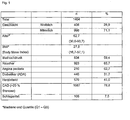
- this variant seems to be protective for the occurrence of acute coronary syndrome and unstable angina in carriers of the PAR1 variant C3329C.
- Carriers of the PAR1 variant A3329C / A3329A have a 2.78-fold reduced risk for the occurrence of acute coronary syndrome and / or unstable angina compared to carriers of the PAR1 variants A3329C / A3329A. Fig. 4 ).
- Solution I 25 mM Tris-HCl, pH 8.0, 50 mM glucose (sterile filtered), 10 mM EDTA 100 ⁇ g / ml Rnase A,
- Solution II 200mM NaOH, 1% SDS.
- Solution III 3M sodium acetate (pH 4.8).
- the cell debris, the genomic DNA and the denatured proteins are centrifuged off.
- the resulting supernatant, in which the plasmid DNA is located is decanted into a second Eppendorf tube and admixed with 1 ml of 96% EtOH (or 300 ⁇ l of isopropanol).
- the precipitation mixture is thoroughly mixed and centrifuged again (15 min at 12000 rpm in the Biofuge Heraeus). In this case, the precipitation of the plasmid DNA occurs.
- the sedimented plasmid DNA is washed with ice-cold 70% EtOH and then dried in air. Finally, the dry sediment in 50 .mu.l sterile dest. Water added.
- the mixture is mixed well. This can be stored at -20 ° C, but the precipitation yield is not increased. Centrifugation at 12,000 rpm for 20 minutes causes the plasmid DNA to sediment.
- the plasmid DNA is to be washed once more with 1 ml of 70% EtOH after the precipitation.
- the purification of DNA amplificates is carried out with the PCR Purification Kit (Qiagen).
- the starter molecules, nucleotides (dNTPs), polymerases and salts are removed.
- the PCR reaction mixture is mixed with five times the volume of PB buffer, mixed well and placed on the Qiaquick column. This is followed by selective binding of the amplified DNA to the column material, the dNTPs are removed by washing twice with 750 ⁇ l of PE buffer. Subsequently, the amplified DNA is eluted with the desired volume of water, preferably with the same volume as the starting material of the PCR reaction mixture.
- the cleavage reaction proceeds depending on the restriction enzyme at 25-55 ° C for 1-2 h.
- the fragments are electrophoresed in an agarose or polyacrylamide gel parallel to a length standard. If it is a double cleavage, an enzyme is added to the batch first. After one hour, apply an aliquot to an appropriate gel, the cleavage is done, so the second enzyme can be added. If the second enzyme does not cleave in the same cleavage buffer, alcohol precipitation is required first.
- the agarose (Roth) is dissolved in the desired concentration in 1 ⁇ agarose buffer and boiled in a microwave until complete dissolution of the agarose. The solution is then poured into a sealed Plexiglas flat-gel chamber.
- the DNA samples are mixed with 1/10 volume of load blue (50% v / v glycerol, 50 mM EDTA, 0.005% w / v BPB [Merck, Darmstadt] and 0.005% xylene cyanol) and pipetted into the gel pockets, which are combed be generated.
- the electrophoresis is carried out horizontally at a constant voltage of 80-140 V, depending on the gel size or electrode spacing, in 1 ⁇ agarose buffer as running buffer.
- 1 x agarose buffer 40 mM Tris-HCl (pH 7.8), 5 mM sodium acetate, 1 mM EDTA.
- polyacrylamide gel solution 0.94 ml of 40% acrylamide-bisacrylamide stock solution, 0.5 ml of 10x TBE buffer (400 mM Tris-HCl, pH 8.3, 200 mM Na-acetate, 20 mM EDTA), 0.25 ml 1% AMPS, 10 ⁇ l TEMED, 3.33 ml dist. Water;
- This mixture is added to polymerization (about 10-20 minutes) between well-cleaned, vertical glass plates clamped in vertical apparatus.
- the gel is run in 1X TBE buffer at a constant voltage of 140V.
- Reagents added to the hybridization mixture for the sequencing reaction 1.0 ⁇ l DTT (0.1 M), 2.0 ⁇ l labeling mixture (diluted 1: 5), 0.5 ⁇ l [ ⁇ - 35 S] dATP, 2 ⁇ l Sequenase TM (13 U / ⁇ l, United States Biochemical) (diluted 1: 8 with enzyme dilution buffer).
- the gel is then fixed in a 10% acetic acid bath (15 min), freed of urea residues under running water and then dried (45 min with a hot air dryer or 2 h in a 70 ° C incubator). Subsequent autoradiography is performed at 4 ° C for 16-24 h (Fujii Medical X-ray RX film, 30x40; Kodak Scientific Imaging X-omat AR).
- Label mixture stock solution 7.5 ⁇ M each of dATP, dTTP, dGTP, dCTP
- Termination mixtures in each case 80 ⁇ M dATP, dTTP, dGTP, dCTP and 8 ⁇ M each of the respective ddNTP
- Stop buffer 95% formamide, 20mM EDTA, 0.005% (w / v) xylene cyanol FF
- the PCR reaction [25 x (15 sec at 94 ° C, 15 sec at 50 ° C, 4 min at 60 ° C] is precipitated with alcohol and taken up in 4 ul loading buffer.) Now the samples for 3 min. denatured at 95 ° C, spun down and applied to a vertical polyacrylamide gel (34 cm long, provided with 24 parallel lanes).
- the dyes After excitation by an argon laser beam at 488 nm, the dyes emit light of different wavelengths between 525 nm and 605 nm, which is transmitted via a grating, a so-called spectrograph, is decomposed into its spectral colors. Subsequently, the simultaneous detection of the spectral colors with the help of the high-resolution pixel field of a CCD camera.
- the data is collected using a computer (Macintosh Quadra / 650 Macllcx Apple Share) and the corresponding evaluation software (PE Biosystems, Rothstadt).
- PCR components amount DNA template 10-100ng Starter molecule 1 25 ⁇ M Starter molecule 2 25 ⁇ M Nucleotide mixture (dNTPs) 20 mM (from a mixture of 10 mM each of NTP) DNA polymerase buffer 1x: 5.0 ⁇ l with Taq DNA polymerase buffer 2.5 ⁇ l in Tfl DNA polymerase buffer MgCl 2 75 mM DNA polymerase 2 U in Taq DNA polymerase 1 U in Tfl DNA polymerase least. H 2 O to a total volume of 50 ⁇ l
- the PCR reaction usually starts with the so-called hot-start: First, the batch without the polymerase is incubated at 94 ° C to allow the first denaturation of the DNA. After reaching a temperature of 80 ° C, the DNA polymerase is added to the batch in order to avoid non-specific amplification at a still low temperature. Thereafter, the actual PCR reaction takes place over 25-35 cycles.
- reaction temperature Time denaturation 94 ° C 30-60 sec Hybridization (anealing) T m -5 ° C 30-60 sec Extension 72 ° C 1 min / 1kb
- the column is transferred to an autoclaved 1.5 ml Eppendorf tube and the RNA is distilled with 15 .mu.l. H 2 O elutes.
- the average concentration of the total RNA obtained in this way is 1 ⁇ g / ⁇ l.
- RNA gel running buffer in the electrophoresis apparatus.
- the RNA is applied together with a special sample buffer.
- RNA gel running buffer 40 ml 10x MOPS, 65 ml 37% formaldehyde, 295 ml dist. water
- RNA sample buffer 1-5 ⁇ g RNA, 5 ⁇ l RNA NEW buffer (7.5 ⁇ l 37% formaldehyde, 4.5 ⁇ l 10x MOPS, 25.9 ⁇ l formamide, 7.5 ⁇ l distilled water), 2 ⁇ l formamide color marker [50% (v / v) glycerol, 1mM EDTA (pH 8.0), 0.25% (v / v) bromophenol blue, 0.25% (v / v) xylene cyanol].
- RNA preparation and the starter molecule are incubated for 10 min at 75 ° C in order to avoid possible secondary structure formation in the RNA template as a disrupting factor for the transcriptase. But even without this step is usually a transcription reaction.
- Reverse transcriptase reaction 28 U RNasin ® (Promega), 25 mM dNTPs, 5 ul 10x reverse transcriptase buffer [10 mM Tris / HCl (pH 8.3), 75 mM KCl, 3 mM MgCl 2], 50 U reverse Transcriptase (StrataScript TM , Stratagene), to 50 ⁇ l volume with dist. Fill up with water.
- the mixture is incubated at 42 ° C. for 15 min and at 37 ° C. for 45 min. A longer incubation at 42 ° C for 2 h with a 30 second interruption at 55 ° C is recommended for longer RNA templates. Subsequent incubation of the mixture at 95 ° C. for 5 minutes results in the inactivation of reverse transcriptase. For a PCR reaction then 5-20 .mu.l of the reverse transcription approach are used.
- tissue in liquid nitrogen will be crushed to powder.
- the tissue powder is placed in a Falcon tube with 6 ml reaction buffer (freshly added 30 ⁇ l proteinase K [20 mg / ml] to the buffer) and incubated overnight shaking gently at 56 ° C. for 12-18 hours. After incubation, 100 ⁇ l of RNase A (10 ⁇ g / ⁇ l) are added and incubated for one hour at 37 ° C. with further shaking. Subsequently, 4 ml of phenol are added and the tube is tilted upside down by hand for about 5 minutes.
- This DNA ball is transferred to about 25 ml of ethanol (70%) by means of a glass snap and allowed to rest for 3 minutes. The washing was repeated twice. Thereafter, the DNA was air-dried and dissolved at room temperature in 0.5 ml of aqua bidestillata.
- Blot construction (from bottom to top): gel, nylon membrane, dry filter paper, absorbent paper, plate, weight (about 1 kg). Blotting overnight with 20x SSC.
- Blot construction (from bottom to top): gel, nylon membrane, dry filter paper, absorbent paper, plate, weight (about 1 kg). Blotting overnight with 20x SSC. Fix RNA on filter by baking at 80 ° C (1 h) Add deglyoxylation RNA RNA to boiling 20 mM Tris pH 8 and allow to cool to RT.
Landscapes
- Chemical & Material Sciences (AREA)
- Health & Medical Sciences (AREA)
- Life Sciences & Earth Sciences (AREA)
- Organic Chemistry (AREA)
- Proteomics, Peptides & Aminoacids (AREA)
- Zoology (AREA)
- Genetics & Genomics (AREA)
- Analytical Chemistry (AREA)
- Wood Science & Technology (AREA)
- General Health & Medical Sciences (AREA)
- Biophysics (AREA)
- Engineering & Computer Science (AREA)
- Biochemistry (AREA)
- Immunology (AREA)
- Molecular Biology (AREA)
- Physics & Mathematics (AREA)
- Microbiology (AREA)
- Biotechnology (AREA)
- Bioinformatics & Cheminformatics (AREA)
- General Engineering & Computer Science (AREA)
- Pathology (AREA)
- Endocrinology (AREA)
- Cell Biology (AREA)
- Toxicology (AREA)
- Gastroenterology & Hepatology (AREA)
- Medicinal Chemistry (AREA)
- Measuring Or Testing Involving Enzymes Or Micro-Organisms (AREA)
- Investigating Or Analysing Biological Materials (AREA)
- Measuring Pulse, Heart Rate, Blood Pressure Or Blood Flow (AREA)
- Measuring And Recording Apparatus For Diagnosis (AREA)
Description
- Die Erfindung betrifft Polynukleotidsequenzen umfassend genetische Variationen des PAR1 Gens an den Positionen 3090 und/oder 3329.
- Der Protease-aktivierte Rezeptor 1 (PAR1) ist ein Thrombin Rezeptor, der zur Klasse der G Protein-gekoppelten Rezeptoren (GCPR) gehört. Das Gen für PAR1 liegt auf Chromosom 5q13, besteht aus zwei Exonen und deckt eine Region von ca. 27 kb ab. PAR1 wird in unter anderem in Endothelzellen, glatten Muskelzellen, Fibroblasten, Neuronen und humanen Blutplättchen exprimiert. In Blutplättchen ist PAR1 ein wichtiger Rezeptor der Signalübertragung welcher an der Initiation der Aggregation von Blutplättchen beteiligt ist.
Die Aktivierung von PARs erfolgt über die proteolytische Abspaltung eines Teils des N-Terminus der PARs, wodurch eine neue N-terminale Sequenz freigelegt wird, die dann den Rezeptor aktiviert.
Bei der Aktivierung von Blutplättchen spielen PAR1 und PAR4 eine zentrale Rolle; die Aktivierung dieser Rezeptoren führt in Blutplättchen zu morphologischen Veränderungen, Freisetzung von ADP und Aggregation der Blutplättchen. - Ein Zusammenhang von koronaren Herzkrankheiten mit Single Nucleotide Polymorphisms (SNP) in der Promotor-Region von PAR1 in einer koreanischen Patientengruppe konnte nicht bestätigt werden. Ein protektiver Effekt für die Entstehung von venösen Thromboembolien wurde in einer anderen Studie für eine PAR1 Promotorvariante gezeigt.
- Die Sequenz des humanen PAR1-Gens ist bekannt. Die Polynukleotidsequenz dieses Gens ist unter der Nummer NM_001992 bei der NCBI Nucleotide-Database abrufbar. Ebenso ist die Proteinsequenz unter der Nummer NP_001983 bei der NCBI Protein Database zugänglich. NCBI ist das National Center for Biotechnology Information (Postadresse: National Center for Biotechnology Information, National Library of Medicine, Building 38A, Bethesda, MD 20894, USA; Web-Adresse:
www.ncbi.nhm.nih.gov). Die Klonierung des PAR1 Gens wurde unter anderem beschrieben in "Schmidt et al., J. Biol. Chem. 271, 9307-9312, 1996". - Neu sind verschiedene Polymorphismen des PAR1 Gens, mittels derer eine stärkere Disposition eines Individuums für koronare Herzkrankheiten festgestellt werden kann. Die betroffenen Individuen erhalten damit die Möglichkeit, durch entsprechende Anpassung in ihrer Lebensführung diesem Risikofaktor rechtzeitig entgegensteuern zu können, in dem beispielsweise durch vermehrte Kontrolle von anderen schädlichen Einflüssen wie Rauchen, Alkoholkonsum, cholesterinreiches Essen, Bluthochdruck und anderem ein Ausgleich geschaffen wird.
- Ohne Kenntnis der im weiteren näher erläuterten PAR1 Polymorphismen und deren Verwendung in entsprechenden Verfahren wären solche die Gesundheit betreffenden Vorsorgemechanismen nicht möglich.
- Varianten einer bestimmten Nukleotidsequenz mit Austauschen an einzelnen Positionen sind dem Fachmann unter dem Begriff SNP (= Single nucleotide polymorphism) bekannt.
- Die Erfindung betrifft eine isoliert vorliegende Polynukleotidsequenz des PAR1 Gens, welche dadurch gekennzeichnet ist, dass an Position 3090 der PAR1 Sequenz gemäß NM_001992, die als Stand der Technik der Öffentlichkeit zur Verfügung steht, ein Austausch des T gegen ein C vorliegt. In einer bevorzugten Ausführungsform umfasst die Polynukleotidsequenz des PAR1 Gens mit einem Austausch von T nach C an Position 3090 eine Sequenz gemäß SEQ ID Nr. 2 und in einer besonders bevorzugten Ausführungsform dieser Polynukleotidsequenz besteht diese aus einer Sequenz der SEQ ID Nr. 2.
- Die Erfindung betrifft weiterhin eine isoliert vorliegende Polynukleotidsequenz des PAR1 Gens, welche dadurch gekennzeichnet ist, dass an Position 3329 der PAR1 Sequenz gemäß NM_001992, die als Stand der Technik der Öffentlichkeit zur Verfügung steht, ein Austausch des A gegen ein C vorliegt. In einer bevorzugten Ausführungsform umfasst die Polynukleotidsequenz des PAR1 Gens mit einem Austausch von A nach C an Position 3329 eine Sequenz gemäß SEQ ID Nr. 3 und in einer besonders bevorzugten Ausführungsform dieser Polynukleotidsequenz besteht diese aus einer Sequenz der SEQ ID Nr. 3.
- Die Erfindung betrifft auch eine isoliert vorliegende Polynukleotidsequenz des PAR1 Gens, welche dadurch gekennzeichnet ist, dass an Position 3090 der PAR1 Sequenz gemäß NM_001992 ein Austausch des T gegen ein C und gleichzeitig an Position 3329 dieser PAR1 Sequenz ein Austausch des A gegen ein V vorliegt. In einer bevorzugten Ausführungsform umfasst die Polynukleotidsequenz des PAR1 Gens mit einem Austausch von T nach C an Position 3090 und einen gleichzeitig vorliegenden Austausch von A nach C an Position 3329 eine Sequenz gemäß SEQ ID Nr. 4 und in einer besonders bevorzugten Ausführungsform dieser Polynukleotidsequenz besteht diese aus einer Sequenz der SEQ ID Nr. 4.
- Die Erfindung bezieht sich auch auf einen isoliert vorliegenden Teil der Polynukleotidsequenz des PAR1 Gens bestehend aus einer Sequenz gemäß SEQ ID Nr. 5.
- Die Erfindung bezieht sich auf einen isoliert vorliegenden Teil der Polynukleotidsequenz des PAR1 Gens, welche sich dadurch auszeichnet, dass an Position 3090 bezogen auf die PAR1 Sequenz gemäß NM_001992 ein Austausch des T gegen ein C vorliegt, bestehend aus einer Sequenz gemäß SEQ ID Nr. 6.
- Die Erfindung bezieht sich außerdem auf einen isoliert vorliegenden Teil der Polynukleotidsequenz des PAR1 Gens, welche sich dadurch auszeichnet, dass an Position 3329 bezogen auf die PAR1 Sequenz gemäß NM_001992 ein Austausch des A gegen ein C vorliegt bestehend aus einer Sequenz gemäß SEQ ID Nr. 7. Die Erfindung bezieht sich auch auf einen isoliert vorliegenden Teil der Polynukleotidsequenz des PAR1 Gens, welche sich dadurch auszeichnet, dass an Position 3090 bezogen auf die PAR1 Sequenz gemäß NM_001992 ein Austausch des T gegen ein C und gleichzeitig an Position 3329 der genannten PAR1 Sequenz ein Austausch des A gegen ein C vorliegt bestehend aus einer Sequenz gemäß SEQ ID Nr. 8.
- Die Erfindung umfasst weiterhin die Herstellung einer Polynukleotidsequenz des PAR1 cDNA Gens mit einer Länge von 3592 Basenpaaren, welche die vorstehend gekennzeichneten Polymorphismen an den Positionen 3090 und 3329 einzeln oder in Kombination enthalten oder nicht enthalten kann, gekennzeichnet durch die folgenden Verfahrensschritte,
- a] Bereitstellung von humaner DNA enthaltend eine PAR1 Sequenz gemäß SEQ ID Nr. 2 und/oder eine PAR1 Sequenz gemäß SEQ ID Nr. 3 und/oder eine PAR1 Sequenz gemäß SEQ ID Nr. 4,
- b] Bereitstellung eines Primerpaares mit einer Sequenz gemäß SEQ ID Nr. 9 und SEQ ID Nr. 10,
- c] Amplifizierung der PAR1 Polynukleotidsequenz durch die Polymerasekettenverlängerungsreaktion (PCR),
- d] Isolierung und/oder Reinigung des entstehenden Fragments mit einer Länge von 3,56 kb aus c]
- e] Sequenzzierung des Fragments aus d].
- Die Erfindung bezieht sich außerdem auf die Herstellung einer Polynukleotidsequenz gemäß SEQ ID Nr. 5, SEQ ID Nr. 6, SEQ ID Nr. 7 oder SEQ ID Nr. 8, gekennzeichnet durch die folgenden Verfahrensschritte,
- a] Bereitstellung von humaner chromosomaler DNA enthaltend eine PAR1 Sequenz gemäß SEQ ID Nr. 1 und/oder eine PAR1 Sequenz gemäß SEQ ID Nr. 2 und/oder eine PAR1 Sequenz gemäß SEQ ID Nr. 3 und/oder eine PAR1 Sequenz gemäß SEQ ID Nr. 4"
- b] Bereitstellung eines Primerpaares gemäß SEQ ID Nr. 11 und SEQ ID Nr. 12,
- c] Amplifizierung des Fragments der PAR1 Polynukleotidsequenz durch die Polymerasekettenverlängerungsreaktion (PCR),
- d] Isolierung und/oder Reinigung des entstandenen Fragments aus c]
- e] Sequenzierung des Fragments aus d].
- Die Erfindung bezieht sich weiterhin auf ein Verfahren zum Nachweis, ob in einem PAR1 Gen an Position 3090 der Sequenz gemäß NM_001992 ein Austausch von T nach C und/oder an Position 3329 der Sequenz gemäß NM_001992 ein Austausch von A nach C vorliegt oder nicht vorliegt, umfassend die folgenden Verfahrensschritte:
- a] Bereitstellung von biologischem Material enthaltend Zellen eines Menschen,
- b] Gewinnung von chromosomaler DNA aus dem Material von a],
- c] Amplifizierung eines Polynukleotidfragments mittels der Primer gemäß SEQ ID Nr. 11 und SEQ ID Nr. 12 durch eine PCR-Reaktion,
- d] Sequenzierung des Polynukleotidfragments aus c].
- Weiterhin umfasst die Erfindung ein Verfahren zum Nachweis, ob in einem PAR1 Gen an Position 3090 der Sequenz gemäß NM_001992 ein Austausch von T nach C und/oder an Position 3329 der Sequenz gemäß NM_001992 ein Austausch von A nach C vorliegt oder nicht vorliegt, umfassend die folgenden Verfahrensschritte:
- a] Bereitstellung von biologischem Material enthaltend Zellen eines Menschen,
- b] Gewinnung von RNA aus dem Material von a],
- c] Umschreiben der RNA in cDNA mittels reverser Transkriptase,
- d] eventuell Amplifizierung eines Polynukleotidfragments mittels der Primer gemäß SEQ ID Nr. 10 und SEQ ID Nr. 11 durch die PCR-Reaktion,
- e] Sequenzierung der cDNA aus c] und/oder des Polynukleotidfragments aus d].
- Die Erfindung bezieht sich auch auf ein Verfahren zum Nachweis, ob in einem PAR1 Gen an Position 3090 der Sequenz gemäß NM_001992 ein Austausch von T nach C und/oder an Position 3329 der Sequenz gemäß NM_001992 ein Austausch von A nach C vorliegt oder nicht vorliegt, umfassend die folgenden Verfahrensschritte:
- a] Bereitstellung von biologischem Material enthaltend Zellen eines Menschen,
- b] Gewinnung von chromosomaler DNA aus dem Material von a],
- c] Southern Blotting der chromosomalen DNA aus b],
- d] Bereitstellung einer Sonde gemäß SEQ ID Nr. 5 und/oder SEQ ID Nr. 6 und/oder SEQ ID Nr. 7 und/oder SEQ ID Nr. 8,
- e] Hybridisierung des Southern Blots aus c] mit der Sonde aus d] unter stringenten Hybridisierungsbedingungen,
- f] Bestimmung des Vorliegens oder Nichtvorliegens einer genetischen Variation im Gen PAR1 an Position 3090 und/oder 3329 gemäß NM_001992 durch Vergleich der Ergebnisse der Hybridisierung aus e].
- Die Erfindung bezieht sich weiterhin auf ein Verfahren zum Nachweis, ob in einem PAR1 Gen an Position 3090 der Sequenz gemäß NM_001992 ein Austausch von T nach C und/oder an Position 3329 der Sequenz gemäß NM_001992 ein Austausch von A nach C vorliegt oder nicht vorliegt, umfassend die folgenden Verfahrensschritte,
- a] Bereitstellung von biologischem Material enthaltend Zellen eines Menschen,
- b] Gewinnung von RNA aus dem Material von a],
- c] Northern-Blotting der RNA aus b],
- d] Bereitstellung einer Sonde gemäß SEQ ID Nr. 5 und/oder SEQ ID Nr. 6 und/oder SEQ ID Nr. 7 und/oder SEQ ID Nr. 8,
- e] Hybridisierung des Northern Blots aus c] mit der Sonde aus d] unter stringenten Hybridisierungsbedingungen,
- f] Bestimmung des Vorliegens oder Nichtvorliegens einer genetischen Variation im Gen PAR1 an Position 3090 und/oder 3329 gemäß NM_001992 durch Vergleich der Ergebnisse der Hybridisierung.
- Der Nachweis der genetischen Variationen oder Polymorphismen im Gen PAR1 an den Positionen 3090 und/oder 3329 kann verwendet werden als (a) genetischer Marker zur Risikoabschätzung des Auftretens von Vorhofflimmern, akutem Koronarsyndrom, Kardiomyopathie und/oder instabiler Angina, als (b) Marker für eine präventive Behandlung von Vorhofflimmern, akutem Koronarsyndrom, Kardiomyopathie und/oder stabiler Angina der Träger der entsprechenden genetischen Varianten, als (c) Marker zur Anpassung der zu verabreichenden Dosis einer pharmazeutisch wirksamen Substanz gegen Vorhofflimmern, akutem Koronarsyndrom, Kardiomyopathie und/oder instabiler Angina, als (d) Marker zur Bestimmung der Hochdurchsatz-Screening Strategie zur Identifizierung einer pharmazeutisch wirksamen Substanz gegen Vorhofflimmern, akutem Koronarsyndrom, Kardiomyopathie und/oder instabiler Angina, als (e) Marker zur Identifizierung der relevanten Individuen bzw. Patienten für klinische Studien um die Verträglichkeit, Sicherheit und Wirksamkeit einer pharmazeutischen Substanz gegen Vorhofflimmern, akutem Koronarsyndrom, Kardiomyopathie und/oder instabiler Angina zu überprüfen und als (f) Basis zur Entwicklung von Testsystemen zur Analyse der genetischen Variation im Gen PAR1 auf DNA, RNA oder Protein Ebene.
- Die Erfindung bezieht sich auch auf eine isolierte Polynukleotidsequenz mit einer Anzahl von 21 bis 50 Nukleotiden gekennzeichnet dadurch, dass darin eine Sequenz entsprechend der SEQ ID Nr. 11 enthalten ist. Diese Sequenz besteht bevorzugt aus der SEQ ID Nr. 11. Die Erfindung bezieht sich weiterhin auf eine isolierte Polynukleotidsequenz mit einer Anzahl von 20 bis 50 Nukleotiden gekennzeichnet dadurch, dass eine Sequenz entsprechend der SEQ ID Nr. 12 enthalten ist. Diese Sequenz besteht bevorzugt aus der SEQ ID Nr. 12.
- Die Erfindung bezieht sich auch auf die Verwendung einer isolierten Polynukleotidsequenz mit einer Länge von 21 bis 50 Nukleotiden, welche eine Sequenz gemäß SEQ ID Nr. 11 umfasst oder aus dieser besteht, in Kombination mit einer isolierten Polynukleotidsequenz mit einer Länge von 20 bis 50 Nukleotiden, welche eine Sequenz gemäß SEQ ID Nr. 12 umfasst oder aus dieser besteht, zur Vermehrung eines entsprechenden Fragments aus dem PAR1 Gen mittels der Polymerasekettenverlängerungsreaktion (PCR). Diese Verwendung betrifft bevorzugt die Vermehrung eines Fragments aus einem PAR1 Gen, welches an Position 3090 der Sequenz gemäß NM_001992 einen Austausch von T nach C aufweist und/oder an Position 3329 der Sequenz gemäß NM_001992 einen Austausch von A nach C aufweist.
- Die Erfindung umfasst außerdem einen Kit, welcher enthält
- a] eine isolierte Polynukleotidsequenz mit einer Länge von 21 bis 50 Nukleotiden, welche eine Sequenz gemäß SEQ ID Nr. 11 umfasst oder aus dieser besteht,
- b] eine isolierte Polynukleotidsequenz mit einer Länge von 20 bis 50 Nukleotiden, welche eine Sequenz geäß SEQ ID Nr. 12 umfasst oder aus dieser besteht,
- c] wenigstens ein Enzym zur Durchführung der Polymerasekettenverlängerungsreaktion (PCR),
- d] eventuell Substanzen und/oder Lösungen für die Ausführung der Polymerasekettenverlängerungsreaktion,
- e] eventuell Polynukleotidsequenzen umfassend das PAR1 Gen mit oder ohne Austausch an Position 3090 der PAR1 Sequenz gemäß NM_001992 und/oder Position 3329 gemäß NM_001992 jeweils in der vollen Länge und/oder Teilen davon
- f] sowie eventuell Reagenzien zur Durchführung einer Sequenzzierung.
- Als Kit wird hierbei und im folgenden die Kombination der genannten Bestandteile verstanden, die als räumliches Nebeneinander zu einer Funktionseinheit zusammengeschlossen sind.
- Die Erfindung bezieht sich weiterhin auf die Herstellung des vorstehend beschriebenen Kit, wobei
- a] eine isolierte Polynukleotidsequenz mit einer Länge von 21 bis 50 Nukleotiden, welche eine Sequenz gemäß SEQ ID Nr. 11 umfasst oder aus dieser besteht, bereitgestellt wird,
- b] eine isolierte Polynukleotidsequenz mit einer Länge von 20 bis 50 Nukleotiden, welche eine Sequenz gemäß SEQ ID Nr. 12 umfasst oder aus dieser besteht, bereitgestellt wird,
- c] ein Enzym für die Durchführung der Polymerasekettenverlängerungsreaktion (PCR) bereitgestellt wird,
- d] gegebenenfalls Reagenzien zur Durchführung einer Sequenzzierung bereitgestellt werden
- e] eventuell Substanzen und/oder Lösungen für die Ausführung der Polymerasekettenverlängerungsreaktion (PCR) bereitgestellt werden,
- f] eventuell Polynukleotidsequenzen umfassend das PAR1 Gen mit oder ohne Austausch an Position 3090 der PAR1 Sequenz gemäß NM_001992 von T nach C und/oder Position 3329 von A nach C gemäß NM_001992 jeweils in der vollen Länge oder Teilen davon bereitgestellt werden,
- g] die Komponenten aus a] bis f] jeweils separat in geeignete Behältnisse gegeben werden,
- h] die Behältnisse aus g] gegebenenfalls kombiniert in einer oder mehrerer Verpackungseinheiten zusammengefasst werden.
- Vorstehend beschriebener Kit kann zur Vermehrung eines Fragments aus dem PAR1 Gen verwendet werden.
- In den folgenden Ausführungen werden die technischen Aspekte der Erfindung ausführlicher erörtert.
- Isoliert vorliegende Polynukleotidsequenzen des PAR1 Gens können beispielsweise durch Vermehrung mittels der Polymerasekettenverlängerungsreaktion (PCR) hergestellt werden. Geeignete Primer hierfür sind in der SEQ ID Nr. 9 und SEQ ID Nr. 10 beschrieben.
Die PCR ist eine in vitro-Technik, mit der man gezielt Polynukleotid-Abschnitte, die von zwei bekannten Sequenzen eingerahmt werden, vervielfältigen kann. Zur Amplifizierung benötigt man kurze, einzelsträngige DNA-Moleküle, die komplementär zu den Enden einer definierten Sequenz einer DNA- oder RNA Matrize sind (Primer). Eine DNA-Polymerase verlängert unter den richtigen Reaktionsbedingungen und in Gegenwart von Desoxynukleotidtriphosphaten (dNTPs) die Primer entlang der einzelsträngigen und denaturierten Polynukleotidmatrize und synthetisiert so neue DNA-Stränge, deren Sequenz komplementär zur Matrize ist. Dabei wechselt die Temperatur periodisch, so dass die Polynukleotidstränge immer wieder denaturiert werden und sich die Primer anlagern und verlängert werden können. Man verwendet hitzestabile DNA-Polymerasen z.B. die Taq-Polymerase. Ein typischer PCR Ansatz enthält neben einer Polynukleotid Matrize zwei geeignete Primernukleotide beispielsweise in Konzentration zwischen 0,2 bis 2µM, weiterhin dNTPs beispielsweise mit Konzentrationen von 200 µM pro dNTP, weiterhin MgCl2 mit einer Konzentration von 1-2mM und 1-10 Einheiten einer hitzestabilen DNA-Polymerase wie beispielsweise der Taq-Polymerase (Polymerase aus Thermus aquaticus). Hitzestabil DNA-Polymerase sowie die Bestandteile zu deren Durchführung samt Protokollen werden von zahlreichen Firmen wie beispielsweise Roche Diagnostics, Clontech, Life Technologie, New England Biolabs, Promega, Stratagene und anderen kommerziell angeboten. - Die Polynukleotid-Matrize zur Vermehrung der zu isolierenden Polynukleotidsequenz kann als RNA oder DNA vorliegen. Wenn die Polynukleotid-Matrize als RNA vorliegt, wird sie vor der eigentlichen PCR Reaktion mittels reverser Transkriptase in DNA umgeschrieben. Die Menge der Polynukleotid-Matrize bei der Ausführung der PCR-Reaktion kann beispielsweise 0,01 bis 20 ng betragen.
Die Gewinnung der Polynukleotid-Matrize erfolgt durch dem Fachmann bekannte Techniken zur Gewinnung von DNA und/oder RNA aus biologischem Material. Biologisches Material soll hierbei unter anderem umfassen die Zellen eines Gewebes oder Organs (beispielsweise Gehirn, Blut, Leber, Milz, Niere, Herz, Blutgefäße) eines Wirbeltiers einschließlich des Menschen, oder Zellen aus einer eukaryotischen Zellkultur (beispielsweise Hela-Zellen, CHO-Zellen, 3T3-Zellen) oder Zellen bestehend aus Bakterien oder Hefen, in denen die zu isolierende DNA-Sequenz in klonierter Form vorliegt. - Zellen eines Gewebeverbandes oder Organs eines Wirbeltiers einschließlich des Menschen können durch Blutentnahme, Gewebepunktion oder operative Techniken gewonnen werden. Eine Polynukleotid-Matrize hieraus erhält man beispielsweise durch Aufschluss der Zellen, eventuell Anreicherung einzelner Organellen insbesondere des Zellkerns und Gewinnung der DNA oder RNA durch Fällung und Zentrifugation.
- Eine weitere Methode zur Herstellung von isoliert vorliegenden Polynukleotidsequenzen des PAR1 Gens besteht in der Klonierung des PAR1 Gens, der anschließenden Expression in Bakterien oder Hefen und der Reinigung des exprimierten Polynukleotids. Zur Herstellung eines Polynukleotidfragments, welches kloniert werden kann, eignet sich beispielsweise die zuvor besprochene PCR-Reaktion. Vorteilhafterweise werden bei einem zu klonierenden Fragment Primer verwendet, welche in 5'-Position von der komplementären Sequenz die Erkennungssequenz eines Reaktionsenzyms tragen. Für die beiden Primer können jeweils dieselbe oder verschiedene Erkennungssequenzen für Restriktionsenzyme verwendet werden.
Gebräuchliche Restriktionsenzyme sind beispielsweise: BamH1 (GGATCC), Clal (ATCGAT), EcoR1 (GAATTC), EcoRV (GATATC), HindIII (AAGCTT), Ncol (CCATGG), Sall (GTCGAC), Xbal (TCTAG1). - Zur Klonierung wird ein Vektor mit den Restriktionsenzymen, die den an die Primer angefügten Erkennungssequenzen entsprechen, behandelt. Das Fragment wird durch Isolierung und Behandlung durch dieselben Restriktionsenzyme mittels Ligase mit dem Vektor verbunden. Als Vektor soll ein DNA Molekül, wie etwa ein Plasmid, Bakteriophage oder ein Cosmid verstanden werden, mit dessen Hilfe man Gene oder andere DNA-Sequenzen klonieren und zur Vervielfältigung in eine bakterielle oder eukaryotische Zelle einschleusen kann. Vektoren sind beispielsweise DNA-Moleküle wie pBR322, pUC18/19, pBluescript, pcDNA3.1. Vektoren sind von Spezialfirmen für biotechnisches Material wie Roche Diagnostics, New England Biolabs, Promega, Stratagene u.a. kommerziell zu erhalten.
- Der Fachmann findet die zur Durchführung der PCR-Reaktion, der Bereitstellung von Polynukleotiden oder zur Ausführung von Klonierungsarbeiten erforderlichen Handlungsanweisungen in Form von Rezepten und Protokollen in Standardhandbüchern wie beispielsweise in a] "Current Protocols in Molecular Biology by Frederick M. Ausubel (Editor), Roger Brent (Editor), Robert E. Kingston (Editor), David D. Moore (Editor), J. G. Seidman (Editor), Kevin Struhl (Editor), loose leaf edition, continuously updated, John Wiley & Sons, Inc., New York oder in b] Short Protocols in Molecular Biology, 5th edition, by Frederick M. Ansubel (Editor), Roger Brent (Editor), Robert E. Kingston (Editor), David D. Moore (Editor), J.G. Seidman (Editor), John A. Smith (Editor), Kevin Struhl (Editor), October 2002, John Wiley & Sons, Inc., New York" oder in c] "Molecular Cloning by J. Sambrock, E.F. Fritsch, T. Maniatis; Cold Spring Harbor Laboratory Press".
- Die Bereitstellung geeigneter Primersequenzen erfolgt beispielsweise über deren chemische Synthese, die auftragsmäßig auf kommerzieller Basis von Firmen wie MWG Biotech und anderen vorgenommen werden kann.
- Humane cDNA aus unterschiedlichen Organen ist kommerziell von Firmen wie beispielsweise Promega, Stratagene oder anderen erhältlich.
- Die Sequenzierung eines Polynukleotids erfolgt mittels dem Fachmann bekannter Routinemethoden über beispielsweise Laborroboter von Firmen wie beispielsweise Life Technologies, Applied Biosystems, BioRad oder anderen.
- Isolierte Polynukleotidsequenzen der PAR1 Variante sowie Fragmente daraus können auch zur Hybridisierung bei unterschiedlicher Stringenz verwendet werden. Stringenz beschreibt Reaktionsbedingungen, die die Spezifität der Hybridisierung oder Anlagerung zweier einzelsträngiger Nukleinsäuremoleküle beeinflussen. Die Stringenz und damit auch die Spezifität einer Reaktion lässt sich steigern, indem man die Temperatur erhöht und die lonenstärke erniedrigt. Niedrige stringente Bedingungen liegen beispielsweise vor, wenn die Hybridisierung bei Raumtemperatur in 2xSSC-Lösung durchgeführt wird. Hoch stringente Bedingungen sind beispielsweise gegeben, wenn bei 68°C in 0,1 x SSC/0,1 % SDS-Lösung hybridisiert wird.
- Hybridisierung unter stringenten Hybridisierungsbedingungen im Sinne dieser Anmeldung bedeutet:
- 1] Hybridisierung der markierten Sonde mit der zu untersuchenden Probe bei 65°C (oder im Falle von Oligonukleotiden 5°C unter der Schmelztemperatur) über Nacht in 50 mM Tris pH 7,5, 1NaCl, 1 % SDS, 10 % Dextran Sulfat, 0,5 mg/ml denaturierte Salmon Sperm DNA.
- 2] Waschen für 10 Min. bei Raumtemperatur in 2 x SSC.
- 3] Waschen für 30 Min. bei 65°C (oder im Falle von Oligonukleotiden, 5°C unter der Schmelztemperatur) in 1 x SSC /1 % SDS.
- 4] Waschen für 30 Min. bei 65°C (oder im Falle von Oligonukleotiden 5°C unter der Schmelztemperatur) in 0,2 x SSC / 0,1 % SDS.
- 5] Waschen für 30 Min. bei 65°C (oder im Falle von Oligonukleotiden 5°C unter der Schmelztemperatur) in 0,1 % SSC / 0,1 % SDS.
- Als Oligonukleotide sollen hierfür DNA-Fragmente mit einer Gesamtlänge von 20 Nukleotiden angesehen werden. Die Schmelztemperatur ergibt sich aus der Formel

- Zur Herstellung einer 2 x SSC bzw. 0,1 x SSC-Lösung wird eine 20 x SSC-Lösung entsprechend verdünnt. Die 20 x SSC-Lösung besteht aus einer 3M NaCl/0,3 Na Citrat 2 H2O-Lösung. SDS steht für Na-dodecylsulfat.
- Für die Durchführung der Hybridisierung werden die zu untersuchenden Polynukleotide nach elektrophoretischer Auftrennung und anschließender Denaturierung auf eine Nylon- oder Nitrozellulosemembran übertragen (Southern Blot - DNA; Northern Blot-RNA). Die Hybridisierung erfolgt mit einer Sonde, welche radioaktiv oder auf andere Weise beispielsweise mit Hilfe von Fluoreszenzfarbstoffen markiert ist. Die Sonde besteht aus einer gewöhnlich einzelsträngigen und/oder denaturierten DNA- oder RNA Polynukleotidsequenz, welche an die komplementäre Nukleotidsequenz der wiederum einzelsträngigen und/oder denaturierten zu untersuchenden DNA- oder RNA Polynukleotidsequenz bindet.
- Der Nachweis von Single Nucleotide Polymorphisms des PAR1 Gens kann mit Hilfe der erfindungsgemäßen Primer, auch durch eine SSCP-Analyse vorgenommen werden. SSCP steht für Single Stranded Conformation Polymorphism. Es handelt sich hierbei um eine Elektrophoresetechnik zur Identifizierung einzelner Basenpaaraustausche. Die zu untersuchenden Polynukleotide werden mittels markierter Primer durch die PCR-Reaktion amplifiziert und nach Denaturierung in Einzelstränge in einer Polyacrylamidgelelektrophorese (PAGE) aufgetrennt. Weisen die zu untersuchenden DNA-Fragmente einzelne Basenpaaraustausche auf, so besitzen sie unterschiedliche Konformation und wandern folglich in der PAGE verschieden schnell.
- Substanzen zur Durchführung der PCR-Reaktion sind beispielsweise Puffer wie Hepes oder Tris, weiterhin dAPP, dGTP, dTTP, dCTP, sowie Mg2+ und eventuell weitere zweiwertige oder einwertige Ionen. Lösungen enthalten diese Substanzen in gelöster Form.
- Zum Nachweis des Nukleotidaustausches T zu C an der Position 3090 und A zu C an der Position 3329 in der PAR1 Sequenz wurden folgende Primer verwendet:
- Primer 1: 5'-ACAGAGTGGAATAAGACAGAG-3' (SEQ ID Nr. 11)
- Primer 2: 5'-CCAGTGCTAGCTTCTACTTAC-3 (SEQ ID Nr. 12)
- Primer 1 (Seq ID Nr. 11) entspricht den Positionen 2767 bis 2789 der NM_001992 Referenzsequenz. Primer 2 stammt aus dem Exon Nr. 1 des PAR1 Gens.
- Verwendete Reagenzien sind von Applied Biosystems (Foster City, USA): 20 ng genomischer DNA; 1 Einheit TaqGold DNA Polymerase; 1 x Taq Polymerase Puffer; 500 µM dNTPs; 2,5 mM MgCl2; 200 nM eines jeden Amplifikations Primer Paares; H2O ad 5 µl.
- Amplifikations Programm der PCR zur Genotypisierung:
95°C für 10 min x 1 Zyklus 95°C für 30 sec 70°C für 30 sec x 2 Zyklen; 95°C für 30 sec 65°C für 30 sec x 2 Zyklen; 95°C für 30 sec 60°C für 30 sec x 2 Zyklen; 95°C für 30 sec 56°C für 30 sec 72°C für 30 sec x 40 Zyklen; 72°C für 10 min 4°C für 30 sec x 1 Zyklus; - Protokoll zur Minisequenzierung und Nachweis der SNPs.
- Alle Reagenzien sind von Applied Biosystems (Foster City, USA). 2 µl gereinigtes PCR Produkt, 1,5 µl BigDye-Terminator-Kit, 200 nM eines Sequenzierungsprimers; H2O ad 10 µl.
- Amplifikationsprogramm zur Sequenzierung:
96°C für 2 min x 1 Zyklus; 96°C für 10 sec 55°C für 10 sec 65°C für 4 min x 30 Zyklen; 72°C für 7 min 4°C für 30 sec x 1 Zyklus; - Die Sequenzen wurden zunächst mit der Sequenz Analyse Software (Applied Biosystems, Foster City, USA) zum Erhalt der Rohdaten analysiert, dann prozessiert mit Phred, Phrap, Polyphred und Consed. Phred, Phrap, Polyphred und Consed sind Software, geschrieben von Phil Green an der Washington University (http://www.genome.washington.edu).
- In einer klinischen Untersuchung wurden zwei PAR1 Polymorphismen aus dem 3'-nicht-kodierenden Bereich des Gens auf einen Zusammenhang mit thrombotischen und kardiovaskulären Komplikationen in einer Patientenkohorte untersucht.
- Im weiteren werden die folgenden Abkürzungen benutzt (alle angegebenen Positionen beziehen sich auf die Positionen der Nukleotide in der Referenzsequenz NM_001992).
- PAR1 T3090T beschreibt die Gruppe von Personen, bei denen auf beiden Allelen des Gens PAR1 an der Position 3090 ein Thymidin (T) vorhanden ist. Diese Personen sind homozygot bezüglich dieser PAR1 Variante.
PAR1 T3090C beschreibt die Gruppe von Personen, bei denen auf einem Allel des Gens PAR1 an der Position 3090 ein Cytidin (C) vorhanden ist, auf dem anderen Allel des Gens PAR1 an der Position 3090 ein Thymidin (T). Diese Personen sind heterozygot bezüglich dieser PAR1 Variante.
PAR1 C3090C beschreibt die Gruppe von Personen, bei denen auf beiden Allelen des Gens PAR1 an der Position 3090 ein Cytidin (C) vorhanden ist. Diese Personen sind homozygot bezüglich dieser PAR1 Variante.
PAR1 A3329A beschreibt die Gruppe von Personen, bei denen auf beiden Allelen des Gens PAR1 an der Position 3329 ein Adenosin (A) vorhanden ist. Diese Personen sind homozygot bezüglich dieser PAR1 Variante. - PAR1 A3329C beschreibt die Gruppe von Personen, bei denen auf einem Allel des Gens PAR1 an der Position 3329 ein Cytidin (C) vorhanden ist, auf dem anderen Allel des Gens PAR1 an der Position 3329 ein Adenosin (A). Diese Personen sind heterozygot bezüglich dieser PAR1 Variante.
PAR1 C3329C beschreibt die Gruppe von Personen, bei denen auf beiden Allelen des Gens PAR1 an der Position 3329 ein Cytidin (C) vorhanden ist. Diese Personen sind homozygot bezüglich dieser PAR1 Variante. - In der analysierten Patientengruppe (
Fig. 1 ) zeigten sich statistisch signifikante Assoziationen der homozygoten Träger der PAR1 Variante C3090C mit Vorhofflimmern und Kardiomyopathie. Nach der Durchführung einer logistischen Regression konnte ein 1,97-fach erhöhtes Risiko für Vorhofflimmern und ein 1,84-fach erhöhtes Risiko für Kardiomyopathie bei homozygoten Trägern der PAR1 Variante C3090C gegenüber Trägern der PAR1 Varianten T3090/T3090T festgestellt werden (Fig. 3 ).
Für Träger der PAR1 Variante C3329C konnte gezeigt werden, dass diese Variante mit einem 2,35-fach erhöhten Risiko für Vorhofflimmern gegenüber Trägern der PAR1 Varianten C3329A/A3329A assoziiert. Bei Trägern der PAR1 Variante C3329C scheint diese Variante darüber hinaus protektiv für das Auftreten von akutem Koronarsyndrom und instabiler Angina zu sein. Gegenüber Trägern der PAR1 Varianten A3329C/A3329A haben Träger der PAR1 Variante C3329C ein 2,78-fach erniedrigtes Risiko für das Auftreten von akutem Koronarsyndrom und/oder instabiler Angina (Fig. 4 ). - Mittels eines erfindungsgemäßen Verfahrens unter Verwendung einer isolierten PAR1 Sequenz des jeweiligen SNP-Typs oder eines Fragments davon kann deshalb für menschliche Individuen ermittelt werden, ob eine Zuordnung zu einer Risikogruppe im Sinne der vorgestellten Resultate besteht.
- Es werden 1 ml einer Bakterien-Übernachtkultur in ein Eppendorf-Gefäß überführt und in einer Heraeus-Biofuge abzentrifugiert (5 min bei 5000rpm). Das Bakterienzellsediment ist in 100 µl gekühlter Lösung I zu resuspendieren und anschließend 5 min auf Eis zu stellen.
- Lösung I: 25 mM Tris-HCl, PH 8,0, 50 mM Glucose (steril filtriert), 10 mM EDTA 100 µg/ml Rnase A,
- Nach der Zugabe von 200 µl Lösung II wird gut gemischt. Es kommt hierbei zur alkalischen Denaturierung der DNA.
- Lösung II: 200 mM NaOH, 1 % SDS.
- Nach anschließender Inkubation für 5 min auf Eis werden dem Ansatz 150 µl Lösung III hinzugefügt. Es wird erneut gemischt und für weitere 15 min auf Eis inkubiert.
- Durch eine 15-minütige Zentrifugation in der Biofuge Heraeus bei 12000 rpm werden die Zelltrümmer, die genomische DNA und die denaturierten Proteine abzentrifugiert. Der entstandene Überstand, in dem sich die Plasmid-DNA befindet, wird in ein zweites Eppendorf-Gefäß dekantiert und mit 1 ml 96 %-igem EtOH (bzw. 300 µl Isopropanol) versetzt. Der Fällungsansatz wird gründlich gemischt und erneut zentrifugiert (15 min bei 12000 rpm in der Biofuge Heraeus). Hierbei tritt die Fällung der Plasmid-DNA ein. Die sedimentierte Plasmid-DNA wird mit eiskaltem 70 %igem EtOH gewaschen und anschließend an der Luft getrocknet. Abschließend wird das trockene Sediment in 50 µl sterilem dest. Wasser aufgenommen.
- Fällungsansatz: DNA-Lösung, 1/10 Volumen 3 M Natriumacetat (pH 5,4), 2 bis 3 Volumina EtOH 96 % (1 Volumen Isopropanol).
- Der Ansatz wird gut gemischt. Dieser kann bei -20°C aufbewahrt werden, dadurch wird die Fällungsausbeute jedoch nicht erhöht. Durch eine 20-minütige Zentrifugation bei 12000 rpm wird die Plasmid-DNA sedimentiert.
- Um die Reste des eingesetzten Natriumacetats zu beseitigen, ist nach der Fällung die Plasmid-DNA noch einmal mit 1 ml 70 %igem EtOH zu waschen.
- Eine DNA-Lösung mit dem gleichen Volumen Phenol (Rotiphenol®, äquilibriert gegen TE-Puffer, pH 7,6; Roth, Karlsruhe) versetzt, für 5 min geschüttelt und bei 5000 rpm zentrifugiert. Der größte Teil der jetzt denaturierten Proteine sammelt sich in der Interphase. Die obere, wässrige Phase enthält die DNA und wird sorgfältig abgezogen, anschließend mit einem Chlorophorm/lsoamylalkoholgemisch (24:1) vermischt, um die Phenolreste zu entfernen. Danach wird erneut zentrifugiert, der wässrige Überstand abgenommen und durch Alkoholfällung die DNA aus der Lösung isoliert.
- Die Aufreinigung von DNA-Amplifikaten erfolgt mit dem PCR-Purification-Kit (Qiagen). Dabei werden die Startermoleküle, Nukleotide (dNTPs), Polymerasen und Salze entfernt. Hierfür wird der PCR-Reaktionsansatz mit Fünffacher Volumen PB-Puffer versetzt, gut gemischt und auf die Qiaquick-Säule gegeben. Es folgt die selektive Bindung der amplifizierten DNA an das Säulenmaterial, die dNTPs werden durch zweimaliges Waschen mit 750 µl PE-Puffer entfernt. Anschließend wird die amplifizierte DNA mit dem gewünschten Wasservolumen eluiert, am besten mit dem gleichen Volumen wie beim Ausgangsmaterial des PCR-Reaktionsansatzes.
- Ansatz: 3 µl DNA, 2 µl 10 x Spaltungspuffer, 2;5-5 U Restriktionsenzym (z.B. EcoRI, BamHI, SalI, Xbal, Xhol und andere), auf 20 µl Volumen mit dest. Wasser auffüllen.
- Die Spaltungsreaktion läuft je nach Restriktionsenzym bei 25-55°C für 1-2 h ab. Zur Analyse werden die Fragmente in einem Agarose- oder Polyacrylamidgel parallel zu einem Längenstandard elektrophoretisch aufgetrennt. Handelt es sich um eine Doppelspaltung, so wird dem Ansatz zuerst ein Enzym zugegeben. Nach einer Stunde trägt man ein Aliquot auf ein entsprechendes Gel auf, ist die Spaltung erfolgt, so kann das zweite Enzym zugegeben werden. Spaltet das zweite Enzym nicht im gleichen Spaltungspuffer, so ist zuerst eine Alkoholfällung erforderlich.
- Die Agarose (Roth) wird in gewünschter Konzentration in 1 x Agarosepuffer gelöst und in einem Mikrowellengerät bis zum vollständigen Lösen der Agarose aufgekocht. Die Lösung wird anschließend in eine abgedichtete Flachgelkammer aus Plexiglas gegossen.
Die DNA-Proben werden mit 1/10 Volumen Ladeblau vermischt (50 % v/v Glycerin; 50 mM EDTA; 0,005 % w/v BPB [Merck, Darmstadt] und 0,005 % Xylencyanol) und in die Geltaschen pipettiert, die durch einen Kamm erzeugt werden.
Die Elektrophorese erfolgt horizontal bei einer konstanten Spannung von 80-140 V, je nach Gelgröße bzw. Elektrodenabstand, in 1 x Agarosepuffer als Laufpuffer. - 7,5 % Polyacrylamidgel-Lösung: 0,94 ml 40 %iger Acrylamid-Bisacrylamid-Stammlösung, 0,5 ml 10 x TBE-Puffer (400 mM Tris-HCl, pH 8,3; 200 mM Na-acetat, 20 mM EDTA), 0,25 ml 1 % AMPS, 10 µl TEMED, 3,33 ml dest. Wasser;
- Diese Mischung wird zur Polymerisation (ca. 10-20 min) zwischen gut gereinigte, vertikale Glasplatten gegeben, die in Vertikalapparaturen eingespannt sind. Das Gel wird in 1 x TBE-Puffer bei einer konstanten Spannung von 140 V gefahren.
- 1-2 µg DNA sind in 81 µl dest. H2O zu lösen und 9 µl NaOH (2 N) zur Denaturierung zuzugeben. Nach 10-minütiger Inkubation bei Raumtemperatur wird der Ansatz präzipitiert, wobei ein gründliches Waschen des erhaltenen DNA-Sediments mit eiskaltem 80 %igem Ethanol wichtig für die nachfolgenden Sequenzreaktionen ist. Das Sediment ist mit 2 µl 5 x Sequenase-Puffer (200 mM Tris-Cl pH 7,5/100 mM MgCl2/250 mM NaCl), 1 µl Oligonukleotid (1 pM/µl) und schließlich mit dest. H2O auf ein Gesamtvolumen von 10 µl aufzufüllen. Während der anschließenden 30-minütigen Inkubation im 37°C-Wasserbad kommt es zum Hybridisieren des Starter-Oligonukleotids an die DNA.
- Für die Sequenzzierungsreaktion dem Hybridisierungsansatz zugesetzte Reagenzien: 1,0 µl DTT (0,1 M), 2,0 µl Markierungsgemisch (1:5 verdünnt), 0,5 µl [α-35S]dATP, 2 µl Sequenase™ (13 U/µl, United States Biochemical), (1:8 mit Enzymverdünnungspuffer verdünnt).
- Während der nachfolgenden 5-minütigen Inkubation bei Raumtemperatur findet die Synthese des Gegenstranges statt, wobei durch den Einbau des radioaktiv markierten dATPs, die Markierung der synthetischen DNA erfolgt. Anschließend werden jeweils 3,5 µl des Markierungsansatzes zu 2,5 µl der vier verschiedenen Terminnationsgemische gegeben. Eine erneute 5-minütige Inkubation bei 37°C führt zu den statistisch verteilten Abbruchreaktionen der Gegenstrangsynthese. Die Reaktionen werden durch Zugabe von 4 µl Stop-Puffer beendet, die Ansätze werden bei 80-90°C denaturiert und anschließend auf ein 6 %iges, denaturiertes Sequenzgel aufgetragen. Nach dem Laden der Proben findet der Hauptlauf für 2-5 h bei 30-50 W bzw. 1300-1600 V statt. Das Gel wird danach in einem 10 %igen Essigsäurebad fixiert (15 min), unter fließendem Wasser von Harnstoffresten befreit und anschließend getrocknet (45 min mit einem Warmluftfön oder 2 h im 70°C-Brutschrank). Die anschließende Autoradiographie erfolgt für 16-24 h bei 4°C (Fujii Medical X-ray-Film RX, 30 x 40; Kodak Scientific Imaging Film X-omat AR).
- Markierungsgemisch-Stammlösung: Je 7,5 µM dATP, dTTP, dGTP, dCTP
- Terminationsgemische: Je 80 µM dATP, dTTP, dGTP, dCTP und je 8 µM des jeweiligen ddNTP
- Sequenase-Verdünnungspuffer: 10 mM Tris/HCl; pH 7,5, 5 mM DTT, 0,5 mg/ml BSA
- Stop-Puffer: 95 % Formamid, 20 mM EDTA, 0,005 % (w/v) Xylencyanol FF
- Ansatz: 1 µg Plasmid-DNA (bei PCR-Fragmenten gilt z.B. 100 ng/500 Nukleotide), 3-5 pmol Startermolekül (PCR-Primer, möglichst eine Tm von 55°C), 4 µl Dye Terminator ready-mix (FddNTPs-Ampli-TaqFS-Gemisch), auf 20 µl mit dest. Wasser auffüllen
- Die PCR-Reaktion [25 x (15 sec. bei 94°C, 15 sec. bei 50°C, 4 min bei 60°C] wird mit Alkohol gefällt und in 4 µl Ladepuffer aufgenommen. Nun werden die Proben für 3 min. bei 95°C denaturiert, abzentrifugiert, und auf ein vertikales Polyacrylamidgel (34 cm lang, mit 24 parallelen Spuren versehen) aufgetragen.
- Nach Anregung durch einen Argon-Laserstrahl bei 488 nm emittieren die Farbstoffe Licht verschiedener Wellenlängen zwischen 525 nm und 605 nm, das über ein Gitter, einen sog. Spektrographen, in seine Spektralfarben zerlegt wird. Anschließend erfolgt die zeitgleiche Detektion der Spektralfarben mit Hilfe des hochauflösenden Pixelfeldes einer CCD-Kamera. Die Erfassung der Daten erfolgt mit Hilfe eines Computers (Macintosh Quadra/650 Macllcx Apple Share) und der entsprechenden Auswerte-Software (PE Biosystems, Weiterstadt).
- Sequenzgel: 30 g Harnstoff (Sigma), 21,5 ml dest. H2O, 6 ml 10 x TBE Das Gemisch wird in einem Weithalskolben bei 50°C auf dem Heizblock gelöst und folgendes zugegeben: 9 ml 40 % Bisacrylamid (filtriert), 180 µl 10 % APS, 24 µl Temed
- Folgende DNA-Polymerasen können verwendet werden:
- Taq (Thermus aquaticus) DNA-Polymerase (rekombinant, Gibco/BRL) und 10 x PCR-Puffer
- [200 mM Tris/HCl (pH 8,4), 500 mM KCl]
- Tfl (Thermus flavus) DNA-Polymerase (Master Amp™, Biozym, Oldendorf) und 20 x PCR
- Puffer [20 mM (NH2)SO4, 1 M Tris/HCl (pH 9,0)
-
PCR-Komponenten Menge DNA-Matrize 10-100ng Startermolekül 1 25 µM Startermolekül 2 25 µM Nukleotidgemisch (dNTPs) 20 mM (aus einem Gemisch mit je 10 mM d'NTP) DNA-Polymerase Puffer 1x:5,0 µl bei Taq DNA-Polymerase Puffer 2,5µl bei Tfl DNA-Polymerase Puffer MgCl2 75 mM DNA-Polymerase 2 U bei Taq DNA-Polymerase 1 U bei Tfl DNA-Polymerase dest. H2O auf ein Gesamtvolumen von 50 µl auffüllen - Hierbei gilt: 1 U katalysiert den Umbau von 10 nM Desoxyribonukleosid-Triphosphaten bei 74°C innerhalb von 30 min in ein säureunlösliches DNA-Produkt.
Die PCR-Reaktion fängt normalerweise mit dem sog. Hot-start an: Erst wird der Ansatz ohne die Polymerase bei 94°C inkubiert, um die erste Denaturierung der DNA zu ermöglichen. Nach Erreichen einer Temperatur von 80°C wird die DNA-Polymerase zum Ansatz zugegeben, um eine unspezifische Amplifikation bei noch niedriger Temperatur zu vermeiden. Danach läuft die eigentliche PCR-Reaktion über 25-35 Zyklen ab. - Für jeden Zyklus gelten folgende Reaktionsbedingungen:
Reaktion Temperatur Zeit Denaturierung 94°C 30-60 sec Hybridisierung (anealing) Tm-5°C 30-60 sec Verlängerung (extension) 72°C 1 min/1kb - Schließlich wird noch bei 72°C über 10 min die Kettenverlängerung durchgeführt und schließlich abgekühlt.
- Alle Zentrifugationsschritte laufen bei 13000 rpm und 16°C ab.
Zellen werden mit 600µl Lysispuffer (100 RLT-Puffer: 1 Mercaptoethanol) lysiert. Das Zellysat wird auf eine QiaSchredder-Säule gegeben und für 2 min abzentrifugiert. Das Eluat wird mit 600 µl 70 % Ethanol versetzt, gut gemischt, DNA auf eine RNAeasy mini Spin-Säule gegeben und für 15 sec zentrifugiert (es erfolgt die RNA-Bindung an die Silica-Matrix). Die Säule wird dreimal gewaschen (einmal mit 700 ml RW1 Puffer und zweimal mit 500 µl RPE Puffer). Anschließend wird die Säule in ein autoklaviertes 1,5 ml Eppendorf-Gefäß überführt und die RNA wird mit 15 µl dest. H2O eluiert. Die durchschnittliche Konzentration der auf diese Weise gewonnenen Gesamt-RNA beträgt 1µg/µl. - Denaturierendes Agarose-Gel:
- 1 g Agarose, 37 ml dest. Wasser, 10 ml 10x MOPS (0,2 mM MOPS, 10 mM EDTA, 100 mM NaAc),
- Das Gemisch wird aufgekocht und auf 60°C abgekühlt
- 16 ml 37 %iges Formaldehyd wird zugegeben.
- Nach dem Erstarren wird es mit RNA-Gel-Laufpuffer in die Elektrophorese-Apparatur eingesetzt. Die RNA wird mit einem speziellen Probenpuffer zusammen aufgetragen.
- RNA-Gel-Laufpuffer: 40 ml 10x MOPS, 65 ml 37 %iges Formaldehyd, 295 ml dest. Wasser
- RNA-Probenpuffer: 1-5 µg RNA, 5 µl RNA-NEW-Puffer (7,5 µl 37 %iges Formaldehyd, 4,5 µl 10x MOPS, 25,9 µl Formamid, 7,5 µl dest. Wasser), 2 µl Formamid-Farbmarker [50 % (v/v) Glycerol, 1 mM EDTA (pH 8,0), 0,25 % (v/v) Bromphenolblau, 0,25 % (v/v) Xylencyanol].
- Das Gel läuft ca. 3 h bei 80 V. Da es sich in dieser Arbeit ausschließlich um Eukaryonten RNA-Isolate handelt, müssen auf dem Gel die 28S- und 18S-rRNA als dominante Banden sichtbar sein.
- Reverse Transkriptase mit MMLV-RT
- (Moloney murine leukemia virus - Reverse Transkriptase)
- Reverse Transkriptase-Ansatz: 5 µg RNA, 100 µM Startermolekül
- Die RNA-Präparation und das Startermolekül werden für 10 min bei 75°C inkubiert, um mögliche Sekundärstrukturbildungen in der RNA-Matrize als Störfaktor für die Transkriptase zu vermeiden. Aber auch ohne diesen Schritt erfolgt normalerweise eine Transkriptionsreaktion.
- Reverse Transkriptase-Reaktionsansatz: 28 U Rnasin® (Promega), 25 mM dNTPs, 5 µl 10x Reverse Transkriptase-Puffer [10 mM Tris/HCl (pH 8,3), 75 mM KCI, 3 mM MgCl2], 50 U Reverse Transkriptase(StrataScript™, Stratagene), auf 50 µl Volumen mit dest. Wasser auffüllen.
- Für die reverse Transkription wird der Ansatz 15 min bei 42°C und 45 min bei 37°C inkubiert. Eine längere Inkubation bei 42°C für 2 h mit einer 30-sekundigen Unterbrechung bei 55°C ist bei längeren RNA-Matrizen empfehlenswert. Eine anschließende 5-minütige Inkubation des Ansatzes bei 95°C führt zur Inaktivierung der Reversen Transkriptase. Für eine PCR-Reaktion werden dann 5-20 µl des Reversen Transkriptionsansatzes eingesetzt.
- Es werden 100 mg Gewebe in flüssigem Stickstoff zu Pulver zerstoßen. Das Gewebepuder wird in ein Falcontube mit 6 ml Reaktionspuffer (frisch 30 µl Proteinase K [20 mg/ml] dem Puffer zugegeben) gefüllt und über Nacht (12-18 Stunden) bei 56°C vorsichtig schüttelnd inkubiert. Nach der Inkubation werden 100 µl RNase A (10 µg/µl) zugegeben und eine Stunde bei 37°C unter weiterem Schütteln inkubiert.
Im Anschluß werden 4 ml Phenol zugefügt und das Tube wird etwa 5 min lang von Hand kopfüber gekippt. Umgehend werden 4 ml Cl (Chloroform/Isoamylalkohol) zugegeben und das 5-minütige Kippen wiederholt und dann 15 min zentrifugiert (3000 rpm). Der Überstand wird vorsichtig abgenommen und in 10 ml Falcontubes überführt. Ist der Überstand noch nicht klar, muß die Phenolextraktion wiederholt werden, ansonsten werden erneut 4 ml Cl zugegeben und das Tube 5 min lang von Hand über Kopf gekippt und danach 15 min zentrifugiert (3000 rpm). Der Überstand wird vorsichtig abgenommen und die Cl-Extraktion wiederholt. Zu dem zum Schluß gewonnenen Überstand werden 1/10 Volumen Natriumazetatlösung (3 M, pH 6) und 2,5-faches Volumen Ethanol (99,8 %) zugegeben. Das Tube wird vorsichtig gedreht bis die DNA als Knäuel ausfällt. Dieses DNA-Knäuel wird mit Hilfe eines Glashakens in etwa 25 ml Ethanol (70 %) überführt und 3 min ruhen gelassen. Das Waschen wurde zweimal wiederholt. Danach wurde die DNA luftgetrocknet und bei Raumtemperatur in 0,5 ml Aqua bidestillata gelöst. - Gel zum Strangbruch der größeren DNA-Moleküle (> 6kBp) etwa 5 min auf kurzwelligem UV liegen lassen. Gel zur DNA-Denaturierung für 30 min in Denaturierungslösung schwenken.
Gel zur Neutralisierung für 30 min in Neutralisierungslösung schwenken. - Blotaufbau (von unten nach oben): Gel, Nylonmembran, trockenes Filterpapier, saugfähiges Papier, Platte, Gewicht (ca. 1 kg).
Blotting über Nacht mit 20 x SSC. - Membran für 10 min in 2 x SSC waschen
Membran auf Filterpapier trocknen
Fixieren der Nukleinsäure durch Backen bei 80°C für 1 h oder UV-Crosslinking (e.g. im "Stratalinker", Automatic position). Membran kann dann bis zur Hybridisierung aufbewahrt werden.
Prähybridisierung der Membran in der Hybridisierungslösung für ca. 1 - 2 h Abdecken unspezifischer Bindungsstellen auf der Membran. - Hybridisierungslösung: 5 x SSC, 5 x Denhardt's Lösung, 0,5 % SDS, 100 µg/ml Heringssperma-DNA,
- Denaturierungslösung: 0,5 M NaOH (20 g), 1 M NaCl
- Neutralisierungslösung: 1,5 M NaCl/0,5 M Tris pH 7,4
- 20 x SSC ist 3 M NaCl, 0,3 M Na-Citrat: 175,3 g NaCl, 88,2 g Na-Citrat X 2 H2O ad 1 I bidest. Wasser, pH auf 7,0 mit HCl einstellen
- 50 x Denhardt's Lösung: 5 g Ficoll 400, 5 g PVP (Polyvinylpyrrolidon), 5 g BSA, bidest. Wasser ad 500 ml
- Blotaufbau (von unten nach oben): Gel, Nylonmembran, trockenes Filterpapier, saugfähiges Papier, Platte, Gewicht (ca. 1 kg).
Blotting über Nacht mit 20 x SSC.
RNA auf Filter durch Backen bei 80°C (1 h) fixieren
Filter zur Deglyoxylierung der RNA in kochendes 20 mM Tris pH 8 geben und auf RT abkühlen lassen. -
-
Fig. 1
Charakteristika der Studiengruppe -
Fig. 2
Verteilung der PAR1 Varianten T3090C und A3329C in 1362 analysierten Individuen -
Fig. 3
Assoziation der PAR1 Varianten C3090C mit Vorhofflimmern und Kardiomyopathie -
Fig. 4
Assoziation der PAR1 Varianten C3329C mit Vorhofflimmern, akutem Koronarsyndrom und instabiler Angina. -
Fig. 5
Polynukleotidsequenz der cDNA des humanen PAR 1 Gens in 5'/3'-Anordnung. Die Sequenz entspricht der unter der Nummer NM_001992 von der NCBI Nucleotide Database der Öffentlichkeit zur Verfügung gestellten Sequenz. Die hergestellte Sequenz ist gleichlautend wie die SEQ ID Nr. 1. -
Fig. 6
Polynukleotidsequenz der cDNA des humanen PAR1 Gens in 5'/3'-Anordnung mit einem Polymorphismus an Position 3090 der Sequenz gemäß NM_001992 bestehend aus einem Austausch von T nach C. Die dargestellte Sequenz ist gleichlautend wie die SEQ ID Nr. 2. -
Fig. 7
Polynukleotidsequenz der cDNA des humanen PAR1 Gens in 5'/3'-Anordnung mit einem Polymorphismus an Position 3329 der Sequenz gemäß NM_001992 bestehend aus einem Austausch von A nach C. Die dargestellte Sequenz ist gleichlautend wie die SEQ ID Nr. 3. -
Fig. 8
Polynukleotidsequenz der cDNA des humanen PAR1 Gens in 5'/3'-Anordnung mit einem Polymorphismus an Position 3090 der Sequenz gemäß NM_001992 bestehend aus einem Austausch von T nach C sowie einem gleichzeitig vorliegenden zweiten Polymorphismus an Position 3329 der Sequenz gemäß NM_001992 bestehend aus einem Austausch von A nach C. Die dargestellte Sequenz ist gleichlautend wie die SEQ ID Nr. 4. -
Fig. 9
Polynukleotidsequenz eines Fragments des humanen PAR1 Gens in 5'/3'-Anordnung. Die dargestellte Sequenz ist gleichlautend wie die SEQ ID Nr. 5. -
Fig. 10
Polynukleotidsequenz eines Fragments des humanen PAR1-Gens in 5'/3'-Anordnung mit einem Polymorphismus an Position 3090 der Sequenz gemäß NM_01992 bestehend aus einem Austausch von T nach C. Die dargestellte Sequenz ist gleichlautend wie die SEQ ID Nr. 6. -
Fig. 11
Polynukleotidsequenz eines Fragmentsdes humanen PAR1-Gens in 5'/3'-Anordnung mit einem Polymorphismus an Position 3329 der Sequenz gemäß NM_001992 bestehend aus einem Austausch von A nach C. Die dargestellte Sequenz ist gleichlautend wie die SEQ ID Nr. 7. -
Fig. 12
Polynukleotidsequenz eines Fragments des humanen PAR1-Gens in 5'/3'-Anordnung mit einem Polymorphismus an Position 3090 der Sequenz gemäß NM_001992 bestehend aus einem Austausch von T nach C sowie einem gleichzeitig vorliegenden zweiten Polymorphismus an Position 3329 der Sequenz gemäß NM_001992 bestehend aus einem Austausch von A nach C. Die dargestellte Sequenz ist gleichlautend wie die SEQ ID Nr. 8. -
Fig. 13
Polynukleotidsequenz in 5'/3'-Anordnung vom 5'-Ende der cDNA des humanen PAR1-Gens. Die dargestellte Sequenz ist gleichlautend wie die SEQ ID Nr. 9. -
Fig. 14
Polynukleotidsequenz in 5'/3'-Anordnung vom 3'-Ende der cDNA des humanen PAR1-Gens. Die dargestellte Sequenz ist gleichlautend wie die SEQ ID Nr. 10. -
Fig. 15
Polynukleotidsequenz in 5'/3'-Anordnung der cDNA des humanen PAR1-Gens betreffend die Positionen 2767 bis 2789 gemäß NM_001992. Die dargestellte Sequenz ist gleichlautend wie die SEQ ID Nr. 11. -
Fig. 16
Polynukleotidsequenz in 5'/3'-Anordnung aus dem Exon Nr. 1 des humanen PAR1-Gens. Die dargestellte Sequenz ist gleichlautend wie die SEQ ID Nr. 12. -
Fig. 17
Proteinsequenz des humanen PAR1-Rezeptors. Die Sequenz entspricht der unter der Nummer NP_001983 von der NCBI Protein-Database der Öffentlichkeit zur Verfügung gestellten Sequenz. Die dargestellte Sequenz ist gleichlautend wie die SEQ ID. Nr. 13. -
- <110> Aventis Pharma Deutschland GmbH
- <120> Analyse und Verwendung von PAR 1 Polymorphismen zur Risikoabschätzung für kardiovaskuläre Erkankungen
- <130> DEAV 2003/0030
- <140>
<141> - <160> 13
- <170> PatentIn Ver. 2.1
- <210> 1
<211> 3592
<212> DNA
<213> Homo sapiens - <400> 1


- <210> 2
<211> 3592
<212> DNA
<213> Homo sapiens - <400> 2


- <210> 3
<211> 3592
<212> DNA
<213> Homo sapiens - <400> 3


- <210> 4
<211> 3592
<212> DNA
<213> Homo sapiens - <400> 4


- <210> 5
<211> 939
<212> DNA
<213> Homo sapiens - <400> 5

- <210> 6
<211> 939
<212> DNA
<213> Homo sapiens - <400> 6
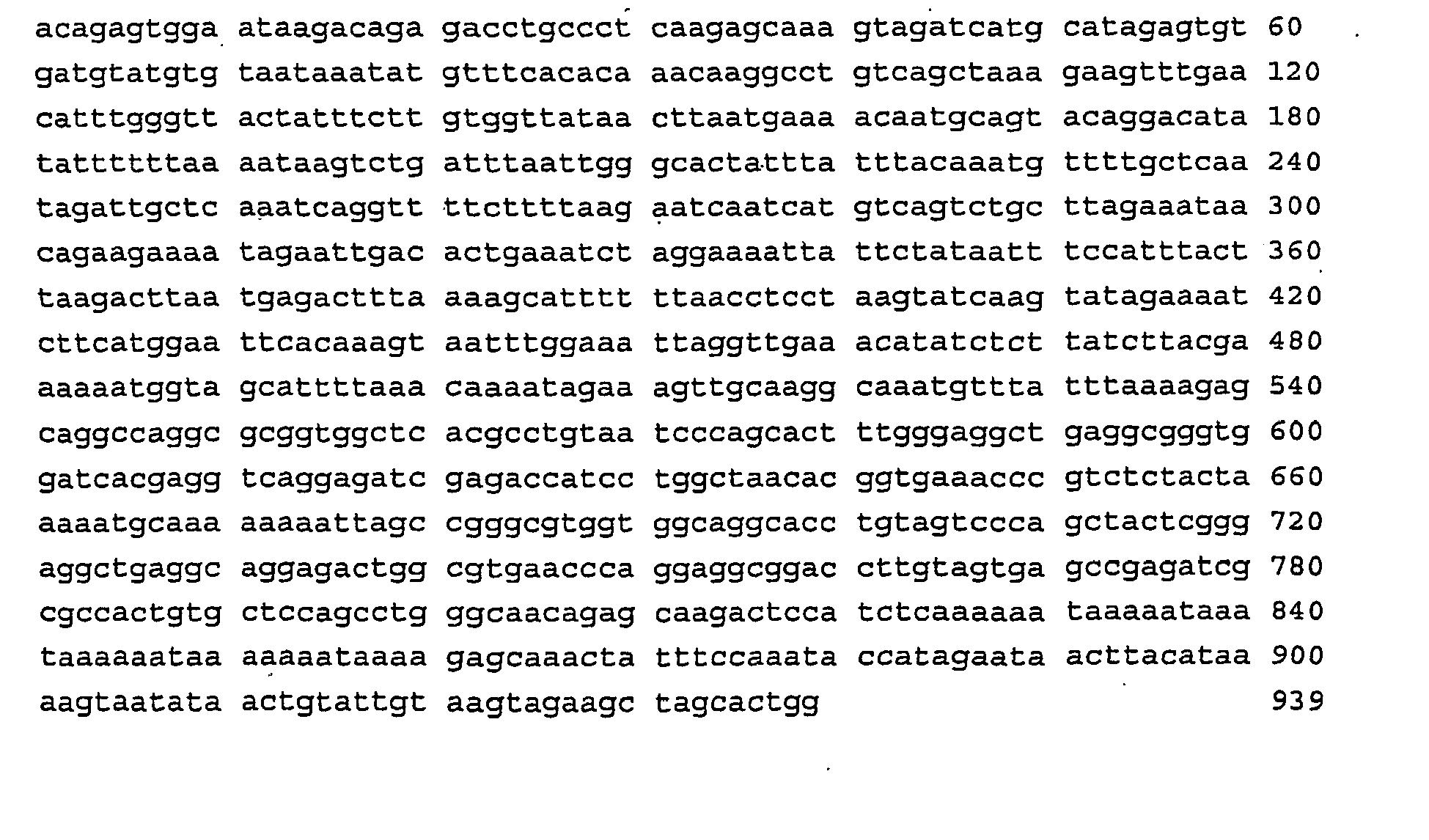
- <210> 7
<211> 939
<212> DNA
<213> Homo sapiens - <400> 7

- <210> 8
<211> 939
<212> DNA
<213> Homo sapiens - <400> 8

- <210> 9
<211> 20
<212> DNA
<213> Homo sapiens - <400> 9
ggcggggggc gcacagagcc 20 - <210> 10
<211> 22
<212> DNA
<213> Homo sapiens - <400> 10
gagatggagt cttgctctgt tg 22 - <210> 11
<211> 21
<212> DNA
<213> Homo sapiens - <400> 11
acagagtgga ataagacaga g 21 - <210> 12
<211> 21
<212> DNA
<213> Homo sapiens - <400> 12
ccagtgctag cttctactta c 21 - <210> 13
<211> 425
<212> PRT
<213> Homo sapiens - <400> 13


Claims (28)
- Isoliert vorliegende Polynukleotidsequenz des PAR1 Gens, dadurch gekennzeichnet, dass an Position 3090 der Sequenz gemäß NM-001992 ein Austausch des T gegen ein C vorliegt.
- Isoliert vorliegende Polynukleotidsequenz nach Anspruch 1, dadurch gekennzeichnet, dass die Polynukleotidsequenz des PAR1 Gens eine Sequenz gemäß SEQ ID NO: 2 umfasst.
- Isoliert vorliegende Polynukleotidsequenz nach Anspruch 1, dadurch gekennzeichnet, dass die Polynukleotidsequenz des PAR1 Gens aus einer Sequenz gemäß SEQ ID NO: 2 besteht.
- Isoliert vorliegende Polynukleotidsequenz des PAR1 Gens, dadurch gekennzeichnet, dass an Position 3329 der Sequenz gemäß NM_001992 ein Austausch des A gegen ein C vorliegt.
- Isoliert vorliegende Polynukleotidsequenz nach Anspruch 4, dadurch gekennzeichnet, dass die Polynukleotidsequenz des PAR 1 Gens eine Sequenz gemäß SEQ ID Nr. 3 umfasst.
- Isoliert vorliegende Polynukleotidsequenz nach Anspruch 4, dadurch gekennzeichnet, dass die Polynukleotidsequenz des PAR 1 Gens aus einer Sequenz gemäß SEQ ID Nr. 3 besteht.
- Isoliert vorliegende Polynukleotidsequenz des PAR 1 Gens, dadurch gekennzeichnet, dass jeweils bezogen auf NM_001992 an Position 3090 ein Austausch des T gegen ein C und an Position 3329 ein Austausch des A gegen ein C vorliegt.
- Isoliert vorliegende Polynukleotidsequenz nach Anspruch 7, dadurch gekennzeichnet, dass die Polynukleotidsequenz des PAR 1 Gens eine Sequenz gemäß SEQ ID Nr. 4 umfasst.
- Isoliert vorliegende Polynukleotidsequenz nach Anspruch 7, dadurch gekennzeichnet, dass die Polynukleotidsequenz des PAR 1 Gens aus einer Sequenz gemäß SEQ ID Nr. 4 besteht.
- Isoliert vorliegender Teil der Polynukleotidsequenz des PAR 1 Gens bestehend aus einer Sequenz gemäß SEQ ID Nr. 5.
- Isoliert vorliegender Teil der Polynukleotidsequenz des PAR 1 Gens bestehend aus einer Sequenz gemäß SEQ ID Nr. 6.
- Isoliert vorliegender Teil der Polynukleotidsequenz des PAR 1 Gens bestehend aus einer Sequenz gemäß SEQ ID Nr. 7.
- Isoliert vorliegender Teil der Polynukleotidsequenz des PAR 1 Gens bestehend aus einer Sequenz gemäß SEQ ID Nr. 8.
- Herstellung einer Polynukleotidsequenz gemäß einem der Ansprüche 1 bis 9 mittels der folgenden Verfahrensschritte:a] Bereitstellung von humaner cDNA enthaltend eine PAR 1 Sequenz gemäß SEQ ID Nr. 2 und/oder eine PAR 1 Sequenz gemäß SEQ ID Nr. 3 und/oder eine PAR 1 Sequenz gemäß SEQ ID Nr. 4,b] Bereitstellung eine Primerpaares gemäß SEQ ID Nr. 9 und SEQ ID Nr. 10.c] Amplifizierung der PAR 1 Polynukleotidsequenz durch die Polymerasekettenverlängerungsreaktion (PCR),d] Isolierung und/oder Reinigung des entstandenen Fragments mit einer Länge von 3,56 kb aus c],e] Sequenzierung des Fragments aus d].
- Herstellung einer Polynukleotidsequenz gemäß einem der Ansprüche 10 bis 13 mittels der folgenden Verfahrensschritte:a] Bereitstellung von
humaner genomischer DNA enthaltend eine PAR 1 Sequenz gemäß SEQ lD Nr. 1 und/oder eine PAR 1 Sequenz gemäß SEQ ID Nr. 2 und/oder eine PAR 1 Sequenz gemäß SEQ ID Nr. 3 und/oder eine PAR 1 Sequenz gemäß SEQ ID Nr. 4b] Bereitstellung eines Primerpaares gemäß SEQ ID Nr. 11 und SEQ ID Nr. 12c] Amplifizierung des Fragments der PAR 1 Polynukleotidsequenz durch die Polymerasekettenverlängerungsreaktion (PCR),d] Isolierung und/oder Reinigung des entstandenen Fragments aus c],e] Sequenzierung des Fragments aus d]. - Verfahren zum Nachweis, ob in einem PAR 1 Gen an Position 3090 der Sequenz gemäß NM_001992 ein Austausch von T nach C und/oder an Position 3329 der Sequenz gemäß NM_001992 ein Austausch von A nach C vorliegt oder nicht vorliegt, umfassend die folgenden Verfahrensschritte:a] Bereitstellung von biologischem Material enthaltend Zellen eines Menschen,b] Gewinnung von chromosomaler DNA aus dem Material von a],c] Amplifizierung eines Polynukleotidfragments mittels der Primer gemäß SEQ ID Nr. 11 und SEQ ID Nr. 12 durch eine PCR-Reaktiond] Sequenzierung des Polynukleotidfragments aus c].
- Verfahren zum Nachweis, ob in einem PAR 1 Gen an Position 3090 der Sequenz gemäß NM_001992 ein Austausch von T nach C und/oder an Position 3329 der Sequenz gemäß NM_001992 ein Austausch von A nach C vorliegt oder nicht vorliegt, umfassend die folgenden Verfahrensschritte:a] Bereitstellung von biologischem Material enthaltend Zellen eines Menschen,b] Gewinnung von RNA aus dem Material von a],c] Umschreiben der RNA in cDNA mittels reverser Transkriptase,d] eventuell Amplifizierung eines Polynukleotidfragments mittels der Primer gemäß SEQ ID Nr. 10 und SEQ ID Nr. 11 durch die PCR-Reaktion ,e] Sequenzzierung der cDNA aus c] und/oder des Polynukleotidfragments aus d].
- Verfahren zum Nachweis, ob in einem PAR 1 Gen an Position 3090 der Sequenz gemäß NM_001992 ein Austausch von T nach C und/oder an Position 3329 der Sequenz gemäß NM_001992 ein Austausch von A nach C vorliegt oder nicht vorliegt, umfassend die folgenden Verfahrensschritte:a] Bereitstellung von biologischem Material enthaltend Zellen eines Menschen,b] Gewinnung von chromosomaler DNA aus dem Material von a],c] Southern-Blotting der chromosonalen DNA aus b]d] Bereitstellung einer Sonde gemäß SEQ ID Nr. 5 und/oder SEQ ID Nr. 6 und/oder SEQ ID Nr. 7 und/oder SEQ ID Nr. 8,e] Hybridisierung des Southern Blots aus c] mit der Sonde aus d] unter stringenten Hybridisierungsbedingungen,f] Bestimmung des Vorliegens oder Nichtvorliegens einer genetischen Variation im Gen PAR 1 an Position 3090 und/oder 3329 gemäß NM_001992 durch Vergleich der Ergebnisse der Hybridisierung aus e].
- Verfahren zum Nachweis, ob in einem PAR 1 Gen an Position 3090 der Sequenz gemäß NM_001992 ein Austausch von T nach C und/oder an Position 3329 der Sequenz gemäß NM_001992 ein Austausch von A nach C vorliegt oder nicht vorliegt, umfassend die folgenden Verfahrensschrittea] Bereitstellung von biologischem Material enthaltend Zellen eines Menschen,b] Gewinnung von RNA aus dem Material von a]c] Bereitstellung einer Sonde gemäß SEQ ID Nr. 5 und/oder SEQ ID Nr. 6 und/oder SEQ ID Nr. 7 und/oder SEQ ID Nr. 8,e] Hybridisierung des Northern Blots aus c] mit der Sonde aus d] unter stringenten Hybridisierungsbedingugnen,f] Bestimmung des Vorliegens oder Nichtvorliegens einer genetischen Variation im Gen PAR 1 an Position 3090 und/oder 3329 gemäß NM_001992 durch Vergleich der Ergebnisse der Hybridisierung.
- Isolierte Polynukleotidsequenz mit einer Anzahl von 21 bis 50 Nukleotiden, gekennzeichnet dadurch, dass eine Sequenz gemäß SEQ ID Nr. 11 enthalten ist.
- Isolierte Polynukleotidsequenz bestehend aus SEQ ID Nr. 11.
- Isolierte Polynukleotidsequenz mit einer Anzahl von 21 bis 50 Nukleotiden, gekennzeichnet dadurch, dass eine Sequenz gemäß SEQ ID Nr. 12 enthalten ist.
- Isolierte Polynukleotidsequenz bestehend aus SEQ ID Nr. 12.
- Verwendung einer isolierten Polynukleotidsequenz gemäß Anspruch 20 oder 21 in Kombination mit einer isolierten Polynukleotidsequenz gemäß Anspruch 22 oder 23 zur Vermehrung eines Fragments aus dem PAR 1 Gen mittels der PCR-Reaktion.
- Verwendung nach Anspruch 24, gekennzeichnet dadurch, dass das PAR 1 Gen an Position 3090 der Sequenz gemäß NM_001992 einen Austausch von T nach C aufweist und/oder an Position 3329 der Sequenz gemäß NM_001992 einen Austausch von A nach C aufweist.
- Kit enthaltenda] eine Polynukleotidsequenz gemäß Anspruch 20 oder 21,b] eine Polynukleotidsequenz gemäß Anspruch 22 oder 23,c] mindestens ein Enzym für die Durchführung der PCR-Reaktiond] sowie eventuell Substanzen und/oder Lösungen für die Ausführung der Polymerasekettenverlängerungsreaktion (PCR),e] sowie eventuell weiterhin Polynukleotidsequenzen gemäß einem oder mehreren der Ansprüche 1 bis 17f] sowie eventuell Reagenzien zur Durchführung einer Sequenzzierung.
- Herstellung des Kit gemäß Anspruch 26 wobeia] eine Polynukleotidsequenz gemäß Anspruch 20 oder 21 hergestellt wird,b] eine Polynukleotidsequenz gemäß Anspruch 22 oder 23 bereitgestellt wird,c] ein Enzym für die Durchführung der PCR-Reaktion bereitgestellt wird,d] gegebenenfalls Reagenzien zur Durchführung einer Sequenzzierung bereitgestellt werdene] eventuell Substanzen und/oder Lösungen für die Ausführung der Polymerasekettenverlängerungsreaktion (PCR) bereitgestellt werden,f] eventuell Polynukleotidsequenzen gemäß einem oder mehreren der Ansprüche 1 bis 13 bereitgestellt werden,g] die Komponenten aus a] bis e] jeweils separat in geeignete Behältnisse gegeben werden,h] die Behältnisse aus g] gegebenenfalls kombiniert in einer oder mehrerer Verpackungseinheiten zusammenfasst werden.
- Verwendung des Kit gemäß Anspruch 26 oder 27 zur Vermehrung eines Fragments aus dem PAR 1 Gen sowie eventuell der weiteren Analyse, ob genetische Variationen im Gen PAR 1 an den Positionen 3090 und/oder 3329 gemäß NM_001992 vorliegen.
Applications Claiming Priority (2)
| Application Number | Priority Date | Filing Date | Title |
|---|---|---|---|
| DE10318496A DE10318496A1 (de) | 2003-04-24 | 2003-04-24 | Analyse und Verwendung von PAR 1 Polymorphismen zur Risikoabschätzung für kardiovaskuläre Erkrankungen |
| PCT/EP2004/004035 WO2004094470A1 (de) | 2003-04-24 | 2004-04-16 | Analyse und verwendung von par 1 polymorphismen zur risikoabschätzung für kardiovaskuläre erkrankungen |
Publications (2)
| Publication Number | Publication Date |
|---|---|
| EP1622940A1 EP1622940A1 (de) | 2006-02-08 |
| EP1622940B1 true EP1622940B1 (de) | 2008-09-03 |
Family
ID=33304897
Family Applications (1)
| Application Number | Title | Priority Date | Filing Date |
|---|---|---|---|
| EP04727840A Expired - Lifetime EP1622940B1 (de) | 2003-04-24 | 2004-04-16 | Analyse und verwendung von par 1 polymorphismen zur risikoabschätzung für kardiovaskuläre erkrankungen |
Country Status (16)
| Country | Link |
|---|---|
| EP (1) | EP1622940B1 (de) |
| JP (1) | JP4728949B2 (de) |
| KR (1) | KR20060006939A (de) |
| CN (1) | CN1791613A (de) |
| AT (1) | ATE407145T1 (de) |
| AU (1) | AU2004232459B2 (de) |
| BR (1) | BRPI0409688A (de) |
| CA (1) | CA2522815A1 (de) |
| DE (2) | DE10318496A1 (de) |
| DK (1) | DK1622940T3 (de) |
| ES (1) | ES2312990T3 (de) |
| IL (1) | IL171477A (de) |
| MX (1) | MXPA05011464A (de) |
| NO (1) | NO20055538L (de) |
| RU (1) | RU2380422C2 (de) |
| WO (1) | WO2004094470A1 (de) |
Families Citing this family (2)
| Publication number | Priority date | Publication date | Assignee | Title |
|---|---|---|---|---|
| RU2322193C1 (ru) * | 2006-12-04 | 2008-04-20 | Федеральное государственное учреждение "Учебно-научный медицинский центр" Управления делами Президента Российской Федерации | Способ оценки генетического риска сердечно-сосудистых заболеваний у спортсменов |
| RU2453606C2 (ru) * | 2010-07-16 | 2012-06-20 | Федеральное государственное автономное образовательное учреждение высшего профессионального образования "ЮЖНЫЙ ФЕДЕРАЛЬНЫЙ УНИВЕРСИТЕТ" | Способ расширенного скрининга предрасположенности к сердечно-сосудистым заболеваниям и биочип для осуществления этого способа |
Family Cites Families (3)
| Publication number | Priority date | Publication date | Assignee | Title |
|---|---|---|---|---|
| EP1075548A1 (de) * | 1998-05-04 | 2001-02-14 | Fraunhofer-Gesellschaft Zur Förderung Der Angewandten Forschung E.V. | Elektrische, integrierte nucleinsäureisolierung, -reinigung und -detektion |
| DE19819889A1 (de) * | 1998-05-04 | 1999-11-11 | Fraunhofer Ges Forschung | Verfahren zur Isolierung von Nucleinsäuren |
| US6322980B1 (en) * | 1999-04-30 | 2001-11-27 | Aclara Biosciences, Inc. | Single nucleotide detection using degradation of a fluorescent sequence |
-
2003
- 2003-04-24 DE DE10318496A patent/DE10318496A1/de not_active Withdrawn
-
2004
- 2004-04-16 ES ES04727840T patent/ES2312990T3/es not_active Expired - Lifetime
- 2004-04-16 JP JP2006505159A patent/JP4728949B2/ja not_active Expired - Fee Related
- 2004-04-16 KR KR1020057020199A patent/KR20060006939A/ko not_active Withdrawn
- 2004-04-16 CN CN200480013663.1A patent/CN1791613A/zh active Pending
- 2004-04-16 AT AT04727840T patent/ATE407145T1/de not_active IP Right Cessation
- 2004-04-16 WO PCT/EP2004/004035 patent/WO2004094470A1/de not_active Ceased
- 2004-04-16 RU RU2005136430/13A patent/RU2380422C2/ru not_active IP Right Cessation
- 2004-04-16 DK DK04727840T patent/DK1622940T3/da active
- 2004-04-16 MX MXPA05011464A patent/MXPA05011464A/es active IP Right Grant
- 2004-04-16 DE DE502004007990T patent/DE502004007990D1/de not_active Expired - Lifetime
- 2004-04-16 AU AU2004232459A patent/AU2004232459B2/en not_active Ceased
- 2004-04-16 BR BRPI0409688-6A patent/BRPI0409688A/pt not_active Application Discontinuation
- 2004-04-16 EP EP04727840A patent/EP1622940B1/de not_active Expired - Lifetime
- 2004-04-16 CA CA002522815A patent/CA2522815A1/en not_active Withdrawn
-
2005
- 2005-10-19 IL IL171477A patent/IL171477A/en not_active IP Right Cessation
- 2005-11-23 NO NO20055538A patent/NO20055538L/no unknown
Also Published As
| Publication number | Publication date |
|---|---|
| CN1791613A (zh) | 2006-06-21 |
| DK1622940T3 (da) | 2009-01-12 |
| ES2312990T3 (es) | 2009-03-01 |
| JP2007534293A (ja) | 2007-11-29 |
| NO20055538L (no) | 2005-11-23 |
| DE502004007990D1 (de) | 2008-10-16 |
| MXPA05011464A (es) | 2006-03-08 |
| RU2380422C2 (ru) | 2010-01-27 |
| IL171477A (en) | 2010-11-30 |
| AU2004232459A1 (en) | 2004-11-04 |
| CA2522815A1 (en) | 2004-11-04 |
| ATE407145T1 (de) | 2008-09-15 |
| JP4728949B2 (ja) | 2011-07-20 |
| WO2004094470A1 (de) | 2004-11-04 |
| RU2005136430A (ru) | 2006-04-20 |
| DE10318496A1 (de) | 2004-11-25 |
| BRPI0409688A (pt) | 2006-04-18 |
| KR20060006939A (ko) | 2006-01-20 |
| EP1622940A1 (de) | 2006-02-08 |
| AU2004232459B2 (en) | 2010-11-11 |
Similar Documents
| Publication | Publication Date | Title |
|---|---|---|
| Miric et al. | Heterogeneous Mutations in the Gene Encoding the�-Subunit of the Stimulatory G Protein of Adenylyl Cyclase in Albright Hereditary Osteodystrophy | |
| DE69333289T2 (de) | Verfahren zur bestimmung von säugetier nukleinsäuren aus stuhlproben und dafür benötigte reagenzien | |
| Petronis | The genes for major psychosis: aberrant sequence or regulation? | |
| DE69605803T2 (de) | Nachweis von fehlpaarungen durch spaltung mit resolvase auf einem festträger | |
| DE60128434T2 (de) | Polymorphismen im menschlichen KDR Gene | |
| DE69230221T2 (de) | Verfahren für die in-vitro-diagnose von mit charcot-marie-tooth-krankheit vom typ-1a zusammenhängenden chromosomenanomalien | |
| DE60115349T2 (de) | Polymorphismen im Gen für den humanen organischen Anionentransporter C (OATP-C) | |
| Naito et al. | Ribosomal ribonucleic acid (rRNA) gene typing for species identification | |
| DE60036750T2 (de) | Verfahren zur Abschätzung der Sensitivität für Osteoporose-Medikamente | |
| EP1305449A2 (de) | Diagnose von mit cd24 assoziierten krankheiten | |
| EP1622940B1 (de) | Analyse und verwendung von par 1 polymorphismen zur risikoabschätzung für kardiovaskuläre erkrankungen | |
| DE69734904T2 (de) | ABO-Glycosyltransferase-Sequenz-Polymorphismus | |
| DE602005004026T2 (de) | Einen transkriptionsfaktor kodierendes humanes prädispositionsgen für autismus sowie dessen verwendungen | |
| DE602005002496T2 (de) | Identifizierung des Gens und der Mutation für die fortschreitende Degenerierung der Sinneszellen (Stäbchen und Zapfen) in der Netzhaut von Hunden und Testmethoden | |
| DE102005048899A1 (de) | Verfahren zur Diagnose thromboembolischer Erkrankungen und koronarer Herzerkrankungen | |
| US6458541B1 (en) | BDNF polymorphism and association with bipolar disorder | |
| US20030157493A1 (en) | BDNF polymorphism and association with bipolar disorder | |
| US20030008301A1 (en) | Association between schizophrenia and a two-marker haplotype near PILB gene | |
| Da Pozzo et al. | Sequence analysis of the complete mitochondrial genome in patients with mitochondrial encephaloneuromyopathies lacking the common pathogenic DNA mutations | |
| CA2263712C (en) | Methods for diagnosing and assessing a predisposition to bipolar affective disorder | |
| DE102017218522B3 (de) | Verfahren zur genbasierten Diagnose eines Legasthenierisikos | |
| DE60311207T2 (de) | Bestimmung der Empfindlichkeit zu Autoimmunerkrankungen, ins besondere Typ 1 Diabetes | |
| US7892744B2 (en) | Analysis and use of PAR1 polymorphisms for evaluating the risk of cardiovascular disorders | |
| Hauke | Candidate gene analysis for bilateral convergent strabismus with exophthalmus in German Brown cattle | |
| DE102004034343B4 (de) | Verfahren zum Nachweis von Spuren genomischer Varianten mittels Nukleinsäure-Amplifikationsreaktionen |
Legal Events
| Date | Code | Title | Description |
|---|---|---|---|
| PUAI | Public reference made under article 153(3) epc to a published international application that has entered the european phase |
Free format text: ORIGINAL CODE: 0009012 |
|
| 17P | Request for examination filed |
Effective date: 20051124 |
|
| AK | Designated contracting states |
Kind code of ref document: A1 Designated state(s): AT BE BG CH CY CZ DE DK EE ES FI FR GB GR HU IE IT LI LU MC NL PL PT RO SE SI SK TR |
|
| RAP1 | Party data changed (applicant data changed or rights of an application transferred) |
Owner name: SANOFI-AVENTIS DEUTSCHLAND GMBH |
|
| DAX | Request for extension of the european patent (deleted) | ||
| RIN1 | Information on inventor provided before grant (corrected) |
Inventor name: CZECH, JOERG Inventor name: KOZIAN, DETLEF C/O SANOFI-AVENTIS DEUTSCHLAND GMBH Inventor name: SIEGLER, KARL-ERNST Inventor name: RICARD, SYLVAIN Inventor name: DELEUZE, JEAN-FRANCOIS Inventor name: MACE, SANDRINE |
|
| GRAP | Despatch of communication of intention to grant a patent |
Free format text: ORIGINAL CODE: EPIDOSNIGR1 |
|
| RIN1 | Information on inventor provided before grant (corrected) |
Inventor name: MACE, SANDRINE Inventor name: RICARD, SYLVAIN Inventor name: CZECH, JOERG Inventor name: KOZIAN, DETLEF Inventor name: SIEGLER, KARL-ERNST Inventor name: DELEUZE, JEAN-FRANCOIS |
|
| GRAS | Grant fee paid |
Free format text: ORIGINAL CODE: EPIDOSNIGR3 |
|
| GRAA | (expected) grant |
Free format text: ORIGINAL CODE: 0009210 |
|
| AK | Designated contracting states |
Kind code of ref document: B1 Designated state(s): AT BE BG CH CY CZ DE DK EE ES FI FR GB GR HU IE IT LI LU MC NL PL PT RO SE SI SK TR |
|
| REG | Reference to a national code |
Ref country code: GB Ref legal event code: FG4D Free format text: NOT ENGLISH |
|
| REG | Reference to a national code |
Ref country code: CH Ref legal event code: EP |
|
| REG | Reference to a national code |
Ref country code: IE Ref legal event code: FG4D Free format text: LANGUAGE OF EP DOCUMENT: GERMAN |
|
| REF | Corresponds to: |
Ref document number: 502004007990 Country of ref document: DE Date of ref document: 20081016 Kind code of ref document: P |
|
| REG | Reference to a national code |
Ref country code: SE Ref legal event code: TRGR |
|
| REG | Reference to a national code |
Ref country code: DK Ref legal event code: T3 |
|
| PG25 | Lapsed in a contracting state [announced via postgrant information from national office to epo] |
Ref country code: NL Free format text: LAPSE BECAUSE OF FAILURE TO SUBMIT A TRANSLATION OF THE DESCRIPTION OR TO PAY THE FEE WITHIN THE PRESCRIBED TIME-LIMIT Effective date: 20080903 |
|
| PG25 | Lapsed in a contracting state [announced via postgrant information from national office to epo] |
Ref country code: SI Free format text: LAPSE BECAUSE OF FAILURE TO SUBMIT A TRANSLATION OF THE DESCRIPTION OR TO PAY THE FEE WITHIN THE PRESCRIBED TIME-LIMIT Effective date: 20080903 Ref country code: FI Free format text: LAPSE BECAUSE OF FAILURE TO SUBMIT A TRANSLATION OF THE DESCRIPTION OR TO PAY THE FEE WITHIN THE PRESCRIBED TIME-LIMIT Effective date: 20080903 |
|
| REG | Reference to a national code |
Ref country code: ES Ref legal event code: FG2A Ref document number: 2312990 Country of ref document: ES Kind code of ref document: T3 |
|
| NLV1 | Nl: lapsed or annulled due to failure to fulfill the requirements of art. 29p and 29m of the patents act | ||
| REG | Reference to a national code |
Ref country code: IE Ref legal event code: FD4D |
|
| PG25 | Lapsed in a contracting state [announced via postgrant information from national office to epo] |
Ref country code: BG Free format text: LAPSE BECAUSE OF FAILURE TO SUBMIT A TRANSLATION OF THE DESCRIPTION OR TO PAY THE FEE WITHIN THE PRESCRIBED TIME-LIMIT Effective date: 20081203 Ref country code: IE Free format text: LAPSE BECAUSE OF FAILURE TO SUBMIT A TRANSLATION OF THE DESCRIPTION OR TO PAY THE FEE WITHIN THE PRESCRIBED TIME-LIMIT Effective date: 20080903 |
|
| PG25 | Lapsed in a contracting state [announced via postgrant information from national office to epo] |
Ref country code: SK Free format text: LAPSE BECAUSE OF FAILURE TO SUBMIT A TRANSLATION OF THE DESCRIPTION OR TO PAY THE FEE WITHIN THE PRESCRIBED TIME-LIMIT Effective date: 20080903 Ref country code: PT Free format text: LAPSE BECAUSE OF FAILURE TO SUBMIT A TRANSLATION OF THE DESCRIPTION OR TO PAY THE FEE WITHIN THE PRESCRIBED TIME-LIMIT Effective date: 20090203 Ref country code: RO Free format text: LAPSE BECAUSE OF FAILURE TO SUBMIT A TRANSLATION OF THE DESCRIPTION OR TO PAY THE FEE WITHIN THE PRESCRIBED TIME-LIMIT Effective date: 20080903 Ref country code: CZ Free format text: LAPSE BECAUSE OF FAILURE TO SUBMIT A TRANSLATION OF THE DESCRIPTION OR TO PAY THE FEE WITHIN THE PRESCRIBED TIME-LIMIT Effective date: 20080903 |
|
| PLBE | No opposition filed within time limit |
Free format text: ORIGINAL CODE: 0009261 |
|
| STAA | Information on the status of an ep patent application or granted ep patent |
Free format text: STATUS: NO OPPOSITION FILED WITHIN TIME LIMIT |
|
| PG25 | Lapsed in a contracting state [announced via postgrant information from national office to epo] |
Ref country code: EE Free format text: LAPSE BECAUSE OF FAILURE TO SUBMIT A TRANSLATION OF THE DESCRIPTION OR TO PAY THE FEE WITHIN THE PRESCRIBED TIME-LIMIT Effective date: 20080903 |
|
| 26N | No opposition filed |
Effective date: 20090604 |
|
| PGFP | Annual fee paid to national office [announced via postgrant information from national office to epo] |
Ref country code: AT Payment date: 20090415 Year of fee payment: 6 Ref country code: LU Payment date: 20090424 Year of fee payment: 6 |
|
| BERE | Be: lapsed |
Owner name: SANOFI-AVENTIS DEUTSCHLAND G.M.B.H. Effective date: 20090430 |
|
| PG25 | Lapsed in a contracting state [announced via postgrant information from national office to epo] |
Ref country code: MC Free format text: LAPSE BECAUSE OF NON-PAYMENT OF DUE FEES Effective date: 20090430 |
|
| PG25 | Lapsed in a contracting state [announced via postgrant information from national office to epo] |
Ref country code: PL Free format text: LAPSE BECAUSE OF FAILURE TO SUBMIT A TRANSLATION OF THE DESCRIPTION OR TO PAY THE FEE WITHIN THE PRESCRIBED TIME-LIMIT Effective date: 20080903 Ref country code: BE Free format text: LAPSE BECAUSE OF NON-PAYMENT OF DUE FEES Effective date: 20090430 |
|
| PG25 | Lapsed in a contracting state [announced via postgrant information from national office to epo] |
Ref country code: GR Free format text: LAPSE BECAUSE OF FAILURE TO SUBMIT A TRANSLATION OF THE DESCRIPTION OR TO PAY THE FEE WITHIN THE PRESCRIBED TIME-LIMIT Effective date: 20081204 |
|
| PG25 | Lapsed in a contracting state [announced via postgrant information from national office to epo] |
Ref country code: AT Free format text: LAPSE BECAUSE OF NON-PAYMENT OF DUE FEES Effective date: 20100416 |
|
| PG25 | Lapsed in a contracting state [announced via postgrant information from national office to epo] |
Ref country code: HU Free format text: LAPSE BECAUSE OF FAILURE TO SUBMIT A TRANSLATION OF THE DESCRIPTION OR TO PAY THE FEE WITHIN THE PRESCRIBED TIME-LIMIT Effective date: 20090304 |
|
| PGFP | Annual fee paid to national office [announced via postgrant information from national office to epo] |
Ref country code: ES Payment date: 20110518 Year of fee payment: 8 Ref country code: FR Payment date: 20110426 Year of fee payment: 8 Ref country code: DE Payment date: 20110413 Year of fee payment: 8 Ref country code: CH Payment date: 20110412 Year of fee payment: 8 Ref country code: SE Payment date: 20110412 Year of fee payment: 8 |
|
| PG25 | Lapsed in a contracting state [announced via postgrant information from national office to epo] |
Ref country code: TR Free format text: LAPSE BECAUSE OF FAILURE TO SUBMIT A TRANSLATION OF THE DESCRIPTION OR TO PAY THE FEE WITHIN THE PRESCRIBED TIME-LIMIT Effective date: 20080903 |
|
| PGFP | Annual fee paid to national office [announced via postgrant information from national office to epo] |
Ref country code: DK Payment date: 20110412 Year of fee payment: 8 Ref country code: GB Payment date: 20110413 Year of fee payment: 8 |
|
| PG25 | Lapsed in a contracting state [announced via postgrant information from national office to epo] |
Ref country code: CY Free format text: LAPSE BECAUSE OF FAILURE TO SUBMIT A TRANSLATION OF THE DESCRIPTION OR TO PAY THE FEE WITHIN THE PRESCRIBED TIME-LIMIT Effective date: 20080903 |
|
| PGFP | Annual fee paid to national office [announced via postgrant information from national office to epo] |
Ref country code: IT Payment date: 20110420 Year of fee payment: 8 |
|
| PG25 | Lapsed in a contracting state [announced via postgrant information from national office to epo] |
Ref country code: LU Free format text: LAPSE BECAUSE OF NON-PAYMENT OF DUE FEES Effective date: 20100416 |
|
| REG | Reference to a national code |
Ref country code: DK Ref legal event code: EBP |
|
| REG | Reference to a national code |
Ref country code: CH Ref legal event code: PL |
|
| REG | Reference to a national code |
Ref country code: SE Ref legal event code: EUG |
|
| GBPC | Gb: european patent ceased through non-payment of renewal fee |
Effective date: 20120416 |
|
| REG | Reference to a national code |
Ref country code: FR Ref legal event code: ST Effective date: 20121228 |
|
| PG25 | Lapsed in a contracting state [announced via postgrant information from national office to epo] |
Ref country code: CH Free format text: LAPSE BECAUSE OF NON-PAYMENT OF DUE FEES Effective date: 20120430 Ref country code: LI Free format text: LAPSE BECAUSE OF NON-PAYMENT OF DUE FEES Effective date: 20120430 Ref country code: GB Free format text: LAPSE BECAUSE OF NON-PAYMENT OF DUE FEES Effective date: 20120416 |
|
| REG | Reference to a national code |
Ref country code: DE Ref legal event code: R119 Ref document number: 502004007990 Country of ref document: DE Effective date: 20121101 |
|
| PG25 | Lapsed in a contracting state [announced via postgrant information from national office to epo] |
Ref country code: FR Free format text: LAPSE BECAUSE OF NON-PAYMENT OF DUE FEES Effective date: 20120430 Ref country code: SE Free format text: LAPSE BECAUSE OF NON-PAYMENT OF DUE FEES Effective date: 20120417 Ref country code: IT Free format text: LAPSE BECAUSE OF NON-PAYMENT OF DUE FEES Effective date: 20120416 |
|
| REG | Reference to a national code |
Ref country code: ES Ref legal event code: FD2A Effective date: 20130716 |
|
| PG25 | Lapsed in a contracting state [announced via postgrant information from national office to epo] |
Ref country code: ES Free format text: LAPSE BECAUSE OF NON-PAYMENT OF DUE FEES Effective date: 20120417 |
|
| PG25 | Lapsed in a contracting state [announced via postgrant information from national office to epo] |
Ref country code: DK Free format text: LAPSE BECAUSE OF NON-PAYMENT OF DUE FEES Effective date: 20120430 |
|
| PG25 | Lapsed in a contracting state [announced via postgrant information from national office to epo] |
Ref country code: DE Free format text: LAPSE BECAUSE OF NON-PAYMENT OF DUE FEES Effective date: 20121101 |