EP1624634A2 - Verfahren und Einrichtung zum Empfangen von Signalen in einem MIMO-System - Google Patents
Verfahren und Einrichtung zum Empfangen von Signalen in einem MIMO-System Download PDFInfo
- Publication number
- EP1624634A2 EP1624634A2 EP05016995A EP05016995A EP1624634A2 EP 1624634 A2 EP1624634 A2 EP 1624634A2 EP 05016995 A EP05016995 A EP 05016995A EP 05016995 A EP05016995 A EP 05016995A EP 1624634 A2 EP1624634 A2 EP 1624634A2
- Authority
- EP
- European Patent Office
- Prior art keywords
- signals
- signal
- mimo
- detection
- dfe
- Prior art date
- Legal status (The legal status is an assumption and is not a legal conclusion. Google has not performed a legal analysis and makes no representation as to the accuracy of the status listed.)
- Withdrawn
Links
Images


Classifications
-
- H—ELECTRICITY
- H04—ELECTRIC COMMUNICATION TECHNIQUE
- H04B—TRANSMISSION
- H04B7/00—Radio transmission systems, i.e. using radiation field
- H04B7/02—Diversity systems; Multi-antenna system, i.e. transmission or reception using multiple antennas
- H04B7/04—Diversity systems; Multi-antenna system, i.e. transmission or reception using multiple antennas using two or more spaced independent antennas
- H04B7/0413—MIMO systems
-
- H—ELECTRICITY
- H04—ELECTRIC COMMUNICATION TECHNIQUE
- H04L—TRANSMISSION OF DIGITAL INFORMATION, e.g. TELEGRAPHIC COMMUNICATION
- H04L25/00—Baseband systems
- H04L25/02—Details ; arrangements for supplying electrical power along data transmission lines
- H04L25/03—Shaping networks in transmitter or receiver, e.g. adaptive shaping networks
- H04L25/03006—Arrangements for removing intersymbol interference
- H04L25/03012—Arrangements for removing intersymbol interference operating in the time domain
- H04L25/03019—Arrangements for removing intersymbol interference operating in the time domain adaptive, i.e. capable of adjustment during data reception
- H04L25/03057—Arrangements for removing intersymbol interference operating in the time domain adaptive, i.e. capable of adjustment during data reception with a recursive structure
-
- H—ELECTRICITY
- H04—ELECTRIC COMMUNICATION TECHNIQUE
- H04B—TRANSMISSION
- H04B7/00—Radio transmission systems, i.e. using radiation field
- H04B7/02—Diversity systems; Multi-antenna system, i.e. transmission or reception using multiple antennas
- H04B7/04—Diversity systems; Multi-antenna system, i.e. transmission or reception using multiple antennas using two or more spaced independent antennas
- H04B7/08—Diversity systems; Multi-antenna system, i.e. transmission or reception using multiple antennas using two or more spaced independent antennas at the receiving station
- H04B7/0837—Diversity systems; Multi-antenna system, i.e. transmission or reception using multiple antennas using two or more spaced independent antennas at the receiving station using pre-detection combining
- H04B7/0842—Weighted combining
- H04B7/0848—Joint weighting
- H04B7/0854—Joint weighting using error minimizing algorithms, e.g. minimum mean squared error [MMSE], "cross-correlation" or matrix inversion
-
- H—ELECTRICITY
- H04—ELECTRIC COMMUNICATION TECHNIQUE
- H04L—TRANSMISSION OF DIGITAL INFORMATION, e.g. TELEGRAPHIC COMMUNICATION
- H04L25/00—Baseband systems
- H04L25/02—Details ; arrangements for supplying electrical power along data transmission lines
- H04L25/03—Shaping networks in transmitter or receiver, e.g. adaptive shaping networks
- H04L25/03006—Arrangements for removing intersymbol interference
- H04L2025/0335—Arrangements for removing intersymbol interference characterised by the type of transmission
- H04L2025/03375—Passband transmission
-
- H—ELECTRICITY
- H04—ELECTRIC COMMUNICATION TECHNIQUE
- H04L—TRANSMISSION OF DIGITAL INFORMATION, e.g. TELEGRAPHIC COMMUNICATION
- H04L25/00—Baseband systems
- H04L25/02—Details ; arrangements for supplying electrical power along data transmission lines
- H04L25/03—Shaping networks in transmitter or receiver, e.g. adaptive shaping networks
- H04L25/03006—Arrangements for removing intersymbol interference
- H04L2025/03433—Arrangements for removing intersymbol interference characterised by equaliser structure
- H04L2025/03439—Fixed structures
- H04L2025/03445—Time domain
- H04L2025/03471—Tapped delay lines
- H04L2025/03484—Tapped delay lines time-recursive
- H04L2025/0349—Tapped delay lines time-recursive as a feedback filter
Definitions
- the present invention relates generally to a wireless communication system, and in particular, to an improved receiver for a multicarrier-based MIMO (Multiple-Input Multiple-Output) system.
- MIMO Multiple-Input Multiple-Output
- a MIMO system equips multiple antennas for both a transmitter and a receiver in order to raise spectrum efficiency.
- the MIMO system is undergoing great advances.
- a D-BLAST Diagonal Bell Labs Layered Space-Time
- a space diversity gain and a transmission/reception diversity gain can be obtained.
- V-BLAST Very-BLAST
- MIMO-DFE MIMO Decision Feedback Equalizer
- IIR Infinite-length Impulse Response
- FIR Finite-length Impulse Response
- FIG. 1 is a block diagram of a conventional MIMO MMSE-DFE receiver.
- signals received via receiving antennas 11-1 through 11-n are passed through a feedforward (FWD) filter 13, to which a tap value for an MSE (Minimum Square Error) is applied, and transmitted to their associated adders 15-1 through 15-m.
- FWD feedforward
- MSE Minimum Square Error
- Signals output from the decision elements 17-1 through 17-m are passed through a feedback filter (FBF) 19 operating under the same principle as the feedforward filter 13, and transmitted to the adders 15-1 through 15-m, in which they are added to the signals output from the feedforward filter 13.
- BPF feedback filter
- an OSIC Organic Successive Interference Cancellation
- the OSIC scheme exhibits the best effect in an area where an SNR (Signal-to-Noise Ratio) is high.
- An OSIC-DFE selects a stream having the highest reliability from the receiving ends and cancels a CCI (Co-Channel Interference) using the OSIC scheme.
- FIG. 2 is a block diagram illustrating signal detection structures of first two stages of a conventional OSIC-DFE receiver.
- the OSIC-DFE receiver is composed of a plurality of MISO (Multiple-Input Single-Output)-DFE structures for successive signal detection.
- signals received via receiving antennas 21-1 through 21-n are processed by a feedforward filter 23.
- a signal output from the feedforward filter 23 is transmitted to an adder 25.
- a signal output from the adder 25 is passed through a decision element 27 and recovered as a transmission signal.
- a signal output from the decision element 27 is passed through a feedback filter 29, and transmitted to the adder 25, in which it is added to the signal output from the feedforward filter 23.
- the signal output from the decision element 27 is also transmitted to an interference cancellation module 24 and cancelled from the signals received via the antennas.
- the OSIC-DFE receiver successively detects a signal having fewer errors from the received signals, cancels the detected signal from the received signals, and then detects a next signal from the received signals, it exhibits good performance in terms of the SINR (Signal-to-Interference-and-Noise Ratio) and the MSE.
- SINR Signal-to-Interference-and-Noise Ratio
- the OSIC-DFE receiver is very complex, since inverse matrix calculations with respect to an input self-correlation matrix corresponding to the square of the number of transmitting antennas are required. For example, in the case of a 6x6 MIMO system, when first through sixth equalizing processes are performed, a total of 21 (6, 5, 4, 3, 2, and 1 in each equalizer) inverse matrix calculations are required.
- an increase in the BER (Bit Error Rate) of an initially detected data stream causes error propagation to the data streams detected by subsequent detecting units, deteriorating system performance.
- the present invention is for substantially solving at least the above problems and/or disadvantages and to provide at least the advantages below. Accordingly, the object of the present invention is to provide a MIMO receiver having relatively low complexity that improves system performance.
- An aspect of the present invention is to apply to a MIMO receiver an SIC mechanism that can minimize the number of inverse matrix calculations for detecting signals received via multiple antennas.
- a further aspect of the present invention is to provide a MIMO receiver that enables effective interference cancellation through reliability normalization.
- a further aspect of the present invention is to provide a MIMO receiver that enables effective CCI cancellation by applying weighted CCI cancellation to an initial detector on the basis of reliability normalization of the data streams according to a log-likelihood ratio.
- a MIMO receiving apparatus includes a detection priority decision unit, which receives signals transmitted from M transmitting antennas via N receiving antennas and determines the detection priorities of the signals, and a signal detector, which successively detects the signals from a signal having a higher priority according to the detection priorities determined by the detection priority decision unit.
- the detection priority decision unit is a MIMO-DFE, which includes a feedforward filter having (N+ 1) taps corresponding to the respective receiving antennas and a feedback filter having N taps corresponding to the respective detected signals.
- the detection priority decision unit includes a MIMO-DFE, which detects the signals and outputs the detected signals, and an interference estimator, which outputs weighted signals obtained by multiplying the signals output from the MIMO-DFE by weights according to the transmitting antennas.
- the signal detector includes M signal detecting units, which are connected in series and detect the respective signals having different detection priorities.
- each of the M signal detecting units includes an interference cancellation module, which cancels an interference component of the signals input from the receiving antennas using the signals output from the interference estimator, and a signal detection module, which detects a signal having the highest detection priority from among the interference cancelled signals.
- weights are calculated using the SINRs of the transmitting antennas.
- the interference estimator includes multipliers, which multiply the parallel signals output from the MIMO-DFE by the weights, and a symbol interference estimation module, which estimates the ISI (Inter-Symbol Interference) of the signal having the highest detection priority.
- multipliers which multiply the parallel signals output from the MIMO-DFE by the weights
- symbol interference estimation module which estimates the ISI (Inter-Symbol Interference) of the signal having the highest detection priority.
- the interference estimator includes multipliers, which multiply parallel signals output from the MIMO-DFE by the weights, and a symbol interference estimation module, which estimates ISI of each of the signals having different detection priorities.
- the signal detection module is a MISO-DFE.
- the MISO-DFE includes a feedforward filter having (N+1) taps corresponding to the respective receiving antennas and a feedback filter having N taps corresponding to the respective detected signals.
- a signal receiving method in a MIMO system including M transmitting antennas and N receiving antennas includes the steps of determining the detection priorities of the signals received via the receiving antennas at a predetermined time; and successively detecting the signals from a signal having a higher priority according to the determined detection priorities.
- the determining of the detection priorities includes the steps of pre-detecting the signals; and outputting weighted signals obtained by multiplying the pre-detected signals by weights according to the transmitting antennas.
- signal detection is successively performed M number of times from a signal having a higher priority.
- the detection of the signal in each time includes the steps of canceling an interference component from the signals input from the receiving antennas using the weighted signals; and detecting a signal having the highest detection priority from among the signals remaining by excluding a signal detected in a previous time period from the interference cancelled signals.
- the interference component includes a CCI (Co-Channel Interference) and an ISI.
- the detection of the signal in each time period includes the steps of removing signals remaining by excluding a signal having the highest detection priority from the signals remaining by excluding a signal detected in a previous time period from the signals input from the receiving antennas; and canceling the ISI of the signal having the highest detection priority.
- weights are calculated using the SINRs of the transmitting antennas.
- FIG. 3 is a block diagram of a MIMO receiving apparatus according to a preferred embodiment of the present invention.
- the MIMO receiving apparatus includes a MIMO MMSE-DFE 310, which detects the data streams transmitted from the m transmitting antennas by receiving signals via the n receiving antennas and determines the processing priorities of the detected data streams, an interference extractor 320, which calculates the reliability coefficients of the data streams by detecting the SINRs of the detected data streams and outputs the signals obtained by multiplying the calculated reliability coefficients by the corresponding data streams, MISO MMSE-DFEs 340 , the number of which is equal to the number of transmitting antennas, m interference cancellation modules 330, which cancel the interference from the data streams input via the receiving antennas in respective detecting units using the signals output from the interference extractor 320 and output the interference-cancelled signals to the MISO MMSE-DFEs 340, respectively.
- a MIMO MMSE-DFE 310 which detects the data streams transmitted from the m transmitting antennas by receiving signals via the n receiving antennas and determines the processing priorities of the detected data streams
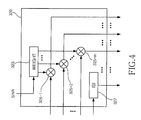
- FIG. 4 is a detailed block diagram illustrating an internal configuration of the interference extractor 320.
- the interference extractor 320 includes a weight generator 323, which detects the SINRs according to the transmitting antennas and generates the reliability coefficients of the transmitting antennas using the detected SINRs, a plurality of multipliers 325-1 through 325-m, which output signals obtained by multiplying the generated reliability coefficients by the signals transmitted from the corresponding transmitting antennas, and an ISI module 327, which generates information for canceling the ISI of a data stream having the highest reliability coefficient.
- a first MISO MMSE-DFE of the MISO MMSE-DFEs 340 receives the data streams, interference of which has been cancelled by a first interference cancellation module 330, and detects a data stream having the highest detection priority.
- a second MISO MMSE-DFE 340 detects a data stream having the highest detection priority from among the data streams remaining by excluding the data stream detected by the first MISO MMSE-DFE 340 from data streams output from a second interference cancellation module (not shown). The same process is repeatedly performed until the last MISO MMSE-DFE 340.
- an inverse matrix calculation of an input self-correlation matrix to detect all of the data streams is required to determine the detection priorities of the data streams in the MIMO MMSE-DFE 310.
- One inverse matrix calculation is required to detect a data stream having the highest priority in every stage of the MISO MMSE-DFEs 340. Accordingly, the total number of inverse matrix calculations is 1+m. This indicates that the present embodiment has a relatively very low complexity as compared with a conventional OSIC-DFE receiver requiring m(m+1)/2 inverse matrix calculations.
- a MIMO MMSE-DFE is deployed to decrease the complexity of the detection order in a first stage of the MIMO receiver according to the embodiment of the present invention, and M MISO MMSE-DFEs are deployed in a next stage.
- the MIMO MMSE-DFE includes feedforward filters for respective receiving antennas, each feedforward filter having (Nf+1) taps and feedback filters each having Nb taps corresponding to the detected data streams.
- Nf is the number of receiving antennas
- Nb is the number of data stream.
- Each of the MISO MMSE-DFEs includes a feedforward filter having (Nf+1) taps corresponding to the receiving antennas and a feedback filter having Nb taps.
- a value input to a decision element to detect a data stream n is obtained from Equation 1.
- c n is a filter weight vector of ( N ( N f + 1) + MN b ) ⁇ 1 and u k denotes input vectors of the feedforward filter and the feedback filter of ( N ( N f + 1) + MN b ) ⁇ 1.
- Equation 2 The filter weight vector for detecting the data stream n is obtained by Equation 2, and an MMSE is obtained by Equation 3.
- ⁇ n 2 is the energy of the data stream n
- R E [ u ( k ) u H (k)] and is an input self-correlation matrix
- p n E [ s n * ( k - ⁇ ) u ( k ) ] and is a cross correlation vector between a delayed data stream n and a filter input vector.
- the data stream n can be detected using the MMSE.
- a conventional OSIC-DFE scheme requires a number of inverse matrix calculations corresponding to a number of non-detected data streams in order to calculate the filter weight vector
- a MIMO MMSE-DFE scheme requires only one inverse matrix calculation of a self-correlation matrix. Accordingly, system complexity can be dramatically reduced in the MIMO MMSE-DFE scheme.
- a detection order calculation for determining a detection order is performed in every detection stage in the conventional OSIC-DFE scheme, the detection order calculation is performed in only a first detection stage in the embodiment of the present invention.
- the receiver complexity can be reduced by linearly changing the number of inverse matrix calculations according to the number of transmitting antennas.
- the overall performance of the receiver is improved by canceling the ISI and the CCI through a reliability normalization of each data stream and redetecting a data stream having a first detection priority.
- Any remaining interference and noise components of a decision element input signal can be represented with a white Gausian channel model as shown in Equation 4.
- BPSK Binary Phase Shift Keying
- a mean value and a variance value of z n ( k ) with respect to a transmitted data stream s n ( k ) can be obtained by Equation 5 and Equation 6, respectively.
- ⁇ n ( k ) c n
- opt H p n ⁇ n 2 ( k ) ⁇ n ( k ) - ⁇ n 2 ( k )
- 2 ⁇ ⁇ n 1 - ⁇ n
- Equation 8 An LLR (log-likelihood ratio) of the data stream n at time k is obtained by Equation 8.
- Pr ( s n ( k ) - 1
- z n ( k ) ) 2 Re ⁇ z n ( k ) ⁇ ( SINR n + 1 )
- the LLR reliability of each bit of the data stream n is proportional to a magnitude of an absolute value of the LLR.
- the absolute value of the LLR is approximated by Equation 9.
- Equation 9 the reliability of each bit of the data stream n is obtained by calculating an absolute value of a real part of the decision element input value and the SINR, which is a reliability element of the data stream n. Therefore, the reliability of the data stream n can be defined as Equation 10.
- the receiver according to the embodiment of the present invention uses a method of canceling the CCI by normalizing the reliability of the other data streams with respect to a data stream having the highest reliability (data stream having an MMSE value) from among all of the data streams in a second stage. Since the reliability of each data stream exists in a log domain, the reliability must be transformed into a linear domain.
- a reliability weight coefficient of the data stream n with respect to a data stream m having the highest reliability in first output signals can be represented as Equation 11.
- ⁇ nm e
- Equation 12 After normalizing the reliability of a data stream having the highest reliability in the first stage on the basis of Equation 11, the ICI and the CCI of the signals received from all of the receiving antennas are cancelled in the second stage as shown in Equation 12.
- the stages after the second stage are composed of the MISO MMSE-DFEs for detecting the remaining data streams in the order detected in the first stage.
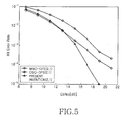
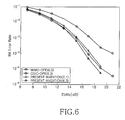
- FIGs. 5 and 6 are graphs illustrating the performance of simulated experimental results of the MIMO receiver according to the preferred embodiment of the present invention.
- the experiment is performed in a channel environment, in which an RMS delay dispersion is 0.5 in a symbol zone and a BER (Bit Error Rate) is reduced according to an exponential function of 6 channel taps, of systems, each including 4 transmitting antennas and 4 receiving antennas.
- the receiver according to the embodiment of the present invention exhibits a performance improvement of 2.5 dB as compared with a conventional OSIC-DFE receiver.
- FIG. 6 when the number of taps of the filters increases, a performance difference is closer to 0.5 dB. However, since the performance difference according to the number of taps of the filters is small, an excellent performance can be exhibited with a few taps. Also, the performance of the receiver according to the embodiment of the present invention that includes a filter having a (2, 1) tap is similar to the performance of a conventional OSIC-DFE receiver having a (6, 3) tap.
- the complexity for determining the signal detection priorities is linearly proportional to the number of transmitting antennas.
- system complexity can be reduced.
- the system complexity can be reduced by minimizing the number of inverse matrix calculations required for an SIC mechanism using one MIMO DFE and a number of MISO DFEs corresponding to the number of transmitting antennas.
- the CCI can be effectively cancelled by normalizing the reliability of the data streams according to an LLR in a first detection stage.
Landscapes
- Engineering & Computer Science (AREA)
- Computer Networks & Wireless Communication (AREA)
- Signal Processing (AREA)
- Power Engineering (AREA)
- Physics & Mathematics (AREA)
- Mathematical Physics (AREA)
- Radio Transmission System (AREA)
- Mobile Radio Communication Systems (AREA)
Applications Claiming Priority (1)
| Application Number | Priority Date | Filing Date | Title |
|---|---|---|---|
| KR1020040061491A KR20060012825A (ko) | 2004-08-04 | 2004-08-04 | 다중입출력 시스템의 수신기 |
Publications (2)
| Publication Number | Publication Date |
|---|---|
| EP1624634A2 true EP1624634A2 (de) | 2006-02-08 |
| EP1624634A3 EP1624634A3 (de) | 2008-02-13 |
Family
ID=35426963
Family Applications (1)
| Application Number | Title | Priority Date | Filing Date |
|---|---|---|---|
| EP05016995A Withdrawn EP1624634A3 (de) | 2004-08-04 | 2005-08-04 | Verfahren und Einrichtung zum Empfangen von Signalen in einem MIMO-System |
Country Status (3)
| Country | Link |
|---|---|
| US (1) | US20060029149A1 (de) |
| EP (1) | EP1624634A3 (de) |
| KR (1) | KR20060012825A (de) |
Cited By (1)
| Publication number | Priority date | Publication date | Assignee | Title |
|---|---|---|---|---|
| WO2023085987A1 (en) * | 2021-11-11 | 2023-05-19 | Telefonaktiebolaget Lm Ericsson (Publ) | A successive interference cancellation receiver for line-of-sight multiple-input multiple-output receivers |
Families Citing this family (24)
| Publication number | Priority date | Publication date | Assignee | Title |
|---|---|---|---|---|
| KR100892104B1 (ko) * | 2005-11-16 | 2009-04-08 | 삼성전자주식회사 | 다중 안테나 통신시스템에서 로그 우도 율 생성 장치 및방법 |
| KR100922938B1 (ko) * | 2006-03-09 | 2009-10-22 | 삼성전자주식회사 | 통신 시스템에서 데이터 수신 방법 및 장치 |
| US7564910B2 (en) * | 2006-04-17 | 2009-07-21 | Zoran Kostic | Method and system for communications with reduced complexity receivers |
| KR100766065B1 (ko) | 2006-06-01 | 2007-10-11 | 한국전자통신연구원 | 다중 입출력 시스템 및 그 시스템의 수신기에서의 송신벡터 복조 방법 |
| KR100902896B1 (ko) | 2006-08-18 | 2009-06-15 | 엘지전자 주식회사 | 피드백 정보의 오류에 대비한 신호 송수신 방법 |
| KR100826529B1 (ko) * | 2006-09-29 | 2008-04-30 | 한국전자통신연구원 | 다수의 송수신 안테나를 갖는 직교주파수 분할 다중 접속시스템에서 효율적인 신호 수신 장치 및 방법 |
| US7623603B2 (en) * | 2006-10-06 | 2009-11-24 | Intel Corporation | Intersymbol interference mitigation |
| KR100808663B1 (ko) * | 2006-12-06 | 2008-03-03 | 한국전자통신연구원 | 다중 송수신 시스템의 신호검출 방법 및 수신 장치 |
| US8457265B2 (en) * | 2007-08-23 | 2013-06-04 | Qualcomm Incorporated | Method and apparatus for generating coefficients in a multi-input-multi-output (MIMO) system |
| KR101359628B1 (ko) * | 2007-10-25 | 2014-02-06 | 삼성전자주식회사 | 인터캐리어 간섭 상쇄 방법, 상기 인터캐리어 간섭 상쇄방법을 이용한 등화방법, 장치, 및 ofdm 수신기 |
| KR100932789B1 (ko) | 2007-12-15 | 2009-12-21 | 한국전자통신연구원 | 다중입력 다중출력 시스템에서 qr 분해 장치 및 그 방법 |
| KR100934007B1 (ko) | 2007-12-18 | 2009-12-28 | 한국전자통신연구원 | 다중입력 다중출력 수신기에서 다차원 검출 장치 및방법과, 이를 이용한 수신 장치 |
| KR100981121B1 (ko) | 2007-12-18 | 2010-09-10 | 한국전자통신연구원 | 다중입력 다중출력 시스템에서의 수신 장치 및 그 방법 |
| KR100890789B1 (ko) | 2007-12-19 | 2009-03-31 | 한국전자통신연구원 | 다중입력 다중출력 시스템의 수신 장치 및 그 방법 |
| KR101158096B1 (ko) * | 2008-11-18 | 2012-06-22 | 삼성전자주식회사 | 다중 송수신 안테나 시스템에서 서로 다른 변조 차수를 갖는 복수의 레이어의 재정렬 방법, 신호 검출 방법 및 그 수신 장치 |
| US8379748B2 (en) | 2008-12-10 | 2013-02-19 | Electronics And Telecommunications Research Institute | Apparatus and method for reception in multi-input multi-output system |
| KR101210599B1 (ko) * | 2009-04-27 | 2012-12-11 | 한국전자통신연구원 | 신호 검출 방법, 신호 검출 장치 및 수신 장치 |
| KR101026021B1 (ko) * | 2009-09-16 | 2011-03-30 | 포항공과대학교 산학협력단 | 시공간 블록 부호의 검출 방법 및 장치 |
| RU2012102842A (ru) | 2012-01-27 | 2013-08-10 | ЭлЭсАй Корпорейшн | Инкрементное обнаружение преамбулы |
| EP2783492B1 (de) * | 2011-10-27 | 2020-05-27 | Intel Corporation | Blockbasierte crestfaktor-verringerung (cfr) |
| US9923595B2 (en) | 2013-04-17 | 2018-03-20 | Intel Corporation | Digital predistortion for dual-band power amplifiers |
| US9813223B2 (en) | 2013-04-17 | 2017-11-07 | Intel Corporation | Non-linear modeling of a physical system using direct optimization of look-up table values |
| KR102221951B1 (ko) * | 2014-07-18 | 2021-03-04 | 삼성전자 주식회사 | Qam-fbmc 시스템을 위한 계층적 검출 방법 및 장치 |
| US9992044B2 (en) | 2015-05-28 | 2018-06-05 | King Fahd University Of Petroleum And Minerals | System and method for applying adaptive frequency-domain RLS DFE for uplink SC-FDMA |
Family Cites Families (3)
| Publication number | Priority date | Publication date | Assignee | Title |
|---|---|---|---|---|
| ES2206374T3 (es) * | 2000-12-28 | 2004-05-16 | Com-Research Gmbh Solutions For Communication Systems | Procedimiento y sistema para la supresion de interferencias para la transmision tdma y/o fdma. |
| US6785341B2 (en) * | 2001-05-11 | 2004-08-31 | Qualcomm Incorporated | Method and apparatus for processing data in a multiple-input multiple-output (MIMO) communication system utilizing channel state information |
| KR20050038122A (ko) * | 2003-10-21 | 2005-04-27 | 한국전자통신연구원 | 다중입력 다중출력에서의 적응 수신 시스템 및 그 방법 |
-
2004
- 2004-08-04 KR KR1020040061491A patent/KR20060012825A/ko not_active Withdrawn
-
2005
- 2005-08-04 EP EP05016995A patent/EP1624634A3/de not_active Withdrawn
- 2005-08-04 US US11/197,144 patent/US20060029149A1/en not_active Abandoned
Non-Patent Citations (3)
| Title |
|---|
| ANGEL LOZANO ET AL: "Layered Space-Time Receivers for Frequency-Selective Wireless Channels" IEEE TRANSACTIONS ON COMMUNICATIONS, IEEE SERVICE CENTER, PISCATAWAY, NJ, US, vol. 50, no. 1, January 2002 (2002-01), XP011010103 ISSN: 0090-6778 * |
| HYOUNKUK KIM ET AL: "An improved V-BLAST receiver based on reliability normalization" VEHICULAR TECHNOLOGY CONFERENCE, 2004. VTC2004-FALL. 2004 IEEE 60TH LOS ANGELES, CA, USA 26-29 SEPT. 2004, PISCATAWAY, NJ, USA,IEEE, 26 September 2004 (2004-09-26), pages 1565-1569, XP010786898 ISBN: 0-7803-8521-7 * |
| MURCH R D ET AL: "Layered space-time equalization for wireless mimo systems" IEEE TRANSACTIONS ON WIRELESS COMMUNICATIONS, IEEE SERVICE CENTER, PISCATAWAY, NJ, US, vol. 2, no. 6, November 2003 (2003-11), pages 1189-1203, XP011103221 ISSN: 1536-1276 * |
Cited By (1)
| Publication number | Priority date | Publication date | Assignee | Title |
|---|---|---|---|---|
| WO2023085987A1 (en) * | 2021-11-11 | 2023-05-19 | Telefonaktiebolaget Lm Ericsson (Publ) | A successive interference cancellation receiver for line-of-sight multiple-input multiple-output receivers |
Also Published As
| Publication number | Publication date |
|---|---|
| KR20060012825A (ko) | 2006-02-09 |
| EP1624634A3 (de) | 2008-02-13 |
| US20060029149A1 (en) | 2006-02-09 |
Similar Documents
| Publication | Publication Date | Title |
|---|---|---|
| US20060029149A1 (en) | Method and apparatus for receiving signals in MIMO system | |
| US7359466B2 (en) | Signal detection by a receiver in a multiple antenna time-dispersive system | |
| US6870882B1 (en) | Finite-length equalization over multi-input multi-output channels | |
| US7961774B2 (en) | Multipath interference-resistant receivers for closed-loop transmit diversity (CLTD) in code-division multiple access (CDMA) systems | |
| EP1575188B1 (de) | Verfahren und Gerät zum Empfangen eines Signals in einem MIMO-Kommunikationssystem | |
| US20080043865A1 (en) | Method and apparatus for transmitting/receiving feedback information and system supporting the same in a multi-user multi-antenna system | |
| JP2007526709A (ja) | W−cdmaシステム内でのsinr推定用crich処理 | |
| EP1719280B1 (de) | Vorrichtung und verfahren zur sequenzschätzung unter verwendung von filterung mit mehreren eingängen und mehreren ausgängen | |
| US20040242179A1 (en) | Iterative detection in mimo systems | |
| US7542528B1 (en) | Far end crosstalk mitigation in multiple-input multiple-output (MIMO) channels using partial maximum likelihood MIMO-DFE | |
| EP1530300B1 (de) | Verfahren und Vorrichtung zur Entzerrerung in einem Empfänger eines CDMA Systems | |
| EP1782554B1 (de) | Vorcodierer und verfahren zum vorcodieren einer eingangssequenz zur erhaltung einer sendesequenz | |
| JP7264260B2 (ja) | 無線通信システム、無線通信方法、送信局装置および受信局装置 | |
| CN101958862A (zh) | 基于叠加结构的自适应判决反馈均衡器 | |
| Zhu et al. | MIMO-DFE based BLAST over frequency selective channels | |
| US20070165735A1 (en) | Method and apparatus for supporting transmit diversity in a receiver | |
| JP2005110201A (ja) | 無線通信システム並びに無線送信機及び無線受信機 | |
| US6970524B1 (en) | Methods and systems for symbol timing recovery | |
| CN100550867C (zh) | 一种多输入多输出系统的宽带接收机 | |
| KR100323616B1 (ko) | 부호 분할 다중 접속 수신기의 검파 장치 및 방법 | |
| US20080069197A1 (en) | Equalizer for equalizing multiple received versions of a signal | |
| Moazzami et al. | Application of a blind channel estimator for source separation in MIMO systems | |
| de Lamare et al. | Adaptive MIMO Decision Feedback Reduced-Rank Equalization Based on Joint Iterative Optimization of Adaptive RLS Estimation Algorithms. | |
| Moazzami et al. | Multistage blind equalization in time-varying MIMO systems | |
| de Lamare et al. | Adaptive MIMO reduced-rank equalization based on joint iterative least squares optimization of estimators |
Legal Events
| Date | Code | Title | Description |
|---|---|---|---|
| PUAI | Public reference made under article 153(3) epc to a published international application that has entered the european phase |
Free format text: ORIGINAL CODE: 0009012 |
|
| 17P | Request for examination filed |
Effective date: 20050804 |
|
| AK | Designated contracting states |
Kind code of ref document: A2 Designated state(s): AT BE BG CH CY CZ DE DK EE ES FI FR GB GR HU IE IS IT LI LT LU LV MC NL PL PT RO SE SI SK TR |
|
| AX | Request for extension of the european patent |
Extension state: AL BA HR MK YU |
|
| PUAL | Search report despatched |
Free format text: ORIGINAL CODE: 0009013 |
|
| AK | Designated contracting states |
Kind code of ref document: A3 Designated state(s): AT BE BG CH CY CZ DE DK EE ES FI FR GB GR HU IE IS IT LI LT LU LV MC NL PL PT RO SE SI SK TR |
|
| AX | Request for extension of the european patent |
Extension state: AL BA HR MK YU |
|
| 17Q | First examination report despatched |
Effective date: 20080422 |
|
| AKX | Designation fees paid |
Designated state(s): DE FI FR GB IT SE |
|
| STAA | Information on the status of an ep patent application or granted ep patent |
Free format text: STATUS: THE APPLICATION IS DEEMED TO BE WITHDRAWN |
|
| 18D | Application deemed to be withdrawn |
Effective date: 20080503 |