EP1624723A2 - Stabilisation de la cadence du système dans une prothèse auditive - Google Patents
Stabilisation de la cadence du système dans une prothèse auditive Download PDFInfo
- Publication number
- EP1624723A2 EP1624723A2 EP05107054A EP05107054A EP1624723A2 EP 1624723 A2 EP1624723 A2 EP 1624723A2 EP 05107054 A EP05107054 A EP 05107054A EP 05107054 A EP05107054 A EP 05107054A EP 1624723 A2 EP1624723 A2 EP 1624723A2
- Authority
- EP
- European Patent Office
- Prior art keywords
- signal
- hearing aid
- system clock
- clock frequency
- clock
- Prior art date
- Legal status (The legal status is an assumption and is not a legal conclusion. Google has not performed a legal analysis and makes no representation as to the accuracy of the status listed.)
- Granted
Links
Images
Classifications
-
- H—ELECTRICITY
- H04—ELECTRIC COMMUNICATION TECHNIQUE
- H04R—LOUDSPEAKERS, MICROPHONES, GRAMOPHONE PICK-UPS OR LIKE ACOUSTIC ELECTROMECHANICAL TRANSDUCERS; ELECTRIC HEARING AIDS; PUBLIC ADDRESS SYSTEMS
- H04R25/00—Electric hearing aids
- H04R25/70—Adaptation of deaf aid to hearing loss, e.g. initial electronic fitting
-
- H—ELECTRICITY
- H04—ELECTRIC COMMUNICATION TECHNIQUE
- H04R—LOUDSPEAKERS, MICROPHONES, GRAMOPHONE PICK-UPS OR LIKE ACOUSTIC ELECTROMECHANICAL TRANSDUCERS; ELECTRIC HEARING AIDS; PUBLIC ADDRESS SYSTEMS
- H04R25/00—Electric hearing aids
- H04R25/55—Electric hearing aids using an external connection, either wireless or wired
- H04R25/558—Remote control, e.g. of amplification, frequency
-
- H—ELECTRICITY
- H04—ELECTRIC COMMUNICATION TECHNIQUE
- H04R—LOUDSPEAKERS, MICROPHONES, GRAMOPHONE PICK-UPS OR LIKE ACOUSTIC ELECTROMECHANICAL TRANSDUCERS; ELECTRIC HEARING AIDS; PUBLIC ADDRESS SYSTEMS
- H04R2420/00—Details of connection covered by H04R, not provided for in its groups
- H04R2420/07—Applications of wireless loudspeakers or wireless microphones
-
- H—ELECTRICITY
- H04—ELECTRIC COMMUNICATION TECHNIQUE
- H04R—LOUDSPEAKERS, MICROPHONES, GRAMOPHONE PICK-UPS OR LIKE ACOUSTIC ELECTROMECHANICAL TRANSDUCERS; ELECTRIC HEARING AIDS; PUBLIC ADDRESS SYSTEMS
- H04R25/00—Electric hearing aids
- H04R25/50—Customised settings for obtaining desired overall acoustical characteristics
- H04R25/505—Customised settings for obtaining desired overall acoustical characteristics using digital signal processing
Definitions
- the invention relates to a hearing aid with an input transducer for receiving an input signal and conversion to an electrical input signal, a signal processing unit for processing and frequency-dependent amplification of the electrical input signal, an output transducer for generating a perceptible by a user as an acoustic signal output signal and a clock element for generating a system clock wherein the actual system clock frequency deviates from a predetermined system clock frequency due to the component within a certain fluctuation range from the predetermined system clock frequency. Furthermore, the invention relates to a hearing aid system with such a hearing aid and an external transmitter. Furthermore, the invention relates to a method for operating such a hearing aid.
- the system clock can not be generated with a quartz, but only with an oscillator due to the desired miniaturization, as a quartz control would take up too much space. Due to higher, sometimes temperature-dependent component tolerances, the fluctuation range within which the clock frequency of the hearing aid can deviate from a predetermined target value, therefore +/- 5%, that is, at a nominal 20 KHz clock frequency, the actual value between 19 KHz and 21 KHz , This is a problem, especially for filters, which are intended to modify purely acoustic / physical phenomena, for example, receiver resonance, effects through the sound tube and the like.
- the parameters of these filters are directly dependent on the sampling rate of the input signal and thus of the clock frequency in a digital implementation. If, for example, a narrow receiver resonance is to be attenuated with a digital filter given physical 8 kHz by the listener, then For example, an inaccurate sampling rate would only allow for a target frequency range of 8 KHz +/- 5%, that is 7.6 KHz to 8.4 KHz. However, this is too inaccurate. For the above reason, such filters are not used yet.
- a hearing aid in which an automatic selection of the active hearing program takes place as a function of the time of day.
- the hearing aid is equipped with an internal clock for this purpose.
- the hearing aid is preferably designed to receive an external time signal (e.g., DCF 77) of a time signal transmitter.
- DCF 77 an external time signal
- a manual setting of the time, z For example, to switch between summer time and winter time, it eliminates.
- a hearing device with a microphone, a signal processing unit, a receiver and a detector element for detecting electromagnetic interference signals is known from EP 1 104 645 B1, wherein a filter element which can be configured as a function of the detected interference signals is present for suppressing the interference signals.
- the known hearing aid is implemented in digital circuit technology and has a clock generator for this purpose. In a detected, clocked interference signal, the previous clock frequency is replaced by the clock frequency of the interference signal or a multiple of this clock frequency. The clock frequency is thus determined by the clock frequency of the interference signal.
- the object of the present invention is to reduce the fluctuation range of a predetermined clock frequency in a digital hearing aid device.
- a hearing aid to an input transducer for receiving an input signal and conversion to an electrical input signal, a signal processing unit for processing and frequency-dependent amplification of the electrical input signal and an output transducer for generating a user as an acoustic signal perceptible output signal and with a clock element for generating a system clock, wherein the actual system clock frequency deviates from a predetermined system clock frequency due to the component within a certain range of variation from the predetermined system clock frequency, solved by an externally generated, in the hearing aid device receivable, periodic electromagnetic signal for stabilizing the actual system clock frequency, the is usable such that the deviation of the actual system clock frequency from the predetermined system clock frequency decreases.
- an input signal is recorded by means of an input transducer and converted into an electrical input signal.
- an input transducer usually serves as an input transducer at least one microphone, which is an acoustic input signal receives.
- Modern hearing aids often comprise a microphone system with a plurality of microphones in order to achieve a direction dependent on the direction of arrival of acoustic signals reception, a directional characteristic.
- the input transducers may also include a telecoil or antenna for receiving electromagnetic input signals.
- the input signals converted by the input transducer into electrical input signals are fed to a signal processing unit for further processing and amplification. The further processing and amplification takes place to compensate for the individual hearing loss of a hearing aid wearer, as a rule, as a function of the signal frequency.
- the signal processing unit outputs an electrical output signal, which is supplied via an output transducer to the hearing of the hearing aid wearer, so that the latter perceives the output signal as an acoustic signal.
- output transducers usually listeners are used, which generate an acoustic output signal.
- output transducers for generating mechanical vibrations are also known, which directly excite certain parts of the ear, such as the ossicles, to vibrate.
- output transducers are known which directly stimulate neurons of the ear.
- the hearing aid according to the invention is implemented in digital circuit technology and therefore comprises a clock element for generating the system clock. Since quartz can not be used due to the intended miniaturization of hearing aids, the hearing aid according to the invention uses a common oscillator. However, this has the disadvantage that a predetermined system clock frequency can actually only be achieved with a deviation of about +/- 5% of the predetermined value. Since this deviation is not acceptable for the application of certain filters, it is proposed according to the invention to use a more precise, for example stabilized with a quartz, external clock signal for stabilizing the internal system clock. This clock signal is generated in an external device, such as a remote control for the hearing aid, and as electromagnetic Transfer the signal wirelessly to the hearing aid.
- the clock frequency of this external clock is known, then the clock frequency of the hearing aid can be compared and readjusted.
- the deviation from the specified value is thereby significantly less than +/- 5%, for example, only +/- 0.5%. Due to the stabilized clock with the achieved thereby, small deviation of the clock frequency of the setpoint then realized in the hearing aid digital filters can be set much more accurate.
- a so-called ring oscillator is often used in hearing aids, which is characterized in particular by a low power consumption.
- This is composed essentially of several series-connected inverters, wherein the output of the last inverter of the chain is fed back to the input of the first inverter.
- the fine adjustment of the clock is done via an adjustable power source, which supplies the inverter with power.
- the current of this power source is usually set once after the production of a hearing aid. Due to the ambient temperature, aging influences, component tolerances, etc., however, during operation of the hearing aid device, the abovementioned deviations of up to +/- 5% from the set desired value occur.
- the current source is readjusted during the operation of the hearing aid in this method of clock generation.
- the invention is not limited to the exemplified ring oscillator for clock generation. Rather, the person skilled in a variety of other methods for clock generation in hearing aids known.
- the clock frequency can generally be readjusted by controllable current or voltage sources, resistors, capacitances or inductances.
- An embodiment of the invention provides a quartz wristwatch as an external transmitter, which is additionally provided with a transmitting unit. This requires compared to a conventional one Quartz wristwatch with only minor modifications and can be worn inconspicuously in the distance to the hearing aid for this application.
- a time signal for radio clocks sent out in many countries, in Germany the DCF77 time signal is used as an external clock signal in order to stabilize the hearing aid device-internal system clock.
- Such a time signal is broadcast in many countries nationwide and with very high accuracy of the clock periods. Also corresponding receivers are available at low cost.
- a development of the invention provides to readjust the system clock an averaging over several counts of the actual clock pulses of the hearing aid clock during at least one period of the external clock signal and perform the corresponding comparisons with the setpoint. This allows an even more accurate adjustment of the system clock. Disturbances in the reception of the external signal are thereby compensated.
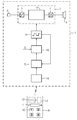
- the figure shows a hearing aid 1 with a microphone 2 for receiving an acoustic input signal and conversion into an electrical signal, a signal processing unit 3 for processing and frequency-dependent amplification of the electrical signal and a receiver 4 for converting the processed and amplified signal into an acoustic output signal.
- the signal processing unit 3 in the embodiment is implemented in digital circuit technology and therefore comprises an A / D converter 5 for converting the electrical input signal into a digital input signal and a D / A converter 7 for converting the processed digital signal into an analog output signal. In between, the signal processing takes place in a digital circuit technology realized signal processing unit 6.
- the digital components of the hearing aid 1 are clocked by a clock generator 8.
- a clock generator 8 By Frequenzvervieltigtiger individual components can be clocked at multiples of this clock frequency. Since the clock generator contains only a simply constructed oscillator and no quartz, the predetermined clock frequency can be maintained with a maximum deviation of +/- 5% from the predetermined setpoint. However, this fluctuation range is too high for certain digital filters included in the digital signal processing unit 6.
- the clock frequency generated by the clock generator 8 will be stabilized according to the invention such that at least temporarily the deviation of up to +/- 5% from the setpoint is substantially limited.
- a remote control 9 for remote control of the hearing aid 1.
- the remote control 9 in the exemplary embodiment comprises a clock generator 12, which comprises a quartz 13.
- the clock frequency can thus be kept very accurate.
- the period of the clock pulses which are generated and emitted by the remote control 1 is preferably very long, for example 10 seconds.
- the hearing aid 1 in turn comprises a receiving unit 14 for receiving the output from the remote control 9 clock signal.
- the external clock signal is finally supplied to a counter 15 which counts the number of clocks of the clock generator 8 during a period of the external clock signal.
- the counter 15 reaches a count of 210,000 during a period of the external clock signal of 10 seconds.
- the count would have after 10 sec, however, be 200,000.
- the clock frequency of the clock generator 8 is therefore readjusted accordingly.
- a comparison control unit 16 is present in the hearing aid 1, in addition to the count and a setpoint S received. From the comparison of the counter reading with the reference value, the comparison and control unit 16 generates a control signal for slowing the clock frequency of the clock generator 8.
- the count is averaged over several periods of the external clock signal before a control signal for correcting the clock frequency of the clock generator 8 is generated.
- a control signal for correcting the clock frequency of the clock generator 8 is generated.
Landscapes
- Engineering & Computer Science (AREA)
- Health & Medical Sciences (AREA)
- General Health & Medical Sciences (AREA)
- Neurosurgery (AREA)
- Otolaryngology (AREA)
- Physics & Mathematics (AREA)
- Acoustics & Sound (AREA)
- Signal Processing (AREA)
- Computer Networks & Wireless Communication (AREA)
- Transmitters (AREA)
- Electric Clocks (AREA)
- Selective Calling Equipment (AREA)
Applications Claiming Priority (1)
| Application Number | Priority Date | Filing Date | Title |
|---|---|---|---|
| DE102004037379 | 2004-08-02 |
Publications (3)
| Publication Number | Publication Date |
|---|---|
| EP1624723A2 true EP1624723A2 (fr) | 2006-02-08 |
| EP1624723A3 EP1624723A3 (fr) | 2009-05-20 |
| EP1624723B1 EP1624723B1 (fr) | 2012-05-30 |
Family
ID=35415260
Family Applications (1)
| Application Number | Title | Priority Date | Filing Date |
|---|---|---|---|
| EP05107054A Expired - Lifetime EP1624723B1 (fr) | 2004-08-02 | 2005-07-29 | Stabilisation de la cadence du système dans une prothèse auditive |
Country Status (3)
| Country | Link |
|---|---|
| US (1) | US7577268B2 (fr) |
| EP (1) | EP1624723B1 (fr) |
| DK (1) | DK1624723T3 (fr) |
Cited By (1)
| Publication number | Priority date | Publication date | Assignee | Title |
|---|---|---|---|---|
| US8588443B2 (en) | 2006-05-16 | 2013-11-19 | Phonak Ag | Hearing system with network time |
Families Citing this family (3)
| Publication number | Priority date | Publication date | Assignee | Title |
|---|---|---|---|---|
| CA2687840A1 (fr) * | 2007-06-13 | 2008-12-18 | Widex A/S | Appareil auditif adapte pour generer une notification et procede de generation d'une notification |
| WO2012119085A1 (fr) * | 2011-03-02 | 2012-09-07 | Touchdome Llc. | Montre dotée d'un dôme vocal pour personnes malvoyantes |
| CN112469470B (zh) | 2018-10-10 | 2024-07-26 | 科利耳有限公司 | 可植入医疗设备短程无线电同步 |
Citations (4)
| Publication number | Priority date | Publication date | Assignee | Title |
|---|---|---|---|---|
| DE10048341C1 (de) | 2000-09-29 | 2002-04-18 | Siemens Audiologische Technik | Verfahren zum Betrieb eines Hörhilfegerätes sowie Hörgeräteanordnung oder Hörhilfegerät |
| EP1104645B1 (fr) | 1998-08-13 | 2003-02-05 | Siemens Audiologische Technik GmbH | Prothese auditive pourvue d'un dispositif permettant de supprimer les signaux parasites electromagnetiques, et procede permettant de supprimer lesdits signaux dans les protheses auditives |
| US20040037442A1 (en) | 2000-07-14 | 2004-02-26 | Gn Resound A/S | Synchronised binaural hearing system |
| US6768802B1 (en) | 1999-10-15 | 2004-07-27 | Phonak Ag | Binaural synchronization |
Family Cites Families (7)
| Publication number | Priority date | Publication date | Assignee | Title |
|---|---|---|---|---|
| WO1993004425A1 (fr) * | 1991-08-13 | 1993-03-04 | Universal Photonix, Inc. | Systeme permettant de valider a distance l'identite d'une personne et de determiner le lieu ou elle se trouve |
| US20050036637A1 (en) * | 1999-09-02 | 2005-02-17 | Beltone Netherlands B.V. | Automatic adjusting hearing aid |
| CA2397317C (fr) * | 2000-01-13 | 2009-04-14 | Phonak Ag | Telecommande d'appareil auditif, et appareil auditif pourvu d'une telle telecommande |
| NL1020387C2 (nl) * | 2002-04-15 | 2003-10-17 | Gatsometer Bv | Werkwijze voor het op afstand synchroniseren van een verkeersbewakingssyteem en daartoe uitgerust verkeersbewakingssysteem. |
| DE10245556B3 (de) * | 2002-09-30 | 2004-04-22 | Siemens Audiologische Technik Gmbh | Hörhilfegerät oder Hörgerätesystem mit einem Taktgenerator und Verfahren zu deren Betrieb |
| US20040190737A1 (en) * | 2003-03-25 | 2004-09-30 | Volker Kuhnel | Method for recording information in a hearing device as well as a hearing device |
| DE102004025691B3 (de) * | 2004-05-26 | 2005-08-18 | Siemens Audiologische Technik Gmbh | Hörhilfegerät oder Hörgerätesystem mit einer Bedieneinrichtung |
-
2005
- 2005-07-29 DK DK05107054.8T patent/DK1624723T3/da active
- 2005-07-29 EP EP05107054A patent/EP1624723B1/fr not_active Expired - Lifetime
- 2005-08-02 US US11/194,932 patent/US7577268B2/en not_active Expired - Fee Related
Patent Citations (4)
| Publication number | Priority date | Publication date | Assignee | Title |
|---|---|---|---|---|
| EP1104645B1 (fr) | 1998-08-13 | 2003-02-05 | Siemens Audiologische Technik GmbH | Prothese auditive pourvue d'un dispositif permettant de supprimer les signaux parasites electromagnetiques, et procede permettant de supprimer lesdits signaux dans les protheses auditives |
| US6768802B1 (en) | 1999-10-15 | 2004-07-27 | Phonak Ag | Binaural synchronization |
| US20040037442A1 (en) | 2000-07-14 | 2004-02-26 | Gn Resound A/S | Synchronised binaural hearing system |
| DE10048341C1 (de) | 2000-09-29 | 2002-04-18 | Siemens Audiologische Technik | Verfahren zum Betrieb eines Hörhilfegerätes sowie Hörgeräteanordnung oder Hörhilfegerät |
Cited By (1)
| Publication number | Priority date | Publication date | Assignee | Title |
|---|---|---|---|---|
| US8588443B2 (en) | 2006-05-16 | 2013-11-19 | Phonak Ag | Hearing system with network time |
Also Published As
| Publication number | Publication date |
|---|---|
| US20060023906A1 (en) | 2006-02-02 |
| EP1624723A3 (fr) | 2009-05-20 |
| DK1624723T3 (da) | 2012-09-03 |
| EP1624723B1 (fr) | 2012-05-30 |
| US7577268B2 (en) | 2009-08-18 |
Similar Documents
| Publication | Publication Date | Title |
|---|---|---|
| EP2043388B1 (fr) | Mise en marche et arrêt totalement automatique pour appareils auditifs | |
| DE102004035256B3 (de) | Hörhilfegerätesystem sowie Verfahren zum Betrieb eines Hörhilfegerätesystems bei Audio-Empfang | |
| EP2180726B2 (fr) | Localisation du son avec des prothèses auditives binauriculaires | |
| EP0168895B1 (fr) | Dispositif d'aide auditive | |
| EP1737270B2 (fr) | Appareil auditif avec réduction du couplage | |
| EP2150076B1 (fr) | Protection contre la perte d'un appareil auditif | |
| EP1643802A2 (fr) | Transmission de signaux entre prothèses auditives | |
| EP1377118A2 (fr) | Système de prothèse auditive avec prothèse auditive et unité processeur externe | |
| EP1750481A2 (fr) | Ajustement de gain automatique d'une prothèse auditive | |
| EP2229010A2 (fr) | Procédé de compensation d'un bruit parasite dans un appareil auditif, appareil auditif et procédé d'adaptation de celui-ci | |
| EP1651006A2 (fr) | Prothèse auditive avec boucle de ligne pour la compensation des champs inductifs perturbateurs | |
| EP1628504A2 (fr) | Fonction d'économie d'énergie dans des prothèses auditives | |
| EP2254354A1 (fr) | Procédé d'acclimatation d'un dispositif auditif programmable et dispositif auditif correspondant | |
| EP1624723B1 (fr) | Stabilisation de la cadence du système dans une prothèse auditive | |
| DE102007001538B4 (de) | Hörvorrichtung mit automatischer Selbsttrimmung und entsprechendes Verfahren | |
| EP2012509B1 (fr) | Système d'appareil auditif à plusieurs composantes et son procédé de fonctionnement | |
| DE102010012623B4 (de) | Verfahren zur Übertragung von Daten zwischen einem Hörgerät und einer externen Einheit sowie zugehörige Anordnung | |
| EP1406468B1 (fr) | Prothèse auditive ou système de prothèse auditive avec un générateur de signal d'horloge | |
| EP1624721A2 (fr) | Signaux d'information configurables librement dans les prothèses auditives | |
| DE102023207237A1 (de) | Verfahren zum Betrieb eines induktiven Ladegeräts eines Hörgeräts und induktives Ladegerät eines Hörgeräts | |
| EP3448063A1 (fr) | Procédé de réglage d'un dispositif de correction auditive | |
| EP3913618A1 (fr) | Procédé de fonctionnement d'un appareil auditif et appareil auditif | |
| DE102012212172A1 (de) | Hörhilfeanordnung mit Kalenderfunktion und Verfahren zum Betreiben der Hörhilfeanordnung | |
| DE102008064382A1 (de) | Hörvorrichtung mit Transpositionsmöglichkeit und entsprechendes Verfahren | |
| DE102008049086B4 (de) | Hörhilfegerät mit einem Richtmikrofonsystem sowie Verfahren zum Betrieb eines derartigen Hörhilfegerätes |
Legal Events
| Date | Code | Title | Description |
|---|---|---|---|
| PUAI | Public reference made under article 153(3) epc to a published international application that has entered the european phase |
Free format text: ORIGINAL CODE: 0009012 |
|
| AK | Designated contracting states |
Kind code of ref document: A2 Designated state(s): AT BE BG CH CY CZ DE DK EE ES FI FR GB GR HU IE IS IT LI LT LU LV MC NL PL PT RO SE SI SK TR |
|
| AX | Request for extension of the european patent |
Extension state: AL BA HR MK YU |
|
| PUAL | Search report despatched |
Free format text: ORIGINAL CODE: 0009013 |
|
| AK | Designated contracting states |
Kind code of ref document: A3 Designated state(s): AT BE BG CH CY CZ DE DK EE ES FI FR GB GR HU IE IS IT LI LT LU LV MC NL PL PT RO SE SI SK TR |
|
| AX | Request for extension of the european patent |
Extension state: AL BA HR MK YU |
|
| 17P | Request for examination filed |
Effective date: 20091117 |
|
| AKX | Designation fees paid |
Designated state(s): CH DE DK FR GB LI |
|
| 17Q | First examination report despatched |
Effective date: 20110330 |
|
| GRAP | Despatch of communication of intention to grant a patent |
Free format text: ORIGINAL CODE: EPIDOSNIGR1 |
|
| GRAS | Grant fee paid |
Free format text: ORIGINAL CODE: EPIDOSNIGR3 |
|
| GRAA | (expected) grant |
Free format text: ORIGINAL CODE: 0009210 |
|
| AK | Designated contracting states |
Kind code of ref document: B1 Designated state(s): CH DE DK FR GB LI |
|
| REG | Reference to a national code |
Ref country code: GB Ref legal event code: FG4D Free format text: NOT ENGLISH |
|
| REG | Reference to a national code |
Ref country code: CH Ref legal event code: NV Representative=s name: SIEMENS SCHWEIZ AG Ref country code: CH Ref legal event code: EP |
|
| REG | Reference to a national code |
Ref country code: DE Ref legal event code: R096 Ref document number: 502005012754 Country of ref document: DE Effective date: 20120726 |
|
| REG | Reference to a national code |
Ref country code: DK Ref legal event code: T3 |
|
| PGFP | Annual fee paid to national office [announced via postgrant information from national office to epo] |
Ref country code: GB Payment date: 20120709 Year of fee payment: 8 |
|
| PGFP | Annual fee paid to national office [announced via postgrant information from national office to epo] |
Ref country code: DE Payment date: 20120906 Year of fee payment: 8 Ref country code: FR Payment date: 20120802 Year of fee payment: 8 |
|
| PGFP | Annual fee paid to national office [announced via postgrant information from national office to epo] |
Ref country code: CH Payment date: 20121011 Year of fee payment: 8 |
|
| PLBE | No opposition filed within time limit |
Free format text: ORIGINAL CODE: 0009261 |
|
| STAA | Information on the status of an ep patent application or granted ep patent |
Free format text: STATUS: NO OPPOSITION FILED WITHIN TIME LIMIT |
|
| 26N | No opposition filed |
Effective date: 20130301 |
|
| REG | Reference to a national code |
Ref country code: DE Ref legal event code: R097 Ref document number: 502005012754 Country of ref document: DE Effective date: 20130301 |
|
| REG | Reference to a national code |
Ref country code: DK Ref legal event code: EBP Effective date: 20130731 |
|
| REG | Reference to a national code |
Ref country code: CH Ref legal event code: PL |
|
| GBPC | Gb: european patent ceased through non-payment of renewal fee |
Effective date: 20130729 |
|
| REG | Reference to a national code |
Ref country code: DE Ref legal event code: R119 Ref document number: 502005012754 Country of ref document: DE Effective date: 20140201 |
|
| REG | Reference to a national code |
Ref country code: FR Ref legal event code: ST Effective date: 20140331 |
|
| PG25 | Lapsed in a contracting state [announced via postgrant information from national office to epo] |
Ref country code: DE Free format text: LAPSE BECAUSE OF NON-PAYMENT OF DUE FEES Effective date: 20140201 Ref country code: GB Free format text: LAPSE BECAUSE OF NON-PAYMENT OF DUE FEES Effective date: 20130729 Ref country code: LI Free format text: LAPSE BECAUSE OF NON-PAYMENT OF DUE FEES Effective date: 20130731 Ref country code: CH Free format text: LAPSE BECAUSE OF NON-PAYMENT OF DUE FEES Effective date: 20130731 |
|
| PG25 | Lapsed in a contracting state [announced via postgrant information from national office to epo] |
Ref country code: FR Free format text: LAPSE BECAUSE OF NON-PAYMENT OF DUE FEES Effective date: 20130731 |
|
| PG25 | Lapsed in a contracting state [announced via postgrant information from national office to epo] |
Ref country code: DK Free format text: LAPSE BECAUSE OF NON-PAYMENT OF DUE FEES Effective date: 20130731 |