EP1627669A1 - Procede de divertissement "poker russe" - Google Patents
Procede de divertissement "poker russe" Download PDFInfo
- Publication number
- EP1627669A1 EP1627669A1 EP03816661A EP03816661A EP1627669A1 EP 1627669 A1 EP1627669 A1 EP 1627669A1 EP 03816661 A EP03816661 A EP 03816661A EP 03816661 A EP03816661 A EP 03816661A EP 1627669 A1 EP1627669 A1 EP 1627669A1
- Authority
- EP
- European Patent Office
- Prior art keywords
- player
- cards
- bet
- game
- dealer
- Prior art date
- Legal status (The legal status is an assumption and is not a legal conclusion. Google has not performed a legal analysis and makes no representation as to the accuracy of the status listed.)
- Withdrawn
Links
Images


Classifications
-
- A—HUMAN NECESSITIES
- A63—SPORTS; GAMES; AMUSEMENTS
- A63F—CARD, BOARD, OR ROULETTE GAMES; INDOOR GAMES USING SMALL MOVING PLAYING BODIES; VIDEO GAMES; GAMES NOT OTHERWISE PROVIDED FOR
- A63F3/00—Board games; Raffle games
- A63F3/00003—Types of board games
- A63F3/00157—Casino or betting games
-
- G—PHYSICS
- G07—CHECKING-DEVICES
- G07F—COIN-FREED OR LIKE APPARATUS
- G07F17/00—Coin-freed apparatus for hiring articles; Coin-freed facilities or services
- G07F17/32—Coin-freed apparatus for hiring articles; Coin-freed facilities or services for games, toys, sports, or amusements
-
- A—HUMAN NECESSITIES
- A63—SPORTS; GAMES; AMUSEMENTS
- A63F—CARD, BOARD, OR ROULETTE GAMES; INDOOR GAMES USING SMALL MOVING PLAYING BODIES; VIDEO GAMES; GAMES NOT OTHERWISE PROVIDED FOR
- A63F1/00—Card games
- A63F2001/005—Poker
-
- A—HUMAN NECESSITIES
- A63—SPORTS; GAMES; AMUSEMENTS
- A63F—CARD, BOARD, OR ROULETTE GAMES; INDOOR GAMES USING SMALL MOVING PLAYING BODIES; VIDEO GAMES; GAMES NOT OTHERWISE PROVIDED FOR
- A63F3/00—Board games; Raffle games
- A63F3/00003—Types of board games
- A63F3/00157—Casino or betting games
- A63F2003/00164—Casino tables
Definitions
- the present application relates to a method of entertainment including a card game and the equipment needed for this card game.
- the invention may be used in gaming establishments, gaming machine halls and electronic devices that use a monitor.
- Russian Poker is an adaptation of poker, one of the most popular games of chance in the 19th and 20th centuries, for modern casinos, gaming machines or computers.
- the analogue to the method of entertainment “Russian Poker” is the "game of poker", based on the popular card game, which uses a standard card table in the form of a half-circle with a hollow cut from the middle of the flat-edged side for the placement of a chip rack with valued chips.
- the "game of poker” uses a cover on the game table with spaces for the game field, a standard deck of cards and valued chips of varying worth (US4836553, Jun. 6, 1989, Int. Cl. A63 F 1/00, US Cl. 273/292; 273/274).
- the inadequacy of gaming machines based on receiving winning combinations stems from the use of a random number generator in the machine, which creates a chance for the player to question the reliability of its randomness.
- Players would prefer to play with a machine in which a traditional deck of cards was used in the place of a random event generator.
- An established strategic computer game comprises a computer with a monitor and with the means to load information from the user of the computer system and the means of displaying an array of elements on the screen (RU 2099782, pub. 20.12.1997, cl. MPK G 06 F 19/00, G 06 F 161:00).
- the method of displaying the computer game to the player, in which the playing field is projected onto the monitor, is also described in this source.
- the method of entertainment uses a gaming table 1, a chip holder 2, a table's cover with the outline of the playing area 3, the chips and a deck of cards, in which one or several players make cash bets using chips.
- the minimum bet and maximum payout for a winning combination is displayed on a tablet on the playing table, but there is no limit to the maximum bet.
- the players' places (area 3) are marked on the gaming table's cloth cover and each place consists of four geometrical figures:
- One player can play on two spaces by making two bets on two square figures used for the game on the bonus and/or two equal initial bets on the ellipse figures, in which case he will receive two hands of five cards each.
- the game uses two decks of 52 cards, consisting of 4 suits of 13 cards each.
- the dealer shuffles the deck of cards 2-3 times, cuts the deck, shuffles it another 2-3 times and then gives it to one of the players to cut.
- the dealer deals five cards each to all the players, himself included, and the last card that goes to the dealer is dealt face-up.
- the bet on the bonus located on the square, pays out when there is a combination in the player's initial hand of a three-of-a-kind or higher, regardless of the playing combination in the dealer's hand.
- Players who receive chips from a winning bet on the bonus can exchange any number of his five cards or buy a sixth card for the sum of his initial wager.
- the players must make the decision about which cards from their first hand to exchange, and only then can they look at the cards of the second hand.
- the players place the cards to be exchanged into the square together with a sum equal to their initial wagers.
- the players place that same sum in the circle.
- the dealer removes the chips from the circle, and places a token with the number 6 in their place and gives the player a sixth card.
- the dealer shuffles the cards that have already been discarded from the game and continues the exchange with those cards.
- Players with three-of-a-kind or higher can insure themselves by placing the insurance sum in the square to protect against the absence of a playing combination in the dealer's hand.
- the sum must be within the parameters of the anticipated winnings.
- the dealer compares the players' hands and his hand in order and determines the winning or losing wagers.
- the player is paid winnings equal to the size of his insurance sum. If the dealer's hand is weaker than the player's, the player loses the insurance sum, and if the dealer's hand is stronger, the insurance sum is returned to the player.
- the players receive their initial bet or, if they pay that sum, placing it on the ellipse, they may exchange one of the dealer's old cards for a new card from the deck. If the dealer still does not have a playing combination after the exchange, the initial bet is not returned or paid. If the new card is the same value as the exchanged one after the card exchange, and the dealer still does not have a playing combination, the player can repeat the exchange. If the dealer has a stronger hand than the player after the exchange, the player loses only the doubled bet that was placed on the rectangle.
- the player is paid the winning bet in accordance to the strength of the winning hand.
- the payout of the player's winnings is based only on the chips placed on the doubled bet, placed on the rectangle, and takes all the fully developed combinations in the player's hand into account, in proportion to the corresponding strength of the playing combination and the table of payouts. If, in addition to the winning combination, there is a second winning combination in the player's hand, it also gets paid.
- the second winning combination must include at least one card that was not part of the primary winning combination. No more than two playing combinations may win in a player's hand.
- the table may be prepared in the shape of an oval 8 (Fig. 3). In this case, the players' places with four geometric figures for bets are spread across the cloth table cover in a semicircle. If the casino is not taking part in the game, one of the players may be the dealer or, if there are multiple players that want to be dealer, the position can rotate among them.
- a playing, gaming, machine 10 (Fig. 4) that comprises electronic equipment, a computer that directs the sequence of the machine actions and corresponding winning and losing wagers, a monitor 11 (Fig. 4) for showing the balance and the turn of the game, a playing panel with command keys 19, 20 and 21, and in-slots for tokens 17 and cash 18 that can calculate their size, value and number, and out-slots for the subsequent payout of tokens 24 and cash 23.
- the machine uses decks of paper or plastic cards, consisting of 52 cards with four suits of 13 cards each for the game. Two decks of cards are used so that the game will be played more quickly. While a player is playing the game, the machine shuffles the second deck.
- control panel with three rows of functional keys for transferring the corresponding command into the electronic device.
- arm rest 22 on the machine panel, below the keys, to be used during the game as an arm support, and it may be adjusted by several centimetres, according to the player's preferences.
- the minimum bet and maximum payout for a winning combination are posted on the gaming machine monitor 11, but there is no limit to the size of a bet.
- Four figures - a circle, a square, an ellipse and a rectangle - are displayed in the window 12, showing the bets the player has made.
- the monitor 11 displays the highest combination of cards in the player's hand for his information.
- a card-shuffling mechanism is used in order to insure the random placement of the cards in the machine.
- each bin the size of a card.
- the machine pays out wagers on the bonus whenever the player's combination of cards is three-of-a-kind or higher, regardless of strength of the gaming machine hand. After the player receives his winning bonus, he may continue the current round of play.
- the machine will exchange 1, 2, 3, 4 or 5 of the player's cards or add a sixth card to the player's five.
- the player uses five buttons located on the machine front panel under each of the player's five cards, or the sixth button to signify that he is buying a sixth card.
- the player shows which cards he wants to exchange and then presses the "Exchange" key, paying a stake the size of the initial bet.
- the card-distributing mechanism places the new cards from the shuffling mechanism into the player's tray and from there places the cards in the player's bins, covering the cards that the player had selected with their substitutions.
- the sixth button the player purchases a sixth card, and it is placed in the player's tray and moved into the empty sixth bin.
- the card-distributing mechanism turns over the cards in the dealer's tray into the five bins of the top row, symbolizing the machine hand.
- a logical optical system determines the suits and value of the cards.
- the winning hand is determined using the help of the controlling computer and, if it is the player's hand, pays out his winnings, changing the data on the status bar on the machine monitor.
- the machine pays out only the doubled bet in proportion to the corresponding strength of the winning combination and the table of payouts. However, it also pays out if there is a second winning combination in the player's hand, provided that combination has at least one card that was not included in the primary winning combination.
- the players may press the "Dealer's Game” key and, paying their initial bet, exchange the senior card in the machine hand for a new one.
- the machine accompanies the game with musical melodies, sounds and video effects.
- the machine may be prepared for several players playing at once, in which case ever player has his own display and command keys, while the playing combinations in the players' hands are compared with the playing combination in the machine hand alone.
- the method of entertainment "Russian Poker" created with the help of an electronic device with a monitor allows for the possibility of its user to play in a place that is comfortable for him. It calls for the use of a random number generator in the electronic device, which does not rely on the help of programming methods, and thereby influences the believability of the player's winnings. Its application in games together with other players can be increased by using the method of entertainment on a local set or on the internet.
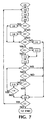
- Fig. 5 is an electronic device with a monitor, used to conduct, based on data analysis, the realization of the entered commands via a computer program that is founded on the algorithm of the game (Fig. 7).
- An image of the playing field, chips and electronic playing cards 33 are formulated on the monitor.
- a random number generator is used to ensure the random order of the electronic cards in the device.
- the electronic device shows the minimum wager and the maximum payout allowed for a winning combination, but the maximum bet is not limited.
- control keys 36 On the monitor, below the player's cards, there is the image of the three rows of control keys 36 with the name of the respective function on each of them. These keys, which may be used at any moment of the game, become brighter so as to help the player make this or that playing decision.
- the electronic device For each move in the game, the electronic device formulates a status bar on the monitor, which shows the current balance of the game, as well as the sum won or lost from the beginning of the game and the results of both the previous and current round of the game.
- the electronic device using a random number generator, formulates the image of two hands of cards, representing the hands of the electronic dealer and the player, on the screen.
- Both the minimum size of the bet on the bonus (excluding the initial bet) and the size of the maximum payout are the same as the regular bet on the given electronic device.
- the electronic device pays out bets on the bonus when the combination in the player's initial hand is a three-of-a-kind and higher, regardless of strength of the electronic dealer's hand.
- the player can pay to exchange any amount of his cards, and the electronic device exchanges the cards indicated by the player for new ones.
- the player may purchase a sixth card, and the electronic device adds this card to the player's hand.
- Players with a three-of-a-kind or higher can insure their bets in case of the absence of a playing combination in the electronic dealer's hand by placing an insurance sum that is within the parameters of the expected winnings of their bet. And if the electronic dealer does not have a playing combination, then instead of the payout of the initial bet, the electronic device pays the player winnings equal to the size of the insurance sum. If playing combination in the cards of the electronic dealer is weaker than that of the player, the insurance sum is lost.
- the players receive the initial bet or, paying their bet, exchange one of the electronic dealer's cards for a new one. If, in this case, the dealer still does not have a hand after the exchange, the electronic device doesn't pay out the bets.
- the electronic device assesses the winning or losing bet, comparing the strength of the electronic dealer's and the player's card combinations. When the player wins, the electronic device pays out only the doubled wagers, corresponding to the strength of the winning combination after examining all the combinations in the player's hand, and pays out again in the case that there is a second playing combination that includes at least one card that was not included in the primary combination.
- the electronic device conducts an accounting with the player at the end of every round of play, and the player may then finish the game or begin the game again.
- the device accompanies the game with sounds and video effects.
- the following keys on the monitor may be used to switch on the corresponding command: "Play”, “Bonus”, “Decrease”, “Increase”, “Cancel”, “Payout”, “Repeat”, “Exchange”, “Dealer's game”, “Bet”, “Insurance”, and “Refuse”.
- the player presses the image of the cards to be exchanged or purchased, and to cancel that decision presses the card a second time.
- Fig. 1 is an example of the use of the method of entertainment "Russian Poker" in a casino, where the game is conducted on a table similar to those used for Blackjack or Caribbean Poker, arranged in the form of a half-circle or polygon.
- the game table may be standard height for standard chairs, or a bit higher for the stools used in casinos when the dealer works standing up.
- Fig. 2 is an image of the casino table cover with the outlines of one of the variations of the playing fields for realization of wagers, prepared for a semicircular card table.
- the marked cover of the game table is stretched on specifically for that table, fortified with metal clamps and placed on a semicircular table. It may be made from cloth, wool, cotton, synthetic fabric, natural or synthetic leather, or other light industrial products.
- the colouring on the marked cover for the game table may produced by a variety of production methods.
- the realization of the marked table cover allows for easily re-equipping a standard game table for the purpose of the method of entertainment "Russian Poker” and thereby allows the casino to broaden the opportunities available for its clients concerning game choice.
- Fig. 3 is the image of the game table of "Russian Poker" for players playing amongst themselves, when the casino is not a part of the game. Up to 6 people can play on this table. It is used when the gaming hall isn't taking part in the game and is only the game organiser. The dealer here is not part of the game; he enforces the rules of the game, collects a commission and may shuffle and deal the cards.
- Fig. 4 is the image of the coin-operated "Russian Poker" gaming machine. It is the same size as other gaming machines. Its construction is intended to increase the comfort of players. The machine uses paper or plastic cards.
- Fig. 5 is the image of the electronic device with the image of "Russian Poker's" playing field and the status bar that the player sees during the game.
- the monitor may be produced using touch screen technology, which uses switches activated not through keys but by pressing a finger against the screen on the image of the buttons.
- Fig. 6 is a portable electronic device with a monitor that may be used in any place the player finds comfortable.
- Fig. 7 is the image of the scheme of the basic algorithm that is used in the electronic device for the realization of the game "Russian Poker.”
- the method of entertainment's of the first embodiment uses a gaming table 1, a chip rack 2, a cover with the outline of the playing area (field) as shown in Fig. 2, chips and a deck of cards, and the dealer, using a shuffled deck of cards, and a random combination in the player's hand reveals the winning or losing bet.
- the playing field contains the parameters of a playing area 3 for several players with parts for placing bets and for the cards, and also for playing on the bonus and for insurance. Every place for a player consists of four geometric figures 4 to 7 that are located in the direction away from the player and increase in size as they get closer to the player.
- All the players play against the casino, meaning against the casino's representative, the dealer.
- the purpose of the game is to collect a combination of cards in one's hand stronger than that of the dealer's.
- a standard deck of 52 cards, consisting of four suits of 13 cards each, is used the game "Russian Poker".
- Each player may receive up to two hands of cards, however the bets on them must be equal.
- the minimum bet and the maximum payout for a winning combination is posted on a tablet on every table. There are no limits on the maximum bet.
- the dealer shuffles the deck 2-3 times, cuts the deck and shuffles another 2-3 times. If the players so desire, a second deck may be used to save time while shuffling the cards. While one dealer conducts the game, another dealer or inspector shuffles the second deck.
- the players make their initial bets, placing their chips on the ellipse. At the same time a player may bet that there will be a high playing combination, three-of-a-kind or higher, in his initial draw. To do this, the player places his chips on the square. That bet is called a bet on the bonus.
- the maximum payout for bets on the bonus is shown on the table's tablet. The size of the bet only on the bonus, placed on the square, excluding the initial sum, and the size of the maximum payout are equal to those for the initial bet on that table.
- the dealer begins to deal the cards face-down, one per every player and himself, and continues until these hands have reached five cards each.
- the dealer also receives five cards, the last one of which is dealt face-up.
- the bet on the bonus pays out when there is a combination of three-of-a-kind or higher in the players hand, regardless of the strength of the dealer's hand.
- the player should turn his cards over and, when the dealer sees that there is a combination of three-of-a-kind in the player's cards or higher, he pays out the winnings and returns the cards to the player.
- the player can win a bonus, take his winnings from the square, and then continue the current round of the game.
- the dealer begins the card exchange. If the player doesn't see the prospect of winning in his cards, he returns the cards and the initial bet, located on the ellipse, and loses.
- players can exchange any number of their cards. For this, they place the cards selected to be exchanged on the square and, on them, chips equal to the sum of the initial bet.
- the player can purchase a sixth card by placing chips equal to the sum of the initial bet on the circle.
- the dealer takes the chips from the circle and adds a sixth card to the player's hand and places a token marked with the number 6 on the circle, showing that the player already has six cards in his hand.
- the player with a hand that has a high playing combination can only count on large winnings in the event that the dealer also has a playing combination. For that reason, it is desirable for a player with a three-of-a-kind or higher to insure his game in case of the absence of a playing combination on the part of the dealer. To do that, the player places the chips representing the insurance sum on the square. The size of that sum must be within the limits of the sum of the initial bet and the doubled bet of the player and the sum of the anticipated winnings.
- the dealer waits until all the players decide whether to double the bets or return their cards, losing the initial bet, as well as whether or not to insure their games from the absence of a playing hand in the dealer's hand. After the players' card exchange and the acceptance of insurance, the dealer shows his cards.
- the players' insurance pays out 1 to 1 for the chips placed on the square.
- the players When the dealer does not have a playing combination, the players receive winnings equal to the initial bet, or pay their initial bet on the ellipse and the dealer exchanges the highest card in his hand for a new card from the deck. If the new card is the same value as the forfeited card, and the dealer still does not have a playing combination, the player may repeat the exchange for free. If, after the exchange, the dealer still does not have a playing combination, the initial bets do not pay out.
- the dealer If there is a playing combination in the dealer's cards, the dealer first takes the insurance chips from the square of those players who insured their game and then turns over the players' cards in order, comparing his combination of cards with theirs. The dealer takes the bets of players who have weaker combinations than his, and pays out the bets of the players who have stronger combinations.
- the winning combination If, in addition to the winning combination, there is a second playing combination, it also pays out.
- the second combination must include a card that wasn't included in the primary combination.
- the winner is determined by the one with the higher cards. If the cards are equal, the game is a push.
- the method of entertainment of the second embodiment exists with the help of a playing machine, in which a paper or plastic deck of cards is used.
- the playing machine 10 for games in "Russian Poker" shown in Fig. 4 comprises the following parts and components:
- arm rest 22 on the machine panel, below the keys, to be used during the game as an arm support, and it may be adjusted by several centimetres according to the player's preferences.
- a status bar is located on the machine monitor 11, upon which the game's current balance is displayed, as well as the amount won or lost from the start of play and the number of rounds played.
- the bets placed by the player are represented in the window 12 of the four figures - a circle, a square, an ellipse and a rectangle.
- the monitor illuminates the best playing combination or two combinations at every move in the game, for the player's information.
- the game is conducted according to the rules used in "Russian Poker" for casinos, and is controlled according to the basic algorithm of the game (Fig. 7).
- a special mechanism shuffles the cards and places five of them in the player's tray 15, for the player's cards.
- the player's tray 15 is built slightly larger than the size of a card and moves with the help of a direction belt, similar to the flow of a printer moving an ink cartridge.
- the player's tray 15 distributes face-up cards to the player's five bins 16.
- the machine hand is placed in the upper dealer's tray 13, but the cards are not exposed in the bins 14. The player can see the top card of the five meant for the machine.
- the player makes an exchange or buys a sixth card, he presses the corresponding buttons on the machine panel, and the new cards are dealt from the card-distributing mechanism, placed in the player's tray 15 and from there lowered into those bins in which the cards the player indicated are located. The old cards are covered by the new cards.
- the machine card-reading mechanism places the cards in the bins 14 for the machine hand with the help of the upper dealer's tray 13.
- An optical system that can determine the suit and face value of the cards compares the two hands, the computer determines the winner and, if it is the player, pays out his winnings and changes information on the status bar on the monitor 11.
- the game is accompanied by musical and video effects.
- a possible construction of the " Russian Poker" machine includes a playing field that consists of several places for players. In this type of multi-place machine several players can play at once. Each player has his own monitor and control keys. The playing combinations in the hands of the players are compared only with the combination in the machine hand.
- the method of entertainment of the third embodiment uses an electronic device 30 with a monitor, in which:
- the game's objective is for the player's combination to be stronger than the electronic dealer's.
- the minimum bet and maximum payout are posted on the game. There is no limit to maximum bets.
- the player makes bets using the keys, and the electronic device displays two random hands of cards on the monitor.
- the winning or losing bet is determined by the combinations of cards, and whether the best playing combination is in the player's hand 36 or in the dealer's 33.
- the electronic device formulates on the display the images 32 of the four figures - a circle, a square, an ellipse and a rectangle.
- the bets placed by the player are represented on these figures.
- the player chooses the sum of his initial bet using the "Decrease” or "Increase” keys.
- the player can also make a bet on the bonus, betting that he will be dealt a high playing combination, from three-of-a-kind to a royal flush, in the initial deal. If the player does not continue after receiving his cards or if he exchanges his cards, the bonus is lost.
- the bet on the bonus pays out when there is a combination of three-of-a-kind or higher in the player's hand upon receipt, regardless of the hand that the electronic dealer has.
- the electronic dealer collects the player's bet on the bonus if the player does not have a high combination. And if there is one, the bonus combination is paid out according to its strength.
- the player can win the bonus, take his winnings, exchange some of his cards for a sum equal to the initial bet and continue the current round of the game.
- the player If the player does not see a prospect for winning in his cards and does not play, he loses his initial bet. For a sum equal to the initial bet the player may exchange any amount of cards or purchase a sixth card. If the player decides to play, he makes a second bet twice the size of the initial bet. The electronic dealer shows his cards. If the dealer does not have a game, the initial bet is paid one-to-one.
- a player with three-of-a-kind or higher can insure himself against the case that the electronic dealer does not have a playing combination by placing the insurance sum within the limits from the sum of his bet up to the expected winnings. If the dealer's cards have a playing combination, the insurance sum is lost. If the dealer does not have a game, then the player receives winnings equal to the size of the insurance sum, in addition to the payout for the initial bet.
- the player can receive winnings equal to the initial bet or, paying his initial sum, exchange an old card of the dealer's for a new one. If the new card turns out to be the same value as the exchanged one, the player can repeat the exchange for free. If the dealer still does not have a playing combination after the exchange, there is not a payout for the initial sum.
- dealer's cards have a playing combination, then they are compared to the player's combination of cards.
- the electronic dealer takes the player's bet if the player has a weaker combination then he does, and pays the bet when the player's cards have a stronger combination. Only doubled bets are paid out in proportion, depending on the generally known playing combinations: Ace - King 1 : 1 Pair 1 : 1 Two Pair 2 : 1 Three-of-a-kind 3 : 1 Straight 4 : 1 Flush 5 : 1 Full House 7 : 1 Four-of-a-kind 20 : 1 Straight Flush 50 : 1 Royal Flush 100 : 1
- the player's hand If in the player's hand there is, in addition to the winning combination, a second playing combination that was not included in the primary combination, it also pays.
- the second combination must include at least one card that was not included in the primary hand. There cannot be a third combination.
- the winner is determined by who has higher cards. If all the cards have the same value, the game is a push.
- the game is accompanied by sound and video effects.
- the computer game "Russian Poker” exists with the help of a computer system that computes the data, a monitor, and a means of conducting information from the user into the system. Any computer system or another secure apparatus that includes a monitor can be used for the computer game “Russian Poker".
- the algorithm of the game is based on the terms of the method of entertainment "Russian Poker", and it contains a programming safeguard, written in a programming language.
- the program is saved on a compact disk or different type of data holder.
- the preferred variant of the embodiment of the game is a computer program, saved on a compact disk, and compatible with a home computer.
- an optimal computer for "Russian Poker" includes a motherboard with a Pentium processor, at least 1 megabit of RAM, a hard drive with several gigabits, a sound card and colour monitor.
- An image of the playing field, the functional keys and the chips for placing bets are projected onto the monitor.
- An electronic deck of 52 cards is used for the game.
- the size of the bet is determined by using the keys on a standard keyboard.
- the player chooses the cards for exchange using either the keys that correspond with the card on the monitor or the mouse.
- the player uses commands that are activated from the image of buttons on the monitor.
- a status bar is located on the monitor that shows the current balance of the game, as well as the sum won or lost from the beginning of the game and the results of both the previous round and current round.
- the game is accompanied by sound and video effects.
- the method of entertainment "Russian Poker" which can be played at an internet casino or at a local set is the same as on a computer, with the one difference that at the internet casino and the local set several players can play together at the same time, for real or virtual money.
- a directing program for a casino server or a client program for remote computers is used.
- the playing field is formulated on the player's computer monitor with the client program and, at an internet casino, the player's balance is formulated on the status bar, in accordance to the size of the player's account.
- the program may be saved with the help of SBIS microcircuit, built into the device or on a PC Card, and read by the device.
- SBIS microcircuit built into the device or on a PC Card
- the game is accompanied by video and sound effects.
- the bets appear on the screen,(window), represented in four geometric figures 32, same as the player's cards 34 and the dealer's cards 33.
- the monitor Under the player's cards, three rows of control keys 36 are shown, with the name of the function on each key. The keys that can be used at a given moment of the game become brighter, helping the player make this or that decision while playing.
- the player makes his decision, pressing one of the keys located in the three rows 39-41 under the monitor.
- Each key has its own number or name. If the machine display utilizes touch screen technology, the command keys can be turned on by pressing a finger against the screen, meaning that the command keys can be activated by pressing on their image.
- the bet in the current round includes two fields: the initial bet on the ellipse and the doubled bet on the rectangle.
- the result of the current round is at first equal to zero, and during the process of the round may become negative when the payment for the purchase or exchange of cards is taken from the player or for the exchange of one of the electronic dealer's cards. If the player purchases insurance during the round, the money won or lost from this sum will also show in the result of the current round.
- the final value of this parameter is formulated when the dealer's cards are reckoned, at the every end of the round.
- the scenario that plays out in the round looks like the following example.
- the player makes his initial bet and presses the key "Play”.
- the player's five face-up cards appear on the monitor, as does a sixth, face-down card and the dealer's cards - one face up and the rest face down.
- the face-up cards of the player are ordered: they are placed left to right in order of their value. If, for example, the player has a pair, then those cards making up the pair are placed on the left (as the most valuable). If the player has a Full House, those cards that make up the three-of-a-kind are placed on the left and the cards that make up the pair are placed on the right.
- the name of the corresponding playing combination or two combinations is illuminated next to the player's cards.
- the command key "Insurance” is activated when the player has a combination of three-of-a-kind or higher.
- the player has the right to make a new bet - insurance - within the limits defined by the rules (or he can decide against insurance by pressing the key "Reject"), and then continue the game with the help of the key "Play”.
- the dealer's four face-down cards are turned over. All five of the dealer's cards are ordered and next to them the name of the dealer's playing combination appears. If the player insured himself, then it is determined whether the insurance won or lost before anything else. The result of the game on this bet is quickly posted on the status bar.
- a new round begins if the player wishes to continue the game.
Landscapes
- Engineering & Computer Science (AREA)
- Physics & Mathematics (AREA)
- General Physics & Mathematics (AREA)
- Educational Technology (AREA)
- Multimedia (AREA)
- Slot Machines And Peripheral Devices (AREA)
Applications Claiming Priority (2)
| Application Number | Priority Date | Filing Date | Title |
|---|---|---|---|
| RU2003111009/12A RU2227754C1 (ru) | 2003-04-18 | 2003-04-18 | Способ развлечений "русский покер" |
| PCT/RU2003/000321 WO2004091742A1 (fr) | 2003-04-18 | 2003-07-21 | Procede de divertissement 'poker russe' |
Publications (2)
| Publication Number | Publication Date |
|---|---|
| EP1627669A1 true EP1627669A1 (fr) | 2006-02-22 |
| EP1627669A4 EP1627669A4 (fr) | 2007-09-19 |
Family
ID=32466123
Family Applications (1)
| Application Number | Title | Priority Date | Filing Date |
|---|---|---|---|
| EP03816661A Withdrawn EP1627669A4 (fr) | 2003-04-18 | 2003-07-21 | Procede de divertissement "poker russe" |
Country Status (7)
| Country | Link |
|---|---|
| US (1) | US20040248635A1 (fr) |
| EP (1) | EP1627669A4 (fr) |
| AU (1) | AU2003277754A1 (fr) |
| CA (1) | CA2496617A1 (fr) |
| RU (1) | RU2227754C1 (fr) |
| WO (1) | WO2004091742A1 (fr) |
| ZA (1) | ZA200502395B (fr) |
Families Citing this family (11)
| Publication number | Priority date | Publication date | Assignee | Title |
|---|---|---|---|---|
| RU2261745C1 (ru) * | 2004-08-24 | 2005-10-10 | Ефремов Иван Павлович | Способ развлечений "рейз покер" |
| JP2006068042A (ja) | 2004-08-31 | 2006-03-16 | Aruze Corp | カード遊技機 |
| US20090104958A1 (en) * | 2007-10-23 | 2009-04-23 | Precedent Gaming, Incorporated | Video poker game providing a bonus advantage for every win |
| US8449363B2 (en) * | 2007-11-08 | 2013-05-28 | Igt | Gaming system, gaming device, and method providing poker game with awards based on odds of winning |
| US20110042899A1 (en) * | 2009-08-18 | 2011-02-24 | Mara Enterprises Limited | Card game |
| US8752839B2 (en) | 2009-08-18 | 2014-06-17 | Mara Enterprises Limited | Card game |
| US8635163B2 (en) * | 2010-01-13 | 2014-01-21 | Green Man Gaming Limited | System and method for facilitating a video game exchange |
| US8430406B2 (en) * | 2011-07-20 | 2013-04-30 | Zvi Gilula | Card game with card exchange feature |
| WO2016156977A1 (fr) | 2015-03-31 | 2016-10-06 | Mara Enterprises Limited | Table de jeu fournissant des opportunités de parier sur d'autres joueurs |
| US20170092053A1 (en) * | 2015-09-24 | 2017-03-30 | Wayne Chiang | Method for playing a three card bottoms up comparing card game |
| US20200211318A1 (en) * | 2018-12-31 | 2020-07-02 | Intralot S.A. - Integrated Lottery Systems And Services | Multi-gaming vending machine and methods of manufacturing and use thereof |
Family Cites Families (53)
| Publication number | Priority date | Publication date | Assignee | Title |
|---|---|---|---|---|
| US1970731A (en) * | 1932-01-14 | 1934-08-21 | John P Boggess | Game apparatus |
| FR2229201A5 (en) * | 1973-05-08 | 1974-12-06 | Borianne Henri | Bridge play device - individual cards formed by respective slips removeably attached to supports |
| US3942799A (en) * | 1974-01-30 | 1976-03-09 | Corwin Games, Inc. | Board game apparatus |
| US4394018A (en) * | 1979-10-19 | 1983-07-19 | Ideal Toy Corporation | Electronic logic game |
| US4362303A (en) * | 1980-09-15 | 1982-12-07 | Pell Philip T | Table game employing two sets of cards |
| US4651997A (en) * | 1984-09-26 | 1987-03-24 | Wood Michael W | Method for playing a card game |
| US4743022A (en) * | 1986-03-06 | 1988-05-10 | Wood Michael W | 2nd chance poker method |
| US5377973B1 (en) * | 1988-04-18 | 1996-12-10 | D & D Gaming Patents Inc | Methods and apparatus for playing casino card games including a progressive jackpot |
| US4836553A (en) * | 1988-04-18 | 1989-06-06 | Caribbean Stud Enterprises, Inc. | Poker game |
| US5042818A (en) * | 1989-12-01 | 1991-08-27 | Gary Weingardt | Multi-deck poker game |
| US5811772A (en) * | 1989-12-19 | 1998-09-22 | Scotch Twist, Inc. | Gaming machine system operable with general purpose charge cards |
| US5216234A (en) * | 1990-03-29 | 1993-06-01 | Jani Supplies Enterprises, Inc. | Tokens having minted identification codes |
| US5255915A (en) * | 1991-10-23 | 1993-10-26 | United Gaming, Inc. | Six-card draw-poker-like video game |
| US5308065A (en) * | 1992-09-21 | 1994-05-03 | Bridgeman James L | Draw poker with random wild-card determination |
| GB2291360B (en) * | 1994-07-22 | 1998-10-28 | Derek John Webb | Games and game apparatus |
| US20020195775A1 (en) * | 1994-07-22 | 2002-12-26 | Shuffle Master, Inc. | Four card poker and associated games |
| US5431407A (en) * | 1994-09-29 | 1995-07-11 | Hofberg; Renee B. | Method of playing a casino card game |
| DE4439502C1 (de) * | 1994-11-08 | 1995-09-14 | Michail Order | Spielanlage zur professionellen Ausübung von Tischspielen mit Spielkarten und Jetons, insbesondere des Spieles "Black Jack" |
| US5725216A (en) * | 1995-10-13 | 1998-03-10 | Progressive Games, Inc. | Methods of playing poker games |
| US5794934A (en) * | 1996-01-11 | 1998-08-18 | Malcolm; James C. | Card game method |
| USRE36739E (en) * | 1996-01-26 | 2000-06-20 | Gutierrez; Teofilo | Method of playing a card game for a casino |
| US5713573A (en) * | 1996-07-18 | 1998-02-03 | Alexanian Vahan | Wagering game |
| US5947821A (en) * | 1996-10-01 | 1999-09-07 | Casino Data Systems | Card game |
| US5882260A (en) * | 1997-11-26 | 1999-03-16 | Ptt, Llc | Modified poker card game and computer system for implementing same |
| US6312332B1 (en) * | 1998-03-31 | 2001-11-06 | Walker Digital, Llc | Method and apparatus for team play of slot machines |
| US6070873A (en) * | 1997-03-14 | 2000-06-06 | Perkins; Thomas Francis | Card game and method of playing card game |
| US20020019253A1 (en) * | 1997-05-05 | 2002-02-14 | Robert Reitzen | Computer gaming system |
| US5941770A (en) * | 1997-05-05 | 1999-08-24 | Gamecraft, Inc. | Computer gaming system |
| US6604998B1 (en) * | 1999-11-10 | 2003-08-12 | Ptt, Llc | Modified poker system with combination of multiple games using at least some common cards and method of playing the same |
| US5951011A (en) * | 1997-07-18 | 1999-09-14 | Potter; Bruce Henri | Method of progressive jackpot gaming |
| DE19748930C2 (de) * | 1997-10-30 | 1999-03-18 | Vitalij Markeev | Kartenspielanlage |
| US5918884A (en) * | 1997-12-22 | 1999-07-06 | Dimuro; Joseph T. | Method of playing a casino card game |
| US6110040A (en) * | 1998-02-26 | 2000-08-29 | Sigma Game Inc. | Video poker machine with revealed sixth card |
| US6257979B1 (en) * | 1998-10-02 | 2001-07-10 | Walker Digital, Llc | Video poker system and method |
| US6079712A (en) * | 1998-10-13 | 2000-06-27 | Pick One, Inc. | Wagering game and table layout for playing same |
| US6409602B1 (en) * | 1998-11-06 | 2002-06-25 | New Millenium Gaming Limited | Slim terminal gaming system |
| RU2151622C1 (ru) * | 1998-12-24 | 2000-06-27 | Крыжановский Александр Александрович | Устройство для карточной игры |
| USD421466S (en) * | 1999-01-20 | 2000-03-07 | Mcbride Scott | Gaming table |
| US6428002B1 (en) * | 1999-03-09 | 2002-08-06 | Alfons V. Baranauskas | Method and apparatus for playing a wagering game |
| US6568682B1 (en) * | 1999-04-15 | 2003-05-27 | Mikohn Gaming Corporation | Maximum bet table game method and apparatus |
| USD442643S1 (en) * | 2000-02-11 | 2001-05-22 | Robert Florence | Surface pattern applied to a casino table |
| US6343789B1 (en) * | 2000-03-24 | 2002-02-05 | Prime Table Games Llc | Apparatus and method for playing a card game incorporating wagers for dealt hands and hand positions |
| GB0024861D0 (en) * | 2000-10-11 | 2000-11-22 | Hall Geoffrey W | Super match |
| US20020153659A1 (en) * | 2001-03-19 | 2002-10-24 | Milcheck Kevin J. | Amusement game with inter-personal contact |
| US7195243B2 (en) * | 2001-03-19 | 2007-03-27 | Kings Gaming, Inc. | Play four poker |
| RU2190445C1 (ru) * | 2001-07-09 | 2002-10-10 | Ефремов Иван Павлович | Способ развлечений "стос", комплект для способа развлечений, осуществление способа развлечений при помощи электронных устройств с дисплеем |
| US20030070178A1 (en) * | 2001-09-09 | 2003-04-10 | Boyd Robert A. | Poker tournament system |
| US20030104851A1 (en) * | 2001-11-29 | 2003-06-05 | Naftali Merari | Apparatus for and method of playing twenty-one |
| US20040183256A1 (en) * | 2003-02-21 | 2004-09-23 | Shenli Ko | Poker game method |
| US6802510B1 (en) * | 2003-02-28 | 2004-10-12 | Jose Cherem Haber | Card game |
| US7185891B2 (en) * | 2003-04-23 | 2007-03-06 | Precedent Gaming, Incorporated | Wagering card game |
| US7213812B2 (en) * | 2003-07-17 | 2007-05-08 | Shuffle Master, Inc. | Intelligent baccarat shoe |
| US20050187001A1 (en) * | 2004-02-25 | 2005-08-25 | Fishel Alan G. | Geography based card game and method of play |
-
2003
- 2003-04-18 RU RU2003111009/12A patent/RU2227754C1/ru not_active IP Right Cessation
- 2003-07-21 CA CA002496617A patent/CA2496617A1/fr not_active Abandoned
- 2003-07-21 WO PCT/RU2003/000321 patent/WO2004091742A1/fr not_active Ceased
- 2003-07-21 AU AU2003277754A patent/AU2003277754A1/en not_active Abandoned
- 2003-07-21 EP EP03816661A patent/EP1627669A4/fr not_active Withdrawn
-
2004
- 2004-07-08 US US10/887,158 patent/US20040248635A1/en not_active Abandoned
-
2005
- 2005-03-23 ZA ZA2005/02395A patent/ZA200502395B/en unknown
Also Published As
| Publication number | Publication date |
|---|---|
| AU2003277754A1 (en) | 2004-11-04 |
| CA2496617A1 (fr) | 2004-10-28 |
| ZA200502395B (en) | 2005-11-30 |
| EP1627669A4 (fr) | 2007-09-19 |
| US20040248635A1 (en) | 2004-12-09 |
| WO2004091742A1 (fr) | 2004-10-28 |
| RU2227754C1 (ru) | 2004-04-27 |
Similar Documents
| Publication | Publication Date | Title |
|---|---|---|
| US7628689B2 (en) | Poker game with blind bet and player selectable play wager | |
| US7451987B1 (en) | Method of playing a bonus wager | |
| US6626433B2 (en) | Card game | |
| US7481434B1 (en) | Method of playing a pai-gow-type game | |
| US5810663A (en) | Method of playing a high/low card game | |
| AU759105B2 (en) | Match symbol side bet game | |
| US6793220B1 (en) | Pai gow poker-type card game of chance with bonuses on partial hands | |
| US6702289B1 (en) | Pai Gow poker-type card game of chance using a random number generator with a side bet | |
| US7618044B2 (en) | System and method for playing a table and electronic card game | |
| US20060284378A1 (en) | Poker game with blind bet and player selectable play wager | |
| RU2190445C1 (ru) | Способ развлечений "стос", комплект для способа развлечений, осуществление способа развлечений при помощи электронных устройств с дисплеем | |
| AU753457B2 (en) | Apparatus for playing a card game | |
| US20040092301A1 (en) | Method of electronically playing a casino card game | |
| WO2005110559A2 (fr) | Jeu de paris de type casino | |
| EP1627669A1 (fr) | Procede de divertissement "poker russe" | |
| US20070021171A1 (en) | Method of entertainment "raise poker" | |
| RU2003111009A (ru) | Способ развлечений "русский покер" | |
| US20040127274A1 (en) | Card game method having three hands | |
| US20130231169A1 (en) | Poker Game | |
| US7159869B2 (en) | Five card high-low wagering games and methods thereof | |
| HK1082215A (en) | Russian poker | |
| US20040053656A1 (en) | Hi - lo poker game method and device | |
| US20050127608A1 (en) | Card game and method of playing |
Legal Events
| Date | Code | Title | Description |
|---|---|---|---|
| PUAI | Public reference made under article 153(3) epc to a published international application that has entered the european phase |
Free format text: ORIGINAL CODE: 0009012 |
|
| 17P | Request for examination filed |
Effective date: 20051115 |
|
| AK | Designated contracting states |
Kind code of ref document: A1 Designated state(s): AT BE BG CH CY CZ DE DK EE ES FI FR GB GR HU IE IT LI LU MC NL PT RO SE SI SK TR |
|
| REG | Reference to a national code |
Ref country code: HK Ref legal event code: DE Ref document number: 1082215 Country of ref document: HK |
|
| DAX | Request for extension of the european patent (deleted) | ||
| A4 | Supplementary search report drawn up and despatched |
Effective date: 20070817 |
|
| RIC1 | Information provided on ipc code assigned before grant |
Ipc: G07F 17/32 20060101AFI20070810BHEP Ipc: A63F 1/00 20060101ALI20070810BHEP Ipc: A63F 13/00 20060101ALI20070810BHEP |
|
| 17Q | First examination report despatched |
Effective date: 20080729 |
|
| STAA | Information on the status of an ep patent application or granted ep patent |
Free format text: STATUS: THE APPLICATION IS DEEMED TO BE WITHDRAWN |
|
| 18D | Application deemed to be withdrawn |
Effective date: 20081111 |
|
| REG | Reference to a national code |
Ref country code: HK Ref legal event code: WD Ref document number: 1082215 Country of ref document: HK |