EP1628426A2 - Dispositif et méthode pour augmenter la performance du codage des blocs espace-temps-fréquence - Google Patents
Dispositif et méthode pour augmenter la performance du codage des blocs espace-temps-fréquence Download PDFInfo
- Publication number
- EP1628426A2 EP1628426A2 EP05017894A EP05017894A EP1628426A2 EP 1628426 A2 EP1628426 A2 EP 1628426A2 EP 05017894 A EP05017894 A EP 05017894A EP 05017894 A EP05017894 A EP 05017894A EP 1628426 A2 EP1628426 A2 EP 1628426A2
- Authority
- EP
- European Patent Office
- Prior art keywords
- cqi
- ant
- stfbc
- transmit antennas
- transmitter
- Prior art date
- Legal status (The legal status is an assumption and is not a legal conclusion. Google has not performed a legal analysis and makes no representation as to the accuracy of the status listed.)
- Granted
Links
Images


Classifications
-
- H—ELECTRICITY
- H04—ELECTRIC COMMUNICATION TECHNIQUE
- H04L—TRANSMISSION OF DIGITAL INFORMATION, e.g. TELEGRAPHIC COMMUNICATION
- H04L1/00—Arrangements for detecting or preventing errors in the information received
- H04L1/02—Arrangements for detecting or preventing errors in the information received by diversity reception
- H04L1/06—Arrangements for detecting or preventing errors in the information received by diversity reception using space diversity
- H04L1/0606—Space-frequency coding
-
- H—ELECTRICITY
- H04—ELECTRIC COMMUNICATION TECHNIQUE
- H04L—TRANSMISSION OF DIGITAL INFORMATION, e.g. TELEGRAPHIC COMMUNICATION
- H04L1/00—Arrangements for detecting or preventing errors in the information received
- H04L1/02—Arrangements for detecting or preventing errors in the information received by diversity reception
- H04L1/06—Arrangements for detecting or preventing errors in the information received by diversity reception using space diversity
- H04L1/0618—Space-time coding
- H04L1/0625—Transmitter arrangements
-
- H—ELECTRICITY
- H04—ELECTRIC COMMUNICATION TECHNIQUE
- H04L—TRANSMISSION OF DIGITAL INFORMATION, e.g. TELEGRAPHIC COMMUNICATION
- H04L1/00—Arrangements for detecting or preventing errors in the information received
- H04L1/02—Arrangements for detecting or preventing errors in the information received by diversity reception
- H04L1/06—Arrangements for detecting or preventing errors in the information received by diversity reception using space diversity
- H04L1/0618—Space-time coding
- H04L1/0637—Properties of the code
- H04L1/0668—Orthogonal systems, e.g. using Alamouti codes
-
- H—ELECTRICITY
- H04—ELECTRIC COMMUNICATION TECHNIQUE
- H04L—TRANSMISSION OF DIGITAL INFORMATION, e.g. TELEGRAPHIC COMMUNICATION
- H04L1/00—Arrangements for detecting or preventing errors in the information received
- H04L1/02—Arrangements for detecting or preventing errors in the information received by diversity reception
- H04L1/06—Arrangements for detecting or preventing errors in the information received by diversity reception using space diversity
- H04L1/0618—Space-time coding
- H04L1/0675—Space-time coding characterised by the signaling
- H04L1/0681—Space-time coding characterised by the signaling adapting space time parameters, i.e. modifying the space time matrix
-
- H—ELECTRICITY
- H04—ELECTRIC COMMUNICATION TECHNIQUE
- H04L—TRANSMISSION OF DIGITAL INFORMATION, e.g. TELEGRAPHIC COMMUNICATION
- H04L1/00—Arrangements for detecting or preventing errors in the information received
- H04L1/0001—Systems modifying transmission characteristics according to link quality, e.g. power backoff
-
- H—ELECTRICITY
- H04—ELECTRIC COMMUNICATION TECHNIQUE
- H04L—TRANSMISSION OF DIGITAL INFORMATION, e.g. TELEGRAPHIC COMMUNICATION
- H04L1/00—Arrangements for detecting or preventing errors in the information received
- H04L1/02—Arrangements for detecting or preventing errors in the information received by diversity reception
- H04L1/06—Arrangements for detecting or preventing errors in the information received by diversity reception using space diversity
- H04L1/0618—Space-time coding
- H04L1/0631—Receiver arrangements
Definitions
- the present invention relates generally to a space-time-frequency block coding apparatus in a transmitter with three transmit (Tx) antennas, and in particular, to an apparatus for transmitting an input symbol sequence through three Tx antennas using feedback information received from a receiver in order to improve the performance of a space-time-frequency block code (STFBC).
- Tx transmit
- STFBC space-time-frequency block code
- the fundamental issue in communications is how efficiently and reliably data is transmitted on the channels.
- future-generation multimedia mobile communications require high-speed communication systems capable of transmitting a variety of information including video and wireless data beyond the voice-focused service, it is important to increase system efficiency through the use of a channel coding method suitable for the system.
- a transmission signal In the wireless channel environment of a mobile communication system, as opposed to a wired channel environment, a transmission signal inevitably experiences loss due to several factors such as multipath interference, shadowing, wave attenuation, time-variant noise, and fading.
- the information loss causes a severe distortion to the transmission signal, degrading the entire system performance.
- many error control techniques are usually adopted to increase system reliability.
- One of these techniques is to use an error correction code.
- Multipath fading is reduced through the use of diversity techniques in the wireless communication system.
- the diversity techniques are time diversity, frequency diversity, and antenna diversity.
- Antenna diversity uses multiple antennas. This diversity scheme is further divided into receive (Rx) antenna diversity using a plurality of Rx antennas, Tx antenna diversity using a plurality of Tx antennas, and multiple-input multiple-output (MIMO) using a plurality of Tx antennas and a plurality of Rx antennas.
- receive Rx
- Tx Tx
- MIMO multiple-input multiple-output
- the MIMO is a special case of space-time coding (STC) that extends the coding of the time domain to the space domain by the transmission through a plurality of Tx antennas of a signal encoded according to a set coding method, with the aim to achieve a lower error rate.
- STC space-time coding
- V. Tarokh, et al. proposed space-time block coding (STBC) as one of the methods to efficiently applying antenna diversity (see “Space-Time Block Coding from Orthogonal Designs", IEEE Trans. On Info., Theory, Vol. 45, pp. 1456-1467, July 1999).
- the Tarokh STBC scheme is an extension of the transmit antenna diversity scheme of S.M. Alamouti (see, "A Simple Transmit Diversity Technique for Wireless Communications", IEEE Journal on Selected Area in Communications, Vol. 16, pp.1451-1458, October 1988), for two or more Tx antennas.
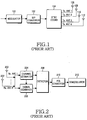
- FIG. 1 is a block diagram of a transmitter in a mobile communication system using the conventional Tarokh's STBC scheme.
- the transmitter is comprised of a modulator 100, a serial-to-parallel (S/P) converter 102, an STBC coder 104, and four Tx antennas 106, 108, 110 and 112.
- S/P serial-to-parallel
- the modulator 100 modulates input information data (or coded data) according to a modulation scheme.
- the modulation scheme can be one of binary phase shift keying (BPSK), quadrature phase shift keying (QPSK), quadrature amplitude modulation (QAM), pulse amplitude modulation (PAM), and phase shift keying (PSK).
- BPSK binary phase shift keying
- QPSK quadrature phase shift keying
- QAM quadrature amplitude modulation
- PAM pulse amplitude modulation
- PSK phase shift keying
- the S/P converter 102 parallelizes serial modulation symbols received from the modulator 100, s 1 , s 2 , s 3 , s 4 .
- the STBC coder 104 creates eight symbol combinations by STBC-encoding the four modulation symbols, s 1 , s 2 , s 3 , s 4 and sequentially transmits them through the four Tx antennas 106 to 112.
- G 4 denotes the coding matrix for symbols transmitted through the four Tx antennas 106 to 112 and s 1 , s 2 , s 3 , s 4 denote the input four symbols.
- the number of columns of the coding matrix is equal to the number of Tx antenna
- s 1 is transmitted through the first Tx antenna 106, s 2 through the second Tx antenna 108, s 3 through the third Tx antenna 110, and s 4 through the fourth Tx antenna 112.
- - s 4 * , - s 3 * , s 2 * , s 1 * are transmitted through the first to fourth Tx antennas 106 to 112, respectively, during an eighth time interval. That is, the STBC coder 104 sequentially provides the symbols of an i th column in the coding matrix to an i th Tx antenna.
- the STBC coder 104 generates the eight symbol sequences using the four input symbols, their conjugates and negatives, and transmits them through the four Tx antennas 106 to 112 over eight time intervals. Since the symbol sequences for the respective Tx antennas, that is the columns of the coding matrix, are mutually orthogonal, a diversity gain equal to the diversity order can be achieved.
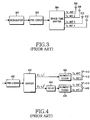
- FIG. 2 is a block diagram of a receiver in the mobile communication system using the conventional STBC scheme.
- the receiver is the counterpart of the transmitter illustrated in FIG. 1.
- the receiver is comprised of a plurality of Rx antennas 200 to 202, a channel estimator 204, a signal combiner 206, a detector 208, a parallel-to-serial (P/S) converter 210, and a demodulator 212.
- the first to P th Rx antennas 200 to 202 provide signals received from the four Tx antennas of the transmitter illustrated in FIG. 1 to the channel estimator 204 and the signal combiner 206.
- the channel estimator 204 estimates channel coefficients representing channel gains from the Tx antennas 106 to 112 to the Rx antennas 200 to 202 using the signals received from the first to P th Rx antennas 200 to 202.
- the signal combiner 206 combines the signals received from the first to P th Rx antennas 200 to 202 with the channel coefficients in a predetermined method.
- the detector 208 generates hypothesis symbols by multiplying the combined symbols by the channel coefficients, calculates decision statistics for all possible symbols transmitted from the transmitter using the hypothesis symbols, and detects the actual transmitted symbols through threshold detection.
- the P/S converter 210 serializes the parallel symbols received from the detector 208.
- the demodulator 212 demodulates the serial symbol sequence according to a demodulation method, thereby recovering the original information bits.
- the Alamouti STBC technique offers the benefit of achieving a diversity order equal to the number of Tx antennas, namely a full diversity order, without sacrificing the data rate by transmitting complex symbols through two Tx antennas only.
- the Tarokh STBC scheme extended from the Alamouti STBC scheme achieves a full diversity order using an STBC in the form of a matrix with orthogonal columns, as described with reference to FIGs. 1 and 2.
- the Tarokh STBC scheme causes a half decrease in the data rate.
- reception performance is degraded due to channel changes within the block over a fast fading channel.
- the transmission of complex symbols through four or more Tx antennas requires 2N time intervals for N symbols, causing a longer latency and a decrease in the data rate.
- the Giannakis group presented a full-diversity, full-rate (FDFR) STBC for four Tx antennas using constellation rotation over a complex field.
- FDFR full-diversity, full-rate
- FIG. 3 is a block diagram of a transmitter in a mobile communication system using the conventional Giannakis STBC scheme.
- the transmitter includes a modulator 300, a pre-coder 302, a space-time mapper 304, and a plurality of Tx antennas 306, 308, 310 and 312.
- the modulator 300 modulates input information data (or coded data) according to a modulation scheme such as BPSK, QPSK, QAM, PAM or PSK.
- the pre-coder 302 pre-encodes N t modulation symbols received from the modulator 300, d 1 , d 2 , d 3 , d 4 such that signal rotation occurs in a signal space, and outputs the resulting N t symbols. For notational simplicity, four Tx antennas are assumed. Let a sequence of four modulation symbols from the modulator 300 be denoted by d.
- the pre-coder 302 generates a complex vector r by computing the modulation symbol sequence, d using Equation (2).
- ⁇ d [ 1 ⁇ 0 1 ⁇ 0 2 ⁇ 0 3 1 ⁇ 1 1 ⁇ 1 2 ⁇ 1 3 1 ⁇ 2 1 ⁇ 2 2 ⁇ 2 3 1 ⁇ 3 1 ⁇ 3 2 ⁇ 3 3 ]
- ⁇ denotes a pre-coding matrix.
- the Giannakis group uses a unitary Vandermonde matrix as the pre-coding matrix.
- the Giannakis STBC scheme uses four Tx antennas and is easily extended to more than four Tx antennas.
- the space-time mapper 304 STBC-encodes the pre-coded symbols according to the following method.
- S [ r 1 0 0 0 0 r 2 0 0 0 0 r 3 0 0 0 r 4 ]
- S is a coding matrix for symbols transmitted through the four Tx antennas 306 to 312.
- the number of the columns of coding matrix is equal to the number of the Tx antennas, and the number of rows corresponds to the time required to transmit the four symbols. That is, the four symbols are transmitted through the four Tx antennas over four time intervals.
- r 1 is transmitted through the first Tx antenna 306, with no signals through the other Tx antennas 308, 310 and 312.
- r 2 is transmitted through the second Tx antenna 308, with no signals through the other Tx antennas 306, 310 and 312.
- r 3 is transmitted through the third Tx antenna 310, with no signals through the other Tx antennas 306, 308, and 312.
- r 4 is transmitted through the fourth Tx antenna 310, with no signals through the other Tx antennas 306, 308 and 310.
- a receiver Upon receipt of the four symbols on a radio channel for the four time intervals, a receiver (not shown) recovers the modulation symbol sequence, d, by using maximum likelihood (ML) decoding.
- ML maximum likelihood
- Tae-Jin Jung and Kyung-Whoon Cheun proposed a pre-coder and a concatenated code with an excellent coding gain in 2003, compared to the Giannakis STBC. They enhance the coding gain by concatenating Alamouti STBCs instead of using a diagonal matrix proposed by the Giannakis group. For the sake of convenience, this STBC will be referred to as the "Alamouti FDFR STBC".
- FIG. 4 is a block diagram of a transmitter in a mobile communication system using the conventional Alamouti FDFR STBC and four Tx antennas.
- the transmitter includes a pre-coder 400, a mapper 402, a delay 404, two Alamouti coders 406 and 408, and four Tx antennas 410, 412, 414 and 416.
- the pre-coder 400 pre-encodes four input modulation symbols, d 1 , d 2 , d 3 , d 4 , such that signal rotation occurs in a signal space.
- the mapper 402 groups the four pre-coded symbols by twos and outputs two vectors each including two elements, [r 1 , r 2 ] T and [r 3 , r 4 ] T to the Alamouti coder 406 and the delay 404, respectively.
- the delay 404 delays the second vector [r 3 , r 4 ] T for one time interval.
- the first vector [r 1 , r 2 ] T is provided to the Alamouti coder 406 in a first time interval and the second vector [r 3 , r 4 ] T is provided to the Alamouti coder 408 in a second time interval.
- the Alamouti coder refers to a coder that operates in the Alamouti STBC scheme.
- the Alamouti coder 406 encodes [r 1 , r 2 ] T so that it is transmitted through the first and second Tx antennas 410 and 412 during the first and second time intervals.
- the Alamouti coder 408 encodes [r 3 , r 4 ] T so that it is transmitted through the third and fourth Tx antennas 414 and 416 during the third and fourth time intervals.
- the above coding matrix is designed to be an Alamouti STBC rather than a diagonal matrix.
- the use of the Alamouti STBC scheme increases the coding gain.
- This Alamouti FDFR STBC has the distinctive shortcoming of increased coding complexity because the transmitter needs to perform computations between all of the elements of the pre-coding matrix and an input vector, for pre-coding. For example, for four Tx antennas, since 0 is not included in the elements of the pre-coding matrix, computation must be carried out on 16 elements. Also, the receiver needs to perform ML decoding with a large volume of computation in order to decode the signal, d, transmitted by the transmitter.
- Chae's scheme is remarkably reduces the ML decoding complexity at the receiver through a series of operations, that is, puncturing and shifting.
- Equation (6) For the Sundar Rajan group's STBC, every value r i of the coding matrix illustrated in Equation (6) is multiplied by e j ⁇ (i.e. rotation on a complex plane), and the real and imaginary parts of the resulting new value x i +jy j are reconstructed.
- Equation (8) allows for linear decoding at the receiver, thus decreasing the decoding complexity.
- Professor Sundar Rajan uses a fixed phase rotation angle ⁇ .
- ⁇ (1/2)atan2.
- a mobile communication system using the Sundar Rajan group's STBC scheme adopts a transmitter having the configuration illustrated in FIG. 5.
- Information symbols s 1 , s 2 , s 3 , s 4 are multiplied by exp(j ⁇ ) in a pre-coder 500 and then reconstructed in a mapper 502.
- the vectors [c 2 'c 1 '] and [c 4 'c 3 '] are transmitted through their corresponding Alamouti coders 506 and 508.
- Delay 504 is used to delay the [C 4 'C 3 '] vector.
- the above coding matrix A involves frequency and time as variables for the communication system with three Tx antennas.
- the rows of the coding matrix A represent the respective Tx antennas.
- the first two columns ( s 1 and - s 2 * in the first row) are mapped to a first frequency and the last two columns (0 and 0 in the first row) to a second frequency.
- the former column in each of the two column pairs ( s 1 in the first row) is mapped to a first time interval and the latter column ( - s 2 * in the first row) to a second time interval. Therefore, the symbol transmitted at the second time interval at the second frequency through the second antenna is s 1 * and the symbol transmitted at the first time interval at the second frequency through the third antenna is s 4 .
- An object of the present invention is to substantially solve at least the above problems and/or disadvantages and to provide at least the advantages below. Accordingly, an object of the present invention is to provide a space-time-frequency block coding apparatus and method for improving performance in a mobile communication system with three Tx antennas.
- Another object of the present invention is to provide a space-time-frequency block coding apparatus and method for improving performance in a mobile communication system with three Tx antennas where vector symbols are rotated on a complex plane and the real and imaginary parts of the resulting new symbols x i +jy i are reconstructed, prior to transmission.
- a further object of the present invention is to provide an apparatus a space-time-frequency block coding apparatus and method for improving performance by selecting a transmission matrix in a mobile communication system using multiple antennas where vector symbols are rotated on a complex plane and the real and imaginary parts of the resulting new symbols x i +jy i are reconstructed, prior to transmission.
- the above objects are achieved by providing a space-time-frequency block coding apparatus and method in a communication system with three Tx antennas.
- a pre-coder pre-codes a symbol vector of an input symbol sequence by multiplying the symbol vector by e j ⁇ .
- ⁇ is a phase rotation angle.
- An STFBC mapper selects an STFBC based on feedback CQIs received from a receiver, maps the pre-coded symbols to the transmit antennas according to the selected STFBC, and transmits the mapped symbols through the transmit antennas.
- a pre-coder pre-codes a symbol vector of an input symbol sequence by multiplying the symbol vector by e j ⁇ .
- ⁇ is a phase rotation angle.
- An STFBC mapper selects an STFBC based on an STBC index received from a receiver, maps the pre-coded symbols to the transmit antennas according to the selected STFBC, and transmits the mapped symbols through the transmit antennas.
- the present invention is intended to provide a space-time-frequency block coding scheme for improving performance in a system using an FDFR orthogonal STFBC.
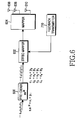
- FIG. 6 is a block diagram of a transmitter in a mobile communication system using an STFBC scheme according to the present invention. It is assumed that the transmitter uses three Tx antennas.
- a pre-coder 600 multiplies each of the input information symbols s 1 , s 2 , s 3 , s 4 by e j ⁇ , that is rotates s 1 , s 2 , s 3 , s 4 on a complex plane by ⁇ , resulting in new symbols c 1 , c 2 , c 3 , c 4 expressed as x i +jy i .
- An STFBC mapper 602 groups the symbols c 1 , c 2 , c 3 , c 4 by selecting an STFBC based on feedback channel information from a receiver, or based on an STFBC index calculated at the receiver.
- a mapper 604 maps the grouped symbols to Tx antennas 606, 608 and 610, for transmission.
- the STFBC mapper 602 and the mapper 604 can be incorporated into a single device.
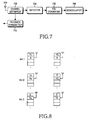
- FIG. 7 is a block diagram of a receiver in the mobile communication system using the STFBC scheme according to the present invention.
- the receiver is assumed to have one Rx antenna.
- a channel estimator 702 performs channel estimation on a signal received through an RX antenna 700. After the channel estimation, the received signal is decoded according to a decoding method.
- a feedback transmitter 710 transmits channel quality indicators (CQIs) received from the channel estimator 702 to the STFBC mapper 602 of the transmitter. Alternatively, the receiver calculates an STFBC index and transmits it to the transmitter through the feedback transmitter 710. The operation of the feedback transmitter 710 will be detailed below.
- the receiver feeds back the CQIs of all of the channels to the transmitter or transmits an STFBC index to the transmitter for use in the STFBC mapper.
- the STFBC mapper 602 Upon receipt of the channel coefficients estimated at the receiver, the STFBC mapper 602 computes the following: select max ( CQI_ant 1 , CQI_ant 2 , CQI_ant 3 ) where CQI_ant1, CQI_ant2, and CQI_ant3 represents CQIs for the first, second and third Tx antennas, respectively.
- the receiver feeds back an STFBC index computed by Equation (14) to the STFBC mapper 602 of the transmitter.
- STFBC mapping is performed in the context of the matrix A.
- Pre-coded symbols c 1 , c 2 , c 3 , c 4 are mapped according to the matrix A.
- s in the matrix A corresponds to c.
- the STFBC mapper 602 maps the symbols to the Tx antennas using one of matrices A, B and C.
- one of the matrices A, B and C that offers the optimum performance is selected based on feedback information received from the feedback transmitter 710 of the receiver. If the first antenna is in the best channel condition, the matrix B is selected to transmit more symbols through the first antenna. If the second antenna is in the best channel condition, the matrix A is selected to transmit more symbols through the second antenna.
- the matrix C is selected to transmit more symbols through the third antenna.
- FIG. 9 is a flowchart illustrating the transmission operation of the transmitter in the mobile communication system using the STFBC scheme according to the present invention.
- the transmitter selects an STFBC based on CQIs received from the receiver by Equation (16), or according to an STFBC index received from the receiver in step 910.
- the STFBC mapper maps the pre-coded symbols according to the selected STFBC in step 906 and transmits the mapped symbols through their corresponding Tx antennas in step 908.
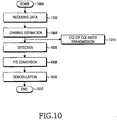
- FIG. 10 is a flowchart illustrating the reception operation of the receiver in the mobile communication system using the STFBC scheme according to the present invention.
- the data stream is channel-estimated in step 1004 and CQIs are transmitted as channel information to the transmitter in step 1014.
- the transmitter calculates an STFBC to be used by Equation (16).
- the receiver calculates an STFBC code by Equation (16) rather than transmitting the channel coefficients to the transmitter and transmits its index to the transmitter.
- the transmitter In the case of direct feedback of the channel information, the transmitter notifies the receiver of the index of an STFBC selected by the transmitter in order to increase communication accuracy. In case the transmitter's selected STFBC is different from the receiver's, the transmission of the index of the transmitter's selected STFBC on a common channel to the receiver renders data transmission between them more accurate.
- step 1006 detection in step 1006, P/S conversion in step 1008, and demodulation in step 1010 are carried out in the same manner as in existing systems.
- the receiver calculates the average channel value of every subchannel including N subcarriers in order to reduce the amount of feedback information.
- the transmitter selects an STFBC based on the average channel values of the subchannels.
- the transmitter then notifies the receiver of the selected STFBC. This bidirectional communication ensures communication accuracy.
- the transmitter may group the Tx antennas according to a set rule without using the feedback information from the receiver.
- the above matrix D is a combination of the matrices illustrated in Equation (15), [ A
- C ]. It is defined by the order of the matrices which can be freely set. Therefore, the following matrices D are available: D [ A
- C ], D [ A
- B ], D [ B
- C ], D [ B
- a ], D [ C
- B ], and D [ CB
- the rows represent Tx antennas like the matrix A in Equation (13).
- the columns are grouped sequentially in pairs.
- the first and second columns are mapped to a first subcarrier, the third and fourth columns to a second subcarrier, and the remaining columns to third to sixth subcarriers in this manner.
- the first and second symbols in each column pair are mapped to a subcarrier and represent first and second symbol times, respectively.
- the logical data subcarrier index refers to a subcarrier index of Fast Fourier Transform (FFT) in OFDM.
- FFT Fast Fourier Transform
- Equation (18) logical data subcarriers with indexes 1 and 2 are mapped to the Tx antennas in the antenna grouping pattern of A 1 , logical data subcarriers with indexes 3 and 4 are mapped to the Tx antennas in the antenna grouping pattern of A 2 , and logical data subcarriers with indexes 5 and 6 are mapped to the Tx antennas in the antenna grouping pattern of A 3 .
- the antenna grouping patterns for the remaining subcarriers are determined by Equation (18).
- a suitable transmission matrix having regularities is selected based on feedback channel information received from a receiver or according to an STFBC calculated at the transmitter, thereby increasing STFBC performance.
Landscapes
- Engineering & Computer Science (AREA)
- Computer Networks & Wireless Communication (AREA)
- Signal Processing (AREA)
- Physics & Mathematics (AREA)
- Mathematical Physics (AREA)
- Radio Transmission System (AREA)
- Mobile Radio Communication Systems (AREA)
Applications Claiming Priority (2)
| Application Number | Priority Date | Filing Date | Title |
|---|---|---|---|
| KR20040064799 | 2004-08-17 | ||
| KR1020050019850A KR100774290B1 (ko) | 2004-08-17 | 2005-03-09 | 성능 향상위한 시공간 블록 부호화 장치 및 방법 |
Publications (3)
| Publication Number | Publication Date |
|---|---|
| EP1628426A2 true EP1628426A2 (fr) | 2006-02-22 |
| EP1628426A3 EP1628426A3 (fr) | 2011-11-30 |
| EP1628426B1 EP1628426B1 (fr) | 2015-07-22 |
Family
ID=35033479
Family Applications (2)
| Application Number | Title | Priority Date | Filing Date |
|---|---|---|---|
| EP05017894.6A Expired - Lifetime EP1628426B1 (fr) | 2004-08-17 | 2005-08-17 | Dispositif et méthode pour augmenter la performance du codage des blocs espace-temps-fréquence |
| EP05017892A Expired - Lifetime EP1628425B1 (fr) | 2004-08-17 | 2005-08-17 | Procédé et appareil pour codage espace-temps-fréquence en blocs. |
Family Applications After (1)
| Application Number | Title | Priority Date | Filing Date |
|---|---|---|---|
| EP05017892A Expired - Lifetime EP1628425B1 (fr) | 2004-08-17 | 2005-08-17 | Procédé et appareil pour codage espace-temps-fréquence en blocs. |
Country Status (6)
| Country | Link |
|---|---|
| US (2) | US7508880B2 (fr) |
| EP (2) | EP1628426B1 (fr) |
| JP (2) | JP4436415B2 (fr) |
| AU (2) | AU2005273134B2 (fr) |
| CA (2) | CA2575698C (fr) |
| WO (2) | WO2006019250A1 (fr) |
Families Citing this family (91)
| Publication number | Priority date | Publication date | Assignee | Title |
|---|---|---|---|---|
| US7295509B2 (en) | 2000-09-13 | 2007-11-13 | Qualcomm, Incorporated | Signaling method in an OFDM multiple access system |
| US9130810B2 (en) * | 2000-09-13 | 2015-09-08 | Qualcomm Incorporated | OFDM communications methods and apparatus |
| CN103297204B (zh) * | 2004-04-02 | 2017-03-01 | 苹果公司 | 用于正交频分复用应用的空间时间发射分集系统及方法 |
| CA2557736C (fr) * | 2004-05-07 | 2013-01-22 | Huawei Technologies Co. | Appareil et procede pour le codage/decodage d'un code de bloc-temps dans un systeme de communication mobile utilisant un schema d'entrees et de sorties multiples |
| US9148256B2 (en) | 2004-07-21 | 2015-09-29 | Qualcomm Incorporated | Performance based rank prediction for MIMO design |
| US9137822B2 (en) | 2004-07-21 | 2015-09-15 | Qualcomm Incorporated | Efficient signaling over access channel |
| GB0423567D0 (en) * | 2004-10-23 | 2004-11-24 | Koninkl Philips Electronics Nv | Mimo system and method of operating a mimo system |
| US7545875B2 (en) * | 2004-11-03 | 2009-06-09 | Nokia Corporation | System and method for space-time-frequency coding in a multi-antenna transmission system |
| WO2006049461A1 (fr) * | 2004-11-04 | 2006-05-11 | Samsung Electronics Co., Ltd. | Dispositif et procede reposant sur l'utilisation de code bloc frequentiel spatio-temporel |
| US9246560B2 (en) | 2005-03-10 | 2016-01-26 | Qualcomm Incorporated | Systems and methods for beamforming and rate control in a multi-input multi-output communication systems |
| US9154211B2 (en) * | 2005-03-11 | 2015-10-06 | Qualcomm Incorporated | Systems and methods for beamforming feedback in multi antenna communication systems |
| US8995547B2 (en) * | 2005-03-11 | 2015-03-31 | Qualcomm Incorporated | Systems and methods for reducing uplink resources to provide channel performance feedback for adjustment of downlink MIMO channel data rates |
| US8724740B2 (en) | 2005-03-11 | 2014-05-13 | Qualcomm Incorporated | Systems and methods for reducing uplink resources to provide channel performance feedback for adjustment of downlink MIMO channel data rates |
| US9520972B2 (en) | 2005-03-17 | 2016-12-13 | Qualcomm Incorporated | Pilot signal transmission for an orthogonal frequency division wireless communication system |
| US9143305B2 (en) * | 2005-03-17 | 2015-09-22 | Qualcomm Incorporated | Pilot signal transmission for an orthogonal frequency division wireless communication system |
| US9461859B2 (en) * | 2005-03-17 | 2016-10-04 | Qualcomm Incorporated | Pilot signal transmission for an orthogonal frequency division wireless communication system |
| US20090213950A1 (en) * | 2005-03-17 | 2009-08-27 | Qualcomm Incorporated | Pilot signal transmission for an orthogonal frequency division wireless communication system |
| US9184870B2 (en) | 2005-04-01 | 2015-11-10 | Qualcomm Incorporated | Systems and methods for control channel signaling |
| US9036538B2 (en) | 2005-04-19 | 2015-05-19 | Qualcomm Incorporated | Frequency hopping design for single carrier FDMA systems |
| US9408220B2 (en) | 2005-04-19 | 2016-08-02 | Qualcomm Incorporated | Channel quality reporting for adaptive sectorization |
| US8634432B2 (en) * | 2005-05-06 | 2014-01-21 | Samsung Electronics Co., Ltd. | System and method for subcarrier allocation in a multicarrier wireless network |
| US8565194B2 (en) | 2005-10-27 | 2013-10-22 | Qualcomm Incorporated | Puncturing signaling channel for a wireless communication system |
| US8611284B2 (en) * | 2005-05-31 | 2013-12-17 | Qualcomm Incorporated | Use of supplemental assignments to decrement resources |
| US8879511B2 (en) | 2005-10-27 | 2014-11-04 | Qualcomm Incorporated | Assignment acknowledgement for a wireless communication system |
| US8599945B2 (en) * | 2005-06-16 | 2013-12-03 | Qualcomm Incorporated | Robust rank prediction for a MIMO system |
| US9179319B2 (en) | 2005-06-16 | 2015-11-03 | Qualcomm Incorporated | Adaptive sectorization in cellular systems |
| US8885628B2 (en) * | 2005-08-08 | 2014-11-11 | Qualcomm Incorporated | Code division multiplexing in a single-carrier frequency division multiple access system |
| US20070041457A1 (en) * | 2005-08-22 | 2007-02-22 | Tamer Kadous | Method and apparatus for providing antenna diversity in a wireless communication system |
| US8073068B2 (en) * | 2005-08-22 | 2011-12-06 | Qualcomm Incorporated | Selective virtual antenna transmission |
| US9209956B2 (en) | 2005-08-22 | 2015-12-08 | Qualcomm Incorporated | Segment sensitive scheduling |
| US8644292B2 (en) * | 2005-08-24 | 2014-02-04 | Qualcomm Incorporated | Varied transmission time intervals for wireless communication system |
| AU2006203698A1 (en) * | 2005-08-26 | 2007-03-15 | Nec Australia Pty Ltd | Transmit diversity scheme |
| US9136974B2 (en) | 2005-08-30 | 2015-09-15 | Qualcomm Incorporated | Precoding and SDMA support |
| US9144060B2 (en) * | 2005-10-27 | 2015-09-22 | Qualcomm Incorporated | Resource allocation for shared signaling channels |
| US9088384B2 (en) * | 2005-10-27 | 2015-07-21 | Qualcomm Incorporated | Pilot symbol transmission in wireless communication systems |
| US8693405B2 (en) * | 2005-10-27 | 2014-04-08 | Qualcomm Incorporated | SDMA resource management |
| US9172453B2 (en) | 2005-10-27 | 2015-10-27 | Qualcomm Incorporated | Method and apparatus for pre-coding frequency division duplexing system |
| US9225488B2 (en) | 2005-10-27 | 2015-12-29 | Qualcomm Incorporated | Shared signaling channel |
| US9225416B2 (en) | 2005-10-27 | 2015-12-29 | Qualcomm Incorporated | Varied signaling channels for a reverse link in a wireless communication system |
| US9210651B2 (en) * | 2005-10-27 | 2015-12-08 | Qualcomm Incorporated | Method and apparatus for bootstraping information in a communication system |
| US8045512B2 (en) | 2005-10-27 | 2011-10-25 | Qualcomm Incorporated | Scalable frequency band operation in wireless communication systems |
| US8582548B2 (en) * | 2005-11-18 | 2013-11-12 | Qualcomm Incorporated | Frequency division multiple access schemes for wireless communication |
| US20070177688A1 (en) * | 2005-11-25 | 2007-08-02 | Jinsong Wu | System and method employing linear dispersion over space, time and frequency |
| US8831607B2 (en) | 2006-01-05 | 2014-09-09 | Qualcomm Incorporated | Reverse link other sector communication |
| EP1993224B1 (fr) | 2006-03-03 | 2019-07-24 | NEC Corporation | Systeme de communication multi-entree multi-sortie, transmetteur et procede d'allocation de ressources |
| KR100950654B1 (ko) * | 2006-03-03 | 2010-04-01 | 삼성전자주식회사 | 다중 입력 다중 출력 방식을 사용하는 통신 시스템에서신호 송수신 장치 및 방법 |
| JP4924106B2 (ja) | 2006-04-27 | 2012-04-25 | ソニー株式会社 | 無線通信システム、並びに無線通信装置及び無線通信方法 |
| JP4775288B2 (ja) * | 2006-04-27 | 2011-09-21 | ソニー株式会社 | 無線通信システム、無線通信装置及び無線通信方法 |
| JP4356756B2 (ja) | 2006-04-27 | 2009-11-04 | ソニー株式会社 | 無線通信システム、並びに無線通信装置及び無線通信方法 |
| JP4924107B2 (ja) | 2006-04-27 | 2012-04-25 | ソニー株式会社 | 無線通信システム、並びに無線通信装置及び無線通信方法 |
| TWI343200B (en) * | 2006-05-26 | 2011-06-01 | Lg Electronics Inc | Method and apparatus for signal generation using phase-shift based pre-coding |
| KR20070113967A (ko) | 2006-05-26 | 2007-11-29 | 엘지전자 주식회사 | 위상천이 기반의 프리코딩 방법 및 이를 지원하는 송수신기 |
| CA2656988C (fr) * | 2006-07-06 | 2013-05-14 | Lg Electronics Inc. | Procede et appareil permettant de corriger des erreurs dans un systeme de communication a plusieurs sous-porteuses au moyen de plusieurs antennes |
| WO2008012719A2 (fr) * | 2006-07-21 | 2008-01-31 | Koninklijke Philips Electronics N.V. | Procédé et appareil de codage et de décodage de fréquence spatio-temporelle |
| KR20090071582A (ko) * | 2006-09-06 | 2009-07-01 | 콸콤 인코포레이티드 | 그룹화된 안테나들에 대한 코드워드 치환 및 감소된 피드백 |
| KR20080026010A (ko) | 2006-09-19 | 2008-03-24 | 엘지전자 주식회사 | 위상천이 기반의 프리코딩을 이용한 데이터 전송 방법 및이를 구현하는 송수신 장치 |
| KR20080026019A (ko) * | 2006-09-19 | 2008-03-24 | 엘지전자 주식회사 | 위상천이 기반의 프리코딩 방법 및 이를 지원하는 송수신기 |
| US20080080434A1 (en) * | 2006-09-28 | 2008-04-03 | Guy Wolf | Method and apparatus of system scheduler |
| KR101431271B1 (ko) * | 2007-01-12 | 2014-08-20 | 삼성전자주식회사 | 다중 입력 다중 출력 방식의 이동 통신 시스템에서 피드백정보 송수신 방법 및 장치 |
| KR20080076683A (ko) * | 2007-02-14 | 2008-08-20 | 엘지전자 주식회사 | 위상천이 기반의 프리코딩 방법 및 이를 지원하는 송수신기 |
| EP1959603A1 (fr) * | 2007-02-15 | 2008-08-20 | Mitsubishi Electric Information Technology Center Europe B.V. | Procédé d'émission de données radio, émetteur et récepteur utilisant le procédé |
| JP5284284B2 (ja) * | 2007-02-15 | 2013-09-11 | ミツビシ・エレクトリック・アールアンドディー・センター・ヨーロッパ・ビーヴィ | Mimo送信機用sc−qostfbc符号 |
| KR100969753B1 (ko) * | 2007-03-26 | 2010-07-13 | 삼성전자주식회사 | 다중 입력 다중 출력 방식을 사용하는 무선 통신시스템에서 사전 부호화 장치 및 방법 |
| KR101414611B1 (ko) | 2007-04-19 | 2014-07-07 | 엘지전자 주식회사 | 다중 안테나 시스템에서 신호 송신 방법 |
| US7990920B2 (en) * | 2007-04-26 | 2011-08-02 | Samsung Electronics Co., Ltd. | Transmit diversity for acknowledgement and category 0 bits in a wireless communication system |
| US8254492B2 (en) * | 2007-04-26 | 2012-08-28 | Samsung Electronics Co., Ltd. | Transmit diversity in a wireless communication system |
| KR100979132B1 (ko) * | 2007-06-26 | 2010-08-31 | 삼성전자주식회사 | 무선통신시스템에서 간섭 제거 장치 및 방법 |
| KR20090030200A (ko) * | 2007-09-19 | 2009-03-24 | 엘지전자 주식회사 | 위상천이 기반의 프리코딩을 이용한 데이터 송수신 방법 및이를 지원하는 송수신기 |
| WO2010015127A1 (fr) * | 2008-08-07 | 2010-02-11 | Huawei Technologies Co., Ltd. | Procédé de codage en diversité d’émission |
| KR20100019947A (ko) * | 2008-08-11 | 2010-02-19 | 엘지전자 주식회사 | 무선 통신 시스템에서 정보 전송 방법 |
| KR101603338B1 (ko) | 2008-08-11 | 2016-03-15 | 엘지전자 주식회사 | 무선 통신 시스템에서 정보 전송 방법 및 장치 |
| KR101571566B1 (ko) | 2008-08-11 | 2015-11-25 | 엘지전자 주식회사 | 무선 통신 시스템에서 제어신호 전송 방법 |
| KR101646249B1 (ko) * | 2008-08-11 | 2016-08-16 | 엘지전자 주식회사 | 무선 통신 시스템에서 정보 전송 방법 및 장치 |
| KR101597573B1 (ko) * | 2008-08-11 | 2016-02-25 | 엘지전자 주식회사 | 제어정보의 상향링크 전송 방법 |
| KR101508704B1 (ko) * | 2008-08-19 | 2015-04-03 | 한국과학기술원 | 다중안테나 시스템에서 송ㆍ수신 장치 및 방법 |
| WO2010031893A1 (fr) * | 2008-09-19 | 2010-03-25 | Nokia Corporation | Appareils, procédés et programmes informatiques pour acheminer des informations |
| KR101243508B1 (ko) | 2008-11-14 | 2013-03-20 | 엘지전자 주식회사 | 무선 통신 시스템에서 신호 전송 방법 및 장치 |
| US8472464B2 (en) * | 2008-11-14 | 2013-06-25 | Lg Electronics Inc. | Method and apparatus for information transmission in wireless transmission system |
| WO2010056078A2 (fr) | 2008-11-14 | 2010-05-20 | 엘지전자주식회사 | Procédé et appareil permettant la transmission d'informations dans un système de communication sans fil |
| EP2377259B1 (fr) * | 2008-12-23 | 2015-09-16 | Orange | Procede de transmission d'un signal de donnees codé espace-fréquence via une pluralite d'entites d'emission |
| KR20100091876A (ko) | 2009-02-11 | 2010-08-19 | 엘지전자 주식회사 | 다중안테나 전송을 위한 단말 동작 |
| US20100232384A1 (en) * | 2009-03-13 | 2010-09-16 | Qualcomm Incorporated | Channel estimation based upon user specific and common reference signals |
| US8553794B2 (en) * | 2009-04-06 | 2013-10-08 | Intel Corporation | Full-rate, full-diversity space-time block code technique for multiple transmissions using simple linear decoding complexity |
| CN101958737B (zh) * | 2009-07-20 | 2014-08-06 | 株式会社Ntt都科摩 | 一种用于下行发送分集的数据处理方法及基站 |
| KR20110038585A (ko) | 2009-10-08 | 2011-04-14 | 엘지전자 주식회사 | 다중 안테나 시스템에서 상향링크 전송 방법 및 장치 |
| CN102098099B (zh) * | 2009-12-15 | 2014-07-09 | 华为技术有限公司 | 控制输出光功率的方法、装置和光通信系统 |
| WO2012030340A1 (fr) | 2010-09-01 | 2012-03-08 | Empire Technology Development Llc | Précodage de données basé sur des informations d'état de canal transférées |
| PE20131090A1 (es) | 2010-12-10 | 2013-10-16 | Panasonic Ip Corp America | Metodo y dispositivo de generacion de senales |
| US8565209B2 (en) * | 2011-09-09 | 2013-10-22 | Kochi University Of Technology | Communication apparatus, communication system, communication method and computer-readable storage medium |
| US9692559B1 (en) * | 2015-02-24 | 2017-06-27 | Marvell International Ltd. | Systems and methods for a multiple-input-multiple-output (MIMO) data transmission scheme using a space time block code (STBC) |
| KR102512844B1 (ko) * | 2016-06-29 | 2023-03-22 | 삼성전자주식회사 | 무선 통신 시스템에서 블록 코드의 퍼뮤테이션을 위한 장치 및 방법 |
Citations (1)
| Publication number | Priority date | Publication date | Assignee | Title |
|---|---|---|---|---|
| WO2001045300A1 (fr) | 1999-12-15 | 2001-06-21 | Iospan Wireless, Inc. | Procede et systemes sans fils utilisant plusieurs antennes et une commande adaptive pour maximiser un parametre de communication |
Family Cites Families (20)
| Publication number | Priority date | Publication date | Assignee | Title |
|---|---|---|---|---|
| EP0807989B1 (fr) | 1996-05-17 | 2001-06-27 | Motorola Ltd | Procédé et appareil de pondération d'une voie de transmission |
| US6256290B1 (en) | 1996-09-13 | 2001-07-03 | Lucent Technologies, Inc. | Multi-carrier CDMA transmission system with frequency and transmit diversity |
| WO1999004519A2 (fr) | 1997-07-16 | 1999-01-28 | At & T Corp. | Traitement en faisceau et codage spatio-temporel combines |
| US6185258B1 (en) * | 1997-09-16 | 2001-02-06 | At&T Wireless Services Inc. | Transmitter diversity technique for wireless communications |
| IL135676A (en) | 1998-08-20 | 2003-12-10 | Samsung Electronics Co Ltd | Deviced and method for inserting previously known bits in input stage of channel encoder |
| RU2145152C1 (ru) | 1998-10-08 | 2000-01-27 | Гармонов Александр Васильевич | Способ ортогональной разнесенной передачи-приема сигнала в сотовой системе радиосвязи с кодовым разделением каналов |
| US6452916B1 (en) | 1999-01-04 | 2002-09-17 | Lucent Technologies Inc. | Space-time spreading method of CDMA wireless communication |
| US6317411B1 (en) | 1999-02-22 | 2001-11-13 | Motorola, Inc. | Method and system for transmitting and receiving signals transmitted from an antenna array with transmit diversity techniques |
| US8537656B2 (en) * | 2000-07-19 | 2013-09-17 | Ipr Licensing, Inc. | Method for compensating for multi-path of a CDMA reverse link utilizing an orthogonal channel structure |
| AU2002251395A1 (en) | 2001-03-28 | 2002-10-15 | Nokia Corporation | Non-zero complex weighted space-time code for multiple antenna transmission |
| US8290098B2 (en) * | 2001-03-30 | 2012-10-16 | Texas Instruments Incorporated | Closed loop multiple transmit, multiple receive antenna wireless communication system |
| JP2002344415A (ja) | 2001-05-14 | 2002-11-29 | Matsushita Electric Ind Co Ltd | マルチキャリア通信方法及びマルチキャリア通信装置 |
| US7227905B2 (en) * | 2001-09-18 | 2007-06-05 | Lucent Technologies Inc. | Open-loop diversity technique for systems employing multi-transmitter antennas |
| WO2003043245A1 (fr) * | 2001-11-10 | 2003-05-22 | Samsung Electronics Co., Ltd. | Appareil et procede de codage/decodage stfbc dans un systeme de communication mobile ofdm |
| US7103325B1 (en) * | 2002-04-05 | 2006-09-05 | Nortel Networks Limited | Adaptive modulation and coding |
| FI20021013A0 (fi) * | 2002-05-29 | 2002-05-29 | Nokia Corp | Tiedonsiirtomenetelmä ja -järjestelmä |
| US8289836B2 (en) * | 2003-02-27 | 2012-10-16 | Intel Corporation | Apparatus and associated methods to introduce diversity in a multicarrier communication channel |
| KR20050037215A (ko) | 2003-10-17 | 2005-04-21 | 엘지전자 주식회사 | 이동통신시스템의 시공간 전송 다이버시티 방법 |
| EP3537681B1 (fr) * | 2004-06-24 | 2020-10-07 | Apple Inc. | Préambules dans un système ofdma |
| US7567621B2 (en) * | 2004-07-21 | 2009-07-28 | Qualcomm Incorporated | Capacity based rank prediction for MIMO design |
-
2005
- 2005-08-17 WO PCT/KR2005/002679 patent/WO2006019250A1/fr not_active Ceased
- 2005-08-17 US US11/205,669 patent/US7508880B2/en active Active
- 2005-08-17 AU AU2005273134A patent/AU2005273134B2/en not_active Ceased
- 2005-08-17 JP JP2007527043A patent/JP4436415B2/ja not_active Expired - Fee Related
- 2005-08-17 WO PCT/KR2005/002682 patent/WO2006019253A1/fr not_active Ceased
- 2005-08-17 EP EP05017894.6A patent/EP1628426B1/fr not_active Expired - Lifetime
- 2005-08-17 AU AU2005273137A patent/AU2005273137B2/en not_active Ceased
- 2005-08-17 US US11/205,598 patent/US7515644B2/en active Active
- 2005-08-17 CA CA2575698A patent/CA2575698C/fr not_active Expired - Lifetime
- 2005-08-17 JP JP2007527045A patent/JP4440971B2/ja not_active Expired - Fee Related
- 2005-08-17 CA CA2575701A patent/CA2575701C/fr not_active Expired - Lifetime
- 2005-08-17 EP EP05017892A patent/EP1628425B1/fr not_active Expired - Lifetime
Patent Citations (1)
| Publication number | Priority date | Publication date | Assignee | Title |
|---|---|---|---|---|
| WO2001045300A1 (fr) | 1999-12-15 | 2001-06-21 | Iospan Wireless, Inc. | Procede et systemes sans fils utilisant plusieurs antennes et une commande adaptive pour maximiser un parametre de communication |
Non-Patent Citations (3)
| Title |
|---|
| CHEN ZHUO ET AL.: "Performance of Alamouti Scheme with Transmit Antenna Selection", ELECTRONICS LETTERS, IEE STEVENAGE, GB, vol. 39, no. 23, 13 November 2003 (2003-11-13), pages 1666 - 1668 |
| ERIK LINDSKOG ET AL.: "Space-Time Codes for 3 Transmit Antennas for the OFDMA PHY", INTERNET CITATION, 18 October 2011 (2011-10-18), Retrieved from the Internet <URL:http://ieee802.org/16/tge/contrib/C80216e-04_208r1.pdf> |
| GORE, D. ET AL.: "IEEE Transactions on Signal Processing", vol. 50, 1 August 2002, IEEE SERVICE CENTER, article "MIMO Antenna Subset Selection with Space-Time Coding", pages: 2580 - 2588 |
Also Published As
| Publication number | Publication date |
|---|---|
| AU2005273137B2 (en) | 2009-03-05 |
| AU2005273134B2 (en) | 2008-10-02 |
| US7515644B2 (en) | 2009-04-07 |
| WO2006019250A1 (fr) | 2006-02-23 |
| JP4440971B2 (ja) | 2010-03-24 |
| JP4436415B2 (ja) | 2010-03-24 |
| AU2005273134A1 (en) | 2006-02-23 |
| CA2575701C (fr) | 2012-04-10 |
| US20060039496A1 (en) | 2006-02-23 |
| US7508880B2 (en) | 2009-03-24 |
| CA2575698C (fr) | 2011-07-19 |
| EP1628426A3 (fr) | 2011-11-30 |
| CA2575701A1 (fr) | 2006-02-23 |
| EP1628425A3 (fr) | 2011-11-30 |
| JP2008510418A (ja) | 2008-04-03 |
| EP1628426B1 (fr) | 2015-07-22 |
| EP1628425A2 (fr) | 2006-02-22 |
| EP1628425B1 (fr) | 2012-12-26 |
| CA2575698A1 (fr) | 2006-02-23 |
| WO2006019253A1 (fr) | 2006-02-23 |
| AU2005273137A1 (en) | 2006-02-23 |
| JP2008510417A (ja) | 2008-04-03 |
| US20060039500A1 (en) | 2006-02-23 |
Similar Documents
| Publication | Publication Date | Title |
|---|---|---|
| US7515644B2 (en) | Apparatus and method for space-time-frequency block coding for increasing performance | |
| EP1608081B1 (fr) | Dispositif et procédé pour le codage/décodage espace-fréquence dans un système de communication | |
| EP1655876A2 (fr) | Dispositif et procédé d'émission et de réception de données utilisant un code de blocs spatio-temporels | |
| CN1943133B (zh) | 利用多输入多输出方案的移动通信系统中编码/解码时空块代码的装置与方法 | |
| EP1679816A1 (fr) | Dispositif et procédé pour codage espace-temps-fréquence en blocs dans un système de communication sans fil | |
| US20060153312A1 (en) | Apparatus and method for space-time frequency block coding in a wireless communication system | |
| US20080260053A1 (en) | Apparatus and method for transmitting and receiving data using space-time block coding | |
| CN101006658B (zh) | 用于时空频率分组编码以提高性能的装置和方法 | |
| US20050281351A1 (en) | Apparatus and method for full-diversity, full-rate space-time block coding for even number of transmit antennas | |
| US20060039499A1 (en) | Apparatus and method for space-time block coding | |
| US20060039495A1 (en) | Apparatus and method for space-time block coding for increasing coding gain | |
| US7801237B2 (en) | Apparatus and method of space time frequency block code |
Legal Events
| Date | Code | Title | Description |
|---|---|---|---|
| PUAI | Public reference made under article 153(3) epc to a published international application that has entered the european phase |
Free format text: ORIGINAL CODE: 0009012 |
|
| AK | Designated contracting states |
Kind code of ref document: A2 Designated state(s): AT BE BG CH CY CZ DE DK EE ES FI FR GB GR HU IE IS IT LI LT LU LV MC NL PL PT RO SE SI SK TR |
|
| AX | Request for extension of the european patent |
Extension state: AL BA HR MK YU |
|
| 17P | Request for examination filed |
Effective date: 20060731 |
|
| PUAL | Search report despatched |
Free format text: ORIGINAL CODE: 0009013 |
|
| RIC1 | Information provided on ipc code assigned before grant |
Ipc: H04L 1/06 20060101AFI20111020BHEP Ipc: H04L 1/04 20060101ALI20111020BHEP |
|
| AK | Designated contracting states |
Kind code of ref document: A3 Designated state(s): AT BE BG CH CY CZ DE DK EE ES FI FR GB GR HU IE IS IT LI LT LU LV MC NL PL PT RO SE SI SK TR |
|
| AX | Request for extension of the european patent |
Extension state: AL BA HR MK YU |
|
| AKX | Designation fees paid |
Designated state(s): DE FR GB IT SE |
|
| 17Q | First examination report despatched |
Effective date: 20120716 |
|
| RAP1 | Party data changed (applicant data changed or rights of an application transferred) |
Owner name: SAMSUNG ELECTRONICS CO., LTD. |
|
| GRAP | Despatch of communication of intention to grant a patent |
Free format text: ORIGINAL CODE: EPIDOSNIGR1 |
|
| INTG | Intention to grant announced |
Effective date: 20150310 |
|
| GRAS | Grant fee paid |
Free format text: ORIGINAL CODE: EPIDOSNIGR3 |
|
| GRAA | (expected) grant |
Free format text: ORIGINAL CODE: 0009210 |
|
| AK | Designated contracting states |
Kind code of ref document: B1 Designated state(s): DE FR GB IT SE |
|
| REG | Reference to a national code |
Ref country code: GB Ref legal event code: FG4D |
|
| REG | Reference to a national code |
Ref country code: DE Ref legal event code: R096 Ref document number: 602005047012 Country of ref document: DE |
|
| PG25 | Lapsed in a contracting state [announced via postgrant information from national office to epo] |
Ref country code: SE Free format text: LAPSE BECAUSE OF FAILURE TO SUBMIT A TRANSLATION OF THE DESCRIPTION OR TO PAY THE FEE WITHIN THE PRESCRIBED TIME-LIMIT Effective date: 20150722 |
|
| REG | Reference to a national code |
Ref country code: DE Ref legal event code: R097 Ref document number: 602005047012 Country of ref document: DE |
|
| PG25 | Lapsed in a contracting state [announced via postgrant information from national office to epo] |
Ref country code: IT Free format text: LAPSE BECAUSE OF FAILURE TO SUBMIT A TRANSLATION OF THE DESCRIPTION OR TO PAY THE FEE WITHIN THE PRESCRIBED TIME-LIMIT Effective date: 20150722 |
|
| PLBE | No opposition filed within time limit |
Free format text: ORIGINAL CODE: 0009261 |
|
| STAA | Information on the status of an ep patent application or granted ep patent |
Free format text: STATUS: NO OPPOSITION FILED WITHIN TIME LIMIT |
|
| REG | Reference to a national code |
Ref country code: FR Ref legal event code: ST Effective date: 20160429 |
|
| 26N | No opposition filed |
Effective date: 20160425 |
|
| GBPC | Gb: european patent ceased through non-payment of renewal fee |
Effective date: 20151022 |
|
| PG25 | Lapsed in a contracting state [announced via postgrant information from national office to epo] |
Ref country code: GB Free format text: LAPSE BECAUSE OF NON-PAYMENT OF DUE FEES Effective date: 20151022 |
|
| PG25 | Lapsed in a contracting state [announced via postgrant information from national office to epo] |
Ref country code: FR Free format text: LAPSE BECAUSE OF NON-PAYMENT OF DUE FEES Effective date: 20150922 |
|
| PGFP | Annual fee paid to national office [announced via postgrant information from national office to epo] |
Ref country code: DE Payment date: 20220621 Year of fee payment: 18 |
|
| REG | Reference to a national code |
Ref country code: DE Ref legal event code: R119 Ref document number: 602005047012 Country of ref document: DE |
|
| PG25 | Lapsed in a contracting state [announced via postgrant information from national office to epo] |
Ref country code: DE Free format text: LAPSE BECAUSE OF NON-PAYMENT OF DUE FEES Effective date: 20240301 |