EP1628428A1 - Empfänger und hybrides apq-kommunikationssystem - Google Patents
Empfänger und hybrides apq-kommunikationssystem Download PDFInfo
- Publication number
- EP1628428A1 EP1628428A1 EP03733095A EP03733095A EP1628428A1 EP 1628428 A1 EP1628428 A1 EP 1628428A1 EP 03733095 A EP03733095 A EP 03733095A EP 03733095 A EP03733095 A EP 03733095A EP 1628428 A1 EP1628428 A1 EP 1628428A1
- Authority
- EP
- European Patent Office
- Prior art keywords
- data
- combining
- retransmission
- reliability
- unit
- Prior art date
- Legal status (The legal status is an assumption and is not a legal conclusion. Google has not performed a legal analysis and makes no representation as to the accuracy of the status listed.)
- Ceased
Links
Images



Classifications
-
- H—ELECTRICITY
- H04—ELECTRIC COMMUNICATION TECHNIQUE
- H04L—TRANSMISSION OF DIGITAL INFORMATION, e.g. TELEGRAPHIC COMMUNICATION
- H04L1/00—Arrangements for detecting or preventing errors in the information received
- H04L1/12—Arrangements for detecting or preventing errors in the information received by using return channel
- H04L1/16—Arrangements for detecting or preventing errors in the information received by using return channel in which the return channel carries supervisory signals, e.g. repetition request signals
- H04L1/18—Automatic repetition systems, e.g. Van Duuren systems
- H04L1/1812—Hybrid protocols; Hybrid automatic repeat request [HARQ]
-
- H—ELECTRICITY
- H04—ELECTRIC COMMUNICATION TECHNIQUE
- H04L—TRANSMISSION OF DIGITAL INFORMATION, e.g. TELEGRAPHIC COMMUNICATION
- H04L1/00—Arrangements for detecting or preventing errors in the information received
- H04L1/12—Arrangements for detecting or preventing errors in the information received by using return channel
- H04L1/16—Arrangements for detecting or preventing errors in the information received by using return channel in which the return channel carries supervisory signals, e.g. repetition request signals
- H04L1/18—Automatic repetition systems, e.g. Van Duuren systems
- H04L1/1829—Arrangements specially adapted for the receiver end
- H04L1/1835—Buffer management
- H04L1/1845—Combining techniques, e.g. code combining
-
- H—ELECTRICITY
- H04—ELECTRIC COMMUNICATION TECHNIQUE
- H04L—TRANSMISSION OF DIGITAL INFORMATION, e.g. TELEGRAPHIC COMMUNICATION
- H04L1/00—Arrangements for detecting or preventing errors in the information received
- H04L1/20—Arrangements for detecting or preventing errors in the information received using signal quality detector
- H04L1/201—Frame classification, e.g. bad, good or erased
-
- H—ELECTRICITY
- H04—ELECTRIC COMMUNICATION TECHNIQUE
- H04L—TRANSMISSION OF DIGITAL INFORMATION, e.g. TELEGRAPHIC COMMUNICATION
- H04L1/00—Arrangements for detecting or preventing errors in the information received
- H04L1/12—Arrangements for detecting or preventing errors in the information received by using return channel
- H04L1/16—Arrangements for detecting or preventing errors in the information received by using return channel in which the return channel carries supervisory signals, e.g. repetition request signals
- H04L1/18—Automatic repetition systems, e.g. Van Duuren systems
- H04L1/1812—Hybrid protocols; Hybrid automatic repeat request [HARQ]
- H04L1/1819—Hybrid protocols; Hybrid automatic repeat request [HARQ] with retransmission of additional or different redundancy
Definitions
- the present invention relates to a receiving apparatus and a hybrid automatic repeat request (ARQ) communication system in which data is received using automatic retransmission control and an error correction code to improve a quality of data transmission.
- ARQ hybrid automatic repeat request
- a transmitter processes information bits by adding a parity bit for error detection to a block of the information bits and by performing error-correction-coding, and then transmits all or a part of the information bits processed.
- the receiver performs error-correction-decoding on the block, and then performs error detection.
- confirmation information of positive acknowledgement (ACK) is returned to the transmitter, and when an error is detected, confirmation information of negative acknowledgement (NACK) is returned to the transmitter.
- the transmitter When the transmitter receives the notification information and determines that the notification information is ACK, the transmitter proceeds to transmission processes described above on next block of the information bits. On the other hand, when the transmitter determines that the notification information is NACK, the transmitter retransmits all or a part of coded bits of the block currently being processed. The receiver performs a combining process on the data retransmitted for each bit that corresponds to existing data, and performs error correction and error detection processes again using combined data. In this manner, the receiver repeats, within a predetermined maximum number of times, a trial of the decoding process by notification and retransmission to the transmitter described above until no error is detected in a block.
- a technology disclosed in non-patent literature 1 below for an ARQ scheme in which transmission of a single packet is repeated until all data blocks become error-free, reliability is defined for each received packet, and the reliability is taken as a weight by which likelihood data of each received packet is multiplied.
- a technology disclosed in patent literature 1 below relates to a retransmission packet capture system under a wireless multi-service communication environment using turbo combining.
- rake combining is performed on delay pulses of different timings in a wideband code division multiple access (W-CDMA) or the like, based on the technology of non-patent literature 1 mentioned above.
- W-CDMA wideband code division multiple access
- the combining process is performed every time. Only under an extremely rare condition, the weight accidentally becomes 0 and the combining process is not performed. Therefore, the combining process is performed even when no effect is produced by the combining process. As a result, an unnecessary process is performed by an error rate determining unit, thereby increasing power consumption.
- the feedback information to be transmitted to the transmitting side only includes the SIR measurement value. Therefore, it is impossible to grasp, at the transmitting side, the combination process performed at the receiver side and a state of data currently stored. As a result, an appropriate retransmission process cannot be performed.
- an object of the present invention to provide a receiving apparatus that can prevent data deterioration and that reduces the number of retransmission by performing an optimum retransmission requesting process depending on a state of data reception and an error-correction-coding process.
- Another object of the present invention is to provide a hybrid-ARQ communication system in which data deterioration is prevented, the number of retransmission is reduced by performing an optimum retransmission requesting process depending on the state of data reception and an error-correction-coding process, and quality and throughput of data transmission with a transmitter are improved.
- a receiving apparatus has following features.
- a reliability calculating unit calculates a value of reliability of a reception state of data transmitted from a transmitter.
- An error correcting unit performs an error correcting process on the data and outputs information on a state of error correction.
- a combining unit combines, when the data retransmitted as retransmission data from the transmitter, the retransmission data with the data that has already existed at the receiver.
- a determining unit instructs, when the reliability is high, the combining unit to execute data combining and determines, based on the state of the error correction at the error correcting process, whether retransmission of the data is required to be requested.
- the determining unit directly outputs, when the reliability is low, a request for retransmission of the data without instructing execution of the data combining.
- a responding unit transmits to the transmitter from which the data is transmitted information that indicates whether the request for the retransmission is required determined by the determining unit as feedback information.
- the present invention based on the reliability, it is determined whether to perform data combining or whether to request retransmission of data.
- the reliability when the reliability is low, retransmission of data is requested without performing unnecessary data combining or universally error correcting processes. Therefore, it is possible to prevent data that has already existed from being deteriorated to have lower reliability as a result of being combined with data having low reliability. As a result, the number of retransmission of data can be reduced. Moreover, power consumption for the error correcting process can be suppressed since unnecessary error correcting process is not performed.
- hybrid-ARQ hybrid-ARQ
- H-ARQ high-speed downlink shared channel
- W-CDMA high-speed downlink shared channel
- 3GPP third generation partnership project
- FEC error correction code
- a structure of H-ARQ includes an H-ARQ-retransmission control unit 18 on a side of a transmitter 1 and an H-ARQ combining unit 23 on a side of a receiver 2.
- Fig. 1 is a block diagram of a structure of a receiving apparatus according to a first embodiment the present invention.
- the transmitter 1 corresponds to a base station and the receiver 2 corresponds to a mobile station in a W-CDMA system.
- the transmitter 1 includes an error-detection coding unit 11 to which information bits are input, an error-correction coding unit 12, a transmission-pattern specifying unit 13, a rate matching unit 14, a modulating unit 15, a demodulating unit 16, an ACK/NACK detecting unit 17, and the H-ARQ-retransmission control unit 18.
- the error-detection coding unit 11 adds a cyclic redundancy check (CRC) parity to information bits of an HS-DSCH transport channel
- the error-correction coding unit 12 performs turbo coding
- the rate matching unit 14 performs rate matching
- the modulating unit 15 performs modulation with a quadrature phase shift keying (QPSK) or 16 quadrature amplitude modulation (16QAM) scheme on the information bits.
- QPSK quadrature phase shift keying
- 16QAM 16 quadrature amplitude modulation
- the information bits are transmitted via a propagation path (wireless propagation path) 19 to the receiver 2.
- a turbo code is a systematic code in which information bits themselves are included as systematic bits.
- the rate matching unit 14 performs repetition or removal (puncturing) of bits so that the information bits are suited for the size of a physical channel. Particularly, in the puncturing, several bits are removed from the parity bits to compress a data length, thereby increasing the coding rate. For example, if three parity bits are assigned to two information bits, the coding ratio is 2/5. With this, although error correction capability is deteriorated under the same propagation environment and with the same transmission electric power, speed of information transmission can be increased.
- the receiver 2 includes a demodulating unit 21, a derate matching unit 22, the H-ARQ combining unit 23, a decoding unit 24, an error detecting unit 25, an NACK/ACK determining unit 26, a coding unit 27, and a modulating unit 28.
- the demodulating unit 21 demodulates reception data transmitted from the transmitter 1 and then passes the reception data as likelihood (soft decision) data to the decoding unit 24.
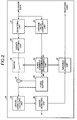
- Fig. 2 is a block diagram of a detailed structure of the receiver.
- a detailed structure of a codec unit 30, which is a main unit of the receiver 2, shown in Fig. 1, is depicted.
- the reception data demodulated by the demodulating unit 21 is input as likelihood data to a quantizing unit 31 and an average-value computing unit 32.
- the average-value computing unit 32 finds an average value (a value obtained by averaging absolute values of the likelihood data) of the likelihood data.
- the quantizing unit 31 performs a quantizing process by setting a value obtained by doubling the data average value computed by the average-value computing unit 32 as an upper-limit value of the likelihood data, thereby limiting the number of bits per data.
- an average value of retransmitted data is taken as M1, and is output to an H-ARQ-combining determining/processing unit 34.
- the average-value computing unit 32 decrypts data words before quantization as an index for specifying a quantization range, and retains a bit position of a quantization bit an integer value.
- the quantization bit output from the quantizing unit 31 is subjected to a derate matching process by the derate matching unit 33, and is then input via a switch 35 and a combiner 37, which form the H-ARQ combining unit 23 shown in Fig. 1, to an error-correction decoding unit 39.
- the H-ARQ combining unit 23 includes the H-ARQ-combining determining/processing unit 34 and an H-ARQ buffer 36.
- the H-ARQ buffer 36 is provided for storing likelihood data that has failed to be decoded.
- the H-ARQ-combining determining/processing unit 34 determines reliability based on the likelihood data that has failed to be decoded and retransmission data (likelihood data) newly received, and based on the reliability determined, switches between combining and non-combining of the likelihood data that has failed to be decoded and the retransmission data.
- the reliability is low, combining is not performed, and when the reliability is high, combining is performed.
- the switch 35 is switched to OFF (open), and feedback information (response signal) of NACK, which is a retransmission request, is sent from an NACK/ACK determining unit 38 to the transmitter 1.
- an error correction decoding process by the error-correction decoding unit 39 is not performed, and also decoded bits are not caused to be output.
- the switch 35 is switched to ON (closed), and feedback information (response signal) of ACK is sent from the NACK/ACK determining unit 38 to the transmitter 1.
- the likelihood data that failed to be decoded is read from the H-ARQ buffer 36, is combined (added) with retransmission data by the combiner 37, and is then output to the error-correction decoding unit 39.
- the error-correction decoding unit 39 then performs an error correcting process on the input data.
- An error detecting unit 40 determines an error using the CRC check, and then outputs decoded bits.
- Fig. 3 is a flowchart of a data transmission/reception process according to the first embodiment.
- steps S1 processes of transmitting and receiving data between the transmitter 1 and the receiver 2 are shown. Since systematic bits are identical to information bits, in extreme cases, demodulation is possible even with 0 parity bit (coding rate 1) when conditions of reception data are satisfactory. Therefore, in a scheme using the H-ARQ scheme according to the present invention, the transmitter 1 determines a transmission pattern (step S1), and then transmits all systematic bits and a part of the parity bits as information data (step S2). The receiver 2 receives such information data (step S3), and the H-ARQ combining unit 23 determines a reliability (step S4).
- the reliability is determined based on the following condition (1), using an average value M0 of likelihood data stored in the H-ARQ buffer 36 and the average value M1 of the retransmission data, where a predetermined rate parameter (coefficient) is ⁇ , when M1 ⁇ M0 ⁇ , the reliability is low ⁇ combining is not to be performed ⁇ determine to transmit NACK (request for retransmission) when M1 ⁇ M0 ⁇ , the reliability is high ⁇ combining is to be performed ⁇ error correcting process ⁇ determine to transmit NACK/ACK (1) As described above, whether the reliability is high or low can be determined by simply comparing two values, using the rate parameter ⁇ .
- step S5 it is determined whether combining is to be performed (step S5).
- the H-ARQ-combining determining/processing unit 34 switches the switch 35 to ON (closed), thereby causing the likelihood data that has failed to be decoded to be read from the H-ARQ buffer 36, to be combined with the retransmission data by the combiner 37, and then to be output to the error-correction decoding unit 39.
- the error-correction decoding unit 39 performs an error correcting process on the data thus input.
- the error detecting unit 40 determines an error using CRC check, and then outputs decoded bits.
- the error-correction decoding unit 39 sets NACK as feedback information to be transmitted to the transmitter 1 if an error is included after the decoding process. On the other hand, if the reliability is low and combining is not to be performed ("NO" at step S5), the switch 35 is switched to OFF (open) not to perform the error-correction decoding process on the likelihood data.
- the NACK/ACK determining unit 38 of the receiver 2 transmits feedback information (response signal) to the transmitter (step S7).
- NACK is transmitted.
- ACK is transmitted when no error is included after the decoding process by the error-correction decoding unit 39, and NACK is transmitted when an error is included.
- the transmitter 1 receives the feedback information transmitted from the receiver 2 (step S8) to obtain the feedback information (step S9).
- the ACK/NACK detecting unit 17 (refer to Fig. 1) detects either ACK or NACK in the feedback information (step S10).
- ACK is included ("ACK” at step S10)
- initial transmission of next information data block is performed (steps S11, S21, and S22).
- NACK is included (“NACK” at step S10)
- retransmission control of the information data is performed (step S12), and at the time of determining the transmission pattern (step S21), a data pattern of a different coding bit is selected by setting a bit that is not previously sent giving a higher priority.
- Step S22 Retransmission is then performed (step S22), and the data is received by the receiver 2 (step S23).
- the likelihood data previously failed to be decoded is stored in the H-ARQ buffer 36. Therefore, the retransmission data newly received and the likelihood data stored are combined as a data set for performing a decoding process.
- the processes described from step S21 to step S23 are similar to those described from step S1 to step S3.
- the transmitter 1 repeats the processes from step S4 and thereafter, in which retransmission regarding the same information bit set is repeated until ACK is received or until the number of retransmission reaches a maximum number thereof.
- the receiver 1 receives the retransmission data to repeat the combining process described above.
- data of the information bit initially transmitted is used as it is as likelihood data.
- a diversity process is performed. For example, in the case of a CDMA communication scheme, data already subjected to maximum-ratio combining by rake combining of a multipath is passed from the modem (the demodulating unit 21) to the codec unit (codec unit 30). Therefore, inside the codec unit 30, all that is required is to perform merely an addition process at the combiner 37, thereby achieving a simplified process.
- the combining process described above changes the average value of the likelihood data
- the average-value computing unit 32 setting a value, for example, by doubling the average value of the absolute value of the reception data as an upper-limit value of the likelihood the quantization bit range at the quantizing unit 31 is appropriately adjusted, thereby allowing stable quantization to be performed.
- the reliability of the reception data is determined at the receiver side. Only when the reliability is high, the error correcting process is performed. Thus, since an error correcting process is not performed on reception data having a low reliability, an unnecessary error correcting process on all of the reception data is not performed, thereby reducing processes and power consumption. Moreover, since reception data having a low reliability is not combined, data deterioration due to unnecessary combining can be prevented. Furthermore, since a measurement value that indicates the state of the reception data is used as the likelihood, appropriate retransmission control can be performed corresponding to an actual reception state. Moreover, the number of retransmission via the propagation path can be reduced, thereby improving throughput of the system and enabling effective use of the transmission path by decreasing traffic by an amount equivalent to the reduction of the number of retransmission.
- a second embodiment according to the present invention is described. While in the first embodiment described above, the average value is used for determining the reliability, in the second embodiment, a measurement amount of a signal to noise (S/N), which is a signal-to-noise ratio (SNR), is used instead of the average value.
- S/N signal to noise
- SNR signal-to-noise ratio
- SIR signal-to-interference ratio
- Fig. 4 is a block diagram of a structure of a receiving apparatus according to the second embodiment.
- components identical in structure to those in the first embodiment described above (refer to Fig. 2) are provided with the same reference numerals.
- the structure depicted in Fig. 4 is different from the structure depicted in Fig. 2 in that the information used for determination in the H-ARQ-combining determining/processing unit 34 is the SIR.
- This SIR is measured at the modem (the demodulating unit 21 in Fig. 1), and an average value in units of data intervals for demodulating the reception data bits is used.
- an average value SIR0 of this SIR is stored.
- the H-ARQ-combining determining/processing unit 34 is supplied with the average value SIR0 of SIR stored in the H-ARQ buffer 36 and an average value SIR1 of SIR at the time of receiving reception data, which is retransmitted.
- the reliability is determined based on these SIR0 and SIR1.
- the reliability is determined under the following condition (2), where ⁇ is a predetermined ratio parameter. when SIR1 ⁇ SIR0 ⁇ , the reliability is low ⁇ data combining is not to be performed ⁇ determine to transmit NACK (request for retransmission) when SIR1 ⁇ SIR0 ⁇ , the reliability is high ⁇ combining is to be performed ⁇ error correcting process ⁇ determine to transmit NACK/ACK (2)
- the SIR is used instead of the average value of the likelihood data used in the first embodiment.
- Retransmission control and error correction decoding in H-ARQ control (for example, the process depicted in Fig. 2) can be performed in a manner similar to that in the first embodiment.
- Retransmission control and error correction decoding in H-ARQ control can be performed in a manner similar to that in the first embodiment.
- an unnecessary error correcting process on all of the reception data is not performed, thereby reducing processes and power consumption.
- reception data having a low reliability is not combined, data deterioration due to unnecessary combining can be prevented.
- a measurement value that indicates a state of the reception data is used as the likelihood, appropriate retransmission control can be performed corresponding to an actual reception state.
- the number of retransmission via the propagation path can be reduced, thereby improving throughput of the system and enabling effective use of the transmission path by decreasing traffic by an amount equivalent to the reduction of the number of retransmission.
- a third embodiment according to the present invention is described.
- the structure is such that determination is made by the H-ARQ-combining determining/processing unit 34 base on an absolute value of the likelihood data after reception.
- Fig. 5 is a block diagram of a receiving apparatus according to the third embodiment.
- the average value M1 of the reception data is computed by the average-value computing unit 32.
- the H-ARQ-combining determining/processing unit 34 the average value M1 of the reception data is compared with a threshold ⁇ to determine whether combining is to be performed.
- the threshold ⁇ can be set to a predetermined value (level) based on a received data format.
- the likelihood data received at a previous time is stored and is combined (added) with retransmission data at the time of combining.
- the combining process changes the average value of the likelihood data, with the average-value computing unit 32 setting a value, for example, by doubling the average value of the absolute value of the reception data as an upper-limit value of the likelihood, the quantization bit range at the quantizing unit 31 is appropriately adjusted, thereby allowing stable quantization to be performed.
- the H-ARQ-combining determining/processing unit 34 determines the reliability on the following condition (3). when M1 ⁇ , the reliability is low ⁇ combining is not to be performed ⁇ determine to transmit NACK (request retransmission) when M1 ⁇ , the reliability is high ⁇ combining is to be performed ⁇ error correcting process ⁇ determine to transmit NACK/ACK (3)
- the determination can be made only with the reception data. Therefore, other reception data stored for determining the reliability is not required. Moreover, the determining process can be performed from an initial reception data.
- the fourth embodiment is different in structure from the third embodiment (Fig. 5) in that the H-ARQ-combining determining/processing unit 34 performs determining process using an absolute value of SIR of the reception data.
- Fig. 6 is a block diagram of a receiving apparatus according to the fourth embodiment.
- the H-ARQ-combining determining/processing unit 34 determines the reliability on the following condition (4), where SIR1 is an SIR of the reception data and ⁇ is a predetermined threshold for the SIR. when SIR1 ⁇ , the reliability is low ⁇ combining is not to be performed ⁇ determine to transmit NACK (request retransmission) when SIR1 ⁇ , the reliability is high ⁇ combining is to be performed ⁇ error correcting process ⁇ determine to transmit NACK/ACK (4)
- the determination can be made using just the SIR of the reception data. Therefore, other SIR stored for determining the reliability is not required. Also, the determining process can be performed from an initial reception data.
- the average-value computing unit 32 decrypts data words, before quantization, as an index for specifying a quantization range, and retains a bit position of the quantization bit as an integer. For example, in data words of 16 bits, a quantization bit position is 6 bits, and this bit position is obtained.
- the average values of the data serving as a quantization reference are sequentially scanned from an most significant bit (MSB) side, and a position at which a bit different from the code first appears is taken as a bit position of the quantization bits.
- MSB most significant bit
- an optimum quantization position after the data combining in data average values obtained as a result of combining of the retransmission data by the H-ARQ scheme is a position different from any of quantization positions of two pieces of data (the reception data stored in the H-ARQ buffer 36 and the retransmission data) before combining.
- the quantization position of the retransmission data is at an extremely lower side compared to the position of the reception data stored, it can be qualitatively expected that the reliability of this retransmission data is low.
- the quantization position of the data stored is pulled in a lower direction, thereby resulting in possible deterioration in entire data.
- retransmission is rather requested by making determination to transmit NACK without performing the combining process, because reduction in the number of retransmission can be expected.
- the reliability is determined with a bit range of the quantization bits. If the quantization range of the retransmission data is such a quantization range that pulls the quantization range of the reception stored data to a lower level, combining is not performed and determination is made to transmit NACK.
- Fig. 7 is a block diagram of a structure of a receiving apparatus according to the fifth embodiment.
- the H-ARQ buffer 36 stores the reception data (likelihood data) that has failed to be decoded M0, as well as a quantization bit position m0 of this likelihood data M0.
- the H-ARQ-combining determining/processing unit 34 compares a quantization bit position m2 of the average value M2 of the data after combining with the quantization bit position m0 of the data stored to determine, under the following condition (5), the reliability of the data after combining. when m2 ⁇ m0, the reliability is low ⁇ combining is not to be performed ⁇ determine to transmit NACK (request retransmission) when m2 ⁇ m0, the reliability is high ⁇ combining is to be performed ⁇ error correcting process ⁇ determine to transmit NACK/ACK (5)
- the quantization bit position of the data after an assumed combining process is compared with the quantization bit position of the existing data to determine the reliability. if the quantization range of the retransmission data is such a quantization range that pulls the quantization range of the reception data stored to a lower level, combining is not performed and a determination is made to transmit NACK for requesting retransmission. As a result, the number of retransmission can be reduced, and throughput of the system can be improved.
- FIG. 8 is a block diagram of a structure of a receiving apparatus according to the sixth embodiment.
- the H-ARQ-combining determining/processing unit 34 is supplied with the quantization bit position m0 of the reception data stored in the H-ARQ buffer 36 and a quantization bit position m1 of the retransmission data. Then, with Nr being taken as a predetermined positive integer (for example, 6 bits, which is the number of quantization bits), a determination is made under the following condition (6).
- the seventh embodiment has a structure such that the determination using the reliability according to the sixth embodiment described above is further simplified.
- Fig. 9 is a block diagram of a structure of a receiving apparatus according to the seventh embodiment.
- the H-ARQ-combining determining/processing unit 34 makes a determination under the following condition (7) with Nr of the reception data stored in the H-ARQ buffer 36 being as a predetermined positive integer (for example, 6 bits, which is the number of quantization bits).
- Nr of the reception data stored in the H-ARQ buffer 36 being as a predetermined positive integer (for example, 6 bits, which is the number of quantization bits).
- the reliability determining condition shown above is similar to the condition (6). However, what is different is that, after it is determined that the reliability is low and combining is not to be performed, an error correcting process is performed on the retransmission data by the error correcting decoding unit 39. At this time, the switch 35 is switched to side a, and the retransmission data is output via a route 42 to the error-correction decoding unit 39. Note that, at the time of combining, the switch 35 is switched to side b.
- the S/N SIR
- the S/N may possibly have a satisfactory characteristic. Therefore, even when combining is not to be performed, an error correction process is performed on the retransmission data. After that, depending on a state of the error correcting by the error detecting unit 40, either ACK or NACK is transmitted. With such a structure, the determining process can be simplified.
- Fig. 10 is a schematic for illustrating contents of information data and feedback information that are transmitted and received in the hybrid-ARQ communication system according to the present invention. From the transmitter 1 to the receiver 2, the information data shown in the drawing is transmitted. The information data is transmitted by a plurality of blocks (blocks #1, #2, ...#n). On the other hand, from the receiver 2 to the transmitter 1, the feedback information shown in the drawing is transmitted. This feedback information is transmitted corresponding to each block of the information data, and includes information that indicates ACK or NACK and additional information.
- the number of times when combining is not performed is obtained, and when the number is equal to a predetermined number, the retransmission process that has been performed so far is reset, and retransmission is performed from the beginning.
- Fig. 11 is a flowchart of a process in the hybrid-ARQ communication system according to the eighth embodiment.
- the transmitter 1 determines a transmission pattern (step S1), and then transmits all systematic bits and a part of parity bits as information data (step S2).
- the receiver 2 receives such information data (step S3), and the H-ARQ combining unit 23 determines reliability of the information data (step S4).
- the reliability can be determined by any method described in the first to seventh embodiments.
- step S5 it is determined whether combining is to be performed (step S5).
- the H-ARQ-combining determining/processing unit 34 switches the switch 35 to ON (closed), thereby causing the likelihood data that has failed to be decoded to be read from the H-ARQ buffer 36, to be combined with the retransmission data by the combiner 37, and then to be output to the error-correction decoding unit 39.
- the error-correction decoding unit 39 performs an error correcting process on the data thus input.
- the error detecting unit 40 determines an error using the CRC check, and then outputs decoded bits.
- the error-correction decoding unit 39 sets NACK as feedback information to be transmitted to the transmitter 1 if an error is included after the decoding process.
- step S5 if the reliability is low and combining is not to be performed ("NO" at step S5), the switch 35 is switched to OFF (open), thereby preventing an error-correction decoding process on the likelihood data. Moreover, the number of times when data combining is not performed is counted, and a value obtained by counting is retained (step S36).
- the NACK/ACK determining unit 38 of the receiver 2 then transmits feedback information (response signal) to the transmitter (step S37).
- feedback information response signal
- NACK is transmitted.
- ACK is transmitted when an error is not included in the data after the data decoding process by the error-correction decoding unit 39, and NACK is transmitted when an error is included.
- the value counted at step S36 if any, is added to the feedback information together with ACK or NACK described above to be transmitted as the additional information.
- the transmitter 1 receives the feedback information transmitted from the receiver 2 (step S8) to obtain the feedback information (step S9). Then, by the ACK/NACK detecting unit 17 (refer to Fig. 1), ACK or NACK included in the feedback information is detected (step S10).
- ACK is included ("ACK" at step S10)
- initial transmission of a next information data block is performed (steps S11, S21, and S22).
- NACK is included (“NACK” at step S10), the number of times when data combining is not performed included in the additional information of the feedback information is detected, and it is determined whether the number of times when data combining is not performed is less than a predetermined threshold (step S38).
- step S12 When the number of times when data combining is not performed is less than the threshold (number ⁇ threshold) ("YES" at step S38), retransmission control of the information data is performed (step S12) and, at the time of determining the transmission pattern (step S21), a data pattern of a different coding bit is selected by setting a bit not previously sent giving a higher priority, and retransmission is then performed (step S22).
- the transmission pattern of the information data is reset (step S39), and then steps S12, S21, and S22 are performed.
- the receiver 2 receives the data transmitted from the transmitter 1 (step S23).
- the likelihood data that previously failed to be decoded is stored in the H-ARQ buffer 36. Therefore, the newly-received retransmission data and the stored likelihood data are combined as a data set for performing a decoding process.
- the processes described from step S21 to step S23 are similar to those described from step S1 to step S3.
- the transmitter 1 repeats the processes from step S4 and thereafter.
- the receiver 1[r]the receiver 2 receives the retransmission data to repeat the processes from step S3 to step S37.
- the receiver 2 transmits, as the feedback information, additional information that indicates the process of H-ARQ combining and a current state, together with the information that indicates NACK or ACK. Also, the transmitter 1 receives the feedback information, and then optimizes a scheme of configuring the next retransmission data by using the addition information when a determination is made to transmit NACK. As such, by counting the number of times when data combining is not performed, it is possible to more specifically detect possibility of deterioration of the reception data, and to notify the transmitter 1 the possibility.
- the receiver 2 transmits the number of times when data combining is not performed on the retransmission data as the additional information, and the transmitter 1 reads the number of times from the additional information, and when the number reaches the predetermined number, resets the retransmission pattern to transmit the data again, thereby improving the reception state of the reception data at the side of the receiver 2.
- Fig. 12 is a flowchart of a process in the hybrid-ARQ communication system according to the ninth embodiment.
- the process at step S39 shown in the eighth embodiment is changed.
- Other processes are identical to those shown in Fig. 11, and therefore are not described herein.
- the transmitter 1 When determining at step S38 whether the number of times when data combining is not performed is less than the predetermined threshold and determining that the number of times is equal to or more than the threshold ("NO" at step S38), the transmitter 1 increases electric power for transmission by a predetermined amount (step S41). The procedure then proceeds to step S12 and continues the process of retransmitting the transmission data.
- the increased amount of the electric power can be a predetermined fixed value, and can be configured so as to be increased stepwise according to the number of times the procedure passes through step S41.
- the transmitter 1 receives the feedback information, and when the feedback information indicates NACK and the number of times when data combining is not performed reaches the threshold, increases the electric power for transmission, thereby improving a condition of the reception data at the side of the receiver 2.
- Fig. 13 is a flowchart of a process in the hybrid-ARQ communication system according to the tenth embodiment.
- the receiver 2 transmits, to the transmitter 1, as the additional information of the feedback information (refer to Fig. 10), information that indicates whether H-ARQ combining has been performed, together with information that indicates either NACK or ACK.
- the transmitter 1 obtains the information that indicates either combining or non-combining from the additional information, counts the number of times when data combining is not performed, and when the number reaches a predetermined number, resets the retransmission process so far to transmit the data again from the beginning.
- the eighth embodiment only processes different from those in the eighth embodiment (refer to Fig. 11) are described referring to Fig. 13. The other processes are similar to those shown in Fig. 11, and therefore are not described herein.
- the receiver 2 transmits, as the additional information to the transmitter 1, information that indicates whether H-ARQ combining has been performed or not (non-combining) on each information data block, together with information that indicates either NACK or ACK, as the feedback information (step S42).
- the receiver 2 counting the number of times when data combining is not performed (this process is equivalent to step S36 of Fig. 11) is not performed.
- step S10 After determining to transmit ACK or NACK based on the feedback information received (step S10), if it is determined to transmit NACK ("NACK" at step S10), the transmitter 1 counts the number of times when data combining is not performed based on the additional information (step S43). Then, a value obtained by counting at step S38 is compared with the threshold to make a determination (step S38). When it is determined that the number of times is equal to or more than the threshold ("NO" at step S38), the transmission pattern of the information data is reset (step S39), and then the procedure proceeds to a retransmission control process (step S12).
- the structure is such that the receiver 2 sends information that indicates either combining or non-combining as the additional information, and the number of times when data combining is not performed is counted at the transmitter 1. Therefore, an entire amount of information (the number of bits) included in the feedback information to be transmitted from the receiver 2 to the transmitter 1 can be suppressed to a minimum, thereby improving throughput of the system.
- Fig. 14 is a flowchart of a process in a the hybrid-ARQ communication system according to the eleventh embodiment.
- the structure is such that the receiver 2 described in the tenth embodiment (refer to Fig. 13) performs the process of transmitting the information that indicates either combining or non-combining as the additional information and the transmitter 1 described in the ninth embodiment (refer to Fig. 12) performs the process of increasing transmission electric power.
- the receiver 2 transmits, as the additional information (refer to Fig. 10) to the transmitter 1, information that indicates whether H-ARQ combining has been performed or not (non-combining) on each information data block, together with information that indicates either NACK or ACK, when transmitting the feedback information (step S42).
- the additional information hereinafter “refer to Fig. 10)
- information that indicates whether H-ARQ combining has been performed or not (non-combining) on each information data block together with information that indicates either NACK or ACK, when transmitting the feedback information (step S42).
- the number of times when data combining is not counted (this process is equivalent to step S36 of Fig. 11).
- step S10 After determining which of ACK and NACK is to be transmitted based on the received feedback information (step S10), if it is determined transmit NACK ("NACK" at step S10), the transmitter 1 counts the number of times when data combining is not performed based on the additional information (step S43). Then, a value obtained by counting at step S38[r]at step S43 is compared with the threshold (step S38). When it is determined that the number of times when data combining is not performed is equal to or more than the threshold ("NO" at step S38), electric power for transmission is increased by a predetermined amount (step S41), and then the procedure proceeds to a retransmission control process (step S12).
- the structure is such that the receiver 2 sends information that indicates either combining or non-combining as the additional information, and the number of times when data combining is not performed is counted at the transmitter 1. Therefore, an amount of the information (the number of bits) included in the feedback information to be transmitted from the receiver 2 to the transmitter 1 can be suppressed to a minimum, thereby improving throughput of the system. Furthermore, the transmitter 1 receives the feedback information and, when the determination is made to transmit NACK and the number of times when data combining is not performed in the additional information reaches the threshold, electric power for transmission is increased. Thus, the state of the reception data received at the side of the receiver 2 can be improved.
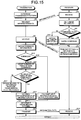
- Fig. 15 is a flowchart of a process in the hybrid-ARQ communication system according to the twelfth embodiment.
- the information described in the first to seventh embodiments (for example, refer to Fig. 1) that indicates whether H-ARQ combining has been performed on each information data block at the receiver 2, the reception data stored, and the information that indicates a difference in reliability of the retransmission data are taken as the additional information (refer to Fig. 10). Then, such additional information is added to the information that indicates either NACK or ACK in the feedback information, and is then reported to the transmitter 1.
- the receiver 2 obtains the difference in reliability (step S45).
- the difference in reliability is obtained by individually calculating each of reliability of the reception data stored in the H-ARQ buffer 36 (for example, refer to Fig. 2) and reliability of the retransmission data, and by acquiring a difference between the reliabilities. Then, at the time of transmitting the feedback information, information that indicates either NACK or ACK is transmitted as the feedback information. Also, information that indicates whether H-ARQ combining has been performed or not (non-combining) on each information data block and the information that indicates the difference in reliability obtained at step S45 are transmitted to the transmitter 1 as the additional information (step S42).
- the transmitter 1 After determining which of ACK and NACK is to be transmitted based on the feedback information received (step S10), if it is determined to transmit NACK ("NACK" at step S10), the transmitter 1 counts the number of times when data combining is not performed based on the additional information (step S43). Then, a value obtained by counting at step S38 is compared with the threshold (step S38). When it is determined that the number of times is equal to or more than the threshold ("NO" at step S38), the difference in reliability is obtained from the additional information in the feedback information (step S47), and the procedure then proceeds to a process of performing retransmission control (step S12). The transmitter 1 sets and stores a relation between difference in reliability and an amount if electric power to be increased, for example, in a table. Thus, the transmitter 1 reads the amount corresponding to the difference in reliability obtained, to increase electric power for transmission by this amount when retransmitting the transmission data.
- the information that indicates either combining or non-combining and the difference in reliability are sent from the receiver 2 as the additional information of the feedback information.
- the transmitter 1 increases the electric power for transmission corresponding to the difference in reliability. In this manner, the transmitter 1 can transmit the transmission data with appropriate amount of electric power for transmission according to variations of conditions of the reception data, thereby efficiently improving a condition of the reception data at the side of the receiver 2.
- the present invention is not restricted to the embodiments described above, and can be variously modified.
- pathmetric likelihood information for estimating probability of correctness of the reception data can be used.
- reliability of data is determined based on a condition of the data received, and optimum processes of a retransmission request and error correction coding are performed depending on the reliability.
- data deterioration can be prevented, and the number of retransmission of data can be reduced.
- the reliability is low, unnecessary processes of data combining and error correcting process are not performed, thereby preventing the reliability of existing data from decreasing, and suppressing consumption of power required for an error correcting process.
- the number of retransmission of data can be reduced, thereby improving throughput of a communication system.
- the present invention is suitable for providing a receiving apparatus in which data deterioration is prevented and the number of retransmission of data is reduced by performing an optimum process of a retransmission request depending on a condition of data received and by performing a process of error-correction coding.
- the present invention is suitable for providing a hybrid-ARQ communication system data deterioration is prevented and the number of retransmission of data is reduced by performing an optimum process of a retransmission request depending on a condition of data received and by performing a process of error-correction coding at a side of a receiver, thereby improving a quality of data communicated with a transmitter and throughput of data transmission.
Landscapes
- Engineering & Computer Science (AREA)
- Computer Networks & Wireless Communication (AREA)
- Signal Processing (AREA)
- Quality & Reliability (AREA)
- Detection And Prevention Of Errors In Transmission (AREA)
Applications Claiming Priority (1)
| Application Number | Priority Date | Filing Date | Title |
|---|---|---|---|
| PCT/JP2003/006604 WO2004107639A1 (ja) | 2003-05-27 | 2003-05-27 | 受信装置およびハイブリッドarq通信システム |
Publications (2)
| Publication Number | Publication Date |
|---|---|
| EP1628428A1 true EP1628428A1 (de) | 2006-02-22 |
| EP1628428A4 EP1628428A4 (de) | 2011-10-19 |
Family
ID=33485768
Family Applications (1)
| Application Number | Title | Priority Date | Filing Date |
|---|---|---|---|
| EP03733095A Ceased EP1628428A4 (de) | 2003-05-27 | 2003-05-27 | Empfänger und hybrides apq-kommunikationssystem |
Country Status (4)
| Country | Link |
|---|---|
| US (1) | US7500166B2 (de) |
| EP (1) | EP1628428A4 (de) |
| JP (1) | JP4032065B2 (de) |
| WO (1) | WO2004107639A1 (de) |
Cited By (4)
| Publication number | Priority date | Publication date | Assignee | Title |
|---|---|---|---|---|
| WO2008068461A3 (en) * | 2006-12-08 | 2008-10-02 | Cambridge Silicon Radio Ltd | Data processing in signal transmissions |
| WO2009075899A1 (en) * | 2007-12-13 | 2009-06-18 | Qualcomm Incorporated | Coding block based harq combining for ofdma systems |
| CN101897141A (zh) * | 2007-12-13 | 2010-11-24 | 高通股份有限公司 | 用于ofdma系统的前向和反向移位选择性harq合并方案 |
| WO2012036955A1 (en) | 2010-09-17 | 2012-03-22 | Intel Corporation | Techniques for successive refinement of metrics stored for harq combining |
Families Citing this family (37)
| Publication number | Priority date | Publication date | Assignee | Title |
|---|---|---|---|---|
| KR20050027679A (ko) * | 2003-09-16 | 2005-03-21 | 삼성전자주식회사 | 이동통신시스템에서 고속 패킷 데이터 송/수신장치 및 방법 |
| JP4224370B2 (ja) * | 2003-09-25 | 2009-02-12 | パナソニック株式会社 | 入力制御装置及び入力制御方法 |
| JP2005311717A (ja) * | 2004-04-21 | 2005-11-04 | Matsushita Electric Ind Co Ltd | 復号装置及び通信システムの受信機 |
| JP4609125B2 (ja) * | 2004-05-06 | 2011-01-12 | 日本電気株式会社 | データ転送システムおよびその方法 |
| CN1832392A (zh) * | 2005-03-11 | 2006-09-13 | 松下电器产业株式会社 | 多入多出系统中数据重传的方法和设备 |
| JP4703310B2 (ja) | 2005-08-04 | 2011-06-15 | 株式会社東芝 | 通信方法および通信システム |
| KR100715204B1 (ko) * | 2005-12-09 | 2007-05-07 | 삼성전자주식회사 | 광대역 무선통신시스템에서 고속 공통 제어 채널 통신 장치및 방법 |
| EP1816776A1 (de) * | 2006-02-07 | 2007-08-08 | Alcatel Lucent | Einrichtung und Verfahren zur Unterdrückung impulsiver Störungen bei paketorientierter Übertragung |
| US8059739B2 (en) * | 2006-06-05 | 2011-11-15 | Telefonaktiebolaget Lm Ericsson | Method and apparatus for correcting data transmission errors |
| US8074139B2 (en) * | 2006-06-27 | 2011-12-06 | Panasonic Corporation | Communication method and communication device |
| US7623597B2 (en) * | 2006-08-28 | 2009-11-24 | Motorola, Inc. | Block codeword decoder with confidence indicator |
| JP2008131601A (ja) * | 2006-11-24 | 2008-06-05 | Matsushita Electric Ind Co Ltd | 通信端末装置、通信システム、通信方法及びプログラム |
| WO2008061364A1 (en) * | 2006-11-24 | 2008-05-29 | Imris Inc. | Sterile draping for the bore of a medical imaging system |
| JP4829754B2 (ja) * | 2006-11-29 | 2011-12-07 | 富士通株式会社 | 無線通信方法及び無線通信装置 |
| WO2008093233A2 (en) * | 2007-02-02 | 2008-08-07 | Lg Electronics Inc. | Methods of transmitting and receiving data in communication system |
| CN101286825A (zh) * | 2007-04-11 | 2008-10-15 | 松下电器产业株式会社 | 实现基于可靠性的混合自动重传的方法、发送端和系统 |
| WO2008133565A2 (en) * | 2007-04-27 | 2008-11-06 | Telefonaktiebolaget Lm Ericsson (Publ) | A method and a device for saving power in a wireless user terminal |
| EP2145493B1 (de) * | 2007-06-19 | 2015-08-12 | LG Electronics Inc. | Erweiterung der lte-zufallzugriffsprozedur |
| KR101048452B1 (ko) * | 2007-10-10 | 2011-07-11 | 삼성전자주식회사 | 무선통신시스템에서 하이브리드 에이알큐 수행 장치 및방법 |
| US8488662B2 (en) * | 2007-12-21 | 2013-07-16 | Mediatek Inc. | Receiver bit rate processing |
| US8149702B2 (en) * | 2007-12-21 | 2012-04-03 | Mediatek Inc. | Multi-mode bit rate processor |
| US20090183037A1 (en) * | 2008-01-16 | 2009-07-16 | Oki Electric Industry Co., Ltd. | Statistical processing apparatus capable of reducing storage space for storing statistical occurrence frequency data and a processing method therefor |
| WO2009093861A1 (en) * | 2008-01-24 | 2009-07-30 | Lg Electronics Inc. | Random access channel preamble detection |
| US9698943B2 (en) * | 2008-06-05 | 2017-07-04 | Nokia Solutions And Networks Oy | Receiving unit in a wireless communication network and method for generating an automatic repeat request feedback message |
| US8225162B2 (en) * | 2008-08-26 | 2012-07-17 | Motorola Mobility, Inc. | Method and apparatus for power control in a wireless communication system |
| JP5195550B2 (ja) * | 2009-03-17 | 2013-05-08 | 沖電気工業株式会社 | 復号装置及び符号化システム |
| JP5262894B2 (ja) * | 2009-03-24 | 2013-08-14 | 富士通株式会社 | 無線通信システムにおける復号誤り検出方法および復号装置 |
| EP2451107B1 (de) * | 2010-11-08 | 2013-06-12 | Alcatel Lucent | Verfahren und Anordnung zum Extrahieren von Informationen aus Signalen in einem Empfänger |
| US8781035B2 (en) * | 2011-01-07 | 2014-07-15 | Qualcomm Incorporated | Methods and systems for improving retransmission performance of data channels in a wireless communication |
| CN103503072B (zh) * | 2012-04-04 | 2016-11-02 | 松下知识产权经营株式会社 | 解码装置以及解码方法 |
| WO2013173987A1 (en) * | 2012-05-23 | 2013-11-28 | Telefonaktiebolaget L M Ericsson (Publ) | Radio resource adaptation method and associated wireless communication devices |
| JP6064522B2 (ja) | 2012-10-30 | 2017-01-25 | 富士通株式会社 | 通信装置及び通信方法 |
| CN103200058B (zh) * | 2013-03-28 | 2016-03-30 | 华为技术有限公司 | 数据处理方法、协调器和节点设备 |
| CN106464451B (zh) * | 2014-03-20 | 2019-11-15 | 瑞典爱立信有限公司 | 用于组合wlan中的帧的方法和设备 |
| WO2016095964A1 (en) * | 2014-12-16 | 2016-06-23 | Huawei Technologies Co.,Ltd | Methods and nodes in a wireless communication system |
| CN106034012B (zh) * | 2015-03-12 | 2020-10-02 | 株式会社Ntt都科摩 | 数据重传方法及装置 |
| CN107547169B (zh) * | 2016-06-28 | 2020-08-25 | 华为技术有限公司 | 一种数据重传方法和相关装置 |
Family Cites Families (13)
| Publication number | Priority date | Publication date | Assignee | Title |
|---|---|---|---|---|
| JPH0646037A (ja) | 1992-03-24 | 1994-02-18 | Idou Tsushin Syst Kaihatsu Kk | モード切替えarq方式 |
| US5828677A (en) * | 1996-03-20 | 1998-10-27 | Lucent Technologies Inc. | Adaptive hybrid ARQ coding schemes for slow fading channels in mobile radio systems |
| US6138260A (en) | 1997-09-04 | 2000-10-24 | Conexant Systems, Inc. | Retransmission packet capture system within a wireless multiservice communications environment with turbo decoding |
| JP2000078118A (ja) | 1998-08-31 | 2000-03-14 | Hitachi Denshi Ltd | 自動再送要求データ伝送方法 |
| US6741581B1 (en) * | 1998-09-22 | 2004-05-25 | Hughes Electronics Corporation | System and method for transmitting data in frame format using an R-Rake retransmission technique with blind identification of data frames |
| FI106493B (fi) * | 1999-02-09 | 2001-02-15 | Nokia Mobile Phones Ltd | Menetelmä ja järjestelmä pakettimuotoisen datan luotettavaksi siirtämiseksi |
| JP3910770B2 (ja) * | 1999-10-15 | 2007-04-25 | 株式会社エヌ・ティ・ティ・ドコモ | 誤り制御方法及びその方法を使用する受信機 |
| JP2001268058A (ja) | 2000-03-17 | 2001-09-28 | Hitachi Kokusai Electric Inc | データ伝送方式 |
| JP4330767B2 (ja) | 2000-06-26 | 2009-09-16 | 株式会社エヌ・ティ・ティ・ドコモ | 自動再送要求を行う通信方法及び基地局装置 |
| DE10050117A1 (de) | 2000-10-11 | 2002-04-25 | Philips Corp Intellectual Pty | Drahtloses Netzwerk mit einem Datenaustausch nach der ARQ-Methode |
| KR100525384B1 (ko) | 2000-10-31 | 2005-11-02 | 엘지전자 주식회사 | 무선 통신 시스템에서의 패킷 재전송 제어 방법 |
| JP3499548B1 (ja) * | 2002-07-01 | 2004-02-23 | 松下電器産業株式会社 | 受信装置及び通信方法 |
| US7254765B2 (en) * | 2002-09-24 | 2007-08-07 | Telefonaktiebolaget Lm Ericsson (Publ) | Method and devices for error tolerant data transmission, wherein retransmission of erroneous data is performed up to the point where the remaining number of errors is acceptable |
-
2003
- 2003-05-27 EP EP03733095A patent/EP1628428A4/de not_active Ceased
- 2003-05-27 JP JP2005500198A patent/JP4032065B2/ja not_active Expired - Fee Related
- 2003-05-27 WO PCT/JP2003/006604 patent/WO2004107639A1/ja not_active Ceased
-
2005
- 2005-06-15 US US11/152,902 patent/US7500166B2/en not_active Expired - Fee Related
Cited By (11)
| Publication number | Priority date | Publication date | Assignee | Title |
|---|---|---|---|---|
| WO2008068461A3 (en) * | 2006-12-08 | 2008-10-02 | Cambridge Silicon Radio Ltd | Data processing in signal transmissions |
| EP2560314A1 (de) * | 2006-12-08 | 2013-02-20 | Cambridge Silicon Radio Limited | Datenverarbeitung bei Signalübertragungen |
| US8495447B2 (en) | 2006-12-08 | 2013-07-23 | Cambridge Silicon Radio Limited | Data processing in signal transmissions |
| WO2009075899A1 (en) * | 2007-12-13 | 2009-06-18 | Qualcomm Incorporated | Coding block based harq combining for ofdma systems |
| CN101897141A (zh) * | 2007-12-13 | 2010-11-24 | 高通股份有限公司 | 用于ofdma系统的前向和反向移位选择性harq合并方案 |
| CN101897142A (zh) * | 2007-12-13 | 2010-11-24 | 高通股份有限公司 | 用于ofdma系统的基于编码块的harq组合方案 |
| US8194588B2 (en) | 2007-12-13 | 2012-06-05 | Qualcomm Incorporated | Coding block based HARQ combining scheme for OFDMA systems |
| RU2458469C2 (ru) * | 2007-12-13 | 2012-08-10 | Квэлкомм Инкорпорейтед | Основанное на блоке кодирования объединение harq для систем ofdma |
| CN101897141B (zh) * | 2007-12-13 | 2016-09-28 | 高通股份有限公司 | 用于ofdma系统的前向和反向移位选择性harq合并方案 |
| WO2012036955A1 (en) | 2010-09-17 | 2012-03-22 | Intel Corporation | Techniques for successive refinement of metrics stored for harq combining |
| EP2617153A4 (de) * | 2010-09-17 | 2015-02-18 | Intel Corp | Verfahren zur sukzessiven verfeinerung von für harq-kombination gespeicherte metriken |
Also Published As
| Publication number | Publication date |
|---|---|
| WO2004107639A1 (ja) | 2004-12-09 |
| JP4032065B2 (ja) | 2008-01-16 |
| EP1628428A4 (de) | 2011-10-19 |
| US20050235190A1 (en) | 2005-10-20 |
| US7500166B2 (en) | 2009-03-03 |
| JPWO2004107639A1 (ja) | 2006-07-20 |
Similar Documents
| Publication | Publication Date | Title |
|---|---|---|
| US7500166B2 (en) | Data receiving apparatus and hybrid-ARQ communication system | |
| US7512860B2 (en) | Communication system and receiving method | |
| US9986571B2 (en) | Hybrid automatic repeat request with feedback dependent bit selection | |
| US7236740B2 (en) | Data retransmission apparatus and method in a mobile communication system employing HARQ technique | |
| EP1496639B1 (de) | Kombinationsverfahren und -empfänger für Hybridwiederholungsaufforderungsverfahren in einem orthogonalen Frequenzmultiplexsystem | |
| US10206198B2 (en) | Communication apparatus and communication method | |
| JP4705029B2 (ja) | 適応型ハイブリッドarqアルゴリズム | |
| US20030040284A1 (en) | Method and apparatus of retransmitted data combination | |
| US20030185175A1 (en) | Channel quality measurement in data transmission using hybrid arq | |
| US8780694B2 (en) | Hybrid ARQ with variable retransmission energy | |
| JP4432645B2 (ja) | 通信装置、無線通信システム | |
| KR20070083775A (ko) | 데이터 통신 장치, 데이터 수신 장치, 데이터 송신 장치 및재송 제어 방법 | |
| JP5139222B2 (ja) | 無線通信装置 | |
| JP5388529B2 (ja) | 無線通信装置 | |
| WO2010041295A1 (ja) | 無線中継装置および中継局における再送方法 | |
| CN106559189B (zh) | 一种基于harq的数据传输方法、装置及系统 | |
| CN102739351A (zh) | 处理可适性调制及编码的方法及其通讯装置 | |
| KR101220680B1 (ko) | 데이터 블록 결합 방법 및 복합 재전송 방법 | |
| Gan et al. | Instantaneous packet information based on-demand adaptive retransmission for HARQ | |
| EP1381181A1 (de) | Kommunikationsystem und -verfahren mit Hybrid-ARQ Zusammenfassen von paketen | |
| Su et al. | A simple adaptive throughput maximization algorithm for adaptive modulation and coding systems with hybrid ARQ |
Legal Events
| Date | Code | Title | Description |
|---|---|---|---|
| PUAI | Public reference made under article 153(3) epc to a published international application that has entered the european phase |
Free format text: ORIGINAL CODE: 0009012 |
|
| 17P | Request for examination filed |
Effective date: 20050616 |
|
| AK | Designated contracting states |
Kind code of ref document: A1 Designated state(s): DE FR GB |
|
| RBV | Designated contracting states (corrected) |
Designated state(s): DE FR GB |
|
| A4 | Supplementary search report drawn up and despatched |
Effective date: 20110915 |
|
| RIC1 | Information provided on ipc code assigned before grant |
Ipc: H04L 1/18 20060101ALI20110909BHEP Ipc: H04L 1/20 20060101AFI20110909BHEP |
|
| 17Q | First examination report despatched |
Effective date: 20120327 |
|
| REG | Reference to a national code |
Ref country code: DE Ref legal event code: R003 |
|
| STAA | Information on the status of an ep patent application or granted ep patent |
Free format text: STATUS: THE APPLICATION HAS BEEN REFUSED |
|
| 18R | Application refused |
Effective date: 20170119 |