EP1630689B1 - Methode zum Darstellen von formatierten Inhalten auf einem mobilen Gerät - Google Patents
Methode zum Darstellen von formatierten Inhalten auf einem mobilen Gerät Download PDFInfo
- Publication number
- EP1630689B1 EP1630689B1 EP04104084A EP04104084A EP1630689B1 EP 1630689 B1 EP1630689 B1 EP 1630689B1 EP 04104084 A EP04104084 A EP 04104084A EP 04104084 A EP04104084 A EP 04104084A EP 1630689 B1 EP1630689 B1 EP 1630689B1
- Authority
- EP
- European Patent Office
- Prior art keywords
- graphic
- page
- mobile station
- request
- server
- Prior art date
- Legal status (The legal status is an assumption and is not a legal conclusion. Google has not performed a legal analysis and makes no representation as to the accuracy of the status listed.)
- Expired - Lifetime
Links
Images




Classifications
-
- G—PHYSICS
- G06—COMPUTING OR CALCULATING; COUNTING
- G06F—ELECTRIC DIGITAL DATA PROCESSING
- G06F16/00—Information retrieval; Database structures therefor; File system structures therefor
- G06F16/90—Details of database functions independent of the retrieved data types
- G06F16/95—Retrieval from the web
- G06F16/957—Browsing optimisation, e.g. caching or content distillation
- G06F16/9577—Optimising the visualization of content, e.g. distillation of HTML documents
Definitions
- the following is directed in general to displaying content on mobile devices, and more particularly to a method for displaying formatted and graphic content on mobile devices having a small screen.
- Handheld mobile devices are essentially portable computers having wireless capability, and come in various forms. These include Personal Digital Assistants (PDA), cellular phones and smart phones. While their reduced size is an advantage to portability, these mobile devices suffer accordingly from very small user interfaces and, in particular, viewing screens.
- PDA Personal Digital Assistants
- HTML Hyper Text Transfer Protocol
- Web pages composed with HTML are, however, generally designed for large viewing screens having at least 640x480 pixels, such as those incorporated into desktop computers and laptops.
- HTML HyperText Markup Language
- XML XML
- SGML GML
- HTML HyperText Markup Language
- WML HyperText Markup Language
- XML, SGML and GML define a method to have a separate file that defines the formatting of the data, without directly damaging the original text.
- HDML Handheld Device Markup Language
- WML Wireless Markup Language
- WAP Wireless Access Protocol
- a method used for providing mobile devices with web content formatted according to HTML is to, in real-time, transcode the HTML content into WML content and, in turn, serve the WML content. To do so also requires a WAP server and a somewhat sophisticated HTML-to-WML transcoding filter. The end result is rarely predictable, however, since perfect transcoding of the rather loose and flexible HTML standard is very difficult to achieve.
- Another problem to surmount is that HTML pages often include embedded programs designed to be interpreted by the client (such as client-side JavaScript) for display purposes that are often lost during transcoding because they cannot be executed by a WML browser.
- client-side JavaScript client-side JavaScript
- WO/0213176 discloses a method and system for displaying visual content such as Web pages, e-mail, e-mail attachments, electronic document and forms, database queries and results, drawings, presentations on a client device using server-side rasterization of such content.
- Visual content is rendered on a server system, transformed into bitmaps compatible with the display attributes of a client device, and transmitted for display on the client device.
- the approach is "multi-level” because rendered visual content is represented as a multi-level set of raster representations; and constitutes a "browsing system” because the client and server share data about the source visual content element being browsed.
- the client performs "multi-level” browsing by downloading additional bit maps (i.e. graphic representations) of selected "zoomed-in" portions of a displayed rastered image, rather than downloading the actual selected portions of the web page, for example, itself.
- a requested formatted language page (document) is retrieved and rendered as a graphic (such as a JPEG, GIF etc.) sized for display by a requesting device (requestor).
- the graphic is, in turn, served to the requesting device in response to a request.
- the requestor need not handle formatting decisions. This advantage is particularly useful for mobile devices having small display screens because the device need only handle the display of a graphic, rather than process a formatted page of data and choose what is or is not to be rendered.
- An additional benefit is that the multiple requests normally executed by the client (as in the case with an HTML document) to completely render a single page (to collect constituent graphics, text, frames and the like for the page) are made by the transmitting party, and not through the reduced-bandwidth client-server mobile connection.
- content need not be arranged in a manner that is particular to the display screen used by the requestor, other than its size, either at publication time as required by the dual-format approach or at request time as required by the transcoding approach.
- client-side programs embedded in the formatted page can be executed because the page is executed as though it were on a client, prior to rendering as a graphic.
- a method of transmitting formatted data from a content delivery server to a mobile station comprising the steps at the content delivery server of retrieving a page of formatted data from a server; rendering said page as a graphic sized for display by said mobile station; subdividing said graphic into portions based on an aspect such as frames or tables of the retrieved page; in response to a request from said mobile station for said page, transmitting said graphic to said mobile station; and in association with said graphic, transmitting subdivision information as an identification of said graphic portions and transmitting at least one hyperlink in said page to said mobile station, said at least one hyperlink being in association with a respective graphic portion, wherein portion numbers identifying said graphic portions for viewing and selecting by a user are displayable on said mobile station.
- a system for transmitting formatted data to a mobile station comprising: a content delivery server for retrieving a page of formatted data from a server; said content delivery server having means for rendering said page as a graphic sized for display by said mobile station; and means responsive to a request from said mobile station for said page for transmitting said graphic to said mobile station, said means responsive to a request being arranged to transmit, in association with said graphic, subdivision information as an identification of portions of said graphic and at least one hyperlink in said page to said mobile station, said subdivision information being based on an aspect of the retrieved page such as frames or tables of said page and said at least one hyperlink being in association with a respective graphic portion, wherein the mobile station is arranged such that portion numbers identifying said graphic portions for viewing and selecting by a user are displayable on said mobile station.
- Network environment 10 includes mobile stations 12 communicating via a wireless network 14 to server 28. While only one server 28 is shown for illustration purposes, it would be understood that network environment 10 could have many such servers. Server 28 can host web sites or graphic download sites, providing access to picture files such as JPEG, TIFF, BMP, PNG, SGI, MP4,MOV, GIF, SVG or other such format.
- wireless networks 14 might include GSM/GPRS, CDPD, TDMA, iDEN Mobitex, DataTAC networks, or future networks such as EDGE or UMTS and broadband networks like Bluetooth and variants of 802.11.
- a connection to a fixed service requires special considerations, and may require special permission as authorized through a Network Access Point (NAP) 16.
- NAP Network Access Point
- a proxy-gateway or Network Address Translator (NAT) 18 may be provided so that a network operator can control and bill for the access.
- NATs 18 enable management of a limited supply of public Internet addresses for large populations of wireless mobile stations. Solutions offered by a proxy-gateway or NAT 18 can require a complex infrastructure and thus may be managed by a value-added service providers (VASPs), which provide, for instance, WAP gateways, WAP proxy gateway solutions, multi-media messaging servers (MMS) and Internet Multi-Media Services (IMS).
- VASPs value-added service providers
- WAP gateways WAP proxy gateway solutions
- MMS multi-media messaging servers
- IMS Internet Multi-Media Services
- Network operators may also place picture file services directly into network environment 10 by connection directly to NAP 16.
- Private Intranet services 26 also connected to Internet 20 may require their own Private Intranet Proxy Gateway 24 for accessing content on server 28.
- Such private services might include WML access to corporate mail systems, HTML access to CRM databases, or any other services that deliver information as formatted data with links and URLs embedded.
- a private service 26 may be connected directly to wireless network 14, as opposed to connected via Internet 20.
- HTML is the prevalent formatting language used on the Internet, but the use of XML is also gaining ground significantly. It will be understood that the use of HTML and web page concepts throughout this document is not meant to limit the graphic rendering method to simply this formatting language only.
- Web content 30 which may consist of formatted data with links and URLs such as HTML or WML, is stored at least partly in server 28.
- a Content Delivery Server 38 resides in proxy gateway/NAT service 18 and private Intranet proxy gateway 24.
- content retriever 42 of Content Delivery Server 38 retrieves a page of web content 30 from server 28 and stores the page in database 44.
- a single web page retrieved via HTTP often includes additional directives for initiating HTTP requests to collect constituent elements including frame data, graphics and banners.
- Content retriever 42 also collects the web page's constituent elements and stores everything in mutual association into database 44.
- graphic converter 48 collects the web page with its constituent elements from database 44 and renders the entire web page as a graphic 80 such as a JPEG (or other suitable format such as GIF) sized (scaled) for display on mobile device 12.
- a processor 46 collects hyperlinks 78 from the page of web content 30 and associates the hyperlinks with the ID or filename of the graphic 80.
- a transmitter 52 transmits graphic 80 and associated hyperlinks 78 via wireless network 14 to Client Content Viewer 60 on mobile station 12.
- Processor 46 may choose which web page constituents are to be rendered in graphic form, and which of the hyperlinks 78 to transmit in association with graphic 80.
- the web page contents may comprise advertising pop-ups, meta-tag information, or hyperlinked text that when rendered as a small graphic, would be extremely small.
- processor 46 operates according to policies that, for instance, specify whether to filter pop-ups out or render them as overlaid images, or to eliminate hyperlinks that, if rendered, would be smaller than a predefined size.
- Scaling may be done using standard methods within proxy gateway/NAT service 18 or server 28 or anywhere else as appropriate in the path between mobile station 12 and the content provider.
- Some of the known image scaling methods include Java class image scaling methods, bicubic interpolation scaling, the bilinear scaling method, radial basis functions (RBF) interpolation, scalable vector graphics (SVG) or one of another possible range of raster, vector MPEG or JPEG scaling methods.
- a Client Content Viewer 60 on mobile station 12 receives graphic 80 and its associated hyperlinks 78, and, via a graphic rendering component 62 sends graphic 80 to a display buffer (not shown) for display on a screen 70 of mobile station 12. Via a link interface component 64, Client Content Viewer 60 then provides a user of mobile station 12 with the option of selecting one or more of the hyperlinks 78 via a pop-up menu or the like. It will be understood that mobile station 12 is required only to request a web page 30 and receive graphic 80. To display the web content, it is not required to receive an entire HTML web page and make further HTTP requests to retrieve the constituent elements of the particular web page 30 across the mobile device connection. Content Delivery Server 38 handles retrieving the web page and its constituent elements across what would typically be a higher bandwidth connection, rendering the page as a graphic 80 and sending the graphic 80 to Client Content Viewer 60.
- hyperlinks 78 sent with graphic 80 may provide a user the option to navigate, in some cases graphic 80 will contain a rendering of text or other information that is too small for the user of mobile station 12 to read or take action on (fill out a form etc.).
- FIG. 3 shown is a pictorial view of an example of web content retrieval.
- a user can toggle on/off a 4x4 grid 74 over top of graphic 80 when displaying graphic 80 on screen 70.
- Mobile station screen 70 is shown displaying graphic 80, while grid 74 defines a 4x4 subdivision of graphic 80 into portions 75.
- graphic 80 has been subdivided by Client Content Viewer 60 into sixteen portions 75. If the user selects the eighth portion 75 (as shown), a second request is initiated to retrieve a corresponding portion 76 of web page 30.
- This second request will contain an identification of the portion such as the coordinates of portion 76 in the graphic 80, or, if there is a predetermined/standard agreement between the Client Content Viewer 60 and Content Delivery Server 38, a portion number.
- the second request is received by receiver 40 of Content Delivery Server 38, which initiates the retrieval of the corresponding portion 76 of web page 30 by processor 46.
- Processor 46 then forwards the portion 76 to transmitter 52 for transmittal to Client Content Viewer 60.
- Client Content Viewer 60 receives and displays portion 76 as a web page (not a graphic) via web page rendering component 66.
- a user may then perform any action on the portion 76 as though it were the full web page 30, limited only by the input interface of mobile device 12. As shown in Figure 3, one of those actions may be to select a hyperlink on portion 76.
- a corresponding request is sent to Content Delivery Server 38 for the web content.
- Content Delivery Server 38 returns a corresponding graphic, which Client Content Viewer 60 accordingly subdivides and displays (80a) on screen 70.
- a further request to Content Delivery Server 38 for a portion 76a of the new page is initiated upon selection of portion 75a of displayed graphic 80a.
- Portion 76a is returned to Client Content Viewer 60 and displayed via web page rendering component 66, as would be a typical web page, on screen 70.
- the user By transmitting the requested content in two steps, the user is provided with an accurate view of an entire web page, but has the option of "zooming in” on a region of the requested page in order to view it or perform an action on it.
- No HTML-to-WML transcoding of the web page is required and there is no requirement to create and store both an HTML and a WML page for the same content.
- typical web content 30 may be divided into the two general classes of passive content 34 and active content 36.
- passive content 34 which generally includes information that can be directly rendered such as basic text drawings and frames, might be retrieved by Content Delivery Server 38 prior to receipt of a request.
- active content 36 such as embedded scripts and links
- hyperlinks 78 can be sent in association with graphic 80 to Client Content Viewer 60 which can, in turn, provide a user with the ability to initiate requests by selecting one of hyperlinks 78.
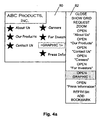
- Figure 4a is a block diagram showing how a user may select embedded links or download particular aspects of web content. All hyperlinks 78 for displayed graphic 80 are shown in a single menu 82.
- Content Delivery Server 38 collects hyperlinks 78 from web page 30 and associates hyperlinks 78 with the ID or filename of the graphic, for transmitting to Client Content Viewer 60. All or some of the hyperlinks 78 are sent along with graphic 80, and may be selected by the user at any time.
- a web page graphic 80 and its associated hyperlinks 78 are cached by Content Delivery Server 38 so that a subsequent request will result in the immediate delivery of a corresponding graphic 80.
- This function behaves similarly to proxy servers in typical web service environments.
- Client Picture Viewer 60 saves the date and time of receipt of graphic 80 and sends it to Content Delivery Server 38 for checking changes in content, as is typical of caching in wireless environments.
- Figure 4b is a block diagram showing an alternative way of enabling a user to select embedded links or download particular aspects of web content when a Client Content Viewer 60 is displaying a graphic 80 of a web page 30.
- Screen 70 displays graphic 80, with hyperlinks 78.
- hyperlinks 78 have been associated by Content Delivery Server 38 with particular coordinates of graphic 80.
- graphical methods such as those found in Scalable Vector Graphics (SVG)
- the X and Y coordinates of a mouse or cursor on screen 70 can be determined by Client Picture Viewer 60. This enables a user to position a mouse or cursor over points in the graphic to display a menu 82 having the option of selecting a corresponding hyperlink 78 or other active section of the page.
- SVG Scalable Vector Graphics
- menu 82 pops up and the user can select that hyperlink. It will be understood that the additional flexibility provided by this embodiment affords the user the ability to select links 78 without having to select a portion 75 of the graphic.
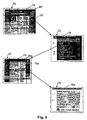
- FIG. 5 a pictorial view showing steps of web content retrieval according to an alternate embodiment of the invention is shown.
- grid 74 defining graphic portions 75 is established by the Content Delivery Server 38 (not Client Content Viewer 60) based on an aspect of the web page content 30 - in particular its frames.
- subdivision information is transmitted in association with graphic 80 to Client Content Viewer 60, which is relieved of having to subdivide graphic 80.
- This alternative enables hyperlinks 78 to be associated with respective such portions 75, so that a user of mobile device 12 has the option of viewing only those hyperlinks 78 that are from a particular portion 76 of a page 30, without the requirement of client content viewer 60 having to track x-y coordinates.
- Also shown in Figure 5 is the effect of an ON/OFF toggle of portion numbers, for viewing and selecting by a user.
- the ON/OFF toggle may be enabled through a keystroke, mouse movement, menu selection, touch screen activity or some other user input method.
- a requested graphic file is simply scaled using one of the aforementioned methods and delivered to Client Content Viewer 60.
- a grid 74 as described is overlaid based on one of a predetermined subdivision agreement, an aspect of the graphic itself or a set of coordinates.
- a user chooses a portion 75, triggering Content Delivery Server to process or retrieve a portion of graphic file sized for display on screen 70 of mobile station 12.
- Client Content Viewer 60 in this case does not need to display formatted content at all.
- subdivision information may be sent to Client Content Viewer 60 so it can enable a user to select one of the portions 75.
- hybrid web-linkable graphics may be transmitted such the Client Content Viewer 60 need only display a graphic or portion thereof (rather than a portion of an actual web page), but enable the user to select hyperlinks based on the graphic or a particular portion.
- Client Content Viewer 60 When a portion 75 is transmitted to Client Content Viewer 60, it may also have transmitted in association an identification of its own subdivisions/portions, for continued zooming in. This depends of course on the original size of the graphic file and the extent to which such a service may be offered.
- the HTML data for the web page and its constituent elements can coincidentally be sent in association with graphic 80. Then, if a user selects a portion of graphic 80 to initiate a request to retrieve a corresponding portion 76 of the web page 30, the HTML data coincidentally sent with graphic 80 can be used by Client Content Viewer 60 to provide a user with the corresponding web page portion 76, without initiating an additional request across network 14.
- subdivisions of graphic 80 of a web page when subdivisions of graphic 80 of a web page are established by Content Delivery Server 38, they may be established in accordance with an aspect of the web page itself (such as its frames as described above, tables or sections). Alternatively, subdivisions may be established by Content Delivery Server 38 in the form of a grid or according to some other criterion as described above by Client Content Viewer 60.
- Content Delivery Server 38 has been described as operating on proxy gateway/NATs 18 or private Intranet proxy gateway 24, it will be understood that it may be operated on server 28, or at another advantageous point in the path between server 28 and requesting mobile device 12. It is advantageous, however, that Content Delivery Server 38 be supported by functions enabling Content Delivery Server 38 to ascertain the size of the mobile device screen 70 so that graphic 80 is rendered in the appropriate size.
Landscapes
- Engineering & Computer Science (AREA)
- Databases & Information Systems (AREA)
- Theoretical Computer Science (AREA)
- Physics & Mathematics (AREA)
- General Engineering & Computer Science (AREA)
- General Physics & Mathematics (AREA)
- Data Mining & Analysis (AREA)
- Information Transfer Between Computers (AREA)
- Financial Or Insurance-Related Operations Such As Payment And Settlement (AREA)
- Mobile Radio Communication Systems (AREA)
- Two-Way Televisions, Distribution Of Moving Picture Or The Like (AREA)
- Image Generation (AREA)
- Digital Computer Display Output (AREA)
Claims (12)
- Verfahren zum Übertragen formatierter Daten von einem Content-Delivery-Server (38) an eine Mobilstation (12), wobei das Verfahren folgende Schritte am Content-Delivery-Server (38) umfasst:Abrufen einer Seite (30) formatierter Daten von einem Server (28);Darstellen dieser Seite als Grafik (80) in einer passenden Größe zur Anzeige auf der Mobilstation (12);Unterteilen der Grafik (80) in Abschnitte (75) anhand eines Aspekts wie etwa Rahmen oder Tabellen der abgerufenen Seite (30);Senden der Grafik (80) and die Mobilstation (12) als Reaktion auf eine Anforderung der betreffenden Seite (30) durch die Mobilstation (12); undzusammen mit der Grafik (80), Senden der Unterteilungsinformationen als Kennung der Grafikabschnitte (75) zusammen mit mindestens einem Hyperlink (78) in der betreffenden Seite (30) an die Mobilstation (12), wobei der mindestens eine Hyperlink (78) einem entsprechenden Grafikabschnitt (75) zugeordnet ist;wobei Abschnittsnummern, welche die Grafikabschnitte (75) für die Ansicht und Auswahl durch einen Benutzer identifizieren, auf der Mobilstation (12) angezeigt werden können.
- Verfahren gemäß Anspruch 1, bei dem der Schritt des Abrufens einer Seite (30) formatierter Daten von einem Server (28) durch den Content-Delivery-Server (38) erfolgt, nachdem der Content-Delivery-Server (38) die Anforderung der betreffenden Seite formatierter Daten von der Mobilstation (12) empfangen hat.
- Verfahren gemäß Anspruch 1 oder 2, welches ferner umfasst:Empfangen einer weitere Anforderung von der Mobilstation (12) über einen Abschnitt (76) der betreffenden Seite (30), indem eine Abschnittsnummer eines Abschnitts (75) der Grafik (80) ausgewählt wird; undSenden des betreffenden Abschnitts der Seite an die Mobilstation (12) als Reaktion auf die weitere Anforderung.
- Verfahren gemäß Anspruch 3, wobei die weitere Anforderung eine vorab festgelegte Kennung des betreffenden Abschnitts der Seite enthält.
- Verfahren gemäß einem der Ansprüche 1 bis 4, welches ferner umfasst:Zusammen mit der Kennung der betreffenden Abschnitte (75) der Grafik (80), das Senden von Hyperlinks (78) in entsprechenden Abschnitten (76) der Seite (30) an die Mobilstation (12).
- Verfahren gemäß einem der Ansprüche 1bis 5, welches ferner umfasst:Zusammen mit der Grafik (80), das Senden der Seite (30) an die Mobilstation (12) als Reaktion auf die Anforderung.
- Verfahren gemäß Anspruch 1, welches ferner folgende Schritte an der Mobilstation umfasst:Anfordern einer Seite (3) formatierter Daten von dem Content-Delivery-Server (38);Empfangen einer Grafik (80) welche die betreffende Seite (30) darstellt, als Reaktion auf diese Anforderung von dem Server (38);Anzeige der Grafik (80);zusammen mit der Grafik (80), Empfangen der Unterteilungsinformationen und dem mindestens einen Hyperlink (78) vom Server (38); undBereitstellen einer Option für den Benutzer zum Ansehen des mindestens einen Hyperlinks (78) an der Mobilstation (12), nachdem der Benutzer eine Abschnittsnummer des betreffenden Grafikabschnitts (75) ausgewählt hat.
- Verfahren gemäß Anspruch 7, welches ferner umfasst:Auswählen einer Abschnittsnummer eines Abschnitts (75) der Grafik (80);als Reaktion auf diese Auswahl, das Senden einer zweite Anforderung über einen Abschnitt (76) der Seite (30), der dem ausgewählten Abschnitt (75) der Grafik (80) entspricht, an den Content-Delivery-Server (38);als Reaktion auf diese zweite Anforderung, das Empfangen des betreffenden Abschnitts (76) der Seite (30) von dem Content-Delivery-Server (38); undAnzeigen dieses Abschnitts der Seite.
- System zum Übertragen formatierter Daten an eine Mobilstation (12), wobei das System umfasst:einen Content-Delivery-Server (38) zum Abrufen einer Seite (30) formatierter Daten von einem Server (28),wobei dieser Content-Delivery-Server (38) Mittel besitzt, die Seite als eine Grafik (80) in einer passenden Größe für die Anzeige durch die Mobilstation (12) darzustellen; undMittel besitzt, welche auf eine Anforderung der Seite (30) durch die Mobilstation (12) reagieren, um die Grafik (80) an die Mobilstation (12) zu senden, wobei die auf die Anforderung reagierende Mittel dafür ausgelegt sind, zusammen mit der Grafik (80) Unterteilungsinformationen als Kennung von Abschnitten (75) der Grafik (80) sowie mindestens einen Hyperlink (78) in der Seite (30) an die Mobilstation (12) zu senden, wobei die Unterteilungsinformationen auf einem Aspekt der abgerufenen Seite (30) basieren, etwa Rahmen oder Tabellen der Seite (30), und der mindestens eine Hyperlink einem jeweiligen Grafikabschnitt (75) zugeordnet ist,wobei die Mobilstation (12) so ausgelegt ist, dass Abschnittsnummern, die die einzelnen Grafikabschnitte (75) für die Ansicht und Auswahl durch einen Benutzer kennzeichnen, auf der Mobilstation (12) angezeigt werden können.
- System gemäß Anspruch 9, wobei die Mobilstation umfasst:Mittel zum Anfordern einer Seite (30) formatierter Daten von dem Content-Delivery-Server (38);Mittel zum Empfangen einer Grafik (80), welche die betreffende Seite (30) von dem Server (38) darstellt, als Reaktion auf die Anforderung;Mittel zum Anzeigen der Grafik (80);Mittel zum Empfangen der Unterteilungsinformationen und des mindestens einen Hyperlinks (78) zusammen mit der Grafik (80) von dem Server (38); undMittel zum Bereitstellen einer Option zum Ansehen des mindestens einen Hyperlinks (78) für einen Benutzer der Mobilstation (12), nachdem der Benutzer eine Abschnittsnummer des jeweiligen Grafikabschnitts (75) ausgewählt hat.
- Maschinenlesbarer Datenträger, der von einem Prozessor des Systems gemäß Anspruch 9 oder 10 ausführbaren Computercode enthält, um das Verfahren gemäß einem der Ansprüche 1 bis 8 zu implementieren.
- Drahtloses Kommunikationssystem, welches ein System gemäß Anspruch 9 oder 10 und eine Vielzahl von Mobilstationen (12) umfasst.
Priority Applications (5)
| Application Number | Priority Date | Filing Date | Title |
|---|---|---|---|
| EP04104084A EP1630689B1 (de) | 2004-08-25 | 2004-08-25 | Methode zum Darstellen von formatierten Inhalten auf einem mobilen Gerät |
| AT04104084T ATE377799T1 (de) | 2004-08-25 | 2004-08-25 | Methode zum darstellen von formatierten inhalten auf einem mobilen gerät |
| DE602004009923T DE602004009923T2 (de) | 2004-08-25 | 2004-08-25 | Methode zum Darstellen von formatierten Inhalten auf einem mobilen Gerät |
| CA 2516906 CA2516906C (en) | 2004-08-25 | 2005-08-23 | Method for rendering formatted content on a mobile device |
| HK06108531.3A HK1087222B (en) | 2006-08-01 | Method for rendering formatted content on a mobile device |
Applications Claiming Priority (1)
| Application Number | Priority Date | Filing Date | Title |
|---|---|---|---|
| EP04104084A EP1630689B1 (de) | 2004-08-25 | 2004-08-25 | Methode zum Darstellen von formatierten Inhalten auf einem mobilen Gerät |
Publications (2)
| Publication Number | Publication Date |
|---|---|
| EP1630689A1 EP1630689A1 (de) | 2006-03-01 |
| EP1630689B1 true EP1630689B1 (de) | 2007-11-07 |
Family
ID=34929488
Family Applications (1)
| Application Number | Title | Priority Date | Filing Date |
|---|---|---|---|
| EP04104084A Expired - Lifetime EP1630689B1 (de) | 2004-08-25 | 2004-08-25 | Methode zum Darstellen von formatierten Inhalten auf einem mobilen Gerät |
Country Status (3)
| Country | Link |
|---|---|
| EP (1) | EP1630689B1 (de) |
| AT (1) | ATE377799T1 (de) |
| DE (1) | DE602004009923T2 (de) |
Families Citing this family (5)
| Publication number | Priority date | Publication date | Assignee | Title |
|---|---|---|---|---|
| US20090089448A1 (en) * | 2007-09-28 | 2009-04-02 | David Sze | Mobile browser with zoom operations using progressive image download |
| WO2009039649A1 (en) * | 2007-09-28 | 2009-04-02 | Research In Motion Limited | Method and apparatus for providing zoom functionality in a portable device display |
| US20090172560A1 (en) * | 2007-12-31 | 2009-07-02 | Sony Ericsson Mobile Communications Ab | Portable communication device having hyperlink targets for improved mobile web browsing |
| US8438473B2 (en) | 2011-01-05 | 2013-05-07 | Research In Motion Limited | Handling of touch events in a browser environment |
| GB201701503D0 (en) * | 2017-01-30 | 2017-03-15 | Blupoint Ltd | Content providing device and method |
Family Cites Families (4)
| Publication number | Priority date | Publication date | Assignee | Title |
|---|---|---|---|---|
| ES2192685T3 (es) * | 1996-06-17 | 2003-10-16 | British Telecomm | Sistema de acceso basado en red. |
| US6185585B1 (en) * | 1997-12-16 | 2001-02-06 | Corporate Media Partners | System and method for distribution and navigation of internet content |
| FI20000735A7 (fi) * | 2000-03-30 | 2001-10-01 | Nokia Corp | Monimodaalinen menetelmä ja laite liikutettavissa laitteissa esitettävän graafisen informaation selaamiseksi |
| US6704024B2 (en) * | 2000-08-07 | 2004-03-09 | Zframe, Inc. | Visual content browsing using rasterized representations |
-
2004
- 2004-08-25 AT AT04104084T patent/ATE377799T1/de not_active IP Right Cessation
- 2004-08-25 EP EP04104084A patent/EP1630689B1/de not_active Expired - Lifetime
- 2004-08-25 DE DE602004009923T patent/DE602004009923T2/de not_active Expired - Lifetime
Non-Patent Citations (1)
| Title |
|---|
| None * |
Also Published As
| Publication number | Publication date |
|---|---|
| ATE377799T1 (de) | 2007-11-15 |
| DE602004009923D1 (de) | 2007-12-20 |
| DE602004009923T2 (de) | 2008-09-04 |
| EP1630689A1 (de) | 2006-03-01 |
| HK1087222A1 (en) | 2006-10-06 |
Similar Documents
| Publication | Publication Date | Title |
|---|---|---|
| US20060048051A1 (en) | Method for rendering formatted content on a mobile device | |
| US10394934B2 (en) | Scalable display of internet content on mobile devices | |
| US7210100B2 (en) | Configurable transformation of electronic documents | |
| US8196062B2 (en) | Method for requesting and viewing a zoomed area of detail from an image attachment on a mobile communication device | |
| US7302637B1 (en) | System and method for abbreviating information sent to a viewing device | |
| US20030011631A1 (en) | System and method for document division | |
| US20030177444A1 (en) | System for describing markup language for mobile use, and information processing apparatus and program for generating display content | |
| CA2423611C (en) | Configurable transformation of electronic documents | |
| US20120246557A1 (en) | System and method for transcoding web content adaptable to multiple client devices | |
| CA2518654C (en) | Method for requesting and viewing a zoomed area of detail from an image attachment on a mobile communication device | |
| EP1630689B1 (de) | Methode zum Darstellen von formatierten Inhalten auf einem mobilen Gerät | |
| CA2516906C (en) | Method for rendering formatted content on a mobile device | |
| HK1087222B (en) | Method for rendering formatted content on a mobile device | |
| CA2563488C (en) | A system and method for abbreviating information sent to a viewing device | |
| HK1088963A (en) | Method for requesting and viewing a zoomed area of detail from an image attachment on a mobile communication device |
Legal Events
| Date | Code | Title | Description |
|---|---|---|---|
| PUAI | Public reference made under article 153(3) epc to a published international application that has entered the european phase |
Free format text: ORIGINAL CODE: 0009012 |
|
| 17P | Request for examination filed |
Effective date: 20040831 |
|
| AK | Designated contracting states |
Kind code of ref document: A1 Designated state(s): AT BE BG CH CY CZ DE DK EE ES FI FR GB GR HU IE IT LI LU MC NL PL PT RO SE SI SK TR |
|
| AX | Request for extension of the european patent |
Extension state: AL HR LT LV MK |
|
| REG | Reference to a national code |
Ref country code: HK Ref legal event code: DE Ref document number: 1087222 Country of ref document: HK |
|
| AKX | Designation fees paid |
Designated state(s): AT BE BG CH CY CZ DE DK EE ES FI FR GB GR HU IE IT LI LU MC NL PL PT RO SE SI SK TR |
|
| AXX | Extension fees paid |
Extension state: AL Payment date: 20040831 Extension state: LT Payment date: 20040831 Extension state: HR Payment date: 20040831 Extension state: LV Payment date: 20040831 Extension state: MK Payment date: 20040831 |
|
| GRAP | Despatch of communication of intention to grant a patent |
Free format text: ORIGINAL CODE: EPIDOSNIGR1 |
|
| GRAS | Grant fee paid |
Free format text: ORIGINAL CODE: EPIDOSNIGR3 |
|
| GRAA | (expected) grant |
Free format text: ORIGINAL CODE: 0009210 |
|
| AK | Designated contracting states |
Kind code of ref document: B1 Designated state(s): AT BE BG CH CY CZ DE DK EE ES FI FR GB GR HU IE IT LI LU MC NL PL PT RO SE SI SK TR |
|
| AX | Request for extension of the european patent |
Extension state: AL HR LT LV MK |
|
| REG | Reference to a national code |
Ref country code: GB Ref legal event code: FG4D |
|
| REG | Reference to a national code |
Ref country code: IE Ref legal event code: FG4D |
|
| REG | Reference to a national code |
Ref country code: CH Ref legal event code: EP |
|
| REF | Corresponds to: |
Ref document number: 602004009923 Country of ref document: DE Date of ref document: 20071220 Kind code of ref document: P |
|
| REG | Reference to a national code |
Ref country code: HK Ref legal event code: GR Ref document number: 1087222 Country of ref document: HK |
|
| PG25 | Lapsed in a contracting state [announced via postgrant information from national office to epo] |
Ref country code: LI Free format text: LAPSE BECAUSE OF FAILURE TO SUBMIT A TRANSLATION OF THE DESCRIPTION OR TO PAY THE FEE WITHIN THE PRESCRIBED TIME-LIMIT Effective date: 20071107 Ref country code: ES Free format text: LAPSE BECAUSE OF FAILURE TO SUBMIT A TRANSLATION OF THE DESCRIPTION OR TO PAY THE FEE WITHIN THE PRESCRIBED TIME-LIMIT Effective date: 20080218 Ref country code: SE Free format text: LAPSE BECAUSE OF FAILURE TO SUBMIT A TRANSLATION OF THE DESCRIPTION OR TO PAY THE FEE WITHIN THE PRESCRIBED TIME-LIMIT Effective date: 20080207 Ref country code: CH Free format text: LAPSE BECAUSE OF FAILURE TO SUBMIT A TRANSLATION OF THE DESCRIPTION OR TO PAY THE FEE WITHIN THE PRESCRIBED TIME-LIMIT Effective date: 20071107 Ref country code: NL Free format text: LAPSE BECAUSE OF FAILURE TO SUBMIT A TRANSLATION OF THE DESCRIPTION OR TO PAY THE FEE WITHIN THE PRESCRIBED TIME-LIMIT Effective date: 20071107 |
|
| NLV1 | Nl: lapsed or annulled due to failure to fulfill the requirements of art. 29p and 29m of the patents act | ||
| PG25 | Lapsed in a contracting state [announced via postgrant information from national office to epo] |
Ref country code: BG Free format text: LAPSE BECAUSE OF FAILURE TO SUBMIT A TRANSLATION OF THE DESCRIPTION OR TO PAY THE FEE WITHIN THE PRESCRIBED TIME-LIMIT Effective date: 20080207 Ref country code: PL Free format text: LAPSE BECAUSE OF FAILURE TO SUBMIT A TRANSLATION OF THE DESCRIPTION OR TO PAY THE FEE WITHIN THE PRESCRIBED TIME-LIMIT Effective date: 20071107 Ref country code: SI Free format text: LAPSE BECAUSE OF FAILURE TO SUBMIT A TRANSLATION OF THE DESCRIPTION OR TO PAY THE FEE WITHIN THE PRESCRIBED TIME-LIMIT Effective date: 20071107 |
|
| REG | Reference to a national code |
Ref country code: CH Ref legal event code: PL |
|
| PG25 | Lapsed in a contracting state [announced via postgrant information from national office to epo] |
Ref country code: AT Free format text: LAPSE BECAUSE OF FAILURE TO SUBMIT A TRANSLATION OF THE DESCRIPTION OR TO PAY THE FEE WITHIN THE PRESCRIBED TIME-LIMIT Effective date: 20071107 |
|
| ET | Fr: translation filed | ||
| PG25 | Lapsed in a contracting state [announced via postgrant information from national office to epo] |
Ref country code: CZ Free format text: LAPSE BECAUSE OF FAILURE TO SUBMIT A TRANSLATION OF THE DESCRIPTION OR TO PAY THE FEE WITHIN THE PRESCRIBED TIME-LIMIT Effective date: 20071107 Ref country code: DK Free format text: LAPSE BECAUSE OF FAILURE TO SUBMIT A TRANSLATION OF THE DESCRIPTION OR TO PAY THE FEE WITHIN THE PRESCRIBED TIME-LIMIT Effective date: 20071107 |
|
| PG25 | Lapsed in a contracting state [announced via postgrant information from national office to epo] |
Ref country code: BE Free format text: LAPSE BECAUSE OF FAILURE TO SUBMIT A TRANSLATION OF THE DESCRIPTION OR TO PAY THE FEE WITHIN THE PRESCRIBED TIME-LIMIT Effective date: 20071107 Ref country code: RO Free format text: LAPSE BECAUSE OF FAILURE TO SUBMIT A TRANSLATION OF THE DESCRIPTION OR TO PAY THE FEE WITHIN THE PRESCRIBED TIME-LIMIT Effective date: 20071107 Ref country code: SK Free format text: LAPSE BECAUSE OF FAILURE TO SUBMIT A TRANSLATION OF THE DESCRIPTION OR TO PAY THE FEE WITHIN THE PRESCRIBED TIME-LIMIT Effective date: 20071107 |
|
| PLBE | No opposition filed within time limit |
Free format text: ORIGINAL CODE: 0009261 |
|
| STAA | Information on the status of an ep patent application or granted ep patent |
Free format text: STATUS: NO OPPOSITION FILED WITHIN TIME LIMIT |
|
| PG25 | Lapsed in a contracting state [announced via postgrant information from national office to epo] |
Ref country code: PT Free format text: LAPSE BECAUSE OF FAILURE TO SUBMIT A TRANSLATION OF THE DESCRIPTION OR TO PAY THE FEE WITHIN THE PRESCRIBED TIME-LIMIT Effective date: 20080407 |
|
| 26N | No opposition filed |
Effective date: 20080808 |
|
| PG25 | Lapsed in a contracting state [announced via postgrant information from national office to epo] |
Ref country code: GR Free format text: LAPSE BECAUSE OF FAILURE TO SUBMIT A TRANSLATION OF THE DESCRIPTION OR TO PAY THE FEE WITHIN THE PRESCRIBED TIME-LIMIT Effective date: 20080208 |
|
| PG25 | Lapsed in a contracting state [announced via postgrant information from national office to epo] |
Ref country code: FI Free format text: LAPSE BECAUSE OF FAILURE TO SUBMIT A TRANSLATION OF THE DESCRIPTION OR TO PAY THE FEE WITHIN THE PRESCRIBED TIME-LIMIT Effective date: 20071107 |
|
| PG25 | Lapsed in a contracting state [announced via postgrant information from national office to epo] |
Ref country code: MC Free format text: LAPSE BECAUSE OF NON-PAYMENT OF DUE FEES Effective date: 20080831 |
|
| PG25 | Lapsed in a contracting state [announced via postgrant information from national office to epo] |
Ref country code: EE Free format text: LAPSE BECAUSE OF FAILURE TO SUBMIT A TRANSLATION OF THE DESCRIPTION OR TO PAY THE FEE WITHIN THE PRESCRIBED TIME-LIMIT Effective date: 20071107 |
|
| PG25 | Lapsed in a contracting state [announced via postgrant information from national office to epo] |
Ref country code: IE Free format text: LAPSE BECAUSE OF NON-PAYMENT OF DUE FEES Effective date: 20080825 Ref country code: CY Free format text: LAPSE BECAUSE OF FAILURE TO SUBMIT A TRANSLATION OF THE DESCRIPTION OR TO PAY THE FEE WITHIN THE PRESCRIBED TIME-LIMIT Effective date: 20071107 |
|
| PG25 | Lapsed in a contracting state [announced via postgrant information from national office to epo] |
Ref country code: LU Free format text: LAPSE BECAUSE OF NON-PAYMENT OF DUE FEES Effective date: 20080825 Ref country code: HU Free format text: LAPSE BECAUSE OF FAILURE TO SUBMIT A TRANSLATION OF THE DESCRIPTION OR TO PAY THE FEE WITHIN THE PRESCRIBED TIME-LIMIT Effective date: 20080508 |
|
| PG25 | Lapsed in a contracting state [announced via postgrant information from national office to epo] |
Ref country code: TR Free format text: LAPSE BECAUSE OF FAILURE TO SUBMIT A TRANSLATION OF THE DESCRIPTION OR TO PAY THE FEE WITHIN THE PRESCRIBED TIME-LIMIT Effective date: 20071107 |
|
| PG25 | Lapsed in a contracting state [announced via postgrant information from national office to epo] |
Ref country code: IT Free format text: LAPSE BECAUSE OF NON-PAYMENT OF DUE FEES Effective date: 20080831 |
|
| REG | Reference to a national code |
Ref country code: DE Ref legal event code: R082 Ref document number: 602004009923 Country of ref document: DE Representative=s name: MERH-IP MATIAS ERNY REICHL HOFFMANN, DE |
|
| REG | Reference to a national code |
Ref country code: DE Ref legal event code: R081 Ref document number: 602004009923 Country of ref document: DE Owner name: BLACKBERRY LIMITED, WATERLOO, CA Free format text: FORMER OWNER: RESEARCH IN MOTION LTD., WATERLOO, ONTARIO, CA Effective date: 20140925 Ref country code: DE Ref legal event code: R082 Ref document number: 602004009923 Country of ref document: DE Representative=s name: MERH-IP MATIAS ERNY REICHL HOFFMANN, DE Effective date: 20140925 Ref country code: DE Ref legal event code: R082 Ref document number: 602004009923 Country of ref document: DE Representative=s name: MERH-IP MATIAS ERNY REICHL HOFFMANN PATENTANWA, DE Effective date: 20140925 |
|
| REG | Reference to a national code |
Ref country code: FR Ref legal event code: PLFP Year of fee payment: 12 |
|
| PGFP | Annual fee paid to national office [announced via postgrant information from national office to epo] |
Ref country code: DE Payment date: 20150827 Year of fee payment: 12 Ref country code: GB Payment date: 20150827 Year of fee payment: 12 |
|
| PGFP | Annual fee paid to national office [announced via postgrant information from national office to epo] |
Ref country code: FR Payment date: 20150817 Year of fee payment: 12 |
|
| REG | Reference to a national code |
Ref country code: DE Ref legal event code: R119 Ref document number: 602004009923 Country of ref document: DE |
|
| GBPC | Gb: european patent ceased through non-payment of renewal fee |
Effective date: 20160825 |
|
| REG | Reference to a national code |
Ref country code: FR Ref legal event code: ST Effective date: 20170428 |
|
| PG25 | Lapsed in a contracting state [announced via postgrant information from national office to epo] |
Ref country code: DE Free format text: LAPSE BECAUSE OF NON-PAYMENT OF DUE FEES Effective date: 20170301 Ref country code: GB Free format text: LAPSE BECAUSE OF NON-PAYMENT OF DUE FEES Effective date: 20160825 Ref country code: FR Free format text: LAPSE BECAUSE OF NON-PAYMENT OF DUE FEES Effective date: 20160831 |