EP1631033B1 - Système et procédé pour le traitement de la transition de IP a Mobile IP - Google Patents
Système et procédé pour le traitement de la transition de IP a Mobile IP Download PDFInfo
- Publication number
- EP1631033B1 EP1631033B1 EP04104178A EP04104178A EP1631033B1 EP 1631033 B1 EP1631033 B1 EP 1631033B1 EP 04104178 A EP04104178 A EP 04104178A EP 04104178 A EP04104178 A EP 04104178A EP 1631033 B1 EP1631033 B1 EP 1631033B1
- Authority
- EP
- European Patent Office
- Prior art keywords
- mip
- wireless
- session
- protocol
- sip
- Prior art date
- Legal status (The legal status is an assumption and is not a legal conclusion. Google has not performed a legal analysis and makes no representation as to the accuracy of the status listed.)
- Expired - Lifetime
Links
Images

Classifications
-
- H—ELECTRICITY
- H04—ELECTRIC COMMUNICATION TECHNIQUE
- H04W—WIRELESS COMMUNICATION NETWORKS
- H04W60/00—Affiliation to network, e.g. registration; Terminating affiliation with the network, e.g. de-registration
-
- H—ELECTRICITY
- H04—ELECTRIC COMMUNICATION TECHNIQUE
- H04L—TRANSMISSION OF DIGITAL INFORMATION, e.g. TELEGRAPHIC COMMUNICATION
- H04L69/00—Network arrangements, protocols or services independent of the application payload and not provided for in the other groups of this subclass
- H04L69/18—Multiprotocol handlers, e.g. single devices capable of handling multiple protocols
-
- H—ELECTRICITY
- H04—ELECTRIC COMMUNICATION TECHNIQUE
- H04W—WIRELESS COMMUNICATION NETWORKS
- H04W76/00—Connection management
- H04W76/10—Connection setup
-
- H—ELECTRICITY
- H04—ELECTRIC COMMUNICATION TECHNIQUE
- H04W—WIRELESS COMMUNICATION NETWORKS
- H04W80/00—Wireless network protocols or protocol adaptations to wireless operation
- H04W80/04—Network layer protocols, e.g. mobile IP [Internet Protocol]
- H04W80/045—Network layer protocols, e.g. mobile IP [Internet Protocol] involving different protocol versions, e.g. MIPv4 and MIPv6
Definitions
- the application relates to the provision of IP (Internet Protocol) connectivity to wireless devices, and in particular to transitions between simple IP and mobile IP sessions.
- IP Internet Protocol
- IP Internet Engineering Task Force
- 3GPP2 Third Generation Partnership Project 2
- IETF Internet Engineering Task Force
- RFC2002 Internet Engineering Task Force
- Some cdma2000-based wireless IP networks support both MIP and SIP. Others support only SIP or only MIP. Regardless of the operation mode, the network and the mobile device establish and configure the point-to-point protocol (PPP) as described in RFC1661 to establish a packet data session.
- PPP point-to-point protocol
- An "always-on" mobile device always maintains PPP connectivity even when it does not have radio link layer connectivity to the network.
- the packet data service on the mobile device enters a "dormant" state.
- the PPP connectivity between the network and the device is maintained, but the physical radio connection is torn down in such a state.
- cdma2000® is a registered trademark of the Telecommunications Industry Association (TIA-USA).
- a SIP-based wireless IP network mobile devices are assigned geographically dependent IP addresses dynamically by the visited Packet Data Serving Nodes (PDSN). As the mobile device moves it will be assigned a new geographically dependent IP address. If the mobile device supports any "push" applications such as Push e-mail, then it is the responsibility of the mobile device to notify the associated push servers whenever its IP address as assigned by the wireless network changes. In a SIP-based network, mobile devices may not know how long the IP address is assigned for. The PDSN may tear down the PPP session and reassign the IP address to another mobile device if it has not heard from the mobile device upon the expiration of an assigned IP address duration.
- PDSN Packet Data Serving Nodes
- a PDSN may unilaterally tear down the PPP session if the mobile fails to respond to page messages while out of coverage even if the PPP session time has not expired. This will break push services as the mobile device is no longer associated with the IP address that the push servers are aware of. As a result, "Always-on" mobile devices in a SIP session need to send periodic "keep alive" packets to maintain PPP connectivity.
- each mobile device is typically assigned a static IP address by its home agent (HA) which is then maintained by the mobile terminal regardless of its geographical point of attachment.
- HA home agent
- FA foreign agent
- COA care-of-address
- the home agent is informed of the mobile device's COA through the registration procedure.
- the foreign agent maintains a binding of Home IP address to care-of-address.
- the home agent receives packets for the terminal and forwards these to the foreign agent according to the care-of-address such that the mobile device remains reachable via its geographically-independent IP address. Because of this, a MIP terminal will always be reachable.
- the network notifies the mobile of the duration of the address and as such the mobile terminal will know the expiry time of assigned address. As long as the mobile device re-registers before this timer expires, the PPP connectivity is maintained.
- Mobile IP provides a number of other advantages over simple IP such as multiple user profiles with different user ID/password etc. This allows a single mobile device to have multiple user accounts.
- the IS-835 standard only states that if a wireless terminal fails to establish a mobile IP session, it should fall back to SIP mode to establish a SIP data session.
- the standard does not state any mechanism how a "dormant" mobile device in a SIP session can establish a MIP session when it visits a network that supports MIP.
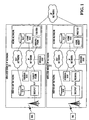
- FIG. 1 shown in Figure 1 is an example of a cdma2000 wireless IP network as described in IS-835.
- a wireless simple IP network 10 and a wireless mobile IP network 12.
- MoIP Mobile IF
- the application provides a method for transitioning between a first wireless protocol having geographically dependent addressing and a second wireless protocol having non-geographically dependent addressing, the method comprising: a wireless device detecting a new system requiring reconnect of a packet data service while in a state during which link layer connectivity is maintained for a packet data service; at least a first time the wireless device detects the new system, the wireless device attempting to establish a session using the second wireless protocol with the new system and if the session using the second wireless protocol is established, the wireless device terminating use of the first wireless protocol thereby transitioning to the second wireless protocol.
- the method is executed only if the mobile device is in state during which link layer connectivity for a packet data service is maintained and a radio link has been torn down.
- the first and second wireless protocols comprise a first wireless IP protocol and a second wireless IP protocol respectively.
- the first wireless protocol comprises SIP (simple IP) and the second wireless protocol comprises MIP (mobile IP).
- the method further comprises: the wireless device storing MIP support information for each new system detected, the MIP support information indicating whether or not a MIP session was established; upon the wireless device detecting a new system requiring reconnect of a packet data service: a) the wireless device checking to see if MIP support information was previously stored in respect of the new system; b) if there is MIP support information indicating a MIP session was established during a previous visit to the new system, the wireless device attempting to establish a MIP session with the new system; and c) if there is MIP support information indicating a MIP session was not established during a previous visit to the new system, the wireless device attempting to establish a SIP session with the new system.
- the method further comprises, if there is no MIP support information stored for the new system: initiating a SIP reconnect request to establish a SIP session; transmitting an unsolicited agent solicitation; if a MIP agent advertisement is received in response to the unsolicited agent solicitation, terminating the SIP session and initiating a MIP session; and adding a record in respect of the new system to indicate whether or not a MIP session was established.
- the method further comprises: transmitting the unsolicited agent solicitation message on a traffic channel assigned as a result of the SIP reconnection.
- the method further comprises: initiating a new call to set up a traffic channel, and transmitting the unsolicited agent solicitation message on the traffic channel.
- the method further comprises: waiting until a new call is initiated that results in a new traffic channel being set up, and transmitting the unsolicited agent solicitation message on the traffic channel.
- the method further comprises: if IPCP is not configured as MIP upon initiating the MIP session, falling back to SIP mode and making the MIP support information indicate that MIP was not supported, and falling back to SIP mode; and if IPCP is configured as MIP upon initiating the MIP session, and MIP registration is not successful, making the MIP support information indicate that MIP was not granted, and falling back to SIP mode.
- the method further comprises: detecting a new system by detecting a change in one or more network identifying parameters.
- the method further comprises: putting a time limit on the validity of the MIP support information for each system stored by the wireless device.
- the application provides a wireless device adapted to communicate with access networks using a first wireless protocol having geographically dependent addressing and a second wireless protocol having non-geographically dependent addressing, the wireless device being adapted to transition between the first protocol and the second protocol using a method as summarized above.
- the application provides a computer readable medium having computer executable instructions stored thereon for execution on a wireless device so as to implement any of the methods as summarized above for transitioning between a first wireless protocol having geographically dependent addressing and a second wireless protocol having non-geographically dependent addressing.
- the TIA/EIA IS-835 standard does not specify how or whether a mobile station with a SIP session should check for availability of a MIP network.
- An example of the necessity for such a feature would be the case when a MIP-capable mobile device with a dormant packet data service (e.g. an always-on mobile device) comes back to its home MIP network after it was forced to establish a SIP session on a roaming SIP network.
- Attempting to establish a MIP session for every data call initiation is not applicable to an "always-on" device which maintains data connectivity all the time.
- an "always-on" wireless terminal may get stuck in SIP mode until a power cycle (when the radio on the device is powered off and turned back on).
- MIP there is a foreign agent in the network being visited by a wireless terminal and a home agent on the wireless terminal's home network.
- the home agent receives packets for the terminal and forwards these to the foreign agent.
- the foreign agent checks the home address to COA mapping, and forwards the packets to the wireless terminal upon receipt.
- a PDSN will send a list of different available COAs together with an indication that it is available to function as a foreign agent. This is a so-called "agent advertisement" message. This message is sent after the PPP between the device and the network is set up.
- the wireless terminal then initiates the MIP registration process by sending a Registration Request message to the foreign agent which includes a selected COA, a home agent address, home IP address and some parameters required for authentication.
- the foreign agent sends the MIP Registration Request to the home agent.
- the home agent responds with a Registration Response message that includes a registration life time and other parameters such as home IP address (if it has not been assigned already). Then, the home and foreign agents establish a tunnel so that the mobile device can be reached by its home IP address.
- a dormant wireless terminal with a PPP (point-to-point protocol) connection is required to "re-connect" its packet data service whenever it detects a change in network parameters such as system ID (SID), network ID (NID) or packet zone ID.
- SID system ID
- NID network ID
- a MIP-capable mobile device attempts to discover whether a new network to which it is trying to reconnect its dormant packet data session supports MIP or not. It may send an ICMP (Internet Control Message Protocol) Agent solicitation message as part of the re-connect process which does not require any extra data call set-up.
- ICMP Internet Control Message Protocol
- Agent solicitation message as part of the re-connect process which does not require any extra data call set-up.
- the network if the network supports mobile IP, then the network sends an ICMP agent advertisement message even if the wireless terminal is currently in SIP mode.
- the ICMP protocol is common to both SIP and MIP stacks.
- each wireless terminal maintains a visited network list (VNL) to keep track of some number of visited networks in terms of whether or not MIP was supported and granted during the last visit.
- the agent solicitation trigger may be partially based on the existing information in the VNL.
- this may reduce blind attempts to establish MIP sessions where they are not possible.
- the VNL is updated every time the wireless terminal decides to solicit agent advertisement.
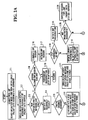
- the method begins at step 2-1 with the session type being SIP and the device operational mode being MIP with SIP fall back.
- the packet data session state is dormant.
- the mobile terminal detects that it has entered a new system requiring re-connect of the packet data service. This is detected by determining that there has been a change in one of more of the system parameters such as the system ID, network ID or packet zone ID to name a few examples.
- the mobile terminal examines its VNL to determine if the new system is in the list. If it is not in the list (no path step 2-3) then at step 2-4 a SIP re-connect request is initiated. If a traffic channel is assigned (yes path step 2-5) then the mobile terminal sends an ICMP agent solicitation message prior to call end and starts a timer. If no traffic channel has been assigned (no path step 2-5) then at step 2-6 the mobile terminal either initiates a new call, or during the next call sends an ICMP agent solicitation message and starts a timer.
- step 2-7 if at step 2-7 an agent advertisement was not received during the call then MIP mode is not available, and the current system is added to the VNL with the access type "MIP not supported" at step 2-8.
- a "call” refers to any origination, for example a voice call.
- Connection on the other hand refers to PPP connectivity or the like.
- step 2--7 if a MIP advertisement was received during the call (yes path step 2-7) then the SIP session is terminated at step 2-12.
- a MIP session set-up is initiated at step 2-13. If the Internet Protocol Control Protocol (IPCP) is configured as MIP as described in IS-835 (yes path step 2-14), then MIP registration is initiated at step 2-20. If MIP registration was successful (yes path step 2-21) then the current system is added to the VNL with the access attribute indicating "MIP granted" at step 2-29. At this point, the current session type is MIP and the packet data status is dormant as indicated at step 2-30.
- IPCP Internet Protocol Control Protocol
- MIP registration is initiated at step 2-20. If MIP registration was successful (yes path step 2-21) then the current system is added to the VNL with the access attribute indicating "MIP granted" at step 2-29. At this point, the current session type is MIP and the packet data status is dormant as indicated at step 2-30.
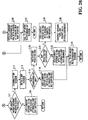
- step 2-14 the current system is added to the VNL with an access attribute indicating "MIP not supported". At this point the terminal falls back to SIP mode and attempts to re-establish a SIP session at step 2-23.
- MIP registration was not successful (no path step 2-21) then the current system is also added to the VNL with the access attribute "MIP not granted” at step 2-22 and the mobile terminal falls back into SIP mode and re-establishes a SIP session at step 2-23.
- step 2-15 and step 2-22 is that in step 2-15 MIP was not supported whereas in step 2-22 MIP was supported but MIP was not granted for the particular access attempt.
- step 2-3 if the new system is included in the VNL (yes path) then the VNL can be used to determine whether the system allowed a MIP session earlier. If the system did not allow a MIP session earlier (no path step 2-9) then packet data service re-connection is performed at step 2-10 and the mobile terminal stays in SIP mode. On the other hand, if the VNL indicates that the system did allow MIP session earlier (yes path step 2-9) then at step 2-16 the mobile terminates the SIP session. The mobile terminal initiates a MIP session set-up at step 2-17. If the IPCP is configured successfully as MIP as described IS-835 (yes path 2-18) then the mobile terminal attempts to initiate MIP registration at step 2-24.
- MIP registration was successful (yes path step 2-25) then the current session type is MIP and the packet data status is dormant as indicated at step 2-28. On the other hand, if MIP registration was unsuccessful (no path step 2-25) then the mobile terminal updates the system information and the VNL to indicate that the access attribute is "MIP not granted" at step 2-26. Also, if the IPCP is not configured as MIP (no path step 2-18), then the system information is updated in the VNL with the access attribute "MIP not supported". After either of steps 2-19 or 2-26 the mobile terminal falls back to SIP mode and attempts to re-establish a SIP session at step 2-27.
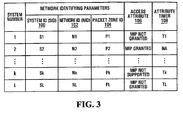
- FIG 3 shows an example of the above discussed VNL.
- the VNL has a number of rows for various systems.
- Each network has a number of network identifying parameters. In the illustrated example these include system ID 100, network ID 102 and packet zone ID 104. However, it may be that in other implementations a subset of these three parameters or different network identifying parameters may be used.
- the mobile terminal can make the determination that it may be possible to transition from SIP to MIP.
- the access attribute for the network identified by the network identifying parameters is listed in column 106.
- the three possible access attributes in the embodiment described above are "MIP not granted", “MIP granted”, and "MIP not supported”.
- the attribute "MIP not granted” is indicated for System No. 1
- the attribute "MIP granted” is indicated for System No. 2 and System No. L
- the attribute "MIP not supported” is indicated for System No. k.
- column 108 Also shown in column 108 is a field for a so-called “attribute timer”.
- System Nos. 1, k and L all have timers T1, Tk and TL respectively. These timers are used to indicate how long the access attribute is to be considered valid. Once the attribute timer expires for a given system, it becomes as if the system is not included in the VNL. It is not necessary to run a timer for the systems having a "MIP granted" access attribute.
- the timer can be implemented in any suitable manner, the only important feature being that after some time, the mobile will again consider re-attempting MIP even though previously it had failed to establish MIP in a given network.
- the VNL is preferably maintained in the mobile terminal in memory. While it may be desirable that the memory be non-volatile memory, this is not essential since if the mobile terminal undergoes a power cycle it will attempt to establish an initial connection in MIP mode and will build up the VNL from scratch again. Similarly, if the wireless component of PDA-type mobile device is turned off, VNL may be erased. Furthermore, while the VNL shown is used in some embodiments, more generally MIP support information is stored in any suitable fashion indicating for each system at least whether or not a MIP session was successfully established or not. In the above example, "MIP not granted" and "MIP not supported" both indicate a failure to establish a MIP session.
- no MIP support information is maintained in any form, and the wireless device attempts MIP every time a new system is detected.
- FIG. 4 shown is an example block diagram of a wireless terminal that may be adapted to implement the method of Figures 2 and 3.
- the device has a microprocessor 200 to which is connected auxiliary I/O 202, serial port 204, keyboard 206, speaker 208 and microphone 210.
- Short range communications functions are indicated at 212 and other device subsystems at 214.
- a battery interface is indicated at 216 and the battery itself at 218.
- the microprocessor 200 is connected to transceiver 220 which has a receiver 222 and transmitter 224 driven by local oscillators 226.
- a DSP 228 is shown in communication with both the receiver 222 and the transmitter 224.
- UIM User Identity Module
- the functionality of the mobile device for communications purposes can be broken down using the OSI protocol stack.
- This is indicated generally at 250 which shows the application layer 252 on top below which is located the UDP/TCP layer 254, the Internet protocol/ICMP protocol 256, the link control protocol/IP control protocol (IPCP) 258, the radio link protocol (RLP) 260 and finally the physical layer 262.
- IPCP link control protocol/IP control protocol
- RLP radio link protocol
- the functionality which decides whether or not to attempt to set up a MIP session versus a SIP session is implemented as part of the network determination component of physical layer software running on the mobile terminal.
- the functionality could be implemented in any appropriate manner on a wireless terminal and not limited to the physical layer 262.
- the embodiments described above have focussed on transitioning between SIP and MIP. More generally, other embodiments are applicable for transitioning between a first wireless protocol having geographically dependent addressing and a second wireless protocol having non-geographically dependent addressing while in a state during which link layer connectivity (e.g. PPP) is maintained for a packet data service but a radio link has been torn down, the Dormant state being an example of this.
- the first and second wireless protocols are IP protocols. Particular examples of these IP protocols are SIP and MIP respectively.
- the link layer connectivity may be PPP or PPP-like connectivity. Other implementations may feature different link layer functionality.
- the method is applicable when the wireless device is involved in active communications for the packet data service, i.e. the device is not dormant, so the link layer connectivity is present, and the radio link is not torn down.
- a handoff may occur from a network allowing only SIP to a network allowing MIP, and the method can be employed to detect the MIP capability and to re-establish the session as a MIP session.
- Another embodiment provides a computer readable medium having computer executable instruction stored thereon for instructing a wireless device to implement any of the methods described herein.
Landscapes
- Engineering & Computer Science (AREA)
- Computer Networks & Wireless Communication (AREA)
- Signal Processing (AREA)
- Mobile Radio Communication Systems (AREA)
Claims (14)
- Procédé permettant d'effectuer la transition entre un premier protocole sans fil ayant un adressage géographiquement dépendant et un second protocole sans fil ayant un adressage non géographiquement dépendant, le procédé comprenant :un dispositif sans fil détectant un nouveau système nécessitant la reconnexion d'un service de paquets de données lorsqu'il est dans un état dans lequel la connectivité de la couche de liaison est maintenue pour un service de paquets de données ;au moins une première fois le dispositif sans fil détecte le nouveau système, le dispositif sans fil tentant d'établir une session en utilisant le second protocole sans fil avec le nouveau système ; etsi la session utilisant le second protocole sans fil est établie, le dispositif sans fil met un terme à l'utilisation du premier protocole sans fil, opérant ainsi la transition vers le second protocole sans fil.
- Procédé selon la revendication 1, exécuté uniquement si le dispositif mobile est dans l'état dans lequel la connectivité de la couche de liaison pour un service de paquets de données est maintenue et une liaison hertzienne a été démontée.
- Procédé selon la revendication 1 ou la revendication 2, dans lequel le premier et le second protocoles sans fil sont constitués respectivement par un premier protocole IP sans fil et un second protocole IP sans fil.
- Procédé selon la revendication 3, dans lequel le premier protocole sans fil est constitué par un SIP, IP simple, et le second protocole sans fil est constitué par un MIP, IP mobile.
- Procédé selon la revendication 4, comprenant en outre :le dispositif sans fil stockant des informations de support de MIP pour chaque nouveau système détecté, les informations de support de MIP indiquant si oui ou non une session MIP a été établie ;lorsque le dispositif sans fil détecte un nouveau système nécessitant une reconnexion d'un service de paquets de données :le dispositif sans fil vérifie si des informations de support de MIP ont été préalablement stockées en ce qui concerne le nouveau système ;s'il existe des informations de support de MIP indiquant qu'une session MIP a été établie pendant une visite précédente sur le nouveau système, le dispositif sans fil tente d'établir une session MIP avec le nouveau système ; ets'il existe des informations de support de MIP indiquant qu'une session MIP n'a pas été établie pendant une visite précédente sur le nouveau système, le dispositif sans fil tente d'établir une session SIP avec le nouveau système.
- Procédé selon la revendication 5 comprenant en outre, s'il n'y a pas d'informations de support MIP stockées pour le nouveau système :le déclenchement d'une demande de reconnexion SIP afin d'établir une session SIP ;la transmission d'une sollicitation d'agent non sollicité ;si une publicité d'agent MIP est reçue en réponse à la sollicitation d'agent non sollicité, l'interruption de la session SIP et le déclenchement (2-13) d'une session MIP ; etl'ajout d'un enregistrement concernant le nouveau système pour indiquer si une session MIP a ou non été établie.
- Procédé selon la revendication 6, comprenant en outre :la transmission du message de sollicitation d'agent non sollicité sur un canal de trafic attribué en conséquence de la reconnexion SIP.
- Procédé selon la revendication 6, comprenant en outre :le déclenchement d'un nouvel appel pour installer un canal de trafic et la transmission du message de sollicitation d'agent non sollicité sur le canal de trafic.
- Procédé selon la revendication 6, comprenant en outre :l'attente jusqu'à ce qu'un nouvel appel soit déclenché, entraînant l'installation d'un nouveau canal de trafic, et la transmission du message de sollicitation d'agent non sollicité sur le canal de trafic.
- Procédé selon la revendication 6, comprenant en outre :si le protocole de contrôle de protocole Internet n'est pas configuré comme un MIP lors du déclenchement de la session MIP, le signalement par les informations de support de MIP que le MIP n'était pas supporté et revenir au mode SIP ; etsi le protocole de contrôle de protocole Internet est configuré (2-14) comme un MIP lors du déclenchement de la session MIP et que l'enregistrement MIP échoue, le signalement par les informations de support de MIP que le MIP n'a pas été accordé et revenir au mode SIP.
- Procédé selon l'une quelconque des revendications 1 à 10, comprenant en outre :la détection d'un nouveau système par détection d'un changement d'un ou plusieurs paramètres identificateurs de réseau.
- Procédé selon l'une quelconque des revendications 3 à 10, comprenant en outre :la fixation d'une limite de temps sur la validité des informations de support de MIP pour chaque système stocké par le dispositif sans fil.
- Dispositif sans fil (220, 250, 200, 236, 238, 230, 232, 234, 216, 218, 202, 204, 206, 208, 210, 212, 214) conçu pour communiquer avec des réseaux d'accès utilisant un premier protocole sans fil ayant un adressage géographiquement dépendant et un second protocole sans fil ayant un adressage non géographiquement dépendant, le dispositif sans fil comprenant des moyens conçus pour exécuter les étapes d'un procédé selon l'une quelconque des revendications 1 à 12 afin d'opérer une transition entre le premier protocole et le second protocole.
- Support lisible par ordinateur (236, 238, 250) sur lequel sont stockées des instructions exécutables par ordinateur destinées à être exécutées sur un dispositif sans fil de manière à mettre en oeuvre un moyen de programmation d'ordinateur destiné à exécuter les étapes d'un procédé selon l'une quelconque des revendications 1 à 12 pour opérer une transition entre un premier protocole sans fil ayant un adressage géographiquement dépendant et un second protocole sans fil ayant un adressage non géographiquement dépendant.
Priority Applications (6)
| Application Number | Priority Date | Filing Date | Title |
|---|---|---|---|
| EP04104178A EP1631033B1 (fr) | 2004-08-31 | 2004-08-31 | Système et procédé pour le traitement de la transition de IP a Mobile IP |
| DE602004004896T DE602004004896T2 (de) | 2004-08-31 | 2004-08-31 | System und Verfahren zur Behandlung der Übergang von IP zu Mobile IP |
| AT04104178T ATE354907T1 (de) | 2004-08-31 | 2004-08-31 | System und verfahren zur behandlung der übergang von ip zu mobile ip |
| PCT/CA2005/001299 WO2006024141A1 (fr) | 2004-08-31 | 2005-08-29 | Systeme et procede permettant de mettre en oeuvre le passage d'un ip simple a un ip mobile |
| CA002554023A CA2554023C (fr) | 2004-08-31 | 2005-08-29 | Systeme et procede permettant de mettre en oeuvre le passage d'un ip simple a un ip mobile |
| HK06108529.7A HK1087272B (en) | 2006-08-01 | System and method for handling simple ip to mobile ip transition |
Applications Claiming Priority (1)
| Application Number | Priority Date | Filing Date | Title |
|---|---|---|---|
| EP04104178A EP1631033B1 (fr) | 2004-08-31 | 2004-08-31 | Système et procédé pour le traitement de la transition de IP a Mobile IP |
Publications (2)
| Publication Number | Publication Date |
|---|---|
| EP1631033A1 EP1631033A1 (fr) | 2006-03-01 |
| EP1631033B1 true EP1631033B1 (fr) | 2007-02-21 |
Family
ID=34929511
Family Applications (1)
| Application Number | Title | Priority Date | Filing Date |
|---|---|---|---|
| EP04104178A Expired - Lifetime EP1631033B1 (fr) | 2004-08-31 | 2004-08-31 | Système et procédé pour le traitement de la transition de IP a Mobile IP |
Country Status (5)
| Country | Link |
|---|---|
| EP (1) | EP1631033B1 (fr) |
| AT (1) | ATE354907T1 (fr) |
| CA (1) | CA2554023C (fr) |
| DE (1) | DE602004004896T2 (fr) |
| WO (1) | WO2006024141A1 (fr) |
Families Citing this family (7)
| Publication number | Priority date | Publication date | Assignee | Title |
|---|---|---|---|---|
| US8412207B2 (en) * | 2006-12-21 | 2013-04-02 | Core Wireless Licensing S.A.R.L. | Method of providing a mobility service |
| WO2008089704A1 (fr) * | 2007-01-23 | 2008-07-31 | Huawei Technologies Co., Ltd. | Procédé de détermination de type de gestion de mobilité de terminal et système et appareil correspondants |
| CN101232699B (zh) * | 2007-01-23 | 2012-07-04 | 华为技术有限公司 | 确定终端移动性管理类型的方法和系统 |
| US8238899B2 (en) | 2007-03-16 | 2012-08-07 | Research In Motion Limited | Soliciting first party in communication session to maintain call when degradation of connection to second party is anticipated |
| EP1971173B1 (fr) * | 2007-03-16 | 2013-10-16 | BlackBerry Limited | Conservation de la continuité d'une session de communication |
| US8929280B2 (en) * | 2007-06-04 | 2015-01-06 | Motorola Mobility Llc | Method to switch between network-controlled and mobile-controlled mobile IP functionality |
| JP2012009961A (ja) * | 2010-06-22 | 2012-01-12 | Nec Casio Mobile Communications Ltd | 移動通信端末装置、移動通信方法、及び移動通信プログラム |
Family Cites Families (5)
| Publication number | Priority date | Publication date | Assignee | Title |
|---|---|---|---|---|
| US6230012B1 (en) * | 1998-08-07 | 2001-05-08 | Qualcomm Incorporated | IP mobility support using proxy mobile node registration |
| KR100399576B1 (ko) * | 2000-09-18 | 2003-09-26 | 한국전자통신연구원 | 차세대이동통신시스템에서의 단순한 아이피와 이동성 아이피 서비스 지원시스템 및 방법 |
| US7369529B2 (en) * | 2001-05-24 | 2008-05-06 | Qualcomm.Incorporated. | Method and apparatus for differentiating point to point protocol session termination points |
| US7701958B2 (en) * | 2002-07-02 | 2010-04-20 | Qualcomm Incorporated | Communication system supporting transition between network communications protocols |
| US7499401B2 (en) * | 2002-10-21 | 2009-03-03 | Alcatel-Lucent Usa Inc. | Integrated web cache |
-
2004
- 2004-08-31 EP EP04104178A patent/EP1631033B1/fr not_active Expired - Lifetime
- 2004-08-31 DE DE602004004896T patent/DE602004004896T2/de not_active Expired - Lifetime
- 2004-08-31 AT AT04104178T patent/ATE354907T1/de not_active IP Right Cessation
-
2005
- 2005-08-29 WO PCT/CA2005/001299 patent/WO2006024141A1/fr not_active Ceased
- 2005-08-29 CA CA002554023A patent/CA2554023C/fr not_active Expired - Lifetime
Also Published As
| Publication number | Publication date |
|---|---|
| DE602004004896D1 (de) | 2007-04-05 |
| DE602004004896T2 (de) | 2007-06-21 |
| ATE354907T1 (de) | 2007-03-15 |
| EP1631033A1 (fr) | 2006-03-01 |
| HK1087272A1 (en) | 2006-10-06 |
| CA2554023C (fr) | 2008-05-06 |
| WO2006024141A1 (fr) | 2006-03-09 |
| CA2554023A1 (fr) | 2006-03-09 |
Similar Documents
| Publication | Publication Date | Title |
|---|---|---|
| US8787334B2 (en) | System and method for handling simple IP to mobile IP transition | |
| JP4584521B2 (ja) | 移動性を容易にするためのipインターネットへの接続ポイントの変更を移動端末装置に知らせる発明 | |
| CN100591069C (zh) | 永远在线无线因特网协议通信 | |
| EP2259642B1 (fr) | Protocole hybride destiné a prendre en charge des communications avec des réseaux multiples | |
| EP1550339B1 (fr) | Transfert en mode passif dans un reseau de donnees en paquets | |
| CN100505942C (zh) | 用于无线分组数据服务连接的切换的方法和装置 | |
| US6822952B2 (en) | Maintaining packet data connectivity in a wireless communications network | |
| US8045522B2 (en) | Method and system for performing handoff in wireless networks | |
| US8140073B2 (en) | Method and system for optimized handover for mobile devices | |
| WO2006006012A1 (fr) | Procede et appareil engendrant un transfert de contexte pour transferts inter-bs et inter-pcf dans un systeme de communication sans fil | |
| EP2288191A1 (fr) | Procédé de traitement d informations de changement d état, passerelle d accès pour mobiles et terminal mobile | |
| EP1631033B1 (fr) | Système et procédé pour le traitement de la transition de IP a Mobile IP | |
| WO2006006015A1 (fr) | Procede et appareil assurant le transfert des contextes lors des transferts entre reseaux pdsn dans un systeme de communications sans fil | |
| US7660595B2 (en) | Method and apparatus for updating mobile Ip data connectivity on transitions between wireless networks | |
| HK1087272B (en) | System and method for handling simple ip to mobile ip transition | |
| HK1091970B (en) | Mobile station to maintain an always-on wireless internet protocol communication and method thereof |
Legal Events
| Date | Code | Title | Description |
|---|---|---|---|
| PUAI | Public reference made under article 153(3) epc to a published international application that has entered the european phase |
Free format text: ORIGINAL CODE: 0009012 |
|
| 17P | Request for examination filed |
Effective date: 20040927 |
|
| AK | Designated contracting states |
Kind code of ref document: A1 Designated state(s): AT BE BG CH CY CZ DE DK EE ES FI FR GB GR HU IE IT LI LU MC NL PL PT RO SE SI SK TR |
|
| AX | Request for extension of the european patent |
Extension state: AL HR LT LV MK |
|
| GRAP | Despatch of communication of intention to grant a patent |
Free format text: ORIGINAL CODE: EPIDOSNIGR1 |
|
| REG | Reference to a national code |
Ref country code: HK Ref legal event code: DE Ref document number: 1087272 Country of ref document: HK |
|
| AKX | Designation fees paid |
Designated state(s): AT BE BG CH CY CZ DE DK EE ES FI FR GB GR HU IE IT LI LU MC NL PL PT RO SE SI SK TR |
|
| AXX | Extension fees paid |
Extension state: AL Payment date: 20040927 Extension state: HR Payment date: 20040927 Extension state: LT Payment date: 20040927 Extension state: LV Payment date: 20040927 Extension state: MK Payment date: 20040927 |
|
| GRAS | Grant fee paid |
Free format text: ORIGINAL CODE: EPIDOSNIGR3 |
|
| GRAA | (expected) grant |
Free format text: ORIGINAL CODE: 0009210 |
|
| AK | Designated contracting states |
Kind code of ref document: B1 Designated state(s): AT BE BG CH CY CZ DE DK EE ES FI FR GB GR HU IE IT LI LU MC NL PL PT RO SE SI SK TR |
|
| AX | Request for extension of the european patent |
Extension state: AL HR LT LV MK |
|
| PG25 | Lapsed in a contracting state [announced via postgrant information from national office to epo] |
Ref country code: NL Free format text: LAPSE BECAUSE OF FAILURE TO SUBMIT A TRANSLATION OF THE DESCRIPTION OR TO PAY THE FEE WITHIN THE PRESCRIBED TIME-LIMIT Effective date: 20070221 Ref country code: FI Free format text: LAPSE BECAUSE OF FAILURE TO SUBMIT A TRANSLATION OF THE DESCRIPTION OR TO PAY THE FEE WITHIN THE PRESCRIBED TIME-LIMIT Effective date: 20070221 Ref country code: CH Free format text: LAPSE BECAUSE OF FAILURE TO SUBMIT A TRANSLATION OF THE DESCRIPTION OR TO PAY THE FEE WITHIN THE PRESCRIBED TIME-LIMIT Effective date: 20070221 Ref country code: SI Free format text: LAPSE BECAUSE OF FAILURE TO SUBMIT A TRANSLATION OF THE DESCRIPTION OR TO PAY THE FEE WITHIN THE PRESCRIBED TIME-LIMIT Effective date: 20070221 Ref country code: BE Free format text: LAPSE BECAUSE OF FAILURE TO SUBMIT A TRANSLATION OF THE DESCRIPTION OR TO PAY THE FEE WITHIN THE PRESCRIBED TIME-LIMIT Effective date: 20070221 Ref country code: AT Free format text: LAPSE BECAUSE OF FAILURE TO SUBMIT A TRANSLATION OF THE DESCRIPTION OR TO PAY THE FEE WITHIN THE PRESCRIBED TIME-LIMIT Effective date: 20070221 Ref country code: DK Free format text: LAPSE BECAUSE OF FAILURE TO SUBMIT A TRANSLATION OF THE DESCRIPTION OR TO PAY THE FEE WITHIN THE PRESCRIBED TIME-LIMIT Effective date: 20070221 Ref country code: PL Free format text: LAPSE BECAUSE OF FAILURE TO SUBMIT A TRANSLATION OF THE DESCRIPTION OR TO PAY THE FEE WITHIN THE PRESCRIBED TIME-LIMIT Effective date: 20070221 Ref country code: LI Free format text: LAPSE BECAUSE OF FAILURE TO SUBMIT A TRANSLATION OF THE DESCRIPTION OR TO PAY THE FEE WITHIN THE PRESCRIBED TIME-LIMIT Effective date: 20070221 |
|
| REG | Reference to a national code |
Ref country code: GB Ref legal event code: FG4D |
|
| REG | Reference to a national code |
Ref country code: CH Ref legal event code: EP |
|
| REF | Corresponds to: |
Ref document number: 602004004896 Country of ref document: DE Date of ref document: 20070405 Kind code of ref document: P |
|
| REG | Reference to a national code |
Ref country code: IE Ref legal event code: FG4D |
|
| REG | Reference to a national code |
Ref country code: HK Ref legal event code: GR Ref document number: 1087272 Country of ref document: HK |
|
| PG25 | Lapsed in a contracting state [announced via postgrant information from national office to epo] |
Ref country code: SE Free format text: LAPSE BECAUSE OF FAILURE TO SUBMIT A TRANSLATION OF THE DESCRIPTION OR TO PAY THE FEE WITHIN THE PRESCRIBED TIME-LIMIT Effective date: 20070521 |
|
| PG25 | Lapsed in a contracting state [announced via postgrant information from national office to epo] |
Ref country code: BG Free format text: LAPSE BECAUSE OF FAILURE TO SUBMIT A TRANSLATION OF THE DESCRIPTION OR TO PAY THE FEE WITHIN THE PRESCRIBED TIME-LIMIT Effective date: 20070522 |
|
| PG25 | Lapsed in a contracting state [announced via postgrant information from national office to epo] |
Ref country code: ES Free format text: LAPSE BECAUSE OF FAILURE TO SUBMIT A TRANSLATION OF THE DESCRIPTION OR TO PAY THE FEE WITHIN THE PRESCRIBED TIME-LIMIT Effective date: 20070601 |
|
| PG25 | Lapsed in a contracting state [announced via postgrant information from national office to epo] |
Ref country code: PT Free format text: LAPSE BECAUSE OF FAILURE TO SUBMIT A TRANSLATION OF THE DESCRIPTION OR TO PAY THE FEE WITHIN THE PRESCRIBED TIME-LIMIT Effective date: 20070723 |
|
| LTIE | Lt: invalidation of european patent or patent extension |
Effective date: 20070221 |
|
| NLV1 | Nl: lapsed or annulled due to failure to fulfill the requirements of art. 29p and 29m of the patents act | ||
| ET | Fr: translation filed | ||
| REG | Reference to a national code |
Ref country code: CH Ref legal event code: PL |
|
| PG25 | Lapsed in a contracting state [announced via postgrant information from national office to epo] |
Ref country code: SK Free format text: LAPSE BECAUSE OF FAILURE TO SUBMIT A TRANSLATION OF THE DESCRIPTION OR TO PAY THE FEE WITHIN THE PRESCRIBED TIME-LIMIT Effective date: 20070221 |
|
| PLBE | No opposition filed within time limit |
Free format text: ORIGINAL CODE: 0009261 |
|
| STAA | Information on the status of an ep patent application or granted ep patent |
Free format text: STATUS: NO OPPOSITION FILED WITHIN TIME LIMIT |
|
| PG25 | Lapsed in a contracting state [announced via postgrant information from national office to epo] |
Ref country code: RO Free format text: LAPSE BECAUSE OF FAILURE TO SUBMIT A TRANSLATION OF THE DESCRIPTION OR TO PAY THE FEE WITHIN THE PRESCRIBED TIME-LIMIT Effective date: 20070221 Ref country code: CZ Free format text: LAPSE BECAUSE OF FAILURE TO SUBMIT A TRANSLATION OF THE DESCRIPTION OR TO PAY THE FEE WITHIN THE PRESCRIBED TIME-LIMIT Effective date: 20070221 |
|
| 26N | No opposition filed |
Effective date: 20071122 |
|
| PG25 | Lapsed in a contracting state [announced via postgrant information from national office to epo] |
Ref country code: MC Free format text: LAPSE BECAUSE OF NON-PAYMENT OF DUE FEES Effective date: 20070831 Ref country code: IT Free format text: LAPSE BECAUSE OF FAILURE TO SUBMIT A TRANSLATION OF THE DESCRIPTION OR TO PAY THE FEE WITHIN THE PRESCRIBED TIME-LIMIT Effective date: 20070221 Ref country code: GR Free format text: LAPSE BECAUSE OF FAILURE TO SUBMIT A TRANSLATION OF THE DESCRIPTION OR TO PAY THE FEE WITHIN THE PRESCRIBED TIME-LIMIT Effective date: 20070522 |
|
| PG25 | Lapsed in a contracting state [announced via postgrant information from national office to epo] |
Ref country code: IE Free format text: LAPSE BECAUSE OF NON-PAYMENT OF DUE FEES Effective date: 20070831 |
|
| PG25 | Lapsed in a contracting state [announced via postgrant information from national office to epo] |
Ref country code: EE Free format text: LAPSE BECAUSE OF FAILURE TO SUBMIT A TRANSLATION OF THE DESCRIPTION OR TO PAY THE FEE WITHIN THE PRESCRIBED TIME-LIMIT Effective date: 20070221 |
|
| PG25 | Lapsed in a contracting state [announced via postgrant information from national office to epo] |
Ref country code: CY Free format text: LAPSE BECAUSE OF FAILURE TO SUBMIT A TRANSLATION OF THE DESCRIPTION OR TO PAY THE FEE WITHIN THE PRESCRIBED TIME-LIMIT Effective date: 20070221 |
|
| PG25 | Lapsed in a contracting state [announced via postgrant information from national office to epo] |
Ref country code: LU Free format text: LAPSE BECAUSE OF NON-PAYMENT OF DUE FEES Effective date: 20070831 |
|
| PG25 | Lapsed in a contracting state [announced via postgrant information from national office to epo] |
Ref country code: HU Free format text: LAPSE BECAUSE OF FAILURE TO SUBMIT A TRANSLATION OF THE DESCRIPTION OR TO PAY THE FEE WITHIN THE PRESCRIBED TIME-LIMIT Effective date: 20070822 Ref country code: TR Free format text: LAPSE BECAUSE OF FAILURE TO SUBMIT A TRANSLATION OF THE DESCRIPTION OR TO PAY THE FEE WITHIN THE PRESCRIBED TIME-LIMIT Effective date: 20070221 |
|
| REG | Reference to a national code |
Ref country code: DE Ref legal event code: R082 Ref document number: 602004004896 Country of ref document: DE Representative=s name: MERH-IP MATIAS ERNY REICHL HOFFMANN, DE |
|
| REG | Reference to a national code |
Ref country code: DE Ref legal event code: R082 Ref document number: 602004004896 Country of ref document: DE Representative=s name: MERH-IP MATIAS ERNY REICHL HOFFMANN, DE Effective date: 20140925 Ref country code: DE Ref legal event code: R081 Ref document number: 602004004896 Country of ref document: DE Owner name: BLACKBERRY LIMITED, WATERLOO, CA Free format text: FORMER OWNER: RESEARCH IN MOTION LTD., WATERLOO, ONTARIO, CA Effective date: 20140925 Ref country code: DE Ref legal event code: R082 Ref document number: 602004004896 Country of ref document: DE Representative=s name: MERH-IP MATIAS ERNY REICHL HOFFMANN PATENTANWA, DE Effective date: 20140925 |
|
| REG | Reference to a national code |
Ref country code: FR Ref legal event code: PLFP Year of fee payment: 13 |
|
| REG | Reference to a national code |
Ref country code: FR Ref legal event code: PLFP Year of fee payment: 14 |
|
| REG | Reference to a national code |
Ref country code: FR Ref legal event code: PLFP Year of fee payment: 15 |
|
| REG | Reference to a national code |
Ref country code: DE Ref legal event code: R079 Ref document number: 602004004896 Country of ref document: DE Free format text: PREVIOUS MAIN CLASS: H04L0029060000 Ipc: H04L0065000000 |
|
| PGFP | Annual fee paid to national office [announced via postgrant information from national office to epo] |
Ref country code: GB Payment date: 20230828 Year of fee payment: 20 |
|
| PGFP | Annual fee paid to national office [announced via postgrant information from national office to epo] |
Ref country code: FR Payment date: 20230825 Year of fee payment: 20 Ref country code: DE Payment date: 20230829 Year of fee payment: 20 |
|
| REG | Reference to a national code |
Ref country code: DE Ref legal event code: R082 Ref document number: 602004004896 Country of ref document: DE Ref country code: DE Ref legal event code: R081 Ref document number: 602004004896 Country of ref document: DE Owner name: MALIKIE INNOVATIONS LTD., IE Free format text: FORMER OWNER: BLACKBERRY LIMITED, WATERLOO, ONTARIO, CA |
|
| REG | Reference to a national code |
Ref country code: DE Ref legal event code: R071 Ref document number: 602004004896 Country of ref document: DE |
|
| REG | Reference to a national code |
Ref country code: GB Ref legal event code: PE20 Expiry date: 20240830 |
|
| PG25 | Lapsed in a contracting state [announced via postgrant information from national office to epo] |
Ref country code: GB Free format text: LAPSE BECAUSE OF EXPIRATION OF PROTECTION Effective date: 20240830 |
|
| PG25 | Lapsed in a contracting state [announced via postgrant information from national office to epo] |
Ref country code: GB Free format text: LAPSE BECAUSE OF EXPIRATION OF PROTECTION Effective date: 20240830 |