EP1632256A2 - Endoprothese aus einer Magnesiumlegierung - Google Patents
Endoprothese aus einer Magnesiumlegierung Download PDFInfo
- Publication number
- EP1632256A2 EP1632256A2 EP05107617A EP05107617A EP1632256A2 EP 1632256 A2 EP1632256 A2 EP 1632256A2 EP 05107617 A EP05107617 A EP 05107617A EP 05107617 A EP05107617 A EP 05107617A EP 1632256 A2 EP1632256 A2 EP 1632256A2
- Authority
- EP
- European Patent Office
- Prior art keywords
- weight
- endoprosthesis
- stent
- magnesium
- alloy
- Prior art date
- Legal status (The legal status is an assumption and is not a legal conclusion. Google has not performed a legal analysis and makes no representation as to the accuracy of the status listed.)
- Granted
Links
- 229910000861 Mg alloy Inorganic materials 0.000 title claims abstract description 22
- FYYHWMGAXLPEAU-UHFFFAOYSA-N Magnesium Chemical compound [Mg] FYYHWMGAXLPEAU-UHFFFAOYSA-N 0.000 claims abstract description 25
- 229910052749 magnesium Inorganic materials 0.000 claims abstract description 25
- 239000011777 magnesium Substances 0.000 claims abstract description 25
- 229910052761 rare earth metal Inorganic materials 0.000 claims abstract description 9
- 150000002910 rare earth metals Chemical class 0.000 claims abstract description 9
- QCWXUUIWCKQGHC-UHFFFAOYSA-N Zirconium Chemical compound [Zr] QCWXUUIWCKQGHC-UHFFFAOYSA-N 0.000 claims abstract description 6
- 239000000203 mixture Substances 0.000 claims abstract description 6
- 229910052727 yttrium Inorganic materials 0.000 claims abstract description 6
- VWQVUPCCIRVNHF-UHFFFAOYSA-N yttrium atom Chemical compound [Y] VWQVUPCCIRVNHF-UHFFFAOYSA-N 0.000 claims abstract description 6
- 229910052726 zirconium Inorganic materials 0.000 claims abstract description 4
- 229910045601 alloy Inorganic materials 0.000 claims description 36
- 239000000956 alloy Substances 0.000 claims description 36
- 229910052782 aluminium Inorganic materials 0.000 claims description 18
- XAGFODPZIPBFFR-UHFFFAOYSA-N aluminium Chemical compound [Al] XAGFODPZIPBFFR-UHFFFAOYSA-N 0.000 claims description 18
- PXHVJJICTQNCMI-UHFFFAOYSA-N Nickel Chemical compound [Ni] PXHVJJICTQNCMI-UHFFFAOYSA-N 0.000 claims description 13
- XEEYBQQBJWHFJM-UHFFFAOYSA-N Iron Chemical compound [Fe] XEEYBQQBJWHFJM-UHFFFAOYSA-N 0.000 claims description 11
- QEFYFXOXNSNQGX-UHFFFAOYSA-N neodymium atom Chemical compound [Nd] QEFYFXOXNSNQGX-UHFFFAOYSA-N 0.000 claims description 9
- 229910052779 Neodymium Inorganic materials 0.000 claims description 8
- 230000002093 peripheral effect Effects 0.000 claims description 7
- VYZAMTAEIAYCRO-UHFFFAOYSA-N Chromium Chemical compound [Cr] VYZAMTAEIAYCRO-UHFFFAOYSA-N 0.000 claims description 6
- RYGMFSIKBFXOCR-UHFFFAOYSA-N Copper Chemical compound [Cu] RYGMFSIKBFXOCR-UHFFFAOYSA-N 0.000 claims description 6
- HCHKCACWOHOZIP-UHFFFAOYSA-N Zinc Chemical compound [Zn] HCHKCACWOHOZIP-UHFFFAOYSA-N 0.000 claims description 6
- 229910052790 beryllium Inorganic materials 0.000 claims description 6
- ATBAMAFKBVZNFJ-UHFFFAOYSA-N beryllium atom Chemical compound [Be] ATBAMAFKBVZNFJ-UHFFFAOYSA-N 0.000 claims description 6
- 229910052793 cadmium Inorganic materials 0.000 claims description 6
- BDOSMKKIYDKNTQ-UHFFFAOYSA-N cadmium atom Chemical compound [Cd] BDOSMKKIYDKNTQ-UHFFFAOYSA-N 0.000 claims description 6
- QSHDDOUJBYECFT-UHFFFAOYSA-N mercury Chemical compound [Hg] QSHDDOUJBYECFT-UHFFFAOYSA-N 0.000 claims description 6
- 229910052759 nickel Inorganic materials 0.000 claims description 6
- 229910052709 silver Inorganic materials 0.000 claims description 6
- 239000011651 chromium Substances 0.000 claims description 5
- 239000010949 copper Substances 0.000 claims description 5
- 229910052742 iron Inorganic materials 0.000 claims description 5
- 229910052725 zinc Inorganic materials 0.000 claims description 5
- 239000011701 zinc Substances 0.000 claims description 5
- WHXSMMKQMYFTQS-UHFFFAOYSA-N Lithium Chemical compound [Li] WHXSMMKQMYFTQS-UHFFFAOYSA-N 0.000 claims description 4
- 229910052804 chromium Inorganic materials 0.000 claims description 4
- 229910052802 copper Inorganic materials 0.000 claims description 4
- 229910052744 lithium Inorganic materials 0.000 claims description 4
- 229910052753 mercury Inorganic materials 0.000 claims description 4
- 239000004332 silver Substances 0.000 claims description 4
- ZOKXTWBITQBERF-UHFFFAOYSA-N Molybdenum Chemical compound [Mo] ZOKXTWBITQBERF-UHFFFAOYSA-N 0.000 claims description 3
- RTAQQCXQSZGOHL-UHFFFAOYSA-N Titanium Chemical compound [Ti] RTAQQCXQSZGOHL-UHFFFAOYSA-N 0.000 claims description 3
- 229910052750 molybdenum Inorganic materials 0.000 claims description 3
- 239000011733 molybdenum Substances 0.000 claims description 3
- 229910052715 tantalum Inorganic materials 0.000 claims description 3
- GUVRBAGPIYLISA-UHFFFAOYSA-N tantalum atom Chemical compound [Ta] GUVRBAGPIYLISA-UHFFFAOYSA-N 0.000 claims description 3
- 229910052719 titanium Inorganic materials 0.000 claims description 3
- 239000010936 titanium Substances 0.000 claims description 3
- WFKWXMTUELFFGS-UHFFFAOYSA-N tungsten Chemical compound [W] WFKWXMTUELFFGS-UHFFFAOYSA-N 0.000 claims description 3
- 229910052721 tungsten Inorganic materials 0.000 claims description 3
- 239000010937 tungsten Substances 0.000 claims description 3
- 239000000463 material Substances 0.000 abstract description 9
- 238000006731 degradation reaction Methods 0.000 description 14
- 230000015556 catabolic process Effects 0.000 description 10
- 239000007943 implant Substances 0.000 description 10
- 230000006870 function Effects 0.000 description 8
- 230000006399 behavior Effects 0.000 description 7
- 230000001766 physiological effect Effects 0.000 description 7
- BQCADISMDOOEFD-UHFFFAOYSA-N Silver Chemical compound [Ag] BQCADISMDOOEFD-UHFFFAOYSA-N 0.000 description 5
- 230000000694 effects Effects 0.000 description 5
- 238000004519 manufacturing process Methods 0.000 description 5
- 229910052751 metal Inorganic materials 0.000 description 5
- 239000002184 metal Substances 0.000 description 5
- 210000001519 tissue Anatomy 0.000 description 5
- 239000007857 degradation product Substances 0.000 description 4
- 230000035876 healing Effects 0.000 description 4
- 239000012535 impurity Substances 0.000 description 4
- 238000001727 in vivo Methods 0.000 description 4
- 230000008092 positive effect Effects 0.000 description 4
- 208000037803 restenosis Diseases 0.000 description 4
- 230000008093 supporting effect Effects 0.000 description 4
- 230000007797 corrosion Effects 0.000 description 3
- 238000005260 corrosion Methods 0.000 description 3
- 238000013461 design Methods 0.000 description 3
- 238000011161 development Methods 0.000 description 3
- 230000001976 improved effect Effects 0.000 description 3
- 208000015181 infectious disease Diseases 0.000 description 3
- FZLIPJUXYLNCLC-UHFFFAOYSA-N lanthanum atom Chemical compound [La] FZLIPJUXYLNCLC-UHFFFAOYSA-N 0.000 description 3
- 206010010149 Complicated fracture Diseases 0.000 description 2
- 241001465754 Metazoa Species 0.000 description 2
- 239000004411 aluminium Substances 0.000 description 2
- 230000017531 blood circulation Effects 0.000 description 2
- 230000010261 cell growth Effects 0.000 description 2
- 210000004351 coronary vessel Anatomy 0.000 description 2
- 230000006378 damage Effects 0.000 description 2
- 238000000354 decomposition reaction Methods 0.000 description 2
- 230000003111 delayed effect Effects 0.000 description 2
- 239000003814 drug Substances 0.000 description 2
- 238000002474 experimental method Methods 0.000 description 2
- 230000002349 favourable effect Effects 0.000 description 2
- 206010020718 hyperplasia Diseases 0.000 description 2
- 230000008105 immune reaction Effects 0.000 description 2
- 238000002513 implantation Methods 0.000 description 2
- 238000000338 in vitro Methods 0.000 description 2
- 230000002757 inflammatory effect Effects 0.000 description 2
- 230000002452 interceptive effect Effects 0.000 description 2
- 238000011835 investigation Methods 0.000 description 2
- 229910052746 lanthanum Inorganic materials 0.000 description 2
- 230000004060 metabolic process Effects 0.000 description 2
- 150000002739 metals Chemical class 0.000 description 2
- 238000000034 method Methods 0.000 description 2
- 230000008569 process Effects 0.000 description 2
- 239000000047 product Substances 0.000 description 2
- NAWDYIZEMPQZHO-UHFFFAOYSA-N ytterbium Chemical compound [Yb] NAWDYIZEMPQZHO-UHFFFAOYSA-N 0.000 description 2
- 208000024827 Alzheimer disease Diseases 0.000 description 1
- 208000000044 Amnesia Diseases 0.000 description 1
- 206010002329 Aneurysm Diseases 0.000 description 1
- 241000894006 Bacteria Species 0.000 description 1
- 229910052684 Cerium Inorganic materials 0.000 description 1
- 206010012289 Dementia Diseases 0.000 description 1
- 229910052692 Dysprosium Inorganic materials 0.000 description 1
- 229910052691 Erbium Inorganic materials 0.000 description 1
- 229910052693 Europium Inorganic materials 0.000 description 1
- 229910052688 Gadolinium Inorganic materials 0.000 description 1
- 229910052689 Holmium Inorganic materials 0.000 description 1
- 241000282412 Homo Species 0.000 description 1
- 241000282414 Homo sapiens Species 0.000 description 1
- 238000012404 In vitro experiment Methods 0.000 description 1
- 206010061218 Inflammation Diseases 0.000 description 1
- 206010024642 Listless Diseases 0.000 description 1
- 229910052765 Lutetium Inorganic materials 0.000 description 1
- 208000026139 Memory disease Diseases 0.000 description 1
- 208000031481 Pathologic Constriction Diseases 0.000 description 1
- 206010057249 Phagocytosis Diseases 0.000 description 1
- 229910052777 Praseodymium Inorganic materials 0.000 description 1
- 229910052773 Promethium Inorganic materials 0.000 description 1
- 102100038567 Properdin Human genes 0.000 description 1
- 108010005642 Properdin Proteins 0.000 description 1
- 229910052772 Samarium Inorganic materials 0.000 description 1
- 229910052771 Terbium Inorganic materials 0.000 description 1
- 229910052775 Thulium Inorganic materials 0.000 description 1
- 206010044565 Tremor Diseases 0.000 description 1
- 206010053648 Vascular occlusion Diseases 0.000 description 1
- 206010047139 Vasoconstriction Diseases 0.000 description 1
- 229910052769 Ytterbium Inorganic materials 0.000 description 1
- 230000003213 activating effect Effects 0.000 description 1
- 239000005557 antagonist Substances 0.000 description 1
- 238000013459 approach Methods 0.000 description 1
- 230000015572 biosynthetic process Effects 0.000 description 1
- 210000004204 blood vessel Anatomy 0.000 description 1
- 210000000988 bone and bone Anatomy 0.000 description 1
- 230000004663 cell proliferation Effects 0.000 description 1
- 210000003169 central nervous system Anatomy 0.000 description 1
- GWXLDORMOJMVQZ-UHFFFAOYSA-N cerium Chemical compound [Ce] GWXLDORMOJMVQZ-UHFFFAOYSA-N 0.000 description 1
- 230000001143 conditioned effect Effects 0.000 description 1
- 210000002808 connective tissue Anatomy 0.000 description 1
- 239000000470 constituent Substances 0.000 description 1
- 238000011109 contamination Methods 0.000 description 1
- 230000001186 cumulative effect Effects 0.000 description 1
- 230000007423 decrease Effects 0.000 description 1
- 230000007123 defense Effects 0.000 description 1
- 230000000593 degrading effect Effects 0.000 description 1
- 238000001514 detection method Methods 0.000 description 1
- 230000037213 diet Effects 0.000 description 1
- 235000005911 diet Nutrition 0.000 description 1
- 238000009792 diffusion process Methods 0.000 description 1
- 229940079593 drug Drugs 0.000 description 1
- KBQHZAAAGSGFKK-UHFFFAOYSA-N dysprosium atom Chemical compound [Dy] KBQHZAAAGSGFKK-UHFFFAOYSA-N 0.000 description 1
- 210000002889 endothelial cell Anatomy 0.000 description 1
- UYAHIZSMUZPPFV-UHFFFAOYSA-N erbium Chemical compound [Er] UYAHIZSMUZPPFV-UHFFFAOYSA-N 0.000 description 1
- OGPBJKLSAFTDLK-UHFFFAOYSA-N europium atom Chemical compound [Eu] OGPBJKLSAFTDLK-UHFFFAOYSA-N 0.000 description 1
- 230000005284 excitation Effects 0.000 description 1
- 239000012530 fluid Substances 0.000 description 1
- UIWYJDYFSGRHKR-UHFFFAOYSA-N gadolinium atom Chemical compound [Gd] UIWYJDYFSGRHKR-UHFFFAOYSA-N 0.000 description 1
- 238000005469 granulation Methods 0.000 description 1
- 230000003179 granulation Effects 0.000 description 1
- 230000009931 harmful effect Effects 0.000 description 1
- 230000036541 health Effects 0.000 description 1
- KJZYNXUDTRRSPN-UHFFFAOYSA-N holmium atom Chemical compound [Ho] KJZYNXUDTRRSPN-UHFFFAOYSA-N 0.000 description 1
- 102000043827 human Smooth muscle Human genes 0.000 description 1
- 108700038605 human Smooth muscle Proteins 0.000 description 1
- 210000000987 immune system Anatomy 0.000 description 1
- 229910052738 indium Inorganic materials 0.000 description 1
- 230000004054 inflammatory process Effects 0.000 description 1
- 230000007794 irritation Effects 0.000 description 1
- 229910052747 lanthanoid Inorganic materials 0.000 description 1
- 150000002602 lanthanoids Chemical class 0.000 description 1
- 230000002045 lasting effect Effects 0.000 description 1
- 210000000265 leukocyte Anatomy 0.000 description 1
- 208000017971 listlessness Diseases 0.000 description 1
- OHSVLFRHMCKCQY-UHFFFAOYSA-N lutetium atom Chemical compound [Lu] OHSVLFRHMCKCQY-UHFFFAOYSA-N 0.000 description 1
- 230000010534 mechanism of action Effects 0.000 description 1
- 230000006984 memory degeneration Effects 0.000 description 1
- 208000023060 memory loss Diseases 0.000 description 1
- 239000007769 metal material Substances 0.000 description 1
- 238000012986 modification Methods 0.000 description 1
- 230000004048 modification Effects 0.000 description 1
- 210000003205 muscle Anatomy 0.000 description 1
- 210000000663 muscle cell Anatomy 0.000 description 1
- 239000003158 myorelaxant agent Substances 0.000 description 1
- 238000005457 optimization Methods 0.000 description 1
- 230000001575 pathological effect Effects 0.000 description 1
- 230000008782 phagocytosis Effects 0.000 description 1
- 230000008560 physiological behavior Effects 0.000 description 1
- 229920000642 polymer Polymers 0.000 description 1
- PUDIUYLPXJFUGB-UHFFFAOYSA-N praseodymium atom Chemical compound [Pr] PUDIUYLPXJFUGB-UHFFFAOYSA-N 0.000 description 1
- 238000001556 precipitation Methods 0.000 description 1
- 238000012545 processing Methods 0.000 description 1
- 230000000750 progressive effect Effects 0.000 description 1
- VQMWBBYLQSCNPO-UHFFFAOYSA-N promethium atom Chemical compound [Pm] VQMWBBYLQSCNPO-UHFFFAOYSA-N 0.000 description 1
- 230000002040 relaxant effect Effects 0.000 description 1
- KZUNJOHGWZRPMI-UHFFFAOYSA-N samarium atom Chemical compound [Sm] KZUNJOHGWZRPMI-UHFFFAOYSA-N 0.000 description 1
- 229910052706 scandium Inorganic materials 0.000 description 1
- SIXSYDAISGFNSX-UHFFFAOYSA-N scandium atom Chemical compound [Sc] SIXSYDAISGFNSX-UHFFFAOYSA-N 0.000 description 1
- 210000000329 smooth muscle myocyte Anatomy 0.000 description 1
- 230000000638 stimulation Effects 0.000 description 1
- 230000003319 supportive effect Effects 0.000 description 1
- 238000001356 surgical procedure Methods 0.000 description 1
- 208000024891 symptom Diseases 0.000 description 1
- GZCRRIHWUXGPOV-UHFFFAOYSA-N terbium atom Chemical compound [Tb] GZCRRIHWUXGPOV-UHFFFAOYSA-N 0.000 description 1
- 238000012360 testing method Methods 0.000 description 1
- FRNOGLGSGLTDKL-UHFFFAOYSA-N thulium atom Chemical compound [Tm] FRNOGLGSGLTDKL-UHFFFAOYSA-N 0.000 description 1
- 230000002792 vascular Effects 0.000 description 1
- 230000003966 vascular damage Effects 0.000 description 1
- 208000021331 vascular occlusion disease Diseases 0.000 description 1
- 230000025033 vasoconstriction Effects 0.000 description 1
- 230000029663 wound healing Effects 0.000 description 1
Images
Classifications
-
- A—HUMAN NECESSITIES
- A61—MEDICAL OR VETERINARY SCIENCE; HYGIENE
- A61L—METHODS OR APPARATUS FOR STERILISING MATERIALS OR OBJECTS IN GENERAL; DISINFECTION, STERILISATION OR DEODORISATION OF AIR; CHEMICAL ASPECTS OF BANDAGES, DRESSINGS, ABSORBENT PADS OR SURGICAL ARTICLES; MATERIALS FOR BANDAGES, DRESSINGS, ABSORBENT PADS OR SURGICAL ARTICLES
- A61L31/00—Materials for other surgical articles, e.g. stents, stent-grafts, shunts, surgical drapes, guide wires, materials for adhesion prevention, occluding devices, surgical gloves, tissue fixation devices
- A61L31/14—Materials characterised by their function or physical properties, e.g. injectable or lubricating compositions, shape-memory materials, surface modified materials
- A61L31/148—Materials at least partially resorbable by the body
-
- A—HUMAN NECESSITIES
- A61—MEDICAL OR VETERINARY SCIENCE; HYGIENE
- A61L—METHODS OR APPARATUS FOR STERILISING MATERIALS OR OBJECTS IN GENERAL; DISINFECTION, STERILISATION OR DEODORISATION OF AIR; CHEMICAL ASPECTS OF BANDAGES, DRESSINGS, ABSORBENT PADS OR SURGICAL ARTICLES; MATERIALS FOR BANDAGES, DRESSINGS, ABSORBENT PADS OR SURGICAL ARTICLES
- A61L31/00—Materials for other surgical articles, e.g. stents, stent-grafts, shunts, surgical drapes, guide wires, materials for adhesion prevention, occluding devices, surgical gloves, tissue fixation devices
- A61L31/02—Inorganic materials
- A61L31/022—Metals or alloys
Definitions
- the invention relates to an endoprosthesis, in particular an intraluminal endoprosthesis such as a stent, with a support structure which consists wholly or in part of a magnesium alloy.
- endoprostheses have the purpose to take over a supportive function inside the body of a patient. Accordingly, endoprostheses are designed implantable and have a support structure that ensures the support function. Implants of metallic materials are known. The choice of metals as material for the support structure of such an implant is based primarily on the mechanical properties of metals.
- Metallic stents are known in large numbers.
- One of the main areas of application of such stents is the permanent widening and keeping open of vascular constrictions, in particular constrictions (stenoses) of the coronary arteries.
- aneurysm stents are known which provide a support function for a damaged vessel wall.
- Such stents usually have a peripheral wall of sufficient Carrying capacity to keep the restricted vessel open to the desired extent. To allow unimpeded blood flow through the stent, it is open at both ends. More complicated designs also allow unhindered blood flow in side branches.
- the supporting peripheral wall is usually formed by a grid-like support structure, which allows to introduce the stent in a compressed state with a small outer diameter to be treated bottleneck of the respective vessel and there, for example, with the help of a balloon catheter expand so far that the vessel the desired , enlarged inner diameter.
- the stent is therefore fundamentally subject to the requirement that its support structure in the expanded state has sufficient bearing capacity in order to keep the vessel open.
- Other criteria that are desirable with respect to a stent include, for example, uniform area coverage and a structure that allows some flexibility with respect to the longitudinal axis of the stent.
- a stent In addition to the desired mechanical properties of a stent, it is intended to interact with the body tissue at the implantation site in such a way that it does not lead to renewed vasoconstriction, in particular vessel narrowings caused by the stent itself. A restenosis (narrowing of the vessel) should be avoided as far as possible. It is also desirable if the stent emits as little as possible or only a very small inflammatory effect. With respect to a biodegradable metal stent, it is also desirable if the degradation products of the metal stent emanate as little or as little negative physiological effects, or even positive physiological effects caused.
- a bioresorbable metal stent whose material contains magnesium, iron or zinc as the main constituent. Due to the mechanical properties, the degradation behavior and the biocompatibility, especially magnesium alloys are to be preferred.
- DE 102 53 634, DE 101 28 100 or EP 1 395 297 focus on the use of such biodegradable magnesium alloys for medical purposes, such as plates, screws, sutures or stents.
- the magnesium alloys have a magnesium content of more than 70% by weight or more than 90% by weight. With increasing magnesium content, however, the degradation time and thus the period of the required mechanical integrity decreases rapidly. For stent applications, the degradation periods of such alloys are typically well below 30 days. This is not sufficient for many applications in medicine. For example, in stent applications it is still unclear how long the mechanical integrity is required for a sufficient support function. Experts' estimates vary from a few days to a year. For complicated fractures, the healing process can easily be 6 months.
- the biocompatibility of the alloy used is essential for use as a medical implant.
- Alternative biodegradable materials such.
- As polymers have to fight in addition to the poor mechanical properties, in particular with the difficulty of low biocompatibility.
- Magnesium alloys have already demonstrated significantly better properties, but these are mainly aluminum-containing alloys such. B. in the DE 101 28 100 or EP 1 395 297.
- the aluminum is u. a. needed for the formation of cover layers, which should slow down the diffusion of magnesium and thus the degradation process. This is according to these documents u. a. necessary to achieve a sufficiently long mechanical stability of the endoprosthesis and to prevent gas precipitation in the degradation process.
- aluminum is known to cause health damage, especially if it is in ionic form. So is aluminum u. a. known to cause damage to the central nervous system and trigger symptoms such as dementia, memory loss, listlessness, or violent tremors. Aluminum is considered a risk factor for Alzheimer's disease (Harold D. Foster Ph. D., Journal of Orthomolecular Medicine 2/01). Negative effects on the biocompatibility in the immediate vicinity of endoprostheses made of aluminum-containing magnesium alloys could be demonstrated in experiments. Thus, in animal experiments, pathological courts have been observed for degrading bars of such stents, as well as pronounced neointimal hyperplasia, which counteracts the actual purpose of the stent to prevent vascular occlusion. The use of aluminum in degradable medical implants, in particular the stents, is therefore not to be favored.
- the present invention has the object to provide a biodegradable endoprosthesis on the basis of a magnesium alloy, which avoids the disadvantages of the prior art.
- alloys with increased mechanical stability and longer degradation periods are to be made available.
- the collective term 'rare earth metal' stands for the elements scandium (atomic number 21), lanthanum (57) and the 14 lanthanum elements cerium (58), praseodymium (59), neodymium (60), promethium (61), samarium (62 ), Europium (63), gadolinium (64), terbium (65), dysprosium (66), holmium (67), erbium (68), thulium (69), ytterbium (70) and lutetium (71), which are known as lanthanides be designated.
- the proportion of rare earth metals in the magnesium alloy thus also includes the proportion of neodymium.
- the latter proportion is also based on the total weight of the alloy and must be within the specified range lie. If the proportion of neodymium in the alloy is z. B. at 2.0 wt.% And the proportion of rare earth metals at 2.5 wt.%, So inevitably rare earth metals except neodymium have a weight fraction of the alloy of 0.5 wt.% Have.
- an alloy with a magnesium content of 60.0 to 70.0 wt.% is particularly preferred.
- the alloy exhibits a delayed degradation behavior compared with the prior art, but is still sufficiently biodegradable.
- the alloy and degradation products showed good biocompatibility, i. H. There were no immunological reactions or inflammations in the first tests.
- the remainder preferably contains only the impurities resulting from the production process of the magnesium alloy. In other words, it contains only specific impurities that can not be avoided in the production of the alloy or residual components that are deliberately added to the alloy. As a result, the positive physiological effects and the mechanical properties of the material are ensured and sometimes even reached.
- the remainder contains no or at most ⁇ 0.01% by weight of aluminum.
- Aluminum in particular has a pronounced negative influence on the physiological behavior, as shown by material investigations as well as in vivo and in vitro investigations.
- the remainder of one or more elements preference is given to the remainder of one or more elements from the group consisting of lithium, zinc, iron, titanium, tantalum, molybdenum and tungsten.
- the proportion of the components in the alloy is preferably from 0.1 to 5.0% by weight, the cumulative total proportion of which adds to a maximum of 10.0% by weight. The presence of these elements apparently has a positive influence on the degradation behavior, the mechanical properties and the biocompatibility of the implant.
- Tantalum, molybdenum and tungsten are u. a. held responsible for improved mechanical stability. Furthermore, the radiopacity of the alloy is improved. Also, titanium, which is known to be extremely biocompatible, has a significant influence on the mechanical stability.
- zinc and iron can be described as biodegradable due to their corrosion behavior and fundamental importance in the metabolic processes in the body. Among other things, these elements can influence the corrosion behavior and the corrosion rate.
- the proportion of neodymium is 0.5 to 10.0 wt.%, In particular 2.0 to 2.5 wt.% Of the alloy. This makes it possible to increase the physiological compatibility of the alloy and its degradation products and to optimize the degradation behavior for the intended purposes.
- Magnesium could provide a contribution to the special tolerability of the implant.
- effects and influences of the magnesium normally absorbed by the diet on the bodily functions suggest that such processes are at least locally activated even when magnesium is used as an implant in a suitable alloy composition.
- magnesium u. a. for combating infections by supporting or activating the body's immune system and reduces the susceptibility to infections.
- Undesirable infection-related inflammatory phenomena due to contamination which may occur in the context of the application of an endoprosthesis, and which in turn can be triggers for restenosis, is thus counteracted.
- the alloy used here also has a positive effect against mechanically induced restenosis. This is achieved on the one hand by the mechanical properties of the alloy used, which are characterized by a favorable modulus of elasticity. Furthermore, the well-known muscle relaxant effect of magnesium (Ca antagonist) is used to reduce mechanical irritation. It is to be expected that the magnesium in the alloy or the magnesium-containing decomposition products during the degradation promote a relaxation of the muscle cells present in the immediate vicinity. This is particularly advantageous in stent applications, since not only the mechanical stimulation is reduced, but also the vessel can be kept open by the locally relaxed muscle tissue.
- the magnesium alloy is preferably extruded. It has been found that the processing of the alloy affects its physiological effect. These physiological properties are thus at least partly conditioned by the manufacturing process.
- the endoprosthesis is preferably designed as an intraluminal endoprosthesis. Particularly preferred is an endoprosthesis which is designed as a stent, in particular as a coronary stent or as a peripheral stent. Due to the positive properties of said magnesium alloy, the support structure of the endoprosthesis preferably consists entirely of the magnesium alloy.
- the specific composition The magnesium alloy and its modification by the manufacturing method and the stent design given in that the decomposition begins immediately after implantation and the mechanical integrity is maintained for at least 5 days to a maximum of 1 year.
- mechanical integrity is understood to mean the stability of the structural elements of the implant that is still sufficient, despite the progressive degradation, which serves to fulfill the medical purpose of the implant, ie, to maintain the required support function. More preferably, the period is 10 to 90 days.
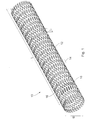
- FIG. 1 shows an endoprosthesis as an endoluminal prosthesis in the form of a stent 10 with a support structure.
- This stent 10 and its support structure have the shape of a hollow body which is open at its end faces and whose circumferential wall is formed by the support structure, which in turn is formed by partially folded webs 12.
- the webs 12 form support portions 14, which are each formed by a longitudinally closed, zig-zagged or meandering folded web 12 in the longitudinal direction.
- the stent 10 is suitable for coronary use.
- the support structure of the stent 10 is formed by a plurality of such longitudinally successive support portions 12.
- the support sections 12 or web rings 14 are connected to one another via connecting webs 16.
- two circumferentially adjacent connecting webs 16 and between these connecting webs 16 opposite portions of the web rings 14 or support portions 12 define a mesh 18 of the stent 10.
- Such a mesh 18 is shown highlighted in Figure 1.
- Each mesh 18 encloses a radial opening of the peripheral wall or support structure of the stent 10.
- Each web ring 14 has slightly three to six over the circumference of the stent 10 equally distributed connecting webs 16, each connecting a web ring 14 with the adjacent web ring 14. Accordingly, the stent 10 in the circumferential direction between two support sections 14 each have three to six stitches 18.
- the stent 10 is expandable in the circumferential direction. This happens, for example, with a balloon catheter known per se, which has a balloon which can be expanded by means of a fluid at its distal end.
- the stent 10 is crimped in the compressed state on the deflated balloon.
- both the balloon and the stent 10 expand.
- the balloon can be deflated again and the stent 10 releases from the balloon.
- the catheter can simultaneously serve to insert the stent 10 into a blood vessel, and in particular into a constricted coronary vessel, and to expand the stent 10 at that location.
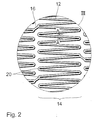
- FIG. 2 shows a section of a development of the peripheral wall of the stent 10 is shown.
- the development shows the compressed state of the stent 10.
Landscapes
- Health & Medical Sciences (AREA)
- Epidemiology (AREA)
- Animal Behavior & Ethology (AREA)
- Heart & Thoracic Surgery (AREA)
- Surgery (AREA)
- Vascular Medicine (AREA)
- Veterinary Medicine (AREA)
- Life Sciences & Earth Sciences (AREA)
- Public Health (AREA)
- General Health & Medical Sciences (AREA)
- Inorganic Chemistry (AREA)
- Chemical & Material Sciences (AREA)
- Materials For Medical Uses (AREA)
- Prostheses (AREA)
- Media Introduction/Drainage Providing Device (AREA)
Abstract
Description
- Die Erfindung betrifft eine Endoprothese, insbesondere eine intraluminale Endoprothese wie einen Stent, mit einer Tragstruktur, die ganz oder in Teilen aus einer Magnesiumlegierung besteht.
- Viele Endoprothesen haben den Zweck, im Inneren des Körpers eines Patienten eine Stützfunktion zu übernehmen. Dementsprechend sind Endoprothesen implantierbar ausgeführt und besitzen eine Tragstruktur, die die Stützfunktion gewährleistet. Bekannt sind Implantate aus metallischen Werkstoffen. Die Wahl von Metallen als Werkstoff für die Tragstruktur eines derartigen Implantats beruht vor allem auf den mechanischen Eigenschaften von Metallen.
- Metallische Stents sind in großer Zahl bekannt. Einer der Hauptanwendungsbereiche solcher Stents ist das dauerhafte Weiten und Offenhalten von Gefäßverengungen, insbesondere von Verengungen (Stenosen) der Herzkranzgefäße. Daneben sind auch Aneurysmenstents bekannt, die eine Stützfunktion für eine beschädigte Gefäßwand bieten. Derartige Stents besitzen in der Regel eine Umfangswandung von ausreichender Tragkraft, um das verengte Gefäß im gewünschten Maße offen zu halten. Um einen ungehinderten Blutfluss durch den Stent zu ermöglichen, ist diese an beiden Stirnseiten offen. Kompliziertere Ausführungen ermöglichen auch einen ungehinderten Blutfluss in Nebengefäße (Side Branch Access). Die tragende Umfangswandung wird in der Regel von einer gitterartigen Tragstruktur gebildet, die es erlaubt, den Stent in einem komprimierten Zustand mit kleinem Außendurchmesser bis zur zu behandelnden Engstelle des jeweiligen Gefäßes einzuführen und dort beispielsweise mit Hilfe eines Ballonkatheters soweit aufzuweiten, dass das Gefäß den gewünschten, vergrößerten Innendurchmesser aufweist. An den Stent wird daher grundsätzlich die Anforderung gestellt, dass seine Tragstruktur im aufgeweiteten Zustand eine ausreichende Tragkraft aufweist, um das Gefäß offen zu halten. Um unnötige Gefäßbeschädigungen zu vermeiden, ist außerdem gewünscht, dass der Stent nach dem Aufweiten und nach Entfernen des Ballons nur wenig elastisch zurückfedert (Recoil), so dass der Stent beim Aufweiten nur wenig über den gewünschten Enddurchmesser hinaus geweitet werden muss. Weitere Kriterien, die in Bezug auf einen Stent wünschenswert sind, umfassen beispielsweise eine gleichmäßige Flächenabdeckung und eine Struktur, die eine gewisse Flexibilität in Bezug auf die Längsachse des Stents erlaubt.
- In einigen Fällen, wie z. B. bei Verschraubungen von komplizierten Brüchen oder anderen Verbindungs- und Stützelementen in der Knochenchirurgie, Nahtmaterialien oder insbesondere im Falle intraluminaler Endoprothesen wie Stents, ist eine dauerhafte Halte- und Stützfunktion durch die Endoprothese nicht erforderlich. Vielmehr kann sich in einigen dieser Anwendungsfälle das Körpergewebe unter Anwesenheit der Halte- und Stützprothese derart erholen, dass eine dauerhafte Stützwirkung durch die Prothese nicht erforderlich ist. Dies hat zu dem Gedanken geführt, solche Prothesen aus bioresorbierbarem Material zu fertigen.
- In einigen Fällen, insbesondere im Falle solcher intraluminaler Endoprothesen wie Stents, ist eine dauerhafte Stützfunktion durch die Endoprothese nicht erforderlich. Vielmehr kann sich in einigen dieser Anwendungsfälle das Körpergewebe unter der Stützprothese derart erholen, dass eine dauerhafte Stützwirkung durch die Prothese nicht erforderlich ist. Dies hat zu dem Gedanken geführt, solche Prothesen aus bioresorbierbarem Material zu fertigen .
- Neben den gewünschten mechanischen Eigenschaften eines Stents soll dieser möglichst in einer Weise mit dem Körpergewebe am Implantationsort interagieren, dass es nicht zu erneuten Gefäßverengungen, insbesondere durch den Stent selbst hervorgerufenen Gefäßverengungen, kommt. Eine Restenose (Wiederverengung des Gefäßes) soll möglichst vermieden werden. Auch ist es wünschenswert, wenn von dem Stent möglichst gar keine oder nur eine sehr geringe inflammatorische Wirkung ausgeht. In Bezug auf einen biodegradierbaren Metallstent ist es darüber hinaus wünschenswert, wenn von den Abbauprodukten des Metallstents möglichst keine oder nur sehr geringe negative physiologische Wirkungen ausgehen, bzw. sogar positive physiologische Wirkungen bedingt sind.
- Aus der DE 197 31 021 ist ein bioresorbierbarer Metallstent bekannt, dessen Werkstoff als Hauptbestandteil Magnesium, Eisen oder Zink enthält. Aufgrund der mechanischen Eigenschaften, dem Degradationverhalten und der Biokompatibilität sind insbesondere Magnesiumlegierungen zu präferieren.
- In DE 102 53 634, DE 101 28 100 oder EP 1 395 297 wird auf den Einsatz von solchen biodegradierbaren Magnesiumlegierungen zu medizinischen Zwecken, wie Platten, Schrauben, Nahtmaterial oder Stents fokussiert. Die Magnesiumlegierungen weisen einen Magnesiumgehalt von über 70 Gew.% bzw. über 90 Gew.% auf. Mit steigendem Magnesiumgehalt nimmt aber die Degradationszeit und damit der Zeitraum der benötigten mechanischen Integrität schnell ab. Bei den Stentanwendungen liegen die Degradationszeiträume solche Legierungen typisch deutlich unter 30 Tagen. Dies ist für viele Anwendungen in der Medizin nicht ausreichend. So ist bei Stent-anwendungen bislang ungeklärt, wie lange die mechanische Integrität für eine ausreichende Stützfunktion erforderlich ist. Schätzungen von Experten variieren von wenigen Tagen bis hin zu einem Jahr. Bei komplizierten Brüchen kann der Heilungsprozess leicht 6 Monate betragen.
- Auch die mechanische Stabilität ist insbesondere für Endoprothese-Anwendungen äußerst wichtig. Sie ermöglicht eine kompakte Auslegung der Endoprothese bei ausreichender Stabilität. Bei Stents z. B. wird versucht immer kleinere Stegbreiten zu verwirklichen, da Studien belegt haben, dass mit der Stegbreite u. a. das Restenoserisiko deutlich reduziert wird, da der Steg das umliegende Gewebe u. a. mechanisch reizt. Um dies zu erreichen sind entsprechende Materialfestigkeiten erforderlich. Bisher verwendete Magnesiumlegierungen, wie in den Schriften DE 102 53 634, DE 101 28 100 oder EP 1 395 297 aufgeführt, sind relativ weich. Dies schränkt den Einsatzbereich als Endoprothese ein.
- Neben den mechanischen Eigenschaften ist die Biokompatibilität der verwendeten Legierung essentiell für einen Einsatz als medizinisches Implantat. Alternative biodegradierbare Materialien, wie z. B. Polymere, haben neben den schlechten mechanischen Eigenschaften insbesondere mit der Schwierigkeit einer geringen Biokompatibilität zu kämpfen. Magnesiumlegierungen haben bereits deutlich bessere Eigenschaften belegt, allerdings handelt es sich dabei vor allem um aluminiumhaltige Legierungen wie z. B. in den Schriften DE 101 28 100 oder EP 1 395 297 beschrieben. Das Aluminium wird dabei u. a. für die Ausbildung von Deckschichten benötigt, die die Diffusion des Magnesiums und damit den Degradationsprozess verlangsamen sollen. Dies ist gemäß diesen Schriften u. a. erforderlich, um eine ausreichend lange mechanische Stabilität der Endoprothese zu erreichen und Gasausscheidungen beim Degradationsprozess zu verhindern.
- Aluminium ist aber dafür bekannt, gesundheitliche Schäden zu verursachen, insbesondere wenn es in ionischer Form vorliegt. So ist Aluminium u. a. dafür bekannt Schäden am Zentralnervensystem zu verursachen und Symptome wie Demenz, Gedächtnisverlust, Antriebslosigkeit oder heftiges Zittern auszulösen. Aluminium gilt als Risikofaktor für die Alzheimer-Krankheit (Harold D. Foster Ph. D., Journal für Orthomolekulare Medizin 2/01). Negative Effekte hinsichtlich der Biokompatibilität in unmittelbarer Umgebung von Endoprothesen aus aluminiumhaltigen Magnesiumlegierungen konnten in Experimenten nachgewiesen werden. So wurden in Tierexperimenten pathologische Höfe um degradierende Stege solcher Stents sowie eine ausgeprägte Neointimahyperplasie beobachtet, die dem eigentlichen Zweck des Stents, den Gefäßverschluss zu verhindern, entgegenwirkt. Der Einsatz von Aluminium in degradierbaren medizinischen Implantaten wie insbesondere den Stents ist somit nicht zu favorisieren.
- Generell vernachlässigt wurde bislang der Ansatz bei medizinischen Implantaten, körpereigene Heilungsprozesse im Rahmen der Anwendung von Endoprothesen zu aktivieren, um so den Heilungsprozess weiter zu verbessern.
- Vor diesem Hintergrund liegt der vorliegenden Erfindung die Aufgabe zugrunde, eine biodegradierbare Endoprothese auf der Basis einer Magnesiumlegierung bereit zu stellen, die die geschilderten Nachteile des Standes der Technik vermeidet. Insbesondere sollen Legierungen mit erhöhter mechanischer Stabilität und längeren Degradationszeiträumen zur Verfügung gestellt werden.
- Erfindungsgemäß wird diese Aufgabe durch eine Endoprothese nach Anspruch 1 gelöst. Die Endoprothese weist eine Tragstruktur auf, die ganz oder in Teilen aus einer Magnesiumlegierung folgender Zusammensetzung besteht:
- ■ Magnesium 60.0 bis 88.0 Gew.%,
- ■ Seltenerdmetalle 2.0 bis 30.0 Gew.%,
- ■ Yttrium 2.0 bis 20.0 Gew.%,
- ■ Zirkonium 0.5 bis 5.0 Gew.%,
- ■ Rest 0 bis 10.0 Gew.%,
- Die Sammelbezeichnung 'Seltenerdmetall' steht für die Elemente Scandium (Ordnungszahl 21), Lanthan (57) sowie die 14 auf das Lanthan folgenden Elemente Cer (58), Praseodym (59), Neodym (60), Promethium (61), Samarium (62), Europium (63), Gadolinium (64), Terbium (65), Dysprosium (66), Holmium (67), Erbium (68), Thulium (69), Ytterbium (70) und Lutetium (71), die als Lanthanoide bezeichnet werden. Der Anteil der Seltenerdmetalle an der Magnesiumlegierung umfasst somit auch den Anteil des Neodyms. Letzterer Anteil ist ― sofern vorhanden - ebenfalls auf das Gesamtgewicht der Legierung bezogen und muss im angegebenen Bereich liegen. Liegt der Anteil an Neodym in der Legierung z. B. bei 2.0 Gew.% und der Anteil an Seltenerdmetallen bei 2.5 Gew.%, so werden zwangsläufig Seltenerdmetalle außer Neodym einen Gewichtsanteil an der Legierung von 0.5 Gew.% aufweisen.
- Besonders bevorzugt ist eine Legierung mit einem Magnesiumanteil von 60.0 bis 70.0 Gew.%. Die Legierung zeigt ein gegenüber dem Stand der Technik verzögertes Degradationsverhalten, ist aber noch hinreichend biodegradierbar. Die Legierung und die Abbauprodukte zeigten eine gute biologische Verträglichkeit, d. h. es traten in ersten Tests keine immunologischen Reaktionen oder Entzündungen auf.
- Der Rest enthält vorzugsweise nur die aus dem Herstellungsprozess der Magnesiumlegierung bedingten Verunreinigungen. Mit anderen Worten, es sind lediglich spezifische Verunreinigungen enthalten, die sich bei der Herstellung der Legierung nicht vermeiden lassen oder Restkomponenten, die bewusst der Legierung zugesetzt werden. Hierdurch werden die positiven physiologischen Effekte und die mechanischen Eigenschaften des Werkstoffs sichergestellt und teils gar erst erreicht.
- Ergänzend oder alternativ zu vorgenannter bevorzugter Variante enthält der Rest kein oder allenfalls < 0.01 Gew.% Aluminium. Gerade Aluminium hat einen ausgeprägten negativen Einfluss auf das physiologische Verhalten, wie Materialuntersuchungen sowie in vivo und in vitro Untersuchungen gezeigt haben.
- Aufgrund der negativen Eigenschaften, insbesondere auf die Biokompatibilität, werden in den Legierungen neben dem Element Aluminium (AI) vorzugsweise auch die Elemente Kupfer (Cu), Nickel (Ni), Silber (Ag), Quecksilber (Hg), Cadmium (Cd), Beryllium (Be) oder Chrom (Cr) vermieden, d. h. die Elemente sind abgesehen von herstellungsbedingten Verunreinigungen nicht in der Legierung enthalten. Der als Rest bezeichnete Anteil der Legierung beinhaltet vorrangig Massenanteile eines, mehrerer oder aller genannter Elemente unter den folgenden Grenzen:
- ■ Aluminium < 0.01 Gew.%,
- ■ Kupfer < 0.03 Gew.%,
- ■ Nickel < 0.005 Gew.%,
- ■ Silber < 0.01 Gew.%,
- ■ Quecksilber < 0.03 Gew.%,
- ■ Cadmium < 0.03 Gew.%,
- ■ Beryllium < 0.03 Gew.%,
- ■ Chrom < 0.03 Gew.%.
- Die Vermeidung dieser Elemente ist für den Zweck der Erfindung von Bedeutung, da diese gesundheitsschädliche Wirkung haben, die mechanischen Eigenschaften der Legierung unerwünscht beeinflussen sowie die auf den Heilungsprozess positiven Einflüsse der Legierung und insbesondere des Magnesiums beeinträchtigen. Bekanntlich können schon geringe Spuren von Verunreinigungen einen metallurgisch und/oder physiologisch erheblichen Effekt haben. Das Identifizieren der Störelemente und insbesondere das Festlegen von Grenzwerten für diese Störelemente liefert damit einen erheblichen technischen Beitrag zur Optimierung der Produkte.
- Bevorzugt ist hingegen, dass der Rest eines oder mehrere Elemente aus der Gruppe Lithium, Zink, Eisen, Titan, Tantal, Molybdän und Wolfram enthält. Der Anteil der Komponenten an der Legierung liegt vorzugsweise bei 0.1 bis 5.0 Gew.%, wobei sich deren kumulierter Gesamtanteil auf maximal 10.0 Gew.% addiert. Die Anwesenheit dieser Elemente hat offenbar positiven Einfluss auf das Degradationsverhalten, die mechanischen Eigenschaften und die Biokompatibilität des Implantats.
- Tantal, Molybdän und Wolfram werden u. a. für eine verbesserte mechanische Stabilität verantwortlich gemacht. Des Weiteren wird die Röntgensichtbarkeit der Legierung verbessert. Auch Titan, das als äußerst biokompatibel bekannt ist, hat deutlichen Einfluss auf die mechanische Stabilität.
- Zink und Eisen können, wie das Magnesium, durch ihr Korrosionsverhalten und grundsätzliche Bedeutung bei den Stoffwechselprozessen im Körper als biodegradierbar bezeichnet werden. Über diese Elemente lässt sich u. a. das Korrosionsverhalten und die Korrosionsgeschwindigkeit beeinflussen.
- Ferner ist bevorzugt, dass der Anteil an Neodym 0.5 bis 10.0 Gew.%, insbesondere 2.0 bis 2.5 Gew.% an der Legierung beträgt. Hierdurch lässt sich die physiologische Verträglichkeit der Legierung und seiner Abbauprodukte noch steigern sowie das Degradationsverhalten für die geplanten Zwecke optimieren.
- Mit der hier beschriebenen Magnesiumlegierung konnte ein signifikant verbesserter Degradationsablauf mit deutlich besserer Reproduzierbarkeit erzielt werden, als bisher z. B. für aluminiumhaltige Magnesiumlegierungen bekannt ist (Heart (2003) 89, 651-656). Insbesondere die Reproduzierbarkeit des Degradationsverlaufes ist für eine medizinische Anwendung unabdingbar. Dank des verwirklichten kontrollierten und langsamen Degradationsprozesses entstehen keine oder allenfalls geringe Gasausscheidungen.
- Es wurde in vivo und in vitro nachgewiesen, dass die Legierung und Ihre Abbauprodukte äußerst biokompatibel sind. Unter Verwendung der Magnesiumlegierung konnte starken immunologischen Reaktionen des Körpers entgegengewirkt werden. Auch eine kontrolliertes Zellwachstum, insbesondere humaner glatter Muskelzellen und Endothelzellen, konnte anhand von in vitro Versuchen belegt werden. Unkontrollierte Zellwucherungen, die zur Restenose führen können, scheinen verhindert bzw. stark eingedämmt zu sein. Dies ist insbesondere bei der Verwendung von aluminiumhaltigen Legierungen, bei denen starke Neointimahyperplasie beobachtet wurde, derart nicht der Fall. Der den positiven Effekten zugrunde liegende Wirkungsmechanismus ist bisher in Detail nicht ergründet.
- Einen Beitrag zur besonderen Verträglichkeit des Implantats könnte Magnesium liefern. Allgemein bekannte Wirkungen und Einflüsse des üblicherweise über die Ernährung aufgenommenen Magnesiums auf die Körperfunktionen lassen vermuten, dass solche Prozesse auch beim Einsatz von Magnesium als Implantat in geeigneter Legierungszusammensetzung zumindest lokal aktiviert werden.
- Es ist z. B. bekannt, dass Magnesium im Organismus einen positiven Einfluss auf die Wundheilung hat, da dieses für den anaeroben Stoffwechsel notwendig ist und die normale Granulation des Bindegewebes fördert und unkontrolliertes Zellwachstum eher verhindert (Dr. med. Dr. sc. Nat PG Seeger, SANUM-Post Nr. 13/1990, 14-16).
- Ein weiterer positiver Aspekt bei der Verwendung von Magnesium ist, dass die unspezifische Abwehr über das Properdinsystem nur bei Anwesenheit von Magnesium wirksam ist und die Phagozytose von Bakterien durch Leukozyten eine Anregung durch das Magnesium erfährt. Somit sorgt Magnesium u. a. für die Bekämpfung von Infektionen durch Unterstützung bzw. Aktivierung des körpereigenen Immunsystems und mindert die Anfälligkeit für Infektionen. Unerwünschten infektionsbedingten Entzündungserscheinungen aufgrund von Kontaminationen, die im Rahmen der Anwendung einer Endoprothese auftreten können, und die wiederum Auslöser für eine Restenose sein können, wird somit entgegengewirkt.
- Die hier verwendete Legierung wirkt auch positiv gegen mechanisch induzierte Restenose. Erreicht wird dies zum einen durch die mechanischen Eigenschaften der verwendeten Legierung, die sich durch ein günstiges Elastizitätsmodul auszeichnen. Des Weiteren wird die allgemein bekannte muskelrelaxierende Wirkung des Magnesium (Ca-Antagonist) genutzt, um mechanische Reizungen zu vermindern. Es ist zu erwarten, dass das Magnesium in der Legierung bzw. die magnesiumhaltigen Zerfallsprodukte bei der Degradation eine Relaxierung der in der näheren Umgebung vorhandenen Muskelzellen fördern. Dies ist insbesondere bei Stent-Anwendungen vorteilhaft, da nicht nur die mechanische Reizung reduziert wird, sondern auch das Gefäß durch das lokal relaxierte Muskelgewebe zusätzlich offen gehalten werden kann.
- Die Magnesiumlegierung wird vorzugsweise stranggepresst. Es hat sich herausgestellt, dass die Verarbeitung der Legierung dessen physiologische Wirkung beeinflusst. Diese physiologischen Eigenschaften sind somit zumindest zum Teil durch den Herstellungsprozess bedingt.
- Die Endoprothese ist vorzugsweise als intraluminale Endoprothese ausgebildet. Besonders bevorzugt ist eine Endoprothese, die als Stent, insbesondere als Koronarstent oder als peripherer Stent, ausgebildet ist. Aufgrund der positiven Eigenschaften der genannten Magnesiumlegierung besteht die Tragstruktur der Endoprothese vorzugsweise zur Gänze aus der Magnesiumlegierung.
- Nach einer bevorzugten Variante für die Anwendung der Legierung als Stent, insbesondere als Koronarstent oder als peripherer Stent, wird die spezifische Zusammensetzung der Magnesiumlegierung sowie deren Modifikation durch die Herstellungsweise und das Stent-Design dahingehend vorgegeben, dass die Zersetzung unmittelbar nach der Implantation einsetzt und die mechanische Integrität für mindestens 5 Tage bis höchstens 1 Jahr aufrecht erhalten wird. Unter "mechanischer Integrität" wird dabei die trotz fortschreitendem Abbau noch ausreichende Stabilität der Strukturelemente des Implantates verstanden, die zur Erfüllung des medizinischen Zwecks des Implantats, d. h. die Aufrechterhaltung der erforderlichen Stützfunktion dienen. Besonders bevorzugt beträgt der Zeitraum 10 bis 90 Tage.
- Nachfolgend wird die Erfindung anhand eines Ausführungsbeispiels und dazu gehöriger Zeichnungen näher erläutert. Es zeigen:
- Figur 1
- eine schematische Darstellung einer Endoprothese in Form eines Stents und
- Figur 2
- eine Abwicklung der Tragstruktur des Stents aus Figur 1.
- Figur 1 zeigt eine Endoprothese als endoluminale Prothese in Form eines Stents 10 mit einer Tragstruktur. Dieser Stent 10 und seine Tragstruktur haben die Form eines an seinen Stirnseiten offenen Hohlköpers, dessen Umfangswandung von der Tragstruktur gebildet ist, die wiederum von teilweise gefalteten Stegen 12 gebildet ist. Die Stege 12 bilden Stützabschnitte 14, welche von jeweils einem in Längsrichtung ringförmig geschlossenen, zick-zack- oder mäanderförmig gefalteten Steg 12 gebildet sind. Der Stent 10 eignet sich für den koronaren Einsatz.
- Die Tragstruktur des Stents 10 wird von mehreren solcher in Längsrichtung aufeinanderfolgender Stützabschnitte 12 gebildet. Die Stützabschnitte 12 bzw. Stegringe 14 sind über Verbindungsstege 16 miteinander verbunden. Jeweils zwei in Umfangsrichtung aneinander benachbarte Verbindungsstege 16 sowie die zwischen diesen Verbindungsstegen 16 einander gegenüberliegenden Teilabschnitte der Stegringe 14 oder Stützabschnitte 12 definieren eine Masche 18 des Stents 10. Eine solche Masche 18 ist in Figur 1 hervorgehoben dargestellt. Jede Masche 18 umschließt eine radiale Öffnung der Umfangswandung bzw. der Tragstruktur des Stents 10.
- Jeder Stegring 14 weist etwas drei bis sechs über den Umfang des Stents 10 gleich verteilte Verbindungsstege 16 auf, die jeweils einen Stegring 14 mit dem benachbarten Stegring 14 verbinden. Dementsprechend weist der Stent 10 in Umfangsrichtung zwischen zwei Stützabschnitten 14 jeweils drei bis sechs Maschen 18 auf.
- Aufgrund der Faltung der Stege 12 ist der Stent 10 in Umfangsrichtung expandierbar. Dies geschieht beispielsweise mit einem an sich bekannten Ballonkatheter, der an seinem distalen Ende einen mittels eines Fluids expandierbaren Ballon aufweist. Der Stent 10 ist im komprimierten Zustand auf den deflatierten Ballon aufgecrimpt. Mit Expansion des Ballons werden sowohl der Ballon als auch der Stent 10 aufgeweitet. Anschließend kann der Ballon wieder deflatiert werden und der Stent 10 löst sich von dem Ballon. Auf diese Weise kann der Katheter gleichzeitig dem Einführen des Stents 10 in ein Blutgefäß und insbesondere in ein verengtes Herzkranzgefäß sowie zum Expandieren des Stents 10 an diesem Ort dienen.
- In Figur 2 ist ein Ausschnitt aus einer Abwicklung der Umfangswandung des Stents 10 dargestellt. Die Abwicklung zeigt den komprimierten Zustand des Stents 10.
- Die Tragstruktur des in den Figuren dargestellten Stents 10 besteht vollständig aus einer biodegradierbaren Magnesiumlegierung folgender Zusammensetzung:
- Magnesium 65 Gew.%,
- Seltenerdmetalle 15.0 Gew.%, dabei Neodym 2.3 Gew.%,
- Yttrium 10.0 Gew.%,
- Zirkonium 3.0 Gew.%,
- Lithium 3.0 Gew.%,
- Eisen 2.0 Gew.%,
- Zink 2.0 Gew.%,
- Aluminium, Silber, Kupfer, Quecksilber, Cadmium, Beryllium, Chrom und Nickel < 0.005 Gew.%*, (*Nachweisgrenze bei der Bestimmung)
wobei sich die Legierungskomponenten auf 100 Gew.% addieren. Die Legierung zeigt sehr günstige mechanische, aber auch physiologische Eigenschaften und ein gegenüber den bekannten Legierungen verzögertes Degradationsverhalten in vivo. Sie kann einfach verarbeitet werden und zeigt in ersten Studien einen positiven physiologischen Effekt auf das umgebene Gewebe in Mensch und Tier, wenn die Legierung in Endoprothesen, insbesondere Stents, verwendet wird.
wobei sich die Legierungskomponenten auf 100 Gew.% addieren.
Claims (16)
- Endoprothese mit einer Tragstruktur, die ganz oder in Teilen aus einer Magnesiumlegierung folgender Zusammensetzung besteht:■ Magnesium 60.0 bis 88.0 Gew.%,■ Seltenerdmetalle 2.0 bis 30.0 Gew.%,■ Yttrium 2.0 bis 20.0 Gew.%,■ Zirkonium 0.5 bis 5.0 Gew.%,■ Rest 0 bis 10.0 Gew.%,wobei sich die Legierungskomponenten auf 100 Gew.% addieren.
- Endoprothese nach Anspruch 1, dadurch gekennzeichnet, dass der Anteil von Magnesium an der Legierung 60.0 bis 70.0 Gew.% beträgt.
- Endoprothese nach Anspruch 1, dadurch gekennzeichnet, dass der Anteil an Neodym 0.5 Gew.% bis 10.0 Gew.% beträgt.
- Endoprothese nach Anspruch 3, dadurch gekennzeichnet, dass der Anteil an Neodym 2.0 Gew.% bis 2.5 Gew.% beträgt.
- Endoprothese nach Anspruch 1, dadurch gekennzeichnet, dass der Rest eines oder mehrere Elemente aus der Gruppe Lithium, Zink, Eisen, Titan, Tantal, Molybdän und Wolfram enthält.
- Endoprothese nach Anspruch 1, dadurch gekennzeichnet, dass der Rest kein oder allenfalls < 0.01 Gew.% Aluminium enthält.
- Endoprothese nach Anspruch 1, dadurch gekennzeichnet, dass der Rest kein oder allenfalls < 0.03 Gew.% Kupfer enthält.
- Endoprothese nach Anspruch 1, dadurch gekennzeichnet, dass der Rest kein oder allenfalls < 0.005 Gew.% Nickel enthält.
- Endoprothese nach Anspruch 1, dadurch gekennzeichnet, dass der Rest kein oder allenfalls < 0.01 Gew.% Silber enthält.
- Endoprothese nach Anspruch 1, dadurch gekennzeichnet, dass der Rest kein oder allenfalls < 0.03 Gew.% Quecksilber enthält.
- Endoprothese nach Anspruch 1, dadurch gekennzeichnet, dass der Rest kein oder allenfalls < 0.03 Gew.% Cadmium enthält.
- Endoprothese nach Anspruch 1, dadurch gekennzeichnet, dass der Rest kein oder allenfalls < 0.03 Gew.% Chrom enthält.
- Endoprothese nach Anspruch 1, dadurch gekennzeichnet, dass der Rest kein oder allenfalls < 0.03 Gew.% Beryllium enthält.
- Endoprothese nach einem der vorhergehenden Ansprüche, dadurch gekennzeichnet, dass die Endoprothese als intraluminale Endoprothese ausgebildet ist.
- Endoprothese nach Anspruch 14, dadurch gekennzeichnet, dass die Endoprothese als Stent ausgebildet ist.
- Endoprothese nach Anspruch 15, dadurch gekennzeichnet, dass die Endoprothese als Koronarstent oder als peripherer Stent ausgebildet ist.
Applications Claiming Priority (1)
| Application Number | Priority Date | Filing Date | Title |
|---|---|---|---|
| DE102004432317 | 2004-09-07 |
Publications (3)
| Publication Number | Publication Date |
|---|---|
| EP1632256A2 true EP1632256A2 (de) | 2006-03-08 |
| EP1632256A3 EP1632256A3 (de) | 2008-06-18 |
| EP1632256B1 EP1632256B1 (de) | 2009-09-30 |
Family
ID=35500879
Family Applications (1)
| Application Number | Title | Priority Date | Filing Date |
|---|---|---|---|
| EP20050107617 Ceased EP1632256B1 (de) | 2004-09-07 | 2005-08-19 | Endoprothese aus einer Magnesiumlegierung |
Country Status (2)
| Country | Link |
|---|---|
| EP (1) | EP1632256B1 (de) |
| DE (1) | DE502005008226D1 (de) |
Cited By (5)
| Publication number | Priority date | Publication date | Assignee | Title |
|---|---|---|---|---|
| EP1891985A3 (de) * | 2006-08-07 | 2008-04-02 | BIOTRONIK VI Patent AG | Markerlegierung |
| EP2213314A1 (de) * | 2009-01-30 | 2010-08-04 | Biotronik VI Patent AG | Implantat mit einem Grundkörper aus einer biokorrodierbaren Magnesiumlegierung |
| WO2012007169A1 (de) * | 2010-07-14 | 2012-01-19 | Acandis Gmbh & Co. Kg | Medizinisches implantat und verfahren zur herstellung eines solchen implantats |
| EP2465551A2 (de) | 2010-12-15 | 2012-06-20 | Biotronik AG | Polymerische Stent |
| US9345819B2 (en) | 2006-08-07 | 2016-05-24 | Biotronik Vi Patent Ag | Marker alloy |
Families Citing this family (18)
| Publication number | Priority date | Publication date | Assignee | Title |
|---|---|---|---|---|
| US7727221B2 (en) | 2001-06-27 | 2010-06-01 | Cardiac Pacemakers Inc. | Method and device for electrochemical formation of therapeutic species in vivo |
| US8840660B2 (en) | 2006-01-05 | 2014-09-23 | Boston Scientific Scimed, Inc. | Bioerodible endoprostheses and methods of making the same |
| US8089029B2 (en) | 2006-02-01 | 2012-01-03 | Boston Scientific Scimed, Inc. | Bioabsorbable metal medical device and method of manufacture |
| US8048150B2 (en) | 2006-04-12 | 2011-11-01 | Boston Scientific Scimed, Inc. | Endoprosthesis having a fiber meshwork disposed thereon |
| JP2009545407A (ja) | 2006-08-02 | 2009-12-24 | ボストン サイエンティフィック サイムド,インコーポレイテッド | 三次元分解制御を備えたエンドプロテーゼ |
| WO2008034031A2 (en) | 2006-09-15 | 2008-03-20 | Boston Scientific Limited | Bioerodible endoprostheses and methods of making the same |
| EP2068782B1 (de) | 2006-09-15 | 2011-07-27 | Boston Scientific Limited | Biologisch erodierbare endoprothesen |
| CA2663304A1 (en) | 2006-09-15 | 2008-03-20 | Boston Scientific Limited | Bioerodible endoprosthesis with biostable inorganic layers |
| JP2010503485A (ja) | 2006-09-15 | 2010-02-04 | ボストン サイエンティフィック リミテッド | 医療用デバイスおよび同デバイスの製造方法 |
| EP2068962B1 (de) | 2006-09-18 | 2013-01-30 | Boston Scientific Limited | Endoprothesen |
| EP2125065B1 (de) | 2006-12-28 | 2010-11-17 | Boston Scientific Limited | Bioerodierbare endoprothesen und herstellungsverfahren dafür |
| US8052745B2 (en) | 2007-09-13 | 2011-11-08 | Boston Scientific Scimed, Inc. | Endoprosthesis |
| US8118857B2 (en) | 2007-11-29 | 2012-02-21 | Boston Scientific Corporation | Medical articles that stimulate endothelial cell migration |
| US8236046B2 (en) | 2008-06-10 | 2012-08-07 | Boston Scientific Scimed, Inc. | Bioerodible endoprosthesis |
| US7985252B2 (en) | 2008-07-30 | 2011-07-26 | Boston Scientific Scimed, Inc. | Bioerodible endoprosthesis |
| US8382824B2 (en) | 2008-10-03 | 2013-02-26 | Boston Scientific Scimed, Inc. | Medical implant having NANO-crystal grains with barrier layers of metal nitrides or fluorides |
| EP2403546A2 (de) | 2009-03-02 | 2012-01-11 | Boston Scientific Scimed, Inc. | Selbstpufferende medizinische implantate |
| US8668732B2 (en) | 2010-03-23 | 2014-03-11 | Boston Scientific Scimed, Inc. | Surface treated bioerodible metal endoprostheses |
Citations (3)
| Publication number | Priority date | Publication date | Assignee | Title |
|---|---|---|---|---|
| DE19731021A1 (de) | 1997-07-18 | 1999-01-21 | Meyer Joerg | In vivo abbaubares metallisches Implantat |
| DE10128100A1 (de) | 2001-06-11 | 2002-12-19 | Hannover Med Hochschule | Medizinisches Implantat für den menschlichen und tierischen Körper |
| DE10253634A1 (de) | 2002-11-13 | 2004-05-27 | Biotronik Meß- und Therapiegeräte GmbH & Co. Ingenieurbüro Berlin | Endoprothese |
-
2005
- 2005-06-24 DE DE200550008226 patent/DE502005008226D1/de not_active Expired - Lifetime
- 2005-08-19 EP EP20050107617 patent/EP1632256B1/de not_active Ceased
Patent Citations (4)
| Publication number | Priority date | Publication date | Assignee | Title |
|---|---|---|---|---|
| DE19731021A1 (de) | 1997-07-18 | 1999-01-21 | Meyer Joerg | In vivo abbaubares metallisches Implantat |
| DE10128100A1 (de) | 2001-06-11 | 2002-12-19 | Hannover Med Hochschule | Medizinisches Implantat für den menschlichen und tierischen Körper |
| EP1395297A1 (de) | 2001-06-11 | 2004-03-10 | Medizinische Hochschule Hannover | Medizinisches implantat für den menschlichen oder tierischen körper |
| DE10253634A1 (de) | 2002-11-13 | 2004-05-27 | Biotronik Meß- und Therapiegeräte GmbH & Co. Ingenieurbüro Berlin | Endoprothese |
Non-Patent Citations (2)
| Title |
|---|
| DR. MED. DR. SC. NAT PG SEEGER, SANUM-POST NR. 13, 1990, pages 14 - 16 |
| HEART, vol. 89, 2003, pages 651 - 656 |
Cited By (6)
| Publication number | Priority date | Publication date | Assignee | Title |
|---|---|---|---|---|
| EP1891985A3 (de) * | 2006-08-07 | 2008-04-02 | BIOTRONIK VI Patent AG | Markerlegierung |
| US9345819B2 (en) | 2006-08-07 | 2016-05-24 | Biotronik Vi Patent Ag | Marker alloy |
| EP2213314A1 (de) * | 2009-01-30 | 2010-08-04 | Biotronik VI Patent AG | Implantat mit einem Grundkörper aus einer biokorrodierbaren Magnesiumlegierung |
| US8268235B2 (en) | 2009-01-30 | 2012-09-18 | Biotronik Vi Patent Ag | Implant with a base body of a biocorrodible magnesium alloy |
| WO2012007169A1 (de) * | 2010-07-14 | 2012-01-19 | Acandis Gmbh & Co. Kg | Medizinisches implantat und verfahren zur herstellung eines solchen implantats |
| EP2465551A2 (de) | 2010-12-15 | 2012-06-20 | Biotronik AG | Polymerische Stent |
Also Published As
| Publication number | Publication date |
|---|---|
| DE502005008226D1 (de) | 2009-11-12 |
| EP1632256A3 (de) | 2008-06-18 |
| EP1632256B1 (de) | 2009-09-30 |
Similar Documents
| Publication | Publication Date | Title |
|---|---|---|
| EP1632255B1 (de) | Endoprothese aus einer Magnesiumlegierung | |
| EP1632256B1 (de) | Endoprothese aus einer Magnesiumlegierung | |
| DE102004043231A1 (de) | Endoprothese aus einer Magnesiumlegierung | |
| EP1419793B1 (de) | Endoprothese mit einer Trägerstruktur aus einer Magnesiumlegierung | |
| EP1270023B2 (de) | In vivo abbaubare metallische Gefäßstütze | |
| EP2266507B1 (de) | Stent mit verbessertem Stentdesign | |
| EP1642551B1 (de) | Implantat mit geringer Radialfestigkeit | |
| DE60220649T2 (de) | Stent aus einer Röntgenopakeslegierung | |
| DE10145714B4 (de) | Stent | |
| DE69908736T2 (de) | Ballonexpandierbarer überzogener Stent | |
| EP2967934B1 (de) | Bioresorbierbarer stent | |
| EP2676684B1 (de) | Kobaltlegierung für medizinische Implantate und Stent aus der Legierung | |
| EP3463206B1 (de) | Vasospasmusbehandlung | |
| WO2013024124A1 (de) | Magnesiumlegierung sowie resorbierbare stents, welche diese enthalten | |
| EP2676686B1 (de) | Stent aus einer Kobaltlegierung | |
| EP2399620B1 (de) | Implantat und Verfahren zur Herstellung desselben | |
| DE10317241A1 (de) | Stent | |
| EP2266508A1 (de) | Stent mit verbessertem Stentdesign | |
| EP2327380B1 (de) | Stent mit Funktionselementen | |
| EP1711213B1 (de) | Implantat zur freisetzung eines wirkstoffs in ein von einem körpermedium durchströmtes gefäss | |
| EP4169489A1 (de) | Stent | |
| EP4169488A1 (de) | Stent | |
| EP3708129A1 (de) | Implantat | |
| EP2446863A1 (de) | Stent mit radial asymmetrischer Kraftverteilung |
Legal Events
| Date | Code | Title | Description |
|---|---|---|---|
| PUAI | Public reference made under article 153(3) epc to a published international application that has entered the european phase |
Free format text: ORIGINAL CODE: 0009012 |
|
| AK | Designated contracting states |
Kind code of ref document: A2 Designated state(s): AT BE BG CH CY CZ DE DK EE ES FI FR GB GR HU IE IS IT LI LT LU LV MC NL PL PT RO SE SI SK TR |
|
| AX | Request for extension of the european patent |
Extension state: AL BA HR MK YU |
|
| PUAL | Search report despatched |
Free format text: ORIGINAL CODE: 0009013 |
|
| RIC1 | Information provided on ipc code assigned before grant |
Ipc: A61L 31/02 20060101AFI20060113BHEP Ipc: A61L 31/14 20060101ALI20080506BHEP |
|
| AK | Designated contracting states |
Kind code of ref document: A3 Designated state(s): AT BE BG CH CY CZ DE DK EE ES FI FR GB GR HU IE IS IT LI LT LU LV MC NL PL PT RO SE SI SK TR |
|
| AX | Request for extension of the european patent |
Extension state: AL BA HR MK YU |
|
| 17P | Request for examination filed |
Effective date: 20080911 |
|
| AKX | Designation fees paid |
Designated state(s): CH DE FR GB IE LI |
|
| GRAP | Despatch of communication of intention to grant a patent |
Free format text: ORIGINAL CODE: EPIDOSNIGR1 |
|
| GRAS | Grant fee paid |
Free format text: ORIGINAL CODE: EPIDOSNIGR3 |
|
| GRAA | (expected) grant |
Free format text: ORIGINAL CODE: 0009210 |
|
| AK | Designated contracting states |
Kind code of ref document: B1 Designated state(s): CH DE FR GB IE LI |
|
| REG | Reference to a national code |
Ref country code: GB Ref legal event code: FG4D Free format text: NOT ENGLISH Ref country code: CH Ref legal event code: EP |
|
| REG | Reference to a national code |
Ref country code: IE Ref legal event code: FG4D |
|
| REF | Corresponds to: |
Ref document number: 502005008226 Country of ref document: DE Date of ref document: 20091112 Kind code of ref document: P |
|
| PLBE | No opposition filed within time limit |
Free format text: ORIGINAL CODE: 0009261 |
|
| STAA | Information on the status of an ep patent application or granted ep patent |
Free format text: STATUS: NO OPPOSITION FILED WITHIN TIME LIMIT |
|
| 26N | No opposition filed |
Effective date: 20100701 |
|
| REG | Reference to a national code |
Ref country code: DE Ref legal event code: R082 Ref country code: DE Ref legal event code: R082 Ref document number: 502005008226 Country of ref document: DE Representative=s name: RANDOLL, SOEREN, DIPL.-CHEM. UNIV. DR. RER. NA, DE |
|
| REG | Reference to a national code |
Ref country code: FR Ref legal event code: PLFP Year of fee payment: 12 |
|
| REG | Reference to a national code |
Ref country code: FR Ref legal event code: PLFP Year of fee payment: 13 |
|
| REG | Reference to a national code |
Ref country code: DE Ref legal event code: R082 Ref document number: 502005008226 Country of ref document: DE Ref country code: DE Ref legal event code: R081 Ref document number: 502005008226 Country of ref document: DE Owner name: BIOTRONIK AG, CH Free format text: FORMER OWNER: BIOTRONIK VI PATENT AG, BAAR, CH |
|
| REG | Reference to a national code |
Ref country code: GB Ref legal event code: 732E Free format text: REGISTERED BETWEEN 20180719 AND 20180725 |
|
| REG | Reference to a national code |
Ref country code: FR Ref legal event code: PLFP Year of fee payment: 14 |
|
| REG | Reference to a national code |
Ref country code: FR Ref legal event code: TP Owner name: BIOTRONIK AG, CH Effective date: 20180907 |
|
| PGFP | Annual fee paid to national office [announced via postgrant information from national office to epo] |
Ref country code: FR Payment date: 20210823 Year of fee payment: 17 Ref country code: IE Payment date: 20210827 Year of fee payment: 17 |
|
| PGFP | Annual fee paid to national office [announced via postgrant information from national office to epo] |
Ref country code: GB Payment date: 20210824 Year of fee payment: 17 Ref country code: CH Payment date: 20210824 Year of fee payment: 17 Ref country code: DE Payment date: 20210825 Year of fee payment: 17 |
|
| REG | Reference to a national code |
Ref country code: DE Ref legal event code: R119 Ref document number: 502005008226 Country of ref document: DE |
|
| REG | Reference to a national code |
Ref country code: CH Ref legal event code: PL |
|
| GBPC | Gb: european patent ceased through non-payment of renewal fee |
Effective date: 20220819 |
|
| PG25 | Lapsed in a contracting state [announced via postgrant information from national office to epo] |
Ref country code: LI Free format text: LAPSE BECAUSE OF NON-PAYMENT OF DUE FEES Effective date: 20220831 Ref country code: CH Free format text: LAPSE BECAUSE OF NON-PAYMENT OF DUE FEES Effective date: 20220831 |
|
| PG25 | Lapsed in a contracting state [announced via postgrant information from national office to epo] |
Ref country code: IE Free format text: LAPSE BECAUSE OF NON-PAYMENT OF DUE FEES Effective date: 20220819 Ref country code: FR Free format text: LAPSE BECAUSE OF NON-PAYMENT OF DUE FEES Effective date: 20220831 Ref country code: DE Free format text: LAPSE BECAUSE OF NON-PAYMENT OF DUE FEES Effective date: 20230301 |
|
| PG25 | Lapsed in a contracting state [announced via postgrant information from national office to epo] |
Ref country code: GB Free format text: LAPSE BECAUSE OF NON-PAYMENT OF DUE FEES Effective date: 20220819 |