EP1632870A2 - Système et procédé d'identification d'une touche de saisie pour un caractère d'une langue extrême-orientale - Google Patents
Système et procédé d'identification d'une touche de saisie pour un caractère d'une langue extrême-orientale Download PDFInfo
- Publication number
- EP1632870A2 EP1632870A2 EP05026896A EP05026896A EP1632870A2 EP 1632870 A2 EP1632870 A2 EP 1632870A2 EP 05026896 A EP05026896 A EP 05026896A EP 05026896 A EP05026896 A EP 05026896A EP 1632870 A2 EP1632870 A2 EP 1632870A2
- Authority
- EP
- European Patent Office
- Prior art keywords
- keystroke
- entry
- index
- language character
- far east
- Prior art date
- Legal status (The legal status is an assumption and is not a legal conclusion. Google has not performed a legal analysis and makes no representation as to the accuracy of the status listed.)
- Withdrawn
Links
Images


Classifications
-
- G—PHYSICS
- G06—COMPUTING OR CALCULATING; COUNTING
- G06F—ELECTRIC DIGITAL DATA PROCESSING
- G06F3/00—Input arrangements for transferring data to be processed into a form capable of being handled by the computer; Output arrangements for transferring data from processing unit to output unit, e.g. interface arrangements
- G06F3/01—Input arrangements or combined input and output arrangements for interaction between user and computer
- G06F3/018—Input/output arrangements for oriental characters
-
- G—PHYSICS
- G06—COMPUTING OR CALCULATING; COUNTING
- G06F—ELECTRIC DIGITAL DATA PROCESSING
- G06F40/00—Handling natural language data
- G06F40/10—Text processing
- G06F40/12—Use of codes for handling textual entities
- G06F40/126—Character encoding
- G06F40/129—Handling non-Latin characters, e.g. kana-to-kanji conversion
Definitions
- the present invention relates to text filtering, and more particularly to filtering an entry that includes a Far East language character.
- IME input method editor
- An IME also known as a front-end processor, typically includes an applet that allows a user to enter the different characters used in Far East languages, and the like, with a standard 101-key keyboard.
- An IME may convert keystrokes into phonetic and ideographic characters. As the user enters a keystroke, the IME attempts to guess into which ideographic character or characters the keystrokes should be converted.
- the present invention provides a system, apparatus, and methods for filtering an entry associated with a Far East (FE) language character.
- An entry may correspond to information associated with an individual's contact information.
- the entry may include a name that includes a FE language character.
- a potential keystroke is determined for each entry in the database, contact list, text file, and the like. As the user enters a keystroke, the invention compares the potential keystroke for each entry to determine if a match exists with the entered keystroke. If a match exists, the entry is displayed to the user. As additional keystrokes are entered, the displayed entries may be reduced. By determining potential keystrokes from the entries, the number of keystrokes that the user needs to enter to obtain a desired entry may be reduced.
- the system is directed to a computer-readable medium having computer executable instructions for filtering an entry associated with a FE language character.
- the instructions include receiving a keystroke and the entry associated with the FE language character.
- the instructions further include determining a potential keystroke based on the entry. If the potential keystroke approximately matches the received keystroke, the entry associated with the FE language character is selected.
- an apparatus is directed to filtering an entry associated with a FE language character.
- the apparatus includes a database, an input module, and a smart filter.
- the database is configured to store an entry.
- the entry is associated with the FE language character.
- the input module is configured to provide an input keystroke.
- the smart filter is coupled to the database and input module, and is configured to perform actions.
- the smart filter is configured to receive the input keystroke and the entry.
- the smart filter is further configured to determine a potential keystroke based on the entry, and if the potential keystroke approximately matches the input keystroke, select the entry.
- a method in a computer device having a graphical user interface and a user input mechanism, a method is directed to filtering an entry in a contact database.
- the method includes receiving an input from the user input mechanism, and determining an input keystroke based on the input.
- the method further includes receiving the entry in the contact database, where the entry is associated with a FE language character.
- the method also includes determining a potential keystroke based on the entry, and if the potential keystroke approximately matches the input keystroke, displaying on the graphical user interface the FE language character associated with the entry.
- a method is directed to identifying a keystroke for a FE language character.
- the method includes receiving a code associated with a FE language character, determining an index based at least in part on the code associated with the FE language character, and employing the index to identify the keystroke, the selected keystroke being associated with the FE language character.
- connection means a direct connection between the things that are connected, without any intermediary devices or components.
- the present invention is directed to a system and method for filtering an entry associated with a FE language character.
- a potential keystroke is determined for an entry in a database, contact list, text file, and the like.
- the entry employs a Unicode Standard code associated with a FE language character.
- An index is determined from the Unicode Standard code based in part on a leading consonant, vowel, and a trailing consonant associated with the FE language character. The index is employed to determine the potential keystroke associated with the FE language character. If the potential keystroke approximately matches a received keystroke, the entry is selected.
- the FE language character associated with the selected entry is provided to a display device.
- the FE language character associated with the entry may include a Japanese, traditional Chinese, and modem Chinese language character.
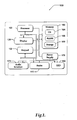
- FIGURE 1 is a functional block diagram illustrating an embodiment of an exemplary communications device 100 for practicing the present invention.
- communications device 100 is implemented as a mobile communications device, such as a personal digital assistant (PDA), smart phone, and the like.
- PDA personal digital assistant
- Communications device 100 may also include handheld computers, tablet computers, personal computers, multiprocessor systems, microprocessor-based or programmable consumer electronics, network PCs, wearable computers, and the like.
- Communications device 100 may include many more components than those shown in FIGURE 1. The components shown, however, are sufficient to disclose an illustrative embodiment for practicing the invention.
- communications device 100 includes processor 160, memory 162, display 128, and keypad 132.
- Memory 162 generally includes both volatile memory (e.g., RAM) and non-volatile memory (e.g., ROM, Flash Memory, or the like).
- Communications device 100 includes an operating system 164, such as the Windows CE operating system from Microsoft Corporation or other such operating system, which is resident in memory 162 and executes on processor 160.
- Keypad 132 may be a push button numeric dialing pad (such as on a typical telephone), a multi-key keyboard (such as a conventional keyboard).
- Display 128 may be a liquid crystal display, or any other type of display commonly used in mobile communications devices. For example, display 128 may be touch-sensitive, and would then also act as an input device enabling entry of FE language strokes.
- One or more application programs 166 are loaded into memory 162 and run on the operating system 164. Examples of application programs include phone dialer programs, content manager, email programs, scheduling programs, word processing programs, spreadsheet programs, smart filter, and so forth.
- Communications device 100 also includes non-volatile storage 168 within memory 162. Non-volatile storage 168 may be used to store persistent information which should not be lost if the communications device 100 is powered down.
- the application programs 166 may use and store information in storage 168, such as e-mail or other messages used by an e-mail application, contact information, databases, and the like, used by the content manager, appointment information used by a scheduling program, documents used by a word processing application, and the like.
- a synchronization application may also reside on communications device 100 and is programmed to interact with a corresponding synchronization application resident on a host computer to keep the information stored in storage 168 synchronized with corresponding information stored at the host computer.
- Communications device 100 also includes power supply 170, which may be implemented as one or more batteries.
- Power supply 170 might further include an external power source, such as an AC adapter or a powered docking cradle that supplements or recharges the batteries.
- Communications device 100 is also shown with two types of external notification mechanisms: LED 140 and audio interface 174. These devices may be directly coupled to power supply 170 so that when activated, they remain on for a duration dictated by the notification mechanism even though processor 160 and other components might shut down to conserve battery power. LED 140 may be programmed to remain on indefinitely until the user takes action to indicate the powered-on status of the device. Audio interface 174 is used to provide audible signals to and receive audible signals from the user. For example, audio interface 174 may be coupled to a speaker for providing audible output and to a microphone for receiving audible input, such as to facilitate a telephone conversation.
- Communications device 100 also includes radio 172 that performs the function of transmitting and receiving radio frequency communications.
- Radio 172 facilitates wireless connectivity between communications device 100 and the outside world, via a communications carrier or service provider. Transmissions to and from radio 172 are conducted under control of operating system 164. In other words, communications received by radio 172 may be disseminated to application programs 166 via operating system 164, and vice versa.
- Radio 172 allows communications device 100 to communicate with other computing devices, such as over a network.
- Radio 172 is one example of communication media.
- Communication media may typically be embodied by computer readable instructions, data structures, program modules, or other data in a modulated data signal, such as a carrier wave or other transport mechanism, and includes any information delivery media.
- modulated data signal means a signal that has one or more of its characteristics set or changed in such a manner as to encode information in the signal.
- communication media includes wired media such as a wired network or direct-wired connection, and wireless media such as acoustic, RF, infrared and other wireless media.
- the term computer readable media as used herein includes both storage media and communication media.
- FIGURE 2 is a functional block diagram for one embodiment of components for filtering an entry associated with a FE language, in accordance with the present invention.
- System 200 may be employed in communication device 100 shown in FIGURE 1.
- System 200 includes content manager 202, smart filter 204, smart table 206, content database 208, input module 210, and output module 212.
- System 200 may include many more components than those shown in FIGURE 2. The components shown, however, are sufficient to disclose an illustrative embodiment for practicing the invention.
- content manager 202 is in communication with smart filer 204, output module 212, content database 208, and input module 210.
- smart filter 204 is also in communication with smart table 206.
- Input module 210 may include a keypad, touch-sensitive device, or the like configured to receive a keystroke or a FE language stroke, or both. Input module 210 may further include a buffer that is configured to store the received keystroke, and the FE language stroke. Because, a FE language stroke may include inputs indicating a FE character brushstroke, and the like, rather that an alphanumeric keystroke entry, input module 210 is also enabled to determine a keystroke based in part on the FE language stroke. In any event, input module 210 is further arranged to provide the keystroke to content manager 202 upon request.
- Content database 208 is configured to provide storage for a plurality of entries.
- the entries enable a computing device, such as communications device 100 in FIGURE 1 to represent a FE language character.
- the entries employ a Unicode Standard code to represent the FE language character.
- Content database 208 may represent a contact list, call log, document, document name, and the like, where each entry includes or is associated with a FE language character.
- a FE language character For example, if content database 208 represents a contact list, one entry may correspond to an individual's contact information. In this case, the entry may include a name in a FE language. Thus, the entry is associated with or includes at least one FE language character, such as the first character of the individual's name.
- content database 208 is further configured to provide at least one entry to content manager 202 upon request.
- Output module 212 includes virtually any display device that enables one to view a FE language character.
- output module 212 includes LED devices, LCD devices, printer devices, and similar display devices.
- Output module 212 is configured to receive characters, bitmaps, and the like from content manager 202 for display.
- the received characters include an entry from content database 208.
- Content manager 202 is configured to receive input keystrokes from input module 210 and an entry from content database 208. In one embodiment, content manager 202 receives a plurality of entries from content database 208.
- Content manager 202 is also configured to provide the input keystroke and the entry to smart filter 204. In one embodiment, content manager 202 provides a subset of an entry, rather than the entire entry in content database 208. Content manager 202 is configured to receive a signal from smart filter 204 that indicates whether a potential keystroke determined from the FE language character associated with the entry approximately matches the input keystroke. Content manager 202 further manages a buffered list of entries associated with the matching potential keystroke. The buffered list enables content manager 202 to reduce the number of entries that are evaluated when another keystroke is input. Content manager 202 is also configured to provide the entry to output module 212 for display.
- Smart table 206 includes tables, algorithms, matrices, and the like configured to enable a determination of a potential keystroke.
- the potential keystroke represents a keystroke that the user may have entered to generate a FE language character.
- FIGURE 3 an illustrative diagram is shown for one embodiment of smart table 206 for Korean language characters.
- a Korean language character known as a Hangul, includes Jamos, or syllables. Each Hangul has three Jamos, a leading consonant (Choseong), a vowel (Jungseong), and a trailing consonant (Jongseong). A Hangul need not have a leading consonant, or a trailing consonant.
- programmatic approaches that map the three parts of the Hangul to the Jamos and from Jamos to keystrokes, or similar representations.
- One approach employs three nested program loops to map the three parts of the Hangul to the Jamos.
- An outer program loop such as a for-loop, do-loop, or the like, is employed to map the Choseong.
- a second, inner program loop maps the Jungseong, and the third inner loop is employed to map the Jongseong.
- the three nested program loops may also be employed to provide an index for each part. These indices may then be employed to index into a table of keystrokes associated with each Jamos character and when these keystrokes are concatenated together in order they form the keystroke for the given Hangul.
- the three nested program loops are illustrated as three tables; Choseong table 302, Jungseong table 304, and Jongseong table 306. Also shown in FIGURE 3 is equivalence mapping 308, and potential keystroke table 310. Equivalence mapping 308 is employed for mapping Jamos from one of the three tables, above, into potential keystroke table 310, to obtain a potential keystroke associated with an entry.
- smart filter 204 employs smart table 206 to determine a potential keystroke based in part an entry received from content manager 202.
- Smart filter 204 may be configured to determine a potential keystroke for a variety of FE language characters, including Korean, Japanese, modem Chinese, and traditional Chinese characters, and the like.
- Smart filter 204 is enabled to compare the potential keystroke to the input keystroke and provide a signal to content manager 202 indicating whether the potential keystroke approximately matches the input keystroke.
- smart table 204 is configured to determine an index into Choseong table 302, Jungseong table 304, and Jongseong table 306, shown in FIGURE 3, based in part on the received entry.
- the index enables smart filter 204 to employ equivalence mapping 308 to further index into keystroke table 310, and thereby determine a potential keystroke for the Jamos associated with the received entry.
- FIGURE 4 is a flow diagram generally showing one embodiment for a process of filtering an entry associated with a FE language character, in accordance with the present invention.
- Process 400 begins, after a start block, at block 402, where an input keystroke is received.
- the input keystroke includes an alphanumeric keystroke such as determined from a traditional telephone touch keypad, or the like.
- Process 400 then proceeds to decision block 404 where a determination is made whether there is an entry to be examined.
- the entry is represented by a Unicode Standard code associated with a FE language character within the entry.
- process 400 ends. Alternatively, if, at decision block 404, it is determined that there are more entries to be examined, process 400 continues to block 406, where a next entry is received.
- a potential keystroke is determined from the received entry.
- the operations performed at block 408 are described in detail in conjunction with FIGURE 5. Briefly, stated, however, a determination is made of the first keystroke that would be entered to identify the FE character associated with the entry. That keystroke is the potential keystroke.
- FIGURE 5 is a flow diagram generally showing one embodiment for a process of determining a potential keystroke associated with a Korean language character, in accordance with the present invention.
- Process 500 may include different actions for another FE language. The actions shown, however, are sufficient to disclose an illustrative embodiment for practicing the invention.
- Process 500 employs a Unicode Standard code that is in the hexadecimal range of 0xAC00 to 0xD7A4 to determine Choseong, Jungseong, and Jongseong indices associated with an entry.
- the indices are based in part on the three nested program loops, described above in conjunction with FIGURES 2-3.
- Process 500 begins, after a start block, at block 502, where a Hangul index is determined from the Unicode Standard code associated with a Hangul.
- a base address is subtracted from the Unicode Standard code to enable zero-based addressing.
- the hexadecimal base address is 0xAC00.
- Process 500 proceeds to block 504, where a Choseong index is determined.
- the Choseong index may be determined by dividing the Hangul index determined at block 502 by the number of Hanguls that are produced by executing the two inner nested loops described above in conjunction with FIGURES 2-3. That is every pass of the outer program loop produces approximately 588 Hanguls. Dividing the Hangul index by about 588 and ignoring the remainder provides the Choseong index.
- the Hangul index determined at block 502 is divided by about the number of Hanguls obtained from executing the two inner program loops in FIGURE 3, or about 588. This effectively strips off the first loop. A remainder from the division is then employed to determine the Jungseong index by dividing by the size of the third inner nested program loop, or about 28, and ignoring the remainder.
- Process 500 continues to block 508, where the Jongseong index is determined by dividing the Hangul index by the size of the inner loop (e.g., 28) and retaining the remainder (i.e., Hangul index MOD 28). This has the effect of stripping off the first two nested program loops and leaving only the third nested program loop. The remainder is employed to determine the Jongseong index.
- process 500 proceeds next to block 510, where the Choseong, Jungseong, and Jongseong indices are employed to map to an associated keystroke that may produce the Hangul. Concatenation of the associated keystrokes provides a sequence of potential keystroke(s) that represent those keystrokes the user might enter for the Hangul associated with the entry. Upon completion of block 510, process 500 returns to performing other actions.
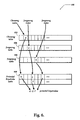
- FIGURE 6 provides an illustrative diagram of one embodiment for determining a keystroke for a Korean language character, in accordance with the present invention.
- the Choseong index obtained from Choseong table 602 is 0.
- the Jungseong index obtained from Jungseong table 604 is 3, and the Jongseong index obtained from Jongseong table 606 is 6, based on the mechanisms described above in conjunction with Process 500.
- Employing keystroke table 608 the keystroke associated with the Choseong index is determined as 4.
- keystroke table 608 is employed to identify the keystroke associated with the determined Jungseong index as 2-7.
- the keystroke associated with the determined Jongseong index indicates that no trailing consonant is associated with the received entry.
- the potential keystroke associated with the entry is determined in this example as 4-2-7.
- each block of the flowchart illustration, and combinations of blocks in the flowchart illustration can be implemented by computer program instructions.
- These program instructions may be provided to a processor to produce a machine, such that the instructions, which execute on the processor, create means for implementing the actions specified in the flowchart block or blocks.
- the computer program instructions may be executed by a processor to cause a series of operational steps to be performed by the processor to produce a computer implemented process such that the instructions, which execute on the processor provide steps for implementing the actions specified in the flowchart block or blocks.
- blocks of the flowchart illustration support combinations of means for performing the specified actions, combinations of steps for performing the specified actions and program instruction means for performing the specified actions. It will also be understood that each block of the flowchart illustration, and combinations of blocks in the flowchart illustration, can be implemented by special purpose hardware-based systems which perform the specified actions or steps, or combinations of special purpose hardware and computer instructions.
Landscapes
- Engineering & Computer Science (AREA)
- Theoretical Computer Science (AREA)
- General Engineering & Computer Science (AREA)
- Physics & Mathematics (AREA)
- General Physics & Mathematics (AREA)
- Health & Medical Sciences (AREA)
- Human Computer Interaction (AREA)
- Artificial Intelligence (AREA)
- Audiology, Speech & Language Pathology (AREA)
- Computational Linguistics (AREA)
- General Health & Medical Sciences (AREA)
- Controls And Circuits For Display Device (AREA)
- Document Processing Apparatus (AREA)
- Input From Keyboards Or The Like (AREA)
Applications Claiming Priority (3)
| Application Number | Priority Date | Filing Date | Title |
|---|---|---|---|
| US37729502P | 2002-05-02 | 2002-05-02 | |
| US10/287,836 US7002491B2 (en) | 2002-05-02 | 2002-11-05 | System and method for filtering far east languages |
| EP03008009.7A EP1359515B1 (fr) | 2002-05-02 | 2003-04-10 | Système et procédé de filtration de langage extrême-orientale |
Related Parent Applications (2)
| Application Number | Title | Priority Date | Filing Date |
|---|---|---|---|
| EP03008009.7A Division-Into EP1359515B1 (fr) | 2002-05-02 | 2003-04-10 | Système et procédé de filtration de langage extrême-orientale |
| EP03008009.7A Division EP1359515B1 (fr) | 2002-05-02 | 2003-04-10 | Système et procédé de filtration de langage extrême-orientale |
Publications (2)
| Publication Number | Publication Date |
|---|---|
| EP1632870A2 true EP1632870A2 (fr) | 2006-03-08 |
| EP1632870A3 EP1632870A3 (fr) | 2006-03-29 |
Family
ID=35810056
Family Applications (1)
| Application Number | Title | Priority Date | Filing Date |
|---|---|---|---|
| EP05026896A Withdrawn EP1632870A3 (fr) | 2002-05-02 | 2003-04-10 | Système et procédé d'identification d'une touche de saisie pour un caractère d'une langue extrême-orientale |
Country Status (1)
| Country | Link |
|---|---|
| EP (1) | EP1632870A3 (fr) |
Family Cites Families (4)
| Publication number | Priority date | Publication date | Assignee | Title |
|---|---|---|---|---|
| US5187480A (en) * | 1988-09-05 | 1993-02-16 | Allan Garnham | Symbol definition apparatus |
| US6003050A (en) * | 1997-04-02 | 1999-12-14 | Microsoft Corporation | Method for integrating a virtual machine with input method editors |
| US6300934B1 (en) * | 1998-11-16 | 2001-10-09 | Sony Corporation | Method and apparatus for entering Hangul (Korean) characters |
| AU2000279663A1 (en) * | 2000-10-13 | 2002-04-22 | Jang-Sung Choi | System for inputting korean characters for the electronic apparatuses |
-
2003
- 2003-04-10 EP EP05026896A patent/EP1632870A3/fr not_active Withdrawn
Also Published As
| Publication number | Publication date |
|---|---|
| EP1632870A3 (fr) | 2006-03-29 |
Similar Documents
| Publication | Publication Date | Title |
|---|---|---|
| US7149550B2 (en) | Communication terminal having a text editor application with a word completion feature | |
| US9508028B2 (en) | Converting text strings into number strings, such as via a touchscreen input | |
| EP2286350B1 (fr) | Systèmes et procédés pour un générateur de dictionnaire personnalisé automatisé pour des dispositifs portables | |
| CN1201611C (zh) | 具有预测编辑作用的通信终端 | |
| RU2377664C2 (ru) | Способ ввода текста | |
| US20080109432A1 (en) | Communication Terminal Having a Predictive Test Editor Application | |
| US20040153975A1 (en) | Text entry mechanism for small keypads | |
| US7002491B2 (en) | System and method for filtering far east languages | |
| KR20160011230A (ko) | 입력 처리 방법 및 장치 | |
| JP2014160252A (ja) | 電子機器、文字列表示方法、および文字列表示プログラム | |
| CN102999639A (zh) | 一种基于语音识别字符索引的查找方法及系统 | |
| US20110131488A1 (en) | Word input method | |
| EP1632870A2 (fr) | Système et procédé d'identification d'une touche de saisie pour un caractère d'une langue extrême-orientale | |
| EP1722294B1 (fr) | Dispositif portatif comprenant un procédé de génération de texte | |
| RU2525748C2 (ru) | Ввод текста с использованием двух алфавитов и функция выделения клавиш | |
| KR20130016867A (ko) | 민감한 단어를 표시할 수 있는 사용자 단말,및 사용자 단말의 민감한 단어 표시 방법 | |
| CN1120437C (zh) | 文字转码通讯方法及装置 | |
| KR100608786B1 (ko) | 이동 통신 단말기에서의 만능 문자를 이용한 전화번호부검색 방법 | |
| CA2821787C (fr) | Appareil electronique pour la desambiguisation bidirectionnelle de textes axee sur le contexte et methode connexe | |
| EP2660728A1 (fr) | Dispositif électronique et procédé de désambiguïsation de texte contextuelle bidirectionnel | |
| EP1956467A1 (fr) | Dispositif électronique portable et procédé associé pour obtenir de nouveaux objets linguistiques à utiliser par une routine de désambiguïsation sur le dispositif | |
| KR20030039068A (ko) | 이동통신 단말기를 위한 한글 입력 방법 | |
| HK1118353A (en) | Method for entering a character into an electronic device | |
| HK1080192A1 (zh) | 将表意字符输入到设备中的方法和装置 |
Legal Events
| Date | Code | Title | Description |
|---|---|---|---|
| PUAI | Public reference made under article 153(3) epc to a published international application that has entered the european phase |
Free format text: ORIGINAL CODE: 0009012 |
|
| PUAL | Search report despatched |
Free format text: ORIGINAL CODE: 0009013 |
|
| 17P | Request for examination filed |
Effective date: 20051208 |
|
| AC | Divisional application: reference to earlier application |
Ref document number: 1359515 Country of ref document: EP Kind code of ref document: P |
|
| AK | Designated contracting states |
Kind code of ref document: A2 Designated state(s): AT BE BG CH CY CZ DE DK EE ES FI FR GB GR HU IE IT LI LU MC NL PT RO SE SI SK TR |
|
| AX | Request for extension of the european patent |
Extension state: AL LT LV MK |
|
| AK | Designated contracting states |
Kind code of ref document: A3 Designated state(s): AT BE BG CH CY CZ DE DK EE ES FI FR GB GR HU IE IT LI LU MC NL PT RO SE SI SK TR |
|
| AX | Request for extension of the european patent |
Extension state: AL LT LV MK |
|
| AKX | Designation fees paid |
Designated state(s): AT BE BG CH CY CZ DE DK EE ES FI FR GB GR HU IE IT LI LU MC NL PT RO SE SI SK TR |
|
| 17Q | First examination report despatched |
Effective date: 20060512 |
|
| STAA | Information on the status of an ep patent application or granted ep patent |
Free format text: STATUS: THE APPLICATION IS DEEMED TO BE WITHDRAWN |
|
| 18D | Application deemed to be withdrawn |
Effective date: 20120508 |