EP1633081A1 - Modulare Diagnosevorrichtung mit evolutiver Wissensbasis für Kommunikationsnetz - Google Patents
Modulare Diagnosevorrichtung mit evolutiver Wissensbasis für Kommunikationsnetz Download PDFInfo
- Publication number
- EP1633081A1 EP1633081A1 EP20050106894 EP05106894A EP1633081A1 EP 1633081 A1 EP1633081 A1 EP 1633081A1 EP 20050106894 EP20050106894 EP 20050106894 EP 05106894 A EP05106894 A EP 05106894A EP 1633081 A1 EP1633081 A1 EP 1633081A1
- Authority
- EP
- European Patent Office
- Prior art keywords
- diagnostic
- blocks
- network
- models
- rules
- Prior art date
- Legal status (The legal status is an assumption and is not a legal conclusion. Google has not performed a legal analysis and makes no representation as to the accuracy of the status listed.)
- Withdrawn
Links
- 238000004891 communication Methods 0.000 title claims abstract description 9
- 238000012545 processing Methods 0.000 claims abstract description 35
- 238000012360 testing method Methods 0.000 claims description 23
- 238000012986 modification Methods 0.000 claims description 5
- 230000004048 modification Effects 0.000 claims description 5
- 238000004458 analytical method Methods 0.000 description 16
- 238000000034 method Methods 0.000 description 16
- 238000003745 diagnosis Methods 0.000 description 13
- 101000617738 Homo sapiens Survival motor neuron protein Proteins 0.000 description 5
- 102100021947 Survival motor neuron protein Human genes 0.000 description 5
- 238000004364 calculation method Methods 0.000 description 5
- 238000013461 design Methods 0.000 description 5
- 238000010586 diagram Methods 0.000 description 5
- 238000004519 manufacturing process Methods 0.000 description 5
- 230000001364 causal effect Effects 0.000 description 3
- 238000001514 detection method Methods 0.000 description 3
- 241001190469 Mussaenda philippica Species 0.000 description 2
- 208000032225 Proximal spinal muscular atrophy type 1 Diseases 0.000 description 2
- 208000026481 Werdnig-Hoffmann disease Diseases 0.000 description 2
- 238000007418 data mining Methods 0.000 description 2
- 230000007547 defect Effects 0.000 description 2
- 238000011161 development Methods 0.000 description 2
- 238000002405 diagnostic procedure Methods 0.000 description 2
- 238000005516 engineering process Methods 0.000 description 2
- 230000007257 malfunction Effects 0.000 description 2
- 238000005259 measurement Methods 0.000 description 2
- 238000007619 statistical method Methods 0.000 description 2
- 208000032471 type 1 spinal muscular atrophy Diseases 0.000 description 2
- 238000012795 verification Methods 0.000 description 2
- 208000033522 Proximal spinal muscular atrophy type 2 Diseases 0.000 description 1
- 238000013528 artificial neural network Methods 0.000 description 1
- 238000004422 calculation algorithm Methods 0.000 description 1
- 230000015556 catabolic process Effects 0.000 description 1
- 230000008859 change Effects 0.000 description 1
- 239000000470 constituent Substances 0.000 description 1
- 238000010276 construction Methods 0.000 description 1
- 230000010354 integration Effects 0.000 description 1
- 201000006913 intermediate spinal muscular atrophy Diseases 0.000 description 1
- 238000012423 maintenance Methods 0.000 description 1
- 239000003607 modifier Substances 0.000 description 1
- 230000006855 networking Effects 0.000 description 1
- 230000000717 retained effect Effects 0.000 description 1
- 208000032521 type II spinal muscular atrophy Diseases 0.000 description 1
- 238000010200 validation analysis Methods 0.000 description 1
Images
Classifications
-
- H—ELECTRICITY
- H04—ELECTRIC COMMUNICATION TECHNIQUE
- H04L—TRANSMISSION OF DIGITAL INFORMATION, e.g. TELEGRAPHIC COMMUNICATION
- H04L41/00—Arrangements for maintenance, administration or management of data switching networks, e.g. of packet switching networks
- H04L41/16—Arrangements for maintenance, administration or management of data switching networks, e.g. of packet switching networks using machine learning or artificial intelligence
-
- H—ELECTRICITY
- H04—ELECTRIC COMMUNICATION TECHNIQUE
- H04L—TRANSMISSION OF DIGITAL INFORMATION, e.g. TELEGRAPHIC COMMUNICATION
- H04L41/00—Arrangements for maintenance, administration or management of data switching networks, e.g. of packet switching networks
- H04L41/14—Network analysis or design
-
- H—ELECTRICITY
- H04—ELECTRIC COMMUNICATION TECHNIQUE
- H04L—TRANSMISSION OF DIGITAL INFORMATION, e.g. TELEGRAPHIC COMMUNICATION
- H04L41/00—Arrangements for maintenance, administration or management of data switching networks, e.g. of packet switching networks
- H04L41/14—Network analysis or design
- H04L41/145—Network analysis or design involving simulating, designing, planning or modelling of a network
Definitions
- the invention relates to the field of managed communication networks, and more particularly the diagnostic devices for determining the cause of problem (s) occurring within such networks.
- the problems occurring in the communications networks can have various origins. They may indeed come from a power failure, a break in connection, a failure or a malfunction in a network equipment, or an element constituting it, or a software, or the integration of a version of a network equipment, or an element constituting it, or a software not completely compatible with the rest of the network.
- ECXpert for "Event Correlation eXpert" which allows the construction of correlation trees of alarms from rules defined manually, or the devices of the company ILOG which use a rules engine Programmable for Diagnostics, or those of Hewlett Packard, including "Network Node Manager", version 6.4, and “Network Node Manager Extended Topology", version 2.0, which use a technique based on fault models , or Agilent's "Fault Detective for Data Communications” (FDDC) ® device that replaces defect diagnostics performed by technicians, automated diagnostic processes, or the TAC ® device from CISCO , which is a problem detection assistant.
- FDDC fault Detective for Data Communications
- the main disadvantage of these devices lies in the mode of acquisition of information (also called knowledge based on expertise). Indeed, when the diagnostic device is developed by a company that is not an equipment manufacturer, the knowledge base (or expertise) is not well suited to specific equipment or certain combinations of equipment.
- the knowledge base (or expertise) contains only basic information, so that certain characteristics specific to the equipment, such as the type, the method of manufacture , version, date of manufacture, and mode of use, are not taken into account. Critical information is usually not communicated to client users, just like the diagnostic devices themselves.
- ALCATEL also proposes a diagnostic device based on the Bayesian probabilistic theory and allowing to define rules to refine hypotheses from notions of additional evidence and background information, which result in numbers representing the probability that a hypothesis is true and allow the creation of Bayesian networks (or diagrams) defining test operations associated with statistical or probabilistic weights.
- the main disadvantage of this device lies in the fact that its Bayesian networks, and the tests associated with them, can not be modified once integrated. Therefore, if a client user realizes that a Bayesian network is not fully adapted to his network or that specific equipment requires a particular test, the diagnostic device can not be adapted. Such a diagnostic device therefore also suffers from a lack of flexibility.
- the object of the invention is therefore to improve the situation.
- diagnostic device comprising diagnostic means comprising a knowledge base, arranged in the form of basic diagnostic blocks, and processing means responsible for establishing selected hierarchical associations between selected blocks of the base. of knowledge to constitute configurable diagnostic models adapted to the determination by the diagnostic means of cause of problem (s) occurring within the network from information provided by its network equipment.
- the object of the invention is to allow the determination of the cause of a problem, occurring within a managed communications network, by means of model (s) of diagnosis.
- IP Internet Protocol
- diagnosis can be as much about the network level (network equipment and configuration) as the level of management and service (network equipment, configuration, quality of service (QoS), and service level agreement (or ALS)).
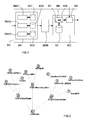
- the invention proposes a diagnostic device DD comprising, as illustrated in FIG. 1, a diagnostic module MD responsible for determining causes of problems from information provided by the equipment of the network.
- a DD device is for example implemented in the network management system (NMS) (for "Network Management System”), or in the service management system of the network when one wants to perform service diagnostics.
- NMS network management system
- the information from the network equipment is for example alarms that they automatically transmit to the NMS when they detect a problem (breakdown or malfunction) within them (that is to say at one of their elements , for example an input or output interface) or on one of their links. But, it can also be management and / or operating information obtained from certain network equipment at the request of the NMS, which are generally stored in their management information base or MIB. They may also be measurements relating to network parameters, such as, for example, the bandwidth used on certain links or communications (traffic analysis) or the packet loss rates on certain links or communications, which in particular allow operators network to control and manage the quality of service (or QoS) associated with each user client (or each service) and defined by a Service Level Agreement (SLA).
- SLA Service Level Agreement
- any information useful for diagnosis can supply the diagnostic module MD of the diagnostic device DD.
- the diagnostic module MD comprises a knowledge database based on the expertise BC, hereinafter referred to as the knowledge base, and arranged in the form of basic diagnostic blocks, as well as a processing module.
- MT responsible for establishing selected hierarchical associations between selected blocks of the BC knowledge base to provide configurable diagnostic models suitable for determining cause of problem (s).
- This BC knowledge base is preferably constructed from data (or information) from different sources, such as equipment design (specifications, configurations, validation, and the like, and problems and / or weaknesses encountered); equipment (components used, technologies used, and the like, and problems and / or weaknesses encountered), laboratory equipment tests (critical failures, reliability, defects (or "bugs"), compatibility, lifetimes, and the like) , and use in real-world conditions (including information from customer-users, maintenance services, and fault reports, such as statistical information about reliability and failure of equipment and components over time, outages the most frequent equipment according to a specific use or specific manufacturing, compatible interoperability between equipment, service life, and the like).
- equipment design specificallyations, configurations, validation, and the like, and problems and / or weaknesses encountered
- equipment components used, technologies used, and the like, and problems and / or weaknesses encountered
- laboratory equipment tests critical failures, reliability, defects (or "bugs"), compatibility, lifetimes, and the like
- real-world conditions including information from customer-users, maintenance
- the diagnostic device DD may comprise an analysis module MA making it possible to collect data and information, whether from the network itself or from the network operator, and from analyze to select those that are useful for a selected diagnosis.
- the analysis module MA is subdivided into three analysis sub-modules SMA1 to SMA3 respectively coupled to three databases BD1 to BD3.
- the SMA1 analysis sub-module is dedicated to the analysis of equipment design and manufacturing data and information.
- the SMA2 analysis sub-module is dedicated to the analysis of data and test information.
- laboratory equipment, and the SMA3 analysis sub-module is dedicated to analyzing data and usage information in real-world conditions.
- the analysis of data within the various SMAi analysis sub-modules can be done by any means, and in particular by means of statistical methods such as for example the data mining technique, or a data mining technique. learning technique, or a signal processing technique, or a prediction / trend technique, or a technique based on experience. It is preferably under the control of a specialist.
- the diagnostic device DD comprises an analysis module MA, it also comprises, as illustrated in FIG. 1, an MGB knowledge base generation module.
- the latter is coupled to the analysis module MA, and more precisely to its databases BDi, as well as to the diagnostic module MD.
- This module MGB knowledge base generation can for example develop the database (s) of knowledge BD, necessary (s) to the diagnostic module (MD) according to the method indicated below.
- the MGB knowledge base generation module begins by forming a knowledge core, arranged in the form of basic diagnostic blocks, from data and information of design and manufacture of the equipment stored in the database BD1. . Then he uses the data and test information laboratory equipment, stored in the BD2 database, to improve the knowledge core. Finally, it completes the improved knowledge core using real-world data and usage information, stored in the BD3 database, in order to build a BC knowledge base arranged as basic diagnostic blocks and adapted to network to diagnose.
- any technique known to those skilled in the art can be implemented by the MGB knowledge base generation module to enable the generation of a knowledge base BC arranged in the form of basic diagnostic blocks.
- these techniques mention may in particular be made of statistical techniques, rule-based and / or model-based techniques, and learning techniques, for example of the neural network or petri dish type.
- Each generation of BC knowledge base, by means of the MGB knowledge base generation module, is preferentially under the control of a specialist.
- the knowledge base BC is communicated to the diagnostic module MD.
- the MGB knowledge base generation module can be arranged for this purpose.
- the diagnostic device DD may not include an analysis module MA and an MGB knowledge base generation module, when the knowledge base BC is provided to it elsewhere.
- the diagnostic module MD has an MT processing module responsible for establishing selected hierarchical associations between selected blocks of the BC knowledge base to provide configurable diagnostic models for determining the cause of one or more problems occurring within the network.
- Hierarchical association is meant here any association or combination of causal blocks, that is to say blocks in which the blocks must be used in relation to each other in a possibly predetermined order.
- Any method can be implemented by the processing module MT to perform hierarchical associations of basic diagnostic blocks. It can in particular use selected rules and / or selected models and / or statistical methods.
- FIG. 2 Another example of a hierarchical association of thirteen blocks, more complex (and not limiting), that can be performed by the processing module MT is illustrated in FIG. 2.
- the processing module MT has established a diagnostic model. adapted to determine the cause of a packet loss in an IP VPN (Internet Protocol Virtual Private Network) network.
- IP VPN Internet Protocol Virtual Private Network
- the diagnostic model is here in the form of a Bayesian network (or causal diagram), well known to those skilled in the art.
- Each node of the Bayesian network is designated by a name that represents the output variable a set of at least one basic (or elementary) test to be performed.
- Bayesian network is intended, when executed, to detect a possible problem and its cause (s).
- the Bayesian network is a causal tree.
- three causes of lost packets or "packet loss" have been listed, each with a certain probability: DropOnlnputQueue (with some probability X), RouterMisconfiguration (with some probability Y) , and DropOnOutputQueue (with some probability Z), the sum of these three probabilities X, Y and Z being equal to 1.
- each sub-branch is assigned a probability. For example, one of the causes of the DropOnlnputQueue branch is Throttle which has an X1 probability.
- LossPacket is a scenario for finding the root cause (or root cause) of packet loss in an IP VPN network. He performs various tests according to probabilities of cause. For example, the LossPacket scenario first tests interfacelnStatus (which is usually the most likely cause). Then, if the status of interfacelnStatus is "OK", it tests interfaceOutStatus (which is usually the second most likely cause). If the status of interfaceOutStatus is "NOK" (or not OK), LossPacket returns InterfaceOutStatus NOK, the cause of the problem (for example "an interface does not work") and the number of packets lost if it can be determined.
- DropOnlnputQueue is a variable indicating whether packets have been dropped (or “dropped") on an input interface (or "ingress interface”).
- RingMisconfiguration is a variable that is not directly observable. It indicates if a router is or is not correctly configured.
- DropOnOutputQueue is a variable indicating whether packages have been extracted (or “dropped”) or not on an output interface (or "egress interface”).
- DropOnlnputQueue is assigned a probability X that represents the probability that the cause of the lost packets will fall on the input queue ("InputQueue ), While RouterMisconfiguration has a probability Y that represents the probability that the cause of the lost packets is due to a misconfiguration of the router, and that DropOnOutputQueue is assigned a probability Z that represents the probability that the cause of the packets lost is the responsibility of the output queue (“OutputQueue").
- InterfacelnStatus is a variable modeling the status of the input interfaces.
- “Throttle” is a variable indicating whether a port is out of order or not. This provides an indication of the state of (over) load of a router. This variable indicates the number of times the receiver on a given port has been decommissioned, for example because of a processing or buffer overhead.
- HighCPUUtilization is a variable indicating whether the processing capacity (or CPU) of a router is overloaded or not.
- BGP4MIB is a variable representing the configuration status of a Border Gateway Protocol (BGP). For example if the status of BGP4MIB is OK it means that the BGP is well configured while if the status of BGP4MIB is NOK it means that the BGP is not well configured.
- IPForwardMIB is a test variable that is used to determine whether a LSP is established or not.
- ClassBasedQoSMIB is a test variable to determine whether the Quality of Service (QoS) policy is properly configured and implemented in the router.
- InterfaceOutStatus is a variable modeling the status of the output interfaces.
- “BadConfOfWRED” is a test that checks the configuration of the WRED algorithm (for "Weighted Random Early Detection”). This test checks for each output interface, associated with an output label (or “label out"), if a RED (Early Random Detection) queuing strategy is defined, and then collects the total number extracted packages.
- QueueMIB is a variable that checks whether policy-maps are defined in an input interface and an output interface.
- the respective positions of the different nodes are representative of the probabilities associated with the branches to which they respectively belong.
- MIBs management information bases
- IP VPN quality of service
- the processing module MT may optionally comprise an MR rule engine responsible for establishing the hierarchical associations chosen between the selected elementary blocks, preferably under the control of a specialist.
- the processing module MT may be arranged to associate selected statistical or probabilistic weights and / or selected administrative costs with at least some of the basic diagnostic blocks and / or at least some of the rules and / or at least some of the rules. models.
- association of statistical or probabilistic weights makes it possible to give certain sets (or sets) of tests a greater (or smaller) importance than that of other sets (or sets) of tests as part of a diagnosis.
- association of administrative costs makes it possible to use only certain sets (or sets) of tests when the cost of a diagnosis is of importance.
- HMI man-machine interface of the type presented above to enable the display on a screen of a virgin tree selected by a specialist and the filling by the latter of the nodes of this tree (or part of it) with basic diagnostic blocks.
- the processing module MT can be arranged to establish the associations in an automated manner, on the basis of instructions provided by a specialist. But, it can also be arranged to propose or make available some or all the elementary blocks of a BC knowledge base and / or some or all of the possible rules between said elementary blocks, so that a specialist defines the different associations intended to constitute a model of diagnosis. In this case, the processing module MT is then also responsible for the generation (physics) of user defined diagnostic models.
- the processing module MT includes a man / machine interface GUI, for example GUI type (for "Graphical User Interface” - GUI user).
- the specialist can transmit his instructions to the processing module MT by means of any type of command (for example type CLI) or code.
- Such an interface HMI can also be used by a specialist to modify at least some of the basic diagnostic blocks and / or at least some rules (and possibly their statistical or probabilistic weights) and / or at least some of the models and / or some at least statistical or probabilistic weights and / or at least some of the administrative costs.
- a modification may consist in adding or deleting or changing one or more elementary blocks (or part thereof) and / or one or more rules and / or models in a BC knowledge base or in a database model. diagnostic.
- processing module MT made hierarchical associations by means of rules and / or models. But, we can consider a variant in which the processing module MT performs hierarchical associations of basic diagnostic blocks selected within selected trees. In this case, each completed tree is ultimately a diagnostic model.
- HMI man-machine interface of the type presented above to enable the display on a screen of a virgin tree selected by a specialist and the filling by the latter of the nodes of this tree (or part of it) with basic diagnostic blocks.
- association simply consists of a sequence of elementary blocks to be executed according to the order defined by the tree concerned, without rules or models between associated elementary blocks.
- a diagnostic model Once a diagnostic model has been generated by the processing module MT and activated, it can then be used by a calculation module MC of the diagnostic module MD.
- This calculation module MC is responsible for supplying the activated diagnostic model with the information that comes (directly or indirectly) from the network equipment, such as for example the alarms, and to issue an output with a diagnosis, that is to say the cause (s) of a problem within the network.
- the calculation module MC is arranged according to the diagnostic model (s) that it uses. It is therefore designed to run the scenario of a diagnostic model, and for example uses a database, SNMP tools, and the like, and outputs an output of the constituent results of the diagnostics.
- this calculation module MC may be for example coupled to an auxiliary module responsible for proposing to the network operator actions to remedy each cause determined during a diagnosis.
- the diagnostic device DD may comprise one or more auxiliary diagnostic modules or one or more auxiliary diagnostic models in addition to that (MD) described above and of different designs.
- the calculation module MC of the diagnosis module MD can be arranged to use each activated diagnostic model, whatever its design.
- a diagnostic performed by a DD diagnostic device can concern network equipment of any type, whether it is pure hardware ("hardwares”), pure software (“softwares”) , or combinations thereof.
- the diagnostic device DD can be realized in the form of electronic circuits, software modules (or computer), or a combination of circuits and software.
Landscapes
- Engineering & Computer Science (AREA)
- Computer Networks & Wireless Communication (AREA)
- Signal Processing (AREA)
- Artificial Intelligence (AREA)
- Computer Vision & Pattern Recognition (AREA)
- Databases & Information Systems (AREA)
- Evolutionary Computation (AREA)
- Medical Informatics (AREA)
- Software Systems (AREA)
- Data Exchanges In Wide-Area Networks (AREA)
- Small-Scale Networks (AREA)
Applications Claiming Priority (1)
| Application Number | Priority Date | Filing Date | Title |
|---|---|---|---|
| FR0451965A FR2875083B1 (fr) | 2004-09-03 | 2004-09-03 | Dispositif de diagnostic modulaire a base de connaissances evolutive, pour un reseau de communications |
Publications (1)
| Publication Number | Publication Date |
|---|---|
| EP1633081A1 true EP1633081A1 (de) | 2006-03-08 |
Family
ID=34940321
Family Applications (1)
| Application Number | Title | Priority Date | Filing Date |
|---|---|---|---|
| EP20050106894 Withdrawn EP1633081A1 (de) | 2004-09-03 | 2005-07-27 | Modulare Diagnosevorrichtung mit evolutiver Wissensbasis für Kommunikationsnetz |
Country Status (4)
| Country | Link |
|---|---|
| US (1) | US7286965B2 (de) |
| EP (1) | EP1633081A1 (de) |
| CN (1) | CN1744522B (de) |
| FR (1) | FR2875083B1 (de) |
Cited By (2)
| Publication number | Priority date | Publication date | Assignee | Title |
|---|---|---|---|---|
| CN102420700A (zh) * | 2011-11-28 | 2012-04-18 | 武汉大学 | 网络故障诊断系统 |
| CN103308824A (zh) * | 2013-05-31 | 2013-09-18 | 东北大学 | 一种基于概率Petri网的电力系统故障诊断方法 |
Families Citing this family (7)
| Publication number | Priority date | Publication date | Assignee | Title |
|---|---|---|---|---|
| US6269533B2 (en) * | 1999-02-23 | 2001-08-07 | Advanced Research Corporation | Method of making a patterned magnetic recording head |
| FR2875078B1 (fr) * | 2004-09-08 | 2006-11-24 | Cit Alcatel | Dispositif de diagnostic a modeles de diagnostic adaptatifs, pour un reseau de communications |
| US7379799B2 (en) * | 2005-06-29 | 2008-05-27 | General Electric Company | Method and system for hierarchical fault classification and diagnosis in large systems |
| US8832657B1 (en) * | 2009-01-12 | 2014-09-09 | Bank Of America Corporation | Customer impact predictive model and combinatorial analysis |
| US8064364B2 (en) * | 2009-03-31 | 2011-11-22 | Comcast Cable Communications, Llc | Automated network condition identification |
| CN108923996B (zh) * | 2018-05-11 | 2021-01-05 | 中国银联股份有限公司 | 一种容量分析方法及装置 |
| US10917308B2 (en) * | 2018-12-20 | 2021-02-09 | Verizon Patent And Licensing Inc. | Virtualized network service management and diagnostics |
Citations (2)
| Publication number | Priority date | Publication date | Assignee | Title |
|---|---|---|---|---|
| US5428619A (en) * | 1990-02-15 | 1995-06-27 | Digital Equipment Corporation | Model based reasoning system for network fault diagnosis |
| US6012152A (en) | 1996-11-27 | 2000-01-04 | Telefonaktiebolaget Lm Ericsson (Publ) | Software fault management system |
Family Cites Families (5)
| Publication number | Priority date | Publication date | Assignee | Title |
|---|---|---|---|---|
| US5448722A (en) * | 1993-03-10 | 1995-09-05 | International Business Machines Corporation | Method and system for data processing system error diagnosis utilizing hierarchical blackboard diagnostic sessions |
| US5644686A (en) * | 1994-04-29 | 1997-07-01 | International Business Machines Corporation | Expert system and method employing hierarchical knowledge base, and interactive multimedia/hypermedia applications |
| US6415150B1 (en) * | 1998-09-11 | 2002-07-02 | Ameritech Corporation | System and method for providing telecommunications service using a wireless link |
| US6535865B1 (en) * | 1999-07-14 | 2003-03-18 | Hewlett Packard Company | Automated diagnosis of printer systems using Bayesian networks |
| US7434099B2 (en) * | 2004-06-21 | 2008-10-07 | Spirent Communications Of Rockville, Inc. | System and method for integrating multiple data sources into service-centric computer networking services diagnostic conclusions |
-
2004
- 2004-09-03 FR FR0451965A patent/FR2875083B1/fr not_active Expired - Fee Related
-
2005
- 2005-07-27 EP EP20050106894 patent/EP1633081A1/de not_active Withdrawn
- 2005-08-16 US US11/203,975 patent/US7286965B2/en not_active Expired - Fee Related
- 2005-08-29 CN CN200510093744.3A patent/CN1744522B/zh not_active Expired - Fee Related
Patent Citations (2)
| Publication number | Priority date | Publication date | Assignee | Title |
|---|---|---|---|---|
| US5428619A (en) * | 1990-02-15 | 1995-06-27 | Digital Equipment Corporation | Model based reasoning system for network fault diagnosis |
| US6012152A (en) | 1996-11-27 | 2000-01-04 | Telefonaktiebolaget Lm Ericsson (Publ) | Software fault management system |
Non-Patent Citations (2)
| Title |
|---|
| CORN P A ET AL: "An autonomous distributed expert system for switched network maintenance", GLOBECOM 88; IEEE GLOBAL TELECOMMUNICATIONS CONFERENCE AND EXHIBITION; COMMUNICATIONS FOR THE INFORMATION AGE, 28 November 1988 (1988-11-28), pages 1530 - 1537, XP010071823 * |
| LAZAR A A ET AL: "An architecture for managing quality of service on broadband networks", SINGAPORE ICCS/ISITA '92. 'COMMUNICATIONS ON THE MOVE' SINGAPORE 16-20 NOV. 1992, NEW YORK, NY, USA,IEEE, US, 16 November 1992 (1992-11-16), pages 974 - 978, XP010067214, ISBN: 0-7803-0803-4 * |
Cited By (3)
| Publication number | Priority date | Publication date | Assignee | Title |
|---|---|---|---|---|
| CN102420700A (zh) * | 2011-11-28 | 2012-04-18 | 武汉大学 | 网络故障诊断系统 |
| CN102420700B (zh) * | 2011-11-28 | 2014-06-18 | 武汉大学 | 网络故障诊断系统 |
| CN103308824A (zh) * | 2013-05-31 | 2013-09-18 | 东北大学 | 一种基于概率Petri网的电力系统故障诊断方法 |
Also Published As
| Publication number | Publication date |
|---|---|
| CN1744522A (zh) | 2006-03-08 |
| FR2875083A1 (fr) | 2006-03-10 |
| FR2875083B1 (fr) | 2006-12-15 |
| CN1744522B (zh) | 2011-04-20 |
| US20060064282A1 (en) | 2006-03-23 |
| US7286965B2 (en) | 2007-10-23 |
Similar Documents
| Publication | Publication Date | Title |
|---|---|---|
| US11894969B2 (en) | Identifying root causes of network service degradation | |
| US20230261930A1 (en) | Predicting network issues based on historical data | |
| EP1463238B1 (de) | Vorrichtung zur lokalen Management von Sicherheitsverfahren für ein Gerät eines Telekommunikationsnetzes | |
| FR2873879A1 (fr) | Systeme de gestion de reseau de communication pour reparation automatique de pannes | |
| WO2015097359A1 (fr) | Procede de diagnostic de fonctions service dans un reseau ip | |
| EP3389224B1 (de) | Verfahren zur erzeugung und kontrolle eines test-datenverkehrs, entsprechender eingangs- oder ausgangsanschluss eines schalters und entsprechender schalter | |
| US20100138688A1 (en) | Managing service levels on a shared network | |
| US8717869B2 (en) | Methods and apparatus to detect and restore flapping circuits in IP aggregation network environments | |
| EP1300985A2 (de) | Verfahren und Vorrichtung zur Simulation von Netzwerkverhalten zur Echtzeitdimensionierung | |
| FR2857543A1 (fr) | Utilisation d'un systeme de gestion d'equipements de reseau de communication pour la gestion de regles de politique de reseau | |
| EP1750393B1 (de) | Kommunikationsnetz-Diagnosewerkzeug mittels Testsergebnisse einer Baumdiagnostik | |
| EP1401146B1 (de) | Vorrichtung und Verfahren zur Planung der Konfiguration eines Telekommunikationsnetzwerkes mittels Vorhersage des Wandels | |
| US7286965B2 (en) | Modular evolving knowledge-based diagnostic device for use in communication networks | |
| EP1635507B1 (de) | Diagnostikvorrichtung mit adaptiven Diagnostikmodellen für ein Kommunikationsnetzwerk | |
| Varga et al. | Integration of service-level monitoring with fault management for end-to-end multi-provider ethernet services | |
| EP1365539A1 (de) | Vorrichtung und Verfahren zur Kontrolle von Servicedaten in einem Kommunikationsnetzwerk | |
| US20120303780A1 (en) | Technique for management of communication networks | |
| EP1469635B1 (de) | Vorrichtung zur Steuerung der Messung Ende-zu-Ende von Flussparametern für ein Multi-Domain Kommunikationsnetz | |
| EP2746977B1 (de) | Verfahren zur Erzeugung einer Überwachungsmodellversion eines Informationssystems | |
| FR2876847A1 (fr) | Dispositif de controle prealable d'actions correctives sur des elements parametrables cause de problemes au sein d'un reseau de communication | |
| EP1667361B1 (de) | Schnittstellenvorrichtung zwischen Diagnosemitteln und Analyseeinrichtungen eines Kommunikationsnetzwerks | |
| EP2472783B1 (de) | Verfahren zur Auswahl von Interdomänen-Randknoten | |
| Chen et al. | {KnowOps}: Towards an Embedded Knowledge Base for Network Management and Operations | |
| US8572235B1 (en) | Method and system for monitoring a complex IT infrastructure at the service level | |
| EP2337265B1 (de) | Ereignisbasierte Netzwerkverwaltung |
Legal Events
| Date | Code | Title | Description |
|---|---|---|---|
| PUAI | Public reference made under article 153(3) epc to a published international application that has entered the european phase |
Free format text: ORIGINAL CODE: 0009012 |
|
| AK | Designated contracting states |
Kind code of ref document: A1 Designated state(s): AT BE BG CH CY CZ DE DK EE ES FI FR GB GR HU IE IS IT LI LT LU LV MC NL PL PT RO SE SI SK TR |
|
| AX | Request for extension of the european patent |
Extension state: AL BA HR MK YU |
|
| 17P | Request for examination filed |
Effective date: 20060908 |
|
| AKX | Designation fees paid |
Designated state(s): AT BE BG CH CY CZ DE DK EE ES FI FR GB GR HU IE IS IT LI LT LU LV MC NL PL PT RO SE SI SK TR |
|
| RAP1 | Party data changed (applicant data changed or rights of an application transferred) |
Owner name: ALCATEL LUCENT |
|
| 17Q | First examination report despatched |
Effective date: 20070515 |
|
| RAP1 | Party data changed (applicant data changed or rights of an application transferred) |
Owner name: ALCATEL LUCENT |
|
| 111Z | Information provided on other rights and legal means of execution |
Free format text: AT BE BG CH CY CZ DE DK EE ES FI FR GB GR HU IE IS IT LI LT LU LV MC NL PL PT RO SE SI SK TR Effective date: 20130410 |
|
| RAP1 | Party data changed (applicant data changed or rights of an application transferred) |
Owner name: ALCATEL LUCENT |
|
| D11X | Information provided on other rights and legal means of execution (deleted) | ||
| STAA | Information on the status of an ep patent application or granted ep patent |
Free format text: STATUS: THE APPLICATION IS DEEMED TO BE WITHDRAWN |
|
| 18D | Application deemed to be withdrawn |
Effective date: 20150917 |