EP1635264A2 - Augmentation de la localité de données de ressources récemment accédées - Google Patents
Augmentation de la localité de données de ressources récemment accédées Download PDFInfo
- Publication number
- EP1635264A2 EP1635264A2 EP05108006A EP05108006A EP1635264A2 EP 1635264 A2 EP1635264 A2 EP 1635264A2 EP 05108006 A EP05108006 A EP 05108006A EP 05108006 A EP05108006 A EP 05108006A EP 1635264 A2 EP1635264 A2 EP 1635264A2
- Authority
- EP
- European Patent Office
- Prior art keywords
- objects
- heap
- accessed
- optimization
- memory
- Prior art date
- Legal status (The legal status is an assumption and is not a legal conclusion. Google has not performed a legal analysis and makes no representation as to the accuracy of the status listed.)
- Withdrawn
Links
Images



Classifications
-
- G—PHYSICS
- G06—COMPUTING OR CALCULATING; COUNTING
- G06F—ELECTRIC DIGITAL DATA PROCESSING
- G06F12/00—Accessing, addressing or allocating within memory systems or architectures
- G06F12/02—Addressing or allocation; Relocation
- G06F12/0223—User address space allocation, e.g. contiguous or non contiguous base addressing
- G06F12/023—Free address space management
- G06F12/0253—Garbage collection, i.e. reclamation of unreferenced memory
- G06F12/0269—Incremental or concurrent garbage collection, e.g. in real-time systems
- G06F12/0276—Generational garbage collection
-
- G—PHYSICS
- G06—COMPUTING OR CALCULATING; COUNTING
- G06F—ELECTRIC DIGITAL DATA PROCESSING
- G06F11/00—Error detection; Error correction; Monitoring
- G06F11/30—Monitoring
-
- G—PHYSICS
- G06—COMPUTING OR CALCULATING; COUNTING
- G06F—ELECTRIC DIGITAL DATA PROCESSING
- G06F9/00—Arrangements for program control, e.g. control units
- G06F9/06—Arrangements for program control, e.g. control units using stored programs, i.e. using an internal store of processing equipment to receive or retain programs
- G06F9/44—Arrangements for executing specific programs
- G06F9/455—Emulation; Interpretation; Software simulation, e.g. virtualisation or emulation of application or operating system execution engines
- G06F9/45504—Abstract machines for programme code execution, e.g. Java virtual machine [JVM], interpreters, emulators
Definitions
- the technical field relates generally to managing memory to increase data access efficiency, and more specifically, to monitoring and rearranging recently accessed objects in order to improve data locality on an automatically managed heap.
- cache memory is expensive and on-chip caches (e.g., L1 cache, ITLB cache, and DTLB cache) are not likely to grow at the same rate as workloads of modem applications due to this expense.
- prefetching techniques in hardware can sometimes reduce memory latencies, but prefetching for irregular data accesses is difficult when serial dependencies (e.g., pointer indirection) preclude timely materialization of prefetch addresses.
- a low overhead technique gathers heap access information which is then utilized to guide the heap reorganization to achieve better data access locality for applications in a garbage collection (GC) based system.
- GC garbage collection
- the profiling and heap reorganization focus on improving page density to create a practical implementation that is inexpensive and yet effective in reducing both page faults and cache misses.
- a GC is utilized primarily and proactively for improving memory locality, and not merely as a mechanism to reclaim free memory space passively as in the past.
- a GC for locality is invoked or triggered upon detection of certain program behavior or performance, even when there is still space for new allocations and therefore a GC for space would not otherwise be triggered.
- triggering the GC for locality can increase the number of garbage collections substantially (e.g., by 50% over the number of collections that would otherwise be required for collecting freed memory space), and yet still result in an overall speedup because of improved locality.
- the method is implemented using the Common Language Runtime (CLR) of Microsoft's .Net Framework.
- CLR Common Language Runtime
- JIT just-in-time
- MSIL Microsoft Intermediate Language
- An example method for improving data locality via garbage collection is evaluated on several exemplary applications written in C#; however, the methods are applicable to applications written in any language targeting for copying GC-based systems. However, garbage collection is not required by the described technologies.
- a method monitors objects accessed on the heap.
- one or more bits are set (or counted) to indicate that an object was accessed.
- the one or more bits may be within or near the object itself or elsewhere in memory.
- not all accesses are counted. Instead, the method periodically monitors accessed objects for a sampling period.
- the method also monitors program behavior in order to determine when to perform a heap reorganization. When a monitored program behavior indicates, the method reorganizes the heap.
- the reorganization clusters recently accessed objects in the same area of the heap.
- the reorganization clusters objects recently accessed during a sampling period in the same area of the heap.
- a cluster of recently accessed objects are placed on one or more pages of the heap.
- the method clears the bits that indicate that an object was accessed, and returns to monitoring objects accesses and program behavior.
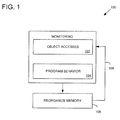
- Figure 1 is a flowchart for an exemplary method for optimizing data locality of the heap. As shown, the method 100 monitors accessed objects, monitors optimization metrics, and reorganizes accessed objects on a heap page(s).
- the method monitors objects accessed on the heap. For example a JIT compiler instruments operations that read or write data objects in the heap. A record is kept indicating what objects are accessed. In one example, the record is a bit in the object itself that is set to indicate that the object was accessed recently. In another example, the record is a bit in a separate bit vector. In yet another example, the processor provides a mechanism or instructions that record the addresses of all objects accessed recently (for example, recording all addresses that are currently in cache) or addresses that caused a page fault.
- the method monitors metrics in order to determine when to perform optimization for data locality.
- a performance metric could be an object allocation rate, a DTLB miss rate, a cache miss rate, a performance counter, an object reference counter, or a timer.
- the method performs step 106.
- the method first identifies recently accessed objects and then congregates them on contiguous pages in the heap. For example, instrumented code set a bit in accessed objects or in an accessed object bit table. For example, if instrumented code set bit(s) in accessed objects or in an accessed object bit table, then these objects are clustered together on the heap.
- an operation provided by the processor tells what object addresses were accessed on the heap.
- an operation provided by the processor indicates what address requests caused DTLB misses.
- access bits or counters corresponding to accessed objects are then reset. In another example, the access bits or counters are not immediately reset, but are reset slowly over time.
- the method returns to steps 102 and 104 once the heap has been optimized for data locality.
- Figure 2 is a block diagram of an exemplary system for optimizing data locality of the heap.
- the computer system 200 includes one or more processors 202, on-chip cache 204, a running program(s) 208 being monitored and optimized for data locality, a module 206 for monitoring programs for improved data locality, a random access memory (RAM) 210 comprising a heap 216 of working data pages (e.g., pages, segments, etc.) for the running program 208, off-chip cache 212, a disk drive or other binary storage device 214, and a network connection 218.
- the processor(s) execute programs 208, 206, 220, which include instructions, data, and/or state. As the monitored program 208 executes, data pages of the program are brought back into the heap 216 from storage 214 and or the network 218 as needed.
- a monitored program 208 is intermediate language (IL) code that is further compiled into native code before execution.
- IL intermediate language
- a compiler 206 compiles and instruments the program.
- the program is already in native binary form, and instrumentation is performed 206 on the native binary code.
- the instrumentation 206 adds instructions supported by the processor for identifying objects or addresses accessed during execution.
- the program 208 is instrumented so that it records objects in the heap 216 that are accessed while the program 208 executes.
- the program is also instrumented so that it monitors metrics and triggers an optimization module 220.
- Various metrics may be used to trigger optimization such as TLB, DTLB, or cache misses. Other possible metrics for triggering optimization are memory allocation rates, object reference counts, along with others discussed below.
- the optimization module 220 reorganizes at least one memory page (or segment) of the heap 216. For example, the optimization places all accessed objects (e.g., hot objects) on a single page (or a set of pages) on the heap. This page (or set of pages) of hot objects on the heap is called a hot page(s).
- the system instruments a program to monitor objects accessed during execution (program monitoring), monitors the program for performance indicators that trigger heap 220 optimization (performance monitoring), and reorganizes the accessed objects into a cluster (e.g., one or more groupings of objects near each other on the heap, onto a single page, onto contiguous page(s), etc.) in memory in order to increase program performance due to increased data locality (data locality optimization). Additionally, once data is optimized for locality, the system begins monitoring the optimized program. Thus, the system is dynamic and ongoing.
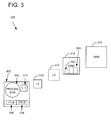
- Figure 3 is a block diagram of an exemplary system for managing memory via multiple levels with varying access speeds.
- Modem computers 300 include a central processing unit(s) 302 (CPU), which include processor(s) 304 and various levels of memory including but not limited to on-chip cache 306, 308, 310, off-chip cache 312, 314, random access memory (RAM) 316, disk storage 318 and many other forms of memory.
- Computers execute programs that have been processed into executable files. The processor fetches the instructions from memory, decodes the instructions, and executes the decoded instructions to perform various functions. To improve performance and speed, computers use various levels of memory to increase the likelihood that a next instruction or data will be available when needed. For example, instead of looking in RAM every time data or instructions (i.e., resources) are needed, the processor checks to see whether the resources are in cache. Obtaining a needed resource from cache is faster than obtaining it from RAM or disk because it can be accomplished in fewer clock cycles. Computers often are designed to provide separate caches for instructions and data. The described methods and systems improve computing performance by reducing the time required to retrieve resources.
- the TLB is used to translate what is presently available in virtual address space to where it is located in physical memory.
- TLB cache is expensive hardware, so designers prefer to keep the size smaller.
- the TLB is a map of what portion of the larger program state is in memory 316.
- the program execution requests an address that is not in RAM 316 as determined by the TLB cache, it encounters a page fault. If the page containing the address is resident in memory then the page fault is called a soft page fault and it takes a few hundred cycles to update the TLB entry for that address. If the page containing that address is not resident in memory, then it must be brought into memory from storage. In this case, the page fault is called a hard page fault and it can take millions of instructions to bring the page from disk.
- memory management involves among other things, managing what pages (blocks, segments, etc.) are available, and how to increase the likelihood that a needed resource will be available to the processor in the fewest number of clock cycles.
- L1 cache level one (L1) cache
- L2 cache level one (L2) cache
- L3 cache can be obtained in about 20-100 clock cycles
- resources in memory can be obtained in about 500 clock cycles
- resources in storage take significantly longer to obtained. Resources are brought into memory from storage in pages (e.g., 4K bytes) as needed, and smaller sizes such as blocks are brought into cache as needed (e.g., 64-128 bytes).
- the system instruments a program to monitor objects accessed during execution (program monitoring), monitors the program for performance indicators that trigger heap 320 optimization (performance monitoring), and reorganizes the accessed objects onto a single page(s) 322 in memory in order to increase program performance due to improved data locality (data locality optimization). Additionally, once data is optimized for locality, the system begins monitoring the optimized program. Thus, the system is dynamic and ongoing.
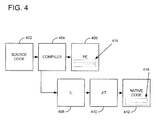
- Figure 4 is a diagram of exemplary methods 400 of creating executable code.
- source code 402 is compiled 404 and distributed in executable form 406 (e.g. X86) and brought into memory as needed.
- executable form 406 e.g. X86
- some code binaries can be run in any compatible environment.
- the compatible binary code is a portable executable (PE) that can be executed in any X86 environment.
- PE portable executable
- source code 402 is compiled 404 into intermediate level code 408 (e.g., MSIL, Java, etc.), that can be further compiled 410 into native executable 412 for the processor where it will execute (e.g., x86, x64, etc.).
- intermediate level code 408 e.g., MSIL, Java, etc.
- native executable 412 e.g., x86, x64, etc.
- JIT just-in-time
- Memory management including garbage collection, is employed in many computing environments including those contemplated by Figure 4, and a single computing environment can employ any of these methods of compilation.
- existing binaries can be instrumented 414 to record what objects are accessed during execution, as well as instrumented 416 during JIT compilation.
- the locality optimizations described herein tend to be especially useful in JIT compilation because often these languages rely more heavily on memory management to clean-up objects that are no longer referenced by programs (e.g., via reachability analysis, reference counts, etc).
- Some high level languages require a programmer to allocate and de-allocate memory that their program is expected to need.
- Other languages or runtimes allow the programmer to rely on garbage collection to do the de-allocation.
- a garbage collection involves identifying in the heap what objects are still in use and discarding any objects that are no longer referenced.
- GC garbage collectors were invoked when there is not enough space to meet new allocation requests, and space occupied by objects that were determined to be no longer referenced were freed and made available for new objects.
- GC was viewed primarily as a way of reclaiming memory as needed. For example, when a program needs more memory than is presently available, the heap is traversed to find out what memory is reachable on the heap. Reachable memory was packed onto pages, and freed space was made available for resources requested by the processor. Thus, GC was triggered only when new allocation requests could not be satisfied.
- GC is viewed as a way of improving the locality of data, and thereby improving performance.
- GC is viewed primarily as improving locality for performance, and secondarily for freeing memory as needed.
- GC often results in improved performance despite the overhead of tracking hot objects and arranging the accessed objects together. In one example, even though GC was performed 50% more times than it would have been performed merely for reclaiming space, the net performance was still better.
- the hot objects are packed onto a page(s), there is increased likelihood that portions of the packed hot page moved into cache will also be needed by the processor.
- packing objects onto a page or set of pages increases spatial locality not only on the heap but also in cache where portions of that page are placed.
- a side effect of packing a page with hot objects is an increased utilization of cache.
- a locality optimization collection operates separately from garbage collection.
- memory pressure causes an existing garbage collection method to free memory, but the locality optimization is invoked whenever necessary as described herein.
- the locality optimization method is provided as an additional optimization of garbage collection, which is convenient since the existing methods and data structures managing the heap can be used to support locality optimization. For example, during a garbage collection while live objects are identified, live and hot objects can be recognized as well and packed in the hot page(s).
- FIG. 5 is an exemplary diagram illustrating exemplary objects spread throughout pages in memory.
- each grid 502 denotes a page on a heap 500 and objects within grids denote live objects 504 or discarded (e.g., released or no longer referenced) objects 506.
- the heap typically occupies a portion of RAM. At any given moment, parts of the heap are available in faster cache memory, based on the size of the available cache.
- the TLB maps the virtual address space to physical addresses and indicates what portions of the virtual address space can be quickly translated to physical address in RAM.
- a garbage collection method is triggered based on memory pressures.
- a bit is set 508 in each object accessed.
- these objects with set bits are collected onto a single set of contiguous pages in memory.
- a hot bit table outside the objects indicates what objects were accessed. Either way, this hot bit data indicates what objects to place on hot pages.
- FIG. 6 is a diagram of an exemplary generational garbage collection method and system.
- the heap 600 is logically divided into generations (e.g., G0, G1, and G2). These generations are logically viewed as portions of the heap, and often three generations are used to divide the heap. For example, there is a youngest generation 602 of objects most recently allocated along with free space, an older generation of objects 604, and a generation of oldest objects 606. Typically, these objects are viewed in terms of time from original allocation, where the youngest objects and the available free space are logically viewed in the first generation 602.
- the logical view of the heap is stored in a data structure that indicates generation boundaries 608, along with an indication of where free space begins.
- garbage collection is triggered based on memory pressure (e.g., the actual or anticipated need for more memory space). For example, when an object allocation is requested and the available memory is too small or the available memory has fallen below some preferred or desirable threshold.
- garbage collection live objects are identified, and garbage is collected (e.g., objects no longer reachable, objects no longer referenced, etc) and removed from the heap, and the size of the generations are adjusted as the freed memory is logically moved to the youngest generation.
- the first generation 602 may be garbage collected several times. When a memory collection of a younger generation no longer produces a desirable threshold of free memory, an older generation can be garbage collected 604. For example, when a triggered garbage collection of the first generation no longer produces enough free memory, it will trigger a garbage collection of the second generation. Several garbage collections of the second generation may occur before any garbage collection of the third generation. Once a first and second generation garbage collection does not collect enough free memory, a garbage collection of the third generation is triggered. Over time, dead objects are removed and the live objects are compacted.
- garbage collection methods such as “mark and sweep”, where dead objects are placed on a free list and “mark and compact” where live objects are compacted together in the heap. Any of these garbage collection methods (along with variations therefrom, combinations thereof, and improvements thereto) can be adapted or enhanced to support the locality optimizations described herein once a skilled artisan has read this specification.
- the described optimization monitors what objects are touched between optimizations or during an interval, and packs these objects on a hot page(s) on the heap when the optimization is triggered.
- a copying generational garbage collector was an interesting environment to adapt to the optimizations discussed herein. It traverses objects to identify all live objects and then compacts them based on their allocation order, which can be taken advantage of to identify hot objects and then pack them together in the desired order. So, these optimizations are not limited by copying generational garbage collection, but are easily supported by it.
- a JIT compiler was modified to instrument operations that access the heap.
- the instrumented code monitors when objects on the heap are touched.
- an area of memory is introduced (e.g., appended to) within each object to indicate whether the object was touched.
- a known unused area of memory e.g., a bit, or bits
- an object header has available space that can be used for various reasons. A bit is set, or a touch is counted if multiple bits are used, and objects touched between optimization or during an interval are packed on a hot page(s). This method is often of low overhead.
- the touched bit(s) (or bit-counter) is cleared so that they are ready to record whether or not they will be touched (or touches are counted from zero) for the next hot object collection.
- placing hot object indication bits in the header is not required.
- the bit(s) can be placed anywhere in the object or elsewhere. Note that there is no sequence information needed to be recorded here.
- a hot object bit table would denote one bit for each object. This would require more memory, but it may be better in many examples since the bits could be more easily cleared after the hot objects are identified.
- bit vector is created that is a smaller version of the heap.
- bits in the bit vector correspond to addresses or areas of the heap, and a bit in the vector is set to indicate that an address or area of the heap was accessed.
- the bit vector can be easily reset, for example, between hot page optimizations, or when garbage collection for memory pressure is performed.
- one or more metrics may be used to determine when to trigger the locality optimization (e.g., allocation rates, performance metrics, etc).
- live objects with corresponding bit(s) indicating they are hot are identified and placed on the hot page(s).
- all hot objects are first copied out of the heap and assembled into a temporary buffer to allow traditional garbage collection for space to proceed as usual, then the assemblage of all hot objects is placed at the younger end of the heap, where newly allocated objects will be placed near these hot live objects. This implementation increases data locality greatly with very low overhead.
- hot objects when hot objects are encountered (e.g., as indicated by set bits) during GC for locality, the hot objects are evaluated to see what other hot objects they point to.
- a hot object points to another hot object, then not only are both hot objects placed on the hot page(s), but they are placed near each other. This provides a lower overhead way of increasing the likelihood that when portions of the hot page are moved into cache, the objects moved into cache will likely be referenced one after another. This will often provide efficient performance.
- Table A shows the page density of four test applications written in C#. These numbers were obtained by running these applications using a dynamic translator and logging memory reads and writes. The numbers do not include references to stack pages. The density metric is equal to the numbers of unique bytes read or written on a page divided by the size of the page. In this example, an interval is set at 10 6 references. Below Table A illustrates that data pages are used very ineffectively, which usually implies poor spatial locality. TABLE A Applications C# Pages touched per interval Average Page Density TestApplication1 600 7.7% TestApplication2 588 6.5% XamlParserTest 602 6.0% SatSolver 1703 28%
- a copying generational garbage collector is optimized to increase data locality.
- the method may be employed using a virtual machine with memory management including garbage collection.
- the system is agnostic with respect to most other details of a virtual machine.
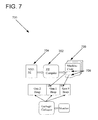
- FIG. 7 illustrates an architectural overview 700 of one possible embodiment of the system.
- a just-in-time (JIT) compiler 702 is configured to take an intermediate language representation 704 (e.g., MSIL) and compile it into machine code 706 for a particular architecture.
- the JIT compiler can be modified to insert lightweight instrumentation in the compiled code.
- the instrumented code 708 marks objects that have been recently accessed.
- Monitoring code can be inserted in the runtime (e.g., common language runtime (CLR) or Java runtime) to gather metrics while the application is running.
- the monitoring code can use the monitoring data and heuristics to trigger GC-for-locality.
- GC-for-locality objects that have been marked as recently accessed (hot) can be identified and co-located on pages separate from the rest of the heap.
- the GC-for-locality can be triggered independently of a normal GC, which is triggered upon detection of memory pressure.
- increasing page densities for data pages may be advantageous. For example, it may be cheaper to collect profile information for page optimization. Since pages (typically 4KB) are several orders of magnitude larger than cache lines (typically 64-128 bytes), one does not need to get precise temporal sequences of data accesses in order to do efficient packing. One can afford to pack data more loosely since the "bin" sizes are larger. Note that by simply increasing page densities, one similarly increases the chances of packing data for better cache utilization (by removing cold intervening objects). This results in significant cache benefits for many programs, effectively as a free side effect of page optimization.
- L2 caches are typically indexed on physical memory addresses, not virtual addresses (e.g. this is true on all x86 architectures). So if a page entry is missing in the TLB, then it may not help much to have the data in the L2 cache.
- a counter is used to decide which objects are hot.
- a compiler or JIT compiler
- the read barrier code may consist of a single call instruction to a helper routine which updates the counter if it is not set.
- Write barriers can be automatically generated by the compiler to support the generational GC, and can be modified to insert a conditional update of the counter.
- the system includes an implementation of a counter, an implementation of a read barrier, and instrumentation of objects (e.g., operations that read/write to heap) so that reads and/or writes are counted.
- objects e.g., operations that read/write to heap
- the object reference counter can be implemented in different ways.
- the object reference counter may be embedded in the object.
- the object reference counter may be implemented as a separate table.
- a 1-bit counter is used that is embedded in the object.
- if an object is touched a bit is set to reflect that the object has been touched at least once during an interval.
- several bits corresponding to an object can function as a counter reflecting how many times an object is touched during the interval.
- each touch is added to the counter corresponding to the touched object.
- a threshold number of touches establishes whether an object is hot or not.
- One or more touches in an interval can be used to identify a hot object.
- Hot objects may also include objects instantiated (created) during the interval.
- the bit(s) corresponding to an object may be stored in the object itself or elsewhere. If the counter corresponding to an object is outside the object, preferably it is in a location that can be accessed rapidly since the overhead of counting should be minimized.
- the counter (one or more bits) is stored in the object itself.
- the CLR has a four byte object header for each object that can be used for various purposes (e.g. to implement a lightweight lock). In some embodiments it may be possible to use one or more of these 32 bits for the counter (or for the hot bit).
- Table B is sample code for one example of read barrier code.
- profiling code can be used to mark accessed objects.
- rg is the register that holds the object address
- the object header is at offset -4 from the start of the object.
- OBJECT_ACCESSED_BIT is a bit mask used to set a single bit in the object header.
- an interlocked operation is used to set the bit since the object header could be concurrently modified by other threads (e.g. when taking a lock on the object).
- the interlocked operation may be expensive on x86 architectures (e.g., 20-30 clock cycles).
- it may dirty a cache line during a read operation that could hurt scalability of applications on multi-processors. Therefore, in another example, a conditional read barrier may be used instead of an unconditional one, even though the conditional read barrier increases the size of the read barrier code.
- the read barrier is not in-lined. Instead, the read barrier code is implemented as a helper routine (e.g., one for each register).
- an optimizing algorithm reduces the number of read barriers and increases performance and/or reduces the amount of added code.
- the read barrier employed is different from normal access barriers in that a call to it is not inserted at every access point. For example, calls to the read barrier code could be exposed to the common sub-expression elimination (CSE) optimization.
- CSE common sub-expression elimination
- no profiling calls are inserted into exception handling code.
- another example ignores constructors that are not in-lined.
- the counter is embedded the in the object
- the counter bit(s) cannot be cheaply cleared without scanning all live objects.
- the counter is cleared while objects are traversed during garbage collection (GC).
- the counter is cleared every time a hot object is encountered during a GC-for-locality.
- the instrumentation model described above has low overhead and is adequate enough to speed up overall performance.
- dynamic heap reorganization may not significantly improve the performance of an application (e.g., if the dataset is small enough to fit in the available memory).
- the cost of the instrumented code e.g., the read barrier
- the read barrier can be too high (in some cases degrading the application by as much as 40%).
- one example only profiles the code intermittently. For example, if a method is instrumented with profiling read barriers, then a second copy of the method may be generated which doesn't have the instrumentation. During profiling (i.e., monitoring, sampling, etc.) the instrumented version is used. During normal operation, the method without the instrumentation is utilized. The prolog of each method is extended to perform a check and transfer control to either the instrumented or the non-instrumented version of the method. In some embodiments, back edges are not modified. Surprisingly, this simplification may not reduce the effectiveness of this approach (e.g., on the benchmarks below -- except for some synthetic ones that have long-running hot loops). As a further optimization, the two copies may be placed in two separate code heaps.
- the normal version of code is run normally, and the instrumented version of the code is run for short periods of time, and only periodically.
- the instrumented code is run for 10 milliseconds, every ten thousand milliseconds. This will produce information about what objects are touched during the periodic sampling period. This information is used to pack the hot page.
- the CLR GC implements a variation of the generational mark-compact garbage collector and divides the small object heap into three generations.
- heap reorganization for locality may be limited to generations greater than 0.
- One rationale for not doing heap reorganization during a generation 0 collection is that most of those generation 0 objects have been recently allocated. Since they have been recently allocated, they are already in the cache or working set, and are thus unlikely to benefit much from locality improvements.
- the system identifies all objects that were a) marked as hot since the previous locality collection and b) belong to a generation that is equal or lower to the generation being collected. In this example, only these objects are candidates for locality optimization. After all the candidate objects having been identified, the locality optimization can decide how they should be laid out and then where hot objects should be placed back onto the GC heap.
- the hot object layout is done using two copying phases.
- the original locations are marked free and reclaimed by the collector.
- Second, the well-rearranged aggregation of hot objects may then be placed back at the younger end of the heap.
- double copying is avoided (e.g., by reserving a designated section of the heap).
- the layout does not mix objects from different generations.
- Another consideration is determining when to trigger optimization for locality. Additionally, determining when triggering for locality optimization is not working so that it is not fruitlessly continued when it is having reduced net performance benefits.
- rates of memory pressured GC collections are monitored.
- a hot object locality optimization is performed every 2 nd , 3 rd , ... N th , memory triggered collection.
- rates of object allocation are monitored. When there is a significant decrease in allocations of new objects, the application is assumed to be reusing instead of allocating new objects. Once allocation rates drop and become relatively stable, optimization for locality is triggered.
- both allocation rates and performance counters are monitored. While allocation rates increase and are high, no optimization is performed. But once allocation rates drop and get relatively stable, the data structures for the program are likely set up and it is more likely that objects will be repeatedly accessed, creating the opportunity to benefit from locality optimization. Additionally, once allocation rates are lower and relatively stable, a high rate ofDTLB or L2 cache misses as indicated by the performance counter is likely to provide a good trigger for optimization. Since new allocations are low, the DTLB and L2 cache misses indicate that blocks are moving in and out of RAM and cache rapidly, and congregating hot objects is likely to reduce overall DTLB and L2 cache misses.
- optimization for data locality could be triggered at regular or varied intervals.
- a previous optimization showed low performance improvements (e.g., same DTLB miss rates after optimization, etc.) and the interval between optimizations is too small, the interval before a next optimization could be increased. If a previous optimization improves DTLB cache miss rates more than a threshold and the interval is too big, the next optimization might be triggered sooner.
- the rate of allocation may be a pretty reliable measure for triggering locality optimization.
- performance counters are used to measure miss rates for data TLB and L2 caches after an optimization. If the data TLB or cache miss rates do not improve according to some relative baseline, it may be desirable to discontinue or reduce triggering GC for locality, for some period of time, or until the results show that the benefits justify the costs.
- any that directly or indirectly triggers the reorganization of the heap for clustering accessed objects is considered program behavior.
- the heap is reorganized (e.g., clustered).
- One or more of the monitored program behavior indicators can trigger a heap reorganization of live-hot objects.
- a performance counter provides a way of determining what objects were touched (e.g., the IA64 processor).
- the code may not need to be instrumented.
- the performance counters indicate what objects (e.g., addresses in the heap) were touched during a period or since the counters were reset. This would be beneficial since the operations touching the heap would not need to be instrumented to identify hot objects. For example, TLB miss addresses could be provided via this instruction.
- instructions are rumored to be introduced soon that will record whenever objects in memory are accessed (e.g., read/write). These addresses or objects will be recorded to an internal circular buffer and made available. These accessed objects provide the information needed to create the hot page(s).
- Allocated objects are "live” but only recently accessed live objects are also "hot”. Historically, hot objects were not known or considered when performing garbage collection. Live objects were compacted and dead objects (e.g., de-allocated or released objects) were collected for new free space during garbage collection. Using the described technologies, even without requiring garbage collection, the live-hot objects are clustered together on the heap. Interestingly, not all accessed objects need to be placed in the same area of the heap in order for this technology to provide substantial benefits. For example, if a sampling period is used to monitor accessed objects and set access bits, then only objects accessed during the sampling period will be placed in a hot cluster on the heap.
- one or more clusters on the heap do not need to include all recently accessed objects in order to be within the scope of this technology. Additionally, even when object access monitoring is continuous (as compared to periodic sampling periods, or otherwise), not all accessed objects need to be placed in the same cluster to obtain significant benefits from the described technology. For example, if two clusters are created anywhere in the heap, then having the hot objects in two (or even several locations) instead of spread all over pages of the heap will provide significant benefits. Thus, clustering live-hot objects on the heap in one or more locations of significantly higher concentrations of hot-live objects is contemplated. Of course, if the hot objects are placed in a single cluster of close proximity, this will likely provide even better results.
- a cluster that fit within a page of the heap might be considered ideal, but certainly not necessary.
- a working set of hot objects is large enough to occupy plural pages on the heap, it may be beneficial if those plural pages are placed near each other, but not required.
- a working set of hot objects occupies plural clusters, then whenever one of the clusters is brought into cache, there is a probability that other hot objects in that cluster will be accessed soon.
- swapping higher probability clusters in and out of cache is likely to require few swaps, regardless of where each individual hot cluster is contained on the heap. All of these ideas contemplate clustering recently accessed objects.
- clustering in the proximity of recently allocated objects provides additional benefits. For example, in a generational garbage collection heap, clustering near the youngest generation of the heap is helpful because newly allocated objects are also generally hotter than older objects.
- experimental results were observed.
- a prototype triggered GC heap reorganization of hot objects and the reorganization provided beneficial results in performance.
- the prototype utilized was a workstation version of the commercial CLR implementation with concurrent GC disabled on the Windows XP operating system.
- the experiments were performed on several machines with different configurations of memory, cache sizes, and CPU speeds. GC for locality improved performance best on machines with smaller L2 cache and memory, which is not surprising.
- micro-benchmarks were created and two applications written in C# were obtained for the analysis.
- the four micro-benchmarks i.e., Tree, Array, SList and Hashtable
- the micro-benchmarks create the respective data structure from a large number of randomly generated data interleaved with some garbage data.
- the benchmarks repeatedly search for a set of data after a training loop and a forced GC.
- One test application called "XamlParserTest” reads from an XAML file three times to measure the performance of different components of the parser.
- XAML extensible application markup language
- the input file used contains a simple but 11000-level deeply nested node.
- Another application called “SAT Solver” is a SAT solver converted into C# from its C++ implementation.
- the input file describes a problem instance with 24640 3250-variable CNFs (conjunctive normal form).
- Instrumentation overhead may vary depending on whether an always-on approach or sampling approach is taken. Table D compares the profiling overheads between the always-on and sampling approaches. The sampling makes the profiling overhead acceptable for the optimization.
- TABLE D Orig always-on profiling Sampling time (sec) slowdown time (sec) slowdown XamlParserTest 117.98 123.10 4.3% 119.66 1.4% SAT solver 138.00 204.90 48.5% 138.90 0.7% Max 97.70 115.80 18.5% 98.30 0.6°/a GenIBC 6.50 7.70 18.5% 6.90 6.2% Tree 4.20 5.30 26.2% 4.40 4.8% Array 17.58 20.03 13.9% 17.98 2.3% List 11.93 14.90 24.9% 12.53 5.0% Hashtable 6.67 7.26 8.8% 6.81 2.1%
- Table E indicates the average number of pages accessed per interval and average page density, with and without optimization (i.e., triggering GC for reorganizing hot objects onto a page(s)). It was measured by collecting traces of memory references, dividing the execution into 1000000-reference intervals (for hashtable micro-benchmark, each interval contains 10000000 references), and computing the number of pages accessed per interval and percentage of data actually accessed on each page for the last 1000 intervals. In general, by packing objects according to the program's access pattern, the optimization may reduce the working set and may increase the "useful" data on each page.
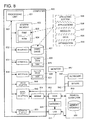
- FIG. 8 and the following discussion are intended to provide a brief, general description of a suitable computing environment for an implementation. While the invention will be described in the general context of computer-executable instructions of a computer program that runs on a computer and/or network device, those skilled in the art will recognize that the invention also may be implemented in combination with other program modules. Generally, program modules include routines, programs, components, data structures, etc. that perform particular tasks or implement particular abstract data types. Moreover, those skilled in the arts will appreciate that the invention may be practiced with other computer system configurations, including multiprocessor systems, microprocessor-based electronics, minicomputers, mainframe computers, network appliances, wireless devices, and the like. The extensions can be practiced in networked computing environments, or on stand-alone computers.
- an exemplary system for implementation includes a conventional computer 820 (such as personal computers, laptops, servers, mainframes, and other variety computers) includes a processing unit 821, a system memory 822, and a system bus 823 that couples various system components including the system memory to the processing unit 821.
- the processing unit may be any of various commercially available processors, including Intel x86, Pentium and compatible microprocessors from Intel and others, including Cyrix, AMD and Nexgen; Alpha from Digital; MIPS from MIPS Technology, NEC, IDT, Siemens, and others; SPARC from Sun and others; and the PowerPC from IBM and Motorola. Dual microprocessors and other multiprocessor architectures also can be used as the processing unit 821.
- the system bus may be any of several types of bus structure including a memory bus or memory controller, a peripheral bus, and a local bus using any of a variety of conventional bus architectures such as PCI, VESA, AGP, Microchannel, ISA and EISA, to name a few.
- the system memory includes read only memory (ROM) 824 and random access memory (RAM) 825.
- ROM read only memory
- RAM random access memory
- BIOS basic input/output system
- BIOS basic routines that help to transfer information between elements within the computer 820, such as during start-up, is stored in ROM 824.
- the computer 820 further includes a hard disk drive 827, a magnetic disk drive 828, e.g., to read from or write to a removable disk 829, and an optical disk drive 830, e.g., for reading a CD-ROM disk 831 or to read from or write to other optical media.
- the hard disk drive 827, magnetic disk drive 828, and optical disk drive 830 are connected to the system bus 823 by a hard disk drive interface 832, a magnetic disk drive interface 833, and an optical drive interface 834, respectively.
- the drives and their associated computer-readable media provide nonvolatile storage of data, data structures, computer-executable instructions, etc. for the computer 820.
- a number of program modules may be stored in the drives and RAM 825, including an operating system 835, one or more application programs 836, other program modules 837, and program data 838; in addition to an implementation of the described monitoring and optimizations 856.
- a user may enter commands and information into the computer 820 through a keyboard 840 and pointing device, such as a mouse 842.
- a serial port interface 846 that is coupled to the system bus, but may be connected by other interfaces, such as a parallel port, game port or a universal serial bus (USB).
- a monitor 847 or other type of display device is also connected to the system bus 823 via an interface, such as a video adapter 848.
- computers typically include other peripheral output devices (not shown), such as speakers and printers.
- the computer 820 operates in a networked environment using logical connections to one or more remote computers, such as a remote computer 849.
- the remote computer 849 may be a server, a router, a peer device or other common network node, and typically includes many or all of the elements described relative to the computer 820, although only a memory storage device 850 has been illustrated.
- the logical connections depicted include a local area network (LAN) 851 and a wide area network (WAN) 852.
- LAN local area network
- WAN wide area network
- Such networking environments are commonplace in offices, enterprise-wide computer networks, intranets and the Internet.
- the computer 820 When used in a LAN networking environment, the computer 820 is connected to the local network 851 through a network interface or adapter 853. When used in a WAN networking environment, the computer 820 typically includes a modem 854 or other means for establishing communications (e.g., via the LAN 851 and a gateway or proxy server 855) over the wide area network 852, such as the Internet.
- the modem 854 which may be internal or external, is connected to the system bus 823 via the serial port interface 846.
- program modules depicted relative to the computer 820, or portions thereof, may be stored in the remote memory storage device. It will be appreciated that the network connections shown are exemplary and other means of establishing a communications link between the computing devices may be used, wireless or otherwise.
Landscapes
- Engineering & Computer Science (AREA)
- Theoretical Computer Science (AREA)
- Physics & Mathematics (AREA)
- General Engineering & Computer Science (AREA)
- General Physics & Mathematics (AREA)
- Software Systems (AREA)
- Quality & Reliability (AREA)
- Memory System Of A Hierarchy Structure (AREA)
- Devices For Executing Special Programs (AREA)
- Memory System (AREA)
Applications Claiming Priority (2)
| Application Number | Priority Date | Filing Date | Title |
|---|---|---|---|
| US60873404P | 2004-09-10 | 2004-09-10 | |
| US10/968,577 US7769974B2 (en) | 2004-09-10 | 2004-10-18 | Increasing data locality of recently accessed resources |
Publications (2)
| Publication Number | Publication Date |
|---|---|
| EP1635264A2 true EP1635264A2 (fr) | 2006-03-15 |
| EP1635264A3 EP1635264A3 (fr) | 2009-03-25 |
Family
ID=35447416
Family Applications (1)
| Application Number | Title | Priority Date | Filing Date |
|---|---|---|---|
| EP05108006A Withdrawn EP1635264A3 (fr) | 2004-09-10 | 2005-09-01 | Augmentation de la localité de données de ressources récemment accédées |
Country Status (4)
| Country | Link |
|---|---|
| US (1) | US7769974B2 (fr) |
| EP (1) | EP1635264A3 (fr) |
| JP (1) | JP2006092532A (fr) |
| KR (1) | KR20060051177A (fr) |
Cited By (2)
| Publication number | Priority date | Publication date | Assignee | Title |
|---|---|---|---|---|
| WO2013090194A1 (fr) * | 2011-12-14 | 2013-06-20 | Advanced Micro Devices, Inc. | Processeur à classification de mémoire basée sur une récupération d'espace mémoire |
| EP2430550A4 (fr) * | 2009-05-12 | 2014-04-23 | Clausal Computing Oy | Regroupements d'objets correspondants pendant la collecte de déchets |
Families Citing this family (75)
| Publication number | Priority date | Publication date | Assignee | Title |
|---|---|---|---|---|
| US7577947B2 (en) * | 2003-12-19 | 2009-08-18 | Intel Corporation | Methods and apparatus to dynamically insert prefetch instructions based on garbage collector analysis and layout of objects |
| US20050165837A1 (en) * | 2004-01-22 | 2005-07-28 | International Business Machines Corporation | System and method for embedded java memory footprint performance improvement |
| US7493605B2 (en) * | 2004-12-29 | 2009-02-17 | Mainsoft R&D Ltd | Method and a software product for adapting a .Net framework compliant reflection mechanism to a java environment |
| US8713524B2 (en) * | 2005-04-06 | 2014-04-29 | Microsoft Corporation | Memory management configuration |
| US7539822B1 (en) * | 2005-04-13 | 2009-05-26 | Sun Microsystems, Inc. | Method and apparatus for facilitating faster execution of code on a memory-constrained computing device |
| US20070174717A1 (en) * | 2006-01-10 | 2007-07-26 | Sun Microsystems, Inc. | Approach for testing instruction TLB using user/application level techniques |
| US7904894B2 (en) * | 2006-03-29 | 2011-03-08 | Microsoft Corporation | Automatically optimize performance of package execution |
| US20070240141A1 (en) * | 2006-03-30 | 2007-10-11 | Feng Qin | Performing dynamic information flow tracking |
| US7594145B2 (en) * | 2006-05-31 | 2009-09-22 | Fujitsu Limited | Improving performance of a processor having a defective cache |
| EP2036307A1 (fr) * | 2006-06-30 | 2009-03-18 | International Business Machines Corporation | Procédé et appareil de mise en mémoire d'informations de diffusion |
| US9507574B2 (en) * | 2006-09-28 | 2016-11-29 | International Business Machines Corporation | Method, computer program product, and device for selectively allocating memory |
| US20080148241A1 (en) * | 2006-10-11 | 2008-06-19 | Scott Thomas Jones | Method and apparatus for profiling heap objects |
| US20090013017A1 (en) * | 2007-07-03 | 2009-01-08 | Branda Steven J | Methods, Systems, and Computer Program Products for Optimizing Virtual Machine Memory Consumption |
| US7900011B2 (en) * | 2007-07-19 | 2011-03-01 | International Business Machines Corporation | Apparatus, system, and method for improving system performance in a large memory heap environment |
| US20090132769A1 (en) * | 2007-11-19 | 2009-05-21 | Microsoft Corporation | Statistical counting for memory hierarchy optimization |
| CN101520733B (zh) * | 2008-02-27 | 2014-04-16 | 国际商业机器公司 | 装载类的方法和装置及重组类存档文件方法 |
| US7552396B1 (en) * | 2008-04-04 | 2009-06-23 | International Business Machines Corporation | Associating screen position with audio location to detect changes to the performance of an application |
| JP2010015223A (ja) * | 2008-07-01 | 2010-01-21 | Internatl Business Mach Corp <Ibm> | メモリ領域中のオブジェクトを隔離するための方法 |
| US8051332B2 (en) | 2008-07-15 | 2011-11-01 | Avicode Inc. | Exposing application performance counters for .NET applications through code instrumentation |
| US9104794B2 (en) * | 2008-07-15 | 2015-08-11 | Microsoft Technology Licensing, Llc | Automatic incremental application dependency discovery through code instrumentation |
| JP4711269B2 (ja) | 2008-11-21 | 2011-06-29 | インターナショナル・ビジネス・マシーンズ・コーポレーション | メモリ電力制御方法及びメモリ電力制御プログラム |
| US20110066897A1 (en) * | 2009-09-11 | 2011-03-17 | William Bumgarner | Methods and apparatuses for determining permanent memory growth |
| JP4917138B2 (ja) | 2009-10-07 | 2012-04-18 | インターナショナル・ビジネス・マシーンズ・コーポレーション | オブジェクト最適配置装置、オブジェクト最適配置方法、及びオブジェクト最適配置プログラム |
| US8832403B2 (en) * | 2009-11-13 | 2014-09-09 | International Business Machines Corporation | Generation-based memory synchronization in a multiprocessor system with weakly consistent memory accesses |
| US8250121B2 (en) * | 2009-11-18 | 2012-08-21 | Oracle America, Inc. | Zero-copy maturing of large objects in generational heap with copying collection |
| US20110154289A1 (en) * | 2009-12-18 | 2011-06-23 | Sandya Srivilliputtur Mannarswamy | Optimization of an application program |
| JP2011154547A (ja) * | 2010-01-27 | 2011-08-11 | Toshiba Corp | メモリ管理装置及びメモリ管理方法 |
| US8782102B2 (en) | 2010-09-24 | 2014-07-15 | International Business Machines Corporation | Compact aggregation working areas for efficient grouping and aggregation using multi-core CPUs |
| KR101303079B1 (ko) * | 2011-05-04 | 2013-09-03 | 한국과학기술원 | 멀티-코어 기반의 가상화 환경에서 캐쉬 일관성을 제어하는 장치 및 방법 |
| US9965381B1 (en) * | 2011-06-30 | 2018-05-08 | EMC IP Holding Company LLC | Indentifying data for placement in a storage system |
| US8789026B2 (en) * | 2011-08-02 | 2014-07-22 | International Business Machines Corporation | Technique for compiling and running high-level programs on heterogeneous computers |
| US8627036B2 (en) * | 2011-09-12 | 2014-01-07 | Microsoft Corporation | Memory management techniques |
| US8966635B2 (en) * | 2012-02-24 | 2015-02-24 | Hewlett-Packard Development Company, L.P. | Software module object analysis |
| US8930624B2 (en) | 2012-03-05 | 2015-01-06 | International Business Machines Corporation | Adaptive cache promotions in a two level caching system |
| US8694562B2 (en) * | 2012-05-22 | 2014-04-08 | Microsoft Corporation | Generational garbage collection for a pool-based heap |
| US8839201B2 (en) | 2012-10-12 | 2014-09-16 | Vmware, Inc. | Capturing test data associated with error conditions in software item testing |
| US9684587B2 (en) | 2012-10-12 | 2017-06-20 | Vmware, Inc. | Test creation with execution |
| US10067858B2 (en) | 2012-10-12 | 2018-09-04 | Vmware, Inc. | Cloud-based software testing |
| US10387294B2 (en) | 2012-10-12 | 2019-08-20 | Vmware, Inc. | Altering a test |
| US8949794B2 (en) | 2012-10-12 | 2015-02-03 | Vmware, Inc. | Binding a software item to a plain english control name |
| US9292422B2 (en) | 2012-10-12 | 2016-03-22 | Vmware, Inc. | Scheduled software item testing |
| US9292416B2 (en) | 2012-10-12 | 2016-03-22 | Vmware, Inc. | Software development kit testing |
| US9069902B2 (en) | 2012-10-12 | 2015-06-30 | Vmware, Inc. | Software test automation |
| US8839202B2 (en) * | 2012-10-12 | 2014-09-16 | Vmware, Inc. | Test environment managed within tests |
| WO2014128955A1 (fr) * | 2013-02-25 | 2014-08-28 | 株式会社日立製作所 | Récupération d'espace mémoire pour sélectionner une région de récupération sur la base d'une mise à jour d'informations de source de référence |
| US9760351B2 (en) * | 2013-04-02 | 2017-09-12 | Google Inc. | Framework for user-directed profile-driven optimizations |
| US9342389B2 (en) * | 2013-04-04 | 2016-05-17 | SK Hynix Inc. | Neighbor based and dynamic hot threshold based hot data identification |
| US9213532B2 (en) | 2013-09-26 | 2015-12-15 | Oracle International Corporation | Method for ordering text in a binary |
| US9805047B1 (en) * | 2014-05-21 | 2017-10-31 | Veritas Technologies Llc | Systems and methods for retrieving data |
| US9983880B2 (en) * | 2014-09-26 | 2018-05-29 | Intel Corporation | Method and apparatus for improved thread selection |
| WO2016118615A1 (fr) * | 2015-01-20 | 2016-07-28 | Ultrata Llc | Exécution d'instructions de flux de données de mémoire d'objet |
| WO2016118627A1 (fr) | 2015-01-20 | 2016-07-28 | Ultrata Llc | Gestion de méta-données dans une matrice de mémoire d'objet |
| US9886210B2 (en) | 2015-06-09 | 2018-02-06 | Ultrata, Llc | Infinite memory fabric hardware implementation with router |
| US9971542B2 (en) | 2015-06-09 | 2018-05-15 | Ultrata, Llc | Infinite memory fabric streams and APIs |
| US10698628B2 (en) | 2015-06-09 | 2020-06-30 | Ultrata, Llc | Infinite memory fabric hardware implementation with memory |
| US10083113B2 (en) | 2015-07-27 | 2018-09-25 | International Business Machines Corporation | Scheme for determining data object usage in a memory region |
| US10223257B2 (en) | 2015-07-27 | 2019-03-05 | International Business Machines Corporation | Multi-section garbage collection |
| US11030262B2 (en) * | 2015-08-25 | 2021-06-08 | Verizon Media Inc. | Recyclable private memory heaps for dynamic search indexes |
| KR102449192B1 (ko) | 2015-09-10 | 2022-09-29 | 삼성전자주식회사 | 데이터 저장 장치의 작동 방법과 이를 포함하는 데이터 처리 시스템의 작동 방법 |
| KR102501751B1 (ko) | 2015-09-22 | 2023-02-20 | 삼성전자주식회사 | 메모리 콘트롤러, 불휘발성 메모리 시스템 및 그 동작방법 |
| EP3387547B1 (fr) | 2015-12-08 | 2023-07-05 | Ultrata LLC | Mise en oeuvre logicielle d'une matrice de mémoire |
| CN115061971A (zh) | 2015-12-08 | 2022-09-16 | 乌尔特拉塔有限责任公司 | 使用容错对象的存储器结构操作和一致性 |
| US10884942B2 (en) | 2016-05-19 | 2021-01-05 | International Business Machines Corporation | Reducing memory access latency in scatter/gather operations |
| US10416892B2 (en) | 2016-06-24 | 2019-09-17 | International Business Machines Corporation | Fileset-based data locality enablement in distributed file systems |
| US10783146B2 (en) | 2016-07-19 | 2020-09-22 | Sap Se | Join operations in hybrid main memory systems |
| US10387127B2 (en) | 2016-07-19 | 2019-08-20 | Sap Se | Detecting sequential access data and random access data for placement on hybrid main memory for in-memory databases |
| US10540098B2 (en) | 2016-07-19 | 2020-01-21 | Sap Se | Workload-aware page management for in-memory databases in hybrid main memory systems |
| US10474557B2 (en) | 2016-07-19 | 2019-11-12 | Sap Se | Source code profiling for line-level latency and energy consumption estimation |
| US11977484B2 (en) | 2016-07-19 | 2024-05-07 | Sap Se | Adapting in-memory database in hybrid memory systems and operating system interface |
| US10437798B2 (en) | 2016-07-19 | 2019-10-08 | Sap Se | Full system simulator and memory-aware splay tree for in-memory databases in hybrid memory systems |
| US10452539B2 (en) | 2016-07-19 | 2019-10-22 | Sap Se | Simulator for enterprise-scale simulations on hybrid main memory systems |
| US10698732B2 (en) * | 2016-07-19 | 2020-06-30 | Sap Se | Page ranking in operating system virtual pages in hybrid memory systems |
| US11010379B2 (en) | 2017-08-15 | 2021-05-18 | Sap Se | Increasing performance of in-memory databases using re-ordered query execution plans |
| CN110058938B (zh) * | 2018-01-19 | 2023-08-01 | 斑马智行网络(香港)有限公司 | 一种内存处理方法、装置、电子设备和可读介质 |
| US11281493B2 (en) * | 2018-05-30 | 2022-03-22 | Texas Instruments Incorporated | Real-time context specific task manager for multi-core communication and control system |
Family Cites Families (21)
| Publication number | Priority date | Publication date | Assignee | Title |
|---|---|---|---|---|
| GB9320982D0 (en) * | 1993-10-12 | 1993-12-01 | Ibm | A data processing system |
| US5640534A (en) * | 1994-10-05 | 1997-06-17 | International Business Machines Corporation | Method and system for concurrent access in a data cache array utilizing multiple match line selection paths |
| US5930807A (en) * | 1997-04-23 | 1999-07-27 | Sun Microsystems | Apparatus and method for fast filtering read and write barrier operations in garbage collection system |
| US6202127B1 (en) * | 1997-11-26 | 2001-03-13 | Compaq Computer Corporation | Apparatus for spatial and temporal sampling in a computer memory system |
| JP2000267861A (ja) * | 1999-03-18 | 2000-09-29 | Toshiba Corp | インタプリタの実装方法及びインタプリタプログラムを記録したコンピュータ読み取り可能な記録媒体 |
| US6480862B1 (en) * | 1999-04-23 | 2002-11-12 | International Business Machines Corporation | Relation-based ordering of objects in an object heap |
| US6611858B1 (en) | 1999-11-05 | 2003-08-26 | Lucent Technologies Inc. | Garbage collection method for time-constrained distributed applications |
| US6594678B1 (en) * | 2000-01-05 | 2003-07-15 | Sun Microsystems, Inc. | Methods and apparatus for improving locality of reference through memory management |
| US6510440B1 (en) * | 2000-01-10 | 2003-01-21 | International Business Machines Corporation | Method and apparatus for performing generational garbage collection using barrier bits |
| JP2001236717A (ja) * | 2000-02-18 | 2001-08-31 | Pioneer Electronic Corp | 情報記録再生装置 |
| US6618792B1 (en) * | 2000-04-06 | 2003-09-09 | Sun Microsystems, Inc. | Method and apparatus for locating data in computer systems |
| US6594674B1 (en) * | 2000-06-27 | 2003-07-15 | Microsoft Corporation | System and method for creating multiple files from a single source file |
| JP2002099427A (ja) * | 2000-09-25 | 2002-04-05 | Toshiba Corp | プログラムの開発方法、プログラムの開発システム及びマイクロプロセッサ |
| US7577951B2 (en) * | 2002-05-30 | 2009-08-18 | Hewlett-Packard Development Company, L.P. | Performance of computer programs while they are running |
| EP1387273B1 (fr) | 2002-07-31 | 2010-07-21 | Texas Instruments Incorporated | Récupération de l'espace de mémoire conditionné basée sur la surveillance pour améliorer la performance en temps réel |
| US7293263B2 (en) * | 2002-12-20 | 2007-11-06 | Bea Systems, Inc. | System and method for memory leak detection in a virtual machine environment |
| US7237064B2 (en) * | 2003-10-10 | 2007-06-26 | Intel Corporation | Method and apparatus for feedback-based management of combined heap and compiled code caches |
| US7197521B2 (en) * | 2003-11-21 | 2007-03-27 | Intel Corporation | Method and system performing concurrently mark-sweep garbage collection invoking garbage collection thread to track and mark live objects in heap block using bit vector |
| US7490117B2 (en) * | 2003-12-31 | 2009-02-10 | Intel Corporation | Dynamic performance monitoring-based approach to memory management |
| US7624137B2 (en) * | 2004-01-05 | 2009-11-24 | International Business Machines Corporation | Method and apparatus for scheduling and performing garbage collection in a real-time system with guaranteed space bounds |
| US7424705B2 (en) * | 2004-03-11 | 2008-09-09 | Intel Corporation | Dynamic management of compiled code |
-
2004
- 2004-10-18 US US10/968,577 patent/US7769974B2/en not_active Expired - Lifetime
-
2005
- 2005-09-01 EP EP05108006A patent/EP1635264A3/fr not_active Withdrawn
- 2005-09-09 KR KR1020050084316A patent/KR20060051177A/ko not_active Withdrawn
- 2005-09-12 JP JP2005263906A patent/JP2006092532A/ja active Pending
Cited By (3)
| Publication number | Priority date | Publication date | Assignee | Title |
|---|---|---|---|---|
| EP2430550A4 (fr) * | 2009-05-12 | 2014-04-23 | Clausal Computing Oy | Regroupements d'objets correspondants pendant la collecte de déchets |
| WO2013090194A1 (fr) * | 2011-12-14 | 2013-06-20 | Advanced Micro Devices, Inc. | Processeur à classification de mémoire basée sur une récupération d'espace mémoire |
| US8738877B2 (en) | 2011-12-14 | 2014-05-27 | Advance Micro Devices, Inc. | Processor with garbage-collection based classification of memory |
Also Published As
| Publication number | Publication date |
|---|---|
| US7769974B2 (en) | 2010-08-03 |
| JP2006092532A (ja) | 2006-04-06 |
| EP1635264A3 (fr) | 2009-03-25 |
| KR20060051177A (ko) | 2006-05-19 |
| US20060059474A1 (en) | 2006-03-16 |
Similar Documents
| Publication | Publication Date | Title |
|---|---|---|
| US7769974B2 (en) | Increasing data locality of recently accessed resources | |
| US7930325B2 (en) | Locality with parallel hierarchical copying garbage collection | |
| Hertz et al. | Quantifying the performance of garbage collection vs. explicit memory management | |
| Huang et al. | The garbage collection advantage: improving program locality | |
| Chilimbi et al. | Using generational garbage collection to implement cache-conscious data placement | |
| EP1702269B1 (fr) | Approche de la gestion de memoire basee sur le controle dynamique des performances | |
| Chen et al. | Profile-guided proactive garbage collection for locality optimization | |
| Adl-Tabatabai et al. | Prefetch injection based on hardware monitoring and object metadata | |
| Joao et al. | Flexible reference-counting-based hardware acceleration for garbage collection | |
| Winwood et al. | Multiple page size support in the linux kernel | |
| Hirzel et al. | Understanding the connectivity of heap objects | |
| Shahriyar et al. | Fast conservative garbage collection | |
| Hirzel | Data layouts for object-oriented programs | |
| Yang et al. | Bridging the performance gap for copy-based garbage collectors atop non-volatile memory | |
| Wright et al. | An object-aware memory architecture | |
| Baker et al. | Accurate garbage collection in uncooperative environments revisited | |
| Cher et al. | Software prefetching for mark-sweep garbage collection: Hardware analysis and software redesign | |
| Siegwart et al. | Improving locality with parallel hierarchical copying GC | |
| McGachey et al. | Reducing generational copy reserve overhead with fallback compaction | |
| Imhmed | Understanding performance of a novel local memory store design through compiler-driven simulation | |
| Wegiel et al. | Dynamic prediction of collection yield for managed runtimes | |
| CN1838090A (zh) | 改善最近被访问资源的数据局部性 | |
| Lam et al. | Being lazy when it counts: Practical constant-time memory management for functional programming | |
| Chen et al. | A lightweight hybrid hardware/software approach for object-relative memory profiling | |
| Veldema et al. | Supporting Huge Address Spaces in a Virtual Machine for Java on a Cluster |
Legal Events
| Date | Code | Title | Description |
|---|---|---|---|
| PUAI | Public reference made under article 153(3) epc to a published international application that has entered the european phase |
Free format text: ORIGINAL CODE: 0009012 |
|
| AK | Designated contracting states |
Kind code of ref document: A2 Designated state(s): AT BE BG CH CY CZ DE DK EE ES FI FR GB GR HU IE IS IT LI LT LU LV MC NL PL PT RO SE SI SK TR |
|
| AX | Request for extension of the european patent |
Extension state: AL BA HR MK YU |
|
| PUAL | Search report despatched |
Free format text: ORIGINAL CODE: 0009013 |
|
| AK | Designated contracting states |
Kind code of ref document: A3 Designated state(s): AT BE BG CH CY CZ DE DK EE ES FI FR GB GR HU IE IS IT LI LT LU LV MC NL PL PT RO SE SI SK TR |
|
| AX | Request for extension of the european patent |
Extension state: AL BA HR MK YU |
|
| AKX | Designation fees paid |
Designated state(s): AT BE BG CH CY CZ DE DK EE ES FI FR GB GR HU IE IS IT LI LT LU LV MC NL PL PT RO SE SI SK TR |
|
| STAA | Information on the status of an ep patent application or granted ep patent |
Free format text: STATUS: THE APPLICATION IS DEEMED TO BE WITHDRAWN |
|
| 18D | Application deemed to be withdrawn |
Effective date: 20090926 |