EP1635501A1 - Verfahren zur Ermittlung der relativen Lage von zwei Signalen und entsprechende Vorrichtung - Google Patents
Verfahren zur Ermittlung der relativen Lage von zwei Signalen und entsprechende Vorrichtung Download PDFInfo
- Publication number
- EP1635501A1 EP1635501A1 EP05291866A EP05291866A EP1635501A1 EP 1635501 A1 EP1635501 A1 EP 1635501A1 EP 05291866 A EP05291866 A EP 05291866A EP 05291866 A EP05291866 A EP 05291866A EP 1635501 A1 EP1635501 A1 EP 1635501A1
- Authority
- EP
- European Patent Office
- Prior art keywords
- signal
- clock
- phase
- clock signals
- input
- Prior art date
- Legal status (The legal status is an assumption and is not a legal conclusion. Google has not performed a legal analysis and makes no representation as to the accuracy of the status listed.)
- Granted
Links
Images




Classifications
-
- H—ELECTRICITY
- H04—ELECTRIC COMMUNICATION TECHNIQUE
- H04L—TRANSMISSION OF DIGITAL INFORMATION, e.g. TELEGRAPHIC COMMUNICATION
- H04L7/00—Arrangements for synchronising receiver with transmitter
- H04L7/0008—Synchronisation information channels, e.g. clock distribution lines
- H04L7/0012—Synchronisation information channels, e.g. clock distribution lines by comparing receiver clock with transmitter clock
-
- H—ELECTRICITY
- H03—ELECTRONIC CIRCUITRY
- H03K—PULSE TECHNIQUE
- H03K5/00—Manipulating of pulses not covered by one of the other main groups of this subclass
- H03K5/22—Circuits having more than one input and one output for comparing pulses or pulse trains with each other according to input signal characteristics, e.g. slope, integral
- H03K5/26—Circuits having more than one input and one output for comparing pulses or pulse trains with each other according to input signal characteristics, e.g. slope, integral the characteristic being duration, interval, position, frequency, or sequence
-
- H—ELECTRICITY
- H04—ELECTRIC COMMUNICATION TECHNIQUE
- H04J—MULTIPLEX COMMUNICATION
- H04J3/00—Time-division multiplex systems
- H04J3/02—Details
- H04J3/04—Distributors combined with modulators or demodulators
- H04J3/047—Distributors with transistors or integrated circuits
-
- H—ELECTRICITY
- H04—ELECTRIC COMMUNICATION TECHNIQUE
- H04L—TRANSMISSION OF DIGITAL INFORMATION, e.g. TELEGRAPHIC COMMUNICATION
- H04L7/00—Arrangements for synchronising receiver with transmitter
- H04L7/02—Speed or phase control by the received code signals, the signals containing no special synchronisation information
-
- H—ELECTRICITY
- H04—ELECTRIC COMMUNICATION TECHNIQUE
- H04N—PICTORIAL COMMUNICATION, e.g. TELEVISION
- H04N21/00—Selective content distribution, e.g. interactive television or video on demand [VOD]
- H04N21/20—Servers specifically adapted for the distribution of content, e.g. VOD servers; Operations thereof
- H04N21/23—Processing of content or additional data; Elementary server operations; Server middleware
- H04N21/242—Synchronisation processes, e.g. processing of PCR [Programme Clock References]
-
- H—ELECTRICITY
- H04—ELECTRIC COMMUNICATION TECHNIQUE
- H04N—PICTORIAL COMMUNICATION, e.g. TELEVISION
- H04N21/00—Selective content distribution, e.g. interactive television or video on demand [VOD]
- H04N21/40—Client devices specifically adapted for the reception of or interaction with content, e.g. set-top-box [STB]; Operations thereof
- H04N21/43—Processing of content or additional data, e.g. demultiplexing additional data from a digital video stream; Elementary client operations, e.g. monitoring of home network or synchronising decoder's clock; Client middleware
- H04N21/4302—Content synchronisation processes, e.g. decoder synchronisation
Definitions
- the invention relates to the detection of the relative positioning of two signals, in particular of two clock signals.
- the invention applies advantageously but not exclusively to the transmission of data between two clock domains.
- the objective is to know the relative positioning of the clock signals of each domain, the frequency of one of the clock signals being n times greater than the frequency of the other signal of clock, with n integer.
- the goal is to find out how an edge of the clock signal has the highest frequency with respect to the front of the clock signal having the lowest frequency or vice versa.
- a known method for detecting the relative positioning of the clock fronts of two clocks of different frequencies proposes to sample the so-called slow clock with the so-called fast clock. In this way, one can know during which cycle of the fast clock, takes place the change of level of the slow clock.
- the invention aims to provide a solution to these problems.
- the invention proposes a method for detecting the relative positioning of two clock signals, one of these clock signals being a so-called fast clock signal and the other a so-called slow clock signal, such as the the frequency of the fast clock is n times greater than the frequency of the slow clock, n being an integer greater than 1. is generated from the clock signals, a so-called phase logic signal taking a predetermined logic value when a rising edge of the fast clock signal is at a predetermined location of the period of the slow clock signal.
- a signal is generated independent of the two clock signals, the value of which indicates when the rising edge of one of the two clocks is at a predetermined location of the period of the other clock; for example, when a front of one of the two clocks is aligned with a front of the other clock.
- This method has the particular advantage, by using an auxiliary signal independent of the two clock signals, to respect the rules of the design techniques of an integrated circuit.
- the fronts of the two signals are preferably substantially aligned. This being the invention also makes it possible to use non-aligned signals.
- the logical operation can be an "EXCLUSIVE OR" operation.
- the invention also proposes a device for detecting the relative positioning of two clock signals, one of these clock signals being a so-called fast clock signal and the other a so-called slow clock signal, such as that the frequency of the fast clock is n times greater than the frequency of the slow clock, n being an integer greater than 1.
- the device comprises generating means able to form, from the clock signals, a signal so-called phase logic taking a predetermined logic value when a rising edge of the fast clock signal is at a predetermined location of the period of the slow clock signal.
- the first and second sequential elements may be flip-flops.
- the device comprises an "EXCLUSIVE OR” logic gate.
- the first and second sequential elements may be flip-flops.
- the logical element may be an "EXCLUSIVE OR" logical gate.
- Case 1 illustrates a first configuration where the two clocks are active on edges of the same polarity, that is to say that a rising edge A of the fast clock HR corresponds to a rising edge M of the slow clock.
- Case 2 illustrates another configuration where the two clocks are active on fronts of opposite polarities, that is to say that a rising edge A of the fast clock HR corresponds to a falling edge D of the slow clock HL .
- the two clock signals HL and HR are aligned, that is to say that a front of the clock signal Front A corresponds to a front of the clock signal.
- HL the technology of the electronic components used can generate a shift between the fronts of the clock signals.
- the frequency of the clock signal HR is n times higher than the frequency of the clock signal HL.
- n 2.
- n can be any integer greater than 1.
- the device DIS comprises a first sequential element Low 1, which can be for example a flip-flop D. It will be considered later, that the sequential elements used in the examples described are flip-flops controlled by a reset signal nrst.
- the flip-flop 1 is clocked by the fast clock signal HR, that is to say the clock signal having the highest frequency, represented in FIG. 1. Moreover, the output QN of the flip-flop 1 is looped back to its input D.
- the flip-flop Bottom 1 outputs a first intermediate logic signal Phase_random.
- the device DIS also comprises a second sequential element Low 2.
- the bottom latch 2 is clocked by the so-called slow clock signal HL, that is to say the clock signal having the lowest frequency.
- the input D of the second lower flip-flop 2 is connected to the QN output of the lower flip-flop 1.
- the second flip-flop 2 thus receives the intermediate random phase signal Phase-randomly.
- the second flip-flop Bottom 2 provides its output terminal Q a second intermediate logic signal Polarity.
- the first and second signals Intermediate logic, Random phase and Polarity are delivered at the input of an EXCLUSIVE OR logic gate, XOR.
- the logic gate XOR then delivers a phase output signal, as a function of the two input signals Phase_random and Polarity.
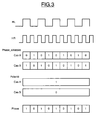
- the fast clock HR and slow HL signals are the signals shown in Figure 1.
- the frequency of the In this example, the fast clock signal HR is twice as high as the frequency of the slow clock signal HL.
- Two separate cases are considered concerning the values taken by the Random Phase signal.
- Case A represents the situation where the first value taken by the Random Phase signal is "0". In this case, the Random Phase signal successively takes the values "0" and then "1" at the frequency of the fast clock signal HR.
- Case B represents the situation where the first value taken by the Random Phase signal is "1". In this case, the Random Phase signal successively takes the values "1" and then "0” at the frequency of the fast clock signal HR.
- the signal generated by the Bas 2 rocker, Polarity evolves in two cases, case A or case B.
- the signal Polarity changes according to case A if the Random phase signal also changes according to case A. In this case, the signal Polarity takes the value "1" whatever the value of the signal Random Phase.
- the signal Polarity changes according to the case B if the Random Phase signal also evolves according to the case B. In this case, the signal Polarity takes the value "0” regardless of the value taken by the signal Phase_reatory.
- the Phase signal is generated by the "EXCLUSIVE OR” logic gate, XOR. It is recalled that according to the table of the "EXCLUSIVE OR” function, the output signal is "1” if the two input signals are in a different state. Otherwise, the output signal is "0” if both input signals are in an identical state.
- the evolution of the Phase signal is the same, that is to say that it successively takes the values "1” then "0".
- the logic value "1" means that a rising edge of the fast clock signal HR corresponding to a rising edge of the signal of the slow clock HL.
- FIG. 4 shows a variant of the device shown in Figure 2, operating with any ratio n between the two clocks.
- the first low level element 3 of the device DIS 2 of FIG. 4 is clocked by the slow clock signal HL.
- the second sequential element Low 4 is clocked by the fast clock signal HR.
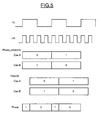
- the slow clock signals HL and fast HR are generated such as the frequency of the fast clock signal HR is three times higher than the frequency of the slow clock signal HL.
- the Random Phase signal can evolve in two distinct cases, the first case illustrates the situation where the first value taken by the Random Phase signal is "0". In this case, the Random Phase signal successively takes the values "0" then "1” at the frequency of the signal of the slow clock HL, which clockes the first sequential element Low 3. If the signal Random phase evolves according to the case B, then successively takes the values "1” then "0” at the frequency of the clock signal HL.
- the signal Polarity also evolves in two cases, case A and case B, respectively associated with case A and case B of the Random Phase signal. If the Polarity signal changes according to the case A, then it successively takes the values "0" then "1” at the frequency of the signal of the slow clock HL. Conversely, if the Polarity signal changes according to the case B, then it successively takes the values "1” then "0” at the frequency of the signal of the slow clock HL.
- the Phase signal generated by the "EXCLUSIVE OR” logic gate, XOR takes the value "1" when a rising edge of the signal of the fast HR clock corresponds to a rising edge of the slow clock signal HL, then the value "0" otherwise.
- FIG. 6 A first example of use of the device DIS represented in FIG. 2 is illustrated in FIG. 6. It is considered in this example that two clock signals are used, a first so-called fast clock signal H_200 whose frequency is 200 MHz and a second so-called slow clock signal H_100 whose frequency is 100 MHz.
- the SYS system represents a synchronized transmission system of data between two different frequency domains.
- a low input flip-flop 5 is clocked by the fast clock signal HR_200.
- the flip-flop 5 is also controlled by a reset signal nrst.
- the output Q of the flip-flop 5 is looped back to its input D via a selector SEL which also receives data data input.
- SEL selector is controlled by a control signal which is the so-called phase logic signal generated by the DIS device shown in FIG. 2. According to the value of the phase logic signal, the selector SEL transmits to the input D of the lower latch. 5 Data Data.
- the flip-flop 5 delivers by its output Q data Data_s.
- the Q output of the Low flip-flop 5 is also connected to the D input of a Low output flip-flop 6, controlled by a reset signal nrst.
- the flip-flop 6 is clocked by the slow clock signal HL_100.
- the flip-flop 6 receives input data Data_s delivered by the output Q of the flip-flop 5.
- Data_s delivered by the output Q of the flip-flop 5.
- n period of the fastest clock signal in this example n is equal to 2 is guaranteed to enable the exchange of data.
- FIG. 7 which illustrates the signals implemented in the SYS system of FIG. 6, the clock signals HL_100 and HR_200 can be seen, such that the frequency of the clock signal HR_200 is 200 MHz and that of the clock signal HL_100 is 100 MHz.
- the Phase signal successively takes the values "1" then "0".
- a rising edge of the clock signal HR_200 corresponds to a rising edge of the clock signal HL_100.
- data Data_s are exchanged when a rising edge of the signal of the fast clock HR_200 corresponds to a rising edge of the clock signal HL_100.
- the SYS 2 system represents a second use of the device shown in FIG.
- the SYS system 2 is a data controlled multiplexing system used, in this example, to transmit in a predetermined order, coefficients representing the luminance and the blue and red chrominances of a digital video application, for example.
- the SYS 2 system includes four Bas 8, 9 Low, 10 Bas, and 11 Bas Flip flops in parallel. Each of the four latches is controlled by a reset signal nrst and is clocked by the slow clock signal HL which is in this example equal to 6.75 MHz.
- the four flip-flops Bottom 8, Bottom 9, Bottom 10 and Bottom 11 are fed respectively by the coefficients of the luminance Y0, the blue chrominance Cb, the red chrominance Cr and the luminance Y1. They deliver through their output terminals Q the data they receive on their input terminal D as a function of the slow clock signal HL.
- This output data is delivered to a multiplexer MUX1, controlled by a modulo_4 counter, CMP4.
- the modulo_4 CMP4 counter receives on an E_raf input the Phase logic signal, delivered by the device represented in FIG. 2.
- the Phase signal is intended to control the refresh of the modulo_4, CMP4 counter.
- the multiplexer MUX 1 outputs in one order the data Data_s corresponding to the planes Y0, Cb, Cr and Y1.
- the data Data_s are delivered to the input D of a flip-flop Low 7.
- the flip-flop 7 is controlled by a reset signal nrst and clocked by the fast clock signal HR.
- the frequency of the fast clock signal is 27 MHz.
- the flip-flop 7 delivers its output terminal Q, the data stream YCBCR at the frequency of the fast clock signal HR, that is to say 27 MHz.
- FIG. 9 represents another example of use of the device shown in FIG.
- the SYS system 3 of FIG. 9 represents a controlled data multiplexing system.
- the SYS system 3 comprises a first Low flip-flop 12 controlled by a reset signal nrst and clocked by a slow clock signal HL.
- the bottom latch 12 receives data data input, which it delivers through its output terminal Q to a mixer MEL.
- the mixer MEL also receives as input data from a multiplexer MUX 3.
- the multiplexer MUX 3 receives as input n coefficients Coeff_1, ..., Coeff_n.
- the multiplexer MUX 3 is controlled by an output signal from a modulo_n counter, CMPn.
- the modulo_n CMPn counter is clocked by the fast clock signal HR.
- it is controlled by the logic signal Phase, received on its input E_raf and able to control the refresh of the modulo_n counter, CMPn.
- the multiplexer MUX3 controlled by the modulo_n counter CMPn makes it possible to successively apply the n coefficients, Coeff_1, ... Coeff_n, to the data delivered by the lower latch 12.
- the n coefficients are applied via the MEL mixer.
- the output signal of the mixer MEL is delivered to an adder ADD.
- the adder ADD can also receive, in parallel, other data from other flip-flops, for example the flip-flop 13, connected in series with the flip-flop 12.
- the adder ADD outputs a resulting signal elaborated by adding the different data input to the adder ADD.
- the resulting signal delivered by the adder ADD is transmitted to a Low output flip-flop 14 controlled by a reset signal nrst and clocked by the fast clock signal HR.
- the bottom latch 14 then outputs an output signal S at the frequency of the fast clock signal HR.
- the frequency of the fast clock HR is n times higher than the frequency of the slow clock signal HL, where n is the number of coefficients delivered to the input of the multiplexer MUX3.
Landscapes
- Engineering & Computer Science (AREA)
- Signal Processing (AREA)
- Computer Networks & Wireless Communication (AREA)
- Multimedia (AREA)
- Microelectronics & Electronic Packaging (AREA)
- Physics & Mathematics (AREA)
- Nonlinear Science (AREA)
- Manipulation Of Pulses (AREA)
- Synchronisation In Digital Transmission Systems (AREA)
Applications Claiming Priority (1)
| Application Number | Priority Date | Filing Date | Title |
|---|---|---|---|
| FR0409735A FR2875311A1 (fr) | 2004-09-14 | 2004-09-14 | Procede de detection du positionnement relatif de deux signaux et dispositif correspondant |
Publications (2)
| Publication Number | Publication Date |
|---|---|
| EP1635501A1 true EP1635501A1 (de) | 2006-03-15 |
| EP1635501B1 EP1635501B1 (de) | 2007-11-14 |
Family
ID=34949637
Family Applications (1)
| Application Number | Title | Priority Date | Filing Date |
|---|---|---|---|
| EP05291866A Expired - Lifetime EP1635501B1 (de) | 2004-09-14 | 2005-09-08 | Verfahren zur Ermittlung der relativen Lage von zwei Signalen und entsprechende Vorrichtung |
Country Status (4)
| Country | Link |
|---|---|
| US (1) | US7627070B2 (de) |
| EP (1) | EP1635501B1 (de) |
| DE (1) | DE602005003287D1 (de) |
| FR (1) | FR2875311A1 (de) |
Families Citing this family (2)
| Publication number | Priority date | Publication date | Assignee | Title |
|---|---|---|---|---|
| US7622961B2 (en) * | 2005-09-23 | 2009-11-24 | Intel Corporation | Method and apparatus for late timing transition detection |
| US12255644B2 (en) * | 2022-11-28 | 2025-03-18 | Texas Instruments Incorporated | Audio interface physical layer |
Citations (2)
| Publication number | Priority date | Publication date | Assignee | Title |
|---|---|---|---|---|
| US6175603B1 (en) * | 1997-08-07 | 2001-01-16 | Cisco Technology, Inc. | System for managing signals in different clock domains and a programmable digital filter |
| EP1146413A2 (de) * | 2000-04-12 | 2001-10-17 | Hewlett-Packard Company | Datensignal, das Taktsignale nachahmt |
Family Cites Families (24)
| Publication number | Priority date | Publication date | Assignee | Title |
|---|---|---|---|---|
| US4535459A (en) * | 1983-05-26 | 1985-08-13 | Rockwell International Corporation | Signal detection apparatus |
| US4964117A (en) * | 1988-10-04 | 1990-10-16 | Vtc Incorporated | Timing synchronizing circuit for baseband data signals |
| US5027085A (en) * | 1989-10-03 | 1991-06-25 | Analog Devices, Inc. | Phase detector for phase-locked loop clock recovery system |
| US5233617A (en) * | 1990-04-13 | 1993-08-03 | Vlsi Technology, Inc. | Asynchronous latch circuit and register |
| US5159279A (en) * | 1990-11-27 | 1992-10-27 | Dsc Communications Corporation | Apparatus and method for detecting out-of-lock condition in a phase lock loop |
| FR2711286B1 (fr) * | 1993-10-11 | 1996-01-05 | Sgs Thomson Microelectronics | Dispositif de surveillance du déphasage entre deux signaux d'horloge. |
| US5579352A (en) * | 1994-04-06 | 1996-11-26 | National Semiconductor Corporation | Simplified window de-skewing in a serial data receiver |
| DE4444601C1 (de) * | 1994-12-14 | 1996-07-11 | Sgs Thomson Microelectronics | Verfahren und Vorrichtung zur empfängerseitigen RDS-Phasensynchronisation |
| US5539786A (en) * | 1995-07-31 | 1996-07-23 | The United States Of America As Represented By The Secretary Of The Navy | Digital circuit for generating a clock signal |
| US6169767B1 (en) * | 1997-03-10 | 2001-01-02 | Sarnoff Corporation | Universal network interface module |
| CA2201695C (en) * | 1997-04-03 | 2004-08-10 | Gennum Corporation | Phase detector for high speed clock recovery from random binary signals |
| US6081572A (en) * | 1998-08-27 | 2000-06-27 | Maxim Integrated Products | Lock-in aid frequency detector |
| US6075388A (en) * | 1998-10-16 | 2000-06-13 | Cypress Semiconductor Corp. | Phase detector with extended linear range |
| US6072337A (en) * | 1998-12-18 | 2000-06-06 | Cypress Semiconductor Corp. | Phase detector |
| US6100722A (en) * | 1999-07-28 | 2000-08-08 | Cypress Semiconductor Corp. | Phase detector with extended linear range |
| US6700944B1 (en) * | 1999-12-09 | 2004-03-02 | Agere Systems Inc. | Phase detector for clock and data recovery |
| JP2002251227A (ja) * | 2001-02-23 | 2002-09-06 | Nec Microsystems Ltd | クロック監視回路、データ処理装置、データ処理システム |
| CA2344787A1 (en) * | 2001-04-19 | 2002-10-19 | Pmc-Sierra Ltd. | A phase detector customized for clock synthesis unit |
| US7092474B2 (en) * | 2001-09-18 | 2006-08-15 | Broadcom Corporation | Linear phase detector for high-speed clock and data recovery |
| JP3476448B2 (ja) * | 2001-12-12 | 2003-12-10 | 沖電気工業株式会社 | 信号同期回路 |
| JP3848152B2 (ja) * | 2001-12-20 | 2006-11-22 | 株式会社東芝 | 多機能icカード |
| US7092484B1 (en) * | 2002-06-14 | 2006-08-15 | Iowa State University Research Foundation, Inc. | Model-assisted reconstruction of volumetric data |
| US6956923B1 (en) * | 2003-01-17 | 2005-10-18 | Xilinx, Inc. | High speed phase detector architecture |
| US7084679B2 (en) * | 2004-04-15 | 2006-08-01 | International Business Machines Corporation | Method and apparatus for ensuring synchronization of clocks in a multiple clock system |
-
2004
- 2004-09-14 FR FR0409735A patent/FR2875311A1/fr active Pending
-
2005
- 2005-09-08 EP EP05291866A patent/EP1635501B1/de not_active Expired - Lifetime
- 2005-09-08 US US11/222,412 patent/US7627070B2/en active Active
- 2005-09-08 DE DE602005003287T patent/DE602005003287D1/de not_active Expired - Lifetime
Patent Citations (2)
| Publication number | Priority date | Publication date | Assignee | Title |
|---|---|---|---|---|
| US6175603B1 (en) * | 1997-08-07 | 2001-01-16 | Cisco Technology, Inc. | System for managing signals in different clock domains and a programmable digital filter |
| EP1146413A2 (de) * | 2000-04-12 | 2001-10-17 | Hewlett-Packard Company | Datensignal, das Taktsignale nachahmt |
Also Published As
| Publication number | Publication date |
|---|---|
| EP1635501B1 (de) | 2007-11-14 |
| US7627070B2 (en) | 2009-12-01 |
| FR2875311A1 (fr) | 2006-03-17 |
| DE602005003287D1 (de) | 2007-12-27 |
| US20060056557A1 (en) | 2006-03-16 |
Similar Documents
| Publication | Publication Date | Title |
|---|---|---|
| EP0142440A2 (de) | Vorrichtung zum Erzeugen einer, bezüglich einer Referenzfrequenz gebrochenen Frequenz | |
| EP0451232B1 (de) | Kodeerfassungsverfahren und schaltung für spreizspektrumsignalempfänger | |
| FR2793091A1 (fr) | Dispositif d'asservissement de frequence | |
| FR2926172A1 (fr) | Boucle a verrouillage de phase avec filtre adaptatif pour synchronisation avec oscillateur a commande numerique | |
| CA2172197A1 (fr) | Dispositif de faible cot et integrable pour l'acquisition de signaux electriques selon la norme arinc 429 | |
| EP0209928B1 (de) | Demodulator für frequenzmodulierte digitale Signale | |
| EP1635501B1 (de) | Verfahren zur Ermittlung der relativen Lage von zwei Signalen und entsprechende Vorrichtung | |
| EP0711049A1 (de) | Verfahren zur Referenzsymboldetektion in einem Emfängen für Digitaldaten | |
| EP0031762B1 (de) | Modulator-Demodulator zur Übertragung durch eine vierpegelige doppelte Amplitudenmodulation auf Quadraturträgern | |
| FR3133508A1 (fr) | Dispositif comportant un circuit de synchronisation pour realiser une communication en champ proche | |
| FR2845783A1 (fr) | Generateur d'horloge a consigne decimale et application d'un tel generateur d'horloge a un circuit uart | |
| EP1101316A1 (de) | Verfahren zur taktrückgewinnung während der abtastung von digitalen signalen | |
| WO2014060280A1 (fr) | Recepteur uwb multi-canal reconfigurable | |
| EP1094631A1 (de) | Suche des optimalen Abtastzeitpunktes in einem TDMApaketübertragungssystem | |
| EP0123587B1 (de) | Rückgewinnung von Träger- und Tastfrequenz für digitale Übertragungssysteme mit Phasen- oder Amplitudenmodulation und kohärente Demodulation | |
| EP0218508B1 (de) | Schnell variierbarer Frequenzgenerator | |
| FR2858730A1 (fr) | Procede pour ameliorer la resolution de mesures de temps et l'alignement dans des reseaux de transmission par paquets au moyen d'une modulation temporelle | |
| FR2908946A1 (fr) | Bvp numerique fractionnaire | |
| FR2710208A1 (fr) | Intégrateur et filtre du premier ordre numériques. | |
| FR2745138A1 (fr) | Dispositif de correction de bruit de phase dans un recepteur numerique | |
| EP1655882A1 (de) | Vorrichtung zur Erzeugung eines Fehlersignals für eine Zeitkorrekturschleife eines Demodulators | |
| FR2670970A1 (fr) | Un systeme recepteur pour le traitement de signaux recus sur des voies de diversite. | |
| FR2776436A1 (fr) | Filtre numerique pour boucle de correction de rotation d'un demodulateur qpsk ou qam | |
| FR2793623A1 (fr) | Procede et dispositif de controle de la synchronisation entre deux noeuds ni-1, ni d'un reseau | |
| FR2613568A1 (fr) | Systeme de television avec restitution de composante continue |
Legal Events
| Date | Code | Title | Description |
|---|---|---|---|
| PUAI | Public reference made under article 153(3) epc to a published international application that has entered the european phase |
Free format text: ORIGINAL CODE: 0009012 |
|
| AK | Designated contracting states |
Kind code of ref document: A1 Designated state(s): AT BE BG CH CY CZ DE DK EE ES FI FR GB GR HU IE IS IT LI LT LU LV MC NL PL PT RO SE SI SK TR |
|
| AX | Request for extension of the european patent |
Extension state: AL BA HR MK YU |
|
| 17P | Request for examination filed |
Effective date: 20060828 |
|
| 17Q | First examination report despatched |
Effective date: 20060928 |
|
| AKX | Designation fees paid |
Designated state(s): DE FR GB IT |
|
| GRAP | Despatch of communication of intention to grant a patent |
Free format text: ORIGINAL CODE: EPIDOSNIGR1 |
|
| GRAS | Grant fee paid |
Free format text: ORIGINAL CODE: EPIDOSNIGR3 |
|
| GRAA | (expected) grant |
Free format text: ORIGINAL CODE: 0009210 |
|
| AK | Designated contracting states |
Kind code of ref document: B1 Designated state(s): DE FR GB IT |
|
| REG | Reference to a national code |
Ref country code: GB Ref legal event code: FG4D Free format text: NOT ENGLISH |
|
| REF | Corresponds to: |
Ref document number: 602005003287 Country of ref document: DE Date of ref document: 20071227 Kind code of ref document: P |
|
| GBT | Gb: translation of ep patent filed (gb section 77(6)(a)/1977) |
Effective date: 20080205 |
|
| PLBE | No opposition filed within time limit |
Free format text: ORIGINAL CODE: 0009261 |
|
| STAA | Information on the status of an ep patent application or granted ep patent |
Free format text: STATUS: NO OPPOSITION FILED WITHIN TIME LIMIT |
|
| 26N | No opposition filed |
Effective date: 20080815 |
|
| PG25 | Lapsed in a contracting state [announced via postgrant information from national office to epo] |
Ref country code: DE Free format text: LAPSE BECAUSE OF FAILURE TO SUBMIT A TRANSLATION OF THE DESCRIPTION OR TO PAY THE FEE WITHIN THE PRESCRIBED TIME-LIMIT Effective date: 20080215 |
|
| REG | Reference to a national code |
Ref country code: FR Ref legal event code: ST Effective date: 20090529 |
|
| PG25 | Lapsed in a contracting state [announced via postgrant information from national office to epo] |
Ref country code: FR Free format text: LAPSE BECAUSE OF NON-PAYMENT OF DUE FEES Effective date: 20080930 |
|
| PG25 | Lapsed in a contracting state [announced via postgrant information from national office to epo] |
Ref country code: IT Free format text: LAPSE BECAUSE OF NON-PAYMENT OF DUE FEES Effective date: 20080930 |
|
| PGFP | Annual fee paid to national office [announced via postgrant information from national office to epo] |
Ref country code: GB Payment date: 20130823 Year of fee payment: 9 |
|
| GBPC | Gb: european patent ceased through non-payment of renewal fee |
Effective date: 20140908 |
|
| PG25 | Lapsed in a contracting state [announced via postgrant information from national office to epo] |
Ref country code: GB Free format text: LAPSE BECAUSE OF NON-PAYMENT OF DUE FEES Effective date: 20140908 |