EP1635604B1 - Ablauffolgeplanung von Wellenlängen mit dem wenigst gebrauchten Kanal in optischen Netzwerken mit Burstschaltung - Google Patents
Ablauffolgeplanung von Wellenlängen mit dem wenigst gebrauchten Kanal in optischen Netzwerken mit Burstschaltung Download PDFInfo
- Publication number
- EP1635604B1 EP1635604B1 EP04021449A EP04021449A EP1635604B1 EP 1635604 B1 EP1635604 B1 EP 1635604B1 EP 04021449 A EP04021449 A EP 04021449A EP 04021449 A EP04021449 A EP 04021449A EP 1635604 B1 EP1635604 B1 EP 1635604B1
- Authority
- EP
- European Patent Office
- Prior art keywords
- ict
- traffic intensity
- wavelength
- burst
- average traffic
- Prior art date
- Legal status (The legal status is an assumption and is not a legal conclusion. Google has not performed a legal analysis and makes no representation as to the accuracy of the status listed.)
- Expired - Lifetime
Links
- 230000003287 optical effect Effects 0.000 title claims description 17
- 238000000034 method Methods 0.000 claims description 11
- 238000012546 transfer Methods 0.000 claims description 6
- 230000003044 adaptive effect Effects 0.000 claims description 5
- 230000005540 biological transmission Effects 0.000 claims description 5
- 230000015572 biosynthetic process Effects 0.000 claims description 5
- 230000000903 blocking effect Effects 0.000 description 12
- 238000010586 diagram Methods 0.000 description 2
- 101000840457 Homo sapiens Peptidyl-tRNA hydrolase ICT1, mitochondrial Proteins 0.000 description 1
- 102100029221 Peptidyl-tRNA hydrolase ICT1, mitochondrial Human genes 0.000 description 1
- 238000004891 communication Methods 0.000 description 1
- 238000013461 design Methods 0.000 description 1
- 238000012545 processing Methods 0.000 description 1
- 230000011664 signaling Effects 0.000 description 1
- 239000011800 void material Substances 0.000 description 1
Images
Classifications
-
- H—ELECTRICITY
- H04—ELECTRIC COMMUNICATION TECHNIQUE
- H04Q—SELECTING
- H04Q11/00—Selecting arrangements for multiplex systems
- H04Q11/0001—Selecting arrangements for multiplex systems using optical switching
- H04Q11/0062—Network aspects
- H04Q11/0066—Provisions for optical burst or packet networks
-
- H—ELECTRICITY
- H04—ELECTRIC COMMUNICATION TECHNIQUE
- H04Q—SELECTING
- H04Q11/00—Selecting arrangements for multiplex systems
- H04Q11/0001—Selecting arrangements for multiplex systems using optical switching
- H04Q11/0062—Network aspects
- H04Q2011/0064—Arbitration, scheduling or medium access control aspects
-
- H—ELECTRICITY
- H04—ELECTRIC COMMUNICATION TECHNIQUE
- H04Q—SELECTING
- H04Q11/00—Selecting arrangements for multiplex systems
- H04Q11/0001—Selecting arrangements for multiplex systems using optical switching
- H04Q11/0062—Network aspects
- H04Q2011/0084—Quality of service aspects
Definitions
- a wavelength scheduling algorithm decides which wavelength should be used to transfer a data flow from the different wavelengths which are temporarily available (i.e., unused) in a switch.
- wavelength scheduling algorithms have a great impact on optical network performance since they can severely influence the blocking probability and, therefore, the throughput of the network.
- LAUC latest unscheduled channel
- LAUC-VF latest available unused channel with void filling
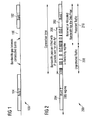
- Bandwidth gaps are fractions of bandwidth and, therefore, are dead zones, since they cannot be used for the transmission of a burst. Naturally, the less gaps there are and the shorter the gaps are, the more efficient the bandwidth use is. This leads to a lower blocking probability and to a higher throughput. This can be seen from timing diagram 100 of Figure 1 , wherein a Burst 1 is separated from a Burst 2(104) by a bandwidth gap 106.
- APSON networks create a whole new problem to the wavelength scheduling issue.
- the gaps between consecutive bursts are naturally filled with IP packets.
- IP packets sent "on-the-fly" (206). From this it is clearly seen that APSON networks do not have bandwidth gaps in the sense that "gaps" no data have transmitted in the gaps.
- This invention aims at setting the basis and basic concepts for this new generation of algorithms.
- the idea of the invention is to design a wavelength scheduling algorithm that breaks the connection with the lowest traffic intensity in order to establish the requested incoming connection. Therefore, the traffic intensity on a link is identified as the most sensitive factor in terms of network performance that should be taken into account by a wavelength scheduling algorithm in APSON. By contrast, the length of the gaps was identified as the most sensitive factor in OBS networks.
- the invention further defines a specific wavelength scheduling algorithm (referred to herein as LUC), which implies the definition of a suitable method to measure the traffic intensity in a link (so that the wavelength scheduling algorithm can take the decision) and of forwarding this information across the optical switches in the network.
- LUC wavelength scheduling algorithm
- the invention realizes that the most efficient wavelength scheduling algorithms for OBS networks do not perform well on APSON.
- the invention report goes further and defines in detail one of these new generation wavelength scheduling algorithms (the LUC). This comprises the following inventive steps: to define exactly the ICT and to describe a method to easily measure it. Using the ICT it is possible with the invention to describe a mechanism to make the ICT information available to the network switches.
- unbreakable connections are those connections which are still transmitting the data for which bandwidth has been allocated and reserved (e.g. through the JET, JIT or Horizon protocols). These connections cannot be touched by the wavelength scheduling algorithm. Breakable connections are those connections which already had sent the data for which bandwidth had been reserved and which are currently sending unprotected packets on the ⁇ -switching regime (see 208, Figure 2 ).
- the wavelength scheduling algorithm chooses among the breakable connections one connection to break.
- the wavelength associated to the broken connection is then used in order to transfer the data of the incoming requested connection.
- the decision of the wavelength scheduling algorithm should minimize the blocking probability and therefore maximize the network throughput.
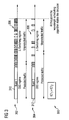
- the wavelength scheduling algorithm chooses between two wavelengths (302,304) in order to send an incoming connection request.
- Wavelength 1 (302) transfers a high traffic load and, therefore has a relatively high ICT 306, whereas wavelength 2 (304) is transfers less traffic and, therefore, has a relatively low ICT 308. Consequently, the wavelength scheduling algorithm decides to use wavelength 2 (304) for the incoming connection. This will lead to a lower blocking probability and a higher network throughput than if wavelength 1 (302) had been chosen to carry the traffic of the incoming connection.
- Wavelength 1 (302) carries higher traffic intensity 306. Therefore, Burst 1 (310) is formed in less time than Burst 2 (312) and/or it is bigger, which leads to the following inequality: ICT1 > ICT2.
- the wavelength scheduling algorithm decides to use the resources of wavelength 2 (304), since this decision leads to a higher network performance in terms of blocking probability and throughput.
- both wavelengths carry the same traffic intensity blocking one of them leads to more IP packets which cannot be transmitted, compared to the case in which one wavelength carries heavy traffic and the other almost no traffic.
- the first task is to develop a method to measure the ICT and, for that matter, a more precise definition of the ICT itself.
- the ICT should reflect the average traffic intensity over a certain wavelength.
- the average traffic intensity can be calculated with a moving average algorithm with a predetermined window size. It is important that ICT is defined at the right time scale, that is, that the size of the window of the moving average is not too large or too small. If the ICT defined is too large, it would not capture the variability of the traffic intensity correctly. If the ICT is too small, it would be excessively sensitive to local changes on the traffic intensity.
- a connection in APSON begins with the transmission of a burst.
- the proposed method to measure the ICT of a connection consists on calculating the quotient of the size of the burst which is sent at the beginning of the connection divided by the time it took the edge node to accumulate the burst.
- Equation 1 provides a measure of the average traffic intensity calculated with a moving average with a window equivalent to the burst formation time.
- the invention proposes the following LUC wavelength scheduling algorithm.
- the header of the request contains the ICT.
- the ICT information is sent to the optical switches along the path.
- each switch keeps track of a lookup table of the ongoing connections and of their respective ICT values (equivalently in a centralized solution, the central unit keeps track of this information).
- the table contains as well whether a connection is breakable or unbreakable.
- an optical switch receives the connection request it breaks the breakable connection with the lowest associated ICT.
- the entry on the lookup table is replaced with the values of the incoming connection.
- the instant invention provides a new manner of determining the ITC and providing a new wavelength scheduling algorithm solution.
- the invention provides merely one definition of the ICT and other methods to measure the ITC are certainly within the present invention. It follows that other ICT definitions would yield other wavelength scheduling algorithms.
- the invention is simple and does not require complex processing at the optical cross connectors, since the decision is made based on finding the minimum value of a set of values. Further, the invention is based on information easy to obtain and measure, since the ICT can be very easily calculated at the edge nodes by measuring the burst size and the burst formation time. The invention also reduces the blocking probability and increases the throughput in the network compared to other state-of-the-art wavelength scheduling algorithms. The state-of-the-art algorithms were specifically designed for OBS networks which have a different functionality than APSON and, therefore, are obsolete. The invention is also advantageous as it profits from variable (e.g. self-similar) traffic as described above with reference to Figure 3 .
Landscapes
- Engineering & Computer Science (AREA)
- Computer Networks & Wireless Communication (AREA)
- Data Exchanges In Wide-Area Networks (AREA)
- Optical Communication System (AREA)
Claims (7)
- Verfahren zum Bestimmen einer zum Übertragen eines Datenflusses zu benutzenden Wellenlänge (304) unter verschiedenen verfügbaren Wellenlängen (302, 304) zu einem adaptiven optischen Wegdurchschaltungsnetz, wobei Datenpakete (206) fliegend während Lücken (106) in Übertragungsbursts (102, 104) sowohl als geschützte (210) als auch ungeschützte Daten (208) gesendet werden, mit folgendem:Bestimmen eines Betrags einer Durchschnitts-Verkehrsstärke ICT für eine bestimmte Wellenlänge (302, 304), wobei die Durchschnitts-Verkehrsstärke ICT nach folgender Gleichung bestimmt wird:
 wobei B eine Burstgröße ist und tB eine Burst-Bildungszeit der bestimmten Wellenlänge (302, 304) ist,Auswählen als unterbrechbare Verbindung einer Verbindung, die gegenwärtig ungeschützte Datenpakete (208) auf der bestimmten Wellenlänge (302, 304) überträgt, für die Bandbreite zugeteilt und reserviert worden ist und im Vergleich mit anderen Verbindungen den geringsten Betrag an Verkehrsstärke ICT aufweist.
 - Verfahren nach Anspruch 1, weiterhin mit Übertragen des Datenflusses auf der ausgewählten unterbrechbaren Verbindung.
- Verfahren nach einem der vorhergehenden Ansprüche, wobei das Maß der Durchschnitts-Verkehrsstärke ICT unter Verwendung eines gleitenden Mittelwerts mit einer vorbestimmten Fenstergröße bestimmt wird.
- Verfahren nach Anspruch 2, weiterhin mit Auswählen der vorbestimmten Fenstergröße zur ausreichenden Erfassung einer Veränderbarkeit einer Verkehrsstärke für die bestimmte Wellenlänge (302, 304).
- Verfahren nach Anspruch 2, weiterhin mit Auswählen der vorbestimmten Fenstergröße, damit die vorbestimmte Fenstergröße nicht übermäßig empfindlich für örtliche Änderungen der Verkehrsstärke ist.
- System zum Bestimmen einer zum Übertragen eines Datenflusses und zu benutzenden Wellenlänge (304) unter verschiedenen verfügbaren Wellenlängen (302, 304) zu einem adaptiven optischen Wegdurchschaltungsnetz, wobei Datenpakete (206) fliegend während Lücken (106) in Übertragungs-Bursts (102, 104) sowohl als geschützte (210) als auch ungeschützte (208) Daten gesendet werden, mit einem Optoschalter zum Bestimmen
eines Betrags einer Durchschnitts-Verkehrsstärke ICT für eine bestimmte Wellenlänge (302, 304), und
einer unterbrechbaren Verbindung, die gegenwärtig ungeschützte Datenpakete (208) auf einer Wellenlänge (304) überträgt, für die Bandbreite zugeteilt und reserviert worden ist und die im Vergleich mit anderen Verbindungen einen geringsten Betrag an Durchschnitts-Verkehrsstärke ICT aufweist,
wobei der Optoschalter zum Auswählen der unterbrechbaren Verbindung zum Übertragen des Datenflusses geführt ist, wobei der Optoschalter zum Bestimmen der Durchschnitts-Verkehrsstärke des ICT nach folgender Gleichung ausgeführt ist:
wobei B eine Burstgröße ist und tB eine Burstbildungszeit für die bestimmte Wellenlänge (302, 304) ist. - System nach Anspruch 6, wobei der Optoschalter zum Bestimmen einer Nachschlagetabelle bestehender Verbindungen und jeweiliger Durchschnitts-Verkehrsstärkewerte ICT ausgeführt ist.
Priority Applications (3)
| Application Number | Priority Date | Filing Date | Title |
|---|---|---|---|
| EP04021449A EP1635604B1 (de) | 2004-09-09 | 2004-09-09 | Ablauffolgeplanung von Wellenlängen mit dem wenigst gebrauchten Kanal in optischen Netzwerken mit Burstschaltung |
| DE602004014494T DE602004014494D1 (de) | 2004-09-09 | 2004-09-09 | Ablauffolgeplanung von Wellenlängen mit dem wenigst gebrauchten Kanal in optischen Netzwerken mit Burstschaltung |
| US11/222,378 US20060050725A1 (en) | 2004-09-09 | 2005-09-08 | Least used channel wavelength scheduling in APSON |
Applications Claiming Priority (1)
| Application Number | Priority Date | Filing Date | Title |
|---|---|---|---|
| EP04021449A EP1635604B1 (de) | 2004-09-09 | 2004-09-09 | Ablauffolgeplanung von Wellenlängen mit dem wenigst gebrauchten Kanal in optischen Netzwerken mit Burstschaltung |
Publications (2)
| Publication Number | Publication Date |
|---|---|
| EP1635604A1 EP1635604A1 (de) | 2006-03-15 |
| EP1635604B1 true EP1635604B1 (de) | 2008-06-18 |
Family
ID=34926479
Family Applications (1)
| Application Number | Title | Priority Date | Filing Date |
|---|---|---|---|
| EP04021449A Expired - Lifetime EP1635604B1 (de) | 2004-09-09 | 2004-09-09 | Ablauffolgeplanung von Wellenlängen mit dem wenigst gebrauchten Kanal in optischen Netzwerken mit Burstschaltung |
Country Status (3)
| Country | Link |
|---|---|
| US (1) | US20060050725A1 (de) |
| EP (1) | EP1635604B1 (de) |
| DE (1) | DE602004014494D1 (de) |
Families Citing this family (1)
| Publication number | Priority date | Publication date | Assignee | Title |
|---|---|---|---|---|
| DE102005010918B4 (de) * | 2005-03-09 | 2011-03-03 | Nokia Siemens Networks Gmbh & Co.Kg | Verfahren zur Übertragung von Datenpaketen |
Family Cites Families (9)
| Publication number | Priority date | Publication date | Assignee | Title |
|---|---|---|---|---|
| US5461611A (en) * | 1994-06-07 | 1995-10-24 | International Business Machines Corporation | Quality of service management for source routing multimedia packet networks |
| US6721315B1 (en) * | 1999-09-30 | 2004-04-13 | Alcatel | Control architecture in optical burst-switched networks |
| JP3578960B2 (ja) * | 2000-02-28 | 2004-10-20 | 日本電信電話株式会社 | 超高速光パケット転送リングネットワーク、光挿入分岐型多重分離ノード装置及び光挿入分岐型多重分離ノード装置の動作方法 |
| US20040062261A1 (en) * | 2001-02-07 | 2004-04-01 | Rami Zecharia | Multi-service segmentation and reassembly device having integrated scheduler and advanced multi-timing wheel shaper |
| US7363039B2 (en) * | 2002-08-08 | 2008-04-22 | Qualcomm Incorporated | Method of creating and utilizing diversity in multiple carrier communication system |
| US7254113B2 (en) * | 2002-09-18 | 2007-08-07 | Alcatel Lucent | Partially preemptive burst scheduling model for an optical burst switching network |
| US7483631B2 (en) * | 2002-12-24 | 2009-01-27 | Intel Corporation | Method and apparatus of data and control scheduling in wavelength-division-multiplexed photonic burst-switched networks |
| US20050030951A1 (en) * | 2003-08-06 | 2005-02-10 | Christian Maciocco | Reservation protocol signaling extensions for optical switched networks |
| EP1580929A1 (de) * | 2004-03-26 | 2005-09-28 | Alcatel | Leistungsüberwachung von transparenten LAN-Diensten |
-
2004
- 2004-09-09 EP EP04021449A patent/EP1635604B1/de not_active Expired - Lifetime
- 2004-09-09 DE DE602004014494T patent/DE602004014494D1/de not_active Expired - Lifetime
-
2005
- 2005-09-08 US US11/222,378 patent/US20060050725A1/en not_active Abandoned
Also Published As
| Publication number | Publication date |
|---|---|
| DE602004014494D1 (de) | 2008-07-31 |
| EP1635604A1 (de) | 2006-03-15 |
| US20060050725A1 (en) | 2006-03-09 |
Similar Documents
| Publication | Publication Date | Title |
|---|---|---|
| Chlamtac et al. | Scalable WDM access network architecture based on photonic slot routing | |
| US9100347B2 (en) | Method of burst scheduling in a communication network | |
| US20030138253A1 (en) | Dynamic wavelength management method in OBS networks | |
| US7573815B2 (en) | Flow control and congestion management for random scheduling in time-domain wavelength interleaved networks | |
| Chlamtac et al. | Light-trails: A solution to IP centric communication in the optical domain | |
| Yoo et al. | The effect of limited fiber delay lines on QoS performance of optical burst switched WDM networks | |
| Farahmand et al. | Dynamic traffic grooming in optical burst-switched networks | |
| EP1224833B1 (de) | Robuster transport von ip verkehr über wdm mittels optischer burstvermittlung | |
| US7420918B2 (en) | Look-ahead contention resolution method for a burst switching network | |
| Wang et al. | Dynamic contention resolution in optical burst switched networks with partial wavelength conversion and fiber delay lines | |
| EP1635604A1 (de) | Ablauffolgeplanung von Wellenlängen mit dem wenigst gebrauchten Kanal in optischen Netzwerken mit Burstschaltung | |
| Teng et al. | On wavelength assignment in optical burst switched networks | |
| Turuk et al. | A novel scheme to reduce burst-loss and provide QoS in optical burst switching networks | |
| Arakawa et al. | Delay analyses of wavelength reservation methods for high-speed burst transfer in photonic networks | |
| Nleya et al. | A RWA Scheme For Deflected Bursts in Optical Burst Switched Networks. | |
| Widjaja | Random access for ATM LANs and WANs | |
| Hirata et al. | Dynamic burst discarding scheme for deflection routing in optical burst switching networks | |
| Nandi et al. | A new contention avoidance scheme in optical burst switch network | |
| Qiao et al. | On the benefit of fast switching in optical networks | |
| Wong et al. | Performance evaluation of CROWNs: WDM multi-ring topologies | |
| KR100453834B1 (ko) | 다중 홉 환경의 광 버스트 교환망에서 종단간 성능 향상을위한 홉 단위 우선순위 증가 방법 | |
| Bengi | An analytical model for a slotted WDM metro ring with a-posteriori access | |
| Palais et al. | Multichannel buffer insertion ring LAN | |
| Hirota et al. | A novel cooperation method for routing and wavelength assignment in optical burst switched networks | |
| Wu et al. | Providing absolute QoS in an OBS/WR architecture |
Legal Events
| Date | Code | Title | Description |
|---|---|---|---|
| PUAI | Public reference made under article 153(3) epc to a published international application that has entered the european phase |
Free format text: ORIGINAL CODE: 0009012 |
|
| AK | Designated contracting states |
Kind code of ref document: A1 Designated state(s): AT BE BG CH CY CZ DE DK EE ES FI FR GB GR HU IE IT LI LU MC NL PL PT RO SE SI SK TR |
|
| AX | Request for extension of the european patent |
Extension state: AL HR LT LV MK |
|
| 17P | Request for examination filed |
Effective date: 20060807 |
|
| AKX | Designation fees paid |
Designated state(s): DE FR GB IT |
|
| 17Q | First examination report despatched |
Effective date: 20070425 |
|
| RAP1 | Party data changed (applicant data changed or rights of an application transferred) |
Owner name: NOKIA SIEMENS NETWORKS GMBH & CO. KG |
|
| RAP3 | Party data changed (applicant data changed or rights of an application transferred) |
Owner name: NOKIA SIEMENS NETWORKS S.P.A. |
|
| RAP3 | Party data changed (applicant data changed or rights of an application transferred) |
Owner name: NOKIA SIEMENS NETWORKS GMBH & CO. KG |
|
| GRAP | Despatch of communication of intention to grant a patent |
Free format text: ORIGINAL CODE: EPIDOSNIGR1 |
|
| GRAS | Grant fee paid |
Free format text: ORIGINAL CODE: EPIDOSNIGR3 |
|
| GRAA | (expected) grant |
Free format text: ORIGINAL CODE: 0009210 |
|
| AK | Designated contracting states |
Kind code of ref document: B1 Designated state(s): DE FR GB IT |
|
| REG | Reference to a national code |
Ref country code: GB Ref legal event code: FG4D |
|
| REF | Corresponds to: |
Ref document number: 602004014494 Country of ref document: DE Date of ref document: 20080731 Kind code of ref document: P |
|
| PLBE | No opposition filed within time limit |
Free format text: ORIGINAL CODE: 0009261 |
|
| STAA | Information on the status of an ep patent application or granted ep patent |
Free format text: STATUS: NO OPPOSITION FILED WITHIN TIME LIMIT |
|
| 26N | No opposition filed |
Effective date: 20090319 |
|
| REG | Reference to a national code |
Ref country code: DE Ref legal event code: R082 Ref document number: 602004014494 Country of ref document: DE Representative=s name: BOEHMERT & BOEHMERT, DE |
|
| REG | Reference to a national code |
Ref country code: DE Ref legal event code: R082 Ref document number: 602004014494 Country of ref document: DE Representative=s name: BOEHMERT & BOEHMERT, DE Effective date: 20131106 Ref country code: DE Ref legal event code: R081 Ref document number: 602004014494 Country of ref document: DE Owner name: XIEON NETWORKS S.A.R.L., LU Free format text: FORMER OWNER: NOKIA SIEMENS NETWORKS GMBH & CO. KG, 81541 MUENCHEN, DE Effective date: 20131106 Ref country code: DE Ref legal event code: R082 Ref document number: 602004014494 Country of ref document: DE Representative=s name: BOEHMERT & BOEHMERT ANWALTSPARTNERSCHAFT MBB -, DE Effective date: 20131106 |
|
| REG | Reference to a national code |
Ref country code: GB Ref legal event code: 732E Free format text: REGISTERED BETWEEN 20131212 AND 20131218 |
|
| REG | Reference to a national code |
Ref country code: GB Ref legal event code: 732E Free format text: REGISTERED BETWEEN 20140130 AND 20140205 |
|
| REG | Reference to a national code |
Ref country code: FR Ref legal event code: GC Effective date: 20140408 Ref country code: FR Ref legal event code: TP Owner name: XIEON NETWORKS S.A.R.L., LU Effective date: 20140408 |
|
| REG | Reference to a national code |
Ref country code: FR Ref legal event code: PLFP Year of fee payment: 12 |
|
| REG | Reference to a national code |
Ref country code: FR Ref legal event code: GC Effective date: 20150922 |
|
| PGFP | Annual fee paid to national office [announced via postgrant information from national office to epo] |
Ref country code: DE Payment date: 20150922 Year of fee payment: 12 Ref country code: GB Payment date: 20150917 Year of fee payment: 12 |
|
| PGFP | Annual fee paid to national office [announced via postgrant information from national office to epo] |
Ref country code: FR Payment date: 20150922 Year of fee payment: 12 |
|
| PGFP | Annual fee paid to national office [announced via postgrant information from national office to epo] |
Ref country code: IT Payment date: 20150924 Year of fee payment: 12 |
|
| REG | Reference to a national code |
Ref country code: DE Ref legal event code: R119 Ref document number: 602004014494 Country of ref document: DE |
|
| GBPC | Gb: european patent ceased through non-payment of renewal fee |
Effective date: 20160909 |
|
| REG | Reference to a national code |
Ref country code: FR Ref legal event code: ST Effective date: 20170531 |
|
| PG25 | Lapsed in a contracting state [announced via postgrant information from national office to epo] |
Ref country code: DE Free format text: LAPSE BECAUSE OF NON-PAYMENT OF DUE FEES Effective date: 20170401 Ref country code: FR Free format text: LAPSE BECAUSE OF NON-PAYMENT OF DUE FEES Effective date: 20160930 Ref country code: GB Free format text: LAPSE BECAUSE OF NON-PAYMENT OF DUE FEES Effective date: 20160909 |
|
| PG25 | Lapsed in a contracting state [announced via postgrant information from national office to epo] |
Ref country code: IT Free format text: LAPSE BECAUSE OF NON-PAYMENT OF DUE FEES Effective date: 20160909 |