EP1636355B1 - Verbesserung der enzymatischen aktivität mittels aktivkohle - Google Patents
Verbesserung der enzymatischen aktivität mittels aktivkohle Download PDFInfo
- Publication number
- EP1636355B1 EP1636355B1 EP04718893A EP04718893A EP1636355B1 EP 1636355 B1 EP1636355 B1 EP 1636355B1 EP 04718893 A EP04718893 A EP 04718893A EP 04718893 A EP04718893 A EP 04718893A EP 1636355 B1 EP1636355 B1 EP 1636355B1
- Authority
- EP
- European Patent Office
- Prior art keywords
- enzyme
- enzyme solution
- raw
- solution
- amylase
- Prior art date
- Legal status (The legal status is an assumption and is not a legal conclusion. Google has not performed a legal analysis and makes no representation as to the accuracy of the status listed.)
- Expired - Lifetime
Links
- 102000004190 Enzymes Human genes 0.000 title claims abstract description 171
- 108090000790 Enzymes Proteins 0.000 title claims abstract description 171
- OKTJSMMVPCPJKN-UHFFFAOYSA-N Carbon Chemical compound [C] OKTJSMMVPCPJKN-UHFFFAOYSA-N 0.000 title claims abstract description 62
- 230000000694 effects Effects 0.000 title claims abstract description 58
- 229940088598 enzyme Drugs 0.000 claims abstract description 168
- 238000000034 method Methods 0.000 claims abstract description 41
- 102000013142 Amylases Human genes 0.000 claims abstract description 37
- 108010065511 Amylases Proteins 0.000 claims abstract description 37
- 235000019418 amylase Nutrition 0.000 claims abstract description 37
- 239000004382 Amylase Substances 0.000 claims abstract description 33
- 239000012629 purifying agent Substances 0.000 claims abstract description 15
- 108010073178 Glucan 1,4-alpha-Glucosidase Proteins 0.000 claims abstract description 6
- 102100022624 Glucoamylase Human genes 0.000 claims abstract description 6
- 102000004157 Hydrolases Human genes 0.000 claims abstract description 5
- 108090000604 Hydrolases Proteins 0.000 claims abstract description 5
- 101710121765 Endo-1,4-beta-xylanase Proteins 0.000 claims abstract description 4
- 230000002708 enhancing effect Effects 0.000 claims abstract description 4
- 239000000243 solution Substances 0.000 claims description 77
- XLYOFNOQVPJJNP-UHFFFAOYSA-N water Substances O XLYOFNOQVPJJNP-UHFFFAOYSA-N 0.000 claims description 9
- 102000004139 alpha-Amylases Human genes 0.000 claims description 8
- 108090000637 alpha-Amylases Proteins 0.000 claims description 8
- 238000001914 filtration Methods 0.000 claims description 8
- 230000003595 spectral effect Effects 0.000 claims description 8
- 229920002472 Starch Polymers 0.000 claims description 7
- 238000001228 spectrum Methods 0.000 claims description 7
- 235000019698 starch Nutrition 0.000 claims description 7
- 238000002835 absorbance Methods 0.000 claims description 6
- 229940024171 alpha-amylase Drugs 0.000 claims description 6
- 239000000284 extract Substances 0.000 claims description 6
- 239000008107 starch Substances 0.000 claims description 6
- 239000000758 substrate Substances 0.000 claims description 6
- 239000012062 aqueous buffer Substances 0.000 claims description 4
- 238000005119 centrifugation Methods 0.000 claims description 4
- 230000002255 enzymatic effect Effects 0.000 claims description 3
- 238000010521 absorption reaction Methods 0.000 claims description 2
- 238000007865 diluting Methods 0.000 claims description 2
- 238000001502 gel electrophoresis Methods 0.000 claims description 2
- 238000002371 ultraviolet--visible spectrum Methods 0.000 claims 2
- 229920002678 cellulose Polymers 0.000 claims 1
- 239000001913 cellulose Substances 0.000 claims 1
- 108010059892 Cellulase Proteins 0.000 abstract description 3
- 229940106157 cellulase Drugs 0.000 abstract description 3
- -1 most preferably Substances 0.000 abstract description 2
- 238000000746 purification Methods 0.000 description 14
- 238000009472 formulation Methods 0.000 description 13
- 239000000203 mixture Substances 0.000 description 13
- 241000894007 species Species 0.000 description 13
- 230000008569 process Effects 0.000 description 11
- 238000010790 dilution Methods 0.000 description 10
- 239000012895 dilution Substances 0.000 description 10
- 239000000047 product Substances 0.000 description 9
- 102000004169 proteins and genes Human genes 0.000 description 6
- 108090000623 proteins and genes Proteins 0.000 description 6
- 210000004027 cell Anatomy 0.000 description 5
- 238000002983 circular dichroism Methods 0.000 description 5
- 238000000855 fermentation Methods 0.000 description 5
- 230000004151 fermentation Effects 0.000 description 5
- 229940025131 amylases Drugs 0.000 description 4
- 238000003556 assay Methods 0.000 description 4
- 230000008859 change Effects 0.000 description 4
- 238000004519 manufacturing process Methods 0.000 description 4
- 238000002360 preparation method Methods 0.000 description 4
- 239000007787 solid Substances 0.000 description 4
- 229920005654 Sephadex Polymers 0.000 description 3
- 239000012507 Sephadex™ Substances 0.000 description 3
- DBMJMQXJHONAFJ-UHFFFAOYSA-M Sodium laurylsulphate Chemical compound [Na+].CCCCCCCCCCCCOS([O-])(=O)=O DBMJMQXJHONAFJ-UHFFFAOYSA-M 0.000 description 3
- 238000009835 boiling Methods 0.000 description 3
- 230000003197 catalytic effect Effects 0.000 description 3
- 230000002779 inactivation Effects 0.000 description 3
- 239000003112 inhibitor Substances 0.000 description 3
- 229910052740 iodine Inorganic materials 0.000 description 3
- 239000011630 iodine Substances 0.000 description 3
- 239000012528 membrane Substances 0.000 description 3
- 235000013824 polyphenols Nutrition 0.000 description 3
- 238000000926 separation method Methods 0.000 description 3
- 238000002415 sodium dodecyl sulfate polyacrylamide gel electrophoresis Methods 0.000 description 3
- 230000007306 turnover Effects 0.000 description 3
- 239000011800 void material Substances 0.000 description 3
- ZCYVEMRRCGMTRW-UHFFFAOYSA-N 7553-56-2 Chemical compound [I] ZCYVEMRRCGMTRW-UHFFFAOYSA-N 0.000 description 2
- 102000002004 Cytochrome P-450 Enzyme System Human genes 0.000 description 2
- 108010015742 Cytochrome P-450 Enzyme System Proteins 0.000 description 2
- 240000008042 Zea mays Species 0.000 description 2
- 235000016383 Zea mays subsp huehuetenangensis Nutrition 0.000 description 2
- 235000002017 Zea mays subsp mays Nutrition 0.000 description 2
- 230000015572 biosynthetic process Effects 0.000 description 2
- 238000004587 chromatography analysis Methods 0.000 description 2
- 238000001142 circular dichroism spectrum Methods 0.000 description 2
- 238000001212 derivatisation Methods 0.000 description 2
- 229940079919 digestives enzyme preparation Drugs 0.000 description 2
- 230000009977 dual effect Effects 0.000 description 2
- 238000001962 electrophoresis Methods 0.000 description 2
- 238000005516 engineering process Methods 0.000 description 2
- 210000002288 golgi apparatus Anatomy 0.000 description 2
- 230000007062 hydrolysis Effects 0.000 description 2
- 238000006460 hydrolysis reaction Methods 0.000 description 2
- 230000006872 improvement Effects 0.000 description 2
- 238000003760 magnetic stirring Methods 0.000 description 2
- 235000009973 maize Nutrition 0.000 description 2
- 230000003228 microsomal effect Effects 0.000 description 2
- 230000009467 reduction Effects 0.000 description 2
- 238000010186 staining Methods 0.000 description 2
- 238000003786 synthesis reaction Methods 0.000 description 2
- 238000000108 ultra-filtration Methods 0.000 description 2
- DGVVWUTYPXICAM-UHFFFAOYSA-N β‐Mercaptoethanol Chemical compound OCCS DGVVWUTYPXICAM-UHFFFAOYSA-N 0.000 description 2
- 229920002261 Corn starch Polymers 0.000 description 1
- 229920001503 Glucan Polymers 0.000 description 1
- 108010093096 Immobilized Enzymes Proteins 0.000 description 1
- 240000007594 Oryza sativa Species 0.000 description 1
- 235000007164 Oryza sativa Nutrition 0.000 description 1
- 240000000020 Picea glauca Species 0.000 description 1
- 108010009736 Protein Hydrolysates Proteins 0.000 description 1
- 238000010266 Sephadex chromatography Methods 0.000 description 1
- 244000061456 Solanum tuberosum Species 0.000 description 1
- 235000002595 Solanum tuberosum Nutrition 0.000 description 1
- 108010073771 Soybean Proteins Proteins 0.000 description 1
- 235000021307 Triticum Nutrition 0.000 description 1
- 244000098338 Triticum aestivum Species 0.000 description 1
- 108700040099 Xylose isomerases Proteins 0.000 description 1
- 239000002250 absorbent Substances 0.000 description 1
- 230000002745 absorbent Effects 0.000 description 1
- 150000001413 amino acids Chemical class 0.000 description 1
- 238000004458 analytical method Methods 0.000 description 1
- 239000013011 aqueous formulation Substances 0.000 description 1
- 230000000712 assembly Effects 0.000 description 1
- 238000000429 assembly Methods 0.000 description 1
- 230000001580 bacterial effect Effects 0.000 description 1
- 235000013405 beer Nutrition 0.000 description 1
- WQZGKKKJIJFFOK-VFUOTHLCSA-N beta-D-glucose Chemical compound OC[C@H]1O[C@@H](O)[C@H](O)[C@@H](O)[C@@H]1O WQZGKKKJIJFFOK-VFUOTHLCSA-N 0.000 description 1
- 235000013361 beverage Nutrition 0.000 description 1
- 230000010261 cell growth Effects 0.000 description 1
- 239000003610 charcoal Substances 0.000 description 1
- 238000006243 chemical reaction Methods 0.000 description 1
- 239000003153 chemical reaction reagent Substances 0.000 description 1
- 238000013375 chromatographic separation Methods 0.000 description 1
- 239000007979 citrate buffer Substances 0.000 description 1
- 239000000084 colloidal system Substances 0.000 description 1
- 239000008120 corn starch Substances 0.000 description 1
- 238000004132 cross linking Methods 0.000 description 1
- 230000001419 dependent effect Effects 0.000 description 1
- 238000011161 development Methods 0.000 description 1
- 238000010586 diagram Methods 0.000 description 1
- 229940042399 direct acting antivirals protease inhibitors Drugs 0.000 description 1
- 238000010828 elution Methods 0.000 description 1
- 238000006911 enzymatic reaction Methods 0.000 description 1
- 210000000416 exudates and transudate Anatomy 0.000 description 1
- 235000013305 food Nutrition 0.000 description 1
- 238000005194 fractionation Methods 0.000 description 1
- 150000004676 glycans Chemical class 0.000 description 1
- 238000000265 homogenisation Methods 0.000 description 1
- 230000003993 interaction Effects 0.000 description 1
- 238000005342 ion exchange Methods 0.000 description 1
- 238000003367 kinetic assay Methods 0.000 description 1
- 239000011159 matrix material Substances 0.000 description 1
- 230000001404 mediated effect Effects 0.000 description 1
- 239000002609 medium Substances 0.000 description 1
- 230000000813 microbial effect Effects 0.000 description 1
- 238000002156 mixing Methods 0.000 description 1
- 238000006384 oligomerization reaction Methods 0.000 description 1
- 239000000137 peptide hydrolase inhibitor Substances 0.000 description 1
- ISWSIDIOOBJBQZ-UHFFFAOYSA-N phenol group Chemical group C1(=CC=CC=C1)O ISWSIDIOOBJBQZ-UHFFFAOYSA-N 0.000 description 1
- 239000008363 phosphate buffer Substances 0.000 description 1
- 229920002401 polyacrylamide Polymers 0.000 description 1
- 238000002264 polyacrylamide gel electrophoresis Methods 0.000 description 1
- 229920001282 polysaccharide Polymers 0.000 description 1
- 239000005017 polysaccharide Substances 0.000 description 1
- 230000008092 positive effect Effects 0.000 description 1
- 235000012015 potatoes Nutrition 0.000 description 1
- 239000003531 protein hydrolysate Substances 0.000 description 1
- 230000009145 protein modification Effects 0.000 description 1
- 239000012521 purified sample Substances 0.000 description 1
- 239000012429 reaction media Substances 0.000 description 1
- 238000011084 recovery Methods 0.000 description 1
- 238000011160 research Methods 0.000 description 1
- 235000009566 rice Nutrition 0.000 description 1
- 238000002741 site-directed mutagenesis Methods 0.000 description 1
- 238000001542 size-exclusion chromatography Methods 0.000 description 1
- 229940001941 soy protein Drugs 0.000 description 1
- 239000003381 stabilizer Substances 0.000 description 1
- 239000000126 substance Substances 0.000 description 1
- 238000012546 transfer Methods 0.000 description 1
Images




Classifications
-
- C—CHEMISTRY; METALLURGY
- C12—BIOCHEMISTRY; BEER; SPIRITS; WINE; VINEGAR; MICROBIOLOGY; ENZYMOLOGY; MUTATION OR GENETIC ENGINEERING
- C12N—MICROORGANISMS OR ENZYMES; COMPOSITIONS THEREOF; PROPAGATING, PRESERVING, OR MAINTAINING MICROORGANISMS; MUTATION OR GENETIC ENGINEERING; CULTURE MEDIA
- C12N9/00—Enzymes; Proenzymes; Compositions thereof; Processes for preparing, activating, inhibiting, separating or purifying enzymes
- C12N9/14—Hydrolases (3)
- C12N9/24—Hydrolases (3) acting on glycosyl compounds (3.2)
- C12N9/2402—Hydrolases (3) acting on glycosyl compounds (3.2) hydrolysing O- and S- glycosyl compounds (3.2.1)
- C12N9/2405—Glucanases
- C12N9/2408—Glucanases acting on alpha -1,4-glucosidic bonds
- C12N9/2411—Amylases
- C12N9/2414—Alpha-amylase (3.2.1.1.)
-
- C—CHEMISTRY; METALLURGY
- C12—BIOCHEMISTRY; BEER; SPIRITS; WINE; VINEGAR; MICROBIOLOGY; ENZYMOLOGY; MUTATION OR GENETIC ENGINEERING
- C12N—MICROORGANISMS OR ENZYMES; COMPOSITIONS THEREOF; PROPAGATING, PRESERVING, OR MAINTAINING MICROORGANISMS; MUTATION OR GENETIC ENGINEERING; CULTURE MEDIA
- C12N9/00—Enzymes; Proenzymes; Compositions thereof; Processes for preparing, activating, inhibiting, separating or purifying enzymes
- C12N9/14—Hydrolases (3)
- C12N9/24—Hydrolases (3) acting on glycosyl compounds (3.2)
- C12N9/2402—Hydrolases (3) acting on glycosyl compounds (3.2) hydrolysing O- and S- glycosyl compounds (3.2.1)
- C12N9/2405—Glucanases
- C12N9/2408—Glucanases acting on alpha -1,4-glucosidic bonds
- C12N9/2411—Amylases
- C12N9/2414—Alpha-amylase (3.2.1.1.)
- C12N9/2417—Alpha-amylase (3.2.1.1.) from microbiological source
-
- C—CHEMISTRY; METALLURGY
- C12—BIOCHEMISTRY; BEER; SPIRITS; WINE; VINEGAR; MICROBIOLOGY; ENZYMOLOGY; MUTATION OR GENETIC ENGINEERING
- C12N—MICROORGANISMS OR ENZYMES; COMPOSITIONS THEREOF; PROPAGATING, PRESERVING, OR MAINTAINING MICROORGANISMS; MUTATION OR GENETIC ENGINEERING; CULTURE MEDIA
- C12N9/00—Enzymes; Proenzymes; Compositions thereof; Processes for preparing, activating, inhibiting, separating or purifying enzymes
- C12N9/14—Hydrolases (3)
- C12N9/24—Hydrolases (3) acting on glycosyl compounds (3.2)
- C12N9/2402—Hydrolases (3) acting on glycosyl compounds (3.2) hydrolysing O- and S- glycosyl compounds (3.2.1)
- C12N9/2405—Glucanases
- C12N9/2408—Glucanases acting on alpha -1,4-glucosidic bonds
- C12N9/2411—Amylases
- C12N9/2428—Glucan 1,4-alpha-glucosidase (3.2.1.3), i.e. glucoamylase
-
- C—CHEMISTRY; METALLURGY
- C12—BIOCHEMISTRY; BEER; SPIRITS; WINE; VINEGAR; MICROBIOLOGY; ENZYMOLOGY; MUTATION OR GENETIC ENGINEERING
- C12Y—ENZYMES
- C12Y302/00—Hydrolases acting on glycosyl compounds, i.e. glycosylases (3.2)
- C12Y302/01—Glycosidases, i.e. enzymes hydrolysing O- and S-glycosyl compounds (3.2.1)
- C12Y302/01001—Alpha-amylase (3.2.1.1)
Definitions
- This invention relates to the use of enzymes for industrial processes, particularly, purification methods advantageous for the enhancement of enzyme activity and stability.
- enzyme immobilization onto a matrix Another means to improve the economic feasibility of enzymes for industrial processes is through enzyme immobilization onto a matrix, which may facilitate re-use of the enzyme.
- Immobilization research has focused upon means to enhance the transfer of enzymes onto the support, and upon means to ensure that the immobilized enzymes remain active. Inactivation of enzymes during catalytic turnover is, however, a key obstacle which may limit the economic feasibility of enzyme-mediated processes. Enzymes may be inactivated by extremes of temperature, pH, shear, and also by free radicals and other reactive species present in the reaction medium. Immobilization technology has the potential to reduce such enzyme inactivation, and, thus, extend the useful lifespan of the enzymes.
- Activated carbon is a well-known absorbent and has been previously used for enzyme immobilization via absorption ( A.S. Rani, M.L.M. Das, S. Satyanarayana, J. Mol. Catal. B. Enzymatic, 10, 471, 2000 ), or following derivatization or cross-linking. It is also frequently used for purification of water, beverages, and other process streams. Activated carbon has been used to remove phenolics and phenolic exudates from cultures of A. Canadensis, to facilitate cell growth ( G.M. Roy, Activated Carbon Applications in the Food and Pharmaceutical Industries, Technomic Publishing Co., Lancaster, PA, 1995 ).
- Activated charcoal has been added during homogenization of membranes of Golgi apparatus from maize to enhance the synthesis of glucan as a result of enhancement of synthase activity ( Gibeaut David M et al - "Synthesis of (1->3), (1->4)-beta-D-glucan in the Golgi apparatus of maize coleoptiles" - Proceedings of the National Academy of Sciences of the United States Vol. 90, no. 9, 1993, pages 3850-3854 , XP002276325).
- the invention provides a method of enhancing the intrinsic activity of an enzyme selected from the Group 3 Hydrolases in a raw enzyme solution, said raw enzyme solution comprising at least a partially purified concentrated enzyme extract, rich in the desired enzyme and relatively devoid of other competing/contaminating enzymes protein debris and/or cells, said method comprising (a) diluting said raw enzyme solution with water or an aqueous buffer solution and (b) treating said diluted raw enzyme solution with an effective amount of activated carbon for a sufficient period of time, at an effective raw enzyme weight to purifying agent weight ratio to effect said enhancement and provide an enzyme solution of enhanced activity.
- the raw enzyme solution comprises one or more proteins resulting from a fermentation process.
- the invention results from the surprising discovery that purification of a raw enzyme solution using the purification of a raw enzyme solution using the purifying agent, activated carbon, can dramatically enhance the activity of the enzyme solution.
- raw enzyme solution in this specification is meant a commercial grade formulation, produced by fermentation from any one of a variety of bacterial and microbial sources.
- the crude enzyme extract is obtained by, filtration or centrifugation of the fermentation broth, thus isolating the enzyme from protein debris. If the enzyme is produced intracellularly, the cells are lysed prior to filtration/centrifugation.
- the crude enzyme extract may also be subject to membrane separation, ion exchange, or ultrafiltration to produce a partially purified, concentrated enzyme extract rich in the desired enzyme, and relative devoid of other competing/contaminating enzymes and/or cells.
- the enzyme solution may also include residual components from the fermentation medium, protease inhibitors, and stabilizing agents.
- the purified enzymes exhibit a significant change in UV-VIS and Far UV (CD) spectra, exhibit substantially different properties as demonstrated by gel electrophoresis and by chromatographic separation, and have increased enzyme activity. Without being bound by theory, we believe that this positive effect of activated carbon purification is a result of improved enzyme substrate interactions, interconversion between inactive and active forms of the protein (enzyme), or the removal of inhibitors.
- Commercial enzyme preparations, formulations and the like are, generally, colloid solutions that may have a significant amount of dispersed solids, such as, cell debris that may adsorb onto the enzyme and shield the enzyme active centre, and, thus, limit access to bulky substrates, such as starches. Accordingly, enzyme active centre shielding by dispersed solids may, thus, decrease the enzyme specific activity.
- the invention provides a method as hereinabove defined wherein said enzyme solution of enhanced activity shows in the CD spectral range of 205-230nm; a relative absorbance intensity lower than said raw enzyme solution.
- the ratio of A to B the ratio of A' to B', wherein A is the amount of enzyme in the enzyme solution of enhanced activity; B is the a mount of said organic entities A' is the amount of enzyme and B' the amount of said organic entities in said raw enzyme solution.
- raw enzyme in connection with its weight is meant the volume of the raw enzyme solution x the density of the raw enzyme solution.
- the weight ratio of raw enzyme to purifying agent is dependent on the enzyme and purifying agent. Preferably, the ratio is not greater than 50:1, more preferably, not greater than 25:1, and still more preferably not greater than 15:1.
- a preferred ratio for use with activated carbon as the purifying agent provides 11 g raw enzyme purified with 0.75 g activated carbon.
- the invention provides in a preferred aspect, a method as hereinabove defined wherein said ratio is not greater than 50, preferably, the ratio is not greater than 25, and more preferably, not greater than 15.
- Typical contact, i.e. residue time, of the raw enzyme with the purifying agent may be selected by the spilled person, but could be as short as less than 15 minutes, preferably 30 minutes, and more preferably at least 1-2 hours, depending on the enzyme and the purifying agent.
- the enzyme is selected from the group consisting of amylase, glucoamylase, cellulase, xylanase and any other group 3 hydrolase.
- the resultant enzyme solution of enhanced activity may be used in admixture with the activated carbon, in its intended subsequent industrial process, such as, the hydrolysis of corn starch, if desired.
- the activated carbon is removed, preferably, by filtration or centrifugation, prior to subsequent use of the enhanced activity formulation, which filtration method comprising passing said enzyme solution through a column containing an effective amount of said purifying agent.
- the raw enzyme solution obtained as a product of a commercial, fermentation-derived product is preferably diluted with water prior to or at the time of admixture, with the purifying agent by a factor of at least three, and more preferably by about 5-10 times, in the process according to the invention.
- the raw enzyme solution is diluted with a desired amount of water or aqueous buffer solution for ease of mixing and separation of the activated carbon while, most surprisingly, at least maintaining its original level of enzymatic activity.
- the process according to the invention comprising the dilution of the raw enzyme solution provides a more efficacious use of the enzyme.
- the invention provides an enzyme aqueous formulation of enhanced activity when made by a process as hereinabove defined when suitably diluted with water.
- the invention provides a method of treating a substrate susceptible to enzymatic reaction with an enzyme, said method comprising treating said substrate with an enzyme formulation of enhanced activity as hereinabove defined.
- the invention is of particular value in the treatment of polysaccharide products such as, for example, starch from, for example, wheat, potatoes and rice, with alpha-amylase, glucoamylase, cellulase, xylanase, glucose isomerase, or any other group 3 hydrolase.
- polysaccharide products such as, for example, starch from, for example, wheat, potatoes and rice, with alpha-amylase, glucoamylase, cellulase, xylanase, glucose isomerase, or any other group 3 hydrolase.
- Example 1 Purification of Alpha Amylase with Activated Carbon
- a purified enzyme solution was prepared as shown generally as 10 in Fig. 1 .
- the purified enzyme (18) was separated from the activated carbon (20) by filtration. Assays of the raw enzyme solution, before dilution (12) and the purified enzyme solution (18) were conducted.
- the activity of the amylase solution (19) before dilution to produce solution (12) was 2035 U/mL, whereas the activity of the purified enzyme (18) was 2010 U/mL, notwithstanding that, due to dilution, the purified preparation contained only about 18mL of amylase per 100 mL of solution (18).
- the activity of the purified enzyme (18), expressed per mL of raw amylase would be about 11000 U/mL, or about 5.4 times the activity of the original amylase formulation (12).
- the activity of the diluted enzyme before purification (12) was statistically equivalent to that of the raw enzyme (19), when expressed per mL of raw amylase in the solution.
- An alternative purified enzyme solution (18) was prepared according to Fig. 1 wherein a diluted raw enzyme solution (12), comprising 40 mL raw amylase (SpezymeTM Fred amylase, from Genencor) and 360 mL of water was prepared and mixed with 8g of activated carbon (14) for 12h with magnetic stirring at 250 rpm in vessel (16). The purified enzyme (18) was separated from the activated carbon (20) by filtration. Assays of the raw enzyme solution before dilution (19) and the purified enzyme solution (18) were conducted.
- a diluted raw enzyme solution (12) comprising 40 mL raw amylase (SpezymeTM Fred amylase, from Genencor) and 360 mL of water was prepared and mixed with 8g of activated carbon (14) for 12h with magnetic stirring at 250 rpm in vessel (16).
- the purified enzyme (18) was separated from the activated carbon (20) by filtration. Assays of the raw enzyme solution before dilution (19) and the purified enzyme solution (18) were conducted.
- the activity of the amylase solution before dilution (19) was 4486 U/mL, whereas the activity of the purified enzyme (18) was 4170 U/mL, notwithstanding that, due to dilution, the purified formulation (18) contained only about 10mL of raw amylase per 100 mL of solution. Thus, the activity of the purified enzyme (18), expressed per mL of raw amylase, would be about 41700 U/mL, or about 9.3 times the activity of the original amylase formulation (19).
- glucoamylase (Genencor) was blended with 45 mL of 0.05M citrate buffer (pH 4.0), added to 2g of activated carbon and mixed for 12h at 250 rpm.
- the purified enzyme was separated from the activated carbon by filtration. Assays of the raw enzyme solution before dilution (19) and the purified enzyme solution (18) were conducted. The activity of the raw enzyme solution was 980 U/mL, and the activity of the purified enzyme solution was 350 U/mL, notwithstanding that, due to dilution, the purified formulation (18) contained only about 5mL of raw amylase per 50 mL of solution. Thus, the activity of the purified enzyme (18), expressed per mL of raw amylase, would be about 3500 U/mL, or about 3.6 times the activity of the original amylase formulation (19).
- Fig. 2 and 3 show spectral scans of the raw, undiluted enzyme ( ⁇ ), the modified enzyme ( ⁇ ), and the raw enzyme diluted in water ( ⁇ ).
- Spectra in Fig. 2 are normalized with respect to their maximum absorbance values, which are 14.5, 1.0, and 1.43 for the raw, purified, and diluted forms, respectively.
- Fig. 2 illustrates that the purified preparation exhibits enhanced absorbance in the range from 340 to 380 nm, and a reduction in the absorbance from about 390 to 410 nm.
- the spectrum for the water-diluted preparation is similar to the spectral profile for the purified enzyme preparation, but exhibits a broader peak from 350 to 360 nm and a depression in absorbance from 390 to 440nm.
- the CD spectra for various enzymes show that there is a substantial difference between the purified enzyme (MK10) and other alpha amylases (ALZ, LQZ, SPEZ, and THZ, especially in the range from 205 and 230 nm, as:-
- a sensitive aspect of these curves is the differences in wavelength (x axis) as well as differences in ellipticity (y axis).
- a small shift along the x axis reflects a difference in protein structure.
- the overall shapes of the curves are indicative of structure. Changes in shape also indicate differences in secondary structure.
- the CD equipment used for these studies detected wavelength differences as low as 0.1 nm, and thus, a 1 nm shift in the location of the minimum of the spectrum is significant, and a 2nm shift is most significant.
- the MK10 samples differ from their parents (raw amylases) in that their minima in ellipticity are shifted by at least 2nm from the minima exhibited by their parents. In one case, the minimum is shifted to the left, and in the other case, it is shifted to the right. However, the 2nm shift to the left, and in the other case, it is shifted to the right. However, the 2nm shift is significant, and it represents a significant structural change.
- the invention in one preferred form provides a purified enzyme in which the minimum ellipticity on the CD spectrum is shifted by at least 1 nm from its parent (raw) amylase, in the range of between 205 and 230nm.
- some of the other enzyme preparations are also relatively devoid of an ⁇ -helix structure, and, thus, although the purified enzymes are not unique in this way, however, a change in secondary structure, e.g. from a structure dominated by ⁇ -helices to one devoid of ⁇ -helices is significant.
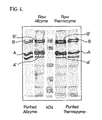
- both the native amylases and the purified form exhibit two distinct species between 47 and 86 kDa ( Fig. 4 ).
- 5 ⁇ g of total protein was heat-denatured in the presence of SDS and separated in a 12% Lammeli gel.
- the image intensity has been log-transformed to clarify the faint lighter species in the source products.
- the two products differ significantly in the proportion of the two species; namely, raw amylase is more highly populated by the apparently larger species relative to the purified form.
- a first ratio, R is defined as “top:bottom”, and represents the relative quantities of the top and bottom bands.
- the second ratio is a "recovery ratio", F, defined as "bottom:(top + bottom)".
- F recovery ratio
- a higher value of F and a lower value of R each indicated a greater proportion of the more active lower band.
- the process according to the invention has demonstrably increased the proportion of the more active form of the enzyme in the system (comparing purified form 1 vs. raw form 2 and purified form 4 vs. raw form 3).
- the greater per-unit mass activity found in the purified enzyme can be largely accounted for by a greater proportion of active enzyme and suggest that a significant fraction of enzyme in raw amylase is inactive.
- the purification/derivatization of raw amylase may result in the conversion of this reservoir of stable, inactive amylase to a catalytically active form.
Landscapes
- Life Sciences & Earth Sciences (AREA)
- Chemical & Material Sciences (AREA)
- Health & Medical Sciences (AREA)
- Organic Chemistry (AREA)
- Engineering & Computer Science (AREA)
- Wood Science & Technology (AREA)
- Bioinformatics & Cheminformatics (AREA)
- Zoology (AREA)
- Genetics & Genomics (AREA)
- Biotechnology (AREA)
- Biochemistry (AREA)
- General Health & Medical Sciences (AREA)
- Molecular Biology (AREA)
- Biomedical Technology (AREA)
- General Engineering & Computer Science (AREA)
- Medicinal Chemistry (AREA)
- Microbiology (AREA)
- Enzymes And Modification Thereof (AREA)
- Preparation Of Compounds By Using Micro-Organisms (AREA)
- Carbon And Carbon Compounds (AREA)
- Immobilizing And Processing Of Enzymes And Microorganisms (AREA)
Claims (18)
- Verfahren zum Verstärken der intrinsischen Aktivität eines Enzyms, das ausgewählt ist aus den Gruppe-3-Hydrolasen, in einer Rohenzymlösung, wobei die genannte Rohenzymlösung wenigstens einen teilweise gereinigten konzentrierten Enzymextrakt umfasst, der reich an dem gewünschten Enzym und relativ frei von anderen konkurrierenden/kontaminierenden Enzymen, Proteinbruchstücken und/oder Zellen ist, wobei das genannte Verfahren Folgendes beinhaltet: (a) Verdünnen der genannten Rohenzymlösung mit Wasser oder einer wässrigen Pufferlösung und (b) Behandeln der genannten verdünnten Rohenzymlösung mit einer effektiven Menge Aktivkohle über einen ausreichenden Zeitraum in einem effektiven Verhältnis zwischen Rohenzymgewicht und Reinigungsmittelgewicht, um die genannte Verstärkung zu bewirken und eine Enzymlösung mit verstärkter Aktivität bereitzustellen.
- Verfahren nach Anspruch 1, wobei ein Teil der genannten Rohenzymlösung mit wenigstens drei Teilen Wasser verdünnt wird, um die genannte verdünnte Rohenzymlösung bereitzustellen.
- Verfahren nach Anspruch 1 oder Anspruch 2, wobei die genannte Rohenzymlösung mit einer wässrigen Pufferlösung verdünnt wird, um eine gepufferte verdünnte Rohenzymlösung bereitzustellen.
- Verfahren nach einem der Ansprüche 1 bis 3, das ferner das Entfernen des genannten Reinigungsmittels aus der genannten Enzymlösung mit verstärkter Aktivität beinhaltet, um eine gereinigte Enzymlösung bereitzustellen.
- Verfahren nach einem der Ansprüche 1 bis 4, das das Leiten der genannten Rohenzymlösung durch eine Säule beinhaltet, die eine effektive Menge des genannten Reinigungsmittels enthält.
- Verfahren nach Anspruch 4, wobei das genannte Reinigungsmittel mit einem Verfahren entfernt wird, das ausgewählt ist aus der Gruppe bestehend aus Filtration und Zentrifugation.
- Verfahren nach einem der Ansprüche 1 bis 6, wobei das genannte effektive Gewichtsverhältnis zwischen Rohenzym und Reinigungsmittel nicht größer als 50:1 ist.
- Vefahren nach Anspruch 7, wobei das genannte Verhältnis nicht größer als 25 ist.
- Verfahren nach Anspruch 8, wobei das genannte Verhältnis nicht größer als 15 ist.
- Verfahren nach einem der Ansprüche 1 bis 9, wobei das genannte Enzym ausgewählt ist aus der Gruppe bestehend aus Amylase, Glucoamylase, Cellulose oder Xylanase.
- Verfahren nach einem der Ansprüche 1 bis 10, wobei die genannte Enzymlösung mit verstärkter Aktivität ein Spektrum hat, das ausgewählt ist aus Fern-UV-(CD)- und UV-VIS-Spektren, die sich von der genannten Rohenzymlösung unterscheiden.
- Verfahren nach Anspruch 11, wobei die genannte Enzymlösung mit verstärkter Aktivität eine relative Absorbanzintensität, die geringer ist als die der genannten Rohenzymlösung, im CD-Spektralbereich von 205-230 nm aufweist.
- Verfahren nach Anspruch 11, wobei das genannte Enzym Alpha-Amylase ist und die genannte Enzymlösung mit verstärkter Aktivität eine minimale Fern-UV-(CD)-Spektrum-Elliptizität hat, die um wenigstens 1 nm von der Rohenzymlösung verschoben ist, im Bereich zwischen 205 und 230 nm.
- Verfahren nach einem der Ansprüche 1 bis 9, wobei die genannte Enzymlösung mit verstärkter Aktivität einen maximalen UV-VIS-Spektrum-Höchstwert hat, der wenigstens 30 nm geringer ist als der der genannten Rohenzymlösung.
- Verfahren nach einem der Ansprüche 1 bis 10, wobei das genannte Enzym Alpha-Amylase ist und die genannte Enzymlösung mit verstärkter Aktivität einen maximalen Spektralabsorptionshöchstwert über dem Bereich von 340 bis 360 nm hat.
- Verfahren nach Anspruch 15, wobei das genannte Substrat Stärke ist und das genannte Enzym Alpha-Amylase ist.
- Verfahren nach einem der Ansprüche 1 bis 11, wobei die Enzymlösung mit verstärkter Aktivität eine relativ geringe Menge an organischen Entitäten ohne enzymatische Aktivität gegen Stärke hat, wie durch Gelelektrophorese ermittelt.
- Verfahren nach Anspruch 12, wobei das Verhältnis zwischen A und B wenigstens 10 mal größer ist als das Verhältnis zwischen A' und B', wobei A die Menge an Enzymen in der Enzymlösung mit verstärkter Aktivität ist, B die Menge der genannten organischen Entitäten ist, A' die Enzymmenge in der genannten Rohenzynlösung ist und B' die Menge der genannten organischen Entitäten in der genannten Rohenzymlösung ist.
Applications Claiming Priority (2)
| Application Number | Priority Date | Filing Date | Title |
|---|---|---|---|
| CA002421832A CA2421832C (en) | 2003-03-13 | 2003-03-13 | Enhancement of enzyme activity by selective purification |
| PCT/CA2004/000370 WO2004081207A1 (en) | 2003-03-13 | 2004-03-10 | Enhancement of enzyme activity by activated carbon |
Publications (2)
| Publication Number | Publication Date |
|---|---|
| EP1636355A1 EP1636355A1 (de) | 2006-03-22 |
| EP1636355B1 true EP1636355B1 (de) | 2010-12-01 |
Family
ID=32968187
Family Applications (1)
| Application Number | Title | Priority Date | Filing Date |
|---|---|---|---|
| EP04718893A Expired - Lifetime EP1636355B1 (de) | 2003-03-13 | 2004-03-10 | Verbesserung der enzymatischen aktivität mittels aktivkohle |
Country Status (6)
| Country | Link |
|---|---|
| US (1) | US7892805B2 (de) |
| EP (1) | EP1636355B1 (de) |
| AT (1) | ATE490310T1 (de) |
| CA (2) | CA2421832C (de) |
| DE (1) | DE602004030336D1 (de) |
| WO (1) | WO2004081207A1 (de) |
Families Citing this family (7)
| Publication number | Priority date | Publication date | Assignee | Title |
|---|---|---|---|---|
| US8765428B2 (en) | 2008-07-18 | 2014-07-01 | Mascoma Corporation | Flow-through biological conversion of lignocellulosic biomass |
| WO2010045168A1 (en) * | 2008-10-16 | 2010-04-22 | Andrew Desbarats | Method and apparatus for producing alcohol or sugar using a commercial-scale bioreactor |
| US10358669B2 (en) | 2013-11-07 | 2019-07-23 | Immortazyme Co. | Apparatus and method for reduction of phenol in enzymatic solutions and/or feedstock |
| WO2017035253A1 (en) | 2015-08-24 | 2017-03-02 | The Regents Of The University Of California | Methods and compositions for protein purification and enzyme reaction |
| EP3638801A4 (de) | 2017-07-26 | 2021-03-24 | Yacyshyn, Vincent | Entfernung von polyphenolverunreinigungen aus einsatzstoffbasierten polyphenolen |
| US11173187B2 (en) | 2018-11-13 | 2021-11-16 | Immortazyme Company Ltd. | Concentrated oil-based polyphenol composition and a method of producing the oil-based polyphenol composition |
| CN121801854A (zh) * | 2024-10-07 | 2026-04-07 | 巴斯夫欧洲公司 | 利用化学活性碳的蛋白质纯化 |
Family Cites Families (9)
| Publication number | Priority date | Publication date | Assignee | Title |
|---|---|---|---|---|
| US3390981A (en) | 1964-02-14 | 1968-07-02 | Du Pont | Method for the production of finely divided metals |
| US3345158A (en) | 1964-08-10 | 1967-10-03 | Ibm | Electrical conductor material and method of making same |
| IT1034632B (it) | 1975-03-27 | 1979-10-10 | Tecnologie Spa | Processo per la separazione e il recupero del rodio e delliridio dalle miscele con altri metalli preziosi |
| US4204041A (en) * | 1977-10-03 | 1980-05-20 | Illinois Water Treatment Company | High loading of immobilized enzymes on activated carbon supports |
| JPS56363A (en) | 1979-06-15 | 1981-01-06 | Santo Tekkosho Kk | Continuous pretreating process of fabric |
| JPS6092433A (ja) | 1983-10-26 | 1985-05-24 | Daido Steel Co Ltd | 貴金属の回収方法 |
| RO90071A2 (ro) | 1984-09-07 | 1986-08-30 | Institutul De Chimie,Ro | Procedeu de recuperare a paladiului argintului si cuprului din deseurri de aliaje |
| US6312612B1 (en) * | 1999-06-09 | 2001-11-06 | The Procter & Gamble Company | Apparatus and method for manufacturing an intracutaneous microneedle array |
| ATE272436T1 (de) * | 2000-05-18 | 2004-08-15 | Novozymes As | Mikrofiltration unter verwendung von aktivkohle |
-
2003
- 2003-03-13 CA CA002421832A patent/CA2421832C/en not_active Expired - Fee Related
-
2004
- 2004-03-10 CA CA2518056A patent/CA2518056C/en not_active Expired - Fee Related
- 2004-03-10 WO PCT/CA2004/000370 patent/WO2004081207A1/en not_active Ceased
- 2004-03-10 AT AT04718893T patent/ATE490310T1/de not_active IP Right Cessation
- 2004-03-10 DE DE602004030336T patent/DE602004030336D1/de not_active Expired - Lifetime
- 2004-03-10 EP EP04718893A patent/EP1636355B1/de not_active Expired - Lifetime
- 2004-03-11 US US10/797,019 patent/US7892805B2/en not_active Expired - Fee Related
Also Published As
| Publication number | Publication date |
|---|---|
| WO2004081207A1 (en) | 2004-09-23 |
| EP1636355A1 (de) | 2006-03-22 |
| ATE490310T1 (de) | 2010-12-15 |
| CA2421832A1 (en) | 2004-09-13 |
| US7892805B2 (en) | 2011-02-22 |
| CA2421832C (en) | 2006-10-10 |
| US20040259219A1 (en) | 2004-12-23 |
| DE602004030336D1 (de) | 2011-01-13 |
| CA2518056A1 (en) | 2004-09-23 |
| CA2518056C (en) | 2013-05-28 |
Similar Documents
| Publication | Publication Date | Title |
|---|---|---|
| Asgher et al. | Improvement of catalytic efficiency, thermo-stability and dye decolorization capability of Pleurotus ostreatus IBL-02 laccase by hydrophobic sol gel entrapment | |
| Muhammad Nasir Iqbal et al. | Decolorization applicability of sol–gel matrix immobilized manganese peroxidase produced from an indigenous white rot fungal strain Ganoderma lucidum | |
| Krisch et al. | Characterization of a β-glucosidase with transgalactosylation capacity from the zygomycete Rhizomucor miehei | |
| Jana et al. | Salt-independent thermophilic α-amylase from Bacillus megaterium VUMB109: an efficacy testing for preparation of maltooligosaccharides | |
| Dey et al. | Purification of polygalacturonase from Aspergillus awamori Nakazawa MTCC 6652 and its application in apple juice clarification | |
| Yandri et al. | Immobilization of Aspergillus fumigatus α-amylase via adsorption onto bentonite/chitosan for stability enhancement | |
| Yandri et al. | The effect of zeolite/chitosan hybrid matrix for thermal-stabilization enhancement on the immobilization of Aspergillus fumigatus α-amylase | |
| Monteiro et al. | Efficient hydrolysis of wine and grape juice anthocyanins by Malbranchea pulchella β-glucosidase immobilized on MANAE-agarose and ConA-Sepharose supports | |
| Lago et al. | The glucoamylase from Aspergillus wentii: purification and characterization | |
| Al-Harbi et al. | Purification and biochemical characterization of Arabian balsam α-amylase and enhancing the retention and reusability via encapsulation onto calcium alginate/Fe2O3 nanocomposite beads | |
| Monteiro et al. | Biochemical Characterization of a β-1, 3-Glucanase from Trichoderma koningii Induced by Cell Wall of Rhizoctonia solani: VN Monteiro and CJ Ulhoa | |
| Ratanakhanokchai et al. | Purification and properties of a maltotetraose-and maltotriose-producing amylase from Chloroflexus aurantiacus | |
| Bamigboye et al. | Stain removing, juice-clarifying, and starch-liquefying potentials of amylase from Pleurotus tuberregium in submerged fermentation system | |
| Aragon et al. | Production of xylo-oligosaccharides by immobilized-stabilized derivatives of endo-xylanase from Streptomyces halstedii | |
| Borzova et al. | Purification and characterization of a naringinase from Cryptococcus albidus | |
| EP1636355B1 (de) | Verbesserung der enzymatischen aktivität mittels aktivkohle | |
| Porfirif et al. | Production of alpha-amylase from Aspergillus oryzae for several industrial applications in a single step | |
| Uzun et al. | Immobilization and some application of α-amylase purified from Rhizoctonia solani AG-4 strain ZB-34 | |
| Roy et al. | Exploiting unusual affinity of usual polysaccharides for separation of enzymes on fluidized beds | |
| CN103320374B (zh) | 一种高效表达枯草芽孢杆菌漆酶的基因工程菌及其应用 | |
| Yandri et al. | Immobilization of α-amylase from Aspergillus fumigatus using adsorption method onto zeolite | |
| Ahmed | Extraction and purification of protease from Aspergillus niger isolation | |
| Fratebianchi et al. | Purification and biochemical and kinetic properties of an endo-polygalacturonase from the industrial fungus Aspergillus sojae | |
| Galdino et al. | Biochemical and Structural Characterization of Amy1: An Alpha‐Amylase from Cryptococcus flavus Expressed in Saccharomyces cerevisiae | |
| El-Shora et al. | Immobilization of purified pectinase from Aspergillus nidulans on chitosan and alginate beads for biotechnological applications |
Legal Events
| Date | Code | Title | Description |
|---|---|---|---|
| PUAI | Public reference made under article 153(3) epc to a published international application that has entered the european phase |
Free format text: ORIGINAL CODE: 0009012 |
|
| 17P | Request for examination filed |
Effective date: 20051010 |
|
| AK | Designated contracting states |
Kind code of ref document: A1 Designated state(s): AT BE BG CH CY CZ DE DK EE ES FI FR GB GR HU IE IT LI LU MC NL PL PT RO SE SI SK TR |
|
| DAX | Request for extension of the european patent (deleted) | ||
| GRAP | Despatch of communication of intention to grant a patent |
Free format text: ORIGINAL CODE: EPIDOSNIGR1 |
|
| GRAS | Grant fee paid |
Free format text: ORIGINAL CODE: EPIDOSNIGR3 |
|
| GRAA | (expected) grant |
Free format text: ORIGINAL CODE: 0009210 |
|
| AK | Designated contracting states |
Kind code of ref document: B1 Designated state(s): AT BE BG CH CY CZ DE DK EE ES FI FR GB GR HU IE IT LI LU MC NL PL PT RO SE SI SK TR |
|
| REG | Reference to a national code |
Ref country code: GB Ref legal event code: FG4D |
|
| REG | Reference to a national code |
Ref country code: CH Ref legal event code: EP |
|
| REG | Reference to a national code |
Ref country code: IE Ref legal event code: FG4D |
|
| REF | Corresponds to: |
Ref document number: 602004030336 Country of ref document: DE Date of ref document: 20110113 Kind code of ref document: P |
|
| RAP2 | Party data changed (patent owner data changed or rights of a patent transferred) |
Owner name: IMMORTAZYME COMPANY |
|
| RIN2 | Information on inventor provided after grant (corrected) |
Inventor name: KHAVKINE, MIKHAIL Inventor name: SAVILLE, BRADLEY A. |
|
| REG | Reference to a national code |
Ref country code: NL Ref legal event code: VDEP Effective date: 20101201 |
|
| PG25 | Lapsed in a contracting state [announced via postgrant information from national office to epo] |
Ref country code: BG Free format text: LAPSE BECAUSE OF FAILURE TO SUBMIT A TRANSLATION OF THE DESCRIPTION OR TO PAY THE FEE WITHIN THE PRESCRIBED TIME-LIMIT Effective date: 20110301 Ref country code: CY Free format text: LAPSE BECAUSE OF FAILURE TO SUBMIT A TRANSLATION OF THE DESCRIPTION OR TO PAY THE FEE WITHIN THE PRESCRIBED TIME-LIMIT Effective date: 20101201 Ref country code: FI Free format text: LAPSE BECAUSE OF FAILURE TO SUBMIT A TRANSLATION OF THE DESCRIPTION OR TO PAY THE FEE WITHIN THE PRESCRIBED TIME-LIMIT Effective date: 20101201 Ref country code: NL Free format text: LAPSE BECAUSE OF FAILURE TO SUBMIT A TRANSLATION OF THE DESCRIPTION OR TO PAY THE FEE WITHIN THE PRESCRIBED TIME-LIMIT Effective date: 20101201 Ref country code: AT Free format text: LAPSE BECAUSE OF FAILURE TO SUBMIT A TRANSLATION OF THE DESCRIPTION OR TO PAY THE FEE WITHIN THE PRESCRIBED TIME-LIMIT Effective date: 20101201 Ref country code: SE Free format text: LAPSE BECAUSE OF FAILURE TO SUBMIT A TRANSLATION OF THE DESCRIPTION OR TO PAY THE FEE WITHIN THE PRESCRIBED TIME-LIMIT Effective date: 20101201 Ref country code: SI Free format text: LAPSE BECAUSE OF FAILURE TO SUBMIT A TRANSLATION OF THE DESCRIPTION OR TO PAY THE FEE WITHIN THE PRESCRIBED TIME-LIMIT Effective date: 20101201 |
|
| PG25 | Lapsed in a contracting state [announced via postgrant information from national office to epo] |
Ref country code: GR Free format text: LAPSE BECAUSE OF FAILURE TO SUBMIT A TRANSLATION OF THE DESCRIPTION OR TO PAY THE FEE WITHIN THE PRESCRIBED TIME-LIMIT Effective date: 20110302 |
|
| PG25 | Lapsed in a contracting state [announced via postgrant information from national office to epo] |
Ref country code: ES Free format text: LAPSE BECAUSE OF FAILURE TO SUBMIT A TRANSLATION OF THE DESCRIPTION OR TO PAY THE FEE WITHIN THE PRESCRIBED TIME-LIMIT Effective date: 20110312 Ref country code: CZ Free format text: LAPSE BECAUSE OF FAILURE TO SUBMIT A TRANSLATION OF THE DESCRIPTION OR TO PAY THE FEE WITHIN THE PRESCRIBED TIME-LIMIT Effective date: 20101201 Ref country code: PT Free format text: LAPSE BECAUSE OF FAILURE TO SUBMIT A TRANSLATION OF THE DESCRIPTION OR TO PAY THE FEE WITHIN THE PRESCRIBED TIME-LIMIT Effective date: 20110401 Ref country code: BE Free format text: LAPSE BECAUSE OF FAILURE TO SUBMIT A TRANSLATION OF THE DESCRIPTION OR TO PAY THE FEE WITHIN THE PRESCRIBED TIME-LIMIT Effective date: 20101201 Ref country code: EE Free format text: LAPSE BECAUSE OF FAILURE TO SUBMIT A TRANSLATION OF THE DESCRIPTION OR TO PAY THE FEE WITHIN THE PRESCRIBED TIME-LIMIT Effective date: 20101201 |
|
| PG25 | Lapsed in a contracting state [announced via postgrant information from national office to epo] |
Ref country code: SK Free format text: LAPSE BECAUSE OF FAILURE TO SUBMIT A TRANSLATION OF THE DESCRIPTION OR TO PAY THE FEE WITHIN THE PRESCRIBED TIME-LIMIT Effective date: 20101201 Ref country code: RO Free format text: LAPSE BECAUSE OF FAILURE TO SUBMIT A TRANSLATION OF THE DESCRIPTION OR TO PAY THE FEE WITHIN THE PRESCRIBED TIME-LIMIT Effective date: 20101201 Ref country code: PL Free format text: LAPSE BECAUSE OF FAILURE TO SUBMIT A TRANSLATION OF THE DESCRIPTION OR TO PAY THE FEE WITHIN THE PRESCRIBED TIME-LIMIT Effective date: 20101201 |
|
| PLBE | No opposition filed within time limit |
Free format text: ORIGINAL CODE: 0009261 |
|
| STAA | Information on the status of an ep patent application or granted ep patent |
Free format text: STATUS: NO OPPOSITION FILED WITHIN TIME LIMIT |
|
| PG25 | Lapsed in a contracting state [announced via postgrant information from national office to epo] |
Ref country code: MC Free format text: LAPSE BECAUSE OF NON-PAYMENT OF DUE FEES Effective date: 20110331 Ref country code: DK Free format text: LAPSE BECAUSE OF FAILURE TO SUBMIT A TRANSLATION OF THE DESCRIPTION OR TO PAY THE FEE WITHIN THE PRESCRIBED TIME-LIMIT Effective date: 20101201 |
|
| REG | Reference to a national code |
Ref country code: CH Ref legal event code: PL |
|
| 26N | No opposition filed |
Effective date: 20110902 |
|
| REG | Reference to a national code |
Ref country code: FR Ref legal event code: ST Effective date: 20111130 |
|
| REG | Reference to a national code |
Ref country code: DE Ref legal event code: R097 Ref document number: 602004030336 Country of ref document: DE Effective date: 20110902 |
|
| PG25 | Lapsed in a contracting state [announced via postgrant information from national office to epo] |
Ref country code: IT Free format text: LAPSE BECAUSE OF FAILURE TO SUBMIT A TRANSLATION OF THE DESCRIPTION OR TO PAY THE FEE WITHIN THE PRESCRIBED TIME-LIMIT Effective date: 20101201 |
|
| REG | Reference to a national code |
Ref country code: IE Ref legal event code: MM4A |
|
| PG25 | Lapsed in a contracting state [announced via postgrant information from national office to epo] |
Ref country code: DE Free format text: LAPSE BECAUSE OF NON-PAYMENT OF DUE FEES Effective date: 20111001 Ref country code: FR Free format text: LAPSE BECAUSE OF NON-PAYMENT OF DUE FEES Effective date: 20110331 Ref country code: LI Free format text: LAPSE BECAUSE OF NON-PAYMENT OF DUE FEES Effective date: 20110331 Ref country code: IE Free format text: LAPSE BECAUSE OF NON-PAYMENT OF DUE FEES Effective date: 20110310 Ref country code: CH Free format text: LAPSE BECAUSE OF NON-PAYMENT OF DUE FEES Effective date: 20110331 |
|
| REG | Reference to a national code |
Ref country code: DE Ref legal event code: R119 Ref document number: 602004030336 Country of ref document: DE Effective date: 20111001 |
|
| PG25 | Lapsed in a contracting state [announced via postgrant information from national office to epo] |
Ref country code: LU Free format text: LAPSE BECAUSE OF NON-PAYMENT OF DUE FEES Effective date: 20110310 |
|
| PG25 | Lapsed in a contracting state [announced via postgrant information from national office to epo] |
Ref country code: TR Free format text: LAPSE BECAUSE OF FAILURE TO SUBMIT A TRANSLATION OF THE DESCRIPTION OR TO PAY THE FEE WITHIN THE PRESCRIBED TIME-LIMIT Effective date: 20101201 |
|
| PG25 | Lapsed in a contracting state [announced via postgrant information from national office to epo] |
Ref country code: HU Free format text: LAPSE BECAUSE OF FAILURE TO SUBMIT A TRANSLATION OF THE DESCRIPTION OR TO PAY THE FEE WITHIN THE PRESCRIBED TIME-LIMIT Effective date: 20101201 |
|
| PGFP | Annual fee paid to national office [announced via postgrant information from national office to epo] |
Ref country code: GB Payment date: 20180329 Year of fee payment: 15 |
|
| GBPC | Gb: european patent ceased through non-payment of renewal fee |
Effective date: 20190310 |
|
| PG25 | Lapsed in a contracting state [announced via postgrant information from national office to epo] |
Ref country code: GB Free format text: LAPSE BECAUSE OF NON-PAYMENT OF DUE FEES Effective date: 20190310 |