EP1638362A2 - Opération ARQ hybride pendant la commutation douce dans un système sans fil - Google Patents
Opération ARQ hybride pendant la commutation douce dans un système sans fil Download PDFInfo
- Publication number
- EP1638362A2 EP1638362A2 EP05255758A EP05255758A EP1638362A2 EP 1638362 A2 EP1638362 A2 EP 1638362A2 EP 05255758 A EP05255758 A EP 05255758A EP 05255758 A EP05255758 A EP 05255758A EP 1638362 A2 EP1638362 A2 EP 1638362A2
- Authority
- EP
- European Patent Office
- Prior art keywords
- information
- packet
- base station
- mobile device
- signal
- Prior art date
- Legal status (The legal status is an assumption and is not a legal conclusion. Google has not performed a legal analysis and makes no representation as to the accuracy of the status listed.)
- Withdrawn
Links
Images
Classifications
-
- H—ELECTRICITY
- H04—ELECTRIC COMMUNICATION TECHNIQUE
- H04L—TRANSMISSION OF DIGITAL INFORMATION, e.g. TELEGRAPHIC COMMUNICATION
- H04L1/00—Arrangements for detecting or preventing errors in the information received
- H04L1/12—Arrangements for detecting or preventing errors in the information received by using return channel
- H04L1/16—Arrangements for detecting or preventing errors in the information received by using return channel in which the return channel carries supervisory signals, e.g. repetition request signals
- H04L1/1607—Details of the supervisory signal
- H04L1/1692—Physical properties of the supervisory signal, e.g. acknowledgement by energy bursts
-
- H—ELECTRICITY
- H04—ELECTRIC COMMUNICATION TECHNIQUE
- H04L—TRANSMISSION OF DIGITAL INFORMATION, e.g. TELEGRAPHIC COMMUNICATION
- H04L1/00—Arrangements for detecting or preventing errors in the information received
- H04L1/12—Arrangements for detecting or preventing errors in the information received by using return channel
- H04L1/16—Arrangements for detecting or preventing errors in the information received by using return channel in which the return channel carries supervisory signals, e.g. repetition request signals
- H04L1/18—Automatic repetition systems, e.g. Van Duuren systems
- H04L1/1829—Arrangements specially adapted for the receiver end
- H04L1/1835—Buffer management
- H04L1/1845—Combining techniques, e.g. code combining
-
- H—ELECTRICITY
- H04—ELECTRIC COMMUNICATION TECHNIQUE
- H04L—TRANSMISSION OF DIGITAL INFORMATION, e.g. TELEGRAPHIC COMMUNICATION
- H04L1/00—Arrangements for detecting or preventing errors in the information received
- H04L1/12—Arrangements for detecting or preventing errors in the information received by using return channel
- H04L1/16—Arrangements for detecting or preventing errors in the information received by using return channel in which the return channel carries supervisory signals, e.g. repetition request signals
- H04L1/18—Automatic repetition systems, e.g. Van Duuren systems
- H04L1/1829—Arrangements specially adapted for the receiver end
- H04L1/1864—ARQ related signaling
-
- H—ELECTRICITY
- H04—ELECTRIC COMMUNICATION TECHNIQUE
- H04W—WIRELESS COMMUNICATION NETWORKS
- H04W28/00—Network traffic management; Network resource management
- H04W28/02—Traffic management, e.g. flow control or congestion control
- H04W28/04—Error control
-
- H—ELECTRICITY
- H04—ELECTRIC COMMUNICATION TECHNIQUE
- H04L—TRANSMISSION OF DIGITAL INFORMATION, e.g. TELEGRAPHIC COMMUNICATION
- H04L1/00—Arrangements for detecting or preventing errors in the information received
- H04L1/12—Arrangements for detecting or preventing errors in the information received by using return channel
- H04L1/16—Arrangements for detecting or preventing errors in the information received by using return channel in which the return channel carries supervisory signals, e.g. repetition request signals
- H04L1/18—Automatic repetition systems, e.g. Van Duuren systems
- H04L1/1812—Hybrid protocols; Hybrid automatic repeat request [HARQ]
-
- H—ELECTRICITY
- H04—ELECTRIC COMMUNICATION TECHNIQUE
- H04L—TRANSMISSION OF DIGITAL INFORMATION, e.g. TELEGRAPHIC COMMUNICATION
- H04L1/00—Arrangements for detecting or preventing errors in the information received
- H04L1/12—Arrangements for detecting or preventing errors in the information received by using return channel
- H04L1/16—Arrangements for detecting or preventing errors in the information received by using return channel in which the return channel carries supervisory signals, e.g. repetition request signals
- H04L1/18—Automatic repetition systems, e.g. Van Duuren systems
- H04L1/1867—Arrangements specially adapted for the transmitter end
- H04L1/187—Details of sliding window management
-
- H—ELECTRICITY
- H04—ELECTRIC COMMUNICATION TECHNIQUE
- H04L—TRANSMISSION OF DIGITAL INFORMATION, e.g. TELEGRAPHIC COMMUNICATION
- H04L1/00—Arrangements for detecting or preventing errors in the information received
- H04L2001/0092—Error control systems characterised by the topology of the transmission link
- H04L2001/0093—Point-to-multipoint
-
- H—ELECTRICITY
- H04—ELECTRIC COMMUNICATION TECHNIQUE
- H04W—WIRELESS COMMUNICATION NETWORKS
- H04W36/00—Hand-off or reselection arrangements
- H04W36/16—Performing reselection for specific purposes
- H04W36/18—Performing reselection for specific purposes for allowing seamless reselection, e.g. soft reselection
-
- H—ELECTRICITY
- H04—ELECTRIC COMMUNICATION TECHNIQUE
- H04W—WIRELESS COMMUNICATION NETWORKS
- H04W88/00—Devices specially adapted for wireless communication networks, e.g. terminals, base stations or access point devices
- H04W88/08—Access point devices
Definitions
- This invention relates generally to telecommunications, and, more particularly, to wireless communications.
- a system typically includes a plurality of base stations distributed within an area to be serviced by the system. Various users within the area, fixed or mobile, may then access the system and, thus, other interconnected telecommunications systems, via one or more of the base stations.
- a mobile device maintains communications with the system as the mobile device passes through an area by communicating with one and then another base station, as the user moves. The mobile device may communicate with the closest base station, the base station with the strongest signal, the base station with a capacity sufficient to accept communications, etc .
- the mobile device transitions from one base station to another, there is a period of time during which the mobile device may be communicating with more than one base station.
- the process of transitioning the mobile device from one base station to another is commonly referred to as soft hand off (SHO).
- SHO soft hand off
- both base stations may be receiving communications from the mobile device.
- HARQ Hybrid Automatic Repeat Request
- a transmitter such as the mobile device
- ACK acknowledgment signal
- NACK negative acknowledgment signal
- the mobile device responds to the NACK by retransmitting the varied set of encoded information. The process repeats until the mobile device receives an ACK from the base station or a preselected number of attempts ( e.g., three) are made.
- the HARQ technique can be problematic during SHO. Since the mobile device is communicating with more than one base station (e.g., two base stations, A and B) during SHO, it is highly possible that base station A will receive the information properly and return an ACK, while base station B may not, returning a NACK instead due to link imbalance and inner loop power control combining strategy to mitigate toward the stronger link. In this situation, if the mobile device ignores the NACK from base station B, and communicates "new" information, base station B may misinterpret the "new" information as a retransmission of the redundancy version of the "old" information.
- base station B may misinterpret the "new" information as a retransmission of the redundancy version of the "old” information.
- base Station A may misinterpret the retransmission as a transmission of "new" information. Neither scenario is desirable in an efficient and reliable telecommunications system.
- the present invention is directed to overcoming, or at least reducing, the effects of one or more of the problems set forth above.
- a method for controlling a communications system. The method comprises communicating a first packet of information to a first and second base station. Thereafter, an acknowledgment signal is received from the first base station and a negative acknowledgment signal is received from the second base station. A communication is then sent to at least the second base station that a second packet of information is a new packet of information.
- a method for controlling a communications system. The method comprises communicating a first packet of information to a plurality of base stations, and receiving one of an acknowledgment signal and a negative acknowledgment signal from at least a portion of the plurality of base stations. Thereafter, a second packet of information is communicated to the plurality of base stations, where the second packet of information contains new information in response to receiving at least one acknowledgment signal from the plurality of base stations. At least a portion of the base stations providing a negative acknowledgment signal are sent a communication that the second packet of information contains new information.
- a method for controlling a communications system. The method comprises receiving a first packet of information, and sending a negative acknowledgment signal. Thereafter, a communication is received that a second packet of information is a new packet of information.
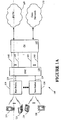
- a communications system 100 is illustrated, in accordance with one embodiment of the present invention.
- the communications system 100 of Figure 1A is a Universal Mobile Telephone System (UMTS), although it should be understood that the present invention may be applicable to other systems that support data and/or voice communication.
- the communications system 100 allows one or more mobile devices 120 to communicate with a data network 125, such as the Internet, and/or a public telephone system (PSTN) 160 through one or more base stations 130.
- a data network 125 such as the Internet
- PSTN public telephone system
- the mobile device 120 may take the form of any of a variety of devices, including cellular phones, personal digital assistants (PDAs), laptop computers, digital pagers, wireless cards, and any other device capable of accessing the data network 125 and/or the PSTN 160 through the base station 130.
- PDAs personal digital assistants
- laptop computers laptop computers
- digital pagers digital pagers
- wireless cards any other device capable of accessing the data network 125 and/or the PSTN 160 through the base station 130.
- a plurality of the base stations 130 may be coupled to a Radio Network Controller (RNC) 138 by one or more connections 139, such as T1/EI lines or circuits, ATM circuits, cables, optical digital subscriber lines (DSLs), and the like.
- RNC Radio Network Controller
- connections 139 such as T1/EI lines or circuits, ATM circuits, cables, optical digital subscriber lines (DSLs), and the like.
- RNC 138 one RNC 138 is illustrated, those skilled in the art will appreciate that a plurality of RNCs 138 may be utilized to interface with a large number of Base stations 130.
- the RNC 138 operates to control and coordinate the base stations 130 to which it is connected.
- the RNC 138 of Figure 1 generally provides replication, communications, runtime, and system management services, and, as discussed below in more detail below, may be responsible for communicating ACK/NACK status associated with a particular transmission of a mobile device 120 during SHO between the base stations 130.
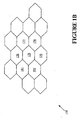
- a region 170 to be serviced by the system 100 is separated into a plurality of regions or cells, each being associated with a separate base station 130.
- each cell has a plurality of adjacent neighboring cells.
- the cell 175 has six neighboring cells 176-181 such that a mobile device 120 entering the cell 175 may travel from one of the neighboring cells 176-181.
- SHO may take place when a mobile device 120 enters the cell 175 from any of the neighboring cells 176-181.
- the RNC 138 is also coupled to a Core Network (CN) 165 via a connection 145, which may take on any of a variety of forms, such as T1/EI lines or circuits, ATM circuits, cables, optical digital subscriber lines (DSLs), and the like.
- CN Core Network
- the CN 165 operates as an interface to the data network 125 and/or to the public telephone system (PSTN) 160.
- PSTN public telephone system
- the CN 165 performs a variety of functions and operations, such as user authentication, however, a detailed description of the structure and operation of the CN 165 is not necessary to an understanding and appreciation of the instant invention. Accordingly, to avoid unnecessarily obfuscating the instant invention, further details of the CN 165 are not presented herein.
- the communications system 100 enables the mobile devices 120 to communicate with the data network 125 and/or the PSTN 160. It should be understood, however, that the configuration of the communications system 100 of Figure 1A is exemplary in nature, and that fewer or additional components may be employed in other embodiments of the communications system 100 without departing from the spirit and scope of the instant invention.
- terms such as “processing” or “computing” or “calculating” or “determining” or “displaying” or the like refer to the action and processes of a computer system, or similar electronic computing device, that manipulates and transforms data represented as physical, electronic quantities within the computer system's registers and memories into other data similarly represented as physical quantities within the computer system's memories or registers or other such information storage, transmission or display devices.
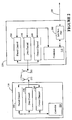
- the base station 130 includes an interface unit 200, a controller 210, an antenna 215 and a plurality of channels: such as a shared channel 220, a data channel 230, and a control channel 240.
- the interface unit 200 controls the flow of information between the base station 130 and the RNC 138 (see Figure 1A).
- the controller 210 generally operates to control both the transmission and reception of data and control signals over the antenna 215 and the plurality of channels 220, 230, 240 and to communicate at least portions of the received information to the RNC 138 via the interface unit 200.
- the mobile device 120 shares certain functional attributes with the base station 130.
- the mobile device 120 includes a controller 250, an antenna 255 and a plurality of channels: such as a shared channel 260, a data channel 270, and a control channel 280.
- the controller 250 generally operates to control both the transmission and reception of data and control signals over the antenna 255 and the plurality of channels 260, 270, 280.
- the channels 260, 270, 280 in the mobile device 120 communicate with the corresponding channels 220, 230, 240 in the base station 130.
- the channels 220, 260; 230, 270; 240, 280 are used to effect a controlled scheduling of communications from the mobile device 120 to the base station 130.
- the mobile device 120 has a first and second status in which it may operate in the network.
- the mobile device 120 In the first status, the mobile device 120 is in contact with a plurality of the base stations 130, which is sometimes referred to as a soft hand off ("SHO") or rate controlled mode of operation.
- the second status the "time scheduled" mode of operation, the mobile device 120 is in contact with only one of the base stations 130, which is called the serving base station.
- the methodology described herein is useful in controlling mobile device transmissions on the uplink when the mobile device 120 is in the SHO mode of operation.
- the following description and drawings are presented with reference to the mobile device 120 entering and leaving the SHO mode of operation, and being in the SHO mode of operation. A detailed discussion of the "time scheduled" mode of operation is not presented herein so as to avoid unnecessarily ob fuscating the instant invention.
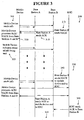
- FIG. 3 a flow diagram illustrating the interoperation of two of the base stations 130, base station A and base station B, one of the mobile devices 120, and the RNC 138 of Figures 1 and 2 is shown.
- a SHO is underway with respect to the mobile device 120 such that the mobile device 120 is communicating with both base station A and base station B.
- the mobile device 120 is within the cell associated with base station A and is approaching or entering the cell associated with the base station B.
- the mobile device 120 sends information, such as a data packet over the data channel 270, to both base station A and base station B (at 305).
- An acknowledgment (ACK) signal indicating that the information was properly received by base station A, is illustrated as being delivered by base station A back to the mobile device 120 (at 310).
- base station B Assuming that base station B, however, has detected an error in the data packet, then base station B returns a negative acknowledgment (NACK) signal to the mobile device 120 (at 315).
- the mobile device 120 receives the ACK and NACK signals from base stations A and B, respectively and processes the signals (at 320).
- the mobile device 120 determines that the data packet was properly received by at least one of the base stations, which in some applications may be adequate to insure efficient operation. Accordingly, the mobile device 120 is now free to transmit a "new" packet of data, but it is desirable to communicate to base station B that the next data packet is not a retransmission of the "old" data packet.
- This information may be communicated to base station B in a variety of forms (at 325).
- the mobile device 120 may explicitly indicate that the HARQ process has completed and that the next packet of data will be a "new" packet of data. This explicit indication may be accomplished using L-1 signaling to indicate the completion of the HARQ operation during SHO.
- the L-1 signaling could be embedded in a control channel of E-DCH, such as E-DPCCH, or piggy-backed in an information field of the HARQ process.
- the mobile device 120 may implicitly indicate that the HARQ process has completed and that the next packet of data will be a "new" packet of data.
- a single bit field may be added to the end of a HARQ process number. If the "new" field is indicated, it implies that the previous HARQ process has completed, and the base station that provided the NACK signal (base station B) will abort the previous HARQ process and treat the next packet of data as "new" data. Thus, in either embodiment, base station B is informed that the next packet of data is "new" data regardless of it having sent a NACK signal for the previous packet of data.
- the responsibility of notifying base station B that the next packet of data will be "new" data can be placed on the RNC 138.
- base stations A and B may be programmed to provide their ACK/NACK signals to the RNC 138 (at 335 and 340, respectively).
- the RNC 138 may then communicate to base station B that the next packet of data is "new" data regardless of base station B having sent a NACK signal for the previous packet of data.
- the processing of the ACK/NACK signals discussed above (at 320), may be more complicated in some applications. In some applications, it may be useful to analyze the reliability that the various ACK/NACK signals received from the base stations 130 are correct.
- the reliability of the radio link has strong effects on the reliability of the received ACK/NACK feedback comments from each base station at the mobile device.
- the Downlink (DL) inner loop power control (ILPC) at the mobile device will behave to generate Uplink Transmit Power Control (UL TPC) commands based on the best link quality result among multiple radio links during SHO.
- the ILPC operates to mitigate the link to the best link among the radio links during SHO. This will create a link imbalance during SHO.
- the link imbalance during SHO may cause the difference of the reliability measure of the received ACK/NACK feedback.
- the reliability measure may reduce the probability of a false alarm or missed detection of the ACK/NACK feedback.
- the ILPC for each radio link is achieved by comparing the Signal to Interference Ratio (SIR) of each link to a target SIR during SHO, the SIR measure could be used as an indicator of the reliability when the link is imbalanced.
- the SIR and the defined reliability threshold are used to determine the reliability of the radio link for the ACK/NACK feedback as follows, SIR ⁇ SIR Thd ... ... ..
- Reliable Link SIR ⁇ SIR Thd ... .... Unreliabl ⁇ e Link where SIR Thd is the threshold of the SIR reliability measure and is optimized based on radio link setting and RF optimization on the field. Once the radio link is considered as a reliable link, the ACK/NACK information from a particular base station may be used in the combining.
- ACK/NACK feedbacks may be received from a plurality of base stations 130 during SHO. Due to link imbalance, the received ACK/NACK signal from each base station 130 is processed independently. Due to the link imbalance during SHO, the ACK/NACK feedback could be unreliable or corrupted.
- the reliability of the received ACK/NACK signals is evaluated through the algorithm discussed above. Once it is determined which of the received ACK/NACK signals are reliable, each of the reliable ACK/NACK signals are combined.
- the ACK/NACK combining strategy determines that the HARQ process is complete if at least one of the base stations provides an ACK signal. The determination that at least one reliable ACK signal has been received results in a determination that the data packet has been successfully transmitted and received regardless of any number of NACK signals being received.
- the SHO mode of operation has been described above in the context of two base stations, base station A and base station B, those skilled in the art will appreciate that the SHO mode of operation may involve three or more base stations (e.g. , base station A, base station B, base station C ). Where three or more base stations are involved, the timing associated with the first base station, A, is retained to communicate with all of the other base stations, A, B, ...) regardless of the order in which the base stations are removed from the active list of the UE 120. For example, assume a UE 120 is initially communicating with A but subsequently enters into the SHO mode of operation with B and then C, such that all three base stations are in the UE 120 active set.
- the UE 120 If A is removed from the active set, leaving B and C in the active set, the UE 120 nonetheless continues to communicate with B and C using the timing information associated with A. As long as the UE 120 remains in the SHO mode of operation, it will continue to use the timing information associated with A until only one base station remains in its active set, at which time the UE 120 will resynchronize with the timing information associated with its now lone base station.
- the various system layers, routines, or modules illustrated in the various embodiments herein may be executable control units (such as the controllers 210, 250 (see Figure 2)).
- the controllers 210, 250 may include a microprocessor, a microcontroller, a digital signal processor, a processor card (including one or more microprocessors or controllers), or other control or computing devices.
- the storage devices referred to in this discussion may include one or more machine-readable storage media for storing data and instructions.
- the storage media may include different forms of memory including semiconductor memory devices such as dynamic or static random access memories (DRAMs or SRAMs), erasable and programmable read-only memories (EPROMs), electrically erasable and programmable read-only memories (EEPROMs) and flash memories; magnetic disks such as fixed, floppy, removable disks; other magnetic media including tape; and optical media such as compact disks (CDs) or digital video disks (DVDs). Instructions that make up the various software layers, routines, or modules in the various systems may be stored in respective storage devices. The instructions when executed by the controllers 210, 250 cause the corresponding system to perform programmed acts.
- DRAMs or SRAMs dynamic or static random access memories
- EPROMs erasable and programmable read-only memories
- EEPROMs electrically erasable and programmable read-only memories
- flash memories such as fixed, floppy, removable disks
- CDs compact disks
- DVDs digital video disks
Landscapes
- Engineering & Computer Science (AREA)
- Computer Networks & Wireless Communication (AREA)
- Signal Processing (AREA)
- Mobile Radio Communication Systems (AREA)
- Small-Scale Networks (AREA)
Applications Claiming Priority (1)
| Application Number | Priority Date | Filing Date | Title |
|---|---|---|---|
| US10/944,449 US20060062173A1 (en) | 2004-09-17 | 2004-09-17 | Hybrid automatic repeat request operation during soft hand offs in a wireless system |
Publications (2)
| Publication Number | Publication Date |
|---|---|
| EP1638362A2 true EP1638362A2 (fr) | 2006-03-22 |
| EP1638362A3 EP1638362A3 (fr) | 2006-05-17 |
Family
ID=35520756
Family Applications (1)
| Application Number | Title | Priority Date | Filing Date |
|---|---|---|---|
| EP05255758A Withdrawn EP1638362A3 (fr) | 2004-09-17 | 2005-09-16 | Opération ARQ hybride pendant la commutation douce dans un système sans fil |
Country Status (5)
| Country | Link |
|---|---|
| US (1) | US20060062173A1 (fr) |
| EP (1) | EP1638362A3 (fr) |
| JP (1) | JP4965837B2 (fr) |
| KR (1) | KR101127867B1 (fr) |
| CN (1) | CN1750451B (fr) |
Cited By (2)
| Publication number | Priority date | Publication date | Assignee | Title |
|---|---|---|---|---|
| WO2010060464A3 (fr) * | 2008-11-25 | 2010-10-21 | Nokia Siemens Networks Oy | Commande de transmission point à multipoint |
| WO2017093186A1 (fr) | 2015-12-01 | 2017-06-08 | Ipcom Gmbh & Co. Kg | Envoi de messages ack/nack dans un réseau monofréquence |
Families Citing this family (18)
| Publication number | Priority date | Publication date | Assignee | Title |
|---|---|---|---|---|
| JP4778342B2 (ja) * | 2006-03-27 | 2011-09-21 | 富士通株式会社 | 無線通信方法、無線通信システム、端末および基地局 |
| CN101064589B (zh) * | 2006-04-30 | 2011-11-30 | 中兴通讯股份有限公司 | 一种自动重传请求的状态报告方法 |
| EP2034751B1 (fr) * | 2006-06-06 | 2017-08-23 | Panasonic Intellectual Property Management Co., Ltd. | Système de communication radio, terminal radio, station de base et procédé de recherche de station de base |
| US8223628B2 (en) * | 2007-01-10 | 2012-07-17 | Lantiq Deutschland Gmbh | Data transmission method, transmitter, receiver, transceiver and transmission system |
| RU2454006C2 (ru) * | 2007-03-19 | 2012-06-20 | Нтт Досомо, Инк. | Базовая станция, терминал пользователя и способ управления связью, используемый в системе мобильной связи |
| US9686045B2 (en) * | 2007-04-04 | 2017-06-20 | Lantiq Beteiligungs-GmbH & Co. KG | Data transmission and retransmission |
| US8446859B2 (en) | 2008-02-01 | 2013-05-21 | Lg Electronics Inc. | Method for controlling uplink load in cell— FACH state |
| KR100893869B1 (ko) * | 2008-03-13 | 2009-04-20 | 엘지전자 주식회사 | 측정 간격을 고려한 harq 동작 방법 |
| US7903818B2 (en) | 2008-03-13 | 2011-03-08 | Lg Electronics Inc. | Random access method for improving scrambling efficiency |
| CN102017506B (zh) * | 2008-03-16 | 2014-06-04 | Lg电子株式会社 | 在无线通信系统中执行混合自动重传请求(harq)的方法 |
| EP2242203A3 (fr) | 2008-03-21 | 2014-01-01 | Lg Electronics Inc. | Procédé de communication des données dans un système de communication sans fil |
| CN101547080B (zh) * | 2008-03-24 | 2012-06-20 | 电信科学技术研究院 | 多进程harq天线模式自适应切换的方法和装置 |
| US8724636B2 (en) * | 2008-03-31 | 2014-05-13 | Qualcomm Incorporated | Methods of reliably sending control signal |
| EP2279577B1 (fr) * | 2008-04-24 | 2011-11-16 | Telefonaktiebolaget LM Ericsson (publ) | Indication de groupage tti à une station de base sans desserte |
| KR20090116601A (ko) * | 2008-05-06 | 2009-11-11 | 한국전자통신연구원 | 광대역 무선 접속 시스템에서의 효율적인 Hybrid ARQ 및 ARQ 동작 방안 |
| WO2010016669A2 (fr) * | 2008-08-04 | 2010-02-11 | Samsung Electronics Co., Ltd. | Procédé d'émission de signal et appareil pour équipement utilisateur dans un système de communication mobile |
| US8059622B2 (en) * | 2008-09-04 | 2011-11-15 | Intel Corporation | Multi-radio platform and method for coordinating activities between a broadband wireless access network transceiver and co-located transceiver |
| CN101860898B (zh) * | 2009-04-10 | 2013-01-02 | 电信科学技术研究院 | 一种配置混合自动重传相关信息的方法和系统 |
Citations (1)
| Publication number | Priority date | Publication date | Assignee | Title |
|---|---|---|---|---|
| WO2004042954A1 (fr) * | 2002-10-30 | 2004-05-21 | Motorola, Inc., A Corporation Of The State Of Delaware | Procede et appareil permettant d'obtenir un systeme de communication sans fil numerique a architecture distribuee |
Family Cites Families (12)
| Publication number | Priority date | Publication date | Assignee | Title |
|---|---|---|---|---|
| US5490830A (en) * | 1994-04-12 | 1996-02-13 | Global Focus Marketing & Distribution | Air-cooled biohazard centrifuge |
| DE19615702C1 (de) * | 1996-04-22 | 1997-10-02 | Heraeus Instr Gmbh | Labor-Zentrifuge |
| US6734401B2 (en) * | 2000-06-28 | 2004-05-11 | 3M Innovative Properties Company | Enhanced sample processing devices, systems and methods |
| US6678523B1 (en) * | 2000-11-03 | 2004-01-13 | Motorola, Inc. | Closed loop method for reverse link soft handoff hybrid automatic repeat request |
| US6678249B2 (en) * | 2002-02-14 | 2004-01-13 | Nokia Corporation | Physical layer packet retransmission handling WCDMA in soft handover |
| WO2003092213A1 (fr) * | 2002-04-24 | 2003-11-06 | Samsung Electronics Co., Ltd. | Appareil et procede pour admettre les demandes de repetition automatique dans un systeme de communication numerique de paquets radio a grande vitesse |
| US6987780B2 (en) * | 2002-06-10 | 2006-01-17 | Qualcomm, Incorporated | RLP retransmission for CDMA communication systems |
| JP3471785B1 (ja) * | 2002-07-31 | 2003-12-02 | 松下電器産業株式会社 | 通信装置及びデータの再送制御方法 |
| KR100459432B1 (ko) * | 2002-08-21 | 2004-12-03 | 엘지전자 주식회사 | 이동통신 시스템의 핸드오버 처리방법 |
| US20040181569A1 (en) * | 2003-03-13 | 2004-09-16 | Attar Rashid Ahmed | Method and system for a data transmission in a communication system |
| US7414989B2 (en) * | 2003-05-07 | 2008-08-19 | Motorola, Inc. | ACK/NACK determination reliability for a communication device |
| FI20040652A0 (fi) * | 2004-05-07 | 2004-05-07 | Nokia Corp | Viestintämenetelmä, pakettiradiojärjestelmä, ohjain ja päätelaite |
-
2004
- 2004-09-17 US US10/944,449 patent/US20060062173A1/en not_active Abandoned
-
2005
- 2005-09-16 KR KR1020050086921A patent/KR101127867B1/ko not_active Expired - Fee Related
- 2005-09-16 EP EP05255758A patent/EP1638362A3/fr not_active Withdrawn
- 2005-09-16 CN CN2005101039620A patent/CN1750451B/zh not_active Expired - Fee Related
- 2005-09-16 JP JP2005270033A patent/JP4965837B2/ja not_active Expired - Fee Related
Patent Citations (1)
| Publication number | Priority date | Publication date | Assignee | Title |
|---|---|---|---|---|
| WO2004042954A1 (fr) * | 2002-10-30 | 2004-05-21 | Motorola, Inc., A Corporation Of The State Of Delaware | Procede et appareil permettant d'obtenir un systeme de communication sans fil numerique a architecture distribuee |
Cited By (5)
| Publication number | Priority date | Publication date | Assignee | Title |
|---|---|---|---|---|
| WO2010060464A3 (fr) * | 2008-11-25 | 2010-10-21 | Nokia Siemens Networks Oy | Commande de transmission point à multipoint |
| WO2017093186A1 (fr) | 2015-12-01 | 2017-06-08 | Ipcom Gmbh & Co. Kg | Envoi de messages ack/nack dans un réseau monofréquence |
| US11184880B2 (en) | 2015-12-01 | 2021-11-23 | Ipcom Gmbh & Co. Kg | ACK/NACK messaging in a single frequency network |
| CN114095131A (zh) * | 2015-12-01 | 2022-02-25 | IPCom两合公司 | Ack/nack消息传送方法和用户设备装置 |
| US11653335B2 (en) | 2015-12-01 | 2023-05-16 | IPCom GmbH & CO, KG | ACK/NACK messaging in a single frequency network |
Also Published As
| Publication number | Publication date |
|---|---|
| EP1638362A3 (fr) | 2006-05-17 |
| JP2006087120A (ja) | 2006-03-30 |
| KR101127867B1 (ko) | 2012-03-22 |
| US20060062173A1 (en) | 2006-03-23 |
| JP4965837B2 (ja) | 2012-07-04 |
| CN1750451B (zh) | 2012-04-18 |
| CN1750451A (zh) | 2006-03-22 |
| KR20060051395A (ko) | 2006-05-19 |
Similar Documents
| Publication | Publication Date | Title |
|---|---|---|
| EP1638362A2 (fr) | Opération ARQ hybride pendant la commutation douce dans un système sans fil | |
| EP1661262B1 (fr) | Procede et appareil de selection du debit de liaison montante en presence de plusieurs voies de transport dans un systeme de communication sans fil | |
| US9344228B2 (en) | Detection and recovery of HARQ NAK-to-ACK feedback error in wireless communications systems | |
| US9882700B2 (en) | Systems and methods for backoff procedures for licensed-assisted access | |
| US20230155720A1 (en) | Multiplexing of harq-ack with different priorities on pucch | |
| US20060292982A1 (en) | Method for accomodating timing drift between base stations in a wireless communications system | |
| US7515579B2 (en) | Dynamic switching of a transmission time interval in a wireless system | |
| US20060274702A1 (en) | Method for controlling transmission rates in a wireless communications system | |
| US7558229B2 (en) | Method for reducing discarded slots and frames in a wireless communications system | |
| US20060072504A1 (en) | Reordering of data packets during soft hand offs in a wireless system | |
| US20070047437A1 (en) | Method and apparatus for controlling retransmissions in a wireless communications system | |
| US20070049305A1 (en) | Method for adjusting timing of channels in a wireless communications system | |
| US7315975B2 (en) | Transmission power control apparatus in wireless communication system and method therefor | |
| EP1745583B1 (fr) | Procede, systeme et station de communication de paquets de donnees utilisant arq | |
| US8666318B2 (en) | Method and apparatus for managing cellular uplink transmissions | |
| CA2546389C (fr) | Dispositif de commande de la puissance d'emission dans un reseau de communication sans fil et procede connexe | |
| KR20090044319A (ko) | 이동통신시스템 및 그 액세스 프로브 전송전력 제어방법 | |
| US7433703B2 (en) | Method for allocating resources in a wireless communication system | |
| KR20260062424A (ko) | 기지국 및 하향링크 재전송 전력 결정 방법 | |
| US20050070316A1 (en) | Controlled timing during soft hand offs in a wireless system |
Legal Events
| Date | Code | Title | Description |
|---|---|---|---|
| PUAI | Public reference made under article 153(3) epc to a published international application that has entered the european phase |
Free format text: ORIGINAL CODE: 0009012 |
|
| 17P | Request for examination filed |
Effective date: 20050928 |
|
| AK | Designated contracting states |
Kind code of ref document: A2 Designated state(s): AT BE BG CH CY CZ DE DK EE ES FI FR GB GR HU IE IS IT LI LT LU LV MC NL PL PT RO SE SI SK TR |
|
| AX | Request for extension of the european patent |
Extension state: AL BA HR MK YU |
|
| PUAL | Search report despatched |
Free format text: ORIGINAL CODE: 0009013 |
|
| AK | Designated contracting states |
Kind code of ref document: A3 Designated state(s): AT BE BG CH CY CZ DE DK EE ES FI FR GB GR HU IE IS IT LI LT LU LV MC NL PL PT RO SE SI SK TR |
|
| AX | Request for extension of the european patent |
Extension state: AL BA HR MK YU |
|
| AKX | Designation fees paid |
Designated state(s): DE FR GB |
|
| RAP3 | Party data changed (applicant data changed or rights of an application transferred) |
Owner name: LUCENT TECHNOLOGIES INC. |
|
| APBK | Appeal reference recorded |
Free format text: ORIGINAL CODE: EPIDOSNREFNE |
|
| APBN | Date of receipt of notice of appeal recorded |
Free format text: ORIGINAL CODE: EPIDOSNNOA2E |
|
| APBR | Date of receipt of statement of grounds of appeal recorded |
Free format text: ORIGINAL CODE: EPIDOSNNOA3E |
|
| APAF | Appeal reference modified |
Free format text: ORIGINAL CODE: EPIDOSCREFNE |
|
| RAP1 | Party data changed (applicant data changed or rights of an application transferred) |
Owner name: ALCATEL-LUCENT USA INC. |
|
| 111Z | Information provided on other rights and legal means of execution |
Free format text: DE FR GB Effective date: 20130410 |
|
| D11X | Information provided on other rights and legal means of execution (deleted) | ||
| APBT | Appeal procedure closed |
Free format text: ORIGINAL CODE: EPIDOSNNOA9E |
|
| STAA | Information on the status of an ep patent application or granted ep patent |
Free format text: STATUS: THE APPLICATION IS DEEMED TO BE WITHDRAWN |
|
| 18D | Application deemed to be withdrawn |
Effective date: 20181205 |