EP1640542A2 - Dispositif pour ouvrir et fermer une porte de véhicule - Google Patents
Dispositif pour ouvrir et fermer une porte de véhicule Download PDFInfo
- Publication number
- EP1640542A2 EP1640542A2 EP05020730A EP05020730A EP1640542A2 EP 1640542 A2 EP1640542 A2 EP 1640542A2 EP 05020730 A EP05020730 A EP 05020730A EP 05020730 A EP05020730 A EP 05020730A EP 1640542 A2 EP1640542 A2 EP 1640542A2
- Authority
- EP
- European Patent Office
- Prior art keywords
- driving
- vehicle door
- opening
- output value
- door
- Prior art date
- Legal status (The legal status is an assumption and is not a legal conclusion. Google has not performed a legal analysis and makes no representation as to the accuracy of the status listed.)
- Withdrawn
Links
Images



Classifications
-
- E—FIXED CONSTRUCTIONS
- E05—LOCKS; KEYS; WINDOW OR DOOR FITTINGS; SAFES
- E05F—DEVICES FOR MOVING WINGS INTO OPEN OR CLOSED POSITION; CHECKS FOR WINGS; WING FITTINGS NOT OTHERWISE PROVIDED FOR, CONCERNED WITH THE FUNCTIONING OF THE WING
- E05F15/00—Power-operated mechanisms for wings
- E05F15/60—Power-operated mechanisms for wings using electrical actuators
- E05F15/603—Power-operated mechanisms for wings using electrical actuators using rotary electromotors
- E05F15/611—Power-operated mechanisms for wings using electrical actuators using rotary electromotors for swinging wings
-
- E—FIXED CONSTRUCTIONS
- E05—LOCKS; KEYS; WINDOW OR DOOR FITTINGS; SAFES
- E05F—DEVICES FOR MOVING WINGS INTO OPEN OR CLOSED POSITION; CHECKS FOR WINGS; WING FITTINGS NOT OTHERWISE PROVIDED FOR, CONCERNED WITH THE FUNCTIONING OF THE WING
- E05F15/00—Power-operated mechanisms for wings
- E05F15/40—Safety devices, e.g. detection of obstructions or end positions
-
- E—FIXED CONSTRUCTIONS
- E05—LOCKS; KEYS; WINDOW OR DOOR FITTINGS; SAFES
- E05F—DEVICES FOR MOVING WINGS INTO OPEN OR CLOSED POSITION; CHECKS FOR WINGS; WING FITTINGS NOT OTHERWISE PROVIDED FOR, CONCERNED WITH THE FUNCTIONING OF THE WING
- E05F15/00—Power-operated mechanisms for wings
- E05F15/70—Power-operated mechanisms for wings with automatic actuation
-
- E—FIXED CONSTRUCTIONS
- E05—LOCKS; KEYS; WINDOW OR DOOR FITTINGS; SAFES
- E05Y—INDEXING SCHEME ASSOCIATED WITH SUBCLASSES E05D AND E05F, RELATING TO CONSTRUCTION ELEMENTS, ELECTRIC CONTROL, POWER SUPPLY, POWER SIGNAL OR TRANSMISSION, USER INTERFACES, MOUNTING OR COUPLING, DETAILS, ACCESSORIES, AUXILIARY OPERATIONS NOT OTHERWISE PROVIDED FOR, APPLICATION THEREOF
- E05Y2201/00—Constructional elements; Accessories therefor
- E05Y2201/20—Brakes; Disengaging means; Holders; Stops; Valves; Accessories therefor
- E05Y2201/214—Disengaging means
- E05Y2201/216—Clutches
-
- E—FIXED CONSTRUCTIONS
- E05—LOCKS; KEYS; WINDOW OR DOOR FITTINGS; SAFES
- E05Y—INDEXING SCHEME ASSOCIATED WITH SUBCLASSES E05D AND E05F, RELATING TO CONSTRUCTION ELEMENTS, ELECTRIC CONTROL, POWER SUPPLY, POWER SIGNAL OR TRANSMISSION, USER INTERFACES, MOUNTING OR COUPLING, DETAILS, ACCESSORIES, AUXILIARY OPERATIONS NOT OTHERWISE PROVIDED FOR, APPLICATION THEREOF
- E05Y2201/00—Constructional elements; Accessories therefor
- E05Y2201/20—Brakes; Disengaging means; Holders; Stops; Valves; Accessories therefor
- E05Y2201/23—Actuation thereof
- E05Y2201/246—Actuation thereof by auxiliary motors, magnets, springs or weights
-
- E—FIXED CONSTRUCTIONS
- E05—LOCKS; KEYS; WINDOW OR DOOR FITTINGS; SAFES
- E05Y—INDEXING SCHEME ASSOCIATED WITH SUBCLASSES E05D AND E05F, RELATING TO CONSTRUCTION ELEMENTS, ELECTRIC CONTROL, POWER SUPPLY, POWER SIGNAL OR TRANSMISSION, USER INTERFACES, MOUNTING OR COUPLING, DETAILS, ACCESSORIES, AUXILIARY OPERATIONS NOT OTHERWISE PROVIDED FOR, APPLICATION THEREOF
- E05Y2201/00—Constructional elements; Accessories therefor
- E05Y2201/40—Motors; Magnets; Springs; Weights; Accessories therefor
- E05Y2201/46—Magnets
- E05Y2201/462—Electromagnets
-
- E—FIXED CONSTRUCTIONS
- E05—LOCKS; KEYS; WINDOW OR DOOR FITTINGS; SAFES
- E05Y—INDEXING SCHEME ASSOCIATED WITH SUBCLASSES E05D AND E05F, RELATING TO CONSTRUCTION ELEMENTS, ELECTRIC CONTROL, POWER SUPPLY, POWER SIGNAL OR TRANSMISSION, USER INTERFACES, MOUNTING OR COUPLING, DETAILS, ACCESSORIES, AUXILIARY OPERATIONS NOT OTHERWISE PROVIDED FOR, APPLICATION THEREOF
- E05Y2800/00—Details, accessories and auxiliary operations not otherwise provided for
-
- E—FIXED CONSTRUCTIONS
- E05—LOCKS; KEYS; WINDOW OR DOOR FITTINGS; SAFES
- E05Y—INDEXING SCHEME ASSOCIATED WITH SUBCLASSES E05D AND E05F, RELATING TO CONSTRUCTION ELEMENTS, ELECTRIC CONTROL, POWER SUPPLY, POWER SIGNAL OR TRANSMISSION, USER INTERFACES, MOUNTING OR COUPLING, DETAILS, ACCESSORIES, AUXILIARY OPERATIONS NOT OTHERWISE PROVIDED FOR, APPLICATION THEREOF
- E05Y2900/00—Application of doors, windows, wings or fittings thereof
- E05Y2900/50—Application of doors, windows, wings or fittings thereof for vehicles
- E05Y2900/53—Type of wing
- E05Y2900/531—Doors
Definitions
- This invention generally relates to a vehicle door opening and closing apparatus which operates a vehicle door to open and close an opening defined in a vehicle body such as a vehicle side door and a back door (tail gate)
- this type of vehicle door opening and closing apparatus is provided with a driving power source configured to generate a driving force relevant to an opening/closing movement of a vehicle door, an opening/closing mechanism for operating a vehicle door by a driving force of the driving power source in such a manner that an opening defined in a vehicle body is opened and closed, an operating means for outputting an operation signal in response to its operation, and a controlling means for controlling, on the basis of the operation signal, a driving of the driving power source.
- This apparatus is further provided with an overload-detecting means for detecting a load applied to the vehicle door.
- the controlling means determines on the basis of a signal from the overload-detecting means that the vehicle door has been subjected to an overload, the controlling means implements a control by which a driving of the driving power source is ceased.
- This apparatus is still further provided with a vehicle door operation intention-detecting means for detecting an intention of a user to manually operate the vehicle door.
- the controlling means has determined on the basis of a signal from the overload-detecting means that the vehicle door has been subjected to an overload, if the controlling means determines on the basis of a signal from the vehicle door operation intension-detecting means that a user intends to manually operate the vehicle door, the controlling means switches an actually running mode to a manual operation mode.
- the controlling means ceases driving the driving power source in response to a signal from the overload-detecting means. Therefore, it is not possible to open and close the vehicle door by use of a driving force of the driving power source, and is further not possible to open and close the vehicle door even manually. In such a case, there is a danger of the convenience, which is required upon opening and closing the vehicle door, of being deteriorated.
- the driving power source is controlled to generate an output value at a low level so that load applied to an entrapped obstacle can be restrained. Accordingly, it is obvious that convenience above described would be damaged.
- the present invention has been made in view of the above circumstances, and provides a vehicle door opening and closing apparatus which is capable of assuring safety of an opening/closing operation of a vehicle door, and of enhancing convenience thereof.
- a vehicle door opening and closing apparatus including a driving power source configured to generate a driving force relevant to an opening operation, and a closing operation, of a vehicle door and an opening-closing mechanism capable of implementing the opening operation, and the closing operation, of the vehicle door by the driving force of the driving power source.
- This vehicle door opening and closing apparatus is characterized in further including: a first operating means for continuously outputting a manual operation signal, confined to times when the first operating means is continuously being operated; a second operating means for outputting an automatic operation signal irrespective of whether or not the second operating means is continuously operated, once the second operating means is put into operation; and a controlling means for controlling, on the basis of the manual operation signal and the automatic operation signal, a driving of the driving power source.
- the controlling means is capable of switching control for driving the driving power source in such a manner that an automatic operation mode is selected at a time that the automatic operation signal is inputted to the controlling means, the automatic operation mode in which the driving power source is driven to output a predetermined first driving output value, and a manual operation mode is selected at a time that the manual operation signal is inputted to the controlling means, the manual operation mode in which the driving power source is driven to output a second driving output value which is higher than the first driving output value.
- the vehicle door opening and closing apparatus further includes a detecting means for outputting a signal representing an operating state of the vehicle door.
- the controlling means computes, on the basis of the signal from the detecting means, an opening speed, and a closing speed, of the vehicle door, the controlling means implements a discontinuation control during the automatic operation mode, the discontinuation control by which the driving of the driving power source is discontinued at an event that the opening speed, or the closing speed, of the vehicle door is decelerated beyond a predetermined speed value, and the controlling means prohibits the discontinuation control for the duration of the manual operation mode.
- the controlling means implements a normal driving control by which driving of the driving power source is controlled in such a manner that the driving power source outputs a third driving output value during the manual operation mode prior to implementing the discontinuation control, and implements an urgent driving control by which driving of the driving power source is controlled in such a manner that the driving power source outputs a fourth driving output value, which is higher than the third driving output value, during the manual operation mode after implementing the discontinuation control.
- the first driving output value is quantitatively equivalent to the third driving output value
- the second driving output value is quantitatively equivalent to the fourth driving output value
- the first driving output value is lower than the third driving output value.
- Fig. 1 is a block view of a vehicle door on which a vehicle door opening and closing apparatus according to an embodiment of the present invention is mounted;
- Fig. 2 is a block view schematically illustrating the vehicle door opening and closing apparatus
- Fig. 3 is a circuit view illustrating a controller for controlling the vehicle door opening and closing apparatus
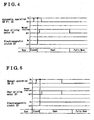
- Fig. 4 is a timing chart for explaining operation of the controller during an automatic operation mode
- Fig. 5 is another timing chart for explaining operation of the controller during a manual operation mode
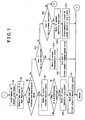
- Fig. 7 is a flowchart for explaining an operation of the controller following the flowchart in Fig. 6.
- a swing door 11 as a vehicle door is supported by use of a known hinge (not illustrated) and is operated to open and close a door opening defined in a vehicle side body.
- a vehicle door opening and closing apparatus 12 is mounted on the swing door 11, an apparatus 12 which controls opening operations, and closing operations, of the swing door 11.
- the vehicle door opening and closing apparatus 12 is provided with an outside automatic operation switch 21 (second operating means) being positioned on the exterior of the swing door 11, an inside automatic operation switch 22 (the second operating means) being positioned on the interior of the swing door 11, an inside manual opening operation switch 26 (first operating means), an inside manual closing operation switch 27 (the first operating means), a door opening and closing operation-driving unit 23, a latch driving unit 24, and a controller 25.
- the door opening and closing operation-driving unit 23 will be described in detail later.
- the latch-driving unit 24 holds the swing door 11 relative to a vehicle side body at a fully closed state, in which the door opening is fully closed, or at a half-closed state, in which the door opening is half closed.
- the controller 25 is electrically connected to all these components 21, 22, 23, 24, 26, and 27.
- the outside automatic operation switch 21 outputs an automatic operation signal irrespective of whether or not the outside automatic operation switch 21 is continuously operated, once the outside automatic operation switch 21 is put into operation.
- the outside automatic operation switch 21 is operated outside the vehicle at a time that an automatic opening/closing operation of the swing door 1 is implemented by the door opening and closing operation-driving unit 23.
- the inside automatic operation switch 22 outputs an automatic operation signal irrespective of whether or not the inside automatic operation switch 22 is subsequently continuously operated, once the inside automatic operation switch 22 is put into operation.
- the inside automatic operation switch 22 is operated inside the vehicle at a time that an automatic opening/closing operation of the swing door 11 is implemented by the door opening and closing operation-driving unit 23.
- the automatic opening/closing operation of the swing door 11 includes an operation from the fully closed state to the fully open state, and an operation from the fully open state to the fully closed state.
- the inside manual opening operation switch 26 continuously outputs a manual operation signal, confined to times when the inside manual opening operation switch 26 is continuously being operated.
- the inside manual opening operation switch 26 is operated inside the vehicle at a time that a manual opening operation of the swing door 11 is implemented by the door opening and closing operation driving unit 23.
- the inside manual closing operation switch 27 continuously outputs a manual operation signal, confined to times when the inside manual closing operation switch 27 is continuously being operated.
- the inside manual closing operation switch 27 is operated inside the vehicle at a time that a manual closing operation of the swing door 11 is implemented by the door opening and closing driving unit 23.
- the latch-driving unit 24 includes a latch engageable with a striker fixed at the vehicle side body, and a pole engageable with the latch during a door latched condition in which the striker is being engaged with the latch.
- the latch-driving unit 24 further includes a known structure which is capable of establishing a door latched condition, a door half-latched condition, and a door unlatched condition.
- the latch-driving unit 24 still further includes an actuator that is operated for the purpose of switching the above-described door latched/unlatched/half-latched condition.
- the controller 25 controls a driving of the actuator of the latch-driving unit 24, wherein the swing door 11 is switched from the door latched condition to the door unlatched condition when the swing door 11 is to be opened, on the other hand, the swing door 11 is switched from the door half latched condition to the door latched condition when the swing door 11 is to be closed.
- the door opening and closing driving unit 23 is attached to the swing door 11, and moves a lever 14 back and forth, of which one end is connected to the swing door 11, and the other end is connected to a pillar 13, wherein the swing door 11 is rotated with the hinge as a fulcrum, and the door opening is closed or opened.
- the controller 25 controls the latch-driving unit 24 and switches the swing door 11 from the door latched condition to the door unlatched condition.
- the controller 25 in succession controls the door opening and closing-driving unit 23 so as to rotate the swing door 11, wherein the door opening is opened.
- the controller 25 controls the door opening and closing-driving unit 23 and rotates the swing door 11.
- the controller 25 in succession controls the latch-driving unit 24, wherein the swing door 11 is switched to the door latched condition so as to close the door opening.
- the door opening and closing-driving unit 23 is configured with a door driving motor 31 as a driving power source, a first speed reduction mechanism 32, an electromagnetic clutch 33 as a power transmitting mechanism, a second speed reduction mechanism 34, and a lever-operating portion 35 as an operating mechanism.
- the door driving motor 31 operates in response to a drive signal from the controller 25, and rotates a rotational shaft 31a in a normal rotational direction or in a reverse rotational direction.
- the electromagnetic clutch 33 is provided with two frictional plates 33a and 33b; the frictional plate 33a as a force transmitting member and the frictional plate 33b as a force-receiving member.
- the electromagnetic clutch 33 operates in response to an operation signal from the controller 25, and switches its condition between a joined condition, in which the frictional plate 33a is frictionally engaged with the frictional plate 33b, and a cutoff condition, in which the frictional plate 33a is disengaged from the frictional plate 33b.
- rotation of the door driving motor 31 is transmitted to the lever-operating portion 35.
- a pulse sensor 36 as a detecting means is preferably positioned between the electromagnetic clutch 33 and the second speed reduction mechanism 34.
- the pulse sensor 36 outputs a signal corresponding to rotation transmitted between the electromagnetic clutch 33 and the second speed reduction mechanism 34, or a signal corresponding to a rotational condition transmitted to the electromagnetic clutch 33 from the first speed reduction mechanism 32.
- a Hall element is one of the examples for the pulse sensor 36, as a non-limiting example.
- the Hall element is mounted so as to output, to the controller 25, a predetermined pulse signal corresponding to variation in magnetic flux of a magnet attached at the frictional plate 33b.
- the controller 25 counts the number of pulse signals and computes a rotational number (rotational speed) of the frictional plate 33b.
- the controller 25 incorporates, therein, a CPU (central processing unit) 41, a motor driving circuit 42, a clutch driving circuit 43, and a pulse width modulation circuit 44.
- a CPU central processing unit
- the CPU 41 is electrically connected, via an input circuit 46, to the outside automatic operation switch 21, the inside automatic operation switch 22, an inside manual opening operation switch 26, and an inside manual closing operation switch 27.
- the CPU 41 is able to compute, on the basis of an automatic operation signal and a manual operation signal therefrom, the presence or absence of an opening operation, and a closing operation, of the swing door 11.
- the CPU 41 is further electrically connected to the pulse sensor 36 via an input circuit 47.
- the CPU 41 is able to count the number of pulse signals outputted from the pulse sensor 36 and to compute the rotational number (rotational speed) of the frictional plate 33b.
- the CPU 41 computes, on the basis of the pulse signals from the pulse sensor 36, a position of the swing door 11 being moved, and further computes an opening/closing speed of the swing door 11.
- the motor driving circuit 42 is electrically connected to the CPU 41 and is applied with a battery voltage from a battery B illustrated in Fig. 3. In response to a driving signal fed from the CPU 41 to the motor driving circuit 42, the motor driving circuit 42 supplies, by use of a polarity corresponding to the driving signal, an electric power to a door driving motor 31 of the door opening and closing-driving unit 23.
- the clutch driving circuit 43 is electrically connected to the CPU 41 and is applied with a battery voltage from the battery B illustrated in Fig. 3. In response to an operation signal fed from the CPU 41 to the clutch driving circuit 43, the clutch driving circuit 43 supplies an operation electric power, or ceases the supply, for the purpose of operating the electromagnetic clutch 33 of the door opening and closing-driving unit 23.
- the pulse width modulation circuit 44 is interposed between the CPU 41 and the door driving motor 31 in such a manner that the CPU 41 is electrically connected to the door driving motor 31 via the pulse width modulation circuit 44.
- the pulse width modulation circuit 44 is able to modulate a value of electric power to be supplied to the door driving motor 31.
- a pulse width modulation circuit 45 is interposed between the CPU 41 and the electromagnetic clutch 33 in such a manner that the CPU 41 is electrically connected to the electromagnetic clutch 33 via the pulse width modulation circuit 45.
- the pulse width modulation circuit 45 is able to modulate a value of electric power to be supplied to the electromagnetic clutch 33.
- the CPU 41 alters a pulse width of a control signal fed to the pulse width modulation circuit 44, in response to a driving condition of the door driving motor 31 to be controlled. Likewise, the CPU 41 alters a pulse width of a control signal fed to the pulse width modulation circuit 45, in response to a joined condition of the electromagnetic clutch 33 to be controlled.
- the pulse width modulation circuits 44 and 45 are respectively provided with switching elements 44a and 45a to be turned on and off in response to the control signals.
- an N-channel MOS transistor can be employed as the switching element as a non-limiting example.
- the pulse width modulation circuit 44 is capable of modulating, in accordance with a ratio of turning the switching element 44a on and off, a mean value of an electric current supplied to the door driving motor 31.
- the CPU 41 controls a driving output (output torque) of the door driving motor 31 by means of a so-called PWM control by the pulse width modulation circuit 44.
- the pulse width modulation circuit 45 is capable of modulating, in accordance with a ratio of turning the switching element 45a on and off, a mean value of an electric current supplied to the electromagnetic clutch 33. That is, the CPU 41 controls a clutch output of the electromagnetic clutch 33 (a frictional engagement condition between the frictional plates 33a and 33b) by means of a so-called PWM control by the pulse width modulation circuit 45.
- the CPU 41 outputs a driving signal to supply a driving electric power to the door driving motor 31, and outputs a control signal to the pulse width modulation circuit 44 to turn the switching element 44a on and off.
- the door driving motor 31 is supplied with a mean electric current in response to an intermittent on operation of the switching element 44a, wherein the door driving motor 31 is activated.
- the electromagnetic clutch 33 during a discontinuation state in which an operation electric power is not supplied to the electromagnetic clutch 33, the electromagnetic clutch 33 is at the cutoff condition in which the frictional plates 33a and 33b are disengaged from each other. These frictional plates 33a and 33b enters into an engaged condition in response to a value of a driving electric power to be supplied from the motor driving circuit 42. Therefore, the CPU 41 outputs an operation stop signal so as not to supply an operation electric power to the electromagnetic clutch 33, wherein the electromagnetic clutch 33 enters into the cutoff condition.
- the CPU 41 outputs an operation signal to supply an operation electric power to the electromagnetic clutch 33, and outputs a control signal to the pulse width modulation circuit 45 to turn the switching element 45a on and off.
- the electromagnetic clutch 33 is supplied with a mean electric current in response 10 an intermittent on operation of the switching element 45a, wherein the electromagnetic clutch 33 enters into the joined condition.
- controller 25 especially an operation relevant to the door opening and closing-driving unit 23 with reference to timing charts illustrated in Figs. 4 and 5.
- Described below is an automatic operation mode implemented by the vehicle opening and closing apparatus according to the embodiment of the present invention.
- an operation signal from the outside automatic operation switch 21 or the inside automatic operation switch 22 is inputted to the controller 25.
- the controller 25 In order to open the swing door 11 by use of a driving force of the door driving motor 31, the controller 25 outputs a driving signal to the motor driving circuit 42 and outputs an operation signal to the clutch driving circuit 43, thereby driving the door driving motor 31 as well as operating the electromagnetic clutch 33. Because a driving signal to the motor driving circuit 42 is employed to rotate the door driving motor 31 in a normal direction, the lever 14 is moved forth or pushed by the lever operating portion 35, wherein the swing door 11 is rotated in a direction to open the door opening.
- a driving signal sent to the motor driving circuit 42 includes a component to move back or pull the lever 14, the swing door 11 is rotated in a reverse direction to close the door opening.
- a driving signal sent to the motor driving circuit 42 is employed for the purpose of controlling the pulse width modulation circuit 44 to modulate or alter a value of electric power to be supplied to the door driving motor 31 in such a manner that a driving torque as a driving output is controlled at a predetermined value (a first torque value).
- an operation signal sent to the clutch driving circuit 43 is employed for the purpose of controlling the pulse width modulation circuit 45 to modulate or alter a value of electric power to be supplied to the electromagnetic clutch 33 in such a manner that a clutch output is controlled at a predetermined value (a first output value) which corresponds to an opening/closing position, and/or an opening/closing speed, of the swing door 11.
- a predetermined value of the clutch output is set in such a manner that a frictional engagement between the frictional plates 33a and 33b can be always assured at the essentially minimum extent for transmitting rotation of the door driving motor 31 to the lever operating portion 35.
- the controller 25 then detects, on the basis of a pulse signal from the pulse sensor 36, the swing door 11 positioned at the fully, opened position. In this case, the controller 25 outputs a discontinuation signal to the motor driving circuit 42 and stops driving the door driving motor 31. As a result, the opening operation of the swing door 11, which is implemented to open the door opening by the driving force of the door driving motor 31, is stopped, and a clutch output is controlled at a predetermined value (a second output value). The predetermined value of the clutch output at this point is controlled at an adequate value for holding the swing door 11 at a predetermined holding load.
- This predetermined holding load corresponds to a load of which level is adequate to cope with a natural force such as a wind blowing to the swing door 11, a force that rotates the swing door 11 in an opening or closing direction at an event that a vehicle has been parked on a slope, and so on.
- a driving force of the door driving motor 31 it is preferable that the door driving motor 31 is driven in a reverse rotational direction by operating the outside or inside automatic operation switch 21 or 22.
- the operation of the electromagnetic clutch 33 and so on is the same as described above.
- Described below is a manual operation mode implemented by the vehicle opening and closing apparatus according to the embodiment of the present invention.
- an operation signal from the inside manual opening operation switch 26 is inputted to the controller 25.
- the controller 25 In order to open the swing door 11 by use of a driving force of the door driving motor 31, the controller 25 outputs a driving signal to the motor driving circuit 42 and outputs an operation signal to the clutch driving circuit 43, thereby driving the door driving motor 31 as well as operating the electromagnetic clutch 33. Because a driving signal to the motor driving circuit 42 is employed to rotate the door driving motor 31 in a normal direction, the lever 14 is moved forth or pushed by the lever operating portion 35, wherein the swing door 11 is rotated in a direction to open the door opening.
- a driving signal sent to the motor driving circuit 42 includes a component to move back or pull the lever 14, the swing door 11 is rotated in a reverse direction to close the door opening.
- a driving signal sent to the motor driving circuit 42 is employed for the purpose of controlling the pulse width modulation circuit 44 to modulate or alter a value of electric power to be supplied to the door driving motor 31 in such a manner that a driving output, i.e., a driving torque, is controlled at a predetermined value (a third torque value or a fourth torque value) which is higher than the first torque value.
- an operation signal sent to the clutch driving circuit 43 is employed for the purpose of controlling the pulse width modulation circuit 45 to modulate or alter a value of electric power to be supplied to the electromagnetic clutch 33 in such a manner that a clutch output is controlled at the highest value.
- the fourth torque value is a driving force that the door driving motor 31 is capable of outputting at the maximum level.
- the third torque value is lower than the fourth torque value, and but is higher than the first torque value.
- the opening operation of the swing door 11, which is implemented to open the door opening by the driving force of the door driving motor 31, is stopped, and a clutch output is controlled at the predetermined value (the second output value,).
- the predetermined value of the clutch output at this point is controlled at an adequate value for holding the swing door 11 at a predetermined holding load.
- the CPU 41 determines on the basis of an automatic operation signal whether either the outside automatic operation switch 21 or the inside automatic operation switch 22 was put into operation.
- the CPU 41 determines on the basis of a manual operation signal whether either the inside manual opening operation switch 26 or the inside manual closing operation switch 27 is being operated.
- the automatic operation mode is selected so as to implement steps S3 to S17.
- the driving force to drive the door driving motor 31 is controlled to the first torque value.
- the electromagnetic clutch 33 is operated so as to generate the clutch output at the first output value.
- an opening operation, or a closing operation, of the swing door 11 is commenced.
- the CPU 41 obtains a pulse signal from the pulse sensor 36.
- the CPU 41 computes a door opening/closing speed N1 of the swing door 11 and a current door opening/closing position P1 of the swing door 11.
- This information is stored in a RAM (random access memory) incorporated in the CPU 41.
- the CUP 41 determines whether a difference between an opening/closing speed of the swing door 11 (corresponding to a previous door opening/closing speed N0), which has been stored in the RAM of the CPU 41, and the opening/closing speed of the swing door 11 (corresponding to the opening/closing speed N1), which was stored at step S6 immediately before proceeding to step S7, exceeds a predetermined deceleration rate.
- the CPU 41 determines at step S7 that the difference therebetween exceeds the predetermined deceleration rate, the CPU 41 determines that the swing door 11 is being applied with an overload.
- step S8 the CPU 41 sends a driving signal to the motor circuit 42 for the purpose of rotating the door driving motor 31 in a reverse rotational direction, wherein the swing door 11 is rotated to a predetermined door position.
- step S9 the CPU 41 determines if the swing door 11 has moved to the predetermined door position.
- the program proceeds to step S10, wherein a driving of the door driving motor 31 is discontinued, i.e., stopped.
- step S11 the CPU 41 controls operation of the electromagnetic clutch 33 in such a manner that the clutch output is controlled at the second output value, wherein the swing door 11 is supportively maintained.
- step S7 when the CPU 41 determines that the difference therebetween does not exceed the predetermined deceleration rate, the CPU 41 determines that the swing door 11 is not being applied with an overload. In such circumstances, at steps S12 and S13, the opening/closing operation of the swing door 11 is continued until the CPU 41 determines on the basis of the door opening/closing position P1 computed at step S6 that the swing door 11 is positioned at the fully open state or at the fully closed state.
- step S12 when the CPU 41 determines that the swing door 11 is at the fully open state, the program proceeds to step S14, wherein a driving of the door driving motor 31 is discontinued, i.e., stopped.
- step S15 the CPU 41 controls operation of the electromagnetic clutch 33 in such a manner that the clutch output is controlled at the second output value wherein the swing door 11 is held.
- step S13 when the CPU 41 determines that the swing door 11 is at the fully closed state, the program proceeds to step S16, wherein a driving of the door driving motor 31 is discontinued, i.e., stopped.
- step S17 the CPU 41 discontinues, i.e., stops, the operation of the electromagnetic clutch 31.
- the manual operation mode is selected so as to implement steps S18 to S25.
- the CPU 41 determines whether or not an overload was detected during the last automatic operation mode.
- the program proceeds to step S19, wherein the CPU 41 controls the driving motor to generate a driving force at the maximum level (a second torque value or the fourth torque value).
- the CPU 41 controls operation of the electromagnetic clutch 33 to generate a clutch output at the maximum level, wherein an opening operation, or a closing operation, of the swing door 11 is commenced.
- step S18 the program proceeds to step S21, wherein the CPU 41 drives the door driving motor 31 to generate a driving force at the third torque value.
- step S22 the CPU 41 controls the operation of the electromagnetic clutch 33 to generate a clutch output at the maximum level, wherein an opening operation, or a closing operation, of the swing door 11 is commenced. If an operation, of the inside manual opening operation switch 26, or of the inside manual closing operation switch 27 is discontinued, i.e., stopped, during the opening/closing operation of the swing door 11, at step S23, the CPU 41 determines whether or not a manual operation signal is being inputted.
- step S23 When a negative answer No is obtained at step S23, the program proceeds to step S24, wherein a driving of the door driving motor 31 is discontinued, i.e., stopped.
- step S25 the CPU 41 controls the electromagnetic clutch 33 to generate a clutch output at the second output value, wherein the swing door 11 is held.
- an affirmative answer Yes is obtained at step S23, i.e., unless an operation, of the inside manual opening operation switch 26, or of the inside manual closing operation switch 27, is discontinued, i.e., stopped, the program returns to step S18, and the above described routine is repeated.
- the third torque value, or the fourth torque value, of the door driving motor 31 for the duration of the manual operation mode is higher than the first torque value of the door driving motor 31 for the duration of the automatic operation mode, even if, for the duration of the automatic operation mode, an overload is imposed on the swing door 11 and a driving of the door driving motor 31 is stopped, an opening/closing operation of the swing door 11, which is implemented by a driving force of the door driving motor 31, is able to be assured while the manual operation mode is being selected. Therefore, comparing with a conventional work, it is possible to enhance convenience for opening and closing the swing door 11.
- the embodiment of the present invention because it is possible to detect the presence or absence of an overload being applied to the swing door 11 for the duration of the automatic operation mode, it is possible to assure safety for opening and closing the swing door 11.
- the duration of the manual operation mode as far as an operation, of the manual opening operation switch 26, or of the manual closing operation switch 27 is discontinued or stopped, an opening/closing operation of the swing door 11 is discontinued, thereby enabling to assure safety.
- the door driving motor 31 when the presence of an overload was detected during the automatic operation mode, the door driving motor 31 is controlled to generate a driving force at the fourth torque value.
- the door driving motor 31 when the absence of an overload was detected during the automatic operation mode, the door driving motor 31 is controlled to generate a driving force at the third torque value.
- a driving force from the door driving motor 31 is not necessarily controlled between the third and fourth torque value as described above.
- the driving output (the second torque value) of the door driving motor 31 is designed to be equivalent to the fourth torque value, which is the maximum driving output value of the door driving motor 31.
- the first torque value during the automatic operation mode corresponds to a first driving output value
- the second torque value during the manual operation mode corresponds to a second driving output value
- the second driving output value is designed to be equal to, or greater than, the first driving output value.
- the third driving output value is designed to be equal to, or greater than the first driving output value.
- the fourth driving output value is designed to be greater than the third driving output value. In this case, it is preferable that the fourth driving output value is the maximum driving output value that the door driving motor 31 (the driving power source) is capable of outputting.
- the vehicle door opening and closing apparatus 12 acts to rotate the swing door 11 by use of a driving force of the door driving motor 31.
- this apparatus can act to slidably move a slide door by use of a driving force of the door driving motor 31.
- an opening/closing operation of the vehicle door includes a rotation of the swing door 11, a slide movement of the slide door, and so on.
- the second driving output value, which the driving power source outputs during the manual operation mode is higher than the first driving output value during the automatic operation mode, even if a driving of the driving power source is discontinued, i.e., stopped, during the automatic operation mode due to detection of an overload being applied to the vehicle door, it is possible to implement, during the manual operation mode, an opening/closing operation of the vehicle door which is performed by driving the driving power source. Therefore, comparing with a conventional work, it is possible to enhance convenience for opening and closing the vehicle door. Further, according to the embodiment of the present invention, because it is possible to detect the presence or absence of an overload being applied to the swing door 11 for the duration of the automatic operation mode, it is possible to assure safety for opening and closing the swing door 11.
- a controller (25) controls, based upon a manual operation signal from a first operating means (26 or 27) and the automatic operation signal from a second operating means (21 or 22), a driving of a driving power source (31) for generating a driving force for an opening/closing operation of a vehicle door (11).
- the controller switches control for driving the driving power source.
- An automatic operation mode is selected when the automatic operation signal is inputted to the controller, in which the driving power source is driven to output a predetermined first driving output value.
- a manual operation mode is selected when the manual operation signal is inputted to the controller in which the driving power source is driven to output a second driving output value which is higher than the first driving output value.
Landscapes
- Power-Operated Mechanisms For Wings (AREA)
Applications Claiming Priority (1)
| Application Number | Priority Date | Filing Date | Title |
|---|---|---|---|
| JP2004277098A JP2006090021A (ja) | 2004-09-24 | 2004-09-24 | 車両用ドア開閉装置 |
Publications (1)
| Publication Number | Publication Date |
|---|---|
| EP1640542A2 true EP1640542A2 (fr) | 2006-03-29 |
Family
ID=35596231
Family Applications (1)
| Application Number | Title | Priority Date | Filing Date |
|---|---|---|---|
| EP05020730A Withdrawn EP1640542A2 (fr) | 2004-09-24 | 2005-09-22 | Dispositif pour ouvrir et fermer une porte de véhicule |
Country Status (3)
| Country | Link |
|---|---|
| US (1) | US7509772B2 (fr) |
| EP (1) | EP1640542A2 (fr) |
| JP (1) | JP2006090021A (fr) |
Families Citing this family (9)
| Publication number | Priority date | Publication date | Assignee | Title |
|---|---|---|---|---|
| DE102004061689A1 (de) * | 2004-12-22 | 2006-07-06 | Daimlerchrysler Ag | Fahrzeugtür mit Ausstiegshilfe |
| US20090293614A1 (en) * | 2008-05-30 | 2009-12-03 | Gm Global Technology Operations, Inc. | Apparatus and method for determining the closing velocity of a vehicle door |
| US9080363B2 (en) * | 2012-03-13 | 2015-07-14 | Ford Global Technologies, Llc | Vehicle door swing governor |
| US9834978B2 (en) | 2014-04-04 | 2017-12-05 | Ford Global Technologies, Llc | Power door system for a motor vehicle |
| JP6356593B2 (ja) * | 2014-12-18 | 2018-07-11 | アイシン精機株式会社 | 車両用開閉体の制御装置及び制御システム |
| US9879465B2 (en) * | 2015-07-29 | 2018-01-30 | Ford Global Technologies, Llc | Programmable door power assist |
| JP6367857B2 (ja) * | 2016-04-05 | 2018-08-01 | ファナック株式会社 | 工作機械システム |
| US10392849B2 (en) | 2017-01-18 | 2019-08-27 | Ford Global Technologies, Llc | Assembly and method to slow down and gently close door |
| US10344519B2 (en) | 2017-04-11 | 2019-07-09 | Ford Global Technologies Llc | Vehicle power door system |
Citations (1)
| Publication number | Priority date | Publication date | Assignee | Title |
|---|---|---|---|---|
| JPH06144000A (ja) | 1992-11-13 | 1994-05-24 | Nissan Motor Co Ltd | 車両用ドアの開閉制御装置 |
Family Cites Families (7)
| Publication number | Priority date | Publication date | Assignee | Title |
|---|---|---|---|---|
| US6729071B1 (en) * | 1995-10-02 | 2004-05-04 | Ohi Seisakusho Co., Ltd. | Device for automatically controlling opening and closing of a vehicle slide door |
| JP3340623B2 (ja) | 1996-06-12 | 2002-11-05 | 本田技研工業株式会社 | パワーアシストスライドドア |
| US6198242B1 (en) * | 1997-12-02 | 2001-03-06 | Mitsui Kinzoku Kogyo Kabushiki Kaisha | Powered sliding device for vehicle slide door |
| US20020178321A1 (en) * | 1998-11-25 | 2002-11-28 | Philip J. Calamatas | Programmable system including self locking memory circuit for a tristate data bus |
| JP2000356069A (ja) | 1999-06-16 | 2000-12-26 | Asmo Co Ltd | ドア開閉装置 |
| JP2002242533A (ja) * | 2001-02-19 | 2002-08-28 | Kayaba Ind Co Ltd | 電動スライドドアの駆動装置 |
| JP3934369B2 (ja) * | 2001-08-01 | 2007-06-20 | 株式会社大井製作所 | 移動体駆動制御装置 |
-
2004
- 2004-09-24 JP JP2004277098A patent/JP2006090021A/ja not_active Withdrawn
-
2005
- 2005-09-22 EP EP05020730A patent/EP1640542A2/fr not_active Withdrawn
- 2005-09-23 US US11/232,877 patent/US7509772B2/en not_active Expired - Fee Related
Patent Citations (1)
| Publication number | Priority date | Publication date | Assignee | Title |
|---|---|---|---|---|
| JPH06144000A (ja) | 1992-11-13 | 1994-05-24 | Nissan Motor Co Ltd | 車両用ドアの開閉制御装置 |
Also Published As
| Publication number | Publication date |
|---|---|
| JP2006090021A (ja) | 2006-04-06 |
| US20060066147A1 (en) | 2006-03-30 |
| US7509772B2 (en) | 2009-03-31 |
Similar Documents
| Publication | Publication Date | Title |
|---|---|---|
| CN107208446B (zh) | 具有动力驱动模块的车辆门系统 | |
| US6964132B2 (en) | Notification control device for vehicle closure member and related notifying control method | |
| US20100270815A1 (en) | Opening and closing member control device | |
| US8360505B2 (en) | Vehicle door opening device | |
| US7698855B2 (en) | Sliding-door opening control apparatus | |
| JP3934022B2 (ja) | 車両用開閉体の速度制御装置 | |
| US7509772B2 (en) | Vehicle door opening and closing apparatus | |
| US20060283089A1 (en) | Control apparatus for opening/closing vehicle door | |
| JP2007063889A (ja) | 開閉部材制御装置及びその制御方法 | |
| CN114658313B (zh) | 开闭体控制装置 | |
| JP3948043B2 (ja) | 開閉機構のモータ制御装置 | |
| JP4500080B2 (ja) | 車両用ドア制御装置 | |
| JP3726056B2 (ja) | 車両用開閉体制御装置 | |
| JP2006057391A (ja) | 車両ドア駆動装置 | |
| JP2007040005A (ja) | スライドドアの制御装置および制御方法 | |
| JP4327539B2 (ja) | 開閉体の閉鎖駆動装置 | |
| JP2002364249A (ja) | 車両用開閉体の制御装置 | |
| JP2005336855A (ja) | 車両ドア駆動装置 | |
| JP4221143B2 (ja) | 車両用開閉体の自動開閉装置 | |
| JP2007224659A (ja) | 車両ドア制御装置 | |
| JP2005325601A (ja) | 車両ドア開閉装置 | |
| JP4109528B2 (ja) | 車両用開閉体の閉止制御装置 | |
| JP2005273368A (ja) | 車両用ドア制御装置 | |
| JP2006265983A (ja) | 車両用自動開閉装置 | |
| JP2010095964A (ja) | パワードア |
Legal Events
| Date | Code | Title | Description |
|---|---|---|---|
| PUAI | Public reference made under article 153(3) epc to a published international application that has entered the european phase |
Free format text: ORIGINAL CODE: 0009012 |
|
| AK | Designated contracting states |
Kind code of ref document: A2 Designated state(s): AT BE BG CH CY CZ DE DK EE ES FI FR GB GR HU IE IS IT LI LT LU LV MC NL PL PT RO SE SI SK TR |
|
| AX | Request for extension of the european patent |
Extension state: AL BA HR MK YU |
|
| STAA | Information on the status of an ep patent application or granted ep patent |
Free format text: STATUS: THE APPLICATION HAS BEEN WITHDRAWN |
|
| 18W | Application withdrawn |
Effective date: 20100611 |