EP1640641A2 - Fahrzeugautomatikgetriebe - Google Patents
Fahrzeugautomatikgetriebe Download PDFInfo
- Publication number
- EP1640641A2 EP1640641A2 EP05020616A EP05020616A EP1640641A2 EP 1640641 A2 EP1640641 A2 EP 1640641A2 EP 05020616 A EP05020616 A EP 05020616A EP 05020616 A EP05020616 A EP 05020616A EP 1640641 A2 EP1640641 A2 EP 1640641A2
- Authority
- EP
- European Patent Office
- Prior art keywords
- assist
- automatic transmission
- operation part
- lever
- force
- Prior art date
- Legal status (The legal status is an assumption and is not a legal conclusion. Google has not performed a legal analysis and makes no representation as to the accuracy of the status listed.)
- Withdrawn
Links
- 230000005540 biological transmission Effects 0.000 title claims abstract description 59
- 230000008878 coupling Effects 0.000 claims abstract description 3
- 238000010168 coupling process Methods 0.000 claims abstract description 3
- 238000005859 coupling reaction Methods 0.000 claims abstract description 3
- 230000007246 mechanism Effects 0.000 claims description 53
- 239000011347 resin Substances 0.000 claims description 6
- 229920005989 resin Polymers 0.000 claims description 6
- 239000002184 metal Substances 0.000 claims description 5
- 230000002093 peripheral effect Effects 0.000 claims description 3
- 210000003127 knee Anatomy 0.000 description 8
- 230000008859 change Effects 0.000 description 5
- 230000015572 biosynthetic process Effects 0.000 description 2
- 230000002452 interceptive effect Effects 0.000 description 2
- 230000004044 response Effects 0.000 description 2
- 230000008901 benefit Effects 0.000 description 1
- 230000002708 enhancing effect Effects 0.000 description 1
- 238000003780 insertion Methods 0.000 description 1
- 230000037431 insertion Effects 0.000 description 1
- 238000004519 manufacturing process Methods 0.000 description 1
- 230000004048 modification Effects 0.000 description 1
- 238000012986 modification Methods 0.000 description 1
- 238000000465 moulding Methods 0.000 description 1
- 230000009467 reduction Effects 0.000 description 1
- 230000000087 stabilizing effect Effects 0.000 description 1
Images








Classifications
-
- F—MECHANICAL ENGINEERING; LIGHTING; HEATING; WEAPONS; BLASTING
- F16—ENGINEERING ELEMENTS AND UNITS; GENERAL MEASURES FOR PRODUCING AND MAINTAINING EFFECTIVE FUNCTIONING OF MACHINES OR INSTALLATIONS; THERMAL INSULATION IN GENERAL
- F16H—GEARING
- F16H61/00—Control functions within control units of change-speed- or reversing-gearings for conveying rotary motion ; Control of exclusively fluid gearing, friction gearing, gearings with endless flexible members or other particular types of gearing
- F16H61/26—Generation or transmission of movements for final actuating mechanisms
- F16H61/28—Generation or transmission of movements for final actuating mechanisms with at least one movement of the final actuating mechanism being caused by a non-mechanical force, e.g. power-assisted
- F16H61/32—Electric motors , actuators or related electrical control means therefor
-
- F—MECHANICAL ENGINEERING; LIGHTING; HEATING; WEAPONS; BLASTING
- F16—ENGINEERING ELEMENTS AND UNITS; GENERAL MEASURES FOR PRODUCING AND MAINTAINING EFFECTIVE FUNCTIONING OF MACHINES OR INSTALLATIONS; THERMAL INSULATION IN GENERAL
- F16H—GEARING
- F16H59/00—Control inputs to control units of change-speed- or reversing-gearings for conveying rotary motion
- F16H59/02—Selector apparatus
- F16H59/08—Range selector apparatus
- F16H59/10—Range selector apparatus comprising levers
- F16H59/105—Range selector apparatus comprising levers consisting of electrical switches or sensors
-
- F—MECHANICAL ENGINEERING; LIGHTING; HEATING; WEAPONS; BLASTING
- F16—ENGINEERING ELEMENTS AND UNITS; GENERAL MEASURES FOR PRODUCING AND MAINTAINING EFFECTIVE FUNCTIONING OF MACHINES OR INSTALLATIONS; THERMAL INSULATION IN GENERAL
- F16H—GEARING
- F16H61/00—Control functions within control units of change-speed- or reversing-gearings for conveying rotary motion ; Control of exclusively fluid gearing, friction gearing, gearings with endless flexible members or other particular types of gearing
- F16H61/12—Detecting malfunction or potential malfunction, e.g. fail safe ; Circumventing or fixing failures
- F16H2061/1232—Bringing the control into a predefined state, e.g. giving priority to particular actuators or gear ratios
-
- F—MECHANICAL ENGINEERING; LIGHTING; HEATING; WEAPONS; BLASTING
- F16—ENGINEERING ELEMENTS AND UNITS; GENERAL MEASURES FOR PRODUCING AND MAINTAINING EFFECTIVE FUNCTIONING OF MACHINES OR INSTALLATIONS; THERMAL INSULATION IN GENERAL
- F16H—GEARING
- F16H61/00—Control functions within control units of change-speed- or reversing-gearings for conveying rotary motion ; Control of exclusively fluid gearing, friction gearing, gearings with endless flexible members or other particular types of gearing
- F16H61/26—Generation or transmission of movements for final actuating mechanisms
- F16H61/28—Generation or transmission of movements for final actuating mechanisms with at least one movement of the final actuating mechanism being caused by a non-mechanical force, e.g. power-assisted
- F16H61/32—Electric motors , actuators or related electrical control means therefor
- F16H2061/323—Electric motors , actuators or related electrical control means therefor for power assistance, i.e. servos with follow up action
-
- F—MECHANICAL ENGINEERING; LIGHTING; HEATING; WEAPONS; BLASTING
- F16—ENGINEERING ELEMENTS AND UNITS; GENERAL MEASURES FOR PRODUCING AND MAINTAINING EFFECTIVE FUNCTIONING OF MACHINES OR INSTALLATIONS; THERMAL INSULATION IN GENERAL
- F16H—GEARING
- F16H61/00—Control functions within control units of change-speed- or reversing-gearings for conveying rotary motion ; Control of exclusively fluid gearing, friction gearing, gearings with endless flexible members or other particular types of gearing
- F16H61/26—Generation or transmission of movements for final actuating mechanisms
- F16H61/28—Generation or transmission of movements for final actuating mechanisms with at least one movement of the final actuating mechanism being caused by a non-mechanical force, e.g. power-assisted
- F16H61/32—Electric motors , actuators or related electrical control means therefor
- F16H2061/326—Actuators for range selection, i.e. actuators for controlling the range selector or the manual range valve in the transmission
-
- Y—GENERAL TAGGING OF NEW TECHNOLOGICAL DEVELOPMENTS; GENERAL TAGGING OF CROSS-SECTIONAL TECHNOLOGIES SPANNING OVER SEVERAL SECTIONS OF THE IPC; TECHNICAL SUBJECTS COVERED BY FORMER USPC CROSS-REFERENCE ART COLLECTIONS [XRACs] AND DIGESTS
- Y10—TECHNICAL SUBJECTS COVERED BY FORMER USPC
- Y10T—TECHNICAL SUBJECTS COVERED BY FORMER US CLASSIFICATION
- Y10T74/00—Machine element or mechanism
- Y10T74/20—Control lever and linkage systems
- Y10T74/20012—Multiple controlled elements
- Y10T74/20018—Transmission control
- Y10T74/2003—Electrical actuator
Definitions
- the invention relates to a vehicular automatic transmission.
- a related vehicular automatic transmission has an operation part disposed in a floor tunnel between the driver seat and the passenger seat.
- the operation part includes an operation lever for changing ranges.
- the operation lever projects into the vehicle interior from the floor tunnel, and is operable forward and backward.
- An operation force is transmitted to a range changing mechanism of the automatic transmission through a cable, a rod or the like.
- This structure allows the operation lever to change the automatic transmission within ranges (P, R, N, D and the like).
- the operation part is integrally provided with an assist, and an assist force produced by the assist is combined with the operation force of the operation lever.
- the combined operation force is transmitted to the automatic transmission as a driving force for changing the ranges.
- a driver changes the ranges with a small operation force.
- the length of the operation lever can be short, and the degree of freedom for layout in the vehicle interior is also enhanced (see, for example, Japanese Patent Application Laid-open No. 2004-203088).
- the operation lever projects into the vehicle interior from the floor tunnel between the driver seat and the passenger seat.
- the space between the driver seat and the passenger seat is not utilized as a walk-through passage.
- the space between the driver seat and the passenger seat is utilized as the walk-through passage.
- the internal space of the instrumental panel in the vicinity of the driver seat is densely-packed with other devices (air conditioner, an audio device and the like). Thus, it is difficult to dispose the integrated operation part and assist.
- Another related vehicular automatic transmission includes an instrumental panel in front of the driver seat, and an operation part disposed in the floor tunnel between the driver seat and the passenger seat.
- the operation part includes an operation lever for changing the ranges.
- An operation force is transmitted to a range changing mechanism of the automatic transmission through a control cable. This structure allows the operation lever to change the automatic transmission within ranges (P, R, N, D and the like).
- This automatic transmission includes a check mechanism in the operation part having the range changing mechanism and the operation lever.
- the check mechanism precisely limits the position angle of the output lever, and transmits a precise driving force from the control cable to the range changing mechanism. That is, the distal end of a resilient member is engaged with a concavoconvex corresponding to the range, and the precision of the position angle is secured (see, for example, Japanese Patent Application Laid-open No. 2003-301942).
- the check mechanism is mounted on the range changing mechanism.
- This structure oppresses the space in the vicinity of the range changing mechanism, and makes it difficult to lay out the range changing mechanism itself.
- the operation part and the assist are connected using an operation force transmitting mechanism (e.g., link mechanism) that transmits the operation force of the operation lever.
- This structure might deteriorate the precision of the position angle due to a backlash of the operation force transmitting mechanism existing in the intermediate area even if the check mechanism is mounted on the operation part.
- the check mechanism must be mounted on the side of the range changing mechanism, and the above-described problem is caused.
- the invention is directed to a vehicular automatic transmission in which an operation part and an assist are located on the side of an instrumental panel.
- the invention is also directed to a vehicular automatic transmission in which the precision of the position angle is improved even if the operation part and the assist are separated from each other.
- the first aspect of the invention provides the following vehicular automatic transmission.
- the transmission includes an operation part including an operation lever projecting into a vehicle interior for changing ranges.
- the transmission includes an assist having an operation force to be transmitted from the operation lever for producing an assist force to be combined with the operation force, thus outputting a driving force to an automatic transmission for changing the ranges.
- the transmission includes a mechanical coupler coupling the operation part and the assist to each other.
- the operation part and the assist are located in an internal space of an instrument panel in the vicinity of a driver seat.
- the assist may be positioned on a side of the driver seat relative to the operation part.
- the assist may be offset in front of the operation part in a longitudinal direction of a vehicle.
- the assist may be positioned on the upper side or lower side relative to the operation part.
- the assist may be positioned in front of the operation part in a longitudinal direction of a vehicle.
- a respective one of the operation part and the assist are mounted to a corresponding one of a steering member extending in a transverse direction of a vehicle and an instrumental stay extending in a vertical direction of the vehicle using the mechanical coupler.
- the steering member or the instrumental stay may include a locking part lockable with a temporarily-holding pawl formed to the mechanical coupler, with the operation part and the assist coupled to each other.
- the operation part may have a key interlock operation member connected thereto.
- the key interlock operation member is separated into a pair of connectable separate components in the vicinity of the mechanical coupler.
- the mechanical coupler has cutouts to temporarily hold ends of separate components respectively.
- the operation part and the assist may have an operation force transmitter therebetween.
- the mechanical coupler may have a cover to prevent interference between the operation transmitter and the harness.
- the second aspect of the invention provides the following vehicular automatic transmission.
- the transmission includes an operation part including an operation lever for changing ranges.
- the transmission includes an assist for producing an assist force to be combined with an operation force of the operation lever to rotate an output lever by the operation force, thus outputting a driving force to an automatic transmission for changing the ranges.
- the transmission includes an operation force transmission mechanism between the operation part and the assist for transmitting the operation force of the operation member to the assist.
- the transmission includes a check mechanism provided to the output lever for limiting a position angle of the output lever.
- the output lever may transmit an amount of rotation of an end of the output lever about a rotation shaft to the automatic transmission as a driving force for changing the ranges.
- One of another end of the output lever and a housing of the assist has a check plate having a concavoconcave corresponding to the ranges.
- the check plate has a resilient plate having an end engageable with the concavoconvex. Another end of the resilient plate is fixed to the other of said another end of the output lever and the housing of the assist.
- the check plate may be mounted to said another end of the output lever as a separate component.
- the check plate is made of a resin. Said another end of the output lever is made of a metal and may be insert molded.
- the output lever may transmit an amount of rotation of an end of the output lever about a rotation shaft to the automatic transmission as a driving force for changing the ranges.
- One of said another end of the output lever and the housing of the assist has a resilient structure having an end biased in a projecting direction.
- the other of said another end of the output lever and the housing of the assist has a check block having an inner peripheral surface having a concavoconvex engageable with the end of the resilient structure.
- the operation part and the assist are separately formed and structured to couple to each other using the mechanical coupler.
- Variation of the mechanical coupler in shape permits the location of the assist relative to the operation part to be arbitrarily selected.
- This structure permits the assist to be located at the position that is selected not to interfere with another instrument in the internal space of the instrumental panel.
- the operation part and the assist are located on the side of the instrumental panel, thus allowing the space between the driver seat and the passenger seat to be used as a walk-through passage.
- the assist is located on the driver seat side relative to the operation part, and does not interfere with the air conditioner located at the central portion in the transverse direction of the vehicle.
- the assist is offset in front of the operation part in the longitudinal direction of the vehicle.
- the offset allows the knees corresponding position of the instrumental panel to be displaced forward (in the direction of coming off from the knees), thus ensuring an enlarged space for the knees.
- the assist is positioned on the upper side or lower side relative to the operation part, thus ensuring an enlarged space for knees.
- the operation part and the assist are mounted to the steering member extending transversely of a vehicle and the instrumental stay extending vertically of the vehicle, thus enhancing each mounting rigidity of the operation part and the assist using the mechanical coupler.
- the temporarily-holding pawl formed to the mechanical coupler locks with the lock part of the steering member or the instrumental stay.
- This structure temporarily holds the operation part or the assist as a heavy object, thus facilitating the mounting operation to the steering member or the instrumental stay.
- the key interlock operation member When the operation part and the assist are mounted, the key interlock operation member does not interfere with the mounting operation, thus facilitating the mounting operation of the operation part or the instrumental stay.
- the separate components of the key interlock operation member are temporarily held within the cutouts formed to the mechanical coupler respectively, thus stabilizing the key interlock operation member separated, not interfering with the mounting operation.
- the cover formed to the mechanical coupler prevents interference with the harness and the operation force transmitter provided between the operation part and the assist, without problem with the harness having an elongate excess portion sagged.
- the check mechanism is provided to the output lever on the side of the assist. This structure is not affected by the backlash of the operation force transmitter, thus improving the precision of the position angle corresponding to each range.
- the check mechanism includes the check plate formed to one of another end of the output lever and the housing of the assist, and the resilient plate provided to the other thereof, thus allowing the position angle to be securely limited with a smaller number of components.
- the check plate with the concavoconvex is mounted to the output lever as a separate component, thus facilitating fabrication of the output lever itself
- the resinous check plate achieves a reduction in weight and sound due to striking and clapping.
- the metal output lever is insert molded, thus achieving a precise positional relationship between the check plate and the output lever.
- the check mechanism is constituted with a resilient structure having an end biased in a projecting direction and the check block having an inner peripheral surface having a concavoconvex engageable with the end of the resilient structure, thus achieving the check mechanism in the smaller size.
- the object of the invention is to provide a vehicular automatic transmission in which an operation part and an assist can be disposed on the side of an instrumental panel.
- the vehicular automatic transmission includes an operation part having an operation lever that projects into a vehicle interior and is used to change the ranges.
- the vehicular automatic transmission includes an assist.
- the operation force of the operation lever is transmitted to the assist, and the assist produces an assist force that is to be combined with the operation force so as to output a driving force for changing the ranges to the automatic transmission.
- the operation part and the assist are coupled to each other using a mechanical joiner, and are disposed in the internal space in an instrumental panel in the vicinity of the driver seat.
- an instrumental panel 1 includes a steering wheel 3 on the side of the driver seat 2.
- the instrumental panel 1 includes a center cluster 4 that slightly projects into a vehicle interior as compared with other portions and is located at a central portion in the widthwise direction of a vehicle.
- the instrumental panel 1 includes a steering member 5 disposed therein in the widthwise direction of the vehicle.
- the portions of the steering member 5 coinciding to both ends of the center cluster 4 are connected to a floor (not illustrated) using an instrumental stay 6.
- the center cluster 4 is provided therein with an audio device 7 disposed on the front side and an air conditioner 8 disposed on the rear side.
- the center cluster 4 includes an operation part 9 disposed on an end on the side of the driver seat 2.
- the operation part 9 includes an operation lever 10 that projects from the operation part 9 toward inside of the vehicle interior.
- the operation lever 10 can be operated vertically for changing ranges.
- the operation lever 10 is shorter in length than a conventional operation lever, and is compact. Thus, the operation lever 10 has a smaller amount of the projection into the vehicle interior, and this does not reduce the degree of freedom for the interior layout.
- position gates are set on the opposite side surfaces of the operation part 9.
- the position gates correspond to respective range positions by a position plate 11 and a gate damper 12. Engagement between the position gate and a position pin 13 of the operation lever 10 selects respective ranges (P, R, N and D).
- the operation lever 10 is provided at the rotation fulcrum with a torque sensor (not illustrated). If the position plate 11 and the gate damper 12 are replaced by other ones, a position gate corresponding to another type of vehicle and thus, most portions of the operation part 9 are commonly used in accordance with the vehicle type.
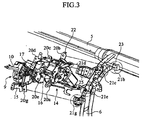
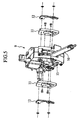
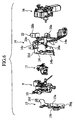
- the operation part 9 has, at the forward offset location on the side of the driver seat 2, an assist 16 having an electric motor using brackets 14 and 15 as "mechanical joiners".
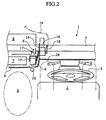
- the operation part 9 and the assist 16 are connected to each other using a link mechanism 17 as an "operation force transmitter”. Therefore, the operation force of the operation lever 10 is transmitted to the assist 16 through the link mechanism 17 to rotate the output lever 18 (see Fig. 2) of the assist 16. This rotation allows a driving force necessary for changing the ranges to be transmitted to the automatic transmission using a transmission cable 19.
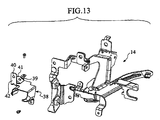
- the bracket 14 includes a first base 14a for mounting the assist 16.
- the bracket 14 includes a second base 14b for mounting the operation part 9.
- the second base 14b and the first base 14a are opposite to each other.
- the bracket 14 includes a third base 14c that connects the ends of the first base 14a and the second base 14b.
- the bracket 15 includes first and second bases 15a and 15b on which the operation part 9 is mounted.
- the second base 15b extends normal to the first base 15a.
- the operation part 9 is held between the second bases 14b and 15b.
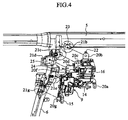
- the brackets 14 and 15 include fitting pieces 20a to 20g.
- the steering member 5 and the instrumental stay 6 include receiver surfaces 21b to 21d and 21g corresponding to the fitting pieces 20b to 20g.
- the fitting pieces 20b to 20g are fastened to the receiver surfaces 21b to 21d and 21g using bolts and nuts.
- the first base 14a includes the fitting piece 20b fixed to the receiver surface 21b of the steering member 5.
- the third base 14c includes the fitting piece 20c fixed to the receiver surface 21c of the instrumental stay 6.
- the third base 14c includes the fitting piece 20d fixed to the receiver surface 21d of the instrumental stay 6.
- the third base 14c includes the fitting piece 20e fixed to the receiver surface 21e of the instrumental stay 6.
- the first base 15a includes the fitting piece 20f mounted on the receiver surface 21d such that the fitting piece 20f is stacked on the fitting piece 20d of the bracket 15.
- the first base 15a includes the fitting piece 20g fixed to the receiver surface 21g of the instrumental stay 6.
- the uppermost fitting piece 20b of the bracket 14 includes a temporarily-holding pawl 22, and the receiver surface21b corresponding thereto includes a retaining portion 23 capable of retaining the temporarily-holding pawl 22.
- the portion 20d of the fitting piece 20 includes a locate pin 24, and the receiver surface 21d corresponding thereto defines a locate hole 25.
- the operation part 9 and the assist 16 as heavy objects that are integrated with each other using the brackets 14 and 15 are mounted on the steering member 5 and the instrumental stay 6.
- the temporarily-holding pawl 22 formed on the bracket 14 is locked to the locking portion 23 formed on the receiver surface 21 of the steering member 5.
- the locking portion temporarily holds the suspended operation part 9 and the assist 16.
- the locate pin 24 formed on a portion of the bracket 14 is inserted into the locate hole 25 formed in the receiver surface 21 of a portion of the instrumental stay 6. This insertion operation positions all of the fitting pieces 20 and the receiver surfaces 21, thus facilitating the subsequent mounting operation.
- the operation part 9 and the assist 16 are mounted on both the steering member 5 extending along the widthwise direction of the vehicle and the instrumental stay 6 extending in the vertical direction using the brackets 14 and 15. With this mounting operation, each mounting rigidity of the operation part 9 and the assist 16 are also improved.
- the separate operation part 9 and the assist 16 are coupled to each other by the brackets 14 and 15.
- the assist 16 with respect to the operation part 9 is arbitrarily selected in position such that the assist 16 does not interfere with other devices in the instrumental panel 1. More specifically, the assist 16 is disposed on the side of the driver seat 2. This layout avoids the interference of the assist 16 with the air conditioner 8.
- the operation part 9 and the assist 16 are disposed on the side of the instrumental panel 1. This arrangement allows the space S (see Fig. 2) to be used between the driver seat 2 and the passenger seat, where the operation lever is conventionally provided, as a walk-through passage.
- the assist 16 is forwardly offset in position with respect to the operation part 9. This offset sets the right end position of the center cluster 4 proximate to the central portion of the vehicle body. Thus, the space around the left knee 26 of the driver is widely secured.
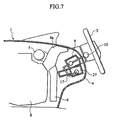
- an assist 27 is disposed below the operation part 9 so that the assist 27 does not interfere with a duct 8a of the air conditioner 8.
- the knee space of the driver is widely secured.
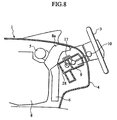
- an assist 28 is disposed in front of the operation part 9 so that the assist 28 does not interfere with the instrumental stay 6.
- the knee space of the driver is widely secured.
- the operation part 9 includes a lock lever (not illustrated) positioned in correspondence with the parking (P) in the position gate.
- the lock lever supports the position pin located at the parking from below, and maintains the parking lock.
- the lock lever is connected to the upper end of a key interlock operation member 29.
- the lower end of the key interlock operation member 29 is connected to a solenoid (not illustrated).
- the key interlock operation member 29 is conventionally one continuous rod-like member.
- the key interlock operation member 29 comes into contact with one or some of the fitting pieces 20 of the bracket 14 and interferes with the mounting operation of the fitting pieces 20.
- the key interlock operation member 29 is separated into an upper rod 30 connected to the operation part 9 and a lower cable 31 connected to the solenoid.
- the bracket 14 is formed with cutouts 32 and 33 that respectively hold the lower end of the rod 30 and the upper end of the cable 31.
- the cutouts 82 and 33 are positioned not to interfere with the rod 30 and the cable 31 during mounting of the fitting pieces 20. This positioning facilitates the mounting operation of the bracket 14. After mounting of the bracket 14, the rod 30 and the cable 31 are detached from the cutouts 32 and 33 to be connected to the corresponding ends, respectively, thus permitting operation by the solenoid.
- the instrumental panel 34 of the fifth embodiment includes a switch panel 36 having switches 35 mounted on a position coinciding with the assist 16.
- the switches 35 include a harness extending therefrom into the instrumental panel 34.
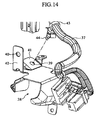
- the length of the harness 37 is preset longer (elongate excess portion is provided) so that the mounting operation of the switch panel 36 is facilitated. Therefore, after mounting of the switch panel 36, the harness 37 sags, and the harness 37 can interfere with the link mechanism 17 located between the operation part 9 and the assist 16.
- a cover 38 for avoiding the interference between the harness 37 and the link mechanism 17 is mounted on the bracket 14 of this embodiment.
- the cover 38 is positioned such as to cover over the link mechanism 17 from the harness 37.
- the cover 38 prevents the elongate excess portion of the harness 37 on the side of the switch 35 from interfering with the link mechanism 17.
- the cover 38 includes a fixing portion 41 and a fixing piece 42 having clip holes 39 and 40, respectively.
- the clip hole 39 of the fixing portion 41 is engaged with the clip 44 of a band 43 that ties up the harness 37 from the switch 35.
- the clip hole 40 of the fixing piece 42 is engaged with a clip 47 formed on the connector 46 of a harness 45 on the side of the operation part 9.
- the connector 46 is connected to the connector 49 of the harness 48 from above.
- operation part 9 and the assist 16 are connected to each other using the link mechanism 17 as the operation force transmitter in the above embodiments, they may be connected to each other using a cable mechanism.
- the object of the invention is to provide a vehicular automatic transmission in which precision of a position angle is improved even if an operation part and an assist are disposed separately from each other without integrally forming them. This object is achieved by providing an output lever with a check mechanism that limits the position angle of the output lever.
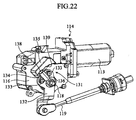
- the operation part 9 includes an assist 114 having an electric motor 113 using brackets 111 and 112.
- the assist 114 is located at the front offset position on the side of the driver seat 2.
- the operation part 9 and the assist 114 are connected to each other using a link mechanism 115 as an "operation force transmitting mechanism".
- the assist 114 is disposed in the diagonal front of the operation part 9, and the brackets 111 and 112 are shaped in a crank as viewed from above.
- the operation part 9 and the assist 114 are mounted on the steering member 5 and the instrumental stay 6 by means of the brackets 111 and 112, with them 9 and 114 connected to each other using the link mechanism 15A.
- the operation part 9 and the assist 114 are formed separately from each other, and they 9 and 114 are joined to each other using the brackets 111 and 112.
- the assist 114 with respect to the operation part 9 is arbitrarily set in position such that the assist 114 does not interfere with other devices in the instrumental panel 1. More specifically, the assist 114 is located on the side of the driver seat 2 to avoid interference of the assist 114 with the air conditioner 8.
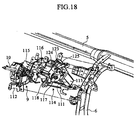
- the side surface of a housing 116 of the assist 114 rotatably supports an output lever 117 about the rotation shaft 118.
- the operation force of the operation lever 10 is transmitted to the output lever 117 through the link mechanism 115 to rotate the output lever 117.
- One end of the output lever 117 is connected to the transmission rod 119.
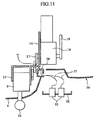
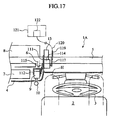
- the transmission rod 119 is connected to a control cable 120. Rotation of the output lever 117 permits an amount of rotation of one end of the output lever 117 to be transmitted to the range changing mechanism 122 of an automatic transmission 121 as a driving force through the control cable 120 (see Fig. 17).
- a symbol H in Fig. 17 represents a knee of the driver.
- the output lever 117 of the assist 114 includes a check mechanism 123 that precisely limits a position angle corresponding to each range.
- the check mechanism 123 includes a check plate 124 mounted on the output lever 117, and a resilient plate 125 mounted on the housing 116 of the assist 114.
- the check plate 124 is of a fan shape having a concavoconvex 126 corresponding to each range.
- the check plate 124 is mounted on the other end of the output lever 117 by a bolt 127 as a separate part.
- the base end of the resilient plate 125 is fixed to the upper portion of the housing 116 of the assist 114.
- the resilient plate 125 includes a tubular distal end 128 that is engaged with the concavoconvex of the check plate 124.
- the engagement between the distal end 128 of the resilient plate 125 and the concavoconvex 126 of the check plate 124 precisely limits the position angle of the output lever 117 in response to each range.
- the check mechanism 123 is mounted on the output lever 117 on the side of the assist 114.
- this structure is not affected by backlash of the link mechanism 115, thus improving the precision of the position angle corresponding to each range.
- the check mechanism 123 including the check plate 124 and the resilient plate 125 reduces the number of components.
- the check plate 124 having the concavoconvex 126 is mounted on the output lever 117 as a separate component. This structure simplifies the shape of the output lever 117, thus facilitating formation of the output lever 117.
- a check plate 129 is made of a resin.
- the other end of a metal output lever 130 is insert-molded together with the check plate 129 during the resin formation.
- the resin check plate 129 reduces the weight and striking sound.
- the metal output lever 130 is insert-molded on the resin check plate 129. The insert molding achieves a precise positional relationship between the check plate 129 and the output lever 130.
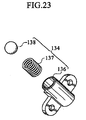
- a check mechanism 131 includes a resilient structure 134 fixed to the other end of an output lever 132 by means of a bolt 133.
- the check mechanism 131 includes a check block 135 fixed to the side surface of the housing 116 of the assist 114.
- the resilient structure 134 is provided with a spring 137 within a tubular holder 136.
- the resilient structure 134 biases a ball 138 as a "distal end" in a projecting direction by means of the spring 137.
- the inlet of the tubular holder 136 is slightly smaller than the ball 138, and the ball does not come out from the holder 136.
- the check block 135 has a curved inner surface that defines a concavoconvex 139 thereon.
- the spring 137 biases the ball 138 of the resilient structure 134 against the concavoconvex 139 to engage the ball 138 with the concavoconvex 139.
- the engagement between the ball 138 and the concavoconvex 139 precisely limits the position angle of the output lever 132 in response to each range.
- the check mechanism 131 including the resilient structure 134 and the check block 135 is smaller in size.
- the check plate 124 and the resilient structure 134 may be mounted on the assist 114, and the resilient plate 125 and the check block 135 may be mounted on the output levers 117 and 132.
Landscapes
- Engineering & Computer Science (AREA)
- General Engineering & Computer Science (AREA)
- Mechanical Engineering (AREA)
- Arrangement Or Mounting Of Control Devices For Change-Speed Gearing (AREA)
Applications Claiming Priority (2)
| Application Number | Priority Date | Filing Date | Title |
|---|---|---|---|
| JP2004278539A JP2006088944A (ja) | 2004-09-24 | 2004-09-24 | 車両用自動変速装置 |
| JP2004328133A JP2006138390A (ja) | 2004-11-11 | 2004-11-11 | 車両用自動変速装置 |
Publications (1)
| Publication Number | Publication Date |
|---|---|
| EP1640641A2 true EP1640641A2 (de) | 2006-03-29 |
Family
ID=35170071
Family Applications (1)
| Application Number | Title | Priority Date | Filing Date |
|---|---|---|---|
| EP05020616A Withdrawn EP1640641A2 (de) | 2004-09-24 | 2005-09-21 | Fahrzeugautomatikgetriebe |
Country Status (2)
| Country | Link |
|---|---|
| US (1) | US20060070476A1 (de) |
| EP (1) | EP1640641A2 (de) |
Citations (2)
| Publication number | Priority date | Publication date | Assignee | Title |
|---|---|---|---|---|
| JP2003301942A (ja) | 2002-02-08 | 2003-10-24 | Calsonic Kansei Corp | 車両用自動変速装置 |
| JP2004203088A (ja) | 2002-12-24 | 2004-07-22 | Calsonic Kansei Corp | 車両用自動変速装置 |
Family Cites Families (5)
| Publication number | Priority date | Publication date | Assignee | Title |
|---|---|---|---|---|
| US5372050A (en) * | 1992-03-06 | 1994-12-13 | Mazda Motor Corporation | Shift device for automatic transmission |
| US6282974B1 (en) * | 1996-03-12 | 2001-09-04 | Fujikiko Kabushiki Kaisha | Operating apparatus for automatic transmission |
| JP4143213B2 (ja) * | 1999-04-02 | 2008-09-03 | 株式会社アツミテック | 車両用変速操作装置 |
| JP3651602B2 (ja) * | 2002-05-29 | 2005-05-25 | 三菱ふそうトラック・バス株式会社 | 変速機操作装置 |
| US7237450B2 (en) * | 2003-02-03 | 2007-07-03 | Calsonic Kansei Corporation | Vehicular automatic power transmission operating device |
-
2005
- 2005-09-21 EP EP05020616A patent/EP1640641A2/de not_active Withdrawn
- 2005-09-23 US US11/233,358 patent/US20060070476A1/en not_active Abandoned
Patent Citations (2)
| Publication number | Priority date | Publication date | Assignee | Title |
|---|---|---|---|---|
| JP2003301942A (ja) | 2002-02-08 | 2003-10-24 | Calsonic Kansei Corp | 車両用自動変速装置 |
| JP2004203088A (ja) | 2002-12-24 | 2004-07-22 | Calsonic Kansei Corp | 車両用自動変速装置 |
Also Published As
| Publication number | Publication date |
|---|---|
| US20060070476A1 (en) | 2006-04-06 |
Similar Documents
| Publication | Publication Date | Title |
|---|---|---|
| CN114007887B (zh) | 驾驶辅助装置 | |
| US6408709B2 (en) | Cable block-locking mechanism for dual mode shift lever unit | |
| KR101789847B1 (ko) | 차량 변속기용 모듈형 작동 장치 | |
| KR20080039255A (ko) | 모듈형 자동 트랜스미션 시프터 | |
| EP1403152A1 (de) | Fahrzeugschalthebelvorrichtung | |
| US11755054B2 (en) | Driver assistance system | |
| EP1609690B1 (de) | Feststellbremse | |
| EP0100855B1 (de) | Fernsteuerungsvorrichtung | |
| JP4327555B2 (ja) | 小型車両のワイヤ用クランプ | |
| EP1647457A1 (de) | Lenksperre | |
| US20070234837A1 (en) | Automotive shift lever | |
| EP1640641A2 (de) | Fahrzeugautomatikgetriebe | |
| JP3478437B2 (ja) | スライドコンソール装置 | |
| JP4171389B2 (ja) | シフトレバー装置 | |
| US7779722B2 (en) | Parking brake | |
| US12060932B2 (en) | Operation device for vehicle transmission and vehicle | |
| JP2001120008A (ja) | 線引きマーカー解除装置 | |
| JP3595919B2 (ja) | キーインタロックケーブルの配索構造 | |
| JP2005125811A (ja) | シフトレバー装置及びシフトレバー装置の取り付け構造 | |
| JP4305235B2 (ja) | ステッキ式パーキングブレーキレバー及びその組み付け方法 | |
| JP2000344053A (ja) | 車両のステアリング構造 | |
| US10072751B2 (en) | Vehicle shifter with offset cable actuator | |
| KR200260537Y1 (ko) | 자동차용 기계식 정속 주행장치 | |
| JP2002326523A (ja) | 自動変速機のシフトロック装置 | |
| JPH02283962A (ja) | 自動変速機の操作装置 |
Legal Events
| Date | Code | Title | Description |
|---|---|---|---|
| PUAI | Public reference made under article 153(3) epc to a published international application that has entered the european phase |
Free format text: ORIGINAL CODE: 0009012 |
|
| AK | Designated contracting states |
Kind code of ref document: A2 Designated state(s): AT BE BG CH CY CZ DE DK EE ES FI FR GB GR HU IE IS IT LI LT LU LV MC NL PL PT RO SE SI SK TR |
|
| AX | Request for extension of the european patent |
Extension state: AL BA HR MK YU |
|
| STAA | Information on the status of an ep patent application or granted ep patent |
Free format text: STATUS: THE APPLICATION HAS BEEN WITHDRAWN |
|
| 18W | Application withdrawn |
Effective date: 20090429 |