EP1640838A1 - Methode und Vorrichtung zur Beschreibung von Haushaltselektronik unter Verwendung von separaten Aufgaben- und Gerätebeschreibungen - Google Patents
Methode und Vorrichtung zur Beschreibung von Haushaltselektronik unter Verwendung von separaten Aufgaben- und Gerätebeschreibungen Download PDFInfo
- Publication number
- EP1640838A1 EP1640838A1 EP05255716A EP05255716A EP1640838A1 EP 1640838 A1 EP1640838 A1 EP 1640838A1 EP 05255716 A EP05255716 A EP 05255716A EP 05255716 A EP05255716 A EP 05255716A EP 1640838 A1 EP1640838 A1 EP 1640838A1
- Authority
- EP
- European Patent Office
- Prior art keywords
- task
- user
- devices
- descriptions
- description
- Prior art date
- Legal status (The legal status is an assumption and is not a legal conclusion. Google has not performed a legal analysis and makes no representation as to the accuracy of the status listed.)
- Granted
Links
Images


Classifications
-
- G—PHYSICS
- G06—COMPUTING OR CALCULATING; COUNTING
- G06Q—INFORMATION AND COMMUNICATION TECHNOLOGY [ICT] SPECIALLY ADAPTED FOR ADMINISTRATIVE, COMMERCIAL, FINANCIAL, MANAGERIAL OR SUPERVISORY PURPOSES; SYSTEMS OR METHODS SPECIALLY ADAPTED FOR ADMINISTRATIVE, COMMERCIAL, FINANCIAL, MANAGERIAL OR SUPERVISORY PURPOSES, NOT OTHERWISE PROVIDED FOR
- G06Q10/00—Administration; Management
- G06Q10/10—Office automation; Time management
-
- G—PHYSICS
- G06—COMPUTING OR CALCULATING; COUNTING
- G06Q—INFORMATION AND COMMUNICATION TECHNOLOGY [ICT] SPECIALLY ADAPTED FOR ADMINISTRATIVE, COMMERCIAL, FINANCIAL, MANAGERIAL OR SUPERVISORY PURPOSES; SYSTEMS OR METHODS SPECIALLY ADAPTED FOR ADMINISTRATIVE, COMMERCIAL, FINANCIAL, MANAGERIAL OR SUPERVISORY PURPOSES, NOT OTHERWISE PROVIDED FOR
- G06Q10/00—Administration; Management
- G06Q10/06—Resources, workflows, human or project management; Enterprise or organisation planning; Enterprise or organisation modelling
- G06Q10/063—Operations research, analysis or management
- G06Q10/0631—Resource planning, allocation, distributing or scheduling for enterprises or organisations
- G06Q10/06316—Sequencing of tasks or work
-
- G—PHYSICS
- G06—COMPUTING OR CALCULATING; COUNTING
- G06F—ELECTRIC DIGITAL DATA PROCESSING
- G06F9/00—Arrangements for program control, e.g. control units
- G06F9/06—Arrangements for program control, e.g. control units using stored programs, i.e. using an internal store of processing equipment to receive or retain programs
- G06F9/44—Arrangements for executing specific programs
- G06F9/451—Execution arrangements for user interfaces
- G06F9/453—Help systems
-
- G—PHYSICS
- G06—COMPUTING OR CALCULATING; COUNTING
- G06Q—INFORMATION AND COMMUNICATION TECHNOLOGY [ICT] SPECIALLY ADAPTED FOR ADMINISTRATIVE, COMMERCIAL, FINANCIAL, MANAGERIAL OR SUPERVISORY PURPOSES; SYSTEMS OR METHODS SPECIALLY ADAPTED FOR ADMINISTRATIVE, COMMERCIAL, FINANCIAL, MANAGERIAL OR SUPERVISORY PURPOSES, NOT OTHERWISE PROVIDED FOR
- G06Q10/00—Administration; Management
- G06Q10/06—Resources, workflows, human or project management; Enterprise or organisation planning; Enterprise or organisation modelling
- G06Q10/063—Operations research, analysis or management
- G06Q10/0631—Resource planning, allocation, distributing or scheduling for enterprises or organisations
- G06Q10/06311—Scheduling, planning or task assignment for a person or group
Definitions
- the present invention relates in general to providing user interfaces for user control of devices, and in particular to presenting and representing user tasks for a set of consumer electronic (CE) devices.
- CE consumer electronic
- Typical user interfaces for user control of devices such as CE devices (e.g., TV, VCR, DVD player, CD player, etc.) are such that user tasks are not represented in the devices. Instead, a set of device functions are presented to the user and the user selects combinations of these device functions to perform a task. For example, to watch a video tape requires the user to select the input (e.g., tape), rewind the tape and press play on a VCR. As a result, the user cannot simply specify that he/she wishes to 'watch' 'video tape' to automate the above operations. Users cannot express desired tasks to be performed (e.g., 'watch' 'video tape'), rather users must directly control devices to perform desired functions (e.g., selecting the input, rewinding the tape and pressing play on a VCR).
- desired tasks e.g., selecting the input, rewinding the tape and pressing play on a VCR.
- consumer electronics are described using interface descriptions such as language APIs.
- Middleware such as UPNP, OSGi, Jini, etc. have standardized the use of such computer procedural interfaces.
- these interfaces do not describe the device to any level of detail that can be meaningfully used by another computer/device, except for calling the defined interfaces.
- Other approaches have focused on describing capabilities and preferences in more detail, such as CC/PP, wherein sets of attributes can be expressed for computing devices that represent capabilities and preferences.
- approaches in the area of the semantic web have moved towards more elaborate description capabilities, such as the work embodied by DAML and RDF. However, such approaches only describe a core for describing entities rather than a particular approach.
- the present invention provides a task orchestration system that implements a method of representing user tasks to be performed by one or more of a plurality of electronic devices in a network.
- Each device preferably includes therein a function description specifying the functions that the device can perform.
- Device functionality is preferably expressed as a device description specifying a function that the device can perform.
- the function descriptions are obtained from one or more of the devices.
- task descriptions that describe the user task and the functions needed to perform certain tasks are also preferably obtained.
- the obtained function descriptions and task descriptions are preferably used to generate task suggestions for the user.
- Each task suggestion preferably abstractly represents a user task as a pseudo-sentence, and is preferably obtained from a task description and that may use one or more of the obtained device descriptions.
- the task suggestions are preferably displayed on a display for the user to select from, wherein the requested task represented by a selected task suggestion is to be performed by one or more of the devices.
- the task suggestions preferably mask device functions from the user of the system.
- Task suggestions are preferably represented to the user using a pseudo language structure organized as a set of terms that have types, to describe user tasks as abstractions of task descriptions and device function descriptions.
- a user interface device is preferably utilized to displays the task suggestions on a display for the user to select from, such that they can be selected to perform the tasks by one or more of the devices under the control of a task orchestration (automation) module.
- a user is preferably allowed to select pseudo-sentence elements/terms such that the user selected task suggestions can be performed by the devices under control of the task orchestration module in the system.
- the task orchestration module can preferably be a logical component of the system.
- a user task description preferably comprises task external description, task properties, task functionalities and task actions.
- the task external description preferably outlines task suggestions (i.e., pseudo-sentences) for interaction with a user.
- the task properties preferably express information about the user task.
- the task functionalities preferably express functionality required to perform the user task.
- the task actions preferably describe the sequencing and combinations of the devices that fulfill the required functionalities.
- the device description preferably comprises device functionality description and device grounding, wherein, the functionality description preferably outlines functionality of a device, and the device grounding describes device control based on the functionality description.
- the task orchestration module preferably comprises a task-driven controller that is operable to obtain device function descriptions from one or more of the devices, to obtain task descriptions that describe device functionalities required by certain tasks, to generate task suggestions from the task descriptions and device descriptions, and once a task suggestion is selected, to perform the selected task suggestion based on task descriptions that use functionalities described in the obtained device function descriptions.
- the present invention provides a system for orchestrating user tasks over a diverse set of devices, such as consumer electronic devices in a home wherein the devices are interconnected in a network.
- Orchestrating user tasks involves automating the process of selecting the devices to use to perform a task.
- this includes obtaining device function descriptions and task descriptions, generating task suggestions based on the obtained device function descriptions and task descriptions, ranking the task suggestions, allowing a user to select among the tasks suggestions, and orchestrating (automating) the devices to perform the selected/requested task suggestions.
- task suggestions can be described as pseudo-sentences comprising a set of elements/terms that modify one another.
- the present invention allows describing user tasks in an incremental and flexible way using pseudo-sentences which are also human-readable. As such it does not define how the description is mapping into the operation of devices, instead is focuses on how to express task operations in a way that can be interpreted by the user.
- the pseudo-sentences provide an abstraction layer away from the underlying devices. Tasks can be described using the pseudo-sentences in a loosely similar approach as graffiti handwriting recognition symbols are close to actual roman letters (e.g., graffiti of user tasks compared to natural language and full handwriting recognition). In one implementation, this allows a compact program to determine user tasks without complex natural language processing.
- Task orchestration operates as a high-level, task-oriented, remote control for the devices and minimizes the selections and settings for the user. As such, combinations of several technologies are utilized to provide an orchestration system suitable for automating the orchestration of user tasks.
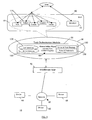
- a task orchestration system 10 allows user tasks to be automated into a set of orchestrated device actions with minimal input from the user.
- the task orchestration system 10 comprises three types of logical devices: (1) client devices 20 which include devices that show a user interface, (2) controller devices 30 which include devices that control other devices, and (3) controlled devices 40 which include devices that are controlled by controllers.
- Each logical device can have a particular functionality to enable task orchestration according to the present invention.
- controlled devices 40 include enhanced descriptions of their functionality using a language such as e.g. a semantic mark-up language (this does not describe their interface, but instead abstractly describes their functionality).
- a device may include one or more user task descriptions. The task descriptions can specify tasks that only use their functionality, use their functionality and potential functionality of other devices, or simply are tasks for other devices.
- Controller devices 30, comprising task orchestration (TO) modules 50, include functionality to orchestrate devices to perform user-selected task suggestions (i.e., task requests).
- a controller 30 includes an inference system (e.g., an expert system, rule system, etc.) in the task orchestration module 50, that is capable of inferring a set of actions and devices for performing a task request.
- the controller 30 takes task and device functionality descriptions and uses that information to infer: (1) what tasks are valid in the system, given the current devices, their functionality, and the described tasks, and (2) what device combinations are potentially usable to fulfill a requested task.
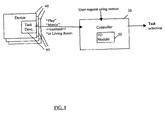
- Client devices 20 include the functionality to request and display task suggestions to the user. As such, they include a user interface that is coupled with the task orchestration module 50 of the controller 30 to show tasks to the user. This coupling enables the user interface (e.g., GUI) to only display task suggestions that are possible given the current devices 40, tasks and functionality. Further, if part of a task suggestion has been made (i.e., part of a task request has been specified), the user interface may use the controller 30 to further reduce applicable user options. Using this functionality, the client device 20 is able to list available tasks and options as task suggestions using pseudo sentences. A task suggestion is selected by the user, and a request to execute the selected task suggestion is processed by the controller 30 to perform the selected/requested task.
- a user interface that is coupled with the task orchestration module 50 of the controller 30 to show tasks to the user. This coupling enables the user interface (e.g., GUI) to only display task suggestions that are possible given the current devices 40, tasks and functionality. Further, if part of a task
- controller 30 determines in a simplified fashion what user task is desired and match it to task descriptions and eventually to device selection and configuration for fulfilling the task.
- User preferences such as which room to play a video in, are specified as part of a task suggestion pseudo sentence as modifiers (e.g., pseudo sentence Play Video 'in the bedroom' or Play Video 'using headphones').
- pseudo sentence Play Video 'in the bedroom' or Play Video 'using headphones' are specified as part of a task suggestion pseudo sentence as modifiers (e.g., pseudo sentence Play Video 'in the bedroom' or Play Video 'using headphones').
- FIG. 2 illustrates an example functional architecture of the task orchestration system 10 according to the present invention, including a user interface (GUI) module 60 and a controller 30 that includes a task orchestration module 50 as a top layer over underlying client devices 40.
- GUI user interface
- the module 70 provides middle layer functions which enable control of the devices (e.g., provides APIs to control the devices). Operation of the module 70 is beyond the scope of the present invention, and therefore, not described in detail herein.
- the task orchestration module 50 allows presenting and representing task suggestions that can be performed by a set of consumer electronic devices 40. As such, the task orchestration module 50 masks how those task suggestions are mapped to the devices 40, and only represents tasks suggestions to a user. A way of describing tasks as tasks suggestions in an incremental and flexible way is provided that is also human-readable. Such a method does not focus the user on how a task description 95 is mapped into the operation of devices 40, and instead focuses on expressing task operations in a way that can be interpreted by the user (e.g., task suggestions as termed pseudo-sentences).
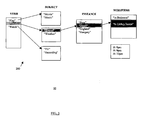
- a task suggestion can be described in a simplified language structure 200 that represents a pseudo sentence.
- the example structure is organized as a set of terms that modify one another, wherein in this example a standardized set of 'verbs' defining actions are used as the root of a hierarchical language tree 200.
- a standardized set of 'verbs' defining actions are used as the root of a hierarchical language tree 200.
- “play”, “show”, “watch”, “adjust”, “water”, etc. are a set of 'verbs', and following each 'verb' is a 'subject', such as "photos", "lawn”, “movie”, etc.
- the 'subjects' modify the 'verbs' by reducing the scope of the actions defined by the ⁇ verbs' .
- 'modifiers' such as an instance that further reduces the scope to a particular action. For example, "Play” “Movie” "The Matrix” adds “The Matrix” as a particular instance. Other 'modifiers' such as “in the den” or “at 8pm” can be specified to control the task. Yet, other modifiers may specify the media on which the movie "The Matrix” resides. Note that this structure specifies tasks, not device actions. Device actions such as changing volume or channels are not tasks herein, instead they are actions on an existing task (e.g., changing the volume while “watching” "TV”).
- Word combinations in this structure 200 are filled not by a fixed set of terms for a particular context (for example the home), rather by a standardized descriptions of tasks located in devices 40. These devices are then queried to produce a set of terms for each level and modifiers that are possible based on the devices currently connected or reachable in the system. This approach makes it much easier to specify a user task, since a large irrelevant word base would make it difficult to determine the correct pseudo-sentence.
- the devices 40 are queried for a set of terms for each level (i.e., position in pseudo-sentence), and modifiers that are possible based on the devices currently connected or reachable in a home network 85 (FIG. 2), as task descriptions 95.
- This approach simplifies specifying a task suggestion because otherwise a large irrelevant word base would make it difficult to determine the correct pseudo sentence.
- An enhancement to this embodiment of the present invention is to determine only the set of terms or modifiers that are possible based on the current selection of other terms or modifiers. For example, if “play” and “on CD player” are selected, then even though “play” "video” is a possible task, it does not fit a device task description in the system because video cannot be played on the CD player. Instead, only "music” is presented to the user, if that is the only option based on the devices 40 present.
- Another enhancement to this embodiment of the present invention is to allow the task to be partially specified (e.g., "Play” "Music” "A Song Name”). If multiple tasks match, then the task may be instantiated by determining an option for the user. This can be by random selection, by learning based on past requests, or by more complex approaches. This allows users to reduce their decision making and user interface options when they know that few options exist, or the task orchestration module 50 can determine a suitable selection for the users based on the user input so far. The task orchestration module 50 can also fill-in available options as it determines them based on the available devices and resources. For example, if only one music device exists (a CD player), then room modifiers and device selections are removed at run-time as part of any underlying machine automation.
- a CD player room modifiers and device selections are removed at run-time as part of any underlying machine automation.
- the present invention allows the users to specify tasks, not device operations; allows applications or devices to specify what functions they perform; allows a user interface to search for only tasks that are possible to be expressed/executed rather than all tasks that could exist; provides a standardized vocabulary that allows users to quickly express tasks; and allows a compact program to determine user tasks without complex natural language processing.
- the present invention provides a method of describing consumer electronic devices using separate task descriptions and device function descriptions.
- device interactions are expressed using both device functionality descriptions and abstract device interactions.
- device descriptions i.e., device functionality
- user tasks i.e., device usage
- a set of consumer electronics such as those in the home
- complex sequential, parallel and coordinated interactions can be expressed to orchestrate functionality of home devices into performing user tasks.
- Device interaction that is described in a flexible description rather than as a controller program acting as a black box; device interactions that more closely match the structure of users' perception of home device usage; task descriptions that allow interactions not to be centered on one single device. (i.e.. no direct device to task mapping); and a description of user tasks as task suggestions that allows interoperable description and interchange of descriptions.
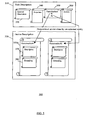
- the description 300 of consumer electronics 40 is provided as two logical descriptions: task description 310 (i.e., user tasks) and device description 320 (i.e., device functionality). These descriptions 310, 320 are related in such as way that a task suggestion can allow a controller 30 to understand what possible devices 40 in the home network 85 can be used to achieve a task suggestion based on a task description 310.
- This type of description 310 has many uses, but principally it allows tasks to be decoupled from the devices 40 in the home network 85. It also allows tasks to be decoupled from black box controller style applications that programmatically perform tasks in predetermined and predefined orders for well-known existing devices.
- a task description 310 includes four parts: (1) task external description 330, (2) task properties 340, (3) task functionalities 350 and (4) task actions 360.
- the task external description 330 outlines the pseudo-sentences (note that in this example the task description 95 in FIG. 2 and the task description 330 in FIG. 5 are the same).
- Task properties express 340 information useful about the task (e.g., that it can optionally dim a light when a DVD is played, or that certain users are allowed to use this task).
- Task functionalities express 350 functionality required by the task to achieve its goals. This functionality is described using a shared terminology with device descriptions 320 and describes the abstract functionality of a device 40. For example, a DVD player may be an "AVSource".
- Device descriptions 320 have a similar structure to task descriptions and share the functionality description.
- Device descriptions 320 may include functionality 350A, wherein the task functionality 350 in the task description 310 maps to functionality 350A in the device description 320.
- the functionality 350A can include a functionality description 370, a device grounding 380 and device attributes (e.g., screen size, features, etc.).
- the functionality description 370 outlines the functionality of a device 40.
- a CD player is a AudioSink
- a transcode would have functionality as a MPEGAudioSink and a MPEGAudioSource.
- the device grounding 380 describes how to control the device 40 based on the functionality description 380. For example, it may include URLs to call to change the volume level, setup device connections, etc. Alternatively, it may have a grounding to control a UPNP device by expressing UPNP interactions necessary to control the device.
- other device control protocols may also be utilized.
- the task descriptions 310 and the device descriptions 320 are read by the task orchestration module 50 and analyzed to determine if a set of devices 40 exist that matches the task functionalities 350. If it does, the task orchestration module 50 takes the device functionalities 350 matching the task as candidate devices for the tasks.. The task orchestration module 50 then recurses through the available devices 40 to determine a combination of devices 40 that fulfill the functionalities 350 of the task. Sets of matching task/device combinations are returned from this search and presented to the user as output solutions 75 on the GUI 60 (FIG. 2). The user selects a pseudo-sentence he prefers, which is mapped to a task/device combination and instantiates the task by using the task actions which in turn require device actions that use the device grounding 380 in the device description 320 to fulfill the task.
- device descriptions 320 are only logically separate from task descriptions 310 in the description 300, nothing prevents a device 40 from describing its functionality as a task description in addition to participating in larger tasks, and the descriptions can be physically combined.
- An alternative implementation is the building of the device descriptions 320 and task descriptions 310 using semantic web technologies, so to allow a shared semantic ontology (language) to be used to richly describe all aspects of devices and tasks in a way that its semantics are machine readable. While the above description is in the context of home consumer electronics, as those skilled in the art recognized, the present invention can be used in other applications such as e.g., in mobile devices, desktop computing, enterprise computing, etc.
- the module 50 combines task descriptions and device descriptions to determine whether a device can be used for a particular task.
- the module 50 obtains information on the combination of task and device descriptions to determine the grounding information for the device, wherein a task description includes a sequence of actions scripts that the module 50 uses to orchestrate the device actions.
- the module 50 combines grounding information from multiple device descriptions with a task description script to generate a specific script for controlling the devices for a user task.
- Device grounding information is specified on a functionality basis from the device descriptions. Further, device grounding information specifies interactions and parameter settings to determine the control of a device.
- the device grounding can be specified in the form of a uniform resource identifier (URI) to describe the action and parameters to use.
- URI uniform resource identifier
- the device grounding information can include multiple grounding information sections that are combined to fulfill the required functionality.
- the device description can include multiple grounding information sections that map to different protocols used by a control or device software.
- the task orchestration system 10 implements techniques for the user to request a task suggestion to the system 10 and techniques to interpret and process the task suggestion.
- the task orchestration system 10 implements techniques for the user to request a task suggestion to the system 10 and techniques to interpret and process the task suggestion.
- Semantic Web based tools and techniques were adapted to build an efficient system, including developing ontologies for entities (e.g., devices) in a semantically rich mark-up language.
- the ontologies are framed to represent home devices 40 and user task requests 95, and are described in detail further below.
- the task orchestration module 50 provides task suggestions to the user, and receives requests from the user to orchestrate the execution of task suggestions selected by the user.
- the task orchestration module 50 uses an inference engine 65 (FIG. 1B) as a top layer, in conjunction with the user interface 60 (FIG. 2), to process a selected task suggestion 95 by parsing it, discovering the appropriate devices 40 that can execute the selected task suggestion and passing this information onto the bottom layers (e.g., module 70) for execution.
- a suitable mark-up language along with the inference engine 65, are used to reason over the content expressed in that language, whereby the entities communicate with, and understand, each other.
- semantic technologies are used to describe device functionality and tasks to facilitate functionality-centric coupling of devices.
- the following types of devices 40 are in the home network 85:
- Example tasks possible in that home network 85 can include:
- the above examples use e.g. a pseudo sentence language to express task suggestion, whereas e.g. a semantic language is used to describe the devices and functionalities, and an inference engine is used to reason over that knowledge and execute a task request.
- the language chosen to express ontologies/rules provides: a semantic level of agreement, a high degree of flexibility and expressiveness, support for type and subsumption, support for datatypes, and expression of restrictions and constraints.
- a Knowledge-base 105 is included in the task orchestration module 50 (FIG. 2).
- Semantic Web technologies can be utilized in the task orchestration module 50.
- the Semantic Web is an extension of the current web in which information is given well-defined meaning, better enabling computers and people to work in cooperation.
- a Mark-up language designed for the Semantic Web provides common understanding between the various entities.
- Example Semantic Web technologies include DAML+OIL, DAML-S, OWL, etc., which were developed for the Semantic Web.
- Device and Task Ontologies 110 are framed using DAML+OIL and are loaded in the Knowledge Base 105 therein. A variety of attributes and functionalities of devices 40 are identified and an ontology is framed that also captures the relationships among the attributes.
- device instances 115 in DAML+OIL are framed based on the ontology, wherein an instance is essentially a semantic description of the device in terms of its interfaces and functionalities.
- Task Orchestration flow in FIG. 1B the user-selected task suggestion is divided into one or more tasks as required and mapped to the functionalities of tasks that can be performed by the available devices. The mapping is made possible by inferencing (reasoning) over the information expressed in the ontology and executing additional rules about the device/user's state/preferences.
- the task orchestration module 50 resides in the controller 30 that interacts with the module which provides interfaces for the task orchestration module 50 to obtain the device descriptions whenever needed.
- DAML+OIL task instances 120 provided by the existing devices are asserted into the Knowledge Base 105, and pre-defined user preferences 130 written as Jess rules and/or DAML+OIL are also loaded into the Knowledge Base 105.
- the device preferences with respect to the task requested and attribute preferences with respect to the functionalities needed for the task are incorporated. All the possible 'verbs' (e.g., "Play”) and 'subjects' (e.g., "Movie”) are retrieved from the Knowledge Base 105 and are displayed on the GUI 60.
- the user's task request is obtained through the GUI 60 as a set of fields 135 (e.g., FIG. 2 ) and provided as input to the Knowledge Base 105 of the task orchestration module 50.
- the input obtained from the user includes all optional fields.
- the input obtained from the user includes:
- the task orchestration module 50 communicates with a protocol stack in the module 70 to obtain all the content available that is relevant in the context of the ⁇ subject'.
- the task orchestration module 50 Upon obtaining a complete task suggestion selected by the user, the task orchestration module 50 parses the task suggestion and corresponding task description 95 and computes all possible combinations of that devices 40 that can service the request as solutions. Then, the task orchestration module 50 applies the preferences and ranks the solutions before sending for display as output 75 for the user via the GUI 60.
- the task orchestration module 50 interacts with the user via the GUI 60, and interacts with the inference engine 65 (FIG. 1B), and a rule engine 130 (FIG. 2).
- the task orchestration module 50 further includes the Knowledge Base 105 that serves to store ontologies 110 in the form of facts and applies rules 130 over that data.
- the user selects the most preferred combination of devices 40 among the solutions, and instantiates the task by using the task actions which in turn require device actions that use the device grounding 380 in the device description 320 (FIG. 5) to fulfill the task.
- the task orchestration module 50 invokes appropriate interfaces on the devices required for the task.
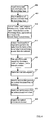
- the basic steps involved in the task orchestration module 50 include:
- the ontologies 110 are framed as a mechanism to describe tasks, devices and user preferences.
- an ontology is a specification of a conceptualization; it is a description (as in a formal specification of a program) of the concepts and relationships that can exist for an entity or a collection of entities (e.g., devices, users, etc.).
- entities e.g., devices, users, etc.
- devices and tasks are described based on their basic attributes/properties and/or functionalities provided or required
- the descriptions are encoded using a mark-up language wherein based on this description the user's task request could be understood, processed and served.
- 'Functionality + Content Type' attributes can be included in the ontologies 110.
- ontologies 110 for each functionality that a device 40 provides, it is also specified what kind of data is accepted as input (the content type), what sources the device 40 can accept the input from and what kind of data is produced as an output (if any). This is sufficient to answer requests that are very generic and that do not specify the content type.
- the task orchestration module 50 is to provide content type-based lookup for devices 50, then a method of representing the functionality that includes the content type (e.g., mp3render), not as a separate attribute, is needed. This can be accomplished by inclusion of 'Functionality + Content Type' attributes can be included in the ontologies 110.
- an ontology for expressing user preferences 130 can be utilized.
- preferences 130 can be expressed in a mark-up language similar to the way device instances 115 and task instances 120 are specified.
- an ontology may be utilized, based on which, instances of a user's preferences can be framed.
- the task orchestration module 50 can understand a preference such as "Choose a device with a larger screen size when playing a movie”.
- the task orchestration module 50 can understand that "Plasma TV is always better than any other kind of TV, and even the one with the largest screen size”.
- more generic ontologies can be included that would be applicable for all kinds of devices, even those devices which are is unknown at time of implementation.
Landscapes
- Engineering & Computer Science (AREA)
- Business, Economics & Management (AREA)
- Human Resources & Organizations (AREA)
- Entrepreneurship & Innovation (AREA)
- Strategic Management (AREA)
- Economics (AREA)
- Theoretical Computer Science (AREA)
- Physics & Mathematics (AREA)
- General Physics & Mathematics (AREA)
- Software Systems (AREA)
- Operations Research (AREA)
- Quality & Reliability (AREA)
- Tourism & Hospitality (AREA)
- Marketing (AREA)
- General Business, Economics & Management (AREA)
- Educational Administration (AREA)
- Game Theory and Decision Science (AREA)
- Development Economics (AREA)
- Human Computer Interaction (AREA)
- General Engineering & Computer Science (AREA)
- Data Mining & Analysis (AREA)
- User Interface Of Digital Computer (AREA)
- Cookers (AREA)
- Recrystallisation Techniques (AREA)
- Control Of Electric Motors In General (AREA)
Applications Claiming Priority (1)
| Application Number | Priority Date | Filing Date | Title |
|---|---|---|---|
| US10/950,121 US8412554B2 (en) | 2004-09-24 | 2004-09-24 | Method and system for describing consumer electronics using separate task and device descriptions |
Publications (2)
| Publication Number | Publication Date |
|---|---|
| EP1640838A1 true EP1640838A1 (de) | 2006-03-29 |
| EP1640838B1 EP1640838B1 (de) | 2007-10-17 |
Family
ID=35276108
Family Applications (1)
| Application Number | Title | Priority Date | Filing Date |
|---|---|---|---|
| EP05255716A Expired - Lifetime EP1640838B1 (de) | 2004-09-24 | 2005-09-15 | Methode und Vorrichtung zur Beschreibung von Haushaltselektronik unter Verwendung von separaten Aufgaben- und Gerätebeschreibungen |
Country Status (7)
| Country | Link |
|---|---|
| US (1) | US8412554B2 (de) |
| EP (1) | EP1640838B1 (de) |
| JP (1) | JP5027397B2 (de) |
| KR (1) | KR100739733B1 (de) |
| CN (1) | CN100541427C (de) |
| AT (1) | ATE376204T1 (de) |
| DE (1) | DE602005002906T2 (de) |
Cited By (2)
| Publication number | Priority date | Publication date | Assignee | Title |
|---|---|---|---|---|
| US8204856B2 (en) | 2007-03-15 | 2012-06-19 | Google Inc. | Database replication |
| US10223637B1 (en) | 2013-05-30 | 2019-03-05 | Google Llc | Predicting accuracy of submitted data |
Families Citing this family (19)
| Publication number | Priority date | Publication date | Assignee | Title |
|---|---|---|---|---|
| US8099313B2 (en) * | 2004-09-22 | 2012-01-17 | Samsung Electronics Co., Ltd. | Method and system for the orchestration of tasks on consumer electronics |
| US8185427B2 (en) * | 2004-09-22 | 2012-05-22 | Samsung Electronics Co., Ltd. | Method and system for presenting user tasks for the control of electronic devices |
| US8412554B2 (en) | 2004-09-24 | 2013-04-02 | Samsung Electronics Co., Ltd. | Method and system for describing consumer electronics using separate task and device descriptions |
| US8510737B2 (en) * | 2005-01-07 | 2013-08-13 | Samsung Electronics Co., Ltd. | Method and system for prioritizing tasks made available by devices in a network |
| US8069422B2 (en) * | 2005-01-10 | 2011-11-29 | Samsung Electronics, Co., Ltd. | Contextual task recommendation system and method for determining user's context and suggesting tasks |
| JP2006236140A (ja) * | 2005-02-25 | 2006-09-07 | Toshiba Corp | 情報管理装置、情報管理方法、及び情報管理プログラム |
| US8205013B2 (en) * | 2005-05-02 | 2012-06-19 | Samsung Electronics Co., Ltd. | Method and system for aggregating the control of middleware control points |
| US8028283B2 (en) * | 2006-03-20 | 2011-09-27 | Samsung Electronics Co., Ltd. | Method and system for automated invocation of device functionalities in a network |
| US20070233287A1 (en) * | 2006-03-30 | 2007-10-04 | Samsung Electronics Co., Ltd. | Dynamic generation of tasks in resource constrained devices |
| US20070261055A1 (en) * | 2006-05-04 | 2007-11-08 | Samsung Electronics Co., Ltd. | Method and system for the generic and flexible access of available tasks through a user interface |
| US20070279389A1 (en) * | 2006-05-31 | 2007-12-06 | Samsung Electronics Co., Ltd. | Method of task-oriented universal remote control user interface |
| WO2008038188A2 (en) | 2006-09-29 | 2008-04-03 | Philips Intellectual Property & Standards Gmbh | Method and device for composing a lighting atmosphere from an abstract description and lighting atmosphere composition system |
| US7945470B1 (en) | 2006-09-29 | 2011-05-17 | Amazon Technologies, Inc. | Facilitating performance of submitted tasks by mobile task performers |
| KR101493692B1 (ko) * | 2007-06-22 | 2015-02-16 | 삼성전자주식회사 | 이벤트 메시지 전송 방법, 이벤트 메시지 수신 방법,피제어 장치 및 제어 포인트 |
| US8214832B2 (en) * | 2007-09-19 | 2012-07-03 | International Business Machines Corporation | Techniques for implementing separation of duties using prime numbers |
| CN102231194A (zh) * | 2009-10-30 | 2011-11-02 | 国际商业机器公司 | 一种管理对象的生命周期的方法和系统 |
| JP2018194900A (ja) * | 2017-05-12 | 2018-12-06 | 富士通株式会社 | 情報処理装置、情報処理プログラムおよび情報処理方法 |
| JP7839381B2 (ja) * | 2021-10-05 | 2026-04-02 | 株式会社デンソーウェーブ | ロボットシステム |
| JP7836057B1 (ja) * | 2025-12-06 | 2026-03-26 | 株式会社Industrial-X | 業務プロセス自動化支援システムおよび方法 |
Citations (3)
| Publication number | Priority date | Publication date | Assignee | Title |
|---|---|---|---|---|
| WO2000028436A1 (en) * | 1998-11-10 | 2000-05-18 | Koninklijke Philips Electronics N.V. | Upgrading of synergetic aspects of home networks |
| WO2000038039A1 (en) * | 1998-12-21 | 2000-06-29 | Koninklijke Philips Electronics N.V. | Clustering of task-associated objects for effecting tasks among a system and its environmental devices |
| EP1168124A2 (de) * | 2000-06-30 | 2002-01-02 | Sony Corporation | Fernsteuerungssystem |
Family Cites Families (69)
| Publication number | Priority date | Publication date | Assignee | Title |
|---|---|---|---|---|
| JPH05197573A (ja) * | 1991-08-26 | 1993-08-06 | Hewlett Packard Co <Hp> | タスク指向パラダイムによるタスク管理システム |
| US5410326A (en) | 1992-12-04 | 1995-04-25 | Goldstein; Steven W. | Programmable remote control device for interacting with a plurality of remotely controlled devices |
| JP3408850B2 (ja) | 1992-12-09 | 2003-05-19 | 三菱電機株式会社 | クライアント・サーバシステムおよびその制御方法、並びにクライアント機装置 |
| EP0626635B1 (de) | 1993-05-24 | 2003-03-05 | Sun Microsystems, Inc. | Graphische Benutzerschnittstelle mit Verfahren zur Schnittstellebildung mit fernsteuernden Einrichtungen |
| US5812865A (en) | 1993-12-03 | 1998-09-22 | Xerox Corporation | Specifying and establishing communication data paths between particular media devices in multiple media device computing systems based on context of a user or users |
| US5555376A (en) | 1993-12-03 | 1996-09-10 | Xerox Corporation | Method for granting a user request having locational and contextual attributes consistent with user policies for devices having locational attributes consistent with the user request |
| JP3488525B2 (ja) * | 1994-12-13 | 2004-01-19 | 富士通株式会社 | ヘルプ画面表示方法およびヘルプ画面表示装置 |
| US5910799A (en) | 1996-04-09 | 1999-06-08 | International Business Machines Corporation | Location motion sensitive user interface |
| JP3857388B2 (ja) | 1997-06-27 | 2006-12-13 | 富士通株式会社 | 移動通信端末 |
| US6421069B1 (en) | 1997-07-31 | 2002-07-16 | Sony Corporation | Method and apparatus for including self-describing information within devices |
| JPH11352446A (ja) | 1998-06-10 | 1999-12-24 | Sony Corp | 基板組み合わせ指示装置 |
| US6563430B1 (en) | 1998-12-11 | 2003-05-13 | Koninklijke Philips Electronics N.V. | Remote control device with location dependent interface |
| KR20000033089A (ko) | 1998-11-19 | 2000-06-15 | 윤종용 | 메뉴 기능 안내 방법 |
| US7046263B1 (en) | 1998-12-18 | 2006-05-16 | Tangis Corporation | Requesting computer user's context data |
| US7225229B1 (en) | 1998-12-18 | 2007-05-29 | Tangis Corporation | Automated pushing of computer user's context data to clients |
| KR20010041425A (ko) | 1998-12-29 | 2001-05-15 | 요트.게.아. 롤페즈 | 분포된 네트워크 장치를 갖는 홈 제어 시스템 |
| US6957075B1 (en) | 1999-02-01 | 2005-10-18 | Intel Corporation | Method and apparatus for providing a location based appliance personality |
| JP4258585B2 (ja) | 1999-03-19 | 2009-04-30 | 株式会社エクォス・リサーチ | 目的地設定装置 |
| EP1166564A1 (de) | 1999-03-30 | 2002-01-02 | Sony Electronics Inc. | Verfahren und vorrichtung zur verwaltung von netwerkmitteln |
| US6256019B1 (en) | 1999-03-30 | 2001-07-03 | Eremote, Inc. | Methods of using a controller for controlling multi-user access to the functionality of consumer devices |
| US6567840B1 (en) | 1999-05-14 | 2003-05-20 | Honeywell Inc. | Task scheduling and message passing |
| US20010032132A1 (en) | 2000-01-28 | 2001-10-18 | Dan Moran | System for message delivery in interactive communication networks |
| AU2001247422A1 (en) | 2000-03-14 | 2001-09-24 | Edapta, Inc. | A system and method for enabling dynamically adaptable user interfaces for electronic devices |
| US7076255B2 (en) | 2000-04-05 | 2006-07-11 | Microsoft Corporation | Context-aware and location-aware cellular phones and methods |
| AU2001276992A1 (en) | 2000-07-20 | 2002-02-05 | Aeptec Microsystems, Inc. | Method, system, and protocol for location-aware mobile devices |
| JP2002049556A (ja) | 2000-08-02 | 2002-02-15 | Sharp Corp | 家庭内メディア配信システム |
| JP2002063033A (ja) | 2000-08-21 | 2002-02-28 | Toko Seiki Co Ltd | オントロジを備えた知識管理システム |
| US6931630B1 (en) | 2000-09-27 | 2005-08-16 | International Business Machines Corporation | Method of, system for, and computer program product for providing automatic identification of a computer program code candidate for web deployment or a stored procedure |
| JP4543532B2 (ja) | 2000-10-06 | 2010-09-15 | ソニー株式会社 | 情報通信システム |
| WO2002033541A2 (en) | 2000-10-16 | 2002-04-25 | Tangis Corporation | Dynamically determining appropriate computer interfaces |
| US7290039B1 (en) | 2001-02-27 | 2007-10-30 | Microsoft Corporation | Intent based processing |
| US20020138327A1 (en) | 2001-03-26 | 2002-09-26 | Mello Celso Luis | System for remotely managing elevator mechanic service routine |
| GB0111431D0 (en) | 2001-05-11 | 2001-07-04 | Koninkl Philips Electronics Nv | A real-world representation system and language |
| US7206559B2 (en) | 2001-10-16 | 2007-04-17 | Hewlett-Packard Development Company, L.P. | System and method for a mobile computing device to control appliances |
| US6954737B2 (en) | 2001-11-05 | 2005-10-11 | Johnsondiversey, Inc. | Method and apparatus for work management for facility maintenance |
| JP4164280B2 (ja) | 2002-04-11 | 2008-10-15 | キヤノン株式会社 | 周辺機器およびジョブ管理方法およびコンピュータが読み取り可能な記憶媒体およびプログラム |
| US7123925B2 (en) | 2002-06-18 | 2006-10-17 | British Telecommunications Public Limited Company | Method and apparatus for locating devices |
| US7170422B2 (en) * | 2002-06-24 | 2007-01-30 | Matsushita Electric Industrial Co., Ltd. | Personal programmable universal remote control |
| US6792323B2 (en) | 2002-06-27 | 2004-09-14 | Openpeak Inc. | Method, system, and computer program product for managing controlled residential or non-residential environments |
| US7024256B2 (en) | 2002-06-27 | 2006-04-04 | Openpeak Inc. | Method, system, and computer program product for automatically managing components within a controlled environment |
| JPWO2004019225A1 (ja) * | 2002-08-26 | 2005-12-15 | 富士通株式会社 | 状況付情報を処理する装置および方法 |
| KR100953806B1 (ko) | 2002-09-30 | 2010-04-21 | 마이크로소프트 코포레이션 | 어플리케이션 및 사용자에게 공지되는 사용자 인터페이스엘리먼트들을 형성하기 위한 시스템 및 방법 |
| US20040100505A1 (en) | 2002-11-21 | 2004-05-27 | Cazier Robert Paul | System for and method of prioritizing menu information |
| US8561069B2 (en) | 2002-12-19 | 2013-10-15 | Fujitsu Limited | Task computing |
| DE60311317T2 (de) | 2003-01-06 | 2007-08-30 | Koninklijke Philips Electronics N.V. | Anwendungsauswahl unter berücksichtigung mehrerer faktoren |
| US8607280B2 (en) * | 2003-01-08 | 2013-12-10 | Intel Corporation | Resource and capability borrowing |
| US20040176118A1 (en) | 2003-02-18 | 2004-09-09 | Michael Strittmatter | Service attribute based filtering system and method |
| JP2004266453A (ja) | 2003-02-28 | 2004-09-24 | Toshiba Corp | ネットワークシステム、サーバ機器および通信方法 |
| FR2852173B1 (fr) | 2003-03-06 | 2005-05-27 | France Telecom | Systeme de creation d'ambiance et d'environnement de personnes a l'aide d'equipements electroniques multisensoriels |
| KR20040080663A (ko) | 2003-03-12 | 2004-09-20 | 삼성전자주식회사 | 유비퀴터스 서비스 기능을 가지는 사설 네트워크 시스템및 그의 동작방법 |
| US7064675B2 (en) | 2003-08-15 | 2006-06-20 | Microsoft Corporation | Context-sensitive remote controls |
| EP1526457B1 (de) | 2003-10-22 | 2013-03-13 | Sony Deutschland GmbH | Kontextbewusste automatische Dienstedetektions- und Ausführungstreiber in mobilen ad-hoc Netzwerken |
| KR100651729B1 (ko) | 2003-11-14 | 2006-12-06 | 한국전자통신연구원 | 홈네트워크 환경에서의 멀티-모달 상황 인식어플리케이션을 위한 시스템 및 방법 |
| US7526458B2 (en) * | 2003-11-28 | 2009-04-28 | Manyworlds, Inc. | Adaptive recommendations systems |
| US7761885B2 (en) * | 2004-04-28 | 2010-07-20 | Fujitsu Limited | Task computing |
| US7496500B2 (en) | 2004-03-01 | 2009-02-24 | Microsoft Corporation | Systems and methods that determine intent of data and respond to the data based on the intent |
| US7081203B2 (en) * | 2004-03-16 | 2006-07-25 | Glenn Helm | Compact surface mounted on-site wastewater treatment unit |
| US7522549B2 (en) | 2004-04-16 | 2009-04-21 | Broadcom Corporation | Registering access device multimedia content via a broadband access gateway |
| US20050267770A1 (en) * | 2004-05-26 | 2005-12-01 | International Business Machines Corporation | Methods and apparatus for performing task management based on user context |
| US8099313B2 (en) | 2004-09-22 | 2012-01-17 | Samsung Electronics Co., Ltd. | Method and system for the orchestration of tasks on consumer electronics |
| US8185427B2 (en) | 2004-09-22 | 2012-05-22 | Samsung Electronics Co., Ltd. | Method and system for presenting user tasks for the control of electronic devices |
| US8412554B2 (en) | 2004-09-24 | 2013-04-02 | Samsung Electronics Co., Ltd. | Method and system for describing consumer electronics using separate task and device descriptions |
| KR100622303B1 (ko) | 2004-12-07 | 2006-09-19 | 한국전자통신연구원 | 디지털 홈 네트워크 시스템의 지능형 관리 장치 및 관리방법 |
| US7613285B2 (en) | 2004-12-07 | 2009-11-03 | Electronics And Telecommunications Research Institute | System and method for service-oriented automatic remote control, remote server, and remote control agent |
| KR100682995B1 (ko) | 2004-12-16 | 2007-02-15 | 한국전자통신연구원 | 유비쿼터스 기반의 상황 정보 제공 서비스 시스템 및 그방법 |
| US8510737B2 (en) | 2005-01-07 | 2013-08-13 | Samsung Electronics Co., Ltd. | Method and system for prioritizing tasks made available by devices in a network |
| US8069422B2 (en) | 2005-01-10 | 2011-11-29 | Samsung Electronics, Co., Ltd. | Contextual task recommendation system and method for determining user's context and suggesting tasks |
| US8972872B2 (en) | 2006-03-27 | 2015-03-03 | Fujitsu Limited | Building computing applications based upon metadata |
| US20070233287A1 (en) | 2006-03-30 | 2007-10-04 | Samsung Electronics Co., Ltd. | Dynamic generation of tasks in resource constrained devices |
-
2004
- 2004-09-24 US US10/950,121 patent/US8412554B2/en not_active Expired - Fee Related
-
2005
- 2005-09-12 KR KR1020050084649A patent/KR100739733B1/ko not_active Expired - Fee Related
- 2005-09-15 DE DE602005002906T patent/DE602005002906T2/de not_active Expired - Lifetime
- 2005-09-15 EP EP05255716A patent/EP1640838B1/de not_active Expired - Lifetime
- 2005-09-15 AT AT05255716T patent/ATE376204T1/de active
- 2005-09-21 JP JP2005274135A patent/JP5027397B2/ja not_active Expired - Fee Related
- 2005-09-22 CN CNB2005101049529A patent/CN100541427C/zh not_active Expired - Fee Related
Patent Citations (3)
| Publication number | Priority date | Publication date | Assignee | Title |
|---|---|---|---|---|
| WO2000028436A1 (en) * | 1998-11-10 | 2000-05-18 | Koninklijke Philips Electronics N.V. | Upgrading of synergetic aspects of home networks |
| WO2000038039A1 (en) * | 1998-12-21 | 2000-06-29 | Koninklijke Philips Electronics N.V. | Clustering of task-associated objects for effecting tasks among a system and its environmental devices |
| EP1168124A2 (de) * | 2000-06-30 | 2002-01-02 | Sony Corporation | Fernsteuerungssystem |
Non-Patent Citations (1)
| Title |
|---|
| LEE D-S ET AL: "Coupling structural and functional models for interaction design", INTERACTING WITH COMPUTERS, BUTTERWORTH-HEINEMANN, GB, vol. 16, no. 1, February 2004 (2004-02-01), pages 133 - 161, XP004908657, ISSN: 0953-5438 * |
Cited By (3)
| Publication number | Priority date | Publication date | Assignee | Title |
|---|---|---|---|---|
| US8204856B2 (en) | 2007-03-15 | 2012-06-19 | Google Inc. | Database replication |
| US10223637B1 (en) | 2013-05-30 | 2019-03-05 | Google Llc | Predicting accuracy of submitted data |
| US11526773B1 (en) | 2013-05-30 | 2022-12-13 | Google Llc | Predicting accuracy of submitted data |
Also Published As
| Publication number | Publication date |
|---|---|
| KR100739733B1 (ko) | 2007-07-13 |
| DE602005002906D1 (de) | 2007-11-29 |
| KR20060051202A (ko) | 2006-05-19 |
| JP5027397B2 (ja) | 2012-09-19 |
| US8412554B2 (en) | 2013-04-02 |
| US20060069602A1 (en) | 2006-03-30 |
| DE602005002906T2 (de) | 2008-07-24 |
| CN100541427C (zh) | 2009-09-16 |
| CN1855038A (zh) | 2006-11-01 |
| JP2006092550A (ja) | 2006-04-06 |
| ATE376204T1 (de) | 2007-11-15 |
| EP1640838B1 (de) | 2007-10-17 |
Similar Documents
| Publication | Publication Date | Title |
|---|---|---|
| US8185427B2 (en) | Method and system for presenting user tasks for the control of electronic devices | |
| US8099313B2 (en) | Method and system for the orchestration of tasks on consumer electronics | |
| EP1640838B1 (de) | Methode und Vorrichtung zur Beschreibung von Haushaltselektronik unter Verwendung von separaten Aufgaben- und Gerätebeschreibungen | |
| JP2023115067A (ja) | アシスタントアプリケーションのための音声ユーザインタフェースショートカット | |
| JP7662888B1 (ja) | エージェントコンパニオン用のアンビエントマルチデバイスフレームワーク | |
| CN118586501A (zh) | 显示设备及基于大语言模型的任务处理方法 | |
| CN118779402A (zh) | 一种终端设备及检索方法 | |
| CN118733917A (zh) | 一种显示设备与用户场景创建方法 | |
| CN113076427B (zh) | 一种媒资资源搜索方法、显示设备及服务器 | |
| CN120475003A (zh) | 一种语音处理方法、装置、设备、介质及程序产品 | |
| CN119415776A (zh) | 一种显示设备和媒体资源搜索方法 | |
| CN120011579A (zh) | 信息查询方法、显示设备、存储介质及程序产品 | |
| CN119440685A (zh) | 多模交互系统、方法、及计算机可读介质 | |
| CN117951257A (zh) | 一种对话数据的处理方法和电子设备 | |
| Hagras et al. | Symbiotic Ecologies in Next Generation Ambient Intelligent Environments. | |
| JP5650877B2 (ja) | 複数のコンピューティング機能ソースを用意するための装置及び方法 | |
| van der Sluijs et al. | Hera: engineering web applications using semantic web-based models | |
| Kalaoja et al. | The Vocabulary Ontology Engineering | |
| Gnanasekar et al. | Towards Development of QoS Based Data and Service Oriented Mashup Platform | |
| Romanelli et al. | Model of Knowledge Based Interaction | |
| Paternò | Carmen Santoro |
Legal Events
| Date | Code | Title | Description |
|---|---|---|---|
| PUAI | Public reference made under article 153(3) epc to a published international application that has entered the european phase |
Free format text: ORIGINAL CODE: 0009012 |
|
| 17P | Request for examination filed |
Effective date: 20050927 |
|
| AK | Designated contracting states |
Kind code of ref document: A1 Designated state(s): AT BE BG CH CY CZ DE DK EE ES FI FR GB GR HU IE IS IT LI LT LU LV MC NL PL PT RO SE SI SK TR |
|
| AX | Request for extension of the european patent |
Extension state: AL BA HR MK YU |
|
| AKX | Designation fees paid |
Designated state(s): AT BE BG CH CY CZ DE DK EE ES FI FR GB GR HU IE IS IT LI LT LU LV MC NL PL PT RO SE SI SK TR |
|
| 17Q | First examination report despatched |
Effective date: 20060505 |
|
| GRAP | Despatch of communication of intention to grant a patent |
Free format text: ORIGINAL CODE: EPIDOSNIGR1 |
|
| GRAS | Grant fee paid |
Free format text: ORIGINAL CODE: EPIDOSNIGR3 |
|
| GRAA | (expected) grant |
Free format text: ORIGINAL CODE: 0009210 |
|
| AK | Designated contracting states |
Kind code of ref document: B1 Designated state(s): AT BE BG CH CY CZ DE DK EE ES FI FR GB GR HU IE IS IT LI LT LU LV MC NL PL PT RO SE SI SK TR |
|
| REG | Reference to a national code |
Ref country code: GB Ref legal event code: FG4D |
|
| REG | Reference to a national code |
Ref country code: CH Ref legal event code: EP |
|
| REG | Reference to a national code |
Ref country code: IE Ref legal event code: FG4D |
|
| REF | Corresponds to: |
Ref document number: 602005002906 Country of ref document: DE Date of ref document: 20071129 Kind code of ref document: P |
|
| REG | Reference to a national code |
Ref country code: AT Ref legal event code: RER Ref document number: 376204 Country of ref document: AT Kind code of ref document: T |
|
| PG25 | Lapsed in a contracting state [announced via postgrant information from national office to epo] |
Ref country code: ES Free format text: LAPSE BECAUSE OF FAILURE TO SUBMIT A TRANSLATION OF THE DESCRIPTION OR TO PAY THE FEE WITHIN THE PRESCRIBED TIME-LIMIT Effective date: 20080128 Ref country code: CH Free format text: LAPSE BECAUSE OF FAILURE TO SUBMIT A TRANSLATION OF THE DESCRIPTION OR TO PAY THE FEE WITHIN THE PRESCRIBED TIME-LIMIT Effective date: 20071017 Ref country code: SE Free format text: LAPSE BECAUSE OF FAILURE TO SUBMIT A TRANSLATION OF THE DESCRIPTION OR TO PAY THE FEE WITHIN THE PRESCRIBED TIME-LIMIT Effective date: 20080117 Ref country code: LI Free format text: LAPSE BECAUSE OF FAILURE TO SUBMIT A TRANSLATION OF THE DESCRIPTION OR TO PAY THE FEE WITHIN THE PRESCRIBED TIME-LIMIT Effective date: 20071017 |
|
| REG | Reference to a national code |
Ref country code: CH Ref legal event code: PL |
|
| PG25 | Lapsed in a contracting state [announced via postgrant information from national office to epo] |
Ref country code: PL Free format text: LAPSE BECAUSE OF FAILURE TO SUBMIT A TRANSLATION OF THE DESCRIPTION OR TO PAY THE FEE WITHIN THE PRESCRIBED TIME-LIMIT Effective date: 20071017 Ref country code: LT Free format text: LAPSE BECAUSE OF FAILURE TO SUBMIT A TRANSLATION OF THE DESCRIPTION OR TO PAY THE FEE WITHIN THE PRESCRIBED TIME-LIMIT Effective date: 20071017 Ref country code: SI Free format text: LAPSE BECAUSE OF FAILURE TO SUBMIT A TRANSLATION OF THE DESCRIPTION OR TO PAY THE FEE WITHIN THE PRESCRIBED TIME-LIMIT Effective date: 20071017 Ref country code: BG Free format text: LAPSE BECAUSE OF FAILURE TO SUBMIT A TRANSLATION OF THE DESCRIPTION OR TO PAY THE FEE WITHIN THE PRESCRIBED TIME-LIMIT Effective date: 20080117 Ref country code: PT Free format text: LAPSE BECAUSE OF FAILURE TO SUBMIT A TRANSLATION OF THE DESCRIPTION OR TO PAY THE FEE WITHIN THE PRESCRIBED TIME-LIMIT Effective date: 20080317 Ref country code: LV Free format text: LAPSE BECAUSE OF FAILURE TO SUBMIT A TRANSLATION OF THE DESCRIPTION OR TO PAY THE FEE WITHIN THE PRESCRIBED TIME-LIMIT Effective date: 20071017 Ref country code: IS Free format text: LAPSE BECAUSE OF FAILURE TO SUBMIT A TRANSLATION OF THE DESCRIPTION OR TO PAY THE FEE WITHIN THE PRESCRIBED TIME-LIMIT Effective date: 20080217 |
|
| ET | Fr: translation filed | ||
| PG25 | Lapsed in a contracting state [announced via postgrant information from national office to epo] |
Ref country code: AT Free format text: LAPSE BECAUSE OF FAILURE TO SUBMIT A TRANSLATION OF THE DESCRIPTION OR TO PAY THE FEE WITHIN THE PRESCRIBED TIME-LIMIT Effective date: 20071017 |
|
| PG25 | Lapsed in a contracting state [announced via postgrant information from national office to epo] |
Ref country code: DK Free format text: LAPSE BECAUSE OF FAILURE TO SUBMIT A TRANSLATION OF THE DESCRIPTION OR TO PAY THE FEE WITHIN THE PRESCRIBED TIME-LIMIT Effective date: 20071017 Ref country code: CZ Free format text: LAPSE BECAUSE OF FAILURE TO SUBMIT A TRANSLATION OF THE DESCRIPTION OR TO PAY THE FEE WITHIN THE PRESCRIBED TIME-LIMIT Effective date: 20071017 |
|
| PLBE | No opposition filed within time limit |
Free format text: ORIGINAL CODE: 0009261 |
|
| STAA | Information on the status of an ep patent application or granted ep patent |
Free format text: STATUS: NO OPPOSITION FILED WITHIN TIME LIMIT |
|
| PG25 | Lapsed in a contracting state [announced via postgrant information from national office to epo] |
Ref country code: SK Free format text: LAPSE BECAUSE OF FAILURE TO SUBMIT A TRANSLATION OF THE DESCRIPTION OR TO PAY THE FEE WITHIN THE PRESCRIBED TIME-LIMIT Effective date: 20071017 Ref country code: BE Free format text: LAPSE BECAUSE OF FAILURE TO SUBMIT A TRANSLATION OF THE DESCRIPTION OR TO PAY THE FEE WITHIN THE PRESCRIBED TIME-LIMIT Effective date: 20071017 Ref country code: RO Free format text: LAPSE BECAUSE OF FAILURE TO SUBMIT A TRANSLATION OF THE DESCRIPTION OR TO PAY THE FEE WITHIN THE PRESCRIBED TIME-LIMIT Effective date: 20071017 |
|
| 26N | No opposition filed |
Effective date: 20080718 |
|
| PG25 | Lapsed in a contracting state [announced via postgrant information from national office to epo] |
Ref country code: GR Free format text: LAPSE BECAUSE OF FAILURE TO SUBMIT A TRANSLATION OF THE DESCRIPTION OR TO PAY THE FEE WITHIN THE PRESCRIBED TIME-LIMIT Effective date: 20080118 |
|
| PG25 | Lapsed in a contracting state [announced via postgrant information from national office to epo] |
Ref country code: FI Free format text: LAPSE BECAUSE OF FAILURE TO SUBMIT A TRANSLATION OF THE DESCRIPTION OR TO PAY THE FEE WITHIN THE PRESCRIBED TIME-LIMIT Effective date: 20071017 |
|
| PG25 | Lapsed in a contracting state [announced via postgrant information from national office to epo] |
Ref country code: MC Free format text: LAPSE BECAUSE OF NON-PAYMENT OF DUE FEES Effective date: 20080930 Ref country code: EE Free format text: LAPSE BECAUSE OF FAILURE TO SUBMIT A TRANSLATION OF THE DESCRIPTION OR TO PAY THE FEE WITHIN THE PRESCRIBED TIME-LIMIT Effective date: 20071017 |
|
| PG25 | Lapsed in a contracting state [announced via postgrant information from national office to epo] |
Ref country code: IE Free format text: LAPSE BECAUSE OF NON-PAYMENT OF DUE FEES Effective date: 20080915 Ref country code: CY Free format text: LAPSE BECAUSE OF FAILURE TO SUBMIT A TRANSLATION OF THE DESCRIPTION OR TO PAY THE FEE WITHIN THE PRESCRIBED TIME-LIMIT Effective date: 20071017 |
|
| PG25 | Lapsed in a contracting state [announced via postgrant information from national office to epo] |
Ref country code: HU Free format text: LAPSE BECAUSE OF FAILURE TO SUBMIT A TRANSLATION OF THE DESCRIPTION OR TO PAY THE FEE WITHIN THE PRESCRIBED TIME-LIMIT Effective date: 20080418 Ref country code: LU Free format text: LAPSE BECAUSE OF NON-PAYMENT OF DUE FEES Effective date: 20080915 |
|
| PG25 | Lapsed in a contracting state [announced via postgrant information from national office to epo] |
Ref country code: TR Free format text: LAPSE BECAUSE OF FAILURE TO SUBMIT A TRANSLATION OF THE DESCRIPTION OR TO PAY THE FEE WITHIN THE PRESCRIBED TIME-LIMIT Effective date: 20071017 |
|
| PG25 | Lapsed in a contracting state [announced via postgrant information from national office to epo] |
Ref country code: IT Free format text: LAPSE BECAUSE OF NON-PAYMENT OF DUE FEES Effective date: 20080930 |
|
| PGFP | Annual fee paid to national office [announced via postgrant information from national office to epo] |
Ref country code: NL Payment date: 20130827 Year of fee payment: 9 Ref country code: DE Payment date: 20130828 Year of fee payment: 9 |
|
| PGFP | Annual fee paid to national office [announced via postgrant information from national office to epo] |
Ref country code: FR Payment date: 20130902 Year of fee payment: 9 Ref country code: GB Payment date: 20130905 Year of fee payment: 9 |
|
| REG | Reference to a national code |
Ref country code: DE Ref legal event code: R119 Ref document number: 602005002906 Country of ref document: DE |
|
| GBPC | Gb: european patent ceased through non-payment of renewal fee |
Effective date: 20140915 |
|
| REG | Reference to a national code |
Ref country code: DE Ref legal event code: R119 Ref document number: 602005002906 Country of ref document: DE Effective date: 20150401 |
|
| REG | Reference to a national code |
Ref country code: FR Ref legal event code: ST Effective date: 20150529 |
|
| PG25 | Lapsed in a contracting state [announced via postgrant information from national office to epo] |
Ref country code: NL Free format text: LAPSE BECAUSE OF NON-PAYMENT OF DUE FEES Effective date: 20150401 |
|
| PG25 | Lapsed in a contracting state [announced via postgrant information from national office to epo] |
Ref country code: DE Free format text: LAPSE BECAUSE OF NON-PAYMENT OF DUE FEES Effective date: 20150401 Ref country code: GB Free format text: LAPSE BECAUSE OF NON-PAYMENT OF DUE FEES Effective date: 20140915 |
|
| PG25 | Lapsed in a contracting state [announced via postgrant information from national office to epo] |
Ref country code: FR Free format text: LAPSE BECAUSE OF NON-PAYMENT OF DUE FEES Effective date: 20140930 |
|
| P01 | Opt-out of the competence of the unified patent court (upc) registered |
Effective date: 20230520 |