EP1641261A2 - Procédé et moyens pour l'interaction de spectateurs avec des émissions de télévision par des terminaux cellulaires mobiles - Google Patents
Procédé et moyens pour l'interaction de spectateurs avec des émissions de télévision par des terminaux cellulaires mobiles Download PDFInfo
- Publication number
- EP1641261A2 EP1641261A2 EP05021214A EP05021214A EP1641261A2 EP 1641261 A2 EP1641261 A2 EP 1641261A2 EP 05021214 A EP05021214 A EP 05021214A EP 05021214 A EP05021214 A EP 05021214A EP 1641261 A2 EP1641261 A2 EP 1641261A2
- Authority
- EP
- European Patent Office
- Prior art keywords
- user
- time
- server
- response
- mobile unit
- Prior art date
- Legal status (The legal status is an assumption and is not a legal conclusion. Google has not performed a legal analysis and makes no representation as to the accuracy of the status listed.)
- Withdrawn
Links
Images














Classifications
-
- H—ELECTRICITY
- H04—ELECTRIC COMMUNICATION TECHNIQUE
- H04M—TELEPHONIC COMMUNICATION
- H04M3/00—Automatic or semi-automatic exchanges
- H04M3/42—Systems providing special services or facilities to subscribers
- H04M3/487—Arrangements for providing information services, e.g. recorded voice services or time announcements
- H04M3/4872—Non-interactive information services
-
- H—ELECTRICITY
- H04—ELECTRIC COMMUNICATION TECHNIQUE
- H04H—BROADCAST COMMUNICATION
- H04H20/00—Arrangements for broadcast or for distribution combined with broadcast
- H04H20/18—Arrangements for synchronising broadcast or distribution via plural systems
-
- H—ELECTRICITY
- H04—ELECTRIC COMMUNICATION TECHNIQUE
- H04L—TRANSMISSION OF DIGITAL INFORMATION, e.g. TELEGRAPHIC COMMUNICATION
- H04L67/00—Network arrangements or protocols for supporting network services or applications
- H04L67/01—Protocols
- H04L67/04—Protocols specially adapted for terminals or networks with limited capabilities; specially adapted for terminal portability
-
- H—ELECTRICITY
- H04—ELECTRIC COMMUNICATION TECHNIQUE
- H04L—TRANSMISSION OF DIGITAL INFORMATION, e.g. TELEGRAPHIC COMMUNICATION
- H04L67/00—Network arrangements or protocols for supporting network services or applications
- H04L67/50—Network services
- H04L67/60—Scheduling or organising the servicing of application requests, e.g. requests for application data transmissions using the analysis and optimisation of the required network resources
- H04L67/62—Establishing a time schedule for servicing the requests
-
- H—ELECTRICITY
- H04—ELECTRIC COMMUNICATION TECHNIQUE
- H04N—PICTORIAL COMMUNICATION, e.g. TELEVISION
- H04N21/00—Selective content distribution, e.g. interactive television or video on demand [VOD]
- H04N21/20—Servers specifically adapted for the distribution of content, e.g. VOD servers; Operations thereof
- H04N21/23—Processing of content or additional data; Elementary server operations; Server middleware
- H04N21/234—Processing of video elementary streams, e.g. splicing of video streams or manipulating encoded video stream scene graphs
-
- H—ELECTRICITY
- H04—ELECTRIC COMMUNICATION TECHNIQUE
- H04N—PICTORIAL COMMUNICATION, e.g. TELEVISION
- H04N21/00—Selective content distribution, e.g. interactive television or video on demand [VOD]
- H04N21/20—Servers specifically adapted for the distribution of content, e.g. VOD servers; Operations thereof
- H04N21/23—Processing of content or additional data; Elementary server operations; Server middleware
- H04N21/242—Synchronisation processes, e.g. processing of PCR [Programme Clock References]
-
- H—ELECTRICITY
- H04—ELECTRIC COMMUNICATION TECHNIQUE
- H04N—PICTORIAL COMMUNICATION, e.g. TELEVISION
- H04N21/00—Selective content distribution, e.g. interactive television or video on demand [VOD]
- H04N21/20—Servers specifically adapted for the distribution of content, e.g. VOD servers; Operations thereof
- H04N21/25—Management operations performed by the server for facilitating the content distribution or administrating data related to end-users or client devices, e.g. end-user or client device authentication, learning user preferences for recommending movies
- H04N21/262—Content or additional data distribution scheduling, e.g. sending additional data at off-peak times, updating software modules, calculating the carousel transmission frequency, delaying a video stream transmission, generating play-lists
-
- H—ELECTRICITY
- H04—ELECTRIC COMMUNICATION TECHNIQUE
- H04N—PICTORIAL COMMUNICATION, e.g. TELEVISION
- H04N21/00—Selective content distribution, e.g. interactive television or video on demand [VOD]
- H04N21/40—Client devices specifically adapted for the reception of or interaction with content, e.g. set-top-box [STB]; Operations thereof
- H04N21/41—Structure of client; Structure of client peripherals
- H04N21/414—Specialised client platforms, e.g. receiver in car or embedded in a mobile appliance
- H04N21/41407—Specialised client platforms, e.g. receiver in car or embedded in a mobile appliance embedded in a portable device, e.g. video client on a mobile phone, PDA, laptop
-
- H—ELECTRICITY
- H04—ELECTRIC COMMUNICATION TECHNIQUE
- H04N—PICTORIAL COMMUNICATION, e.g. TELEVISION
- H04N21/00—Selective content distribution, e.g. interactive television or video on demand [VOD]
- H04N21/40—Client devices specifically adapted for the reception of or interaction with content, e.g. set-top-box [STB]; Operations thereof
- H04N21/43—Processing of content or additional data, e.g. demultiplexing additional data from a digital video stream; Elementary client operations, e.g. monitoring of home network or synchronising decoder's clock; Client middleware
- H04N21/4302—Content synchronisation processes, e.g. decoder synchronisation
- H04N21/4307—Synchronising the rendering of multiple content streams or additional data on devices, e.g. synchronisation of audio on a mobile phone with the video output on the TV screen
- H04N21/43074—Synchronising the rendering of multiple content streams or additional data on devices, e.g. synchronisation of audio on a mobile phone with the video output on the TV screen of additional data with content streams on the same device, e.g. of EPG data or interactive icon with a TV programme
-
- H—ELECTRICITY
- H04—ELECTRIC COMMUNICATION TECHNIQUE
- H04N—PICTORIAL COMMUNICATION, e.g. TELEVISION
- H04N21/00—Selective content distribution, e.g. interactive television or video on demand [VOD]
- H04N21/40—Client devices specifically adapted for the reception of or interaction with content, e.g. set-top-box [STB]; Operations thereof
- H04N21/47—End-user applications
- H04N21/475—End-user interface for inputting end-user data, e.g. personal identification number [PIN], preference data
- H04N21/4758—End-user interface for inputting end-user data, e.g. personal identification number [PIN], preference data for providing answers, e.g. voting
-
- H—ELECTRICITY
- H04—ELECTRIC COMMUNICATION TECHNIQUE
- H04N—PICTORIAL COMMUNICATION, e.g. TELEVISION
- H04N21/00—Selective content distribution, e.g. interactive television or video on demand [VOD]
- H04N21/60—Network structure or processes for video distribution between server and client or between remote clients; Control signalling between clients, server and network components; Transmission of management data between server and client, e.g. sending from server to client commands for recording incoming content stream; Communication details between server and client
- H04N21/61—Network physical structure; Signal processing
- H04N21/6106—Network physical structure; Signal processing specially adapted to the downstream path of the transmission network
- H04N21/6131—Network physical structure; Signal processing specially adapted to the downstream path of the transmission network involving transmission via a mobile phone network
-
- H—ELECTRICITY
- H04—ELECTRIC COMMUNICATION TECHNIQUE
- H04N—PICTORIAL COMMUNICATION, e.g. TELEVISION
- H04N21/00—Selective content distribution, e.g. interactive television or video on demand [VOD]
- H04N21/60—Network structure or processes for video distribution between server and client or between remote clients; Control signalling between clients, server and network components; Transmission of management data between server and client, e.g. sending from server to client commands for recording incoming content stream; Communication details between server and client
- H04N21/61—Network physical structure; Signal processing
- H04N21/6156—Network physical structure; Signal processing specially adapted to the upstream path of the transmission network
- H04N21/6181—Network physical structure; Signal processing specially adapted to the upstream path of the transmission network involving transmission via a mobile phone network
-
- H—ELECTRICITY
- H04—ELECTRIC COMMUNICATION TECHNIQUE
- H04N—PICTORIAL COMMUNICATION, e.g. TELEVISION
- H04N21/00—Selective content distribution, e.g. interactive television or video on demand [VOD]
- H04N21/80—Generation or processing of content or additional data by content creator independently of the distribution process; Content per se
- H04N21/85—Assembly of content; Generation of multimedia applications
- H04N21/854—Content authoring
- H04N21/8547—Content authoring involving timestamps for synchronizing content
-
- H—ELECTRICITY
- H04—ELECTRIC COMMUNICATION TECHNIQUE
- H04N—PICTORIAL COMMUNICATION, e.g. TELEVISION
- H04N21/00—Selective content distribution, e.g. interactive television or video on demand [VOD]
- H04N21/80—Generation or processing of content or additional data by content creator independently of the distribution process; Content per se
- H04N21/85—Assembly of content; Generation of multimedia applications
- H04N21/858—Linking data to content, e.g. by linking an URL to a video object, by creating a hotspot
- H04N21/8586—Linking data to content, e.g. by linking an URL to a video object, by creating a hotspot by using a URL
-
- H—ELECTRICITY
- H04—ELECTRIC COMMUNICATION TECHNIQUE
- H04N—PICTORIAL COMMUNICATION, e.g. TELEVISION
- H04N7/00—Television systems
- H04N7/16—Analogue secrecy systems; Analogue subscription systems
- H04N7/173—Analogue secrecy systems; Analogue subscription systems with two-way working, e.g. subscriber sending a programme selection signal
- H04N7/17309—Transmission or handling of upstream communications
-
- H—ELECTRICITY
- H04—ELECTRIC COMMUNICATION TECHNIQUE
- H04N—PICTORIAL COMMUNICATION, e.g. TELEVISION
- H04N7/00—Television systems
- H04N7/16—Analogue secrecy systems; Analogue subscription systems
- H04N7/173—Analogue secrecy systems; Analogue subscription systems with two-way working, e.g. subscriber sending a programme selection signal
- H04N7/17309—Transmission or handling of upstream communications
- H04N7/17318—Direct or substantially direct transmission and handling of requests
-
- H—ELECTRICITY
- H04—ELECTRIC COMMUNICATION TECHNIQUE
- H04W—WIRELESS COMMUNICATION NETWORKS
- H04W4/00—Services specially adapted for wireless communication networks; Facilities therefor
- H04W4/06—Selective distribution of broadcast services, e.g. multimedia broadcast multicast service [MBMS]; Services to user groups; One-way selective calling services
-
- H—ELECTRICITY
- H04—ELECTRIC COMMUNICATION TECHNIQUE
- H04M—TELEPHONIC COMMUNICATION
- H04M2203/00—Aspects of automatic or semi-automatic exchanges
- H04M2203/35—Aspects of automatic or semi-automatic exchanges related to information services provided via a voice call
- H04M2203/353—Aspects of automatic or semi-automatic exchanges related to information services provided via a voice call where the information comprises non-audio but is provided over voice channels
-
- H—ELECTRICITY
- H04—ELECTRIC COMMUNICATION TECHNIQUE
- H04M—TELEPHONIC COMMUNICATION
- H04M2203/00—Aspects of automatic or semi-automatic exchanges
- H04M2203/65—Aspects of automatic or semi-automatic exchanges related to applications where calls are combined with other types of communication
- H04M2203/651—Text message transmission triggered by call
-
- H—ELECTRICITY
- H04—ELECTRIC COMMUNICATION TECHNIQUE
- H04W—WIRELESS COMMUNICATION NETWORKS
- H04W4/00—Services specially adapted for wireless communication networks; Facilities therefor
- H04W4/12—Messaging; Mailboxes; Announcements
Definitions
- the present invention relates to an audience participation method and apparatus and, more particularly, but not exclusively to audience participation method and apparatus via cellular and other networked devices.
- Audience participation in broadcast programmes is not new.
- News reporters frequently conduct spontaneous interviews in the street with passing members of the public, and broadcast show hosts often take a microphone into the audience in order to ask questions and poll different points of view.
- the ability to feed telephone calls from the general public into the broadcast programme chain was a significant step forward in relation to audience participation. More recently, the ability for programme producers to broadcast polls and invite the audience to vote and answer questions via phone, IVR, personal computer, CTV remote+set top box or text from a mobile phone has increased the choices of those designing new audience-participation formats for broadcast programmes.
- a method for connecting a user of a mobile unit of a cellular communication service to a server comprising:
- a method of interaction between a user of a cellular mobile unit and a broadcast program comprising:
- a method of interaction between a user of a cellular mobile unit and a broadcast program comprising:
- a method for interacting with a plurality of users of a respective plurality of cellular communications mobile units comprising:
- a method for interacting with a user of a cellular communications mobile unit comprising:
- a method for retaining a communication channel with a mobile telephony device comprising:
- a server for connecting a user of a cellular communications mobile unit thereto via a cellular network comprising:
- a synchronized content distribution apparatus for distributing content to a plurality of users in accordance with external time constraints, the content being within an application; the system comprising:
- a apparatus for interactive broadcasting comprising:
- Implementation of the method and system of the present invention involves performing or completing certain selected tasks or steps manually, automatically, or a combination thereof.
- several selected steps could be implemented by hardware or by software on any operating system of any firmware or a combination thereof.
- selected steps of the invention could be implemented as a chip or a circuit.
- selected steps of the invention could be implemented as a plurality of software instructions being executed by a computer using any suitable operating system.
- selected steps of the method and system of the invention could be described as being performed by a data processor, such as a computing platform for executing a plurality of instructions.
- the present embodiments comprise an apparatus and a method for interaction with a broadcast, preferably using cellular devices over a cellular network. Further embodiments comprise providing traffic spreading at the level of an application.
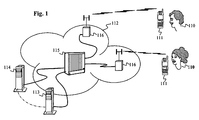
- FIG. 11 is a simplified illustration of a cellular network equipped with an audience participation controller, according to a preferred embodiment of the present invention.
- a plurality of users 110 operating a respective plurality of cellular mobile units 111, are connected via a cellular network 112 to an audience participation controller 113 and to an information server 114.
- the cellular network 1112 consists of a network switch 115 and a plurality of network of base stations 116.
- the audience participation controller 1113 and the information server 1114 are any type of network servers, preferably Internet servers or any other HTTP server. Further preferably, the audience participation controller 1113 and the information server 114 can be wireless applications protocol (WAP) servers. It is appreciated that the audience participation controller 113 and the information server 114 can be embodied within two separate servers or within a single server.
- WAP wireless applications protocol
- the information server 114 can be any number of information servers 114. It is further appreciated that the cellular mobile unit 111 is any device capable of communicating via a cellular network, such as a cellular telephone, a cellular personal digital assistant (PDA), etc.
- a cellular network such as a cellular telephone, a cellular personal digital assistant (PDA), etc.
- FIG. 12 is a simplified block diagram of a process flow that connects a cellular mobile unit to a network server according to a preferred embodiment of the present invention.
- the process of connecting a cellular mobile unit to a network server is preferably performed by the audience participation controller (element 113 of Fig. 11, not shown in Fig. 12).
- the process starts in step 17, when the cellular mobile unit (element 111 of Fig. 11, not shown in Fig. 12) calls a telephone number, preferably a cellular telephone number.
- the call to the telephone number is preferably performed by sending a short message service (SMS) message to the telephone number or by dialing the telephone number.
- SMS short message service
- the cellular switch (element 115 of Fig. 11, not shown in Fig. 12) identifies the called number and informs the audience participation controller 113. It is appreciated that the call is optionally completed to the audience participation controller 113, preferably by accepting the SMS message, or, alternatively, by answering the telephone call. Alternatively the call is not completed, but the audience participation controller 113 receives the call details, typically comprising the dialed telephone number and the caller's telephone number.
- the audience participation controller 113 retrieves a Uniform Resource Locator (URL) associated with the dialed telephone number.
- URL Uniform Resource Locator
- the URL is retrieved from a database hosted by the audience participation controller 113.
- the audience participation controller 113 sends the URL to the mobile unit 1111 that started the procedure.
- the audience participation controller 113 sends the URL to the mobile unit 111 embedded within a message of a message service, also known as wireless application protocol push (WAP push).
- WAP push wireless application protocol push
- the URL is embedded in a message of a short message service (SMS).
- SMS short message service
- the URL is embedded in an iMod email message.
- the mobile unit 111 After receiving the URL, the mobile unit 111 issues a request for content having the address defined by the URL, preferably following a user selection, but alternatively automatically.
- the audience participation controller 1113 receives the request for the URL content from the mobile unit 1111 and in step 122 the audience participation controller 1113 redirects the request according to the URL.
- the mobile unit 111 is connected directly to the server hosting the URL. Further alternatively and preferably the audience participation controller 113 hosts the URL
- FIG. 13 is a simplified block diagram of a flow of another process that connects a cellular mobile unit to a network server according to another preferred embodiment of the present invention.
- the process of Fig. 13 is similar to the process of Fig. 12 and steps that perform the same functions are enumerated by the same numerals.
- the process of Fig. 13 is preferably performed by the audience participation controller 113.
- step 19 the process continues to step 123 and creates a personalized URL, preferably by generating a unique identifier of a web page or folder and adding it to a valid address.
- the additional identifier does not necessarily point to an existing web page or folder.
- the valid address to which the additional identifier is added is the URL of the audience participation controller 113.
- the valid address to which the additional identifier is added is the URL of a valid web page or folder hosted by the audience participation controller 113 and the identifier is added as a dummy folder.
- the unique identifier is generated within a very large field of numbers. For example, by generating a random number between 1 and 2 128 .
- the unique identifier may be obtained by performing hashing on an enumerator, preferably by encrypting a user enumerator.
- step 124 the process optionally encrypts the unique part of the URL.
- encryption uses the Data Encryption Standard (DES), further preferably using triple DES.
- DES Data Encryption Standard
- encrypting is only of the unique identifier, but additional data may be encrypted as well if desired.
- the result of the encryption is preferably modified to comply with rules pertaining to URL format, for example by converting to base 64.
- step 1120 the URL is sent to the mobile unit and in step 1121 a request for the resource defined by the URL is received from the mobile unit, preferably following a manual user request.
- the audience participation controller 113 retrieves the personalized component from the URL and in step 126 the audience participation controller 1113 verifies that the user identifier is valid, preferably by decrypting the retrieved personalized component. Then, in step 127, the audience participation controller 113 identifies the user and finally, in step 1122, the audience participation controller 113 connects the mobile unit 111 to the required resource.
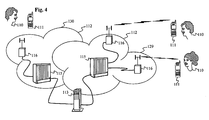
- FIG. 14 is a simplified illustration of a plurality of cellular networks served by the audience participation controller 113, according to a preferred embodiment of the present invention.
- Both cellular networks 131 are connected to the audience participation controller 1113 and preferably also to an information server 132 (not shown).
- Fig. 15 is a simplified illustration of the audience participation controller 113 connecting between a broadcasting service and a plurality of users of cellular mobile units, according to a preferred embodiment of the present invention.
- the audience participation controller 113 is connected to a plurality of cellular networks 133 and to a broadcasting service 134, preferably a television broadcasting service broadcasting television programs to television sets 135 viewed by the users 110 of mobile units 1111.
- a broadcasting service 134 preferably a television broadcasting service broadcasting television programs to television sets 135 viewed by the users 110 of mobile units 1111.
- the audience participation controller 113 enables viewers of a television program broadcast by broadcasting service 136 to participate is the television program via their mobile units.
- FIG. 16 is a simplified drawing of a synchronization procedure providing synchronization between a broadcast program and a cellular mobile unit, according to a preferred embodiment of the present invention.
- a broadcast program 137 contains several events 138 in which spectators are asked to participate.
- the spectators of the broadcast program 1137 are requested to respond to some content displayed on a display of their respective cellular mobile units 1111.
- the content presented on the display requires the user to make a selection by pressing one of the keys of the mobile unit 111.
- the mobile unit 111 then sends the user response to a server of the broadcasting service via a cellular data communication facility. It is therefore desirable that all mobile units 111 present the content at the same time.
- the purpose of the process described with reference to Fig. 16 is to synchronize between the broadcast program and the content display so that the content is displayed at the same time on all mobile units 111 in synchronization with the respective event 138.
- each event 1138 there is an interaction display 139 that contains the content to be displayed on the display of the mobile units 111 in synchronization with the respective event 1138.
- Several interaction displays 1139 are grouped together in a group of interaction displays 140.
- the audience participation controller 113 sends (step 141) the group of interaction displays 1140 to all the mobile units 111 that have previously connected to a respective server.
- the server is the audience participation controller 113.
- the users performed the connection using the procedure described with reference to Figs. 12 and 13.
- each of the interaction displays 1139 contains a time-of-display in which the mobile unit has to display the interaction displays 1139 to the user 110. This time-of-display is synchronized (142) with the respective event 1138.
- the interaction displays 1139 are grouped in several groups 140 and the audience participation controller 113 sends (step 143) successive groups 1140 to the mobile units 111
- the group of interaction displays is embodied using a deck-of-cards method of Wireless Application Protocol (WAP).
- WAP Wireless Application Protocol
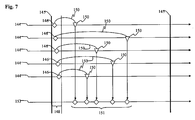
- Fig. 17 is a simplified diagram of a procedure for spreading user responses over time to avoid congestion, according to a preferred embodiment of the present invention.
- Fig. 17 shows several timelines 144 for respective mobile units 111.
- the mobile units 111 display content to which the users 1110 provide user responses 146. These user responses initiate transmissions bearing the respective user responses. These transmissions are sent by the mobile units 111 to a server, preferably the audience participation controller 113. It is appreciated that at least some of the user responses 1146 occur within a short time period 147. Thus, it is necessary to spread the transmissions in time to avoid congestion over the cellular network. Such congestion may cause unknown delays between the time the user provided the response and the time the transmission bearing the response is received by the server or even the loss of some of the transmissions.
- every mobile unit is assigned a time-delay 148 to create a delay between the time the user provides the response to the mobile unit 1111 and the time the mobile unit 111 sends the transmission 1149. Therefore the transmissions 1149 are spread over a time period 150 that is longer than time period 1147, thus avoiding congestion.
- the delay 1149 is known to the server, preferably the audience participation controller 113, that computes the time in which the user provided the user response by subtracting the delay 1149 from the time of reception 151, as shown on the server timeline 152. It is appreciated that the longest delay 1148 should not cause a transmission 1149 past the next time 1145 when the mobile units 111 display content to which the users 110 provide user responses.
- the audience participation controller 1113 maintains such a procedure for spreading user responses over time for each of the cellular networks 1112.
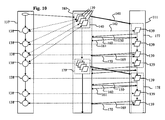
- Fig. 18 is a simplified diagram of a latency measuring process according to a preferred embodiment of the present invention.
- Fig. 18 shows a timeline 153 of a mobile unit 111 and a timeline 154 of a server, preferably the audience participation controller 113.
- the mobile unit 111 sends, at time 155, a transmission, such as transmission 1149 of Fig. 17, bearing a user-response. Due to latency 156, typically caused by the cellular network 112 of Figs. 11, 14 and 15, the transmission is received by the server at time 157. Shortly after time 1155, the server sends to the mobile unit 111 a request-for-automatic-response 158. The mobile unit 111 responds immediately with an automatic-response 159. The server then measures the round-trip-time 160.
- the server subtracts a part of the round-trip-time 1160 from the time-of-reception 1155 to obtain the time of user-response 1154.
- the part of the round-trip-time to be subtracted from the time-of-reception is predetermined, preferably according to statistical measurements.
- the request-for-automatic-response 161 is performed by the server sending an HTTP code such as Status Code 302 to the mobile unit 1111.
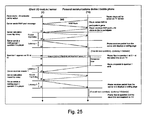
- Fig. 19 is a simplified drawing of a disconnection avoidance process according to a preferred embodiment of the present invention.
- the mobile device disconnects a session with a mobile unit 111 if there is no traffic with the mobile unit 111 within a time-out period 162.
- a mobile unit 111 is used to provide interaction with a broadcast program, preferably as described with reference to Fig. 16, it is possible that the broadcast program requires interaction after a period of time 163, which is longer than the time-out period 164.
- the purpose of the disconnection avoidance procedure is to initiate automatic traffic from the mobile unit 111, preferably to the audience participation controller 113, at a rate that eliminates such premature disconnection.
- the audience participation controller 113 sends (165) a group 1140 of interaction displays 1139, such as described with reference to Fig. 16. At least some, preferably all the interaction displays 1139 contain wireless application protocol (WAP) Markup Language (WML) procedure (WML page).
- WAP wireless application protocol
- WML Markup Language
- a request for a WML script (WMLS) is preferably embedded within each WML page. Therefore, when the mobile unit 111 invokes such an interaction display 1139 and processes the WML page, the mobile unit 111 sends (166) the request for WMLS to the audience participation controller 113, that sends back (167) a short and simple WMLS that preserves the visual display on the mobile unit 111.
- the interaction displays 1139 are set to be invoked, and create traffic, at a rate that eliminates premature disconnection of the session.
- the server preferably the audience participation controller 113, is operative to execute any combination of the processes described with reference to Figs. 16, 17, 18 and 19 to enable viewers of broadcast television programs to participate in the program by using their mobile units, to synchronize between the display on the mobile units and events presented via the television set, to obtain the correct time in which the user 110 provided a user-response to the mobile unit 1111, and to eliminate premature disconnection of the session with the mobile unit.
- FIG. 20 is a simplified diagram of a process combining the processes of Figs 16, 18 and 19 according to a preferred embodiment of the present invention. Elements of Fig. 20 are referenced by the same numbers used in Figs 16, 18 and 19.
- the audience participation controller 113 when the audience participation controller 113 has to determine a preference between users 110 based on user responsiveness, namely the time elapse between a request for a user response is provided to the user and the time the user provided a user-response, the audience participation controller 113 preferably averages the values of responsiveness for each user and compares the averages.
- the audience participation system of the present embodiments is designed to take audience participation into a new dimension, enabling the producers of broadcast programmes - and particularly live programmes - not only to stimulate general interaction with a broadcast audience as a whole, but also simultaneously to initiate and manage specific interactions with those individuals and groups in the audience who are actively participating.
- the broadcaster is preferably provided with an audience participation controller.
- the broadcaster initiates audience participation in the traditional way, by broadcasting an invitation to the audience to respond on a selected topic.
- the audience is invited to respond individually, each using their own personal communications device - which, in the preferred implementation of the invention is a mobile internet MI enabled mobile phone.
- MI phones are capable of having MI pages transferred to them from MI sites.
- MI sites are installed on personal communications gateways, which, in the preferred implementation of the invention, are MI gateways.
- Personal communications gateways are embedded in the public mobile phone communications networks.
- MI pages enable those programming them to create and transfer interactive, multimedia presentations onto the screens of MI phones, via MI gateways.
- MI pages can be navigated and interactively modified by the person using the data entry keypad of the MI phone, and the response parameters relating to the page can be transferred back to the MI gateway.
- This interactivity is achieved in a similar manner to which a person using a QWERTY keyboard on a personal computer can navigate and respond to an interactive web page received from an internet website, and send the response parameters back to the website via the internet.
- WAP wireless application protocol
- the controller rapidly and automatically captures the audience response data from the personal communications devices.
- the data processing system rapidly and automatically aggregates, analyses and processes this response data into results and production management information.
- Use of such a controller offers audience-participation capabilities which will be explained later in this document.
- the processed results, management information and new audience-participation features are controllable by and accessible to the production team in the production studio in various electronic forms via the interfaces of the present embodiment. Processing delays within the present embodiment are constantly minimised to the extent that both the production team and the audience perceive that the present embodiment produces results, management information and new audience participation features in real time.
- the present embodiment preferably saves all available information relating to all the respondents and their responses in an associated database.
- the production team uses the processed results as a live audio-visual programme source for instantaneous mixing with other programme sources, such as camera and microphone outputs, within the programme chain. In this way, rapidly processed results and other audience participation features are fed back to the audience as an integral part of the programme.
- the production team can instruct the controller to feed back to each individual respondent's personal communications device, a set of individual messages tailored specifically for each individual respondent.
- Such messages may include, but are not limited to showing the individual's own personal results and ranking in a nationally broadcast competition, while the processed results broadcast to the audience via their broadcast receivers might only list the top 10 rankings.
- the production team can rapidly search the controller's databases for particular individual or group profiles within the mass of data received from respondents, in order to identify and select the most ideal individuals and groups as prospective audience-participants. When these selections have been made, the production team can instruct the controller to send messages to the personal communications devices of targeted individuals and groups in the form of personalised invitations to participate in the programme.
- the production team can use the controller in stand-alone mode to send any other messages they consider appropriate; either to the individuals or groups specially selected during programmes, or to any other individuals or groups that may be profiled and identified at any time within the database of the controller.
- the production team can use the controller to further develop innovative audience-participation events - preferably independently of the original broadcast medium - using the audience's network of personal communications devices as the exclusive, stand-alone MI-cast & audience-interaction medium for staging these events.
- innovative audience-participation events - preferably independently of the original broadcast medium - using the audience's network of personal communications devices as the exclusive, stand-alone MI-cast & audience-interaction medium for staging these events.
- Such new ideas may be applied to any entertainment, marketing or gambling application that the production team may choose to create.
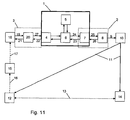
- Figs 11 and 12 provide schematic representations of the controller of the present embodiment; and various physical, logical and electronic boundaries and exchanges between the controller and neighboring systems which the controller may connect to or interact with.
- FIG. 11 shows the controller 1 connecting with and interacting with, on the one hand, the programme production facilities 8 commonly found in a broadcast programme production studio 2 and, on the other hand, with the public communications networks 3.
- Controller 1 is the audience participation controller.
- the controller is a computer system and the elements described within element 1 represent the logical components of the controller 1, namely the clients I/O module 4, the database 5, and the business logic module 6. Each of these are described in greater detail hereinbelow. These elements communicate with each other bi-directionally in the usual way.
- Controller 1 also includes a specialised programme production interface 7 also described in greater detail hereinbelow.
- Block 2 represents the physical boundaries of a broadcast programme production studio.
- the production interface 7 of the controller 1 is located in the production studio 2 and can be located remotely from the rest of the controller 6 5 4 if desired.
- the production interface 7 communicates on a bi-directional basis with the rest of the controller 6 5 4 via the bi-directional electronic links 23 24.
- Broadcast programme production facilities 8 are those commonly found in a production studio 2.
- the production interface 7 communicates on a bi-directional basis with the other production facilities 8 via the electronic links 25 26.
- Fig. 12 expands the contents of5the box representing the production studio 2 and explains the elements therein in more detail.
- Electronic link 25 in Fig. 11 represents a group of links which are expanded in Fig. 12 into 25A 25B and 25C.
- Link 25A is the API Application Program Interface connection of the production interface 7 through which messages are transferred to target API devices 8.2.
- API devices are designed to interpret data sets in predetermined formats which are then transformed by the API device into appropriate audio-visual formats suitable for output to a broadcast control console 8.6.
- the target API device 8.2 is typically a TV graphics generator of the type commonly found in a TV production studio, a typical example being an Aston caption generator.
- Link 25B is the broadcast-ready output of the production interface 7 through which appropriate audio-visual signals are transferred to the main programme control console 8.6.
- the control console 8.6 is typically a video switcher or mixer of the type commonly found in a production studio 2.
- the audio-visual signals are typically transferred in PAL, NTSC, SECAM and / or analogue audio format, or digital equivalents
- Link 25C is the system management output of the programme production interface 7 which transfers messages to the system management computer 8.1, typically a general purpose computer.
- 26 is a link which transfers messages from the system management computer 8.1 to the programme production interface 7.
- Other programme sources controlled in the production studio 2 may include, but need not be limited to remote broadcast sources such as a camera feeds and / or microphones 8.4 and local broadcast sources such as a playback machines 8.5, which might be tape-recorders or disc players.
- the main programme output 9 from the production studio 2 is sent to the broadcast transmitter or distribution centre 10, for broadcast via the chosen broadcast medium 11.
- the broadcast medium 11 is typically terrestrial TV transmission.
- the broadcast programme 9 is transmitted in this way to an array of individual broadcast receivers 12, 13 & 14.
- these broadcast receivers are typically TV sets.
- the personal communications devices 18 are typically MI phones.
- Block 16 represents the programme on the broadcast receiver 12 being watched or listened to by the audience 15.
- Block 17 represents the physical operations, typically the operation of alphanumeric & navigational arrow keys, made by the audience 15 on the data entry keypad of their personal communications devices 18.
- Block 3 represents the public communications networks, typically mobile phone networks, which carry messages between the audience's personal communications devices 18 and the controller 1.
- the public communications networks 3 contain personal communications gateways 20. In the preferred implementation of the present embodiment, these gateways are typically MI gateways.
- Each personal communications gateway 20 has one set of bi-directional links 19 21 between the communications gateway 20 and each of the audience's personal communications devices 18 and another set of bi-directional links 22 27 between the communications gateway 20 and the clients I/O module 4 of the controller 1.
- the core of the controller is based on well established client-server computer technology which is commonly available.
- the server function of the overall system is performed by the clients I/O module 4, database module 5 and business logic module 6 components of the controller 1.
- the client functions of the overall system are performed by the array of personal communications devices 18 used by individual members of the audience 15 who decide to participate in and respond to the interactive broadcast.
- personal communications device and “client” are synonymous, and the terms “clients I/O module” and “server” are synonymous.
- the clients I/O module / server 4 and database module 5 components of the controller 1 are controlled by the programs installed in the business logic module 6.
- the business logic module 6 also controls the programme production interface 7 of the controller 1.
- the specialised program logic embedded in the business logic module 6, combined with the specialised operational control and electronic interfacing & connection facilities available on the programme production interface 7 provides the programme production team with a production tool for stimulating, managing and controlling audience interaction within the broadcast programme production process.
- the programme production interface 7 provides the production team with many audience-participation capabilities and features, as will be explained in greater detail below.
- controller 1 Rather than focus exclusively on the functionality of the controller 1 itself, the overall production process will be described, so that the functionality of the controller 1 may be more easily appreciated within the context of the workflow involved in producing an audience-participation programme.
- pre-broadcast preparation involves the creation of a series of audio-visual cues to be broadcast to the audience.
- These cues offer specific invitations to the audience, encouraging them and instructing them how to respond to each possible stage of the interactive programme that can reasonably be envisaged in advance.
- These invitations are designed to be broadcast to the audience as a whole in the usual manner, and are prepared by production staff in the usual way, using the production facilities 8 commonly found in a broadcast production studio 2.
- a series of interactive question pages - which, in context with the preferred implementation of the controller 1, is a series of MI pages - is created to match the series of broadcast invitations described above.
- These question pages are designed by production staff using the systems management computer 8.1 in conjunction with appropriate computer applications running on the business logic module 6 of the controller 1 via link 26, the programme production interface 7 and link 23.
- the programme being broadcast may involve a multiple choice quiz.
- the first invitation broadcast to the audience's broadcast receivers 12 13 14 might say "Choose A, B, C or D".
- the first question page to be transferred onto the audience's personal communications devices / clients 18 would therefore enable the respondent to select A, B, C or D, and send a response.
- the second invitation might say "Choose E, F, G or H", and the second question page would therefore enable the respondent to select E, F, G or H, and send a response. And so on.
- the programme goes on-air.
- the production team feeds the first invitation through the control console 8.6, to be broadcast to the audience 15 via the transmit and receive chain 9 10 11 12 13 14.
- the production team makes the matching question page available on the clients I/O module / server 4 to any participating personal communications device / client 18 which makes the appropriate request of the clients I/O module / server 4 via the personal communications network 3 19 20 27.
- the production team makes the matching question pages available in this manner by using the general purpose computer 8.1 in fig. 11 to make the appropriate command via 26 7 23.
- it is necessary to manage this process in the manner described. This is because current industry-standard MI protocols which govern the operational features of MI client / server relationships do not allow the server 4 to unilaterally transfer data to target clients 18. Data may only be transferred to a client 4 if the client 4 requests the server 4 to do so.
- the first invitation at the beginning of each programme is unique. It presents the prime opportunity for the production team to persuade viewers and listeners in the audience to participate in the programme. Many of the audience may never have responded before, and any details will not be recorded on the database 5. Therefore, the first invitation would typically be a generic announcement which describes in explicit detail how prospective respondents 15 can use their personal communications devices / clients 18 to request the first, matching question page.
- the first question page is also unique. Typically it would present a generic welcome message to the new respondent, and conduct a set of tests which would not only confirm to the respondent 15 and the controller 1 that the system is working properly, but would also give the controller 1 an opportunity to check, for example, which type of personal communications device / client 18 is being used, and to calculate what time delays each device may be encountering in transferring messages across the public communications network 3.
- a generic welcome message to the new respondent, and conduct a set of tests which would not only confirm to the respondent 15 and the controller 1 that the system is working properly, but would also give the controller 1 an opportunity to check, for example, which type of personal communications device / client 18 is being used, and to calculate what time delays each device may be encountering in transferring messages across the public communications network 3.
- a more detailed description of key logical processes and transactions is given below.
- the respondent follows the instructions being broadcast and operates 17 his/her own personal communications device / client 18 to dial up special phone numbers and / or request 19 the clients I/O module / server 4 via the personal communications gateway 20 embedded in the public communications network 35to transfer 21 the question page matching the invitation onto the respondent's personal communications device /client 18.
- the user simply dials a preset number.
- the preset number triggers a text message to be sent to the user.
- the text message has a URL embedded therein and when the text message appears on the user's screen, the user can select the URL in order to trigger a request to download the necessary content.
- the respondent 15 then views the choices displayed on the screen of the personal communications device / client 18. By operating 17 the data-entry controls on the personal communications device / client 18, and navigating the question page, the respondent 15 makes the appropriate selections and ultimately activates the send command in order to transfer 19 27 the completed response back to the clients I/O module / server of the controller 1 via the personal communications gateway 20.
- the controller 1 may receive extremely high volumes of response data from respondents 15 via the public communications networks 3.
- the components of the controller 1 are designed to be scalable in order to cope with wide variations in demand, in proportion to the anticipated popularity of any particular interactive programme. The issue of scalability is discussed in greater detail elsewhere herein. Equipped with appropriate bandwidth, storage capacity and processing power, the business logic 6 of the present embodiment can receive, analyse, and process response data from the audience 15 and produce processed results, management information and other audience-participation features in what is perceived by the production team and the audience as "real-time". A more detailed description of key logical processes and transactions is given hereinbelow.
- the production team can use the systems management computer 8.1 of Fig 12 to continuously request processed information from the controller 1 for display on the systems management computer 8.1 in the production studio 2.
- These capabilities enable the production team to make critical production decisions in real-time as the programme develops, as described in greater detail below.
- Systems management information may include, but is not limited to alphanumeric and graphical displays showing absolute numbers of audience respondents 15 at that point in time; absolute numbers and percentages of types of response at that point in time, typically aggregated votes or choices from multiple choice, or breakdowns of most popular selections from free text entries; together with tables and graphs showing the time and volume profiles of the response data traffic at that point in time.
- controller 1 In response to further requests initiated from the general purpose computer 8.1, controller 1 sends to the production interface 7 a wide variety of processed results in a wide variety of broadcastable formats. This enables the production team to select the processed results they want, and immediately put them on-air. Consequently, the audience watching the broadcast can see and hear the results developing in real-time as responses come in. This is a very powerful feature in context with the stimulation of audience interactivity.
- the production team may devise completely new styles of audience participation.
- individual respondents 15 may be sent continuous and detailed analyses of their own performance - such as running totals, average response times, and graphical representations of overall ranking & ranking trends - while the overall audience rankings appearing on the main broadcast might be limited to the top 10 or so contestants, as discussed in greater detail hereinbelow.
- Processed results for input to the API device 8.2 may be configured in a variety of data, alphanumeric and graphical formats on link 25A depending on the specific data format of the target API device 8.2.
- the target API device is a TV graphics generator 8.2 of a type commonly found in the production studio 2, such as an Aston character generator.
- the graphics generator 8.2 is then operated in the normal way, enabling graphical representations 8.3 of the processed results to be input to the control console 8.6. In this way, processed results in appropriate audio-visual form can be mixed into or superimposed onto the main broadcast programme output 9 and fed back to the audience in real-time.
- an additional set of processed results presented in a variety of broacast-ready audio-visual formats may be generated by the controller 1.
- these results may be configured on link 25B in PAL, NTSC, SECAM and / or analogue audio formats, or digital equivalents, appropriate for direct input to the control console 8.6.
- processed results in appropriate audio-visual form can be mixed into or superimposed onto the main broadcast programme output 9 and fed back to the audience in real-time.
- the controller 1 may be flexibly programmed to meet the individual needs of different programme production teams with regard to the data sets and formats required for generating production management information, API data sets, broadcast-ready audio-visual elements and other advanced audience-participation features.
- responses sent to the controller 1 via links 19 and 27 may be received from different respondents 15 via a number of different public communications networks 3. Because network performance can vary between different networks operated by different operators, there can be significant differences in how quickly a response gets to the clients I/O module / server 4 of the controller 1 from one respondent's personal communications device / client 18 as compared with another 18.
- the present embodiment has been refined to create a level playing field for participants of audience-participation programmes involving such time-critical formats.
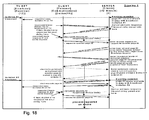
- the controller 1 receives each response, it instantly sends an automatically generated time-proving message back to the personal communications device / client 18 from which the original response message came, and logs the time of despatch of this message.
- This time-proving message includes the necessary protocols and commands required to instruct the personal communications device / client 18 to immediately send a time-proving return message back to the controller 1 which also logs the time that each individual time-proving return message is received. Suitable protocols are discussed in greater detail below.
- the controller 1 calculates and maintains an individual network delay parameter for each respondent. This parameter is stored on the database 5, constantly updated following each new response, and used to produce adjusted response times for each individual response before calculating processed results.
- the present embodiment's level-playing-field feature provides a means of equalising all respondents' time-performances on a fair basis before processing and producing rankings and results.
- time-delays may be encountered across the broadcast network 9 10 11, as well as across the public communications networks. If a production company is using a number of different broadcast network paths in order to broadcast to different segments of the audience 15, then different segments of the audience 15 may receive the broadcast at different times, according to the different time-delays inherent in the different broadcast network paths. Consequently, depending on how critical the overall time-accuracy is in relation to a particular audience-participation broadcast, it may be necessary for the production team to ensure that appropriate time-delays are introduced at various points in the broadcast distribution system, in order to ensure that the entire audience 15 receives the broadcast 11 at exactly the same time.
- audience-participation formats require that when each successive, pre-programmed invitation is selected and broadcast to the audience 11 12 13 14, each successive matching question page should be transferred on request 22 20 21 in-step, onto each requesting personal communications device / client 18 ready for respondents 15 to view the screens on their personal communications devices / clients 18, make decisions and generate immediate responses 17 19 27.
- the controller 1 has been further refined so that once the respondents 15 have logged on to the controller 1, the production team has the means to keep successive question pages displayed on requesting personal communications devices / clients 18 in-step with the matching broadcast invitations without any further operational intervention 7 by the respondents 15.
- the in-step feature is implemented as follows
- the production team may select any of the pre-programmed invitations or audio-visual cues to be broadcast from the batch that was prepared before the broadcast started. These are prepared, ready for broadcast in the normal way in context with the facilities 8 available in the studio 2.
- the production team uses the systems management computer 8.1 in Fig. 12 to select the matching question page from the batch of pre-programmed possibilities that were transferred to the controller 1 before the broadcast.
- the business logic module 6 sends a message via the clients I/O module / server 4 to each personal communications device / client 18 instructing it to go into a holding pattern until the next question page becomes available. This technique involves redirecting personal communications devices / clients 18 to the results page, which has a number of holding features.
- phase 1 of the holding pattern when personal communications devices / clients 18 request the results page, they are instructed to make further requests of the results page after a defined period of time. This keeps all personal communications devices / clients 18 rotating around the results page while the production team decide when to advance to the next question.
- the production team initiates a countdown using the systems management computer 8.1.
- the holding pattern switches into phase 2.
- the results page instructs each personal communications device / client 18 to redirect, and request the next question page from its proper location at the time when the countdown is scheduled to reach zero.
- the simultaneous switching on-air of the invitation at the same point in time that the matching question page is made available to all requesting personal communications devices / clients 18 may be executed manually by production staff monitoring the countdown, through independent but simultaneous operation of the control console 8.6 and the systems management computer 8.1.
- the business logic module 6 may be preprogrammed by production staff via the systems management computer 8.1 to perform this simultaneous operation when the countdown reaches zero via links 25A and / or 25B [broadcast invitation] and 22 21 [question page transfer].
- controller 1 may be programmed to send additional automatic switching and mixing protocols from the production interface 7 to the control console 8.6 via link 25B in order to provide the production team with more operational flexibility.
- the controller 1 provides the production team with all the capabilities to ensure that all the creative elements of a wide variety of audience-participation programmes can be kept in-step within the framework of a flexible and spontaneous production process.
- All responses are stored on the database 5 along with data profiles relating to all respondents 15, including, but not limited to the topics that each individual has responded to, and the level of interest or involvement in each topic. Relative levels of interest or involvement may be deduced from the level of knowledge, skill or response time achieved by each respondent 15 during the course of a programme. It is possible for the production team to use this information on-air in a variety of ways. For example, the production team can use the systems management computer 8.1 to interrogate the database 5 in order to select suitable individuals and groups to act as featured participants in an interactive programme, and to send personalised messages to selected prospects automatically from the controller 1.
- the controller 1 can also be used off-air as a stand-alone entertainment, marketing and gambling platform. Messages of all kinds can be sent at any time from the controller 1 to all previous respondents 15 who have participated in all previous programmes. Such messages may be presented in the form of invitations to participate in all kinds of stand-alone activities. In addition, because the database 5 holds all data relating to all respondents, it is possible for the controller 11 to personalise each message that is sent out.
- the controller 1 is also designed to initiate and host stand-alone audience-participation events using the network of personal communications devices 18 as the exclusive, stand-alone MI-cast medium for staging these events. Consequently, the production company operating the controller 1 can use it to create all manner of stand-alone entertainment, marketing and gambling spin-offs from the initial audience-participation broadcast programme formats.
- Any audience-participation activity can be set up and managed involving any set or sub-set of respondents 15 logged on the database 5.
- the controller 1 can also be configured to transfer messages encouraging respondents 15 to set up their own virtual groups or communities on the database 5 for the purposes of competing directly against their friends, families or peer groups; or for forming teams drawn from these groups to compete against others.
- the controller 1 can also be configured to allow respondents 15 to use their own personal communications devices / clients 18 in combination with the multi-media messaging power and features contained in the controller 1 in order to invite friends and colleagues to participate in such communities of interest, and also to manage community affairs using the facilities offered by the controller 1.
- Such features may include, but are not limited to, group contact lists, group diaries of events, group bulletin boards, group rankings, nicknames of individuals within groups, group log-on status and group messages, including specifically designed multi-media welcome messages.
- the individuals within these communities of interest can interact with each other within the group, or groups can interact with other groups, either completely independently in a stand-alone context, or in-step with an on-air interactive broadcast.
- stand-alone audience-participation activities can be extended into the field of pure marketing. Independent market surveys can be initiated from the present embodiment, and a wide variety of marketing spin-offs can be created, including but not limited to wild cards, bonuses, introductory offers, sponsored interactive events, promotional messages, electronic discounts & coupons and any other inducements to participate in either in-step or stand-alone entertainment, marketing or gambling activities involving audience-participation. All stand-alone activities can be linked back into any current or future in-step productions.
- a further aspect of the present embodiments in relation to both in-step and stand-alone activities is the capability to display a personalised call-to-action message onto the personal communications device / client 18 of each respondent 15 logged on the database 5.
- the controller 1 displays the call to action by transferring 22 20 21 a call-so-action page onto to each respondent's personal communications device / client 18.
- this capability is achieved by invoking the WAP-push protocol on a WAP gateway 20 embedded in the public communications network 3.
- the call-to-action feature is useful in notifiying regular participants that an audience-participation broadcast is about to take place. It automatically sends a personalised message in advance to each regular participant profiled on the database 5, and, at the appropriate time, instructs each regular participant's personal communications device / client 18 to request that the appropriate question page be transferred onto the device / client 18.
- the call-to-action feature can be linked to, and automatically triggered from an electronic programme guide EPG.
- the call-to-action feature is also useful in context with the stand-alone activities previously described.
- Personalised call-to-action promotions and reminders for off-air audience-participation events can be initiated by the production team and automatically sent out by the controller 1 to all respondents 15 whose details are recorded on the database 5.
- personalised call-to-action promotions and reminders can also be initiated by individuals and groups for dispatch to any other individuals, friends, families or groups in order to publicise and manage any audience-participation activities that these individuals and groups may wish to organize, either within groups, or between groups.
- controller 1 as described herein is only one of a number of possible ways of implementing the controller 1.
- controller 1 has great potential to transform radio, or audio-only broadcasts into audio-visual and multimedia audience-participation experiences.
- the present embodiment will continue to offer full functionality and capabilities regardless of any technological advances relating to the broadcast 8 9 10 11 12 13 14 and / or public communications network systems 3 with which it is required to be connected to or interact with.
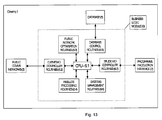
- FIG. 13 is a simplified diagram illustrating the software components involved with controller 1.
- Database 5 is managed by database control routines 6.5 within business logic module 6.
- Business logic module 6 will be discussed in greater detail below but includes database control routines 6.55as mentioned, public network optimization routines 6.3, client I/O controller routines 6.2, results processing routines 6.4, systems management routines 6.6 and studio controller routines 6.7.
- the studio controller routines interface with programme production interface 7 and the clients controller routines 6.2 interface with public communications networks 3.
- the Business Logic Module 6 is a suite of computer programs which controls all functions of the Audience Participation Controller 1.
- One possible implementation of the software architecture of the Business Logic Module 6 is described with respect to Fig. 11 above, and is shown within the boundaries of the dotted-line box 6. Other different implementations are equally possible.
- the highest system priority is put on ensuring that all new respondents 15 are logged on properly, and that all systems are functioning properly.
- These processes are initiated within the systems management routines 6.6.
- the first invitation is broadcast to the broadcast receivers 12 13 14.
- This first invitation is important in relation to the capture of data from first-time respondents, as their details will not yet be logged on the database 5.
- the first invitation therefore gives explicit instructions, so that respondents can operate their personal communications devices / clients 18 in order to dial up, log on to the controller 1 and make the appropriate request of the clients I/O module / server 4 for transfer of the welcome page onto the personal communications device / client 18.
- the highest priority for the systems management routines 6.6 is to call relevant programs within the suite of database control routines 6.5 in order to compare the data contained in each log-on received by the client's I/O controller routines 6.2 with the data already stored on the database 5, and to create new records in the database 5 for new respondents 15.
- Data stored in this way includes, but may not be limited to, the calling line ID caller's phone number and IP address of the personal communications device 18, as well as the IP address of the personal communications gateway 20 through which the respondent's message is routed.
- This data is not only used to identify each respondent 15, but it is also of use to subsidiary respondent-management routines which may, for example, perform such activities as fraud-detection, anti-hacking, bad-credit and troublesome respondent barring.
- the next task for the systems management routines 6.6 is to invoke the public network optimisation routines 6.3. These routines check the latency of the public communications networks as described in greater detail hereinbelow. They periodically check the delays being experienced by each respondent's personal communications device / server 18, and create, store and maintain a network delay parameter for each respondent 15. In this way a level-playing-field is created and maintained for all time-critical audience-participation formats.
- the audience-participation event proper may be initiated.
- the priority at this stage may be to ensure that invitations are broadcast at the same time that matching question pages are made available for transfer and display on the screens of the respondents' 15 personal communications devices / clients 18.
- 15 the production staff in the studio 2 must key in the appropriate command to the systems management computer 8.1.
- the systems management routines 6.6 receive this command via the programme production interface 7. This triggers the systems management routines 6.6 to invoke the in-step logic feature described in greater detail below which makes available the matching question page to be transferred from the clients I/O module 4 to each requesting personal communications device 18, thus ensuring that all respondents see the question page on their personal communications devices / clients 18 at the same time that the matching invitation is broadcast to receivers 12 13 14.
- the response handling stage of the process may cause a very large burst of data across the public communications networks 3, as responses come in.
- this constraint could be the cause of a response bottleneck, and response data could be delayed, or lost.
- a data load-spreading feature is invoked by the network optimisation routines.
- the feature is described in greater detail hereinbelow.
- the network optimisation routines By using the personal communications gateway routing information received with each completed response, the network optimisation routines know how many respondents are logged on to each mobile internet gateway 20. When question pages are pushed out to the respondents' 15 personal communications devices / clients 18 the network optimisation routines embed an individual response timeout parameter into each question page. These messages instruct each individual personal communications device / client 18 to wait for a defined period before sending a completed response. By staggering the response timeout delays over an appropriate period of time, the responses do not all happen in a simultaneous burst, but are spread in a much more manageable time-sequence, allowing a personal communications gateway 20 of limited capacity to deal with much more response data than if it all arrived in time with the actual responses made by respondents.
- the respondent 15 clicks the send command, the screen immediately acknowledges that the completed response has been sent. This message is pre-programmed for local execution within the personal communications device / client 18. Although the response timeout parameter delays the dispatch of the completed response page from the personal communications device / client 18, the actual elapsed time between the time that the device / client 18 received the question page, and the time that the respondent 15 operated the send command is embedded in the response message. Therefore, the respondent 15 is not disadvantaged in any way.
- the systems management routines 6.6 ensure that in addition to running the clients I/O controller 6.2 routines, all the necessary public network optimisation 6.3, results processing 6.4, database control 6.5 and studio I/O controller routines 6.7 are run concurrently, in order to continuously receive, store and process completed responses; and transfer processed results according to the wishes of the production staff.
- results may be requested in a variety of alphanumeric and graphical forms by the production staff in the studio 2 for a variety of uses.
- Production staff may use the systems management computer 8.1 of Fig. 12 to request the systems management routines 6.6 via the programme production interface 7 to transfer processed results to the systems management computer 8.1, the API output of the programme production interface 25A and / or the broadcast-ready output of the programme production interface 25B.
- the production staff may wish to monitor how the processed results are developing on-air, using the various facilities available on the systems management computer 8.1 before mixing or switching any processed results onto the broadcast output 9.
- the production staff might request the business logic module 6 to transfer graphs to the systems management computer 8.1 showing the distribution of responses received during the initial period, so that the director can decide, for example, when the bulk of responses have been received.
- Fig. 14 is a simplified chart of responses per unit time when responses are unmoderated. The chart shows that after 6 seconds, the responses per second reach their peak - at around 250 thousand responses per second.
- Fig. 15 is the cumulative analog of Fig. 14 and shows cumulative numbers of users who have responded by a given time.
- Fig. 15 shows that by the time the responses per second reach their peak after 6 seconds, around 60% of audience-participants logged on have responded.
- the graphs corresponding to Figs 14 and 15 develop dynamically as the results come in, giving the director immediate feedback.
- the director faced with such data, may decide that, with 60% of the logged-on audience responding within 6 seconds, he / she will not wait any longer for stragglers, and will move on to the next invitation / question.
- the director might decide to request the business logic module 6 to transfer to the API output 25A or the broadcast-ready output 25B a bar-chart relating to the current processed result.
- a bar chart is illustrated in Fig. 16, which shows the total number of results received after a given time and their distribution as separate bars.
- Fig. 16 is a snapshot of the state of play after 7 seconds, and all the charts would continue to develop as more responses come in.
- the director would know by looking at the "Cumulative % Responses" curve Fig. 15 on the screen of the systems management computer 8.1, that 7 seconds after broadcasting the relevant invitation, there remained 30% of audience-participants logged on who had not yet voted.
- the production decision might be to request the presenter to encourage the remaining voters to cast their votes - and the audience-participants would see Fig. 16 change dynamically on their TV screens as the remaining votes were cast.
- Processed results are not limited to data received in response to individual invitations / questions. It is equally possible for the production staff to request a number of aggregations and running totals, for example:
- controller 1 While the controller 1 is transferring processed results to the studio 2 for systems management reference and on-air display, it can also communicate on a bi-directional basis with the respondents 15 in a live audience-participation event.
- a very useful feature is the ability to send messages to all respondents 15 immediately after they have submitted a response. In the case of a quiz or game show, such messages keep contestants informed of whether the answer they just submitted was correct or not. As the controller 1 keeps tally of all scores, it is also possible to keep each contestant informed of their overall progress in a multi-question quiz by sending their individual cumulative total of correct answers so far, along with the result of the last question.
- the production team will only be able to feed back to the broadcast receivers 12 13 14 a very limited set of ranking information - i.e. top 10 rankings or so. Consequently, the feedback of processed results and rankings on a personalised basis to individuals and groups via their personal communications devices 18 greatly enriches the audience-participation experience.
- a particular feature of the controller is the ability to interrogate and search the database 5 while the controller 1 is being used to manage an audience-participation event, such as a live broadcast programme or live stand-alone event.
- the director may wish to identify a sample cross-section of individuals in order to canvas their individual points of view on-air, either via on-air text messaging, or on-air phone conversation.
- the production team could, simultaneously, search the current responses, and request a list of potential interviewees.
- the search criteria could include the latest data from the poll underway, sorting respondents 15 by the way they voted, here three choices are shown, and their geographical area assuming location based services are feasible.
- any of the respondents 15 has taken part in previous stand-alone marketing activities which have been carried out by the production team, it would be possible to further narrow the searches according to age, sex, occupation, and any other parameter which has been gathered onto the database 5 through previous market surveys.
- the same techniques may be applied to any number of entertainment-oriented audience-participation activities - either in-step with a broadcast, or stand-alone.
- controller 1 is fundamentally a computer system, it may be easily and flexibly programmed in response to the specific requirements of creative production teams involved in the development of new audience-participation formats & events.
- controller 1 When the controller 1 is being used in-step concurrently with a broadcast programme, a great deal of processing power is devoted to ensuring the required performance relating to the in-step processes described above. When the system is not in-step running concurrently with a broadcast programme a great deal of data and processing power is available to the production team for other uses.
- the production team may use the respondents' database 5 to send messages of any description to any respondent 15 or group of respondents on the database 5.
- Independent market surveys can be initiated from the controller 1, and when the marketing data collected as a result is added to the basic data already stored on the database, the controller 1 is transformed into a powerful marketing tool.
- a wide variety of marketing spin-offs may be created, including but not limited to wild cards, bonuses, introductory offers, sponsored interactive events, promotional messages, electronic discounts & coupons and any other inducements to participate in either in-step or stand-alone interactive entertainment, marketing or gambling activities. All of these off-air activities can be linked back into any current or future in-step productions.
- the programme production interface 7 is a computer processor with appropriate interfacing hardware and software which is usually located in the production studio 2. It is the means by which information is transferred between the business logic module 6 and the production studio 2.
- Bi-directional connections 23 24 are represented as logical connections in Fig. 11. They may be any appropriate standard computer connection such as RS 232, SCSI, Ethernet, etc.... These connections are the means by which data is passed between the programme production interface 7 and the business logic module 6.
- the programme production interface 7 is provided with appropriate processing facilities to transfer data from the business logic module via connection 24, and transform this data into the appropriate format for any or all of the target devices connected to 25A 25B 25C; and also to transfer data from the systems management computer via connection 26, and transform this data into the appropriate format for transfer to the business logic module 6 via connection 23
- Link 25A is the API connection.
- the interfacing specification of this connection, and the data protocols transmitted on it are preferably decided by the API specification of the target API device 8.2 to which it is connected.
- Link 25B is the broadcast-ready connection.
- the interfacing specification of this connection, and the electronic signals transmitted on it are preferably decided by the connection specification of the target broadcast control console 8.6 to which it is connected.
- Links 25C and 26 are the bi-directional connections between the systems management computer 8.1 and the programme production interface 7. These are represented as logical connections in Fig. 11 above. The interfacing of these connections and the data protocols transmitted on them are preferably decided by the interfacing specifications of the target systems management computer 8.1.
- the systems management computer 8.1 is typically a general purpose computer, for example, a PC or a MAC. Therefore, the connections 25C 26 may be implemented as per a variety of standard computer interface specifications, such as RS232, SCSI and/or Ethernet.
- Fig. 11 describes one possible MI-based implementation of key logical interactions between the clients devices 18 and the server [clients I/O module 4]. It helps explains how the level-playing-field and in-step features may be implemented. Many alternative implementations are possible.
- Fig. 17 is a chart illustrating the flow of communications between the client and the server and showing how these flow events are intended to synchronize with events at the broadcast receiver.
- question page #1 is made available to requesting clients 18 in-step with invitation #1.
- invitation #1 instructs the audience 15 how to operate the client 18 in order to dialup / log on and request transfer of question page #1 onto the client 18.
- a prospective respondent 15 follows the instructions and logs on.
- Question page #1 is consequently transferred from the server 4 onto the client 18.
- the respondent 15 operates the personal communications device / client 18 in order to complete response #1, and then executes the appropriate send command.
- Response #1 is then sent off to the server 4.
- question page #1 In response to instructions embedded within question page #1, the client 18 embeds within response #1 a further request from the client 18 to the server 4 for transfer of the next question page - #2 - from the server 4 to the client 18
- these instruction-embedding techniques are repeated continuously, in order to ensure that the clients 18 request continual transfers of subsequent pages from the server 4 without any further operational intervention by respondents 15.
- question page #1 is simply an SMS which is sent automatically in response to the user dialing a given number.
- Embedded within is a URL which the user may select in order to make further requests as per response #1.
- the first question page is usually a welcome page, and calculating the respondents' response times is not usually critical at this stage.
- logical interactions may be time-critical depending on the format of the audience-participation event. Examples of time-critical formats are quizzes and games which measure the speed of eye-to-hand co-ordination and the intellectual dexterity of contestants.
- respondents' 15 time-performance is measured by comparing the time that a particular question page is made available to clients which, in this case, is the same time for all clients to the time that each response to that page is received back from each client. This measurement is called the overall response time, and is logged by the server 4 with respect to each question / response transaction from each client 18.
- a difficulty with this approach is caused by the latency which may be experienced on the public communications networks 3.
- Different networks provided by different operators may introduce different time delays in different parts of the network. For time-critical formats, this problem is solved as follows.
- each response message submitted by the client has a request embedded in it requesting the next question page.
- the server 4 may invoke a response redirect feature, which instructs the client 18 to request the results page which may tell the respondent if their response is correct or not.
- a response redirect feature instructs the client 18 to request the results page which may tell the respondent if their response is correct or not.
- One way of implementing the page redirect is to use the http feature 302 - object move, although the skilled person will be aware that there are other methods available both within and beyond the protocol.
- the time of dispatch of each individual response redirect message is logged, and when this message gets to the client 18, the client 18 requests the results page from the server 4, as instructed.
- the server 4 When the server 4 receives back from each client 18 the redirected request for the results page, it logs the time of receipt. By comparing the time of dispatch of the original response redirect message with the time of receipt of the return message, the round-trip time between the server 4 and each individual client 18 can be calculated. From the data related to this round-trip time a network delay parameter can be estimated.
- the resulting network delay parameter is subtracted from the overall response time, and a more accurate actual-performance time is calculated for each question / response transaction sequence - net of any delays experienced in the public communications networks 3. This approach creates a more level-playing-field for those taking part in time-critical audience-participation events.
- Time proving routines like those described above may be sent and measured each time a respondent 15 sends a response. Consequently, the system can be programmed to constantly monitor network performance 3, and update each respondent's 15 network delay parameter on a continuous basis.
- the production staff After an invitation is broadcast and a matching question page is transferred to requesting clients 18, the production staff will allocate a period of time for the audience 15 to respond. This period of time is not predictable, and the way it is dealt with will vary from one programme format to another. Some formats will be quick-fire, in which case, stragglers will be ignored; whereas other formats will be more measured, perhaps involving a commentary from the studio, along with a presenter's analysis as the results come in, and are seen to develop graphically on the TV screens 12 13 14 over a period of time.
- Some programme formats require that when the production team decides to broadcast the next invitation, and make the next matching question page available to requesting clients 18, both events happen in-step, so that there is no mis-timing between the information on the broadcast receivers 12 13 14 and the screens of the respondents' 15 personal communications devices 18.
- one possible implementation can be achieved as follows.
- the server 4 After a response is received, and the time-proving response redirect message has been sent out to the client 18, and returned to the server 4, the server 4 sends another message to the client, redirecting it to request a results page as described above. Apart from using the first round trip to estimate the network delay parameter, the results page has another important function.
- the results page instructs successive requesting clients 18 to make further repeated requests of the results page after defined periods of time. This has the effect of putting each client into a holding pattern, so that as successive clients 18 submit completed responses, they can effectively be kept on hold until the next question page is available to be transferred.
- each device In the first phase of holding, each device is sent a constant holding delay, which has the effect of rotating all requesting clients 18 in a permanent hold state.
- the second phase of holding happens once the production team has decided to move on to the next invitation / question. To do this, they select an in-step countdown via the systems management computer 8.1 of Fig. 12. This countdown can be any time period appropriate to current production requirements. The countdown is transferred to the systems management computer 8.1, so that the production team can use this information for visual and / or automatic cueing purposes in the production studio 2.
- Holding phase 1 time constants and holding phase 2 countdowns may be tailored by the systems management computer 8.1 to specific programme requirements.
- Fig. 18 is a simplified diagram further illustrating message flow between the client and the server in tandem with events on the broadcast receiver, and in particular illustrating load traffic spreading techniques as discussed in the following.
- Some nodes in the public communications networks 3 may be constrained in capacity, and therefore in maximum data throughput. At the present time, this constraint applies particularly to personal communications gateways 20. It is noted that in the preferred implementation, personal communications gateways are provided as mobile internet MI gateways. These constraints can cause major problems when an invitation has just been broadcast, as there are likely to be huge bursts of data over short periods of time from the audience's personal communications devices 18 in response.
- a preferred solution to this problem is to implement a response time-spreading technique which involves an application level method of measuring the actual performance times of respondents.
- the network optimisation routines know how many respondents 15 are logged on to each personal communications gateway 20.
- the production staff can monitor the level of data coming from various gateways 20 via the systems management computer 8.1. Should they consider that certain gateways 20 are overloaded, the following logic may be applied on a gateway by gateway basis.
- each message is an individual response timeout parameter for each personal communications device 18. These messages instruct each individual personal communications device 18 to wait for a defined period, a response timeout delay before sending back the completed response.
- the responses do not all happen in a simultaneous burst, but are spread in a much more manageable time-sequence, allowing a personal communications gateway 20 of limited capacity to deal with much more response data than if it all arrived in time with the actual responses made by respondents 18.
- Each server message containing a response timeout parameter also instructs the client 18 to log the time-period between the time that a question page is displayed onto the screen of the personal communications device 18 and the time that the respondent 15 operates the command to send the response back to the server 4.
- the personal communications device 18 does not send the response back immediately, but rather waits until the response timeout delay has expired.
- the respondent's actual response time has already been logged in the personal communications device 18, the respondent's actual response time is returned to the server along with the response message when it is eventually sent. In this way, accurate performances can be measured and logged by the system, despite the fact that deliberate delays have been introduced into the system through the implementation of data load-spreading techniques.
- timing mechanism or specific aspects thereof are encrypted.
- One method of encrypting is to represent each time increment of the response timeout parameter embedded in the message as a long string, which is different from one question to another and from one personal communications device 18 to another.
- load-spreading parameters may be programmed and implemented on the controller 1, depending on the actual degree of bottlenecks experienced in the networks 3, and the performance constraints of each particular audience-participation event.
- controller 1 is fundamentally a computer system, many other approaches are possible, and will be necessary, depending on the capabilities and constraints of target personal communications devices 18, and public communications networks 3; as well as the creative requirements of individual audience-participation formats.
- the in step feature as referred to above enables the production team to transfer a succession of question pages to all participating personal communications devices / clients 18 in step or in synch with the matching broadcast invitations without any further operational intervention 17 by the respondents 15.
- the successful operation of the Audience Participation Controller 1 does not require that the master clock of the Audience Participation Controller be synchronised with the master clock of any other equipment external to the Audience Participation Controller - including the broadcast transmitter 10 or any other equipment in the broadcast distribution centre 10 or the programme production studio 2.
- the overhead in data transactions between all the participating personal communications devices / clients 18 and the clients I/O module / server 4 passing through the personal communications gateways 20 may generate large amounts of data traffic, in direct proportion to the number of participating clients 18.
- an optional block-transaction feature has been added to the system.
- This block-transaction feature trades off some of the benefits of production spontaneity and flexibility relating to the in step feature described hereinabove in order to significantly reduce the amount of data traffic flowing between the clients 18 the clients I/O module 4 and through the personal communications gateways 20.
- Fig. 19 is a simplified diagram illustrating time-based correspondence between questions being broadcast and displays being shown on the user's mobile telephone.
- the server 4 transfers a block of data back to each personal communications device 18 containing a pre-programmed sequence of question pages.
- the maximum number of question pages contained within the block is limited by the storage capacity available within each personal communications device 18, and the size of each question page. In some current applications, such question blocks can comfortably contain 15 or so question pages.
- Respondents 15 will not be aware that an entire question block has been transferred onto their personal communications device 18, but after the question block has been successfully transferred, the server may instruct each client 18 to display an appropriate message such as "please wait for broadcast cue to start".
- the data in the question block also has instructions embedded in it, which tell the client 18 when and how to display the sequence of questions which is now stored on the client 18.
- the production team may have decided in advance that there will be a 10 second gap between the transmission of each question within a particular pre-planned segment of the programme to be broadcast.
- the data within the question block in order to display the corresponding questions on the client 18 in step with the questions to be broadcast, not only contains all the questions for that segment in the correct order, but also contains a set of embedded switching and timing instructions for the client 18.
- Some of these instructions command the client 18 to wait for a trigger signal before starting a display sequence.
- Other instructions command the client 18 to insert, in the case of this example, a 10 second interval between the switching of the display from one question to the next, in order to keep the sequence of questions displayed on the client 18 in step with the corresponding sequence of questions to be broadcast, one every 10 seconds.
- respondents 15 are instructed via the broadcast to wait for a countdown. Respondents 15 are further instructed to press a particular button on their personal communications devices 18 at the end of the countdown. When these buttons are pressed, the clients 18 internally generate the trigger signals which initiate the display of the block of questions in the timed sequence pre-programmed within the question block. As the production team uses the same countdown to initiate the transmission of the corresponding sequence of questions on-air, then both sets of questions are consequently switched in step.
- the respondent 15 responds by entering the answer via the keypad of the mobile communications device 18. However, this answer is not returned immediately to the server 4. Instead, provided that the response is made before the display switches to the next question, then, for the time being, this answer is stored locally, on the client 18. In order to maintain effective dialogue, when the respondent 15 enters an answer, the client 18 may be instructed to acknowledge via the display that an answer has been accepted.
- the client 18 After the appropriate time-interval pre-programmed by the instructions embedded in the question block, the client 18 will display the next question, and the respondent 15 will enter a response to the next question, and successive questions, in the same way.
- This process is repeated in relation to each question contained in the question block, until the last question is reached.
- the client 18 ceases to accept any further responses from the respondent 15.
- the client 18 interprets instructions embedded within the question block telling it to wait for a further specified period of time for implementation of the Data Spreading feature - see later and when this further data-spreading period is timed out, to send the answers corresponding to the original question block, back to the server 4.
- this particular implementation is structured in such a way that on answering each question, each client 18 is required to send a constant stream of "next question” requests to the server 4 which responds by sending a constant stream of "hold” instructions back to the clients 18 until the production team decide that the next question should be displayed on the clients 18 in step with the information broadcast on the receivers 12.
- this implementation may generate very large and continuous amounts of data traffic across the public communications networks 3.
- the implementation involves sending a series of page displays in a group following a single request.
- the group of displays are downloaded once and then the local device displays them one by one as appropriate or using any timing rules that are provided.
- Such a group of displays can be implemented using the deck of cards feature of WAP.
- Instructions embedded in the question blocks sent from the server 4 to the clients 18 can optionally include variable data-spreading time-delays to be invoked by the clients 18 after the time-period has elapsed during which the respondent 15 may respond to the last question, but before all the answers are sent back to the server 4.
- the server 4 When the server 4 sends out a question block to clients 18, it may vary the time delay parameter on an individual client basis. For example, when sending the question block to the first client 18, the server 4 might embed a 1 second time-delay to 5 be invoked by the client after the last answer has been entered by the respondent 15, but before the client 18 sends the completed question block back to the server 4. Then, when sending the question block to the second client 18, the time-delay may be incremented to 2 seconds, and with the third client, 3 seconds, and so on.... On reaching the 60 th client 18, the server may be programmed to restart the process at 1 second for the 61 st client, and so on...
- the total data load returned to the server 4 from all clients 18 will be spread evenly over a 60 second period, consequently evening out peaks and overloads.
- different time-delay parameters may be programmed according to different circumstances and requirements.
- Some GPRS mobile communications devices 18 are programmed to disconnect from the public communications network 3 should they remain idle for more than a few minutes.
- the block-transaction approach is designed to ensure that each participating mobile communications device 18 is kept as idle as possible during the period when a question block is being maintained in step with a broadcast. Consequently, there is a risk that some respondents 15 using GPRS devices 18 may lose their GPRS connection 4 during a broadcast.
- the system 1 may be programmed to log the details of all GPRS participants on the database 5, and instruct them to request a tiny package from the server during a broadcast at an appropriate frequency designed to keep them "alive” on the network 3, and prevent them from disconnecting themselves.
- This method is designed with Traffic Spreading in mind, and therefore clients will request the "Keep_Alive” package at different times.
- respondents 18 communicate with the server 4 by sending an MO Mobile Originated SMS.
- the server 4 logs each respondent's MSISDN caller's phone number - which is available to the controller 1 via the incoming SMS message on the database 5, and generates an internal user_id which will be stored against the MSISDN in cases where one does not already exist in the database.
- the server After the respondents' phone numbers / internal User IDs, have been logged on the database 5, the server sends a WAP push message to the client with a URL link 18, and communication between server 4 and client 18 is continued thereafter using Mobile Internet protocols.
- the controller 1 creates and cross-refers on the database 5 an encrypted User ID for each respondent 15, and uses these encrypted User IDs embedded in the URL string, instead of the respondents' actual phone numbers, in all Mobile Internet communications between the server 4 and the clients 18.
- controller 1 implemented using MI Mobile Internet and Wireless Application Protocol WAP technologies is now described.
- the present embodiment relates particularly to the following topics:
- Fig. 20 is a simplified diagram illustrating a three-stage log-on or registration process.
- An initial broadcast invitation instructs prospective respondents 15 how to use their personal communications devices / mobile handset / client 18 to log-on / register on the controller 1.
- this initial broadcast invitation invites respondents 15 to register on the controller 1 using a standard SMS short message service short code.
- This SMS mobile originated MO message is delivered to the controller 1.
- the controller 1 stores the user's MSISDN mobile phone number - available to the controller 1 within the MO message, generates a unique user ID for each user within the database 5 and responds by sending back to each mobile handset / client 18 an SMS mobile terminated MT message in the form of a WAP PUSH.
- WAP Push is a binary SMS message and includes a Mobile Internet link to the controller 1.
- the WAP PUSH contains a URL with an encrypted user ID - unique to each mobile handset 18 - embedded in the URL string.
- the WAP PUSH when activated by the respondent 15, automatically launches the WAP browser on the mobile handset 18 and connects it to the controller 1 using Mobile Internet technology typically via GPRS.
- the controller 1 extracts each mobile handset's 18 unique user ID from the encrypted version contained in the URL to identify the mobile handset 18. The controller 1 then decides whether the user is allowed to log on to the application and decides what page to serve back.
- the MSISDN mobile phone number is the only means by which the controller 1 can identify individual mobile handsets 18 and communicate on an individual basis with individual respondents 15. SMS is a relatively secure technology, whereas WAP is not. Therefore, for privacy and fraud-control reasons, the vast majority of mobile operators do not reveal the user's MSISDN on the HTTP requests.
- the controller 1 captures the respondent's 15 mobile phone number via a secure technology SMS, and then, after protecting the confidentiality of respondents' phone numbers by using encryption techniques, communication is continued thereafter using Mobile Internet technology, which is less secure than SMS, but much more powerful in terms of graphical and presentational capabilities.
- Fig. 21 illustrates how the WAP application receives only the encrypted user ID and therefore the MSISDN is never transferred over an unsecure network, although it is transferred quite openly via SMS.
- Variable latencies can be introduced at each stage of the highly complex mobile networks see diagram below.
- Fig. 22 is a simplified block diagram illustrating the communication path from the user's mobile device to the controller 1 according to a preferred embodiment of the present invention and also showing the relationship of the controller to the broadcast production facilities.
- Communication from the handset to the controller is carried out via a base station and following features of a typical cellular network and then via firewalls and the Internet to the controller itself.
- TALI and SS7 protocol data provides a vast array of information for time-stamping, routing and billing events within a mobile network. However, this represents only a small portion of the information required for the controller 1 to successfully deliver audience participation applications. Consequently, the controller 1 has been refined in order to better estimate the variable latencies that exist for each mobile user at any given point in time.
- Fig. 23 is a block diagram showing the path in Fig. 22 between the user and the controller and in respect of which latency estimation will now be explained.
- the latency estimation process involves the following key steps:
- the individual latency parameters determined by the latency estimation process allows the compilation and transfer to requesting mobile phones / clients 18 of blocks of questions with card timers code embedded within the question blocks which instructs the mobile phone / client 18 when to switch from one question / card to the next. These latency parameters are adjusted on a user-by-user basis to reflect the different end-to-end latency values experienced by individual mobile phones / clients 18. Individual latency values are continuously updated per mobile phone or User ID to ensure minimal drift from the average value.
- the latency of each mobile handset 18 at any given time depends on various parameters such as the cell BTS, the base station controller BSC, how busy the SGSN is with higher-prioritized traffic and how busy the GGSN WAP gateway 20 is.
- the level of activity on the operator's internet connection and the load on the client I/O modules / servers 4 of the controller all form part of the model. Therefore, the task of predicting an absolutely exact latency for each individual user is highly problematic.
- the controller 1 uses algorithms to reach the most accurate estimation possible of each mobile handset's latency in real-time e.g. using the HTTP redirect code 302
- Latency profiles experienced by individual handsets 18 are continually improved by measuring end-to-end latency after each event, and by building dynamic profiles of measurements based on time of day, and network loading factors.
- Latency estimations take into account any latency caused by specific characteristics of mobile handset 18; these include but are not exclusive to processor speed and firmware version.
- Fig. 24 illustrates the key components in the latency measurement, although it should be borne in mind that the latency estimation explained above allows other factors to be measured as well, as long as they affect the latency in practice.
- the In-Step feature as described above is used to deliver content to respondent's 15 mobile phones 18 at the same time that matching content is broadcast. To do this in one preferred embodiment for each individual respondent 15, In-Step:
- the controller 1 also uses the latency capabilities in order to measure the true 'time_to_answer' for answers submitted by each respondent 15.
- a respondent 15 connected to the controller 1 via a slow handset 18 on a slow network 3 is not disadvantaged relative to another respondent 15 connected to the controller 1 using a fast handset 18 on a fast network 3. Instead the highly desirable Level Playing Field is created.
- Fig. 25 shows interactions between the server and the mobile device and illustrates the above-described embodiment for achieving a level playing field.
- a game starts at t0.
- the broadcaster calls the audience to action by asking them to send an SMS message to a specific short code number
- the client I/O module / server 4 of the controller 1 receives this SMS and responds by sending a WAP PUSH back to the user 15 including the encrypted User ID as described above.
- the user 15 receives the WAP PUSH and clicks on the link to participate. This generates an HTTP request from the mobile phone 18 to the controller 1.
- the server 4 receives this HTTP request at timestamp t1 - this time stamp is stored against that mobile phone's 18 User ID.
- the server 4 then sends a message to the mobile phone 18 that gets automatically sent back to the server 4 due to special code embedded in the message by the controller 1.
- the server 4 time stamps the time at which this message arrives back at the server 4 - t2 .
- the round trip delay is t1 subtracted from t2.
- the server 4 sends the first piece of content, for example Question 1, to the mobile phone 18. This arrives at the mobile phone 18 at t3 . Most of this content, for example Question 1, does not appear on the mobile phone 18 until t5 . This is because the controller 1 plants a timer within the content at t3 - the value of this timer depends on the value 'Latency 1', which is the controller's estimate of the latency value - as previously described.
- the respondent 15 responds to the first question at t6 .
- the 'time_to_answer' for each respondent 15 is calculated from the difference between t4 , the time at which the question first appeared on the TV broadcast, and t6 .
- the controller 1 performs another latency measurement by triggering another message to the mobile phone 18 that gets automatically sent back to the server 4 - this arrives back at the server 4 at t8, and an improved latency value is estimated through averaging.
- the controller 1 repeats the process from t2. This process is continued until the end of the broadcast or advertising event.
- In-Step works in the case of WAP applications by compiling a WML deck of cards block transaction as described above.
- the cards include embedded timers, including individually estimated latency parameters, set on a per mobile phone 18 basis.
- Each respondent's 15 mobile 18 is profiled and a unique set of timers is applied to the trans-coded template that is sent back to them as explained above.
- the controller 1 is capable of implementing application-specific, time-based traffic spreading. Using this feature, in combination with latency estimations and the In-Step feature, reduces the traffic spikes in mobile network 3 loads that could be caused by large scale broadcasting or advertising events.
- Fig. 26 and upper line 2601 illustrates the network traffic without spreading following a stimulus on the television at a given time without traffice spreading.
- Line 2603 illustrates in idealized fashion the traffic load with spreading according to the present embodiments.
- the controller 1 includes a Traffic Spreading feature as follows: 10
- Fig. 27 illustrates a transcoder 2701.
- the transcoder 2701 receives as input application 2703 and data from capability database 2705.
- Database 2705 contains information about individual mobile devices and their capabilities and allows the transcoder to produce versions of interactive pages which are suitable for the more and less capable mobile devices.
- Transcoding is a common service when dealing with the mobile applications used in the preferred implementation of the controller 1 described in this document. There are, for example, many companies that have products to handle automatic transcoding of web pages to WML pages.
- the transcoding engine included in the controller 1 transcodes application code as opposed to static content.
- the need for a special transcoding capability arises from the fact that the controller 1 requires specialised knowledge of third party systems.
- the specialized knowledge is incorporated in the database 2705 of the controller 1.
- the database 5 preferably incorporates a learning facility to allow it to learn from operational experience. It is regularly updated with new handset models and newly discovered mobile handset behavior.
- the controller's 1 transcoding capabilities can adapt content applications based on a set of specific requirements necessary for the successful operation of In-Step broadcasting and advertising applications.
- the engine can adapt WML decks to cater for differences in the time it takes each handset to move between cards in a deck or for the ability to display a certain object.
- the 'Keep Alive' feature as described above preferably solves the issues relating to certain models of mobile device 18 which disconnect from GPRS after a few minutes of idle time.
- the controller 1 instructs each of the mobiles 18 to initiate a call to a short WMLScript function at regular time intervals. This causes the mobiles' 18 browser to request a tiny WMLScript file from the controller 1 and as a consequence keep the GPRS connection alive.
- Each call to this function transfers a random value as a parameter to force the roundtrip between mobile 18 and server 4 and ensure that the connection will be kept alive.
- the controller described hereinabove is preferably a device which enables a network of individual personal communications devices and public communications networks to be used as an interactive broadcasting system, and which enables producers of broadcast programmes designed for audience participation to elicit and gather responses from participating individuals in a manner perceived as "continuous, spontaneous, synchronous and instantaneous" by both the programme producer and the audience.
- the device preferably enables producers of broadcast programmes to sequence and re-sequence, in a random manner, programme material and interactive pages designed to elicit and gather responses from participating individuals within the audience while the programme is being broadcast, and in a manner perceived as "continuous, spontaneous, synchronous and instantaneous" as described above.
- the device may be programmed by producers of audience participation broadcast programmes so that responses received in the form of data embedded in the interactive pages returned to the device by participating individuals in the audience may be analysed and processed by the device in order to automatically produce results in any reasonable data-processing format; including but not limited to alphanumeric listings, numerical rankings and graphical representations of absolute totals and ratios relating to the results, sub-elements of results and aggregates of results received from audience participants, in a manner perceived as "continuous, spontaneous, synchronous and instantaneous" by the producer and the audience, as explained.
- the device preferably enables the producer of an audience participation broadcast programme to elicit initial responses from participating individuals and as a consequence of initial results received, to make editorial and production decisions on how the remainder of the programme should be sequenced or re-sequenced. It is possible to feed back the consequent results to the audience - to achieve an optimum balance between automatic processing, monitoring and feeding back to the audience of the outcome of results already elicited and received from participants up to any particular point in time during the broadcast on the one hand - while on the other hand, retaining substantial control over the generation, sequencing and re-sequencing of the remaining material to be broadcast in order to elicit further audience participation.
- the remaining interactive pages may be broadcast in order to gather the consequent responses from participants in the audience.
- the overall outcome of these processes is enabled by the device resulting in unprecedented control over editorial processes relating to the production of audience participation programmes in a manner which is perceived as "continuous, spontaneous, synchronous and instantaneous" by the producer and the audience.
- the device preferably protects the confidentiality of individual audience participants by encrypting each participant's phone number at the earliest opportunity in the process, and using the encrypted version thereafter.
- the device preferably enables the producer of an audience participation broadcast programme to trade off some of the benefits relating to "spontaneity" in order to reduce the high data overhead required to provide these benefits. This may be achieved by providing flexible options to structure in blocks the broadcast of material designed to elicit audience participation and the matching interactive pages designed to gather responses from individual participants.
- a preferred device uses all available data relating to the public communications networks to make the best possible estimate of the variations in actual time-delays caused by variations in the quality of each signal path within the public communication networks between the device and the personal communications device of each individual participant.
- the device preferably applies the resulting data to results actually received from individual participants in such a way that applications which are time-critical for example, success in a broadcast competition, need not depend on speed of individual response to questions which have been simultaneously broadcast to all participants. Rather delays across the system are taken into account when calculating results. The taking into consideration of such delays creates a level playing field with regard to time-critical applications for all audience participants, regardless of the quality of the signal path via which they are communicating on the public networks.
- the device preferably uses traffic spreading to minimise the peaks of large data-bursts - which, in mass-audience response situations, might otherwise cause data overload on those elements of the public communications network which suffer throughput constraints and which might lead to the loss of audience participation response data.
- the traffic spreading staggers the timing of responses to be returned to the device from all participating personal communications devices, so that sharp peaks are avoided on the public communications networks by spreading the data load over an appropriate time period, while ensuring that the device keeps track of all response staggering information, and takes this information into account in the calculation of final results, thereby extracting the optimum performance from the available public communications networks while guaranteeing the integrity of the results.
- the device preferably ensures that the personal communications devices belonging to all audience participants remain logged on during the broadcast by automatically sensing which personal communications devices are prone to log themselves off during relatively short periods of network inactivity, and by sending those devices appropriate refresh messages during quiet periods which ensure that they do not log themselves off during the audience-participation broadcast.
- a preferred device may optionally be operated in tandem with a separate, one-way broadcast medium such as but not limited to a television broadcasting system in such a way as to keep the material broadcast via the one-way system the content of which will typically be designed to elicit responses from audience participants in-step with the matching interactive pages broadcast via the network of individual personal communications devices the content of which will be typically be designed to capture response data from individual participants and return this data to the device.
- a separate, one-way broadcast medium such as but not limited to a television broadcasting system in such a way as to keep the material broadcast via the one-way system the content of which will typically be designed to elicit responses from audience participants in-step with the matching interactive pages broadcast via the network of individual personal communications devices the content of which will be typically be designed to capture response data from individual participants and return this data to the device.
Landscapes
- Engineering & Computer Science (AREA)
- Signal Processing (AREA)
- Multimedia (AREA)
- Computer Networks & Wireless Communication (AREA)
- Human Computer Interaction (AREA)
- Computer Security & Cryptography (AREA)
- General Engineering & Computer Science (AREA)
- Databases & Information Systems (AREA)
- Mobile Radio Communication Systems (AREA)
Applications Claiming Priority (2)
| Application Number | Priority Date | Filing Date | Title |
|---|---|---|---|
| US61323704P | 2004-09-28 | 2004-09-28 | |
| US66987505P | 2005-04-11 | 2005-04-11 |
Publications (1)
| Publication Number | Publication Date |
|---|---|
| EP1641261A2 true EP1641261A2 (fr) | 2006-03-29 |
Family
ID=35517351
Family Applications (1)
| Application Number | Title | Priority Date | Filing Date |
|---|---|---|---|
| EP05021214A Withdrawn EP1641261A2 (fr) | 2004-09-28 | 2005-09-28 | Procédé et moyens pour l'interaction de spectateurs avec des émissions de télévision par des terminaux cellulaires mobiles |
Country Status (2)
| Country | Link |
|---|---|
| US (1) | US20060068818A1 (fr) |
| EP (1) | EP1641261A2 (fr) |
Cited By (6)
| Publication number | Priority date | Publication date | Assignee | Title |
|---|---|---|---|---|
| WO2007003004A1 (fr) * | 2005-07-01 | 2007-01-11 | Jeylan Kismet | Envoi randomise d'un message a partir d'un terminal |
| EP2129117A1 (fr) * | 2008-05-28 | 2009-12-02 | Nokia Corporation | Acquisition d'informations dans un dispositif de terminal de diffusion de vidéo numérique |
| WO2013186544A1 (fr) * | 2012-06-11 | 2013-12-19 | Fowkes Adrian Michael | Système de synchronisation de contenu électronique |
| EP2867849A4 (fr) * | 2012-06-27 | 2016-01-06 | Intel Corp | Analyse de performance permettant de combiner des réponses de public à distance |
| TWI549495B (zh) * | 2014-06-20 | 2016-09-11 | Lin Hung Yuan | Audience identification method and system |
| US10373179B2 (en) | 2016-08-08 | 2019-08-06 | International Business Machines Corporation | Determining streaming content user consumption |
Families Citing this family (62)
| Publication number | Priority date | Publication date | Assignee | Title |
|---|---|---|---|---|
| AU2002327677A1 (en) | 2001-09-19 | 2003-04-01 | Meta Tv, Inc. | Interactive user interface for television applications |
| US8413205B2 (en) | 2001-09-19 | 2013-04-02 | Tvworks, Llc | System and method for construction, delivery and display of iTV content |
| US8042132B2 (en) | 2002-03-15 | 2011-10-18 | Tvworks, Llc | System and method for construction, delivery and display of iTV content |
| US11388451B2 (en) | 2001-11-27 | 2022-07-12 | Comcast Cable Communications Management, Llc | Method and system for enabling data-rich interactive television using broadcast database |
| US7703116B1 (en) | 2003-07-11 | 2010-04-20 | Tvworks, Llc | System and method for construction, delivery and display of iTV applications that blend programming information of on-demand and broadcast service offerings |
| US11070890B2 (en) | 2002-08-06 | 2021-07-20 | Comcast Cable Communications Management, Llc | User customization of user interfaces for interactive television |
| US8220018B2 (en) | 2002-09-19 | 2012-07-10 | Tvworks, Llc | System and method for preferred placement programming of iTV content |
| US10664138B2 (en) | 2003-03-14 | 2020-05-26 | Comcast Cable Communications, Llc | Providing supplemental content for a second screen experience |
| US8578411B1 (en) | 2003-03-14 | 2013-11-05 | Tvworks, Llc | System and method for controlling iTV application behaviors through the use of application profile filters |
| US11381875B2 (en) | 2003-03-14 | 2022-07-05 | Comcast Cable Communications Management, Llc | Causing display of user-selectable content types |
| US8819734B2 (en) | 2003-09-16 | 2014-08-26 | Tvworks, Llc | Contextual navigational control for digital television |
| US7258275B1 (en) * | 2004-05-25 | 2007-08-21 | Steven David Reddy | Televised competition viewer voting modified scoring methodology |
| US7818667B2 (en) | 2005-05-03 | 2010-10-19 | Tv Works Llc | Verification of semantic constraints in multimedia data and in its announcement, signaling and interchange |
| US8190568B2 (en) * | 2005-05-20 | 2012-05-29 | Cisco Technology, Inc. | System and method for providing interactive communications |
| KR100703705B1 (ko) * | 2005-11-18 | 2007-04-06 | 삼성전자주식회사 | 동영상을 위한 멀티 미디어 코멘트 처리 장치 및 방법 |
| US20070192161A1 (en) * | 2005-12-28 | 2007-08-16 | International Business Machines Corporation | On-demand customer satisfaction measurement |
| US20070264982A1 (en) * | 2006-04-28 | 2007-11-15 | Nguyen John N | System and method for distributing media |
| US8291004B2 (en) * | 2006-09-07 | 2012-10-16 | Research In Motion Limited | Remotely controlling playback of media content on a wireless communication device |
| US8290442B2 (en) * | 2006-09-07 | 2012-10-16 | Research In Motion Limited | Testing media content for wireless communication devices |
| GB0619887D0 (en) * | 2006-10-07 | 2006-11-15 | Ibm | Data processing system and method |
| US8006190B2 (en) | 2006-10-31 | 2011-08-23 | Yahoo! Inc. | Social namespace addressing for non-unique identifiers |
| US8478250B2 (en) | 2007-07-30 | 2013-07-02 | Bindu Rama Rao | Interactive media management server |
| US8700014B2 (en) | 2006-11-22 | 2014-04-15 | Bindu Rama Rao | Audio guided system for providing guidance to user of mobile device on multi-step activities |
| US8285196B2 (en) * | 2006-11-22 | 2012-10-09 | Bindu Rama Rao | Mobile device and distribution server for surveys using interactive media |
| US10803474B2 (en) | 2006-11-22 | 2020-10-13 | Qualtrics, Llc | System for creating and distributing interactive advertisements to mobile devices |
| US8200763B2 (en) * | 2006-11-22 | 2012-06-12 | Yahoo! Inc. | Enabling display of a recipient list for a group text message |
| US11256386B2 (en) | 2006-11-22 | 2022-02-22 | Qualtrics, Llc | Media management system supporting a plurality of mobile devices |
| US8599801B2 (en) * | 2007-02-01 | 2013-12-03 | Yahoo! Inc. | Collecting implicit information for determining context of event actions |
| US8370349B2 (en) * | 2007-02-28 | 2013-02-05 | Yahoo! Inc. | Instant contact searching and presentation by category |
| CA2682586A1 (fr) * | 2007-03-30 | 2008-10-09 | Ntn Buzztime, Inc. | Synchronisation de train d'entree video dans un environnement interactif |
| US7934239B1 (en) * | 2008-11-14 | 2011-04-26 | Monsoon Multimedia | Method and system to daisy-chain access to video resources |
| US11832024B2 (en) | 2008-11-20 | 2023-11-28 | Comcast Cable Communications, Llc | Method and apparatus for delivering video and video-related content at sub-asset level |
| US8543639B2 (en) * | 2009-03-18 | 2013-09-24 | Vocus, Inc. | Methods and apparatus for collecting and transferring information over a network |
| US8489774B2 (en) | 2009-05-27 | 2013-07-16 | Spot411 Technologies, Inc. | Synchronized delivery of interactive content |
| US8805723B2 (en) * | 2009-05-27 | 2014-08-12 | Iviu Technologies, Llc | Acoustically transmitting a resource identifier in multiple concurrent segments |
| US8554792B1 (en) * | 2009-09-15 | 2013-10-08 | Cellco Partnership | Method and system for providing contents available on the internet to mobile handset |
| CN102763148A (zh) | 2010-01-20 | 2012-10-31 | 桑福德有限合伙人公司 | 可动态配置的观众响应系统 |
| US8858313B1 (en) * | 2010-01-25 | 2014-10-14 | Topspin Networks, Inc. | Methods, systems, and devices for synchronized parallel gameplay |
| US8832284B1 (en) * | 2011-06-16 | 2014-09-09 | Google Inc. | Virtual socializing |
| US8678932B2 (en) * | 2012-03-12 | 2014-03-25 | Brian M. Alman | Online skill competition system with competitive consumer judging and method |
| CN103546517B (zh) * | 2012-07-16 | 2018-03-20 | 腾讯科技(深圳)有限公司 | 网络信息推送系统和方法 |
| US11115722B2 (en) | 2012-11-08 | 2021-09-07 | Comcast Cable Communications, Llc | Crowdsourcing supplemental content |
| WO2014134575A1 (fr) | 2013-02-28 | 2014-09-04 | Fox Broadcasting Company | Procédé et appareil pour le vote groupé sur des diffusions en direct |
| US9553927B2 (en) * | 2013-03-13 | 2017-01-24 | Comcast Cable Communications, Llc | Synchronizing multiple transmissions of content |
| US10880609B2 (en) | 2013-03-14 | 2020-12-29 | Comcast Cable Communications, Llc | Content event messaging |
| US20150046558A1 (en) * | 2013-03-15 | 2015-02-12 | Google Inc. | System and method for choosing lowest latency path |
| US20150020178A1 (en) * | 2013-07-12 | 2015-01-15 | International Business Machines Corporation | Using Personalized URL for Advanced Login Security |
| WO2015014189A1 (fr) | 2013-08-02 | 2015-02-05 | 优视科技有限公司 | Procédé et dispositif d'accès à un site web |
| JP6431257B2 (ja) * | 2013-10-21 | 2018-11-28 | キヤノン株式会社 | ネットワークシステム及びネットワークデバイスの管理方法、ネットワークデバイスおよびその制御方法とプログラム、管理システム |
| JP6371511B2 (ja) | 2013-10-22 | 2018-08-08 | キヤノン株式会社 | ネットワークシステムおよびデバイス管理方法 |
| US9794526B2 (en) * | 2014-02-12 | 2017-10-17 | Sonr Llc | Non-disruptive monitor system |
| CN105100954B (zh) * | 2014-05-07 | 2018-05-29 | 朱达欣 | 一种基于互联网通信及流媒体直播的交互应答系统及方法 |
| US9948984B2 (en) * | 2014-09-15 | 2018-04-17 | Verizon Patent And Licensing Inc. | Content publishing for personalized content aggregation platform |
| US11783382B2 (en) | 2014-10-22 | 2023-10-10 | Comcast Cable Communications, Llc | Systems and methods for curating content metadata |
| US9491517B2 (en) | 2015-03-03 | 2016-11-08 | Google Inc. | Systems and methods for broadcast audience interaction and participation |
| US9905267B1 (en) * | 2016-07-13 | 2018-02-27 | Gracenote, Inc. | Computing system with DVE template selection and video content item generation feature |
| US10063600B1 (en) | 2017-06-19 | 2018-08-28 | Spotify Ab | Distributed control of media content item during webcast |
| US10693830B2 (en) * | 2017-10-26 | 2020-06-23 | Halo Innovative Solutions Llc | Methods, systems, apparatuses and devices for facilitating live streaming of content on multiple social media platforms |
| CN112272580B (zh) * | 2018-04-06 | 2024-11-08 | 星印度私人有限公司 | 在线游戏环境与实况事件的视频流传输的同步 |
| US20200220927A1 (en) * | 2019-01-09 | 2020-07-09 | Dahyu Patel | Activity synchronization |
| US11178107B2 (en) * | 2019-09-30 | 2021-11-16 | Michael Schloss | System and method for detecting surreptitious packet rerouting |
| US20230328118A1 (en) * | 2022-04-11 | 2023-10-12 | Richard Wayne Pickett, JR. | Streaming host content adjustment based on user interaction response data |
-
2005
- 2005-09-28 EP EP05021214A patent/EP1641261A2/fr not_active Withdrawn
- 2005-09-28 US US11/236,623 patent/US20060068818A1/en not_active Abandoned
Cited By (7)
| Publication number | Priority date | Publication date | Assignee | Title |
|---|---|---|---|---|
| WO2007003004A1 (fr) * | 2005-07-01 | 2007-01-11 | Jeylan Kismet | Envoi randomise d'un message a partir d'un terminal |
| EP2129117A1 (fr) * | 2008-05-28 | 2009-12-02 | Nokia Corporation | Acquisition d'informations dans un dispositif de terminal de diffusion de vidéo numérique |
| WO2013186544A1 (fr) * | 2012-06-11 | 2013-12-19 | Fowkes Adrian Michael | Système de synchronisation de contenu électronique |
| EP2867849A4 (fr) * | 2012-06-27 | 2016-01-06 | Intel Corp | Analyse de performance permettant de combiner des réponses de public à distance |
| TWI549495B (zh) * | 2014-06-20 | 2016-09-11 | Lin Hung Yuan | Audience identification method and system |
| US10373179B2 (en) | 2016-08-08 | 2019-08-06 | International Business Machines Corporation | Determining streaming content user consumption |
| US11062331B2 (en) | 2016-08-08 | 2021-07-13 | International Business Machines Corporation | Determining streaming content user consumption |
Also Published As
| Publication number | Publication date |
|---|---|
| US20060068818A1 (en) | 2006-03-30 |
Similar Documents
| Publication | Publication Date | Title |
|---|---|---|
| EP1641261A2 (fr) | Procédé et moyens pour l'interaction de spectateurs avec des émissions de télévision par des terminaux cellulaires mobiles | |
| US11457283B2 (en) | System and method for multi-user digital interactive experience | |
| US8046478B1 (en) | Providing a presentation on a network having a plurality of synchronized media types | |
| US9948692B1 (en) | Apparatus, method, and computer readable medium for providing a presentation on a network having a plurality of synchronized media types | |
| JP3573203B2 (ja) | 情報再生方法及び情報再生システム。 | |
| EP1176828B1 (fr) | Méthode et système pour communication de données | |
| US12574605B2 (en) | System and method for multi-user digital interactive experience | |
| US20080282286A1 (en) | Method and Apparatus for Conducting Real Time Dialogues With Mass Viewer Audiences During Live Programs | |
| US8387090B2 (en) | Method and system for providing a regional channel in a digital broadcast environment | |
| WO2001039506A2 (fr) | Systeme et procede de synchronisation d'activites en ligne avec des programmes d'emissions | |
| EP1305893A2 (fr) | Contenu radiodiffuse sur des telephones cellulaires | |
| WO2002001474A2 (fr) | Procede et appareil permettant de presenter des informations mises a jour en continu ou periodiquement | |
| US7707302B2 (en) | Method for transmitting a data stream from a producer to a plurality of viewers | |
| AU2003271576B2 (en) | Method and system for directing interactive TV game shows | |
| JP4225994B2 (ja) | 移動通信端末機のチャネル切替装置及び方法 | |
| JP2011029786A (ja) | 情報配信システム及び情報配信方法 | |
| KR100233666B1 (ko) | 멀티캐스트 백본상의 세션 관리 프로토콜 및 세션 관리방법 | |
| US20230063532A1 (en) | Data transmission method | |
| EP1662683A1 (fr) | Procédé et reseau de télécommunication permettant de délivrer des sondages et des questions de quiz associées à des programmes de télévision aux utilisateurs du réseau de télécommunication | |
| US20070213130A1 (en) | Method And System For Directing Interactive Tv Shows | |
| JP2004101593A (ja) | 広告ゲーム配信方法、及び広告ゲーム配信システム | |
| KR20040041105A (ko) | 방송 프로그램에 실시간 참여를 허용하는 방법 및 시스템 | |
| KR20040069300A (ko) | 방송 프로그램에 실시간 참여를 허용하는 방법 및 시스템 |
Legal Events
| Date | Code | Title | Description |
|---|---|---|---|
| PUAI | Public reference made under article 153(3) epc to a published international application that has entered the european phase |
Free format text: ORIGINAL CODE: 0009012 |
|
| AK | Designated contracting states |
Kind code of ref document: A2 Designated state(s): AT BE BG CH CY CZ DE DK EE ES FI FR GB GR HU IE IS IT LI LT LU LV MC NL PL PT RO SE SI SK TR |
|
| AX | Request for extension of the european patent |
Extension state: AL BA HR MK YU |
|
| STAA | Information on the status of an ep patent application or granted ep patent |
Free format text: STATUS: THE APPLICATION IS DEEMED TO BE WITHDRAWN |
|
| 18D | Application deemed to be withdrawn |
Effective date: 20090331 |