EP1642625A2 - Videospielvorrichtung und Bildverarbeitungsprogramm - Google Patents
Videospielvorrichtung und Bildverarbeitungsprogramm Download PDFInfo
- Publication number
- EP1642625A2 EP1642625A2 EP05014162A EP05014162A EP1642625A2 EP 1642625 A2 EP1642625 A2 EP 1642625A2 EP 05014162 A EP05014162 A EP 05014162A EP 05014162 A EP05014162 A EP 05014162A EP 1642625 A2 EP1642625 A2 EP 1642625A2
- Authority
- EP
- European Patent Office
- Prior art keywords
- mask data
- producing means
- game space
- virtual game
- game
- Prior art date
- Legal status (The legal status is an assumption and is not a legal conclusion. Google has not performed a legal analysis and makes no representation as to the accuracy of the status listed.)
- Granted
Links
Images











Classifications
-
- A—HUMAN NECESSITIES
- A63—SPORTS; GAMES; AMUSEMENTS
- A63F—CARD, BOARD, OR ROULETTE GAMES; INDOOR GAMES USING SMALL MOVING PLAYING BODIES; VIDEO GAMES; GAMES NOT OTHERWISE PROVIDED FOR
- A63F13/00—Video games, i.e. games using an electronically generated display having two or more dimensions
- A63F13/40—Processing input control signals of video game devices, e.g. signals generated by the player or derived from the environment
-
- A—HUMAN NECESSITIES
- A63—SPORTS; GAMES; AMUSEMENTS
- A63F—CARD, BOARD, OR ROULETTE GAMES; INDOOR GAMES USING SMALL MOVING PLAYING BODIES; VIDEO GAMES; GAMES NOT OTHERWISE PROVIDED FOR
- A63F13/00—Video games, i.e. games using an electronically generated display having two or more dimensions
- A63F13/50—Controlling the output signals based on the game progress
- A63F13/52—Controlling the output signals based on the game progress involving aspects of the displayed game scene
-
- A—HUMAN NECESSITIES
- A63—SPORTS; GAMES; AMUSEMENTS
- A63F—CARD, BOARD, OR ROULETTE GAMES; INDOOR GAMES USING SMALL MOVING PLAYING BODIES; VIDEO GAMES; GAMES NOT OTHERWISE PROVIDED FOR
- A63F2300/00—Features of games using an electronically generated display having two or more dimensions, e.g. on a television screen, showing representations related to the game
- A63F2300/60—Methods for processing data by generating or executing the game program
- A63F2300/66—Methods for processing data by generating or executing the game program for rendering three dimensional images
-
- A—HUMAN NECESSITIES
- A63—SPORTS; GAMES; AMUSEMENTS
- A63F—CARD, BOARD, OR ROULETTE GAMES; INDOOR GAMES USING SMALL MOVING PLAYING BODIES; VIDEO GAMES; GAMES NOT OTHERWISE PROVIDED FOR
- A63F2300/00—Features of games using an electronically generated display having two or more dimensions, e.g. on a television screen, showing representations related to the game
- A63F2300/60—Methods for processing data by generating or executing the game program
- A63F2300/66—Methods for processing data by generating or executing the game program for rendering three dimensional images
- A63F2300/6653—Methods for processing data by generating or executing the game program for rendering three dimensional images for altering the visibility of an object, e.g. preventing the occlusion of an object, partially hiding an object
Definitions
- the present invention relates to a video game device and an image processing program, and more particularly to a video game device and an image processing program capable of solving the problem that a player character controlled by a player is hidden behind a building, which may occur when an image of a building, for example, is rendered in a 3D virtual game space together with an image of the player character.
- the player character may be hidden behind a building in the game screen when the player character moves between buildings.
- the player's viewpoint is shifted so that the player character can be seen.
- the game image is displayed such that the virtual game space is always viewed from the same direction without shifting the viewpoint.
- Japanese Patent No. 2902352 discloses a technique in which a transparency operation is performed on a wall or a floor only when they are overlapping with, or close to, the display position of the player character so that the player character can always be seen on the display screen.
- Japanese Patent No. 3141737 discloses a technique in which it is determined whether or not an obstacle is hiding a subject, and a transparency operation is performed on the obstacle only when the obstacle is hiding the subject so that the player character can always be seen on the display screen.
- each object needs to be rendered after determining whether or not it is hiding the player character (or the subject) based on the positional relationship between the object, the player character (or the subject) and the viewpoint, for each of a plurality of objects such as a wall or an obstacle. Therefore, the processing load for the determination process increases as the number of objects increases.
- an object of the present invention is to provide a video game device capable of displaying a particular object such as the player character so that it can always be seen, with minimum detraction from the atmosphere of the game field.
- Another object of the present invention is to provide a novel video game device and a novel game program capable of displaying a particular object such as the player character so that it can always be seen by appropriately performing a transparency operation on objects such as a wall or an obstacle without having to determine whether or not an object is hiding the player character based on the positional relationship between the object, the player character and the viewpoint for each of the objects.
- a first aspect of the present invention is directed to a video game device including control means (20) operated by a user, object storing means (28, 66), mask data producing means (24, 26, 54, S16), mask data storing means (28, 86), projection means (24, 26, 56), game image producing means (24, 26, 58) and display control means (24, 26, 60).
- the object storing means (28, 66) stores a position of each of a plurality of objects including at least one first object (CH1, CH2, ...) present in a 3D virtual game space.
- the mask data producing means (24, 26, 54, S16) produces mask data (FIG. 12, FIG. 14, FIG. 19, FIG. 34, FIG. 38) according to a position of the first object in the virtual game space.
- the mask data storing means (28, 86) stores the mask data produced by the mask data producing means.
- the projection means (24, 26, 56) projects each object present in the virtual game space onto a screen plane defined in the virtual game space (by either a perspective projection or a parallel projection).
- the game image producing means (24, 26, 58) renders each object based on a result of the projection by the projection means to produce a game image.
- the display control means (24, 26, 60) displays the game image produced by the game image producing means on a display device (12).
- the mask data producing means produces mask data such that each object is made transparent (i.e., the object is not displayed or displayed to be semi-transparent) in a predetermined masked area including a position of the first object in a screen of the display device while each object is displayed normally (i.e., an opaque object is displayed to be opaque and a semi-transparent object is displayed to be semi-transparent) in a remaining area.
- the game image producing means does not perform a masking process (S38) when rendering the first object and performs the masking process using the mask data (S36) only when rendering a second object (OB1, OB2, 7) being an object other than the first object present in the virtual game space.
- the video game device further includes transparent object identification information storing means (28, 84) for storing transparent object identification information that indicates whether or not to perform the masking process using the mask data for each second object.
- the game image producing means performs the masking process using the mask data (S34) only for a particular second object or particular second objects according to the transparent object identification information stored in the transparent object identification information storing means (FIG. 6).
- the game image producing means performs the masking process using the mask data (S42) only for a second object that is closer to the viewpoint defined in the virtual game space than a reference position (88) predetermined with respect to the viewpoint (FIG. 24).
- the game image producing means performs the masking process using the mask data only for a second object that is closer to the viewpoint defined in the virtual game space than the first object.
- the video game device further includes reference position determination means (24, S44, S46) for, where there are a plurality of first objects in a viewing volume defined in the virtual game space, determining the reference position to be a position of one of the plurality of first objects that is farthest away from the viewpoint defined in the virtual game space.
- the game image producing means performs the masking process using the mask data only for a second object that is closer to the viewpoint defined in the virtual game space than the reference position determined by the reference position determination means (FIG. 29).
- the mask data producing means produces mask data (depth mask data, FIG. 34, FIG. 40) such that each object is made transparent in a predetermined masked space (FIG. 32, FIG. 33) extending from the position of the first object in the virtual game space to the viewpoint defined in the virtual game space while each object is displayed normally in a remaining area.
- the mask data producing means produces mask data defining a plurality of masked spaces each having a length according to a position of the corresponding first object (FIG. 32).
- the game image producing means changes an alpha value of each dot of each object according to the mask data, and determines a color of each pixel of the game image through an alpha blending operation based on the changed alpha value.
- the first object is a player character controlled by the user operating the control means.
- the mask data producing means produces mask data (FIG. 14, FIG. 38) such that each object is made transparent (i.e., the object is not displayed or displayed to be semi-transparent) in a predetermined masked area including a position of the first object in a screen of the display device while each object is displayed normally (i.e., an opaque object is displayed to be opaque and a semi-transparent object is displayed to be semi-transparent) in a remaining area, with a transparency of each object being gradually varied around a boundary of the masked area.
- the mask data producing means produces mask data having a lower resolution than that of the game image produced by the game image producing means.
- the game image producing means uses the mask data while enlarging the mask data.
- the projection means perspectively projects each object present in the virtual game space onto the screen plane based on the viewpoint defined in the virtual game space.
- the mask data producing means changes a size of the masked area according to a distance from the viewpoint defined in the virtual game space to the first object (FIG. 17B, FIG. 17C).
- a thirteenth aspect of the present invention is directed to a storage medium storing an image processing program for instructing a computer (24, 26, 28) of a video game device including control means (20) operated by a user to function as object storing means (28, 66), mask data producing means (24, 26, 54, S16), mask data storing means (28, 86) for storing the mask data produced by the mask data producing means, projection means (24, 26, 56), game image producing means (24, 26, 58) and display control means (24, 26, 60).
- the object storing means (28, 66) stores a position of each of a plurality of objects including at least one first object (CH1, CH2, ...) present in a 3D virtual game space.
- the mask data producing means (24, 26, 54, S16) produces mask data (FIG. 12, FIG. 14, FIG. 19, FIG. 34, FIG. 38) according to a position of the first object in the virtual game space.
- the mask data storing means (28, 86) stores the mask data produced by the mask data producing means.
- the projection means (24, 26, 56) projects each object present in the virtual game space onto a screen plane defined in the virtual game space (by either a perspective projection or a parallel projection).
- the game image producing means (24, 26, 58) renders each object based on a result of the projection by the projection means to produce a game image.
- the display control means (24, 26, 60) displays the game image produced by the game image producing means on a display device (12).
- the mask data producing means produces mask data such that each object is made transparent (i.e., the object is not displayed or displayed to be semi-transparent) in a predetermined masked area including a position of the first object in a screen of the display device while each object is displayed normally (i.e., an opaque object is displayed to be opaque and a semi-transparent object is displayed to be semi-transparent) in a remaining area.
- the game image producing means does not perform a masking process (S38) when rendering the first object and performs the masking process using the mask data (S36) only when rendering a second object (OB1, OB2, ...) being an object other than the first object present in the virtual game space.
- a twenty-fifth aspect of the present invention is directed to a storage medium storing a game program for instructing a computer (24, 26) of a video game device to perform a perspective projection transformation for a plurality of objects in a 3D virtual game space based on a viewpoint defined in the virtual game space so as to render a game image to be displayed on a display screen in a rendering buffer.
- the game program instructs the computer to perform: an object positioning step (S10, S14), a calculation step (S24), a mask data producing step (S26), a first object rendering step (S38) and a second object rendering step (S36).
- the object positioning step is a step of determining first 3D coordinates based on which a first object (CH1, CH2, ...) is positioned in the 3D virtual game space and second 3D position coordinates based on which a second object (OB1, OB2, ...) is positioned in the 3D virtual game space.
- the calculation step is a step of performing a perspective projection transformation for the 3D position coordinates of the first object based on the viewpoint to obtain 2D coordinates of the first object on the display screen (FIG. 11).
- the mask data producing step is a step of producing mask data for one screen (FIG. 12, FIG. 14, FIG. 19, FIG. 34, FIG.
- the first object rendering step is a step of rendering the first object positioned at the first 3D coordinates in the rendering buffer while performing a perspective projection transformation, wherein the first object is rendered in the rendering buffer without referring to the mask data.
- the second object rendering step is a step of rendering the second object positioned at the second 3D coordinates in the rendering buffer while performing a perspective projection transformation, wherein the second object is rendered in the rendering buffer while referring to the mask data so that a transparency of a portion of the second object that overlaps with the mask image is varied from that of other portions not overlapping with the mask image (FIG. 13).
- the mask image is an image whose color depth gradually increases or decreases from a center thereof toward a periphery thereof (FIG. 14, FIG. 38).
- the game image is rendered in the transparency varying step so that the transparency of the second object changes according to the color depth of the mask image in an area where the mask image and the second object overlap with each other (FIG. 15, FIG. 16).
- only a portion of an object hiding the first object that is contained within the masked area is made transparent instead of making the entire object transparent, whereby the first object can always be seen by the user without detracting from the atmosphere of the game field and without causing awkwardness such as the abrupt disappearance of the object that is hiding the first object.
- the masking process can be performed only for a particular one or particular ones of the second objects.
- the masking process can be performed only for a second object that is closer to the viewpoint than the predetermined reference position, whereby it is possible to obtain a game image with little awkwardness by avoiding a situation where a second object much farther away from the viewpoint than the first character object is made transparent.
- the masking process using the mask data is performed only for a second object that is closer to the viewpoint than the first object, whereby it is possible to obtain a game image with little awkwardness by avoiding a situation where a second object farther away from the viewpoint than the first character object is made transparent.
- the fifth and seventeenth aspects in a case where there are a plurality of first objects in the viewing volume defined in the virtual game space, all of the first objects contained within the viewing volume can be seen by the user, and it is possible to obtain a game image with little awkwardness by avoiding a situation where a second object farther away from the viewpoint than one of the first objects that is farthest away from the viewpoint is made transparent.
- only a portion of an object that is contained within the masked space extending from the position of the first object toward the viewpoint can be made transparent, whereby it is possible to obtain a game image with little awkwardness in which only a second object located on the near side of the first character object (i.e., within the space closer to the viewpoint than the first character object) is made transparent even if the masking process using the mask data is performed for all of the second objects.
- an object can easily be made transparent or semi-transparent through an alpha blending operation by changing the alpha value of each object according to the mask data.
- the player character to be controlled by the user can always be seen, thereby improving the playability of the game.
- the degree of transparency of an object gradually varies around the boundary of a masked area, whereby it is possible to obtain a game image with little awkwardness even when the game image changes during the game.
- the size of the mask data is reduced, whereby it is possible to reduce the capacity of the mask data storing means.
- the size of a masked area is decreased as the size of the displayed first object decreases at a position farther away from the viewpoint as a result of a perspective projection, whereby it is possible to obtain a game image with reduced awkwardness.
- a perspective projection transformation is performed for the first 3D coordinates of the first object to obtain 2D coordinates of the first object, based on which mask data for one screen is produced.
- the mask data is referred to when rendering a second object, and the transparency of a portion of the second object that overlaps with the mask image is varied.
- the mask image has a color depth that gradually increases or decreases from the center thereof toward the periphery thereof, whereby the transparency changes gradually in an area where the mask image overlaps with a second object.
- the first object behind the second object can be seen through the second object in a manner that seems natural to the player.
- FIG. 1 generally shows a video game system according to one embodiment of the present invention.
- a video game system 10 includes a monitor 12, a video game machine 14, an optical disk 16, a memory card 18 and a controller 20.
- the optical disk 16 and the external memory card 18 are inserted in the video game machine 14.
- the controller 20 is connected, via a connection cable, to the connector of one of a plurality (four in FIG. 1) of controller ports of the video game machine 14.
- the monitor 12 is connected to the video game machine 14 via an AV cable, or the like. Note that the connection between the video game machine 14 and the controller 20 may be a wireless connection.
- the controller 20 is an input device with which the player gives inputs to the video game, and includes a plurality of control switches.
- the controller 20 outputs, to the video game machine 14, operation data indicating the state of the control switches. By operating the controller 20, the player can make the player character to move or do an action in the video game.
- the optical disk 16 statically stores a game program and game data.
- the optical disk 16 is inserted in the video game machine 14 when the player plays the video game.
- the means for storing the game program, etc. may be any other suitable external storage medium such as, for example, a DVD-ROM, a CD-ROM, an MO disk, a memory card or a ROM cartridge.
- the video game machine 14 reads out the game program recorded on the optical disk 16, and performs various processes according to the game program.
- the monitor 12 displays a game image on the screen based on a video signal outputted from the video game machine 14.
- the monitor 12 includes a speaker 22, and the speaker 22 outputs game sound based on a sound signal outputted from the video game machine 14.
- the memory card 18 includes, as a backup memory, a rewritable storage medium such as a flash memory, which stores saved game data, or the like.
- FIG. 2 is a block diagram showing an internal configuration of the video game machine 14. Various components of the video game machine 14 will now be described in greater detail with reference to FIG. 2.
- the video game machine 14 includes a CPU 24 and a memory controller 34 connected to the CPU 24.
- the memory controller 34 is connected to a GPU (Graphics Processing Unit) 26, a main memory 28, a DSP (Digital Signal Processor) 30 and various interfaces.
- the memory controller 34 controls the data transfer between these components.
- a disk drive 46 first drives the optical disk 16 inserted in the video game machine 14.
- the game program stored in the optical disk 16 is loaded into the main memory 28 via a disk I/F (interface) 44 and the memory controller 34.
- the game program loaded in the main memory 28 is executed by the CPU 24 to start a game.
- the player makes inputs using the controller 19, in response to which the controller 20 outputs the corresponding operation data to the video game machine 14.
- the operation data outputted from the controller 20 is inputted to the CPU 24 via a controller I/F 36 and the memory controller 34.
- the CPU 24 performs the game process based on the input operation data.
- the game image is produced primarily by the GPU 26, and the game sound is produced primarily by the DSP 30.
- An ARAM (Audio RAM) 32 is used to store an audio signal.
- the GPU 26 performs operations on the coordinates of each object in the 3D virtual game space (e.g., rotation, enlargement/shrinking or deformation of the object, and coordinate transformation from world coordinates to camera coordinates or screen coordinates), and renders the object being projected onto the screen plane based on texture data, etc. (by determining the color of each of the pixels corresponding to the object and writing the color in the color buffer), thus producing the game image.
- the color buffer is a memory area that is reserved for storing game image data (RGB data) to be displayed on the monitor 12.
- the GPU 26 produces a game image by using other buffers in addition to the color buffer, as necessary, including a z-buffer for storing the distance from the viewpoint to each object rendered in the color buffer, and a stencil buffer for the shadow volume algorithm.
- FIG. 3 and FIG. 4 show the memory map of the main memory 28. Specifically, FIG. 3 is a memory map for programs, and FIG. 4 is a memory map for data.
- a game main program 48, an object movement control program 50 and an image processing program 52 are loaded from the optical disk 16 into the main memory 28.
- the object movement control program 50 is a program for moving an object in the 3D virtual game space according to a predetermined algorithm or in response to user instructions.
- the image processing program 52 includes a mask producing program 54, a projection program 56, a rendering program 58 and a display control program 60.
- the mask producing program 54 is a program for instructing the CPU 24 or the GPU 26 to produce mask data to be described later.
- the projection program 56 is a program for instructing the CPU 24 or the GPU 26 to project an object in the virtual game space onto a predetermined screen plane. Methods of projection include a perspective projection and a parallel projection.
- the rendering program 58 is a program for instructing the CPU 24 or the GPU 26 to render an object in the virtual game space (i.e., write the colors of the object in the color buffer).
- the display control program 60 is a program for instructing the CPU 24 or the GPU 26 to periodically output a video signal to the monitor 12 based on the image data stored in the color buffer.
- the main memory 28 includes an area used as an operation data buffer 62, an area used as a color buffer 64, an area for storing data of character objects, an area for storing data of field objects, an area for storing mask data 86 to be described later, and an area for storing other data.
- the operation data buffer 62 is a memory area for temporarily storing operation data outputted from the controller 20.
- the color buffer 64 is a memory area for temporarily storing color data of a game image displayed on the monitor 12.
- a character object is an object representing a character in the virtual game space, and may be a player character controlled by the player or a non-player character controlled by the computer, but not by the player, according to the movement of the player character. It is assumed in the present embodiment that there are a plurality of character objects (CH1, CH2, CH3, ...) in the virtual game space.
- the main memory 28 stores, for each character object, position data 66 representing the position (3D coordinates) of the character object in the virtual game space, polygon data 68 defining the shape of the character object, and texture data 70 defining the surface texture of the character object.
- a field obj ect is one of the obj ects that together form the field of the virtual game space, and may be a building, a wall, the ground, a street, etc., in the virtual game space. It is assumed in the present embodiment that there are a plurality of field objects (OB1, OB2, OB3, ...) in the virtual game space.
- the main memory 28 stores, for each field object, position data 78 representing the position (3D coordinates) of the field object in the virtual game space, polygon data 80 defining the shape of the field object, texture data 82 defining the surface texture of the field object, and a transparency flag 84 to be described later.
- FIG. 5 and FIG. 6 each show an example of a game screen according to a first embodiment of the present invention.
- FIG. 5 shows the character object CH1 and the field objects OB1 to OB3 arranged in the virtual game space.
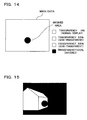
- a predetermined area of the field object OB1 that is centered about the character object CH1 is made transparent as shown in FIG. 6.
- the user can see the character object CH1.
- step S10 an initialization process is performed.
- the viewpoint, the position of each object, the position of the light source, etc., in the virtual game space are initialized.
- step S12 operation data outputted from the controller 20 is stored in the operation data buffer 62.
- step S14 the position of each object in the virtual game space is updated based on the object movement control program 50 of FIG. 3.
- the character object CH1 is a player character, which is controlled based on the player's operation of the controller 20
- the position of the character object CH1 is updated based on the operation data stored in the operation data buffer 62 in step S12.
- the character object CH1 may alternatively be a non-player character attacking the player character, for example.
- the position of the character object CH1 is updated based on a stored program according to the position of the player character.
- step S16 a mask producing process is performed based on the mask producing program shown in FIG. 3. The details of the mask producing process will be described later.
- step S18 a rendering process is performed based on the rendering program 58 shown in FIG. 3, whereby a game image to be displayed on the monitor 12 is stored in the color buffer 64. The details of the rendering process will also be described later.
- step S20 a video signal based on the game image stored in the color buffer 64 is outputted to the monitor 12 based on the display control program 60 shown in FIG. 3, whereby the game image is displayed on the screen of the monitor 12.
- step S22 it is determined whether or not the game is over. If the game is not over, the process returns back to step S12. While the game is not over, steps S12 to S18 are repeated with a 1/30-second period, for example.
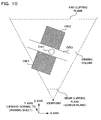
- FIG. 10 shows the game space as viewed from a direction vertical to the line of sight.
- objects that are contained within the space defined between the near clipping plane and the far clipping plane are to be displayed. While objects are rendered by a perspective projection in the example of FIG. 10, the present invention is not limited to this, and objects may be rendered by a parallel projection.
- the transparency flag 84 is "1" for the field object OB1 and "0" for the field object OB2 and the field object OB3, as shown in FIG. 6.
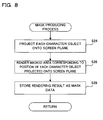
- each character object (the character object CH1 in the example of FIG. 5) is projected onto the screen plane defined in the virtual game space based on the projection program 56 of FIG. 3.
- the position coordinates (3D coordinates) of each character object in the 3D virtual game space are subjected to a perspective projection transformation based on the viewpoint to obtain coordinates (2D coordinates) of the character object on the display screen of the monitor 12.
- the screen plane is used as the near clipping plane in the example of FIG. 10, the present invention is not limited to this.
- the projection operation is typically done by subjecting vertex coordinates of each polygon of each character object to a coordinate transformation using a predetermined transformation matrix.
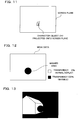
- FIG 11 shows the character object CH1 being projected onto the screen plane. While each polygon of the character object CH1 is projected onto the screen plane in the illustrated example, the present invention is not limited to this, and only a point indicating the position of the character object CH1 may be projected onto the screen plane.
- step S26 monochrome image data as shown in FIG. 12 is produced based on the position of each character object projected onto the screen plane. Specifically, the process renders a circular area (masked area) as shown in FIG. 12 that is centered about the position of each character object projected onto the screen plane.
- the color buffer 64 may be temporarily used for the rendering of the masked area.
- step S28 image data obtained in step S26 is stored in the main memory 28 as mask data.
- the resolution of image data stored as mask data does not have to be the same as that of the game image, but the image data may be stored in the main memory 28 after the resolution thereof is lowered from that of the game image. Then, it is possible to save the memory area of the main memory 28 required for storing mask data.
- mask data with a lowered resolution is used in the rendering process to be described later, the resolution of the mask data stored in the main memory 28 can be converted to that of game image.
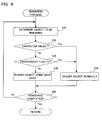
- step S30 an object to be rendered in the color buffer is determined. While the order in which objects are rendered is arbitrary, objects may be rendered in a predetermined order as necessary. For example, by rendering opaque objects first and then semi-transparent objects, the semi-transparency operation (alpha blending) may be facilitated. For example, by first rendering objects farther away from the viewpoint and then closer objects, hidden-surface removal is achieved without performing a z-test using the z-buffer.
- step S32 it is determined whether or not the object to be rendered as determined in step S30 is a character object. The process proceeds to step S38 if the object is a character object, and to step S34 otherwise (i.e., if it is a field object).
- step S34 it is determined with reference to the main memory 28 whether or not the transparency flag 84 of the field object to be rendered is "0". The process proceeds to step S38 if the transparency flag 84 is "0", and to step S36 otherwise (i.e., if is "1").
- step S36 the object to be rendered (a field object whose transparency flag is "1") is rendered by using the mask data 86 stored in the main memory 28 in the mask producing process.
- the transparency of each pixel of the object to be rendered is determined based on the value of each pixel of a mask image (an image of the masked area) included in the mask data 86 for one screen.
- the process refers to the mask data 86 stored in the main memory 28 so that the transparency of a portion of the object that overlaps with the masked area is changed to 100% (whereby the portion contained within the masked area is not rendered in the color buffer 64) while the transparency is not changed for the rest of the object (whereby the rest of the object is displayed normally).
- the field object OB1 will be rendered as shown in FIG. 13.
- step S38 the object to be rendered (a character object or a field object whose transparency flag is "0") is rendered normally, i.e., without referring to the mask data 86 stored in the main memory 28 in the mask producing process.
- step S40 it is determined whether or not the rendering process is completed (i.e., whether or not all of the objects contained within the viewing volume have been rendered). If the rendering process is not complete, the process returns back to step S30 to determine and render the next object. If the rendering process is complete, the process proceeds to step S20 of FIG. 7, where a game image as shown in FIG. 6, for example, is displayed on the monitor 12.
- the present invention is not limited to this.
- a portion of an object contained within the masked area may be made semi-transparent.
- the alpha value (a value that determines the transparency) of a portion of an object contained within the masked area can be changed to an appropriate value, before performing an alpha blending operation based on the changed alpha value.
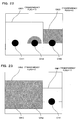
- FIG. 14 shows an example where the mask data is image data using four different values for different transparencies. Specifically, in the mask data shown in FIG. 14, the transparency of the object is gradually varied around the boundary of the masked area.
- FIG. 15 shows the field object OB1 rendered by using the mask data. The transparency (alpha value) of the field object OB1 is changed according to the value of the mask data, and a game image as shown in FIG. 16 is produced through an alpha blending operation based on the changed alpha value. In the example of FIG. 16, a portion of the field object OB1 around the boundary of the masked area has gradually varying transparencies. Such a game image will appear more elegant and beautiful than that of FIG. 6.
- the present invention is not limited to this, and the masked area may be of any other suitable shape (e.g., elliptical, rectangular or star-shaped).
- the size of the masked area may be fixed, or may change according to the size or state of the character object.
- the size of the masked area may be changed according to the distance from the viewpoint to the character object. Particularly, where a game image is produced by a perspective projection, it is preferred that the size of the masked area is reduced as the character object moves away from the viewpoint as shown in FIG. 17B and FIG. 17C when the character object moves in the direction indicated by an arrow in FIG. 17A, for example. Then, it is possible to obtain a sophisticated game image while the character object can always be seen.
- FIG. 12 There is only one masked area in FIG. 12 since there is only one character object being projected onto the screen plane in the example of FIG. 11.
- a plurality of character objects as shown in FIG. 18 a plurality of masked areas are produced in the mask data corresponding to the plurality of character objects (the character objects CH1 and CH2 in the illustrated example) as shown in FIG. 19.
- a game image as shown in FIG. 20 is obtained.
- the transparency flag 84 is set to be "1" for the field object OB1 and “0" for the field objects OB2 and OB3 of FIG. 10 in the present embodiment
- the value of the transparency flag of each field object is appropriately determined in advance in view of the position of the field object and the viewpoint.
- the transparency flag is set to be "0" for a field object representing the ground since a character object will not usually be hidden behind the ground.
- the transparency flag is set to be "1" for a field object representing something located at a higher position than a character object (e.g., a sail of a ship) since such an object is likely to be hiding the character object if the viewpoint is located above the character object.
- the transparency flag may be set to be "0" for a field object that is smaller than a character object or a field object that is semi-transparent since it is unlikely that such an object will significantly block the view of the character object.
- mask data is produced based on the position of a character object, and field objects are subjected to the masking process using the produced mask data, whereby the character object can always be seen.
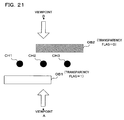
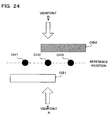
- the masking process using mask data is performed only on field objects that are closer to the viewpoint than a predetermined reference position.
- the reference position may be defined as an absolute position in the virtual game space, as a relative position with respect to the viewpoint, or as the position of a particular character object.
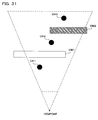
- the character objects CH1 to CH3 are all displayed, and no portion of any field object that is farther away from the viewpoint than a character object is omitted unnecessarily.
- a reference position 88 as described above is stored in the main memory 28 as shown in FIG. 27. It is assumed that the reference position is defined as the distance from the viewpoint.
- step S30 of FIG. 9 After an object to be rendered is determined in step S30 of FIG. 9, it is determined in step S32 of FIG. 28 whether or not the object to be rendered is a character object. The process proceeds to step S38 if the object is a character object, and to step S34 otherwise (i.e., if it is a field object).
- step S42 it is determined with reference to the main memory 28 whether or not the field object to be rendered is closer to the viewpoint than the reference position 88. The process proceeds to step S36 if the field object to be rendered is closer to the viewpoint than the reference position 88, and to step S38 otherwise (i.e., if it is farther away from the viewpoint than the reference position 88).
- step S36 the object to be rendered (a field object that is closer to the viewpoint than the reference position 88) is rendered by using the mask data 86 stored in the main memory 28 in the mask producing process.
- step S38 the object to be rendered (a character object or a field object that is farther away from the viewpoint than the reference position 88) is rendered normally.
- the reference position is defined as the distance from the viewpoint in the present embodiment, the present invention is not limited to this.
- the reference position may be defined as the position of a particular character object, as mentioned above.
- the reference position 88 stored in the main memory 28 needs to be updated as the particular character object moves.
- the reference position is defined as the position of one of the character objects contained within the viewing volume (the character objects CH1 to CH3 in the illustrated example) that is farthest away from the viewpoint (the character object CH3 in the illustrated example).
- the character objects contained within the viewing volume will be displayed, and it is possible to obtain a game image that is not awkward (i.e., no portion of the field object OB3 is omitted in the example of FIG. 29). This can be realized by performing steps S44 to S46 of FIG. 30 before the rendering process in step S18 of FIG. 7.
- step S44 the process obtains the position of one of the character objects contained within the viewing volume that is farthest away from the viewpoint.
- step S46 the position of the character object obtained in step S44 (the position may be an absolute position in the virtual space or a relative position with respect to the viewpoint) is stored in the main memory 28 as the reference position 88.
- the method of the first embodiment and that of the second embodiment may be combined together. Specifically, the masking process using mask data may be performed only for field objects that are closer to the viewpoint than the reference position and whose transparency flag is "1", while not performing the masking process for the other field objects.
- the process produces mask data as shown in FIG. 12, FIG. 14 or FIG. 19 with depth information being added thereto, and performs the masking process using such mask data.
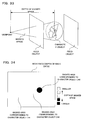
- FIG. 32 shows the principle of the third embodiment.
- a masked space is a space extending from the position of a character object in the virtual game space to the viewpoint.
- the shape of a masked space is basically a conical shape where objects are rendered by a perspective projection, and is basically a columnar shape where objects are rendered by a parallel projection.
- the rendering process Based on the mask data, the rendering process renders a portion of a field object within the masked space transparent (or semi-transparent) while rendering the rest of the field object normally, as shown in FIG. 33.
- FIG. 34 shows an example of mask data produced in the third embodiment. While the mask producing process of the third embodiment renders a masked area based on the position of each character object projected onto the screen plane as in the first embodiment, the depth of the color of the masked area is determined according to the depth of the masked space (i.e., the distance from the viewpoint to the corresponding character object). In the example of FIG. 34, the depth of the color of the masked area increases as the depth of the masked space increases. The depth of the color of a masked area may have any number of levels. Note that the depth of the color of a masked area in the mask data of FIG. 12 or FIG.
- each masked area may also be varied so that it is possible to realize an image as shown in FIG. 17. Specifically, the masked area can be rendered smaller as the depth of the masked space increases. Thus, it is possible to realize a more sophisticated game image.
- mask data defining the transparency as shown in FIG. 12 or FIG. 14 will be referred to as "color mask data", distinguished from mask data defining the depth of a masked space as shown in FIG. 34, which will be referred to as "depth mask data”.
- the field objects OB1 and OB2 are rendered by using mask data as shown in FIG. 34. Specifically, the field objects OB1 and OB2 are rendered so that any portion of the field objects OB1 and OB2 that is contained within any masked space will be rendered with a transparency of 100% (i.e., such a portion is not rendered in the color buffer 64) while the remaining portion will be rendered with a transparency of 0% (i.e., it is rendered normally).
- a game image as shown in FIG. 35 is obtained.
- the character object CH3 is displayed while portions of the field objects OB1 and OB2 that are behind the character objects CH1 and CH2 are not omitted unnecessarily.
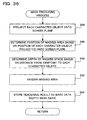
- step S24 each character object is projected onto the screen plane as in the first and second embodiments.
- step S26 the position of each masked area is determined based on the position of each character object on the screen plane.
- step S28 the process determines the depth of the color of each masked area in the mask data according to the distance from the viewpoint to the corresponding character object.
- step S30 the masked area is rendered based on the determination results from step S26 and step S28.
- step S32 image data obtained in step S30 is stored in the main memory 28 as mask data.
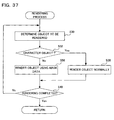
- FIG. 37 differs from FIG. 9 in that step S34 is absent and step S36 is replaced by step S56. Therefore, steps other than step S56 will not be described below.
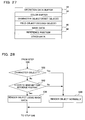
- step S32 It is determined in step S32 whether or not an object to be rendered is a character object, and the process proceeds to step S56 if it is not a character object (i.e., if it is a field object).
- step S56 the object to be rendered (a field object) is rendered by using the mask data 86 stored in the main memory 28 in mask producing process.
- the object is rendered so that any portion of the object that is within a masked area when projected onto the screen plane and whose distance from the viewpoint is smaller than the depth of the masked space represented by the mask data will be rendered with a transparency of 100% (i.e., such a portion is not rendered in the color buffer 64) while the remaining portion will be rendered with a transparency of 0% (i.e., it is rendered normally).
- color mask data may be used in addition to depth mask data so that the transparency of the field object is gradually varied around the boundary of the masked area as shown in FIG. 16.
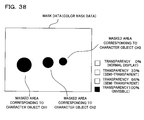
- color mask data as shown in FIG. 38 for example, is produced in addition to the depth mask data of FIG. 34, and the two sets of mask data are stored in the main memory 28.
- the rendering process a portion of the object to be rendered that is contained within the masked space is distinguished from the rest of the object based on the depth mask data, and the transparency (alpha value) for the portion contained within the masked space is varied based on the color mask data.
- each masked area in the depth mask data has a uniform color depth as shown in FIG. 34 in the present embodiment
- the present invention is not limited to this.
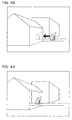
- the process may produce depth mask data as shown in FIG. 40.
- each masked area is rendered so that the color depth decreases at a position farther away from the center of the masked area.
- a game image as shown in FIG. 41 is obtained. The user cannot determine from the game image of FIG. 35 whether the character object CH3 is on the near side of the field object OB2 or behind the field object OB2, whereas the user can clearly determine from the game image of FIG. 41 that the character object CH2 is behind the field object OB2.
Landscapes
- Engineering & Computer Science (AREA)
- Multimedia (AREA)
- Processing Or Creating Images (AREA)
- Image Generation (AREA)
- Controls And Circuits For Display Device (AREA)
Applications Claiming Priority (1)
| Application Number | Priority Date | Filing Date | Title |
|---|---|---|---|
| JP2004253143A JP3877077B2 (ja) | 2004-08-31 | 2004-08-31 | ゲーム装置および画像処理プログラム |
Publications (3)
| Publication Number | Publication Date |
|---|---|
| EP1642625A2 true EP1642625A2 (de) | 2006-04-05 |
| EP1642625A3 EP1642625A3 (de) | 2010-06-16 |
| EP1642625B1 EP1642625B1 (de) | 2012-04-11 |
Family
ID=35735202
Family Applications (1)
| Application Number | Title | Priority Date | Filing Date |
|---|---|---|---|
| EP05014162A Expired - Lifetime EP1642625B1 (de) | 2004-08-31 | 2005-06-30 | Videospielvorrichtung und Bildverarbeitungsprogramm |
Country Status (3)
| Country | Link |
|---|---|
| US (1) | US8602888B2 (de) |
| EP (1) | EP1642625B1 (de) |
| JP (1) | JP3877077B2 (de) |
Families Citing this family (34)
| Publication number | Priority date | Publication date | Assignee | Title |
|---|---|---|---|---|
| EP1762286A4 (de) * | 2004-05-10 | 2007-07-25 | Sega Corp | Elektronische spielmaschine, datenverarbeitungsverfahren in elektronischer spielmaschine, programm und speichermedium dafür |
| JP4563266B2 (ja) * | 2005-06-29 | 2010-10-13 | 株式会社コナミデジタルエンタテインメント | ネットワークゲームシステム、ゲーム装置、ゲーム装置の制御方法及びプログラム |
| JP4739002B2 (ja) * | 2005-06-30 | 2011-08-03 | キヤノン株式会社 | 画像処理方法、画像処理装置 |
| US8117541B2 (en) | 2007-03-06 | 2012-02-14 | Wildtangent, Inc. | Rendering of two-dimensional markup messages |
| US7928992B2 (en) * | 2007-05-30 | 2011-04-19 | Kabushiki Kaisha Toshiba | System and method for transparent object rendering |
| JP2008304967A (ja) * | 2007-06-05 | 2008-12-18 | Konami Digital Entertainment:Kk | 画像表示制御装置、ゲーム装置及びプログラム |
| US8898574B2 (en) * | 2008-12-19 | 2014-11-25 | International Business Machines Corporation | Degrading avatar appearances in a virtual universe |
| US9633465B2 (en) | 2009-02-28 | 2017-04-25 | International Business Machines Corporation | Altering avatar appearances based on avatar population in a virtual universe |
| JP5738525B2 (ja) * | 2009-11-30 | 2015-06-24 | 株式会社コナミデジタルエンタテインメント | ゲーム装置、ゲーム装置の制御方法、及びプログラム |
| JP5481751B2 (ja) * | 2010-05-27 | 2014-04-23 | 富士通株式会社 | 隠蔽処理プログラム、可視化処理方法及び装置 |
| JP5675260B2 (ja) | 2010-10-15 | 2015-02-25 | 任天堂株式会社 | 画像処理プログラム、画像処理装置、画像処理システム、及び、画像処理方法 |
| JP5738569B2 (ja) | 2010-10-15 | 2015-06-24 | 任天堂株式会社 | 画像処理プログラム、装置、システムおよび方法 |
| US8376849B2 (en) * | 2011-06-03 | 2013-02-19 | Nintendo Co., Ltd. | Apparatus and method for controlling objects on a stereoscopic display |
| US9022864B2 (en) * | 2011-06-03 | 2015-05-05 | Nintendo Co., Ltd. | Apparatus and method for controlling objects on a stereoscopic display |
| US10074182B2 (en) * | 2013-11-14 | 2018-09-11 | Microsoft Technology Licensing, Llc | Presenting markup in a scene using depth fading |
| US9986225B2 (en) * | 2014-02-14 | 2018-05-29 | Autodesk, Inc. | Techniques for cut-away stereo content in a stereoscopic display |
| US9855501B2 (en) * | 2014-04-23 | 2018-01-02 | King.Com Ltd. | Opacity method and device therefor |
| US9766768B2 (en) * | 2014-04-23 | 2017-09-19 | King.Com Limited | Opacity method and device therefor |
| US10102672B2 (en) * | 2015-03-16 | 2018-10-16 | Square Enix Co., Ltd. | Storage medium, information processing apparatus and control method |
| WO2018103633A1 (zh) * | 2016-12-06 | 2018-06-14 | 腾讯科技(深圳)有限公司 | 一种图像处理的方法及装置 |
| JP6275809B1 (ja) * | 2016-12-09 | 2018-02-07 | 株式会社コロプラ | 表示制御方法および当該表示制御方法をコンピュータに実行させるためのプログラム |
| JP6382928B2 (ja) * | 2016-12-27 | 2018-08-29 | 株式会社コロプラ | 仮想空間における画像の表示を制御するためにコンピュータによって実行される方法、当該方法をコンピュータに実現させるためのプログラム、および、コンピュータ装置 |
| JP6606791B2 (ja) * | 2017-01-12 | 2019-11-20 | 株式会社コナミデジタルエンタテインメント | ゲーム装置及びプログラム |
| JP6407460B1 (ja) * | 2018-02-16 | 2018-10-17 | キヤノン株式会社 | 画像処理装置、画像処理方法およびプログラム |
| US10843089B2 (en) * | 2018-04-06 | 2020-11-24 | Rovi Guides, Inc. | Methods and systems for facilitating intra-game communications in a video game environment |
| JP6799864B2 (ja) * | 2018-06-01 | 2020-12-16 | 株式会社コナミデジタルエンタテインメント | ゲーム装置及びプログラム |
| CN111265861A (zh) * | 2020-01-15 | 2020-06-12 | 腾讯科技(深圳)有限公司 | 虚拟道具的显示方法和装置、存储介质及电子装置 |
| US11481962B2 (en) | 2020-06-26 | 2022-10-25 | Gree, Inc. | Information processing device, information processing method, and information processing program |
| JP7226822B2 (ja) * | 2020-11-13 | 2023-02-21 | 株式会社コナミデジタルエンタテインメント | ゲーム装置及びプログラム |
| CN113134233B (zh) * | 2021-05-14 | 2023-06-20 | 腾讯科技(深圳)有限公司 | 控件的显示方法、装置、计算机设备及存储介质 |
| KR102909485B1 (ko) * | 2021-05-14 | 2026-01-07 | 텐센트 테크놀로지(센젠) 컴퍼니 리미티드 | 컨트롤 디스플레이 방법 및 장치, 디바이스, 매체 및 프로그램 제품 |
| CN114405008B (zh) * | 2022-01-21 | 2025-03-25 | 腾讯科技(深圳)有限公司 | 虚拟场景中的障碍物处理方法、装置、设备及存储介质 |
| JP7557490B2 (ja) * | 2022-03-02 | 2024-09-27 | 任天堂株式会社 | 情報処理プログラム、情報処理システム、情報処理装置、および、情報処理方法 |
| JP7550188B2 (ja) * | 2022-06-10 | 2024-09-12 | 任天堂株式会社 | 情報処理プログラム、情報処理装置、情報処理システム、および情報処理方法 |
Citations (4)
| Publication number | Priority date | Publication date | Assignee | Title |
|---|---|---|---|---|
| JP2902352B2 (ja) | 1996-05-15 | 1999-06-07 | コナミ株式会社 | ビデオゲーム装置 |
| JP3141737B2 (ja) | 1995-08-10 | 2001-03-05 | 株式会社セガ | 仮想画像生成装置及びその方法 |
| WO2001088854A2 (en) | 2000-05-16 | 2001-11-22 | Sun Microsystems, Inc. | Graphics system using a blur filter |
| WO2004072935A2 (en) | 2003-02-11 | 2004-08-26 | Nds Limited | Apparatus and methods for handling interactive applications in broadcast networks |
Family Cites Families (14)
| Publication number | Priority date | Publication date | Assignee | Title |
|---|---|---|---|---|
| US5060280A (en) * | 1986-09-30 | 1991-10-22 | Canon Kabushiki Kaisha | Masking control for image processing systems |
| US6331856B1 (en) * | 1995-11-22 | 2001-12-18 | Nintendo Co., Ltd. | Video game system with coprocessor providing high speed efficient 3D graphics and digital audio signal processing |
| US6139433A (en) * | 1995-11-22 | 2000-10-31 | Nintendo Co., Ltd. | Video game system and method with enhanced three-dimensional character and background control due to environmental conditions |
| US5769718A (en) * | 1996-05-15 | 1998-06-23 | Rieder; William R. | Video game apparatus and medium readable by a computer stored with video game program |
| US6040841A (en) * | 1996-08-02 | 2000-03-21 | Microsoft Corporation | Method and system for virtual cinematography |
| JP3372832B2 (ja) * | 1997-07-25 | 2003-02-04 | コナミ株式会社 | ゲーム装置、ゲーム画像処理方法およびゲーム画像処理プログラムを記録したコンピュータ読み取り可能な記録媒体 |
| JP2001276420A (ja) * | 2000-03-30 | 2001-10-09 | Namco Ltd | ゲーム装置および情報記憶媒体 |
| JP3347124B2 (ja) * | 2000-04-28 | 2002-11-20 | 株式会社コナミコンピュータエンタテインメントジャパン | ゲームシステムおよびゲーム用プログラムが記憶されたコンピュータ読み取り可能な記録媒体 |
| US6828969B2 (en) * | 2000-06-05 | 2004-12-07 | Namco Ltd. | Game system, program and image generating method |
| US7046242B2 (en) * | 2000-06-05 | 2006-05-16 | Namco Ltd. | Game system, program and image generating method |
| EP1386645B1 (de) | 2000-12-14 | 2011-12-07 | KABUSHIKI KAISHA SEGA doing business as SEGA CORPORATION | Spielmaschine, kommunikationsspielsystem und aufgezeichnetes medium |
| JP3690672B2 (ja) * | 2002-05-17 | 2005-08-31 | 任天堂株式会社 | ゲームシステムおよびゲームプログラム |
| GB2390950A (en) * | 2002-07-17 | 2004-01-21 | Sony Uk Ltd | Video wipe generation based on the distance of a display position between a wipe origin and a wipe destination |
| JP3639280B2 (ja) * | 2003-02-12 | 2005-04-20 | 任天堂株式会社 | ゲームメッセージ表示方法およびゲームプログラム |
-
2004
- 2004-08-31 JP JP2004253143A patent/JP3877077B2/ja not_active Expired - Lifetime
-
2005
- 2005-06-28 US US11/167,222 patent/US8602888B2/en active Active
- 2005-06-30 EP EP05014162A patent/EP1642625B1/de not_active Expired - Lifetime
Patent Citations (4)
| Publication number | Priority date | Publication date | Assignee | Title |
|---|---|---|---|---|
| JP3141737B2 (ja) | 1995-08-10 | 2001-03-05 | 株式会社セガ | 仮想画像生成装置及びその方法 |
| JP2902352B2 (ja) | 1996-05-15 | 1999-06-07 | コナミ株式会社 | ビデオゲーム装置 |
| WO2001088854A2 (en) | 2000-05-16 | 2001-11-22 | Sun Microsystems, Inc. | Graphics system using a blur filter |
| WO2004072935A2 (en) | 2003-02-11 | 2004-08-26 | Nds Limited | Apparatus and methods for handling interactive applications in broadcast networks |
Also Published As
| Publication number | Publication date |
|---|---|
| JP2006068138A (ja) | 2006-03-16 |
| EP1642625A3 (de) | 2010-06-16 |
| EP1642625B1 (de) | 2012-04-11 |
| US20060046844A1 (en) | 2006-03-02 |
| JP3877077B2 (ja) | 2007-02-07 |
| US8602888B2 (en) | 2013-12-10 |
Similar Documents
| Publication | Publication Date | Title |
|---|---|---|
| US8602888B2 (en) | Video game device and image processing program | |
| JP3668019B2 (ja) | 記録媒体、画像処理装置および画像処理方法 | |
| US7104891B2 (en) | Game machine and game program for displaying a first object casting a shadow formed by light from a light source on a second object on a virtual game space | |
| US7588497B2 (en) | Method, an apparatus and a computer program product for generating an image | |
| CN1985277A (zh) | 显示装置、显示方法、信息记录媒体及程序 | |
| JP3352982B2 (ja) | レンダリング方法及び装置、ゲーム装置、並びに立体モデルをレンダリングするプログラムを格納するコンピュータ読み取り可能な記録媒体 | |
| EP1808207B1 (de) | Aufzeichnungsmedium für Spielprogramm und Spielvorrichtung | |
| EP1795245B1 (de) | Speichermedium mit darauf gespeichertem Spieleprogramm und Spieleapparat | |
| JP2009140135A (ja) | ゲームプログラム、そのゲームプログラムを記録した記録媒体及びコンピュータ | |
| JPH10198819A (ja) | 水面の画像表示装置,その画像表示方法,及びコンピュータプログラムを記録した機械読取り可能な記録媒体 | |
| JP3990258B2 (ja) | 画像生成システム、プログラム及び情報記憶媒体 | |
| JP4343207B2 (ja) | ゲーム装置および画像処理プログラム | |
| US7479961B2 (en) | Program, information storage medium, and image generation system | |
| EP1139292B1 (de) | Spielsystem und entsprechendes computerlesbares Aufzeichungsmedium | |
| JP4012948B2 (ja) | ゲーム装置、コンピュータ読み取り可能な記録媒体、およびゲーム画像の光表現方法 | |
| US7173618B2 (en) | Image creation program and method of creating image | |
| JP2000093654A (ja) | ゲーム装置、ゲーム方法および情報記録媒体 | |
| JP4447000B2 (ja) | 画像生成システム、プログラム及び情報記憶媒体 | |
| EP1249791B1 (de) | Bildverarbeitung für 3-D Spiele zum Zeichnen von Randlinien | |
| GB2364495A (en) | Object insertion in virtual game scene | |
| JP4521811B2 (ja) | プログラム、情報記憶媒体、及び画像生成システム | |
| JP4476040B2 (ja) | プログラム、情報記憶媒体、及び画像生成システム | |
| JP4233859B2 (ja) | ゲーム装置及びゲームプログラム | |
| JP2003015214A (ja) | 画像表示装置 | |
| JP2006252427A (ja) | プログラム、情報記憶媒体及び画像生成システム |
Legal Events
| Date | Code | Title | Description |
|---|---|---|---|
| PUAI | Public reference made under article 153(3) epc to a published international application that has entered the european phase |
Free format text: ORIGINAL CODE: 0009012 |
|
| AK | Designated contracting states |
Kind code of ref document: A2 Designated state(s): AT BE BG CH CY CZ DE DK EE ES FI FR GB GR HU IE IS IT LI LT LU MC NL PL PT RO SE SI SK TR |
|
| AX | Request for extension of the european patent |
Extension state: AL BA HR LV MK YU |
|
| PUAL | Search report despatched |
Free format text: ORIGINAL CODE: 0009013 |
|
| AK | Designated contracting states |
Kind code of ref document: A3 Designated state(s): AT BE BG CH CY CZ DE DK EE ES FI FR GB GR HU IE IS IT LI LT LU MC NL PL PT RO SE SI SK TR |
|
| AX | Request for extension of the european patent |
Extension state: AL BA HR LV MK YU |
|
| 17P | Request for examination filed |
Effective date: 20101012 |
|
| 17Q | First examination report despatched |
Effective date: 20101110 |
|
| AKX | Designation fees paid |
Designated state(s): DE FR GB |
|
| GRAP | Despatch of communication of intention to grant a patent |
Free format text: ORIGINAL CODE: EPIDOSNIGR1 |
|
| GRAS | Grant fee paid |
Free format text: ORIGINAL CODE: EPIDOSNIGR3 |
|
| GRAA | (expected) grant |
Free format text: ORIGINAL CODE: 0009210 |
|
| AK | Designated contracting states |
Kind code of ref document: B1 Designated state(s): DE FR GB |
|
| RAP1 | Party data changed (applicant data changed or rights of an application transferred) |
Owner name: NINTENDO CO., LTD. |
|
| REG | Reference to a national code |
Ref country code: GB Ref legal event code: FG4D |
|
| REG | Reference to a national code |
Ref country code: DE Ref legal event code: R096 Ref document number: 602005033554 Country of ref document: DE Effective date: 20120606 |
|
| PLBE | No opposition filed within time limit |
Free format text: ORIGINAL CODE: 0009261 |
|
| STAA | Information on the status of an ep patent application or granted ep patent |
Free format text: STATUS: NO OPPOSITION FILED WITHIN TIME LIMIT |
|
| 26N | No opposition filed |
Effective date: 20130114 |
|
| REG | Reference to a national code |
Ref country code: DE Ref legal event code: R097 Ref document number: 602005033554 Country of ref document: DE Effective date: 20130114 |
|
| REG | Reference to a national code |
Ref country code: FR Ref legal event code: PLFP Year of fee payment: 12 |
|
| REG | Reference to a national code |
Ref country code: FR Ref legal event code: PLFP Year of fee payment: 13 |
|
| REG | Reference to a national code |
Ref country code: FR Ref legal event code: PLFP Year of fee payment: 14 |
|
| P01 | Opt-out of the competence of the unified patent court (upc) registered |
Effective date: 20230428 |
|
| PGFP | Annual fee paid to national office [announced via postgrant information from national office to epo] |
Ref country code: GB Payment date: 20240509 Year of fee payment: 20 |
|
| PGFP | Annual fee paid to national office [announced via postgrant information from national office to epo] |
Ref country code: DE Payment date: 20240507 Year of fee payment: 20 |
|
| PGFP | Annual fee paid to national office [announced via postgrant information from national office to epo] |
Ref country code: FR Payment date: 20240509 Year of fee payment: 20 |
|
| REG | Reference to a national code |
Ref country code: DE Ref legal event code: R071 Ref document number: 602005033554 Country of ref document: DE |
|
| PG25 | Lapsed in a contracting state [announced via postgrant information from national office to epo] |
Ref country code: GB Free format text: LAPSE BECAUSE OF EXPIRATION OF PROTECTION Effective date: 20250629 |
|
| REG | Reference to a national code |
Ref country code: GB Ref legal event code: PE20 Expiry date: 20250629 |