EP1643068A2 - Schutzschild - Google Patents
Schutzschild Download PDFInfo
- Publication number
- EP1643068A2 EP1643068A2 EP05255038A EP05255038A EP1643068A2 EP 1643068 A2 EP1643068 A2 EP 1643068A2 EP 05255038 A EP05255038 A EP 05255038A EP 05255038 A EP05255038 A EP 05255038A EP 1643068 A2 EP1643068 A2 EP 1643068A2
- Authority
- EP
- European Patent Office
- Prior art keywords
- screen
- circuit
- circuits
- container
- substrate
- Prior art date
- Legal status (The legal status is an assumption and is not a legal conclusion. Google has not performed a legal analysis and makes no representation as to the accuracy of the status listed.)
- Granted
Links
Images


Classifications
-
- E—FIXED CONSTRUCTIONS
- E05—LOCKS; KEYS; WINDOW OR DOOR FITTINGS; SAFES
- E05G—SAFES OR STRONG-ROOMS FOR VALUABLES; BANK PROTECTION DEVICES; SAFETY TRANSACTION PARTITIONS
- E05G1/00—Safes or strong-rooms for valuables
- E05G1/02—Details
- E05G1/024—Wall or panel structure
-
- G—PHYSICS
- G08—SIGNALLING
- G08B—SIGNALLING SYSTEMS, e.g. PERSONAL CALLING SYSTEMS; ORDER TELEGRAPHS; ALARM SYSTEMS
- G08B13/00—Burglar, theft or intruder alarms
- G08B13/02—Mechanical actuation
- G08B13/12—Mechanical actuation by the breaking or disturbance of stretched cords or wires
- G08B13/126—Mechanical actuation by the breaking or disturbance of stretched cords or wires for a housing, e.g. a box, a safe, or a room
Definitions
- the present invention relates to a penetration screen and in particular to the use of a flexible planar penetration screen in a security container.
- ATMs Automated Teller machines
- ATMs Automated Teller machines
- security protection is vital when delivering valuable media, such as bank notes, to an ATM. Therefore, a security system must be devised which will protect the media in the delivery vehicle, whilst it is being carried from the vehicle to the ATM and during replenishment and operation of the ATM.
- the security system usually takes the form of an alarm system and a robust security enclosure, such as a safe.
- a robust security enclosure such as a safe.
- security enclosures can be bulky and heavy, which makes them difficult to transport or relocate. It also makes them expensive hence today, for example, a safe makes up a significant amount of the cost of an ATM.
- dye dispersal systems secure heavy weight safe type enclosures still form the basis of most if not all security systems in this industry.
- a security enclosure may be lining the inner surfaces of the security enclosure with plastic mats, which have two electrode arrays within their laminated construction.
- plastic mats which have two electrode arrays within their laminated construction.
- a signal is generated to trip the anti-theft countermeasures, for example, an alarm or dye dispersion system.
- the alarm signal may be generated by the detection of an open circuit in either of the two electrodes, a short circuit between the electrodes, or a combination of both.
- a penetration screen comprising a substantially planar substrate with, at least, one electrical circuit disposed thereon, wherein the electrical circuit is configured such that, at least, one section of the circuit is electrically isolatable from the remainder of the circuit without causing a fault condition in said remainder of the circuit.
- the fault condition is an open circuit.
- the circuit comprises a plurality of primary sub-circuits and corresponding secondary sub-circuits, each secondary sub-circuit only being configured for use when the corresponding primary sub-circuit is deactivated.
- the primary sub-circuits are each adapted to be deactivated by punching a hole in a predefined section of said sub-circuit.
- circuits are disposed on both sides of the substrate.
- the fault condition is a short circuit.
- circuits being arranged with respect to each other such that the substrate can be cut along predetermined lines without elements of one circuit coming into contact with elements of the other circuit.
- the circuits on either side of the substrate are each arranged in grid patterns, said grid patterns being offset with respect to each other.
- the grid patterns are both rectilinear grid patterns.
- one circuit is arranged in a substantially circular grid pattern and the other circuit is arranged in a substantially radial grid pattern.
- the grids are intersect, on opposite sides of the screen, at distinct points.
- a security container formed, at least, in part from a penetration screen comprising a screen having a substantially planar substrate with, at least, one electrical circuit disposed thereon, wherein the electrical circuit is configured such that, at least, one section of the circuit is electrically isolatable from the remainder of the circuit without causing a fault condition in said remainder of the circuit.
- a method of manufacturing a security container utilising a screen as described above, comprising the steps of: selecting areas of said screen to form the container and electrically isolating the sections of electrical circuit in the remaining areas of the screen not for use in the container, and folding the screen so that the selected areas form the shape of the container.
- the areas of the screen not for use in the container are cut from the screen without causing a fault condition in the electrical circuit in the areas of the screen being used to form the container.
- Figure 1 schematically illustrates a security container 10 in which a section is cut away to illustrate more clearly the formation of the container 10.
- the container of Figure 1 comprises a container wall 12 equipped with or formed from a penetration screen 14 comprising a substantially planar substrate 20 with one electrical circuit 16, 18 disposed on opposite sides of the substrate 20.
- a penetration screen 14 comprising a substantially planar substrate 20 with one electrical circuit 16, 18 disposed on opposite sides of the substrate 20.
- the security screen can be fitted over the different internal surfaces of the security container.
- the security screen can be fitted to the external surfaces of the security container. It is also possible to replace the container wall 12 by the penetration screen, the screen itself being suitably reinforced, for example by epoxy resin.
- the electrical circuits 16, 18 are configured such that, at least, one section of the circuit is electrically isolatable from the remainder of the circuit without causing a fault condition in said remainder of the circuit.
- the container 10 provides protection against theft of the contents and may be an in-situ container, for example, as installed in a self-service terminal (SST) such as an automated teller machine (ATM), or as an in-transit container such as used to convey bank notes from one location to another.
- SST self-service terminal
- ATM automated teller machine
- the container may be a removable ATM cash cassette for installation in an ATM.
- the penetration screen can provide a signal used to detect physical penetration of the screen, and hence, the security container 10.
- Figure 2 schematically illustrates a penetration screen 14 showing an "upper” electrical circuit 22 and "lower” electrical circuit 24 disposed on opposite sides of the flexible substrate layer 26.
- Figure 3 shows the screen structure of Figure 2 with an additional insulating layer 28.
- the additional insulating layer 28 allows screens to be stacked in multiple layers to improve penetration coverage and sensitivity.
- the circuits 22, 24 can be deposited on a flexible substrate by known deposition techniques.
- the circuits may be formed be any suitable electrical conductor, for example, polymer electrodes and the substrate can be any suitable flexible surface such as paper. It is known to deposit circuits on such substrates utilising ink-jet printing technology. The use of such technology allows for large-scale printing techniques be used to manufacture penetration screens, which in turn lowers the manufacturing costs of penetration screens and security containers in accordance with the present invention.
- the circuits can be manufactured from materials that can register a thermal or physical attack.
- One such material is QTC (Quantum Tunnelling Composite) which reacts under thermal or physical influence in that its electrical resistance decreases under pressure or heat. This can then be sandwiched between two layers of a flexible conductive substrate (isolated if need be on the exterior) as part of an alarm circuit, in accordance with the present invention. Therefore once penetrated by a drill or other device or when heat of an attack level is detected then the alarm will be triggered.
- the circuits may be manufactured using conductive ink on a suitable substrate, either laminated paper or composite/plastics based.
- a suitable substrate either laminated paper or composite/plastics based.
- conductive ink printers There are specific conducive ink printers but there are also conductive inks that can use current print technologies and can print on current associated substrates used e.g. paper, polymer based foil, etc.
- circuits can be manufactured utilising miniaturised sensors known as smart dust or motes, perhaps suspended in paint, to detect any penetrative attack, pressure change, local temperature change or acoustic stimulus, etc. These sensors are capable of communicating with each other and a central processor, which could raise an alarm.
- miniaturised sensors known as smart dust or motes, perhaps suspended in paint, to detect any penetrative attack, pressure change, local temperature change or acoustic stimulus, etc.
- the penetration screen 14 can detect the physical penetration of the security container 10 by monitoring the electrodes 22, 24 and detecting a short circuit condition in the circuits.
- circuit configurations are possible, as illustrated in Figures 4 and 5.
- the key requirement of the circuit configurations for the short circuit embodiment is that there is an independent circuit on either side of the substrate, the circuits being arranged with respect to each other such that the substrate can be cut along predetermined lines without elements of one circuit coming into contact with elements of the other circuit.
- Figure 4 shows one possible circuit configuration with two circuits 34, 36 disposed on opposite sides of an insulating substrate.
- the insulating substrate is not show here for simplicity.
- Each circuit 34, 36 is composed of a grid of conductors.
- the two circuits are arranged orthogonal to each other, that is, the lines of each grid are not coincident and lie at right angles to each other.
- the layout of the orthogonal electrodes allows the screen to be cut to a convenient shape to be formed into a penetration screen.
- the dashed line 38 in Figure 4 shows one possible pattern to be cut into the screen. The separation between the two circuits is sufficient to prevent the circuits from coming into contact with each other and causing a short circuit. Therefore, cutting along line 38 will not cause a short circuit condition between the electrode arrays.
- a short circuit may be caused by the mechanical destruction of the screen, the short circuit arising from the circuits either contacting directly or via conductive tools such as a drill, or a knife.
- conductive tools such as a drill, or a knife.
- a conducting implement for example a drill bit
- a short circuit would be caused.
- the positioning of the two grids of electrodes means that if the penetration screen was disturbed by a non-conducting implement or explosive blast, the conductors are close enough that they may be forced into contact with each, again causing a short circuit.
- Figure 5 shows another possible configuration of electrical circuit with two electrode arrays used to detect short circuit conditions in a penetration screen.
- This configuration is based on a non-rectilinear electrode layout and has a series of concentric, circular electrodes 42 overlaid with occasional radial conductors 44, disposed on the opposite side of an insulating substrate to a series of radial electrodes 46.
- a possible path to cut the screen along is shown at 48. Again, the penetration screen can detect if there is a short circuit between the electrode membranes, for example, if a conducting implement penetrates the electrode membrane at the position indicated by 50.
- circuits illustrated in Figures 4 and 5 should only be cut between conductor runs or substantially at right angles to conductor runs to ensure that cutting the screen does not produce a short circuit.
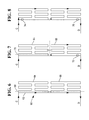
- Figures 6 to 8 show possible circuit configurations used to detect open circuit conditions in a penetration screen, in accordance with a further embodiment of the present invention.
- the circuit comprises a plurality of primary sub-circuits 62 and corresponding secondary sub-circuits 64, 66 each secondary sub-circuit only being configured for use when the corresponding primary sub-circuit is deactivated.
- the primary sub-circuits 62 are each adapted to be deactivated by punching a hole in a predefined section 72, 74, 76 of said sub-circuit.
- the secondary sub-circuits 64, 66 are arranged in a convoluted, rectilinear pattern. This type of pattern maximises the area covered by the electrode and maximises the penetration screens sensitivity.
- a security screen can detect the creation of an open circuit within either of the two electrically isolatable sub-circuits 64, 66. As before, the open circuit is caused by the mechanical destruction of the membrane.
- the open circuit electrode system can also be configured to operate in the short circuit mode to provide additional protection, in the same ways as described for Figures 4 and 5.
- Figure 6 illustrates one instance of the open circuit in which neither secondary sub-circuit 64, 66 is required.
- the screen can be cut along dashed line 68, without causing a fault condition in the form of n open circuit. Consequently, current flows from point C to D along the path indicated by the arrows.
- Figure 7 illustrates another instance of the open circuit arrangement wherein the first sub-circuit 64 is not required and so a cut is made along dashed line 70.
- second sub-circuit 66 is required to be a part of the open circuit system and so a hole is punched at 72, which open circuits that particular branch of the electrode and forces the current to flow from C to D, as shown by the arrows in Figure 7.
- Figure 8 is yet another instance of the open circuit electrode system where both the first and second sub-circuits 64 and 66 are required to be activated. In this instance holes are made through the electrodes at points 74 and 76 which cause the current to flow from C to D, as shown by the arrows in Figure 8.
- the configuration of the open circuit system allows a single screen to be cut into complex shapes without requiring different templates for each different application or design.
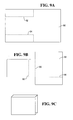
- Figures 9A to C show a practical application of the penetration screen.
- the penetration screen is cut so as to fit into a box shaped container, for example of the type used for cash cassettes for ATMs, as illustrated in Figure 1 or 9C.
- Figure 9A shows the penetration screen 80 in its initial format, that is, as printed and without any modifications.
- Dashed lines 82, 84 illustrate predetermined lines along which the screen can be cut to provide the box template shown in Figure 9B, without causing a fault condition.
- the box template can then be folded along the dashed lines 86-92 to produce the box shape in figure 9C.
- the penetration screen can be strengthened using suitable techniques and materials.
- the screen can be impregnated and cured with an epoxy resin to provide a solid structure, which can replace the outer walls of a security container or safe.
- the areas of the substrate that are not required need not be cut away. Instead those areas may merely be folded so that they provide additional structure to the construction.
Landscapes
- Physics & Mathematics (AREA)
- General Physics & Mathematics (AREA)
- Burglar Alarm Systems (AREA)
- Devices For Indicating Variable Information By Combining Individual Elements (AREA)
Applications Claiming Priority (1)
| Application Number | Priority Date | Filing Date | Title |
|---|---|---|---|
| GBGB0421742.8A GB0421742D0 (en) | 2004-09-30 | 2004-09-30 | A penetration screen |
Publications (3)
| Publication Number | Publication Date |
|---|---|
| EP1643068A2 true EP1643068A2 (de) | 2006-04-05 |
| EP1643068A3 EP1643068A3 (de) | 2013-03-13 |
| EP1643068B1 EP1643068B1 (de) | 2014-04-02 |
Family
ID=33427824
Family Applications (1)
| Application Number | Title | Priority Date | Filing Date |
|---|---|---|---|
| EP05255038.1A Expired - Lifetime EP1643068B1 (de) | 2004-09-30 | 2005-08-22 | Schutzschild |
Country Status (3)
| Country | Link |
|---|---|
| US (1) | US7436313B2 (de) |
| EP (1) | EP1643068B1 (de) |
| GB (1) | GB0421742D0 (de) |
Cited By (2)
| Publication number | Priority date | Publication date | Assignee | Title |
|---|---|---|---|---|
| WO2014131899A3 (de) * | 2013-02-28 | 2014-10-23 | Id-Diamonds Gmbh | Aufnahmebehältnis für wertgegenstände, insbesondere für diamanten, andere edelsteine oder perlen |
| EP4506913A1 (de) * | 2023-08-08 | 2025-02-12 | António Nuno Sampaio e Abrantes | Verbesserte sicherheitsbehälterkassette mit explosionserkennung für wertgegenstände wie banknoten und für automatische bankgeräte (atm) |
Families Citing this family (6)
| Publication number | Priority date | Publication date | Assignee | Title |
|---|---|---|---|---|
| US7699225B2 (en) * | 2007-04-27 | 2010-04-20 | Techreco Company, Ltd. | Magnetic head for reading data |
| US8334749B1 (en) * | 2009-09-28 | 2012-12-18 | General Electric Company | Temperature detection in a gas turbine |
| DE102010036708A1 (de) | 2010-07-28 | 2012-02-02 | Wincor Nixdorf International Gmbh | Geldkassette mit einem elektrisch leitenden textilen Stoff als Manipulationssensor |
| DE102010060379B4 (de) | 2010-11-05 | 2025-05-08 | Diebold Nixdorf Systems Gmbh | Geldkassette mit Mitteln zur Detektion von Manipulationsversuchen |
| WO2017127083A1 (en) * | 2016-01-21 | 2017-07-27 | Entit Software Llc | Detecting physical penetration of secure device |
| WO2022083872A1 (en) * | 2020-10-22 | 2022-04-28 | Pataco Ag | Security bag |
Family Cites Families (10)
| Publication number | Priority date | Publication date | Assignee | Title |
|---|---|---|---|---|
| GB1400882A (en) | 1972-02-10 | 1975-07-16 | Dean A W | Detection of vandalism |
| US4228425A (en) | 1978-02-06 | 1980-10-14 | Afg Industries, Inc. | Tamper-proof transparent security plate |
| GB2108302A (en) * | 1981-10-24 | 1983-05-11 | Michael Sacks | Alarm systems |
| FR2610125B1 (fr) * | 1987-01-23 | 1989-12-15 | Pieddeloup Daniel | Dispositif de detection contre l'effraction |
| US4939407A (en) * | 1988-07-05 | 1990-07-03 | The United States Of America As Represented By The Secretary Of The Navy | Block patterning of the metallization of polyvinylidene fluoride transducers |
| DE4018195A1 (de) * | 1990-05-26 | 1991-11-28 | Straehle & Hess | Vorrichtung zum absichern von flaechen gegen unbefugtes zerstoeren |
| GB2270785B (en) * | 1992-09-22 | 1996-05-08 | Gore & Ass | Improvements in security enclosure manufacture |
| DE19600770C2 (de) * | 1996-01-11 | 1997-11-13 | Ibm | Sicherheitsfolie mit EMV-Schutz |
| US7271723B2 (en) * | 2002-07-08 | 2007-09-18 | Omron Corporation | Container device provided with surveillance panels, surveillance method using the same device, and structure of the same device |
| US7098444B2 (en) * | 2004-01-09 | 2006-08-29 | Beinhocker Gilbert D | Tamper proof container |
-
2004
- 2004-09-30 GB GBGB0421742.8A patent/GB0421742D0/en not_active Ceased
-
2005
- 2005-08-22 EP EP05255038.1A patent/EP1643068B1/de not_active Expired - Lifetime
- 2005-09-12 US US11/224,177 patent/US7436313B2/en active Active
Cited By (2)
| Publication number | Priority date | Publication date | Assignee | Title |
|---|---|---|---|---|
| WO2014131899A3 (de) * | 2013-02-28 | 2014-10-23 | Id-Diamonds Gmbh | Aufnahmebehältnis für wertgegenstände, insbesondere für diamanten, andere edelsteine oder perlen |
| EP4506913A1 (de) * | 2023-08-08 | 2025-02-12 | António Nuno Sampaio e Abrantes | Verbesserte sicherheitsbehälterkassette mit explosionserkennung für wertgegenstände wie banknoten und für automatische bankgeräte (atm) |
Also Published As
| Publication number | Publication date |
|---|---|
| GB0421742D0 (en) | 2004-11-03 |
| EP1643068A3 (de) | 2013-03-13 |
| EP1643068B1 (de) | 2014-04-02 |
| US7436313B2 (en) | 2008-10-14 |
| US20060077065A1 (en) | 2006-04-13 |
Similar Documents
| Publication | Publication Date | Title |
|---|---|---|
| US11191155B1 (en) | Tamper-respondent assembly with structural material within sealed inner compartment | |
| JP5647681B2 (ja) | 多層のセキュリティ保護された構造体 | |
| EP1643068B1 (de) | Schutzschild | |
| US10271424B2 (en) | Tamper-respondent assemblies with in situ vent structure(s) | |
| US5289785A (en) | Security enclosures | |
| JP6741276B2 (ja) | 埋め込まれた不正開封反応センサを含む回路基板および電子パッケージ | |
| JP6807380B2 (ja) | 形成されたフレキシブル層を備える不正開封反応センサ | |
| US9999124B2 (en) | Tamper-respondent assemblies with trace regions of increased susceptibility to breaking | |
| US20190261506A1 (en) | Enclosure-to-board interface with tamper-detect circuit(s) | |
| US20180092203A1 (en) | Vented tamper-respondent assemblies | |
| CN103578201A (zh) | 安全保护装置、以及形成和安装该装置的方法 | |
| WO1999021142A1 (en) | Tamper respondent enclosure | |
| WO2013162843A1 (en) | Tamper respondent covering | |
| US20180082556A1 (en) | Tamper-respondent assembly with sensor connection adapter | |
| CN104105335A (zh) | 带有可撕裂基板的安全保护装置 | |
| WO2008002878A2 (en) | Large area distributed sensor | |
| US11076496B2 (en) | Tamper-resistant electronics system and improved method of manufacturing therefor | |
| US10595401B1 (en) | Tamper detection at enclosure-to-board interface | |
| US20190037686A1 (en) | Tamper-respondent assembly with interconnect characteristic(s) obscuring circuit layout | |
| US9430675B2 (en) | Encrypting pin pad | |
| CN101253821B (zh) | 用于防止敏感电子数据组件受到外部操纵的硬件保护的传感器 | |
| PL242116B1 (pl) | Elektroniczna pieczęć | |
| EP2931011A1 (de) | Sicherheitskasten für elektronischen Schaltungsschutz | |
| KR102113424B1 (ko) | 전자기기 보안장치 | |
| EP3644209B1 (de) | Manipulationssensor |
Legal Events
| Date | Code | Title | Description |
|---|---|---|---|
| PUAI | Public reference made under article 153(3) epc to a published international application that has entered the european phase |
Free format text: ORIGINAL CODE: 0009012 |
|
| AK | Designated contracting states |
Kind code of ref document: A2 Designated state(s): AT BE BG CH CY CZ DE DK EE ES FI FR GB GR HU IE IS IT LI LT LU LV MC NL PL PT RO SE SI SK TR |
|
| AX | Request for extension of the european patent |
Extension state: AL BA HR MK YU |
|
| RAP1 | Party data changed (applicant data changed or rights of an application transferred) |
Owner name: NCR INTERNATIONAL, INC. |
|
| REG | Reference to a national code |
Ref country code: DE Ref legal event code: R079 Ref document number: 602005043149 Country of ref document: DE Free format text: PREVIOUS MAIN CLASS: E05G0001000000 Ipc: E05G0001024000 |
|
| PUAL | Search report despatched |
Free format text: ORIGINAL CODE: 0009013 |
|
| AK | Designated contracting states |
Kind code of ref document: A3 Designated state(s): AT BE BG CH CY CZ DE DK EE ES FI FR GB GR HU IE IS IT LI LT LU LV MC NL PL PT RO SE SI SK TR |
|
| AX | Request for extension of the european patent |
Extension state: AL BA HR MK YU |
|
| RIC1 | Information provided on ipc code assigned before grant |
Ipc: G08B 13/12 20060101ALI20130207BHEP Ipc: E05G 1/024 20060101AFI20130207BHEP |
|
| 17P | Request for examination filed |
Effective date: 20130913 |
|
| RBV | Designated contracting states (corrected) |
Designated state(s): AT BE BG CH CY CZ DE DK EE ES FI FR GB GR HU IE IS IT LI LT LU LV MC NL PL PT RO SE SI SK TR |
|
| AKX | Designation fees paid |
Designated state(s): DE ES FR GB IT |
|
| GRAP | Despatch of communication of intention to grant a patent |
Free format text: ORIGINAL CODE: EPIDOSNIGR1 |
|
| INTG | Intention to grant announced |
Effective date: 20131218 |
|
| GRAS | Grant fee paid |
Free format text: ORIGINAL CODE: EPIDOSNIGR3 |
|
| GRAA | (expected) grant |
Free format text: ORIGINAL CODE: 0009210 |
|
| AK | Designated contracting states |
Kind code of ref document: B1 Designated state(s): DE ES FR GB IT |
|
| REG | Reference to a national code |
Ref country code: GB Ref legal event code: FG4D |
|
| REG | Reference to a national code |
Ref country code: DE Ref legal event code: R096 Ref document number: 602005043149 Country of ref document: DE Effective date: 20140515 Ref country code: DE Ref legal event code: R084 Ref document number: 602005043149 Country of ref document: DE Effective date: 20140317 |
|
| REG | Reference to a national code |
Ref country code: GB Ref legal event code: 746 Effective date: 20140502 |
|
| PG25 | Lapsed in a contracting state [announced via postgrant information from national office to epo] |
Ref country code: ES Free format text: LAPSE BECAUSE OF FAILURE TO SUBMIT A TRANSLATION OF THE DESCRIPTION OR TO PAY THE FEE WITHIN THE PRESCRIBED TIME-LIMIT Effective date: 20140402 |
|
| REG | Reference to a national code |
Ref country code: DE Ref legal event code: R097 Ref document number: 602005043149 Country of ref document: DE |
|
| PLBE | No opposition filed within time limit |
Free format text: ORIGINAL CODE: 0009261 |
|
| STAA | Information on the status of an ep patent application or granted ep patent |
Free format text: STATUS: NO OPPOSITION FILED WITHIN TIME LIMIT |
|
| 26N | No opposition filed |
Effective date: 20150106 |
|
| PG25 | Lapsed in a contracting state [announced via postgrant information from national office to epo] |
Ref country code: IT Free format text: LAPSE BECAUSE OF FAILURE TO SUBMIT A TRANSLATION OF THE DESCRIPTION OR TO PAY THE FEE WITHIN THE PRESCRIBED TIME-LIMIT Effective date: 20140402 |
|
| REG | Reference to a national code |
Ref country code: DE Ref legal event code: R097 Ref document number: 602005043149 Country of ref document: DE Effective date: 20150106 |
|
| REG | Reference to a national code |
Ref country code: FR Ref legal event code: PLFP Year of fee payment: 12 |
|
| REG | Reference to a national code |
Ref country code: FR Ref legal event code: PLFP Year of fee payment: 13 |
|
| REG | Reference to a national code |
Ref country code: FR Ref legal event code: PLFP Year of fee payment: 14 |
|
| P01 | Opt-out of the competence of the unified patent court (upc) registered |
Effective date: 20230512 |
|
| PGFP | Annual fee paid to national office [announced via postgrant information from national office to epo] |
Ref country code: DE Payment date: 20240828 Year of fee payment: 20 |
|
| PGFP | Annual fee paid to national office [announced via postgrant information from national office to epo] |
Ref country code: GB Payment date: 20240827 Year of fee payment: 20 |
|
| PGFP | Annual fee paid to national office [announced via postgrant information from national office to epo] |
Ref country code: FR Payment date: 20240826 Year of fee payment: 20 |
|
| REG | Reference to a national code |
Ref country code: DE Ref legal event code: R071 Ref document number: 602005043149 Country of ref document: DE |
|
| REG | Reference to a national code |
Ref country code: GB Ref legal event code: PE20 Expiry date: 20250821 |