EP1644302B1 - Engrais et procede de production correspondant - Google Patents
Engrais et procede de production correspondant Download PDFInfo
- Publication number
- EP1644302B1 EP1644302B1 EP03741656A EP03741656A EP1644302B1 EP 1644302 B1 EP1644302 B1 EP 1644302B1 EP 03741656 A EP03741656 A EP 03741656A EP 03741656 A EP03741656 A EP 03741656A EP 1644302 B1 EP1644302 B1 EP 1644302B1
- Authority
- EP
- European Patent Office
- Prior art keywords
- fertilizer
- blend
- organomineral
- urea
- fertilizer material
- Prior art date
- Legal status (The legal status is an assumption and is not a legal conclusion. Google has not performed a legal analysis and makes no representation as to the accuracy of the status listed.)
- Expired - Lifetime
Links
- 239000003337 fertilizer Substances 0.000 title claims abstract description 215
- 238000000034 method Methods 0.000 title claims abstract description 99
- 230000008569 process Effects 0.000 title claims abstract description 93
- 238000004519 manufacturing process Methods 0.000 title claims abstract description 19
- 239000000203 mixture Substances 0.000 claims abstract description 95
- 239000000463 material Substances 0.000 claims abstract description 82
- 229910052500 inorganic mineral Inorganic materials 0.000 claims abstract description 72
- 239000011707 mineral Substances 0.000 claims abstract description 72
- 239000004202 carbamide Substances 0.000 claims abstract description 71
- XSQUKJJJFZCRTK-UHFFFAOYSA-N Urea Chemical compound NC(N)=O XSQUKJJJFZCRTK-UHFFFAOYSA-N 0.000 claims abstract description 70
- 229920005610 lignin Polymers 0.000 claims abstract description 60
- 150000001875 compounds Chemical class 0.000 claims abstract description 59
- 239000003895 organic fertilizer Substances 0.000 claims abstract description 46
- 238000002156 mixing Methods 0.000 claims abstract description 41
- 238000010438 heat treatment Methods 0.000 claims abstract description 34
- IJGRMHOSHXDMSA-UHFFFAOYSA-N Atomic nitrogen Chemical compound N#N IJGRMHOSHXDMSA-UHFFFAOYSA-N 0.000 claims description 80
- 235000010755 mineral Nutrition 0.000 claims description 70
- 229910052757 nitrogen Inorganic materials 0.000 claims description 44
- 210000003608 fece Anatomy 0.000 claims description 40
- 239000010871 livestock manure Substances 0.000 claims description 40
- 239000002245 particle Substances 0.000 claims description 21
- 238000000576 coating method Methods 0.000 claims description 19
- 239000011248 coating agent Substances 0.000 claims description 17
- 241000287828 Gallus gallus Species 0.000 claims description 16
- 238000010792 warming Methods 0.000 claims description 16
- 125000001477 organic nitrogen group Chemical group 0.000 claims description 12
- 229920001732 Lignosulfonate Polymers 0.000 claims description 10
- 239000007788 liquid Substances 0.000 claims description 10
- CSNNHWWHGAXBCP-UHFFFAOYSA-L Magnesium sulfate Chemical compound [Mg+2].[O-][S+2]([O-])([O-])[O-] CSNNHWWHGAXBCP-UHFFFAOYSA-L 0.000 claims description 9
- MNNHAPBLZZVQHP-UHFFFAOYSA-N diammonium hydrogen phosphate Chemical compound [NH4+].[NH4+].OP([O-])([O-])=O MNNHAPBLZZVQHP-UHFFFAOYSA-N 0.000 claims description 7
- 239000005696 Diammonium phosphate Substances 0.000 claims description 6
- WCUXLLCKKVVCTQ-UHFFFAOYSA-M Potassium chloride Chemical compound [Cl-].[K+] WCUXLLCKKVVCTQ-UHFFFAOYSA-M 0.000 claims description 6
- LFVGISIMTYGQHF-UHFFFAOYSA-N ammonium dihydrogen phosphate Chemical compound [NH4+].OP(O)([O-])=O LFVGISIMTYGQHF-UHFFFAOYSA-N 0.000 claims description 6
- 229910000387 ammonium dihydrogen phosphate Inorganic materials 0.000 claims description 6
- 229910000388 diammonium phosphate Inorganic materials 0.000 claims description 6
- 235000019838 diammonium phosphate Nutrition 0.000 claims description 6
- 235000019837 monoammonium phosphate Nutrition 0.000 claims description 6
- 239000006012 monoammonium phosphate Substances 0.000 claims description 6
- BFNBIHQBYMNNAN-UHFFFAOYSA-N ammonium sulfate Chemical compound N.N.OS(O)(=O)=O BFNBIHQBYMNNAN-UHFFFAOYSA-N 0.000 claims description 5
- 229910052921 ammonium sulfate Inorganic materials 0.000 claims description 5
- 239000001166 ammonium sulphate Substances 0.000 claims description 5
- 235000011130 ammonium sulphate Nutrition 0.000 claims description 5
- BAUYGSIQEAFULO-UHFFFAOYSA-L iron(2+) sulfate (anhydrous) Chemical compound [Fe+2].[O-]S([O-])(=O)=O BAUYGSIQEAFULO-UHFFFAOYSA-L 0.000 claims description 5
- 238000002203 pretreatment Methods 0.000 claims description 5
- NLXLAEXVIDQMFP-UHFFFAOYSA-N Ammonia chloride Chemical compound [NH4+].[Cl-] NLXLAEXVIDQMFP-UHFFFAOYSA-N 0.000 claims description 4
- 241000283690 Bos taurus Species 0.000 claims description 4
- 244000025254 Cannabis sativa Species 0.000 claims description 4
- 239000005569 Iron sulphate Substances 0.000 claims description 4
- YYRMJZQKEFZXMX-UHFFFAOYSA-N calcium;phosphoric acid Chemical compound [Ca+2].OP(O)(O)=O.OP(O)(O)=O YYRMJZQKEFZXMX-UHFFFAOYSA-N 0.000 claims description 4
- 238000001035 drying Methods 0.000 claims description 4
- 239000001103 potassium chloride Substances 0.000 claims description 4
- 244000144977 poultry Species 0.000 claims description 4
- 239000000843 powder Substances 0.000 claims description 4
- 238000007873 sieving Methods 0.000 claims description 4
- 235000001674 Agaricus brunnescens Nutrition 0.000 claims description 3
- 235000017060 Arachis glabrata Nutrition 0.000 claims description 3
- 244000105624 Arachis hypogaea Species 0.000 claims description 3
- 235000010777 Arachis hypogaea Nutrition 0.000 claims description 3
- 235000018262 Arachis monticola Nutrition 0.000 claims description 3
- 244000060011 Cocos nucifera Species 0.000 claims description 3
- 235000013162 Cocos nucifera Nutrition 0.000 claims description 3
- 229910052943 magnesium sulfate Inorganic materials 0.000 claims description 3
- 235000020232 peanut Nutrition 0.000 claims description 3
- 239000002367 phosphate rock Substances 0.000 claims description 3
- 235000013311 vegetables Nutrition 0.000 claims description 3
- 239000002699 waste material Substances 0.000 claims description 3
- 235000019270 ammonium chloride Nutrition 0.000 claims description 2
- 235000019341 magnesium sulphate Nutrition 0.000 claims description 2
- 235000011164 potassium chloride Nutrition 0.000 claims description 2
- OTYBMLCTZGSZBG-UHFFFAOYSA-L potassium sulfate Chemical compound [K+].[K+].[O-]S([O-])(=O)=O OTYBMLCTZGSZBG-UHFFFAOYSA-L 0.000 claims description 2
- 229910052939 potassium sulfate Inorganic materials 0.000 claims description 2
- 239000001120 potassium sulphate Substances 0.000 claims description 2
- 235000011151 potassium sulphates Nutrition 0.000 claims description 2
- 239000002426 superphosphate Substances 0.000 claims description 2
- 238000001816 cooling Methods 0.000 claims 1
- 239000002689 soil Substances 0.000 description 57
- XLYOFNOQVPJJNP-UHFFFAOYSA-N water Substances O XLYOFNOQVPJJNP-UHFFFAOYSA-N 0.000 description 31
- 235000015097 nutrients Nutrition 0.000 description 23
- 239000007858 starting material Substances 0.000 description 21
- 238000002474 experimental method Methods 0.000 description 20
- 229910002651 NO3 Inorganic materials 0.000 description 16
- QGZKDVFQNNGYKY-UHFFFAOYSA-N Ammonia Chemical compound N QGZKDVFQNNGYKY-UHFFFAOYSA-N 0.000 description 14
- NHNBFGGVMKEFGY-UHFFFAOYSA-N Nitrate Chemical compound [O-][N+]([O-])=O NHNBFGGVMKEFGY-UHFFFAOYSA-N 0.000 description 14
- 241000219315 Spinacia Species 0.000 description 14
- 235000009337 Spinacia oleracea Nutrition 0.000 description 13
- 239000008187 granular material Substances 0.000 description 11
- 239000008188 pellet Substances 0.000 description 11
- 238000003306 harvesting Methods 0.000 description 9
- VUTBELPREDJDDH-UHFFFAOYSA-N 4-amino-5-hydroxymethyl-2-methylpyrimidine Chemical compound CC1=NC=C(CO)C(N)=N1 VUTBELPREDJDDH-UHFFFAOYSA-N 0.000 description 8
- 241000196324 Embryophyta Species 0.000 description 8
- 230000001143 conditioned effect Effects 0.000 description 8
- 230000004720 fertilization Effects 0.000 description 7
- 239000005416 organic matter Substances 0.000 description 7
- 229910021529 ammonia Inorganic materials 0.000 description 6
- -1 ammonium ions Chemical class 0.000 description 6
- 238000004458 analytical method Methods 0.000 description 6
- 238000005469 granulation Methods 0.000 description 6
- 230000003179 granulation Effects 0.000 description 6
- 239000011148 porous material Substances 0.000 description 6
- QGZKDVFQNNGYKY-UHFFFAOYSA-O Ammonium Chemical compound [NH4+] QGZKDVFQNNGYKY-UHFFFAOYSA-O 0.000 description 5
- 229920005550 ammonium lignosulfonate Polymers 0.000 description 5
- 230000003993 interaction Effects 0.000 description 5
- 239000012528 membrane Substances 0.000 description 5
- 238000010561 standard procedure Methods 0.000 description 5
- 230000008901 benefit Effects 0.000 description 4
- CRQQGFGUEAVUIL-UHFFFAOYSA-N chlorothalonil Chemical compound ClC1=C(Cl)C(C#N)=C(Cl)C(C#N)=C1Cl CRQQGFGUEAVUIL-UHFFFAOYSA-N 0.000 description 4
- 238000013270 controlled release Methods 0.000 description 4
- 239000003112 inhibitor Substances 0.000 description 4
- MIVBAHRSNUNMPP-UHFFFAOYSA-N manganese(2+);dinitrate Chemical compound [Mn+2].[O-][N+]([O-])=O.[O-][N+]([O-])=O MIVBAHRSNUNMPP-UHFFFAOYSA-N 0.000 description 4
- 239000011159 matrix material Substances 0.000 description 4
- NLHHRLWOUZZQLW-UHFFFAOYSA-N Acrylonitrile Chemical compound C=CC#N NLHHRLWOUZZQLW-UHFFFAOYSA-N 0.000 description 3
- 244000291564 Allium cepa Species 0.000 description 3
- 235000002732 Allium cepa var. cepa Nutrition 0.000 description 3
- WSFSSNUMVMOOMR-UHFFFAOYSA-N Formaldehyde Chemical compound O=C WSFSSNUMVMOOMR-UHFFFAOYSA-N 0.000 description 3
- NINIDFKCEFEMDL-UHFFFAOYSA-N Sulfur Chemical compound [S] NINIDFKCEFEMDL-UHFFFAOYSA-N 0.000 description 3
- 239000005864 Sulphur Substances 0.000 description 3
- 230000033558 biomineral tissue development Effects 0.000 description 3
- 238000011161 development Methods 0.000 description 3
- 230000018109 developmental process Effects 0.000 description 3
- 230000004069 differentiation Effects 0.000 description 3
- 238000009826 distribution Methods 0.000 description 3
- 238000011049 filling Methods 0.000 description 3
- 239000012530 fluid Substances 0.000 description 3
- 238000011010 flushing procedure Methods 0.000 description 3
- 229910052928 kieserite Inorganic materials 0.000 description 3
- 230000002045 lasting effect Effects 0.000 description 3
- 239000011572 manganese Substances 0.000 description 3
- ZQEIXNIJLIKNTD-UHFFFAOYSA-N methyl N-(2,6-dimethylphenyl)-N-(methoxyacetyl)alaninate Chemical compound COCC(=O)N(C(C)C(=O)OC)C1=C(C)C=CC=C1C ZQEIXNIJLIKNTD-UHFFFAOYSA-N 0.000 description 3
- 230000000813 microbial effect Effects 0.000 description 3
- 229910052698 phosphorus Inorganic materials 0.000 description 3
- 229910052700 potassium Inorganic materials 0.000 description 3
- 238000012360 testing method Methods 0.000 description 3
- VTYYLEPIZMXCLO-UHFFFAOYSA-L Calcium carbonate Chemical compound [Ca+2].[O-]C([O-])=O VTYYLEPIZMXCLO-UHFFFAOYSA-L 0.000 description 2
- OAICVXFJPJFONN-UHFFFAOYSA-N Phosphorus Chemical compound [P] OAICVXFJPJFONN-UHFFFAOYSA-N 0.000 description 2
- ZLMJMSJWJFRBEC-UHFFFAOYSA-N Potassium Chemical compound [K] ZLMJMSJWJFRBEC-UHFFFAOYSA-N 0.000 description 2
- 229920001807 Urea-formaldehyde Polymers 0.000 description 2
- 108010046334 Urease Proteins 0.000 description 2
- 239000002253 acid Substances 0.000 description 2
- 230000002378 acidificating effect Effects 0.000 description 2
- 150000001408 amides Chemical class 0.000 description 2
- XKMRRTOUMJRJIA-UHFFFAOYSA-N ammonia nh3 Chemical compound N.N XKMRRTOUMJRJIA-UHFFFAOYSA-N 0.000 description 2
- VGPYEHKOIGNJKV-UHFFFAOYSA-N asulam Chemical compound COC(=O)NS(=O)(=O)C1=CC=C(N)C=C1 VGPYEHKOIGNJKV-UHFFFAOYSA-N 0.000 description 2
- ZOMSMJKLGFBRBS-UHFFFAOYSA-N bentazone Chemical compound C1=CC=C2NS(=O)(=O)N(C(C)C)C(=O)C2=C1 ZOMSMJKLGFBRBS-UHFFFAOYSA-N 0.000 description 2
- 230000015556 catabolic process Effects 0.000 description 2
- 238000006243 chemical reaction Methods 0.000 description 2
- 239000004927 clay Substances 0.000 description 2
- 229920001577 copolymer Polymers 0.000 description 2
- 239000013078 crystal Substances 0.000 description 2
- 238000006731 degradation reaction Methods 0.000 description 2
- 238000009792 diffusion process Methods 0.000 description 2
- 230000000694 effects Effects 0.000 description 2
- XEEYBQQBJWHFJM-UHFFFAOYSA-N iron Substances [Fe] XEEYBQQBJWHFJM-UHFFFAOYSA-N 0.000 description 2
- 238000005259 measurement Methods 0.000 description 2
- 244000005700 microbiome Species 0.000 description 2
- 239000000178 monomer Substances 0.000 description 2
- 239000000575 pesticide Substances 0.000 description 2
- 239000011574 phosphorus Substances 0.000 description 2
- 229920003023 plastic Polymers 0.000 description 2
- 239000004033 plastic Substances 0.000 description 2
- 229920000642 polymer Polymers 0.000 description 2
- 239000011591 potassium Substances 0.000 description 2
- 238000001556 precipitation Methods 0.000 description 2
- ODLMAHJVESYWTB-UHFFFAOYSA-N propylbenzene Chemical compound CCCC1=CC=CC=C1 ODLMAHJVESYWTB-UHFFFAOYSA-N 0.000 description 2
- 244000000000 soil microbiome Species 0.000 description 2
- 238000003860 storage Methods 0.000 description 2
- 239000000126 substance Substances 0.000 description 2
- 231100000331 toxic Toxicity 0.000 description 2
- 230000002588 toxic effect Effects 0.000 description 2
- LZFOPEXOUVTGJS-ONEGZZNKSA-N trans-sinapyl alcohol Chemical compound COC1=CC(\C=C\CO)=CC(OC)=C1O LZFOPEXOUVTGJS-ONEGZZNKSA-N 0.000 description 2
- AYTGUZPQPXGYFS-UHFFFAOYSA-N urea nitrate Chemical compound NC(N)=O.O[N+]([O-])=O AYTGUZPQPXGYFS-UHFFFAOYSA-N 0.000 description 2
- PTNLHDGQWUGONS-UHFFFAOYSA-N 4-hydroxycinnamyl alcohol Chemical compound OCC=CC1=CC=C(O)C=C1 PTNLHDGQWUGONS-UHFFFAOYSA-N 0.000 description 1
- ODPOAESBSUKMHD-UHFFFAOYSA-L 6,7-dihydrodipyrido[1,2-b:1',2'-e]pyrazine-5,8-diium;dibromide Chemical compound [Br-].[Br-].C1=CC=[N+]2CC[N+]3=CC=CC=C3C2=C1 ODPOAESBSUKMHD-UHFFFAOYSA-L 0.000 description 1
- 239000004254 Ammonium phosphate Substances 0.000 description 1
- 208000031295 Animal disease Diseases 0.000 description 1
- 241000193830 Bacillus <bacterium> Species 0.000 description 1
- 241000894006 Bacteria Species 0.000 description 1
- 102100028637 CLOCK-interacting pacemaker Human genes 0.000 description 1
- 101100298222 Caenorhabditis elegans pot-1 gene Proteins 0.000 description 1
- UXVMQQNJUSDDNG-UHFFFAOYSA-L Calcium chloride Chemical compound [Cl-].[Cl-].[Ca+2] UXVMQQNJUSDDNG-UHFFFAOYSA-L 0.000 description 1
- OKTJSMMVPCPJKN-UHFFFAOYSA-N Carbon Chemical compound [C] OKTJSMMVPCPJKN-UHFFFAOYSA-N 0.000 description 1
- 241000218631 Coniferophyta Species 0.000 description 1
- 239000005630 Diquat Substances 0.000 description 1
- LFQSCWFLJHTTHZ-UHFFFAOYSA-N Ethanol Chemical compound CCO LFQSCWFLJHTTHZ-UHFFFAOYSA-N 0.000 description 1
- 235000019733 Fish meal Nutrition 0.000 description 1
- 101000766839 Homo sapiens CLOCK-interacting pacemaker Proteins 0.000 description 1
- 240000008415 Lactuca sativa Species 0.000 description 1
- FYYHWMGAXLPEAU-UHFFFAOYSA-N Magnesium Chemical compound [Mg] FYYHWMGAXLPEAU-UHFFFAOYSA-N 0.000 description 1
- PWHULOQIROXLJO-UHFFFAOYSA-N Manganese Chemical compound [Mn] PWHULOQIROXLJO-UHFFFAOYSA-N 0.000 description 1
- DFPAKSUCGFBDDF-UHFFFAOYSA-N Nicotinamide Chemical compound NC(=O)C1=CC=CN=C1 DFPAKSUCGFBDDF-UHFFFAOYSA-N 0.000 description 1
- ATUOYWHBWRKTHZ-UHFFFAOYSA-N Propane Chemical group CCC ATUOYWHBWRKTHZ-UHFFFAOYSA-N 0.000 description 1
- 241000589516 Pseudomonas Species 0.000 description 1
- 229920002125 Sokalan® Polymers 0.000 description 1
- PNNCWTXUWKENPE-UHFFFAOYSA-N [N].NC(N)=O Chemical compound [N].NC(N)=O PNNCWTXUWKENPE-UHFFFAOYSA-N 0.000 description 1
- 238000010306 acid treatment Methods 0.000 description 1
- 230000001476 alcoholic effect Effects 0.000 description 1
- 150000001299 aldehydes Chemical class 0.000 description 1
- 229910000148 ammonium phosphate Inorganic materials 0.000 description 1
- 229940010556 ammonium phosphate Drugs 0.000 description 1
- 235000019289 ammonium phosphates Nutrition 0.000 description 1
- QVGXLLKOCUKJST-UHFFFAOYSA-N atomic oxygen Chemical compound [O] QVGXLLKOCUKJST-UHFFFAOYSA-N 0.000 description 1
- 230000001580 bacterial effect Effects 0.000 description 1
- 238000010923 batch production Methods 0.000 description 1
- 239000011230 binding agent Substances 0.000 description 1
- 230000015572 biosynthetic process Effects 0.000 description 1
- 239000002374 bone meal Substances 0.000 description 1
- 229940036811 bone meal Drugs 0.000 description 1
- 229910000019 calcium carbonate Inorganic materials 0.000 description 1
- 239000001110 calcium chloride Substances 0.000 description 1
- 229910001628 calcium chloride Inorganic materials 0.000 description 1
- 239000002775 capsule Substances 0.000 description 1
- 229910052799 carbon Inorganic materials 0.000 description 1
- 210000002421 cell wall Anatomy 0.000 description 1
- 239000001913 cellulose Substances 0.000 description 1
- 229920002678 cellulose Polymers 0.000 description 1
- 239000004568 cement Substances 0.000 description 1
- 230000008859 change Effects 0.000 description 1
- CWJSHJJYOPWUGX-UHFFFAOYSA-N chlorpropham Chemical compound CC(C)OC(=O)NC1=CC=CC(Cl)=C1 CWJSHJJYOPWUGX-UHFFFAOYSA-N 0.000 description 1
- LZFOPEXOUVTGJS-UHFFFAOYSA-N cis-sinapyl alcohol Natural products COC1=CC(C=CCO)=CC(OC)=C1O LZFOPEXOUVTGJS-UHFFFAOYSA-N 0.000 description 1
- 239000003086 colorant Substances 0.000 description 1
- 230000002860 competitive effect Effects 0.000 description 1
- 238000010924 continuous production Methods 0.000 description 1
- 238000000354 decomposition reaction Methods 0.000 description 1
- 230000007812 deficiency Effects 0.000 description 1
- 230000003111 delayed effect Effects 0.000 description 1
- 201000010099 disease Diseases 0.000 description 1
- 208000037265 diseases, disorders, signs and symptoms Diseases 0.000 description 1
- 239000000428 dust Substances 0.000 description 1
- 238000010410 dusting Methods 0.000 description 1
- 230000007613 environmental effect Effects 0.000 description 1
- RTZKZFJDLAIYFH-UHFFFAOYSA-N ether Substances CCOCC RTZKZFJDLAIYFH-UHFFFAOYSA-N 0.000 description 1
- OSUHJPCHFDQAIT-UHFFFAOYSA-N ethyl 2-{4-[(6-chloroquinoxalin-2-yl)oxy]phenoxy}propanoate Chemical compound C1=CC(OC(C)C(=O)OCC)=CC=C1OC1=CN=C(C=C(Cl)C=C2)C2=N1 OSUHJPCHFDQAIT-UHFFFAOYSA-N 0.000 description 1
- 238000001704 evaporation Methods 0.000 description 1
- 238000000605 extraction Methods 0.000 description 1
- 238000001914 filtration Methods 0.000 description 1
- 239000004467 fishmeal Substances 0.000 description 1
- 235000019256 formaldehyde Nutrition 0.000 description 1
- 239000000417 fungicide Substances 0.000 description 1
- 239000007789 gas Substances 0.000 description 1
- 239000011521 glass Substances 0.000 description 1
- 239000011121 hardwood Substances 0.000 description 1
- 239000004009 herbicide Substances 0.000 description 1
- 238000003898 horticulture Methods 0.000 description 1
- 230000006872 improvement Effects 0.000 description 1
- 239000004615 ingredient Substances 0.000 description 1
- 230000002401 inhibitory effect Effects 0.000 description 1
- 238000009434 installation Methods 0.000 description 1
- NRXQIUSYPAHGNM-UHFFFAOYSA-N ioxynil Chemical compound OC1=C(I)C=C(C#N)C=C1I NRXQIUSYPAHGNM-UHFFFAOYSA-N 0.000 description 1
- 229910000358 iron sulfate Inorganic materials 0.000 description 1
- 230000001788 irregular Effects 0.000 description 1
- 238000009533 lab test Methods 0.000 description 1
- 229920002521 macromolecule Polymers 0.000 description 1
- 239000011777 magnesium Substances 0.000 description 1
- 229910052749 magnesium Inorganic materials 0.000 description 1
- 229910052748 manganese Inorganic materials 0.000 description 1
- DSKJXGYAJJHDOE-UHFFFAOYSA-N methylideneurea Chemical compound NC(=O)N=C DSKJXGYAJJHDOE-UHFFFAOYSA-N 0.000 description 1
- 230000004048 modification Effects 0.000 description 1
- 238000012986 modification Methods 0.000 description 1
- 230000007935 neutral effect Effects 0.000 description 1
- 235000021232 nutrient availability Nutrition 0.000 description 1
- 235000021049 nutrient content Nutrition 0.000 description 1
- 235000021231 nutrient uptake Nutrition 0.000 description 1
- 235000003715 nutritional status Nutrition 0.000 description 1
- 150000007524 organic acids Chemical class 0.000 description 1
- 235000005985 organic acids Nutrition 0.000 description 1
- 239000011368 organic material Substances 0.000 description 1
- 230000003204 osmotic effect Effects 0.000 description 1
- 230000003647 oxidation Effects 0.000 description 1
- 238000007254 oxidation reaction Methods 0.000 description 1
- 239000001301 oxygen Substances 0.000 description 1
- 229910052760 oxygen Inorganic materials 0.000 description 1
- 238000005453 pelletization Methods 0.000 description 1
- 230000000704 physical effect Effects 0.000 description 1
- 230000001863 plant nutrition Effects 0.000 description 1
- ODGAOXROABLFNM-UHFFFAOYSA-N polynoxylin Chemical class O=C.NC(N)=O ODGAOXROABLFNM-UHFFFAOYSA-N 0.000 description 1
- 238000002360 preparation method Methods 0.000 description 1
- 230000002035 prolonged effect Effects 0.000 description 1
- 239000002994 raw material Substances 0.000 description 1
- 235000012045 salad Nutrition 0.000 description 1
- WKEDVNSFRWHDNR-UHFFFAOYSA-N salicylanilide Chemical compound OC1=CC=CC=C1C(=O)NC1=CC=CC=C1 WKEDVNSFRWHDNR-UHFFFAOYSA-N 0.000 description 1
- 150000003839 salts Chemical class 0.000 description 1
- 239000011780 sodium chloride Substances 0.000 description 1
- FAPWRFPIFSIZLT-UHFFFAOYSA-M sodium chloride Inorganic materials [Na+].[Cl-] FAPWRFPIFSIZLT-UHFFFAOYSA-M 0.000 description 1
- 239000011122 softwood Substances 0.000 description 1
- 238000005507 spraying Methods 0.000 description 1
- 238000000528 statistical test Methods 0.000 description 1
- 238000009479 steam granulation Methods 0.000 description 1
- 230000008961 swelling Effects 0.000 description 1
- 239000011573 trace mineral Substances 0.000 description 1
- 235000013619 trace mineral Nutrition 0.000 description 1
- 235000015112 vegetable and seed oil Nutrition 0.000 description 1
- 239000008158 vegetable oil Substances 0.000 description 1
- 235000013343 vitamin Nutrition 0.000 description 1
- 239000002023 wood Substances 0.000 description 1
Images


Classifications
-
- C—CHEMISTRY; METALLURGY
- C05—FERTILISERS; MANUFACTURE THEREOF
- C05C—NITROGENOUS FERTILISERS
- C05C9/00—Fertilisers containing urea or urea compounds
- C05C9/005—Post-treatment
-
- C—CHEMISTRY; METALLURGY
- C05—FERTILISERS; MANUFACTURE THEREOF
- C05B—PHOSPHATIC FERTILISERS
- C05B1/00—Superphosphates, i.e. fertilisers produced by reacting rock or bone phosphates with sulfuric or phosphoric acid in such amounts and concentrations as to yield solid products directly
- C05B1/04—Double-superphosphate; Triple-superphosphate; Other fertilisers based essentially on monocalcium phosphate
-
- C—CHEMISTRY; METALLURGY
- C05—FERTILISERS; MANUFACTURE THEREOF
- C05C—NITROGENOUS FERTILISERS
- C05C9/00—Fertilisers containing urea or urea compounds
Definitions
- This invention is related to a process for the production of a fertilizer.
- the invention is also related to a fertilizer.
- the invention is related to a process for the production of an organomineral fertilizer.
- the invention is also related to an organomineral fertilizer.
- Fertilizers like mineral fertilizers, organic fertilizers and organonmineral fertilizers are known from the art and are widely used in agriculture.
- WO 0206186 describes a method for the preparation of organic fertilizer (organomineral fertilizer) granules in which dried manure is mixed with urea and minerals and fed to a granulator.
- organic fertilizer organic fertilizer
- a disadvantage of this organomineral fertilizer is that the release of nitrogen (urea) and minerals is very fast. This means that a repeated fertilization with this organomineral fertilizer is necessary.
- urea a slow-release of urea or other nutrients over e.g. weeks or months.
- Slow-release of mineral fertilizers is known, e.g. from US 4789391.
- the most common method of modifying the fertilizer product to provide controlled nutrient release is to control the solubility of the fertilizer.
- urea such products can be made by reacting urea with various aldehydes. Urea has also been reacted with formaldehyde resulting in a product that mainly consists of methylene urea polymers that vary in chain length and degree of cross-linlcing.
- Nitrogen is released from the insoluble portion of these materials by microbial degradation and therefore, factors such as soil moisture, temperature, pH, nutrient content and oxygen which influence the rate of microbial activity also effect the rate of nitrogen release.
- Urea takes part in the reaction to form urea formaldehydes.
- Modification of the fertilizer product to control the amount of nutrient uptake can also be achieved by coating soluble fertilizers to adjust the nitrogen release.
- Coatings are generally classified in a number of types. There are semipermeable membranes which are broken down by internal osmotic water pressure built-up by vapour diffusion. Release of the nitrogen from the soluble fertilizer is usually complete once the coating is broken.
- Another type of coating involves the use of impermeable membranes with small pores. In this type of coating water passes through the coating and dissolves the fertilizer, causing swelling of the capsule and enlargement of the pores. The dissolved fertilizer then diffuses through the enlarged pores in the coating. Further, impermeable membranes without pores are utilised to coat soluble fertilizers. In this type of coating, chemical, physical or microbial action degrades the membrane material before fertilizer release occurs, and nutrient release is usually complete once the coating is degraded.
- Some controlled release products use polymer coatings based on impermeable membranes with small pores to coat soluble fertilizers. Release of the nutrients can be varied by changing the thickness of the coating. Sulphur coated urea has also been used to provide a controlled release fertilizer. Nitrogen release is based upon the thickness and completeness of the sulphur coating, the soil moisture, and the soil temperature. Increased soil moisture and temperature accelerate the degradation of the impermeable sulphur coating and thus the diffusion of urea through the pores in the coating.
- Nitrification is the process which converts ammonium ions, when applied to the soil as ammonia, by bacterial oxidation to nitrate ions. Certain materials inhibit nitrification because they are toxic to the soil bacteria that oxidise ammonium ions. For example, certain pesticides and chemicals are toxic to the bacteria that convert ammonium ions to nitrate. The inhibitors delay conversion of ammonium nitrogen to nitrate by specifically inhibiting the activity of the soil bacteria.
- Mineral fertilizers can also be entrapped or coated.
- the use of lignosulfonate to make a coating or a kind of matrix to encase or entrap mineral fertilizers is known from US 4789391. This document describes a copolymerisation process wherein lignosulfonate and acrylonitrile are reacted. In a next process, the obtained copolymer is hydrolysed under basic conditions while evaporating an urea solution at elevated temperatures (about 140°C).
- the acrylonitrile group is essential, since this group can react to the desired polyacrylic acid-amide (PAA), leading to the formation of a matrix that entraps or encases urea.
- PAA polyacrylic acid-amide
- US 4789391 The process of US 4789391 is a complicated process leading to a product with an uncontrolled release or only a slow-release over a short period. Next to that, US 4789391 does not describe how slow-release organomineral fertilizers can be obtained. Further, the use of acrylonitrile might be less desired in view of environmental aspects.
- the invention provides a process for the production of a fertilizer, the process comprising intimately mixing urea and a lignin compound thereby providing a blend, and heating the blend.
- a process for the production of an organomineral fertilizer comprising: intimately mixing mineral fertilizer material, urea, a lignin compound and organic fertilizer material thereby providing a blend, and heating the blend.
- the invention provides a process for the production of an organomineral fertilizer, the process comprising:
- an organomineral fertilizer comprising mineral fertilizer material, urea, organic fertilizer material and a lignin compound, that is obtainable according the process of the invention.
- the organomineral fertilizer comprises 20-80 wt.% mineral fertilizer material, 2-40 wt.% urea, 20-80 wt.% organic fertilizer material and 0.5-5 wt.% of a lignin compound based on the total weight of the organomineral fertilizer.
- the invention is directed to a process for the production of a fertilizer, the process comprising intimately mixing urea and a lignin compound thereby providing a blend, and heating the blend.
- a slow-release fertilizer is obtained having a controlled slow-release, with a relatively simple process.
- the weight ratio of urea and the lignin compound may be varied, depending on the desired application and desired slow-release properties. For example, the weight ratio may be between about 2:1 and 15:1. In one embodiment, the weight ratio is between about 4:1 and 8:1.
- the invention is directed to a process, the process comprising intimately mixing urea and a lignin compound thereby providing a blend, and crushing, heating and moisturing the blend.
- This heating of the blend may e.g. be carried out by raising the temperature after or during blending, either in the same reactor or in a subsequent reactor.
- the heating of the blend is performed by pelletising the blend and optionally heating this blend. By pelletising the pressure, and thus the temperature, rises.
- the invention comprises a process wherein pelletising is performed at pressures between 90 and 120 bar. During this pelletising, the blend can optionally be heated. Good results are obtained when the pressure is about 100-110 bar or when the temperature is above about 100°C, e.g. about 110-120°C or above.
- the blend obtained is granulated in a granulation process. This can be carried out after the heating of the blend. Heating, e.g. during a granulation process, can be performed by leading steam through the blend, e.g. steam with a temperature above about 100°C. After using steam to heat the blend, the product that is obtained may be dried in order to get the desired dry matter content. In this way, a slow-release fertilizer is obtainable, that has release properties between about a few weeks to a few months.
- the invention is related to the above-mentioned process, further comprising admixing mineral fertilizer material in the blend, or further comprising admixing organic fertilizer material in the blend.
- One of the advantages of this process over processes of the state of the art is that it is relatively simple.
- both mineral fertilizer material and organic fertilizer material are admixed.
- the invention is also directed to a process for the production of an organomineral fertilizer, the process comprising intimately mixing mineral fertilizer material, urea, a lignin compound and organic fertilizer material thereby providing a blend, and heating the blend.
- This process has advantages over state of the art processes for producing slow-release fertilizers, since it is relatively simple, e.g. with respect to the process described in US 4789391.
- the process of the invention leads to a product with a controlled release over a prolonged period, e.g. weeks or even months. This has the advantage that farmers need less fertilising runs on their fields.
- the slow-release fertilizers of US 4789391 may still display a too fast release in the beginning.
- Slow-release fertilizers based on organic fertilizer usually have a large deficiency in release in the period direct after applying to a field, and next to that, are unpredictable in their release.
- the organomineral fertilizer of the invention which is obtainable by the process of the invention, has improved (slow-)release properties but also direct release of nutrients.
- the organomineral fertilizer of the invention is therefore called a long-release fertilizer, with slow and fast release properties.
- the 'mineral fertilizer material' relates to material comprising mineral salts as fertilizer material, as known in the art.
- mineral fertilizer material may comprises one or more of diammonium phosphate (DAP), monoammonium phosphate (MAP), phosphate rock, potassium chloride (MOP), potassium sulphate (SOP), single superphosphate (SSP), triplesuperphosphate (TSP), ammonium sulphate (AS), ammonium chloride, ironsulphate and magnesiumsulphate (kieserite).
- DAP diammonium phosphate
- MAP monoammonium phosphate
- MOP potassium chloride
- SOP potassium sulphate
- SSP single superphosphate
- TSP triplesuperphosphate
- AS ammonium sulphate
- ammonium chloride ironsulphate and magnesiumsulphate
- kieserite magnesiumsulphate
- urea is considered as mineral fertilizer.
- Urea in this invention on the one hand takes part in the first nutrient release step, wherein the mineral fertilizer material is released and in which urea that is not bound to a lignin compound, or loosely bound, is released, and on the other hand, may take part in the second release step, in which the urea that may be bound to the lignin compound is released.
- urea is a mineral fertilizer and provides mineral nitrogen, but urea can also provide organomineral nitrogen in the second nutrient release step.
- the organic fertilizer material is pre-treated.
- this pre-treatment comprises drying the organic fertilizer material.
- the pre-treatment comprises drying the organic fertilizer material to a dry matter content of at least 80 wt.%, e.g 85 wt.%, heating the organic fertilizer material to a temperature of at least 75°C and pelletising the organic fertilizer material, e.g. during 1 hour.
- the starting materials are crushed, e.g. especially those starting materials that have large particle sizes (larger than about 2 mm) and which may be pelletised.
- a 'lignin compound' is lignin or a derivative thereof.
- Lignin compounds are found in cell walls as a cement layer between cellulose strands. They are copolymers, i.e. macromolecules of which the monomers are of a different nature. Three phenylpropane (C 6 -C 3 ) derivates are considered as being monomers of lignin: e.g. coneferyl alcohol, sinapyl alcohol and coumaryl or p-hydroxy cinnamyl alcohol. They are coupled together via C-C bonds of the propane chains and via ether bonds between alcoholic groups.
- the lignin compound used in the invention comprises one or more of lignin and lignosulfonate. Lignins can be obtained from wood, like e.g. softwood (conifers) or hardwood. The molecular weight varies between about 5,000 and 10,000. In one embodiment, ammoniumlignosulfonate is used as lignin compound.
- urea bound to the lignin compound' is meant that it appears that urea in combination with the lignin compound provides a delayed release of nitrogen (second nutrient release) for the fertilizer or organomineral fertilizer of the invention. This means that there is probably an interaction of urea with the lignin compound, or possibly urea has reacted with the lignin compound or is physically bound to the lignin compound.
- the term 'bound to the lignin compound' is meant to comprise all these cases. It appears that when urea is brought into the blend, it is substantially not found as water-soluble urea afterwards, as it is the case with conventional mineral fertilizers.
- the nitrogen fractions in the organomineral fertilizer of the invention may be divided in several classes:
- the manure e.g. chicken manure, brings about 1 wt.% organic nitrogen into the fertilizer product, which is released in the third nitrogen fraction (insoluble organic nitrogen). Because (chicken) manure contains also some ureic acid that is a water-soluble organic nitrogen, this compound is found in the second fraction (usually about 1 wt.% of fertilizer weight).
- the organomineral fertilizer according to the invention may comprise about 15 to 70 wt.% water-soluble mineral nitrogen (from e.g. urea and ammonium), 25 to 75 wt.% of water-soluble organic nitrogen (organonitrogen, mainly from urea bound to the lignin compound), and 5 to 25 wt.% of water-insoluble organic nitrogen (organic nitrogen (e.g. amide (NH 2 )) groups embedded in organic matter of manure) of the total-N content (wt.%) of the organomineral fertilizer.
- the ranges vary on the desired N(P)K-formula that is prepared and the amount of lignin compound, e.g. lignosulfonate, used.
- NPK-formulas with a high N content (up to 20 wt.% N on fertilizer weight) and a low to medium P and/or K-content may comprise the highest amount of organonitrogen (up to 75 wt.% of total-N).
- Formulas with a high content of P and/or K and a low content of N (up to 8 wt.% N on fertilizer weight), may comprise the lowest amount of organonitrogen compounds, as little as about 25 wt.% of total-N).
- the organomineral fertilizer comprises 20-80 wt.% mineral fertilizer material, 2-40 wt.% urea, 20-80 wt.% organic fertilizer material and 0.5-5 wt.% of a lignin compound based on the total weight of the organomineral fertilizer.
- the organomineral fertilizer comprises 30-70 wt.% mineral fertilizer material, 5-30 wt.% urea, 30-70 wt.% organic fertilizer material and 0.7-4 wt.% of a lignin compound based on the total weight of the organomineral fertilizer.
- the organomineral fertilizer comprises 40-70 wt.% mineral fertilizer material, including 5-30 wt.% urea, 30-60 wt.% organic fertilizer material and 1-3 wt.% of a lignin compound based on the total weight of the organomineral fertilizer.
- the mineral fertilizer material, including urea comprises in a further embodiment about 0-22 wt.% MAP, 0-22 wt.% DAP, 0-12 wt.% kieserite (MgSO 4 ), 0-40 wt.% SOP, 5-30 wt.% urea and 0-6 wt.% iron sulphate, based on the total weight of the organomineral fertilizer.
- the wt.% of urea in these embodiments of the invention are related to urea that is added as starting material. Ureic acid that may be present in manure is not included in this weight percentage.
- the organomineral fertilizer of the invention is obtainable with the process of the invention comprising: intimately mixing mineral fertilizer material, urea, a lignin compound and organic fertilizer material thereby providing a blend, and heating the blend.
- the process comprises a) blending mineral fertilizer material, urea, and organic fertilizer material; b) blending a lignin compound with the fertilizer blend obtained at a); c) warming and moistening the blend obtained at c); d) heating the blend obtained at c).
- the process of the invention may be a batch process or a continuous process.
- the blending of the mineral fertilizer material, urea, and organic fertilizer material and the blending of the lignin compound with the fertilizer blend obtained at a) may also be combined in one process.
- the blending of the starting materials can done in a blender, e.g. a rotary blend system or a volumetric blend system.
- the blending process can also comprise crushing or crumbling, during the blending or before the blending, in which the particles are e.g. reduced in size to approximately 3 mm or smaller, e.g. a particle size of 1-3 mm for 90 wt.% of the starting material.
- smaller particle size can be used, e.g. 0.5-2 mm, or even smaller, e.g. 90 wt.% of the starting material having a particle size smaller than 1 mm (for example 0.5-1 mm).
- the organic fertilizer material that is used as starting material may be pre-treated, e.g. a pre-treatment comprising drying the organic fertilizer material.
- the pre-treatment may also comprise a pelletising process.
- the pre-treated organic fertilizer comprises one or more of dried (or conditioned) poultry manure, chicken manure, cattle manure and pig manure.
- dried (dry matter content is 70 wt.% or more, e.g. 80-90 wt.%) conditioned (heated) pelletised manure, e.g. chicken manure is used. This can e.g. be obtained by pelletising and heating this manure, reaching temperatures above about 70°C, e.g.
- the manure (as starting material) has a dry matter content of 70 wt.% or more, e.g. 80-90 wt.%) or higher (dried), a nitrogen content of about 2 to 5 wt.% on fresh weight base (not dried) and a C/N-ratio (carbon/nitrogen ratio) between 6 and 14.
- the organic fertilizer starting materials also comprise one or more of vegetable residues of litter, green waste, mushrooms, peanut hulls, coconut hulls, cacao-hulls, and grass
- the dry matter content of the organic materials is preferably 70 wt.% or higher (dried)
- the nitrogen content is about 1 to 3 wt.% on fresh weight base
- the C/N-ratio is between about 8 and 16.
- the seeds are preferably inactivated, e.g. by (an extra) thermal process or acid treatment.
- the organomineral fertilizer of the invention may further comprise one or more of pesticides, herbicides, fungicides, biostimulants (like vitamines, organic acids, etc.) and micro-organisms (like pseudomona's, bacillus, etc.).
- the lignin compound may in one embodiment be added with the other starting materials (mineral fertilizer material, urea, organic fertilizer material), but the lignin compound may in another embodiment also be added together with the urea compound after the other starting materials (mineral fertilizer material, organic fertilizer material) are blended, followed by intimiately mixing with the blend.
- the particle size of the lignin compound is preferably small, e.g. a powder with a particle size below about 0.02 mm.
- the pH of the blend during the blending, but also during the rest of the process, is in one embodiment adjusted and maintained between about 7, e.g. 6-8, or 6.5-7.
- the risk of ammonia volatilisation is much smaller in a neutral to acidic environment than in an alkaline environment, and hence, in an embodiment the pH is maintained between 6.5-7.
- the pH of these blends can be measured by pH-H 2 O (pH is measured of a filtered sample)
- pH-H 2 O pH is measured of a filtered sample
- the process in one embodiment continues with c) warming and moistening of the blend obtained (at b)).
- the moistening can be done in several ways, like adding water, either as liquid or as gas.
- the warming and moistening is carried out by a process wherein the warming and moistening at c) of the blend obtained at b) comprises leading steam into the blend, such that e.g. 0.5 to 5 wt.% water is added to the blend (based on the total weight of the blend).
- the reactor in which the warming and moistening takes place, can also be heated.
- the blend reaches a temperature of about 30-40°C. During warming and moistening, the blend may further be blended.
- the lignin compound e.g. (ammonium)lignosulfonate
- the lignin compound becomes fluid, thereby improving the interaction between the lignin compound and urea.
- other heating temperatures can be chosen, such that the lignin compound starts to become fluid.
- the warming at c) is mainly performed to liquidize the lignin compound.
- the interaction between the lignin compound and urea is improved. Further, the blending is facilitated.
- the lignin compound that is admixed during the blending or which is used as starting material in the process of the invention is liquid.
- the process of the invention comprises: blending mineral fertilizer material, urea, and organic fertilizer material; followed by blending a liquid lignin compound with the obtained fertilizer blend; and a subsequent heating of the obtained blend.
- the process of the invention comprises a) blending mineral fertilizer material, urea, and organic fertilizer material; b) blending a liquid lignin compound with the fertilizer blend obtained at a); c) warming and/or moistening the blend obtained at b); d) heating the blend obtained at c). Moistening can be carried out by leading steam into the blend or adding water to the blend.
- the organic fertilizer material e.g. manure as starting material
- the organic fertilizer material has a dry matter content of 70 wt.% or more, e.g. 80-90 wt.%) or higher (dried).
- moistening may be used to increase the interaction and improve blending.
- the process proceeds by heating the blend. This can e.g. be carried out by raising the temperature after or during the previous stage (c), either in the same reactor or in a subsequent reactor. As mentioned above, the warming and moistening are optional. Hence, the heating (at d) may also be performed after blending, e.g. when a liquid lignin compound is used during blending the starting materials.
- the heating of the blend is performed by pelletising the blend obtained at c) and optionally heating this blend.
- the invention comprises a process (d) wherein pelletising is performed at pressures between 90 and 120 bar. During this pelletising, the blend can optionally be heated. Good results are obtained when the pressure is about 100-110 bar and/or when the temperature is above about 100°C, e.g. about 110-120°C.
- the blend obtained (at (c)) is granulated in a granulation process. This can be carried out after the heating of the blend. If desired, an extra crushing step, after the heating and before the granulation, can be included in the process, e.g. in a steam granulation or binder granulation.
- the granules that are obtained after a granulation process or the product obtained after a pelletisation and/or heating process will usually be further cooled down and processed in order to get the desired particle size and distribution, which may depend on the application and application conditions.
- the process as described above may further comprise crushing and sieving the product obtained after heating, such that e.g. pellets or particles are obtained with a particle size (average or main size) of about 1-6 mm.
- the person skilled in the art can also choose other sizes or smaller size distributions.
- the process may be continued by coating the sieved particles obtained after sieving, which have the desired particle size and particle size distribution. This coating may e.g. be done in order to prevent and/or minimise dusting.
- the fertilizer of the invention obtainable by the process of the invention, can be used for treating soils for growing, grass lanes, golf courses, sport fields, parks, arable crops and horticulture crops, professional and private use, etc.
- the application rate will depend on the nutrient demands of e.g. the crop and the duration of the crop staying on the field.
- the nutrient demand is covered by regular nutrient recommendations according to the aims of Good Agricultural Practice (GAP).
- GAP Good Agricultural Practice
- the total N application rate can be reduced by 10 to 20% due to a higher N-efficiency of the organomineral fertilizer of the invention fertilizer.
- N(P)K-formula Depending on crop type and fertilizer N(P)K-formula one may use about 750 to 2000 kg/ha of this organomineral fertilizer, but other amounts can also be used, since the nutrient release, but also the nutrient demand, depend on temperature, moisture (rainfall), sunlight, pH of the soil, etc.
- the composition of the organomineral fertilizer of the invention can be adjusted to fit to the desired parameters.
- crops can be fed which stay on the field for only 2 months but also crops which stay on the field for 5 months e.g.: a crop like spinach (stays 6 to 8 week on the field) needs all the nutrients in a short period (the nitrogen demand for spinach is about 100-140 kg/ha), whereas onions stay on the field for 5 months and have almost the same nutrient demand as spinach over a much longer period of time.
- the crops can be provided with enough nutrients.
- Such mineral slow-release fertilizers usually have a relatively strong and quick release in the beginning.
- the organomineral fertilizer of the invention may have a lower release in the beginning, and a more constant release (long-release fertilizer).
- Another advantage of the organomineral fertilizer of the invention is that tailor made fertilizers can be provided. It is the crop, the soil and the climate that in general rule the nutrient availability from the organomineral fertilizer. During the process of the invention, the weight percentages of the starting materials may be chosen such that the organomineral fertilizer that is obtained meets the requirements of the specific application.
- Example 1 process for the production of a pelletised product
- the granules look like agglomerates wherein the potassium (K-fertilizer) and also some ammoniumphosphate particles (NP-fertilizer) are seen as beige particles in a gray matrix. This matrix is the organic matter from the chicken manure. In the granules, urea is usually not visible by the eye.
- Example 2 Composition of an organomineral fertilizer of the invention
- Table 1 Composition of an organomineral fertilizer of the invention MATERIAL TYPE RANGE (WT.%) EXAMPLE* (WT.%) Mineral fertilizer material 20-80 DAP 0-12 7.7 MAP 0-22 0 phosphate rock 0-30 0 MOP 0-20 0 SOP 0-40 13.6 TSP 0-20 0 AS 0-10 0 Kieserite 0-12 6.0 iron sulphate 0-6 1.5 Urea 2-40 22.7
- the organomineral fertilizer in the example has the following formula: NPK 14-5-8 + 2MgO + 0.5Fe.
- 14-5-8 herein reflects the ratio of N, P and K, respectively, and 2 MgO the amount of magnesium present in the blend, calculated as oxide.
- the iron sulfate leads to an amount of 0.5 Fe in the blend.
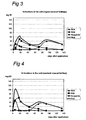
- This example demonstrates the nitrogen release patern of an organomineral fertilizer comparable to the organomineral fertilizer of example 2 compared to an organic soil improver (conditioned dried pelletised chicken manure) a standard mineral fertilizer (NPK standard) and a coated slow-release mineral fertilizer (NPK slow-release, coated; 5-6 months duration).
- NPK standard standard mineral fertilizer
- NPK slow-release, coated coated; 5-6 months duration.
- the results of this experiment are shown in Figures 1-5.
- the Department of Soil Science and Plant Nutrition of Wageningen University in the Netherlands (Wageningen Universiteit, faculteit Omgevingswetenschappen, Sectie Bodem ambience en Plantenvoeding) performed these experiments.
- the total duration of the test was 72 days. In this period, at different points in time various amounts of water were flushed through the soil at certain moments. The amount of water equals the mean amount of rainfall during the growing season (April to July) in the Netherlands. This water is analysed and gave a rough indication of the amount of nitrogen released from the soil itself and from the fertilizers/soil improvers used in a certain time period of where nitrogen is being measured.
- the experiment is performed in plastic pots.
- the height of the pots is 25 cm and the pots have diameters of 24 cm.
- These pots are placed in a plastic bucket to collect the flush of water. In case there is flushed with a lot of water, an empty pot is placed under the bucket (14 cm high) such that enough room is created for the flushed water.
- the soil is a humic sandy soil from the surroundings of Wageningen.
- the organic matter content is about 2.6 wt.% and the pH is 6.5.
- the mineral nitrogen content is very low.
- the maximum water holding capacity of this soil is 230 ml per kg soil. With filling the pots, the soil is being made moist until field capacity (60% of maximum water holding capacity).
- the pots are divided and filled in 2 parts.
- the soil is covered with filtering paper so that with rewetting the soil with water during the experiment, the upper soil is not disturbed.
- 3 numbers are put on the bucket on top of each other.
- the first number represents the pot number and furthermore, the treatment.
- the second number is the total weight of the bucket plus the pot under the pot with soil in the bucket and the pot with soil. This weight relates to a moisture content of the soil of 60% of the water holding capacity.
- the third number is the weight of the bucket alone. After all pots have been filled, they are placed in the climate chamber at 25 °C.
- the method of analyzing is according to Soil analyses procedures Extraction with 0,01 M CaCl 2 (Soil and Plant Analyses, Part 5A), Houba, V.J.G, Novazamsky I, Temminghoff, E., Syllabus 1997 Landbouwuniversiteit Wageningen (06173011).
- the amount water-soluble organic nitrogen/organomineral nitrogen (urea and transformed urea) is calculated from the analyzed fractions.
- the absolute amount of flushed element can be determined by the flushing weight (rounded off by grams).
- Figure 1 shows that in the sandy soil mineralization starts directly from the start of the experiment. Nitrification starts after 17 days. The total amount of nitrogen fractions in the soil is rather low. The rather high amount of organomineral N at the start of the experiment is due to the decomposition of organic matter. Then amide-N (NH 2 ) is released and transformed into ammonium (NH 4 ).
- Figure 2 shows the release pattern of the conditioned chicken manure (ingredient of the organomineral fertilizer of the invention). Mineralization starts after 20 days. Then the nitrogen release stays rather stable. Only a change form ammonium to nitrate takes place.
- Figure 4 shows the traditional picture of the nitrogen release of a standard mineral NPK fertilizer in which the total nitrogen content consists of 50% nitrate and 50% ammonium. Directly at the start of the experiment a high nitrogen release (all mineral N) is analysed.
- the organomineral fertilizer ( Figure 3) has no nitrate release at the beginning, only ammonia, urea and organomineral nitrogen.
- the organonitrogen fraction lasts for about 1 to 2 months.
- This example demonstrates the mineral efficiency of an organomineral NPK fertilizer according to the invention compared to the use of standard NPK fertilizers in the cultivation of seed unions. The experiment was done on a trial field in the open air.
- Table 6 is the color and development on July 17, the percentage unions fallen on August 27 and the total yield and size differentiation are presented out.
- the untreated plots showed a significant lower yield than the objects that have been treated.
- Object C treated with the organomineral of the invention has significant more proceeds than the standard fertilization (B).
- the standard fertilization gave a total yield of 635 kg/ha and stayed significant under the organomineral fertilizer yield (about 700 kg/ha).
- the size differentiation was better with organomineral fertilizer than with standard NPK fertilizers. All this was achieved with just one application of the organomineral fertilizer organo-mineral fertilizer against two applications with standard mineral fertilizers. That means that the organomineral fertilizer does not only give a better yield and quality of the unions but also significantly saves time on application.
- This example demonstrates the mineral efficiency of the organomineral NPK fertilizer (Organomineral fertilizer) compared to the use of standard NPK fertilizers in the cultivation of spinach. Especially N-efficiency related to the controlling or reducing of nitrate in spinach is watched. This should have happened via special fertilization or crop squirting.
- Table 12 Amount of nitrate in the spinach Object Results amount of nitrate 1 473 b 2 523 b 3 371 b 4 484 b 5 923 a F-value 0.06 5 % LSD 201
- Table 13 Average counted amount of leaves and calculated yield Object Number of leaves Yield (Mt/ha)* 1 6 21.4 2 11 39.3 3 10 35.7 4 9 32.1 5 7 25.0 (* The yield is calculated and extrapolated, based on the difference in counted leaves and an average yield of 25 Mt/ha in common practice.)
Landscapes
- Chemical & Material Sciences (AREA)
- Organic Chemistry (AREA)
- Fertilizers (AREA)
Abstract
Claims (16)
- Procédé de production d'un engrais organominéral, le procédé impliquant de bien mélanger de l'engrais minéral, de l'urée, un composé de type lignine et de l'engrais organique pour obtenir un mélange, et de chauffer ledit mélange, l'engrais organique comprenant du fumier.
- Procédé selon la revendication 1, dans lequel l'engrais organominéral comprend de 20 à 80 % en poids d'engrais minéral, de 2 à 40 % en poids d'urée, de 20 à 80 % en poids d'engrais organique et de 0,5 à 5 % en poids d'un composé de type lignine, sur la base du poids total de l'engrais organominéral.
- Procédé selon l'une des revendications 1 ou 2, dans lequel l'engrais minéral comprend une ou plusieurs des substances suivantes : phosphate diammonique (DAP), phosphate monoammonique (MAP), phosphorite, chlorure de potassium (MOP), sulfate de potassium (SOP), superphosphate simple (SSP), superphosphate triple (TSP), sulfate d'ammonium (AS), chlorure d'ammonium, sulfate de fer et sulfate de magnésium.
- Procédé selon l'une des revendications 1 à 3, dans lequel l'engrais organique comprend une ou plusieurs des substances suivantes : fumier de volaille, fumier de poulet, fumier de bétail, fumier de porc et, éventuellement, une ou plusieurs des substances suivantes : résidus végétaux de litière, déchets verts, champignons, coques d'arachide, enveloppes de noix de coco, gousses de cacao et herbe.
- Procédé selon l'une des revendications 1 à 4, dans lequel l'engrais organique est prétraité, ledit prétraitement comprenant le séchage de l'engrais organique.
- Procédé selon l'une des revendications 1 à 5, dans lequel le composé de type lignine se présente sous la forme d'une poudre ou d'un liquide.
- Procédé selon l'une des revendications 1 à 6, comprenant :a) le mélange de l'engrais minéral, de l'urée et de l'engrais organique ;b) le mélange d'un composé de type lignine avec le mélange fertilisant obtenu lors de l'étape a) ;c) le chauffage et l'humidification du mélange obtenu lors de l'étape b) ;d) le chauffage du mélange obtenu lors de l'étape c).
- Procédé selon la revendication 7, dans lequel le chauffage et l'humidification appliqués lors de l'étape c) au mélange obtenu lors de l'étape b) comprennent l'introduction de vapeur dans le mélange.
- Procédé selon l'une des revendications 1 à 8, dans lequel le chauffage du mélange est réalisé par granulation du mélange et, éventuellement, par chauffage du mélange.
- Procédé selon la revendication 9, dans lequel la granulation est réalisée à une pression comprise entre 90 et 120 bar.
- Procédé selon l'une des revendications 1 à 10, comprenant, en outre, les étapes consistant à refroidir, broyer et tamiser le produit obtenu après chauffage et à enrober les particules tamisées obtenues après tamisage.
- Procédé selon l'une des revendications 1 à 11, dans lequel le composé de type lignine comprend de la lignine et/ou du lignosulfonate.
- Procédé selon l'une des revendications 1 à 12, dans lequel le pH est maintenu entre 6 et 7,5 lors du mélange.
- Engrais organominéral, comprenant de l'engrais minéral, de l'urée, de l'engrais organique et un composé de type lignine, pouvant être obtenu selon l'une des revendications 1 à 13.
- Engrais organominéral selon la revendication 14, comprenant de 20 à 80 % en poids d'engrais minéral, de 2 à 40 % en poids d'urée, de 20 à 80 % en poids d'engrais organique et de 0,5 à 5 % en poids d'un composé de type lignine, sur la base du poids total de l'engrais organominéral.
- Engrais organominéral selon les revendications 14 ou 15, comprenant de 25 à 75 % en poids d'azote organique hydrosoluble, de 15 à 70 % en poids d'azote minéral hydrosoluble et de 5 à 25 % en poids d'azote organique non hydrosoluble, sur la base de la teneur totale en azote de l'engrais organominéral.
Priority Applications (1)
| Application Number | Priority Date | Filing Date | Title |
|---|---|---|---|
| AT03741656T ATE346027T1 (de) | 2003-06-27 | 2003-06-27 | Verfahren zur herstellung eines düngemittels und das düngemittel |
Applications Claiming Priority (1)
| Application Number | Priority Date | Filing Date | Title |
|---|---|---|---|
| PCT/NL2003/000480 WO2005000770A1 (fr) | 2003-06-27 | 2003-06-27 | Engrais et procede de production correspondant |
Publications (2)
| Publication Number | Publication Date |
|---|---|
| EP1644302A1 EP1644302A1 (fr) | 2006-04-12 |
| EP1644302B1 true EP1644302B1 (fr) | 2006-11-22 |
Family
ID=33550372
Family Applications (1)
| Application Number | Title | Priority Date | Filing Date |
|---|---|---|---|
| EP03741656A Expired - Lifetime EP1644302B1 (fr) | 2003-06-27 | 2003-06-27 | Engrais et procede de production correspondant |
Country Status (7)
| Country | Link |
|---|---|
| US (1) | US20070095118A1 (fr) |
| EP (1) | EP1644302B1 (fr) |
| AU (1) | AU2003304243A1 (fr) |
| CA (1) | CA2529222A1 (fr) |
| DE (1) | DE60309938T2 (fr) |
| ES (1) | ES2277093T3 (fr) |
| WO (1) | WO2005000770A1 (fr) |
Cited By (2)
| Publication number | Priority date | Publication date | Assignee | Title |
|---|---|---|---|---|
| RU2550037C1 (ru) * | 2013-12-04 | 2015-05-10 | Общество с ограниченной ответственностью "НеоФор" | Способ получения биогумуса |
| WO2025063837A2 (fr) | 2023-09-01 | 2025-03-27 | Universite Mohammed VI Polytechnique | Nouvel engrais hybride de type organo- minéral |
Families Citing this family (28)
| Publication number | Priority date | Publication date | Assignee | Title |
|---|---|---|---|---|
| US20040244448A1 (en) * | 1996-09-30 | 2004-12-09 | Blount David H. | Urea condensate-organic waste material products |
| US20050166652A1 (en) * | 1996-09-30 | 2005-08-04 | Blount David H. | Urea based fertilizer, fungicide and insecticide |
| US20050178177A1 (en) * | 2004-02-18 | 2005-08-18 | Universite Laval | Organo phosphatic fertilizer |
| US8048190B2 (en) * | 2007-12-19 | 2011-11-01 | Jose Luis Miranda Valencia | Composition of liquid fertilizer |
| EP2451759A1 (fr) * | 2009-07-07 | 2012-05-16 | Sveaskog Förvaltnings AB | Procédé de préparation d'engrais à libération lente |
| ES2848156T3 (es) | 2009-09-03 | 2021-08-05 | Fbsciences Holdings Inc | Composiciones y métodos de tratamiento de semillas |
| CA2775407A1 (fr) * | 2009-09-28 | 2011-03-31 | Fbsciences Holdings, Inc. | Compositions pour engrais et procedes |
| SG184852A1 (en) * | 2010-04-12 | 2012-11-29 | Avelis Llc | Mineral complex, compositions thereof, and methods of using the same |
| US8682584B2 (en) * | 2011-08-19 | 2014-03-25 | Brookside Laboratories, Inc. | Nitrogen potential index |
| EP2802204B1 (fr) | 2012-01-12 | 2020-09-09 | FBSciences Holdings, Inc. | Modulation de la biologie végétale |
| US20130255340A1 (en) * | 2012-04-02 | 2013-10-03 | David H. Blount | Delignification of biomass containing lignin and production of long lasting lignin fertilizer |
| WO2014009326A1 (fr) * | 2012-07-09 | 2014-01-16 | Shell Internationale Research Maatschappij B.V. | Procédé pour la préparation d'une émulsion de particules de soufre élémentaire |
| US9174885B2 (en) | 2013-03-15 | 2015-11-03 | University Of Kentucky Research Foundation | Nitrogen fertilizer composition and method to improve detection and lessen the explosive potential of nitrogen-based fertilizers |
| EP2835392A1 (fr) * | 2013-08-06 | 2015-02-11 | Maxbiogas GmbH | Nouvelles composition contenant de la lignine |
| CA2935921C (fr) | 2014-01-09 | 2022-08-02 | Shell Internationale Research Maatschappij B.V. | Procede de preparation d'un engrais a base du'ree et de soufre |
| MX380582B (es) * | 2014-01-09 | 2025-03-12 | Shell Int Research | Fertilizador con menor contenido de biuret. |
| CN103755498B (zh) * | 2014-01-23 | 2015-02-25 | 成都新柯力化工科技有限公司 | 一种水溶性矿物肥及其制备方法 |
| CN103951515B (zh) * | 2014-05-04 | 2015-12-02 | 靳玉环 | 一种生态农业栽培土壤、其制备方法及其应用 |
| WO2015176076A2 (fr) * | 2014-05-12 | 2015-11-19 | Gary David Mcknight | Amélioration de l'efficacité d'engrais artificiel et/ou à base de fumier animal d'origine organique naturel par libération des nutriments liés (macro et micro) grâce à l'utilisation de formulations d'administration liquides non aqueuses contenant des poly(acides organiques) organiques et/ou leurs sels |
| CN104045419A (zh) * | 2014-05-23 | 2014-09-17 | 保康丰源肥业有限责任公司 | 复混肥料及其生产方法 |
| BR112017001547B1 (pt) | 2014-07-28 | 2022-09-13 | Shell Internationale Research Maatschappij B.V | Processo para fabricação de uma composição de fertilizante de ureia-enxofre |
| CN104262058A (zh) * | 2014-09-30 | 2015-01-07 | 广西博白县琼达农业科技有限公司 | 一种花生化肥 |
| US10464858B2 (en) * | 2015-05-13 | 2019-11-05 | World Source Enterprises, Llc | Non-aqueous organo liquid delivery systems containing dispersed poly (organic acids) that improve availability of macro and micro-nutrients to plants |
| CN109574737A (zh) * | 2019-01-22 | 2019-04-05 | 东北师范大学 | 一种花生专用有机块型肥料的制法及其规模化应用 |
| CN110015935A (zh) * | 2019-04-09 | 2019-07-16 | 福建农林大学 | 一种设施番茄专用有机无机颗粒复混肥 |
| WO2020264322A1 (fr) * | 2019-06-28 | 2020-12-30 | Sustainable Fiber Technologies, LLC | Engrais agricole à base de lignine-urée |
| CN111393235A (zh) * | 2020-05-09 | 2020-07-10 | 山东植丰农化集团有限公司 | 一种高磷缓释菌肥及其制法 |
| CN114933507A (zh) * | 2022-04-18 | 2022-08-23 | 黑龙江晟禾农业生物科技有限公司 | 一种矿源生物有机肥及其制备方法 |
Family Cites Families (15)
| Publication number | Priority date | Publication date | Assignee | Title |
|---|---|---|---|---|
| JPS5715070B2 (fr) * | 1974-04-23 | 1982-03-27 | ||
| SU952831A1 (ru) * | 1980-05-20 | 1982-08-23 | Институт Торфа Ан Бсср | Органоминеральное удобрение |
| US4545802A (en) * | 1984-06-25 | 1985-10-08 | The Dow Chemical Company | Soil treating method and composition for conserving nitrogen in soil |
| SU1661180A1 (ru) * | 1989-06-06 | 1991-07-07 | Днепропетровский химико-технологический институт им.Ф.Э.Дзержинского | Способ получени модифицированного азотного удобрени |
| US5443613A (en) * | 1989-11-06 | 1995-08-22 | Robinson; Elmo C. | Method for producing suspension fertilizer |
| GB2253621B (en) * | 1991-03-14 | 1994-11-23 | Intevep Sa | Fertilizer composition |
| US5466273A (en) * | 1994-04-28 | 1995-11-14 | Connell; Larry V. | Method of treating organic material |
| US5411568A (en) * | 1994-05-25 | 1995-05-02 | Harmony Products Inc. | Highly available waste based nitrogen fertilizer |
| US6413291B1 (en) * | 1995-03-03 | 2002-07-02 | Magic Green Corporation | Soil conditioning agglomerates containing calcium |
| US6287356B1 (en) * | 1995-03-03 | 2001-09-11 | Magic Green Corporation | Soil conditioning agglomerates containing calcium |
| US5997599A (en) * | 1995-03-03 | 1999-12-07 | Magic Green Corporation | Soil conditioning agglomerates containing cement kiln dust |
| US5741346A (en) * | 1996-05-30 | 1998-04-21 | Vulcan Materials Company | Mineral and organic fertilizer |
| US6206945B1 (en) * | 1998-08-10 | 2001-03-27 | Charles Arthur Weiss, Jr. | Method of producing artificial guano |
| US6312492B1 (en) * | 1999-09-21 | 2001-11-06 | Harold W. Wilson | Beneficiation of animal manure |
| EP1487761B1 (fr) * | 2002-03-26 | 2013-12-04 | Koch Agronomic Services, LLC | Méthode pour la production de particules de polymère d'urée-formaldéhyde comme engrais azoté à libération contrôlée |
-
2003
- 2003-06-27 CA CA002529222A patent/CA2529222A1/fr not_active Abandoned
- 2003-06-27 EP EP03741656A patent/EP1644302B1/fr not_active Expired - Lifetime
- 2003-06-27 WO PCT/NL2003/000480 patent/WO2005000770A1/fr not_active Ceased
- 2003-06-27 AU AU2003304243A patent/AU2003304243A1/en not_active Abandoned
- 2003-06-27 US US10/561,240 patent/US20070095118A1/en not_active Abandoned
- 2003-06-27 ES ES03741656T patent/ES2277093T3/es not_active Expired - Lifetime
- 2003-06-27 DE DE60309938T patent/DE60309938T2/de not_active Expired - Lifetime
Cited By (2)
| Publication number | Priority date | Publication date | Assignee | Title |
|---|---|---|---|---|
| RU2550037C1 (ru) * | 2013-12-04 | 2015-05-10 | Общество с ограниченной ответственностью "НеоФор" | Способ получения биогумуса |
| WO2025063837A2 (fr) | 2023-09-01 | 2025-03-27 | Universite Mohammed VI Polytechnique | Nouvel engrais hybride de type organo- minéral |
Also Published As
| Publication number | Publication date |
|---|---|
| AU2003304243A1 (en) | 2005-01-13 |
| CA2529222A1 (fr) | 2005-01-06 |
| ES2277093T3 (es) | 2007-07-01 |
| US20070095118A1 (en) | 2007-05-03 |
| WO2005000770A1 (fr) | 2005-01-06 |
| DE60309938T2 (de) | 2007-05-24 |
| EP1644302A1 (fr) | 2006-04-12 |
| DE60309938D1 (de) | 2007-01-04 |
Similar Documents
| Publication | Publication Date | Title |
|---|---|---|
| US20070095118A1 (en) | Process for the production of a fertilizer and fertilizer | |
| EP2694456B1 (fr) | Système de liaison lignine-glucide multi-usages | |
| CA2006751C (fr) | Engrais azote en granules homogenes | |
| CA2479614C (fr) | Engrais azote a liberation lente | |
| CN101468930B (zh) | 适宜于盐碱地使用的甜高粱专用无机复合底肥及制备方法 | |
| CN104876769B (zh) | 一种改良土壤酸化的硅元素碱性肥料及其制备方法 | |
| US20030205072A1 (en) | Soil improving and fertilising composition | |
| CA2295344A1 (fr) | Composition d'additifs probiotiques pour sols et methode | |
| AU2006207886B2 (en) | Fertiliser | |
| Chandra et al. | Role of polymer coated fertilizers (PCFS) an advance technology for improving nutrient use efficiency and crop productivity: A review | |
| CN107759328A (zh) | 旱薄地花生专用包膜控释肥及其制备方法 | |
| RU2401824C2 (ru) | Удобрение "зеленит" | |
| CN112159274A (zh) | 一种具有生防营养功能的微生物颗粒菌剂 | |
| CN112341264A (zh) | 一种有机肥料 | |
| CA2382856A1 (fr) | Ameliorations apportees aux fertilisants | |
| Varadachari et al. | Slow-release and controlled-release nitrogen fertilizers | |
| EP3024804B1 (fr) | Fertilisant au magnésium à haute efficacité | |
| GB2229350A (en) | Pelleted seed | |
| JP5401656B2 (ja) | 粘土熱処理粒状物 | |
| El-Sayed et al. | Responses of maize (Zea mays L.) production and soil fertility to application controlled-release N-fertilizers and poultry manure | |
| CN119462297B (zh) | 利用生物结皮改良坡耕地酸化土壤的复混肥及其制备方法 | |
| KR20010086703A (ko) | 완효성 비료의 제조방법 및 그 제조물 | |
| KR20020033450A (ko) | 유리아미노산 함유의 누에번데기를 이용한 생물자극형비료. | |
| PL146275B1 (en) | Melamine containing nitrogenous fertilizer and method of obtaining the same | |
| CN102992912A (zh) | 一种掺混肥料 |
Legal Events
| Date | Code | Title | Description |
|---|---|---|---|
| PUAI | Public reference made under article 153(3) epc to a published international application that has entered the european phase |
Free format text: ORIGINAL CODE: 0009012 |
|
| 17P | Request for examination filed |
Effective date: 20051207 |
|
| AK | Designated contracting states |
Kind code of ref document: A1 Designated state(s): AT BE BG CH CY CZ DE DK EE ES FI FR GB GR HU IE IT LI LU MC NL PT RO SE SI SK TR |
|
| GRAP | Despatch of communication of intention to grant a patent |
Free format text: ORIGINAL CODE: EPIDOSNIGR1 |
|
| GRAS | Grant fee paid |
Free format text: ORIGINAL CODE: EPIDOSNIGR3 |
|
| DAX | Request for extension of the european patent (deleted) | ||
| GRAA | (expected) grant |
Free format text: ORIGINAL CODE: 0009210 |
|
| AK | Designated contracting states |
Kind code of ref document: B1 Designated state(s): AT BE BG CH CY CZ DE DK EE ES FI FR GB GR HU IE IT LI LU MC NL PT RO SE SI SK TR |
|
| PG25 | Lapsed in a contracting state [announced via postgrant information from national office to epo] |
Ref country code: SK Free format text: LAPSE BECAUSE OF FAILURE TO SUBMIT A TRANSLATION OF THE DESCRIPTION OR TO PAY THE FEE WITHIN THE PRESCRIBED TIME-LIMIT Effective date: 20061122 Ref country code: SI Free format text: LAPSE BECAUSE OF FAILURE TO SUBMIT A TRANSLATION OF THE DESCRIPTION OR TO PAY THE FEE WITHIN THE PRESCRIBED TIME-LIMIT Effective date: 20061122 Ref country code: RO Free format text: LAPSE BECAUSE OF FAILURE TO SUBMIT A TRANSLATION OF THE DESCRIPTION OR TO PAY THE FEE WITHIN THE PRESCRIBED TIME-LIMIT Effective date: 20061122 Ref country code: AT Free format text: LAPSE BECAUSE OF FAILURE TO SUBMIT A TRANSLATION OF THE DESCRIPTION OR TO PAY THE FEE WITHIN THE PRESCRIBED TIME-LIMIT Effective date: 20061122 Ref country code: FI Free format text: LAPSE BECAUSE OF FAILURE TO SUBMIT A TRANSLATION OF THE DESCRIPTION OR TO PAY THE FEE WITHIN THE PRESCRIBED TIME-LIMIT Effective date: 20061122 Ref country code: CZ Free format text: LAPSE BECAUSE OF FAILURE TO SUBMIT A TRANSLATION OF THE DESCRIPTION OR TO PAY THE FEE WITHIN THE PRESCRIBED TIME-LIMIT Effective date: 20061122 Ref country code: IT Free format text: LAPSE BECAUSE OF FAILURE TO SUBMIT A TRANSLATION OF THE DESCRIPTION OR TO PAY THE FEE WITHIN THE PRESCRIBED TIME-LIMIT;WARNING: LAPSES OF ITALIAN PATENTS WITH EFFECTIVE DATE BEFORE 2007 MAY HAVE OCCURRED AT ANY TIME BEFORE 2007. THE CORRECT EFFECTIVE DATE MAY BE DIFFERENT FROM THE ONE RECORDED. Effective date: 20061122 |
|
| REG | Reference to a national code |
Ref country code: GB Ref legal event code: FG4D |
|
| REG | Reference to a national code |
Ref country code: CH Ref legal event code: EP |
|
| REG | Reference to a national code |
Ref country code: IE Ref legal event code: FG4D |
|
| REF | Corresponds to: |
Ref document number: 60309938 Country of ref document: DE Date of ref document: 20070104 Kind code of ref document: P |
|
| REG | Reference to a national code |
Ref country code: CH Ref legal event code: NV Representative=s name: BRAUNPAT BRAUN EDER AG |
|
| PG25 | Lapsed in a contracting state [announced via postgrant information from national office to epo] |
Ref country code: DK Free format text: LAPSE BECAUSE OF FAILURE TO SUBMIT A TRANSLATION OF THE DESCRIPTION OR TO PAY THE FEE WITHIN THE PRESCRIBED TIME-LIMIT Effective date: 20070222 Ref country code: BG Free format text: LAPSE BECAUSE OF FAILURE TO SUBMIT A TRANSLATION OF THE DESCRIPTION OR TO PAY THE FEE WITHIN THE PRESCRIBED TIME-LIMIT Effective date: 20070222 |
|
| REG | Reference to a national code |
Ref country code: SE Ref legal event code: TRGR |
|
| PG25 | Lapsed in a contracting state [announced via postgrant information from national office to epo] |
Ref country code: PT Free format text: LAPSE BECAUSE OF FAILURE TO SUBMIT A TRANSLATION OF THE DESCRIPTION OR TO PAY THE FEE WITHIN THE PRESCRIBED TIME-LIMIT Effective date: 20070423 |
|
| ET | Fr: translation filed | ||
| REG | Reference to a national code |
Ref country code: ES Ref legal event code: FG2A Ref document number: 2277093 Country of ref document: ES Kind code of ref document: T3 |
|
| PLBE | No opposition filed within time limit |
Free format text: ORIGINAL CODE: 0009261 |
|
| STAA | Information on the status of an ep patent application or granted ep patent |
Free format text: STATUS: NO OPPOSITION FILED WITHIN TIME LIMIT |
|
| 26N | No opposition filed |
Effective date: 20070823 |
|
| PG25 | Lapsed in a contracting state [announced via postgrant information from national office to epo] |
Ref country code: MC Free format text: LAPSE BECAUSE OF NON-PAYMENT OF DUE FEES Effective date: 20070630 |
|
| PG25 | Lapsed in a contracting state [announced via postgrant information from national office to epo] |
Ref country code: GR Free format text: LAPSE BECAUSE OF FAILURE TO SUBMIT A TRANSLATION OF THE DESCRIPTION OR TO PAY THE FEE WITHIN THE PRESCRIBED TIME-LIMIT Effective date: 20070223 |
|
| PG25 | Lapsed in a contracting state [announced via postgrant information from national office to epo] |
Ref country code: EE Free format text: LAPSE BECAUSE OF FAILURE TO SUBMIT A TRANSLATION OF THE DESCRIPTION OR TO PAY THE FEE WITHIN THE PRESCRIBED TIME-LIMIT Effective date: 20061122 |
|
| PG25 | Lapsed in a contracting state [announced via postgrant information from national office to epo] |
Ref country code: CY Free format text: LAPSE BECAUSE OF FAILURE TO SUBMIT A TRANSLATION OF THE DESCRIPTION OR TO PAY THE FEE WITHIN THE PRESCRIBED TIME-LIMIT Effective date: 20061122 |
|
| PG25 | Lapsed in a contracting state [announced via postgrant information from national office to epo] |
Ref country code: HU Free format text: LAPSE BECAUSE OF FAILURE TO SUBMIT A TRANSLATION OF THE DESCRIPTION OR TO PAY THE FEE WITHIN THE PRESCRIBED TIME-LIMIT Effective date: 20070523 Ref country code: TR Free format text: LAPSE BECAUSE OF FAILURE TO SUBMIT A TRANSLATION OF THE DESCRIPTION OR TO PAY THE FEE WITHIN THE PRESCRIBED TIME-LIMIT Effective date: 20061122 |
|
| REG | Reference to a national code |
Ref country code: FR Ref legal event code: PLFP Year of fee payment: 13 |
|
| REG | Reference to a national code |
Ref country code: FR Ref legal event code: PLFP Year of fee payment: 14 |
|
| REG | Reference to a national code |
Ref country code: FR Ref legal event code: PLFP Year of fee payment: 15 |
|
| PGFP | Annual fee paid to national office [announced via postgrant information from national office to epo] |
Ref country code: PT Payment date: 20170530 Year of fee payment: 12 |
|
| PGFP | Annual fee paid to national office [announced via postgrant information from national office to epo] |
Ref country code: SE Payment date: 20170627 Year of fee payment: 15 Ref country code: LU Payment date: 20170627 Year of fee payment: 15 |
|
| REG | Reference to a national code |
Ref country code: CH Ref legal event code: PCAR Free format text: NEW ADDRESS: HOLEESTRASSE 87, 4054 BASEL (CH) |
|
| REG | Reference to a national code |
Ref country code: FR Ref legal event code: PLFP Year of fee payment: 16 |
|
| REG | Reference to a national code |
Ref country code: SE Ref legal event code: EUG |
|
| PG25 | Lapsed in a contracting state [announced via postgrant information from national office to epo] |
Ref country code: SE Free format text: LAPSE BECAUSE OF NON-PAYMENT OF DUE FEES Effective date: 20180628 |
|
| PG25 | Lapsed in a contracting state [announced via postgrant information from national office to epo] |
Ref country code: LU Free format text: LAPSE BECAUSE OF NON-PAYMENT OF DUE FEES Effective date: 20180627 |
|
| REG | Reference to a national code |
Ref country code: IE Ref legal event code: MM4A |
|
| PG25 | Lapsed in a contracting state [announced via postgrant information from national office to epo] |
Ref country code: IE Free format text: LAPSE BECAUSE OF NON-PAYMENT OF DUE FEES Effective date: 20180627 |
|
| REG | Reference to a national code |
Ref country code: DE Ref legal event code: R082 Ref document number: 60309938 Country of ref document: DE Representative=s name: MEISSNER BOLTE PATENTANWAELTE RECHTSANWAELTE P, DE Ref country code: DE Ref legal event code: R081 Ref document number: 60309938 Country of ref document: DE Owner name: OLMIX B.V., NL Free format text: FORMER OWNER: MELSPRING INTERNATIONAL B.V., ARNHEM, NL |
|
| REG | Reference to a national code |
Ref country code: BE Ref legal event code: PD Owner name: OLMIX B.V.; NL Free format text: DETAILS ASSIGNMENT: CHANGE OF OWNER(S), CESSION; FORMER OWNER NAME: MELSPRING INTERNATIONAL B.V. Effective date: 20200228 |
|
| REG | Reference to a national code |
Ref country code: NL Ref legal event code: PD Owner name: OLMIX B.V.; NL Free format text: DETAILS ASSIGNMENT: CHANGE OF OWNER(S), ASSIGNMENT; FORMER OWNER NAME: MELSPRING INTERNATIONAL B.V. Effective date: 20200227 |
|
| REG | Reference to a national code |
Ref country code: GB Ref legal event code: 732E Free format text: REGISTERED BETWEEN 20200430 AND 20200506 |
|
| REG | Reference to a national code |
Ref country code: ES Ref legal event code: PC2A Owner name: OLMIX B.V. Effective date: 20200728 |
|
| PGFP | Annual fee paid to national office [announced via postgrant information from national office to epo] |
Ref country code: NL Payment date: 20220425 Year of fee payment: 20 |
|
| REG | Reference to a national code |
Ref country code: DE Ref legal event code: R082 Ref document number: 60309938 Country of ref document: DE Representative=s name: HELLMICH, WOLFGANG, DIPL.-PHYS.UNIV. DR.-ING., DE |
|
| PGFP | Annual fee paid to national office [announced via postgrant information from national office to epo] |
Ref country code: GB Payment date: 20220426 Year of fee payment: 20 Ref country code: FR Payment date: 20220519 Year of fee payment: 20 Ref country code: DE Payment date: 20220421 Year of fee payment: 20 |
|
| PGFP | Annual fee paid to national office [announced via postgrant information from national office to epo] |
Ref country code: BE Payment date: 20220421 Year of fee payment: 20 |
|
| PGFP | Annual fee paid to national office [announced via postgrant information from national office to epo] |
Ref country code: ES Payment date: 20220704 Year of fee payment: 20 |
|
| PGFP | Annual fee paid to national office [announced via postgrant information from national office to epo] |
Ref country code: CH Payment date: 20220701 Year of fee payment: 20 |
|
| REG | Reference to a national code |
Ref country code: DE Ref legal event code: R071 Ref document number: 60309938 Country of ref document: DE |
|
| REG | Reference to a national code |
Ref country code: NL Ref legal event code: MK Effective date: 20230626 |
|
| REG | Reference to a national code |
Ref country code: CH Ref legal event code: PL |
|
| REG | Reference to a national code |
Ref country code: ES Ref legal event code: FD2A Effective date: 20230704 |
|
| REG | Reference to a national code |
Ref country code: BE Ref legal event code: MK Effective date: 20230627 |
|
| REG | Reference to a national code |
Ref country code: GB Ref legal event code: PE20 Expiry date: 20230626 |
|
| PG25 | Lapsed in a contracting state [announced via postgrant information from national office to epo] |
Ref country code: ES Free format text: LAPSE BECAUSE OF EXPIRATION OF PROTECTION Effective date: 20230628 |
|
| PG25 | Lapsed in a contracting state [announced via postgrant information from national office to epo] |
Ref country code: GB Free format text: LAPSE BECAUSE OF EXPIRATION OF PROTECTION Effective date: 20230626 |