EP1645449B1 - Système d'entraînement pour véhicule automobile à propulsion hybride et son procédé de commande - Google Patents
Système d'entraînement pour véhicule automobile à propulsion hybride et son procédé de commande Download PDFInfo
- Publication number
- EP1645449B1 EP1645449B1 EP05110259A EP05110259A EP1645449B1 EP 1645449 B1 EP1645449 B1 EP 1645449B1 EP 05110259 A EP05110259 A EP 05110259A EP 05110259 A EP05110259 A EP 05110259A EP 1645449 B1 EP1645449 B1 EP 1645449B1
- Authority
- EP
- European Patent Office
- Prior art keywords
- torque
- drivetrain
- engine
- req
- gear shift
- Prior art date
- Legal status (The legal status is an assumption and is not a legal conclusion. Google has not performed a legal analysis and makes no representation as to the accuracy of the status listed.)
- Expired - Lifetime
Links
Images


Classifications
-
- B—PERFORMING OPERATIONS; TRANSPORTING
- B60—VEHICLES IN GENERAL
- B60L—PROPULSION OF ELECTRICALLY-PROPELLED VEHICLES; SUPPLYING ELECTRIC POWER FOR AUXILIARY EQUIPMENT OF ELECTRICALLY-PROPELLED VEHICLES; ELECTRODYNAMIC BRAKE SYSTEMS FOR VEHICLES IN GENERAL; MAGNETIC SUSPENSION OR LEVITATION FOR VEHICLES; MONITORING OPERATING VARIABLES OF ELECTRICALLY-PROPELLED VEHICLES; ELECTRIC SAFETY DEVICES FOR ELECTRICALLY-PROPELLED VEHICLES
- B60L58/00—Methods or circuit arrangements for monitoring or controlling batteries or fuel cells, specially adapted for electric vehicles
- B60L58/10—Methods or circuit arrangements for monitoring or controlling batteries or fuel cells, specially adapted for electric vehicles for monitoring or controlling batteries
-
- B—PERFORMING OPERATIONS; TRANSPORTING
- B60—VEHICLES IN GENERAL
- B60K—ARRANGEMENT OR MOUNTING OF PROPULSION UNITS OR OF TRANSMISSIONS IN VEHICLES; ARRANGEMENT OR MOUNTING OF PLURAL DIVERSE PRIME-MOVERS IN VEHICLES; AUXILIARY DRIVES FOR VEHICLES; INSTRUMENTATION OR DASHBOARDS FOR VEHICLES; ARRANGEMENTS IN CONNECTION WITH COOLING, AIR INTAKE, GAS EXHAUST OR FUEL SUPPLY OF PROPULSION UNITS IN VEHICLES
- B60K6/00—Arrangement or mounting of plural diverse prime-movers for mutual or common propulsion, e.g. hybrid propulsion systems comprising electric motors and internal combustion engines
- B60K6/20—Arrangement or mounting of plural diverse prime-movers for mutual or common propulsion, e.g. hybrid propulsion systems comprising electric motors and internal combustion engines the prime-movers consisting of electric motors and internal combustion engines, e.g. HEVs
- B60K6/42—Arrangement or mounting of plural diverse prime-movers for mutual or common propulsion, e.g. hybrid propulsion systems comprising electric motors and internal combustion engines the prime-movers consisting of electric motors and internal combustion engines, e.g. HEVs characterised by the architecture of the hybrid electric vehicle
- B60K6/48—Parallel type
-
- B—PERFORMING OPERATIONS; TRANSPORTING
- B60—VEHICLES IN GENERAL
- B60K—ARRANGEMENT OR MOUNTING OF PROPULSION UNITS OR OF TRANSMISSIONS IN VEHICLES; ARRANGEMENT OR MOUNTING OF PLURAL DIVERSE PRIME-MOVERS IN VEHICLES; AUXILIARY DRIVES FOR VEHICLES; INSTRUMENTATION OR DASHBOARDS FOR VEHICLES; ARRANGEMENTS IN CONNECTION WITH COOLING, AIR INTAKE, GAS EXHAUST OR FUEL SUPPLY OF PROPULSION UNITS IN VEHICLES
- B60K6/00—Arrangement or mounting of plural diverse prime-movers for mutual or common propulsion, e.g. hybrid propulsion systems comprising electric motors and internal combustion engines
- B60K6/20—Arrangement or mounting of plural diverse prime-movers for mutual or common propulsion, e.g. hybrid propulsion systems comprising electric motors and internal combustion engines the prime-movers consisting of electric motors and internal combustion engines, e.g. HEVs
- B60K6/50—Architecture of the driveline characterised by arrangement or kind of transmission units
- B60K6/54—Transmission for changing ratio
-
- B—PERFORMING OPERATIONS; TRANSPORTING
- B60—VEHICLES IN GENERAL
- B60L—PROPULSION OF ELECTRICALLY-PROPELLED VEHICLES; SUPPLYING ELECTRIC POWER FOR AUXILIARY EQUIPMENT OF ELECTRICALLY-PROPELLED VEHICLES; ELECTRODYNAMIC BRAKE SYSTEMS FOR VEHICLES IN GENERAL; MAGNETIC SUSPENSION OR LEVITATION FOR VEHICLES; MONITORING OPERATING VARIABLES OF ELECTRICALLY-PROPELLED VEHICLES; ELECTRIC SAFETY DEVICES FOR ELECTRICALLY-PROPELLED VEHICLES
- B60L15/00—Methods, circuits, or devices for controlling the traction-motor speed of electrically-propelled vehicles
- B60L15/20—Methods, circuits, or devices for controlling the traction-motor speed of electrically-propelled vehicles for control of the vehicle or its driving motor to achieve a desired performance, e.g. speed, torque, programmed variation of speed
-
- B—PERFORMING OPERATIONS; TRANSPORTING
- B60—VEHICLES IN GENERAL
- B60L—PROPULSION OF ELECTRICALLY-PROPELLED VEHICLES; SUPPLYING ELECTRIC POWER FOR AUXILIARY EQUIPMENT OF ELECTRICALLY-PROPELLED VEHICLES; ELECTRODYNAMIC BRAKE SYSTEMS FOR VEHICLES IN GENERAL; MAGNETIC SUSPENSION OR LEVITATION FOR VEHICLES; MONITORING OPERATING VARIABLES OF ELECTRICALLY-PROPELLED VEHICLES; ELECTRIC SAFETY DEVICES FOR ELECTRICALLY-PROPELLED VEHICLES
- B60L50/00—Electric propulsion with power supplied within the vehicle
- B60L50/10—Electric propulsion with power supplied within the vehicle using propulsion power supplied by engine-driven generators, e.g. generators driven by combustion engines
- B60L50/16—Electric propulsion with power supplied within the vehicle using propulsion power supplied by engine-driven generators, e.g. generators driven by combustion engines with provision for separate direct mechanical propulsion
-
- B—PERFORMING OPERATIONS; TRANSPORTING
- B60—VEHICLES IN GENERAL
- B60L—PROPULSION OF ELECTRICALLY-PROPELLED VEHICLES; SUPPLYING ELECTRIC POWER FOR AUXILIARY EQUIPMENT OF ELECTRICALLY-PROPELLED VEHICLES; ELECTRODYNAMIC BRAKE SYSTEMS FOR VEHICLES IN GENERAL; MAGNETIC SUSPENSION OR LEVITATION FOR VEHICLES; MONITORING OPERATING VARIABLES OF ELECTRICALLY-PROPELLED VEHICLES; ELECTRIC SAFETY DEVICES FOR ELECTRICALLY-PROPELLED VEHICLES
- B60L58/00—Methods or circuit arrangements for monitoring or controlling batteries or fuel cells, specially adapted for electric vehicles
- B60L58/10—Methods or circuit arrangements for monitoring or controlling batteries or fuel cells, specially adapted for electric vehicles for monitoring or controlling batteries
- B60L58/16—Methods or circuit arrangements for monitoring or controlling batteries or fuel cells, specially adapted for electric vehicles for monitoring or controlling batteries responding to battery ageing, e.g. to the number of charging cycles or the state of health [SoH]
-
- B—PERFORMING OPERATIONS; TRANSPORTING
- B60—VEHICLES IN GENERAL
- B60W—CONJOINT CONTROL OF VEHICLE SUB-UNITS OF DIFFERENT TYPE OR DIFFERENT FUNCTION; CONTROL SYSTEMS SPECIALLY ADAPTED FOR HYBRID VEHICLES; ROAD VEHICLE DRIVE CONTROL SYSTEMS FOR PURPOSES NOT RELATED TO THE CONTROL OF A PARTICULAR SUB-UNIT
- B60W10/00—Conjoint control of vehicle sub-units of different type or different function
- B60W10/04—Conjoint control of vehicle sub-units of different type or different function including control of propulsion units
- B60W10/06—Conjoint control of vehicle sub-units of different type or different function including control of propulsion units including control of combustion engines
-
- B—PERFORMING OPERATIONS; TRANSPORTING
- B60—VEHICLES IN GENERAL
- B60W—CONJOINT CONTROL OF VEHICLE SUB-UNITS OF DIFFERENT TYPE OR DIFFERENT FUNCTION; CONTROL SYSTEMS SPECIALLY ADAPTED FOR HYBRID VEHICLES; ROAD VEHICLE DRIVE CONTROL SYSTEMS FOR PURPOSES NOT RELATED TO THE CONTROL OF A PARTICULAR SUB-UNIT
- B60W10/00—Conjoint control of vehicle sub-units of different type or different function
- B60W10/04—Conjoint control of vehicle sub-units of different type or different function including control of propulsion units
- B60W10/08—Conjoint control of vehicle sub-units of different type or different function including control of propulsion units including control of electric propulsion units, e.g. motors or generators
-
- B—PERFORMING OPERATIONS; TRANSPORTING
- B60—VEHICLES IN GENERAL
- B60W—CONJOINT CONTROL OF VEHICLE SUB-UNITS OF DIFFERENT TYPE OR DIFFERENT FUNCTION; CONTROL SYSTEMS SPECIALLY ADAPTED FOR HYBRID VEHICLES; ROAD VEHICLE DRIVE CONTROL SYSTEMS FOR PURPOSES NOT RELATED TO THE CONTROL OF A PARTICULAR SUB-UNIT
- B60W10/00—Conjoint control of vehicle sub-units of different type or different function
- B60W10/10—Conjoint control of vehicle sub-units of different type or different function including control of change-speed gearings
-
- B—PERFORMING OPERATIONS; TRANSPORTING
- B60—VEHICLES IN GENERAL
- B60W—CONJOINT CONTROL OF VEHICLE SUB-UNITS OF DIFFERENT TYPE OR DIFFERENT FUNCTION; CONTROL SYSTEMS SPECIALLY ADAPTED FOR HYBRID VEHICLES; ROAD VEHICLE DRIVE CONTROL SYSTEMS FOR PURPOSES NOT RELATED TO THE CONTROL OF A PARTICULAR SUB-UNIT
- B60W20/00—Control systems specially adapted for hybrid vehicles
- B60W20/30—Control strategies involving selection of transmission gear ratio
-
- B—PERFORMING OPERATIONS; TRANSPORTING
- B60—VEHICLES IN GENERAL
- B60L—PROPULSION OF ELECTRICALLY-PROPELLED VEHICLES; SUPPLYING ELECTRIC POWER FOR AUXILIARY EQUIPMENT OF ELECTRICALLY-PROPELLED VEHICLES; ELECTRODYNAMIC BRAKE SYSTEMS FOR VEHICLES IN GENERAL; MAGNETIC SUSPENSION OR LEVITATION FOR VEHICLES; MONITORING OPERATING VARIABLES OF ELECTRICALLY-PROPELLED VEHICLES; ELECTRIC SAFETY DEVICES FOR ELECTRICALLY-PROPELLED VEHICLES
- B60L2240/00—Control parameters of input or output; Target parameters
- B60L2240/10—Vehicle control parameters
- B60L2240/12—Speed
-
- B—PERFORMING OPERATIONS; TRANSPORTING
- B60—VEHICLES IN GENERAL
- B60L—PROPULSION OF ELECTRICALLY-PROPELLED VEHICLES; SUPPLYING ELECTRIC POWER FOR AUXILIARY EQUIPMENT OF ELECTRICALLY-PROPELLED VEHICLES; ELECTRODYNAMIC BRAKE SYSTEMS FOR VEHICLES IN GENERAL; MAGNETIC SUSPENSION OR LEVITATION FOR VEHICLES; MONITORING OPERATING VARIABLES OF ELECTRICALLY-PROPELLED VEHICLES; ELECTRIC SAFETY DEVICES FOR ELECTRICALLY-PROPELLED VEHICLES
- B60L2240/00—Control parameters of input or output; Target parameters
- B60L2240/40—Drive Train control parameters
- B60L2240/42—Drive Train control parameters related to electric machines
- B60L2240/423—Torque
-
- B—PERFORMING OPERATIONS; TRANSPORTING
- B60—VEHICLES IN GENERAL
- B60L—PROPULSION OF ELECTRICALLY-PROPELLED VEHICLES; SUPPLYING ELECTRIC POWER FOR AUXILIARY EQUIPMENT OF ELECTRICALLY-PROPELLED VEHICLES; ELECTRODYNAMIC BRAKE SYSTEMS FOR VEHICLES IN GENERAL; MAGNETIC SUSPENSION OR LEVITATION FOR VEHICLES; MONITORING OPERATING VARIABLES OF ELECTRICALLY-PROPELLED VEHICLES; ELECTRIC SAFETY DEVICES FOR ELECTRICALLY-PROPELLED VEHICLES
- B60L2240/00—Control parameters of input or output; Target parameters
- B60L2240/40—Drive Train control parameters
- B60L2240/44—Drive Train control parameters related to combustion engines
- B60L2240/441—Speed
-
- B—PERFORMING OPERATIONS; TRANSPORTING
- B60—VEHICLES IN GENERAL
- B60L—PROPULSION OF ELECTRICALLY-PROPELLED VEHICLES; SUPPLYING ELECTRIC POWER FOR AUXILIARY EQUIPMENT OF ELECTRICALLY-PROPELLED VEHICLES; ELECTRODYNAMIC BRAKE SYSTEMS FOR VEHICLES IN GENERAL; MAGNETIC SUSPENSION OR LEVITATION FOR VEHICLES; MONITORING OPERATING VARIABLES OF ELECTRICALLY-PROPELLED VEHICLES; ELECTRIC SAFETY DEVICES FOR ELECTRICALLY-PROPELLED VEHICLES
- B60L2240/00—Control parameters of input or output; Target parameters
- B60L2240/40—Drive Train control parameters
- B60L2240/44—Drive Train control parameters related to combustion engines
- B60L2240/443—Torque
-
- B—PERFORMING OPERATIONS; TRANSPORTING
- B60—VEHICLES IN GENERAL
- B60L—PROPULSION OF ELECTRICALLY-PROPELLED VEHICLES; SUPPLYING ELECTRIC POWER FOR AUXILIARY EQUIPMENT OF ELECTRICALLY-PROPELLED VEHICLES; ELECTRODYNAMIC BRAKE SYSTEMS FOR VEHICLES IN GENERAL; MAGNETIC SUSPENSION OR LEVITATION FOR VEHICLES; MONITORING OPERATING VARIABLES OF ELECTRICALLY-PROPELLED VEHICLES; ELECTRIC SAFETY DEVICES FOR ELECTRICALLY-PROPELLED VEHICLES
- B60L2240/00—Control parameters of input or output; Target parameters
- B60L2240/40—Drive Train control parameters
- B60L2240/44—Drive Train control parameters related to combustion engines
- B60L2240/445—Temperature
-
- B—PERFORMING OPERATIONS; TRANSPORTING
- B60—VEHICLES IN GENERAL
- B60L—PROPULSION OF ELECTRICALLY-PROPELLED VEHICLES; SUPPLYING ELECTRIC POWER FOR AUXILIARY EQUIPMENT OF ELECTRICALLY-PROPELLED VEHICLES; ELECTRODYNAMIC BRAKE SYSTEMS FOR VEHICLES IN GENERAL; MAGNETIC SUSPENSION OR LEVITATION FOR VEHICLES; MONITORING OPERATING VARIABLES OF ELECTRICALLY-PROPELLED VEHICLES; ELECTRIC SAFETY DEVICES FOR ELECTRICALLY-PROPELLED VEHICLES
- B60L2240/00—Control parameters of input or output; Target parameters
- B60L2240/40—Drive Train control parameters
- B60L2240/48—Drive Train control parameters related to transmissions
- B60L2240/486—Operating parameters
-
- B—PERFORMING OPERATIONS; TRANSPORTING
- B60—VEHICLES IN GENERAL
- B60L—PROPULSION OF ELECTRICALLY-PROPELLED VEHICLES; SUPPLYING ELECTRIC POWER FOR AUXILIARY EQUIPMENT OF ELECTRICALLY-PROPELLED VEHICLES; ELECTRODYNAMIC BRAKE SYSTEMS FOR VEHICLES IN GENERAL; MAGNETIC SUSPENSION OR LEVITATION FOR VEHICLES; MONITORING OPERATING VARIABLES OF ELECTRICALLY-PROPELLED VEHICLES; ELECTRIC SAFETY DEVICES FOR ELECTRICALLY-PROPELLED VEHICLES
- B60L2240/00—Control parameters of input or output; Target parameters
- B60L2240/40—Drive Train control parameters
- B60L2240/54—Drive Train control parameters related to batteries
- B60L2240/545—Temperature
-
- B—PERFORMING OPERATIONS; TRANSPORTING
- B60—VEHICLES IN GENERAL
- B60L—PROPULSION OF ELECTRICALLY-PROPELLED VEHICLES; SUPPLYING ELECTRIC POWER FOR AUXILIARY EQUIPMENT OF ELECTRICALLY-PROPELLED VEHICLES; ELECTRODYNAMIC BRAKE SYSTEMS FOR VEHICLES IN GENERAL; MAGNETIC SUSPENSION OR LEVITATION FOR VEHICLES; MONITORING OPERATING VARIABLES OF ELECTRICALLY-PROPELLED VEHICLES; ELECTRIC SAFETY DEVICES FOR ELECTRICALLY-PROPELLED VEHICLES
- B60L2240/00—Control parameters of input or output; Target parameters
- B60L2240/40—Drive Train control parameters
- B60L2240/54—Drive Train control parameters related to batteries
- B60L2240/547—Voltage
-
- B—PERFORMING OPERATIONS; TRANSPORTING
- B60—VEHICLES IN GENERAL
- B60L—PROPULSION OF ELECTRICALLY-PROPELLED VEHICLES; SUPPLYING ELECTRIC POWER FOR AUXILIARY EQUIPMENT OF ELECTRICALLY-PROPELLED VEHICLES; ELECTRODYNAMIC BRAKE SYSTEMS FOR VEHICLES IN GENERAL; MAGNETIC SUSPENSION OR LEVITATION FOR VEHICLES; MONITORING OPERATING VARIABLES OF ELECTRICALLY-PROPELLED VEHICLES; ELECTRIC SAFETY DEVICES FOR ELECTRICALLY-PROPELLED VEHICLES
- B60L2240/00—Control parameters of input or output; Target parameters
- B60L2240/40—Drive Train control parameters
- B60L2240/54—Drive Train control parameters related to batteries
- B60L2240/549—Current
-
- B—PERFORMING OPERATIONS; TRANSPORTING
- B60—VEHICLES IN GENERAL
- B60L—PROPULSION OF ELECTRICALLY-PROPELLED VEHICLES; SUPPLYING ELECTRIC POWER FOR AUXILIARY EQUIPMENT OF ELECTRICALLY-PROPELLED VEHICLES; ELECTRODYNAMIC BRAKE SYSTEMS FOR VEHICLES IN GENERAL; MAGNETIC SUSPENSION OR LEVITATION FOR VEHICLES; MONITORING OPERATING VARIABLES OF ELECTRICALLY-PROPELLED VEHICLES; ELECTRIC SAFETY DEVICES FOR ELECTRICALLY-PROPELLED VEHICLES
- B60L2250/00—Driver interactions
- B60L2250/26—Driver interactions by pedal actuation
-
- B—PERFORMING OPERATIONS; TRANSPORTING
- B60—VEHICLES IN GENERAL
- B60W—CONJOINT CONTROL OF VEHICLE SUB-UNITS OF DIFFERENT TYPE OR DIFFERENT FUNCTION; CONTROL SYSTEMS SPECIALLY ADAPTED FOR HYBRID VEHICLES; ROAD VEHICLE DRIVE CONTROL SYSTEMS FOR PURPOSES NOT RELATED TO THE CONTROL OF A PARTICULAR SUB-UNIT
- B60W20/00—Control systems specially adapted for hybrid vehicles
-
- B—PERFORMING OPERATIONS; TRANSPORTING
- B60—VEHICLES IN GENERAL
- B60W—CONJOINT CONTROL OF VEHICLE SUB-UNITS OF DIFFERENT TYPE OR DIFFERENT FUNCTION; CONTROL SYSTEMS SPECIALLY ADAPTED FOR HYBRID VEHICLES; ROAD VEHICLE DRIVE CONTROL SYSTEMS FOR PURPOSES NOT RELATED TO THE CONTROL OF A PARTICULAR SUB-UNIT
- B60W2510/00—Input parameters relating to a particular sub-units
- B60W2510/08—Electric propulsion units
- B60W2510/083—Torque
-
- B—PERFORMING OPERATIONS; TRANSPORTING
- B60—VEHICLES IN GENERAL
- B60W—CONJOINT CONTROL OF VEHICLE SUB-UNITS OF DIFFERENT TYPE OR DIFFERENT FUNCTION; CONTROL SYSTEMS SPECIALLY ADAPTED FOR HYBRID VEHICLES; ROAD VEHICLE DRIVE CONTROL SYSTEMS FOR PURPOSES NOT RELATED TO THE CONTROL OF A PARTICULAR SUB-UNIT
- B60W2540/00—Input parameters relating to occupants
- B60W2540/10—Accelerator pedal position
-
- B—PERFORMING OPERATIONS; TRANSPORTING
- B60—VEHICLES IN GENERAL
- B60W—CONJOINT CONTROL OF VEHICLE SUB-UNITS OF DIFFERENT TYPE OR DIFFERENT FUNCTION; CONTROL SYSTEMS SPECIALLY ADAPTED FOR HYBRID VEHICLES; ROAD VEHICLE DRIVE CONTROL SYSTEMS FOR PURPOSES NOT RELATED TO THE CONTROL OF A PARTICULAR SUB-UNIT
- B60W2710/00—Output or target parameters relating to a particular sub-units
- B60W2710/10—Change speed gearings
- B60W2710/105—Output torque
-
- F—MECHANICAL ENGINEERING; LIGHTING; HEATING; WEAPONS; BLASTING
- F16—ENGINEERING ELEMENTS AND UNITS; GENERAL MEASURES FOR PRODUCING AND MAINTAINING EFFECTIVE FUNCTIONING OF MACHINES OR INSTALLATIONS; THERMAL INSULATION IN GENERAL
- F16H—GEARING
- F16H59/00—Control inputs to control units of change-speed- or reversing-gearings for conveying rotary motion
- F16H59/14—Inputs being a function of torque or torque demand
- F16H59/18—Inputs being a function of torque or torque demand dependent on the position of the accelerator pedal
- F16H59/20—Kickdown
-
- F—MECHANICAL ENGINEERING; LIGHTING; HEATING; WEAPONS; BLASTING
- F16—ENGINEERING ELEMENTS AND UNITS; GENERAL MEASURES FOR PRODUCING AND MAINTAINING EFFECTIVE FUNCTIONING OF MACHINES OR INSTALLATIONS; THERMAL INSULATION IN GENERAL
- F16H—GEARING
- F16H61/00—Control functions within control units of change-speed- or reversing-gearings for conveying rotary motion ; Control of exclusively fluid gearing, friction gearing, gearings with endless flexible members or other particular types of gearing
- F16H61/02—Control functions within control units of change-speed- or reversing-gearings for conveying rotary motion ; Control of exclusively fluid gearing, friction gearing, gearings with endless flexible members or other particular types of gearing characterised by the signals used
- F16H61/0202—Control functions within control units of change-speed- or reversing-gearings for conveying rotary motion ; Control of exclusively fluid gearing, friction gearing, gearings with endless flexible members or other particular types of gearing characterised by the signals used the signals being electric
- F16H61/0204—Control functions within control units of change-speed- or reversing-gearings for conveying rotary motion ; Control of exclusively fluid gearing, friction gearing, gearings with endless flexible members or other particular types of gearing characterised by the signals used the signals being electric for gearshift control, e.g. control functions for performing shifting or generation of shift signal
- F16H61/0213—Control functions within control units of change-speed- or reversing-gearings for conveying rotary motion ; Control of exclusively fluid gearing, friction gearing, gearings with endless flexible members or other particular types of gearing characterised by the signals used the signals being electric for gearshift control, e.g. control functions for performing shifting or generation of shift signal characterised by the method for generating shift signals
-
- Y—GENERAL TAGGING OF NEW TECHNOLOGICAL DEVELOPMENTS; GENERAL TAGGING OF CROSS-SECTIONAL TECHNOLOGIES SPANNING OVER SEVERAL SECTIONS OF THE IPC; TECHNICAL SUBJECTS COVERED BY FORMER USPC CROSS-REFERENCE ART COLLECTIONS [XRACs] AND DIGESTS
- Y02—TECHNOLOGIES OR APPLICATIONS FOR MITIGATION OR ADAPTATION AGAINST CLIMATE CHANGE
- Y02T—CLIMATE CHANGE MITIGATION TECHNOLOGIES RELATED TO TRANSPORTATION
- Y02T10/00—Road transport of goods or passengers
- Y02T10/10—Internal combustion engine [ICE] based vehicles
- Y02T10/40—Engine management systems
-
- Y—GENERAL TAGGING OF NEW TECHNOLOGICAL DEVELOPMENTS; GENERAL TAGGING OF CROSS-SECTIONAL TECHNOLOGIES SPANNING OVER SEVERAL SECTIONS OF THE IPC; TECHNICAL SUBJECTS COVERED BY FORMER USPC CROSS-REFERENCE ART COLLECTIONS [XRACs] AND DIGESTS
- Y02—TECHNOLOGIES OR APPLICATIONS FOR MITIGATION OR ADAPTATION AGAINST CLIMATE CHANGE
- Y02T—CLIMATE CHANGE MITIGATION TECHNOLOGIES RELATED TO TRANSPORTATION
- Y02T10/00—Road transport of goods or passengers
- Y02T10/60—Other road transportation technologies with climate change mitigation effect
- Y02T10/62—Hybrid vehicles
-
- Y—GENERAL TAGGING OF NEW TECHNOLOGICAL DEVELOPMENTS; GENERAL TAGGING OF CROSS-SECTIONAL TECHNOLOGIES SPANNING OVER SEVERAL SECTIONS OF THE IPC; TECHNICAL SUBJECTS COVERED BY FORMER USPC CROSS-REFERENCE ART COLLECTIONS [XRACs] AND DIGESTS
- Y02—TECHNOLOGIES OR APPLICATIONS FOR MITIGATION OR ADAPTATION AGAINST CLIMATE CHANGE
- Y02T—CLIMATE CHANGE MITIGATION TECHNOLOGIES RELATED TO TRANSPORTATION
- Y02T10/00—Road transport of goods or passengers
- Y02T10/60—Other road transportation technologies with climate change mitigation effect
- Y02T10/64—Electric machine technologies in electromobility
-
- Y—GENERAL TAGGING OF NEW TECHNOLOGICAL DEVELOPMENTS; GENERAL TAGGING OF CROSS-SECTIONAL TECHNOLOGIES SPANNING OVER SEVERAL SECTIONS OF THE IPC; TECHNICAL SUBJECTS COVERED BY FORMER USPC CROSS-REFERENCE ART COLLECTIONS [XRACs] AND DIGESTS
- Y02—TECHNOLOGIES OR APPLICATIONS FOR MITIGATION OR ADAPTATION AGAINST CLIMATE CHANGE
- Y02T—CLIMATE CHANGE MITIGATION TECHNOLOGIES RELATED TO TRANSPORTATION
- Y02T10/00—Road transport of goods or passengers
- Y02T10/60—Other road transportation technologies with climate change mitigation effect
- Y02T10/70—Energy storage systems for electromobility, e.g. batteries
-
- Y—GENERAL TAGGING OF NEW TECHNOLOGICAL DEVELOPMENTS; GENERAL TAGGING OF CROSS-SECTIONAL TECHNOLOGIES SPANNING OVER SEVERAL SECTIONS OF THE IPC; TECHNICAL SUBJECTS COVERED BY FORMER USPC CROSS-REFERENCE ART COLLECTIONS [XRACs] AND DIGESTS
- Y02—TECHNOLOGIES OR APPLICATIONS FOR MITIGATION OR ADAPTATION AGAINST CLIMATE CHANGE
- Y02T—CLIMATE CHANGE MITIGATION TECHNOLOGIES RELATED TO TRANSPORTATION
- Y02T10/00—Road transport of goods or passengers
- Y02T10/60—Other road transportation technologies with climate change mitigation effect
- Y02T10/7072—Electromobility specific charging systems or methods for batteries, ultracapacitors, supercapacitors or double-layer capacitors
-
- Y—GENERAL TAGGING OF NEW TECHNOLOGICAL DEVELOPMENTS; GENERAL TAGGING OF CROSS-SECTIONAL TECHNOLOGIES SPANNING OVER SEVERAL SECTIONS OF THE IPC; TECHNICAL SUBJECTS COVERED BY FORMER USPC CROSS-REFERENCE ART COLLECTIONS [XRACs] AND DIGESTS
- Y02—TECHNOLOGIES OR APPLICATIONS FOR MITIGATION OR ADAPTATION AGAINST CLIMATE CHANGE
- Y02T—CLIMATE CHANGE MITIGATION TECHNOLOGIES RELATED TO TRANSPORTATION
- Y02T10/00—Road transport of goods or passengers
- Y02T10/60—Other road transportation technologies with climate change mitigation effect
- Y02T10/72—Electric energy management in electromobility
Definitions
- the present invention relates to a method and a system in a vehicle, according to the pre-characterizing portion of claim 1 and 2, respectively.
- a vehicle comprising a drivetrain with an automatic transmission, controlled by an electronic control device such as a Transmission Control Module (TCM)
- TCM Transmission Control Module
- the selection of gears in the transmission is made according to a predetermined gearshift schedule, accordingto which a decision to shift gearcan be ordered based on information about, e.g. vehicle speed and accelerator pedal position.
- the shift schedule can be adapted so that, during an acceleration, gear shifts will occur at a relatively early stage.
- early gear shifts will decrease the amount of torque of the drivedrain. This problem becomes obvious in situations where a relatively large amount of torque is desired, for example in an acceleration or when the vehicle is moving uphill.
- Vehicle drivetrain systems comprising an internal combustion engine, an automatic transmission and an electric machine, which can be used as a motor, are known in the art, see for example GB2348630A .
- an electric engine e.g. an integrated Starter/Generator (ISG)
- ISG Starter/Generator
- the ISG can be used to provide additional torque in situations where this is desired.
- the amount of torque available from the ISG is dependent on properties of its power source, i.e. batteries.
- the amount of torque from the ISG may not suffice for the drivetrain output rotational speed at hand.
- the document EP-A-1 101 650 discloses a method/system in a vehicle comprising a drivetrain, comprising a drive unit, such as an internal combustion engine, with a motive power output, a transmission, mechanically connected to the motive power output, directly or indirectly, and an electric machine, which can be used at least as a motor, mechanically connected to the motive power output, directly or indirectly, the vehicle further comprising an accelerator control device and drivetrain control means, which is connected to the accelerator control device and the drivetrain, the drivetrain control means being adapted to select a gear of the transmission based on a set of gear shift control elements, including at least one gear shift schedule and at least one gear shift schedule input parameter, and to send at least one signal to the transmission so as to control the gear state of the latter, the method /system comprising the steps of/means for:
- EP110650A2 thus discloses, in a vehicle provided with an electric motor assisted output torque, a gear shift schedule in a priority sequence in the drive power control, the sequence being: based on a requested torque, check if the engine torque suffices; if not, check if the electric motor torque and the engine torque added together suffices; of not, change gear.
- EP1101650A2 entails the time consuming and costly process of providing a special gear strategy entirely designed for the drive arrangement, i.e. engine + electric motor, at hand.
- the object of the invention is achieved by a method and a system of the type mentioned initially, presenting the characterizing features of claim 1 and 2, respectively.
- the function of the invention can be added as a "bolt-on" solution onto existing transmission control systems, without changes having to be performed in the latter.
- the method comprises the steps of determining nominal torque of the drive unit, comparing the nominal torque of the drive unit to the requested torque and performing said steps of determining an available torque of the electric machine, determining an available torque of the drivetrain and adjusting at least one of the gear shift schedule input parameters, if the nominal torque of the drive unit is lower than the requested torque.
- the gear shift schedule input parameter will not be not adjusted if it is established that the torque of the engine alone will suffice to meet the torque demands at hand, which in turn results in reducing fuel consumption. Also, the electric machine will not be activated for additional torque, if it is established that the torque of the engine alone will suffice.
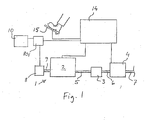
- Fig. 1 shows schematically a vehicle drivetrain 1 and a control system therefore.
- the drivetrain comprises a drive u nit in the form of an internal combustion engine 2 with a motive power output in the form of a crankshaft, here also referred to as an engine output shaft 5.
- a hydraulic automatic transmission 4 is indirectly connected to the engine output shaft 5 via an intermediate fluidic torque converter 3, which is adapted to drive a transmission input shaft 6.
- a transmission output shaft 7 drives the wheels of the vehicle for its propulsion.
- the drivetrain 1 also comprises an electric machine in the form of an integrated starter/generator (ISG) 8, which can be used as an electrical motor and a generator.
- ISG integrated starter/generator
- the ISG is connected directly to the engine crankshaft via an ISG output shaft 9, and therefore the ISG 8 is adapted to have the same rotational speed as the engine.
- the ISG 8 can be connected to the engine crankshaft indirectly via a gear, so that it is adapted to have a rotational speed different from the engine 2.
- Fig. 1 shows the electric machine 8 as located on a side of the engine 2, being opposite to a side on which the transmission 4 is located. As an alternative the electric machine 8 is located between the engine 2 and the transmission 4.
- Reference number 10 denotes an electric system of the vehicle.
- the electric system 10 comprises a battery and electricity consuming devices in the vehicle.
- An ISG-controller 801 is connected to, and adapted to control the ISG 8.
- Vehicle control means here referred to as drivetrain control means 14 or drive train control device, is a control system adapted to control the drivetrain 1 by means of a plurality of actuator controls, as is known to the person skilled in the art.
- the drivetrain control means 14 can comprise an engine control module (ECM) and a transmission control module (TCM).
- ECM engine control module
- TCM transmission control module
- the drivetrain control means 14 is connected to and adapted, in a manner known in the art, to receive signals from an accelerator control device in the form of an accelerator pedal 15.
- the drivetrain control means 14 is also adapted to receive engine condition parameters and to send signals to control the operation of the engine 2.
- the drivetrain control means 14 is adapted to determine the engine output torque based on certain predetermined drivetrain parameters, e.g. air pressure, air temperature, engine temperature, and rotational speed.
- the drivetrain control means 14 is also adapted, in a manner known in the art, to receive, by means of the ISG-controller 801, condition parameters of the electric system 10 of the vehicle. These parameters can include state of charge (SOC) of the battery, battery temperature, and also the electric consumption requirements of electricity consuming devices. Static information about components in the electric system can be stored in the drivetrain control means 14, such as battery durability and battery limitations.
- SOC state of charge
- battery temperature battery temperature
- Static information about components in the electric system can be stored in the drivetrain control means 14, such as battery durability and battery limitations.
- the drivetrain control means 14 is also adapted to send control signals to the ISG-controller 801, to control the output power, the output torque or the rotational speed of the ISG 8, when the latter is operating as an electric motor.
- the drivetrain control means 14 is adapted to receive, in a manner known in the art, signals corresponding to transmission condition parameters and to send control signals to the transmission 4. Among other parameters the drivetrain control means 14 is adapted to receive information about the transmission input and output rotational speed.
- the drivetrain control means 14 is adapted to select a gear of the transmission based on a set of gear shift control elements. This set includes a predetermined gear shift schedule and gear shift schedule input parameters. Using the gear shift schedule the drivetrain control means 14 can send signals to the transmission 4 so as to change gear of the latter. The gears are selected based on the gear shift schedule input parameters, which could be values corresponding to the speed of the vehicle, and signals from the accelerator pedal 15. Instead of accelerator pedal signals a requested torque determined on the basis of the accelerator pedal signals can form a gear shift schedule input parameter.
- the flowchart in fig. 2 depicts a method according to an embodiment of the invention.
- the steps in the method can be used in a situation in which an increased output torque from the vehicle drivetrain is desired. This could be, for example, at an acceleration of the vehicle or when the vehicle is moving uphill.
- the method comprises detection by the drivetrain control means 14 of a signal p corresponding to the setting of the accelerator pedal (block 101).
- the drivetrain control means 14 determines (block 104) a corresponding requested crankshaft torque T req according to a predetermined accelerator pedal signal to requested torque correlation.
- a predetermined accelerator pedal signal to requested torque correlation.
- another physical entity such as force or power, is used to represent the requested performance of the drivetrain.
- the drivetrain control means 14 determines an available torque of the engine T Engav based on engine specific parameters, for example engine rotational speed, air temperature, engine temperature and air pressure (block 150).
- the drivetrain control means 14 determines an available ISG torque T ISGav (block 152), based on information of the power source, i.e. the battery, of the ISG 8, which information can include SOC, battery current RMS limits, battery temperature and battery durability and limitations.
- the drivetrain control means 14 calculates an available torque T av as the sum of the available torque of the engine T Engav and the available ISG torque T ISGav (block 154).
- a nominal torque T N is calculated (block 153) as T EngMax - T aux .
- T EngMax is the maximum engine output torque, which has a predetermined value and corresponds to the highest level of torque that can be produced by the engine at current rotational speed, or the torque that the engine is allowed to produce at current rotational speed.
- the engine output torque being dependent upon rotational speed means that T EngMax is dependent upon current selected gear, since the latter determines the rotational speed of the engine. Additionally, T EngMax can be chosen to be dependent upon current engine conditions, such as air temperature, engine temperature and air pressure.
- T aux is an auxiliary load torque corresponding to the maximum effect caused by auxiliary loads in the electricity system 10.
- T aux is dependent upon the engine rotational speed and an auxiliary load power P aux .
- P aux can be chosen to have a fixed predetermined value corresponding to a maximum auxiliary load, including battery charging requirements and loads of electric components.
- a suitable value for P aux in a medium size passenger vehicle is 3-4 kW.
- P aux can be determined according to a predetermined scheme, at which the value of P aux is determined based on the requested torque T req . Thereby, at current operation conditions the priority of electrical components or groups of components are weighted against the torque requirements.
- the drivetrain control means 14 calculates (block 109) an adjustment factor A p for the accelerator pedal signal p, based on the requested torque T req , the available torque T av , the nominal toque T N and a maximum torque T Max .
- the maximum torque T Max equals T EgngMax and T ISGMax added together.
- T ISGMax is the highest torque that can be produced by the ISG 8 and is predetermined. Alternatively, T ISGMax can assume some other predetermined value, e.g. a highest torque allowed to be produced by the ISG 8.
- the accelerator pedal signal p is adjusted by the adjustment factor A p (block 110).
- the vehicle speed v is determined in a manner known in the art (block 111). A decision is made by the drivetrain control means 14 based on the vehicle speed v and the adjusted accelerator pedal signal p, if a gear shift should be made in the transmission.
- Fig. 3 and 4 show diagrams related to the determination of the adjustment factor A p for the accelerator pedal signal p (block 109 in fig. 2 ).
- Input information in fig. 3 is the requested torque T req .
- a value of the adjustment factor A p is given by a line, I or II, which ever gives the highest value of A p for the value of T req .
- Line I corresponds to a constant A p of 1, i.e. no adjustment of the accelerator pedal signal.
- Line II which also could be a curve, corresponds to increasing A p with increasing T req .
- the line II is moved vertically in the diagram in fig. 3 .
- the vertical position of the line II is determined by a value of a curve adjustment parameter CA II , which is dependent on the available torque T av , and illustrated by a wide double arrow in fig. 3 .
- Fig. 4 depicts the determination of CA II .
- T av equals the maximum torque T Max which, according to the description above, corresponds to the highest level of torque which can be produced by the drivetrain
- CA II is set to zero, which corresponds to the lowest level of the line II in fig. 3 .
- T av equals the nominal torque T N which, deduced form the description above, can be said to correspond to the lowest level of torque which can be guaranteed by the drivetrain
- CA II is set to 1. This corresponds to the highest level of the line II in fig. 3 .
- the line II in fig. 3 can take an infinite number of or a plurality of vertical positions between two extreme positions.
- the lowest position corresponds to the available torque being equal to the maximum torque at which no adjustment of the pedal signal p is needed, and for all values of T req , A p is set to 1.
- the highest position of the line II corresponds to the available torque being equal to the nominal torque at which no adjustment of the pedal signal p is made for values of T req below T N , but for values of T req above T N , A p is set to a value above 1, and the accelerator pedal signal is adjusted upward.
- the flowchart in fig. 5 depicts a method according to a preferred embodiment of the invention. Many of the steps in the alternative method correspond to steps in the method described in connection to fig. 2 above.
- a detection by the drivetrain control means 14 of a signal p corresponding to the setting of the accelerator pedal is carried out (block 201), and in response thereto, the drivetrain control means 14 determines (block 204) a corresponding requested crankshaft torque T req .
- the requested torque T req is compared to the nominal torque T N (block 205). If the requested torque T req is smaller than the nominal torque T N , the steps above are repeated (blocks 201-205).
- the drivetrain control means 14 determines an available torque of the engine T Engav (block 250), and an available ISG torque T ISGav (block252), in a manner similar to what has been described above in connection to fig. 2 .
- the drivetrain control means 14 calculates (block 209), similar to what has been described above, an adjustment factor A p for the accelerator pedal signal p, the accelerator pedal signal p is adjusted by the adjustment factor A p (block 210) and the vehicle speed v is determined, after which a decision is made by the drivetrain control means, if a gear shift should be made in the transmission.
- the preferred embodiment described in connection to fig. 5 provides for a comparison between the requested and the available torque before the ISG is engaged. This will in turn limit the use of the ISG in cases where torque provided by the engine only suffices.
- accelerator pedal signals form an input parameter for the gear shift schedule and are adjusted to force a downshift, when available torque does not meet requested torque.
- gear shift schedule input parameters can be adjusted to accomplish the same effect.
- the requested torque forms a gear shift schedule input parameter
- an adjustment factor A v can be calculated for the vehicle speed, where the latter forms a gear shift schedule input parameter.
- this can be adjusted by a wheel traction adjustment factor in a similar way to what has been described above.
- Another alternative could include adjusting more than one of the gear shift schedule input parameters.
- the gear shift schedule itself is adjusted.
- the schedule may be adapted, as is known in the art, to control gear shifts at certain vehicle speeds.
- an upper and a lower limit speed is used so that the gear is shifted up and down, respectively, at speeds corresponding to these limit speeds.
- a limit speed can be adjusted so as for the transmission to change gear at a different vehicle speed, than would the limit speeds have been un-adjusted.
- the lower limit speed of a certain gear can be adjusted upwards so as to cause a gear down shift at a higher speed than otherwise.
- gear shift schedule In an alternative embodiment, other values, functions or algorithms of the gear shift schedule can be altered or replaced.
- the invention has been described in relation to an automatic transmission. However, the invention is also applicable on any other type of transmission, where some type of automatic gear control is involved, such as in a automated shifted manual transmission, or a continuously variable transmission (CVT).
- CVT continuously variable transmission
Landscapes
- Engineering & Computer Science (AREA)
- Transportation (AREA)
- Mechanical Engineering (AREA)
- Combustion & Propulsion (AREA)
- Chemical & Material Sciences (AREA)
- Power Engineering (AREA)
- Sustainable Energy (AREA)
- Sustainable Development (AREA)
- Life Sciences & Earth Sciences (AREA)
- Automation & Control Theory (AREA)
- Electric Propulsion And Braking For Vehicles (AREA)
- Hybrid Electric Vehicles (AREA)
- Control Of Transmission Device (AREA)
Claims (2)
- Procédé, dans un véhicule comprenant une transmission (1), comprenant une unité d'entrainement (2) telle qu'un moteur à combustion interne, ayant une sortie de force motrice, une boîte de vitesses (4) reliée mécaniquement à la sortie de force motrice, directement ou indirectement, et une machine électrique (8) pouvant être utilisée au moins en tant que moteur, reliée mécaniquement à la sortie de force motrice, directement ou indirectement, le véhicule comprenant en outre un dispositif de commande d'accélérateur (15) et un moyen de commande de transmission (14) relié au dispositif de commande d'accélérateur (15) et à la transmission (1), le moyen de commande de transmission (14) étant adapté pour sélectionner un rapport de vitesse de la boîte de vitesses dans un ensemble d'éléments de commande de changement de vitesse comprenant au moins un programme de changement de vitesse et au moins un paramètre d'entrée de programme de changement de vitesse (p, v), et pour envoyer au moins un signal à la boîte de vitesses de façon à commander le statut de rapport de vitesse de celle-ci, le procédé comprenant les étapes suivantes :- réception (101, 201) d'au moins un signal (p) depuis le dispositif de commande d'accélérateur (15), et- détermination (104, 204) d'un couple requis (Treq ) de la transmission, au moins partiellement en fonction du signal reçu du dispositif de commande d'accélérateur,détermination d'un couple disponible (TEngav) du moteur, en fonction de paramètres spécifiques du moteur présent,
détermination d'un couple disponible (TISGav) de la machine électrique, en fonction d'informations de sa source d'énergie,
détermination d'un couple disponible (Tav) de l'arbre de transmission, en fonction de la somme du couple disponible (TEngav) du moteur et du couple disponible (TISGav) de la machine électrique,
comparaison du couple requis (Treq) et du couple nominal (TN), le couple nominal (TN) étant la différence entre le couple de sortie de moteur maximal (Tengmax) et un couple de charge auxiliaire (Taux) correspondant à l'effet maximal causé par des charges auxiliaires dans le système électrique, et
ajustement, si le couple requis (Treq) est supérieur au couple nominal (TN), au moyen de moyens de commande d'entrainement, du programme de changement de rapport de vitesse, au moins partiellement en fonction du couple requis (Treq) et du couple disponible (Tav), afin de limiter l'utilisation de la machine électrique. - Système, dans un véhicule comprenant une transmission (1), comprenant une unité d'entrainement (2) telle qu'un moteur à combustion interne, ayant une sortie de force motrice, une boîte de vitesses (4) reliée mécaniquement à la sortie de force motrice directement ou indirectement, et une machine électrique (8) pouvant être utilisée au moins en tant que moteur, reliée mécaniquement à la sortie de force motrice directement ou indirectement, le véhicule comprenant en outre un dispositif de commande d'accélérateur (15) et un moyen de commande de transmission (14) relié au dispositif de commande d'accélérateur (15) et à la transmission (1), le moyen de commande de transmission (14) étant adapté pour sélectionner un rapport de vitesse de la boîte de vitesses dans un ensemble d'éléments de commande de changement de vitesse comprenant au moins un programme de changement de vitesse et au moins un paramètre d'entrée de programme de changement de vitesse (p, v), et pour envoyer au moins un signal à la boîte de vitesses de façon à commander le statut de rapport de vitesse de celle-ci, dans lequel le moyen de commande de transmission est adapté- pour recevoir (101, 201) au moins un signal (p) depuis le dispositif de commande d'accélérateur (15),pour déterminer (104, 204) un couple requis (Treq ) de la transmission, au moins partiellement en fonction du signal reçu du dispositif de commande d'accélérateur, pour déterminer un couple disponible (TEngav) du moteur, en fonction de paramètres spécifiques du moteur présent,
pour déterminer un couple disponible (TISGav) de la machine électrique, en fonction d'informations de sa source d'énergie,
pour déterminer un couple disponible (Tav) de l'arbre de transmission, en fonction de la somme du couple disponible (TEngav) du moteur et du couple disponible (TISGav) de la machine électrique,
pour comparer le couple requis (Treq) et le couple nominal (TN), le couple nominal (TN) étant la différence entre le couple de sortie de moteur maximal (Tengmax) et un couple de charge auxiliaire (Taux) correspondant à l'effet maximal causé par des charges auxiliaires dans le système électrique, et
pour ajuster, si le couple requis (Treq) est supérieur au couple nominal (TN), au moyen de moyens de commande d'entrainement, le programme de changement de rapport de vitesse, au moins partiellement en fonction du couple requis (Treq) et du couple disponible (Tav), afin de limiter l'utilisation de la machine électrique.
Priority Applications (1)
| Application Number | Priority Date | Filing Date | Title |
|---|---|---|---|
| DE60229985T DE60229985D1 (de) | 2002-04-08 | 2002-04-08 | Antriebssystem für ein Hybrid angetriebenes Kraftfahrzeug und dafür geeignetes Steuerungsverfahren |
Applications Claiming Priority (1)
| Application Number | Priority Date | Filing Date | Title |
|---|---|---|---|
| EP02445044A EP1356972B1 (fr) | 2002-04-08 | 2002-04-08 | Procédé de commande pour véhicule automobile à propulsion hybride |
Related Parent Applications (1)
| Application Number | Title | Priority Date | Filing Date |
|---|---|---|---|
| EP02445044A Division EP1356972B1 (fr) | 2002-04-08 | 2002-04-08 | Procédé de commande pour véhicule automobile à propulsion hybride |
Publications (3)
| Publication Number | Publication Date |
|---|---|
| EP1645449A2 EP1645449A2 (fr) | 2006-04-12 |
| EP1645449A3 EP1645449A3 (fr) | 2006-04-19 |
| EP1645449B1 true EP1645449B1 (fr) | 2008-11-19 |
Family
ID=28686048
Family Applications (2)
| Application Number | Title | Priority Date | Filing Date |
|---|---|---|---|
| EP05110259A Expired - Lifetime EP1645449B1 (fr) | 2002-04-08 | 2002-04-08 | Système d'entraînement pour véhicule automobile à propulsion hybride et son procédé de commande |
| EP02445044A Expired - Lifetime EP1356972B1 (fr) | 2002-04-08 | 2002-04-08 | Procédé de commande pour véhicule automobile à propulsion hybride |
Family Applications After (1)
| Application Number | Title | Priority Date | Filing Date |
|---|---|---|---|
| EP02445044A Expired - Lifetime EP1356972B1 (fr) | 2002-04-08 | 2002-04-08 | Procédé de commande pour véhicule automobile à propulsion hybride |
Country Status (2)
| Country | Link |
|---|---|
| EP (2) | EP1645449B1 (fr) |
| DE (2) | DE60229985D1 (fr) |
Families Citing this family (6)
| Publication number | Priority date | Publication date | Assignee | Title |
|---|---|---|---|---|
| DE102004022114B4 (de) | 2004-05-05 | 2018-11-22 | Robert Bosch Gmbh | Verfahren zum Betreiben eines Fahrzeugs |
| CA2573111C (fr) | 2004-07-07 | 2012-06-05 | Eaton Corporation | Determination des points de passage des vitesses dans une boite de vitesse pour vehicule electrique hybride |
| CN103332193B (zh) * | 2013-07-12 | 2015-11-18 | 东风汽车公司 | 基于规则曲线补偿控制法的发动机扭矩波动补偿方法 |
| US9718462B2 (en) | 2014-01-10 | 2017-08-01 | Ford Global Technologies, Llc | Hybrid vehicle transmission shift management system and method |
| JP6197764B2 (ja) | 2014-08-08 | 2017-09-20 | トヨタ自動車株式会社 | 電動車両 |
| CN114704636B (zh) * | 2022-03-17 | 2024-07-19 | 潍柴动力股份有限公司 | 车辆档位自学习自修正方法、电子设备和存储介质 |
Family Cites Families (8)
| Publication number | Priority date | Publication date | Assignee | Title |
|---|---|---|---|---|
| JP3145426B2 (ja) * | 1991-04-17 | 2001-03-12 | マツダ株式会社 | 車両の駆動力制御装置 |
| JP2888056B2 (ja) * | 1992-10-02 | 1999-05-10 | 日産自動車株式会社 | 車両用自動変速装置 |
| JP3933728B2 (ja) * | 1996-07-23 | 2007-06-20 | トヨタ自動車株式会社 | ハイブリッド車両の制御装置 |
| JP3096447B2 (ja) * | 1997-09-17 | 2000-10-10 | 本田技研工業株式会社 | ハイブリッド車両の制御装置 |
| US6110066A (en) * | 1998-02-05 | 2000-08-29 | Southwest Research Institute | Parallel hybrid drivetrain |
| GB2348630B (en) | 1998-09-09 | 2002-12-04 | Luk Lamellen & Kupplungsbau | Drive train |
| WO2000046062A1 (fr) * | 1999-02-08 | 2000-08-10 | Toyota Jidosha Kabushiki Kaisha | Vehicule freine par couple moteur et procede de commande du vehicule |
| JP2001146121A (ja) * | 1999-11-19 | 2001-05-29 | Toyota Motor Corp | 変速機付きハイブリッド車両の制御装置 |
-
2002
- 2002-04-08 EP EP05110259A patent/EP1645449B1/fr not_active Expired - Lifetime
- 2002-04-08 DE DE60229985T patent/DE60229985D1/de not_active Expired - Lifetime
- 2002-04-08 EP EP02445044A patent/EP1356972B1/fr not_active Expired - Lifetime
- 2002-04-08 DE DE60220987T patent/DE60220987T2/de not_active Expired - Lifetime
Also Published As
| Publication number | Publication date |
|---|---|
| DE60220987T2 (de) | 2007-10-25 |
| EP1645449A3 (fr) | 2006-04-19 |
| DE60220987D1 (de) | 2007-08-16 |
| EP1645449A2 (fr) | 2006-04-12 |
| EP1356972A1 (fr) | 2003-10-29 |
| EP1356972B1 (fr) | 2007-07-04 |
| DE60229985D1 (de) | 2009-01-02 |
Similar Documents
| Publication | Publication Date | Title |
|---|---|---|
| CN101674950B (zh) | 包括运动模式和经济模式的混合动力变速器的固定速度操作 | |
| CN100412419C (zh) | 在电气可变传动中的过中性点切换控制 | |
| JP3375123B2 (ja) | 自動車のドライブトレイン制御装置 | |
| US8204659B2 (en) | Engine start control system for hybrid vehicle | |
| EP1101650B1 (fr) | Commande pour véhicule hybride comportant une boîte de vitesses | |
| EP1291219B1 (fr) | Système d'entraînement auxiliaire et véhicule équipé d'un tel système | |
| EP0940287B1 (fr) | Système de commande d'entrainement pour un vehicule hybride | |
| CN100538130C (zh) | 混合动力系最优比值选择 | |
| US8210985B2 (en) | Vehicular power transmission control apparatus | |
| US8545365B2 (en) | Vehicular power transmission control apparatus | |
| US8630778B2 (en) | Controlling a throttle for fuel cut acquisition | |
| CN1985109A (zh) | 用于混合动力电动车变速器的换档点策略 | |
| GB2436878A (en) | Vehicle Transmission Control System and Method | |
| JP2012153321A (ja) | 電動車両の制御装置 | |
| US9956948B2 (en) | Systems and methods for improving gear shifts | |
| JP2010208520A (ja) | 車両の動力伝達制御装置 | |
| JP2010208521A (ja) | 車両の動力伝達制御装置 | |
| EP1645449B1 (fr) | Système d'entraînement pour véhicule automobile à propulsion hybride et son procédé de commande | |
| US7134982B2 (en) | Control system for hybrid drive unit | |
| CN101617147A (zh) | 用于在怠速行驶模式时运行重型车辆的自动或半自动变速器的方法 | |
| JP5201786B2 (ja) | エンジン出力制御装置 | |
| CN1900504A (zh) | 车辆及控制车辆发动机的方法 | |
| JPH09308007A (ja) | ハイブリッド車両の制御装置 | |
| JP2006017147A (ja) | 車両制御装置 | |
| CN114905965B (zh) | 一种车辆油门map优化方法、控制器、系统及机动车辆 |
Legal Events
| Date | Code | Title | Description |
|---|---|---|---|
| PUAI | Public reference made under article 153(3) epc to a published international application that has entered the european phase |
Free format text: ORIGINAL CODE: 0009012 |
|
| PUAL | Search report despatched |
Free format text: ORIGINAL CODE: 0009013 |
|
| AC | Divisional application: reference to earlier application |
Ref document number: 1356972 Country of ref document: EP Kind code of ref document: P |
|
| AK | Designated contracting states |
Kind code of ref document: A2 Designated state(s): AT BE BG CH CY CZ DE DK EE ES FI FR GB GR HU IE IS IT LI LT LU LV MC NL PL PT RO SE SI SK TR |
|
| AX | Request for extension of the european patent |
Extension state: AL BA HR MK YU |
|
| AK | Designated contracting states |
Kind code of ref document: A3 Designated state(s): AT BE BG CH CY CZ DE DK EE ES FI FR GB GR HU IE IS IT LI LT LU LV MC NL PL PT RO SE SI SK TR |
|
| AX | Request for extension of the european patent |
Extension state: AL BA HR MK YU |
|
| RAP1 | Party data changed (applicant data changed or rights of an application transferred) |
Owner name: FORD GLOBAL TECHNOLOGIES, LLC. |
|
| 17P | Request for examination filed |
Effective date: 20060919 |
|
| 17Q | First examination report despatched |
Effective date: 20061030 |
|
| AKX | Designation fees paid |
Designated state(s): DE GB SE |
|
| 17Q | First examination report despatched |
Effective date: 20061030 |
|
| GRAP | Despatch of communication of intention to grant a patent |
Free format text: ORIGINAL CODE: EPIDOSNIGR1 |
|
| RIC1 | Information provided on ipc code assigned before grant |
Ipc: B60W 10/06 20060101ALI20080519BHEP Ipc: B60W 10/10 20060101ALI20080519BHEP Ipc: B60W 10/08 20060101ALI20080519BHEP Ipc: F16H 61/02 20060101ALI20080519BHEP Ipc: B60K 6/20 20071001AFI20080519BHEP |
|
| GRAS | Grant fee paid |
Free format text: ORIGINAL CODE: EPIDOSNIGR3 |
|
| GRAA | (expected) grant |
Free format text: ORIGINAL CODE: 0009210 |
|
| AC | Divisional application: reference to earlier application |
Ref document number: 1356972 Country of ref document: EP Kind code of ref document: P |
|
| AK | Designated contracting states |
Kind code of ref document: B1 Designated state(s): DE GB SE |
|
| REG | Reference to a national code |
Ref country code: GB Ref legal event code: FG4D |
|
| REF | Corresponds to: |
Ref document number: 60229985 Country of ref document: DE Date of ref document: 20090102 Kind code of ref document: P |
|
| REG | Reference to a national code |
Ref country code: SE Ref legal event code: TRGR |
|
| PLBE | No opposition filed within time limit |
Free format text: ORIGINAL CODE: 0009261 |
|
| STAA | Information on the status of an ep patent application or granted ep patent |
Free format text: STATUS: NO OPPOSITION FILED WITHIN TIME LIMIT |
|
| 26N | No opposition filed |
Effective date: 20090820 |
|
| REG | Reference to a national code |
Ref country code: GB Ref legal event code: 732E Free format text: REGISTERED BETWEEN 20111020 AND 20111025 |
|
| REG | Reference to a national code |
Ref country code: DE Ref legal event code: R081 Ref document number: 60229985 Country of ref document: DE Owner name: VOLVO CAR CORPORATION, SE Free format text: FORMER OWNER: FORD GLOBAL TECHNOLOGIES, LLC, DEARBORN, US Effective date: 20120207 Ref country code: DE Ref legal event code: R081 Ref document number: 60229985 Country of ref document: DE Owner name: VOLVO CAR CORPORATION, SE Free format text: FORMER OWNER: FORD GLOBAL TECHNOLOGIES, LLC, DEARBORN, MICH., US Effective date: 20120207 |
|
| PGFP | Annual fee paid to national office [announced via postgrant information from national office to epo] |
Ref country code: SE Payment date: 20150424 Year of fee payment: 14 Ref country code: GB Payment date: 20150420 Year of fee payment: 14 |
|
| PGFP | Annual fee paid to national office [announced via postgrant information from national office to epo] |
Ref country code: DE Payment date: 20160411 Year of fee payment: 15 |
|
| REG | Reference to a national code |
Ref country code: SE Ref legal event code: EUG |
|
| GBPC | Gb: european patent ceased through non-payment of renewal fee |
Effective date: 20160408 |
|
| PG25 | Lapsed in a contracting state [announced via postgrant information from national office to epo] |
Ref country code: GB Free format text: LAPSE BECAUSE OF NON-PAYMENT OF DUE FEES Effective date: 20160408 |
|
| PG25 | Lapsed in a contracting state [announced via postgrant information from national office to epo] |
Ref country code: SE Free format text: LAPSE BECAUSE OF NON-PAYMENT OF DUE FEES Effective date: 20160409 |
|
| REG | Reference to a national code |
Ref country code: DE Ref legal event code: R119 Ref document number: 60229985 Country of ref document: DE |
|
| PG25 | Lapsed in a contracting state [announced via postgrant information from national office to epo] |
Ref country code: DE Free format text: LAPSE BECAUSE OF NON-PAYMENT OF DUE FEES Effective date: 20171103 |