EP1645979A1 - Procede et programme servant a generer des donnees de volume a partir de donnees de representation limitrophe - Google Patents
Procede et programme servant a generer des donnees de volume a partir de donnees de representation limitrophe Download PDFInfo
- Publication number
- EP1645979A1 EP1645979A1 EP04747489A EP04747489A EP1645979A1 EP 1645979 A1 EP1645979 A1 EP 1645979A1 EP 04747489 A EP04747489 A EP 04747489A EP 04747489 A EP04747489 A EP 04747489A EP 1645979 A1 EP1645979 A1 EP 1645979A1
- Authority
- EP
- European Patent Office
- Prior art keywords
- cell
- data
- triangle
- boundary
- phase
- Prior art date
- Legal status (The legal status is an assumption and is not a legal conclusion. Google has not performed a legal analysis and makes no representation as to the accuracy of the status listed.)
- Withdrawn
Links
Images





Classifications
-
- G—PHYSICS
- G06—COMPUTING OR CALCULATING; COUNTING
- G06T—IMAGE DATA PROCESSING OR GENERATION, IN GENERAL
- G06T17/00—Three-dimensional [3D] modelling for computer graphics
- G06T17/20—Finite element generation, e.g. wire-frame surface description, tesselation
-
- G—PHYSICS
- G06—COMPUTING OR CALCULATING; COUNTING
- G06F—ELECTRIC DIGITAL DATA PROCESSING
- G06F30/00—Computer-aided design [CAD]
- G06F30/20—Design optimisation, verification or simulation
- G06F30/23—Design optimisation, verification or simulation using finite element methods [FEM] or finite difference methods [FDM]
Definitions
- the present invention relates to a method for generating volume data which can unify CAD and simulation by storing the volume data that integrates a shape and physical properties by a small storage capacity, and more particularly to a method and a program for adapting a triangle patch frequently used as an input surface shape to a cell having a designated size.
- CAD computer aided design
- CAM computer aided manufacturing
- CAE computer aided engineering
- CAT computer aided testing
- C-Simulation which is continuous simulation
- advanced CAM A-CAM
- D-fabrication deterministic fabrication
- data of an object is stored based on constructive solid geometry (CSG) or boundary representation (B-rep).
- CSG constructive solid geometry
- B-rep boundary representation
- the object is represented by a boundary.
- data is light and an amount of data is small, there is no direct information regarding the inside of a boundary surface, causing a problem of unsuitability to deformation analysis.
- external data constituted of boundary data of an object is divided into cubic cells by oct-tree division in which boundary surfaces cross each other at right angles, and the divided cells are classified into an internal cell 13a positioned inside and outside of the object and a boundary cell 13b which includes a boundary surface.
- a reference numeral 15 is a cutting point.
- various physical property values are stored for each cell, and substantial data that integrates shapes and physical properties can be stored by a small storage capacity.
- a shape, a structure, physical property information, and hysteresis of the object are managed in a unified manner to enable management of data regarding a series of processes from designing to fabricating, assembling, testing, evaluation and the like based on the same data, whereby it is possible to unify CAD and simulation.
- the present invention it is possible to form, from external data, cell internal data capable of dividing a surface very accurately approximated to a curved surface having a large curvature into triangular meshes without forming any triangle having unsatisfactory gap or accuracy, while retaining continuity from an adjacent cell in a volume CAD.
- Non-Patent Document 1 a method for generating shape representation by a cell and a triangle patch adapted to the cell, and data is conducted in the following three steps.
- phase information of the triangle patch as the input shape is used as such, and the shape is simplified if necessary.
- Non-Patent Document 11 As to a process in the triangle patch alone, Hoppe [Non-Patent Document 11] or the like has proposed a method of segmentizing/integrating the triangle patches to thereby detail/simplify shape representation [Non-Patent Document 12], and there exist parameters or a dividing method for the sementizing, and various derived systems depending on judgment standards at an integrating time.
- these methods there is used a conversion method in which two-various-article conditions and phase conditions of an original shape are taken over as such, and the methods are not suitable for an operation to intentionally simplify micro shapes or the like [Non-Patent Documents 6, 7, and 8].
- an object of the present invention is to provide a method and a program for generating volume data from boundary representation data, in which phase information of a triangle patch of an input shape is used as such, and the shape can be simplified if necessary in volume CAD.
- Non-Patent Document 1 As a shape representation method of V-CAD [Non-Patent Document 1], means is adopted in which rectangular parallelepiped cells and triangle patches adapted to the respective cells are utilized. The present invention realizes conversion from a triangle patch group used frequently as a three-dimensional shape representation method into a triangle patch group adapted to the cells.
- arbitrary shape data can be adapted to a cell having an arbitrary size, and it is possible to realize a configuration of digital data usable over all steps in manufacturing, including not only designing but also analyzing, manufacturing, reverse engineering and the like.
- the method and program of the present invention is roughly constituted of the following three steps:
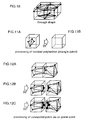
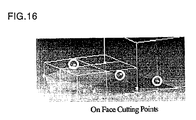
- a shape which requires the processing of (Step 3) is classified into the following size types (a, b, c, d1, d2, and d3), and five types of processing and combinations thereof are applied to each type of shape to approximate the shape and set adequacy of the shape:
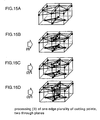
- the case of (d) can be divided into three patterns (d1, d2, and d3) depending on states of the triangle patches connected to the individual cutting points, and the processing is performed in accordance with each state to erase the points on the edge one by one.
- the finally left case (d3) two triangle groups are regarded as one set to erase the cutting point on the edge.
- the processing is continued until the number of the cutting points on the edge is 0 or 1:
- the present invention it is possible to realize shape representation or physical value representation by the triangle patches adapted to an octtree and an octant cell, which has heretofore been difficult in a conventional height. According to development of a method of adapting the cell to the triangle patch, modification processing such as a set operation of shapes represented by the triangle patches can be robustly performed as compared with existing Brep data.
- phase information of the triangle patch of an input shape is used as such, the shape can be simplified if necessary, and it is possible to realize a bi-directional link of CAE, CAM or the like with design data by CAD.
- a method of generating and editing the triangle patch adapted to the cell from boundary representation data hereinafter referred to as B-rep. data
- B-rep. data boundary representation data
- V-CAD volume CAD
- the present invention aims at speeding-up of a geometric operation by strengthening and paralleling, which has heretofore been a problem in a boundary representation CAD using a parametric curved surface or the like, and an object thereof is simulation of structure analysis or thermal fluid analysis using unified data, or direct utilization in comparison with measurement data from a variously worked object having various internal structures.
- FIG. 2 is a device constitution diagram for executing a method of the present invention. As shown in the drawing, this device 10 is provided with external data input means 2, an external storage unit 3, an internal storage unit 4, a central processing unit 5, and an output unit 6.
- the external data input means 2 is, for example, a keyboard, and inputs external data constituted of boundary representation data of an object.
- the external storage unit 3 is a hard disk, a floppy disk, a magnetic tape, a compact disc or the like, and stores volume data that integrates a shape and a physical amount and a program for generating the data.
- the internal storage unit 4 is, for example, RAM, ROM or the like, and stores calculation information.
- the central processing unit 5 (CPU) processes an operation, input/output or the like in a centralized manner, and executes the program together with the internal storage unit 4.
- the output unit 6 includes, for example, a display unit and a printer, and outputs stored volume data and an execution result of the program.
- the central processing unit 5, the internal storage unit 4, and the external storage unit 3 cooperate to function as data converting means, associating means, dividing/arranging means, ridge line integrating means, state check means, simplifying means, cell assigning means, and labeling means.
- the external data input from the outside is polygon data indicating a polyhedron, a tetrahedron or hexahedron element for use in a finite element method, curved surface data for use in three-dimensional CAD or a CG tool, or data in which another solid surface is represented by information containing a partial plane or curved surface.
- the external data may be (1) data directly prepared by a human input through an interface of V-CAD's own (V-interface), (2) surface digitized data of a measuring device, a sensor, a digitizer or the like, and (3) volume data containing internal information such as voxel data for CT scanning, MRI, and generally used for volume rendering.
- the data of solid CAD or surface CAD (hereinafter referred to generically as the S-CAD) which has heretofore handled the boundary representation data (B-rep. data) can represent various shapes with a very small data size, but reusability of the data largely drops owing to accuracy or the like in a boundary position of the plane, and close attention has to be paid in operating the data [Non-Patent Document 15] [Non-Patent Document 16].
- Non-Patent Document 17 using an octree
- Patent Document 18 a research [Non-Patent Document 18] of an extended octree, in which an octant cell is associated with a polyhedron.
- Kitta Cube [Non-Patent Document 1], [Non-Patent Document 2], or [Non-Patent Document 3] which is a data structure of a volume CAD constituted of a hierarchized cell such as a voxel or an octant cell, and a triangle group in the cell. Accordingly, there is proposed a method in which accuracy or size of a triangle patch for use in a subsequent step is controlled, and there are constructed a data structure usable in not only designing but also reverse engineering including analysis, manufacturing, and internal structure, and Kitta Cube while retaining phase conditions by a basic operation with respect to the triangle patch having a phase.
- the volume data means Kitta Cube which is the data structure of the volume CAD.
- Non-Patent Documents 7, 12 and 19 As a method of shape representation, a method utilizing the triangle patch is utilized in broad fields of CG, CAE, CAM, reverse engineering and the like in respect of convenience of the data structure, and convenience/processing speed of calculation processing [Non-Patent Documents 7, 12 and 19]. In addition, in a case where local calculation such as contact judgment when utilized in the CAE or the CAM is frequently used, a method of managing a triangle floating in a space by use of the voxel or the like is also frequently used [Non-Patent Documents 10, 20 and 21].
- the octant cell and the triangle patch managed by each cell are used in shape representation [Non-Patent Documents 1, 2 and 3]. Furthermore, a position of a vertex constituting the triangle patch (the triangle managed by Kitta Cube will be described hereinafter as the "cut triangle") is limited to the vertex of each cell or the position on a ridge line. The number of the vertexes on the ridge line is limited to one at most to thereby simplify the data structure and processing.
- Non-Patent Document 19 MC method
- the triangle using Kitta Cube is investigated as a method capable of more directly handling information of a broader representational power [Non-Patent Document 1] and S-CAD.
- V-CAD data proposed by the volume CAD [Non-Patent Document 1] by Kase et al. is focused on management of the triangle patch by the voxel.
- the data structure is shown in FIG. 3, and a target of the method of the present invention is this data structure.
- This data structure has two types: a boundary cell as a cell which manages the triangle patch; and a nonboundary cell which is not related to the triangle patch.
- the boundary cell retains one medium value for each vertex, and the nonboundary cell retains one medium value for each cell.
- a method of generating the data of the V-CAD is performed in the following steps.
- An intersection point of a tessellated triangle patch and a ridge line of a cell is calculated to obtain a cutting point.
- one representative point is integrated in a case where a plurality of intersection points are obtained on a cell edge.
- boundary loops of the cut triangles in the cell are determined in order by use of a phase relation between the adjacent cells, and the cut triangles are set in comparison with a geometric shape.
- the internal/external judgment of the nonboundary cell is performed. Subsequently, the internal/external judgment of the boundary cell is performed.
- the medium value of the nonboundary cell is set to the vertex shared with the nonboundary cell.
- a cell ridge line that does not include any cutting point, and a diagonal line of a cell that does not intersect with the cut triangle are tracked to add a known medium value. It is to be noted that in a case where the cutting point exists on the cell vertex, a medium value having a larger azimuthal angle occupied by the medium value in the corresponding cell is adopted.
- An intermediate triangle having a phase is utilized as intermediate data while V-CAD data is generated from S-CAD data.
- An intermediate vertex having the phase is constituted of data of a hierarchical structure of an intermediate edge having the phase/intermediate vertex having the phase.
- the intermediate vertex having the phase retains, as attribute values, index data (Index) of the cell including the vertex and a type of vertex (in the cell (BODY), cell face (FACE_YZ, FACE_ZX, FACE_XY), cell edge (EDGE_X, EDGE_Y, EDGE_Z), and vertex (VERTEX)).
- An intersection point of an infinite plane including the cell face and the intermediate ridge line having the phase is calculated utilizing this data structure, the intermediate triangle having the phase is segmentized, and the ridge line is integrated in accordance with the ridge line of the cell to thereby adapt the intermediate triangle having the phase to the cell.
- S-CAD data that is, boundary representation data is input beforehand into the external storage unit 3 or the internal storage unit 4 of a computer by the external data input means 2 in Step 1.
- Step 1 Tessellation (Data Conversion)
- the central processing unit 5, the internal storage unit 4, and the external storage unit 3 cooperate to perform a data converting step by data converting means. That is, in Step 1, B-rep. data is solidified (merge of a boundary line of a plane), and a surface shape is converted into the triangle patch having the phase based on the data. In this case, when accuracy of the original B-rep. data is bad, and the solidifying cannot be performed well, phases cannot be connected well at the time of the conversion into the triangle patch having the phase, and there exists a case where holes are made in the triangle patch, but in this case, the holes are filled by dividing, into triangles, a polygon of a portion having a gap with a diameter which is not more than a designated threshold value.
- the central processing unit 5, the internal storage unit 4, and the external storage unit 3 cooperate to perform an associating step by associating means. That is, in Step 2, associating of the cell with the triangle to be included in the cell is performed beforehand using a rectangular parallelepiped member (Bounding Box) along a coordinate axis circumscribed on the triangle in order to speed up the calculation of the cutting point by means of the cell face.
- Step 2 associating of the cell with the triangle to be included in the cell is performed beforehand using a rectangular parallelepiped member (Bounding Box) along a coordinate axis circumscribed on the triangle in order to speed up the calculation of the cutting point by means of the cell face.
- the central processing unit 5, the internal storage unit 4, and the external storage unit 3 cooperate to perform the dividing/arranging step by dividing/arranging means.
- the central processing unit 5, the internal storage unit 4, and the external storage unit 3 cooperate to perform a ridge line integrating step by ridge line integrating means.
- the central processing unit 5, the internal storage unit 4, and the external storage unit 3 cooperate to perform a state check step by state check means. In this step, it is judged whether or not the following items are satisfied at the end of the ridge line integrating (edge collapse) in Kitta Cube in order to manage both of a data amount and a processing time (edge-base point management):
- the central processing unit 5, the internal storage unit 4, and the external storage unit 3 cooperate to perform a simplifying step by simplifying means.
- Step 6 Adapting of Triangle to Cell (Cell Assigning)
- the central processing unit 5, the internal storage unit 4, and the external storage unit 3 cooperate to perform a cell assigning step by cell assigning means. That is, in Step 6, each triangle and the vertex are assigned to the cell with reference to index data of the vertex.
- Step 6 the data structure of Kitta Cube shown in FIG. 3 is generated.
- the central processing unit 5, the internal storage unit 4, and the external storage unit 3 cooperate to perform a labeling step by labeling means. That is, in Step 7, attribute values of the cell are set utilizing an adjacency relation between the cells.
- a method described in [Patent Document 4] is applied. That is, the method has a space dividing step (D) of dividing each vertex of each cell into a plurality of spaces partitioned by boundary data.
- This space dividing step (D) includes: a nonboundary cell setting step (D1) of setting, to all nonboundary cells, space numbers which differ with each of the spaces partitioned by the boundary data; and a boundary cell setting step of setting each vertex of the boundary cell to the space number of the adjacent nonboundary cell which is not partitioned by the boundary data.
- the boundary cell setting step (D2) the vertex which agrees with the boundary data is set to either of the space numbers of two adjacent nonboundary cells.
- the nonboundary cell setting step (D1) is repeated in order with respect to three directions of X, Y, and Z, or all rectangular parallelepiped cells are scanned in order by recursive processing.
- V-CAD data volume data
- a purpose is to divide the triangle patch having the phase, floating in the space, by cell faces, and arrange all triangles in the cell and on the boundary.
- the attribute values of BODY to VERTEX, and index data of the included cells from the coordinate value are added depending on whether or not each vertex exists on any plane.
- intersection point of the intermediate ridge line having the phase and the plane including the cell face is calculated utilizing cell mapping information and phase information of the intermediate triangle having the phase, the intersection point is registered as a new intermediate vertex having the phase, and the attribute value and the index data of the cell to which the point belongs as described in 4.1 are added in order.
- the ridge line is integrated without changing the phase as described in [Non-Patent Documents 7, 8, 9, 11 and 12] and the like.
- the following items are added as conditions capable of integrating the ridge lines in order to limit the vertex of the triangle on the edge of the cell or the cell vertex:
- a value obtained by disposing an attribute value t1 in the ordinate of the table and disposing an attribute value t2 on the abscissa is regarded as a flag.
- the attribute value t2 is integrated toward the attribute value t1.
- priorities are set in order from a small volume change by means of a value of Quadric Error Metric (QEM) described in [Non-Patent Document 14] or the like, and the ridge lines are integrated in a form close to an original geometric shape.
- QEM Quadric Error Metric
- the processing in the simplifying step is branched depending on each case.
- the approximation of a shape is performed by the following five types of operations and a combination thereof.
- a constitution in which the triangles formed by the intermediate vertexes having the same index data and having the phases constitute a polyhedron (according to Hoppe rule, a tetrahedron is basically constituted, but integration from the on-plane point to a point on another plane cannot be performed, and therefore another polyhedron is also considered in the present method) is searched from a constitution in which all sides of the triangles are shared by the triangles in the cell.
- the polyhedron floating alone is searched for by finding a triangle group whose sides are not shared by the triangles of another cell.
- the shape is divided at the boundary that is the triangle constituted of three points (i.e., three points on the plane in the drawing, but all the points are sometimes on the cell edge) constituted of two points which have failed in the ridge line integration and one arbitrary point adjacent to the two points), and three open sides on opposite sides are closed by the respective triangles.
- the vertexes of the divided triangles are duplicated and handled as separate elements.
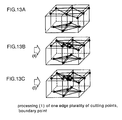
- the division is performed as preprocessing with respect to a case where there are a plurality of vertexes on the cell ridge line as shown in FIGS. 13 to 15.
- the sides of the triangles connected to the intermediate vertexes as objects are listed up, the intermediate vertex having the phase is prepared in a position distant at a micro distance, and the ridge line is divided at this point.
- Holes are made in two plates to connect the plates to each other in a cylindrical form.
- the point present on the cell edge or the cell surface is changed to the on-plane point or the in-body point in order to perform the ridge line integration again.
- ID and index data of the plane are set with reference to the index data of a direction (adjacent vertexes) to be integrated in the next step.
- a cell inner surface can be freely constituted. Since the triangle constituting the boundary is managed with the cell, shape calculation processing such as set operation processing is possible only by repeating local operation for each cell or only with reference to one adjacent vicinity as pointed out by Kela [Non-Patent Document 17].
- the set operation is possible in the following steps, and much more robust calculation is possible as compared with the set operation of S-CAD utilizing NURBS curved surface.
- the processing is branched, but information of either cell is taken over as such or only by reversing the boundary surface depending on a type of operation or the boundary cell.
- a correspondence table is shown in Table 3.
- Base indicates the cell on a reference side of Boolean operation
- characters of a processing column Inside: inside the shape as a target, Outside: outside the shape as the target, and Boundary: boundary of the shape as the target. The information of the boundary cell of either Base or Tool is taken over as such.
- the triangles intersect/coexist/overlap with each other in the same cell area.
- the following processing is performed in order to edit the shape into a targeted shape.
- (S1) Intersection between the triangles is calculated, and the ridge line division is performed to obtain a state in which an intersection line portion of the triangle patch is divided into the triangles.
- (S2) The triangle present in an unnecessary area is deleted from both of the triangles (Table 4).
- Boolean Operation (2) Point/triangle to be deleted Base Tool Union Inside Tool Inside Base Subtraction Inside Tool Outside Base Intersection Outside Tool Outside Tool (S3) The triangles are merged. In this case, the boundary surface of the cell on a tool side of a subtraction operation is turned over and merged.
- (S4) In a case where the triangles exist on the same plane, the processing is performed as follows depending on a front/back direction of the triangle.
- the ridge line integration processing and subsequent processing are performed based on the triangles connected in this manner to thereby end the set operation.
- V-CAD data prepared by performing the processing is attached in FIGS. 17A to 17F, FIG. 18A, and FIG. 18B.
- FIGS. 17A to 17F show shapes of actual industrial products (mold components of car bumpers).
- FIG. 17C a portion having a hole shape that is smaller than the cell size
- FIG. 17F a portion having a hole shape that is smaller than the cell size
- FIG. 17F a portion having a hole shape that is smaller than the cell size
- FIGS. 18A and 18B operation results of simple shapes are depicted in FIGS. 18A and 18B.
- FIG. 18A shows an original result
- FIG. 18B shows the result after subtraction.
- two inscribed rectangular parallelepiped members are subjected to subtraction, and the set operation in a state in which two shapes are brought into contact with each other fails in the existing S-CAD in considerable cases. Therefore, in a standard (Product Design Quality) of CAD data preparation in each country, it is recommended that the set operation be performed in a state in which shapes surely clearly intersect with each other as "modeling sub-branches".
- the shape is constituted to be discrete, and managed with the cell by use of Kitta Cube, the set operation of the shapes brought into contact with each other is also easily realized.
Landscapes
- Engineering & Computer Science (AREA)
- Physics & Mathematics (AREA)
- Theoretical Computer Science (AREA)
- Geometry (AREA)
- General Physics & Mathematics (AREA)
- Computer Graphics (AREA)
- Software Systems (AREA)
- Computer Hardware Design (AREA)
- Evolutionary Computation (AREA)
- General Engineering & Computer Science (AREA)
- Image Generation (AREA)
- Processing Or Creating Images (AREA)
Applications Claiming Priority (2)
| Application Number | Priority Date | Filing Date | Title |
|---|---|---|---|
| JP2003275055A JP4381743B2 (ja) | 2003-07-16 | 2003-07-16 | 境界表現データからボリュームデータを生成する方法及びそのプログラム |
| PCT/JP2004/010023 WO2005008547A1 (fr) | 2003-07-16 | 2004-07-14 | Procede et programme servant a generer des donnees de volume a partir de donnees de representation limitrophe |
Publications (2)
| Publication Number | Publication Date |
|---|---|
| EP1645979A1 true EP1645979A1 (fr) | 2006-04-12 |
| EP1645979A4 EP1645979A4 (fr) | 2011-09-28 |
Family
ID=34074535
Family Applications (1)
| Application Number | Title | Priority Date | Filing Date |
|---|---|---|---|
| EP04747489A Withdrawn EP1645979A4 (fr) | 2003-07-16 | 2004-07-14 | Procede et programme servant a generer des donnees de volume a partir de donnees de representation limitrophe |
Country Status (5)
| Country | Link |
|---|---|
| US (1) | US7372460B2 (fr) |
| EP (1) | EP1645979A4 (fr) |
| JP (1) | JP4381743B2 (fr) |
| CN (1) | CN100468418C (fr) |
| WO (1) | WO2005008547A1 (fr) |
Cited By (1)
| Publication number | Priority date | Publication date | Assignee | Title |
|---|---|---|---|---|
| EP1857949A4 (fr) * | 2005-03-09 | 2013-05-01 | Riken | Methode et programme servant a creer des informations de surface limitrophe |
Families Citing this family (36)
| Publication number | Priority date | Publication date | Assignee | Title |
|---|---|---|---|---|
| AU2002230169A1 (en) * | 2002-02-06 | 2003-09-02 | Digital Process Ltd. | Three-dimensional shape displaying program, three-dimensional shae displaying method, and three-dimensional shape displaying device |
| US7042455B2 (en) * | 2003-05-30 | 2006-05-09 | Sand Codex Llc | System and method for multiple node display |
| US7298376B2 (en) | 2003-07-28 | 2007-11-20 | Landmark Graphics Corporation | System and method for real-time co-rendering of multiple attributes |
| JP4597766B2 (ja) | 2005-05-20 | 2010-12-15 | 株式会社日立製作所 | 解析用メッシュ生成システム |
| JP4783100B2 (ja) | 2005-09-12 | 2011-09-28 | 独立行政法人理化学研究所 | 境界データのセル内形状データへの変換方法とその変換プログラム |
| US8572523B2 (en) * | 2006-07-21 | 2013-10-29 | Synopsys, Inc. | Lithography aware leakage analysis |
| MX2009007229A (es) * | 2007-01-05 | 2010-02-18 | Landmark Graphics Corp | Sistemas y metodos para visualizar multiples grupos de datos volumetricos en tiempo real. |
| JP4845761B2 (ja) * | 2007-02-09 | 2011-12-28 | 富士通株式会社 | 3次元モデルの形状簡略化装置及び3次元モデルの形状簡略化プログラム |
| US7825925B2 (en) * | 2007-03-09 | 2010-11-02 | St. Jude Medical, Atrial Fibrillation Division, Inc. | Method and system for repairing triangulated surface meshes |
| JP5120926B2 (ja) | 2007-07-27 | 2013-01-16 | 有限会社テクノドリーム二十一 | 画像処理装置、画像処理方法およびプログラム |
| US8253726B1 (en) | 2008-01-09 | 2012-08-28 | Spaceclaim Corporation, Inc. | Systems and methods for modifying three dimensional geometry using an arbitrary cross-section plane |
| CN102047294B (zh) * | 2008-06-06 | 2013-10-30 | 兰德马克绘图国际公司,哈里伯顿公司 | 对表示网格体的几何不规则网格数据的三维体成像的系统及方法 |
| JP5241573B2 (ja) * | 2009-03-05 | 2013-07-17 | 株式会社神戸製鋼所 | 3次元形状データの穴削除方法 |
| JP5240132B2 (ja) * | 2009-09-04 | 2013-07-17 | 富士通株式会社 | 熱流体シミュレーション解析装置 |
| EP2610772A4 (fr) * | 2010-08-24 | 2015-04-22 | Asahi Glass Co Ltd | Appareil de génération de données de calcul, procédé de génération de données de calcul, et programme de génération de données de calcul |
| JP5790874B2 (ja) * | 2011-05-03 | 2015-10-07 | 富士通株式会社 | 形状変更方法 |
| US8923999B2 (en) * | 2011-09-07 | 2014-12-30 | Siemens Product Lifecycle Management Software Inc. | Volumetric cut planning |
| CN103164867A (zh) * | 2011-12-09 | 2013-06-19 | 金耀有限公司 | 三维图形数据处理方法和装置 |
| JP5892846B2 (ja) * | 2012-04-26 | 2016-03-23 | 三菱電機株式会社 | 加工シミュレーション装置及び方法 |
| DE102012112775A1 (de) * | 2012-12-20 | 2014-07-10 | Bayer Technology Services Gmbh | Computerimplementiertes Verfahren zum Herstellen eines Produktionsanlagenmodells |
| EP2829993B1 (fr) * | 2013-07-25 | 2020-09-30 | Dassault Systèmes | Conception d'un trajet reliant un premier point à un second point dans une scène tridimensionnelle |
| US20150106065A1 (en) * | 2013-10-11 | 2015-04-16 | Livermore Software Technology Corporation | Joining Imperfectly-Matching NURBS Patches To Form a Computerized Model Suitable For FEA |
| EP2933777A1 (fr) * | 2014-04-17 | 2015-10-21 | amberMind | Modélisation tridimensionnelle |
| WO2017077609A1 (fr) * | 2015-11-04 | 2017-05-11 | 富士通株式会社 | Procédé d'analyse structurelle et programme d'analyse structurelle |
| US10353352B2 (en) * | 2017-02-22 | 2019-07-16 | Mitsubishi Electric Research Laboratories, Inc. | System and method for distributed machining simulation |
| EP3635687B1 (fr) * | 2017-05-08 | 2022-07-13 | Physna Inc. | Système et procédés d'évaluation de modèle 3d |
| JP6942007B2 (ja) * | 2017-08-25 | 2021-09-29 | 国立大学法人 東京大学 | 画像処理装置、及びプログラム |
| JP7206705B2 (ja) | 2018-08-30 | 2023-01-18 | 富士フイルムビジネスイノベーション株式会社 | 三次元形状データの生成装置、三次元造形装置、及び三次元形状データの生成プログラム |
| US11288411B2 (en) | 2019-01-04 | 2022-03-29 | Ptc Inc. | B-rep matching for maintaining associativity across CAD interoperation |
| CN110796693B (zh) * | 2019-09-11 | 2023-03-21 | 重庆大学 | 一种工业ct切片图像直接生成二维有限元模型的方法 |
| CN111324955B (zh) * | 2020-02-19 | 2023-10-10 | 北京工业大学 | 一种自由曲面激光切削加工的方法 |
| CN114357593B (zh) * | 2022-03-07 | 2022-06-28 | 深圳小库科技有限公司 | 曲面建筑的三角表皮面板模板化方法及装置 |
| US12456261B2 (en) * | 2022-03-21 | 2025-10-28 | Nvidia Corporation | Hash cell boundary shifting for light transport simulation systems and applications |
| US12327313B2 (en) * | 2022-03-25 | 2025-06-10 | Sony Group Corporation | Patch generation for dynamic mesh coding |
| CN116049924B (zh) * | 2023-03-07 | 2023-07-04 | 武汉益模科技股份有限公司 | 一种基于Cuda的三维零件差异分析方法 |
| CN118468613B (zh) * | 2023-12-29 | 2024-11-05 | 大连理工大学 | 一种用于优化六面体网格奇异结构的方法及相关产品 |
Family Cites Families (57)
| Publication number | Priority date | Publication date | Assignee | Title |
|---|---|---|---|---|
| DE2547477C3 (de) | 1975-10-23 | 1981-01-22 | Maschinenfabrik Rissen Gmbh, 2000 Hamburg | Verfahren und Vorrichtung zum Tiefziehen einer Folie aus thermoplastischem Werkstoff |
| US4694404A (en) * | 1984-01-12 | 1987-09-15 | Key Bank N.A. | High-speed image generation of complex solid objects using octree encoding |
| US4665492A (en) | 1984-07-02 | 1987-05-12 | Masters William E | Computer automated manufacturing process and system |
| US4729098A (en) | 1985-06-05 | 1988-03-01 | General Electric Company | System and method employing nonlinear interpolation for the display of surface structures contained within the interior region of a solid body |
| US4710876A (en) | 1985-06-05 | 1987-12-01 | General Electric Company | System and method for the display of surface structures contained within the interior region of a solid body |
| US4719585A (en) | 1985-08-28 | 1988-01-12 | General Electric Company | Dividing cubes system and method for the display of surface structures contained within the interior region of a solid body |
| US5197013A (en) * | 1987-07-28 | 1993-03-23 | David M. Dundorf | Method of forming a carved sign using an axially rotating carving tool |
| JPH0767576B2 (ja) | 1987-11-18 | 1995-07-26 | ファナック株式会社 | パンチ取り付け用部品の穴位置定義方法 |
| JP2920195B2 (ja) | 1989-03-10 | 1999-07-19 | 株式会社日立製作所 | 形状変換方法及び装置 |
| US5014207A (en) | 1989-04-21 | 1991-05-07 | E. I. Du Pont De Nemours And Company | Solid imaging system |
| JPH047580A (ja) | 1990-04-25 | 1992-01-10 | Casio Comput Co Ltd | 磁性粉体搬送装置 |
| JP2597778B2 (ja) | 1991-01-03 | 1997-04-09 | ストラタシイス,インコーポレイテッド | 三次元対象物組み立てシステム及び組み立て方法 |
| US5166876A (en) | 1991-01-16 | 1992-11-24 | General Electric Company | System and method for detecting internal structures contained within the interior region of a solid object |
| US5594652A (en) * | 1991-01-31 | 1997-01-14 | Texas Instruments Incorporated | Method and apparatus for the computer-controlled manufacture of three-dimensional objects from computer data |
| US5345490A (en) | 1991-06-28 | 1994-09-06 | General Electric Company | Method and apparatus for converting computed tomography (CT) data into finite element models |
| US5510066A (en) | 1992-08-14 | 1996-04-23 | Guild Associates, Inc. | Method for free-formation of a free-standing, three-dimensional body |
| US5517602A (en) * | 1992-12-03 | 1996-05-14 | Hewlett-Packard Company | Method and apparatus for generating a topologically consistent visual representation of a three dimensional surface |
| JPH06315849A (ja) | 1993-03-04 | 1994-11-15 | Nikon Corp | 研磨加工用プログラムの作成方法及び それを用いた作成装置 |
| JPH06348862A (ja) | 1993-06-11 | 1994-12-22 | Toshiba Corp | 三次元等値面生成方法 |
| JP3340198B2 (ja) | 1993-08-12 | 2002-11-05 | 株式会社東芝 | 形状復元装置 |
| JPH07334541A (ja) | 1994-06-08 | 1995-12-22 | Hitachi Ltd | 数値解析用要素作成システム |
| US5594651A (en) * | 1995-02-14 | 1997-01-14 | St. Ville; James A. | Method and apparatus for manufacturing objects having optimized response characteristics |
| US6136252A (en) | 1995-09-27 | 2000-10-24 | 3D Systems, Inc. | Apparatus for electro-chemical deposition with thermal anneal chamber |
| JP3150066B2 (ja) | 1996-07-16 | 2001-03-26 | 有限会社アロアロ・インターナショナル | 造形装置および方法 |
| US6075538A (en) * | 1996-07-25 | 2000-06-13 | Institute Of High Performance Computing | Time and space efficient data structure and method and apparatus for using the same for surface rendering |
| JPH1063873A (ja) | 1996-08-23 | 1998-03-06 | Atr Tsushin Syst Kenkyusho:Kk | 八分木生成方法 |
| WO1999034336A1 (fr) | 1997-12-29 | 1999-07-08 | The United States Of America, Represented By The Administrator Of The National Aeronautics And Space Administration (Nasa) | Traitement geometrique triangulaire pour surfaçage et generation d'un grillage cartesien |
| JP3344558B2 (ja) | 1998-02-26 | 2002-11-11 | 理化学研究所 | 通電ドレッシング研削方法及び装置 |
| JP2000182081A (ja) | 1998-12-14 | 2000-06-30 | Suzuki Motor Corp | 解析モデル作成方法および装置並びに解析モデル作成用プログラム若しくは解析モデルデータを記憶した記憶媒体 |
| JP2000194881A (ja) | 1998-12-24 | 2000-07-14 | Suzuki Motor Corp | 解析モデルを作成する方法および装置並びに解析モデルデータ作成用プログラム若しくは解析モデルデータを記憶した記憶媒体 |
| US6405095B1 (en) * | 1999-05-25 | 2002-06-11 | Nanotek Instruments, Inc. | Rapid prototyping and tooling system |
| JP3388203B2 (ja) | 1999-05-28 | 2003-03-17 | 株式会社半導体先端テクノロジーズ | 形状シミュレーション方法、装置および記録媒体 |
| JP2001025023A (ja) | 1999-07-09 | 2001-01-26 | Nippon Telegr & Teleph Corp <Ntt> | 映像ストリーム配信方法、配信システムならびに該方法のプログラムを記録した記録媒体 |
| JP2001022961A (ja) | 1999-07-13 | 2001-01-26 | Ricoh Co Ltd | 非一様ボリュームモデルからの同位相面生成方法 |
| US6214279B1 (en) * | 1999-10-02 | 2001-04-10 | Nanotek Instruments, Inc. | Apparatus and process for freeform fabrication of composite reinforcement preforms |
| US6627835B1 (en) * | 2000-02-02 | 2003-09-30 | Purdue Research Foundation | Three dimensional object fabrication techniques |
| US6639597B1 (en) * | 2000-02-28 | 2003-10-28 | Mitsubishi Electric Research Laboratories Inc | Visibility splatting and image reconstruction for surface elements |
| WO2001075538A1 (fr) * | 2000-03-31 | 2001-10-11 | Incs Inc. | Dispositif, procede et programme de generation de donnees |
| US6968075B1 (en) * | 2000-05-09 | 2005-11-22 | Chang Kurt C | System and method for three-dimensional shape and size measurement |
| US6606528B1 (en) * | 2000-06-21 | 2003-08-12 | The Boeing Company | Method for creating computer-aided design (CAD) solid models from numerically controlled (NC) machine instructions |
| JP2002024306A (ja) * | 2000-07-05 | 2002-01-25 | Suzuki Motor Corp | 解析モデルデータ作成方法及び装置並びに解析モデルデータ作成用プログラムを記録した記録媒体。 |
| DE60109541T2 (de) | 2000-09-18 | 2006-02-16 | Fuji Photo Film Co., Ltd., Minami-Ashigara | System zum Auswählen, Anzeigen und Speichern von Kunstknochenschablonen und Aufzeichnungsträger dafür |
| WO2002023408A1 (fr) * | 2000-09-18 | 2002-03-21 | Hitachi, Ltd. | Procede de description de profiles pleins et dispositif associe et systeme d'aide a la conception de profiles pleins les utilisant |
| WO2002035250A1 (fr) * | 2000-10-20 | 2002-05-02 | Duke University | Sequence epi avec recuperation de signal perdu du fait d'une susceptibilite magnetique |
| US6471800B2 (en) * | 2000-11-29 | 2002-10-29 | Nanotek Instruments, Inc. | Layer-additive method and apparatus for freeform fabrication of 3-D objects |
| US20020113331A1 (en) | 2000-12-20 | 2002-08-22 | Tan Zhang | Freeform fabrication method using extrusion of non-cross-linking reactive prepolymers |
| GB0117157D0 (en) | 2001-07-16 | 2001-09-05 | Imec Inter Uni Micro Electr | Extraction, hierarchical representation and flexible compression of surface meshes derived from 3D data |
| JP3468464B2 (ja) * | 2001-02-01 | 2003-11-17 | 理化学研究所 | 形状と物性を統合したボリュームデータ生成方法 |
| JP2004521423A (ja) * | 2001-03-12 | 2004-07-15 | コーニンクレッカ フィリップス エレクトロニクス エヌ ヴィ | 8分木を用いた多数の画像からの3次元表現の生成 |
| JP4703907B2 (ja) | 2001-07-31 | 2011-06-15 | 富士重工業株式会社 | 物体の表面格子生成方法 |
| US7110852B2 (en) * | 2001-08-16 | 2006-09-19 | Riken | Die machining method and device by V-CAD data |
| WO2003016031A1 (fr) * | 2001-08-16 | 2003-02-27 | Riken | Procede et dispositif de prototypage rapide utilisant des donnees v-cad |
| US6504742B1 (en) | 2001-10-31 | 2003-01-07 | Hewlett-Packard Company | 3-D memory device for large storage capacity |
| WO2003048980A1 (fr) | 2001-12-04 | 2003-06-12 | Riken | Procede de conversion de donnees d'image tridimensionnelle en donnees de cellules interieures et programme de conversion |
| JP4320425B2 (ja) | 2002-02-28 | 2009-08-26 | 独立行政法人理化学研究所 | 境界データのセル内形状への変換方法及び変換プログラム |
| SE524439C2 (sv) * | 2002-12-19 | 2004-08-10 | Arcam Ab | Anordning samt metod för framställande av en tredimensionell produkt |
| JP4349562B2 (ja) | 2003-05-09 | 2009-10-21 | 独立行政法人理化学研究所 | 空間の識別方法とそのプログラム |
-
2003
- 2003-07-16 JP JP2003275055A patent/JP4381743B2/ja not_active Expired - Fee Related
-
2004
- 2004-07-14 US US10/595,047 patent/US7372460B2/en not_active Expired - Fee Related
- 2004-07-14 CN CNB2004800263961A patent/CN100468418C/zh not_active Expired - Fee Related
- 2004-07-14 EP EP04747489A patent/EP1645979A4/fr not_active Withdrawn
- 2004-07-14 WO PCT/JP2004/010023 patent/WO2005008547A1/fr not_active Ceased
Cited By (1)
| Publication number | Priority date | Publication date | Assignee | Title |
|---|---|---|---|---|
| EP1857949A4 (fr) * | 2005-03-09 | 2013-05-01 | Riken | Methode et programme servant a creer des informations de surface limitrophe |
Also Published As
| Publication number | Publication date |
|---|---|
| WO2005008547A1 (fr) | 2005-01-27 |
| JP4381743B2 (ja) | 2009-12-09 |
| EP1645979A4 (fr) | 2011-09-28 |
| US7372460B2 (en) | 2008-05-13 |
| CN1849608A (zh) | 2006-10-18 |
| JP2005038219A (ja) | 2005-02-10 |
| CN100468418C (zh) | 2009-03-11 |
| US20070057938A1 (en) | 2007-03-15 |
Similar Documents
| Publication | Publication Date | Title |
|---|---|---|
| US7372460B2 (en) | Method and program for generating volume data from boundary representation data | |
| CN113348459B (zh) | 将网格几何结构转换为水密边界表示的方法、系统及介质 | |
| Thakur et al. | A survey of CAD model simplification techniques for physics-based simulation applications | |
| EP2031564B1 (fr) | Procédé de conception assistée par ordinateur d'un objet 3D modelé par géométrie | |
| EP2808810B1 (fr) | Compression et décompression d'objet modélisé 3D | |
| CN114861500B (zh) | 基于三维点云自动生成隧道结构有限元模型的方法及系统 | |
| CL Wang et al. | Thickening freeform surfaces for solid fabrication | |
| US20080246766A1 (en) | Numerical analysis mesh generating method and apparatus | |
| Hoffmann et al. | Solid modeling | |
| JP4783100B2 (ja) | 境界データのセル内形状データへの変換方法とその変換プログラム | |
| CN110235182A (zh) | 用于轻量精确3d视觉格式的系统和方法 | |
| CN119169226B (zh) | 一种高效的Delaunay表面三角网格生成方法 | |
| CN111243094B (zh) | 一种基于点灯法的三维模型精确体素化方法 | |
| CN118071960A (zh) | 面向半导体器件模拟的八叉树网格加密和生成方法 | |
| JP4255016B2 (ja) | 3次元形状データのセル内部データへの変換方法および変換プログラム | |
| US7388584B2 (en) | Method and program for determining insides and outsides of boundaries | |
| Wang et al. | Universal and efficient hybrid modeling and direct slicing method for additive manufacturing processes | |
| Kase et al. | Volume cad | |
| Mayer et al. | Feature-based reconstruction of non-beam-like topology optimization design proposals in boundary-representation | |
| Ren et al. | Feature conservation and conversion of tri-dexel volumetric models to polyhedral surface models for product prototyping | |
| Patel et al. | Automatic CAD model topology generation | |
| JP2021033769A (ja) | 三次元形状データの編集装置、及び三次元形状データの編集プログラム | |
| Yin | Direct generation of extended STL file from unorganized point data | |
| JP7645484B2 (ja) | 情報処理方法及び情報処理装置 | |
| Li | Automatic parting surface determination for plastic injection mould |
Legal Events
| Date | Code | Title | Description |
|---|---|---|---|
| PUAI | Public reference made under article 153(3) epc to a published international application that has entered the european phase |
Free format text: ORIGINAL CODE: 0009012 |
|
| 17P | Request for examination filed |
Effective date: 20060104 |
|
| AK | Designated contracting states |
Kind code of ref document: A1 Designated state(s): FR |
|
| DAX | Request for extension of the european patent (deleted) | ||
| RBV | Designated contracting states (corrected) |
Designated state(s): FR |
|
| A4 | Supplementary search report drawn up and despatched |
Effective date: 20110825 |
|
| RIC1 | Information provided on ipc code assigned before grant |
Ipc: G06T 17/00 20060101ALN20110819BHEP Ipc: G06F 17/50 20060101AFI20110819BHEP |
|
| 17Q | First examination report despatched |
Effective date: 20120327 |
|
| STAA | Information on the status of an ep patent application or granted ep patent |
Free format text: STATUS: THE APPLICATION IS DEEMED TO BE WITHDRAWN |
|
| 18D | Application deemed to be withdrawn |
Effective date: 20120807 |