EP1647281A2 - Polynukleotid-impfstoffformulierung gegen Pferdekrankheiten - Google Patents
Polynukleotid-impfstoffformulierung gegen Pferdekrankheiten Download PDFInfo
- Publication number
- EP1647281A2 EP1647281A2 EP05025200A EP05025200A EP1647281A2 EP 1647281 A2 EP1647281 A2 EP 1647281A2 EP 05025200 A EP05025200 A EP 05025200A EP 05025200 A EP05025200 A EP 05025200A EP 1647281 A2 EP1647281 A2 EP 1647281A2
- Authority
- EP
- European Patent Office
- Prior art keywords
- vaccine
- plasmid
- virus
- promoter
- encephalitis virus
- Prior art date
- Legal status (The legal status is an assumption and is not a legal conclusion. Google has not performed a legal analysis and makes no representation as to the accuracy of the status listed.)
- Ceased
Links
- 108700001237 Nucleic Acid-Based Vaccines Proteins 0.000 title abstract description 7
- 208000012860 Horse disease Diseases 0.000 title 1
- 239000013612 plasmid Substances 0.000 claims abstract description 97
- 108090000623 proteins and genes Proteins 0.000 claims abstract description 61
- 241000283073 Equus caballus Species 0.000 claims abstract description 45
- 241000700605 Viruses Species 0.000 claims abstract description 40
- 108091007433 antigens Proteins 0.000 claims abstract description 20
- 238000001727 in vivo Methods 0.000 claims abstract description 6
- 229960005486 vaccine Drugs 0.000 claims description 67
- 206010014599 encephalitis Diseases 0.000 claims description 36
- 238000002255 vaccination Methods 0.000 claims description 21
- 239000000427 antigen Substances 0.000 claims description 19
- 102000036639 antigens Human genes 0.000 claims description 19
- 239000000203 mixture Substances 0.000 claims description 17
- 210000004027 cell Anatomy 0.000 claims description 11
- 238000004519 manufacturing process Methods 0.000 claims description 6
- 229940031551 inactivated vaccine Drugs 0.000 claims description 5
- 229940031626 subunit vaccine Drugs 0.000 claims description 4
- 108010008038 Synthetic Vaccines Proteins 0.000 claims description 3
- 229940124551 recombinant vaccine Drugs 0.000 claims description 3
- 102000007469 Actins Human genes 0.000 claims description 2
- 108010085238 Actins Proteins 0.000 claims description 2
- 241000701022 Cytomegalovirus Species 0.000 claims description 2
- 102100036912 Desmin Human genes 0.000 claims description 2
- 108010044052 Desmin Proteins 0.000 claims description 2
- 241000714474 Rous sarcoma virus Species 0.000 claims description 2
- 210000005045 desmin Anatomy 0.000 claims description 2
- 238000013518 transcription Methods 0.000 claims description 2
- 230000035897 transcription Effects 0.000 claims description 2
- 102000008482 12E7 Antigen Human genes 0.000 claims 2
- 108010020567 12E7 Antigen Proteins 0.000 claims 2
- 241000283086 Equidae Species 0.000 abstract description 17
- 241000712461 unidentified influenza virus Species 0.000 abstract description 17
- 244000052769 pathogen Species 0.000 abstract description 11
- 108010055044 Tetanus Toxin Proteins 0.000 abstract description 5
- 101150111062 C gene Proteins 0.000 abstract description 4
- 229940118376 tetanus toxin Drugs 0.000 abstract description 3
- 206010035664 Pneumonia Diseases 0.000 abstract 1
- 206010035742 Pneumonitis Diseases 0.000 abstract 1
- 239000012634 fragment Substances 0.000 description 59
- 108091034117 Oligonucleotide Proteins 0.000 description 54
- 238000000034 method Methods 0.000 description 33
- 238000003757 reverse transcription PCR Methods 0.000 description 26
- 239000013598 vector Substances 0.000 description 20
- JLCPHMBAVCMARE-UHFFFAOYSA-N [3-[[3-[[3-[[3-[[3-[[3-[[3-[[3-[[3-[[3-[[3-[[5-(2-amino-6-oxo-1H-purin-9-yl)-3-[[3-[[3-[[3-[[3-[[3-[[5-(2-amino-6-oxo-1H-purin-9-yl)-3-[[5-(2-amino-6-oxo-1H-purin-9-yl)-3-hydroxyoxolan-2-yl]methoxy-hydroxyphosphoryl]oxyoxolan-2-yl]methoxy-hydroxyphosphoryl]oxy-5-(5-methyl-2,4-dioxopyrimidin-1-yl)oxolan-2-yl]methoxy-hydroxyphosphoryl]oxy-5-(6-aminopurin-9-yl)oxolan-2-yl]methoxy-hydroxyphosphoryl]oxy-5-(6-aminopurin-9-yl)oxolan-2-yl]methoxy-hydroxyphosphoryl]oxy-5-(6-aminopurin-9-yl)oxolan-2-yl]methoxy-hydroxyphosphoryl]oxy-5-(6-aminopurin-9-yl)oxolan-2-yl]methoxy-hydroxyphosphoryl]oxyoxolan-2-yl]methoxy-hydroxyphosphoryl]oxy-5-(5-methyl-2,4-dioxopyrimidin-1-yl)oxolan-2-yl]methoxy-hydroxyphosphoryl]oxy-5-(4-amino-2-oxopyrimidin-1-yl)oxolan-2-yl]methoxy-hydroxyphosphoryl]oxy-5-(5-methyl-2,4-dioxopyrimidin-1-yl)oxolan-2-yl]methoxy-hydroxyphosphoryl]oxy-5-(5-methyl-2,4-dioxopyrimidin-1-yl)oxolan-2-yl]methoxy-hydroxyphosphoryl]oxy-5-(6-aminopurin-9-yl)oxolan-2-yl]methoxy-hydroxyphosphoryl]oxy-5-(6-aminopurin-9-yl)oxolan-2-yl]methoxy-hydroxyphosphoryl]oxy-5-(4-amino-2-oxopyrimidin-1-yl)oxolan-2-yl]methoxy-hydroxyphosphoryl]oxy-5-(4-amino-2-oxopyrimidin-1-yl)oxolan-2-yl]methoxy-hydroxyphosphoryl]oxy-5-(4-amino-2-oxopyrimidin-1-yl)oxolan-2-yl]methoxy-hydroxyphosphoryl]oxy-5-(6-aminopurin-9-yl)oxolan-2-yl]methoxy-hydroxyphosphoryl]oxy-5-(4-amino-2-oxopyrimidin-1-yl)oxolan-2-yl]methyl [5-(6-aminopurin-9-yl)-2-(hydroxymethyl)oxolan-3-yl] hydrogen phosphate Polymers Cc1cn(C2CC(OP(O)(=O)OCC3OC(CC3OP(O)(=O)OCC3OC(CC3O)n3cnc4c3nc(N)[nH]c4=O)n3cnc4c3nc(N)[nH]c4=O)C(COP(O)(=O)OC3CC(OC3COP(O)(=O)OC3CC(OC3COP(O)(=O)OC3CC(OC3COP(O)(=O)OC3CC(OC3COP(O)(=O)OC3CC(OC3COP(O)(=O)OC3CC(OC3COP(O)(=O)OC3CC(OC3COP(O)(=O)OC3CC(OC3COP(O)(=O)OC3CC(OC3COP(O)(=O)OC3CC(OC3COP(O)(=O)OC3CC(OC3COP(O)(=O)OC3CC(OC3COP(O)(=O)OC3CC(OC3COP(O)(=O)OC3CC(OC3COP(O)(=O)OC3CC(OC3COP(O)(=O)OC3CC(OC3COP(O)(=O)OC3CC(OC3CO)n3cnc4c(N)ncnc34)n3ccc(N)nc3=O)n3cnc4c(N)ncnc34)n3ccc(N)nc3=O)n3ccc(N)nc3=O)n3ccc(N)nc3=O)n3cnc4c(N)ncnc34)n3cnc4c(N)ncnc34)n3cc(C)c(=O)[nH]c3=O)n3cc(C)c(=O)[nH]c3=O)n3ccc(N)nc3=O)n3cc(C)c(=O)[nH]c3=O)n3cnc4c3nc(N)[nH]c4=O)n3cnc4c(N)ncnc34)n3cnc4c(N)ncnc34)n3cnc4c(N)ncnc34)n3cnc4c(N)ncnc34)O2)c(=O)[nH]c1=O JLCPHMBAVCMARE-UHFFFAOYSA-N 0.000 description 19
- 238000010276 construction Methods 0.000 description 19
- 238000000746 purification Methods 0.000 description 19
- 239000000047 product Substances 0.000 description 18
- 108091032973 (ribonucleotides)n+m Proteins 0.000 description 14
- 238000003752 polymerase chain reaction Methods 0.000 description 14
- 206010022000 influenza Diseases 0.000 description 12
- 108020004414 DNA Proteins 0.000 description 11
- 241000701089 Equid alphaherpesvirus 4 Species 0.000 description 11
- 241000701081 Equid alphaherpesvirus 1 Species 0.000 description 10
- 108090000288 Glycoproteins Proteins 0.000 description 10
- 102000003886 Glycoproteins Human genes 0.000 description 10
- 238000009472 formulation Methods 0.000 description 10
- 241001465754 Metazoa Species 0.000 description 9
- 230000003612 virological effect Effects 0.000 description 8
- 230000007170 pathology Effects 0.000 description 7
- 206010043376 Tetanus Diseases 0.000 description 6
- 238000002347 injection Methods 0.000 description 6
- 239000007924 injection Substances 0.000 description 6
- 230000001717 pathogenic effect Effects 0.000 description 6
- 238000000605 extraction Methods 0.000 description 5
- 241000589969 Borreliella burgdorferi Species 0.000 description 4
- HEDRZPFGACZZDS-UHFFFAOYSA-N Chloroform Chemical compound ClC(Cl)Cl HEDRZPFGACZZDS-UHFFFAOYSA-N 0.000 description 4
- 241000230501 Equine herpesvirus sp. Species 0.000 description 4
- 208000016604 Lyme disease Diseases 0.000 description 4
- 108091028043 Nucleic acid sequence Proteins 0.000 description 4
- 241000711798 Rabies lyssavirus Species 0.000 description 4
- 206010003230 arteritis Diseases 0.000 description 4
- 208000015181 infectious disease Diseases 0.000 description 4
- 238000010369 molecular cloning Methods 0.000 description 4
- 229940031348 multivalent vaccine Drugs 0.000 description 4
- 108091033319 polynucleotide Proteins 0.000 description 4
- 102000040430 polynucleotide Human genes 0.000 description 4
- 239000002157 polynucleotide Substances 0.000 description 4
- 238000002360 preparation method Methods 0.000 description 4
- 239000000243 solution Substances 0.000 description 4
- 239000003981 vehicle Substances 0.000 description 4
- 101800001603 Capsid protein C Proteins 0.000 description 3
- 101800001847 Core protein precursor Proteins 0.000 description 3
- 101150082674 E2 gene Proteins 0.000 description 3
- 101150039660 HA gene Proteins 0.000 description 3
- 108700006640 OspA Proteins 0.000 description 3
- 230000001413 cellular effect Effects 0.000 description 3
- 238000007918 intramuscular administration Methods 0.000 description 3
- 239000007788 liquid Substances 0.000 description 3
- 229940031346 monovalent vaccine Drugs 0.000 description 3
- 102000004169 proteins and genes Human genes 0.000 description 3
- 239000000725 suspension Substances 0.000 description 3
- 229910021642 ultra pure water Inorganic materials 0.000 description 3
- 239000012498 ultrapure water Substances 0.000 description 3
- 241000894006 Bacteria Species 0.000 description 2
- 208000035473 Communicable disease Diseases 0.000 description 2
- KCXVZYZYPLLWCC-UHFFFAOYSA-N EDTA Chemical compound OC(=O)CN(CC(O)=O)CCN(CC(O)=O)CC(O)=O KCXVZYZYPLLWCC-UHFFFAOYSA-N 0.000 description 2
- 108010015149 Equid herpesvirus 4 glycoprotein D Proteins 0.000 description 2
- 101150082239 G gene Proteins 0.000 description 2
- 241000124008 Mammalia Species 0.000 description 2
- 241000699666 Mus <mouse, genus> Species 0.000 description 2
- 108010061100 Nucleoproteins Proteins 0.000 description 2
- 102000011931 Nucleoproteins Human genes 0.000 description 2
- ISWSIDIOOBJBQZ-UHFFFAOYSA-N Phenol Chemical compound OC1=CC=CC=C1 ISWSIDIOOBJBQZ-UHFFFAOYSA-N 0.000 description 2
- 206010037742 Rabies Diseases 0.000 description 2
- DBMJMQXJHONAFJ-UHFFFAOYSA-M Sodium laurylsulphate Chemical compound [Na+].CCCCCCCCCCCCOS([O-])(=O)=O DBMJMQXJHONAFJ-UHFFFAOYSA-M 0.000 description 2
- 239000007984 Tris EDTA buffer Substances 0.000 description 2
- 239000002671 adjuvant Substances 0.000 description 2
- 239000000872 buffer Substances 0.000 description 2
- 125000002091 cationic group Chemical group 0.000 description 2
- 230000000120 cytopathologic effect Effects 0.000 description 2
- 101150029683 gB gene Proteins 0.000 description 2
- 230000002458 infectious effect Effects 0.000 description 2
- PHTQWCKDNZKARW-UHFFFAOYSA-N isoamylol Chemical compound CC(C)CCO PHTQWCKDNZKARW-UHFFFAOYSA-N 0.000 description 2
- 239000002502 liposome Substances 0.000 description 2
- 239000002609 medium Substances 0.000 description 2
- 210000003205 muscle Anatomy 0.000 description 2
- 239000002245 particle Substances 0.000 description 2
- 239000008188 pellet Substances 0.000 description 2
- 108091008146 restriction endonucleases Proteins 0.000 description 2
- 238000010561 standard procedure Methods 0.000 description 2
- 238000005199 ultracentrifugation Methods 0.000 description 2
- 102000040650 (ribonucleotides)n+m Human genes 0.000 description 1
- QKNYBSVHEMOAJP-UHFFFAOYSA-N 2-amino-2-(hydroxymethyl)propane-1,3-diol;hydron;chloride Chemical compound Cl.OCC(N)(CO)CO QKNYBSVHEMOAJP-UHFFFAOYSA-N 0.000 description 1
- NKDFYOWSKOHCCO-YPVLXUMRSA-N 20-hydroxyecdysone Chemical compound C1[C@@H](O)[C@@H](O)C[C@]2(C)[C@@H](CC[C@@]3([C@@H]([C@@](C)(O)[C@H](O)CCC(C)(O)C)CC[C@]33O)C)C3=CC(=O)[C@@H]21 NKDFYOWSKOHCCO-YPVLXUMRSA-N 0.000 description 1
- FWMNVWWHGCHHJJ-SKKKGAJSSA-N 4-amino-1-[(2r)-6-amino-2-[[(2r)-2-[[(2r)-2-[[(2r)-2-amino-3-phenylpropanoyl]amino]-3-phenylpropanoyl]amino]-4-methylpentanoyl]amino]hexanoyl]piperidine-4-carboxylic acid Chemical compound C([C@H](C(=O)N[C@H](CC(C)C)C(=O)N[C@H](CCCCN)C(=O)N1CCC(N)(CC1)C(O)=O)NC(=O)[C@H](N)CC=1C=CC=CC=1)C1=CC=CC=C1 FWMNVWWHGCHHJJ-SKKKGAJSSA-N 0.000 description 1
- 108020000946 Bacterial DNA Proteins 0.000 description 1
- 239000002028 Biomass Substances 0.000 description 1
- 241000700199 Cavia porcellus Species 0.000 description 1
- 241000193449 Clostridium tetani Species 0.000 description 1
- 108091026890 Coding region Proteins 0.000 description 1
- 108020004635 Complementary DNA Proteins 0.000 description 1
- 241000777300 Congiopodidae Species 0.000 description 1
- 239000006145 Eagle's minimal essential medium Substances 0.000 description 1
- 108010067770 Endopeptidase K Proteins 0.000 description 1
- LFQSCWFLJHTTHZ-UHFFFAOYSA-N Ethanol Chemical compound CCO LFQSCWFLJHTTHZ-UHFFFAOYSA-N 0.000 description 1
- 108091006027 G proteins Proteins 0.000 description 1
- 102000030782 GTP binding Human genes 0.000 description 1
- 108091000058 GTP-Binding Proteins 0.000 description 1
- 241000287828 Gallus gallus Species 0.000 description 1
- 101000617805 Homo sapiens Staphylococcal nuclease domain-containing protein 1 Proteins 0.000 description 1
- 101000830894 Homo sapiens Targeting protein for Xklp2 Proteins 0.000 description 1
- 241001529936 Murinae Species 0.000 description 1
- 241000699670 Mus sp. Species 0.000 description 1
- 241000282341 Mustela putorius furo Species 0.000 description 1
- 108091061960 Naked DNA Proteins 0.000 description 1
- 101000942603 Schizosaccharomyces pombe (strain 972 / ATCC 24843) Condensin complex subunit 3 Proteins 0.000 description 1
- FAPWRFPIFSIZLT-UHFFFAOYSA-M Sodium chloride Chemical compound [Na+].[Cl-] FAPWRFPIFSIZLT-UHFFFAOYSA-M 0.000 description 1
- 208000003217 Tetany Diseases 0.000 description 1
- ZMZDMBWJUHKJPS-UHFFFAOYSA-M Thiocyanate anion Chemical compound [S-]C#N ZMZDMBWJUHKJPS-UHFFFAOYSA-M 0.000 description 1
- 239000007983 Tris buffer Substances 0.000 description 1
- 108020005202 Viral DNA Proteins 0.000 description 1
- 108020000999 Viral RNA Proteins 0.000 description 1
- 101000963191 Xenopus laevis Maternal DNA replication licensing factor mcm3 Proteins 0.000 description 1
- 210000000577 adipose tissue Anatomy 0.000 description 1
- 230000003321 amplification Effects 0.000 description 1
- 239000008135 aqueous vehicle Substances 0.000 description 1
- 238000003556 assay Methods 0.000 description 1
- 230000002238 attenuated effect Effects 0.000 description 1
- 230000001580 bacterial effect Effects 0.000 description 1
- 210000000481 breast Anatomy 0.000 description 1
- 238000009395 breeding Methods 0.000 description 1
- 230000001488 breeding effect Effects 0.000 description 1
- 210000004899 c-terminal region Anatomy 0.000 description 1
- 238000010804 cDNA synthesis Methods 0.000 description 1
- AIYUHDOJVYHVIT-UHFFFAOYSA-M caesium chloride Chemical compound [Cl-].[Cs+] AIYUHDOJVYHVIT-UHFFFAOYSA-M 0.000 description 1
- YTRQFSDWAXHJCC-UHFFFAOYSA-N chloroform;phenol Chemical compound ClC(Cl)Cl.OC1=CC=CC=C1 YTRQFSDWAXHJCC-UHFFFAOYSA-N 0.000 description 1
- 238000010367 cloning Methods 0.000 description 1
- 239000002299 complementary DNA Substances 0.000 description 1
- 239000000470 constituent Substances 0.000 description 1
- 229940028617 conventional vaccine Drugs 0.000 description 1
- 238000012258 culturing Methods 0.000 description 1
- 230000009089 cytolysis Effects 0.000 description 1
- 210000004292 cytoskeleton Anatomy 0.000 description 1
- 238000012217 deletion Methods 0.000 description 1
- 230000037430 deletion Effects 0.000 description 1
- 241001493065 dsRNA viruses Species 0.000 description 1
- 230000000694 effects Effects 0.000 description 1
- ZMMJGEGLRURXTF-UHFFFAOYSA-N ethidium bromide Chemical compound [Br-].C12=CC(N)=CC=C2C2=CC=C(N)C=C2[N+](CC)=C1C1=CC=CC=C1 ZMMJGEGLRURXTF-UHFFFAOYSA-N 0.000 description 1
- 229960005542 ethidium bromide Drugs 0.000 description 1
- 101150036031 gD gene Proteins 0.000 description 1
- 238000001415 gene therapy Methods 0.000 description 1
- PCHJSUWPFVWCPO-UHFFFAOYSA-N gold Chemical compound [Au] PCHJSUWPFVWCPO-UHFFFAOYSA-N 0.000 description 1
- 239000010931 gold Substances 0.000 description 1
- 229910052737 gold Inorganic materials 0.000 description 1
- ZMZDMBWJUHKJPS-UHFFFAOYSA-N hydrogen thiocyanate Natural products SC#N ZMZDMBWJUHKJPS-UHFFFAOYSA-N 0.000 description 1
- 230000028993 immune response Effects 0.000 description 1
- 230000036039 immunity Effects 0.000 description 1
- 238000002649 immunization Methods 0.000 description 1
- 230000003053 immunization Effects 0.000 description 1
- 238000007912 intraperitoneal administration Methods 0.000 description 1
- 238000001990 intravenous administration Methods 0.000 description 1
- 238000002955 isolation Methods 0.000 description 1
- 229940090046 jet injector Drugs 0.000 description 1
- 230000005923 long-lasting effect Effects 0.000 description 1
- 238000007726 management method Methods 0.000 description 1
- 244000000010 microbial pathogen Species 0.000 description 1
- 239000007758 minimum essential medium Substances 0.000 description 1
- 238000002156 mixing Methods 0.000 description 1
- 238000001823 molecular biology technique Methods 0.000 description 1
- 230000035772 mutation Effects 0.000 description 1
- 231100000252 nontoxic Toxicity 0.000 description 1
- 230000003000 nontoxic effect Effects 0.000 description 1
- 238000003199 nucleic acid amplification method Methods 0.000 description 1
- 101150045801 ospA gene Proteins 0.000 description 1
- 230000037368 penetrate the skin Effects 0.000 description 1
- 238000004321 preservation Methods 0.000 description 1
- 230000002265 prevention Effects 0.000 description 1
- 230000001681 protective effect Effects 0.000 description 1
- 230000001012 protector Effects 0.000 description 1
- 230000002829 reductive effect Effects 0.000 description 1
- 208000023504 respiratory system disease Diseases 0.000 description 1
- 230000004044 response Effects 0.000 description 1
- 230000000717 retained effect Effects 0.000 description 1
- 238000012770 revaccination Methods 0.000 description 1
- 238000010839 reverse transcription Methods 0.000 description 1
- 210000003491 skin Anatomy 0.000 description 1
- 238000003860 storage Methods 0.000 description 1
- 239000006228 supernatant Substances 0.000 description 1
- 229960000814 tetanus toxoid Drugs 0.000 description 1
- 210000001519 tissue Anatomy 0.000 description 1
- 238000001890 transfection Methods 0.000 description 1
- 238000012546 transfer Methods 0.000 description 1
- LENZDBCJOHFCAS-UHFFFAOYSA-N tris Chemical compound OCC(N)(CO)CO LENZDBCJOHFCAS-UHFFFAOYSA-N 0.000 description 1
- XLYOFNOQVPJJNP-UHFFFAOYSA-N water Substances O XLYOFNOQVPJJNP-UHFFFAOYSA-N 0.000 description 1
Images







Classifications
-
- A—HUMAN NECESSITIES
- A61—MEDICAL OR VETERINARY SCIENCE; HYGIENE
- A61K—PREPARATIONS FOR MEDICAL, DENTAL OR TOILETRY PURPOSES
- A61K39/00—Medicinal preparations containing antigens or antibodies
- A61K39/12—Viral antigens
-
- A—HUMAN NECESSITIES
- A61—MEDICAL OR VETERINARY SCIENCE; HYGIENE
- A61K—PREPARATIONS FOR MEDICAL, DENTAL OR TOILETRY PURPOSES
- A61K39/00—Medicinal preparations containing antigens or antibodies
- A61K39/12—Viral antigens
- A61K39/145—Orthomyxoviridae, e.g. influenza virus
-
- A—HUMAN NECESSITIES
- A61—MEDICAL OR VETERINARY SCIENCE; HYGIENE
- A61K—PREPARATIONS FOR MEDICAL, DENTAL OR TOILETRY PURPOSES
- A61K39/00—Medicinal preparations containing antigens or antibodies
- A61K39/12—Viral antigens
- A61K39/205—Rhabdoviridae, e.g. rabies virus
-
- A—HUMAN NECESSITIES
- A61—MEDICAL OR VETERINARY SCIENCE; HYGIENE
- A61K—PREPARATIONS FOR MEDICAL, DENTAL OR TOILETRY PURPOSES
- A61K39/00—Medicinal preparations containing antigens or antibodies
- A61K39/12—Viral antigens
- A61K39/245—Herpetoviridae, e.g. herpes simplex virus
- A61K39/27—Equine rhinopneumonitis virus
-
- A—HUMAN NECESSITIES
- A61—MEDICAL OR VETERINARY SCIENCE; HYGIENE
- A61P—SPECIFIC THERAPEUTIC ACTIVITY OF CHEMICAL COMPOUNDS OR MEDICINAL PREPARATIONS
- A61P31/00—Antiinfectives, i.e. antibiotics, antiseptics, chemotherapeutics
- A61P31/12—Antivirals
-
- A—HUMAN NECESSITIES
- A61—MEDICAL OR VETERINARY SCIENCE; HYGIENE
- A61P—SPECIFIC THERAPEUTIC ACTIVITY OF CHEMICAL COMPOUNDS OR MEDICINAL PREPARATIONS
- A61P37/00—Drugs for immunological or allergic disorders
- A61P37/02—Immunomodulators
- A61P37/04—Immunostimulants
-
- C—CHEMISTRY; METALLURGY
- C07—ORGANIC CHEMISTRY
- C07K—PEPTIDES
- C07K14/00—Peptides having more than 20 amino acids; Gastrins; Somatostatins; Melanotropins; Derivatives thereof
- C07K14/005—Peptides having more than 20 amino acids; Gastrins; Somatostatins; Melanotropins; Derivatives thereof from viruses
-
- C—CHEMISTRY; METALLURGY
- C07—ORGANIC CHEMISTRY
- C07K—PEPTIDES
- C07K14/00—Peptides having more than 20 amino acids; Gastrins; Somatostatins; Melanotropins; Derivatives thereof
- C07K14/195—Peptides having more than 20 amino acids; Gastrins; Somatostatins; Melanotropins; Derivatives thereof from bacteria
- C07K14/33—Peptides having more than 20 amino acids; Gastrins; Somatostatins; Melanotropins; Derivatives thereof from bacteria from Clostridium (G)
-
- A—HUMAN NECESSITIES
- A61—MEDICAL OR VETERINARY SCIENCE; HYGIENE
- A61K—PREPARATIONS FOR MEDICAL, DENTAL OR TOILETRY PURPOSES
- A61K39/00—Medicinal preparations containing antigens or antibodies
- A61K2039/51—Medicinal preparations containing antigens or antibodies comprising whole cells, viruses or DNA/RNA
-
- A—HUMAN NECESSITIES
- A61—MEDICAL OR VETERINARY SCIENCE; HYGIENE
- A61K—PREPARATIONS FOR MEDICAL, DENTAL OR TOILETRY PURPOSES
- A61K39/00—Medicinal preparations containing antigens or antibodies
- A61K2039/51—Medicinal preparations containing antigens or antibodies comprising whole cells, viruses or DNA/RNA
- A61K2039/53—DNA (RNA) vaccination
-
- A—HUMAN NECESSITIES
- A61—MEDICAL OR VETERINARY SCIENCE; HYGIENE
- A61K—PREPARATIONS FOR MEDICAL, DENTAL OR TOILETRY PURPOSES
- A61K39/00—Medicinal preparations containing antigens or antibodies
- A61K2039/55—Medicinal preparations containing antigens or antibodies characterised by the host/recipient, e.g. newborn with maternal antibodies
- A61K2039/552—Veterinary vaccine
-
- A—HUMAN NECESSITIES
- A61—MEDICAL OR VETERINARY SCIENCE; HYGIENE
- A61K—PREPARATIONS FOR MEDICAL, DENTAL OR TOILETRY PURPOSES
- A61K39/00—Medicinal preparations containing antigens or antibodies
- A61K2039/70—Multivalent vaccine
-
- C—CHEMISTRY; METALLURGY
- C12—BIOCHEMISTRY; BEER; SPIRITS; WINE; VINEGAR; MICROBIOLOGY; ENZYMOLOGY; MUTATION OR GENETIC ENGINEERING
- C12N—MICROORGANISMS OR ENZYMES; COMPOSITIONS THEREOF; PROPAGATING, PRESERVING, OR MAINTAINING MICROORGANISMS; MUTATION OR GENETIC ENGINEERING; CULTURE MEDIA
- C12N2710/00—MICROORGANISMS OR ENZYMES; COMPOSITIONS THEREOF; PROPAGATING, PRESERVING, OR MAINTAINING MICROORGANISMS; MUTATION OR GENETIC ENGINEERING; CULTURE MEDIA dsDNA viruses
- C12N2710/00011—Details
- C12N2710/16011—Herpesviridae
- C12N2710/16034—Use of virus or viral component as vaccine, e.g. live-attenuated or inactivated virus, VLP, viral protein
-
- C—CHEMISTRY; METALLURGY
- C12—BIOCHEMISTRY; BEER; SPIRITS; WINE; VINEGAR; MICROBIOLOGY; ENZYMOLOGY; MUTATION OR GENETIC ENGINEERING
- C12N—MICROORGANISMS OR ENZYMES; COMPOSITIONS THEREOF; PROPAGATING, PRESERVING, OR MAINTAINING MICROORGANISMS; MUTATION OR GENETIC ENGINEERING; CULTURE MEDIA
- C12N2710/00—MICROORGANISMS OR ENZYMES; COMPOSITIONS THEREOF; PROPAGATING, PRESERVING, OR MAINTAINING MICROORGANISMS; MUTATION OR GENETIC ENGINEERING; CULTURE MEDIA dsDNA viruses
- C12N2710/00011—Details
- C12N2710/16011—Herpesviridae
- C12N2710/16111—Cytomegalovirus, e.g. human herpesvirus 5
- C12N2710/16122—New viral proteins or individual genes, new structural or functional aspects of known viral proteins or genes
-
- C—CHEMISTRY; METALLURGY
- C12—BIOCHEMISTRY; BEER; SPIRITS; WINE; VINEGAR; MICROBIOLOGY; ENZYMOLOGY; MUTATION OR GENETIC ENGINEERING
- C12N—MICROORGANISMS OR ENZYMES; COMPOSITIONS THEREOF; PROPAGATING, PRESERVING, OR MAINTAINING MICROORGANISMS; MUTATION OR GENETIC ENGINEERING; CULTURE MEDIA
- C12N2710/00—MICROORGANISMS OR ENZYMES; COMPOSITIONS THEREOF; PROPAGATING, PRESERVING, OR MAINTAINING MICROORGANISMS; MUTATION OR GENETIC ENGINEERING; CULTURE MEDIA dsDNA viruses
- C12N2710/00011—Details
- C12N2710/16011—Herpesviridae
- C12N2710/16711—Varicellovirus, e.g. human herpesvirus 3, Varicella Zoster, pseudorabies
- C12N2710/16722—New viral proteins or individual genes, new structural or functional aspects of known viral proteins or genes
-
- C—CHEMISTRY; METALLURGY
- C12—BIOCHEMISTRY; BEER; SPIRITS; WINE; VINEGAR; MICROBIOLOGY; ENZYMOLOGY; MUTATION OR GENETIC ENGINEERING
- C12N—MICROORGANISMS OR ENZYMES; COMPOSITIONS THEREOF; PROPAGATING, PRESERVING, OR MAINTAINING MICROORGANISMS; MUTATION OR GENETIC ENGINEERING; CULTURE MEDIA
- C12N2710/00—MICROORGANISMS OR ENZYMES; COMPOSITIONS THEREOF; PROPAGATING, PRESERVING, OR MAINTAINING MICROORGANISMS; MUTATION OR GENETIC ENGINEERING; CULTURE MEDIA dsDNA viruses
- C12N2710/00011—Details
- C12N2710/16011—Herpesviridae
- C12N2710/16711—Varicellovirus, e.g. human herpesvirus 3, Varicella Zoster, pseudorabies
- C12N2710/16734—Use of virus or viral component as vaccine, e.g. live-attenuated or inactivated virus, VLP, viral protein
-
- C—CHEMISTRY; METALLURGY
- C12—BIOCHEMISTRY; BEER; SPIRITS; WINE; VINEGAR; MICROBIOLOGY; ENZYMOLOGY; MUTATION OR GENETIC ENGINEERING
- C12N—MICROORGANISMS OR ENZYMES; COMPOSITIONS THEREOF; PROPAGATING, PRESERVING, OR MAINTAINING MICROORGANISMS; MUTATION OR GENETIC ENGINEERING; CULTURE MEDIA
- C12N2760/00—MICROORGANISMS OR ENZYMES; COMPOSITIONS THEREOF; PROPAGATING, PRESERVING, OR MAINTAINING MICROORGANISMS; MUTATION OR GENETIC ENGINEERING; CULTURE MEDIA ssRNA viruses negative-sense
- C12N2760/00011—Details
- C12N2760/16011—Orthomyxoviridae
- C12N2760/16111—Influenzavirus A, i.e. influenza A virus
- C12N2760/16122—New viral proteins or individual genes, new structural or functional aspects of known viral proteins or genes
-
- C—CHEMISTRY; METALLURGY
- C12—BIOCHEMISTRY; BEER; SPIRITS; WINE; VINEGAR; MICROBIOLOGY; ENZYMOLOGY; MUTATION OR GENETIC ENGINEERING
- C12N—MICROORGANISMS OR ENZYMES; COMPOSITIONS THEREOF; PROPAGATING, PRESERVING, OR MAINTAINING MICROORGANISMS; MUTATION OR GENETIC ENGINEERING; CULTURE MEDIA
- C12N2760/00—MICROORGANISMS OR ENZYMES; COMPOSITIONS THEREOF; PROPAGATING, PRESERVING, OR MAINTAINING MICROORGANISMS; MUTATION OR GENETIC ENGINEERING; CULTURE MEDIA ssRNA viruses negative-sense
- C12N2760/00011—Details
- C12N2760/16011—Orthomyxoviridae
- C12N2760/16111—Influenzavirus A, i.e. influenza A virus
- C12N2760/16134—Use of virus or viral component as vaccine, e.g. live-attenuated or inactivated virus, VLP, viral protein
-
- C—CHEMISTRY; METALLURGY
- C12—BIOCHEMISTRY; BEER; SPIRITS; WINE; VINEGAR; MICROBIOLOGY; ENZYMOLOGY; MUTATION OR GENETIC ENGINEERING
- C12N—MICROORGANISMS OR ENZYMES; COMPOSITIONS THEREOF; PROPAGATING, PRESERVING, OR MAINTAINING MICROORGANISMS; MUTATION OR GENETIC ENGINEERING; CULTURE MEDIA
- C12N2760/00—MICROORGANISMS OR ENZYMES; COMPOSITIONS THEREOF; PROPAGATING, PRESERVING, OR MAINTAINING MICROORGANISMS; MUTATION OR GENETIC ENGINEERING; CULTURE MEDIA ssRNA viruses negative-sense
- C12N2760/00011—Details
- C12N2760/20011—Rhabdoviridae
- C12N2760/20111—Lyssavirus, e.g. rabies virus
- C12N2760/20122—New viral proteins or individual genes, new structural or functional aspects of known viral proteins or genes
-
- C—CHEMISTRY; METALLURGY
- C12—BIOCHEMISTRY; BEER; SPIRITS; WINE; VINEGAR; MICROBIOLOGY; ENZYMOLOGY; MUTATION OR GENETIC ENGINEERING
- C12N—MICROORGANISMS OR ENZYMES; COMPOSITIONS THEREOF; PROPAGATING, PRESERVING, OR MAINTAINING MICROORGANISMS; MUTATION OR GENETIC ENGINEERING; CULTURE MEDIA
- C12N2760/00—MICROORGANISMS OR ENZYMES; COMPOSITIONS THEREOF; PROPAGATING, PRESERVING, OR MAINTAINING MICROORGANISMS; MUTATION OR GENETIC ENGINEERING; CULTURE MEDIA ssRNA viruses negative-sense
- C12N2760/00011—Details
- C12N2760/20011—Rhabdoviridae
- C12N2760/20111—Lyssavirus, e.g. rabies virus
- C12N2760/20134—Use of virus or viral component as vaccine, e.g. live-attenuated or inactivated virus, VLP, viral protein
-
- C—CHEMISTRY; METALLURGY
- C12—BIOCHEMISTRY; BEER; SPIRITS; WINE; VINEGAR; MICROBIOLOGY; ENZYMOLOGY; MUTATION OR GENETIC ENGINEERING
- C12N—MICROORGANISMS OR ENZYMES; COMPOSITIONS THEREOF; PROPAGATING, PRESERVING, OR MAINTAINING MICROORGANISMS; MUTATION OR GENETIC ENGINEERING; CULTURE MEDIA
- C12N2770/00—MICROORGANISMS OR ENZYMES; COMPOSITIONS THEREOF; PROPAGATING, PRESERVING, OR MAINTAINING MICROORGANISMS; MUTATION OR GENETIC ENGINEERING; CULTURE MEDIA ssRNA viruses positive-sense
- C12N2770/00011—Details
- C12N2770/36011—Togaviridae
- C12N2770/36111—Alphavirus, e.g. Sindbis virus, VEE, EEE, WEE, Semliki
- C12N2770/36122—New viral proteins or individual genes, new structural or functional aspects of known viral proteins or genes
-
- C—CHEMISTRY; METALLURGY
- C12—BIOCHEMISTRY; BEER; SPIRITS; WINE; VINEGAR; MICROBIOLOGY; ENZYMOLOGY; MUTATION OR GENETIC ENGINEERING
- C12N—MICROORGANISMS OR ENZYMES; COMPOSITIONS THEREOF; PROPAGATING, PRESERVING, OR MAINTAINING MICROORGANISMS; MUTATION OR GENETIC ENGINEERING; CULTURE MEDIA
- C12N2770/00—MICROORGANISMS OR ENZYMES; COMPOSITIONS THEREOF; PROPAGATING, PRESERVING, OR MAINTAINING MICROORGANISMS; MUTATION OR GENETIC ENGINEERING; CULTURE MEDIA ssRNA viruses positive-sense
- C12N2770/00011—Details
- C12N2770/36011—Togaviridae
- C12N2770/36111—Alphavirus, e.g. Sindbis virus, VEE, EEE, WEE, Semliki
- C12N2770/36134—Use of virus or viral component as vaccine, e.g. live-attenuated or inactivated virus, VLP, viral protein
Definitions
- the present invention relates to a vaccine formula for the vaccination of equines, including horses. It is also related to a corresponding vaccination method.
- horses The pathology of horses is quite diverse. In addition to well-known respiratory diseases, such as rhinopneumonia and influenza, horses are sensitive, especially in the Americas, to various encephalitis. Finally, horses have various other pathologies among which include, in particular, tetanus, Lyme disease, equine arteritis, not to mention the risk of exposure to the rabies virus.
- Equine influenza is also an important pathology, which is sought, also prevent by vaccination.
- the vaccines used are inactivated vaccines or subunits, which have some efficacy but which do not remain nevertheless without problem. Indeed, it is common that the protection is not complete and it is generally of a relatively short duration, requiring, as for rhinopneumonia, revaccinations. There may also be safety issues.
- Tetanus toxoid vaccines have also been developed and are undeniably effective.
- these formulations have not allowed to associate three major valences, namely equine influenza, rhinopneumonia, including EHV-1 and EHV-4, and tetanus valencies.
- equine influenza equine influenza
- rhinopneumonia including EHV-1 and EHV-4
- tetanus valencies equine influenza
- the associations of influenza and encephalitis valencies, or rhinopneumia and encephalitis are known.
- Patent applications WO-A-90 11 092, WO-A-93 19 183, WO-A-94 21 797 and WO-A-95 20 660 have proposed to make use of the newly developed technique of polynucleotide vaccines. These vaccines are known to use a plasmid capable of expressing in the host cells the antigen inserted into the plasmid.
- Polynucleotide vaccines can use both naked DNAs and formulated DNAs, for example within liposomes or cationic lipids.
- Polynucleotide vectors integrating the HA or NP genes, have been tested for the influenza virus (influenza virus) in the mouse, ferret and chicken. No data is available in the horse.
- influenza virus influenza virus
- mice with a plasmid expressing, with fragment C, the non-toxic C-terminal region of tetanus toxin induced the appearance of seroprotective antibodies in the mouse.
- the invention proposes to provide a multivalent vaccine formula for ensuring vaccination of equines, including horses, against a number of pathogens.
- Another object of the invention is to provide such a vaccine formula combining different valences while presenting the required criteria of compatibility and stability of the valences between them.
- Another object of the invention is to provide such a vaccine formula for combining different valencies. in the same vehicle.
- Another object of the invention is to provide such a vaccine formula which is easy to implement and inexpensive.
- Yet another object of the invention is to provide such a formula and a method of vaccination of horses that provides protection, including multivalent protection, with a high level of efficiency and long duration, and good safety.
- the subject of the present invention is therefore a vaccine formula against pathologies of equines, and in particular horses, comprising at least 3 valencies of polynucleotide vaccine each comprising a plasmid integrating, so as to express it in vivo in the cells, a gene for a valence of equine pathogen, these valences being chosen from those of the group consisting of equine rhinopneumonitis virus EHV, equine influenza virus EIV and tetanus (C1 tetani), these plasmids comprising, for each valence, one or more genes selected from the group consisting of gB and gD for equine rhinopneumonitis virus, HA, NP, N for the equine influenza virus and a gene encoding all or part of the tetanus toxin subunit C.
- valence in the present invention is meant at least one antigen providing protection against the virus of the pathogen considered, the valence may contain, as a sub-valence, one or more natural or modified genes of one or more strains of the considered pathogen.
- pathogen gene is meant not only the complete gene, but also the different nucleotide sequences, including fragments, retaining the ability to induce a protective response.
- the notion of gene covers the nucleotide sequences equivalent to those precisely described in the examples, that is to say the different sequences but coding for the same protein. It also covers the nucleotide sequences of other strains of the pathogen considered, providing cross protection or specific protection of strain or group of strain. It still covers the nucleotide sequences that have been modified to facilitate expression in vivo by the host animal but coding for the same protein.
- the vaccine according to the invention comprises, in the equine rhinopneumonia valence, at least one antigen of the strain EHV-1 and at least one antigen of the strain EHV-4, and preferably the same type of antigen.
- the therapeutically effective amounts of the polynucleotide valencies are contained or intended to be contained in a vehicle suitable for administration to the animal, and preferably for intramuscular administration.
- this vehicle is an aqueous vehicle devoid of oily constituents.
- gB and gD genes preferably EHV strains, in particular strains 1 and 4.
- HA virus sequences in particular different strains encountered in the field, will be combined in the same vaccine.
- NP provides cross-protection and so we will be satisfied with the sequence of a single strain of the virus.
- subunit C which may be modified by mutation or deletion, is preferred.
- the association of genes coding for several antigens of the same valence, or the same strain in a valence, can be achieved by the plasmid mixture expressing a single antigen, or on the contrary by inserting several genes into the same plasmid.
- the combination of the different valences of the vaccine according to the invention can be carried out, preferably, by mixing polynucleotide plasmids expressing one or more antigens of each valency, but it is also possible to have several antigens of several valences expressed by one and the same vector. plasmid type.
- the formulation may also include one or more other valences of other equine pathogens, including valencies of Eastern Encephalitis Viruses EEV, Western Encephalitis WEV and Venezuelan Encephalitis VEV, preferably all three simultaneously.
- valences may also be advantageously the valence of Lyme disease, B. burgdorferi, equine arteritis (EAV) and rabies.
- the genes of antigens C and E2 are used.
- the genes of antigens C and E2 are used.
- OspA In the valence of Lyme disease, one chooses among OspA, OspB and p100 genes, preferably OspA.
- a vaccine formulation according to the invention may be in a dose volume of between 0.1 and 10 ml and in particular between 1 and 5 ml.
- the dose will generally be between 10 ng and 1 mg, in particular between 100 ng and 500 ⁇ g, and preferably between 1 ⁇ g and 250 ⁇ g per type of plasmid.
- Naked plasmids simply placed in the vaccination vehicle which will generally be physiological water (NaCl 0.9%), ultrapure water, TE buffer, etc., will preferably be used. It is of course possible to use all the forms of polynucleotide vaccine described in the prior art.
- Each plasmid comprises a promoter capable of ensuring the expression of the gene inserted under its control in the host cells. It will generally be a strong eukaryotic promoter, and in particular a cytomegalovirus CMV-IE early promoter, of human or murine origin, or else. possibly of another origin such as rat, pig, guinea pig.
- the promoter may be of viral origin or of cellular origin.
- viral protector other than CMV-IE, mention may be made of the early or late promoter of the SV 40 virus or the LTR promoter of the Rous Sarcoma virus. It can also be a promoter of the virus comes the gene, for example the gene-specific promoter.
- a cellular promoter mention may be made of the promoter of a cytoskeleton gene, such as, for example, the desmin promoter (Polmont et al., Journal of Submicroscopic Cytology and Pathology, 1990, 22, 117-122, and Zhenlin et al. Gene, 1989, 78, 243-254), or the actin promoter.
- the desmin promoter Polymont et al., Journal of Submicroscopic Cytology and Pathology, 1990, 22, 117-122, and Zhenlin et al. Gene, 1989, 78, 243-254
- actin promoter the actin promoter.
- genes When several genes are present in the same plasmid, they can be presented in the same transcription unit or in two different units.
- the subject of the invention is also monovalent vaccine formulas comprising one or more plasmids encoding one or more genes of one of the abovementioned pathogens, and in particular rhinopneumonia or Lyme disease, equine arteritis, Eastern encephalitis, Western encephalitis and Venezuelan encephalitis, the genes being those described above.
- These formulas may include the features set forth above with respect to the selection of genes of the same pathogen and their combination, plasmid composition, dose volumes, assays, and the like.
- the present invention also relates to a method for vaccinating equines and in particular horses against infectious diseases, comprising the administration of an effective dose of a vaccine formula, multivalent or monovalent, as described above.
- This method of vaccination includes the administration of one or more doses of the vaccine formula.
- the vaccine formulations according to the invention may be administered by the various routes of administration proposed in the general context of the polynucleotide vaccination and by known delivery techniques. However, the intramuscular route will be preferred.
- liquid jet injector preferably by multiple jets, and in particular an injector using an injection head provided with several holes or nozzles, in particular comprising from 5 to 6 holes. or nozzles, such as the Pigjet manufactured and distributed by Endoscoptic, Laons, France.
- the dose volume for such an apparatus will preferably be reduced to between 0.1 and 0.9 ml, in particular between 0.2 and 0.6 ml and advantageously between 0.4 and 0.5 ml, the volume being administrable in one or more, preferably 2, applications.
- the above-mentioned monovalent vaccines may in particular be used for the preparation of the polyvalent vaccine according to the invention.
- the monovalent vaccine formulations may also be used in combination with another type of vaccine (live or inactivated whole, recombinant, subunit) against another pathology or as a vaccine booster as described below.
- the subject of the present invention is still the use of one or more plasmids according to the invention for the manufacture of a vaccine intended to vaccinate horses primo-vaccinated by means of a first conventional vaccine (monovalent or multi -valent) of the type of those of the prior art, chosen especially from the group consisting of whole live vaccine, inactivated whole vaccine, subunit vaccine, recombinant vaccine, this first vaccine having (that is to say containing or capable of expressing) the antigen (s) encoded by the plasmid (s) or antigen (s) providing cross-protection.
- a first conventional vaccine monovalent or multi -valent
- this first vaccine having (that is to say containing or capable of expressing) the antigen (s) encoded by the plasmid (s) or antigen (s) providing cross-protection.
- the polynucleotide vaccine has a powerful booster effect resulting in an amplification of the immune response and the introduction of long-lasting immunity.
- primary vaccination vaccines may be chosen from the commercial vaccines available from the various veterinary vaccine producers.
- the animal is first administered with an effective dose of the conventional type vaccine, especially inactivated, live, attenuated or recombinant, or a vaccine of subunit so as to ensure a primary vaccination, and, after a delay of preferably 2 to 4 weeks, the administration of the polyvalent or monovalent vaccine according to the invention.
- the conventional type vaccine especially inactivated, live, attenuated or recombinant, or a vaccine of subunit so as to ensure a primary vaccination, and, after a delay of preferably 2 to 4 weeks, the administration of the polyvalent or monovalent vaccine according to the invention.
- the subject of the invention is also a vaccination kit comprising a vaccine formulation according to the invention and a primary vaccination vaccine as described above. It also relates to a vaccine formula according to the invention accompanied by a notice indicating the use of this formula as a reminder of a primary vaccination as described above.
- the invention also relates to the method for preparing the vaccine formulations, namely the preparation of valences and their mixtures, as it appears from this description.
- viruses are cultured on the appropriate cell system until a cytopathic effect is achieved.
- the cellular systems to be used for each virus are well known to those skilled in the art. Briefly, virus-sensitive cells used, cultured in Eagle's minimum essential medium (“MEM” medium) or other suitable medium, are inoculated with the viral strain studied using a multiplicity of infection of 1. The infected cells are then incubated. at 37 ° C for the time necessary for the appearance of a complete cytopathic effect (on average 36 hours).
- MEM Eagle's minimum essential medium
- Tetanus ........... Bacteria are cultured in the appropriate media and according to conditions well known to those skilled in the art so as to obtain a bacterial biomass sufficient for the extraction of genetic material. This extraction is carried out according to the usual techniques described by Sambrook J. et al . (Molecular Cloning: A Laboratory Manual 2nd Edition Cold Spring Harbor Laboratory Cold Spring Harbor New York, 1989 together). Strains of Borrelia burgdorferi are grown in the appropriate media and conditions well known to those skilled in the art. These conditions and media are in particular described by A. Barbour (J. Biol Med 1984. 57, 71-75). Extraction of the bacterial DNA was carried out according to the conditions described by W. Simpson et al. (Infect Immun 1990, 58, 847-853). The usual techniques described by J. Sambrook et al . ( Molecular Cloning: A Laboratory Manual, 2 nd Edition, Cold Spring Harbor Laboratory, Cold Spring Harbor, New York, 1989) can also be used.
- the supernatant and the lysed cells are harvested and the entire virus suspension is centrifuged at 1000 g for 10 minutes at + 4 ° C to remove cell debris.
- the viral particles are then harvested by ultracentrifugation at 400000 g for 1 hour at + 4 ° C.
- the pellet is taken up in a minimum volume of buffer (10 mM Tris, 1 mM EDTA).
- This concentrated viral suspension is treated with proteinase K (100 ⁇ g / ml final) in the presence of sodium dodecyl sulfate (SDS) (0.5% final) for 2 hours at 37 ° C.
- SDS sodium dodecyl sulfate
- the DNA is centrifuged at 10000 g for 15 minutes at + 4 ° C.
- the DNA pellet is dried and then taken up in a minimum volume of sterile ultrapure water. It can then be digested with restriction enzymes.
- RNA viruses have been purified according to techniques well known to those skilled in the art. The genomic viral RNA of each virus was then isolated using the "guanidium thiocyanate / phenol chloroform" extraction technique described by P. Chomczynski and N. Sacchi (Anal Biochem, 1987, 162. 156-159).
- oligonucleotides having at their 5 'ends restriction sites to facilitate cloning of the amplified fragments
- the reverse transcription reaction (RT) and the polymerase chain reaction (PCR) were performed according to standard techniques (Sambrook J. et al ., 1989). Each RT-PCR reaction was made with a couple of specific amplimers and taking as template viral genomic RNA extracted.
- the amplified complementary DNA was extracted with phenol / chloroform / isoamyl alcohol (25: 24: 1) before being digested with the restriction enzymes.
- Plasmid pVR1012 ( Figure No. 1) was obtained from Vical Inc. San Diego, CA, USA. Its construction has been described in J. Hartikka et al . (Human Gene Therapy, 1996. 7. 1205-1217).
- a PCR reaction was performed with genomic DNA of equine herpesvirus type 1 (EHV-1) (Kentucky D strain) (P. Guo et al J. Virol 1990. 64. 2399-2406) and with the following oligonucleotides: to isolate the gene encoding the glycoprotein gB (EHV-1 gB) as a PstI-NotI fragment.
- EHV-1 gB glycoprotein gB
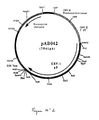
- the 2981 bp PCR product was digested with Pst I and Not I to isolate a 2959 bp PstI-NotI fragment. This fragment was ligated with the vector pVR1012 (Example 7), previously digested with Pst I and Not I, to give the plasmid pAB042 (7841 bp) ( Figure No. 2).
- a PCR reaction was carried out with the genomic DNA of equine herpesvirus type 4 (EHV-4) (strain 1942) (M. Riggio et al J. Virol, 1989, 63, 1123-1133) and with the following oligonucleotides: to amplify a 2949 bp fragment containing the gene encoding the glycoprotein gB of EHV-4 as a PstI-XbaI fragment.
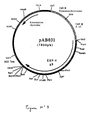
- the PCR product was digested with PstI and XbaI to give a PstI-XbaI fragment of 2931 bp. This fragment was ligated with the vector pVR1012 (Example 7), previously digested with PstI and XbaI, to give the plasmid pAB031 (7806 bp) ( Figure No. 3).
- PCR reaction was performed with the genomic DNA of equine herpesvirus type 1 (EHV-1) (strain Kentucky D) (Audonnet JC et al. J. Gen. Virol. 1990. 71. 2969-2978) and with the following oligonucleotides: to isolate the gene encoding the glycoprotein gD (EHV-1 gD) as a PstI-BamHI fragment.
- EHV-1 gD glycoprotein gD
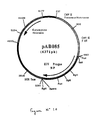
- 1228 bp PCR product was digested with PstI and Bam HI to isolate a 1211 bp PstI-BamHI fragment. This fragment was ligated with the vector pVR1012 (Example 7), previously digested with Pst I and Bam HI, to give the plasmid pAB013 (6070 bp) ( Figure No. 4).
- EHV-4 equine herpesvirus type 4
- EHV-4 gD glycoprotein gD of EHV-4
- 1230 bp PCR product was digested with Pst I and Bam HI to isolate a 1212 bp PstI-BamHI fragment. This fragment was ligated with the vector pVR1012 (Example 7), previously digested with Pst I and Bam HI, to give the plasmid pAB032 (6071 bp) (FIG. No. 5).
- the 1729 bp RT-PCR product was digested with Sal I and Bam HI to isolate a 1717 bp SalI-BamHI fragment. This fragment was ligated with the vector pVR1012 (Example 7), previously digested with Sal I and Bam HI, to give the plasmid pAB033 (6584 bp) (FIG. No. 7).
- equine influenza virus (EIV) (Fontainebleau strain), prepared according to Example 4, and with the following oligonucleotides: to isolate the gene coding for the equine influenza virus HA glycoprotein (Fontainebleau strain) (FIG. No. 8 and SEQ ID No. 15) in the form of a NotI-NotI fragment.
- EIV equine influenza virus
- Fontainebleau strain Fontainebleau strain
- This fragment was ligated with the vector pVR1012 (Example 7), previously digested with Not I, to give the plasmid pAB099 (6625 bp) which contains the HA gene (equine influenza strain Fontainebleau) in the correct orientation with respect to the promoter (FIG. No. 9).
- equine influenza virus (EIV) genomic RNA Jillin strain H3N8) (O. Gorman et al., J. Virol 1991. 65 3704-3714), prepared according to the technique of Example 4, and with the following oligonucleotides: to isolate the gene coding for the NP nucleoprotein of the equine influenza virus in the form of a SalI-BamHI fragment.
- the 1515 bp RT-PCR product was digested with Sal I and Bam HI to isolate a 1503 bp SalI-BamHI fragment. This fragment was ligated with the vector pVR1012 (Example 7), previously digested with Sail and BamHI, to give the plasmid pAB084 (6371 bp) (FIG. No. 11).
- a PCR reaction was carried out with the genomic DNA of Clostridium tetani (strain CN3911) (N. Fairweather et al ., J. Bact, 1986. 165. 21-27), prepared according to the technique of Example 2, and with the following oligonucleotides: to isolate the sequence coding for the subunit C of Clostridium tetani toxin as a PstI-BamHI fragment.
- the 1377 bp PCR product was digested with PstI and Bam HI to isolate a 1361 bp PstI-BamHI fragment. This fragment was ligated with the vector pVR1012. (Example 7), previously digested with Pst I and Bam HI, to give the plasmid pAB070 (6219 bp) ( Figure No. 12).
- a PCR reaction was carried out with the genomic DNA of Borrelia burgdorferi (strain B31) (Bergstrom S. et al Mol Microbiol, 1989. 3. 479-486), prepared according to the technique of Example 2, and with the following oligonucleotides: to isolate the gene encoding the OspA membrane protein as a SalI-BamHI fragment.
- the 842 bp PCR product was digested with Sal I and Bam HI to isolate an 829 bp SalI-BamHI fragment. This fragment was ligated with the vector pVR1012 (Example 7), previously digested with SalI and BamHI, to give the plasmid pAB017 (5698 bp) (FIG. 13).
- Example 6 An RT-PCR reaction according to the technique of Example 6 was carried out with Eastern Encephalitis Virus (EEV) genomic RNA (North America strain 82V2137) (S. Weaver et al ., Virology. 1993. 197. 375-390), prepared according to the technique of Example 4, and with the following oligonucleotides: to isolate the gene encoding EEV glycoprotein E2 as a PstI-BamHI fragment. After purification, the 1294 bp RT-PCR product was digested with Pst I and Bam HI to isolate a 1278 bp PstI-BamHI fragment. This. fragment was ligated with the vector pVR1012 (Example 7), previously digested with PstI and BamHI, to give the plasmid pAB094 (6136 bp) ( Figure No. 14).
- EEV Eastern Encephalitis Virus
- Example 6 An RT-PCR reaction according to the technique of Example 6 was carried out with Eastern Encephalitis virus (EEV) genomic RNA (North America strain 82V2137) (S. Weaver et al ., Virology. 1993. 197. 375-390), prepared according to the technique of Example 4, and with the following oligonucleotides: to isolate the gene encoding the capsid protein C (EEV C) as a PstI-BglII fragment. After purification, the 801 bp RT-PCR product was digested with Pst I and Bgl II to isolate a 785 bp PstI-BglII fragment. This fragment was ligated with the vector pVR1012 (Example 7), previously digested with Pst I and Bgl II, to give the plasmid pAB093 ⁇ (5650 bp) (FIG. 15).
- EEV Eastern Encephalitis virus
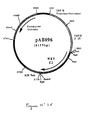
- Example 6 An RT-PCR reaction according to the technique of Example 6 was carried out with Western Encephalitis virus (WEV) genomic RNA (strain BSF1703) (C. Hahn et al ., Proc Natl. Acad Sci USA 1988. 85. 5997-6001), prepared according to the technique of Example 4, and with the following oligonucleotides: to isolate the gene encoding WEV glycoprotein E2 as a SalI-BamHI fragment. After purification, the 1304 bp RT-PCR product was digested with Sal I and Bam HI to isolate a 1291 bp SalI-BamHI fragment. This fragment was ligated with the vector pVR1012 (Example 7), previously digested with Sal I and Bam HI, to give the plasmid pAB096 (6159 bp) (FIG. No. 16).
- WEV Western Encephalitis virus
- Example 6 An RT-PCR reaction according to Example 6 was carried out with the Western Encephalitis Virus (WEV) genomic RNA (strain BSF1703) (C. Hahn et al ., Proc.Natl.Acad.Sci USA, 1988, 85, 5997-6001), prepared according to Example 4, and with the following oligonucleotides: to isolate the gene encoding the WEV virus capsid protein C as a SalI-BamHI fragment. After purification, the 809-bp RT-PCR product was digested with Sal I and Bam HI to isolate a SalI-BamHI fragment from 796 bp. This fragment was ligated with the vector pVR1012 (Example 7), previously digested with Sal I and Bam HI, to give the plasmid pAB095 (5664 bp) (FIG. No. 17).
- WEV Western Encephalitis Virus
- RT-PCR reaction was carried out with Venezuelan encephalitis virus (VEV) genomic RNA (strain P676 (Type IC)) (Kinney R. et al Virology 1992. 191. 569-580), prepared according to Example 4, and with the following oligonucleotides: to isolate the gene coding for the glycoprotein E2 of the VEV virus in the form of a SalI-BamHI fragment.
- VEV Venezuelan encephalitis virus
- strain P676 Type IC
- oligonucleotides to isolate the gene coding for the glycoprotein E2 of the VEV virus in the form of a SalI-BamHI fragment.
- the RT-PCR product of 1304 bp was digested with Sal I and Bam HI to isolate a SalI-BamHI fragment of 1291 bp. This fragment was ligated with the vector pVR1012 (Example 7), previously digested with Sal I and Bam HI, to give the plasmid pAB
- RT-PCR reaction was carried out with Venezuelan encephalitis virus (VEV) genomic RNA (strain P676 (Type IC)) (Kinney R. et al Virology 1992. 191. 569-580), prepared according to Example 4, and with the following oligonucleotides: to isolate the gene coding for the capsid protein C of the VEV virus under the form of a PstI-BamHI fragment.
- VEV Venezuelan encephalitis virus
- strain P676 Type IC
- oligonucleotides to isolate the gene coding for the capsid protein C of the VEV virus under the form of a PstI-BamHI fragment.
- the 856 bp RT-PCR product was digested with PstI and Bam HI to isolate a 839 bp PstI-BamHI fragment. This fragment was ligated with the vector pVR1012 (Example 7), previously digested with Pst I and Bam HI,
- RT-PCR reaction was carried out with genomic RNA of rabies virus (ERA strain) (A. Anilionis et al ., Nature, 1981. 294. 275-278), prepared according to the example 4, and with the following oligonucleotides: to amplify a 1589 bp fragment containing the gene encoding the rabies virus G protein.
- the RT-PCR product was digested with PstI and Bam HI to give a 1578 bp PstI-BamHI fragment. This fragment was ligated with the vector pVR1012 (Example 7), previously digested with Pst I and Bam HI, to give the plasmid pAB041 (6437 bp) (FIG. No. 20).
- any technique may be used which makes it possible to obtain a suspension of purified plasmids predominantly in supercoiled form.
- these techniques are well known to those skilled in the art.
- the purified plasmids are resuspended so as to obtain solutions with high concentration (> 2 mg / ml) compatible with the storage.
- the plasmids are resuspended either in ultrapure water or in TE buffer (10 mM Tris-HCl, 1 mM EDTA, pH 8.0).
- the various plasmids necessary for the manufacture of an associated vaccine are mixed from their concentrated solutions (Example 16).
- the mixtures are made in such a way that the final concentration of each plasmid corresponds to the effective dose of each plasmid.
- Solutions that can be used to adjust the final concentration of the vaccine can be either a 0.9% NACI solution or PBS buffer.
- Particular formulations such as liposomes, cationic lipids, can also be used for the manufacture of vaccines.
- Horses are vaccinated with doses of 100 ⁇ g, 250 ⁇ g or 500 ⁇ g per plasmid. Injections can be done by needle intramuscularly in the muscles of the neck. In this case, the vaccine doses are administered in a volume of 2 ml. Injections can be performed intradermally using a liquid jet (needle-free) injection apparatus delivering a 0.2 ml dose at 5 points (0.04 ml per injection point) (e.g. PIGJET "). In this case, the vaccine doses are administered in volumes of 0.2 or 0.4 ml, which corresponds respectively to one or two administrations. When two successive administrations are carried out using the PIGJET apparatus, these administrations are carried out in an offset manner, so that the two injection zones are separated from each other by a distance of approximately 1 to 2 centimeters.
Landscapes
- Health & Medical Sciences (AREA)
- Life Sciences & Earth Sciences (AREA)
- Chemical & Material Sciences (AREA)
- Virology (AREA)
- Medicinal Chemistry (AREA)
- General Health & Medical Sciences (AREA)
- Immunology (AREA)
- Veterinary Medicine (AREA)
- Organic Chemistry (AREA)
- Pharmacology & Pharmacy (AREA)
- Animal Behavior & Ethology (AREA)
- Public Health (AREA)
- Epidemiology (AREA)
- Mycology (AREA)
- Microbiology (AREA)
- Biophysics (AREA)
- Proteomics, Peptides & Aminoacids (AREA)
- Molecular Biology (AREA)
- Genetics & Genomics (AREA)
- Biochemistry (AREA)
- Gastroenterology & Hepatology (AREA)
- Chemical Kinetics & Catalysis (AREA)
- Tropical Medicine & Parasitology (AREA)
- Nuclear Medicine, Radiotherapy & Molecular Imaging (AREA)
- Pulmonology (AREA)
- General Chemical & Material Sciences (AREA)
- Engineering & Computer Science (AREA)
- Bioinformatics & Cheminformatics (AREA)
- Communicable Diseases (AREA)
- Oncology (AREA)
- Medicines Containing Antibodies Or Antigens For Use As Internal Diagnostic Agents (AREA)
- Micro-Organisms Or Cultivation Processes Thereof (AREA)
- Medicines That Contain Protein Lipid Enzymes And Other Medicines (AREA)
- Pharmaceuticals Containing Other Organic And Inorganic Compounds (AREA)
Applications Claiming Priority (2)
| Application Number | Priority Date | Filing Date | Title |
|---|---|---|---|
| FR9609400A FR2751226B1 (fr) | 1996-07-19 | 1996-07-19 | Formule de vaccin polynucleotidique contre les pathologies du cheval |
| EP97934569A EP0936922B1 (de) | 1996-07-19 | 1997-07-15 | Polynukleotid-impfstoffformulierung gegen pferdekrankheiten |
Related Parent Applications (1)
| Application Number | Title | Priority Date | Filing Date |
|---|---|---|---|
| EP97934569A Division EP0936922B1 (de) | 1996-07-19 | 1997-07-15 | Polynukleotid-impfstoffformulierung gegen pferdekrankheiten |
Publications (2)
| Publication Number | Publication Date |
|---|---|
| EP1647281A2 true EP1647281A2 (de) | 2006-04-19 |
| EP1647281A3 EP1647281A3 (de) | 2009-08-05 |
Family
ID=9494494
Family Applications (2)
| Application Number | Title | Priority Date | Filing Date |
|---|---|---|---|
| EP05025200A Ceased EP1647281A3 (de) | 1996-07-19 | 1997-07-15 | Polynukleotid-impfstoffformulierung gegen Pferdekrankheiten |
| EP97934569A Expired - Lifetime EP0936922B1 (de) | 1996-07-19 | 1997-07-15 | Polynukleotid-impfstoffformulierung gegen pferdekrankheiten |
Family Applications After (1)
| Application Number | Title | Priority Date | Filing Date |
|---|---|---|---|
| EP97934569A Expired - Lifetime EP0936922B1 (de) | 1996-07-19 | 1997-07-15 | Polynukleotid-impfstoffformulierung gegen pferdekrankheiten |
Country Status (13)
| Country | Link |
|---|---|
| US (2) | US6207166B1 (de) |
| EP (2) | EP1647281A3 (de) |
| JP (2) | JP2000516199A (de) |
| AR (2) | AR009947A1 (de) |
| AU (1) | AU735372B2 (de) |
| BR (1) | BR9710502A (de) |
| CA (2) | CA2660355C (de) |
| CZ (2) | CZ300593B6 (de) |
| DE (1) | DE69734778T2 (de) |
| FR (1) | FR2751226B1 (de) |
| NZ (1) | NZ333754A (de) |
| PL (1) | PL188409B1 (de) |
| WO (1) | WO1998003198A1 (de) |
Families Citing this family (52)
| Publication number | Priority date | Publication date | Assignee | Title |
|---|---|---|---|---|
| FR2751226B1 (fr) * | 1996-07-19 | 1998-11-27 | Rhone Merieux | Formule de vaccin polynucleotidique contre les pathologies du cheval |
| FR2775601B1 (fr) * | 1998-03-03 | 2001-09-21 | Merial Sas | Vaccins vivants recombines et adjuves |
| FR2776928B1 (fr) * | 1998-04-03 | 2000-06-23 | Merial Sas | Vaccins adn adjuves |
| FR2794648B1 (fr) * | 1999-06-10 | 2003-03-07 | Merial Sas | Vaccins adn pour animaux de compagnie et de sport |
| CA2375320C (en) * | 1999-06-10 | 2013-02-19 | Merial | Dna vaccines for pets or for animals used in sports |
| US6645740B1 (en) | 1999-06-10 | 2003-11-11 | Merial Limited | Nucleic acids encodings equine GM-CSF |
| EP1282640A2 (de) * | 2000-05-01 | 2003-02-12 | Powderject Vaccines, Inc. | Impfung durch nukleinsäure |
| US6803041B2 (en) * | 2001-03-20 | 2004-10-12 | Boehringer Ingelheim Vetmedica, Inc. | Equine herpesvirus vaccine |
| FR2823222B1 (fr) | 2001-04-06 | 2004-02-06 | Merial Sas | Vaccin contre le virus de la fievre du nil |
| US7906311B2 (en) | 2002-03-20 | 2011-03-15 | Merial Limited | Cotton rat lung cells for virus culture |
| EP1606419A1 (de) | 2003-03-18 | 2005-12-21 | Quantum Genetics Ireland Limited | Systeme und methoden zur erhohung der milchproduktion in tieren |
| US7468273B2 (en) | 2003-05-01 | 2008-12-23 | Meial Limited | Canine GHRH gene, polypeptides and methods of use |
| WO2005049794A2 (en) | 2003-11-13 | 2005-06-02 | University Of Georgia Research Foundation, Inc. | Methods of characterizing infectious bursal disease virus |
| WO2005112544A2 (en) | 2004-02-19 | 2005-12-01 | The Governors Of The University Of Alberta | Leptin promoter polymorphisms and uses thereof |
| US11865172B2 (en) | 2005-04-21 | 2024-01-09 | University Of Florida Research Foundation, Inc. | Materials and methods for respiratory disease control in canines |
| US7959929B2 (en) | 2005-04-21 | 2011-06-14 | University Of Florida Research Foundation, Inc. | Materials and methods for respiratory disease control in canines |
| RS51324B (sr) | 2005-04-25 | 2010-12-31 | Merial Ltd. | Vakcine protiv nipah virusa |
| US20080241184A1 (en) | 2005-08-25 | 2008-10-02 | Jules Maarten Minke | Canine influenza vaccines |
| EP3147296A1 (de) | 2005-11-14 | 2017-03-29 | Merial, Inc. | Gentherapie für nierenversagen |
| US7771995B2 (en) | 2005-11-14 | 2010-08-10 | Merial Limited | Plasmid encoding human BMP-7 |
| US7682619B2 (en) | 2006-04-06 | 2010-03-23 | Cornell Research Foundation, Inc. | Canine influenza virus |
| US7862821B2 (en) | 2006-06-01 | 2011-01-04 | Merial Limited | Recombinant vaccine against bluetongue virus |
| UA100692C2 (ru) | 2007-05-02 | 2013-01-25 | Мериал Лимитед | Днк-плазмиды, имеющие повышенную экспрессию и стабильность |
| US20080274137A1 (en) * | 2007-05-02 | 2008-11-06 | Jean Christophe Francis Audonnet | DNA plasmids having improved expression and stability |
| EP3542815A1 (de) | 2008-11-28 | 2019-09-25 | Boehringer Ingelheim Animal Health USA Inc. | Rekombinanter vogelgrippeimpfstoff und verwendungen davon |
| EP2414386B1 (de) | 2009-04-03 | 2016-01-27 | Merial Limited | Vogelimpfstoffe mit newcastle-krankheit-vektor |
| US10633667B2 (en) | 2009-12-28 | 2020-04-28 | Boehringer Ingelheim Animal Health USA Inc. | Recombinant NDV antigen and uses thereof |
| US20130197612A1 (en) | 2010-02-26 | 2013-08-01 | Jack W. Lasersohn | Electromagnetic Radiation Therapy |
| ES2617743T3 (es) | 2010-03-12 | 2017-06-19 | Merial, Inc. | Vacunas recombinantes del virus de la lengua azul y sus utilizaciones |
| EP2611460B1 (de) | 2010-08-31 | 2016-10-05 | Merial, Inc. | Auf das virus der newcastle-krankheit gerichtete herpesvirus-impfstoffe |
| WO2012090073A2 (en) | 2010-12-30 | 2012-07-05 | The Netherlands Cancer Institute | Methods and compositions for predicting chemotherapy sensitivity |
| EP2694678A2 (de) | 2011-04-04 | 2014-02-12 | Netherland Cancer Institute | Verfahren und zusammensetzungen zur vorhersage der resistenz gegenüber einer antikrebsbehandlung |
| US20140296248A1 (en) | 2011-04-04 | 2014-10-02 | Stichting het Nederlands Kanker Instiuut-Antoni van Leeuwenhoek ziekenhuis | Methods and compositions for predicting resistance to anticancer treatment |
| US9216213B2 (en) | 2011-04-20 | 2015-12-22 | Merial, Inc. | Adjuvanted rabies vaccine with improved viscosity profile |
| WO2012149038A1 (en) | 2011-04-25 | 2012-11-01 | Advanced Bioscience Laboratories, Inc. | Truncated hiv envelope proteins (env), methods and compositions related thereto |
| CA2837582C (en) | 2011-05-27 | 2021-03-02 | Merial Limited | Genetic vaccines against hendra virus and nipah virus |
| CA2837375C (en) | 2011-06-01 | 2019-07-16 | Merial Limited | Needle-free administration of prrsv vaccines |
| MX350096B (es) | 2011-08-12 | 2017-08-25 | Merial Inc | Preservación asistida con vacío de productos biológicos, en particular de vacunas. |
| WO2013093629A2 (en) | 2011-12-20 | 2013-06-27 | Netherlands Cancer Institute | Modular vaccines, methods and compositions related thereto |
| SI2814508T1 (sl) | 2012-02-14 | 2017-10-30 | Merial, Inc. | Rotavirusna podenotska cepiva ter postopki njihove izdelave in uporaba |
| EP3466443B1 (de) | 2012-02-14 | 2020-12-16 | Boehringer Ingelheim Animal Health USA Inc. | Sowohl tollwut- als auch ox40-proteine exprimierende rekombinante poxvirusvektoren und daraus hergestellte impfstoffe |
| WO2013138776A1 (en) | 2012-03-16 | 2013-09-19 | Merial Limited | Novel methods for providing long-term protective immunity against rabies in animals, based upon administration of replication-deficient flavivirus expressing rabies g |
| KR101490292B1 (ko) | 2012-04-16 | 2015-02-04 | 한국생명공학연구원 | 신규한 h3n8 말 인플루엔자 바이러스 |
| EP2861248B1 (de) | 2012-06-13 | 2017-11-15 | Merial, Inc. | Impfstoffe aus reassortierendem btv und ahsv |
| HK1216006A1 (zh) | 2013-03-12 | 2016-10-07 | Boehringer Ingelheim Animal Health USA Inc. | 反向遺傳學施馬倫貝格病毒疫苗組合物,和其使用方法 |
| WO2016073410A1 (en) | 2014-11-03 | 2016-05-12 | Merial, Inc. | Methods of using microneedle vaccine formulations to elicit in animals protective immunity against rabies virus |
| ES3050936T3 (en) | 2015-06-23 | 2025-12-23 | Boehringer Ingelheim Vetmedica Gmbh | Prrsv minor protein-containing recombinant viral vectors and methods of making and use thereof |
| WO2017031120A1 (en) | 2015-08-20 | 2017-02-23 | Merial, Inc. | Fcv recombinant vaccines and uses thereof |
| HUE065661T2 (hu) | 2015-09-29 | 2024-06-28 | Boehringer Ingelheim Animal Health Usa Inc | Kutya parvovírus (CPV) vírusszerû részecske (VLP) vakcinák és alkalmazásuk |
| DK3380119T3 (da) | 2015-11-23 | 2021-11-15 | Boehringer Ingelheim Animal Health Usa Inc | Fmdv- og e2-fusionsproteiner og anvendelser deraf |
| TWI760322B (zh) | 2016-01-29 | 2022-04-11 | 美商百靈佳殷格翰動物保健美國有限公司 | 重組腺病毒載體裝載之fmdv疫苗及其用途 |
| CN109136264B (zh) * | 2018-09-19 | 2022-07-29 | 天康制药(苏州)有限公司 | 马疱疹病毒1型gB-gD融合蛋白、重组载体和真核细胞株及其制备方法和疫苗 |
Family Cites Families (11)
| Publication number | Priority date | Publication date | Assignee | Title |
|---|---|---|---|---|
| US4631191A (en) * | 1985-06-20 | 1986-12-23 | Biotechnology Research Partners, Ltd. | Methods and compositions useful in preventing equine influenza |
| US4944942A (en) * | 1987-08-27 | 1990-07-31 | Mobay Corporation | Intranasal vaccination of horses with inactivated microorganisms or antigenic material |
| SU1671688A1 (ru) * | 1989-01-27 | 1991-08-23 | Всесоюзный Научно-Исследовательский Институт Молекулярной Биологии | Штамм гибридных культивируемых клеток животных MUS мUSсULUS L. - продуцент моноклональных антител к гликопротеиду Е1 вируса восточного энцефаломиелита лошадей |
| US5185440A (en) * | 1989-06-20 | 1993-02-09 | North Carolina State University | cDNA clone coding for Venezuelan equine encephalitis virus and attenuating mutations thereof |
| FR2659349B1 (fr) * | 1990-03-12 | 1993-12-24 | Rhone Merieux | Virus herpes recombinants notamment pour la realisation de vaccins, leur procede de preparation, les plasmides realises au cours de ce procede et les vaccins obtenus. |
| US5643578A (en) * | 1992-03-23 | 1997-07-01 | University Of Massachusetts Medical Center | Immunization by inoculation of DNA transcription unit |
| US5243121A (en) | 1992-03-19 | 1993-09-07 | Engelhard Corporation | Fluid catalytic cracking process for increased formation of isobutylene and isoamylenes |
| US5925358A (en) * | 1993-02-26 | 1999-07-20 | Syntro Corporation | Recombinant fowlpox viruses and uses thereof |
| ATE475668T1 (de) * | 1994-01-27 | 2010-08-15 | Univ Massachusetts Medical | Immunisierung durch impfung von dns transkriptionseinheit |
| FR2751226B1 (fr) * | 1996-07-19 | 1998-11-27 | Rhone Merieux | Formule de vaccin polynucleotidique contre les pathologies du cheval |
| ATE276271T1 (de) * | 1998-03-27 | 2004-10-15 | Secr Defence | Rekombinantes virus |
-
1996
- 1996-07-19 FR FR9609400A patent/FR2751226B1/fr not_active Expired - Lifetime
-
1997
- 1997-07-11 AR ARP970103113A patent/AR009947A1/es active IP Right Grant
- 1997-07-15 PL PL97331202A patent/PL188409B1/pl unknown
- 1997-07-15 CA CA2660355A patent/CA2660355C/en not_active Expired - Lifetime
- 1997-07-15 DE DE69734778T patent/DE69734778T2/de not_active Expired - Lifetime
- 1997-07-15 EP EP05025200A patent/EP1647281A3/de not_active Ceased
- 1997-07-15 CA CA2260858A patent/CA2260858C/en not_active Expired - Lifetime
- 1997-07-15 AU AU37727/97A patent/AU735372B2/en not_active Expired
- 1997-07-15 JP JP09532943A patent/JP2000516199A/ja active Pending
- 1997-07-15 EP EP97934569A patent/EP0936922B1/de not_active Expired - Lifetime
- 1997-07-15 WO PCT/FR1997/001314 patent/WO1998003198A1/fr not_active Ceased
- 1997-07-15 NZ NZ333754A patent/NZ333754A/en not_active IP Right Cessation
- 1997-07-15 CZ CZ0017499A patent/CZ300593B6/cs not_active IP Right Cessation
- 1997-07-15 CZ CZ20080390A patent/CZ301365B6/cs not_active IP Right Cessation
- 1997-07-15 BR BR9710502A patent/BR9710502A/pt not_active Application Discontinuation
-
1999
- 1999-01-15 US US09/232,478 patent/US6207166B1/en not_active Expired - Lifetime
-
2001
- 2001-02-16 US US09/785,055 patent/US6558674B1/en not_active Expired - Lifetime
-
2007
- 2007-03-12 AR ARP070101015A patent/AR059828A2/es unknown
- 2007-12-07 JP JP2007316669A patent/JP2008143900A/ja active Pending
Also Published As
| Publication number | Publication date |
|---|---|
| WO1998003198A1 (fr) | 1998-01-29 |
| US6558674B1 (en) | 2003-05-06 |
| AR009947A1 (es) | 2000-05-17 |
| EP0936922B1 (de) | 2005-11-30 |
| PL188409B1 (pl) | 2005-01-31 |
| NZ333754A (en) | 2001-03-30 |
| EP0936922A1 (de) | 1999-08-25 |
| CZ300593B6 (cs) | 2009-06-24 |
| BR9710502A (pt) | 1999-08-17 |
| AU3772797A (en) | 1998-02-10 |
| AU735372B2 (en) | 2001-07-05 |
| CA2660355A1 (en) | 1998-01-29 |
| AR059828A2 (es) | 2008-04-30 |
| JP2000516199A (ja) | 2000-12-05 |
| DE69734778D1 (de) | 2006-01-05 |
| CZ301365B6 (cs) | 2010-01-27 |
| EP1647281A3 (de) | 2009-08-05 |
| US6207166B1 (en) | 2001-03-27 |
| DE69734778T2 (de) | 2006-09-07 |
| FR2751226B1 (fr) | 1998-11-27 |
| CA2260858A1 (en) | 1998-01-29 |
| PL331202A1 (en) | 1999-07-05 |
| CZ17499A3 (cs) | 1999-05-12 |
| CA2260858C (en) | 2011-01-18 |
| CA2660355C (en) | 2012-05-22 |
| FR2751226A1 (fr) | 1998-01-23 |
| JP2008143900A (ja) | 2008-06-26 |
Similar Documents
| Publication | Publication Date | Title |
|---|---|---|
| EP0936922B1 (de) | Polynukleotid-impfstoffformulierung gegen pferdekrankheiten | |
| EP0954332B2 (de) | Impfstofformel auf polynukleotidbasis zur behandlung von hundekrankheiten, insbesondere solcher des atmungs- und verdauungstraktes | |
| EP0912194B1 (de) | Polynukleotid-impfstoff, vorzugsweise zur behandlung der atemkrankheit bei rindern | |
| EP0934416B1 (de) | Zusammensetzung eines polynukleotid-impfstoffes für katzen | |
| EP0914442B1 (de) | Hühner polynukleotide impfstoff-formulierung | |
| EP0912743B1 (de) | Zusammensetzung eines polynukleotidvakzins zur behandlung von atemwegs- und fortpflanzungsbezogenen erkrankungen des schweins | |
| EP0910657B1 (de) | Rekombinanter lebendimpfstoff basierend auf hunde-herpesvirus, insbesondere gegen staupe, tollwut und parainfluenza virus typ 2 | |
| WO1998003660A9 (fr) | Formule de vaccin polynucleotidique felin | |
| US7294338B2 (en) | Polynucleotide vaccine formula against canine pathologies, in particular respiratory and digestive pathologies | |
| NZ506427A (en) | A canidae vaccine comprising the rabies G gene under the control of the CMV-IE promoter |
Legal Events
| Date | Code | Title | Description |
|---|---|---|---|
| PUAI | Public reference made under article 153(3) epc to a published international application that has entered the european phase |
Free format text: ORIGINAL CODE: 0009012 |
|
| AC | Divisional application: reference to earlier application |
Ref document number: 0936922 Country of ref document: EP Kind code of ref document: P |
|
| AK | Designated contracting states |
Kind code of ref document: A2 Designated state(s): BE CH DE FR GB IE IT LI NL SE |
|
| AX | Request for extension of the european patent |
Extension state: AL LT LV RO SI |
|
| RIN1 | Information on inventor provided before grant (corrected) |
Inventor name: RIVIERE, MICHEL Inventor name: BOUCHARDON, ANNABELLE Inventor name: AUDONNET, JEAN-CHRISTOPHE |
|
| REG | Reference to a national code |
Ref country code: HK Ref legal event code: DE Ref document number: 1083763 Country of ref document: HK |
|
| PUAL | Search report despatched |
Free format text: ORIGINAL CODE: 0009013 |
|
| AK | Designated contracting states |
Kind code of ref document: A3 Designated state(s): BE CH DE FR GB IE IT LI NL SE |
|
| AX | Request for extension of the european patent |
Extension state: AL LT LV RO SI |
|
| 17P | Request for examination filed |
Effective date: 20100120 |
|
| 17Q | First examination report despatched |
Effective date: 20100309 |
|
| AKX | Designation fees paid |
Designated state(s): BE CH DE FR GB IE IT LI NL SE |
|
| STAA | Information on the status of an ep patent application or granted ep patent |
Free format text: STATUS: THE APPLICATION HAS BEEN REFUSED |
|
| 18R | Application refused |
Effective date: 20110224 |
|
| REG | Reference to a national code |
Ref country code: HK Ref legal event code: WD Ref document number: 1083763 Country of ref document: HK |