EP1648103A2 - Leistungsprämien erhältlich von einem Zielpublikum das zu einer Sendung abgestimmt ist - Google Patents
Leistungsprämien erhältlich von einem Zielpublikum das zu einer Sendung abgestimmt ist Download PDFInfo
- Publication number
- EP1648103A2 EP1648103A2 EP05022269A EP05022269A EP1648103A2 EP 1648103 A2 EP1648103 A2 EP 1648103A2 EP 05022269 A EP05022269 A EP 05022269A EP 05022269 A EP05022269 A EP 05022269A EP 1648103 A2 EP1648103 A2 EP 1648103A2
- Authority
- EP
- European Patent Office
- Prior art keywords
- code signals
- reward
- signal
- program
- monitored person
- Prior art date
- Legal status (The legal status is an assumption and is not a legal conclusion. Google has not performed a legal analysis and makes no representation as to the accuracy of the status listed.)
- Ceased
Links
- 238000000034 method Methods 0.000 claims abstract description 28
- 238000009825 accumulation Methods 0.000 claims 3
- 230000000903 blocking effect Effects 0.000 claims 1
- 230000015654 memory Effects 0.000 description 9
- 230000008859 change Effects 0.000 description 8
- 238000001514 detection method Methods 0.000 description 6
- 230000005540 biological transmission Effects 0.000 description 5
- 238000013461 design Methods 0.000 description 5
- 238000012545 processing Methods 0.000 description 3
- 241000282414 Homo sapiens Species 0.000 description 2
- 238000013459 approach Methods 0.000 description 2
- 238000009434 installation Methods 0.000 description 2
- 238000005259 measurement Methods 0.000 description 2
- 230000008054 signal transmission Effects 0.000 description 2
- 230000009471 action Effects 0.000 description 1
- 230000004913 activation Effects 0.000 description 1
- 230000036626 alertness Effects 0.000 description 1
- 230000008901 benefit Effects 0.000 description 1
- 238000013500 data storage Methods 0.000 description 1
- 238000010586 diagram Methods 0.000 description 1
- 239000003814 drug Substances 0.000 description 1
- 229940079593 drug Drugs 0.000 description 1
- 230000006870 function Effects 0.000 description 1
- 230000008676 import Effects 0.000 description 1
- 238000004519 manufacturing process Methods 0.000 description 1
- 230000004048 modification Effects 0.000 description 1
- 238000012986 modification Methods 0.000 description 1
- 230000008569 process Effects 0.000 description 1
- 230000004044 response Effects 0.000 description 1
- 238000009420 retrofitting Methods 0.000 description 1
- 239000004065 semiconductor Substances 0.000 description 1
- 239000007787 solid Substances 0.000 description 1
Images

Classifications
-
- H—ELECTRICITY
- H04—ELECTRIC COMMUNICATION TECHNIQUE
- H04H—BROADCAST COMMUNICATION
- H04H60/00—Arrangements for broadcast applications with a direct linking to broadcast information or broadcast space-time; Broadcast-related systems
- H04H60/35—Arrangements for identifying or recognising characteristics with a direct linkage to broadcast information or to broadcast space-time, e.g. for identifying broadcast stations or for identifying users
- H04H60/37—Arrangements for identifying or recognising characteristics with a direct linkage to broadcast information or to broadcast space-time, e.g. for identifying broadcast stations or for identifying users for identifying segments of broadcast information, e.g. scenes or extracting programme ID
-
- H—ELECTRICITY
- H04—ELECTRIC COMMUNICATION TECHNIQUE
- H04H—BROADCAST COMMUNICATION
- H04H60/00—Arrangements for broadcast applications with a direct linking to broadcast information or broadcast space-time; Broadcast-related systems
- H04H60/61—Arrangements for services using the result of monitoring, identification or recognition covered by groups H04H60/29-H04H60/54
- H04H60/63—Arrangements for services using the result of monitoring, identification or recognition covered by groups H04H60/29-H04H60/54 for services of sales
-
- H—ELECTRICITY
- H04—ELECTRIC COMMUNICATION TECHNIQUE
- H04H—BROADCAST COMMUNICATION
- H04H60/00—Arrangements for broadcast applications with a direct linking to broadcast information or broadcast space-time; Broadcast-related systems
- H04H60/29—Arrangements for monitoring broadcast services or broadcast-related services
- H04H60/33—Arrangements for monitoring the users' behaviour or opinions
-
- H—ELECTRICITY
- H04—ELECTRIC COMMUNICATION TECHNIQUE
- H04H—BROADCAST COMMUNICATION
- H04H60/00—Arrangements for broadcast applications with a direct linking to broadcast information or broadcast space-time; Broadcast-related systems
- H04H60/35—Arrangements for identifying or recognising characteristics with a direct linkage to broadcast information or to broadcast space-time, e.g. for identifying broadcast stations or for identifying users
- H04H60/38—Arrangements for identifying or recognising characteristics with a direct linkage to broadcast information or to broadcast space-time, e.g. for identifying broadcast stations or for identifying users for identifying broadcast time or space
- H04H60/41—Arrangements for identifying or recognising characteristics with a direct linkage to broadcast information or to broadcast space-time, e.g. for identifying broadcast stations or for identifying users for identifying broadcast time or space for identifying broadcast space, i.e. broadcast channels, broadcast stations or broadcast areas
- H04H60/43—Arrangements for identifying or recognising characteristics with a direct linkage to broadcast information or to broadcast space-time, e.g. for identifying broadcast stations or for identifying users for identifying broadcast time or space for identifying broadcast space, i.e. broadcast channels, broadcast stations or broadcast areas for identifying broadcast channels
-
- H—ELECTRICITY
- H04—ELECTRIC COMMUNICATION TECHNIQUE
- H04H—BROADCAST COMMUNICATION
- H04H60/00—Arrangements for broadcast applications with a direct linking to broadcast information or broadcast space-time; Broadcast-related systems
- H04H60/61—Arrangements for services using the result of monitoring, identification or recognition covered by groups H04H60/29-H04H60/54
- H04H60/65—Arrangements for services using the result of monitoring, identification or recognition covered by groups H04H60/29-H04H60/54 for using the result on users' side
Definitions
- This invention is directed to a technique applied to an audience that is listening to and/or watching a program broadcast from a program signal source as it is being performed by reproduction equipment and, more particularly, to reward persons who meet certain reward issuance criteria when they have chosen to be members of that audience by tuning in to the program signal source which is offering the reward.
- program can be a commercial type (e.g. advertisement) and/or a non-commercial type (e.g. an entertainment show), and it involves a programming signal (e.g. a television signal) obtained from a program signal source (e.g. a television station), originated by a program provider (e.g. a television network, an advertiser, or a production company) and reproduced as audio and/or video.
- a programming signal e.g. a television signal
- a program signal source e.g. a television station
- a program provider e.g. a television network, an advertiser, or a production company
- the "broadcast” of the program can be over the airwaves, cable, satellite, or any other signal transmission medium.
- An “audience” for such program reproduction is constituted of the persons who perceive the program.
- the program is "performed” by any reproduction equipment which results in some form that is perceptible to human beings, the most common being video and audio.
- the "reproduction equipment” is any and all types of units to convert a broadcast signal into human perceptible form.
- the audience can be described as being “tuned” to a specific program signal source, such as a television ("TV”) or radio broadcast station.
- a specific program signal source such as a television (“TV”) or radio broadcast station.
- the word “tuned” is applied herein to all situations in which a person chooses to be an audience member of a program or programs being broadcast by that specific program signal source, such as by twisting a dial or operating a remote control device of a TV, for example, in order to set that TV so it can receive and perform the programs from that source.
- the size of an audience can be important for any one of a number of reasons. For example, a TV show must have a minimum audience size in order to survive. It also affects advertising rates. TV and radio stations charge advertisers based on two variables, namely the number of people in the audience and the qualities of the viewers in the audience. Charges are based on a certain number of dollars per thousand viewers. It can cost an advertiser to broadcast a commercial on one TV show an amount several times what it would cost on another TV show. As regards the qualities of the audience, certain advertisers want to speak to young trendsetters, while other advertisers want to speak to older viewers (e.g. drug companies) or wealthier viewers (e.g. luxury car co.). To measure these audiences, national TV samples are taken daily in the seven largest U.S.
- audience size is important, for example, to producers of TV shows, to advertisers, and to the TV stations and networks who profit from the shows and the commercials.
- the incentive for a person to watch, for example, a particular network TV show and thus become a member of its audience is, of course, that person's level of interest in the TV show in relation to the attractions of competing interests. Competing for that person's viewership are the other network TV shows then being broadcast, other forms of entertainment available in the house, such as cable TV and live radio programs, recorded audio/video programs, various types of entertainment available outside of the house, and of course a host of other activities. Program providers would find it advantageous to have some incentive, other than the program itself, for attracting a person away from all those competing entertainment and non-entertainment activities to tune into a specific program and thereby increase its audience size.
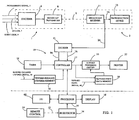
- a program signal source 1 such as a TV broadcast station, generates a broadcast output signal 2 which is a combination of a programming signal 5, an identification (“ID”) code signal 7 and an event code signal 9.
- ID code can be uniquely assigned to a local TV station or to a national TV network.
- the event code can be uniquely assigned to a specific program. One or the other code can be used by itself, or both can be used together.
- ID code 7 and/or event code 9 are provided along with the programming signal 5 in order to enable printing a reward coupon automatically upon certain criteria being met in connection with, for example, being tuned to the program signal source which is offering the rewards.
- the conventional programming signal 5 is encoded by encoder 6 with codes 7 and/or 9.
- the term "encoded" is used in the broadest sense to include any and all techniques for combining a programming signal with other signals for broadcasting them together by a well known, commonly used broadcast transmitter 8.
- Signal 2 is received by program reproduction apparatus 3 which is capable of performing the programming signal, such as in video and/or audio, at a site of an audience member, such as in the home.
- the reproduction apparatus 3 also provides a signal 2A, related to signal 2, as an input to reward output apparatus 10 which is automatically actuated, when certain audience-related reward issuance criteria are met, to print a reward on a printer 37 located at the site of such audience member.
- the specific broadcasting and encoding techniques chosen depend on various design considerations.
- the code signals can be either analog or digital.
- the encoding, transmission, detection and decoding of such data signals are conventional and readily apparent to anyone with ordinary skill in the art. Such specifics do not form a part of the present invention. Details thereof would add unnecessarily to the length and complexity of this description. Consequently, such details are not provided herein.
- Broadcast receiver 11 of apparatus 3 processes the received programming signal 5 and inputs it, as signal 5A, to reproduction device 13.
- apparatus 3 is a TV set
- receiver 11 could be a tuner
- device 13 is the TV screen and its related circuitry and components.
- Decoder 15 includes circuitry to extract a signal containing the code signals 7, 9 from signal 2A. Such circuitry is well known, and thus details thereof are not needed herein. Decoder 15 determines whether its input has received a code signal and, if so, it outputs signals 7A and 9A, respectively corresponding to the code signals 7 and 9, to controller 17. Signals 7A and 9A can be respectively identical to the code signals 7 and 9 obtained from broadcast signal 2 via receiver 11, or they can be a minimally changed version thereof (e.g., amplified), or they can be a substantially changed version, depending on the specific signals and the encoding/decoding technique chosen and based on well known design considerations.
- Controller 17 can be a suitable microprocessor chip that is programmed to implement a sequence of operations for recognizing when certain tuning criteria have been met and, if so, to trigger reward processing circuit 35 into retrieving reward printing data from memory 39 for use in printing a reward on printer 37. More details of controller 17 are provided below.
- Apparatus 3 is a conventional part of a commercially available video and/or audio instrument, such as a TV set.
- Apparatus 10 could be embodied as a separate box that houses all of its components.
- Apparatus 10 is located in the viewer's home. Only minimal retrofitting of the TV, for example, would be required in order to implement the invention, such as connecting the broadcast receiver 11 (e.g. TV tuner) to the decoder 15.
- the connection to the TV set could be with a direct line or by remote signal transmission (e.g. RF, infrared, sonic).
- the installation of the box housing apparatus 10 is very simple in that it just needs to be plugged into the socket of a wall outlet to receive power. Only a one-time; fast, simple installation is involved that requires no retrofit of other apparatus in the house.
- apparatus 10 could have its circuitry incorporated into the electronics of the TV.
- the electronics could be fabricated on the semiconductor chip used to control operation of a TV and the viewing of programs on it.
- Such TV chips are becoming increasingly sophisticated with modern TVs being provided with added functionality approaching that of a computer.
- the cost of adding such circuitry to a TV chip is minimal considering the large number of chips over which the cost would be spread.
- the parameters for the reward issuance criteria are stored in memory 38.
- the reward issuance criteria specify a minimum number of ID codes and/or event codes that must be detected within a designated interval.
- the interval can be the duration of a certain program, a certain time of the day, any period of a certain duration, or an entire day.
- the ID reward issuance parameters and event reward issuance parameters are stored in memory 38 with a one-time, preset, fixed data storage operation.
- memory 38 can be of the rewritable type to which a reward issuance criteria signal 66 is input.
- Signal 66 can be provided via a transmission medium, such as a telephone line to device 10 provided for this purpose.
- signal 66 can be transmitted in combination with programming signal 5, in the same way as codes 7 and 9 are combined therewith. This could occur once per day or as needed.
- reward print data memory 39 holds the necessary reward output data which includes all of the data specific to the particular reward that is required in order to print it.
- data includes, for example, the text, font, graphics, formatting, symbols, background color, font color, and so on.
- this data can be provided via the above-mentioned transmission medium or it can be included in a reward data signal which is combined with programming signal 5 and transmitted along with the programming signal as part of output signal 2, as disclosed in U.S. application Serial No. 10/080,949, filed February 20, 2002.
- a variation of this approach is to pre-store some of this data in memory 39.
- Timer 14 is provided to enable apparatus 10 to carry out its time-related activities.
- Timer 14 is typically an accurate clock. Preferably, it should not be accessible for setting by the audience because this could lead to fraudulent issuance of rewards which depends on preset time intervals, as explained in more detail below.
- controller 17 preferably includes counters for determining how many ID codes and how many event codes have been decoded by decoder 15 and input to controller 17 as signals 7A, 9A. Controller 17 determines whether the preset number of ID codes that is stored as an ID reward issuance parameter has been exceeded. If it has, then the ID reward is printed.
- controller 17 checks to determine whether the preset number for the event codes has been exceeded. If it has, then a print of the reward is made promptly and automatically.
- controller 17 determines that a reward is to be issued, a signal is inputted to reward processing circuit 35 and reward print data memory 39 (Fig. 1).
- Reward processing circuit 35 utilizes the data retrieved from memory 39 to print the appropriate reward via printer 37, as explained above.
- the reward data can be outputted to a portable electronic storage device, such as a smartcard.
- a portable electronic storage device such as a smartcard.
- the smartcard could be inserted into a reader at a merchant's shop designed to read the reward data and enable redemption without the necessity to use paper and ink.
- Other possible variations include combining memories 38 and 39.
- the sequence of steps in the flow charts depicted in the drawings can be modified with equivalent results.
- USSN 10/391,907 is a valuable contribution to the prior art. It effectively achieves the aim of rewarding an audience member's viewership without requiring any active incentive-related participation by the viewer other than to tune in to particular program.
- the determination of whether or not to issue a reward is based on detection of codes 7 and/or 9, regarding which the viewer can remain completely passive. However, it is this passivity which leaves an opening for possible misuse or abuse of this technique.
- the viewer need not, in fact be actively viewing the program as long as the TV is tuned to the program and codes are being received by apparatus 10.
- an example of misuse is a viewer who has fallen asleep in front of the TV for an extended period. Such a person is tuned in to the program, but cannot be truly counted as a viewer.
- An example of abuse is a viewer who turns on the TV in the morning and then goes to work for the day. While the person is at work, the codes are being detected, counted and applied toward meeting the reward issuance criteria. It is desirable to eliminate such situations from qualifying for rewards.
- One object of the present invention is to issue incentive rewards only to audience members who are present and actively viewing a program associated with such rewards.
- a programming signal is provided for broadcasting the program with a programming signal source.
- the programming signal is encoded with discrete code signals, such that a preset number of the code signals occur within a given period of time, to produce an output signal, and the output signal is then broadcast.
- the broadcast output signal is received at a site where the monitored person is located, and the code signals therein are detected.
- the detected code signals are recognized only if a signal manually-actuated by the monitored person is received within a predetermined time period.
- the number of the code signals recognized while the monitored person is an audience member of the at least one program is determined, and the number of recognized code signals is compared with predetermined reward issuance criteria.
- a reward is issued when the reward issuance criteria are met by the number of recognized code signals.
- the present invention it is possible to determine when ID and/or event codes are being improperly accumulated toward meeting a reward issuance criterion when no one is an active viewer of the program.
- This requires a manually-actuatable unit that sends a signal when activated by the viewer.
- Such a unit can be one dedicated to this task.
- the invention is cognizant of the fact that remote controls are sold with almost all TVs. Thus, it can be safely assumed that any household with a TV will also have a remote control.
- the remote control in its conventional form is used in accordance with the present invention as a manually actuatable unit to enable performance of a checking function on the presence and alertness of the viewer by requiring the viewer to activate the remote control at least once during a specified period of time.
- Remote control 50 is a typical unit of conventional design that emits an infrared (IR) signal 52 in the general direction in which it is aimed.
- IR detector 54 is installed in apparatus 10 and positioned to detect IR signal 52 when remote control 50 is activated by the viewer and aimed at the TV.
- IR detector 54 can be, for example, module no. GP1UD281YK, available from Sharp, which allows remote controls to operate on a broad range of ambient light levels.
- IR detector 54 The output of IR detector 54 is presented to a digital processor 56, such as model no. TMS320VC5401PGE50-0 available from Texas Instruments.
- processor 56 initiates a subroutine performed in controller 17 and which is described in connection with Fig. 2.
- a display 58 is provided for a purpose described below.
- an I/O communications unit 60 is provided to enable signals to be sent to and from processor 56, as explained in greater detail below.
- a time limit is set during which a signal from remote control 50 must be received in order for the ID and event codes that are being received to count toward meeting a reward issuance criterion.
- a timer which can be a part of processor 56, has the time limit set into it, and the processor counts down to zero (or vice versa), as per operation 70 in Fig. 2. Thus, if the time limit is 90 minutes, the timer will keep track of whether this time limit has been exceeded.
- Processor 56 checks, per 72, whether a signal has been received from IR detector 54 to indicate an emission from remote control 50. If no such IR signal from remote control 50 has been received, processor 56 determines whether the countdown is within 10 minutes of reaching the time limit. Of course, the number 10 is a matter of design choice. If the 10 minute mark has been reached, i.e. 80 minutes have elapsed without any IR signal having been detected from remote control 50, processor 56 causes display 58 to provide some indication to the viewer of that status. Display 58 can be an LED on apparatus 10 that changes color from green to red, or the LED can turn from a solid light to a flashing light, or any one of many other possibilities that will readily occur to anyone with ordinary skill in the art.
- processor 56 keeps checking and re-checking during that 10 minute interval until the time limit is reached, as per 80. If and when that occurs, codes that are detected thereafter are not recognized. In particular, further operation of controller 17 to accumulate received codes is blocked. Thus, a person who is not actively viewing the program, as indicated by the fact that time expired with no activity on the remote control 50 having been detected, will not receive credit for viewing time beyond that point.
- step 72 the processor 56 determines at 82 whether controller 17 has been blocked, as per 80 described above. If it has not, then the routine progresses to resetting the timer, as per 84, so that it starts from the beginning to count down the full allotted time of 90 minutes. If the controller 17 is in a blocked condition, then it is released, per 86, and then the timer is reset, per 84.
- display 58 is shown in Fig. 1 as an individual component, it could be integrated into the TV so that a message, or at least a light, appears on the TV screen rather than on apparatus 10.
- processor 56 is shown as an individual component, it could be a part of controller 17.
- Whether or not to recognize detected codes can be determined by another approach in accordance with the present invention which does not block controller 17 from accumulating detected codes toward meeting the reward issuance criteria. Instead, all the IR signals from IR detector 54 are stored along with the time stamp information from timer 14 and detected code information. The following table is an example of how this information can be stored. TIME ID CODE EVENT CODEIR SIGNAL 600 A1212 675 B2233 700 A1212 725 B2233 825 C4236 875 C4236 * * * * * * * * * * * * * * * * * * * * * * * * * * * * * * * * * * * * * * * * * * * * * * * * * * * * * * * * * * * * * * * * * * * * * * * * * * * * * * * * * * * * * * * * * * * * * * * * * * * * * * * * * * * * * * * * * * * * * * * * * * * * * * * * *
- This table illustrates that at time 600 (the time units, e.g., seconds, are a design choice, as is the start time of the count) an ID code was received from a program source, (e.g., a TV station) identified as A1212, and was repeated at time 700. Apparently these ID codes are transmitted at a spacing of 100 units. Also, an event code was received at time 675 for a program identified by the code B2233, and was repeated at time 725. Apparently these event codes are transmitted at a spacing of 50 units. At time 825 the TV had been switched to another program identified by the event code C4236. Since there was no intervening signal from the remote control, and no new ID code was received, this program change was due to the start of a new program.
- a program source e.g., a TV station
- an IR signal was detected. It is identified as XXXX because for purposes of the present invention the specific IR code transmitted by the remote control, e.g. to change channels or to vary the sound volume, is immaterial, and, therefore, is not processed.
- the IR detector is set to detect any IR signal above a certain threshold representative of ambient conditions, and processor 56 records that only as an occurrence of an IR signal.
- the invention acts in real time to block operation of controller 17 if a signal is not received from the remote control before expiration of the time limit. In the present embodiment, operation of all the circuitry is permitted to continue unimpeded. All the detected codes are stored along with the timer and IR signal information. All this data is sent by I/O circuitry 60 to a remote computer processing center. Transmission of this data is performed at preset times, such as once per day or once per hour. The data is processed to determine when signals from the remote control 50 were received.
- a further embodiment of the invention takes advantage of the actual, coded IR signal which is transmitted by the remote control. It was explained above that the specific IR code transmitted by the remote control, e.g. to change channels or to vary the sound volume, is immaterial. However, in the present embodiment such data is stored and utilized. Consequently, for this embodiment the last column of the above-presented table would not store just the detection of an IR signal, as represented by XXXX. Instead, it would store the actual IR code transmitted by the remote control 50. This provides a powerful analysis tool to enable making determinations on when a viewer switched channels, what channel was being viewed at any given time, whether and when mute was turned ON, and so on.
Landscapes
- Engineering & Computer Science (AREA)
- Signal Processing (AREA)
- Two-Way Televisions, Distribution Of Moving Picture Or The Like (AREA)
- Management, Administration, Business Operations System, And Electronic Commerce (AREA)
Applications Claiming Priority (2)
| Application Number | Priority Date | Filing Date | Title |
|---|---|---|---|
| US61782104P | 2004-10-12 | 2004-10-12 | |
| US11/245,682 US8250596B2 (en) | 2004-10-12 | 2005-10-06 | Incentive rewards obtainable by a targeted audience tuned to a broadcast |
Publications (2)
| Publication Number | Publication Date |
|---|---|
| EP1648103A2 true EP1648103A2 (de) | 2006-04-19 |
| EP1648103A3 EP1648103A3 (de) | 2007-07-11 |
Family
ID=35464437
Family Applications (1)
| Application Number | Title | Priority Date | Filing Date |
|---|---|---|---|
| EP05022269A Ceased EP1648103A3 (de) | 2004-10-12 | 2005-10-12 | Leistungsprämien erhältlich von einem Zielpublikum das zu einer Sendung abgestimmt ist |
Country Status (3)
| Country | Link |
|---|---|
| US (1) | US8250596B2 (de) |
| EP (1) | EP1648103A3 (de) |
| JP (1) | JP5201788B2 (de) |
Families Citing this family (4)
| Publication number | Priority date | Publication date | Assignee | Title |
|---|---|---|---|---|
| JP4739050B2 (ja) * | 2006-02-15 | 2011-08-03 | シャープ株式会社 | 放送受信装置、視聴管理サーバ、視聴判定方法、放送システム、視聴判定プログラム、および記録媒体 |
| US8818844B2 (en) * | 2006-03-07 | 2014-08-26 | International Business Machines Corporation | Incenting viewers to remain with their current digital media content |
| US9317872B2 (en) | 2013-02-06 | 2016-04-19 | Muzak Llc | Encoding and decoding an audio watermark using key sequences comprising of more than two frequency components |
| US20190268662A1 (en) * | 2018-02-27 | 2019-08-29 | Microsoft Technology Licensing, Llc | System and method for enhancing live video content streams |
Citations (3)
| Publication number | Priority date | Publication date | Assignee | Title |
|---|---|---|---|---|
| WO2000072484A1 (en) * | 1999-05-20 | 2000-11-30 | Nielsen Media Research, Inc. | Viewer identification apparatus for use in a broadcast audience measurement |
| US20030159155A1 (en) | 2002-02-20 | 2003-08-21 | Lee S. Weinblatt | Interactive reward associated with a broadcast |
| US20040031046A1 (en) | 2002-03-19 | 2004-02-12 | Lee S. Weinblatt | Incentive rewards obtainable automatically by an audience tuned to a broadcast |
Family Cites Families (16)
| Publication number | Priority date | Publication date | Assignee | Title |
|---|---|---|---|---|
| US4926255A (en) * | 1986-03-10 | 1990-05-15 | Kohorn H Von | System for evaluation of response to broadcast transmissions |
| US6002443A (en) * | 1996-11-01 | 1999-12-14 | Iggulden; Jerry | Method and apparatus for automatically identifying and selectively altering segments of a television broadcast signal in real-time |
| JP3924847B2 (ja) * | 1997-06-19 | 2007-06-06 | ソニー株式会社 | 情報受信装置および方法、並びに記録媒体 |
| US6057872A (en) | 1997-07-09 | 2000-05-02 | General Instrument Corporation | Digital coupons for pay televisions |
| JP2000115726A (ja) * | 1998-10-06 | 2000-04-21 | Toshiba Corp | ディジタル放送送信装置及びディジタル放送受信装置 |
| DE10195792B4 (de) | 2000-02-29 | 2006-12-07 | Intel Corporation, Santa Clara | Bereitstellen eines Betrachter-Incentives zusammen mit Videoinhalt |
| JP2001251602A (ja) * | 2000-03-03 | 2001-09-14 | Matsushita Electric Ind Co Ltd | 番組受信装置および送信装置 |
| JP2001285830A (ja) * | 2000-03-31 | 2001-10-12 | Atsushi Hirota | デジタルテレビシステム |
| JP2002024691A (ja) * | 2000-07-05 | 2002-01-25 | Hitachi Ltd | 広告情報放送方法、広告付属データ記憶方法並びに広告情報放送受信装置及び送信装置 |
| AU2001288670A1 (en) * | 2000-08-31 | 2002-03-13 | Myrio Corporation | Real-time audience monitoring, content rating, and content enhancing |
| US20020133817A1 (en) * | 2001-03-13 | 2002-09-19 | Markel Steven O. | Affinity marketing for interactive media systems |
| US7992161B2 (en) * | 2001-05-22 | 2011-08-02 | At&T Intellectual Property I, L.P. | Method and apparatus for providing incentives for viewers to watch commercial advertisements |
| JP4579491B2 (ja) * | 2002-03-05 | 2010-11-10 | リー・エス・ウェインブラット | 放送される番組に関する補足材料に対する双方向アクセス |
| US20030172376A1 (en) * | 2002-03-11 | 2003-09-11 | Microsoft Corporation | User controlled targeted advertisement placement for receiver modules |
| JP4251834B2 (ja) * | 2002-08-28 | 2009-04-08 | 株式会社電通 | 広告の視聴結果に応じたインセンティブを供与するコンテンツ提供方法およびそのシステム |
| US7222071B2 (en) * | 2002-09-27 | 2007-05-22 | Arbitron Inc. | Audio data receipt/exposure measurement with code monitoring and signature extraction |
-
2005
- 2005-10-06 US US11/245,682 patent/US8250596B2/en active Active
- 2005-10-12 JP JP2005297948A patent/JP5201788B2/ja not_active Expired - Fee Related
- 2005-10-12 EP EP05022269A patent/EP1648103A3/de not_active Ceased
Patent Citations (3)
| Publication number | Priority date | Publication date | Assignee | Title |
|---|---|---|---|---|
| WO2000072484A1 (en) * | 1999-05-20 | 2000-11-30 | Nielsen Media Research, Inc. | Viewer identification apparatus for use in a broadcast audience measurement |
| US20030159155A1 (en) | 2002-02-20 | 2003-08-21 | Lee S. Weinblatt | Interactive reward associated with a broadcast |
| US20040031046A1 (en) | 2002-03-19 | 2004-02-12 | Lee S. Weinblatt | Incentive rewards obtainable automatically by an audience tuned to a broadcast |
Also Published As
| Publication number | Publication date |
|---|---|
| JP2006185417A (ja) | 2006-07-13 |
| EP1648103A3 (de) | 2007-07-11 |
| US8250596B2 (en) | 2012-08-21 |
| JP5201788B2 (ja) | 2013-06-05 |
| US20060080700A1 (en) | 2006-04-13 |
Similar Documents
| Publication | Publication Date | Title |
|---|---|---|
| US8555305B2 (en) | Incentive rewards obtainable automatically by an audience tuned to a broadcast | |
| US8468556B2 (en) | Methods, systems, and products for evaluating performance of viewers | |
| US7992161B2 (en) | Method and apparatus for providing incentives for viewers to watch commercial advertisements | |
| US5999689A (en) | Method and apparatus for controlling a videotape recorder in real-time to automatically identify and selectively skip segments of a television broadcast signal during recording of the television signal | |
| US8266667B2 (en) | Systems and methods for awarding affinity points based upon remote control usage | |
| US20030144035A1 (en) | Electronically generating and displaying a reward coupon | |
| US7950031B2 (en) | Interactive reward associated with a broadcast | |
| JP2006500811A (ja) | ビデオレコーダ装置およびその動作方法 | |
| US9027043B2 (en) | Methods and apparatus to detect an operating state of a display | |
| US8250596B2 (en) | Incentive rewards obtainable by a targeted audience tuned to a broadcast | |
| US20100218206A1 (en) | Viewer presence detection | |
| US9124916B2 (en) | Interactive reward associated with a broadcast | |
| JP4663221B2 (ja) | 有料テレビのための使用量ベースの請求書送付装置および方法 | |
| AU686825B2 (en) | System for collecting data concerning received transmitted material | |
| HK1135264A1 (en) | Systems and methods to identify intentionally placed products | |
| HK1135264B (en) | Systems and methods to identify intentionally placed products |
Legal Events
| Date | Code | Title | Description |
|---|---|---|---|
| PUAI | Public reference made under article 153(3) epc to a published international application that has entered the european phase |
Free format text: ORIGINAL CODE: 0009012 |
|
| AK | Designated contracting states |
Kind code of ref document: A2 Designated state(s): AT BE BG CH CY CZ DE DK EE ES FI FR GB GR HU IE IS IT LI LT LU LV MC NL PL PT RO SE SI SK TR |
|
| AX | Request for extension of the european patent |
Extension state: AL BA HR MK YU |
|
| PUAL | Search report despatched |
Free format text: ORIGINAL CODE: 0009013 |
|
| AK | Designated contracting states |
Kind code of ref document: A3 Designated state(s): AT BE BG CH CY CZ DE DK EE ES FI FR GB GR HU IE IS IT LI LT LU LV MC NL PL PT RO SE SI SK TR |
|
| AX | Request for extension of the european patent |
Extension state: AL BA HR MK YU |
|
| 17P | Request for examination filed |
Effective date: 20080110 |
|
| AKX | Designation fees paid |
Designated state(s): AT BE BG CH CY CZ DE DK EE ES FI FR GB GR HU IE IS IT LI LT LU LV MC NL PL PT RO SE SI SK TR |
|
| 17Q | First examination report despatched |
Effective date: 20080228 |
|
| STAA | Information on the status of an ep patent application or granted ep patent |
Free format text: STATUS: THE APPLICATION HAS BEEN REFUSED |
|
| 18R | Application refused |
Effective date: 20170629 |