EP1648551B1 - Vorrichtung zur verbesserung der durchlässigkeit der menschlichen haut - Google Patents
Vorrichtung zur verbesserung der durchlässigkeit der menschlichen haut Download PDFInfo
- Publication number
- EP1648551B1 EP1648551B1 EP04741149A EP04741149A EP1648551B1 EP 1648551 B1 EP1648551 B1 EP 1648551B1 EP 04741149 A EP04741149 A EP 04741149A EP 04741149 A EP04741149 A EP 04741149A EP 1648551 B1 EP1648551 B1 EP 1648551B1
- Authority
- EP
- European Patent Office
- Prior art keywords
- plaster
- layer
- skin
- permeability
- improving
- Prior art date
- Legal status (The legal status is an assumption and is not a legal conclusion. Google has not performed a legal analysis and makes no representation as to the accuracy of the status listed.)
- Expired - Lifetime
Links
- 230000035699 permeability Effects 0.000 title abstract description 11
- 239000011505 plaster Substances 0.000 claims abstract description 27
- 239000013543 active substance Substances 0.000 claims abstract description 16
- 210000003491 skin Anatomy 0.000 claims abstract 7
- 210000000434 stratum corneum Anatomy 0.000 claims abstract 3
- 239000010410 layer Substances 0.000 claims description 35
- 230000003287 optical effect Effects 0.000 claims description 11
- 239000012790 adhesive layer Substances 0.000 claims description 8
- 230000037317 transdermal delivery Effects 0.000 claims description 3
- 238000000034 method Methods 0.000 abstract description 4
- 239000000463 material Substances 0.000 description 8
- 239000011159 matrix material Substances 0.000 description 6
- 239000000853 adhesive Substances 0.000 description 5
- 229940079593 drug Drugs 0.000 description 5
- 239000003814 drug Substances 0.000 description 5
- 239000010408 film Substances 0.000 description 5
- 239000004480 active ingredient Substances 0.000 description 4
- 210000004087 cornea Anatomy 0.000 description 4
- 230000001070 adhesive effect Effects 0.000 description 3
- 239000003623 enhancer Substances 0.000 description 3
- 239000011521 glass Substances 0.000 description 3
- -1 polyethylene Polymers 0.000 description 3
- LFQSCWFLJHTTHZ-UHFFFAOYSA-N Ethanol Chemical compound CCO LFQSCWFLJHTTHZ-UHFFFAOYSA-N 0.000 description 2
- LRHPLDYGYMQRHN-UHFFFAOYSA-N N-Butanol Chemical compound CCCCO LRHPLDYGYMQRHN-UHFFFAOYSA-N 0.000 description 2
- 239000011248 coating agent Substances 0.000 description 2
- 238000000576 coating method Methods 0.000 description 2
- 230000000694 effects Effects 0.000 description 2
- 238000009472 formulation Methods 0.000 description 2
- 239000000203 mixture Substances 0.000 description 2
- 230000005855 radiation Effects 0.000 description 2
- 230000001225 therapeutic effect Effects 0.000 description 2
- 238000002560 therapeutic procedure Methods 0.000 description 2
- SNICXCGAKADSCV-JTQLQIEISA-N (-)-Nicotine Chemical compound CN1CCC[C@H]1C1=CC=CN=C1 SNICXCGAKADSCV-JTQLQIEISA-N 0.000 description 1
- VOXZDWNPVJITMN-ZBRFXRBCSA-N 17β-estradiol Chemical compound OC1=CC=C2[C@H]3CC[C@](C)([C@H](CC4)O)[C@@H]4[C@@H]3CCC2=C1 VOXZDWNPVJITMN-ZBRFXRBCSA-N 0.000 description 1
- SNIOPGDIGTZGOP-UHFFFAOYSA-N Nitroglycerin Chemical compound [O-][N+](=O)OCC(O[N+]([O-])=O)CO[N+]([O-])=O SNIOPGDIGTZGOP-UHFFFAOYSA-N 0.000 description 1
- 239000004952 Polyamide Substances 0.000 description 1
- 239000004698 Polyethylene Substances 0.000 description 1
- 239000004743 Polypropylene Substances 0.000 description 1
- 241000288906 Primates Species 0.000 description 1
- 238000005299 abrasion Methods 0.000 description 1
- 238000010521 absorption reaction Methods 0.000 description 1
- 230000032683 aging Effects 0.000 description 1
- 150000001298 alcohols Chemical class 0.000 description 1
- 239000002537 cosmetic Substances 0.000 description 1
- 239000013039 cover film Substances 0.000 description 1
- 230000001419 dependent effect Effects 0.000 description 1
- 239000007933 dermal patch Substances 0.000 description 1
- 201000010099 disease Diseases 0.000 description 1
- 208000037265 diseases, disorders, signs and symptoms Diseases 0.000 description 1
- 238000012377 drug delivery Methods 0.000 description 1
- 238000004146 energy storage Methods 0.000 description 1
- 229960005309 estradiol Drugs 0.000 description 1
- 229930182833 estradiol Natural products 0.000 description 1
- 229960002428 fentanyl Drugs 0.000 description 1
- IVLVTNPOHDFFCJ-UHFFFAOYSA-N fentanyl citrate Chemical compound OC(=O)CC(O)(C(O)=O)CC(O)=O.C=1C=CC=CC=1N(C(=O)CC)C(CC1)CCN1CCC1=CC=CC=C1 IVLVTNPOHDFFCJ-UHFFFAOYSA-N 0.000 description 1
- 238000010579 first pass effect Methods 0.000 description 1
- 239000011888 foil Substances 0.000 description 1
- 229960003711 glyceryl trinitrate Drugs 0.000 description 1
- 230000035876 healing Effects 0.000 description 1
- 238000001746 injection moulding Methods 0.000 description 1
- 230000004060 metabolic process Effects 0.000 description 1
- 238000001393 microlithography Methods 0.000 description 1
- 229960002715 nicotine Drugs 0.000 description 1
- SNICXCGAKADSCV-UHFFFAOYSA-N nicotine Natural products CN1CCCC1C1=CC=CN=C1 SNICXCGAKADSCV-UHFFFAOYSA-N 0.000 description 1
- 239000003973 paint Substances 0.000 description 1
- 238000000053 physical method Methods 0.000 description 1
- 229920003229 poly(methyl methacrylate) Polymers 0.000 description 1
- 229920000058 polyacrylate Polymers 0.000 description 1
- 229920002647 polyamide Polymers 0.000 description 1
- 229920000515 polycarbonate Polymers 0.000 description 1
- 239000004417 polycarbonate Substances 0.000 description 1
- 229920000728 polyester Polymers 0.000 description 1
- 229920000573 polyethylene Polymers 0.000 description 1
- 229920000139 polyethylene terephthalate Polymers 0.000 description 1
- 239000005020 polyethylene terephthalate Substances 0.000 description 1
- 239000004926 polymethyl methacrylate Substances 0.000 description 1
- 229920001155 polypropylene Polymers 0.000 description 1
- 230000001681 protective effect Effects 0.000 description 1
- 239000000243 solution Substances 0.000 description 1
- 239000000126 substance Substances 0.000 description 1
- 230000009885 systemic effect Effects 0.000 description 1
- 230000000699 topical effect Effects 0.000 description 1
- 238000013271 transdermal drug delivery Methods 0.000 description 1
- 230000007704 transition Effects 0.000 description 1
Images

Classifications
-
- A—HUMAN NECESSITIES
- A61—MEDICAL OR VETERINARY SCIENCE; HYGIENE
- A61K—PREPARATIONS FOR MEDICAL, DENTAL OR TOILETRY PURPOSES
- A61K9/00—Medicinal preparations characterised by special physical form
- A61K9/70—Web, sheet or filament bases ; Films; Fibres of the matrix type containing drug
- A61K9/7023—Transdermal patches and similar drug-containing composite devices, e.g. cataplasms
-
- A—HUMAN NECESSITIES
- A61—MEDICAL OR VETERINARY SCIENCE; HYGIENE
- A61B—DIAGNOSIS; SURGERY; IDENTIFICATION
- A61B18/00—Surgical instruments, devices or methods for transferring non-mechanical forms of energy to or from the body
- A61B18/18—Surgical instruments, devices or methods for transferring non-mechanical forms of energy to or from the body by applying electromagnetic radiation, e.g. microwaves
- A61B18/20—Surgical instruments, devices or methods for transferring non-mechanical forms of energy to or from the body by applying electromagnetic radiation, e.g. microwaves using laser
- A61B18/203—Surgical instruments, devices or methods for transferring non-mechanical forms of energy to or from the body by applying electromagnetic radiation, e.g. microwaves using laser applying laser energy to the outside of the body
-
- A—HUMAN NECESSITIES
- A61—MEDICAL OR VETERINARY SCIENCE; HYGIENE
- A61M—DEVICES FOR INTRODUCING MEDIA INTO, OR ONTO, THE BODY; DEVICES FOR TRANSDUCING BODY MEDIA OR FOR TAKING MEDIA FROM THE BODY; DEVICES FOR PRODUCING OR ENDING SLEEP OR STUPOR
- A61M35/00—Devices for applying media, e.g. remedies, on the human body
-
- A—HUMAN NECESSITIES
- A61—MEDICAL OR VETERINARY SCIENCE; HYGIENE
- A61B—DIAGNOSIS; SURGERY; IDENTIFICATION
- A61B17/00—Surgical instruments, devices or methods
- A61B2017/00743—Type of operation; Specification of treatment sites
- A61B2017/00747—Dermatology
- A61B2017/00765—Decreasing the barrier function of skin tissue by radiated energy, e.g. using ultrasound, using laser for skin perforation
-
- A—HUMAN NECESSITIES
- A61—MEDICAL OR VETERINARY SCIENCE; HYGIENE
- A61B—DIAGNOSIS; SURGERY; IDENTIFICATION
- A61B18/00—Surgical instruments, devices or methods for transferring non-mechanical forms of energy to or from the body
- A61B2018/00315—Surgical instruments, devices or methods for transferring non-mechanical forms of energy to or from the body for treatment of particular body parts
- A61B2018/00452—Skin
-
- A—HUMAN NECESSITIES
- A61—MEDICAL OR VETERINARY SCIENCE; HYGIENE
- A61B—DIAGNOSIS; SURGERY; IDENTIFICATION
- A61B18/00—Surgical instruments, devices or methods for transferring non-mechanical forms of energy to or from the body
- A61B18/18—Surgical instruments, devices or methods for transferring non-mechanical forms of energy to or from the body by applying electromagnetic radiation, e.g. microwaves
- A61B2018/1807—Surgical instruments, devices or methods for transferring non-mechanical forms of energy to or from the body by applying electromagnetic radiation, e.g. microwaves using light other than laser radiation
Definitions
- the invention relates to an at least partially transparent, active substance-containing patch according to the preamble of claim 1. This can be used in conjunction with at least one external light source to improve the permeability of the human skin for the transdermal delivery of drugs.
- Transdermal therapeutic systems have been established for years in the therapy of various topical and systemic diseases. Active agents, such as Nicotine, estradiol, nitroglycerine, fentanyl, can be administered in this way because of the significantly improved pharmacokinetics and the avoidance of the first-pass effect more suitable for therapy than oral.
- Active agents such as Nicotine, estradiol, nitroglycerine, fentanyl
- the choice of drugs suitable for transdermal delivery is limited. For some drugs, the transport is possible, but the formulations require an impractical large area.
- permeation enhancers such as ethanol, butanol, and other short chain alcohols, are chemicals added to the formulation to temporarily increase the permeability of human skin. This then enables a sufficiently high flow rate of the pharmaceutical active substance.
- these enhancers are absorbed by the body and burden the body's metabolic processes.
- a dressing material which has a covering element formed at least partially transparent.
- This cover element can at least partially have an adhesive area and possibly added or impregnated with a drug.
- the transparent cover element illuminates the skin surface eg with colored light.
- the DE 101 28 629 A1 describes a wound plaster that carries in its center an artificial light source, an energy storage and a Fresnel lens.
- the skin patch is glued to a cut, abrasion or burn wound, for example.
- the internal light source illuminates the human skin via the Fresnel lens.
- the biocompatible irradiation of the wound promotes the healing process of the skin by accelerating wound closure.
- the present invention is therefore based on the problem to develop a method for improving the permeability of the human skin, which allows - without side effects for the whole organism - a reproducible permeability to certain drugs.
- the patch according to the invention is at least partially normal incident, at least temporarily emitted by an external light source light bundled by a plurality of individual integrated in the patch collecting lenses on the horny layer of the skin, so as to produce the permeability of the skin improving horny layer changes.
- the plaster has for this purpose at least one cover layer and at least one active substance-containing self-adhesive layer.
- the cover layer and the active substance-containing layer are at least partially transparent, wherein the transparent regions lie one above the other within the plaster and the cover layer comprises a plurality of surface-mounted optical converging lenses.
- the transdermal therapeutic system thus consists inter alia of at least one active ingredient-containing skin-oriented matrix layer and a transparent, geometrically contoured covering layer.
- the system is temporarily glued to the body in the form of a plaster. Such an arrangement allows the use of light sources to improve transdermal absorption during the wearing period of the patch.
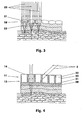
- the FIG. 1 shows a physical method that significantly accelerates transdermal drug delivery.
- a self-adhesive plaster (10) is used, which has a transparent covering or backing layer (12, 13) and at least one active substance-containing, likewise transparent adhesive or matrix layer (50, 40).
- the cover layer (12) consists of a field of optical lenses (20-22).
- the adhesive on the skin (6) plaster (10) is exposed at least in the short term with a light source (1) of high illuminance.
- the light (2) impinging on the plaster backing (14) at least almost perpendicularly is projected separately from the individual converging lenses (20-23) onto the horny layer (7) of the skin (6).
- small focal spots (8) which keep the horny layer (7) for drug delivery open and thin.
- the focal lines arise due to the diakustics of the collecting lenses.
- the matrix and / or the adhesive layer (40, 50) are in this case an active agent depot which contains its active ingredient, e.g. over hours or days.
- the patch (10) stored before the application is protected at least by a protective film adhering to the adhesive layer (50) against an unwanted release of active ingredient or loss of active ingredient.
- the cover layer (12) is here e.g. a transparent film in which a large number of small lenses (20) is integrated.
- Each individual lens (20) has, for example, a double-convex shape whose center of curvature lies on an optical axis (23).
- the individual optical axes (23) are usually oriented normal to the respective surface element of the back of the plasterboard (14).
- the spacing of the optical axes (23) of two adjacent lenses (20) is e.g. 50 to 500 ⁇ m. In certain cases, the distance can be increased to one millimeter.
- the focal length of the individual lenses (20) is dimensioned such that the average focal length is approximately 10 to 20 ⁇ m below the outer surface (9) of the skin (6) in the cornea layer (7) lies.
- the average focal length With a 40 ⁇ m thick cover layer (12) and a 100 ⁇ m thick matrix and adhesive layer (40, 50), e.g. the average focal length thus 135 microns.
- Radial are the lenses (20) after FIG. 2 for example, limited by the lateral surface (25) of a straight, regular and hexagonal primate.
- a complete lens (20) would have the in the Figures 1 and 2 shown circular outer contour (26).
- the lenses (20) may each also have a cylindrical outer contour.
- the resulting gaps would then be filled in for example by flat surfaces.
- the average thickness of the flexible film (12) containing the lenses (20) is approximately 40-100 ⁇ m.
- the total area of the translucent part of the plaster (10) is, depending on the application, for example between 2 and 50 cm 2 .
- the lenses may e.g. partially opacified or without convex curvature, to reduce the transition contrast from un-toned to tinted corneal area, for cosmetic reasons, for example.
- a tanning pattern in the form of a temporary tattoo on the cornea can be generated by a certain arrangement of focal points producing lenses and optically inactive intermediate areas.
- Possible materials of the cover layer are: polycarbonate, polyethylene, polymethyl methacrylate, polyethylene terephthalate, and other polyesters, polypropylene, acrylate polymers, polyamides, and inorganic glasses or the like, provided that these materials have optically refractive and transparent properties.
- the film (12) can be produced, for example, by injection molding. In microlens fields with above-average small lenses, the film (12) can also be produced by microlithography.
- lenses (20-22) of different focal lengths can be arranged in a lens field.
- three different lenses (20, 21, 22) are used, which are arranged distributed regularly within the lens array, for example.
- Their focal lengths vary in a range of, for example, 10 to 50 ⁇ m. With the aid of such a lens field, a thicker layer of cornea can be temporarily made more permeable.
- FIG. 4 is a plaster shown, the cover layer (13), for example, from three to four times the material thickness of the cover layer (12) FIG. 1 equivalent.
- the rear convex surfaces (31) of the individual lenses (20) each form the bottom of a blind hole (32) embedded in the cover layer (13).
- the inner surfaces (33) of the blind holes (32) - with the exception of the lens surface (31) - for example, have a coating that allows either total reflection, or only in the form of a diffuse reflection. Possibly. the coating consists of a matt black paint application.
- incident light (3) below the lens hardly bring about a skin change.
- FIG. 1 known lens field are used, on which a flexible honeycomb grid is glued.
- the honeycomb grid which is possibly made of a different material than the lens array, for example, consists of a plurality of tubes with hexagonal cross-section. The midlines of the tubes are largely normal to the skin surface oriented.
- Another way to mitigate false light is to apply to almost every single edge of each lens (20-22). to arrange one or more pins, wherein the pins are aligned substantially normal to the skin surface (9).
- the pins projecting from the plaster outer surface (14) largely shade the individual lens surfaces (31) in the case of stray light.
- dimming lens materials can be used, which become permanently cloudy or darken by aging under light conditions after minutes or hours.
Landscapes
- Health & Medical Sciences (AREA)
- Engineering & Computer Science (AREA)
- Life Sciences & Earth Sciences (AREA)
- General Health & Medical Sciences (AREA)
- Animal Behavior & Ethology (AREA)
- Veterinary Medicine (AREA)
- Public Health (AREA)
- Physics & Mathematics (AREA)
- Heart & Thoracic Surgery (AREA)
- Optics & Photonics (AREA)
- Bioinformatics & Cheminformatics (AREA)
- Surgery (AREA)
- Biomedical Technology (AREA)
- Electromagnetism (AREA)
- Medicinal Chemistry (AREA)
- Medical Informatics (AREA)
- Otolaryngology (AREA)
- Anesthesiology (AREA)
- Hematology (AREA)
- Nuclear Medicine, Radiotherapy & Molecular Imaging (AREA)
- Dermatology (AREA)
- Chemical & Material Sciences (AREA)
- Molecular Biology (AREA)
- Pharmacology & Pharmacy (AREA)
- Epidemiology (AREA)
- Radiation-Therapy Devices (AREA)
- Medicinal Preparation (AREA)
- Medical Preparation Storing Or Oral Administration Devices (AREA)
- Media Introduction/Drainage Providing Device (AREA)
- Materials For Medical Uses (AREA)
- Prostheses (AREA)
Description
- Die Erfindung betrifft ein zumindest bereichsweise transparentes, wirkstoffhaltiges Pflaster gemäß dem Oberbegriff des Anspruchs 1. Dieses kann in Verbindung mit mindestens einer externen Lichtquelle zum Verbessern der Durchlässigkeit der menschlichen Haut für die transdermale Zufuhr von Wirkstoffen benutzt werden.
- Transdermale therapeutische Systeme sind seit Jahren in der Therapie verschiedener topischer und systemischer Erkrankungen etabliert. Wirkstoffe, wie z.B. Nicotin, Estradiol Nitroglycerin, Fentanyl, können auf diese Weise wegen der deutlich verbesserten Pharmakokinetik und der Vermeidung des First-Pass-Effekts therapiegerechter appliziert werden als bei oraler Aufnahme. Die Auswahl der für die transdermale Zufuhr geeigneten Wirkstoffe ist jedoch limitiert. Bei einigen Wirkstoffen ist der Transport zwar möglich, die Formulierungen erfordern aber eine unpraktikabel große Fläche.
- Eine mögliche Problemlösung stellen Permeationsverstärker dar. Diese Verstärker, z.B. Ethanol, Butanol und andere kurzkettige Alkohole, sind chemische Stoffe, die der Formulierung zugesetzt werden, um die Durchlässigkeit der menschlichen Haut vorübergehend zu erhöhen. Damit wird dann eine hinreichend hohe Flussrate des pharmazeutischen Wirkstoffes ermöglicht. Allerdings werden diese Verstärker vom Körper aufgenommen und belasten die metabolischen Vorgänge des Körpers.
- In der
DE 195 44 255 A , welche die Merkmale des Oberbegriffs von Anspruch 1 offenbart, wird ein Verbandsmaterial beschrieben, das ein mindestens bereichsweise transparent ausgebildetes Abdeckelement aufweist. Dieses Abdeckelement kann mindestens bereichsweise einen Klebebereich haben und ggf. mit einem Medikament versetzt oder getränkt sein. Durch das transparente Abdeckelement wird die Hautoberfläche z.B. mit farbigem Licht beleuchtet. - Ferner ist in der
DE 101 28 629 A1 wird ein Wundpflaster beschrieben, das in seinem Zentrum eine künstliche Lichtquelle, einen Energiespeicher und eine Fresnellinse trägt. Das Hautpflaster wird z.B. auf eine Schnitt-, Schürf- oder Brandwunde geklebt. Die interne Lichtquelle beleuchtet über die Fresnellinse die menschliche Haut. Die bioverträgliche Bestrahlung der Wunde fördert den Heilungsprozess der Haut durch eine Beschleunigung der Wundschließung. - Der vorliegenden Erfindung liegt daher die Problemstellung zugrunde, ein Verfahren zur Verbesserung der Durchlässigkeit der menschlichen Haut zu entwickeln, das - ohne Nebenwirkungen für den Gesamtorganismus - eine reproduzierbare Durchlässigkeit für bestimmte Wirkstoffe ermöglicht.
- Diese Problemstellung wird mit den Merkmalen des Haupt- und der Unteransprüche gelöst. Bei der Verwendung wird auf das erfindungsgemäße Pflaster zumindest bereichsweise normal auftreffendes, von einer externen Lichtquelle zumindest kurzfristig ausgesandtes Licht durch eine Vielzahl von einzelnen im Pflaster integrierten Sammellinsen auf die Hornschicht der Haut gebündelt, um so die Durchlässigkeit der Haut verbessernden Hornschichtveränderungen zu erzeugen.
- Das Pflaster hat hierzu mindestens eine Deckschicht und mindestens eine wirkstoffhaltige selbstklebende Schicht. Die Deckschicht und die wirkstoffhaltige Schicht sind zumindest bereichsweise transparent, wobei die transparenten Bereiche innerhalb des Pflasters übereinander liegen und die Deckschicht eine Vielzahl flächig angeordneter optischer Sammellinsen umfasst.
- Das transdermale therapeutische System besteht somit u.a. aus mindestens einer wirkstoffhaltigen hautzugewandten Matrixschicht und einer transparenten, geometrisch konturierten Deckschicht. Das System wird in Form eines Pflasters temporär auf die Körperhaut geklebt. Eine solche Anordnung erlaubt die Verwendung von Lichtquellen zur Verbesserung der transdermalen Resorption während der Tragedauer des Pflasters.
- Weitere Einzelheiten der Erfindung ergeben sich aus den Unteransprüchen und der nachfolgenden Beschreibung schematisch dargestellter Ausführungsformen.
- Figur 1:
- Pflaster und Hornhautschicht im Schnitt;
- Figur 2:
- Teildraufsicht auf ein Linsenfeld ohne den Pflasterrand;
- Figur 3:
- wie
Figur 1 , jedoch mit Linsen verschiedener Brennweiten; - Figur 4:
- wie
Figur 1 , jedoch mit mechanischer Falschlichtabschattung. - Die
Figur 1 zeigt eine physikalische Methode, mit der die transdermale Wirkstoffzufuhr erheblich beschleunigt wird. Dazu wird z.B. ein selbstklebendes Pflaster (10) verwendet, das eine transparente Deck- bzw. Rückschicht (12, 13) und mindestes eine wirkstoffhaltige, ebenfalls transparente Klebe- bzw. Matrixschicht (50, 40) aufweist. Die Deckschicht (12) besteht aus einem Feld optischer Linsen (20-22). Das auf der Haut (6) aufgeklebte Pflaster (10) wird zumindest kurzfristig mit einer Lichtquelle (1) großer Beleuchtungsstärke belichtet. Das auf die Pflasterrückseite (14) zumindest nahezu senkrecht auftreffende Licht (2) wird von den einzelnen Sammellinsen (20-23) separat focusiert auf die Hornschicht (7) der Haut (6) projiziert. In den einzelnen Brennpunkten oder Brennlinien entstehen kleine Brennflecken (8), die die Hornschicht (7) für den Wirkstofftransport offen und dünn halten. Die Brennlinien entstehen aufgrund der Diakaustik der Sammellinsen. - Die Matrix- und/oder die Klebeschicht (40, 50) sind hierbei ein Wirkstoffdepot, das seinen Wirkstoff z.B. über Stunden oder Tage abgeben kann.
- Das vor der Anwendung gelagerte Pflaster (10) ist zumindest durch eine auf der Klebeschicht (50) haftende Schutzfolie vor einer ungewollten Wirkstoffabgabe oder einem Wirkstoffverlust geschützt.
- Die Deckschicht (12) ist hier z.B. eine transparente Folie, in der eine große Anzahl von kleinen Linsen (20) integriert ist. Jede einzelne Linse (20) hat beispielsweise eine doppeltkonvexe Form, deren Krümmungsmittelpunkte jeweils auf einer optischen Achse (23) liegen. Die einzelnen optischen Achsen (23) sind in der Regel normal zum jeweiligen Flächenelement der Plasterrückseite (14) orientiert. Der Abstand der optischen Achsen (23) zweier benachbarter Linsen (20) beträgt z.B. 50 bis 500 µm. In bestimmten Fällen kann der jeweilige Abstand bis auf einen Millimeter vergrößert werden. Die Brennweite der einzelnen Linsen (20) ist unter der Berücksichtigung der ggf. verschiedenen Brechungsindizes des Linsenwerkstoffs und der Matrixwerkstoffe so dimensioniert, dass die mittlere Brennweite ca. 10 bis 20 µm unter der äußeren Oberfläche (9) der Haut (6) in der Hornhautschicht (7) liegt. Bei einer 40 µm dicken Deckschicht (12) und einer 100 µm starken Matrix- und Klebeschicht (40, 50) beträgt z.B. die mittlere Brennweite somit 135 µm.
- Radial sind die Linsen (20) nach
Figur 2 beispielsweise durch die Mantelfläche (25) eines geraden, regelmäßigen und sechseckigen Primas begrenzt. Eine komplette Linse (20) hätte die in denFiguren 1 und 2 gezeigte kreisrunde Außenkontur (26). Alternativ können die Linsen (20) jeweils auch eine zylindrische Außenkontur haben. Die hierbei entstehenden Zwischenräume wären dann z.B. durch Planflächen ausgefüllt. Die mittlere Stärke der die Linsen (20) beinhaltenden flexiblen Folie (12) beträgt ca. 40 - 100 µm. Die Gesamtfläche des lichtdurchlässigen Teils des Pflasters (10) liegt je nach Anwendungsfall beispielsweise zwischen 2 und 50 cm2. - Bei Anwendungsfällen, bei denen sich durch die Belichtung eine sichtbare partielle dunkle Tönung der Hornhaut ergibt, können in den äußeren Pflasterbereichen die Linsen z.B. teilweise eingetrübt oder ohne konvexe Krümmung ausgestattet sein, um den Übergangkontrast von ungetöntem zu getöntem Hornhautbereich beispielsweise aus kosmetischen Gründen zu verringern.
- Dieses Prinzip lässt sich selbstverständlich auch umkehren. So kann durch eine bestimmte Anordnung von Brennpunkten erzeugende Linsen und optisch inaktiven Zwischenbereichen ein Bräunungsmuster in Form einer temporären Tätowierung auf der Hornhaut erzeugt werden.
- Als Werkstoffe der Deckschicht sind denkbar: Polycarbonat, Polyethylen, Polymethylmethacrylat, Polyethylenterephthalat, und andere Polyester, Polypropylen, Acrylatpolymere, Polyamide, und anorganische Gläser oder dergleichen, sofern diese Materialen optisch brechende und transparente Eigenschaften haben.
- Da in der Regel keine hohen Anforderungen an die optische Qualität der Linsenfelder gestellt wird, kann die Folie (12) z.B. im Spritzgussverfahren hergestellt werden. Bei Mikrolinsenfeldern mit überdurchschnittlich kleinen Linsen, kann die Folie (12) auch mikrolithografisch produziert werden.
- Nach
Figur 3 können in einem Linsenfeld Linsen (20-22) verschiedener Brennweiten angeordnet sein. Im Ausführungsbeispiel werden drei verschiedene Linsen (20, 21, 22) verwendet, die innerhalb des Linsenfeldes z.B. regelmäßig verteilt angeordnet sind. Ihre Brennweiten variieren in einem Bereich von beispielsweise 10 bis 50 µm. Mit Hilfe eines derartigen Linsenfeldes kann eine dickere Hornhautschicht temporär durchlässiger gemacht werden. - In
Figur 4 ist ein Pflaster dargestellt, dessen Deckschicht (13) z.B. der drei- bis vierfachen Materialstärke der Deckschicht (12) ausFigur 1 entspricht. Hier bilden die rückseitigen konvexen Flächen (31) der einzelnen Linsen (20) jeweils den Grund eines in der Deckschicht (13) eingelassenen Sackloches (32). Die Innenflächen (33) der Sacklöcher (32) - mit Ausnahme der Linsenoberfläche (31) - haben beispielsweise eine Beschichtung, die eine Totalreflektion entweder nicht oder nur in Form einer diffusen Reflektion zulässt. Ggf. besteht die Beschichtung aus einem mattschwarzen Farbauftrag. Hier kann dann schräg in die Sacklöcher (32) einfallendes Licht (3) unterhalb der Linse kaum eine Hautveränderung herbeiführen. - Anstelle des mit Sacklöchern (32) ausgestatteten Linsenfeldes kann auch ein aus
Figur 1 bekanntes Linsenfeld verwendet werden, auf das ein flexibles Wabengitter aufgeklebt wird. Das Wabengitter, das ggf. aus einem anderen Werkstoff hergestellt wird als das Linsenfeld, besteht z.B. aus einer Vielzahl von Röhren mit sechseckigem Querschnitt. Die Mittellinien der Röhren sind weitgehend normal zur Hautoberfläche orientiert. - Eine andere Variante zur Eindämmung von Falschlicht besteht darin, an fast jedem einzelnen Rand der einzelnen Linsen (20-22) einen oder mehrere Zapfen anzuordnen, wobei die Zapfen im Wesentlichen normal zur Hautoberfläche (9) ausgerichtet sind. Die von der Pflasteraußenfläche (14) abstehenden Zapfen verschatten bei Falschlicht weitgehend die einzelnen Linsenoberflächen (31).
- Eine weitere Alternative zur Dosierung der auf die Haut aufzubringenden Lichtmenge besteht in der Verwendung phototropischer Gläser. Derartige Linsenwerkstoffe dunkeln innerhalb von Sekunden bis Minuten die Linsen reversibel ab. Auch eine vollständige Abdeckung des Linsenfeldes mittels einer lichtundurchlässigen selbstklebenden Abdeckfolie ist vorstellbar.
- Anstelle einer derartigen Mehrfachabblendung können auch Linsenwerkstoffe eingesetzt werden, die nach Minuten oder Stunden durch Alterung unter Lichteinwirkung sich dauerhaft eintrüben oder dunkel färben.
- Mit einer definierten Belichtung der entsprechenden pflastertragenden Hornhautstelle wird eine Regelung des Wirkstofftransports durch die Haut reproduzierbar erzielt. Wichtige Einflussfaktoren sind hier beispielsweise eine konstante Strahlungsintensität und ein gleichbleibender Abstand zwischen der Lichtquelle und dem Pflaster. Da unter Umständen eine einmalige Licht- bzw. Strahlungsenergiezufuhr zu Anfang der Behandlung nicht ausreicht, kann es erforderlich sein, eine in gewissen Zeitabständen, z.B. Minuten oder Stunden, Lichtimpulse abgebende Blitzlampe zu konfigurieren, damit die durch die Brennlinsenwirkung entstandenen Strukturen der Haut offen gehalten bleiben.
-
- 1
- Lichtquelle
- 2
- Licht, Lichtrichtung normal zur Pflasteroberfläche
- 3
- Licht, Lichtrichtung schräg zur Pflasteroberfläche
- 6
- Haut, menschlich
- 7
- Hornschicht
- 8
- Brennflecken, Hornschichtveränderungen
- 9
- Oberfläche der Haut
- 10
- Pflaster
- 11
- Pflaster mit teilabgeschatteten Linsen
- 12, 13
- Deckschicht, Rückschicht, Folie
- 13
- Deckschicht mit Sacklöchern
- 14
- Pflasteraußenseite, Pflasterrückseite
- 20-22
- Linsen, Brenngläser
- 23
- optische Achse
- 25
- Mantelfläche
- 26
- Außenkontur
- 31
- Flächen, gekrümmt
- 32
- Sacklöcher
- 33
- Innenfläche, zylindrisch
- 40
- Matrixschicht
- 50
- Klebeschicht
Claims (4)
- Pflaster für die transdermale Zufuhr von Wirkstoffen mit mindestens einer Deckschicht und mindestens einer wirkstoffhaltigen selbstklebenden Schicht,
wobei
die Deckschicht (12, 13) und die wirkstoffhaltige Schicht (40) zumindest bereichsweise transparent sind, wobei die transparenten Bereiche innerhalb des Pflasters. (10, 11) übereinander liegen, dadurch gekennzeichnet,- dass die Deckschicht (12, 13) eine Vielzahl flächig angeordneter optischer Linsen (20-22) umfasst und- dass die Brennpunkte der optischen Linsen (20 - 22) in der Hornschicht (7) der das Pflaster tragenden Haut (6) liegen. - Pflaster nach Anspruch 1,
dadurch gekennzeichnet,
dass die Schicht (40) eine Klebeschicht ist oder dass die Schicht (40) als ausschließlich wirkstoffhaltige Schicht mit einer zur Haut (6) hin orientierten, wirkstoffdurchlässigen Klebeschicht (50) ausgestattet ist. - Pflaster nach Anspruch 1,
dadurch gekennzeichnet,
dass mindestens ein Teil der optischen Linsen (20-22) unterschiedliche Brennweiten hat. - Pflaster nach Anspruch 1,
dadurch gekennzeichnet,
dass auf der der menschlichen Haut (6) abgewandten Seite des Pflasters (11) auf dem Feld aus optischen Linsen (20-22) abschattende Erhebungen angeordnet sind.
Applications Claiming Priority (2)
| Application Number | Priority Date | Filing Date | Title |
|---|---|---|---|
| DE10335231A DE10335231B4 (de) | 2003-08-01 | 2003-08-01 | Verfahren zur Verbesserung der Durchlässigkeit der menschlichen Haut und Pflaster für die transdermale Zufuhr von Wirkstoffen |
| PCT/EP2004/008068 WO2005011797A1 (de) | 2003-08-01 | 2004-07-20 | Verfahren und vorrichtung zur verbesserung der durchlässigkeit der menschlichen haut |
Publications (2)
| Publication Number | Publication Date |
|---|---|
| EP1648551A1 EP1648551A1 (de) | 2006-04-26 |
| EP1648551B1 true EP1648551B1 (de) | 2010-02-17 |
Family
ID=34089014
Family Applications (1)
| Application Number | Title | Priority Date | Filing Date |
|---|---|---|---|
| EP04741149A Expired - Lifetime EP1648551B1 (de) | 2003-08-01 | 2004-07-20 | Vorrichtung zur verbesserung der durchlässigkeit der menschlichen haut |
Country Status (14)
| Country | Link |
|---|---|
| US (1) | US7858113B2 (de) |
| EP (1) | EP1648551B1 (de) |
| JP (1) | JP4776535B2 (de) |
| KR (1) | KR101106823B1 (de) |
| CN (1) | CN100528258C (de) |
| AT (1) | ATE457771T1 (de) |
| AU (1) | AU2004260595B2 (de) |
| BR (1) | BRPI0413099A (de) |
| CA (1) | CA2527371A1 (de) |
| DE (2) | DE10335231B4 (de) |
| ES (1) | ES2338790T3 (de) |
| MX (1) | MXPA06001265A (de) |
| WO (1) | WO2005011797A1 (de) |
| ZA (1) | ZA200509384B (de) |
Families Citing this family (6)
| Publication number | Priority date | Publication date | Assignee | Title |
|---|---|---|---|---|
| EP1702578B1 (de) * | 2005-03-18 | 2010-12-29 | Quantel Derma GmbH | Vorrichtung für die Lichtbehandlung der Haut |
| JP2010504107A (ja) * | 2006-09-01 | 2010-02-12 | クアンテル デルマ ゲーエムベーハー | 皮膚の光線治療用の装置 |
| KR100820164B1 (ko) * | 2007-03-31 | 2008-04-08 | 한국전기연구원 | 피부질환 치료용 레이저 장치 |
| CA3026179A1 (en) * | 2016-06-29 | 2018-01-04 | Lumenis Ltd. | Apparatus and method for fractional light treatment |
| CN114848506B (zh) * | 2017-06-27 | 2024-09-27 | 强生消费者公司 | 具有治疗特性的多功能个性化贴片 |
| CN108904998A (zh) * | 2018-09-17 | 2018-11-30 | 深圳市名家汇科技股份有限公司 | 一种护理装置 |
Family Cites Families (14)
| Publication number | Priority date | Publication date | Assignee | Title |
|---|---|---|---|---|
| KR970009135B1 (ko) * | 1987-06-01 | 1997-06-05 | 사이언티픽 어플라이드 리서어치(에스에이알) 피엘씨 | 광투과 스크린을 이용하는 표시 장치 및 그 제조방법 |
| US6315772B1 (en) * | 1993-09-24 | 2001-11-13 | Transmedica International, Inc. | Laser assisted pharmaceutical delivery and fluid removal |
| US5616140A (en) * | 1994-03-21 | 1997-04-01 | Prescott; Marvin | Method and apparatus for therapeutic laser treatment |
| US6231593B1 (en) * | 1994-03-21 | 2001-05-15 | Dusa Pharmaceuticals, Inc. | Patch, controller, and method for the photodynamic therapy of a dermal lesion |
| DE19544255A1 (de) * | 1995-07-21 | 1997-03-06 | G U T Gmbh Vertrieb Von Gesund | Verbandsmaterial |
| DE29612198U1 (de) * | 1996-07-12 | 1996-09-12 | Wilden, Lutz, Dr.med., 94051 Hauzenberg | Medizinischer Verband |
| US6027496A (en) | 1997-03-25 | 2000-02-22 | Abbott Laboratories | Removal of stratum corneum by means of light |
| IT1292396B1 (it) * | 1997-06-23 | 1999-02-08 | Lisapharma Spa | Cerotto dermico avente elevata resistenza meccanica,flessibilita' trasparenza e conducibilita' elettrica nel trattamento di affezioni |
| JP4393641B2 (ja) * | 1998-11-26 | 2010-01-06 | 久光製薬株式会社 | イオントフォレーシス用粘着ゲル組成物及びその装置 |
| US6663659B2 (en) * | 2000-01-13 | 2003-12-16 | Mcdaniel David H. | Method and apparatus for the photomodulation of living cells |
| AU2000226049A1 (en) * | 2000-01-10 | 2001-07-24 | Transmedica International, Inc. | Improved laser assisted pharmaceutical delivery and fluid removal |
| US6706032B2 (en) * | 2000-06-08 | 2004-03-16 | Massachusetts Institute Of Technology | Localized molecular and ionic transport to and from tissues |
| DE10128629A1 (de) * | 2001-06-13 | 2002-12-19 | Novicur Ag Balzers | Hautpflaster, Licht bzw. Strahlung emittierende Vorrichtung hierfür, sowie Verfahren zur Anhebung des menschlichen Wohlbefindens |
| JP2003001472A (ja) * | 2001-06-21 | 2003-01-08 | Matsushita Electric Ind Co Ltd | レーザ加工装置及び方法 |
-
2003
- 2003-08-01 DE DE10335231A patent/DE10335231B4/de not_active Expired - Fee Related
-
2004
- 2004-07-20 CN CNB2004800197851A patent/CN100528258C/zh not_active Expired - Fee Related
- 2004-07-20 DE DE502004010775T patent/DE502004010775D1/de not_active Expired - Lifetime
- 2004-07-20 BR BRPI0413099-5A patent/BRPI0413099A/pt not_active Application Discontinuation
- 2004-07-20 AU AU2004260595A patent/AU2004260595B2/en not_active Ceased
- 2004-07-20 KR KR1020067002149A patent/KR101106823B1/ko not_active Expired - Fee Related
- 2004-07-20 US US10/566,236 patent/US7858113B2/en not_active Expired - Fee Related
- 2004-07-20 CA CA002527371A patent/CA2527371A1/en not_active Abandoned
- 2004-07-20 ES ES04741149T patent/ES2338790T3/es not_active Expired - Lifetime
- 2004-07-20 AT AT04741149T patent/ATE457771T1/de not_active IP Right Cessation
- 2004-07-20 EP EP04741149A patent/EP1648551B1/de not_active Expired - Lifetime
- 2004-07-20 MX MXPA06001265A patent/MXPA06001265A/es unknown
- 2004-07-20 WO PCT/EP2004/008068 patent/WO2005011797A1/de not_active Ceased
- 2004-07-20 JP JP2006521467A patent/JP4776535B2/ja not_active Expired - Fee Related
-
2005
- 2005-11-18 ZA ZA200509384A patent/ZA200509384B/xx unknown
Also Published As
| Publication number | Publication date |
|---|---|
| WO2005011797A1 (de) | 2005-02-10 |
| JP4776535B2 (ja) | 2011-09-21 |
| DE502004010775D1 (de) | 2010-04-01 |
| EP1648551A1 (de) | 2006-04-26 |
| AU2004260595A1 (en) | 2005-02-10 |
| AU2004260595B2 (en) | 2009-10-01 |
| KR20060052956A (ko) | 2006-05-19 |
| US20070020323A1 (en) | 2007-01-25 |
| US7858113B2 (en) | 2010-12-28 |
| ES2338790T3 (es) | 2010-05-12 |
| ZA200509384B (en) | 2007-02-28 |
| DE10335231A1 (de) | 2005-02-24 |
| BRPI0413099A (pt) | 2006-10-03 |
| CN1819854A (zh) | 2006-08-16 |
| JP2007500525A (ja) | 2007-01-18 |
| MXPA06001265A (es) | 2006-04-11 |
| CN100528258C (zh) | 2009-08-19 |
| KR101106823B1 (ko) | 2012-01-19 |
| DE10335231B4 (de) | 2007-06-28 |
| CA2527371A1 (en) | 2005-02-10 |
| ATE457771T1 (de) | 2010-03-15 |
Similar Documents
| Publication | Publication Date | Title |
|---|---|---|
| DE69526371T2 (de) | Pflaster und steuereinrichtung für photodynamische therapie von dermalen verletzungen | |
| EP0261402A1 (de) | Transdermales therapeutisches System, seine Verwendung und Verfahren zu seiner Herstellung | |
| DE202004003389U1 (de) | Applicator zum Einbringen von Wirkstoffen in menschliche Haut | |
| DE3642408A1 (de) | Lichbestrahlungsmatte | |
| DE69907802T2 (de) | Thermisch wirkende Pflaster und seiner Verwendung | |
| DE102011111865A1 (de) | Transdermales therapeutisches System für 5-Aminolävulinsäurehydrochlorid | |
| EP2229979A1 (de) | Bestrahlung-Kühlkombination für die Anwendung in der photodynamischen Therapie | |
| DE10335231B4 (de) | Verfahren zur Verbesserung der Durchlässigkeit der menschlichen Haut und Pflaster für die transdermale Zufuhr von Wirkstoffen | |
| DE19706824C1 (de) | Transdermales oder topisches Plastersystem mit Polyacrylatmatrix mit verbesserten physikalischen Eigenschaften | |
| DE19708674C2 (de) | Transdermales therapeutisches System mit einer wirkstoffhaltigen Filmschicht und einer löslichen Trennschicht, sowie ein Verfahren zu dessen Herstellung | |
| EP3569288A1 (de) | Lichtwellen-therapievorrichtung | |
| DE4336299A1 (de) | Gelkörper zur percutanen Verabreichung, insbesondere von Medikamenten | |
| DE19832221C2 (de) | Verfahren und Vorrichtung zur kosmetischen Haarentfernung | |
| DE3643153C2 (de) | ||
| DE102020134781B4 (de) | Verbessertes Pflaster | |
| EP2114385B1 (de) | Transdermale therapeutisches system zur verabreichung wasserlöslicher wirkstoffe | |
| DE2140557A1 (de) | Heilmittelabgabetablette fuer einen menschlichen augapfel | |
| DE19828874C2 (de) | Vorrichtung zur Applikation eines salben- oder gelförmigen Arzneimittels | |
| DE202020107505U1 (de) | Verbessertes Pflaster | |
| DE202016103990U1 (de) | Kompresse für die Applikation von medizinischen Wirkstoffen oder Arzneimitteln |
Legal Events
| Date | Code | Title | Description |
|---|---|---|---|
| PUAI | Public reference made under article 153(3) epc to a published international application that has entered the european phase |
Free format text: ORIGINAL CODE: 0009012 |
|
| 17P | Request for examination filed |
Effective date: 20051123 |
|
| AK | Designated contracting states |
Kind code of ref document: A1 Designated state(s): AT BE BG CH CY CZ DE DK EE ES FI FR GB GR HU IE IT LI LU MC NL PL PT RO SE SI SK TR |
|
| DAX | Request for extension of the european patent (deleted) | ||
| 17Q | First examination report despatched |
Effective date: 20070917 |
|
| GRAP | Despatch of communication of intention to grant a patent |
Free format text: ORIGINAL CODE: EPIDOSNIGR1 |
|
| RTI1 | Title (correction) |
Free format text: DEVICE FOR IMPROVING THE PERMEABILITY OF THE HUMAN SKIN |
|
| GRAS | Grant fee paid |
Free format text: ORIGINAL CODE: EPIDOSNIGR3 |
|
| GRAA | (expected) grant |
Free format text: ORIGINAL CODE: 0009210 |
|
| AK | Designated contracting states |
Kind code of ref document: B1 Designated state(s): AT BE BG CH CY CZ DE DK EE ES FI FR GB GR HU IE IT LI LU MC NL PL PT RO SE SI SK TR |
|
| REG | Reference to a national code |
Ref country code: GB Ref legal event code: FG4D Free format text: NOT ENGLISH |
|
| REG | Reference to a national code |
Ref country code: CH Ref legal event code: EP |
|
| REG | Reference to a national code |
Ref country code: IE Ref legal event code: FG4D Free format text: LANGUAGE OF EP DOCUMENT: GERMAN |
|
| REF | Corresponds to: |
Ref document number: 502004010775 Country of ref document: DE Date of ref document: 20100401 Kind code of ref document: P |
|
| REG | Reference to a national code |
Ref country code: ES Ref legal event code: FG2A Ref document number: 2338790 Country of ref document: ES Kind code of ref document: T3 |
|
| REG | Reference to a national code |
Ref country code: NL Ref legal event code: VDEP Effective date: 20100217 |
|
| PG25 | Lapsed in a contracting state [announced via postgrant information from national office to epo] |
Ref country code: PT Free format text: LAPSE BECAUSE OF FAILURE TO SUBMIT A TRANSLATION OF THE DESCRIPTION OR TO PAY THE FEE WITHIN THE PRESCRIBED TIME-LIMIT Effective date: 20100617 |
|
| PG25 | Lapsed in a contracting state [announced via postgrant information from national office to epo] |
Ref country code: PL Free format text: LAPSE BECAUSE OF FAILURE TO SUBMIT A TRANSLATION OF THE DESCRIPTION OR TO PAY THE FEE WITHIN THE PRESCRIBED TIME-LIMIT Effective date: 20100217 Ref country code: FI Free format text: LAPSE BECAUSE OF FAILURE TO SUBMIT A TRANSLATION OF THE DESCRIPTION OR TO PAY THE FEE WITHIN THE PRESCRIBED TIME-LIMIT Effective date: 20100217 Ref country code: SI Free format text: LAPSE BECAUSE OF FAILURE TO SUBMIT A TRANSLATION OF THE DESCRIPTION OR TO PAY THE FEE WITHIN THE PRESCRIBED TIME-LIMIT Effective date: 20100217 |
|
| REG | Reference to a national code |
Ref country code: IE Ref legal event code: FD4D |
|
| PG25 | Lapsed in a contracting state [announced via postgrant information from national office to epo] |
Ref country code: RO Free format text: LAPSE BECAUSE OF FAILURE TO SUBMIT A TRANSLATION OF THE DESCRIPTION OR TO PAY THE FEE WITHIN THE PRESCRIBED TIME-LIMIT Effective date: 20100217 Ref country code: EE Free format text: LAPSE BECAUSE OF FAILURE TO SUBMIT A TRANSLATION OF THE DESCRIPTION OR TO PAY THE FEE WITHIN THE PRESCRIBED TIME-LIMIT Effective date: 20100217 Ref country code: GR Free format text: LAPSE BECAUSE OF FAILURE TO SUBMIT A TRANSLATION OF THE DESCRIPTION OR TO PAY THE FEE WITHIN THE PRESCRIBED TIME-LIMIT Effective date: 20100518 Ref country code: SE Free format text: LAPSE BECAUSE OF FAILURE TO SUBMIT A TRANSLATION OF THE DESCRIPTION OR TO PAY THE FEE WITHIN THE PRESCRIBED TIME-LIMIT Effective date: 20100217 Ref country code: NL Free format text: LAPSE BECAUSE OF FAILURE TO SUBMIT A TRANSLATION OF THE DESCRIPTION OR TO PAY THE FEE WITHIN THE PRESCRIBED TIME-LIMIT Effective date: 20100217 Ref country code: IE Free format text: LAPSE BECAUSE OF FAILURE TO SUBMIT A TRANSLATION OF THE DESCRIPTION OR TO PAY THE FEE WITHIN THE PRESCRIBED TIME-LIMIT Effective date: 20100217 Ref country code: CY Free format text: LAPSE BECAUSE OF FAILURE TO SUBMIT A TRANSLATION OF THE DESCRIPTION OR TO PAY THE FEE WITHIN THE PRESCRIBED TIME-LIMIT Effective date: 20100217 |
|
| PG25 | Lapsed in a contracting state [announced via postgrant information from national office to epo] |
Ref country code: CZ Free format text: LAPSE BECAUSE OF FAILURE TO SUBMIT A TRANSLATION OF THE DESCRIPTION OR TO PAY THE FEE WITHIN THE PRESCRIBED TIME-LIMIT Effective date: 20100217 Ref country code: BG Free format text: LAPSE BECAUSE OF FAILURE TO SUBMIT A TRANSLATION OF THE DESCRIPTION OR TO PAY THE FEE WITHIN THE PRESCRIBED TIME-LIMIT Effective date: 20100517 Ref country code: SK Free format text: LAPSE BECAUSE OF FAILURE TO SUBMIT A TRANSLATION OF THE DESCRIPTION OR TO PAY THE FEE WITHIN THE PRESCRIBED TIME-LIMIT Effective date: 20100217 |
|
| PLBE | No opposition filed within time limit |
Free format text: ORIGINAL CODE: 0009261 |
|
| STAA | Information on the status of an ep patent application or granted ep patent |
Free format text: STATUS: NO OPPOSITION FILED WITHIN TIME LIMIT |
|
| 26N | No opposition filed |
Effective date: 20101118 |
|
| BERE | Be: lapsed |
Owner name: LTS LOHMANN THERAPIE-SYSTEME A.G. Effective date: 20100731 |
|
| PG25 | Lapsed in a contracting state [announced via postgrant information from national office to epo] |
Ref country code: DK Free format text: LAPSE BECAUSE OF FAILURE TO SUBMIT A TRANSLATION OF THE DESCRIPTION OR TO PAY THE FEE WITHIN THE PRESCRIBED TIME-LIMIT Effective date: 20100217 |
|
| PG25 | Lapsed in a contracting state [announced via postgrant information from national office to epo] |
Ref country code: MC Free format text: LAPSE BECAUSE OF NON-PAYMENT OF DUE FEES Effective date: 20100731 |
|
| REG | Reference to a national code |
Ref country code: CH Ref legal event code: PL |
|
| PG25 | Lapsed in a contracting state [announced via postgrant information from national office to epo] |
Ref country code: CH Free format text: LAPSE BECAUSE OF NON-PAYMENT OF DUE FEES Effective date: 20100731 Ref country code: LI Free format text: LAPSE BECAUSE OF NON-PAYMENT OF DUE FEES Effective date: 20100731 |
|
| PG25 | Lapsed in a contracting state [announced via postgrant information from national office to epo] |
Ref country code: BE Free format text: LAPSE BECAUSE OF NON-PAYMENT OF DUE FEES Effective date: 20100731 |
|
| PG25 | Lapsed in a contracting state [announced via postgrant information from national office to epo] |
Ref country code: AT Free format text: LAPSE BECAUSE OF NON-PAYMENT OF DUE FEES Effective date: 20100720 |
|
| PG25 | Lapsed in a contracting state [announced via postgrant information from national office to epo] |
Ref country code: HU Free format text: LAPSE BECAUSE OF FAILURE TO SUBMIT A TRANSLATION OF THE DESCRIPTION OR TO PAY THE FEE WITHIN THE PRESCRIBED TIME-LIMIT Effective date: 20100818 Ref country code: LU Free format text: LAPSE BECAUSE OF NON-PAYMENT OF DUE FEES Effective date: 20100720 |
|
| PG25 | Lapsed in a contracting state [announced via postgrant information from national office to epo] |
Ref country code: TR Free format text: LAPSE BECAUSE OF FAILURE TO SUBMIT A TRANSLATION OF THE DESCRIPTION OR TO PAY THE FEE WITHIN THE PRESCRIBED TIME-LIMIT Effective date: 20100217 |
|
| REG | Reference to a national code |
Ref country code: FR Ref legal event code: PLFP Year of fee payment: 13 |
|
| PGFP | Annual fee paid to national office [announced via postgrant information from national office to epo] |
Ref country code: DE Payment date: 20160722 Year of fee payment: 13 Ref country code: GB Payment date: 20160721 Year of fee payment: 13 Ref country code: IT Payment date: 20160725 Year of fee payment: 13 |
|
| PGFP | Annual fee paid to national office [announced via postgrant information from national office to epo] |
Ref country code: FR Payment date: 20160721 Year of fee payment: 13 |
|
| PGFP | Annual fee paid to national office [announced via postgrant information from national office to epo] |
Ref country code: ES Payment date: 20160715 Year of fee payment: 13 |
|
| REG | Reference to a national code |
Ref country code: DE Ref legal event code: R119 Ref document number: 502004010775 Country of ref document: DE |
|
| GBPC | Gb: european patent ceased through non-payment of renewal fee |
Effective date: 20170720 |
|
| REG | Reference to a national code |
Ref country code: FR Ref legal event code: ST Effective date: 20180330 |
|
| PG25 | Lapsed in a contracting state [announced via postgrant information from national office to epo] |
Ref country code: GB Free format text: LAPSE BECAUSE OF NON-PAYMENT OF DUE FEES Effective date: 20170720 Ref country code: DE Free format text: LAPSE BECAUSE OF NON-PAYMENT OF DUE FEES Effective date: 20180201 |
|
| PG25 | Lapsed in a contracting state [announced via postgrant information from national office to epo] |
Ref country code: FR Free format text: LAPSE BECAUSE OF NON-PAYMENT OF DUE FEES Effective date: 20170731 |
|
| PG25 | Lapsed in a contracting state [announced via postgrant information from national office to epo] |
Ref country code: IT Free format text: LAPSE BECAUSE OF NON-PAYMENT OF DUE FEES Effective date: 20170720 |
|
| REG | Reference to a national code |
Ref country code: ES Ref legal event code: FD2A Effective date: 20181105 |
|
| PG25 | Lapsed in a contracting state [announced via postgrant information from national office to epo] |
Ref country code: ES Free format text: LAPSE BECAUSE OF NON-PAYMENT OF DUE FEES Effective date: 20170721 |