EP1650254A1 - Joint à couple réduit, procédé de fabrication, son utilisation comme joint dans une valve à clapet et valve à clapet - Google Patents
Joint à couple réduit, procédé de fabrication, son utilisation comme joint dans une valve à clapet et valve à clapet Download PDFInfo
- Publication number
- EP1650254A1 EP1650254A1 EP05021875A EP05021875A EP1650254A1 EP 1650254 A1 EP1650254 A1 EP 1650254A1 EP 05021875 A EP05021875 A EP 05021875A EP 05021875 A EP05021875 A EP 05021875A EP 1650254 A1 EP1650254 A1 EP 1650254A1
- Authority
- EP
- European Patent Office
- Prior art keywords
- gasket
- seal
- plasma
- rubber
- plasma discharge
- Prior art date
- Legal status (The legal status is an assumption and is not a legal conclusion. Google has not performed a legal analysis and makes no representation as to the accuracy of the status listed.)
- Withdrawn
Links
- 238000000034 method Methods 0.000 title description 15
- 230000008569 process Effects 0.000 title description 6
- 239000000463 material Substances 0.000 claims abstract description 42
- 239000012530 fluid Substances 0.000 claims abstract description 17
- 229920001971 elastomer Polymers 0.000 claims abstract description 12
- 238000007789 sealing Methods 0.000 claims abstract description 10
- 238000006116 polymerization reaction Methods 0.000 claims abstract description 5
- 239000013013 elastic material Substances 0.000 claims abstract description 3
- 238000004519 manufacturing process Methods 0.000 claims description 15
- 238000000576 coating method Methods 0.000 claims description 14
- 239000013536 elastomeric material Substances 0.000 claims description 14
- 239000011248 coating agent Substances 0.000 claims description 12
- 239000004610 Internal Lubricant Substances 0.000 claims description 10
- 150000001875 compounds Chemical class 0.000 claims description 9
- 125000002524 organometallic group Chemical group 0.000 claims description 8
- -1 polyethylene Polymers 0.000 claims description 7
- 229920000459 Nitrile rubber Polymers 0.000 claims description 6
- 239000011368 organic material Substances 0.000 claims description 6
- 239000005060 rubber Substances 0.000 claims description 6
- 150000003961 organosilicon compounds Chemical class 0.000 claims description 5
- 229920006311 Urethane elastomer Polymers 0.000 claims description 4
- 229920001577 copolymer Polymers 0.000 claims description 4
- KUDUQBURMYMBIJ-UHFFFAOYSA-N 2-prop-2-enoyloxyethyl prop-2-enoate Chemical compound C=CC(=O)OCCOC(=O)C=C KUDUQBURMYMBIJ-UHFFFAOYSA-N 0.000 claims description 2
- NIXOWILDQLNWCW-UHFFFAOYSA-M Acrylate Chemical compound [O-]C(=O)C=C NIXOWILDQLNWCW-UHFFFAOYSA-M 0.000 claims description 2
- 239000004709 Chlorinated polyethylene Substances 0.000 claims description 2
- 244000043261 Hevea brasiliensis Species 0.000 claims description 2
- 239000005062 Polybutadiene Substances 0.000 claims description 2
- 239000004698 Polyethylene Substances 0.000 claims description 2
- 150000001343 alkyl silanes Chemical class 0.000 claims description 2
- 229920005557 bromobutyl Polymers 0.000 claims description 2
- 229920005549 butyl rubber Polymers 0.000 claims description 2
- 125000003178 carboxy group Chemical group [H]OC(*)=O 0.000 claims description 2
- 229920005556 chlorobutyl Polymers 0.000 claims description 2
- 229920005561 epichlorohydrin homopolymer Polymers 0.000 claims description 2
- 239000005038 ethylene vinyl acetate Substances 0.000 claims description 2
- 229920005560 fluorosilicone rubber Polymers 0.000 claims description 2
- 229920003052 natural elastomer Polymers 0.000 claims description 2
- 229920001194 natural rubber Polymers 0.000 claims description 2
- 229920001084 poly(chloroprene) Polymers 0.000 claims description 2
- 229920001200 poly(ethylene-vinyl acetate) Polymers 0.000 claims description 2
- 229920000636 poly(norbornene) polymer Polymers 0.000 claims description 2
- 229920002857 polybutadiene Polymers 0.000 claims description 2
- 229920000728 polyester Polymers 0.000 claims description 2
- 229920000573 polyethylene Polymers 0.000 claims description 2
- 229920003048 styrene butadiene rubber Polymers 0.000 claims description 2
- 239000010410 layer Substances 0.000 claims 3
- 125000005376 alkyl siloxane group Chemical group 0.000 claims 1
- 239000011247 coating layer Substances 0.000 claims 1
- 238000000465 moulding Methods 0.000 claims 1
- 239000000806 elastomer Substances 0.000 abstract description 6
- 238000002360 preparation method Methods 0.000 abstract description 2
- 239000000565 sealant Substances 0.000 abstract 1
- 210000002381 plasma Anatomy 0.000 description 36
- 229920000642 polymer Polymers 0.000 description 10
- 239000000758 substrate Substances 0.000 description 9
- 238000005259 measurement Methods 0.000 description 8
- 150000002894 organic compounds Chemical class 0.000 description 7
- 150000002902 organometallic compounds Chemical class 0.000 description 7
- UQEAIHBTYFGYIE-UHFFFAOYSA-N hexamethyldisiloxane Chemical compound C[Si](C)(C)O[Si](C)(C)C UQEAIHBTYFGYIE-UHFFFAOYSA-N 0.000 description 6
- 229920002943 EPDM rubber Polymers 0.000 description 5
- 238000009832 plasma treatment Methods 0.000 description 5
- XPDWGBQVDMORPB-UHFFFAOYSA-N Fluoroform Chemical compound FC(F)F XPDWGBQVDMORPB-UHFFFAOYSA-N 0.000 description 4
- BOTDANWDWHJENH-UHFFFAOYSA-N Tetraethyl orthosilicate Chemical compound CCO[Si](OCC)(OCC)OCC BOTDANWDWHJENH-UHFFFAOYSA-N 0.000 description 3
- 230000002378 acidificating effect Effects 0.000 description 3
- 239000012459 cleaning agent Substances 0.000 description 3
- 230000001590 oxidative effect Effects 0.000 description 3
- 230000009467 reduction Effects 0.000 description 3
- 238000003860 storage Methods 0.000 description 3
- XKRFYHLGVUSROY-UHFFFAOYSA-N Argon Chemical compound [Ar] XKRFYHLGVUSROY-UHFFFAOYSA-N 0.000 description 2
- IJGRMHOSHXDMSA-UHFFFAOYSA-N Atomic nitrogen Chemical compound N#N IJGRMHOSHXDMSA-UHFFFAOYSA-N 0.000 description 2
- YCKRFDGAMUMZLT-UHFFFAOYSA-N Fluorine atom Chemical compound [F] YCKRFDGAMUMZLT-UHFFFAOYSA-N 0.000 description 2
- 125000000217 alkyl group Chemical group 0.000 description 2
- 238000004140 cleaning Methods 0.000 description 2
- 230000008021 deposition Effects 0.000 description 2
- 239000003599 detergent Substances 0.000 description 2
- 239000011737 fluorine Substances 0.000 description 2
- 229910052731 fluorine Inorganic materials 0.000 description 2
- 235000013305 food Nutrition 0.000 description 2
- 125000005843 halogen group Chemical group 0.000 description 2
- 125000005842 heteroatom Chemical group 0.000 description 2
- 239000000314 lubricant Substances 0.000 description 2
- 239000000203 mixture Substances 0.000 description 2
- 125000000962 organic group Chemical group 0.000 description 2
- 150000001282 organosilanes Chemical class 0.000 description 2
- 125000005375 organosiloxane group Chemical group 0.000 description 2
- 230000002093 peripheral effect Effects 0.000 description 2
- 230000008961 swelling Effects 0.000 description 2
- 238000011282 treatment Methods 0.000 description 2
- UFHFLCQGNIYNRP-UHFFFAOYSA-N Hydrogen Chemical compound [H][H] UFHFLCQGNIYNRP-UHFFFAOYSA-N 0.000 description 1
- OAICVXFJPJFONN-UHFFFAOYSA-N Phosphorus Chemical compound [P] OAICVXFJPJFONN-UHFFFAOYSA-N 0.000 description 1
- BLRPTPMANUNPDV-UHFFFAOYSA-N Silane Chemical compound [SiH4] BLRPTPMANUNPDV-UHFFFAOYSA-N 0.000 description 1
- XUIMIQQOPSSXEZ-UHFFFAOYSA-N Silicon Chemical group [Si] XUIMIQQOPSSXEZ-UHFFFAOYSA-N 0.000 description 1
- NINIDFKCEFEMDL-UHFFFAOYSA-N Sulfur Chemical compound [S] NINIDFKCEFEMDL-UHFFFAOYSA-N 0.000 description 1
- 230000009471 action Effects 0.000 description 1
- 239000000654 additive Substances 0.000 description 1
- 230000000996 additive effect Effects 0.000 description 1
- 125000002877 alkyl aryl group Chemical group 0.000 description 1
- 229910052786 argon Inorganic materials 0.000 description 1
- 125000003118 aryl group Chemical group 0.000 description 1
- 125000004429 atom Chemical group 0.000 description 1
- QVGXLLKOCUKJST-UHFFFAOYSA-N atomic oxygen Chemical compound [O] QVGXLLKOCUKJST-UHFFFAOYSA-N 0.000 description 1
- 235000013361 beverage Nutrition 0.000 description 1
- 230000000903 blocking effect Effects 0.000 description 1
- 239000012159 carrier gas Substances 0.000 description 1
- 230000008859 change Effects 0.000 description 1
- 238000001493 electron microscopy Methods 0.000 description 1
- 238000005265 energy consumption Methods 0.000 description 1
- 125000001188 haloalkyl group Chemical group 0.000 description 1
- 229910052736 halogen Inorganic materials 0.000 description 1
- 150000002367 halogens Chemical class 0.000 description 1
- 238000000265 homogenisation Methods 0.000 description 1
- 239000001257 hydrogen Substances 0.000 description 1
- 229910052739 hydrogen Inorganic materials 0.000 description 1
- 239000007788 liquid Substances 0.000 description 1
- 239000002184 metal Substances 0.000 description 1
- 229910052751 metal Inorganic materials 0.000 description 1
- 150000002739 metals Chemical class 0.000 description 1
- 229910052757 nitrogen Inorganic materials 0.000 description 1
- QYSGYZVSCZSLHT-UHFFFAOYSA-N octafluoropropane Chemical compound FC(F)(F)C(F)(F)C(F)(F)F QYSGYZVSCZSLHT-UHFFFAOYSA-N 0.000 description 1
- HMMGMWAXVFQUOA-UHFFFAOYSA-N octamethylcyclotetrasiloxane Chemical compound C[Si]1(C)O[Si](C)(C)O[Si](C)(C)O[Si](C)(C)O1 HMMGMWAXVFQUOA-UHFFFAOYSA-N 0.000 description 1
- 239000003921 oil Substances 0.000 description 1
- 239000001301 oxygen Substances 0.000 description 1
- 229910052760 oxygen Inorganic materials 0.000 description 1
- 125000004430 oxygen atom Chemical group O* 0.000 description 1
- 229960004065 perflutren Drugs 0.000 description 1
- 229910052698 phosphorus Inorganic materials 0.000 description 1
- 239000011574 phosphorus Substances 0.000 description 1
- 239000004033 plastic Substances 0.000 description 1
- 229920003023 plastic Polymers 0.000 description 1
- 239000002243 precursor Substances 0.000 description 1
- 230000002035 prolonged effect Effects 0.000 description 1
- 230000004044 response Effects 0.000 description 1
- 229920006395 saturated elastomer Polymers 0.000 description 1
- 229930195734 saturated hydrocarbon Natural products 0.000 description 1
- 229910000077 silane Inorganic materials 0.000 description 1
- 229910052710 silicon Inorganic materials 0.000 description 1
- 239000007858 starting material Substances 0.000 description 1
- 239000000126 substance Substances 0.000 description 1
- 239000011593 sulfur Substances 0.000 description 1
- 229910052717 sulfur Inorganic materials 0.000 description 1
- BFKJFAAPBSQJPD-UHFFFAOYSA-N tetrafluoroethene Chemical group FC(F)=C(F)F BFKJFAAPBSQJPD-UHFFFAOYSA-N 0.000 description 1
- 229920001169 thermoplastic Polymers 0.000 description 1
- 239000004416 thermosoftening plastic Substances 0.000 description 1
- 239000010409 thin film Substances 0.000 description 1
- UHUUYVZLXJHWDV-UHFFFAOYSA-N trimethyl(methylsilyloxy)silane Chemical compound C[SiH2]O[Si](C)(C)C UHUUYVZLXJHWDV-UHFFFAOYSA-N 0.000 description 1
- 229930195735 unsaturated hydrocarbon Natural products 0.000 description 1
- XLYOFNOQVPJJNP-UHFFFAOYSA-N water Chemical compound O XLYOFNOQVPJJNP-UHFFFAOYSA-N 0.000 description 1
- 239000001993 wax Substances 0.000 description 1
- 238000007704 wet chemistry method Methods 0.000 description 1
Images


Classifications
-
- C—CHEMISTRY; METALLURGY
- C08—ORGANIC MACROMOLECULAR COMPOUNDS; THEIR PREPARATION OR CHEMICAL WORKING-UP; COMPOSITIONS BASED THEREON
- C08J—WORKING-UP; GENERAL PROCESSES OF COMPOUNDING; AFTER-TREATMENT NOT COVERED BY SUBCLASSES C08B, C08C, C08F, C08G or C08H
- C08J7/00—Chemical treatment or coating of shaped articles made of macromolecular substances
- C08J7/12—Chemical modification
- C08J7/123—Treatment by wave energy or particle radiation
-
- C—CHEMISTRY; METALLURGY
- C08—ORGANIC MACROMOLECULAR COMPOUNDS; THEIR PREPARATION OR CHEMICAL WORKING-UP; COMPOSITIONS BASED THEREON
- C08J—WORKING-UP; GENERAL PROCESSES OF COMPOUNDING; AFTER-TREATMENT NOT COVERED BY SUBCLASSES C08B, C08C, C08F, C08G or C08H
- C08J7/00—Chemical treatment or coating of shaped articles made of macromolecular substances
- C08J7/12—Chemical modification
- C08J7/16—Chemical modification with polymerisable compounds
-
- C—CHEMISTRY; METALLURGY
- C08—ORGANIC MACROMOLECULAR COMPOUNDS; THEIR PREPARATION OR CHEMICAL WORKING-UP; COMPOSITIONS BASED THEREON
- C08J—WORKING-UP; GENERAL PROCESSES OF COMPOUNDING; AFTER-TREATMENT NOT COVERED BY SUBCLASSES C08B, C08C, C08F, C08G or C08H
- C08J7/00—Chemical treatment or coating of shaped articles made of macromolecular substances
- C08J7/12—Chemical modification
- C08J7/16—Chemical modification with polymerisable compounds
- C08J7/18—Chemical modification with polymerisable compounds using wave energy or particle radiation
Definitions
- the present invention relates to specially coated elastomeric gaskets, which can be used in particular as seals for flap valves and which are characterized by a reduced torque, and to a method for their production.
- a sealing ring for a piston rod is known, which is characterized by a good response and wear behavior and which is characterized in that provided for sealing sliding surfaces on portions of elastomeric material with a friction-reducing coating are provided.
- coatings produced by thin-film plasma processes are mentioned. Otherwise, the type of coating will not be described in detail.
- Flap valves are known per se. They are used to control the passage of fluids through pipeline systems, especially in the beverage industry. and food industry. Flap valves are typically characterized by a generally annular housing having a fluid passageway in which a valve flap of substantially circular rim is rotatably mounted about a transverse axis to selectively or completely occlude the fluid passageway.
- the valve flap is driven by a drive shaft which passes through a transverse bore of the housing and is held by a rear shaft which is disposed in a rear bore coaxial with the transverse bore and diametrically opposite in the housing.
- the flapper valve is usually equipped with a seal made of a rubber-elastic material in the fluid passage opening between the housing inner wall and the valve flap.
- valve flap In the closed position, the valve flap with its outer circumference seals against the inner peripheral surface of the sealing collar.
- the outer peripheral surface of the substantially hollow-cylindrical sealing sleeve abuts against the inner circumferential surface of the valve housing. In a central annular region, the sleeve is penetrated by two diametrically opposed transverse passages, which are traversed by the drive shaft and the rear shaft.
- Flap valves of this type are known from many documents, for example from documents EP-A-292,659, US-A-3,778,028, US-A-2002 / 74,040, GB-A-1,486,934 and WO-A-93 / 22,587.
- the sealing collar must be designed so that on the one hand a sufficiently high tightness is ensured, on the other hand, but should not exceed the torque for moving the valve flap a certain limit.
- valve flaps should be designed so that they still seal after a variety of movements and that the friction between the valve flap and sealing sleeve remains substantially constant and that the torque assumes the lowest possible value.
- the object of the invention is to provide a seal with respect to known solutions significantly reduced torque between the shut-off element and the seal and with reduced swelling in contact with liquid media.
- Another object of the invention is to provide a seal and a flap valve of the type described above, which still have a low torque even during continuous operation or after a large number of load changes and at the same time reduce the wear of the component surface.
- Yet another object of the invention is to provide a seal and flapper valve of the type described above which do without the use of internal lubricants and which can be used in particular for the production and processing of foods in industry.
- an elastomeric shaped body which has a plasma-applied coating, which is preferably derived from organic and / or organometallic material.
- the present invention relates to a gasket of an elastomeric molded body having a plasma-deposited layer, preferably a layer derived from organic and / or organometallic material.
- the seal according to the invention can contain a wide variety of elastomers.
- elastomers are polymers having rubber-elastic behavior. Those skilled in such materials are known.
- elastomers are acrylate rubber, polyester urethane rubber, brominated butyl rubber, polybutadiene, chlorinated butyl rubber, chlorinated polyethylene, epichlorohydrin homopolymer, polychloroprene, sulfurized polyethylene, ethylene-acrylate rubber, epichlorohydrin copolymers, ethylene-propylene Copolymers, sulfur-crosslinked or peroxide-crosslinked, polyether-urethane rubber, ethylene-vinyl acetate copolymer, fluorine rubber, fluorosilicone rubber, hydrogenated nitrile rubber, butyl rubber, nitrile rubber, natural rubber, thioplasts, polyfluorophosphazenes, polynorbornene, Styrene-butadiene rubber and carboxy group-containing nitrile rubber.
- the elastomeric shaped body contains an inner lubricant in addition to the layer applied by plasma polymerization.
- internal lubricants are waxes and / or oils which have been added to the elastomer.
- Plasma-coated seals with internal lubricants are characterized by extended service life and excellent gliding properties even in corrosive environments or treatments. These seals are therefore very well suited for applications with oxidizing, basic or acidic cleaning or for applications in which the flap valve is exposed to strongly oxidizing, basic or acidic media.
- the components of the flap valve according to the invention may be made of a wide variety of materials, which are adapted to the respective fluid to be transported in the pipeline system. Examples thereof are metals or plastics, preferably thermoplastics.
- the coating of substrates with compounds by deposition using plasmas is known per se.
- the hydrophobing of substrates with siloxanes is a long-proven technique.
- WO-A-01 / 40,359 describes the treatment of an organic polymeric material wherein a substrate containing a polymer is treated with a plasma to which an organosilicon additive has been added. As a result, a coating of SiO x groups is formed on the surface of the substrate.
- WO-A-02 / 28,548 describes a method and an apparatus for producing a coating.
- a finely divided layer-forming material is injected into an atmospheric plasma and is reflected on the treated substrate surface down.
- the method is particularly suitable for the production of organosilicon coatings.
- the plasma coating produces thin layers of the polymerized starting material, which is preferably an organic material and / or an organometallic material, which adhere firmly and permanently to the surface of the respective substrate. It is believed that the layer is at least partially covalently bonded to the substrate surface.
- the layer thicknesses of the covalently bonded organic materials are up to 5000 nm, preferably 5 to 1000 nm.
- starting substances for the deposition of the polymer layers are saturated or unsaturated hydrocarbons which may optionally have heteroatoms, such as, for example, oxygen, nitrogen, phosphorus, sulfur or halogen.
- organometallic compounds examples include organosilicon compounds such as hexamethyldisiloxane, octamethylcyclotetrasiloxane, tetraethoxysilane and tetramethyldisiloxane.
- organosilicon compounds or organofluorine compounds are particularly preferred.
- gaskets or butterfly valves containing them which have on at least one surface a plasma-deposited layer of organosilicon or fluorohydrocarbon-containing material of up to 5000 nm thickness, preferably of 5 to 1000 nm thickness.
- the layer of covalently bonded organic material can be applied to the gasket by plasma treatment, wherein the plasma i) a polymerizable preferably an organic and / or organometallic material is added in finely divided form or ii) the plasma-treated gasket to be polymerized preferably an organic and / or or organometallic material is exposed or iii) the seal is impregnated with a polymer to be polymerized preferably an organic and / or organometallic material before the plasma treatment.
- the invention also relates to methods of making the coated gaskets.
- the siliconization of substrates by plasma treatment is known per se and described, for example, in WO-A-01 / 40,359 and WO-A-02 / 28,548.
- the layer thicknesses move in the above-mentioned range and can be e.g. determine by electron microscopy.
- the inventive method is characterized by a low material and energy consumption and as a solvent-free process by sparing the environment.
- the gaskets comprise a layer of organosilicon material and / or a layer of fluoro-organic material covalently bonded to the elastomer surface.
- the layer is additionally crosslinked. This increases their service life.
- alkylsilanes or alkoxysilanes are used: e.g. Methylhydrogensilanes, tri- or tetraalkoxysilanes, triaminoalkylsilanes and hexamethylenedisiloxane (hereinafter also referred to as "HMDSO") or fluroalkanes or fluoroalkenes, e.g. Trifluoromethane or tetrafluoroethylene.
- the former is particularly preferred.
- the plasma treatment is carried out by continuous or preferably stepwise introduction of the seals in the plasma discharge.
- Typical working pressures in the plasma are 0.01 Pa to 100 Pa, preferably 0.5 to 5 Pa.
- organic and / or organometallic compounds are preferably used for the coating. These may be monomeric, oligomeric or polymeric compounds.
- the organic group can either be bonded directly to the silicon atom or via a heteroatom, such as the oxygen atom. Further, the organic group may in turn be substituted, for example, with halogen atoms, alkyl groups or aryl groups. Examples of these are haloalkyl groups or alkylaryl groups.
- fluoroorganic compounds e.g. Fluroalkane or fluoroalkenes.
- Suitable organosilicon compounds are monomeric, oligomeric or polymeric organosilanes or organosiloxanes, such as alkyl or alkoxysilanes or siloxanes.
- the organosilane or organosiloxane may have further atoms, such as hydrogen and / or halogen atoms.
- the invention also relates to the use of plasma-deposited with organic compounds seals in flap valves.
- silane-containing percursor e.g. HMDSO or TEOS (tetraethoxysilane) or one or more fluorine-containing precursors, such as e.g. Trifluoromethane or octafluoropropane, as well as a carrier gas, e.g. Argon initiated.
- a homogenization time of about 60 s the plasma was ignited with a power of about 150 W and the elastomeric materials in the plasma system for about 2400 s coated.
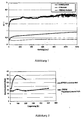
- Figure 2 shows that the media resistance of elastomeric materials can be improved by plasma polymer layers, thereby extending the life of elastomeric seals.
- Figure 2 shows the results of measurements of torque after storage of elastomeric materials.
- Figure 2 shows that the torque of an untreated EPDM material is drastically increased by the action of water vapor at 130 ° C, while a plasma-coated EPDM material - within the measurement accuracy - shows no increase in torque.
- Figure 3 shows friction measurements on specimens made of a hexamethyldisiloxane plasma-coated EPDM material containing an internal lubricant. Shown are six measurements, two each on untreated test specimens, on test specimens stored for 168 hours in a basic detergent, and on test specimens stored in a basic detergent for 300 hours.
- Figure 4 shows friction measurements on specimens made of a hexamethyldisiloxane plasma-coated EPDM material containing an internal lubricant.
- the test specimens are stored in an acidic cleaning agent.
- Figure 5 shows friction measurements on specimens made of a hexamethyldisiloxane plasma-coated EPDM material containing an internal lubricant.
- the test specimens are stored in an oxidizing cleaning agent.
- Figures 3, 4 and 5 show the results of measurements of torque after storage of elastomeric materials. It can be seen from these figures that even after a storage time of 300 h in different and aggressive cleaning agents, no damage to the test specimen showed.
- the inner lubricant does not interfere the adhesion or durability of the plasma polymer layer. On the contrary, the internal lubricant diffuses through the plasma polymer layer and thus promotes the sliding properties of the plasma polymer layer.
Landscapes
- Chemical & Material Sciences (AREA)
- Health & Medical Sciences (AREA)
- General Chemical & Material Sciences (AREA)
- Chemical Kinetics & Catalysis (AREA)
- Medicinal Chemistry (AREA)
- Polymers & Plastics (AREA)
- Organic Chemistry (AREA)
- Toxicology (AREA)
- Gasket Seals (AREA)
Applications Claiming Priority (2)
| Application Number | Priority Date | Filing Date | Title |
|---|---|---|---|
| DE102004051781A DE102004051781A1 (de) | 2004-10-22 | 2004-10-22 | Dichtung mit reduziertem Drehmoment, Verfahren zu deren Herstellung, deren Verwendung als Dichtung für Klappenventile und Klappenventil |
| DE200510025253 DE102005025253A1 (de) | 2005-06-02 | 2005-06-02 | Dichtung mit reduziertem Drehmoment, Verfahren zur Herstellung, deren Verwendung als Dichtung für Klappenventile und Klappenventil |
Publications (1)
| Publication Number | Publication Date |
|---|---|
| EP1650254A1 true EP1650254A1 (fr) | 2006-04-26 |
Family
ID=35781242
Family Applications (1)
| Application Number | Title | Priority Date | Filing Date |
|---|---|---|---|
| EP05021875A Withdrawn EP1650254A1 (fr) | 2004-10-22 | 2005-10-07 | Joint à couple réduit, procédé de fabrication, son utilisation comme joint dans une valve à clapet et valve à clapet |
Country Status (1)
| Country | Link |
|---|---|
| EP (1) | EP1650254A1 (fr) |
Citations (10)
| Publication number | Priority date | Publication date | Assignee | Title |
|---|---|---|---|---|
| US3778028A (en) | 1972-08-02 | 1973-12-11 | Dore Co John L | Lined butterfly valve |
| GB1486934A (en) | 1973-12-10 | 1977-09-28 | Saab Scania Ab | Rotary valves |
| US4588309A (en) * | 1983-06-20 | 1986-05-13 | Smith International, Inc. | Resilient bearing seal with ability to compensate for wear and compression set |
| EP0292659A2 (fr) | 1987-05-25 | 1988-11-30 | Garlock Gmbh Geschäftsbereich Armaturen | Vanne papillon |
| WO1993022587A1 (fr) | 1992-04-24 | 1993-11-11 | Ksb Aktiengesellschaft | Etoupage de l'axe de clapets d'arret |
| WO2001040359A1 (fr) | 1999-12-02 | 2001-06-07 | Dow Corning Limited | Traitement de surface d'un materiau polymere organique |
| WO2002028548A2 (fr) | 2000-10-04 | 2002-04-11 | Dow Corning Ireland Limited | Procede et appareil pour former un revetement |
| US20020074040A1 (en) | 2000-10-17 | 2002-06-20 | Schwarz Philip R. | Butterfly valve with passive-lubricated liner/seat |
| US6488992B1 (en) * | 1999-08-18 | 2002-12-03 | University Of Cincinnati | Product having a thin film polymer coating and method of making |
| DE10342273A1 (de) | 2003-09-12 | 2005-04-07 | Volkswagen Ag | Dichtungsring für eine Kolbenstange, insbesondere für eine Kolbenstange eines Schwingungsdämpfers |
-
2005
- 2005-10-07 EP EP05021875A patent/EP1650254A1/fr not_active Withdrawn
Patent Citations (10)
| Publication number | Priority date | Publication date | Assignee | Title |
|---|---|---|---|---|
| US3778028A (en) | 1972-08-02 | 1973-12-11 | Dore Co John L | Lined butterfly valve |
| GB1486934A (en) | 1973-12-10 | 1977-09-28 | Saab Scania Ab | Rotary valves |
| US4588309A (en) * | 1983-06-20 | 1986-05-13 | Smith International, Inc. | Resilient bearing seal with ability to compensate for wear and compression set |
| EP0292659A2 (fr) | 1987-05-25 | 1988-11-30 | Garlock Gmbh Geschäftsbereich Armaturen | Vanne papillon |
| WO1993022587A1 (fr) | 1992-04-24 | 1993-11-11 | Ksb Aktiengesellschaft | Etoupage de l'axe de clapets d'arret |
| US6488992B1 (en) * | 1999-08-18 | 2002-12-03 | University Of Cincinnati | Product having a thin film polymer coating and method of making |
| WO2001040359A1 (fr) | 1999-12-02 | 2001-06-07 | Dow Corning Limited | Traitement de surface d'un materiau polymere organique |
| WO2002028548A2 (fr) | 2000-10-04 | 2002-04-11 | Dow Corning Ireland Limited | Procede et appareil pour former un revetement |
| US20020074040A1 (en) | 2000-10-17 | 2002-06-20 | Schwarz Philip R. | Butterfly valve with passive-lubricated liner/seat |
| DE10342273A1 (de) | 2003-09-12 | 2005-04-07 | Volkswagen Ag | Dichtungsring für eine Kolbenstange, insbesondere für eine Kolbenstange eines Schwingungsdämpfers |
Similar Documents
| Publication | Publication Date | Title |
|---|---|---|
| EP2012938B1 (fr) | Pproduits polymeres de plasma flexibles, articles et utilisation y afferents | |
| EP2291439B1 (fr) | Article d étanchéité | |
| DE102015104103B4 (de) | Gleitelement und gleitende Maschine | |
| EP3152342B1 (fr) | Systèmes de revêtement à faible frottement étanches aux fluides pour mettre dynamiquement en contact des surfaces de support de charge | |
| EP3680100B1 (fr) | Matériau composite pourvu de couche de promoteur d'adhérence à base de si, c et o | |
| DE102009046947B4 (de) | Substrat mit stickstoffhaltiger plasmapolymerer Beschichtung, dessen Verwendung und Verfahren zu dessen Herstellung | |
| DE3832692A1 (de) | Dichtungselement mit einem absperrkoerper aus einem metallischen oder nichtmetallischen werkstoff und verfahren zum auftragen von hartstoffschichten auf den absperrkoerper | |
| WO2015128231A1 (fr) | Appareil comportant un composant mobile | |
| DE102005025253A1 (de) | Dichtung mit reduziertem Drehmoment, Verfahren zur Herstellung, deren Verwendung als Dichtung für Klappenventile und Klappenventil | |
| DE102012010603B4 (de) | Beschichteter Dichtungsartikel | |
| US20180298481A1 (en) | Fully Dense, Fluid Tight and Low Friction Coating Systems for Dynamically Engaging Load Bearing Surfaces for High Pressure High Temperature Applications | |
| DE102018202842A1 (de) | Verschleißschutzbeschichtetes metallisches Bauteil insbesondere für ein Kugelventil und Verfahren zum Aufbringen einer mehrschichtigen Verschleißschutzschicht zur Erzeugung eines solchen Bauteils | |
| EP1650254A1 (fr) | Joint à couple réduit, procédé de fabrication, son utilisation comme joint dans une valve à clapet et valve à clapet | |
| DE102014222240A1 (de) | Ventilvorrichtung für ein Kraftfahrzeug | |
| DE102004051781A1 (de) | Dichtung mit reduziertem Drehmoment, Verfahren zu deren Herstellung, deren Verwendung als Dichtung für Klappenventile und Klappenventil | |
| DE102009022334A1 (de) | Dichtung mit L-förmigem Querschnitt | |
| EP0787220A1 (fr) | Element d'etancheite, notamment pour organes d'obturation et de regulation, et son procede de fabrication | |
| WO2018206248A1 (fr) | Élément d'étanchéité revêtu par plasma | |
| DE60317820T2 (de) | Plasmabeständige elastomerteile | |
| EP2382385A1 (fr) | Procédé et système d'injection de carburant dans les machines à combustion interne | |
| WO2017122585A1 (fr) | Agent de revêtement, corps élastique à surface revêtue, et corps stratifié en caoutchouc-métal revêtu en surface | |
| DE102009027768B4 (de) | Dichtungsartikel | |
| WO2006122744A1 (fr) | Procede de modification d'une surface en caoutchouc de silicone | |
| DE3718559C2 (fr) | ||
| EP1174298A2 (fr) | Procédé de réduction de bruit entre composants |
Legal Events
| Date | Code | Title | Description |
|---|---|---|---|
| PUAI | Public reference made under article 153(3) epc to a published international application that has entered the european phase |
Free format text: ORIGINAL CODE: 0009012 |
|
| AK | Designated contracting states |
Kind code of ref document: A1 Designated state(s): AT BE BG CH CY CZ DE DK EE ES FI FR GB GR HU IE IS IT LI LT LU LV MC NL PL PT RO SE SI SK TR |
|
| AX | Request for extension of the european patent |
Extension state: AL BA HR MK YU |
|
| 17P | Request for examination filed |
Effective date: 20060519 |
|
| 17Q | First examination report despatched |
Effective date: 20060725 |
|
| AKX | Designation fees paid |
Designated state(s): AT BE BG CH CY CZ DE DK EE ES FI FR GB GR HU IE IS IT LI LT LU LV MC NL PL PT RO SE SI SK TR |
|
| STAA | Information on the status of an ep patent application or granted ep patent |
Free format text: STATUS: THE APPLICATION IS DEEMED TO BE WITHDRAWN |
|
| 18D | Application deemed to be withdrawn |
Effective date: 20120503 |