EP1651159B1 - Dispositif pour conserver des articles solides et/ou liquides et/ou gazeux - Google Patents
Dispositif pour conserver des articles solides et/ou liquides et/ou gazeux Download PDFInfo
- Publication number
- EP1651159B1 EP1651159B1 EP20040762515 EP04762515A EP1651159B1 EP 1651159 B1 EP1651159 B1 EP 1651159B1 EP 20040762515 EP20040762515 EP 20040762515 EP 04762515 A EP04762515 A EP 04762515A EP 1651159 B1 EP1651159 B1 EP 1651159B1
- Authority
- EP
- European Patent Office
- Prior art keywords
- compartment
- evaluation electronics
- integrated
- memory cell
- memory
- Prior art date
- Legal status (The legal status is an assumption and is not a legal conclusion. Google has not performed a legal analysis and makes no representation as to the accuracy of the status listed.)
- Expired - Lifetime
Links
- 239000007788 liquid Substances 0.000 title claims description 17
- 239000007787 solid Substances 0.000 title claims description 17
- 238000003860 storage Methods 0.000 title claims description 7
- 230000015654 memory Effects 0.000 claims description 99
- 238000011156 evaluation Methods 0.000 claims description 57
- 239000000758 substrate Substances 0.000 claims description 16
- 230000005540 biological transmission Effects 0.000 claims description 9
- 235000013305 food Nutrition 0.000 claims description 9
- 229920000642 polymer Polymers 0.000 claims description 8
- XAGFODPZIPBFFR-UHFFFAOYSA-N aluminium Chemical compound [Al] XAGFODPZIPBFFR-UHFFFAOYSA-N 0.000 claims description 6
- 229910052782 aluminium Inorganic materials 0.000 claims description 6
- 230000006870 function Effects 0.000 claims description 3
- 150000002894 organic compounds Chemical class 0.000 claims description 3
- 239000003990 capacitor Substances 0.000 claims description 2
- 238000004806 packaging method and process Methods 0.000 description 16
- 239000003814 drug Substances 0.000 description 13
- 229940079593 drug Drugs 0.000 description 10
- 239000004020 conductor Substances 0.000 description 9
- 238000001514 detection method Methods 0.000 description 6
- 239000000463 material Substances 0.000 description 4
- XUIMIQQOPSSXEZ-UHFFFAOYSA-N Silicon Chemical compound [Si] XUIMIQQOPSSXEZ-UHFFFAOYSA-N 0.000 description 3
- 230000010354 integration Effects 0.000 description 3
- 239000004033 plastic Substances 0.000 description 3
- 229910052710 silicon Inorganic materials 0.000 description 3
- 239000010703 silicon Substances 0.000 description 3
- 235000013618 yogurt Nutrition 0.000 description 3
- 238000004891 communication Methods 0.000 description 2
- 230000000694 effects Effects 0.000 description 2
- 239000012212 insulator Substances 0.000 description 2
- 238000000034 method Methods 0.000 description 2
- 239000004065 semiconductor Substances 0.000 description 2
- 238000012546 transfer Methods 0.000 description 2
- 229920000144 PEDOT:PSS Polymers 0.000 description 1
- 230000006978 adaptation Effects 0.000 description 1
- 230000015572 biosynthetic process Effects 0.000 description 1
- 239000006229 carbon black Substances 0.000 description 1
- 239000012876 carrier material Substances 0.000 description 1
- 239000011248 coating agent Substances 0.000 description 1
- 238000000576 coating method Methods 0.000 description 1
- 239000002131 composite material Substances 0.000 description 1
- 238000013500 data storage Methods 0.000 description 1
- 238000013461 design Methods 0.000 description 1
- 238000005429 filling process Methods 0.000 description 1
- 238000010353 genetic engineering Methods 0.000 description 1
- 238000004519 manufacturing process Methods 0.000 description 1
- 238000002483 medication Methods 0.000 description 1
- 238000012544 monitoring process Methods 0.000 description 1
- 125000002524 organometallic group Chemical group 0.000 description 1
- 239000012785 packaging film Substances 0.000 description 1
- 229920006280 packaging film Polymers 0.000 description 1
- 238000002161 passivation Methods 0.000 description 1
- 238000000059 patterning Methods 0.000 description 1
- SLIUAWYAILUBJU-UHFFFAOYSA-N pentacene Chemical compound C1=CC=CC2=CC3=CC4=CC5=CC=CC=C5C=C4C=C3C=C21 SLIUAWYAILUBJU-UHFFFAOYSA-N 0.000 description 1
- 239000002985 plastic film Substances 0.000 description 1
- 229920006255 plastic film Polymers 0.000 description 1
- 229920000767 polyaniline Polymers 0.000 description 1
- 230000001681 protective effect Effects 0.000 description 1
- 150000003384 small molecules Chemical class 0.000 description 1
- 230000001360 synchronised effect Effects 0.000 description 1
- 230000001960 triggered effect Effects 0.000 description 1
Images


Classifications
-
- A—HUMAN NECESSITIES
- A61—MEDICAL OR VETERINARY SCIENCE; HYGIENE
- A61J—CONTAINERS SPECIALLY ADAPTED FOR MEDICAL OR PHARMACEUTICAL PURPOSES; DEVICES OR METHODS SPECIALLY ADAPTED FOR BRINGING PHARMACEUTICAL PRODUCTS INTO PARTICULAR PHYSICAL OR ADMINISTERING FORMS; DEVICES FOR ADMINISTERING FOOD OR MEDICINES ORALLY; BABY COMFORTERS; DEVICES FOR RECEIVING SPITTLE
- A61J7/00—Devices for administering medicines orally, e.g. spoons; Pill counting devices; Arrangements for time indication or reminder for taking medicine
- A61J7/04—Arrangements for time indication or reminder for taking medicine, e.g. programmed dispensers
- A61J7/0409—Arrangements for time indication or reminder for taking medicine, e.g. programmed dispensers with timers
- A61J7/0481—Arrangements for time indication or reminder for taking medicine, e.g. programmed dispensers with timers working on a schedule basis
-
- A—HUMAN NECESSITIES
- A61—MEDICAL OR VETERINARY SCIENCE; HYGIENE
- A61J—CONTAINERS SPECIALLY ADAPTED FOR MEDICAL OR PHARMACEUTICAL PURPOSES; DEVICES OR METHODS SPECIALLY ADAPTED FOR BRINGING PHARMACEUTICAL PRODUCTS INTO PARTICULAR PHYSICAL OR ADMINISTERING FORMS; DEVICES FOR ADMINISTERING FOOD OR MEDICINES ORALLY; BABY COMFORTERS; DEVICES FOR RECEIVING SPITTLE
- A61J1/00—Containers specially adapted for medical or pharmaceutical purposes
- A61J1/03—Containers specially adapted for medical or pharmaceutical purposes for pills or tablets
- A61J1/035—Blister-type containers
-
- A—HUMAN NECESSITIES
- A61—MEDICAL OR VETERINARY SCIENCE; HYGIENE
- A61J—CONTAINERS SPECIALLY ADAPTED FOR MEDICAL OR PHARMACEUTICAL PURPOSES; DEVICES OR METHODS SPECIALLY ADAPTED FOR BRINGING PHARMACEUTICAL PRODUCTS INTO PARTICULAR PHYSICAL OR ADMINISTERING FORMS; DEVICES FOR ADMINISTERING FOOD OR MEDICINES ORALLY; BABY COMFORTERS; DEVICES FOR RECEIVING SPITTLE
- A61J7/00—Devices for administering medicines orally, e.g. spoons; Pill counting devices; Arrangements for time indication or reminder for taking medicine
- A61J7/04—Arrangements for time indication or reminder for taking medicine, e.g. programmed dispensers
- A61J7/0409—Arrangements for time indication or reminder for taking medicine, e.g. programmed dispensers with timers
- A61J7/0427—Arrangements for time indication or reminder for taking medicine, e.g. programmed dispensers with timers with direct interaction with a dispensing or delivery system
- A61J7/0436—Arrangements for time indication or reminder for taking medicine, e.g. programmed dispensers with timers with direct interaction with a dispensing or delivery system resulting from removing a drug from, or opening, a container
Definitions
- the invention relates to a device for storing solid and / or liquid and / or gaseous articles according to the preamble of claim 1. It allows in particular the automatic detection of the state of packaging such as blister packs or food packaging.
- blister packs for the storage and metered supply of medicines in the healthcare sector.
- readers are known, which detect the condition of the blister pack and - possibly via a remote connection - the corresponding information to the attending physician. Especially in the home care sector such control options are desired.
- the known readers for detecting the condition of blister packs are designed such that the blister pack to be tested is substantially completely inserted into the reader.
- the state of the blister packs is then determined either optically or electrically, in the latter case a single printed circuit is printed on the individual blisters, so that it can be detected by applying two contacts to a blister, whether the blister is still intact or not.
- the disadvantage here must be provided a variety of contacts in the reader.
- Known Readers for blister packs are generally characterized by a complex structure and high production costs. In addition, an adaptation to the respective dimensions of the blister packs to be tested is required.
- the WO 01/72260 A1 also relates to a medication storage device comprising a multi-compartment plate suitable for storage of medicaments, wherein electrical contacts are attached to the closure lid. These electrical contacts are connected to a unit which registers the removal of the drug.
- a major disadvantage of said arrangements is that a clear assignment to a blister due to its interchangeability is not given, so that this device is neither suitable for product protection nor for patient monitoring.
- the Canadian document CA 2 353 350 relates to packaging for drugs with compartments, a memory chip and electrical traces, each connecting a compartment with the memory chip.
- the conductor tracks are destroyed, which is registered by the memory chip.
- the invention is therefore an object of the invention to provide a device for storing solid and / or liquid and / or gaseous objects available that allows in conjunction with a reader a simple and inexpensive detection of the state of the device.
- the solution according to the invention is characterized in that the filling and / or emptying of the compartment triggers an electrically readable signal.
- the state of the device can be detected. In this case, in addition to a removal of an object from a compartment and the filling or loading of a compartment with an object can be detected or detected.
- the compartment for removing the article and / or for filling with the object is mechanically changeable and an electrically readable is mechanically changeable and an electrically readable signal is generated in a mechanical change of the compartment.
- the mechanical change thus leads directly to an electrically readable signal.
- an electrical data memory is integrated into the device.
- the electrical data memory has at least one memory cell, which is assigned to a respective compartment of the device and occupies a different memory value in the event of a mechanical change of the compartment.
- an evaluation electronics for reading out the data memory is additionally integrated into the device.
- This preferred embodiment is based on the idea to form the device for storing solid and / or liquid and / or gaseous objects themselves as a carrier of electrical functionality.
- a compartment of the device which changes mechanically when an object is removed, is assigned a memory cell, so that the mechanical change of the compartment is reflected in an altered memory value of the respective memory cell.
- the evaluation electronics can be integrated directly into the substrate of the device or alternatively be formed on a separate carrier which is applied to the device.
- the integration of the evaluation electronics in the device has the advantage that the intelligence for detecting a change in state of the device is integrated into the device itself. This is done in particular by the fact that the electrical data memory and the evaluation electronics are integrated in commercial packaging, in particular using the polymer electronics. Due to the realization of electronic functionalities in the device itself, the intelligence of a reading device can be considerably reduced and the size of a reading device can be miniaturized to the size of a pure display, which results in a considerable cost saving.
- the reader only needs to communicate with a standardized interface of the evaluation and it is no longer necessary to provide means in the reader, which detect the state of all compartments of the reader. Rather, it is sufficient to provide only one contact for a serial data transmission. Furthermore, it is no longer necessary for the readers to completely pick up the device whose condition is to be detected. As a result, the readers can be made smaller and use in connection with a much wider variety of packaging. Overall, the automatic recognition of the state of a device for storing solid and / or liquid and / or gaseous objects by the said solution is made possible in a much simpler and more cost-effective manner.
- a "compartment” in the sense of the present invention is understood to mean any area which can be defined in a distantly different manner and which allows at least a partial reception or storage of an object. In particular, it may be closed or even partially closed areas of a device.
- the device under consideration may have one or more compartments.
- An "article” for the purposes of the present invention, which is located in a compartment, may be solid and / or liquid and / or gaseous. For example, these are tablets or food portions.
- a compartment each forms a part of the associated memory cell.
- a mechanical change of the compartment accordingly leads directly to a changed memory value of the memory cell.
- the compartment preferably has a conductor track, which is part of the memory cell. The trace is destroyed by a mechanical change of the compartment, whereby the memory cell takes on a different value.
- the memory cell and associated compartment may be coupled in other ways.
- the compartment forms a capacitance, wherein the capacitance is changed with a mechanical change of the compartment, so that the memory cell then assumes a different value.
- the compartment forms an inductance and the inductance is changed during a mechanical change of the compartment. In this case, the memory cell assumes a different memory value due to the changed inductance.
- the memory cell may also have a resonant circuit which is destroyed or detuned in the event of a mechanical change in the compartment, which in turn leads to a different memory value. The latter cases, in particular when integrating an AC voltage source into the device, are sensible alternatives to the electrical detection of a mechanical change of a compartment.
- both embodiments of a memory cell can be provided, in which the memory cell stores digital values, in particular digital voltage values (eg "zero” or “ONE”).
- embodiments of a memory cell may be provided in which the memory cell stores analog values.
- only two values may be stored (eg, "NULL” or "ONE") corresponding to two states of the compartment ("filled” and “empty”). or “intact” and "open”).
- the evaluation electronics has, for example, a shift register for reading out the data memory.
- the individual memory cells of the data memory form parallel inputs of the shift register.
- the shift register is read out serially via a suitable interface.
- the evaluation of the data memory by a shift register is merely exemplary. The person skilled in the art recognizes that the read-out of the memory values of a data memory can be implemented in many ways.
- the solution according to the invention comprises both embodiments in which a voltage source is integrated into the device, as well as embodiments in which a voltage source is not integrated.
- the energy for operating the data memory and the evaluation electronics is added externally, for example, by means of the reading device. This can be done as well as the actual data transfer contact or contactless.
- the evaluation electronics preferably has only two connection contacts for the voltage (the operating voltage Vdd and GROUND) and a connection contact for serial data transmission.
- a connection contact for a timer is available.
- the energy is inductively coupled or via an electromagnetic signal. The latter methods are provided in the case of information transmission in accordance with RFID (Radio Frequency Identification) and are known to the person skilled in the art.
- the evaluation electronics itself has a timer and stores, at which time a compartment mechanically was changed. This makes it possible to additionally store the time of removal of a drug or food from a considered compartment and determine afterwards.
- the evaluation electronics is preferably designed as a separate chip with an integrated voltage source, which is applied to the device, for example glued. Such a "high performance" design of the evaluation electronics is particularly useful for high-quality drugs, such as drugs of genetic engineering.
- the chip is preferably formed as a silicon chip.
- the memory cell and / or conductor tracks and / or component evaluation electronics are preferably integrated directly into the substrate of the device.
- the data memory and / or printed conductors and / or components of the evaluation electronics are at least partially embodied as elements of the polymer electronics It is preferably provided that active and / or passive electrical components such as transistors, diodes, capacitances, inductances or resistors as well as circuits formed therefrom are integrated into the layer network Evaluation electronics can be integrated cost-effectively in this way directly into the substrate of the device for storing solid and / or liquid and / or gaseous objects. Preferably, integration takes place in the substrate of a packaging which represents or comprises the device.
- organic transistors which, like silicon-based transistors, are made up of several layers: substrate, gate electrode, gate insulator, source and drain contacts, organic semiconductors (eg pentacene or substituted oligothiophene) and a protective passivation. It is also conceivable to use hybrid organic / inorganic structures and to integrate them into the substrate of the device or the substrate of the packaging.
- the electrical lines of the data memory or the evaluation electronics for the case that the substrate of the device has an aluminum layer, formed by the aluminum layer itself, which is structured accordingly and after structuring serves as a conductor track plane.
- the printed conductors can be realized, for example by means of conductive organic compounds by printing. Suitable organic compounds are, for example, carbon black, polystyrenesulfonic acid-doped polydioxyethylenethiophene (PEDOT: PSS) or champanosulfonic acid-doped polyaniline.
- the device preferably represents or has a packaging, wherein the packaging forms the compartments and the data memory and the evaluation electronics are integrated into the substrate of the packaging.
- the packaging is for example a blister pack.
- the invention is also suitable for the detection of the condition of other packages, in particular for the detection of the condition of food packaging.
- the device may be a yogurt cup.
- the yoghurt cup forms a memory cell together with the aluminum lid, whereby the memory value of the memory cell changes when the conductive aluminum lid is removed, ie when the yoghurt cup is mechanically changed becomes.
- the evaluation electronics are integrated, for example, in the plastic material of the cup.
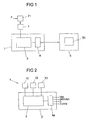
- the FIG. 1 shows a data memory 1 and an evaluation electronics 2, which is part of a device for storing solid and / or liquid and / or gaseous objects.
- the data memory 1 has a memory cell which is assigned to a compartment 71 of the device for storing solid and / or liquid and / or gaseous objects.
- the compartment 71 serves to receive at least one object.
- the compartment 71 is a blister of a blister pack.
- the memory value before a removal of the object is logically zero and after removal of the object logically one.
- the evaluation electronics 2 To read out the value of the data memory 1, the evaluation electronics 2 is provided which has an evaluation module 3 and an interface 4. Via the interface 4, the values of the data memory 1 detected by the evaluation module 3 can be transmitted to an external reading device 5. The transmission can be made contact or contactless.
- the reading device 5 has a display 51, on which the information relating to the memory value of the data memory 1 or the corresponding information about the state of the device under consideration can be displayed. Since the evaluation electronics 2 in the device integrated for storage of solid and / or liquid and / or gaseous objects, the reader 5 can be configured in a simple manner.
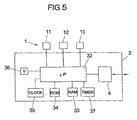
- the FIG. 2 shows an embodiment of the device for storing solid and / or liquid and / or gaseous objects, in which a data transmission to a reading device is contact-based.
- the data memory 1 contains in the embodiment of FIG. 2 three memory cells 11, 12, 13, which are each associated with a corresponding compartment (not shown separately).
- the evaluation module 3 reads out the current values of the memory cells 11, 12, 13 and communicates this information to the interface 4a.
- the interface 4a has four standardized connections. It is a connection for the operating voltage Vdd, a connection for the reference potential GROUND, a connection D for a serial data transmission and a connection for a clock. The latter can also be dispensed with. With Clock the data transfer is synchronous, without clock asynchronous.
- a contactless interface 4a according to the standard RFID is provided.
- the RFID interface 4a represents a transceiver (or "tag") that interacts with an RFID reader.
- the RFID interface 4b has an antenna 4b '. Inductively or via electromagnetic waves, energy is coupled into the interface 4b via the reading device, which is made available to the evaluation unit 2 and the data memory 1. With the aid of the coupled-in energy, the current value of the memory cells 11, 12, 13 is detected and transmitted to the reading device.
- RFID interfaces can be designed in a variety of ways. For example, it may also be provided that in the RFID interface 4b or in the Evaluation electronics 2 a voltage source is integrated (so-called active RFID transceiver). Since the person skilled in a contactless communication by means of RFID components is known, this will not be discussed further.
- the FIG. 4 shows a possible embodiment of the evaluation module 3.
- the evaluation module 3 a shift register 31 with a plurality of cells 311, ... 31n.
- the output values of a plurality of memory cells 11, 12, 13... 1n are fed to the individual cells 311,... 31n of the shift register 31 via parallel inputs E1, E2, E3,.
- the shift register 31 passes information of the respective cell to the subsequent cell at the cycle times.
- the information of the individual data memories can be read out serially.
- the clock of the shift register 31 is specified by a timer CLOCK, the time signal can be supplied externally or a timer can be integrated into the evaluation electronics.
- the FIG. 5 shows an embodiment of an evaluation electronics 2, which is formed in a separate chip, which is applied to the device for storing solid and / or liquid and / or gaseous objects and electrically connected via suitable contacting points (not shown) to the data memory 1 of the device ,
- the evaluation electronics 2 is formed, for example, on a silicon chip.
- a timer module 37 it is possible to additionally store the time at which a compartment is mechanically changed or the memory value of the associated memory cell 11, 12, 13 changes. So there is provided a clock function.
- a clock function At a check of the In the state of the device, it is therefore possible to also detect the time of removal of the respective article, such as a tablet of a blister pack.
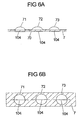
- FIGS. 6a, 6b show in side view and in plan view as an example of a device for storing solid and / or liquid and / or gaseous objects a blister pack 7 with a plurality of blisters 71, 72, 73.
- Each blister 71, 72, 73 forms part of a memory cell
- one printed conductor 104 is integrated into the depressible region 70 of the blister. This is destroyed when pushing the blister. This leads to the description of the memory cell assigned to the respective blister 71, 72, 73 or to a change of the memory value.
- the FIG. 7 shows an exemplary embodiment of a memory cell or a memory element 11.
- the FIG. 7 is connected between the terminals Ground 102 and the operating voltage Vdd 101, a line which is partially formed by the track 104 of the compartment.
- An output signal is provided at an output 103.
- a p-channel transistor 100 which is preferably implemented in polymer electronics, limits the current, so that when the conductor 104 is closed, the potential at the output 103 is zero volts (logic zero). In the case of a destroyed trace 104, on the other hand, the operating voltage Vdd (logic one) is present at the output 103.
- FIG. 7 illustrated embodiment of the memory cell is to be understood only as an example. Numerous other embodiments of a memory cell are conceivable. For example, instead of a current-limiting transistor, a resistor may be provided. For AC applications, capacitors and / or inductors may also be used.
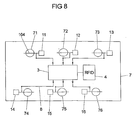
- FIG. 8 shows a memory cell with six blisters 71-76 and six associated memory cells 11-16, for example, as in FIG FIG. 7 are shown formed.
- the outputs 103 of the memory cells are connected via electrical lines 8 to an evaluation module 3, which reads out the contents of the memory cells 71-76 and forwards the data to an interface 4 for transmitting a reading device, the information transmission taking place, for example, contactlessly by means of an RFID interface.
- Both the memory cells 11 to 16 and the evaluation module 3 and the RFID module 4 are at least partially implemented in polymer electronics.
- the other components of the memory cells and the evaluation electronics 3, 4, such as transistors and diodes, are integrated into further layers of the plastic material of the blister pack 7.
- the RFID interface 4 is preferably realized on a polymer basis.
- a contact-type interface according to the interface 4a of FIG. 2 be used.
- the reader module can be used with a variety of blister packs of different sizes and number of blisters. Commercially available RFID readers or else readers specially designed for blister packs can be used.
- the invention is not limited in its execution to the embodiments shown above. Instead of blister packs, any other packaging or devices for storing solid and / or liquid and / or gaseous objects can also be used in connection with the invention.
- the on removal of an object mechanically variable compartments are, for example, compartments of commercial food packaging. The invention then makes it possible, after receiving a food delivery to quickly check whether the packaging of the individual foods were damaged during transport.
- the filling of a compartment is detected, wherein when filling a compartment, an electrically readable signal is generated.
- the electrically readable signal is triggered in particular by a mechanical change of the compartment during the filling process.
Landscapes
- Health & Medical Sciences (AREA)
- Engineering & Computer Science (AREA)
- Medical Informatics (AREA)
- Life Sciences & Earth Sciences (AREA)
- Animal Behavior & Ethology (AREA)
- General Health & Medical Sciences (AREA)
- Public Health (AREA)
- Veterinary Medicine (AREA)
- Packages (AREA)
- Medical Preparation Storing Or Oral Administration Devices (AREA)
- Read Only Memory (AREA)
- Details Of Rigid Or Semi-Rigid Containers (AREA)
Claims (22)
- Dispositif pour stocker des articles solides et/ou liquides et/ou gazeux avec au moins un compartiment qui contient un article, sachant que- le remplissage et/ou le vidage du compartiment (71-76) déclenche un signal lisible électriquement,- le compartiment (71-76) peut être modifié mécaniquement pour le retrait de l'article et/ou pour le remplissage avec l'article et un signal lisible électriquement est généré en cas de modification mécanique du compartiment (71-76), et- une mémoire de données (1 ; 11-16) électrique avec au moins une cellule de mémoire (11-16) associée à un compartiment (71-76) qui adopte une autre valeur de mémoire en cas de modification mécanique du compartiment (71-76), est intégrée dans le dispositif (7),caractérisé en ce que- le compartiment (71-76) réalise une partie de la cellule de mémoire (11-16).
- Dispositif selon la revendication 1, caractérisé en ce que le dispositif (7) intègre en outre : une électronique d'évaluation (2, 3, 4) pour la lecture de la mémoire de données (1).
- Dispositif selon la revendication 1 ou 2, caractérisé en ce que le compartiment (71-76) présente une piste conductrice (104) qui fait partie de la cellule de mémoire (11-16) et la piste conductrice (104) est détruite en cas de modification mécanique du compartiment (71-76), moyennant quoi la cellule de mémoire (11-16) adopte une autre valeur.
- Dispositif selon la revendication 1 ou 2, caractérisé en ce que le compartiment (71-76) réalise une capacité et la capacité est modifiée en cas de modification mécanique du compartiment, moyennant quoi la cellule de mémoire (11-16) adopte une autre valeur.
- Dispositif selon la revendication 1, 2 ou 4, caractérisé en ce que le compartiment (71-76) réalise une inductance et l'inductance est modifiée en cas de modification mécanique du compartiment, moyennant quoi la cellule de mémoire (11-16) adopte une autre valeur.
- Dispositif selon au moins l'une quelconque des revendications précédentes, caractérisé en ce que l'électronique d'évaluation (2, 3) présente un registre à décalage (31) pour la lecture de la mémoire de données (1).
- Dispositif selon au moins l'une quelconque des revendications précédentes, caractérisé en ce que l'électronique d'évaluation (2, 4) présente deux contacts de raccordement (broche positive Vdd, Masse) pour la tension et un contact de raccordement (D) pour une transmission de données en série.
- Dispositif selon au moins l'une quelconque des revendications précédentes, caractérisé en ce que l'électronique d'évaluation (2) présente une interface avec contact ou sans contact (4a, 4b) pour la transmission de données entre l'électronique d'évaluation (2) et un lecteur externe (5).
- Dispositif selon au moins l'une quelconque des revendications précédentes, caractérisé en ce que l'électronique d'évaluation (5) présente un temporisateur (37) et enregistre le moment auquel un compartiment (71-76) a été modifié mécaniquement.
- Dispositif selon l'une quelconque des revendications précédentes, caractérisé en ce qu'au moins une cellule de mémoire (11-16) et/ou des pistes conductrices (104 ; 8) et/ou des composants de l'électronique d'évaluation (2, 3, 4) sont intégrés dans le substrat du dispositif (7).
- Dispositif selon la revendication 10, caractérisé en ce que la mémoire de données (1 ; 11-16) est réalisée comme une mémoire WOROM inhérente, intégrée dans le substrat.
- Dispositif selon la revendication 10 ou 11, caractérisé en ce que la mémoire de données (1 ; 11-16) et/ou des pistes conductrices (104, 8) et/ou des composants de l'électronique d'évaluation (2, 3, 4) sont réalisés au moins en partie comme des éléments de l'électronique polymère.
- Dispositif selon l'une quelconque des revendications 10 à 12, caractérisé en ce que le dispositif (7) présente un assemblage par couches et au moins l'une des couches de l'assemblage est utilisée pour réaliser une fonction électrique.
- Dispositif selon la revendication 13, caractérisé en ce que des éléments structurels électriques, actifs et/ou passifs tels que des transistors (100), des diodes, des capacités, des inductances ou des résistances ainsi que des circuits formés à partir de ceux-ci (2, 3, 4) sont intégrés dans la structure par couches.
- Dispositif selon l'une quelconque des revendications 10 à 14, caractérisé en ce que le substrat (7) présente une couche d'aluminium qui réalise les câbles électriques (104, 8).
- Dispositif selon l'une quelconque des revendications 10 à 15, caractérisé en ce que le substrat (7) présente des liaisons organiques imprimées qui réalisent les pistes conductrices.
- Dispositif selon l'une quelconque des revendications 10 à 16, caractérisé en ce que le dispositif constitue ou présente un emballage (7) qui réalise le compartiment (71-76), et la mémoire de données (1) et l'électronique d'évaluation (2, 3, 4) sont intégrées dans le substrat de l'emballage (7).
- Dispositif selon la revendication 17, caractérisé en ce que le substrat de l'emballage (7) sert de support pour des câbles électriques (104, 8) et/ou l'électronique d'évaluation (2, 3, 4).
- Dispositif selon la revendication 17, caractérisé en ce que l'électronique d'évaluation (32, 33, 34, 35) est intégrée dans une puce avec source de tension intégrée (36), qui est montée sur l'emballage (7).
- Dispositif selon au moins l'une quelconque des revendications précédentes, caractérisé en ce que le dispositif est un emballage blister (7).
- Dispositif selon la revendication 20, caractérisé en ce qu'un blister (71-76) réalise une partie d'une cellule de mémoire (11-16).
- Dispositif selon l'une quelconque des revendications précédentes, caractérisé en ce que le dispositif est un emballage alimentaire.
Applications Claiming Priority (2)
| Application Number | Priority Date | Filing Date | Title |
|---|---|---|---|
| DE2003135284 DE10335284B4 (de) | 2003-07-28 | 2003-07-28 | Vorrichtung zur Aufbewahrung von festen und/oder flüssigen und/oder gasförmigen Gegenständen |
| PCT/DE2004/001668 WO2005011564A1 (fr) | 2003-07-28 | 2004-07-26 | Dispositif pour conserver des articles solides et/ou liquides et/ou gazeux |
Publications (3)
| Publication Number | Publication Date |
|---|---|
| EP1651159A1 EP1651159A1 (fr) | 2006-05-03 |
| EP1651159B1 true EP1651159B1 (fr) | 2013-02-06 |
| EP1651159B8 EP1651159B8 (fr) | 2013-04-24 |
Family
ID=34089021
Family Applications (1)
| Application Number | Title | Priority Date | Filing Date |
|---|---|---|---|
| EP20040762515 Expired - Lifetime EP1651159B8 (fr) | 2003-07-28 | 2004-07-26 | Dispositif pour conserver des articles solides et/ou liquides et/ou gazeux |
Country Status (5)
| Country | Link |
|---|---|
| US (1) | US7466230B2 (fr) |
| EP (1) | EP1651159B8 (fr) |
| CA (1) | CA2533462C (fr) |
| DE (1) | DE10335284B4 (fr) |
| WO (1) | WO2005011564A1 (fr) |
Families Citing this family (13)
| Publication number | Priority date | Publication date | Assignee | Title |
|---|---|---|---|---|
| WO2007060588A1 (fr) * | 2005-11-23 | 2007-05-31 | Koninklijke Philips Electronics N.V. | Systeme de controle d’un distributeur de medicament |
| EP2040995A1 (fr) * | 2006-06-26 | 2009-04-01 | Aida Centre, S.L. | Conditionnement sous blister intégrant des étiquettes rfid |
| DE102006052742A1 (de) * | 2006-11-08 | 2008-05-15 | Siemens Ag | Automatische Medikamentenversorgung in einer medizinischen Einrichtung |
| WO2009000425A2 (fr) * | 2007-06-22 | 2008-12-31 | Alcan Technology & Management Ltd. | Système de vérification de l'intégrité d'un emballage sous blister |
| EP2160172A2 (fr) * | 2007-06-22 | 2010-03-10 | Alcan Technology & Management Ltd. | Système pour contrôler un processus de prise de médicaments |
| EP2113235A1 (fr) * | 2008-04-28 | 2009-11-04 | Alcan Technology & Management AG | Feuille de couverture et de fermeture pour un emballage et procédé de détermination de l'état de l'ouverture d'un emballage |
| EP2113236A1 (fr) * | 2008-04-28 | 2009-11-04 | Alcan Technology & Management Ltd. | Feuille de couverture et/ou de fermeture pour un emballage ainsi que procédé et système de détermination de l'état de l'ouverture d'un emballage |
| WO2009140313A1 (fr) * | 2008-05-12 | 2009-11-19 | Synthetic Genomics, Inc. | Procédés pour stimuler une production de méthane biogénique à partir de formation contenant des hydrocarbures |
| DE102009018285B4 (de) * | 2009-04-21 | 2015-09-10 | Schreiner Group Gmbh & Co. Kg | Blisterpackung, Auswertevorrichtung und Verfahren zum Betreiben einer Blisterpackungsanordnung |
| GB2470006B (en) * | 2009-05-05 | 2012-05-23 | Cambridge Display Tech Ltd | Device and method of forming a device |
| DE102013109221B4 (de) * | 2013-08-26 | 2022-05-19 | Infineon Technologies Ag | Chip-Anordnung, Analysevorrichtung, Aufnahmebehälter, und Aufnahmebehältersystem |
| US10704944B2 (en) | 2014-09-14 | 2020-07-07 | Becton, Dickinson And Company | System and method for capturing dose information |
| US10971260B2 (en) | 2014-09-14 | 2021-04-06 | Becton, Dickinson And Company | System and method for capturing dose information |
Family Cites Families (19)
| Publication number | Priority date | Publication date | Assignee | Title |
|---|---|---|---|---|
| US5088056A (en) * | 1985-02-19 | 1992-02-11 | Kenneth B. McIntosh | Medication clock |
| SE463348B (sv) * | 1988-03-29 | 1990-11-12 | Compumed Ab | Anordning foer signalering av intag av medikamenttabletter |
| US5412372A (en) * | 1992-09-21 | 1995-05-02 | Medical Microsystems, Inc. | Article dispenser for monitoring dispensing times |
| US5862222A (en) * | 1994-05-27 | 1999-01-19 | Gunnarsson; Staffan | System at a vehicle for debiting at automatic fuelling |
| US5508684A (en) * | 1995-03-02 | 1996-04-16 | Becker; Richard S. | Article tag |
| SE508758C2 (sv) * | 1997-02-19 | 1998-11-02 | Jakob Ehrensvaerd | Registreringsanordning |
| DE19739438A1 (de) * | 1997-09-09 | 1999-03-11 | Parras Karl Heinz | Verpackung für formfeste Medikamentenproben |
| CA2272017A1 (fr) * | 1998-05-29 | 1999-11-29 | Alusuisse Technology & Management Ltd. | Opercule avec bandes conductrices |
| DE19835940A1 (de) * | 1998-08-08 | 2000-02-17 | Jenapharm Gmbh | Arzneimittelverpackung |
| DE19852602A1 (de) * | 1998-11-14 | 2000-05-18 | Thomas Wagner | Vorrichtung und Verfahren zur Erinnerung an eine zeitgerechte Einnahme von Medikamenten |
| US6294999B1 (en) * | 1999-12-29 | 2001-09-25 | Becton, Dickinson And Company | Systems and methods for monitoring patient compliance with medication regimens |
| SE516642C2 (sv) * | 2000-03-24 | 2002-02-05 | Meditelligence Ab | Förvaringsanordning särskilt för läkemedel och därtill hörande förvaringsplatta |
| US6961285B2 (en) * | 2000-07-07 | 2005-11-01 | Ddms Holdings L.L.C. | Drug delivery management system |
| US6373387B1 (en) * | 2000-08-08 | 2002-04-16 | Honeywell International Inc. | Integrated hybrid electronic article surveillance marker |
| US6392544B1 (en) * | 2000-09-25 | 2002-05-21 | Motorola, Inc. | Method and apparatus for selectively activating radio frequency identification tags that are in close proximity |
| CA2353350A1 (fr) * | 2001-07-20 | 2003-01-20 | Michael Petersen | Dispositif de conditionnement et systeme de detection d'utilisation du contenu |
| US6888502B2 (en) * | 2002-03-05 | 2005-05-03 | Precision Dynamics Corporation | Microstrip antenna for an identification appliance |
| US20040008123A1 (en) * | 2002-07-15 | 2004-01-15 | Battelle Memorial Institute | System and method for tracking medical devices |
| WO2004073498A2 (fr) * | 2003-02-14 | 2004-09-02 | Brue Vesta L | Dispositif d'aide a l'observance therapeutique |
-
2003
- 2003-07-28 DE DE2003135284 patent/DE10335284B4/de not_active Expired - Fee Related
-
2004
- 2004-07-26 CA CA2533462A patent/CA2533462C/fr not_active Expired - Fee Related
- 2004-07-26 WO PCT/DE2004/001668 patent/WO2005011564A1/fr not_active Ceased
- 2004-07-26 EP EP20040762515 patent/EP1651159B8/fr not_active Expired - Lifetime
- 2004-07-26 US US10/566,144 patent/US7466230B2/en not_active Expired - Fee Related
Also Published As
| Publication number | Publication date |
|---|---|
| US7466230B2 (en) | 2008-12-16 |
| CA2533462C (fr) | 2012-01-24 |
| US20070267431A1 (en) | 2007-11-22 |
| WO2005011564A1 (fr) | 2005-02-10 |
| DE10335284A1 (de) | 2005-02-24 |
| CA2533462A1 (fr) | 2005-02-10 |
| EP1651159B8 (fr) | 2013-04-24 |
| DE10335284B4 (de) | 2009-09-10 |
| EP1651159A1 (fr) | 2006-05-03 |
Similar Documents
| Publication | Publication Date | Title |
|---|---|---|
| EP1651159B1 (fr) | Dispositif pour conserver des articles solides et/ou liquides et/ou gazeux | |
| DE69932169T2 (de) | Formular | |
| DE60304601T2 (de) | Elektronisches manipulationserfassungssystem | |
| EP3104823B1 (fr) | Dispositif pour la detection de la prise de medicaments | |
| WO2006002667A1 (fr) | Emballage-blister | |
| EP3338519B1 (fr) | Objet avec une unité électronique et avec des structures conductrices sur une structure porteuse | |
| EP1828963B1 (fr) | Systeme d'identification | |
| DE102013109221A1 (de) | Chip-Anordnung, Analysevorrichtung, Aufnahmebehälter, und Aufnahmebehältersystem | |
| EP2113235A1 (fr) | Feuille de couverture et de fermeture pour un emballage et procédé de détermination de l'état de l'ouverture d'un emballage | |
| WO2003046922A2 (fr) | Montage a semi-conducteurs avec transistors a base de semi-conducteurs organiques et de cellules de memoire d'ecriture-lecture non volatiles | |
| DE102009018285B4 (de) | Blisterpackung, Auswertevorrichtung und Verfahren zum Betreiben einer Blisterpackungsanordnung | |
| EP3319575A1 (fr) | Procédés à base de rfid et systèmes de surveillance d'observance médicamenteuse | |
| WO2006007867A1 (fr) | Plaquette de support de produits | |
| DE19852602A1 (de) | Vorrichtung und Verfahren zur Erinnerung an eine zeitgerechte Einnahme von Medikamenten | |
| WO2009132773A1 (fr) | Film de couverture et de fermeture pour emballage et procédé pour déterminer l'état d'ouverture d'un emballage | |
| WO2009000425A2 (fr) | Système de vérification de l'intégrité d'un emballage sous blister | |
| DE20106542U1 (de) | Identifikationselement für Gegenstände | |
| EP2482237B1 (fr) | Corps en forme d'emballage ou de pièce de formage comportant une antenne RFID | |
| EP3218274A1 (fr) | Dispositif de détection d'ouverture d'emballage et procédé de production dudit dispositif | |
| EP2170242A2 (fr) | Système de contrôle de la prise de médicaments | |
| EP2343243A1 (fr) | Installation destinée au remplissage controlé de produits pharmaceutiques solides | |
| WO2016074821A1 (fr) | Dispositif pour détecter un emballage | |
| WO2016074822A1 (fr) | Dispositif pour identifier l'ouverture d'une emballage | |
| EP2170243A2 (fr) | Système de contrôle de la prise de médicaments | |
| WO2012103659A1 (fr) | Cachet électronique |
Legal Events
| Date | Code | Title | Description |
|---|---|---|---|
| PUAI | Public reference made under article 153(3) epc to a published international application that has entered the european phase |
Free format text: ORIGINAL CODE: 0009012 |
|
| 17P | Request for examination filed |
Effective date: 20060220 |
|
| AK | Designated contracting states |
Kind code of ref document: A1 Designated state(s): AT CH DE FR GB IE LI |
|
| DAX | Request for extension of the european patent (deleted) | ||
| RBV | Designated contracting states (corrected) |
Designated state(s): AT CH DE FR GB IE LI |
|
| RIN1 | Information on inventor provided before grant (corrected) |
Inventor name: TREUTLEIN, ROLAND Inventor name: SCHMID, GUENTER Inventor name: ROST, HENNING Inventor name: MUELLER, MATTHIAS Inventor name: HALIK, MARCUS Inventor name: GERLT, AXEL Inventor name: CLEMENS, WOLFGANG Inventor name: BERNDS, ADOLF Inventor name: BERGSMANN, MARTIN |
|
| RAP1 | Party data changed (applicant data changed or rights of an application transferred) |
Owner name: HUECK FOLIEN GESELLSCHAFT M.B.H. |
|
| GRAP | Despatch of communication of intention to grant a patent |
Free format text: ORIGINAL CODE: EPIDOSNIGR1 |
|
| RBV | Designated contracting states (corrected) |
Designated state(s): AT CH FR GB IE LI |
|
| REG | Reference to a national code |
Ref country code: DE Ref legal event code: R108 |
|
| REG | Reference to a national code |
Ref country code: DE Ref legal event code: R108 Effective date: 20120926 |
|
| GRAS | Grant fee paid |
Free format text: ORIGINAL CODE: EPIDOSNIGR3 |
|
| GRAA | (expected) grant |
Free format text: ORIGINAL CODE: 0009210 |
|
| AK | Designated contracting states |
Kind code of ref document: B1 Designated state(s): AT CH FR GB IE LI |
|
| REG | Reference to a national code |
Ref country code: GB Ref legal event code: FG4D Free format text: NOT ENGLISH |
|
| REG | Reference to a national code |
Ref country code: AT Ref legal event code: REF Ref document number: 595915 Country of ref document: AT Kind code of ref document: T Effective date: 20130215 |
|
| REG | Reference to a national code |
Ref country code: IE Ref legal event code: FG4D Free format text: LANGUAGE OF EP DOCUMENT: GERMAN |
|
| REG | Reference to a national code |
Ref country code: CH Ref legal event code: NV Representative=s name: SCHMAUDER AND PARTNER AG PATENT- UND MARKENANW, CH |
|
| PGFP | Annual fee paid to national office [announced via postgrant information from national office to epo] |
Ref country code: AT Payment date: 20130722 Year of fee payment: 10 Ref country code: CH Payment date: 20130723 Year of fee payment: 10 |
|
| PGFP | Annual fee paid to national office [announced via postgrant information from national office to epo] |
Ref country code: FR Payment date: 20130719 Year of fee payment: 10 Ref country code: GB Payment date: 20130723 Year of fee payment: 10 |
|
| PLBE | No opposition filed within time limit |
Free format text: ORIGINAL CODE: 0009261 |
|
| STAA | Information on the status of an ep patent application or granted ep patent |
Free format text: STATUS: NO OPPOSITION FILED WITHIN TIME LIMIT |
|
| 26N | No opposition filed |
Effective date: 20131107 |
|
| REG | Reference to a national code |
Ref country code: IE Ref legal event code: MM4A |
|
| PG25 | Lapsed in a contracting state [announced via postgrant information from national office to epo] |
Ref country code: IE Free format text: LAPSE BECAUSE OF NON-PAYMENT OF DUE FEES Effective date: 20130726 |
|
| REG | Reference to a national code |
Ref country code: CH Ref legal event code: PL |
|
| REG | Reference to a national code |
Ref country code: AT Ref legal event code: MM01 Ref document number: 595915 Country of ref document: AT Kind code of ref document: T Effective date: 20140726 |
|
| GBPC | Gb: european patent ceased through non-payment of renewal fee |
Effective date: 20140726 |
|
| REG | Reference to a national code |
Ref country code: FR Ref legal event code: ST Effective date: 20150331 |
|
| PG25 | Lapsed in a contracting state [announced via postgrant information from national office to epo] |
Ref country code: CH Free format text: LAPSE BECAUSE OF NON-PAYMENT OF DUE FEES Effective date: 20140731 Ref country code: LI Free format text: LAPSE BECAUSE OF NON-PAYMENT OF DUE FEES Effective date: 20140731 |
|
| PG25 | Lapsed in a contracting state [announced via postgrant information from national office to epo] |
Ref country code: GB Free format text: LAPSE BECAUSE OF NON-PAYMENT OF DUE FEES Effective date: 20140726 Ref country code: FR Free format text: LAPSE BECAUSE OF NON-PAYMENT OF DUE FEES Effective date: 20140731 Ref country code: AT Free format text: LAPSE BECAUSE OF NON-PAYMENT OF DUE FEES Effective date: 20140726 |