EP1651165B1 - Composition de scellement du canal d'une racine dentaire - Google Patents
Composition de scellement du canal d'une racine dentaire Download PDFInfo
- Publication number
- EP1651165B1 EP1651165B1 EP04763677A EP04763677A EP1651165B1 EP 1651165 B1 EP1651165 B1 EP 1651165B1 EP 04763677 A EP04763677 A EP 04763677A EP 04763677 A EP04763677 A EP 04763677A EP 1651165 B1 EP1651165 B1 EP 1651165B1
- Authority
- EP
- European Patent Office
- Prior art keywords
- group
- root canal
- dental root
- sealing composition
- prepolymer
- Prior art date
- Legal status (The legal status is an assumption and is not a legal conclusion. Google has not performed a legal analysis and makes no representation as to the accuracy of the status listed.)
- Expired - Lifetime
Links
- 0 CCN(*)CCC(***C(CCN*)=O)=O Chemical compound CCN(*)CCC(***C(CCN*)=O)=O 0.000 description 1
Classifications
-
- A—HUMAN NECESSITIES
- A61—MEDICAL OR VETERINARY SCIENCE; HYGIENE
- A61K—PREPARATIONS FOR MEDICAL, DENTAL OR TOILETRY PURPOSES
- A61K6/00—Preparations for dentistry
- A61K6/50—Preparations specially adapted for dental root treatment
- A61K6/54—Filling; Sealing
Definitions
- the present invention relates to a dental root canal sealing composition curable by addition polymerisation in the absence of a polymerisation catalyst.
- the dental root canal sealing composition of the invention is provided in the form of a two-component composition.
- Dental root canal sealing compositions are frequently applied into the root canal through a canal of a needle. Due to the small dimensions of the needle canal, the compositions are required to have a low viscosity. Alternatively, dental root canal sealing compositions are applied by using lentulos or gutta percha tips. Accordingly, the viscosity must be low so that thin films may be formed. Independent from the application technique, the viscosity of the material must be low enough so that the composition may enter into dentine canals in the root canal.
- compositions are checked by using X-ray procedures. Due to the requirement for radioopacity, the compositions are required to contain a substantial amount of a radioopaque filler.
- Dental root canal sealing compositions are known from WO 02/13767 disclosing in the application examples a two-component paste/paste system.
- the two-component paste/paste system is based on addition polymerisation of equimolar amounts of low-molecular diamines and low-molecular diacrylates optionally in the presence of a reactive diluent for ajusting the viscosity of the composition.
- Polyaminoesters specifically disclosed in WO 02/13767 are highly viscous and require the use of a substantial amount of reactive diluent in order to decrease the viscosity.
- reactive diluents cannot be polymerised by addition polymerisation, but require the presence of a polymerisation initiator.
- WO 02/13767 does not disclose a di-or polyfunctional acrylate compound or a di- or polyfunctional maleimide compound which is capable of undergoing polyaddition.
- the present invention provides a dental root canal sealing composition curable in the absence of a polymerisation initiator, which comprises
- X represents a nitrogen or an oxygen atom.
- Z is an n-valent saturated aliphatic C 2-16 hydrocarbon group or a divalent saturated cycloaliphatic C 3-6 hydrocarbon group, which groups may be based on linear or branched alkylene groups having 2 to 16 carbon atoms, preferably 4 to 10 carbon atoms, or cycloalkylene groups having 3 to 6 carbon atoms, preferably 4 to 6 carbon atoms.
- Preferable Z is divalent or trivalent.
- the hydrocarbon group may be substituted by one or more C 1-4 alkyl groups.
- the alkyl groups are methyl, ethyl, n-propyl, i-propyl, n-butyl, i-butyl or tert.-butyl.
- the hydrocarbon group may contain 1 to 6 oxygen atoms in the carbon chain connecting the n acrylate substituents or in a side chain.
- the aliphatic or cycloaliphatic C 2-16 hydrocarbon group is highly flexible due to the presence of ether bonds and the absence of bulky groups.
- Z is a divalent group based on a straight chain alkyl group which may contain ether bonds. Specifically, Z may be a C 2-6 alkylene group.
- R represents a C 1-6 alkyl or a C 3-14 cycloalkyl group.
- Examples for a C 1-6 alkyl group can include linear or branched alkyl groups having 1 to 6 carbon atoms, preferably 1 to 4 carbon atoms, for example, methyl, ethyl, n-propyl, isopropyl, n-butyl, isobutyl, sec-butyl, tert-butyl, n-pentyl, isopentyl and n-hexyl.
- Examples of the C 3-14 cycloalkyl group can include those having 3 to 14 carbon atoms, for example, cyclopropyl, cyclobutyl, cyclopentyl and cyclohexyl.
- the C 1-6 alkyl group and the C 3-14 cycloalkyl group may optionally be substituted by one or more members (up to six) of the group selected from a C 1-4 alkyl group, C 1-4 alkoxy group, a phenyl group, and a hydroxy group.
- Examples for a C 1-4 alkyl group can include linear or branched alkyl groups having 1 to 4 carbon atoms, for example, methyl, ethyl, n-propyl, isopropyl, n-butyl, isobutyl, sec-butyl, tert-butyl.
- Examples for an C 1-4 alkoxy group can include linear or branched alkoxy groups having 1 to 4 carbon atoms, for example, methoxy, ethoxy, n-propoxy, isopropoxy, n-butoxy, isobutoxy, sec-butoxy, and tert-butoxy.
- the compound of formula (II) may be optionally used in combination with with one or more di- or polyamine compounds.
- the di- or polyamine compound may be used to replace up to n/1.5 moles, preferably n/20 to n/2 moles of the compound of formula (II) used in the reaction for preparing the prepolymer, wherein n is as defined above.
- the amount of the component used in combination with the amine of formula (II) must be chosen such that the viscosity of the prepolymer does not exceed 100 Pa*s, preferably 80 Pa*s, more preferably 20 Pa*s.
- the dental root canal sealing composition contains a prepolymer of the following formula (III) wherein
- the dental root canal sealing compositon is in the form of a two-component composition wherein a first component contains the amino terminated prepolymer (i) and optionally filler (iii) and a second component contains the compound (ii) capable of undergoing polyaddition with the aminoterminated prepolymer (i) and optionally filler (iii). At least one of the components contains filler.
- the dental root canal sealing composition of the invention contains 40 to 85 wt.-% of a filler for providing a minimum radioopacity of the cured composition of at least 3mm/mm Al.
- the filler contains La 2 O 3 , ZrO 2 , BiPO 4 , CaWO 4 , BaWO 4 , SrF 2 , Bi 2 O 3 .
- the radioopacity of the cured composition of the invention is at least 3mm/mm Al, preferably at least 5 to 7 mm/mm Al, and most preferably at least 7 mm/mm Al.
- the dental root canal sealing composition of the invention does not contain a diluent, in particular a reactive diluent, having a viscosity which is lower than the viscosity of the prepolymer of the invention.
- the dental root canal sealing composition does not need to contain a polymerisation initiator.
- the dental root canal sealing composition consists essentially of components (i) to (iii).
- a dental root canal sealing composition consisting essentially of components (i) to (iii) may contain common additives used in the dental field such as colorants, antibiotic agents and ion releasing agents, in a total amount of not more than 25 wt.-%, preferably not more than 10 wt.% of the composition.
- a preferred embodiment of the dental root canal sealing composition of the invention contains 40 to 85 wt.-% of a filler and 15 to 60 wt.-% of the aminoterminated prepolymer and the compound capable of undergoing polyaddition with the aminoterminated prepolymer.
- the aminoterminated prepolymer used in the present invention is usually a mixture of oligomers. Accordingly, the amount of the aminoterminated prepolymer and the compound capable of undergoing polyaddition with the aminoterminated prepolymer is calculated based on the mixture of oligomers.
- the dental root canal sealing composition of the present invention is a two component composition which is mixed prior to use.
- the two component composition is preferably a powder/liquid system, a powder/paste system, a paste/paste system or a liquid/paste system.
- the paste/paste system or a liquid/paste system may be applied by an applicator wherein both components are mixed by a static mixer.
- the present invention is based on the recognition that the Michael addition of specific diamines to specific di- and oligoacrylate compounds provides prepolymers having low viscosity while at the same time eliminating the problems associated with the presence of low molecular amines.
- the reaction kinetics of the Michael addition of diamines with acrylates differs from the reaction kinetics of other addition reactions of amines so that the reaction products are not crosslinked or high molecular highly viscous materials, but uncrosslinked prepolymers having low viscosity. It appears that the difference of the reaction rates between primary and secondary amines with acrylate compounds is the basis for the possibility of obtaining the compositions of the present invention.
- the content of residual primary amines in the prepolymer or in the dental root canal sealing composition of the present invention is substantially reduced as compared to systems using functional end groups showing the same reactivity towards primary and secondary amines, cf. J. Klee, H.-H. Hörhold, J. Raddatz; Acta Polymerica, 41 (1990) 557-560 ; " Telechele Prepolymere aus DGEBA und disekundumb Diaminen. Unvernetzte Epoxid-Amin-Additionspolymere, 29.”; J.E. Klee; Acta Polym.
- the prepolymer contained in the dental root canal sealing composition of the present invention has a viscosity at 23°C of less than 100 Pa*s.
- the viscosity of the prepolymer is in the range of from 1 to 80 Pa*s, more preferably from 1 to 20 Pa*s. If the viscosity is too high, then it will be difficult to apply the composition through the canal of a needle. If the viscosity is too low, then it will be difficult handle the composition.
- the dental root canal sealing composition of the present invention is curable in the absence of a polymerisation initiator.
- the curing mechanism is based on an addition reaction of an addition reaction between the aminoterminated prepolymer (i) and a compound capable of undergoing polyaddition with the aminoterminated prepolymer (i).
- the compound capable of undergoing polyaddition with the aminoterminated prepolymer (i) is a di- or polyfunctional acylate, or di- or polyfunctional maleimide. Di-or polyfunctional acrylates and di- or polyfunctional maleimides are preferred with regard to the selectivity in the reaction with primary and secondary amino groups.
- the compound capable of undergoing polyaddition with the aminoterminated prepolymer (i) may be the same or different as the compound as defined by formula (I) wherein X and Z are as defined above and n represents an integer of from 2 to 6.
- the use of the specific amino terminated prepolymers eliminates or at least strongly reduces the problems associated with low molecular amines. Moreover, it is surprising that the use of the specific prepolymers provides a dental root canal sealing composition which has a low viscosity. For this purpose, it is essential that rigid moieties in the prepolymers are avoided.
- compositions of the pesent invention may be applied to a root canal by using conventional techniques. Specifically, the compositions of the present invention may be applied via the canal of a syringe into the root canal. Moreover, the compositions of the present invention may also be used for the manufacture of prefabricated root canal cones. If cones made of the compositions of the invention are used in combination with the respective dental root canal sealing composition of the invention, compatibility of the cones with the sealing composition can be guaranteed whereby a tight seal may be obtained.
- the cured product obtained with the composition according to the invention has superior mechanical properties, in particular with regard to flexibility, which is essential for the application as a root canal sealing composition.
- the amino terminated prepolymer may be obtained by reacting
- the reaction may be carried out in the absence of a solvent or in the presence of a suitable solvent.
- the temperature of the reaction is preferably in the range of from 10 °C to 150 °C, more preferably in the range of 20 °C to 80 °C.
- the reaction time depends on the temperature and the reactivity of the reaction system and is usually in the range of from hours to several days.
- the termination of the reaction may be checked by conventional methods such as an IR spectrum whereby the end of the reaction is reached wen all acrylic carbon-carbon double bonds have disappeared.
- the prepolymers obtained by the reaction of compounds (I) and (II) may be used as such without further work-up of the reaction mixture.
- the compound of formula (II) may be used in combination with one or more di- or polyamine compounds.
- the di- or polyamine compound may be used to replace of from n/10 to n/2 moles of the compound of formula (II) used in the reaction for preparing the prepolymer.
- Dynamic viscosities were measured by using a Bohlin CS50 rheometer at 23°C.
- Acrylate Paste 5.000 g (9.77 mmol) ethoxylated bisphenol A diacrylate (SR-601, Sartomer). 9.917 g calcium tungstate, 2.479 g zirconium oxide, 0.050 g arosil A 200 and 0.025 g iron (III) oxide were homogeneously mixed.
- Prepolymer Paste 4.830 g (9.77 mmol) aminoterminated prepolymer according example 6, 9.500 g calcium tungstate, 2.375 g zirconium oxides and 0.536 g arosil A 200 were homogeneously mixed.
Landscapes
- Health & Medical Sciences (AREA)
- Oral & Maxillofacial Surgery (AREA)
- Epidemiology (AREA)
- Life Sciences & Earth Sciences (AREA)
- Animal Behavior & Ethology (AREA)
- General Health & Medical Sciences (AREA)
- Public Health (AREA)
- Veterinary Medicine (AREA)
- Dental Preparations (AREA)
Abstract
Claims (10)
- Composition d'obturation de canal radiculaire dentaire, durcissable en l'absence d'initiateur de polymérisation et ayant une viscosité à 23°C inférieure à 100 Pas, qui comprend(i) un prépolymère à terminaison amino ayant une viscosité à 23°C inférieure à 100 Pas pouvant être obtenu en faisant réagir(a) une mole d'un composé répondant à la formule (I) suivante
 X représente un atome d'azote ou un atome d'oxygèneZ représente un groupe hydrocarboné en C2 à C16 aliphatique ou cycloaliphatique saturé de valence n qui peut contenir 1 à 6 atomes d'oxygène, et qui peut être substitué avec un ou plusieurs groupes alkyle en C1 à C4 ; etn représente un nombre entier de 2 à 6 ; et(b) au moins n moles d'un ou plusieurs composés soit de la formule (II) suivante
 R représentede formule (II) en association avec un ou plusieurs composés du type di- ou polyamine ;
un groupe alkyle en C1 à C6 ou cycloalkyle en C3 à C14, qui peut être substitué avec un ou plusieurs (jusqu'à 6) membres du groupe choisi entre un groupe alkyle en C1 à C4, un groupe alkoxy en C1 à C4, un groupe phényle et un groupe hydroxy, soit(ii) un composé du type acrylate di- ou polyfonctionnel ou un composé du type maléimide di- ou polyfonctionnel qui est capable de subir une polyaddition avec le prépolymère à terminaison amino (i) :(iii) 40 à 85 % en poids d'une charge pour parvenir à une radio-opacité minimale d'au moins 3 mm/mm de A1 ;ladite composition étant sous forme d'une composition à deux constituants dans laquelle un premier constituant contient le prépolymère à terminaison amino (i) et facultativement une charge (iii) et un second constituant contient le composé (ii) capable de subir une polyaddition avec le prépolymère à terminaison amino (i) et facultativement la charge (iii). - Composition d'obturation de canal radiculaire dentaire suivant la revendication 1, qui contient un prépolymère répondant à la formule (III) suivante
 X représente un atome d'oxygène ou un atome d'azote ;Z représente un groupe hydrocarboné en C2 à C16 aliphatique saturé de valence n ou un groupe hydrocarboné en C3 à C6 cycloaliphatique saturé divalent, groupes qui peuvent contenir 1 à 6 atomes d'oxygène et qui peuvent être substitués avec un à six groupes alkyle en C1 à C4 ; etR représente un groupe alkyle en C1 à C4 ou cycloalkyle en C3 à C14, qui peut être substitué avec un groupe alkyle en C1 à C4, un groupe phényle ou un groupe hydroxy ; etx représente un nombre entier de 1 à 8 ;(ii) un composé du type acrylate di- ou polyfonctionnel ou un composé du type maléimide di- ou polyfonctionnel qui est capable de subir une polyaddition avec le prépolymère à terminaison amino (i) :(iii) 40 à 85 % en poids d'une charge pour parvenir à une radio-opacité minimale d'au moins 3 mm/mm de Al.
 - Composition d'obturation de canal radiculaire dentaire suivant l'une quelconque des revendications précédentes, dans laquelleZ représente une chaîne hydrocarbonée en C2 à C10 aliphatique saturée divalente qui peut être substituée avec un à six groupes alkyle en C1 à C4.
- Composition d'obturation de canal radiculaire dentaire suivant l'une quelconque des revendications précédentes, dans laquelle Z représente un groupe alkylène en C2 à C6.
- Composition d'obturation de canal radiculaire dentaire suivant l'une quelconque des revendications précédentes, dans laquelle X représente un atome d'oxygène.
- Composition d'obturation de canal radiculaire dentaire suivant les revendications 1 à 4, dans lesquelles X représente un atome d'azote.
- Composition d'obturation de canal radiculaire dentaire suivant l'une quelconque des revendications précédentes, dans laquelle R est choisi parmi des groupes alkyle en C1 à C4, qui peuvent être substitués avec un groupe phényle, un groupe hydroxy ou un groupe amino.
- Composition d'obturation de canal radiculaire dentaire suivant l'une quelconque des revendications précédentes, dans lesquelles la charge contient La2O3, ZrO2, BiPO4, CaWO4, BaWO4, SrF2, Bi2O3.
- Composition d'obturation de canal radiculaire dentaire suivant l'une quelconque des revendications précédentes, ladite composition à deux constituants étant un système de poudre / liquide ou un système de pâte / pâte.
- Composition d'obturation de canal radiculaire dentaire suivant l'une quelconque des revendications précédentes, dans laquelle le prépolymère à terminaison amino peut être obtenu en faisant réagir(i) une mole d'un composé répondant à la formule (IV) suivante
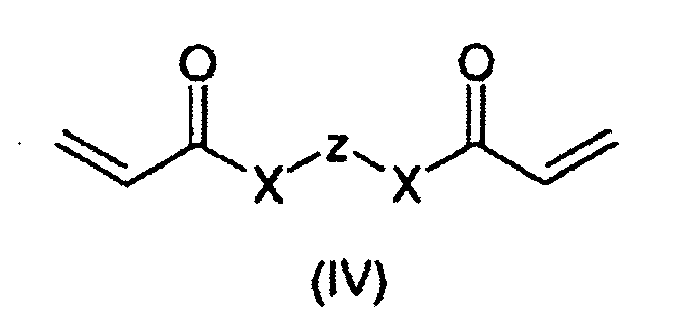 (ii) au moins deux moles d'un ou plusieurs composés répondant à la formule (II) suivante
Priority Applications (1)
| Application Number | Priority Date | Filing Date | Title |
|---|---|---|---|
| EP04763677A EP1651165B1 (fr) | 2003-07-31 | 2004-07-30 | Composition de scellement du canal d'une racine dentaire |
Applications Claiming Priority (4)
| Application Number | Priority Date | Filing Date | Title |
|---|---|---|---|
| EP03017391 | 2003-07-31 | ||
| US55134804P | 2004-03-10 | 2004-03-10 | |
| PCT/EP2004/008599 WO2005013922A1 (fr) | 2003-07-31 | 2004-07-30 | Composition de scellement du canal d'une racine dentaire |
| EP04763677A EP1651165B1 (fr) | 2003-07-31 | 2004-07-30 | Composition de scellement du canal d'une racine dentaire |
Publications (2)
| Publication Number | Publication Date |
|---|---|
| EP1651165A1 EP1651165A1 (fr) | 2006-05-03 |
| EP1651165B1 true EP1651165B1 (fr) | 2009-06-03 |
Family
ID=34137564
Family Applications (1)
| Application Number | Title | Priority Date | Filing Date |
|---|---|---|---|
| EP04763677A Expired - Lifetime EP1651165B1 (fr) | 2003-07-31 | 2004-07-30 | Composition de scellement du canal d'une racine dentaire |
Country Status (7)
| Country | Link |
|---|---|
| EP (1) | EP1651165B1 (fr) |
| AU (1) | AU2004262913B2 (fr) |
| BR (1) | BRPI0413159A (fr) |
| CA (1) | CA2533096C (fr) |
| DE (1) | DE602004021391D1 (fr) |
| ES (1) | ES2324995T4 (fr) |
| WO (1) | WO2005013922A1 (fr) |
Family Cites Families (3)
| Publication number | Priority date | Publication date | Assignee | Title |
|---|---|---|---|---|
| US5624976A (en) * | 1994-03-25 | 1997-04-29 | Dentsply Gmbh | Dental filling composition and method |
| DE60120416T2 (de) * | 2000-08-11 | 2006-12-14 | Dentsply International Inc. | Polyaminoester und ihre verwendung in dentalmassen |
| DE60206933T2 (de) * | 2001-08-13 | 2006-07-27 | Dentsply International Inc. | Konus zur Füllung von Zahnwurzelkanälen |
-
2004
- 2004-07-30 BR BRPI0413159-2A patent/BRPI0413159A/pt active Search and Examination
- 2004-07-30 EP EP04763677A patent/EP1651165B1/fr not_active Expired - Lifetime
- 2004-07-30 ES ES04763677T patent/ES2324995T4/es not_active Expired - Lifetime
- 2004-07-30 CA CA2533096A patent/CA2533096C/fr not_active Expired - Lifetime
- 2004-07-30 AU AU2004262913A patent/AU2004262913B2/en not_active Ceased
- 2004-07-30 WO PCT/EP2004/008599 patent/WO2005013922A1/fr not_active Ceased
- 2004-07-30 DE DE602004021391T patent/DE602004021391D1/de not_active Expired - Lifetime
Also Published As
| Publication number | Publication date |
|---|---|
| EP1651165A1 (fr) | 2006-05-03 |
| WO2005013922A1 (fr) | 2005-02-17 |
| AU2004262913A1 (en) | 2005-02-17 |
| CA2533096A1 (fr) | 2005-02-17 |
| DE602004021391D1 (de) | 2009-07-16 |
| CA2533096C (fr) | 2013-02-05 |
| AU2004262913B2 (en) | 2010-06-10 |
| ES2324995T4 (es) | 2009-11-26 |
| BRPI0413159A (pt) | 2006-10-03 |
| WO2005013922A9 (fr) | 2006-02-16 |
| ES2324995T3 (es) | 2009-08-21 |
Similar Documents
| Publication | Publication Date | Title |
|---|---|---|
| US11400031B2 (en) | Dental cement compositions and methods of use | |
| KR102099780B1 (ko) | 중합성 조성물 | |
| JPS5857405B2 (ja) | シカヨウジユウテンソセイブツ オヨビ ソノシヨウホウホウ | |
| CA2169596C (fr) | Composition polymerisable double stable a l'entreposage contenant un peroxyde et un element monomere | |
| US8044113B2 (en) | Dental root canal filling material | |
| US4486179A (en) | Biocompatible cementitious dental compositions | |
| EP1648375B1 (fr) | Composition pour rendre etanche un canal radiculaire | |
| EP1651165B1 (fr) | Composition de scellement du canal d'une racine dentaire | |
| JP4827735B2 (ja) | 歯科用根管密封組成物 | |
| JP4785742B2 (ja) | 歯科用根管密封組成物 | |
| MXPA06001057A (en) | Dental root canal sealing composition | |
| EP4331557A1 (fr) | Composition polymérisable par voie radicalaire comprenant un système initiateur redox à base de dihydropyridines | |
| EP3721858A1 (fr) | Composition dentaire | |
| EP4414390A1 (fr) | Oligomères d'acylthiourée utilisables comme composants d'initiateur redox et compositions polymérisables par voie radicalaire les comprenant |
Legal Events
| Date | Code | Title | Description |
|---|---|---|---|
| PUAI | Public reference made under article 153(3) epc to a published international application that has entered the european phase |
Free format text: ORIGINAL CODE: 0009012 |
|
| 17P | Request for examination filed |
Effective date: 20051209 |
|
| AK | Designated contracting states |
Kind code of ref document: A1 Designated state(s): CH DE ES FR GB IT LI |
|
| DAX | Request for extension of the european patent (deleted) | ||
| RBV | Designated contracting states (corrected) |
Designated state(s): CH DE ES FR GB IT LI |
|
| 17Q | First examination report despatched |
Effective date: 20060428 |
|
| GRAP | Despatch of communication of intention to grant a patent |
Free format text: ORIGINAL CODE: EPIDOSNIGR1 |
|
| GRAS | Grant fee paid |
Free format text: ORIGINAL CODE: EPIDOSNIGR3 |
|
| GRAA | (expected) grant |
Free format text: ORIGINAL CODE: 0009210 |
|
| AK | Designated contracting states |
Kind code of ref document: B1 Designated state(s): CH DE ES FR GB IT LI |
|
| REG | Reference to a national code |
Ref country code: GB Ref legal event code: FG4D |
|
| REG | Reference to a national code |
Ref country code: CH Ref legal event code: NV Representative=s name: E. BLUM & CO. AG PATENT- UND MARKENANWAELTE VSP Ref country code: CH Ref legal event code: EP |
|
| REF | Corresponds to: |
Ref document number: 602004021391 Country of ref document: DE Date of ref document: 20090716 Kind code of ref document: P |
|
| REG | Reference to a national code |
Ref country code: ES Ref legal event code: FG2A Ref document number: 2324995 Country of ref document: ES Kind code of ref document: T3 |
|
| PLBE | No opposition filed within time limit |
Free format text: ORIGINAL CODE: 0009261 |
|
| STAA | Information on the status of an ep patent application or granted ep patent |
Free format text: STATUS: NO OPPOSITION FILED WITHIN TIME LIMIT |
|
| 26N | No opposition filed |
Effective date: 20100304 |
|
| PG25 | Lapsed in a contracting state [announced via postgrant information from national office to epo] |
Ref country code: IT Free format text: LAPSE BECAUSE OF NON-PAYMENT OF DUE FEES Effective date: 20120730 |
|
| PGRI | Patent reinstated in contracting state [announced from national office to epo] |
Ref country code: IT Effective date: 20131025 |
|
| REG | Reference to a national code |
Ref country code: FR Ref legal event code: PLFP Year of fee payment: 13 |
|
| PGFP | Annual fee paid to national office [announced via postgrant information from national office to epo] |
Ref country code: ES Payment date: 20160613 Year of fee payment: 13 |
|
| PGFP | Annual fee paid to national office [announced via postgrant information from national office to epo] |
Ref country code: FR Payment date: 20160613 Year of fee payment: 13 |
|
| PGFP | Annual fee paid to national office [announced via postgrant information from national office to epo] |
Ref country code: GB Payment date: 20160727 Year of fee payment: 13 Ref country code: IT Payment date: 20160720 Year of fee payment: 13 Ref country code: CH Payment date: 20160712 Year of fee payment: 13 Ref country code: DE Payment date: 20160726 Year of fee payment: 13 |
|
| REG | Reference to a national code |
Ref country code: DE Ref legal event code: R119 Ref document number: 602004021391 Country of ref document: DE |
|
| REG | Reference to a national code |
Ref country code: CH Ref legal event code: PL |
|
| GBPC | Gb: european patent ceased through non-payment of renewal fee |
Effective date: 20170730 |
|
| REG | Reference to a national code |
Ref country code: FR Ref legal event code: ST Effective date: 20180330 |
|
| PG25 | Lapsed in a contracting state [announced via postgrant information from national office to epo] |
Ref country code: GB Free format text: LAPSE BECAUSE OF NON-PAYMENT OF DUE FEES Effective date: 20170730 Ref country code: CH Free format text: LAPSE BECAUSE OF NON-PAYMENT OF DUE FEES Effective date: 20170731 Ref country code: LI Free format text: LAPSE BECAUSE OF NON-PAYMENT OF DUE FEES Effective date: 20170731 Ref country code: DE Free format text: LAPSE BECAUSE OF NON-PAYMENT OF DUE FEES Effective date: 20180201 |
|
| PG25 | Lapsed in a contracting state [announced via postgrant information from national office to epo] |
Ref country code: FR Free format text: LAPSE BECAUSE OF NON-PAYMENT OF DUE FEES Effective date: 20170731 |
|
| PG25 | Lapsed in a contracting state [announced via postgrant information from national office to epo] |
Ref country code: IT Free format text: LAPSE BECAUSE OF NON-PAYMENT OF DUE FEES Effective date: 20170730 |
|
| REG | Reference to a national code |
Ref country code: ES Ref legal event code: FD2A Effective date: 20181030 |
|
| PG25 | Lapsed in a contracting state [announced via postgrant information from national office to epo] |
Ref country code: ES Free format text: LAPSE BECAUSE OF NON-PAYMENT OF DUE FEES Effective date: 20170731 |