EP1651996B1 - Methods for designing tinted contact lenses - Google Patents
Methods for designing tinted contact lenses Download PDFInfo
- Publication number
- EP1651996B1 EP1651996B1 EP04779115A EP04779115A EP1651996B1 EP 1651996 B1 EP1651996 B1 EP 1651996B1 EP 04779115 A EP04779115 A EP 04779115A EP 04779115 A EP04779115 A EP 04779115A EP 1651996 B1 EP1651996 B1 EP 1651996B1
- Authority
- EP
- European Patent Office
- Prior art keywords
- pattern
- iris
- eye
- eyes
- image
- Prior art date
- Legal status (The legal status is an assumption and is not a legal conclusion. Google has not performed a legal analysis and makes no representation as to the accuracy of the status listed.)
- Expired - Lifetime
Links
Images
Classifications
-
- G—PHYSICS
- G02—OPTICS
- G02C—SPECTACLES; SUNGLASSES OR GOGGLES INSOFAR AS THEY HAVE THE SAME FEATURES AS SPECTACLES; CONTACT LENSES
- G02C7/00—Optical parts
- G02C7/02—Lenses; Lens systems ; Methods of designing lenses
- G02C7/04—Contact lenses for the eyes
-
- G—PHYSICS
- G02—OPTICS
- G02C—SPECTACLES; SUNGLASSES OR GOGGLES INSOFAR AS THEY HAVE THE SAME FEATURES AS SPECTACLES; CONTACT LENSES
- G02C7/00—Optical parts
- G02C7/02—Lenses; Lens systems ; Methods of designing lenses
- G02C7/024—Methods of designing ophthalmic lenses
- G02C7/028—Special mathematical design techniques
-
- G—PHYSICS
- G02—OPTICS
- G02C—SPECTACLES; SUNGLASSES OR GOGGLES INSOFAR AS THEY HAVE THE SAME FEATURES AS SPECTACLES; CONTACT LENSES
- G02C7/00—Optical parts
- G02C7/02—Lenses; Lens systems ; Methods of designing lenses
- G02C7/04—Contact lenses for the eyes
- G02C7/046—Contact lenses having an iris pattern
-
- G—PHYSICS
- G02—OPTICS
- G02C—SPECTACLES; SUNGLASSES OR GOGGLES INSOFAR AS THEY HAVE THE SAME FEATURES AS SPECTACLES; CONTACT LENSES
- G02C2202/00—Generic optical aspects applicable to one or more of the subgroups of G02C7/00
- G02C2202/06—Special ophthalmologic or optometric aspects
Definitions
- the invention relates to methods for designing tinted contact lenses.
- the invention provides a method for evaluating tinted contact lens designs without having to place the lenses on-eye.
- tinted, or colored, contact lenses that incorporate iris patterns to alter the natural color of the iris is well known.
- the patterns used in the tinted lenses are derived from artistic renderings of human iris patterns.
- the disadvantage of this design method is that the patterns, and colors used in the patterns, are not created with sufficient consideration for the interaction of the spectral and optical characteristics of the patterns when the lenses are on-eye. These optical characteristics include, without limitation, reflections, metamerism, and color summations such as the cumulative appearance of placing a transparent or translucent color over another color.
- the on-eye appearance of the lens' iris pattern is unpredictable as to both the geometric appearance and the blending of the colors with the eye's natural iris colors.
- WO 02/37170 discloses a method and system for ordering customized cosmetic contact lenses.
- the invention provides a method for designing contact lenses.
- the method of the invention permits the computer-assisted modeling of a tinted lens on-eye.
- the method of the invention provides a substantially accurate prediction as to the appearance of the lens on-eye.
- substantially accurate is meant that the accuracy is sufficient to predict the appearance of the lens on-eye as if the lens actually had been placed on-eye for evaluation.
- the method reduces the number of designs that must be clinically tested and the number of iterations that each design must go through.
- the method of the invention provides for two-dimensional or three-dimensional images to be used in a three-dimensional graphics arts software program to provide a display of a model eye with a tinted contact lens overlaying the model eye at given illumination and observation conditions.
- the invention provides a computer assisted method of designing a tinted contact lens according to claim 1.
- the method of the invention may be used by tinted contact lens designers and eye care practitioners, but will provide particular utility for the contact lens designer.
- the user may use any convenient input device including, without limitation, a keyboard, a scanning device, a mouse, a touch-pad or touch-screen or the like or a combination thereof.
- the user may create a tinted contact lens with a specific iris pattern and view it on-eye under a variety of illumination and observation conditions.
- Useful hardware for carrying out the method of the invention includes any commercially available personal computer, including any MACINTOSH TM , WINDOWS TM , or UNIX TM based computer or the like that has video graphics capability. A color-calibrated monitor is required. Calibration may be provided by commercially available software such as Monaco EZ COLOR TM .
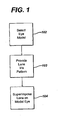
- Figure 1 is a flow diagram of the method of the invention.
- a model eye image is selected by the user from a library of stored eye images.
- the images stored may be obtained from any convenient means such as digital photographs or scanned images of eyes, artistic renderings of eyes, or combinations thereof.
- photographs or scanned images of eyes are used.
- the eye structures including, without limitation, the globe, sclera, cornea, iris and pupil are provided, preferably along with extra-ocular facial features including, without limitation, lashes, brows, skin tone and the like. These various structures and features are selected and applied as separate layers.
- Suitable software for use in carrying out this step is commercially available, such as 3DS MAX TM , MAYA TM , LIGHTWAVE TM , and the like.
- a contact lens having an iris pattern is provided.
- the contact lens is specified in a three-dimensional model as a spherical shell of multiple layers.
- the refractive index of each of the layers may be defined numerically to simulate the refractive index of the lens material of interest.
- Other lens parameters specified may include, without limitation, geometric shape, such as spheric or toric, lens material, thickness, diameter, and the like.
- the parameters of the iris pattern of the lens are selected by the user and include color, including, without limitation hue, saturation, and chroma, pattern, opacity level, pattern area coverage, and the like.
- the color may be selected from a palette of colors preferably using a RGB (red, green, blue) color system.
- the pattern may be selected by the user from a pattern library that includes a wide variety of individual components that can be used in a pattern. Pattern components may be any geometric shape or free-hand drawn components including, without limitation, dots, striae, feather-like shapes, lines and the like.
- Opacity level is selected by the user taking into consideration the model eye the pattern is to be placed upon, the nature of the pattern itself, and the desired result of the iris-pattern combination.
- pattern coverage is also selected by the user.
- the pattern coverage defines the outer and inner diameter of the area of the lens in which the pattern is located. Typically, this area will have an inner diameter of about 4.0 mm to about 6.0 mm and an outer diameter of 10.0 mm to about 14.0 mm.
- the iris pattern may be composed in, and exported to, an image file using any suitable software.
- the pattern may be rendered in either a bitmap program, such as ADOBE PHOTOSHOP TM , or a vector-based program, such as CORELDRAW TM , along with any number of other commercially available programs.
- the iris pattern may then be exported to and stored in a suitable image file including, without limitation a JPEG, BMP, PSD, TIFF, TGA or other suitable file format.
- the iris pattern may be created directly in the three dimensional graphics art software used to model the appearance of the tinted contact lens on the model eye
- the rendered iris pattern is displayed on any suitable display means.
- Suitable display means include, without limitation, a cathode ray tube monitor, a liquid crystal monitor, or the like.
- the display preferably has a magnification of at least 2048 x 1536 pixels.
- step 104 the contact lens is then superimposed on the model eye so that the iris pattern of the lens is superimposed on the iris of the model eye.
- the user applies the individual layers of the pattern or a composite image of the pattern to the model eye, while manipulating the layers or composite image for color and opacity level.
- the pattern or image is mapped, meaning placed in a specific location in three-dimensional space, so that it aligns with the model eye in x and y rectangular coordinates. By additionally specifying the z coordinate, the pattern may be positioned at any desired spatial distance from the iris of the model eye.
- the graphics art program such as the 3DS MAX program, may be used to provide several methods for simulating the result of light passing through the various layers of the colored contact lens and the associated layers of the model eye.
- a preferred method of simulation is ray-tracing. In simulating the passage of light, the geometries and indices of refracting of the various elements of the pattern and eye model are considered as well as that of the materials, colors and opacity levels assigned thereto. By user manipulation of each variable, the resulting image of the pattern provides a substantially accurate representation of the on-eye appearance of the lens.
- the lighting spectra level and direction as well as observer viewing angle may be varied by using suitable software including, without limitation, 3DS MAX, MAYA, or LIGHTWAVE.
- suitable software including, without limitation, 3DS MAX, MAYA, or LIGHTWAVE.
- This enables the appearance of the lens on the model eye to be simulated under a variety of luminance levels and lighting types, such as daylight, fluorescent, mercury, or the like.
- the lighting direction may be varied to simulate the change in iris color imparted by the tinted lens pattern under one or both of differing illumination conditions and lighting angles. This capability enables optimization of the color and opacity levels of the composite image or of each layer of a pattern either for a specific lighting condition or an average of many varied lighting conditions.
- the invention may be used to provide tinted hard or soft contact lenses made of any known lens-forming material, or material suitable for manufacturing such lenses.
- the lenses are soft contact lenses and the material selected for forming the lenses is any material suitable for producing soft contact lenses.
- Suitable preferred materials for forming soft contact lenses using the method of the invention include, without limitation, silicone elastomers, silicone-containing macromers including, without limitation, those disclosed in United States Patent Nos. 5,371,147 , 5,314,960 , and 5,057,578 , hydrogels, silicone-containing hydrogels, and the like and combinations thereof.
- the surface is a siloxane, or contains a siloxane functionality, including, without limitation, polydimethyl siloxane macromers, methacryloxypropyl polyalkyl siloxanes, and mixtures thereof, silicone hydrogel or a hydrogel, made of monomers containing hydroxy groups, carboxyl groups, or both or be made from silicone-containing polymers, such as siloxanes, hydrogels, silicone hydrogels, and combinations thereof.
- Materials for making soft contact lenses are well known and commercially available.
- the material is acquafilcon, etafilcon, galyfilcon, genfilcon, or lenefilcon.
Landscapes
- Physics & Mathematics (AREA)
- Health & Medical Sciences (AREA)
- Ophthalmology & Optometry (AREA)
- General Health & Medical Sciences (AREA)
- General Physics & Mathematics (AREA)
- Optics & Photonics (AREA)
- Mathematical Physics (AREA)
- Eyeglasses (AREA)
- Lenses (AREA)
Applications Claiming Priority (2)
| Application Number | Priority Date | Filing Date | Title |
|---|---|---|---|
| US49173903P | 2003-08-01 | 2003-08-01 | |
| PCT/US2004/023907 WO2005012982A1 (en) | 2003-08-01 | 2004-07-23 | Methods for designing tinted contact lenses |
Publications (2)
| Publication Number | Publication Date |
|---|---|
| EP1651996A1 EP1651996A1 (en) | 2006-05-03 |
| EP1651996B1 true EP1651996B1 (en) | 2008-07-02 |
Family
ID=34115545
Family Applications (1)
| Application Number | Title | Priority Date | Filing Date |
|---|---|---|---|
| EP04779115A Expired - Lifetime EP1651996B1 (en) | 2003-08-01 | 2004-07-23 | Methods for designing tinted contact lenses |
Country Status (12)
| Country | Link |
|---|---|
| US (1) | US7226163B2 (pt) |
| EP (1) | EP1651996B1 (pt) |
| JP (1) | JP4694483B2 (pt) |
| KR (1) | KR101045770B1 (pt) |
| CN (1) | CN1829932B (pt) |
| AR (1) | AR045192A1 (pt) |
| AU (1) | AU2004262316B2 (pt) |
| BR (1) | BRPI0413254B1 (pt) |
| CA (1) | CA2535203C (pt) |
| DE (1) | DE602004014778D1 (pt) |
| TW (1) | TWI333090B (pt) |
| WO (1) | WO2005012982A1 (pt) |
Families Citing this family (8)
| Publication number | Priority date | Publication date | Assignee | Title |
|---|---|---|---|---|
| US7802883B2 (en) * | 2007-12-20 | 2010-09-28 | Johnson & Johnson Vision Care, Inc. | Cosmetic contact lenses having a sparkle effect |
| US8511821B2 (en) * | 2008-04-25 | 2013-08-20 | Wavelight Gmbh | Eye model for use in ophthalmological measurements |
| TWI526730B (zh) * | 2009-09-23 | 2016-03-21 | 諾華公司 | 基於不規則影像之經著色之隱形眼鏡 |
| KR101520778B1 (ko) * | 2014-11-28 | 2015-05-18 | (주) 뷰엠테크놀로지 | 콘택트렌즈 가상 피팅 방법, 장치 및 이 방법을 실행시키는 컴퓨터 프로그램 |
| WO2018033770A1 (en) * | 2016-08-16 | 2018-02-22 | Stroma Medical Corporation | Method and apparatus for prediction of post-operative perceived iris color |
| CN106530264B (zh) * | 2016-11-07 | 2019-01-08 | 成都通甲优博科技有限责任公司 | 一种虚拟美瞳瞳片的制作方法和显示方法 |
| KR102271063B1 (ko) * | 2020-08-18 | 2021-06-29 | 정윤호 | 가상 피팅 서비스 제공 방법, 장치 및 그 시스템 |
| TWI866739B (zh) * | 2024-01-11 | 2024-12-11 | 望隼科技股份有限公司 | 鏡片配戴效果模擬方法及其程式和系統 |
Family Cites Families (7)
| Publication number | Priority date | Publication date | Assignee | Title |
|---|---|---|---|---|
| NL1007397C2 (nl) * | 1997-10-30 | 1999-05-12 | V O F Headscanning | Werkwijze en inrichting voor het met een gewijzigd uiterlijk weergeven van tenminste een deel van het menselijk lichaam. |
| JPH11195131A (ja) * | 1997-12-26 | 1999-07-21 | Canon Inc | 仮想現実方法及び装置並びに記憶媒体 |
| AR029671A1 (es) | 2000-06-12 | 2003-07-10 | Novartis Ag | Lente de contacto de color con aspecto mas natural y metodo para fabricarla |
| AU2001291067A1 (en) | 2000-09-15 | 2002-03-26 | Cygen Industries, Llc | Method for ornamenting contact lenses |
| US6746120B2 (en) * | 2000-10-30 | 2004-06-08 | Novartis Ag | Method and system for ordering customized cosmetic contact lenses |
| EP1203979B1 (en) * | 2000-11-01 | 2008-05-28 | Menicon Co., Ltd. | Method of designing an ophthalmic lens |
| US6655804B2 (en) * | 2001-06-29 | 2003-12-02 | Daniel G. Streibig | Colored contact lens and method of making same |
-
2004
- 2004-07-14 US US10/890,787 patent/US7226163B2/en not_active Expired - Lifetime
- 2004-07-23 WO PCT/US2004/023907 patent/WO2005012982A1/en not_active Ceased
- 2004-07-23 CN CN2004800218237A patent/CN1829932B/zh not_active Expired - Lifetime
- 2004-07-23 DE DE602004014778T patent/DE602004014778D1/de not_active Expired - Lifetime
- 2004-07-23 JP JP2006521958A patent/JP4694483B2/ja not_active Expired - Fee Related
- 2004-07-23 KR KR1020067002254A patent/KR101045770B1/ko not_active Expired - Fee Related
- 2004-07-23 AU AU2004262316A patent/AU2004262316B2/en not_active Ceased
- 2004-07-23 CA CA2535203A patent/CA2535203C/en not_active Expired - Fee Related
- 2004-07-23 BR BRPI0413254A patent/BRPI0413254B1/pt not_active IP Right Cessation
- 2004-07-23 EP EP04779115A patent/EP1651996B1/en not_active Expired - Lifetime
- 2004-07-30 TW TW093122973A patent/TWI333090B/zh not_active IP Right Cessation
- 2004-08-02 AR ARP040102747A patent/AR045192A1/es not_active Application Discontinuation
Also Published As
| Publication number | Publication date |
|---|---|
| TWI333090B (en) | 2010-11-11 |
| BRPI0413254A (pt) | 2006-10-03 |
| KR101045770B1 (ko) | 2011-07-04 |
| JP2007501421A (ja) | 2007-01-25 |
| US7226163B2 (en) | 2007-06-05 |
| DE602004014778D1 (de) | 2008-08-14 |
| EP1651996A1 (en) | 2006-05-03 |
| CA2535203A1 (en) | 2005-02-10 |
| TW200519448A (en) | 2005-06-16 |
| AU2004262316B2 (en) | 2009-11-12 |
| CN1829932A (zh) | 2006-09-06 |
| CN1829932B (zh) | 2010-12-29 |
| WO2005012982A1 (en) | 2005-02-10 |
| HK1089242A1 (en) | 2006-11-24 |
| KR20060066079A (ko) | 2006-06-15 |
| JP4694483B2 (ja) | 2011-06-08 |
| BRPI0413254B1 (pt) | 2016-12-06 |
| CA2535203C (en) | 2014-11-18 |
| AR045192A1 (es) | 2005-10-19 |
| AU2004262316A1 (en) | 2005-02-10 |
| US20050041204A1 (en) | 2005-02-24 |
Similar Documents
| Publication | Publication Date | Title |
|---|---|---|
| AU698887B2 (en) | Apparatus for and method of simulating ocular optical system | |
| US6604826B2 (en) | Method for evaluating an ocular optical lens and apparatus and memory medium therefor | |
| CN102511014B (zh) | 基于无定形图像的彩色接触透镜 | |
| WO2007056795A1 (en) | Ophthalmic lens simulation system and method | |
| US7226163B2 (en) | Methods for designing tinted contact lenses | |
| Kakimoto et al. | Glare generation based on wave optics | |
| JP2003177076A (ja) | 眼鏡レンズの両眼視性能表示方法及びその装置 | |
| CN104869901B (zh) | 用于测量视觉引起的人员姿势不稳定性的方法 | |
| KR20230091903A (ko) | 개인의 눈을 검사하기 위한 검안 장치, 상기 장치를 위한 사진 세트, 및 그러한 사진 세트의 디스플레이 유닛 | |
| HK1089242B (en) | Methods for designing tinted contact lenses | |
| JP2002045336A (ja) | 眼光学系のシミュレーション方法及び装置 | |
| JPH0765203A (ja) | 視覚シミュレーション装置 | |
| JP2002063229A (ja) | 眼鏡レンズの表示方法、表示装置及び記録媒体 | |
| JPH08266472A (ja) | 眼光学系のシミュレーション装置及び眼光学系のシミュレーション方法 | |
| JP3328100B2 (ja) | 眼光学系のシミュレーション装置 | |
| KR102874156B1 (ko) | 시기능 검사 장치, 안경 렌즈 제시 시스템, 인쇄물, 시기능 검사 방법, 안경 렌즈의 제시 방법, 및 프로그램 | |
| Vu et al. | Highly parallelized rendering of the retinal image through a computer-simulated human eye for the design of virtual reality head-mounted displays | |
| AU2002301484B2 (en) | A Method for Evaluating An Ocular Optical Lens | |
| CN107967628A (zh) | 用于在线定制的饰品价格计算方法及装置 | |
| KR20240136331A (ko) | 라이트 필드 디스플레이를 사용하여 가상 3차원 장면을 보는 대상자의 눈 상의 안구 렌즈를 시뮬레이션하기 위한 방법 | |
| Rocca | Protocol for modeling visual perception in computer generated architectural renderings | |
| Liu | Towards the optimization of resolution and rendering issues in the context of contemporary environmental design computer modelling |
Legal Events
| Date | Code | Title | Description |
|---|---|---|---|
| PUAI | Public reference made under article 153(3) epc to a published international application that has entered the european phase |
Free format text: ORIGINAL CODE: 0009012 |
|
| 17P | Request for examination filed |
Effective date: 20060213 |
|
| AK | Designated contracting states |
Kind code of ref document: A1 Designated state(s): DE FR GB IE IT |
|
| DAX | Request for extension of the european patent (deleted) | ||
| RBV | Designated contracting states (corrected) |
Designated state(s): DE FR GB IE IT |
|
| REG | Reference to a national code |
Ref country code: HK Ref legal event code: DE Ref document number: 1089242 Country of ref document: HK |
|
| GRAP | Despatch of communication of intention to grant a patent |
Free format text: ORIGINAL CODE: EPIDOSNIGR1 |
|
| RAP1 | Party data changed (applicant data changed or rights of an application transferred) |
Owner name: JOHNSON & JOHNSON VISION CARE, INC. |
|
| GRAS | Grant fee paid |
Free format text: ORIGINAL CODE: EPIDOSNIGR3 |
|
| GRAA | (expected) grant |
Free format text: ORIGINAL CODE: 0009210 |
|
| AK | Designated contracting states |
Kind code of ref document: B1 Designated state(s): DE FR GB IE IT |
|
| REG | Reference to a national code |
Ref country code: GB Ref legal event code: FG4D |
|
| REF | Corresponds to: |
Ref document number: 602004014778 Country of ref document: DE Date of ref document: 20080814 Kind code of ref document: P |
|
| REG | Reference to a national code |
Ref country code: IE Ref legal event code: FG4D |
|
| PLBE | No opposition filed within time limit |
Free format text: ORIGINAL CODE: 0009261 |
|
| STAA | Information on the status of an ep patent application or granted ep patent |
Free format text: STATUS: NO OPPOSITION FILED WITHIN TIME LIMIT |
|
| 26N | No opposition filed |
Effective date: 20090403 |
|
| REG | Reference to a national code |
Ref country code: HK Ref legal event code: GR Ref document number: 1089242 Country of ref document: HK |
|
| REG | Reference to a national code |
Ref country code: FR Ref legal event code: PLFP Year of fee payment: 13 |
|
| REG | Reference to a national code |
Ref country code: FR Ref legal event code: PLFP Year of fee payment: 14 |
|
| REG | Reference to a national code |
Ref country code: FR Ref legal event code: PLFP Year of fee payment: 15 |
|
| PGFP | Annual fee paid to national office [announced via postgrant information from national office to epo] |
Ref country code: FR Payment date: 20190619 Year of fee payment: 16 |
|
| PG25 | Lapsed in a contracting state [announced via postgrant information from national office to epo] |
Ref country code: FR Free format text: LAPSE BECAUSE OF NON-PAYMENT OF DUE FEES Effective date: 20200731 |
|
| PGFP | Annual fee paid to national office [announced via postgrant information from national office to epo] |
Ref country code: IT Payment date: 20230612 Year of fee payment: 20 Ref country code: IE Payment date: 20230606 Year of fee payment: 20 |
|
| PGFP | Annual fee paid to national office [announced via postgrant information from national office to epo] |
Ref country code: GB Payment date: 20230601 Year of fee payment: 20 |
|
| PGFP | Annual fee paid to national office [announced via postgrant information from national office to epo] |
Ref country code: DE Payment date: 20230531 Year of fee payment: 20 |
|
| REG | Reference to a national code |
Ref country code: DE Ref legal event code: R071 Ref document number: 602004014778 Country of ref document: DE |
|
| REG | Reference to a national code |
Ref country code: GB Ref legal event code: PE20 Expiry date: 20240722 |
|
| REG | Reference to a national code |
Ref country code: IE Ref legal event code: MK9A |
|
| PG25 | Lapsed in a contracting state [announced via postgrant information from national office to epo] |
Ref country code: IE Free format text: LAPSE BECAUSE OF EXPIRATION OF PROTECTION Effective date: 20240723 |
|
| PG25 | Lapsed in a contracting state [announced via postgrant information from national office to epo] |
Ref country code: GB Free format text: LAPSE BECAUSE OF EXPIRATION OF PROTECTION Effective date: 20240722 |
|
| PG25 | Lapsed in a contracting state [announced via postgrant information from national office to epo] |
Ref country code: IE Free format text: LAPSE BECAUSE OF EXPIRATION OF PROTECTION Effective date: 20240723 Ref country code: GB Free format text: LAPSE BECAUSE OF EXPIRATION OF PROTECTION Effective date: 20240722 |