EP1652979A1 - Procede de tricot de vetements avec difference de ligne, vetements presentant une difference de ligne, et dispositif de creation de tricot - Google Patents
Procede de tricot de vetements avec difference de ligne, vetements presentant une difference de ligne, et dispositif de creation de tricot Download PDFInfo
- Publication number
- EP1652979A1 EP1652979A1 EP04747808A EP04747808A EP1652979A1 EP 1652979 A1 EP1652979 A1 EP 1652979A1 EP 04747808 A EP04747808 A EP 04747808A EP 04747808 A EP04747808 A EP 04747808A EP 1652979 A1 EP1652979 A1 EP 1652979A1
- Authority
- EP
- European Patent Office
- Prior art keywords
- sleeves
- knitting
- gores
- sleeve
- joined
- Prior art date
- Legal status (The legal status is an assumption and is not a legal conclusion. Google has not performed a legal analysis and makes no representation as to the accuracy of the status listed.)
- Granted
Links
Images




Classifications
-
- D—TEXTILES; PAPER
- D04—BRAIDING; LACE-MAKING; KNITTING; TRIMMINGS; NON-WOVEN FABRICS
- D04B—KNITTING
- D04B1/00—Weft knitting processes for the production of fabrics or articles not dependent on the use of particular machines; Fabrics or articles defined by such processes
- D04B1/22—Weft knitting processes for the production of fabrics or articles not dependent on the use of particular machines; Fabrics or articles defined by such processes specially adapted for knitting goods of particular configuration
-
- A—HUMAN NECESSITIES
- A41—WEARING APPAREL
- A41D—OUTERWEAR; PROTECTIVE GARMENTS; ACCESSORIES
- A41D1/00—Garments
- A41D1/04—Vests, jerseys, sweaters or the like
-
- A—HUMAN NECESSITIES
- A41—WEARING APPAREL
- A41D—OUTERWEAR; PROTECTIVE GARMENTS; ACCESSORIES
- A41D27/00—Details of garments or of their making
- A41D27/10—Sleeves; Armholes
-
- D—TEXTILES; PAPER
- D04—BRAIDING; LACE-MAKING; KNITTING; TRIMMINGS; NON-WOVEN FABRICS
- D04B—KNITTING
- D04B1/00—Weft knitting processes for the production of fabrics or articles not dependent on the use of particular machines; Fabrics or articles defined by such processes
- D04B1/22—Weft knitting processes for the production of fabrics or articles not dependent on the use of particular machines; Fabrics or articles defined by such processes specially adapted for knitting goods of particular configuration
- D04B1/24—Weft knitting processes for the production of fabrics or articles not dependent on the use of particular machines; Fabrics or articles defined by such processes specially adapted for knitting goods of particular configuration wearing apparel
-
- D—TEXTILES; PAPER
- D04—BRAIDING; LACE-MAKING; KNITTING; TRIMMINGS; NON-WOVEN FABRICS
- D04B—KNITTING
- D04B1/00—Weft knitting processes for the production of fabrics or articles not dependent on the use of particular machines; Fabrics or articles defined by such processes
- D04B1/22—Weft knitting processes for the production of fabrics or articles not dependent on the use of particular machines; Fabrics or articles defined by such processes specially adapted for knitting goods of particular configuration
- D04B1/24—Weft knitting processes for the production of fabrics or articles not dependent on the use of particular machines; Fabrics or articles defined by such processes specially adapted for knitting goods of particular configuration wearing apparel
- D04B1/246—Upper torso garments, e.g. sweaters, shirts, leotards
Definitions
- the present invention relates to knitting of a garment such as a sweater, a vest, a one-piece suit, and a dress.
- the present invention relates to knitting of a garment with asymmetrically joined front and back sleeves and asymmetrically joined front and back bodies.
- the sleeves are oriented forward such that the garment fits the body shape of human.
- the present invention relates to a knitting method for such a garment with asymmetrically joined sleeves, the garment with asymmetrically joined sleeves produced by knitting, and a knit design device for generating the required knitting data.
- Japanese Patent Publication No. 3-75656 proposes a knitting method for knitting a cylindrical rib using a flat knitting machine having two beds. The method is known as broad rib knitting. In the method, every other needle in the front and back needle beds is used.
- Japanese Laid-Open Patent Publication No. 8-158209 proposes a method of joining two knitted fabrics. For example, five knit stitches of one knitted fabric are joined to five knit stitches of the other knitted fabric.
- the knitted fabrics are joined together such that knit stitches at the center of one knitted fabric are overlapped with knit stitches at the center of the other knitted fabric, or knit stitches at both ends of one knitted fabric are overlapped with knitted stitches at both ends of the other knitted fabric.
- Japanese Laid-Open Patent Publication No. 9-310254, Japanese Laid-Open Patent Publication No. 10-226947, and Japanese Laid-Open Patent Publication No. 10-77556 propose methods for joining knitted fabrics or cast off stitches.
- WO00/12799 discloses a knitting method for permitting the entry of an upper end of a front body into a back body beyond a shoulder line.
- WO01/55491 discloses a method of knitting a neckline.
- WO01/88243 discloses a method of knitting a gore between a sleeve and a body.
- WO01/94671 discloses a method of joining a T-sleeve and a body.
- An object of the present invention is to provide a method of knitting a garment with asymmetrically joined front and back sleeves substantially without sewing in which when the garment is worn, the sleeves are oriented forward, and fits the human body, to provide such a garment, and to provide a knit design device for generating the required knitting program.
- a body and both sleeves are knitted up to underarm positions to have cylindrical shapes, respectively. Then, both sleeves are joined to the body, and then, upper ends of a front body and a back body of the body are joined together.
- the method comprises the steps of: (a) forming gores at the underarm positions for connecting front sleeves of both the sleeves and the front body without forming any gores between back sleeves of both the sleeves and the back body, or forming gores at the underarm positions for connecting both the front sleeves and the front body such that the gores between both the back sleeves and the back body become smaller than the gores between both the front sleeves and the front body in the case of forming the gores between both the back sleeves and the back body; (b) rotating at least one of the sleeves and the body in a first direction on the flat knitting machine such that a border between a front side and a backside of the one of the sleeves is positioned between the pair of front and back needle beds, and while knitting the one of the sleeves and the front and back bodies, joining the front and back bodies to the one of the sleeves; and (c) rotating at least the other of the sleeves in a direction opposite to the first direction on the flat knitting machine such that a border between a front side and a backside of the other of the
- without sewing means the knitting method in which sewing is not carried out at all, or the knitting method in which no sewing is carried out at the time of forming the gores, and joining the sleeves and the body.
- the upper/lower, left/right, and back/front sides of the garment are determined based on the state in which the garment is worn on the body. Knitting is started from the lower side. The neck hole and collar are present on the upper side.
- the front side or the backside, and the racking (swaying) direction are determined based on the state as viewed from the front side toward the knitting machine.
- the front side may be simply referred to as the "front”
- the backside may be simply referred to as the "back”.
- Left swaying as viewed from the front side is referred to as "racking to the left”
- right swaying as viewed from the front side is referred to as "racking to the right”.
- a garment with asymmetrically joined sleeves includes a body comprising a cylindrical knitted fabric and both sleeves.
- Each of the cylindrical knitted fabric and both sleeves comprises a cylindrical knitted fabric.
- the body and both sleeves are joined on sides by knitting operation without sewing, and a front body and a back body of the body are joined at shoulders.
- a knit design device is generating knitting data for knitting a garment by knitting a body and both sleeves up to underarm positions to have cylindrical shapes, respectively, then, joining both the sleeves to the body, and then, joining upper ends of a front body and a back body of the body, on a flat knitting machine having a pair of front and back needle beds, the knitting data being used by the flat knitting machine for carrying out the steps of:
- the knitting data is used by the flat knitting machine for carrying out the steps in the order of (a) to (c).
- the front sleeves and the front body are connected using the gores (front gores) such that the front gores become larger than the gores (back gores) connecting the back sleeves and back body, or no back gores are formed.
- the knitting width of the front body and the knitting width of the back body are the same up to the underarm positions, since the gores are only present on the front body side, or since the length of the front gores is different from the length of the back gores, the knitting width of the front body becomes smaller than the knitting width of the back body above the underarm positions. Therefore, the borders between the front sleeves and the back sleeves are present on the side of the front sleeves.
- the sleeves are oriented to the front side, and the garment has a silhouette which fits the body shape of human.
- the garment fits the human body when it is worn. Further, wrinkles are few on the front side of the sleeves, and the stress of the knitted fabric is small on the backside of the sleeves.
- FIG. 14 shows knitting operation for joining both sleeves and the body in a conventional example.
- B, B' denote both ends of a front body 4
- E, E' denote both ends of a back body 6,
- h, h' denote outer borders between the front side and the back side of both sleeves 8, 10.
- Knitting operation is performed from the step on the lower side to the step on the upper side in FIG. 14. After the back knitted fabric is knitted one course, by racking the knitted fabric of the right back sleeve to the inside of the knitting width, one stitch is joined.
- the front body is knitted one course from the left front sleeve.
- the left front sleeve and the left back sleeve By racking the left front sleeve and the left back sleeve inwardly, one knit stitch of the left front sleeve and one knit stitch of the left back sleeve are overlapped with, and joined to the knit stitches of the body.
- the right front sleeve one knit stitch of the right front sleeve is joined.
- the front body with the left front sleeve, and the left back sleeve with the back body are knitted one course, respectively.
- One knit stitch of the left back sleeve and one knit stitch of the right back sleeve are joined.
- the back body is knitted one course.
- One knit stitch of the left back sleeve is joined.
- the back body with the right back sleeve is knitted one course.
- One knit stitch of the left front sleeve is joined.
- the right front sleeve with the front body is knitted one course.
- One knit stitch of the left front sleeve, one knit stitch of the right front sleeve, and one knit stitch of the right back sleeve are joined. Thereafter, the front body with the right front sleeve is knitted one course.
- One knit stitch of the right front sleeve is joined. In every knitting operation, two courses of the sleeve are knitted, four courses of the body are knitted, and three knit stitches of the sleeves are joined. Therefore, the knitting operation is referred to as the knitting operation of 2(the number of knitting courses of the sleeve): 4(the number of knitting courses of the body): 3(the number of joined knit stitches).
- the knit stitch rotated from the back sleeve to the front sleeve by the gore becomes the twisted stitch. If a new knit stitch of a new course is knitted on the twisted stitch, the twisted stitch remains, and the commercial value of the garment is lowered.
- the sleeves and the body is rotated on the flat knitting machine in a first direction.
- the border between the front side and the backside of one of the sleeves is positioned on the border between at least a pair of front and back needle beds.
- the twisted state of the knit stitch is eliminated.
- one of the sleeves, the front body, and the back body are knitted a suitable number of courses. Further, a suitable number of stitches of one of the sleeves are joined to the front body and the back body.
- At least the other of the sleeves and the body are rotated on the flat knitting machine in the direction opposite to the first direction such that the border between the front side and the backside of the other of the sleeve is positioned on the border between at least the pair of front and back sleeves.
- the other of the sleeves is joined to the body, and the other of the sleeves and the body are knitted.
- joining of one of the sleeves and joining of the other of the sleeves are performed alternately.
- the type of sleeve attaching can be selected from a wide range of types such as T-sleeve, set-in sleeve, raglan sleeve depending on the number of knitting courses of the sleeve, the number of knitting courses of the body, the number of stitches for joining the sleeve and the body, and the position of the overlapping stitches formed by joining.
- After joining of the sleeve and the body is finished, for example, knitting of the front shoulder and the back shoulder, and joining of the front knitted fabric and the back knitted fabric is performed.
- the front and back sleeve caps would be knitted by flechage knitting before formation of asymmetrical front and back gores such that the knitting width of the front sleeve cap becomes narrower than the knitting width of the back sleeve cap.
- the knit stitch which has been knitted, and detached from the knitting needle does not become the twisted stitch. Therefore, twisted stitches appear in the final course of the sleeve cap. By overlapping the twisted stitches with the knit stitches of the body such that the twisted stitches are hidden under the knit stitches of the body, the twisted stitches cannot be seen easily.
- both sleeves are oriented forward naturally, and the garment fits the human body when it is worn. Further, when the garment with asymmetrically joined sleeves according to the present invention is worn, wrinkles are few on the front side, and the stress is small on the backside. Thus, a beautiful silhouette can be obtained.
- knitting data of the garment with asymmetrically joined sleeves can be generated.
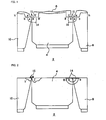
- FIGS. 1 to 3 show a sweater 2 of a set-in sleeve type knitted in the embodiment.
- a reference numeral 4 denotes a front body.
- a back body 6 is present on the backside of the front body 4, and a left sleeve 8 and a right sleeve 10 are present on the left and right sides of the front body 4.
- the left and right sides are determined based on the state in which the sweater 2 is worn. Therefore, the left and the right sides in the drawings appear oppositely to the normal left and right sides.
- lowercase letters denote positions on the sleeve side
- uppercase letters denote positions on the body side.
- the points denoted by corresponding alphabets, e.g., the lowercase letter "a” and the uppercase letter "A" are overlapped with each other at the same position by knitting.
- Knitting of the front body 4 and the back body 6 is started from a portion of the bottom rubber.
- the front body 4 and the back body 6 are knitted to have a cylindrical shape up to the underarm positions.
- knitting of the left sleeve 8 and the right sleeve 10 is started from portions of the bottom rubber.
- the left sleeve 8 and the right sleeve 10 are knitted to have cylindrical shapes, respectively.
- the left sleeve 8 is joined to the front body 4 and the back body 6 using a gore by joining the points (a, A), (b, B), and (e, E) together, and also in the right sleeve 10, a gore is formed such that the points (a', A'), (b', B'), and (e', E') are joined together.
- the outer borders between the front side and the backside of the sleeves 8, 10 are denoted by h, h'.
- Gore forming portions 14, 14 on the side of the front body and the front sleeves are wider than gore forming portions 15, 15 on the side of the back body and the back sleeves, by about two to six stitches.
- the gore forming portions 15 on the side of the back sleeves may not be provided.
- FIG. 2 schematically shows a state in which the gores have been formed. Arrows in FIG. 2 represent the joining direction at the gore.
- reference numerals 20, 21 denote joining lines between the front sleeves and the front body
- reference numerals 22, 23 denote joining lines between the back sleeves and the back body.
- the joining lines 20, 22 are processed by knitting operation of 4(the number of knitting courses for the sleeve): 4(the number of knitting courses for the body): 4(the number of the narrowing stitches).
- the narrowing stitches are provided inside the body for gradually reducing the knitting width of the front body and the back body.
- knitting operation of 4(the number of knitting courses for the sleeves): 4(the number of knitting courses for the body): 2(the number of narrowing stitches) is performed for joining.
- Overlapping stitches are provided at the border between the sleeve and the body for gradually reducing the knitting width of the sleeve.
- the front shoulders and the back shoulders are joined at the joining lines 24.
- a reference numeral 25 denotes a neck hole.
- the sweater 2 is produced without sewing. However, for example, sewing may be used for attaching the collar or the pocket.
- the feature of "without sewing" is particularly meaningful in the portions of forming the gores, i.e., the gore forming portions 14, 15, joining both sleeves 8, 10 to the front body 4 and the back body 6, and joining the upper end of the front body 4 and the upper end of the back body 6.
- the garment with asymmetrically joined front and back sleeves may include a one-piece suit, a cardigan or the like in addition to the sweater.
- the sleeves may be long sleeves or short sleeves.
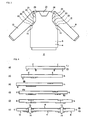
- FIGS. 4 to 11 show a method of knitting the sweater 2.
- the numbers of the knitting steps, e.g., 1 to 6 are used independently in each of the drawings. The same number represents different steps in different drawings.
- the knitting operation is performed in the order of the step on the lower side to the step on the upper side in the drawings. It is assumed that a flat knitting machine having four needle beds (two needle beds for the front, and two needle beds for the back) is used, for example. Also in the case where a flat knitting machine having two needle beds, one for the front and the other for the back, is used, the knitting operation can be carried out in the same manner using the known broad rib knitting.
- Both sleeves 8, 10 and the front and back bodies 4, 6 are knitted into cylindrical shapes up to the underarm positions.
- step 1 of FIG. 4 a state of engagement between the body and the sleeves on the needle bed when knitting has been carried out up to the underarm positions is shown.
- step 2 for knitting the gores, both sleeves are drawn toward the body side such that the sleeves are positioned alongside the body. At this time, the front body and both front sleeves are fixed to a lower front bed FD, and the back body and both back sleeves are fixed to a lower back bed BD.
- step 3 the stitches of the left front sleeve are transferred to the upper back bed BU, and the stitches of the right back sleeve are transferred to the upper front bed FU such that a gore between the right back sleeve and the back body is formed, and about the half of a gore between the left front sleeve and the front body is formed.
- step 4 the right back sleeve is transferred back to the original lower back bed BD.
- step 4 while racking the upper and lower back beds to the left, the gore is formed between the left front sleeve and the front body.
- the knit stitches at the end of the right back sleeve are sequentially rotated from the lower back bed BD to the lower front bed FD. Rotation will be described later with reference to FIG. 6.
- step 4 of FIG. 4 formation of the gore between the front body and the left front sleeve is finished.
- the knit stitches of the left front sleeve are transferred from the upper back bed BU to the lower front bed FD
- the knit stitches of the left back sleeve are transferred from the lower back bed BD to the upper front bed FU
- the knit stitches of the right front sleeve are transferred from the lower front bed FD to the upper back bed BU.
- step 5 while racking the upper and lower back beds to the right side in FIG. 4, a gore between the back body and the left back sleeve is formed, and about the half of a gore between the front body and the right front sleeve is formed.
- step 5 the stitches of the left back sleeve are transferred to the lower back bed BD.
- step 6 while racking the upper and lower back beds to the right side, the rest of the gore between the front body and the right front sleeve is formed, and the end of the left back sleeve is rotated to the lower front bed FD.
- the knit stitches of the upper back bed BU are transferred to the lower front bed FD, and the knit stitches of the lower back bed BD are transferred to the upper front bed FU such that the knit stitches are assembled on the two beds.
- the left and right back sleeves are rotated toward the front bed.
- the borders h, h' between the front and back sleeves are shifted toward the front needle bed.
- FIG. 5 shows knitting operation of joining both sleeves and the body in the case of 4: 4: 4 (meaning of the expression has been described above).
- Step 1 shows a state in which formation of the gores has been finished. From this state, in step 2, the entire knitted fabric (hereinafter simply referred to as the "knitted fabric") is rotated, e.g., counterclockwise such that the border h between the front side and the backside of the left sleeve 8 is positioned between the front and back needle beds (needle bed gap). As a result, the twist of knit stitches in the final course of the left sleeve is eliminated.
- FIG. 6 shows the principle of rotation. In step 0, it is assumed that the knitted fabrics 30, 31 face each other.
- step 1 for example, the knitted fabric 31 on the backside is shifted to the left by racking.
- step 2 knit stitches at both ends are transferred.
- step 3 the knitted fabric is shifted again. Thereafter, transferring and racking are repeated. In this manner, it is possible to rotate the knitted fabrics on the flat knitting machine.
- the left front sleeve is knitted two courses, and likewise, the left back sleeve is knitted two courses. Then, in step 5, two knit stitches of the left front sleeve are joined to the knit stitches at the end of the front body, and two knit stitches of the left back sleeve are joined to the knit stitches at the end of the back body. In the joining operation, the knitted fabric of the sleeve is transferred to the needle bed on the opposite side, and the knitted fabric is moved inwardly by two knit stitches to return the knitted fabric to the original needle bed.
- the front body with the left front sleeve, and the back body with the left back sleeve are knitted two courses, respectively.
- narrowing stitches are provided inwardly for both of the front body and the back body by two stitches, respectively.
- the knitting width of the front body and the knitting width of the back body are reduced by two stitches, respectively.
- the left front sleeve and the left back sleeve are knitted four courses, respectively.
- the front body and the back body are knitted two courses, respectively.
- the number of stitches is decreased by four on the front side and on the backside, respectively.
- step 9 the knitted fabric is rotated in the opposite direction, e.g., clockwise such that the border h' between the front side and the backside of the right sleeve is positioned between the front needle bed and the back needle bed.
- the right sleeve 10 the front body 4 and the back body 6 are knitted, for example, using a new yarn guide b in the same manner as the knitting operation in steps 3 to 8.
- a state shown at the top in FIG. 5 is obtained. From this state, the knitting operation is repeated from steps 2 to 15.
- steps 3 to 15 both sleeves on the front side and the backside are knitted four courses, respectively.
- the front body and the back body are also knitted four courses, respectively.
- the left knitting width and the right knitting width, on the front side and the backside are reduced by four stitches, respectively. Further, by selecting the position of inward narrowing stitches in steps 8 and 15, it is possible to change the pattern of attaching the sleeves or the like.
- FIG. 7 shows the knitting operation in FIG. 5 for the front body and both front sleeves.
- a horizontally extending field 34 denotes a knitting course (newly knitted knit stitch row).
- a reference numeral 36 denotes overlapping stitches.
- a reference numeral 38 denotes reduction in the knitting width (knitting width reduced by narrowing stitches).
- Common step numbers are used in FIGS. 5 and 7. Since the overlapping stitches formed in steps 8 and 15 are present within the front body, the border between the sleeve and the body is oriented obliquely inwardly to perform 4: 4: 4 knitting operation for joining. By repeating the knitting operation from steps 3 to 15, the sleeve is joined to the body.
- FIGS. 8 and 9 show 4: 4: 2 knitting operation for joining.
- step 1 it is assumed that formation of the gores has been finished.
- step 2 the knitted fabric is rotated, e.g., counterclockwise such that the border h between the front side and the backside of the left sleeve 8 is positioned between the front and back needle beds.
- step 2 the left front and left back sleeves are knitted two courses, respectively (steps 3 and 4).
- step 5 two knit stitches of the left front sleeve are joined to the knit stitches at the end of the front body and two knit stitches of the left back sleeve are joined to the knit stitches at the end of the back body.
- steps 6 and 7 the front and back bodies and the left front sleeve and the left back sleeve are knitted two courses, respectively.
- step 8 the knitted fabric is rotated in the opposite direction, i.e., clockwise.
- knitting operation is carried out in the same manner as the knitting operation from steps 3 to 7.
- the routine returns from step 13 to step 2, and the knitting operation is repeated from step 2 to step 13.
- the front and back sleeves are knitted four courses, respectively, and the front and back bodies are knitted four courses, respectively.
- the front and back sleeves are joined by two stitches on the left side and on the right side, respectively. Since the knitting width of the body is not reduced, the sleeves are attached to the body vertically.
- FIG. 9 shows reduction in the knitting width of the left sleeve, and reduction in the knitting width of the right sleeve, and positions of joining the body and the sleeves on the front knitted fabric side, in the knitting operation for joining in FIG. 8.
- the sleeve is joined to the body by overlapping the knit stitches at the end of the sleeve on the inner side with the knit stitches at the end of the body on the outer side, and the knitting width of the sleeve is reduced.
- FIG. 10 shows 2: 4: 3 knitting operation for joining.
- steps 1 and 2 it is assumed that formation of the gores has been finished.
- step 3 the knitted fabric is rotated, e.g., counterclockwise such that the border between the front side and the backside of the left sleeve 8 is positioned between the front and back needle beds.
- step 4 the left front sleeve and the left back sleeve are knitted two courses, respectively, and the front body and the back body are knitted two courses, respectively.
- two knit stitches of the left front sleeve and three knit stitches of the left back sleeve are joined to knit stitches of the body.
- two knit stitches of the right back sleeve and one knit stitch of the right front sleeve are joined to knit stitches of the body.
- step 5 the knitted fabric is rotated such that the border between the front side and the backside of the right sleeve is positioned between the front needle bed and the back needle bed.
- step 6 the front body and the back body are knitted two courses, respectively, and right front sleeve and the right back sleeve are knitted two courses, respectively.
- one knit stitch of the left front sleeve is joined to the body
- two knit stitches of the right front sleeve are joined to the body
- one knit stitch of the right back sleeve is joined to the body.
- step 7 the knitted fabric is rotated, and the routine returns to step 4. By the process, the knitting operation from steps 3 to 6 is repeated.
- the front sleeve and the back sleeve are knitted two courses, respectively, the front body and the back body are knitted four courses, respectively, and the front and back sleeves are joined by three stitches on the left side and on the right side, respectively.
- the sleeves can be attached to the body in the desired pattern.
- the knitting width of the front body is narrower than the knitting width of the back body.
- the front side is narrower than the backside. Therefore, the armhole is oriented forward naturally.
- the sweater fits the human body. Wrinkles are few on the front side, and the stress is small on the backside.
- the knitted fabric is rotated such that the border between the front side and the backside of the sleeve is positioned between the front needle bed and the back needle bed. Therefore, no twisted stitches are formed. Further, since no flechage knitting is performed, even if the flat knitting machine does not have any movable sinker device, knitting operation is performed easily.
- flechage knitting may be used in combination with the present invention. For example, part of the sleeve cap may be knitted by flechage knitting prior to formation of the gore.
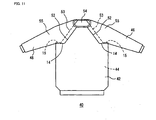
- FIG. 11 shows an example in which the embodiment is applied to a raglan sweater 40.
- a reference numeral 42 denotes a front body
- a reference numeral 44 denotes a back body
- a reference numeral 46 denotes a left sleeve
- a reference numeral 48 denotes a right sleeve.
- Gores 14, 14 on the front side are wider than gores 15, 15 on the backside.
- Joining lines 52 between the sleeves 46, 48 and the front body 42 are positioned inside joining lines 53 between the sleeves 46, 48 and the back body 44.
- a reference numeral 54 denotes a neck hole.
- the gores 14, 15 are formed such that the gores 14 on the front side become wider than the gores 15 on the backside.
- sleeve caps 55 on the front side are narrower than sleeve caps 55 on the backside.
- a suitable knitting operation such as 4: 4: 4 is performed for the joining lines 52, 53 to reduce the knitting width of the body at a predetermined pitch.
- the wale of the sleeve caps may be knitted by flechage knitting before formation of the gores.
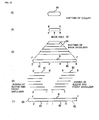
- FIG. 12 shows the steps of knitting from the portion of the neck hole 25.
- Step 1 schematically shows a state before knitting the portion of the neck hole 25.
- I - I' denotes the lower end of the neck hole.
- Step 2 schematically shows knitting of a left front shoulder 60 and a right front shoulder 61, and joining the left front shoulder 60 and the right front shoulder 61 to the sleeves.
- a reference numeral 62 denotes the final course of the left sleeve
- a reference numeral 63 denotes the final course of the right sleeve. Knitting is carried out such that the knitted fabric gradually moves toward the sleeve side. For example, knitting is carried out while moving the knitted fabric for every predetermined number of courses, e.g., two courses.
- step 3 the back shoulder 64 at the upper part of the back body 6 is knitted. While gradually reducing the knitting width, the knit stitches of the back shoulders 64 and the knit stitches of the front shoulders 60, 61 are overlapped with, and joined together. Thus, the sweater 2 becomes a state in step 4.
- the reference numeral 25 denotes the neck hole. From this state, a collar 66 is knitted to complete the sweater 2.
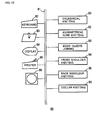
- FIG. 13 shows a knit design device 80 used in the embodiment.
- the knit design device 80 is intended to generate knitting data for the garment with asymmetrically joined sleeves which have been described in connection with the embodiment, in accordance with the design of the user.
- a reference numeral 81 denotes a bus
- a reference numeral 82 denotes a keyboard
- a reference numeral 83 denotes a stylus.
- input devices such as a mouse or a track ball may be provided.
- a reference numeral 84 denotes a display such as a color monitor
- a reference numeral 85 denotes a color printer
- a reference numeral 86 denotes a disk.
- the knit design device 80 may be connectable to a LAN.
- a cylindrical knitting unit 90 generates knitting data needed for cylindrically knitting the body up to the underarm positions or both sleeves in accordance with the design of the user. The components as described later also generate knitting data for respective parts in accordance with the design of the user.
- An asymmetrical gore knitting unit 92 generates knitting data of front and back gores. The front gore and the back gore are asymmetrical. The front gore is larger than the back gore. The back gore may not be provided.
- a body sleeve joining unit 93 generates data for joining the front body and the back body to the sleeves above the underarm positions, and course knitting of the front body and the back body, and the sleeves.
- a front shoulder knitting unit 94 generates knitting data for knitting the front shoulder and joining the front shoulder to the sleeve.
- a back shoulder knitting unit 95 generates knitting data for knitting operation of joining the back shoulder and the front shoulder. Knitting of the back shoulder may be carried out mainly for joining and only a small number of knit stitches may be formed. Alternatively, a large number of knit stitches may be formed at the time of knitting the back shoulder.
- a collar knitting unit 96 generates knitting data for the collar.
- a pair of yarn guides are used in the knitting operation for joining the sleeves and body.
- the knitting course can be drawn with a single stroke, it is possible to use only one yarn feeder.
- the garment it is possible to knit the garment with asymmetrically joined front and back sleeves.
- the sleeves are oriented forward, and the garment fits the body shape. Further, when the garment is worn, wrinkles are few on the front side, and the stress is small on the backside. Thus, a beautiful silhouette can be obtained.
- a sweater is used as an example.
- the present invention is also applicable to other garments such as a one-piece suit, a dress, or a vest.
Landscapes
- Engineering & Computer Science (AREA)
- Textile Engineering (AREA)
- Knitting Machines (AREA)
- Knitting Of Fabric (AREA)
Applications Claiming Priority (2)
| Application Number | Priority Date | Filing Date | Title |
|---|---|---|---|
| JP2003284725A JP4233409B2 (ja) | 2003-08-01 | 2003-08-01 | くり違いのある衣類の編成方法及びニットデザイン装置 |
| PCT/JP2004/010397 WO2005012611A1 (fr) | 2003-08-01 | 2004-07-22 | Procede de tricot de vetements avec difference de ligne, vetements presentant une difference de ligne, et dispositif de creation de tricot |
Publications (3)
| Publication Number | Publication Date |
|---|---|
| EP1652979A1 true EP1652979A1 (fr) | 2006-05-03 |
| EP1652979A4 EP1652979A4 (fr) | 2007-08-29 |
| EP1652979B1 EP1652979B1 (fr) | 2014-04-23 |
Family
ID=34113851
Family Applications (1)
| Application Number | Title | Priority Date | Filing Date |
|---|---|---|---|
| EP04747808.6A Expired - Lifetime EP1652979B1 (fr) | 2003-08-01 | 2004-07-22 | Procede de tricot de vetements avec difference de ligne, vetements presentant une difference de ligne, et dispositif de creation de tricot |
Country Status (6)
| Country | Link |
|---|---|
| US (1) | US7212881B2 (fr) |
| EP (1) | EP1652979B1 (fr) |
| JP (1) | JP4233409B2 (fr) |
| KR (1) | KR101072394B1 (fr) |
| CN (1) | CN100447322C (fr) |
| WO (1) | WO2005012611A1 (fr) |
Families Citing this family (13)
| Publication number | Priority date | Publication date | Assignee | Title |
|---|---|---|---|---|
| JP4408708B2 (ja) * | 2004-01-14 | 2010-02-03 | 株式会社島精機製作所 | ニットパンツの編成方法、ニットパンツ、および横編機にパンツを編成させるための編成プログラム |
| JP4374309B2 (ja) * | 2004-11-29 | 2009-12-02 | 株式会社島精機製作所 | 横編機で編まれたニットウエアおよびその編成方法 |
| JP4374310B2 (ja) | 2004-12-01 | 2009-12-02 | 株式会社島精機製作所 | 編地の編成方法 |
| WO2006109782A1 (fr) * | 2005-04-12 | 2006-10-19 | Shima Seiki Mfg., Ltd. | Procede de tricotage d'un tissu tricote tubulaire |
| JP4856635B2 (ja) * | 2005-06-01 | 2012-01-18 | 株式会社島精機製作所 | 身頃筒状部に開き部を有するニットウエアおよびその編成方法 |
| KR101414029B1 (ko) * | 2009-02-25 | 2014-07-01 | 가부시키가이샤 시마세이키 세이사쿠쇼 | 통 모양 편성포 및 그 편성방법 |
| JP5804729B2 (ja) * | 2011-03-01 | 2015-11-04 | 株式会社島精機製作所 | 筒状編地の編成方法、および筒状編地 |
| JP2014114513A (ja) * | 2012-12-07 | 2014-06-26 | Shima Seiki Mfg Ltd | 筒状編地の編成方法、および筒状編地 |
| US10100445B2 (en) | 2014-04-03 | 2018-10-16 | Nike, Inc. | Method of forming a unitary knit article using flat-knit construction |
| JP5980273B2 (ja) * | 2014-07-14 | 2016-08-31 | 株式会社島精機製作所 | 縄柄の編成方法、編地のデザインシステム、および記憶媒体 |
| JP7573491B2 (ja) | 2021-06-11 | 2024-10-25 | 株式会社島精機製作所 | ニットウェアの編成方法、及び横編機のカムシステムへの編成データの割当装置 |
| CN113818131B (zh) * | 2021-10-23 | 2023-01-31 | 嘉兴市蒂维时装有限公司 | 一种改善全成型灯笼袖袖口不平的编织方法及针织物 |
| US12460326B1 (en) * | 2025-03-10 | 2025-11-04 | Global Apparel Partners Inc. | One-piece knitted article for lower portion of human body and methods for knitting same |
Family Cites Families (18)
| Publication number | Priority date | Publication date | Assignee | Title |
|---|---|---|---|---|
| IE33829B1 (en) * | 1968-07-22 | 1974-11-13 | Courtaulds Ltd | Knitting method |
| JP3075656B2 (ja) | 1993-09-07 | 2000-08-14 | 東京瓦斯株式会社 | ガスメータ |
| JP2706760B2 (ja) * | 1994-10-07 | 1998-01-28 | 株式会社島精機製作所 | 編成方法 |
| JP3406085B2 (ja) * | 1994-10-12 | 2003-05-12 | 株式会社島精機製作所 | 筒状編地の編み幅側縁部に縄柄を編成する方法 |
| IT1290915B1 (it) * | 1996-02-09 | 1998-12-14 | Shima Seiki Mfg | Metodo di lavorazione a maglia su una macchina rettilinea per maglieria e tessuto a maglia cosi' prodotto. |
| JP3164507B2 (ja) | 1996-05-20 | 2001-05-08 | 株式会社島精機製作所 | 1×1リブ編地の伏せ目処理方法 |
| JP3071147B2 (ja) * | 1996-08-30 | 2000-07-31 | 株式会社島精機製作所 | 衿付衣服の編成方法 |
| JP3164528B2 (ja) * | 1997-02-17 | 2001-05-08 | 株式会社島精機製作所 | 横編機による編地の接合編成方法 |
| TW446774B (en) * | 1998-08-28 | 2001-07-21 | Shima Seiki Mfg | Knitwear knitting method |
| JP4025453B2 (ja) * | 1999-03-12 | 2007-12-19 | 株式会社島精機製作所 | 横編機によるニットウエア編成方法 |
| DE19924503A1 (de) * | 1999-05-28 | 2000-11-30 | Stoll & Co H | Verfahren zur Herstellung von Schlauchgestricken auf einer Flachstrickmaschine |
| TW480299B (en) * | 2000-01-26 | 2002-03-21 | Shima Seiki Mfg | Method of knitting neck portion of knit wear by weft knitting machine and the knit wear |
| TW538161B (en) * | 2000-01-31 | 2003-06-21 | Shima Seiki Mfg | Knit wear knitting method |
| US6658899B2 (en) * | 2000-02-29 | 2003-12-09 | Shima Seiki Mfg., Ltd. | Method of knitting neck of knit wear by weft knitting machine and the knit wear |
| TW491918B (en) * | 2000-05-17 | 2002-06-21 | Shima Seiki Mfg | Method of joining knitted fabrics and joined knitted fabric |
| JP3887409B2 (ja) * | 2000-06-05 | 2007-02-28 | 株式会社島精機製作所 | 編地接合方法及び接合された編地 |
| DE60236721D1 (de) * | 2001-02-02 | 2010-07-29 | Shima Seiki Mfg | Verfahren zum verknüpfen von schlauchförmigen maschenwaren und dafür geeignete maschenware |
| EP1441054B1 (fr) * | 2001-10-05 | 2009-12-16 | Shima Seiki Mfg., Ltd | Procede de formation d'un soufflet et vetement tricote comprenant le soufflet forme |
-
2003
- 2003-08-01 JP JP2003284725A patent/JP4233409B2/ja not_active Expired - Fee Related
-
2004
- 2004-07-22 CN CNB2004800216547A patent/CN100447322C/zh not_active Expired - Fee Related
- 2004-07-22 WO PCT/JP2004/010397 patent/WO2005012611A1/fr not_active Ceased
- 2004-07-22 EP EP04747808.6A patent/EP1652979B1/fr not_active Expired - Lifetime
- 2004-07-22 US US10/566,441 patent/US7212881B2/en not_active Expired - Fee Related
- 2004-07-22 KR KR1020067000740A patent/KR101072394B1/ko not_active Expired - Fee Related
Also Published As
| Publication number | Publication date |
|---|---|
| US20060248928A1 (en) | 2006-11-09 |
| US7212881B2 (en) | 2007-05-01 |
| WO2005012611A1 (fr) | 2005-02-10 |
| KR20060039901A (ko) | 2006-05-09 |
| CN1833058A (zh) | 2006-09-13 |
| EP1652979A4 (fr) | 2007-08-29 |
| JP4233409B2 (ja) | 2009-03-04 |
| JP2005054296A (ja) | 2005-03-03 |
| EP1652979B1 (fr) | 2014-04-23 |
| CN100447322C (zh) | 2008-12-31 |
| KR101072394B1 (ko) | 2011-10-11 |
Similar Documents
| Publication | Publication Date | Title |
|---|---|---|
| US6651462B2 (en) | Method of knitting neck portion of knit wear by using flat knitting machine, and the knitwear | |
| EP1441054B1 (fr) | Procede de formation d'un soufflet et vetement tricote comprenant le soufflet forme | |
| EP1818436B1 (fr) | Procédé de tricotage d'un tissu tricoté | |
| JP3071147B2 (ja) | 衿付衣服の編成方法 | |
| EP1652979B1 (fr) | Procede de tricot de vetements avec difference de ligne, vetements presentant une difference de ligne, et dispositif de creation de tricot | |
| EP1394308B1 (fr) | Procédé de tricotage d'un vetement pourvu d'un col tricote a l'aide d'un métier à mailles cueillies | |
| EP1672105B1 (fr) | Tricotage de vêtement à emmanchure raglan | |
| JP5567565B2 (ja) | 袖と身頃を有するニットウェアおよびその編成方法 | |
| CN100503924C (zh) | 针织物的接合方法 | |
| EP1662031B1 (fr) | Procede de tricotage de vetements ayant une difference de ligne, vetement a difference de ligne, et dispositif de creation de tricotage | |
| EP1829995B1 (fr) | Tricot tricoté par machine à mailles cueillies et procédé de tricotage dudit article | |
| EP1908867B1 (fr) | Procede de tricotage d' un tricot muni d'ouvertures sur une partie cylindrique d'un corps | |
| EP1510606B1 (fr) | Procede de tricotage de vetements tricotes à col devant |
Legal Events
| Date | Code | Title | Description |
|---|---|---|---|
| PUAI | Public reference made under article 153(3) epc to a published international application that has entered the european phase |
Free format text: ORIGINAL CODE: 0009012 |
|
| 17P | Request for examination filed |
Effective date: 20060201 |
|
| AK | Designated contracting states |
Kind code of ref document: A1 Designated state(s): AT BE BG CH CY CZ DE DK EE ES FI FR GB GR HU IE IT LI LU MC NL PL PT RO SE SI SK TR |
|
| DAX | Request for extension of the european patent (deleted) | ||
| A4 | Supplementary search report drawn up and despatched |
Effective date: 20070726 |
|
| 17Q | First examination report despatched |
Effective date: 20080429 |
|
| GRAJ | Information related to disapproval of communication of intention to grant by the applicant or resumption of examination proceedings by the epo deleted |
Free format text: ORIGINAL CODE: EPIDOSDIGR1 |
|
| GRAP | Despatch of communication of intention to grant a patent |
Free format text: ORIGINAL CODE: EPIDOSNIGR1 |
|
| GRAP | Despatch of communication of intention to grant a patent |
Free format text: ORIGINAL CODE: EPIDOSNIGR1 |
|
| INTG | Intention to grant announced |
Effective date: 20131108 |
|
| GRAS | Grant fee paid |
Free format text: ORIGINAL CODE: EPIDOSNIGR3 |
|
| GRAA | (expected) grant |
Free format text: ORIGINAL CODE: 0009210 |
|
| AK | Designated contracting states |
Kind code of ref document: B1 Designated state(s): AT BE BG CH CY CZ DE DK EE ES FI FR GB GR HU IE IT LI LU MC NL PL PT RO SE SI SK TR |
|
| REG | Reference to a national code |
Ref country code: GB Ref legal event code: FG4D |
|
| REG | Reference to a national code |
Ref country code: CH Ref legal event code: EP |
|
| REG | Reference to a national code |
Ref country code: AT Ref legal event code: REF Ref document number: 663949 Country of ref document: AT Kind code of ref document: T Effective date: 20140515 |
|
| REG | Reference to a national code |
Ref country code: IE Ref legal event code: FG4D |
|
| REG | Reference to a national code |
Ref country code: DE Ref legal event code: R096 Ref document number: 602004044902 Country of ref document: DE Effective date: 20140605 |
|
| REG | Reference to a national code |
Ref country code: AT Ref legal event code: MK05 Ref document number: 663949 Country of ref document: AT Kind code of ref document: T Effective date: 20140423 |
|
| REG | Reference to a national code |
Ref country code: NL Ref legal event code: VDEP Effective date: 20140423 |
|
| PG25 | Lapsed in a contracting state [announced via postgrant information from national office to epo] |
Ref country code: NL Free format text: LAPSE BECAUSE OF FAILURE TO SUBMIT A TRANSLATION OF THE DESCRIPTION OR TO PAY THE FEE WITHIN THE PRESCRIBED TIME-LIMIT Effective date: 20140423 Ref country code: GR Free format text: LAPSE BECAUSE OF FAILURE TO SUBMIT A TRANSLATION OF THE DESCRIPTION OR TO PAY THE FEE WITHIN THE PRESCRIBED TIME-LIMIT Effective date: 20140724 Ref country code: FI Free format text: LAPSE BECAUSE OF FAILURE TO SUBMIT A TRANSLATION OF THE DESCRIPTION OR TO PAY THE FEE WITHIN THE PRESCRIBED TIME-LIMIT Effective date: 20140423 Ref country code: CY Free format text: LAPSE BECAUSE OF FAILURE TO SUBMIT A TRANSLATION OF THE DESCRIPTION OR TO PAY THE FEE WITHIN THE PRESCRIBED TIME-LIMIT Effective date: 20140423 Ref country code: BG Free format text: LAPSE BECAUSE OF FAILURE TO SUBMIT A TRANSLATION OF THE DESCRIPTION OR TO PAY THE FEE WITHIN THE PRESCRIBED TIME-LIMIT Effective date: 20140723 |
|
| PG25 | Lapsed in a contracting state [announced via postgrant information from national office to epo] |
Ref country code: SE Free format text: LAPSE BECAUSE OF FAILURE TO SUBMIT A TRANSLATION OF THE DESCRIPTION OR TO PAY THE FEE WITHIN THE PRESCRIBED TIME-LIMIT Effective date: 20140423 Ref country code: PL Free format text: LAPSE BECAUSE OF FAILURE TO SUBMIT A TRANSLATION OF THE DESCRIPTION OR TO PAY THE FEE WITHIN THE PRESCRIBED TIME-LIMIT Effective date: 20140423 Ref country code: ES Free format text: LAPSE BECAUSE OF FAILURE TO SUBMIT A TRANSLATION OF THE DESCRIPTION OR TO PAY THE FEE WITHIN THE PRESCRIBED TIME-LIMIT Effective date: 20140423 Ref country code: AT Free format text: LAPSE BECAUSE OF FAILURE TO SUBMIT A TRANSLATION OF THE DESCRIPTION OR TO PAY THE FEE WITHIN THE PRESCRIBED TIME-LIMIT Effective date: 20140423 |
|
| PG25 | Lapsed in a contracting state [announced via postgrant information from national office to epo] |
Ref country code: PT Free format text: LAPSE BECAUSE OF FAILURE TO SUBMIT A TRANSLATION OF THE DESCRIPTION OR TO PAY THE FEE WITHIN THE PRESCRIBED TIME-LIMIT Effective date: 20140825 |
|
| REG | Reference to a national code |
Ref country code: DE Ref legal event code: R097 Ref document number: 602004044902 Country of ref document: DE |
|
| PG25 | Lapsed in a contracting state [announced via postgrant information from national office to epo] |
Ref country code: DK Free format text: LAPSE BECAUSE OF FAILURE TO SUBMIT A TRANSLATION OF THE DESCRIPTION OR TO PAY THE FEE WITHIN THE PRESCRIBED TIME-LIMIT Effective date: 20140423 Ref country code: EE Free format text: LAPSE BECAUSE OF FAILURE TO SUBMIT A TRANSLATION OF THE DESCRIPTION OR TO PAY THE FEE WITHIN THE PRESCRIBED TIME-LIMIT Effective date: 20140423 Ref country code: RO Free format text: LAPSE BECAUSE OF FAILURE TO SUBMIT A TRANSLATION OF THE DESCRIPTION OR TO PAY THE FEE WITHIN THE PRESCRIBED TIME-LIMIT Effective date: 20140423 Ref country code: SK Free format text: LAPSE BECAUSE OF FAILURE TO SUBMIT A TRANSLATION OF THE DESCRIPTION OR TO PAY THE FEE WITHIN THE PRESCRIBED TIME-LIMIT Effective date: 20140423 Ref country code: CZ Free format text: LAPSE BECAUSE OF FAILURE TO SUBMIT A TRANSLATION OF THE DESCRIPTION OR TO PAY THE FEE WITHIN THE PRESCRIBED TIME-LIMIT Effective date: 20140423 Ref country code: BE Free format text: LAPSE BECAUSE OF FAILURE TO SUBMIT A TRANSLATION OF THE DESCRIPTION OR TO PAY THE FEE WITHIN THE PRESCRIBED TIME-LIMIT Effective date: 20140423 |
|
| PG25 | Lapsed in a contracting state [announced via postgrant information from national office to epo] |
Ref country code: LU Free format text: LAPSE BECAUSE OF FAILURE TO SUBMIT A TRANSLATION OF THE DESCRIPTION OR TO PAY THE FEE WITHIN THE PRESCRIBED TIME-LIMIT Effective date: 20140722 |
|
| PLBE | No opposition filed within time limit |
Free format text: ORIGINAL CODE: 0009261 |
|
| REG | Reference to a national code |
Ref country code: CH Ref legal event code: PL |
|
| STAA | Information on the status of an ep patent application or granted ep patent |
Free format text: STATUS: NO OPPOSITION FILED WITHIN TIME LIMIT |
|
| GBPC | Gb: european patent ceased through non-payment of renewal fee |
Effective date: 20140723 |
|
| 26N | No opposition filed |
Effective date: 20150126 |
|
| REG | Reference to a national code |
Ref country code: IE Ref legal event code: MM4A |
|
| REG | Reference to a national code |
Ref country code: FR Ref legal event code: ST Effective date: 20150331 |
|
| PG25 | Lapsed in a contracting state [announced via postgrant information from national office to epo] |
Ref country code: LI Free format text: LAPSE BECAUSE OF NON-PAYMENT OF DUE FEES Effective date: 20140731 Ref country code: CH Free format text: LAPSE BECAUSE OF NON-PAYMENT OF DUE FEES Effective date: 20140731 |
|
| REG | Reference to a national code |
Ref country code: DE Ref legal event code: R097 Ref document number: 602004044902 Country of ref document: DE Effective date: 20150126 |
|
| PG25 | Lapsed in a contracting state [announced via postgrant information from national office to epo] |
Ref country code: GB Free format text: LAPSE BECAUSE OF NON-PAYMENT OF DUE FEES Effective date: 20140723 Ref country code: FR Free format text: LAPSE BECAUSE OF NON-PAYMENT OF DUE FEES Effective date: 20140731 |
|
| PG25 | Lapsed in a contracting state [announced via postgrant information from national office to epo] |
Ref country code: SI Free format text: LAPSE BECAUSE OF FAILURE TO SUBMIT A TRANSLATION OF THE DESCRIPTION OR TO PAY THE FEE WITHIN THE PRESCRIBED TIME-LIMIT Effective date: 20140423 |
|
| PG25 | Lapsed in a contracting state [announced via postgrant information from national office to epo] |
Ref country code: IE Free format text: LAPSE BECAUSE OF NON-PAYMENT OF DUE FEES Effective date: 20140722 |
|
| PG25 | Lapsed in a contracting state [announced via postgrant information from national office to epo] |
Ref country code: MC Free format text: LAPSE BECAUSE OF FAILURE TO SUBMIT A TRANSLATION OF THE DESCRIPTION OR TO PAY THE FEE WITHIN THE PRESCRIBED TIME-LIMIT Effective date: 20140423 |
|
| PG25 | Lapsed in a contracting state [announced via postgrant information from national office to epo] |
Ref country code: TR Free format text: LAPSE BECAUSE OF FAILURE TO SUBMIT A TRANSLATION OF THE DESCRIPTION OR TO PAY THE FEE WITHIN THE PRESCRIBED TIME-LIMIT Effective date: 20140423 Ref country code: HU Free format text: LAPSE BECAUSE OF FAILURE TO SUBMIT A TRANSLATION OF THE DESCRIPTION OR TO PAY THE FEE WITHIN THE PRESCRIBED TIME-LIMIT; INVALID AB INITIO Effective date: 20040722 |
|
| PGFP | Annual fee paid to national office [announced via postgrant information from national office to epo] |
Ref country code: IT Payment date: 20160720 Year of fee payment: 13 Ref country code: DE Payment date: 20160720 Year of fee payment: 13 |
|
| REG | Reference to a national code |
Ref country code: DE Ref legal event code: R119 Ref document number: 602004044902 Country of ref document: DE |
|
| PG25 | Lapsed in a contracting state [announced via postgrant information from national office to epo] |
Ref country code: DE Free format text: LAPSE BECAUSE OF NON-PAYMENT OF DUE FEES Effective date: 20180201 |
|
| PG25 | Lapsed in a contracting state [announced via postgrant information from national office to epo] |
Ref country code: IT Free format text: LAPSE BECAUSE OF NON-PAYMENT OF DUE FEES Effective date: 20170722 |