EP1653301A2 - Bilderzeugungsvorrichtung - Google Patents
Bilderzeugungsvorrichtung Download PDFInfo
- Publication number
- EP1653301A2 EP1653301A2 EP05023041A EP05023041A EP1653301A2 EP 1653301 A2 EP1653301 A2 EP 1653301A2 EP 05023041 A EP05023041 A EP 05023041A EP 05023041 A EP05023041 A EP 05023041A EP 1653301 A2 EP1653301 A2 EP 1653301A2
- Authority
- EP
- European Patent Office
- Prior art keywords
- magnetic flux
- confining
- flux confining
- fixation roller
- generating element
- Prior art date
- Legal status (The legal status is an assumption and is not a legal conclusion. Google has not performed a legal analysis and makes no representation as to the accuracy of the status listed.)
- Granted
Links
Images








Classifications
-
- G—PHYSICS
- G03—PHOTOGRAPHY; CINEMATOGRAPHY; ANALOGOUS TECHNIQUES USING WAVES OTHER THAN OPTICAL WAVES; ELECTROGRAPHY; HOLOGRAPHY
- G03G—ELECTROGRAPHY; ELECTROPHOTOGRAPHY; MAGNETOGRAPHY
- G03G15/00—Apparatus for electrographic processes using a charge pattern
-
- G—PHYSICS
- G03—PHOTOGRAPHY; CINEMATOGRAPHY; ANALOGOUS TECHNIQUES USING WAVES OTHER THAN OPTICAL WAVES; ELECTROGRAPHY; HOLOGRAPHY
- G03G—ELECTROGRAPHY; ELECTROPHOTOGRAPHY; MAGNETOGRAPHY
- G03G15/00—Apparatus for electrographic processes using a charge pattern
- G03G15/20—Apparatus for electrographic processes using a charge pattern for fixing, e.g. by using heat
- G03G15/2003—Apparatus for electrographic processes using a charge pattern for fixing, e.g. by using heat using heat
- G03G15/2014—Apparatus for electrographic processes using a charge pattern for fixing, e.g. by using heat using heat using contact heat
- G03G15/2053—Structural details of heat elements, e.g. structure of roller or belt, eddy current, induction heating
-
- G—PHYSICS
- G03—PHOTOGRAPHY; CINEMATOGRAPHY; ANALOGOUS TECHNIQUES USING WAVES OTHER THAN OPTICAL WAVES; ELECTROGRAPHY; HOLOGRAPHY
- G03G—ELECTROGRAPHY; ELECTROPHOTOGRAPHY; MAGNETOGRAPHY
- G03G15/00—Apparatus for electrographic processes using a charge pattern
- G03G15/20—Apparatus for electrographic processes using a charge pattern for fixing, e.g. by using heat
- G03G15/2003—Apparatus for electrographic processes using a charge pattern for fixing, e.g. by using heat using heat
- G03G15/2014—Apparatus for electrographic processes using a charge pattern for fixing, e.g. by using heat using heat using contact heat
- G03G15/2039—Apparatus for electrographic processes using a charge pattern for fixing, e.g. by using heat using heat using contact heat with means for controlling the fixing temperature
- G03G15/2042—Apparatus for electrographic processes using a charge pattern for fixing, e.g. by using heat using heat using contact heat with means for controlling the fixing temperature specially for the axial heat partition
-
- G—PHYSICS
- G03—PHOTOGRAPHY; CINEMATOGRAPHY; ANALOGOUS TECHNIQUES USING WAVES OTHER THAN OPTICAL WAVES; ELECTROGRAPHY; HOLOGRAPHY
- G03G—ELECTROGRAPHY; ELECTROPHOTOGRAPHY; MAGNETOGRAPHY
- G03G2215/00—Apparatus for electrophotographic processes
- G03G2215/20—Details of the fixing device or porcess
- G03G2215/2003—Structural features of the fixing device
- G03G2215/2006—Plurality of separate fixing areas
-
- G—PHYSICS
- G03—PHOTOGRAPHY; CINEMATOGRAPHY; ANALOGOUS TECHNIQUES USING WAVES OTHER THAN OPTICAL WAVES; ELECTROGRAPHY; HOLOGRAPHY
- G03G—ELECTROGRAPHY; ELECTROPHOTOGRAPHY; MAGNETOGRAPHY
- G03G2215/00—Apparatus for electrophotographic processes
- G03G2215/20—Details of the fixing device or porcess
- G03G2215/2003—Structural features of the fixing device
- G03G2215/2016—Heating belt
- G03G2215/2035—Heating belt the fixing nip having a stationary belt support member opposing a pressure member
Definitions
- the present invention relates to an image forming apparatus which heats an image on recording medium with the use of a heating method based on electromagnetic induction. More specifically, it relates to an apparatus for modifying an image on recording medium in glossiness, a fixing apparatus for fixing an unfixed image on recording medium, etc.
- a heating method based on electromagnetic induction has been employed as the heating method for a thermal fixing apparatus for heating an image on recording medium.
- An image heating apparatus employing a heating method based on electromagnetic induction (which hereinafter may be referred to simply as inductive heating method) is made up of a heating member in which heat (Joule heat) is generated, and a magnetic field generating means which generates a magnetic field.
- the heating member is heated by the heat generated therein by the eddy current induced in the heating member by the magnetic field generated the magnetic field generating means, and the thus generated heat is applied to recording medium as an object to be heated, and the image thereon, to thermally fix the image to the recording medium.
- Japanese Patent Application Publication 5-9027 discloses an apparatus which heats its fixation roller (formed of a ferrous substance) by the function of the magnetic flux generated by a coil.
- the portion(s) of the heating member, in which heat is generated by the magnetic flux can be placed closer to a fixation nip, compared to an apparatus employing a heat roller, the heat source of which is a halogen lamp. Therefore, this apparatus is higher in efficiency than an apparatus employing a heat roller, the heat source of which is a halogen lamp.
- Japanese Laid-open Patent Application 2004-265670 discloses a heating apparatus characterized in that it is provided with a magnetic flux blocking member for varying the density distribution of the magnetic flux in terms of the lengthwise direction of the fixation roller (width direction of fixation film).
- This heating apparatus presents an example of how to solve the so-called out-of-path temperature increase, that is, the phenomenon that as multiple sheets of recording medium of a size smaller than that of the largest sheet of recording medium conveyable through an inductive fixing apparatus, the portions of the fixation roller between the lateral edges of the path of a sheet of recording medium of a smaller size and the corresponding lateral edges of the path of a sheet of recording medium of the largest size abnormally increase in temperature.
- the magnetic flux adjustment area which opposes the end surface of the portion of the core around which the coil is wound, in terms of the radius direction of the holder 6, (the cross section of the core is in the shape of letter T; the coil is wound around the center core, that is, the portion of the core equivalent to the horizontal portion of the letter T; and the magnetic flux is highest in density around the end surface of the this portion of the core), will be entirely covered with the connective portion of the magnetic flux blocking member, in terms of the lengthwise direction of the core. If the end surface of the center core remains covered by the magnetic flux blocking member, the problem that the magnetic flux blocking member and/or coil abnormally increases in temperature occurs.
- the heating member is shielded by the magnetic flux blocking member across the entirety of the portions across which the magnetic flux is to be controlled, the problem that the value of the apparent impedance L of the coil suddenly reduces, allowing a large amount of electric current to flow, which sometimes destroys the electric power source, occurs.
- the primary object of the present invention is to prevent the problem attributable to the movement of the connective portion of the magnetic flux controlling means into a preset magnetic flux controlling position.
- an image heating device comprising magnetic flux generating means; a heat generating element for generating heat by a magnetic flux from said magnetic flux generating means to heat an image on a recording material; a magnetic flux confining member for confining the magnetic flux directed toward said heat generating element from said magnetic flux generating means, said magnetic flux confining member including a magnetic flux confining portion for confining the magnetic flux directed toward a predetermined region of said heat generating element at a predetermined magnetic flux confining position and a connecting portion connecting with said magnetic flux confining portion in a longitudinal direction of said heat generating element to hold said magnetic flux confining portion; and moving means for moving said magnetic flux confining member to a magnetic flux confining position or to a retracted position where said magnetic flux confining member is retracted from said magnetic flux confining position, wherein said connecting portion has a regulating member for preventing movement to said magnetic flux confining position.
- an image heating apparatus comprising a heating rotatable member for heating an image on a recording material; an excitation coil for induction heat generation in induction heat generation; an electric power supplying means for supplying electric power to said excitation coil; a magnetic flux confining means for confining the magnetic flux directed toward said heating rotatable member from said excitation coil, said magnetic flux confining means including a first magnetic flux confining portion, a second magnetic flux confining portion, and a connecting portion for connecting said first magnetic flux confining portion and said second magnetic flux confining portion; rotating means for rotation said magnetic flux confining means between a magnetic flux confining position and a retracted position retracted from the magnetic flux confining position; a regulating member for stopping the rotation of said magnetic flux confining means beyond a predetermined rotatable range including the magnetic flux confining position and the retracted position.
- an image heating apparatus comprising a heating rotatable member for heating an image on a recording material; an excitation coil for induction heat generation in said heating rotatable member; electric power supplying means for supplying electric power to said excitation coil; a rotatable magnetic flux confining member for confining a magnetic flux directed toward a predetermined region of said heating rotatable member from said excitation coil, said magnetic flux confining member is capable of being positioned at a magnetic flux confining position and at a retracted position retracted from the magnetic flux confining position; a supporting member for rotatably supporting at each of opposite longitudinal ends of said magnetic flux confining member; and a regulating member for limiting rotation of said magnetic flux confining member beyond a predetermined rotatable range including the magnetic flux confining position and the retracted position.
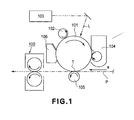
- FIG. 1 is a schematic drawing of an example of an image forming apparatus employing the heating apparatus, in accordance with the present invention, employing a heating method based on electromagnetic induction as a thermal image heating apparatus (which hereinafter will be referred to simply as fixing apparatus).
- This example of an image forming apparatus is a laser printer of the transfer type employing an electrophotographic process.
- Designated by a referential symbol 101 is an electrophotographic photosensitive member in the form of a rotatable drum (which hereinafter will be referred to simply as photosensitive drum).
- the photosensitive drum 1.01 is rotationally driven at a preset peripheral velocity in the clockwise direction indicated by an arrow mark.
- Designated by a referential symbol 102 is a charge roller, as a charging means, of the contact type, which uniformly charges to predetermined polarity and potential level, the peripheral surface of the photosensitive drum 101 while the photosensitive drum 101 is rotated.
- Designated by a referential symbol 103 is a laser scanner as an exposing means.
- the laser scanner scans, exposing thereby, the uniformly charged peripheral surface of the photosensitive drum 101 by outputting a beam of laser light L, while modulating it with the sequential digital electric video signals which reflect the image formation data.
- an electrostatic latent image is formed, which reflects the pattern in which the peripheral surface of the photosensitive drum 101 is scanned (exposed).
- Designated by a referential symbol 104 is a developing apparatus, which develops, reversely or normally, the electrostatic latent image on the peripheral surface of the photosensitive drum 101 into an image formed of toner (which hereinafter will be referred to as toner image).
- Designated by a referential symbol 105 is a transfer roller as a transferring means, which is kept pressed upon the peripheral surface of the photosensitive drum 101 with the application of a preset amount of pressure, forming a transfer nip T, to which a recording medium P as an object to be heated is conveyed from an unshown recording medium feeding/conveying mechanism with a preset control timing, and then, is conveyed through the transfer nip T while remaining pinched by the photosensitive drum 101 and transfer roller 105.
- a preset transfer bias is applied to the transfer roller 105 with a preset control timing.
- the toner image on the peripheral surface of the photosensitive drum 101 is electrostatically and gradually transferred onto the surface of the recording medium P.
- the recording medium P After being conveyed out of the transfer nip T, the recording medium P is separated from the peripheral surface of the photosensitive drum 101, and introduced into the fixing apparatus 100, which fixes the unfixed toner image on the recording medium P by applying heat and pressure to the introduced recording medium P and the unfixed toner image thereon; it turns the unfixed image into a permanent image. After the fixation, the recording medium P is conveyed out of the fixing apparatus.
- Designated by a referential symbol 106 is a device for cleaning the photosensitive drum 101, which removes the transfer residual toner, that is, the toner remaining on the peripheral surface of the photosensitive drum 101 after the separation of the recording medium P from the peripheral surface of the photosensitive drum 101. After the cleaning of the peripheral surface of the photosensitive drum 101, that is, the removal of the transfer residual toner, the peripheral surface of the photosensitive drum 101 is used for the following image formation cycle; the peripheral surface of the photosensitive drum 101 is repeatedly used for image formation.
- the direction indicated by a referential symbol a is the direction in which the recording medium P is conveyed.
- the recording medium P is conveyed through the main assembly so that the centerline of the recording medium P is kept aligned with the center of the fixation roller.
- Figure 2 is a schematic front view of the essential portions of the fixing apparatus as an image heating apparatus
- Figure 3 is an enlarged schematic cross-sectional view of the essential portions of the fixing apparatus
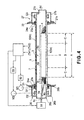
- Figure 4 is a schematic vertical sectional view of the fixation roller assembly portion of the fixing apparatus.
- the fixation roller 1 is the fixation roller as a member in which heat can be generated by electromagnetic induction.
- the fixation roller 1 is formed of such a substance as iron, nickel, and SUS 430 (electrically conductive magnetic substance), in which heat can be generated by electromagnetic induction. It is cylindrical, and the thickness of its wall is in the range of 0.1 mm - 1.5 mm. Generally, it comprises a toner releasing layer as the surface layer, or the combination of a toner releasing layer, an elastic layer, etc.
- ferromagnetic metals metallic substances with high level of permeability
- the material for the fixation roller makes it possible to confine a larger portion of the magnetic flux generated by the magnetic flux generating means, in the wall of the fixation roller 1. In other words, it makes it possible to increase the fixation roller in magnetic flux density, making it thereby possible to more efficiently induce eddy current in the surface portion of the metallic fixation roller.
- This fixing apparatus 100 is provided with a front plate 21, a rear plate 22, a fixation roller supporting front member 26 (fixation roller positioning plate), a fixation roller supporting rear member 27 (fixation roller positioning plate). To the fixation roller supporting members 26 and 27, first supporting portions 26a and 27a are attached, respectively.
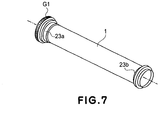
- the fixation roller 1 is provided with a pair of heat insulating bushings 23a and 23b, which are fitted around the lengthwise end portions of the fixation roller 1.
- the heat insulating bushings 23a and 23b are employed to minimize the heat transmission from the fixation roller 1 to the bearings 24a and 24b.
- Designated by a referential symbol G1 is a fixation roller driving gear fitted fast around the front end portion of the fixation roller 1.
- the fixation roller 1 is rotationally driven at a preset peripheral velocity in the clockwise direction indicated by an arrow mark in Figure 3.
- Figure 7 is an external perspective view of the fixation roller 1 fitted with the pair of heat insulating bushings 23a and 23b and the fixation roller gear G1.
- a pressure roller as a pressure applying member, which is an elastic roller made up of a metallic core 2a, a cylindrical elastic layer 2b formed integrally and concentrically around the metallic core 2a, etc.
- the elastic layer 2b is a layer formed of a rubbery substance, for example, silicone rubber, which displays the releasing property and is heat resistant.
- This elastic roller 2 is disposed under the fixation roller, in parallel to the fixation roller, being rotatably supported by the front and rear end portions of the metallic core 2a, with a pair of bearings 25a and 25b attached to the front and rear plates 21 and 22, respectively, in such a manner that they can be slid toward the fixation roller 1.
- the bearings 25a and 25b are kept pressured upward toward the fixation roller 1 by a pair of pressure applying means (unshown).
- the pressure roller 2 is pressed against the downwardly facing portion of the peripheral surface of the fixation roller 1, so that a predetermined amount of contact pressure is maintained between the fixation roller 1 and pressure roller 2 against the elasticity of the elastic layer 2b.
- a fixation nip N as a heating nip, with a preset width is formed between the fixation roller 1 and pressure roller 2.
- the pressure roller 2 is rotated by the friction which occurs between the fixation roller 1 and pressure roller 2 in the fixation nip N.
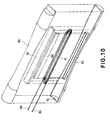
- the excitation coil assembly 3 is made up of an excitation coil 4 (which hereinafter will be referred to simply as coil), magnetic cores 5a and 5b (which hereinafter will be referred to simply as cores), and a holder 6.
- the magnetic cores 5a and 5b are integrally attached to each other, yielding a component with a T-shaped cross section, and are disposed in the hollow of the holder 6.
- the excitation coil assembly 3 is also provided with a magnetic flux controlling member 7 (magnetic flux blocking member (magnetic flux reducing member): shutter), which is rotatably disposed on the outward side of the holder 6, coaxially with the holder 6.
- a magnetic flux controlling member 7 magnetic flux blocking member (magnetic flux reducing member): shutter
- Figure 8 is an external view of this excitation coil assembly 3 and means M2, 28, G4, and G5 for moving the magnetic flux controlling member 7.
- Figure 9 is an exploded perspective view of the holder 6 and magnetic flux controlling member 7.
- Figure 10 is an exploded perspective view of the holder 6, and the components therein.
- the lengthwise direction of the structural components or the portions thereof of the fixing apparatus means the direction perpendicular (intersectional) to the recording medium conveyance direction a.
- the holder 6 is roughly cylindrical, being therefore roughly circular in cross section, from one lengthwise end to the other.
- a mixture of PPS resin which is heat resistant and has mechanical strength, and glass fiber, is used.
- PEEK resin polyimide resin, polyamide resin, polyamide-imide resin, ceramic, liquid polymer, fluorinated resin, and the like are available.
- the holder 6 is made up of two (first and second) roughly semicylindrical portions 6a and 6b, which are attached to each other with adhesive, or are interlocked to each other by providing the two portions 6a and 6b with such a shape that makes it possible to interlock the two portions 6a and 6b with each other, to form the holder 6, which is roughly cylindrical, from one lengthwise end to the other.
- the coil 4 and cores 5a and 5b are disposed in the first semicylindrical portion 6a, and then, the second semicylindrical portion 6b is bonded to the first semicylindrical portion 6a in a manner of encasing the coil 4 and core 5a and 5b, completing the holder 6 which internally holds the coil 4 and core 5a and 5b.
- Designated by referential symbols 4a and 4b are lead wires, which are extended outward from the holder 6 through a hole 6c of the front end wall of the holder 6.
- the coil 4 has a roughly elliptical shape (shape of long and narrow boat), the major axis of which is parallel to the lengthwise direction of the fixation roller 1. It is disposed in the hollow of the first semicylindrical portion 6a of the holder 6 so that its external contour follows the internal surface of the fixation roller 1.
- the coil 4 must be capable of generating an alternating magnetic flux strong enough to generate a sufficient amount of heat for fixation. Therefore, the coil 4 must be small in electrical resistance, and high in inductance.
- Litz wire is used, which is made by bundling roughly 80 - 160 strands of fine wire, the diameter of which is in the range of 0.1 - 0.3 mm.
- the Litz wire is wound 6 - 12 times around the first core 5a.
- the core 5a constitutes a first core (equivalent to vertical portion of letter T) around which the Litz wire is wound.
- the core 5b constitutes a second core (equivalent to horizontal portion of letter T).
- the two cores 5a and 5b are attached to each other so that the resultant component will be T-shaped in cross section.
- the material for the cores 5a and 5b such a substance as ferrite that is high in permeability, and yet, is low in residual magnetic flux density, is preferable.
- the only requirement for the material for the cores 5a and 5b is that the material is capable of generating magnetic flux. In other words, what is required of the material for the cores 5a and 5b is not particularly restrictive.
- the cores 5a and 5b are not required to be in a specific form, or be made of a specific material. Moreover, the first and second core 5a and 5b may be formed as parts of a monolithic magnetic core, which is T-shaped in cross section.
- the fixing apparatus 100 is structured so that the holder 6 of the excitation coil assembly 3 is supported as shown in Figures 2 and 4. That is, one of the lengthwise end portions of the cylindrical holder 6 is extended outward beyond the front end of the fixation roller 1, through the front opening of the fixation roller 1, and is fitted in the hole 26c of the second portion 26b of the front supporting member 26 attached to the outward side of the front plate 21 of the fixing apparatus 100, being thereby supported by the front plate 21.
- the other lengthwise end portion of the holder 6 is extended outward beyond the rear end of the fixation roller 1, through the rear opening the fixation roller 1, and is fitted in the hole 27c of the second portion 27b of the rear supporting member 27 attached to the outward side of the rear plate 22 of the fixing apparatus 100, being thereby supported by the rear plate 22. More specifically, the rear end portion of the holder 6 is provided with a D-cut portion 6d, and the hole 27c of the rear supporting member 27 is D-shaped in cross section. Therefore, the holder 6 is nonrotationally supported by the front and rear plates 26 and 27 of the fixing apparatus 100.
- the holder 6 is disposed in the hollow of the fixation roller 1 so that the two are coaxially disposed while providing a preset amount of gap between the peripheral surface of the holder 6 and internal surface of the fixation roller 1, and also, so that the holder 6 is nonrotationally held in a preset attitude, that is, at a preset angle in terms of its circumferential direction.
- the aforementioned lead wires 4a and 4b extending outward from the holder 6 through the hole 6c, with which the front end wall of the holder 6 is provided, are connected to an excitation circuit 51.
- the means for nonrotationally holding the holder 6 at the aforementioned angle (position) in terms of its circumferential direction in this embodiment, the D-cut end portion 6d of the holder 6 is fitted in the hole 27c of the portion 27b of the second supporting member 27, which is D-shaped in cross section.
- the means for nonrotationally holding the holder 6 at the preset angle (position) does not need to be limited to the above described one. That is, any means will suffice as long as the holder 6 can be nonrotationally held at the preset angle (position) in terms of its circumferential direction.
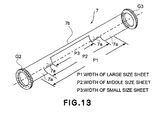
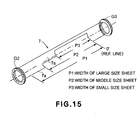
- the magnetic flux controlling member 7 is shaped so that its cross section is roughly arcuate, from one lengthwise end to the other. It has a pair of shutter portions 7a and 7a (magnetic flux controlling portions) having the arcuate cross section, and a connective portion 7b having also the arcuate cross section.
- the shutter portions 7a and 7a are the portions adjacent to the lengthwise ends of the magnetic flux controlling member 7, and the connective portion 7b is the center portion of the magnetic flux controlling member 7, which connects the shutter portions 7a and 7a.
- the shutter portions 7a and 7a are wider than the connective portion 7b.
- the connective portion 7b is a supporting portion for supporting the arcuate shutter portions 7a and 7a (magnetic flux controlling portions) attached to, and rotatably supported by, a pair of shutter gears located at the lengthwise ends of the fixation roller assembly (magnetic flux controlling member 7).
- the material for the magnetic flux controlling member 71 such a nonferrous metallic substance as aluminum, copper, or the like is used as the material for the magnetic flux controlling member 7, and among nonferrous metallic substances, those which are lower in electrical resistance are preferable.
- the magnetic flux controlling member 7 is also provided with a pair of protrusions 7c and 7c, which protrude from the outward edges of the shutter portions 7a and 7a, one for one, in the lengthwise direction of the magnetic flux controlling member 7.
- the magnetic flux controlling member 7 is rotated within the hollow of the fixation roller 1, more specifically, within the cylindrical gap between the external surface of the holder 6 and the internal surface of the fixation roller 1, in the circumferential direction of the fixation roller 1 (holder 6), with the rotational axis of the magnetic flux controlling member 7 coinciding with that of the holder 6.
- a referential symbol M2 stands for a second motor
- 28 a shaft
- G4 first output gear
- a referential symbol G5 stands for a second output gear.
- the shaft 28, which is located outside the fixation roller 1, is rotatably supported in parallel to the fixation roller 1, by the front and rear plates 21 and 22 of the fixing apparatus 100, with a pair of bearings (unshown) placed between the shaft 28 and the plates 21 and 22.
- the second motor M2 is a driving force source for rotating the shaft 28, and is a stepping motor.
- the first and second output gears G4 and G5 are rigidly attached to the shaft 28 so that they are coaxial with the shaft 28.
- the first and second output gears G4 and G5 are meshed with the first and second shutter gears G2 and G3 of the excitation coil assembly 3, respectively.
- the rotational force is transmitted to the first and second shutter gears G2 and G3, causing thereby the magnetic flux controlling member 7 to rotate about the axial line of the holder 6 in a manner to follow the peripheral surface of the holder 6.
- the material for the gears one of the various resinous substances may be selected according to the ambient temperature, and the amount of torque to which they are subjected.
- a control circuit portion (CPU) as a controlling means, which activates the first motor M1 with a preset control timing, through a driver 52, according to an image formation sequence.
- the rotational force is given to the driving gear G1 of the fixation roller 1, rotationally driving the fixation roller 1 in the clockwise direction indicated by an arrow mark in Figure 3, within a preset range.
- the pressure roller 2 is rotated by the rotation of the fixation roller 1.
- the control circuit portion 50 also activates the excitation circuit 51 with a preset timing, supplying thereby the coil 4 with alternating electric current.
- an alternating magnetic flux (alternating magnetic field) is generated, and therefore, heat is generated in the wall of the fixation roller 1 by electromagnetic induction, causing the fixation roller 1 to increase in temperature.
- Figure 6 is the combination of a schematic cross-sectional view of the fixation roller 1 in the system such as the above described one, and a graph showing the heat distribution of the fixation roller 1 in the heated condition. It shows the areas to which the major portion of the magnetic flux generated by the magnetic flux generating means concentrates, and the corresponding heat distribution of the fixation roller 1, in terms of the circumferential direction of the fixation roller 1.
- alternating electric current is flowed through the coil 4
- the coil 4 generates an alternating magnetic flux.
- the fixation roller 1 is formed of a magnetic metal or nonmetallic magnetic substance as described above.
- eddy current is induced in a manner to neutralize the magnetic field. This eddy current generates heat (Joule heat) in the wall of the fixation roller 1, increasing thereby the fixation roller 1 in temperature.
- the area in which major portion of the magnetic flux is generated is on the outward side of the first semicylindrical portion 6a of the holder 6, in which the coil 4 and cores 5a and 5b are disposed.
- the portion of the fixation roller 1, which is in this area is where heat is generated by the magnetic flux.
- the heat distribution of the fixation roller 1, in terms of the circumferential direction of the fixation roller 1, across the portion in the abovementioned magnetic flux generation area, has two areas H and H, in which most of the heat is generated, as shown by the schematic drawing and graph in Figure 6.
- the holder 6 is nonrotationally held (positioned) at such an angle in terms of the circumferential direction of the holder 6 that the portion of the coil 4, which corresponds to one of the two areas H and H, faces the fixation nip N, and the portion of the coil 4, which corresponds to the other of the two areas H and H, faces the immediate adjacencies of the fixation nip N on the upstream side in terms of the rotational direction of the fixation roller 1.
- the temperature of the fixation roller 1 is detected by a central thermistor TH1 as a temperature detecting means, disposed at the roughly mid point of the fixation roller 1 in terms of the lengthwise direction thereof, in contact, or with no contact, with the fixation roller 1, and the detected temperature is inputted into the control circuit 50, which controls the temperature of the fixation roller 1 by controlling the electric power supplied from the excitation circuit 51 to the coil 4, so that the fixation roller temperature detected by the central thermistor TH1 and inputted into the control circuit 50 remains at a preset target temperature (fixation temperature).
- the fixation roller 1 is controlled in temperature so that the temperature of the fixation roller 1 is kept at the target level across the entirety of its effective range (heatable range) in terms of its lengthwise direction.
- a recording medium P bearing an unfixed toner image t is introduced into the fixation nip N, and is conveyed through the fixation nip N while being kept pinched by the fixation roller 1 and pressure roller 2.
- the unfixed toner image t on the recording medium P is fixed to the surface of the recording medium P by the heat from the fixation roller 1 and the pressure in the fixation nip N.
- recording medium width means the dimension of a recording medium, in terms of the direction perpendicular to the recording medium conveyance direction a, when the recording medium P is completely flat.
- the recording medium P is conveyed through the fixing apparatus (image forming apparatus) so that the center of the recording medium P in terms of its width direction coincides with the center of the fixing apparatus (fixation roller 1) in terms of the width direction of the recording medium P.
- a referential symbol O is the centerline (hypothetical line), as the referential line, of the fixation roller 1 (recording medium) in terms of its lengthwise direction
- a referential symbol A is the width of the path of the largest recording medium, in terms of width, usable with the image forming apparatus.
- Designated by a referential symbol B is the width of the path of a recording medium which is one size smaller than the largest recording medium.
- a recording medium smaller in width than the largest recording medium will be referred to simply as recording medium of the small size.
- Designated by a referential symbol C are the areas between the edges of a large recording medium and the edge of a recording medium of the small size.
- each of the areas C is the portion of the recording medium passage, which does not come into contact with a recording medium of the small size when the recording medium the small size is conveyed through the fixing apparatus. Since a recording medium is conveyed through the fixing apparatus so that the center of the recording medium in terms of its width direction coincides with the center of the fixation roller 1 in terms of its lengthwise direction, there will be two areas C, one on the left side of the path B of a recording medium of the small size, and the other on the right side of the path B of a recording medium of the small size. The width of the areas C is changed by the width of the recording medium being conveyed through the fixing apparatus (image forming apparatus).
- the abovementioned central thermistor TH1 used for controlling the temperature of the fixation roller 1 is disposed within the path B of a recording medium of the small size so that it will be within the path of a recording medium regardless of recording medium width.
- a peripheral thermistor as a temperature detecting means disposed within one of the areas C, that is, the areas outside the path of a recording medium, in terms of the lengthwise direction of the fixation roller 1, in contact, or with no contact, with the fixation roller 1, in order to monitor the increase in the temperature of the fixation roller 1, across the portions corresponding to the out-of-path areas C.
- the temperature data obtained by this peripheral thermistor TH2 are also inputted into the control circuit portion 50.
- the portions of the fixation roller 1 corresponding in position to the out-of-path areas C increases in temperature, and this increase in temperature is detected by the peripheral thermistor TH2, and the detected increase in temperature is inputted from the thermistor TH2 to the control circuit portion 50.
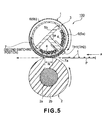
- the control circuit portion 50 rotates the magnetic flux controlling member 7 from the first position shown in Figures 3 and 6 into the second position shown in Figure 5 by activating the second motor M2 through the driver 53.
- the second position for the magnetic flux controlling member 7 is such a position that when the magnetic flux controlling member 7 is in this position, the arcuate shutter portions 7a and 7a, that is, the virtual end portions of the magnetic flux controlling member 7 in its lengthwise direction, which are wider, in terms of the circumferential direction of the fixation roller 1, than the connective portion 7b, that is, the center portion of the magnetic flux controlling member 7, are in the following positions.
- the arcuate shutter portions 7a and 7a of the magnetic flux controlling member 7 which is in the gap between the peripheral surface of the holder 6 and the internal surface of the fixation roller 1, are placed in the portions of the above described portions of the gap, one for one, which correspond in position to the out-of-path areas C in terms of the lengthwise direction of the fixation roller 1, and also, to the area in which the magnetic flux is generated, in terms of the circumferential direction of the fixation roller 1.
- the magnetic flux controlling member 7 placed in the second position, the magnetic flux from the magnetic flux generating means is reduced in the amount by which it acts on the portion of the fixation roller 1 which corresponds in position to the out-of-path areas C and C. Therefore, the portions of the fixation roller 1 corresponding to the out-of-path areas C are minimized in the amount by which heat is generated therein. Therefore, the problem that the portions of the fixation roller 1 corresponding to the out-of-path areas C increase in temperature is prevented.
- the fixing apparatus 100 it is possible to structure the fixing apparatus 100 so that as the magnetic flux controlling member 7, which is in the gap between the peripheral surface of the holder 6 and the internal surface of the fixation roller 1, is moved into the aforementioned second position, the shutter portions 7a and 7a, which correspond in position to the out-of-path areas C and C, extend from one end of the magnetic flux generation area, in terms of the circumferential direction of the fixation roller 1 (holder 6), to the other, or a part of the way to the other.
- Figure 5 shows the structural arrangement in which the shutter portions 7a and 7a extend from one end of the magnetic flux generation area halfway to the other.
- the portions of the fixation roller 1 corresponding to the out-of-path areas C gradually reduce in temperature.
- the control circuit portion 50 rotationally moves the magnetic flux controlling member 7 into the first position to prevent these portions of the fixation roller 1 from becoming too low in temperature.
- control circuit portion 50 rotates the magnetic flux controlling member 7 back into the first position.
- Shaping the holder 6 as described above makes it possible to make the rotational axes of the holder 6, fixation roller 1, and magnetic flux controlling member 7 coincide, making it therefore possible to improve the fixing apparatus 100 in terms of the accuracy with which these components are positioned relative to each other.
- the front and rear lengthwise end portions of the holder 6 are fitted with the first and second shutter gears G2 and G3, respectively, which are rotatable around the holder 6, as described above.
- the magnetic flux controlling member 7 is provided with the aforementioned protrusions 7c, which protrude outward from the outward edges of the magnetic flux controlling member 7. These protrusions 7c are engaged with the first and second shutter gears G2 and G3 so that the magnetic flux controlling member 7 is supported at both of its lengthwise ends, between the gears G2 and G3, by the gears G2 and G3.
- the shutter gears G2 and G3 are engaged with (fitted around) the holder 6 by the portions which are not engaged with the protrusions 7c and 7c of the magnetic flux controlling member 7. Therefore, the magnetic flux controlling member 7 can be rotated by the gears G2 and G3, following the peripheral surface of the holder 6.
- the portion of the holder 6, around which the gear G2 is fitted, and the portion of the holder 6, around which the gear G3 is fitted, are rendered uniform in external diameter across the portions largest in external diameter.
- the expression that the portions of the holder 6, around which the gears G2 and G3 are fitted, one for one, and are the largest in external diameter means that these portions may be provided with ribs so that these portions are rendered uniform in the external diameter inclusive of the ribs.
- the magnetic flux controlling member 7 is arcuate in cross section from one lengthwise end to the other in terms of the lengthwise direction of the fixation roller 1.
- the lengthwise end portions of the magnetic flux controlling member 7 are different in dimension (in terms of circumferential direction of fixation roller 1: arc length in cross-sectional view) from the center portion of the magnetic flux controlling member 7.
- the magnetic flux is controlled by moving the shutter portions 7a and 7a, that is, the magnetic flux blocking portions of the magnetic flux controlling member 7, into the out-of-path areas of the magnetic flux generation area.
- this is not the only method to control a magnetic flux.
- the magnetic flux controlling member 7 is shaped so that the center portion of the magnetic flux controlling member 7 constitutes the magnetic flux controlling portion (shutter portion) which corresponds in position to the recording medium passage in terms of the lengthwise direction of the fixing apparatus, and this shutter portion is moved into the magnetic flux generation area to change the magnetic flux in the distribution across the area which corresponds to the recording medium passage.
- the temperature of the fixation roller 1 may be adjusted by changing the area corresponding to the recording medium path, and the areas corresponding to the areas outside the recording medium path, in the distribution of the amount by which heat is generated, in terms of the lengthwise direction of the fixation roller 1. (Method for Driving Magnetic Flux Controlling Member)
- Figure 11 is a perspective drawing showing the mechanism for driving the magnetic flux controlling member 7 in this embodiment.
- the magnetic flux controlling member 7 in this drawing is such a magnetic flux controlling member that is provided with three kinds of magnetic flux controlling portions, being enabled to deal with three kinds of recording mediums different in width.
- Figure 12 is an enlarged perspective view of the means for driving the magnetic flux controlling member 7, depicting the regulating portion for regulating the movement of the magnetic flux controlling member 7 in this embodiment. For the purpose of simplifying the description, some of the components of the magnetic flux controlling member driving mechanism are not shown in Figures 11 and 12.
- the magnetic flux controlling member driving mechanism is provided with a magnetic flux controlling member driving gear G2 as a first driving force transmitting means (first driving force moving means), which is disposed on the front side of the image forming apparatus, and a magnetic flux member driving gear G3 as a second driving force transmitting means, which is disposed on the rear side of the image forming apparatus.
- the magnetic flux controlling member 7 is provided with a pair of protrusions 7c, which protrude from the lengthwise outward edges of the magnetic flux controlling member 7.
- the protrusions 7c are engaged with the aforementioned gears G2 and G3 as the first and second driving force transmitting means, one for one.
- the gears G2 and G3 as the first and second driving force transmitting means are fitted around the holder 6, with the internal surface of each gear being in contact with the peripheral surface of the holder 6, except for where the corresponding protrusion 7c is in engagement with the gear.
- the magnetic flux controlling member 7 is supported in such a manner that when the magnetic flux controlling member 7 is rotated by the rotation of the gears G2 and G3, it remains supported by the peripheral surface of the holder 6. Therefore, the holder 6 is not locally worn by friction.
- the shaft 28 as a third driving force transmitting means which is the means for distributing the driving force between the abovementioned gears G2 and G3, is disposed in parallel to the fixation roller 1.
- the means used, in this embodiment, for generating the force for driving the magnetic flux blocking member is the stepping motor M2.
- the driving force outputted from the stepping motor M2 is transmitted to the shaft 28 through the output gear. Then, it is transmitted to the magnetic flux controlling means 7, from both the front and rear end sides thereof, through the first and second magnetic flux controlling means driving gears G2 and G3.
- the magnetic flux controlling member driving gear G2 is provided with first, second, and third notches G2a, G2b, and G2c, respectively.
- the rotation of the magnetic flux controlling member driving gear G2 is controlled in response to the ON or OFF signal outputted by a position sensor 210, as the first, second, and third notches G2a, G2b, or G2c of the gear G2 moves past the position sensor 210.
- the positions of the first, second, and third notches G2a, G2b, and G2c relative to the magnetic flux controlling member 7 in terms of the rotational direction of the magnetic flux controlling member 7 (gear G2) correspond to the positions in which the magnetic flux controlling member 7 is placed to shield the fixation roller 1 from the magnetic flux, across the portions outside the recording medium path, according to the size of a recording medium.
- Figure 12 is a drawing of the magnetic flux controlling member driving mechanism in the state in which the position sensor 210 has failed to detect the notches G2a, G2b, and G2c of the magnetic flux controlling member driving gear G2.
- the magnetic flux controlling member driving gear G2 is allowed to continue to be rotated, because the position of the gear G2 in terms of the rotational direction thereof has not been detected.
- the fixing apparatus is provided with a regulating member which prevents the magnetic flux controlling means from moving past a preset range.
- the magnetic flux controlling member driving gear G2 is provided with a rotation regulating portion G2d as the portion for regulating the movement (rotation) of the magnetic flux controlling means driving gear G2, and the movement (rotation) of the magnetic flux controlling member is regulated (stopped) as the rotating regulating portion G2d comes into contact with the rotation regulating portion 220a of a rotation regulating member 220. That is, as the rotation regulating portion G2d comes into contact with the rotation regulating portion 220a, the stepping motor M2 becomes overloaded, becoming thereby asynchronous. As a result, the motor stops rotating.
- the gear G3 On the rear side of the fixing apparatus, the gear G3 is provided with a rotation regulating portion G3d, and the rotation regulating portion 220 with a rotation regulating portion 220b.
- the rotation of the magnetic flux controlling member driving gear G3 is regulated at the same time as the rotation of the magnetic flux controlling member driving gear G2 is regulated. Referring to Figure 12, even after the magnetic flux controlling member 7 is rotated as far as it can be rotated, the lengthwise center portion of the first core 5a is not covered with the magnetic flux controlling member 7. That is, the magnetic flux controlling member 7 is prevented from being moved into the position in which the connective portion 7a of the magnetic flux controlling member 7 covers the first core 5a.
- the magnetic flux controlling portions 7a and connective plate portion 7b (connective portion), which are arcuate in cross section, are generally the same in material, and are formed of such a nonferrous metallic substance as aluminum, copper, or the like, for example.
- nonferrous metallic substances those which are low in electrical resistivity are preferred.
- the magnetic flux controlling positions for the magnetic flux controlling member is such positions that when the magnetic flux controlling member is in one of the controlling positions, the magnetic flux controlling portions of the magnetic flux controlling member 7 oppose the center of the coil (center of outward end of first core in terms of radius direction of holder), that is, where the magnetic flux generated toward the heating member from the coil is densest.
- the rotation controlling member 220a and rotation regulating portion G2d are positioned so that even when the magnetic flux controlling member 7 is in the farthest position into which it can be rotated, it does not cover the entirety of the first core 5a in terms of the lengthwise direction of the first core 5a.
- the magnetic flux controlling member driving gear G2 is also provided with a rotation regulating portion similar to the rotation regulating portion G2d.
- the rotation of the magnetic flux controlling member driving gear G2 is regulated to prevent the first core 5a from being entirely covered by the magnetic flux controlling member 7 in terms of the lengthwise direction of the first core 5a, also when the gear G2 is rotated toward the third notch G2c.
- the rotation regulating members are located at both lengthwise ends of the magnetic flux controlling member.
- the regulating member(s) may be located at only one of the lengthwise ends, or the center, of the magnetic flux controlling member.
- the lengthwise end of the magnetic flux controlling member at which the regulating member is placed is desired to be the same lengthwise end as where the driving force generating means (driving power source) for moving the magnetic flux controlling member is disposed.
- An image heating device includes magnetic flux generating means; a heat generating element for generating heat by a magnetic flux from the magnetic flux generating means to heat an image on a recording material; a magnetic flux confining member for confining the magnetic flux directed toward the heat generating element from the magnetic flux generating means, the magnetic flux confining member including a magnetic flux confining portion for confining the magnetic flux directed toward a predetermined region of the heat generating element at a predetermined magnetic flux confining position and a connecting portion connecting with the magnetic flux confining portion in a longitudinal direction of the heat generating element to hold the magnetic flux confining portion; and moving means for moving the magnetic flux confining member to a magnetic flux confining position or to a retracted position where the magnetic flux confining member is retracted from the magnetic flux confining position, wherein the connecting portion has a regulating member for preventing movement to the magnetic flux confining position.
Landscapes
- Physics & Mathematics (AREA)
- General Physics & Mathematics (AREA)
- Fixing For Electrophotography (AREA)
- General Induction Heating (AREA)
Priority Applications (1)
| Application Number | Priority Date | Filing Date | Title |
|---|---|---|---|
| EP18173121.7A EP3415999A1 (de) | 2004-10-22 | 2005-10-21 | Bilderzeugungsvorrichtung |
Applications Claiming Priority (1)
| Application Number | Priority Date | Filing Date | Title |
|---|---|---|---|
| JP2004307530 | 2004-10-22 |
Related Child Applications (2)
| Application Number | Title | Priority Date | Filing Date |
|---|---|---|---|
| EP18173121.7A Division EP3415999A1 (de) | 2004-10-22 | 2005-10-21 | Bilderzeugungsvorrichtung |
| EP18173121.7A Division-Into EP3415999A1 (de) | 2004-10-22 | 2005-10-21 | Bilderzeugungsvorrichtung |
Publications (3)
| Publication Number | Publication Date |
|---|---|
| EP1653301A2 true EP1653301A2 (de) | 2006-05-03 |
| EP1653301A3 EP1653301A3 (de) | 2012-03-07 |
| EP1653301B1 EP1653301B1 (de) | 2018-06-27 |
Family
ID=35432760
Family Applications (2)
| Application Number | Title | Priority Date | Filing Date |
|---|---|---|---|
| EP05023041.6A Expired - Lifetime EP1653301B1 (de) | 2004-10-22 | 2005-10-21 | Bilderzeugungsvorrichtung |
| EP18173121.7A Withdrawn EP3415999A1 (de) | 2004-10-22 | 2005-10-21 | Bilderzeugungsvorrichtung |
Family Applications After (1)
| Application Number | Title | Priority Date | Filing Date |
|---|---|---|---|
| EP18173121.7A Withdrawn EP3415999A1 (de) | 2004-10-22 | 2005-10-21 | Bilderzeugungsvorrichtung |
Country Status (4)
| Country | Link |
|---|---|
| US (2) | US7348524B2 (de) |
| EP (2) | EP1653301B1 (de) |
| KR (1) | KR100767487B1 (de) |
| CN (2) | CN101424915B (de) |
Cited By (1)
| Publication number | Priority date | Publication date | Assignee | Title |
|---|---|---|---|---|
| EP3415999A1 (de) | 2004-10-22 | 2018-12-19 | Canon Kabushiki Kaisha | Bilderzeugungsvorrichtung |
Families Citing this family (9)
| Publication number | Priority date | Publication date | Assignee | Title |
|---|---|---|---|---|
| JP2006119410A (ja) * | 2004-10-22 | 2006-05-11 | Canon Inc | 定着装置及び画像形成装置 |
| JP4164484B2 (ja) * | 2004-10-22 | 2008-10-15 | キヤノン株式会社 | 像加熱装置 |
| JP4681865B2 (ja) * | 2004-12-07 | 2011-05-11 | キヤノン株式会社 | 画像形成装置 |
| US7398027B2 (en) * | 2005-03-30 | 2008-07-08 | Canon Kabushiki Kaisha | Image forming apparatus with conveyance speed control based in part on loop detection |
| US9026024B2 (en) * | 2012-02-09 | 2015-05-05 | Ricoh Company, Ltd. | Fixing device capable of minimizing damage of endless rotary body and image forming apparatus incorporating same |
| JP6150107B2 (ja) * | 2013-03-15 | 2017-06-21 | 株式会社リコー | 定着装置及び画像形成装置 |
| JP6256141B2 (ja) * | 2013-11-11 | 2018-01-10 | 株式会社リコー | 定着装置及び画像形成装置 |
| JP6455104B2 (ja) * | 2014-12-01 | 2019-01-23 | 株式会社リコー | 定着装置及び画像形成装置 |
| JP7519006B2 (ja) * | 2020-07-29 | 2024-07-19 | 株式会社リコー | 加熱装置、定着装置および画像形成装置 |
Family Cites Families (22)
| Publication number | Priority date | Publication date | Assignee | Title |
|---|---|---|---|---|
| US5240242A (en) | 1990-07-05 | 1993-08-31 | Canon Kabushiki Kaisha | Sheet feeding device |
| JP3267640B2 (ja) | 1991-06-28 | 2002-03-18 | 宇部日東化成株式会社 | 黒色系微粒子及びその製造方法 |
| JPH1074009A (ja) * | 1996-08-30 | 1998-03-17 | Minolta Co Ltd | 定着装置 |
| JP2001042595A (ja) | 1999-03-19 | 2001-02-16 | Canon Inc | 画像形成装置 |
| WO2001031405A1 (en) * | 1999-10-26 | 2001-05-03 | Matsushita Electric Industrial Co., Ltd. | Image heating device and image forming device |
| JP2002083676A (ja) * | 2000-09-08 | 2002-03-22 | Canon Inc | 加熱装置及び画像形成装置 |
| JP3880334B2 (ja) * | 2001-05-28 | 2007-02-14 | キヤノン株式会社 | 像加熱装置及び画像形成装置 |
| US6801726B2 (en) | 2001-07-27 | 2004-10-05 | Canon Kabushiki Kaisha | Image forming apparatus |
| JP4186457B2 (ja) * | 2001-07-30 | 2008-11-26 | 富士ゼロックス株式会社 | 磁場発生用磁心、およびこれを用いた電子写真装置 |
| JP3870060B2 (ja) * | 2001-10-12 | 2007-01-17 | キヤノン株式会社 | 像加熱装置 |
| JP2003233233A (ja) | 2002-02-08 | 2003-08-22 | Canon Inc | カラー画像形成装置及び画質調整制御方法 |
| JP4231504B2 (ja) * | 2003-01-14 | 2009-03-04 | パナソニック株式会社 | 像加熱装置及び画像形成装置 |
| JP2004265670A (ja) | 2003-02-28 | 2004-09-24 | Canon Inc | 加熱装置 |
| JP2004287414A (ja) | 2003-03-06 | 2004-10-14 | Canon Inc | 像加熱装置及び画像形成装置 |
| JP4110047B2 (ja) | 2003-06-10 | 2008-07-02 | キヤノン株式会社 | 像加熱装置 |
| US7122769B2 (en) * | 2003-12-25 | 2006-10-17 | Canon Kabushiki Kaisha | Induction heating apparatus for image fixing |
| JP2006119410A (ja) | 2004-10-22 | 2006-05-11 | Canon Inc | 定着装置及び画像形成装置 |
| US7348524B2 (en) | 2004-10-22 | 2008-03-25 | Canon Kabushiki Kaisha | Image forming apparatus |
| JP2006119422A (ja) | 2004-10-22 | 2006-05-11 | Canon Inc | 画像形成装置 |
| JP4681865B2 (ja) | 2004-12-07 | 2011-05-11 | キヤノン株式会社 | 画像形成装置 |
| JP2006172745A (ja) | 2004-12-13 | 2006-06-29 | Canon Inc | コイルユニット及びその製造方法、及び加熱装置 |
| US7398027B2 (en) | 2005-03-30 | 2008-07-08 | Canon Kabushiki Kaisha | Image forming apparatus with conveyance speed control based in part on loop detection |
-
2005
- 2005-10-21 US US11/255,149 patent/US7348524B2/en not_active Expired - Lifetime
- 2005-10-21 EP EP05023041.6A patent/EP1653301B1/de not_active Expired - Lifetime
- 2005-10-21 EP EP18173121.7A patent/EP3415999A1/de not_active Withdrawn
- 2005-10-21 KR KR1020050099411A patent/KR100767487B1/ko not_active Expired - Lifetime
- 2005-10-21 CN CN2008101817279A patent/CN101424915B/zh not_active Expired - Fee Related
- 2005-10-21 CN CNB2005101163793A patent/CN100451866C/zh not_active Expired - Fee Related
-
2008
- 2008-01-31 US US12/023,349 patent/US7842906B2/en not_active Expired - Lifetime
Cited By (1)
| Publication number | Priority date | Publication date | Assignee | Title |
|---|---|---|---|---|
| EP3415999A1 (de) | 2004-10-22 | 2018-12-19 | Canon Kabushiki Kaisha | Bilderzeugungsvorrichtung |
Also Published As
| Publication number | Publication date |
|---|---|
| KR20060049111A (ko) | 2006-05-18 |
| CN1763652A (zh) | 2006-04-26 |
| CN101424915A (zh) | 2009-05-06 |
| KR100767487B1 (ko) | 2007-10-17 |
| US20080128408A1 (en) | 2008-06-05 |
| EP3415999A1 (de) | 2018-12-19 |
| US7348524B2 (en) | 2008-03-25 |
| EP1653301B1 (de) | 2018-06-27 |
| CN101424915B (zh) | 2012-01-11 |
| EP1653301A3 (de) | 2012-03-07 |
| CN100451866C (zh) | 2009-01-14 |
| US7842906B2 (en) | 2010-11-30 |
| US20060086727A1 (en) | 2006-04-27 |
Similar Documents
| Publication | Publication Date | Title |
|---|---|---|
| US7397017B2 (en) | Image heating apparatus | |
| US7842906B2 (en) | Image forming apparatus | |
| US7465906B2 (en) | Image heating apparatus | |
| US6463252B2 (en) | Fixing device employing an induction heating method | |
| US7394045B2 (en) | Image forming apparatus | |
| US7991337B2 (en) | Image heating apparatus | |
| US7657217B2 (en) | Image heating apparatus and method for manufacturing image heating apparatus | |
| US7199339B2 (en) | Heating apparatus | |
| JP4110013B2 (ja) | 像加熱装置 | |
| JP2004273249A (ja) | 加熱装置 | |
| US7326890B2 (en) | Image heating apparatus with movable electroconductive member | |
| JP4777037B2 (ja) | 画像加熱装置 | |
| JP4047229B2 (ja) | 像加熱装置 | |
| JP2006251026A (ja) | 加熱装置 | |
| JP4971621B2 (ja) | 画像加熱装置 |
Legal Events
| Date | Code | Title | Description |
|---|---|---|---|
| PUAI | Public reference made under article 153(3) epc to a published international application that has entered the european phase |
Free format text: ORIGINAL CODE: 0009012 |
|
| 17P | Request for examination filed |
Effective date: 20051021 |
|
| AK | Designated contracting states |
Kind code of ref document: A2 Designated state(s): AT BE BG CH CY CZ DE DK EE ES FI FR GB GR HU IE IS IT LI LT LU LV MC NL PL PT RO SE SI SK TR |
|
| AX | Request for extension of the european patent |
Extension state: AL BA HR MK YU |
|
| PUAL | Search report despatched |
Free format text: ORIGINAL CODE: 0009013 |
|
| AK | Designated contracting states |
Kind code of ref document: A3 Designated state(s): AT BE BG CH CY CZ DE DK EE ES FI FR GB GR HU IE IS IT LI LT LU LV MC NL PL PT RO SE SI SK TR |
|
| AX | Request for extension of the european patent |
Extension state: AL BA HR MK YU |
|
| RIC1 | Information provided on ipc code assigned before grant |
Ipc: G03G 15/20 20060101AFI20120127BHEP |
|
| 17Q | First examination report despatched |
Effective date: 20120214 |
|
| AKX | Designation fees paid |
Designated state(s): DE FR GB IT |
|
| GRAP | Despatch of communication of intention to grant a patent |
Free format text: ORIGINAL CODE: EPIDOSNIGR1 |
|
| INTG | Intention to grant announced |
Effective date: 20180115 |
|
| GRAS | Grant fee paid |
Free format text: ORIGINAL CODE: EPIDOSNIGR3 |
|
| GRAA | (expected) grant |
Free format text: ORIGINAL CODE: 0009210 |
|
| AK | Designated contracting states |
Kind code of ref document: B1 Designated state(s): DE FR GB IT |
|
| REG | Reference to a national code |
Ref country code: GB Ref legal event code: FG4D |
|
| REG | Reference to a national code |
Ref country code: DE Ref legal event code: R096 Ref document number: 602005054177 Country of ref document: DE |
|
| REG | Reference to a national code |
Ref country code: FR Ref legal event code: PLFP Year of fee payment: 14 |
|
| REG | Reference to a national code |
Ref country code: DE Ref legal event code: R097 Ref document number: 602005054177 Country of ref document: DE |
|
| PLBE | No opposition filed within time limit |
Free format text: ORIGINAL CODE: 0009261 |
|
| STAA | Information on the status of an ep patent application or granted ep patent |
Free format text: STATUS: NO OPPOSITION FILED WITHIN TIME LIMIT |
|
| 26N | No opposition filed |
Effective date: 20190328 |
|
| PGFP | Annual fee paid to national office [announced via postgrant information from national office to epo] |
Ref country code: IT Payment date: 20230920 Year of fee payment: 19 Ref country code: GB Payment date: 20230920 Year of fee payment: 19 |
|
| PGFP | Annual fee paid to national office [announced via postgrant information from national office to epo] |
Ref country code: FR Payment date: 20230920 Year of fee payment: 19 |
|
| PGFP | Annual fee paid to national office [announced via postgrant information from national office to epo] |
Ref country code: DE Payment date: 20230920 Year of fee payment: 19 |
|
| REG | Reference to a national code |
Ref country code: DE Ref legal event code: R119 Ref document number: 602005054177 Country of ref document: DE |
|
| GBPC | Gb: european patent ceased through non-payment of renewal fee |
Effective date: 20241021 |
|
| PG25 | Lapsed in a contracting state [announced via postgrant information from national office to epo] |
Ref country code: DE Free format text: LAPSE BECAUSE OF NON-PAYMENT OF DUE FEES Effective date: 20250501 |
|
| PG25 | Lapsed in a contracting state [announced via postgrant information from national office to epo] |
Ref country code: GB Free format text: LAPSE BECAUSE OF NON-PAYMENT OF DUE FEES Effective date: 20241021 |
|
| PG25 | Lapsed in a contracting state [announced via postgrant information from national office to epo] |
Ref country code: FR Free format text: LAPSE BECAUSE OF NON-PAYMENT OF DUE FEES Effective date: 20241031 |
|
| PG25 | Lapsed in a contracting state [announced via postgrant information from national office to epo] |
Ref country code: IT Free format text: LAPSE BECAUSE OF NON-PAYMENT OF DUE FEES Effective date: 20241021 |