EP1653355A2 - Processeur d'information, méthode de traitement d'information et programmes à cet effet - Google Patents
Processeur d'information, méthode de traitement d'information et programmes à cet effet Download PDFInfo
- Publication number
- EP1653355A2 EP1653355A2 EP05021658A EP05021658A EP1653355A2 EP 1653355 A2 EP1653355 A2 EP 1653355A2 EP 05021658 A EP05021658 A EP 05021658A EP 05021658 A EP05021658 A EP 05021658A EP 1653355 A2 EP1653355 A2 EP 1653355A2
- Authority
- EP
- European Patent Office
- Prior art keywords
- power
- run
- saving
- program
- translation
- Prior art date
- Legal status (The legal status is an assumption and is not a legal conclusion. Google has not performed a legal analysis and makes no representation as to the accuracy of the status listed.)
- Withdrawn
Links
Images






Classifications
-
- G—PHYSICS
- G06—COMPUTING OR CALCULATING; COUNTING
- G06F—ELECTRIC DIGITAL DATA PROCESSING
- G06F1/00—Details not covered by groups G06F3/00 - G06F13/00 and G06F21/00
- G06F1/26—Power supply means, e.g. regulation thereof
- G06F1/32—Means for saving power
- G06F1/3203—Power management, i.e. event-based initiation of a power-saving mode
-
- G—PHYSICS
- G06—COMPUTING OR CALCULATING; COUNTING
- G06F—ELECTRIC DIGITAL DATA PROCESSING
- G06F9/00—Arrangements for program control, e.g. control units
- G06F9/06—Arrangements for program control, e.g. control units using stored programs, i.e. using an internal store of processing equipment to receive or retain programs
- G06F9/44—Arrangements for executing specific programs
- G06F9/455—Emulation; Interpretation; Software simulation, e.g. virtualisation or emulation of application or operating system execution engines
- G06F9/45504—Abstract machines for programme code execution, e.g. Java virtual machine [JVM], interpreters, emulators
- G06F9/45516—Runtime code conversion or optimisation
-
- G—PHYSICS
- G06—COMPUTING OR CALCULATING; COUNTING
- G06F—ELECTRIC DIGITAL DATA PROCESSING
- G06F8/00—Arrangements for software engineering
- G06F8/40—Transformation of program code
- G06F8/41—Compilation
- G06F8/44—Encoding
- G06F8/443—Optimisation
- G06F8/4432—Reducing the energy consumption
-
- Y—GENERAL TAGGING OF NEW TECHNOLOGICAL DEVELOPMENTS; GENERAL TAGGING OF CROSS-SECTIONAL TECHNOLOGIES SPANNING OVER SEVERAL SECTIONS OF THE IPC; TECHNICAL SUBJECTS COVERED BY FORMER USPC CROSS-REFERENCE ART COLLECTIONS [XRACs] AND DIGESTS
- Y02—TECHNOLOGIES OR APPLICATIONS FOR MITIGATION OR ADAPTATION AGAINST CLIMATE CHANGE
- Y02D—CLIMATE CHANGE MITIGATION TECHNOLOGIES IN INFORMATION AND COMMUNICATION TECHNOLOGIES [ICT], I.E. INFORMATION AND COMMUNICATION TECHNOLOGIES AIMING AT THE REDUCTION OF THEIR OWN ENERGY USE
- Y02D10/00—Energy efficient computing, e.g. low power processors, power management or thermal management
Definitions
- the present invention relates to a method of translating a source program into a machine language program in a computer and, more particularly, to an information processing method which uses an intermediate format common to plural kinds of computers, compiles the intermediate language (or, bytecodes) during run time, transforms it into a machine language, and executes the language.
- the invention relates to the information processing method implemented on an information processor having a bytecode accelerator that converts a stack-based intermediate language (bytecodes) into register-based instructions by hardware.
- the installer has means for receiving the abstract object program in an intermediate language format not dependent on computer's type, means for generating a machine language program on the memory from the received abstract object program, and means for causing the CPU to execute the generated machine language program immediately after the generation.
- an information processor having plural registers, an instruction execution portion for executing a first format instruction as native instructions, and an instruction converting circuit has been proposed (see JP-A-2004-30222 (corresponding to US2004/3204A1)).
- the information processor can be operated either in a first mode or in a second mode.
- a first instruction set contained in the first program is converted into the first format instructions by the instruction converting circuit and executed.
- a second instruction set contained in the first program is converted into the first format instructions by conversion software written in the first format instructions and executed.
- a transient mode of operation is introduced. Transfer of data between at least one of the registers and the instruction converting circuit is performed in parallel with the operation for switching of mode of operation.
- Interpreting means for interpreting the source program or intermediate language program and program translating means for translating each individual module of the source program or intermediate language program into a machine language program are provided.
- the interpreting means counts the number of executions of each module during interpretation of the source program or intermediate language program and creates data about the frequency of the execution.
- the program translating means selects the module executed most frequently from the data about the frequencies of executions concurrently with the interpretation of the source program or intermediate language program done by the interpreting means.
- the module is translated into a machine language program.
- a program described in a high-level language is converted into a machine language program for the computer to be run. Then, the converted machine language program is directly executed.
- the interpreter method a language (intermediate language) different from the machine language for the computer to be run is set. Another program (interpreter) for interpreting the intermediate language on the computer to be run is previously prepared. The program written in a high-level language is converted into an intermediate language program, which in turn is executed by the interpreter.
- the interpreter method needs assignment to processing steps corresponding to individual intermediate codes and computation of addresses of operands, in addition to execution of machine language corresponding to an intermediate language. Meanwhile, the compiler method does not need them because machine language is directly executed.
- the interpreter itself has versatility regarding intermediate language programs. Therefore, the interpreter simply executes the intermediate language program intact. Omission of processing taking account of the context of the program cannot be done. Furthermore, the characteristics of the executing computer are not reflected in the intermediate language program. Therefore, it is impossible to increase the speed of processing, for example, by mapping certain variables described in a high-level language into a register in the target computer.
- the compiler method however, has disadvantages compared with the interpreter method.
- Each type of machine needs a compiler for converting a source program into a machine language program.
- the amount of compiler developed is increased. Besides, it is necessary to perform maintenance and expansion according to each individual machine type. This increases the overheads associated with maintenance and expansion.
- each individual machine type needs a separate compilation for conversion from a source program into a machine language program. This produces a large amount of overhead in management of machine language program.
- the compiler method is more advantageous but results in demerits in terms of maintenance and operations as described above. Consequently, it has been necessary to use both the compiler and interpreter methods properly.
- Method 1 As a measure for mitigating the tradeoff between the aspect of maintenance and operation and the aspect of speed, a system making use of the advantages of both compiler and interpreter methods has been developed. This is the run-time translation (hereinafter referred to as "Method 1").
- Method 1 adopts an intermediate language program not dependent on certain computer machines as the aspect of maintenance and operation.
- the intermediate language program When the intermediate language program is executed, it is converted into a machine language program for the target computer to obtain higher speed.
- a Java (trademark registered) program can be executed and there is a run-time JIT (just-in-time) compiler, if the run-time compiler (run-time translator) performs dynamic compilation, the result of the run-time compilation (run-time translation) is stored in memory, and the intermediate language is subsequently executed, then the compiled native codes (machine codes) are executed.
- Method 1 speed increases are achieved by software (run-time translation).
- Method 2 achieves speed increases by hardware.
- the execution speed can be improved more easily by making the run-time translation and bytecode accelerator complement each other.
- run-time translation is used, the execution speed is much higher (several times to ten times or higher) than where run-time translation is not used.
- the CPU load for the same amount of task is reduced, i.e., the number of dynamic steps is reduced. As a result, a power-saving effect is rather produced.
- the present invention has been made. It is a main object of the present invention to provide information processor and information processing method which can vary the allocation ratio between run-time translation and interpretation of intermediate language and suppress the power consumption while maintaining an appropriate execution speed.
- An information processor that solves the foregoing problems in accordance with the teachings of the present invention has interpretation means for interpreting a source program or intermediate language program and run-time translation means for translating the program into a machine language program native to a computer.
- the information processor is characterized in that it further includes a power-saving request monitor and a power-saving translation controller.
- the power-saving request monitor monitors whether or not there is a power-saving request from an input interface or a predetermined power-saving request in a given memory device.
- the power-saving request makes a request for suppression of power consumed by the information processor.
- the power-saving translation controller makes a decision as to whether the run-time translation means executes a run-time translation of the program according to whether there is the power-saving request, and instructs the run-time translation means to execute the run-time translation according to the result of the decision. (First aspect of the invention).
- a second aspect of the present invention is based on the first aspect and further characterized in that if the result of the decision is that there is the power-saving request, the power-saving translation controller disables execution of run-time translation of the program and if the result of the decision is that there is not the power-saving request, the power-saving translation controller enables the execution of the run-time translation of the program.
- a third aspect of the present invention is based on the first aspect and further characterized in that the power-saving translation controller makes a decision as to whether the run-time translation means executes the run-time translation of the program according to magnitude of the power-saving request, and instructs the run-time translation means to execute processing of run-time translation based on the result of the decision.
- a fourth aspect of the present invention is based on the third aspect and further characterized in that when making the decision, the power-saving translation controller disables execution of the run-time translation of the program in a case where the power-saving request makes a request for power saving stronger than a given decision criterion and enables execution of the run-time translation of the program in a case where the power-saving request makes a request for power saving weaker than the given decision criterion.
- a fifth aspect of the present invention is based on the first aspect and further characterized in that the power-saving translation controller varies a decision criterion for whether the run-time translation is executed or not, depending on whether there is the power-saving request and on circumstances of power consumed by the information processor.
- a sixth aspect of the present invention is based on the fifth aspect and further characterized in that the decision criterion is a given execution frequency determined regarding the execution frequency of the program.
- the power-saving translation controller sets the predetermined execution frequency that is the decision criterion to a frequency higher than in a case where there is not the power-saving request or the circumstances of power consumed do not require power saving.
- a seventh aspect of the present invention is an information processor having interpretation means for interpreting a source program or intermediate language program, a hardware accelerator interlocking with the interpretation means and converting an instruction expression contained in the program into instructions native to the CPU of the information processor, and run-time translation means for translating the program into a machine language program native to a computer.
- the information processor is characterized in that it further includes a power-saving request monitor and a power-saving translation controller.
- the power-saving request monitor monitors whether or not there is a power-saving request from an input interface or a predetermined power-saving request in a given memory device.
- the power-saving request makes a request for suppression of power consumed by the information processor.
- the power-saving translation controller makes a decision as to whether the run-time translation means executes run-time translation of the program or as to whether processing of the interpreter involving the hardware accelerator is executed or not according to whether there is the power-saving request, and instructs the run-time translation means to execute the run-time translation or instructs the hardware accelerator to execute the processing of the interpreter according to the result of the decision.
- An eighth aspect of the present invention is based on the seventh aspect and further characterized in that when the power-saving translation controller makes a decision as to whether the run-time translation means executes the run-time translation of the program, the power-saving translation controller disables execution of the run-time translation of the program or execution of the processing of the interpreter in a case where there is the power-saving request and enables run-time translation of the program or execution of the processing of the interpreter in a case where there is not the power-saving request.
- a ninth aspect of the present invention is based on the seventh aspect and further characterized in that the power-saving translation controller makes a decision as to whether the run-time translation means executes run-time translation of the program or as to whether the processing of the interpreter involving the hardware accelerator is executed according to magnitude of the power-saving request and instructs the run-time translation means to execute the run-time translation or instructs the hardware accelerator to execute the processing of the interpreter based on the result of the decision.
- a tenth aspect of the present invention is based on the ninth aspect and further characterized in that when the decision is made, in a case where the power-saving request makes a request for power saving stronger than a given decision criterion, the power-saving translation controller disables execution of the run-time translation of the program or processing of the interpreter and, in a case where the power-saving request makes a request for power saving weaker than the given decision criterion, the power-saving translation controller enables execution of the run-time translation of the program or processing of the interpreter.
- An eleventh aspect of the present invention is based on the seventh aspect and further characterized in that the power-saving translation controller modifies a decision criterion for whether the run-time translation or processing of the interpreter is executed or not, depending on whether there is the power-saving request or on circumstances of power consumed by the information processor.
- a twelfth aspect of the present invention is based on the eleventh aspect and further characterized in that the decision criterion is a given execution frequency determined regarding the execution frequency of the program.
- the power-saving translation controller sets the given execution frequency that is the decision criterion to a frequency higher than in a case where there is not the power-saving request or the circumstances of power consumed do not require power saving.
- a thirteenth aspect of the present invention is an information processing method implemented by an information processor having interpretation means for interpreting a source program or intermediate language program and run-time translation means for translating the program into a machine language program native to a computer.
- the method comprises the steps of: monitoring whether or not there is a power-saving request from an input interface or a predetermined power-saving request in a given memory device, the power saving request making a request for suppression of power consumed by the information processor; making a decision as to whether the run-time translation means executes run-time translation of the program according to whether there is the power-saving request; and instructing the run-time translation means to execute processing of run-time translation based on the result of the decision.
- a fourteenth aspect of the present invention is an information processing method implemented by an information processor having interpretation means for interpreting a source program or intermediate language program, a hardware accelerator interlocking with the interpretation means and converting an instruction expression contained in the program into instructions native to a CPU of the information processor, and run-time translation means for translating the program into a machine language program native to a computer.
- the method comprises the steps of: monitoring whether or not there is a power-saving request from an input interface or a predetermined power-saving request in a given memory device, the power-saving request making a request for suppression of power consumed by the information processor; making a decision as to whether the run-time translation means executes run-time translation of the program or processing of an interpreter involving the hardware accelerator is executed according to whether there is the power-saving request; and instructing the run-time translation means to execute processing of run-time translation or instructing the hardware accelerator to execute the processing of the interpreter based on the result of the decision.
- a fifteenth aspect of the present invention is a program for implementing an information processing method by an information processor having interpretation means for interpreting a source program or intermediate language program and run-time translation means for translating the program into a machine language program native to a computer.
- the method comprises the steps of: monitoring whether or not there is a power-saving request from an input interface or a predetermined power-saving request in a given memory device, the power-saving request making a request for suppression of power consumed by the information processor; and making a decision as to whether the run-time translation means executes run-time translation of the program according to whether there is the power-saving request and instructing the run-time translation means to execute processing of run-time translation based on the result of the decision.
- a sixteenth aspect of the present invention is a program for implementing an information processing method by an information processor having interpretation means for interpreting a source program or intermediate language program, a hardware accelerator interlocking with the interpretation means and converting an instruction expression contained in the program into instructions native to a CPU of the information processor, and run-time translation means for translating the program into a machine language program native to a computer.
- the method comprises the steps of: monitoring whether or not there is a power-saving request from an input interface or a predetermined power-saving request in a given memory device, the power-saving request making a request for suppression of power consumed by the information processor; making a decision as to whether the run-time translation means executes processing of run-time translation of the program or processing of an interpreter involving the hardware accelerator is executed according to whether there is the power-saving request; and instructing the run-time translation means to execute processing of run-time translation or instructing the hardware accelerator to execute processing of the interpreter based on the result of the decision.
- the allotment ratio between run-time translation and interpretation of an intermediate language is made variable. Power consumption can be suppressed while maintaining an appropriate execution speed.
- FIG. 1 is a block diagram schematically showing the configuration of the information processor that implements a method of translating a program at run-time in accordance with one embodiment of the present invention.
- the information processor 1 includes a central processing unit (CPU) 110, a main memory 120, a basic controller 121, an intermediate language file reader 122, an intermediate language data interpreter 123 (acting as interpretation means), a run-time translator 124 (acting as run-time translation means), a power-saving request monitor 126, a power-saving translation controller 129, an input device 130, a display device 140, a communication device 150, and a bytecode accelerator 1231.
- Data treated by the information processor 1 include machine language data 125, intermediate language data 127, and an intermediate language file 161 stored in an external storage 160.
- the bytecode accelerator 1231 converts a stack-based intermediate language (bytecodes) into register-based instructions, and is used to achieve increased speed by directly executing the intermediate language by hardware while retaining the interpreter method.
- the main memory 120 described above is loaded with the basic controller 121, intermediate language file reader 122, intermediate language interpreter 123, and run-time translator 124.
- the intermediate language data 127 created by the intermediate language file reader 122 and machine language data 125 created by the run-time translator 124 are stored in the main memory 120.
- the intermediate language file 161 is stored in the external storage 160.
- the basic controller 121 is a program for controlling the whole information processor that implements the information processing method according to the present invention.
- the programs are executed by the CPU 110 to provide fundamental control of the hardware of the information processor 1 and programs.
- generation of events associated with the hardware units and programs in the information processor 1 is detected, if shortage of the remaining capacity of the battery is detected, the power-saving request monitor 126 can be informed of this detection.
- the intermediate language file reader 122 is a program for reading the intermediate language file 161 from the external storage 160 and creating intermediate language data 127.
- the external storage 160 may be present via the communication device 150 and a network or exist locally.
- the intermediate language interpreter 123 is an interpreter that interprets the intermediate language data 127.
- the interpreter 123 interprets and directly executes the intermediate language data 127.
- the run-time translator 124 is the executing portion for program translation.
- the translator 124 selects a module from the intermediate language data 127 and converts the module into machine language data 125.
- the machine language data 125 is a program expressed by machine language statements that can be directly executed by the CPU 110.
- the intermediate language data 127 is data created by reading the intermediate language file 161 into the main memory 120.
- the intermediate language data 127 is interpreted and executed on an instruction by instruction basis by the intermediate language interpreter 123.
- An intermediate language program written by virtual instructions (intermediate language instructions) not dependent on a certain computer system is held in the intermediate language file 161.
- this intermediate language program is obtained by converting some source program, information capable of relating the individual portions of the intermediate language program to the respective portions of the unconverted source program is stored in the file.
- the power-saving request monitor 126 monitors and detects one or more events which need low power consumption operation. For example, the power-saving request monitor 126 recognizes the degree (magnitude) of the power saving request depending on the remaining capacity of the battery in the information processor 1 and on the content of user's request made when the software is activated or when it is being executed. The user's request is gained via the basic controller. Where the request monitor 126 has detected a circumstance where the degree of the power-saving request is high and thus power saving is necessary (shifting to power-saving mode is necessary), the monitor 126 turns ON a power-saving flag (not shown in Fig. 1), for example, within a given storage area in the main memory 120. Furthermore, the power-saving request monitor 126 detects an inverse event in which the mode of operation returns to normal operation (non-power-saving mode) from power-saving mode and turns OFF the power-saving flag.
- a power-saving flag not shown in Fig. 1
- the intermediate language file reader 122, intermediate language interpreter 123, and run-time translator 124 are read from the external storage 160 into the main memory 120 by the basic controller 121 and executed by the CPU 110.
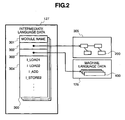
- the intermediate language data 127 contains intermediate language modules 300, each of which is composed of a module name 301 indicative of the module 300, a pointer 302 to management data 305 corresponding to the intermediate language module 300, a pointer 303 to the machine language data 125 obtained by translating the intermediate language module 300, and an intermediate language data area 304 for storing instruction sets of the intermediate language program in the intermediate language module 300.
- the intermediate language data 127 is composed of the plural intermediate language modules 300.
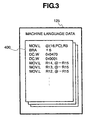
- Fig. 3 shows one example of the machine language data 125.
- machine language modules 400 are contained in the machine language data 125.
- Each machine language module 400 is composed of a data area in which plural machine language instructions are stored.
- the machine language data 125 is made up of such plural machine language modules 400.
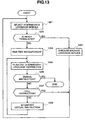
- Fig. 4 is a flowchart illustrating a processing procedure performed when the basic controller 121 starts up when a translation method according to one embodiment of the present invention is implemented.
- the intermediate language interpreter 123 and run-time translator 124 are activated after the basic controller 121 reads in the intermediate language file 161. At this time, the intermediate language interpreter 123 and run-time translator 124 may be executed concurrently or serially.
- Fig. 5 is a flowchart illustrating the processing procedure of the intermediate language file reader 122.
- the intermediate language file reader 122 reads in the intermediate language file 161 and creates the intermediate language data 127.
- Fig. 6 is a flowchart illustrating the processing procedure of the intermediate language interpreter 123.
- the flowchart illustrated in Fig. 6 depicts processing of the intermediate language interpreter 123 to repeat interpretation of the intermediate language data 127.
- Fig. 7 is a flowchart illustrating the processing procedure of the run-time translator 124.
- the flowchart illustrated in Fig. 7 corresponds to processing of translation for converting an intermediate language program into a machine language program.
- translation into a machine language program first from the called intermediate language module 300 is performed recursively.
- the result is stored in the machine language module 400 indicated by the pointer 303 to the machine language data 125.
- Embodiment 1 of the present invention has been described so far, the invention is not limited to the above embodiment. Rather, various modifications and changes thereto are possible within the range achievable from the foregoing description and within the range conducted from Embodiment 1 of the invention.
- the above embodiment contains software.
- the invention can be embodied by a combination of hardware and software or only hardware.
- the invention can be embodied by various programming languages.
- the power-saving translation controller 129 is combined with profiled run-time translation (referred to as the "well-known run-time translation" in the description of this Embodiment 2) that restrictively permits transition to run-time translation by run-time profiling. This is described below while comparing it with the well-known run-time translation (i.e., run-time translation performed unconsciously of power-saving effects).
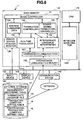
- a run-time information measurement program 15 a measurement recording table 17, a translation condition setting table 18, a translation controller 128, and a power-saving translation condition setting table 19 are added to the components of Fig. 1.
- the power-saving translation controller 129 provides finer control than the power-saving translation controller of Embodiment 1.
- the other common components function in the same way as in Fig. 1.
- the run-time information measurement program 15, measurement recording table 17, translation condition setting table 18, and translation controller 128 have functions similar to the components also used in the well-known profiled run-time translation as in Patent Reference 3.
- the power-saving translation condition setting table 19 and power-saving translation controller 129 are characteristic components of the present invention.
- the run-time information measurement program 15 is a program for measuring run-time information.
- the number of calls (execution frequency) to processing such as a method (described later) is taken as an index about run-time information.
- the rate at which intermediate language species appear (execution frequency) may be used as an index about run-time information. Furthermore, other index may also be used.
- the measurement recording table 17 is an area in which run-time information is recorded by the run-time information measurement program 15.
- the translation condition setting table 18 is an area in which conditions under which run-time translation is permitted are recorded.
- the translation controller 128 makes a decision as to whether the run-time translator 124 is activated or not, based on the contents of the measurement recording table 17 and translation condition setting table 18.
- the power-saving translation controller 129 makes a decision as to whether the run-time translator 124 is activated or not, based on the contents of the power-saving translation condition setting table 19, in addition to the contents of the measurement recording table 17 and translation condition setting table 18.
- Fig. 9 shows the configuration of the measurement recording table 17 in Embodiment 2 of the present invention.
- the recording table 17 has information about measurement point number 172 and symbol name 173.
- the symbol name 173 corresponds to the measurement point number 172.
- the number of calls is adopted as run-time information.
- the number of calls to method A is registered as measurement point number 1 and the number of calls to method B is registered as measurement point number 2.
- the run-time information measurement program 15 updates a pass number column 1710 regarding the number point number 1. For example, "1" is added whenever a call is made.
- the configuration of the translation condition setting table 18 in Embodiment 2 of the invention is shown in Fig. 10.
- This table is referenced by the basic controller 12 to make a decision as to whether a run-time translation is necessary.
- a threshold value (decision criterion) permitting run-time translation is put in the column of a set value 181.
- the lower limit 183 of the number at which a translation is started i.e., the lower limit of the number of calls to the measurement point at which a run-time translation is regarded to be necessary
- Fig. 11 shows the configuration of the power-saving translation condition setting table 19 in Embodiment 2 of the invention.
- a threshold value (decision criterion) permitting a run-time translation is put in the column of the lower limit of the number for translation 191 when there is a power-saving request.
- "10000" is set as the lower limit 1910 of the number of calls to the measuring point necessary to permit a run-time translation.
- the threshold value for run-time translation is higher than the lower limit of the number 1810 (in the illustrated example, the value is "100") in the translation condition setting table 18.
- the threshold value set for the case where there is a power-saving request is used, the run-time translation will be less dominant than before a power-saving request occurs. As a result, consumption of power caused by run-time translation can be suppressed. Hence, power saving can be achieved.
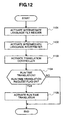
- Fig. 12 is a flowchart illustrating a processing procedure when the basic controller 121 is activated to perform the well-known run-time translation. Power-saving effects correspond to invisible processing procedure.
- the flowchart shown in Fig. 12 depicts processing in which the basic controller 121 activates the intermediate language interpreter 123 and run-time translator 124 after reading in the intermediate language file 161. At this time, the intermediate language interpreter 123 and run-time translator 124 may be executed concurrently or sequentially.
- the processing procedure of the run-time translator 124 is the same as the procedure of Fig. 7 shown in Embodiment 1.
- the procedure of the well-known run-time translation ends in this way.
- none of the power-saving translation condition setting table 19 and power-saving translation controller 129 participate.
- participation of the power-saving translation condition setting table 19 and power-saving translation controller 129 is distinctive compared with the well-known run-time translation.
- the power-saving translation controller 129 provides such a control that the likelihood of occurrence of run-time translation is made different than in the immediately executed environment. This is a feature of the present invention.
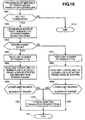
- Fig. 15 is a flowchart illustrating the processing procedure performed until a run-time translation is performed, in view of the power-saving effects which are characteristic of the present invention.
- the basic controller 121 activates the intermediate language interpreter 123 and run-time translator 124 after reading in the intermediate language file 161.
- the intermediate language interpreter 123 and run-time translator 124 may be executed concurrently or serially.
- the processing procedure of the run-time translator 124 is the same as the procedure of Fig. 8 shown in Embodiment 1.
- Embodiment 2 of the present invention has been described so far. Notice that the present invention is not limited to the above embodiment. It can be modified variously within the range attainable from the above description or within the range conducted from Embodiment 2 of the invention.
- the above embodiment contains software.
- the present invention can be embodied by a combination of hardware and software or only by hardware.
- the invention can be embodied by various programming languages.
- each set value in the translation condition setting table 18 may be updated without using the power-saving translation condition setting table 19. That is, if one wants to make the run-time translation less dominant than prior to power-saving request, by increasing the level of the threshold of the run-time translation, each set value 181 in the translation condition setting table 18 may be modified to a greater value.
- the operation is made to branch according to two values indicating whether power-saving mode has been specified or not. Continuous variations in the value of the remaining capacity of the battery may be gained, and the operation may be controlled finely in a corresponding manner to the variations in the numerical value. That is, the threshold value may be varied continuously.
- the measurement recording table 17 may be stored in the management data 305 corresponding to the intermediate language module 300 and executed.
- the ratio at which bytecodes supported by the bytecode accelerator for the intermediate language (bytecodes) appear may be quite low in some cases.
- the power-saving may be deleteriously affected though the run-time translation is suppressed.
- conditions that mitigate the conditions under which transition to run-time translation is made may be used in combination in addition to suppression of run-time translation.
- power-saving effect is commonly utilized in setting the conditions under which transition to a run-time translation is made. It may be practiced within the scope of the present invention.
- a structure not having the bytecode accelerator 1231 may also be adopted, because this structure may be achieved within the scope of the present invention in an information processor where the frequency of run-time translation creates a tradeoff between the power consumption and other item of performance such as the execution speed.
- various components stored in the external storage 160 such as a hard disk are shown to be transferred to the main memory 121 and referenced or executed.
- These various means may be stored in a storage medium such as an external storage medium (such as a CD-ROM or floppy disk) or a semiconductor memory (such as flash EEPROM), read from the storage medium, and used.
- Data transmitted from the outside by data communication may be stored in some form of storage medium.
- a decision may be made as to whether the processing of the interpreter is executed instead of the decision as to whether a run-time translation is executed as in the description of the seventh through twelfth aspects, and then an instruction for execution may be given.
- the allotment ratio between run-time translation and intermediate language interpretation can be modified according to circumstances. This makes it possible to suppress the power consumption of the information processor while maintaining a high level of execution speed.
- JIT compiler run-time translation
- the execution frequency of the method capable of easily suppressing power consumption is increased and conversely if emphasis is placed on high speed rather than power saving, the execution frequency of the run-time translation is increased. In this way, tradeoff between the power consumption and execution speed can be easily optimized.
- the allocation ratio between run-time translation and intermediate language interpretation is made variable. Power consumption can be suppressed while maintaining an appropriate execution speed.
Landscapes
- Engineering & Computer Science (AREA)
- Software Systems (AREA)
- Theoretical Computer Science (AREA)
- Physics & Mathematics (AREA)
- General Engineering & Computer Science (AREA)
- General Physics & Mathematics (AREA)
- Devices For Executing Special Programs (AREA)
- Power Sources (AREA)
Applications Claiming Priority (1)
| Application Number | Priority Date | Filing Date | Title |
|---|---|---|---|
| JP2004311095A JP4846226B2 (ja) | 2004-10-26 | 2004-10-26 | 情報処理装置、情報処理方法、およびプログラム |
Publications (2)
| Publication Number | Publication Date |
|---|---|
| EP1653355A2 true EP1653355A2 (fr) | 2006-05-03 |
| EP1653355A3 EP1653355A3 (fr) | 2008-03-12 |
Family
ID=35781331
Family Applications (1)
| Application Number | Title | Priority Date | Filing Date |
|---|---|---|---|
| EP05021658A Withdrawn EP1653355A3 (fr) | 2004-10-26 | 2005-10-04 | Processeur d'information, méthode de traitement d'information et programmes à cet effet |
Country Status (3)
| Country | Link |
|---|---|
| US (1) | US7739672B2 (fr) |
| EP (1) | EP1653355A3 (fr) |
| JP (1) | JP4846226B2 (fr) |
Cited By (1)
| Publication number | Priority date | Publication date | Assignee | Title |
|---|---|---|---|---|
| WO2012080771A1 (fr) | 2010-12-17 | 2012-06-21 | Renault Trucks | Camion doté d'un compartiment réfrigéré |
Families Citing this family (5)
| Publication number | Priority date | Publication date | Assignee | Title |
|---|---|---|---|---|
| CN101118487B (zh) * | 2006-08-02 | 2011-09-28 | 鸿富锦精密工业(深圳)有限公司 | 量测程序转换系统及方法 |
| KR100964582B1 (ko) | 2008-08-20 | 2010-06-21 | 주식회사 컴퍼니원헌드레드 | 스크립트 언어의 실행속도 향상 시스템 |
| JP2010191734A (ja) * | 2009-02-19 | 2010-09-02 | Hitachi Software Eng Co Ltd | 画像再生装置及び中間語プログラム実行方法 |
| JP5505522B2 (ja) * | 2011-02-01 | 2014-05-28 | 富士通株式会社 | プログラム実行方法 |
| US10108442B1 (en) * | 2017-09-18 | 2018-10-23 | International Business Machines Corporation | Optimization and affinity for hypervisor-based just-in-time translator |
Citations (2)
| Publication number | Priority date | Publication date | Assignee | Title |
|---|---|---|---|---|
| EP1037145A2 (fr) | 1999-03-09 | 2000-09-20 | Hewlett-Packard Company | Compilateur juste-à-temps hybride utilisant des ressources minimales |
| WO2004006078A1 (fr) | 2002-07-09 | 2004-01-15 | University Of Massachusetts | Reduction de consommation d'energie d'un processeur par la commande de ressources de ce processeur |
Family Cites Families (23)
| Publication number | Priority date | Publication date | Assignee | Title |
|---|---|---|---|---|
| JP2803320B2 (ja) * | 1990-04-27 | 1998-09-24 | 日本曹達株式会社 | 誘電体磁器組成物 |
| US5392437A (en) * | 1992-11-06 | 1995-02-21 | Intel Corporation | Method and apparatus for independently stopping and restarting functional units |
| JP3520611B2 (ja) * | 1995-07-06 | 2004-04-19 | 株式会社日立製作所 | プロセッサの制御方法 |
| JP3538292B2 (ja) * | 1997-02-28 | 2004-06-14 | 株式会社日立製作所 | 実行時プログラム翻訳方法 |
| JPH10254712A (ja) | 1998-04-23 | 1998-09-25 | Hitachi Ltd | 多機種対応型情報処理システム、および、方法 |
| DE69924857T2 (de) * | 1998-10-10 | 2006-03-02 | Transitive Ltd., Hanging Ditch | Programm-kode-umwandlung |
| US6324687B1 (en) * | 1998-12-03 | 2001-11-27 | International Business Machines Corporation | Method and apparatus to selectively control processing of a method in a java virtual machine |
| JP2000267768A (ja) * | 1999-03-16 | 2000-09-29 | Toshiba Tec Corp | 携帯用端末装置 |
| JP3705022B2 (ja) * | 1999-07-09 | 2005-10-12 | 株式会社日立製作所 | 低消費電力マイクロプロセッサおよびマイクロプロセッサシステム |
| JP2001056764A (ja) * | 1999-08-18 | 2001-02-27 | Access:Kk | 仮想計算機の実行方法および装置 |
| JP4654485B2 (ja) * | 2000-04-28 | 2011-03-23 | ソニー株式会社 | 情報処理システム、情報処理装置、情報処理方法 |
| JP2002189539A (ja) * | 2000-10-02 | 2002-07-05 | Fujitsu Ltd | ソフトウェア処理装置、プログラム及び記録媒体 |
| JP2002169696A (ja) * | 2000-12-04 | 2002-06-14 | Mitsubishi Electric Corp | データ処理装置 |
| JP2002315203A (ja) * | 2001-04-12 | 2002-10-25 | Hitachi Maxell Ltd | 携帯式小型電気機器 |
| JP2003131765A (ja) * | 2001-10-26 | 2003-05-09 | Matsushita Electric Ind Co Ltd | 携帯型端末装置と、そのデータバックアップ方法および電源制御方法 |
| JP3808755B2 (ja) * | 2001-11-07 | 2006-08-16 | 富士通株式会社 | Jitコンパイラを備えた仮想計算機 |
| US6996814B2 (en) * | 2001-11-14 | 2006-02-07 | Sun Microsystems, Inc. | Method and apparatus for dynamically compiling byte codes into native code |
| JP4035004B2 (ja) | 2002-06-26 | 2008-01-16 | 株式会社ルネサステクノロジ | 情報処理装置 |
| US7080267B2 (en) * | 2002-08-01 | 2006-07-18 | Texas Instruments Incorporated | Methodology for managing power consumption in an application |
| JP2004157590A (ja) * | 2002-11-01 | 2004-06-03 | Ricoh Co Ltd | 携帯型電子機器 |
| US7337334B2 (en) * | 2003-02-14 | 2008-02-26 | International Business Machines Corporation | Network processor power management |
| US7437704B2 (en) * | 2003-08-28 | 2008-10-14 | Ines Antje Dahne-Steuber | Real-time generation of software translation |
| US7458070B2 (en) * | 2004-03-05 | 2008-11-25 | International Business Machines Corporation | Reducing the run-time cost of invoking a server page |
-
2004
- 2004-10-26 JP JP2004311095A patent/JP4846226B2/ja not_active Expired - Fee Related
-
2005
- 2005-10-04 EP EP05021658A patent/EP1653355A3/fr not_active Withdrawn
- 2005-10-06 US US11/244,077 patent/US7739672B2/en not_active Expired - Fee Related
Patent Citations (2)
| Publication number | Priority date | Publication date | Assignee | Title |
|---|---|---|---|---|
| EP1037145A2 (fr) | 1999-03-09 | 2000-09-20 | Hewlett-Packard Company | Compilateur juste-à-temps hybride utilisant des ressources minimales |
| WO2004006078A1 (fr) | 2002-07-09 | 2004-01-15 | University Of Massachusetts | Reduction de consommation d'energie d'un processeur par la commande de ressources de ce processeur |
Cited By (2)
| Publication number | Priority date | Publication date | Assignee | Title |
|---|---|---|---|---|
| WO2012080771A1 (fr) | 2010-12-17 | 2012-06-21 | Renault Trucks | Camion doté d'un compartiment réfrigéré |
| US9482460B2 (en) | 2010-12-17 | 2016-11-01 | Volvo Truck Corporation | Truck having intermediate heat exchanging circuit between cabin and cargo container |
Also Published As
| Publication number | Publication date |
|---|---|
| JP4846226B2 (ja) | 2011-12-28 |
| US7739672B2 (en) | 2010-06-15 |
| EP1653355A3 (fr) | 2008-03-12 |
| JP2006126947A (ja) | 2006-05-18 |
| US20060101426A1 (en) | 2006-05-11 |
Similar Documents
| Publication | Publication Date | Title |
|---|---|---|
| US6332216B1 (en) | Hybrid just-in-time compiler that consumes minimal resource | |
| US8732678B2 (en) | Methods and apparatus for dynamic best fit compilation of mixed mode instructions | |
| US6219832B1 (en) | System and method of using annotations to optimize dynamically translated code in the presence of signals | |
| Krall | Efficient JavaVM just-in-time compilation | |
| US6907519B2 (en) | Systems and methods for integrating emulated and native code | |
| US7543285B2 (en) | Method and system of adaptive dynamic compiler resolution | |
| US7725883B1 (en) | Program interpreter | |
| US6820252B2 (en) | Selective conversion to native code using hardware translator, software translator, and software interpreter | |
| US7383417B2 (en) | Prefetching apparatus, prefetching method and prefetching program product | |
| KR100643268B1 (ko) | 자바 가상 머신의 성능을 향상시키는 방법 및 상기 방법에의해 동작되는 시스템 | |
| US20030005271A1 (en) | System and method using a hardware embedded run-time optimizer | |
| JP2000040007A (ja) | バイトコ―ド・コンパイラのためのコ―ド生成 | |
| EP1208425A2 (fr) | Systeme informatique, support de stockage lisible par ordinateur, procede de fonctionnement et procede de mise en service dudit systeme | |
| JP2002527811A (ja) | オンスタックリプレースメントを伴うことなくバーチャルコールを直接にインライン化する方法 | |
| US7406684B2 (en) | Compiler, dynamic compiler, and replay compiler | |
| US6931638B2 (en) | Method and apparatus to facilitate sharing optimized instruction code in a multitasking virtual machine | |
| JP3992102B2 (ja) | コンパイラ装置、コンパイル方法、コンパイラプログラム、及び記録媒体 | |
| Inoue et al. | A trace-based Java JIT compiler retrofitted from a method-based compiler | |
| US7739672B2 (en) | Information processor, information processing method, and programs therefor | |
| US8056061B2 (en) | Data processing device and method using predesignated register | |
| Gregg et al. | The case for virtual register machines | |
| Kieburtz | A RISC architecture for symbolic computation | |
| US5319784A (en) | System for automatic and selective compile-time installation of fastpath into program for calculation of function/procedure without executing the function/procedure | |
| US8091077B1 (en) | System and method for handling rare events by modification of executable code | |
| Donzellini et al. | Object oriented ARM7 coprocessor |
Legal Events
| Date | Code | Title | Description |
|---|---|---|---|
| PUAI | Public reference made under article 153(3) epc to a published international application that has entered the european phase |
Free format text: ORIGINAL CODE: 0009012 |
|
| AK | Designated contracting states |
Kind code of ref document: A2 Designated state(s): AT BE BG CH CY CZ DE DK EE ES FI FR GB GR HU IE IS IT LI LT LU LV MC NL PL PT RO SE SI SK TR |
|
| AX | Request for extension of the european patent |
Extension state: AL BA HR MK YU |
|
| 17P | Request for examination filed |
Effective date: 20060331 |
|
| RAP1 | Party data changed (applicant data changed or rights of an application transferred) |
Owner name: HITACHI SOFTWARE ENGINEERING CO., LTD. |
|
| PUAL | Search report despatched |
Free format text: ORIGINAL CODE: 0009013 |
|
| AK | Designated contracting states |
Kind code of ref document: A3 Designated state(s): AT BE BG CH CY CZ DE DK EE ES FI FR GB GR HU IE IS IT LI LT LU LV MC NL PL PT RO SE SI SK TR |
|
| AX | Request for extension of the european patent |
Extension state: AL BA HR MK YU |
|
| AKX | Designation fees paid |
Designated state(s): DE FR GB |
|
| 17Q | First examination report despatched |
Effective date: 20081113 |
|
| STAA | Information on the status of an ep patent application or granted ep patent |
Free format text: STATUS: THE APPLICATION HAS BEEN WITHDRAWN |
|
| 18W | Application withdrawn |
Effective date: 20170807 |